THE ROLE OF NUTRITIONAL VIRULENCE IN FRANCISELLA TULARENSIS PATHOGENESIS
Shaun Steele
A dissertation submitted to the faculty at the University of North Carolina at Chapel Hill in partial fulfillment of the requirements for the degree of Doctor of Philosophy in the department
of Microbiology and Immunology in the School of Medicine.
Chapel Hill 2015
Approved by: Tom Kawula
Nathaniel Moorman William Goldman Ed Miao
ii © 2015 Shaun Steele
iii ABSTRACT
Shaun Steele: The Role of Nutritional Virulence in Francisella tularensis Pathogenesis (Under the direction of Thomas Kawula)
Intracellular pathogens and infected host cells compete with each other for survival and limited resources, such as nutrients. To limit infections, host cells have evolved a multitude of overlapping innate defense mechanisms; but, intracellular pathogens evade or exploit these defenses to replicate within cells. The bacterial pathogen Francisella tularensis manipulates several host defense mechanisms to proliferate within cells. F. tularensis replicates to extremely high densities within host cells and transfers to uninfected cells without inducing significant host cell death. The efficiency of F. tularensis intracellular replication and spread raises two
fundamental questions that form the core of my dissertation work: how does F. tularensis acquire enough nutrients from the host cell to sustain rapid proliferation and how does F.
iv
v
ACKNOWLEDGEMENTS
My research has only been possible through the contributions of dozens of people who have mentored, assisted, and guided me. Tom and Jeff have been the greatest contributors to my research career. In addition to all of their scientific mentorship, I would not have been successful without the confidence and independence they instilled in me.
Jason, Sharon and Cheryl have helped me develop and filter my research for years. In addition to working with me on experiments, they have been instrumental in helping me develop and shape my research. Our impromptu lab meetings that led to many of my experiments were inspired by or came directly from them.
vi
TABLE OF CONTENTS
LIST OF TABLES ... 11
LIST OF FIGURES ... 12
LIST OF ABBREVIATIONS ... 15
CHAPTER 1: INTRODUCTION ... 1
F. tularensis Cytosolic Replication ... 2
Nutrient Deprivation in the Host Cell Cytosol ... 3
F. tularensis Immune suppression ... 8
F. tularensis Exocytosis ... 12
F. tularensis Suppression of Cell Death ... 13
F. tularensis Cell to Cell Transfer ... 13
Other Research Related to My Dissertation ... 16
CHAPTER 2: A METHOD FOR FUNCTIONAL TRANS-COMPLEMENTATION OF INTRACELLULAR FRANCISELLA TULARENSIS ... 18
Overview ... 18
Introduction ... 19
Results ... 21
Two bacterial strains consistently bind to the same bead ... 21
vii
Bead co-infections functionally complement cytokine suppression ... 23
Phagosomal escape is functionally complemented during bead co-infections ... 24
Bead co-infections complement intracellular survival ... 26
Discussion ... 28
Materials and Methods ... 31
Figures ... 38
CHAPTER 3: FRANCISELLA TULARENSIS HARVESTS NUTRIENTS DERIVED VIA ATG5-INDEPENDENT AUTOPHAGY TO SUPPORT INTRACELLULAR GROWTH ... 45
Overview ... 45
Introduction ... 46
Results ... 49
Host cell constituents are sufficient to support F. tularensis intracellular proliferation. ... 49
Autophagy supplies energy and anabolic substrates that support F. tularensis growth in Fibroblasts. ... 50
Autophagy supports F. tularensis replication in primary human monocyte derived macrophages. ... 52
F. tularensis infection increases autophagic flux. ... 53
Autophagy derived amino acids are transferred from host proteins to F. tularensis ... 54
F. tularensis uses autophagy by- products primarily for energy. ... 55
ATG5 is not required for autophagy in Francisella infected cells. ... 56
viii
F. tularensis is adjacent to autophagic vacuoles. ... 61
Discussion ... 62
Materials and Methods ... 65
Figures ... 76
CHAPTER 4: TROGOCYTOSIS-ASSOCIATED TRANSFER OF INTRACELLULAR PATHOGENS ... 93
Overview ... 93
Introduction ... 94
Results and Discussion ... 95
Francisella tularensis transfers between macrophages during cytosolic exchange. ... 95
Bacterial transfer requires cell to cell contact. ... 96
Viable bacteria transfer between cells to propagate infection. ... 96
Bacterial transfer is cell type specific. ... 97
F. tularensis does not transfer via previously described bacterial transfer mechanisms. ... 98
Bacterial transfer correlates with trogocytosis. ... 99
Infected cells undergo increased levels of trogocytosis in a mouse infection model. ... 100
Trogocytosis-associated bacterial transfer is a general phenomenon. ... 101
Concluding remarks ... 102
Materials and Methods ... 103
ix
CHAPTER 5: DISCUSSION, FUTURE DIRECTION AND CONCLUSIONS ... 126
The characterization of a novel interaction between bacterial pathogens and autophagy. ... 126
Macrophages acquire live bacteria from neighboring infected cells... 130
Conclusions ... 135
APPENDIX 1: FEEDING UNINVITED GUESTS: MTOR AND AMPK SET THE TABLE FOR INTRACELLULAR PATHOGENS ... 137
Introduction ... 137
AMPK and mTOR Regulate Energy Homeostasis ... 138
Manipulation of Both AMPK and mTOR by Intracellular Pathogens ... 139
Inhibiting AMPK or Inducing mTOR Can Provide Essential Substrates for Pathogen Replication ... 140
AMPK Activation May Benefit Replication of Diverse Pathogens ... 141
Autophagy Provides Intracellular Pathogens with Nutrients ... 142
Conclusion ... 143
Figures ... 145
APPENDIX 2: THE ROLE OF AUTOPHAGY IN INTRACELLULAR PATHOGEN NUTRIENT ACQUISITION ... 146
Overview ... 146
Introduction ... 146
What is Autophagy? ... 148
Pathogens Induce Xenophagy ... 150
x
Pathogens harvest autophagy derived nutrients for replication ... 153
Conclusions and Perspectives ... 155
APPENDIX 3: IDENTIFICATION OF EARLY INTERACTIONS BETWEEN FRANCISELLA AND THE HOST ... 164
Overview ... 164
Introduction ... 164
Materials and Methods ... 167
Results ... 170
LVS infects myeloid cells after intranasal inoculation. ... 170
Alveolar macrophages are the dominant infected cell type after intranasal inoculation in all Francisella strains. ... 171
Interstitial macrophages and neutrophils are the dominant infected cell types in the lungs after intradermal inoculation. ... 172
Discussion ... 173
Figures ... 179
xi
LIST OF TABLES
Table 3.1: Quantitative RT-PCR primer sequences. ... 92 Table B. 1: A summary of the mechanisms employed by select pathogens to induce autophagy, evade destruction through xenophagy, and pro-microbial benefits of
autophagy induction. ... 163 Table C. 1: Identification of lung cell types. ... 186 Table C. 2: Mean percentage of infected cells in the lung 4 hours post intranasal
inoculation... 187 Table C. 3: Mean percentage of infected cells in the lung 48 hours post intradermal
xii
LIST OF FIGURES
Figure 2.1: Multiple F. tularensis bacteria reliably bind to the same bead. ... 38
Figure 2.2: F. tularensis separates from the beads inside host cells. ... 39
Figure 2.3: Functional trans-complementation via bead-bound bacteria complements suppression of cytokine secretion. ... 40
Figure 2.4: Functional trans-complementation via bead-bound bacteria complements phagosomal escape... 41
Figure 2.5: Functional trans-complementation via bead-bound bacteria complements intracellular proliferation of ΔpdpC but not ΔripA. ... 42
Figure 2.6: Genetic complementation of ΔpdpC intracellular proliferation. ... 44
Figure 3.1: Autophagy derived nutrients enhance F. tularensis intracellular growth. ... 76
Figure 3.2: F. tularensis harvests amino acids via host cell autophagy. ... 77
Figure 3.3: F. tularensis uses autophagy derived nutrients for energy and anabolic substrates. ... 78
Figure 3.4: S6-P is reduced in F. tularensis infected cells. ... 80
Figure 3.5: ATG5 is not required for efficient F. tularensis intracellular replication. ... 81
Figure 3.6: F. tularensis induces ATG5-independent autophagy in late logarithmic growth. ... 82
Figure 3.7: F. tularensis does not induce canonical autophagy during late logarithmic phase of intracellular growth. ... 83
Figure 3.8: p62/SQSTM1 and polyubiquitin are not required for F. tularensis induced ATG5-independent autophagy ... 84
Figure 3.9: F. tularensis replicates to high densities in the host cell cytoplasm. ... 86
Figure 3.10: Autophagy derived nutrients enhance F. tularensis intracellular growth. ... 87
xiii
Figure 3.12: Beclin-1 shRNA depletes Beclin-1 mRNA in MEFS. ... 89
Figure 3.13: F. tularensis infection decreases polyubiquitin puncta but increases the number of p62+ acidic vacuoles. ... 90
Figure 3.14: F. tularensis localizes adjacent to autolysosomes. ... 91
Figure 4.1: F. tularensis transfers between macrophages during cytosolic transfer. ... 114
Figure 4.2 Live bacteria transfer to macrophages during bacterial transfer. ... 115
Figure 4.3: Bacterial transfer is cell type specific. ... 116
Figure 4.4: Plasma membrane protein transfer correlates with bacterial transfer. ... 117
Figure 4.5: Bacterial transfer is a general phenomenon. ... 118
Figure 4.6: Experimental design and bacterial motility for transwell assay. ... 119
Figure 4.7: The extracellular space is not a major source of infectious bacteria. ... 120
Figure 4.8: F. tularensis does not transfer via actin based motility or autophagy. ... 122
Figure 4.9: Plasma membrane protein exchange increases during infection. ... 123
Figure 4.10: Plasma membrane protein transfer does not require de novo protein synthesis. ... 124
Figure 4.11: Trogocytosis in various cell types in mouse splenocytes. ... 125
Figure A1.1: Infection by Diverse Pathogens Impacts AMPK and mTOR Signaling. ... 145
Figure C.1: Lung gating scheme. ... 179
Figure C.2: LVS infects myeloid-derived cells following intranasal inoculation. ... 181
Figure C.3: Alveolar macrophages are the primary infected cell type in the lung after intranasal inoculation with Francisella. ... 182
xiv
xv
LIST OF ABBREVIATIONS
AIM2 Absent in Melanoma 2
AMP Adenosine monophosphate
AMPK AMP-activated protein kinase APC Antigen presenting cell ATP Adenosine triphosphate
EBV Epstein Barr Virus
FACS Fluorescence activated cell sorting FCV Francisella containing vacuole FDA Food and Drug Administration FPI Francisella pathogenicity island
GAS Group A Streptococcus
GFP Green Fluorescent protein
ggt gamma-glutamyl transpeptidase
GSH Glutathione
HBV Hepatitis B virus
HCMV Human cytomegalovirus
HCV Hepatitis C virus
hMDM Human monocyte derived macrophage
HIV Human immunodeficiency virus
HSV Herpes Simplex Virus
IFNγ Interferon gamma
xvi
IL-18 Interleukin-18
IL-1B Interleukin-1β
IL-6 Interleukin-6
IRES Internal ribosome entry site J774 J774A.1 macrophage-like cell KSHV Kaposis sarcoma herpesvirus
LC3 Microtubule associated light chain 3
LPS Lipopolysaccharide
Lux Luciferase
LVS Live vaccine strain
mBMDM Mouse bone marrow derived macrophages MEF Mouse embryonic fibroblasts
MHC-I Major histocompatibility complex- I MHC-II Major histocompatibility complex- II MOI Multiplicity of infection
mRNA Messenger ribonucleic acid mTOR Mammalian target of rapamycin
NLR Nucleotide-binding domain, leucine-rich repeat containing proteins PI3K Phosphoinositide-3-kinase
PolyI:C Polyinosinic: polycytidylic acid RVFV Rift Valley Fever virus
SD Standard deviation
xvii
SV40 Simian virus 40
T6SS Type VI secretion system TCA Trichloroacetic acid
TEM Transmission electron microscopy TGF-B Transforming growth factor B
Th T helper
TLR Toll like receptor
U112 Utah 112
1
CHAPTER 1: INTRODUCTION
Intracellular pathogens and infected host cells compete with each other for survival and limited resources, such as nutrients. To limit infections, host cells have evolved a multitude of overlapping innate defense mechanisms; but, intracellular pathogens evade these defenses to replicate within cells. In many instances, microbes even co-opt host innate immune defenses to enhance microbial survival or replication. For example, host immune cells ingest microbes via phagocytosis. Phagocytosis destroys the vast majority of ingested microbes; however,
intracellular bacterial pathogens must overcome phagocytosis to proliferate within cells. The strategies to nullify phagocytosis vary between different bacterial pathogens but generally they either escape from the phagosome to enter the cell cytosol or co-opt the phagosome to form a replicative niche. By modifying the phagosome, certain bacterial pathogens incorporate an anti-microbial host defense into a crucial step in their intracellular replication and virulence within the host. Manipulating host defenses to benefit the pathogen is a recurrent theme in pathogenesis. As a result, intracellular bacteria are frequently used as a tool to characterize many different host immune and cell biology pathways. My dissertation work focused on identifying and
characterizing host anti-microbial pathways that bacterial pathogens exploit to enhance intracellular survival or replication.
2
decay to become an obligate intracellular pathogen 1. F. tularensis replicates within virtually every cell type tested, but macrophages are the major replicative niche 2. F. tularensis is an excellent model organism for characterizing host-pathogen interactions because it is a ‘stealth pathogen’ that replicates to high densities in the cytosol without eliciting a substantial host response. Cells infected with dozens or hundreds of F. tularensis bacteria will even undergo cell division at the same rate as uninfected cells (unpublished data). Despite inhibiting cell death, F. tularensis rapidly disseminates to new cells at the site of infection and systemically 2-4.
Moreover, F. tularensis replicates quickly within cells, often 100 to 1000-fold within 24 hours 5. In comparison, most intracellular pathogens, such as Listeria monocytogenes and Salmonella typhimurium, replicate approximately 10-fold within cells 6,7. The efficiency of F. tularensis intracellular replication and spread raises two fundamental questions that formed the core of my dissertation work: how does F. tularensis acquire enough nutrients from the host cell to sustain rapid proliferation and how does F. tularensis infect new cells despite inhibiting cell death?
F. tularensis Cytosolic Replication
F. tularensis replicates extremely rapidly and to high densities inside the host cell cytosol. F. tularensis even has a faster doubling time in macrophages than in Chamberlains defined media (unpublished data). This is unusual because only a few bacterial pathogens replicate within the host cell cytosol due to the scarcity of readily available nutrients and a multitude of host defense mechanisms designed to destroy intracellular bacteria. But F.
3
autophagy for nutrients while evading the anti-microbial form of autophagy, a process termed xenophagy.
Nutrient Deprivation in the Host Cell Cytosol
During infection, the host cell and intracellular pathogen compete for the same nutrients. When the bacteria invade the cell, most cellular nutrients are sequestered within macromolecular structures. Cells have some free amino acids to build new proteins, but the majority of amino acids within the cell are already incorporated into proteins. To secure a large amount of amino acids for replication, intracellular bacteria must either increase host cell amino acid import or degrade host proteins to acquire amino acids.
The nutrients that F. tularensis requires for replication are known. F. tularensis requires several salts and metals such as iron as well as pantothenate, spermine, thiamine, 13 amino acids that F. tularensis cannot synthesize, and a carbon source such as glucose or excess amino acids 8. During infections, F. tularensis must acquire each of these nutrients from the host cell. Several groups have assessed how F. tularensis acquires iron and select amino acids from the host, and we focused our effort on determining the major source of carbon that F. tularensis uses for replication.
Iron
4
F. tularensis synthesizes siderophores to acquire exogenous iron 9. Iron siderophores are required for virulence in the less pathogenic F. novicida and the live vaccine strain of F.
tularensis, but not in the highly virulent Schu S4 strain 10. Instead, FupA is required for iron uptake in Schu S4. The mechanism of FupA iron acquisition is unknown, but does not involve siderophores 10. An interesting quirk of F. tularensis iron acquisition is that unlike many other Gram-negative bacteria, F. tularensis does not transport iron via TonB 11.F. tularensis still transports the iron bound molecules through its membranes via proton motive force, but via a different mechanism than other bacteria.
Amino acid uptake
Another characterized nutrient acquisition mechanism in F. tularensis is amino acid uptake. F. tularensis cannot synthesize 13 amino acids and must acquire these from the host cell. Additionally, we found that amino acids are a major carbon source for F. tularensis 5. F.
tularensis uses a number of synergistic mechanisms to acquire these amino acids. F. tularensis degrades glutathione, increases host amino acid transport, and harvests autophagy by-products 5,12,13
.
Glutathione degradation
5
F. tularensis can synthesize glycine and glutamic acid, but is auxotrophic for cysteine 8. F. tularensis degrades GSH for its constituent amino acids via a gamma-glutamyl transpeptidase (ggt). Deletion mutants of ggt are highly attenuated for replication in cells, but can be
functionally complemented with exogenous cysteine 13. Although F. tularensis may also import glycine or glutamic acids, cysteine is the only required nutrient that F. tularensis obtains from GSH.
Amino Acid transporters
The eukaryotic amino acid transporter SLC1A5 (also called ASCT2) imports neutral amino acids. F. tularensis infection increases both SLC1A5 mRNA and protein levels in infected cells 12. SCL1A5 works with SLC7A5 (LAT1), another amino acid transporter, to balance the cytoplasmic pool of amino acids 16. While SLC1A5 levels are increased during infection, SLC7A5 has decreased mRNA expression and protein levels during F. tularensis infection 12. Altering the ratio of SCL1A5 and SLC7A5 may functionally increase the intracellular level of glutamine during F. tularensis infections 12.
Autophagy
Macroautophagy (hereafter autophagy) is a constitutive process that degrades long lived-proteins, organelles, and aggregates into their base constituents. Autophagy is a critical,
constitutive process for nutrient generation and maintenance of cellular homeostasis. In mouse embryonic fibroblasts (MEFs), a common cell line used for autophagy research, approximately 1-2% of the cytosolic volume of the cell is engulfed by autophagosomes at any given time 17. A wide range of stimuli increase autophagy. Two major signaling pathways for autophagy
6
and inhibition of the mammalian target of rapamycin (mTOR). AMPK is activated in response to a low ATP to AMP ratio, such as during glucose deprivation 18,19. AMPK induces autophagy directly by phosphorylating ULK1 or indirectly through mTOR inhibition 20. mTOR is inhibited by several other stress factors besides AMPK, such as amino acid starvation or hypoxia 21.
The initiation of autophagy results in a complex signaling cascade with several intricacies and permutations. In canonical autophagy, AMPK activation or mTOR inhibition result in ULK1 activation 20. ULK1 phosphorylates Beclin-1 and activates the kinase VPS34. ULK1, Beclin-1, and VPS34 as well as their associated complexes localize to an open, double membrane structure termed the phagophore. The phagophore is elongated by the ATG5-ATG12-ATG16L complex 22
. The phagophore expands to engulf cytoplasmic material while forming a double membrane vacuole termed the autophagosome. Molecules targeted for autophagic degradation are anchored to the autophagosome by microtubule associated light chain 3 (LC3). Unprocessed LC3 is cytosolic (LC3-I), but LC3 is cleaved, lipidated with phosphatidylethanolamine (LC3-II), and embedded into the autophagic membrane upon the initiation of autophagy 23. Molecules targeted for autophagic degradation are polyubiquitinated and adaptor proteins including p62,
OPTINEURIN, or NDP52 bind to both LC3-II and ubiquitinated molecules 24-26. The
7
Canonical autophagy is the best characterized type of autophagy, but there are several versions of non-canonical autophagy. These non-canonical forms also generate double membrane, degradative vacuoles with the same basic maturation process (phagophore to
autophagosome to autolysosome). However, non-canonical autophagosomes are formed through different signaling cascades and do not use all of the proteins or protein complexes required for canonical autophagy. One recurrent form of non-canonical autophagy in pathogenesis is ATG5-independent autophagy. ATG5-ATG5-independent autophagy uses some of the same machinery as canonical autophagy, such as ULK1 and Beclin-1, but does not require ATG5, ATG7, or LC3 17. LC3 cleavage and ATG5 knockouts are the best characterized autophagy tools that are
commonly used to assay for xenophagy, a version of autophagy that targets intracellular
microbes for degradation. Pathogens may preferentially induce ATG5-independent autophagy to avoid xenophagy.
ATG5-independent autophagy is induced by starvation and correlates with mTOR inhibition, but mTOR inhibition alone is not sufficient to induce this form of autophagy 5,17. ATG5-independent autophagy is critical for Brucella abortus to infect neighboring cells 28. Mycobacterium marinum enters autophagosome-like vacuoles in an ATG5-independent manner although the function of this vacuole is unknown 29. The differences between ATG5-independent autophagy and other forms of autophagy in pathogenesis are not known. It is also unclear how ATG5-independent autophagy is preferentially induced during these infections.
8 F. tularensis Immune suppression
F. tularensis is often referred to as a ‘stealth pathogen’ because infection by this organism does not stimulate a robust immune response. F. tularensis evades identification and cytokine production in response to infection while resisting innate host cell anti-microbial defenses. It is important to note that the closely related F. novicida strain (often referred to as F. tularensis novicida in older literature) is highly pro-inflammatory, synthesizes a different LPS structure, and has different immune evasion characteristics and interactions with the
inflammasome 30-32.
Immune suppression during infection is an important aspect of F. tularensis
pathogenesis. In addition to transcriptional changes within the cell to destroy microbes, the activation of Toll-like receptors (TLRs), the inflammasome, and other changes to cellular homeostasis induce xenophagy 33-35. For F. tularensis to successfully harvest autophagy derived nutrients, F. tularensis must evade xenophagy.
Toll-like receptors
TLRs identify extracellular microbes or microbes within endosomes. 13 different TLRs have been identified in mice and humans, although certain TLRs are species specific. TLRs recognize conserved microbial features such as lipopolysaccharide (LPS), peptidoglycan, and flagella 36.
9
through Myd88. Myd88 is an adapter molecule that interacts with all of the TLRs except TLR3 to initiate downstream signaling. TLR signaling through Myd88 eventually leads to stimulation of several pro-inflammatory transcription factors including NF-kB, IRF3, and IRF7 36. These transcription factors lead to transcription of a range of chemokines, cytokines, and the up-regulation of a number of anti-microbial factors 36.
TLRs are stimulated in response to most pathogens, but F. tularensis evades and suppresses TLR stimulation 38. TLRs are pattern recognition receptors, but the typical bacterial agonists that stimulate the various TLRs are structurally different in F. tularensis. For example, Gram-negative bacteria typically stimulate TLR4 with lipopolysaccharide (LPS), but F.
tularensis LPS is structurally different than LPS from other bacteria and does not stimulate TLR4 39. Instead, F. tularensis LPS primarily stimulates TLR2, although induction is relatively weak 40. In addition to poor stimulation of TLRs, F. tularensis dampens artificial TLR
stimulation by secreting an uncharacterized lipid 41,42.
Inflammasome
The inflammasome is a multimeric complex involved in detecting conserved microbial factors within the cytosol. The specific inflammasome complex formed depends on the microbial stimuli that are detected. In a simplified model, the inflammasome is composed of an
10 44
. The mature cytokines are then secreted. Robust IL-1B secretion also requires TLR stimulation to increase IL-1B transcription 45.
F. tularensis infection results in negligible caspase-1 processing and IL-1B secretion, suggesting that F. tularensis does not induce caspase-1 inflammasome activation 46. Likewise, F. tularensis does not stimulate caspase-11 due to its non-canonical LPS structure 47. Instead, F. tularensis suppresses inflammasome activation, even in the presence of strong artificial inflammasome stimulation 48. The closely related F. novicida has a very different interaction with the inflammasome. F. novicida activates the inflammasome when bacterial DNA binds to absent in melanoma 2 (AIM2) 49.
Xenophagy
Xenophagy is a form of selective autophagy that sequesters and degrades intracellular pathogens. Briefly, bacteria are polyubiquitinated and the polyubiquitin binds to an adaptor molecule. The adaptor molecule can be p62/sequestosome 1, NBR1, or opineurin. The adaptor molecule recruits LC3 to isolate the bacteria within a phagosome. The targeted bacteria are then degraded and antigens from the bacteria are presented via the major histocompatibility complex II (MHC-II) 50.
11
Not surprisingly, GAS strains that encode speB are much more likely to cause disease than strains that lack speB 53.
Xenophagy has many overlapping and redundant surveillance mechanisms that pathogens must avoid. Xenophagy is induced in response to extracellular or phagocytosed microbes
through the activation of TLRs. TLRs initiate xenophagy when Myd88 or TRIF interact with Beclin-1 33,34. Cell to cell signaling can also induce autophagy. IFN-γ activates xenophagy through IRGM1 in human cells while CD40 ligation stimulates xenophagy through
phosphoinositide-3-kinase (PI3K) and Rab7; priming cells to resist microbes 54,55.
After phagocytosis, certain pathogens escape the phagosome and replicate within the cytosol. The host cell mounts a xenophagic response to the membrane damage that occurs during phagosomal escape 56. Once microbes reach the cytosol, they can be targeted for xenophagy through immune surveillance or by causing cell stress. Several molecules identify microbial components within the cytosol and target microbes for xenophagy, such as Nod-1 and Nod-2. Nod-1 and Nod-2 induce xenophagy and microbial antigen processing in response to bacterial peptidoglycan 57,58. Microbes can also induce xenophagy through a number of cell stress mechanisms, such as the unfolded protein response (UPR) or changes in intracellular calcium levels 59-61. Lastly, xenophagy can also be directly induced by bacterial proteins. For example, Shigella flexneri exports VirG to polymerize actin and propel the bacteria through the cytosol 62. ATG5 binds directly to VirG and initiates autophagosome formation without upstream
autophagy signaling 63. S. flexneri secretes the effector protein IcsB to block ATG5 from binding to VirG, which inhibits autophagy 63.
12
phagosome which initiates xenophagy 56. Likewise, F. tularensis infection results in mTOR inhibition immediately after late during infection 5. Additionally, F. tularensis uses amino acids as a carbon source, which should induce autophagy when ammonium by-products of amino acid catabolism are secreted into the cytosol 5,64. Despite the appropriate signals to induce xenophagy, F. tularensis does not induce xenophagy or co-localize with xenophagy markers 5,65. F.
tularensis LPS and O-antigen contribute to resistance to xenophagy, but there is also an active, unidentified factor that contributes to xenophagy evasion 65,66. Together, these results suggest that F. tularensis both suppresses and resists xenophagy.
F. tularensis Exocytosis
The final step in the intracellular life cycle of F. tularensis is exocytosis. The mechanism for F. tularensis egress is unclear, but is well defined in many other intracellular bacterial
pathogens. Several bacterial pathogens transfer from cell to cell via actin polymerization or syncytia formation. For example, L. monocytogenes secretes ActA to polymerize actin so that protrusions containing bacteria propel into and are engulfed by neighboring cells, thereby infecting the neighboring cell 67,68. F. tularensis does not contain any homologs to known actin polymerization proteins and does not co-localize with actin as determined by fluorescence and transmission electron microscopy (unpublished results). Additionally, F. tularensis infected cells do not form giant multi-nucleated cells characteristic of syncytia formation (unpublished results). As a result, it was assumed that F. tularensis does not transfer directly from infected to
uninfected cells.
13
Although F. tularensis does not polymerize actin or form multi-nucleated syncytia, these results suggest that F. tularensis transfers between cells via an alternate mechanism.
F. tularensis Suppression of Cell Death
Host cells use several pathways to induce cell death upon infection. This is a highly efficient way to ensure that intracellular pathogens cannot survive within a host during infection. For optimal intracellular replication, F. tularensis must suppress host cell death. F. tularensis mutants lacking FTT1236, FTT1237, or FTT1238 are disrupted for capsule or O-antigen
production 70,71. These mutants replicate within the cytosol as a similar rate as wild type bacteria, but they are significantly more cytotoxic. As a result, these mutants only replicate for
approximately 12 to 18 hours in cells compared to the 24 hours replication cycle typical of wild type bacteria 70. As a result, these mutants are significantly less virulent in mice 71.
F. tularensis inhibits infected host cell death. F. tularensis uses a TolC-dependent mechanism to inhibit apoptosis 72,73. TolC is an outer membrane channel involved in the export of bacterial virulence factors and is likely not the effector protein inhibiting apoptosis 72. Caspase-11 induced pyroptosis is another common cell death mechanism in response to infection, but F. tularensis does not stimulate caspase-11 47.
F. tularensis Cell to Cell Transfer
We were interested in how F. tularensis infects new cells while inducing minimal
infected cell death. We found that F. tularensis transfers directly from one cell to another by live cell imaging and part of my dissertation research was to characterize how F. tularensis
14
but F. tularensis does transfer between cells via homologous mechanisms. Mammalian cells routinely transfer cytosolic components, and we investigated if F. tularensis and other intracellular bacteria are transferred via a passive transfer mechanism.
Francisella containing vacuoles
F. tularensis enters autophagic vacuoles termed Francisella containing vacuoles (FCVs) late during infection 74. Brucella abortus enters an autophagic vacuole late in infection for non-lytic exocytosis 28, and FCVs have been proposed as a potential mechanism for F. tularensis cell to cell transfer. However, FCVs did not affect F. tularensis cell to cell transfer (unpublished data). These results prompted us to investigate other potential cell to cell transfer mechanisms.
Cytosolic exchange
Cells communicate with one another through a wide variety of mechanisms including cytokines, chemokines, hormones, surface proteins, pyroptosis, exosomes, and through the exchange of cytosolic material. The exchange of cytosolic material is best studied in the context of pore formation between the cells, such as gap junctions 75. But several groups have also found that immune cells exchange intracellular proteins, polystyrene beads, and live mitochondria 76-78. Cytosolic transfer requires cell to cell contact but the molecular mechanism of cytosolic
exchange is unknown. There are at least 2 different forms of cytosolic exchange: the formation of nanotubules and the phagocytosis of live cells by macrophages 78,79. Human
15
non-antigen presenting cells (APCs) to transfer antigen to professional APCs to mount an adaptive immune response 77,80-82.
Phagocytosis of Live Cells
Macrophages are phagocytic cells that are commonly associated with ingesting extracellular particles and dead cells. But macrophages also ingest portions of live cells. For example, macrophages acquire lipid droplets from live adipocytes without killing the adipocytes 79
. The ingested material can then stimulate an immune response. Macrophage ingestion of adipocytes can lead to through NF-KB, leading to interleukin-6 (IL-6) production 79. F. tularensis is primarily found within macrophages in vivo and phagocytosis of live cells by macrophages is a potential mechanism for F. tularensis to transfer between cells.
Trogocytosis
16
Entamoeba histolytica ingestion of human cells 79,87. Our work indicates that cytosolic material also transfers during trogocytosis and that this is a mechanism for bacterial spread.
Other Research Related to My Dissertation
My dissertation research primarily focused on how F. tularensis exploits host defense mechanisms. In addition to my primary research articles, I have helped to write reviews on how pathogens interact with the host to acquire nutrients (Appendix 1 and 2). My interest in these types of interactions was piqued by a project characterizing how the innate and adaptive immune response interacted in response to pathogens, and how pathogens altered this interaction
(Appendix 3). Although I began this research prior to beginning my dissertation, shaping and completing this project in my dissertation lab was instrumental for me to develop as an
independent scientist. This work was the foundation and inspiration for my research on bacterial cell to cell transfer and provided me with the requisite background and skills to complete the project. Lastly, I developed several tools and protocols for my lab to assess how F. tularensis interacts with the host. The most extensive method I developed and characterized is included in Chapter 2.
17
18
CHAPTER 2: A METHOD FOR FUNCTIONAL TRANS-COMPLEMENTATION OF INTRACELLULAR FRANCISELLA TULARENSIS1
Overview
Francisella tularensis is a highly infectious bacterial pathogen that invades and replicates within numerous host cell types. After uptake, F. tularensis bacteria escape the phagosome, replicate within the cytosol, and suppress cytokine responses. However, the mechanisms
employed by F. tularensis to thrive within host cells are mostly unknown. Potential F. tularensis mutants involved in host-pathogen interactions are typically discovered by negative selection screens for intracellular replication or virulence. Mutants that fulfill these criteria fall into two categories: mutants with intrinsic intracellular growth defects and mutants that fail to modify detrimental host cell processes. It is often difficult and time consuming to discriminate between these two possibilities. We devised a method to functionally trans-complement and thus identify mutants that fail to modify the host response. In this assay, host cells are consistently and
reproducibly infected with two different F. tularensis strains by physically tethering the bacteria to antibody-coated beads. To examine the efficacy of this protocol, we tested phagosomal escape, cytokine suppression, and intracellular replication for F. tularensis ΔripA and ΔpdpC.
ΔripA has an intracellular growth defect that is likely due to an intrinsic defect and fails to
suppress IL-1β secretion. In the co-infection model, ΔripA was unable to replicate in the host cell
1
This chapter was previously published as an article in PLOS One. The citation is: Steele S, Taft-Benz S, Kawula T. A method for functional trans-complementation of intracellular Francisella tularensis. PLoS One.
19
when wild-type bacteria infected the same cell, but cytokine suppression was rescued. Therefore,
ΔripA intracellular growth is due to an intrinsic bacterial defect while cytokine secretion results
from a failed host-pathogen interaction. Likewise, ΔpdpC is deficient for phagosomal escape, intracellular survival and suppression of IL-1β secretion. Wild-type bacteria that entered through
the same phagosome as ΔpdpC rescued all of these phenotypes, indicating that ΔpdpC failed to
properly manipulate the host. In summary, functional trans-complementation using bead-bound bacteria co-infections is a method to rapidly identify mutants that fail to modify a host response.
Introduction
Francisella tularensis is a facultative intracellular bacterial pathogen and is the causative agent of the disease tularemia. F. tularensis enters host cells through phagocytosis, escapes the phagosome, and replicates in the host cell cytosol while suppressing cytokine secretion 89-92. Although substantial progress has been made in understanding the intracellular life cycle of F. tularensis, the F. tularensis proteins responsible for manipulating many host cell pathways are unknown. Identifying novel host-pathogen effector proteins is difficult because there is no rapid method to reliably distinguish between bacterial proteins that modify host processes and proteins that are involved in bacterial processes that are required for the bacteria to survive or replicate in the intracellular environment. The ability to identify mutants that are deficient for host-pathogen interactions is important because it can aid in prioritizing the investigation of genes of interest and in downstream experimental design. Moreover, certain mutant phenotypes, such as
20
tularensis mutants. Thus we sought to develop a method to easily identify and functionally complement mutants that are deficient for interactions with the host.
In order to distinguish whether a phenotype results from a host-pathogen interaction or an intrinsic bacterial defect, we devised a method to functionally complement and thus identify host-pathogen interactions in trans. Wild-type and a mutant strain were tethered to the same magnetic bead to ensure that both bacteria enter the same eukaryotic cell. Since cells are
consistently infected with both strains of bacteria via the same phagosome, the wild-type bacteria functionally complement the host-pathogen interactions that the neighboring mutant strain fails to initiate. For example, a mutant deficient for phagosomal escape that co-infects a host cell with wild-type bacteria will escape the phagosome because the wild-type bacteria secrete the effectors required for phagosomal escape. Bacterial mutants that exhibit a phenotype caused by intrinsic deficiencies such as defective metabolite production or acquisition will not be functionally complemented by this method since intrinsic defects cannot be trans-complemented by neighboring bacteria.
To demonstrate the efficacy of this protocol, we functionally complemented cytokine suppression, phagosomal escape, and intracellular survival in F. tularensis subsp. holartica live vaccine strain (LVS) ΔpdpC and ΔripA. The pdpC gene is located in the Francisella
pathogenicity island (FPI), which is proposed to encode a secretion and effector system that facilitates phagosomal escape 93-101. PdpC contributes to phagosomal escape, intracellular survival and cytokine suppression 93,101. We therefore used ΔpdpC as a model of a mutant that contributes to a host-pathogen interaction.
21
of 6.5, which implies that cytosolic pH, rather than a host-pathogen interaction, is responsible for decreased intracellular proliferation 103. Furthermore, RipA regulates the activity of LpxA, a protein required for F. tularensis lipid A synthesis (our unpublished data). The ΔripA strain does not proliferate within host cells, but ΔripA strains encoding lpxA suppressors are able to replicate within host cells (our unpublished data). These data imply that ΔripA fails to replicate inside of host cells due to irregular regulation of lipid A synthesis and therefore intracellular proliferation of this mutant should not be restored by co-infection with wild-type organisms.
Results
Two bacterial strains consistently bind to the same bead
Reliable functional complementation of mutants within infected cells requires that both the mutant and complementing strain consistently enter host cells together. To achieve this result we tethered two different F. tularensis strains to individual magnetic beads. To test if the two different strains consistently bound to the same bead, we combined anti- F. tularensis
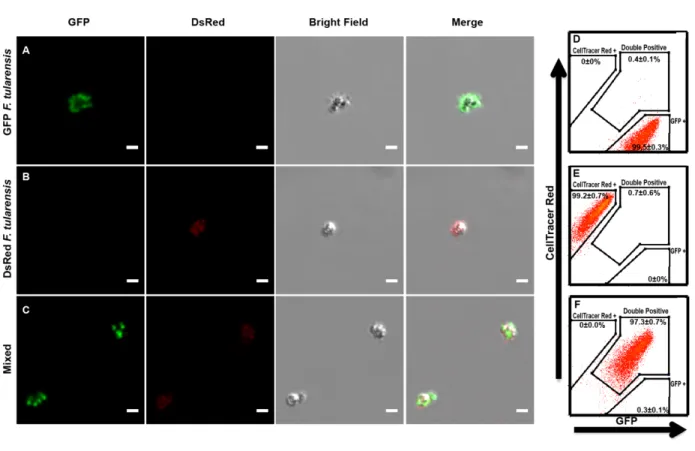
lipopolysaccharide (LPS) antibody coated beads with a 1:1 mixture of F. tularensis expressing either GFP or DsRed. By microscopy, virtually every observed bead had GFP and DsRed
bacteria bound to it (Figure 2.1 A-C). We quantified the amount of beads that bound to both GFP and Cell Trace Far Red labeled F. tularensis by flow cytometry and found that 97.3 +/- 0.7% (mean +/- SD) of the beads bound to both GFP and Cell Trace Far Red labeled bacteria (Figure 2.1 D-F). This indicates that in infection experiments where wild-type and mutant bacteria are bound to beads, the majority of cells will be infected with both bacterial strains.
22
To quantify the number of bacteria per bead, F. tularensis LVS containing a luciferase plasmid was bound to beads and the amount of luminescence per bead was compared to a standard curve. The median bacteria per bead was 3.43 (SEM = 6.69, 4 independent experiments). Additionally, 6.66 +/- 2.52 intracellular wild-type bacteria per cell were present at 4 hours post inoculation (average +/- SEM, n=23 from 9 independent experiments, assumptions described in materials and methods). Taken together, we estimate that the average cell is infected with 3 to 8 bacteria using bead co-infections.
F. tularensis is transiently linked to the bead
23
results in bacteria bound to beads upon initial infection, but that the bacteria detach from the bead following host cell entry. The bacteria also released from beads at similar rates when left in PBS for 2 hours, suggesting that bacterial release from the bead is not mediated by infection (data not shown).
Bead co-infections functionally complement cytokine suppression
F. tularensis suppresses host cell production or secretion of several different cytokines,
including interleukin 1β (IL-1β) by both active (such as MAPK inhibition) and passive
mechanisms (such as via LPS modifications) 90,92,93,104-106. Since wild-type F. tularensis actively suppresses inflammatory responses, co-infection of cells with wild-type bacteria should
complement a mutant that fails to suppress the immune response. To test the efficacy of bead co-infections on rescuing immune suppression, we co-infected murine bone marrow derived
macrophages (mBMDM) with wild-type F. tularensis bound to beads with either ΔpdpC or
ΔripA and measured IL-1β secretion.
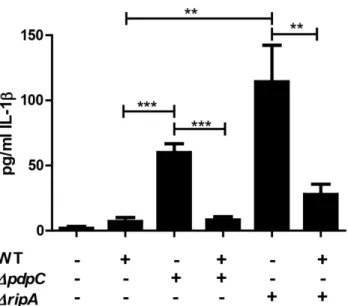
Infections of mBMDMs with ΔripA results in increased IL-1β secretion compared to wild-type 90. Similarly, cells infected with ΔripA bound to beads also induced increased IL-1β secretion compared to cells infected with bead-bound wild-type F. tularensis (Figure 2.3). However, co-infecting cells with wild-type bacteria and ΔripA resulted in reduced IL-1β secretion compared to ΔripA alone (Figure 2.3). ΔripA bound to beads and typical ΔripA
infections elicit similar levels of IL-1β, even though the cells infected with beads should contain more bacteria initially (data not shown). Thus the decrease of IL-1β secretion during co
24
active immune suppression mechanisms expressed by wild-type F. tularensis was sufficient to inhibit the inflammatory response induced by ΔripA.
We also measured IL-1β secretion of ΔpdpC infected mBMDMs and found that cells infected with ΔpdpC bound to beads also had slightly increased IL-1β secretion when compared to wild-type infected cells (Figure 2.3). Co-infecting cells with wild-type and ΔpdpC bacteria resulted in decreased IL-1β secretion compared to ΔpdpC bacteria alone (Figure 2.3). Thus,
ΔpdpC failed to entirely suppress the host immune response but suppression could be rescued by the presence of wild-type bacteria. Wild-type bacteria fully complemented suppression of IL-1β secretion during mixed infections of wild-type and ΔpdpC (p=0.77) but there was a slight increase in the wild-type and ΔripA mixed infection when compared to wild-type infections alone (p=0.01). We hypothesize that the observed increase in IL-1β secretion during co -infections with ΔripA is due to a small subset of cells that are infected by beads bound only to
ΔripA bacteria combined with the increased magnitude of IL-1β secretion observed during ΔripA infections compared to ΔpdpC infections. However, we cannot rule out the possibility that ΔripA may stimulate the immune response via a pathway that cannot be entirely suppressed by wild-type bacteria. In summary, co-infections of mutant and wild-wild-type bacteria can rescue a phenotype caused by the inability of the mutant to properly modify the host cell.
Phagosomal escape is functionally complemented during bead co-infections
25
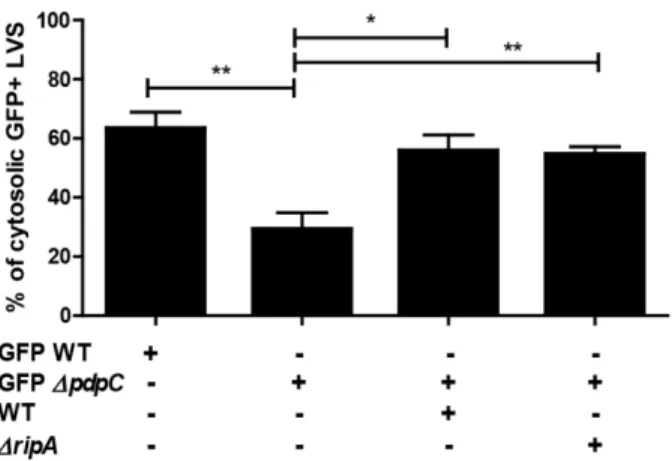
hypothesis, we bound ΔpdpC containing a GFP-expressing plasmid (GFPΔpdpC) to beads and quantified the amount of GFPΔpdpC present in the cytosol of J774 cells. We found that GFPΔpdpC had reduced phagosomal escape at 2 hours post inoculation compared to GFP
expressing wild-type bacteria and GFPΔpdpC phagosomal escape was rescued by the presence of wild-type bacteria within the same phagosome (Figure 2.4). This result is consistent with other published analyses of ΔpdpC mutant phenotypes and indicates that PdpC contributes to, but is not absolutely required for, F. tularensis LVS phagosomal escape 93,101. More importantly, wild-type bacteria export the necessary effector protein(s) to allow both wild-wild-type and ΔpdpC to escape the phagosome.
Bead co-infections achieve functional complementation of phagosomal escape across an entire population. This allows for the further characterization of phagosomal escape deficient mutants in the cytoplasmic environment. One caveat to using wild-type bacteria for
complementation is that wild-type bacteria may out-compete certain mutants in the cytosol or obscure additional host-pathogen interactions. We hypothesized that any mutant strain that escapes the phagosome can be used to complement phagosomal escape of escape deficient mutants. To test this hypothesis, we co-infected cells with GFPΔpdpC and ΔripA. The ΔripA strain escapes the phagosome with similar kinetics as wild-type bacteria, but does not replicate inside the host cell 102. Indeed, ΔripA functionally complemented GFPΔpdpC phagosomal escape when GFPΔpdpC entered through the same phagosome as ΔripA (Figure 2.4). Our data
26 Bead co-infections complement intracellular survival
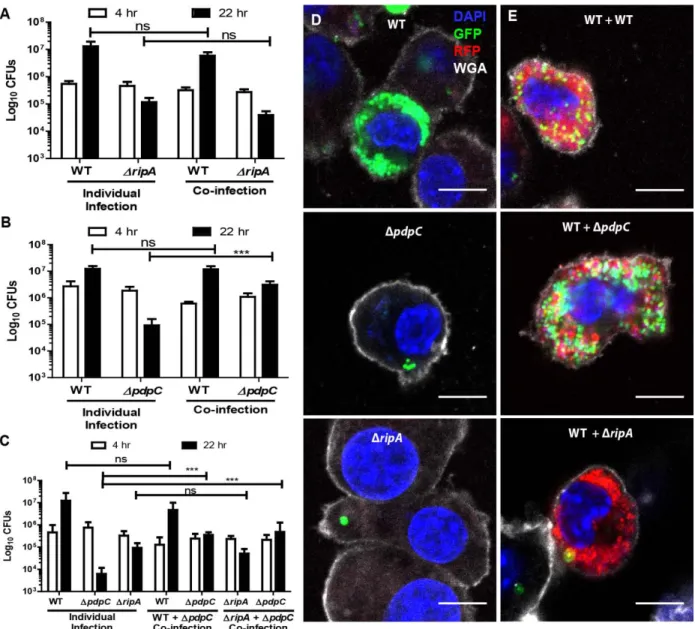
F. tularensis mutants can be deficient for intracellular survival or replication due to the inability of the mutant to perform a required interaction with the host or due to an intrinsic intracellular survival or replication defect. Co-infections with both mutant and wild-type bacteria can be used to determine whether the mutant fails to properly control a host-pathogen interaction The ripA gene encodes a hypothetical protein of unknown function that is required for F. tularensis intracellular proliferation, likely through regulation of lipid A synthesis 102 (our unpublished data). We found that co-infecting J774 cells infected with wild-type F. tularensis did not complement ΔripA intracellular growth (Figure 2.5A). Likewise, individual cells had similar numbers of ΔripA expressing GFP regardless of whether or not wild-type F. tularensis was present in the same cell (Figure 2.5D, 2.5E). These data further indicate that ripA is involved in an intrinsic bacterial process essential for intracellular bacterial proliferation.
The PdpC protein is encoded on the FPI and ΔpdpC bacteria are deficient for intracellular proliferation 93,101. Intracellular proliferation of ΔpdpC is not consistent across the entire
27
slight increase in ΔpdpC replication during co-infections with wild type between 4 and 22 hours (2.0 +/- 0.3 fold, n=7 independent experiments, p=0.0014) (Figure 2.5B, 2.5D, 2.5E). We conclude that wild-type bacteria complemented the defect of ΔpdpC by secreting the effector(s) necessary to manipulate the host cell into being permissive for F. tularensis survival. Thus, F. tularensis LVS ΔpdpC does not survive inside of J774 cells due to its inability to properly manipulate an interaction(s) with the host that F. tularensis requires for intracellular survival.
Although ΔpdpC replicated slightly when wild-type bacteria were present in the same cell, ΔpdpC replication did not achieve wild-type levels. This is interesting because ΔpdpC escaped the phagosome, albeit at lower levels than wild-type, but was still inhibited by the host cell during individual infections (Figure 2.4, 2.5B) 93,101. Thus, wild-type bacteria may promote
ΔpdpC survival in the host cytosol (Figure 2.5B) but wild-type F. tularensis either out-competes
ΔpdpC or pdpC is also required for a cell intrinsic process to fully restore intracellular replication. To distinguish between these possibilities, we co-infected cells with ΔpdpC and
ΔripA. The ΔripA strain has an intact FPI and rescues ΔpdpC phagosomal escape, but since
ΔripA does not replicate, it should not out-compete ΔpdpC. We found that co-infections with
ΔripA and ΔpdpC resulted in ΔpdpC survival but proliferation did not increase to wild-type levels (Figure 2.5C). Thus, we conclude that PdpC is required for intracellular survival through a host-mediated process but has a secondary function that enhances bacterial proliferation.
28 Discussion
We developed and optimized a method to reliably deliver two distinct F. tularensis bacteria into the same host cell. Co-infection of cells with bacteria bound to beads allows for functional complementation of host-pathogen interactions, which can be used to identify mutants that fail to induce a host-pathogen interaction or to complement a specific host-pathogen
interaction.
The ΔripA strain fails to replicate inside of cells and induces IL-1β secretion 90,102,103. With the described co-infection method, neighboring wild-type bacteria functionally complement IL-1β suppression in ΔripA infected cells but not ΔripA intracellular proliferation. The
Francisella novicida ΔripA strain has also been shown to have increased intracellular lysis compared to wild-type F. novicida bacteria, which leads to increased cytokine secretion via the AIM2 inflammasome 108. Herein we show that wild-type F. tularensis LVS bacteria can suppress cytokine secretion in cells infected with ΔripA bacteria. Assuming that RipA has an identical function between the different Francisella species, these data indicate that wild-type LVS bacteria, but not ΔripA, suppress the AIM2 inflammasome.
29
secretion (data not shown). Taken together, the described co-infection method indicates that RipA is involved in cytokine suppression (a host-pathogen interaction) and a separate, intrinsic bacterial process for intracellular replication.
The ΔpdpC strain was functionally complemented for phagosomal escape, intracellular survival, and IL-1β suppression. Thus, PdpC contributes to those host-pathogen interactions. Interestingly, ΔpdpC replication never reached the same level as wild-type bacteria during co-infections even though ΔpdpC escaped the initial phagosome with the wild-type bacteria. These data hint that PdpC is involved in an intrinsic bacterial replication process that is required for optimal growth. It is also possible that a local host-pathogen interaction is required that is not reliably complemented by neighboring bacteria. Further investigation is needed to determine if the intracellular growth defect is specific to ΔpdpC or if other FPI genes are required for replication in the host cell cytosol.
The antibody used throughout these experiments has been used to identify F. tularensis Schu S4 by microscopy and for purifying Schu S4 from infected cell lysates 5,109. As described, this method should be compatible with a range of F. tularensis species with O-antigen structures similar to F. tularensis LVS. More importantly, the described co-infection method is compatible with any biotinylated antibody, so antibodies specific to surface molecules of F. tularensis novicida or other bacterial species can be used to link bacterial cells to beads.
30
infection and the magnitude of certain phenotypes, particularly intracellular proliferation, are slightly different. Lastly, we expect that phagocytosis of beads coated in bacteria will primarily occur through typical phagocytic routes of a given bacteria because bacteria on the bead surface still interact with the cell. But phagocytosis may occasionally occur through a different
mechanism than in a typical infection. For example, some Fc receptor mediated phagocytosis likely occurs in some cells due to antibodies bound to the beads. Despite these potential pitfalls, our individual infection controls for IL-1β secretion, phagosomal escape, and intracellular proliferation resulting from infection with bead-bound bacteria are consistent with previously published data based on infection by free bacterial cells 90,93,101,102.
Bead co-infections provide a consistent method of functionally complementing most intracellular bacterial manipulations of the host cell. However, there are a few specialized cases in which further characterization beyond bead co-infections is necessary. We expect that some gain of function mutants and host-pathogen interactions that require local manipulation will not be reliably complemented. For example, immune signaling phenotypes that are not
31
Materials and Methods Bacteria and plasmids
Francisella tularensis subsp holartica LVS was obtained from the CDC Atlanta, GA. A pdpC deletion construct was made by splice overlap extension (SOE) PCR as described
previously 102. Primers were used to delete all but the first five amino acid (MNDKY) and the last five codons (KISS stop) while keeping the deletion in frame. After blunt end cloning into pCR BLUNT II (Invitrogen), the SOED pdpC fragment was removed by BamHI-Not I digest and cloned into suicide vector pMP812 110. Integrants were selected on kanamycin (10 ug/ml). Resolved integrants were selected by growth overnight in brain heart infusion (BHI) broth (BD Biosciences) supplemented with isovitalex followed by plating on chocolate containing 10% sucrose. Resolved integrants were sequenced to confirm in-frame deletion of pdpC and integrity of the flanking sequence. Deletion of both pdpC genes was verified by PCR. Genetic
complementation of pdpC by constitutively expressing the pdpC gene on pMP822 restored intracellular proliferation (Supplemental Figure 1) 111. The ΔripA in-frame deletion and GFPΔripA strains were previously generated 112.
GFP wild-type LVS (GFP-wt) was generated by Hall et al 2 and GFP-ΔpdpC was generated using the same GFP plasmid. DsRed LVS and luciferase expressing LVS were
generated with the plasmids from DsRed Schu S4 and luciferase expressing Schu S4 respectively
5
32 Cell Culture
J774A.1 Macrophage like cells were obtained from ATCC and grown in DMEM with 4.5 g/L glucose and supplemented with 10% FBS, L-glutamine and sodium pyruvate (all from Gibco). Mouse bone marrow derived macrophages were generated from a C57Bl/6 as previously described 113. All animal studies were conducted according to the Institutional Animal Care and Use Committee guidelines of the University of North Carolina- Chapel Hill (IACUC ID 13-213).
Binding F. tularensis to the magnetic beads
800 nm streptavidin coated magnetic beads (Solulink) were blocked with sterile filtered Tris buffered saline (TBS) containing 0.1% casein for 20 minutes. The beads were washed 4 times with antibody wash buffer (100 mM Tris, 150 mM NaCl and 0.05% tween 20 in distilled
water, pH 8.0). For every 10 ug of beads, we added 2.5 μg of anti-Francisella tularensis LPS antibody (US Biological) that was previously biotinylated using a FluoReporter Mini-Biotin-XX Protein Labeling Kit (Invitrogen) following the manufacturer’s instructions. The antibody was suspended in antibody wash. After 30 minutes of rocking at 4°C, the beads were washed twice in
antibody wash buffer and twice in PBS. 10 μg of magnetic beads coated with anti- LPS antibody were mixed with 8x10⁸ bacteria for 20 minutes. Each sample was then washed twice in PBS to remove unbound F. tularensis. After the final wash, the beads were suspended in cell culture media and ready to use for the given experiment. All washes were performed by placing a 12 x 75 mm round bottom tube containing the sample on a BD IMagnet (BD biosciences) and waiting approximately 2 minutes for the beads to move toward the magnet. After all wash steps,
33
106 beads between experiments. All experiments were inoculated assuming 1x10⁷ bacteria bound to beads per 10 ug of starting beads.
For samples where multiple strains were added together, 4x10⁸ of each strain was added. For all mixed infections, the inoculum of each type of bacteria was plated and compared to ensure both types of bacteria were equally represented. Typically the ratio of one type of bacteria to the other was between 1: 0.8 and 1: 1.2 (data not shown). Infecting cells at a MOI higher than 1 can result in each cell taking up a substantial number of beads, which may impact results (data not shown). Bead aggregates can form over time which may impact the number of bacteria that enter each cell.
Microscopy
For micrographs of bacteria on beads, GFP-LVS and/or DsRed labeled LVS were coated onto the beads as described above. The bacteria bound beads were fixed in 4% paraformaldehyde and were placed into an 8 well chamber slide (Nunc). The beads were allowed to settle and the fixative was carefully removed.
For images of infected cells, beads were prepared as above with the indicated bacteria. J774 cells were inoculated for 2 hours and then the media was removed and replaced with media
containing 25 μg/ml of gentamicin. The cells were washed and fixed with 4% paraformaldehyde
at 4 or 22 hours post inoculation. Cells were treated with 50 mM ammonium chloride for 10
minutes and then stained with 10 μg/ml of AF647 wheat germ agglutinin (Invitrogen) where
indicated.
34
image acquisition software (Zeiss) or an Olympus FV500 confocal scanning laser microscope (Olympus). Images were cropped and scale bars were added using ImageJ 114.
Flow Cytometry
To assess the frequency of both types of bacteria binding to a single bead, beads were prepared as above with GFP-LVS and/or Cell Trace Far Red DDAO-SE (Invitrogen) labeled wild-type LVS. Immediately following the final wash, the beads were stained with pacific blue conjugated anti- F. tularensis LPS antibody (US biological) (Pacific blue antibody labeling kit [Invitrogen] following the manufacturers protocol). The beads were washed once more and then immediately fixed using 4% paraformaldehyde. The event trigger on the flow cytometer was set to only record Pacific Blue positive events.
Phagosomal escape assays were performed as previously described 74. Briefly, J774 cells were inoculated with beads coated with the indicated wild-type or deletion mutants bacteria (prepared as above). 2 hours post inoculation, the cells were suspended and stained with pacific blue conjugated anti- Francisella tularensis LPS antibody to label extracellular bacteria. After the antibody was washed away with KHM buffer, the cells were permeabilized with 100 ul of 10
μg/ml digitonin and the cells were stained with AF647 conjugated anti- Francisella tularensis LPS antibody to stain cytosolic bacteria. The cells were lysed and the samples were then analyzed by flow cytometry. We compared the ratio of intracellular cytosolic bacteria (GFP+ AF647+ Pac Blue-) to bacteria in the phagosome (GFP+ AF647- Pac Blue-). The data from these experiments includes both bacteria bound to beads and unattached bacteria. No significant
35
were stained with calnexin to assay the percentage of cells that were permeabilized. The percentage of permeabilized cells was used to determine the total percentage of bacteria that escaped the phagosome.
To assay for bacterial dissociation from the beads prior to inoculation, GFP-LVS was bound to beads as previously described and stained with pacific blue conjugated anti- F. tularensis LPS antibody. The fixed sample was then analyzed for the percentage of bacteria bound to beads. To assess the amount of dissociation from beads inside of cells, GFP-LVS was bound to beads as previously described. The cells were removed from the plate, washed in KHM buffer 74, and permeabilized with digitonin 2 hours post inoculation. The permeabilized cells were stained with an AF647 conjugated anti- F. tularensis LPS antibody (US biological). The antibody was washed away and then the infected cells were lysed by vortexing the cells in distilled water. AF647+, GFP+ events were analyzed for attachment to a bead based on size.
All samples were analyzed using a Cyan Flow Cytometer (Dako) with the event trigger set to record only pacific blue positive events or GFP positive events depending on the
experiment. All histograms were pre-gated so that only single events were analyzed.
Intracellular bacterial proliferation assay
36
hygromycin to assess bacterial proliferation. As expected, hygromycin resistant colonies did not form under kanamycin selection and vice versa (data not shown).
Quantification of bacteria per bead
F. tularensis LVS containing a luciferase –expressing plasmid was bound to beads following the previously described method. Half of the sample was plated on chocolate agar to assay for the number of beads bound to bacteria and the other half was placed into an Infinite M200 Pro plate reader (Tecan) and the amount of light produced was quantified and compared to a standard curve consisting of know quantities of F. tularensis LVS containing the luciferase plasmid.
The number of bacteria per cell was determined based on the results at 4 hours post inoculation of the wild-type bacteria from the intracellular proliferation assay described
previously. We assumed that 60% of the cells were infected based on flow cytometry of similar samples examined 2 hours post inoculation. Since gentamicin is added 2 hours post inoculation, additional cells should not be infected. We also assumed that the J774 cells doubled overnight, resulting in 5x10⁵ cells, that each cell was infected with 1 bead, that 100% of bacteria were bound to beads and no bacterial death or replication occurred between 0 and 4 hours post inoculation.
IL-1β ELISA
37
inoculation and the amount of IL-1β was measured using a BD OptEIA mouse IL-1β ELISA set (BD biosciences) following the manufacturers protocol.
Statistics
All statistics were performed using an unpaired Student t-test using the compiled data from all experiments performed. Intracellular proliferation assays were log10 transformed prior to
38 Figures
Figure 2.1: Multiple F. tularensis bacteria reliably bind to the same bead.
39
Figure 2.2: F. tularensis separates from the beads inside host cells.
40
Figure 2.3: Functional trans-complementation via bead-bound bacteria complements suppression of cytokine secretion.
41
Figure 2.4: Functional trans-complementation via bead-bound bacteria complements phagosomal escape.
42
Figure 2.5: Functional trans-complementation via bead-bound bacteria complements intracellular proliferation of ΔpdpC but not ΔripA.
43
hygromycin resistant ΔpdpC were individually or co-inoculated into J774 cells and assayed for intracellular proliferation at 4 and 22 hours post inoculation. Results are from 3 independent experiments performed in duplicate or triplicate. Bar graphs represent the mean +/- the standard deviation. (D) Representative fluorescence micrographs of J774 cells inoculated for 22 hours with GFP wild-type, GFPΔpdpC or GFPΔripA bacteria attached to beads. (E) Representative fluorescence micrographs of J774 cells inoculated with beads bound to DsRed LVS and either
GFP WT, GFPΔpdpC or GFPΔripA. Blue represents the nucleus (DAPI), green represents the
indicated GFP LVS mutants, red represents DsRed wild-type LVS, and white represents the
plasma membrane stain wheat germ agglutinin (WGA). All scale bars represent 10 μm. All
44
Figure 2.6: Genetic complementation of ΔpdpC intracellular proliferation. Supplemental figure 1
45
CHAPTER 3: FRANCISELLA TULARENSIS HARVESTS NUTRIENTS DERIVED VIA ATG5-INDEPENDENT AUTOPHAGY TO SUPPORT INTRACELLULAR GROWTH2
Overview
Francisella tularensis is a highly virulent intracellular pathogen that invades and replicates within numerous host cell types including macrophages, hepatocytes and
pneumocytes. By 24 hours post invasion F. tularensis replicates up to 1000-fold in the cytoplasm of infected cells. To achieve such rapid intracellular proliferation, F. tularensis must scavenge large quantities of essential carbon and energy sources from the host cell while evading anti-microbial immune responses. We found that macroautophagy, a eukaryotic cell process that primarily degrades host cell proteins and organelles as well as intracellular pathogens, was induced in F. tularensis infected cells. F. tularensis not only survived macroautophagy, but optimal intracellular bacterial growth was found to require macroautophagy. Intracellular growth upon macroautophagy inhibition was rescued by supplying excess nonessential amino acids or pyruvate, demonstrating that autophagy derived nutrients provide carbon and energy sources that support F. tularensis proliferation. Furthermore, F. tularensis did not require canonical, ATG5-dependent autophagy pathway induction but instead induced an ATG5-inATG5-dependent autophagy pathway. ATG5-independent autophagy induction caused the degradation of cellular constituents
2This chapter was previously published as an article in PLOS Pathogens. The citation is: Steele S, Brunton J, Ziehr
B, Taft-Benz S, Moorman N, Kawula T. Francisella tularensis harvests nutrients derived via ATG5-independent