TIME COURSE OF CHANGES IN NEUROMUSCULAR FUNCTION DURING AND FOLLOWING CREATINE LOADING
Eric J. Sobolewski
A dissertation proposal submitted to the faculty of the University of North Carolina at Chapel Hill in partial fulfillment of the requirements for the degree of Doctor of Philosophy in the
Curriculum of Interdisciplinary Human Movement Science (School of Medicine).
Chapel Hill 2014
Approved by:
Eric D. Ryan
Anthony C. Hackney
Brian G. Pietrosimone
Abbie Smith-Ryan
iii
ABSTRACT
Eric J Sobolewski: The Time Course of Changes in Neuromuscular Function during and following Creatine Loading
(Under the Direction of Eric D. Ryan)
The purposes of the present study were to determine the effect of Creatine (Cr) supplementation
on 1) voluntary isometric and isokinetic strength and 2) active and passive range of motion
(ROM) during loading and the subsequent washout period. The secondary purpose was to
address any possible underlying neuromuscular mechanisms that might influence these changes.
Using a double-blinded, placebo-controlled, matched-paired, randomized design, 40 males were
assigned to a Cr (n=20, age: 20.3 ± 2.1 yrs,) or a placebo group (Pl; 20.4 ± 2.3 yrs) group.
Participants supplemented four times daily for five days with 5g Cr + 20g dextrose or 20g
dextrose. Testing was conducted prior to supplementation, during the loading phase (days 2, 4 &
6), and during the washout period (day 20 & 35). Muscular strength was examined with a
maximal isometric and isokinetic (30, 90 & 120°·sec-1) muscle action of the plantar flexors on a
calibrated isokinetic dynamometer. Muscle activation was determined by examining percent
voluntary activation (%VA) and normalized electromyographic (EMG) amplitudes. Passive
ROM , common and relative passive stiffness values were determined from a slow passive ROM
assessment on a dynamometer. Active ROM was determined as the maximal dorsiflexion
possible. Total body water, extracellular water, and intracellular water were measured with
Bioimpedance Spectroscopy. Panoramic ultrasound imaging was used to address architectural
changes in muscle cross sectional area, pennation angle, and fascicle length. Resting evoked
iv
resonance spectroscopy (MRS) was used to evaluate Cr uptake by the muscle in a subset of
participants (Cr = 4; Pl = 4). Mass and fluid distribution for the Cr group did not significantly
(P≥0.11) differ from the Pl group over the course of the study. There was no significant
interactions for all strength measures (P≥0.36) or active and passive ROM (P≥0.15), or any of
the possible underlying mechanism (P>0.05). There were no changes in Cr stores (P>0.05).
Overall, the results of this study suggest that Cr supplementation alone does not influence
neuromuscular function or any of the underlying factors that could improve strength or limit
v
TABLE OF CONTENTS
LIST OF TABLES ... viii
LIST OF FIGURES ... ix
CHAPTER I ... 1
Physiological Role of Creatine ... 1
The influence of creatine supplementation on muscle creatine stores ... 2
The influence of creatine supplementation on performance ... 3
The influence of creatine supplementation on neuromuscular function ... 4
The influence of creatine supplementation on range of motion and stiffness ... 6
Time Course ... 8
Statement of purpose ... 10
Specific Aims ... 11
CHAPTER II ... 12
The influence of Cr supplementation on neuromuscular function ... 12
Bazzucchi I, Felici F, and Sacchetti M (2009) ... 12
Bembem MG, Tuttle, TD, Bembem DA, and Knehans AW (2001) ... 13
Deutekom M, Beltman JGM, de Ruiter CJ, de Koning JJ, and de Haan A (2000) ... 14
Greenhaff PL, Casey A, Short AH, Harris R, Soderlund K, and Hutlman E (1993) ... 15
Hamilton KL, Meyers MC, Skelly WA, and Marley RJ (2000) ... 16
Jakobi JM, Rice CL, Curtin SV, and Marsh CD (2000) ... 17
vi
Law YLL, Ong WS, GillianYap TL, Lim SCJ, and Von Chia (2009) ... 19
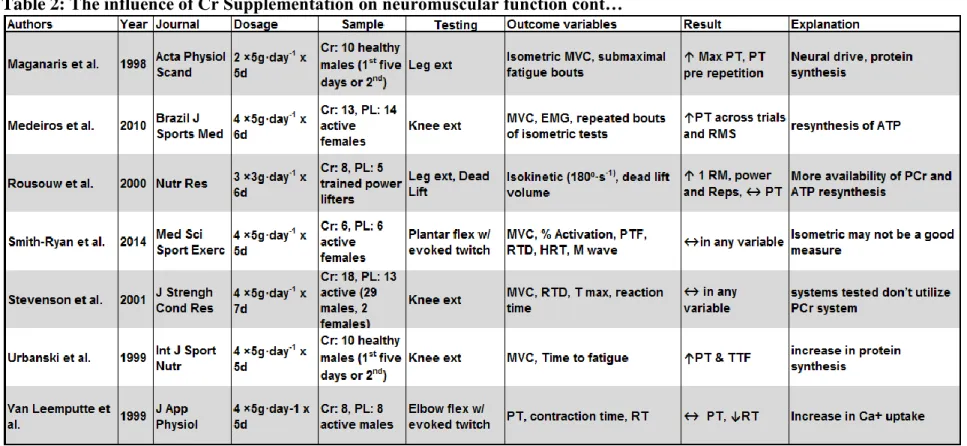
Medeiros RJD, Santos AAd, Ferreira AdCD, et al. (2010) ... 20
Rawson ES, Clarkson, PM (2000) ... 20
Rossouw F, Kruger PE, and Rossouw J (2000) ... 21
Smith-Ryan AE, Ryan ED, Fukuda DH, Costa PB, Cramer JT, and Stout JR (2013) ... 22
Stevenson, SW and Dudley GA (2001) ... 23
Urbanski RL, Loy SF, Vincent WJ, and Yaspelkis BB (1999) ... 23
van Leemputte M, Vandenberghe K, and Hespel P (1999) ... 24
The influence of Cr supplementation on ROM and muscle stiffness ... 25
Sculthorpe N, Grace F, Jones, and Fletcher I (2010) ... 25
Watsford ML, Musphy, AJ, Warwick, SL and Walshe ED. (2003) ... 26
The influence of Cr supplementation on fluid distribution ... 27
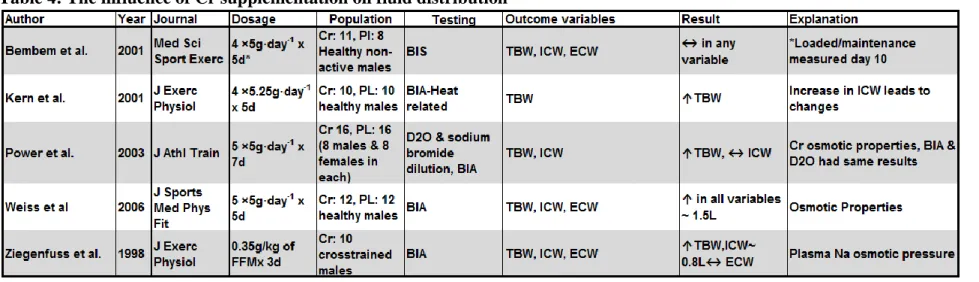
Bembem. MG. Tuttle, TD., Bembem DA. And Knehans AW. (2001)... 27
Kern M, Podewils L, Vukovich M, and Buono M (2001) ... 28
Powers ME, Arnold B, Weltman AL, Perrin DH, Mistry D, Kahler D (2003) ... 29
Weiss BA, and Powers ME (2006) ... 30
Ziegenfuss TN, Lowery LM, and Lemon PW. (1998) ... 31
The physiological role of Cr supplementation ... 31
Harris RC, Soderlund K, and Hultman E. (1992) ... 31
Hultman E, Soderlund, K, Timmons JA, Cederblad G and Greenhaff PL. (1996) ... 33
CHAPTER III ... 35
Participants ... 35
Experimental Design ... 35
Familiarization Day ... 36
Supplementation Procedure ... 36
vii
Muscle Size and Architecture Measurements ... 38
Electromyography ... 39
Isokinetic Testing ... 40
Twitch Interpolation Procedure ... 41
Proton Magnetic Resonance Spectroscopy ... 42
Signal Processing ... 43
Statistical Analyses ... 44
CHAPTER IV... 45
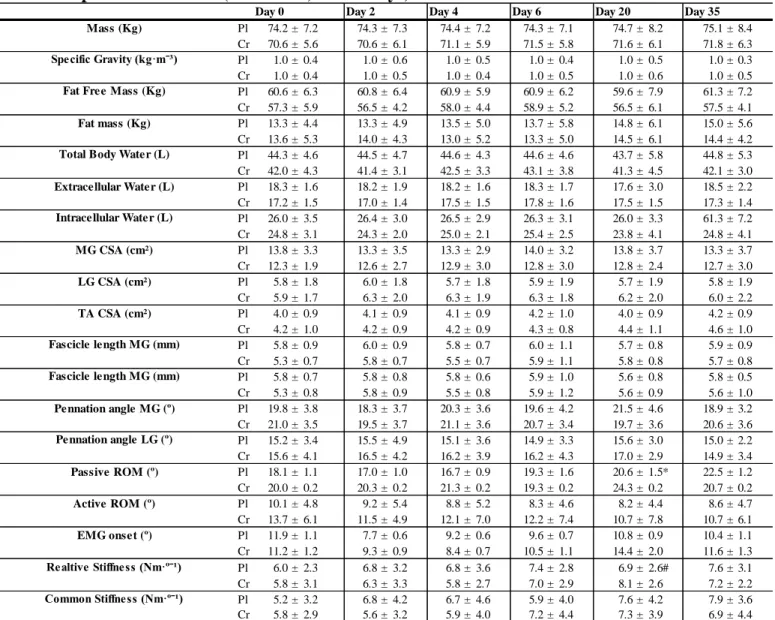
Demographics ... 45
Body Fluid distribution ... 45
Muscle Size and Architecture ... 46
ROM assessments ... 46
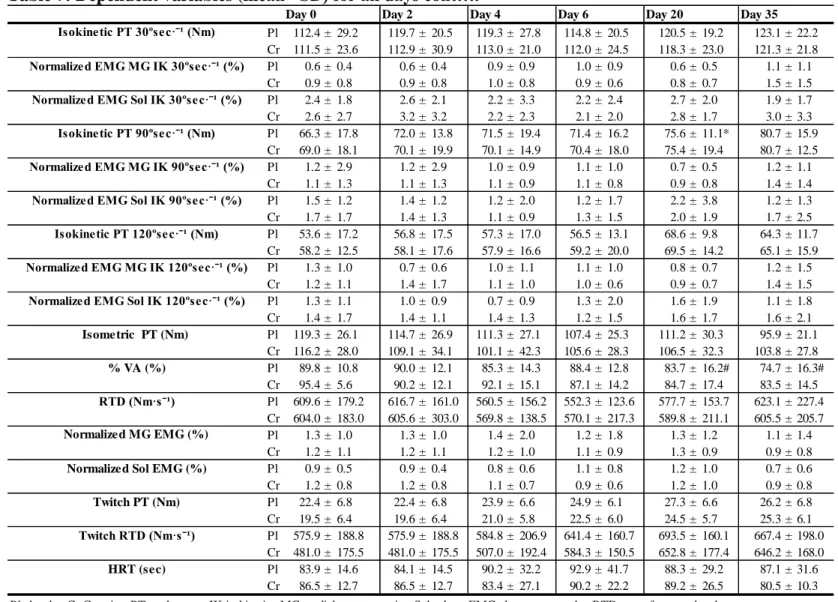
Isokinetic Strength ... 47
Isometric MVC PT and %VA ... 48
Twitch Properties ... 49
MRS ... 49
CHAPTER V ... 50
Muscular Strength ... 50
Range of Motion ... 52
Body Mass ... 53
Conclusion ... 54
TABLES ... 56
FIGURES ... 65
viii
LIST OF TABLES
Table 1: The influence of Cr supplementation on neuromuscular function ... 56
Table 2: The influence of Cr Supplementation on neuromuscular function cont… ... 57
Table 3: The influence of Cr supplementation on ROM and stiffness... 58
Table 4: The influence of Cr supplementation on fluid distribution ... 59
Table 5: Participant Demographics and amount of time per week exercising (mean ± SD) ... 60
Table 6: Dependent variables (mean± SD) for all days ... 61
Table 7: Dependent variables (mean± SD) for all days cont…. ... 62
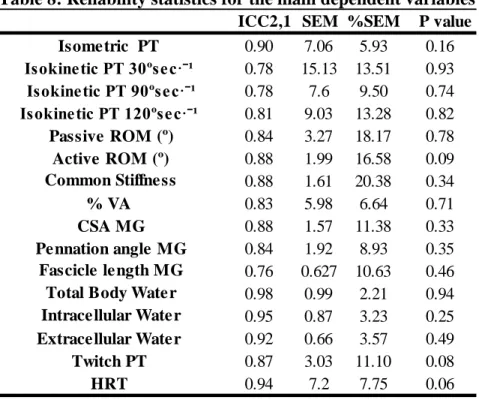
Table 8: Reliability statistics for the main dependent variables... 63
ix
LIST OF FIGURES
Figure 1. Body mass during and following creatine loading.
Values are presented as mean ± SD. ... 65
Figure 2: Fluid distribution during and following creatine loading.
(A) total body water, (B) extracellular water (C) intracellular water.
Values are presented as mean ± SD. ... 66
Figure 3: Muscle cross sectional area during and following creatine loading. (A) medial gastrocnemius, (B) lateral gastrocnemius, (C) tibialis anterior.
Values are presented as mean ± SD. ... 67
Figure 4: Muscle fascicle length during and following creatine loading A) medial gastrocnemius, B) lateral gastrocnemius.
Values are presented as mean ± SD. ... 68
Figure 5: Pennation angle during and following creatine
loading. A) medial gastrocnemius, B) lateral gastrocnemius
Values are presented as mean ± SD. ... 69
Figure 6: Active and passive range of motion (ROM) during and following creatine loading. A) active range of ROM, B)
EMG onset, C) passive ROM. * Indicates day 20 having
greater ROM than Day 6 (P=0.014) for both groups.
Values are presented as mean ± SD. ... 70
Figure 7: Passive stiffness at A) common angle and B) relative angle during and following creatine loading. *Indicates day 20 being stiffer then day 0 (P=0.006) for both groups..
Values are presented as mean ± SD. ... 71
Figure 8: Isokinetic peak torque at A) 30 °·sec-1, B) 90 °·sec-1 and 120°·sec-1 during and following creatine loading.
*Indicates day 20 having higher peak torque values then day 0 (P=0.001) for both groups.
Values are presented as mean ± SD. ... 72
Figure 9: Medial gastrocnemius muscle activation during isokinetic testing at A) 30 °·sec-1, B) 90 °·sec-1 and 120°·sec-1 during and following creatine loading. * Indicates day 35 being more active then day 20 (P=0.030) for both groups.
x
Figure 10: Soleus muscle activation during isokinetic testing at A) 30 °·sec-1, B) 90 °·sec-1 and 120°·sec-1 during
and following creatine loading.
Values are presented as mean ± SD. ... 74
Figure 11: Isometric strength measurements during and following creatine loading. A) peak torque, B) rate of torque development, C) % voluntary activation. * Indicates days 20 and 35 being less active then the previous days (P=0.001-0.015) for both groups.
Values are presented as mean ± SD. ... 75
Figure 12: Muscle activation during the isometric maximal voluntary contractions of the A)medial gastrocnemius, and (B) soleus during and following creatine loading.
Values are presented as mean ± SD. ... 76
Figure 13: Resting twitch properties during and following creatine loading. A) peak torque, B) rate of torque development, and C) half relaxation time. *Indicates day 20 having higher torque values then day 0 (P=0.001) collapsed across groups. #Indicates day 6 having a higher rate of torque development then Day 2 (P<0.001) for both groups.
Values are presented as mean ± SD. ... 77
Figure 14: Percent change from day 0 for muscle creatine concentrations using magnetic resonance spectroscopy.
1
CHAPTER I
INTRODUCTION
Physiological Role of Creatine
Creatine (Cr) is one of the most popular ergogenic aids on the market. Its popularity
could be contributed to the large number of studies demonstrating its positive influence on high
intensity exercise performance.102 Cr is a naturally occurring organic compound usually
consumed in the diet as it is found in meat and fish. Cr is also synthesized in the liver and
pancreas from the amino acids glycine, arginine, and methionine.109 The majority of Cr (95%)
is stored in skeletal muscle, with the remaining 5% found in the heart, brain and testes. Cr is
primarily (~60%) found bound to inorganic phosphate in the form of phosphocreatine (PCr) with
the remaining 40% stored as the free form of Cr. Cr’s role in metabolism was first discovered by
Hutlman et al,49 who identified Cr and its ability to re-phosphorylate adenosine diphosphate
(ADP) to adenosine triphosphate (ATP) via the creatine kinase reaction. It was not until 1992
when Harris et al42 demonstrated Cr supplementation could increase muscle Cr stores both as
PCr and free form Cr. Since this ground breaking study, Cr research has further evaluated the
possible implications of Cr supplementation as an ergogenic aid.
Dietary supplementation with Cr has been shown to increase PCr stores in muscle,
increasing the cells ability to re-phosphorylate ATP.38,63,84 Previous authors have suggested that
Cr may have many other positive functions inside the cell which may be influenced by Cr
2
the mitochondria to the cytosol,74 and during times of low pH, PCr and ADP buffer hydrogen
ions (H+) by the formation of Cr and ATP.83 Cr may also have additional metabolic effects due
to its potential involvment in regulating glycolysis.81 For example, low levels of Cr promote the
release of oxidative enzymes that in turn increase glycolysis. Cr may also indirectly increase
protein synthesis. An increase in Cr concentrations through the breakdown of PCr to Cr during
muscle contractions has been shown to stimulate protein synthesis.50 Swelling of muscle cells
has also been suggested to increase protein synthesis.43 Since Cr has known osmotic properties
and results in the cells pulling water from the extracellular fluid into the cells causing them to
swell,9 it is likely this may lead indirectly to increases in protein synthesis. Lastly, Cr in the
form of PCr acts as a membrane stabilizer by binding to the phospholipid heads thus not
allowing for the cytoplasmic contents to dissipate through the cell wall which could lead to an
increase in cell size.93
The influence of creatine supplementation on muscle creatine stores
Traditionally, Cr is “loaded’ by consuming 20 g a day for the first five days followed by a
maintenance dose of 3-5 g per day.62,94,106,107 The “loading” of Cr in the system is done to
rapidly saturate muscle cells with Cr.26 In the classic study by Harris et al,42 Cr stores increased
in as little as two days during loading and by the fifth day had increased by more than 20%
from pre values. The maintenance dosage was determined by Hultman et al48 who compared a
loading period followed by either the cessation of Cr supplementation or two grams for the next
28 days. They observed a steady decline in Cr stores following cessation, but Cr levels remained
elevated through 35 days with the two gram/day dosage. Cr may also be taken without loading
(2-5 g·day-1) but in order to saturate the muscle it may take up to 14 days.48 The results of these
3
traditional Cr loading period or gradually increased with lower dosages48,89 and once saturated,
Cr stores can be maintained with 3-5 g·day-1.
The influence of creatine supplementation on performance
The most commonly supplemented form of Cr is Cr monohydrate, consumed by a variety
of athletes ranging from high school football players to professional track athletes.61,97,102 A
recent review97 has suggested that the prevalence of Cr usage is greatest in elite power lifters and
high school and college-aged football players. Cr supplementation improves maximal
strength,5,6,45,58 vertical jump height,60 sports specific skills,54,82 running capacity,63,77 training
volume30 and delays fatigue.89,96,99 The performance enhancing effects of Cr vary depending the
type of performance (strength vs endurance) and if training is coupled with supplementation.
The majority of the research62 examining the effects of Cr supplementation on performance
include supplementation protocols lasting between 5-28 days39,42,48,70,89,107 and is often combined
with training. These increases in performance have been attributed to the ergogenic effects of Cr
and overall greater training volume.108 In theory, if a more readily available energy source is
present, this will allow for greater training loads and volumes; which may subsequently improve
performance. For example, a meta-analysis by Branch et al13 has indicated Cr supplementation
improves work capacity (ES: 0.29), force output (0.29), 1-RM strength (0.32), power output
(0.20) and sprint times (0.36). However, it is important to note that fewer studies have examined
Cr supplementation without training. Cr supplementation alone has demonstrated improvements
in 1-RM22,33,100,108,110, isokinetic5,39,55,90 and isometric34,70,72,103 strength, sprint times,17,24 vertical
jump height,51 and power116. However, future work is needed to fully understand the potential
4
The influence of creatine supplementation on neuromuscular function
Fewer studies have examined the influence of Cr supplementation on neuromuscular
function5,52,72,95,104 without training. Collectively, the body of literature has reported that Cr
loading does not improve voluntary isometric strength of the bicep brachii,7,52,53,104
plantarflexors,95 or leg flexors,7,98 except for the Medeiros et al72 who observed a 7% increase in
leg extension strength. The discrepancy between the changes in isometric strength may be
explained in the different muscles being tested, as larger muscles have been shown to respond
better to Cr supplementation mainly due to their larger mass and demand for Cr.103 Cr
supplementation does however appear to enhance isokinetic strength at fast velocities (180 and
240 °/sec).5,39,55 Previous authors have suggested that improvements in voluntary strength
following Cr supplementation may be due to (1) increases in muscle activation, (2) increases in
intracellular water (ICW) content which may increase muscle size102 potentially stimulating
protein synthesis,103 and/or altering pennation angles,52 and (3) Ca2+ kinetics that may improve as
Cr buffers ADP allowing for Ca2+-ATPase to improve actin-myosin unbinding.5,104 Ca2+
sensitivity may also improve with an increase in ICW as it requires less Ca2+ to produce the same
force in a reduced ion environment.78 Ca2+ kinetics can be indirectly evaluated during evoked
twitch properties (peak twitch torque and half-relaxation time).
Muscle activation has been reported to be improved with Cr supplementation as Mederios
et al. 72 observed by an increase in surface EMG amplitude of the leg extensors following Cr
loading. However, although they attributed the increase in EMG amplitude to an improved
5
contrary, other studies52,104 have indicated Cr loading does not improve percent voluntary
activation, but may improve conduction velocity104 through recruiting faster motor neurons or
facilitating the uptake of neurotransmitters.5 Bazzucchi et al.5 previously demonstrated that five
days of Cr loading improved the torque-angular velocity curve, mean fiber conduction velocity at
all angular velocities, electrically induced peak twitch force, and the time to reach peak twitch
force. However, Smith-Ryan et al95 reported no changes in peak torque (PT), peak rate of torque
development (PRTD) and half relaxation time (HRT) following five days of supplementation in
women. Bazzuchi et al.5 speculated that the change in neuromuscular function after Cr
supplementation was contributed to the increased cross bridge cycling rate. It is possible that
more readily available ATP, mainly due to the enhanced PCr energy system, increases the Ca2+
-ATPase pump therefore increasing cycling rates.5,104 These changes may result in a faster
detachment of actomyosin bridges increasing the capacity to produce force rapidly.5 The results
are still inconclusive since other studies52,95,104 have found no significant changes in isometric
strength, relaxation time, or rate of force development. It is speculated that Ca2+ kinetics maybe
dependent on the load and type of stimulus32, thus in an isometric contraction; where cross
bridge cycling rate is not a limiting factor, may not be affected.85 This would explain why
Bazzucchi et al. 5 observed improvements in isokinetic strength and not isometric strength
following Cr loading. Additional mechanisms for Cr induced increases in performance may be
the increase in muscle size102 and architectural changes.52 For example, Terjung et al102
speculated that “if Cr supplementation was to enlarge muscle volume and this in turn could in
some manner alter the force/power development; there could be a real enhancement in muscle
performance.” Jakobi et al52
also suggests that with the increase in cell size from swelling,
6
highlight the need for future studies to further evaluate the influence of Cr loading on
neuromuscular function.
The influence of creatine supplementation on range of motion and stiffness
Even less research has addressed the effect of Cr loading on the extensibility of muscle.
The only study to date that has examined the influence of Cr loading on flexibility is a recent
paper by Sculthorpe et al.92 They addressed Cr loading on active range of motion and concluded
that Cr loading limits range of motion during shoulder extension and abduction and ankle
dorsiflexion movements. The authors attributed the decreases in flexibility to increases in cell
size as a result of an increase in intracellular water (ICW) content. The authors speculate that the
increase in cell size may have led to increases in muscle stiffness and/or altered muscle spindle
neural outflow. In theory, altered muscle spindles would result in the stretch reflex being
initiated earlier in the range of motion and potentially decrease maximum range of motion. Cr
has the potential to bring water into the cell via its osmotic properties and restrain cytoplasm in
the cell due to the membrane stabilization of PCr. This increase in cell size is commonly thought
to reflect the increase in body mass (1 – 3 kg) seen during Cr loading.97 This increase in body
mass is most likely due to the Cr induced changes in total body water (TBW). The majority of
literature28,56,57,86,97,112,114 attributes the increase in TBW to increases in intracellular water (ICW)
credited to Cr pulling water into the cell. Another possible explanation attributes the weight gain
to an increase in dry matter growth.28,31 In theory, increases in muscle cell volume from
increases in ICW or dry matter would result in a change in muscle viscosity and/or stiffness. This
was previously suggested by Grazi et al.35,36 who noted that any increase in osmotic pressures
7
alters ICW, there would be an increase in passive stiffness which may lead to a decreased range
of motion and increased risk of soft tissue injury.113
We are aware of only one study that has examined changes in stiffness following Cr
loading. Watsford et al111 measured active stiffness using the oscillation technique with loads
ranging from 50-200% of body weight, and found no significant increases in stiffness. This could
be due to the variability of how the oscillation technique is performed and/or the stiffness
contributed to muscle cell volume does not play a role in active stiffness. Recent studies 91 have
employed techniques utilizing powered dynamometers and surface electromyographic measures
to examine passive stiffness and maximal passive range of motion (ROM). EMG onset (point of
which muscle activity becomes detachable during a passive stretch)11 is believed to indicate
muscle spindle activity in response to excessive stretch or load. If the stretch reflex is altered
due to increases in muscle size as speculated by Sculthorpe et al,92 it is possible EMG onset may
occur earlier during a passive ROM assessment following Cr loading. Overall, passive stiffness
and passive ROM have not been evaluated after Cr loading. The limited research addressing
changes in viscosity and stiffness does not allow for a conclusion to be made if the osmotic
properties of Cr influence ROM and stiffness. Furthermore, Sculthorpe et al. 92 and Watsford et
al 111 failed to determine if changes in fluid distribution actually occurred and if these changes
may account for the alterations in ROM and/or stiffness. Recent studies have demonstrated that
bioelectrical impedance spectroscopy (BIS) is a valid assessment of total body water (TBW) and
extracellular water 20,66,76 (r= 0.80-.97) and can be used to examine changes in fluid distribution
during Cr supplementation.114 To further evaluate the possible changes in muscle cell size as a
result of Cr supplementation, non-invasive diagnostic tools have been utilized. For example,
8
after just three days of Cr loading and attributed these changes to an increase in TBW.
Ultrasonography has been reported to be a valid and reliable measure of muscle size.1 Thus,
ultrasound measurements may offer a unique alternative to MRI techniques to examine the
changes in muscle size during Cr supplementation.
Time Course
Research would indicate when the muscle is fully saturated with Cr38,42 and when
performance is improved5,55,64 may occur at different time points. For example, Harris et al, 42
demonstrated that only two days of Cr loading was needed to increase Cr stores by 20% and
improve maximal leg extension torque production. However, Eckerson et al 23 and Law et al 65
demonstrated that two days of loading did not improve anaerobic work capacity or anaerobic
power and back squat strength, respectively. Law et al 65 reported that a five day loading scheme
was necessary to enhance strength and power. Kambis et al 55 reported increases in muscle
performance (isokinetic contractions) just after five days of Cr supplementation. This would
imply that the mechanisms that are responsible for the improvements in performance may have
an adaptation period. There may be a difference from the time that Cr is introduced into the
system and saturates the cells to when improvements in neuromuscular function are observed.
Future research is need to simultaneously examine changes in muscle Cr concentrations and
neuromuscular function. Traditionally Cr concentrations are measured using invasive muscle
biopsies.39,42,48,107 A potential non-invasive technique is proton magnetic resonance spectroscopy
(MRS)105 which has demonstrated to be a valid and reliable assessment of total Cr content in
9
Another aspect that has not been fully addressed is the washout period, it has yet to be
determined if the effects of Cr are permanent or have a residual effect that gradually declines
after Cr supplementation is discontinued. To date, there has been limited research that has
evaluated changes in performance observed during the washout period,27,48,88 which would
provide insight into the possible mechanisms affected by Cr and provide practical dosing
strategies for practitioners and athletes. The fundamental study for the majority of the literature
that addresses the washout period is by Hultman et al,48 who loaded with Cr for six days then
ceased supplementation and tracked muscle Cr levels for 35 days. Muscle total Cr
concentrations (both PCr and free Cr) were measured with muscle biopsies of the vastus lateralis
prior to Cr loading, immediately following loading (day 7), at day 21 and 35. Total Cr
concentration was elevated following the loading period but then gradually declined until day 35
when Cr levels were no different than pre supplementation values. Another study that examined
Cr content in skeletal muscle was by Rawson et al88 who examined PCr levels in muscle using
phosphate (31P) magnetic resonance spectroscopy prior to and following a five day loading and
following a 30 day washout period. A 45% increase in PCr stores was observed following Cr
loading, and after the 30 day washout period PCr levels remained 23% above
pre-supplementation levels. The discrepancies between these studies maybe related to the type of Cr
stores examined. For example, Hultman et al48 measured both PCr and free Cr, and it appeared in
their tables that free Cr was returning to baseline but PCr remained elevated even up to day 35.
This would then be in line with Rawson et al88 who indicated that PCr will remain elevated
following Cr loading.
To date minimal research has addressed the washout period and it implication on
10
performance following Cr loading and a 28 day washout period. Despite increases in
intramuscular creatine stores following Cr loading, supplementation had no influence on
performance at either time point. This study found that after 28 days, total Cr levels returned to
normal, but failed to shed any light on the washout effect on performance since loading was
insufficient at increasing performance. Most research only addresses Cr loading and fails to
monitor the time course effects that Cr may have, thus if the possible underlying mechanisms are
affected we do not know if the results are permanent or if they gradually diminish as Cr is slowly
returns to baseline values. Thus, the effects of Cr loading on neuromuscular function and the
possible implication with the cessation of supplementing (washout) warrants further
investigation.
Statement of purpose
Although Cr is one of the most studied supplements to date, some of the fundamental
questions on how Cr influences performance are still left unanswered. The underlying
mechanisms that are believed to be responsible for the increases in performance have failed to be
determined by the literature. The current literature only speculates Cr’s effect on neuromuscular
function, ROM and stiffness. One common implication is the idea of an increase fluid retention
and swelling of cells. Yet the majority of the research fails to measure water distribution and
muscle Cr content. Therefore, the purpose of this study was to determine the effects of Cr
supplementation on muscular strength and ROM during and following a traditional loading
11
Specific Aims
Specific Aim 1: To determine the effect of Cr supplementation on voluntary isometric and
isokinetic strength during a traditional loading period and the subsequent washout.
We hypothesize that isokinetic strength at the fastest velocity (180º·s-1) will increase after five
full days of Cr loading then return to baseline by the 35th day. The increase in isokinetic strength
will be accompanied by a decrease in evoked twitch half-relaxation time, none of the other
variables will differ from that of those observed by the control group and will remain the same
throughout the washout period.
Specific Aim 2: To determine the effects of Cr supplementation on active and passive ROM
during a traditional loading period and the subsequent washout.
We hypothesize that active ROM will be reduced following five days of Cr supplementation and
return to baseline by the 35th day. These changes will be accompanied by an increase in TBW,
ECW and ICW and subsequent increase in muscle size, however, passive ROM, stiffness, and
the onset of EMG activity will not differ from that of those observed by the control group and
12
CHAPTER II
REVIEW OF THE LITERATURE
This review of the literature is not an all-inclusive list of studies examining Cr
supplementation on physiological function, but rather highlights the current literature examining
Cr supplementation (without training) on neuromuscular function. This review will focus on
studies that have specifically used the twitch interpolation technique, resting evoked twitches,
isokinetic and isometric testing, and measures of ROM and stiffness as it pertains to Cr
supplementation. In addition, key articles describing the physiological role of Cr
supplementation are included. Lastly, a table is provided in the appendix that includes studies
that are most relevant to the current research questions.
The influence of Cr supplementation on neuromuscular function
Bazzucchi I, Felici F, and Sacchetti M (2009)
The purpose of this study was to evaluate the effects of short term Cr supplementation on
muscle contractile properties, the force-velocity relationship and muscle fiber conduction
velocity. Sixteen moderately trained males (25 ± 5 yrs) were either given Cr monohydrate (n=8)
or maltodextrin (5 days, 20 g/day). Isometric MVC, max twitch force, isokinetic contractions
(15, 30, 60, 90, 120, 180, & 240 º·s-1) and fatigue of the elbow flexors were measured prior to
and following supplementation. Tests were conducted on an isokinetic dynamometer with the
elbow axis of rotation aligned with the center or the lever arm. Force was measured from a load
13
velocity via the cross-correlation technique. The fatiguing protocol consisted of five sets of 30
isokinetic (180 º·s-1) contractions. Following supplementation twitch peak torque increased, and
time to peak torque decreased (P<0.05). Isokinetic peak torque was significantly increased at
180 and 240 º·s-1 (P<0.05) from pre to post. Conduction velocity was increased following
supplementation at all velocities (P<0.05). There was no difference between pre and post peak
torque values during the fatiguing protocol. The authors concluded that Cr supplementation
improves neuromuscular function of the elbow flexors as an increase in torque was observed at
higher velocities. They speculated that the increase in performance is a result of improvement in
Ca2+ kinetics which is contributed to the increase in available ATP. They also demonstrated that
Cr may have a neurological effect that needs further study. Surprisingly the study did not
observe differences in any of the fatigue measures, the authors hypothesize that the factors that
are positively influenced by Cr supplementation are not the same as the ones negatively affected
by fatigue.
Bembem MG, Tuttle, TD, Bembem DA, and Knehans AW (2001)
The purpose of this study was to examine the effect of Cr supplementation on the force
time curve of an isometric contraction of different muscles. Nineteen healthy sedentary males
consumed 20g of either Cr monohydrate (n=11) or corn starch (n=8) for five days followed by a
maintenance dose of five grams for five days. All testing was done on an isometric testing cage.
Elbow flexion and extension were conducted at 90º of flexion with the palm supinated for
flexion and pronated for extension. Knee extension and flexion was performed at 90º of knee
flexion. A load cell was appropriately placed on the wrist or ankle to measure force output. Three
MVCs at each joint were held for three sec with one min rest between each contraction.
14
rest were performed. All isometric tests were completed on the same muscle group before
moving on to the next. The force time curve for each contraction was analyzed to determine
maximal force (MF), maximal rate of force development (MRFD), time to max force (TMF),
impulse of max force (IMF), total impulse (TI) and from the endurance tasks they calculated
percent force decrement. No significant difference (P> 0.05) between groups was found for MF
(pre: 246, post 232N), TMF, and MRFD (pre: 782, post 853 N·s-1). For the endurance task, there
was no significant difference for TI and PFD. There was a time effect found for both groups as
both groups improved from day one to day 10. The authors of this study concluded that Cr
supplementation alone does not bring about any changes in isometric force production after 10
days of supplementation. They believed that the positive effects of Cr supplementation can be
attributed to its ability to increase work capacity and must be paired with weight training to
maximize the effects.
Deutekom M, Beltman JGM, de Ruiter CJ, de Koning JJ, and de Haan A (2000)
The purpose of this study was three fold, the first objective was to determine if short term
Cr loading effects power output during whole body performance; the second objective was to
investigate the effect of Cr loading evoked peak torque and rate of torque development, and the
third objective was to address the influence of Cr loading on fatigue during electrically
stimulated contractions of the quadriceps. Well trained rowers were given five grams of either
maltodextrine (n=12) or Cr monohydrate (n=11) four times a day for six days. Testing was
conducted prior to and following the supplementation period. Evoked twitch properties were
conducted using surface electrodes placed on the quadriceps and were stimulated until 30% of
the force generated during a maximal isometric contraction was reached. Isometric contractions
15
maximal contractions were performed followed by the electrical stimulus at 10, 20, 50, 100, 150
& 200 Hz. The sequence of the stimulus was randomly ordered and one min of rest was given
between each contraction. For total body fatigue two 30s sprints on a cycle ergometer was used
to determine power output. Cr loading demonstrated no effect on maximal contractions (pre:
305, post 298 Nm), muscle activation, or power output during the cycle ergometer fatiguing task.
The authors concluded that Cr supplementation did not significantly affect torque production or
the rate of torque production and fatigue or recovery from fatigue.
Greenhaff PL, Casey A, Short AH, Harris R, Soderlund K, and Hutlman E (1993)
The purpose of this study was to examine the effect of Cr supplementation on torque
production during repeated bouts of maximal isokinetic contraction. Twelve college students (9
males, 3 females) consumed 20g (5 x 4 serving) per day for five days of either glucose (n=6) or
Cr monohydrate (n=6). Participants reported to the lab on a two occasions for initial testing and
following the five days of supplementation. Testing included five sets of 30 maximal voluntary
leg extensions at a constant angular velocity of 180 º·s-1 with a minute rest between each set.
Blood draws were also taken before testing, after the warm up, between each set, immediately
post, and two, five, and 10 minutes post exercise. At baseline both groups were similar in peak
torque production and both had a similar decline in toque production during the repeated
isokinetic muscle actions. There was no difference (P > 0.05) in the decline (~50%) between pre
and post supplementation with the placebo group; however the participants that supplemented
with Cr maintained higher levels of torque across all five sets post supplementation. The Cr
group generated significantly more torque during the second (P < 0.001) and third (P < 0.05)
exercise bouts than the placebo group. There was no difference in blood lactate levels after
16
accumulation post supplementation. The authors speculated that the low amount of ammonia
acumination and the muscles ability to maintain higher levels of peak torque was the result of
more available Cr due to supplementation and its ability to phosphorylate ATP via the PCr cycle.
In conclusion Cr supplementation did not improve peak torque production but aided in
maintaining torque levels through a fatiguing task.
Hamilton KL, Meyers MC, Skelly WA, and Marley RJ (2000)
The purpose of this study was to investigate the influence of Cr on upper body strength
and fatigue in women who participate in overhead sports. Females were given either 25 g of Cr
monohydrate (n=11) or a placebo (n=13) for seven days. All testing was conducted prior to and
following supplementation. All participants performed elbow flexion and shoulder internal
rotation on a powered isokinetic dynamometer. For elbow flexion the following tests were
performed: concentric and eccentric isokinetic flexion at 90 º·s-1, an isotonic 1RM, and a
fatiguing protocol which consisted of performing as many repetitions to failure at 70% of 1RM.
For shoulder internal rotation an isotonic 1RM, one isotonic max velocity test at 25% of 1RM,
and the fatiguing protocol were performed. Two min of rest was given between all tests. The
isokinetic testing of the elbow flexors yielded no significant change in eccentric (Pre: 62, Post 64
Nm) or concentric (Pre: 4, Post: 46Nm) torque values following supplementation. Reps to
fatigue for the elbows flexors was significant increased (P<0.05, 12-16 reps) from pre to post
supplementation in the Cr group. There were no significant changes in 1RM or reps to fatigue (P
< 0.05) for the internal rotators. The results of this study determined that only isotonic work to
fatigue was improved with Cr supplementation. None of the other variables measured showed
significant changes from pre to post supplementation or differed from the placebo. In conclusion
17
improve upper extremity strength measurements, thus explosive overhead athletes may not
benefit from Cr supplementation alone. The authors speculated that Cr’s effects would have been
larger had supplementation been part of a training program.
Jakobi JM, Rice CL, Curtin SV, and Marsh CD (2000)
The purpose of this investigation was to determine if short term Cr supplementation
would alter the neuromuscular response prior to and following a fatiguing task. Fourteen young
males (22 ± 3 yrs) were either given either 20 grams of Cr monohydrate (n=7) or maltodextrin
for 5 days. Prior to and following supplementation, participants performed a twitch interpolation
technique that consisted of an isometric contraction of the elbow flexors (90º of elbow flexion)
with a superimposed twitch, followed by resting twitches. Prior to and following a fatiguing
task, tetanic twitches were administered at 50Hz. The fatiguing task consisted of repeated bouts
of six second isometric contractions at 50 % maximum force production with four seconds of
rest until 50% of maximum force could no longer be achieved. Force output was measured via a
strain gauge that was tethered to the floor and attached to the wrist. From the twitch
interpolation technique, percent activation, peak torque, time to peak torque, half relaxation time,
EMG amplitude, contraction duration where calculated. Tetanic tension and tetanic relaxation
time were calculated prior to and following the fatiguing task. Time to fatigue was also
measured as the time at which 50% of maximum force could not be achieved. The Cr group was
not significantly different from the placebo group at any measure pre or post supplementation.
There was a 44% reduction in peak force during the fatiguing task (P<0.05) combining the
groups. Following the fatigue protocol, there was a 10% decrease in muscle activation and an
increase in relaxation time in the resting twitches for both groups (P<0.05). The results of this
18
properties following a fatiguing bout of exercise. The authors speculate that muscle metabolism
and muscle force are independent of each other; Cr supplementation positively influences the
metabolic properties of muscle but may not influence the mechanical properties.
Kambis KW and Pizzedaz SK (2003)
The purpose of this study was to investigate the effect of Cr supplementation on power
and torque output of the quadriceps. Twenty-two healthy college aged women were matched
according to diet, menstrual phase and exercise history then given 0.05g·kg-1 a day of either a Cr
monohydrate or a placebo. The supplement was consumed in four equal servings per day for
five days. Participants completed all testing prior to and following supplementation.
Participants completed five consecutive maximal isokinetic muscle actions of the leg extensors
and flexors at 60 º·s-1. Participants then rested five minutes before completing 50 maximal
contractions at 180 º·s-1. During the isokinetic testing, power output and time to peak torque
were examined. There was as an increase in power output across the 50 isokinetic contractions
at 180 º·s-1 for both flexion (6.0 W) and extension (9.1 W) (P< 0.05) following Cr
supplementation. Time to peak torque for leg extension decreased 2.2ms following Cr
supplementation (P< 0.05). In the placebo group, there were no changes in any measure during
the 50 contractions pre to post. There was no difference in any of the measures at 60 º·s-1
between groups or pre or post supplementation (P=0.05). In conclusion, Cr supplementation
improves muscle performance in women at faster velocities of leg extension but does not
influence muscle performance during low velocity isokinetic muscle actions. The authors
contribute these differences to the recruitment pattern of muscles at high velocities in which fast
twitch fibers are recruiter more thus type II fibers, which rely heavily on the PCr systems, would
19
Law YLL, Ong WS, GillianYap TL, Lim SCJ, and Von Chia (2009)
This study was included in the literature review based of the fact that it is the only study
to date the addresses different days within the Cr loading period on muscular function, however,
the Cr supplementation was coupled with eight resistance exercises on day one and four. The
purpose of this study was to address the effect of two and five days for Cr loading on muscular
strength and anaerobic performance. Participants either consumed 20 g of Cr (n=8) or a placebo
(n=9) for five days. One repetition maximum (1RM) bench press and squat exercises were
conducted with the ascending weights on a smith machine working up to a 1RM. Power was
determined from a 30s Wingate anaerobic power test. All testing was conducted prior to and
following two and five days of supplementation. There was no improvement in strength (P>0.05)
or power (P>0.05) after two days of supplementing. There was however, a significant increase in
the 1RM squat strength following five days of supplementation (P<0.05). Average power also
improved following five days (P<0.05) of Cr use. The authors concluded that it takes at least
five days for Cr to influence measures of strength and power. The improvements in performance
seen with Cr supplementation may take longer to manifest then it takes Cr to enter the cell. This
research indicates there may be a saturation level that must be reached to improve performance
20
Medeiros RJD, Santos AAd, Ferreira AdCD, et al. (2010)
The purpose of this study was to examine the effect of Cr loading on maximal isometric
strength and EMG amplitude in women. Twenty seven women (23±2 years) consumed either 20
grams of Cr monohydrate (n=13) or maltodextrin (n=14) for 6 days. Isometric leg extension
strength was tested at 120º of leg extension of the dominate leg using a powered dynamometer
with EMG electrodes placed on the vastus lateralis. Three maximal isometric knee extensions
were performed for six seconds with 180 seconds rest between trials. For each trial, peak torque
and max EMG amplitude were analyzed as well as the mean of the three trials. Comparisons
were done between pre and post measures of isometric strength and root mean squared EMG
amplitude. A significant increase (P= 0.002) in isometric strength from pre to post (~7.85%)
was found with Cr supplementation but not the placebo. The significant increase in isometric
strength of the participants who supplemented with Cr was accompanied by a significant (P=
0.026) increase in EMG amplitude (~15μV). The authors conclude that Cr supplementation
alone does have the ability to increase isometric force production, and this was accompanied by
an increase in EMG amplitude. The authors acknowledge that increase in EMG does not
necessarily coincide with an increase in strength. The authors attribute the increase in EMG
amplitude to an increase in recruitment of motor units and/or firing frequency, but failed to
normalize or provide any mechanisms behind the increases in EMG amplitude and torque
production.
Rawson ES, Clarkson, PM (2000)
The purpose of this study was to examine the effects of short term Cr supplementation in
21
Seventeen older males (65 years) were given 20 grams day of either Cr monohydrate (n=9) or a
placebo (n=8). The supplement was consumed in four equal servings per day for five days.
Participants complete all strength testing prior to and following supplementation. Isometric
elbow strength was tested on a preacher curl bench with the humerus against the pad and the
hand grabbing on to a bar that was attached to a strain gauge. Leg extension peak torque was
measured during three sets of 30 maximal concentric leg extensions at 180 º·s-1 on a isokinetic
dynamometer. The sum of the peak torque values per set were used as a measure of strength.
Following the five days of supplementation peak torque increased 25.2Nm for the second set and
72.6Nm for the third set for leg extension strength (P <0.05) in the Cr group, but not differ from
the placebo group. There was no significant change in elbow strength (P >0.05) for either group.
In conclusion, the authors determined that supplementing with Cr does not increase upper or
lower body strength. The authors suggest the Cr kinetics may be reduced in an elderly population
which could be one reason why there was not an improvement in strength.
Rossouw F, Kruger PE, and Rossouw J (2000)
The purpose of this study was to evaluate the effects of Cr supplementation on deadlift
and isokinetic leg extension performance in well trained power lifters. Thirteen well trained
power lifters were administered nine grams of either Cr monohydrate (n=8) or sucrose (n=5) for
six days. Isokinetic leg extensions were performed prior to and at day five of supplementation,
and a 1RM deadlift was done prior to and at day six of supplementation. The isokinetic testing
consisted of three sets of 25 isokinetic leg extensions at 180 º·s-1. Peak torque, peak power, work
and work from reps 1-5 and 21-25 were calculated for leg extension performance. Deadlift was
measured as the maximum amount weight lifted according to competition standards. Both
22
(P=.01−.05), but the Cr group experienced an increase (P=0.01) in power during the third set
while the placebo did not. The Cr group deadlifted 7.81±7.95 kg more than they did prior to
supplementation (P=0.02), the placebo group did not significantly lift more (P=0.20). The
results of this study indicate that even well trained lifters may benefit from Cr supplementation
as it improved some markers of isokinetic strength and deadlift performance.
Smith-Ryan AE, Ryan ED, Fukuda DH, Costa PB, Cramer JT, and Stout JR (2013)
The purpose of this study was to examine the effects of fatigue on neuromuscular
function following Cr loading. This study addressed the issue of Cr’s ability to prolonged
fatigue, but since fatigue is not part of this review, the focus will be on measures pre and post
supplementation prior to the fatiguing task. Twelve females consumed 20 grams of fructose with
either five grams of Cr monohydrate or a placebo four times a day for five days. Maximal
isometric plantar flexion strength was performed prior to and following five days of
supplementation on a custom made force plate. During the maximal voluntary contraction
(MVC) the twitch interpolation technique was used to determine percent voluntary activation and
peak force. From the resting twitches, peak twitch force, peak rate of force development, half
relaxation time, and M-wave amplitude of the soleus and medial gastrocnemius. There were no
differences between the placebo and the supplement group in any of the neuromuscular measures
(P=0.805 −0.064) (MVC, peak RFD, relaxation time and RMS). The results of this study
indicate that short term Cr supplementation does not influence isometric measures of strength or
evoked twitch properties of the lower leg in women. In conclusion, isometric strength may not
23
Stevenson, SW and Dudley GA (2001)
The purpose of this study was to address the effects of Cr loading on fatigue, dynamic
resistance exercise performance, voluntary and evoked isometric strength. Thirty one resistance
trained males (n=29) and females (n=20) consumed either 20g of Cr monohydrate (n=18) or a
placebo (n=13) per day for five days. Participants performed all tests prior to and following five
days of supplementation. Five maximal isometric contractions were performed with the leg
extensors at 45º below the horizontal plane on a dynamometer. Five repetitions of electrically
stimulated contractions were performed at 70% of maximal torque. Leg extension one maximal
repetition (1-RM) and repetitions to failure were conducted on a leg extension machine. The
load for the repetitions to failure test was subjective but remained the same for pre and post
testing. From both voluntary and evoked isometric contractions, rate of torque development and
relaxation time were calculated. Rate of torque was calculated during 20-80% of the maximal
torque. Cr supplementation did not significantly improve rate of torque development (P=0.0807
Pre: 801, Post: 753N·m·s-1) and was not different from the placebo. There was no significant
difference in relaxation time (pre: 30, post: 29 ms), 1 RM strength, or repetitions to failure
between groups. The authors concluded that short term Cr supplementation in resistance trained
men does not improve leg extension rate of force development, relaxation time or fatigability.
Urbanski RL, Loy SF, Vincent WJ, and Yaspelkis BB (1999)
The purpose of this investigation was to determine if Cr supplementation improves
maximal isometric strength and time to fatigue following loading. Ten males (26±6 years)
consumed either 20 g of Cr monohydrate or a placebo for five days, then following a 35 days
24
crossover design of this study allowed for all 10 participants to be given both the placebo and Cr.
Isometric strength tests were performed prior to and following both supplementation periods (5
days). Isometric leg extension strength was examined on a dynamometer with the leg flexed at
90º. Isometric grip strength was performed with the arm by their side and flexed to 90º on a
hand held dynamometer. Time to fatigue was measured by having the participant perform three
trials of isometric holds at 67% of MVC for as long as possible for both the leg extension and
grip exercise. Isometric peak strength and time to fatigue were recorded and compared between
the placebo and Cr. Cr supplementation increased (~2 Kg·m) isometric leg extension strength
(P<0.05) but failed to increase hand grip strength. Time to fatigue was significantly increased
(P<0.001) for both leg extension and grip strength following Cr supplementation when compared
to the placebo during all three bouts (~3s). The authors attributed the increase in time to fatigue
to the more readily available sources of ATP via the PCr system as a result of Cr
supplementation. The authors concluded that Cr supplementation improves performance when
ATP is a limiting a factor, and may be more beneficial in larger muscles.
van Leemputte M, Vandenberghe K, and Hespel P (1999)
The purpose of this study was to evaluate the effect of Cr supplementation on voluntary
isometric torque and relaxation time. Sixteen males (18-23 years) were asked to consume either
20 grams of Cr monohydrate (n=8) or maltodextrin for five days. Participants performed all tests
of the elbow flexors prior to and following the five days of supplementation. Testing began with
three isometric MVCs of the elbow flexors at 110º of flexion on a dynamometer and held for
three seconds. Following the MVCs, participants performed twelve consecutive MVCs with 10
seconds rest intervals and EMG was recorded to muscle activation. Over the course of the
25
calculated as the time course of isometric torque decay from 75 to 25% of maximum torque.
Muscle activation was the normalized peak EMG amplitudes during the initial contraction (25-75
% of peak torque) and during RT. Cr supplementation had no effect on peak torque during the
12 contractions (pre: 57Nm, post: 58Nm). Cr supplementation did reduce (~20%) RT during
the 12 contractions while the placebo did not (P<0.05). There was also no significant change in
muscle activation between groups. The authors attribute the decrease in RT to an increase in
Ca2+ kinetics due to an improvement in the PCr system as a result of Cr supplementation. The
authors attributed the lack of change in peak torque was a result of the fiber composition of the
bicep muscle group being an equal distribution of fiber type, not primary type II which would
utilize more Cr. In conclusion, short term Cr supplementation shortens relaxation time during
brief isometric contractions.
The influence of Cr supplementation on ROM and muscle stiffness
Sculthorpe N, Grace F, Jones, and Fletcher I (2010)
The purpose of this study was to determine the effects of Cr loading on joint range of
motion. Forty healthy young participants (24±3yrs) consumed either 25grams of either Cr (n=20)
or a placebo (n=20) for five days then five grams for the remaining three days. Prior to and
following supplementation, active range of motion (ROM) assessments were taken with a
universal goniometer. The tests consisted of: shoulder flexion, extension, lateral & medial
rotation and abduction; elbow flexion; hip: flexion, extension abduction, medial and lateral
rotation; ankle plantar and dorsiflexion. The results showed that the control group’s ROM did
not differ from pre to post (P < 0.05). The Cr group had significant decreases in ROM for
26
ES = 0.25) and ankle dorsiflexion (14.8%, P < 0.01; ES = 0.301). The authors concluded that
ROM was affected by Cr supplementation in joints where smaller muscles were working against
larger antagonist muscles. There was no change in ROM in joints with larger agonist muscles.
The authors determined that altered ROM was not due to an inhibition in the active muscle but
an enlargement in size of the antagonist muscle. The authors contributed the increase in size of
the antagonist muscle to the fluid shift that occurs with Cr supplementation. The authors
speculate that the increase in size of the antagonist muscle would trigger the stretch reflex sooner
as it is lengthening during the active ROM causing a contraction of the antagonist muscle leading
to a reduction in active ROM in the smaller agonist muscle.
Watsford ML, Musphy, AJ, Warwick, SL and Walshe ED. (2003)
The purpose of this study was to examine the effects of Cr supplementation on
musculotendionus active stiffness, isometric force and jump performance. Twenty men
consumed either 20 grams of Cr (n=10) or a placebo (n=10) for seven days then consumed 10
grams a day for 21 days. Testing was conducted prior to loading, following loading (day 7) and
after the supplementation period (day 28). Active stiffness of the plantar flexors was determined
by using the oscillation technique measuring peak to peak distance at 50, 100 and 200% of body
weight. Isometric contractions of the plantarflexors were performed with participant in a seated
calf raise position with the knees and hips bent to 90° of flexion with a load cell placed between
the ground and the movable arm of the calf raise machine. Countermovement and drop jumps
from 80 and 100cm were used to determine jump performance. Addressing only the time point
following the loading period (day 7) there was no significant influence of Cr supplementation on
active stiffness at 50% of body weight (pre: 3,463.7; post: 3,440.1 N·m-1), 100% (pre: 5,199.7;
27
technique. There was no significant change (P > 0.05) in isometric force (pre: 2,908.8; post
2,958.5N), RFD (pre: 11,677; post: 11,356 N·s-1), and jump performance following seven days
of Cr supplementation. As a result, the authors concluded that Cr supplementation does not
influence isometric strength or jump performance. The authors hypothesized that an increase in
water retention with Cr, as observed in previous literature, would alter the muscles size and thus
affect stiffness. These results would indicate that there is no influence of Cr supplementation on
active stiffness. Based on these findings Cr supplementation did not influence any performance
measures or an increase in active stiffness after seven days of loading.
The influence of Cr supplementation on fluid distribution
Bembem. MG. Tuttle, TD., Bembem DA. And Knehans AW. (2001)
The purpose of this study was to address the effect of Cr supplementation on the force
time curve during an isometric contraction of different muscles. The secondary purpose was to
address the possible fluid shifts during supplementation. Nineteen healthy sedentary males
consumed either 20 grams of either Cr (n=11) or corn starch (n=8) for five days, then a
maintenance dose of five grams for five days. The fluid shift was examined using bioimpedance
spectroscopy. Total body water and intracellular and extracellular water were calculated with a
Xitron BIS analyzer system and examined pre and post supplementation. There was no
significant difference between the pre and post-testing body water measures (P> 0.05). There
was a trend in the Cr group, as all three body water measures increased while the placebo group
remained unchanged. The authors concluded that ten full days of Cr maybe enough time for the
28
influence water shift during the initial loading period but may return to balance after continued
supplementation.
Kern M, Podewils L, Vukovich M, and Buono M (2001)
The purpose of this study was to evaluate body water changes in relation to gains in body
weight following Cr supplementation and to determine if Cr benefits thermal regulation capacity
in the heat. Twenty healthy males consumed either 21 grams of Cr monohydrate (n=11) or sugar
(n=8) for five days then two grams a day for 23 days. Total body water was determined using a
bioelectrical impedance analysis and was measured weekly for the 28 days. Body composition
was measured using hydrostatic weighing with the Siri equation. VO2 max was determined on a
cycle ergometer prior to supplementation and following the 28 days. A 60 minute of cycle
ergometer test was performed at 60% VO2max in the heat (37º C). Core temperature was assessed
prior to and during the cycling. There was no difference in any of the pre values between the
groups (P=0.484). Subjects that supplemented with Cr demonstrated an increase in lean mass
and body mass after the 28 days. There was a corresponding gain in TBW with the Cr group,
which was associated with the increase in body mass. The core temperature rose in all conditions
but was lower in the Cr group pre and post supplementation but was not significantly different
during the cycling test (P=0.057). The authors concluded that the increase in body mass is
attributed to the increase in water during Cr supplementation, and thus an increase in TWB
would in theory improve heat buffering in the body when exercising in high temperature
conditions. Even though the results were insignificant, a decreasing trend in body temperature
during the 60 min cycling following Cr supplementation suggests it may be beneficial when
29
Powers ME, Arnold B, Weltman AL, Perrin DH, Mistry D, Kahler D (2003)
The purpose of this study was to investigate the effects of Cr supplementation on Cr
concentrations in the muscle and fluid volumes using direct measures. Sixteen males and 16
females who regularly performed resistance training participated in this study. Subjects reported
to the clinic the first day and stayed overnight. During their stay they had their resting vitals and
fluid volumes, urinary Cr and muscle Cr levels taken. Participants were stratified by gender then
randomly given either a placebo or Phosphagen supplement containing five grams of Cr
monohydrate. The supplement was taken five times a day for seven days then once a day for the
next 21 days. They were then post tested at day seven and 28. Urinary Cr levels were taken from
the urine collected during the overnight stay. Muscle biopsies from the vastus lateralis were used
to address Cr stores in the muscle. Fluid volumes were measured using deuterium oxide (D2O)
dilution for TBW and sodium bromide dilution for ECW and ICW volumes. BIA was also used
to with the D2O values. There was no difference in baseline urinary Cr levels but there was a
significant increase in Cr in the urine in the supplement group (P= 0.023), Cr stores in the
muscle also increased during the supplementation in the Cr group (P= 0.023), but not the placebo
group. There was not a significant increase in body mass (P<0.05) at day seven but there was an
increase in body mass by day 28 (P=0.044). For fluid distribution, there was an increase in
TBW with both groups but the Cr group had a significantly higher increase in TBW (P=0.027).
There was no significant difference between groups at any time point for ECW or ICW
(P=0.366). In conclusion, Cr’s osmotic properties increase the body’s ability to retain water as
measured with an increase in TBW this coincides with an increase in muscular Cr stores increase
30
with no change between ECW and ICW. Thus, the authors conclude that Cr increases overall
water carrying capacity but does not affect how it is distributed.
Weiss BA, and Powers ME (2006)
The purpose of this study was to determine if an acute Cr supplementation alters fluid
distribution and thus impairs thermoregulation during a bout of exercise in greater thermal
temperatures. Twenty-four male participants consumed either 25 grams of Cr monohydrate
(n=12) or a placebo (n=12) for five days. Prior to and following the supplementation period,
participants had their body mass, heart rate, body water volumes and core temperature measured.
Participants then performed a graded exercise test on cycle ergometer in a 37º C temperature
control room. During exercise, HR, sweat loss, and core temperature were taken every 10
minutes during the 60 minute test. Water volumes were measured using bioelectrical impedance
spectroscopy. There was no significant difference between the Cr and placebo groups in HR
(P=0.754), sweat loss (P=0.144), or core temperature (P=0.870). There was a significant
increase in TBW (p=0.004), ECW (p=0.005) and ICW (p=0.046), in the Cr groups following five
days of supplementation while the placebo group exhibited no change. The results showed that
Cr supplementation does influence water retention but does not unequally distribute fluid within
the body. Cr increased water content in the body but did not have any adverse effects on the
sweat response or core temperature. The concerns that Cr’s osmolality properties may cause a
fluid shift resulting in less sweat loss were shown to be invalid as a result of this study. The
authors concluded that Cr supplementation maybe beneficial in maintaining proper temperature
31
Ziegenfuss TN, Lowery LM, and Lemon PW. (1998)
The purpose of this study was to estimate the relative fluid volumes during three days of
Cr supplementation. Ten healthy males consumed 0.07g·kg·FFM-1 of Cr five times a day for
three days. Prior to and following supplementation baseline values of FFM, body fat percentage;
TBW, ECW, and ICW were measured for three days. Bioelectrical impedance analysis was used
to determined fluid distribution. Following three days of supplementation there was an increase
in TBW (P= 0.07), and ICW (P<0.05), but there was no significant change in ECW (P= 0.51).
The authors suggest that even though there was a small significant change in fluid volumes this
change was not large enough to influence other variables associated with increases in cell size
like protein or glucose synthesis. The authors calculated effect size for TBW and ICW and they
were 0.39 and 0.64, respectively. In conclusion, even though the significant changes in fluid
volumes were small, they may have small to moderate effects on fluid distribution.
The physiological role of Cr supplementation
Harris RC, Soderlund K, and Hultman E. (1992)
The purpose of this study was to determine if Cr supplementation would be absorbed by
human tissue and whether absorption would increase with continued supplementation. This is the
first study that addressed Cr absorption in human muscle. Five females and 12 males between the
ages of 20-62 participated in this study. Twelve of the participants consumed 4 × 5 g a day for
4.5 days. At that point two participants stopped consumption, while the remaining participants
consumed Cr for either 7, 10 or 21 days total days. This design was to address how long it took