Lay out Textcetera, Den Haag
ISBN 978-90-9023608-7
Psychosocial Development and The
Development of Problem Behaviour during
Adolescence
Proefschrift ter verkrijging van
de graad van Doctor aan de Universiteit Leiden, op gezag van Rector Magnificus prof.mr. P.F. van der Heijden,
volgens besluit van het College voor Promoties te verdedigen op woensdag 26 november 2008
klokke 13.45 uur
door
Promotores: Prof.dr. P.M. Westenberg (Universiteit Leiden) Prof.dr.mr. C.C.J.H. Bijleveld (Vrije Universiteit, Amsterdam & NSCR)
Co-promotor: Dr. F.M. Weerman (NSCR)
Referent: Dr. G.J.J.M. Stams (Universiteit van Amsterdam) Overige leden: Prof.dr. M. Boekaerts (Universiteit Leiden)
Inhoud
Chapter 1 General Introduction 9
Chapter 2 The Relation between Levels in Psychosocial Development and Delinquent Behaviour in
Early Adolescence 27
Chapter 3 Early Adolescence and Delinquency: Levels of Psychosocial Development and Self-control as an Explanation of
Misbehaviour and Delinquency 43
Chapter 4 Pathways of Psychosocial Development and
Problem Behaviour from Early to Mid-adolescence 63 Chapter 5 The Effect of Psychosocial Development on Problem
Behaviour beyond Environmental Factors 81
Chapter 6 General Discussion 103
Nederlandse samenvatting 115
Acknowledgments 121
1
General Introduction
1.1 Introduction
Adolescence is a time of change and transition. In a nutshell: it is the “road towards adulthood”. The adolescent period is characterised by the fastest growth of individual development in psychosocial functioning and personality. Several essential characteris-tics such as identity formation, moral reasoning and social emotions take huge steps in adolescent development. Also, considerable changes occur regarding peer interactions and peer relations. In early adolescence, youth are largely involved in peer-networks and coping with authority figures. In late adolescence, youth individualise more. They are less affected by peer pressure. Also during adolescence, problem behaviour increases. To a great extent, this problem behaviour appears in the shape of mild antisocial behaviour. This type of problem behaviour is part and parcel of the adolescent “Sturm und Drang”
period.
Criminological and psychological studies have shown that several individual risk fac-tors play a role in the origin of problem behaviour. These individual risk facfac-tors are often related to personality or character; regarding the classical personality traits of the Big Five or other theoretical models of personality, several studies concluded that rela-tions exist between these personality characteristics and antisocial behaviour (Loeber & Farrington, 2000; Miller & Lynam, 2001; Thornberry & Krohn, 2003). Especially the traits described as “conscientiousness” and “agreeableness” are related to antisocial be-haviour. Furthermore, it is well known that impulsivity, a lack of conscience develop-ment, neuroticism, and a need for excitement relate to (some kinds of) juvenile delin-quency (Bijleveld, Bakker, & Hendriks, 1998; Miller & Lynam, 2001).
Research has shown that the personality characteristics that are related to problem behaviour can also be seen as developmental dimensions. In other words, it is possible to explain individual differences in personality partially through individual differences in the development of personality characteristics. Individual differences in personality may as such be actually developmental differences. It is therefore important to take the pace of development into account.
This introduction will continue with an elaboration on problem behaviour. Then, devel-opment of problem behaviour is discussed. Subsequently, the need for a develdevel-opmental approach is discussed. Lastly, the outline of the various chapters is provided.
1.2 Research on the prevalence of problem behaviour in early adolescence
Research in crime and problem behaviour employs, broadly speaking, two ways of col-lecting data. These are through the use of self-report questionnaires and through the use of official records. Both types have their advantages, but also their disadvantages. Current thesis uses self-report data. The following paragraph will therefore introduce shortly the findings of recent studies from self-report questionnaire data on problem behaviour prevalence.
A recent study on juvenile self-report problem behaviour was conducted by the WODC (Dutch Research and Documentation Centre) in 2005 (Van der Laan & Blom, 2006). This was a cross-sectional study, repeated every three years, with approximately 1500 respondents in 2005 ranging from 10 to 17 year old. The respondents were asked to report about 33 crimes whether or not they had committed them the previous year and, if so, how many times. The results revealed that more than 50% of the adolescents had committed some sort of offence in the past year. Fare dodging and illegal lighting of fireworks were most often reported. When these two offences were not considered, approximately 40% of the respondents reported a criminal offence. Van der Laan and Blom also mentioned an important difference in gender. Boys committed a criminal offence 1.5 times more often than girls do. Furthermore, they reported significant dif-ferences in prevalence between age group of late childhood (10-11) and early adolescence (12-13) and the middle adolescent (14-15) and late adolescent group (16-17).
shift in focus by the adolescent is characterised by less parental dependency and greater interest in spending time with peers (Bokhorst, Sumter, & Westenberg, 2007).
Another national study on self-reported delinquency dates from a relatively longer time ago. In 2003, the Central Bureau of Statistics reported the results of the National Youth study with data from 2002. Here, a sample of almost 10,000 adolescents ranging from 12-18 years old were asked to report about 10 different offences in the past year. Of all students 15% reported that they committed one of the ten offences. The most common offence was a fight outside the school perimeters (14.4%), followed by vandalism and injuring someone who needed medical attention afterwards (9.3%) (CBS, 2003). Junger-Tas, Haen-Marshall, and Ribeaud (2003) also conducted a self-report study on juvenile crime in various countries in Europe and also The United States. Overall, great similarity was seen between nations in age of offending. Most offending took place be-tween ages 14-18. Furthermore great similarity was seen in the variation of offences adolescents reported. The study followed a categorisation into three clusters of countries. It appeared that adolescents from Northwest European and South European countries had a later age of onset than the adolescents from Anglo-Saxon countries with respect to violence and drug use.
In 2006 “The Home Office”, the English governmental statistical research institute, con-ducted a periodical self-report survey on young people and crime, describing the amount of offending. Among others, they studied antisocial behaviour in the last 12 months (i.e. the year 2005). The results showed that within a proportion of 10-15 year olds a total of 25% of the female sample offended, whereas 30% of the male sample offended. Regard-ing age we see that respectively from the age of 10-11, 12-13, and 14-15 a total of 20%, 27%, and 34% of the youth committed any type of antisocial behaviour (Wilson, Sharp, & Patterson, 2006).
1.3 Development of problem behaviour
In all likelihood, a relatively small part of the population never commits an offence in their life. A large part of the population shows some sort of rule breaking behaviour once or more in their life. Such offences are mostly seen in adolescence, that is, between 11-18 years old. Many studies have shown that a sudden increase in problem behaviour starts in early adolescence. The peak age of offending is observed around the 16th to 18th year. During this period of adolescence the percentage of youth committing an offence is highest (see for instance Farrington, 1986; Junger-Tas, 1992; Donker, 2004). Most of the youth desist in their criminal behaviour in adulthood (18 years and older).
for crime as well as contribute to the desistance of crime. Lastly, criminology uses the typological perspective where qualitative differences between offenders are emphasised. Currently, these theories assume that a large proportion of the offenders are not crimi-nally active and a small proportion is. Each group has distinct mechanisms for their behaviour (Blokland, 2005).
One particular example of a well known typological theory is Moffitt’s taxonomic model. Here, the differentiation is made between the “adolescence-limited offenders” and “life-course persistent offenders” (Moffitt, 1993; Donker, 2004). Adolescent-limited offenders are characterised by the fact that they mimic the persistent offenders in their “risky behaviour”. Life-course persistent offenders, showing chronically delinquent behaviour, manifest early signs of offending around the age of 8-10 years and do not desist. The sudden increase in problem behaviour in early adolescence is partially explained through the presence of a so-called “maturity gap”, experienced by the adolescent-limit-ed offenders (Moffitt, 1993). This phenomenon occurs in early adolescence and describes the incongruent feelings that adolescents have when they develop to a certain physical maturity, but are not accepted as such by their (adult) environment. This premature pubertal development can result in deviant behaviour and quasi-adult characteristics, such as smoking and promiscuous sexual behaviour. According to Moffitt (1993), ado-lescence-limited offenders thus mimic the deviant behaviour shown by life-course per-sistent offenders, which might be a result of experienced peer pressure and desire to belonging to the group.
Next to theoretical explanations, numerous empirical studies have found explanations for the differences and changes in the prevalence of problem behaviour in late childhood and adolescence. Studies from developmental psychology show that (persistent) prob-lematic behaviour already starts in early childhood (Loeber, Green, Lahey, & Stoutham-er-Loeber, 1989; Tremblay, 2000). Differences in delinquent behaviour (or inter-individ-ual differences) are often explained through the presence of environmental risk factors (e.g., problematic family situation, negative parental characteristics and the presence of delinquent peers in the neighbourhood or school) and individual risk factors (e.g., low impulse control, neuroticism, and hyperactivity). The change in prevalence of delin-quent behaviour (intra-individual difference) is often explained through changes in the adolescent’s relations with adults and peers (unravelling relations between youth and parents, and greater focus on peers, start of forming steady relationships). Furthermore, the presence of delinquent peers is considered an important risk factor for delinquent behaviour. Mingling with delinquent peers could be a negative influence in further development. It should be noted that girls are less often and less frequently involved in criminal behaviour; their duration of offending is also shorter than that of boys (see for instance Mertens, Grapendaal, & Docter-Schamhardt, 1998; Nijboer, 1997).
1.4 Need for a Developmental Approach
Developmental theories are important to the understanding of psychological cognition and emotion. A lot of contemporary criminological research focuses on cognition, often supported by neurological and neuropsychological findings. However, emotional devel-opment is to a considerable deal entwined with overall psychological develdevel-opment and thus also with cognitive development. Studies of the personality development of children and adolescents are therefore important in explaining delinquent behaviour. However, up till now, only few studies have been conducted with respect to the possibilities of psychological theories and the perspectives of personality development for the explana-tion of problem behaviour. No studies at all have been conducted on the interrelaexplana-tion of personality development with other causal factors. This dissertation has the ambition to further examine these relatively unexplored theoretical crossroads.
Next to the scarce empirical knowledge on the relation between personality development and problem behaviour, there is another reason to relate developmental theory with the study of problem behaviour. Levels of development clearly relate to age-cohorts (see for instance Cohn, 1998). A considerable part of this development takes place between the 8th until 23rd year. This knowledge interconnects with the findings in criminological research where delinquent behaviour increases in early adolescence and decreases at the end of the adolescent period (often between 18th and 25th year). The characteristics of the early levels of psychosocial development and later levels of psychosocial development thus appear to follow the development of problem behaviour. The descriptions of the lev-els resemble known criminological risk factors (e.g., impulsiveness, lack of self-control and an egocentric attitude). During these phases problematic behaviour may increase for a part due to the psychological states that are associated with the levels.
Over the years, many psychologists have debated on how psychosocial maturity devel-ops. Steinberg and Caufmann summarised it in four areas: 1) the ability to control the own impulses and emotions, 2) the development of autonomy of adolescents in rela-tion to their parents and peers, 3) the increasing capacity to sympathise and empathise with others and understand other peoples’ differing opinions, 4) an increasing feeling of responsibility to themselves and toward others (Steinberg & Caufmann, 1996). One person who succeeded to develop a theory on psychosocial development in a way that it can be measured is Jane Loevinger. The following paragraph will describe in some more detail her perspective on psychosocial development.
1.5 Psychosocial Development
devel-opment”, her original definition, should be considered as completely independent of age. With the use of age-cohorts, deviance in development became visible. Here the practical value of the revised theory and its instruments is revealed.
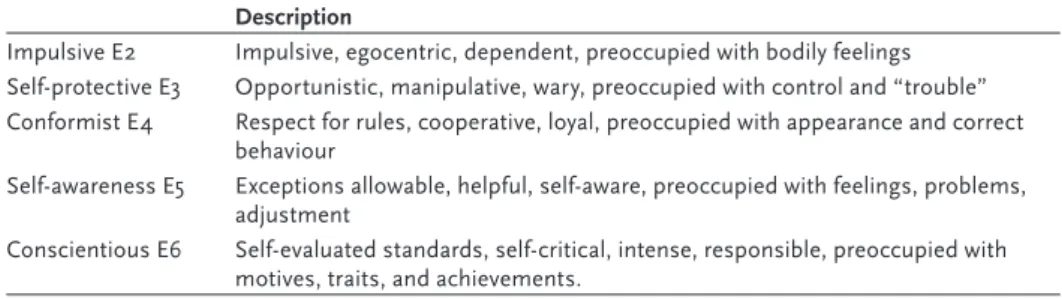
Loevinger (1976) described different stages of ego1, a term Loevinger used for the de-velopmental framework through which each individual interprets the world. Psychoso-cial development is viewed as personal growth experienced by every individual, entail-ing changes in impulse control, conscious preoccupations, character development and interpersonal orientation (the view on one self, on others, and the third-person-view on interaction between two persons). A central tenet is that the theory of psychosocial development consists of various levels and that individuals have to go through the levels in a fixed pattern. The theory identifies nine developmental levels2, each of them having its own unique characteristics. As far as the developmental levels of early adolescents are concerned, three of them are most relevant: the so-called Impulsive level (E2), the Self-protective level (E3), and the Conformist level (E4). Before the Impulsive level and further levels described above, a child enters the pre-social or Symbiotic level (E1). This level develops throughout the first years after birth and is therefore not measurable. The levels following the Conformist level E4 are the Self-awareness level (E5), the Conscien-tious level (E6), the Individualistic level (E7), the Autonomous level (E8) and the Inte-grated level (E9) (see Westenberg et al., 2000, for a detailed description of these levels). As transition from one level to the next is often gradual, also transition levels are identi-fied between each level (Loevinger, 1976). Table 1.1 summarises the characteristics of the five developmental levels that are most relevant from early to mid-adolescence.
Table 1.1 Levels of Psychosocial Development in Early to Mid Adolescence
Description
Impulsive E2 Impulsive, egocentric, dependent, preoccupied with bodily feelings Self-protective E3 Opportunistic, manipulative, wary, preoccupied with control and “trouble” Conformist E4 Respect for rules, cooperative, loyal, preoccupied with appearance and correct
behaviour
Self-awareness E5 Exceptions allowable, helpful, self-aware, preoccupied with feelings, problems, adjustment
Conscientious E6 Self-evaluated standards, self-critical, intense, responsible, preoccupied with motives, traits, and achievements.
Note. Based on Loevinger, J. (1997). Stages of personality development (p. 203). In R. Hogan, J. Johnson, & S. Briggs (Eds.), Handbook of Personality Psychology (pp. 199-208). San Diego, CA: Academic Press. Reprinted with permission.
1 Loevinger referred in her theory to stages of ego development. This ego is not defined as in the psychoanalytical theories. Nonetheless, current thesis will refer to psychosocial development or psychosocial maturity, which is a satisfying and more concrete definition for the theory. 2 This thesis uses the concept level instead of stage. Reason to do so is that stage implies a
In the Impulsive level (E2), which is most prevalent until the age of ten, there is a fast admittance to aggressive, but also empathic impulses. Impulsive children expect that others will satisfy their needs and desires. At the same time they expect that parents are giving guidelines of which behaviour is allowed and which is not. This obedience is nevertheless overshadowed by their impulsivity.
The Self-protective level (E3) is most prevalent in pre- and early adolescence, from 10-13 years, the same period in which the steepest increase in prevalence of problem behaviour occurs. Early adolescents in the Self-protective level have an ability to manage things independently and they may feel indisputable. This level is qualitatively different from the Impulsive level, which is characterised by dependency on others and in which autonomous behaviour rarely occurs. In the Self-protective level, rules made by others are meant to be broken, as long as one does not get caught or punished. Reactions of adolescents in this level are often opportunistic; adolescents search for, mostly, instru-mental relationships with others. The adolescent attempts to control his/her impulses and emotions, but at the same he/she denies and keeps off negative emotions. As a con-sequence, the adolescent presents him/herself as being unassailable.
The Conformist level (E4) that generally sets in around the age of 12-13 is, unlike the Self-protective level, characterised by the importance given to equality and reciprocity in relationships. Relationships with others have become relevant goals. This level in-volves an important shift in thoughts of the adolescent: it is a change from the relatively egocentric character of the previous level into a more pro-social attitude towards the world. However, conformist behaviour is also possible towards non-conventional groups; identification occurs through detecting expressions of social desirable behaviour and criticism or rejection. The prevalence of the Conformist level increases strongly during middle adolescence (Westenberg et al., 2000).
In adolescence, the last relevant level is the Self-awareness level (E5). Here, the focus is changed to the (inner) Self, instead of the group. Rules are guidelines while in the previ-ous level rule obedience is essential. The personal feelings and characteristics do not have to be in line with the characteristics that are socially desirable. One consequence of the focus towards the own individual is that there is more caution regarding influ-ences by others. This does not imply that the outer world is totally irrelevant; Self-aware individuals are sensitive to appreciation and also concerned with rejection. Unlike the more collective constitution in the Conformist level, fear for loneliness is here seen as the price to be paid when trying to hold on to your own personality.
1.6 Research on Loevinger’s theory of psychosocial development and delinquent behaviour
The relation between level of psychosocial development and problem behaviour has been studied to a limited extent. There are three studies of relevance. Frank and Quinlan (1976) studied the relation between girl delinquency and levels of psychosocial devel-opment. Delinquent girls were significantly more often in lower developmental levels (mostly E2) than non-delinquent girls. Non-delinquent girls were more prevalent in the Self-protective level (mostly E3). An additional finding was that reasons for fighting dif-fered qualitatively between the Impulsive level and the Self-protective level. Impulsive girls fought randomly without a reason, where self-protective girls only fought when they had to (Frank & Quinlan, 1976). So, the distinction with psychosocial maturity levels made it possible to distinguish instrumental arguments for committing an offence from (basal) impulsive reasons.
More recently, Krettenauer and colleagues (2003) carried out a longitudinal study on psychosocial development and behavioural problems. They found that psychosocial development predicted externalising problems. The largest prevalence of externalising problems was found among youths in the Impulsive and the Self-protective level. Fur-ther results indicated that children with externalising problems had stagnated in their psychosocial development around the 12th year, i.e., in early adolescence (Krettenauer, Ullrich, Hofmann, & Edelstein, 2003).
Hauser and colleagues (1990, 1991) did not emphasise the possible relation between adolescent psychosocial development and problem behaviour. However, they contrib-uted significantly to the understanding of psychosocial maturity from a developmental point of view. In their studies, particular attention was given to underdevelopment of psychosocial maturity. The developmental aspect that Hauser studied originated from the implementation of paths of psychosocial development instead of studying levels of psychosocial development. The research focussed on the interaction between the ado-lescent and his parents. Results showed that adoado-lescents on a pre-normative psychoso-cial path had more superfipsychoso-cial and difficult parental relations (Hauser, Borman, Powers, Jacobson, & Noam, 1990; Hauser, Powers, & Noam, 1991). The latter phenomenon has already received support as a risk factor for problem behaviour (Loeber & Stouthamer-Loeber, 1986; Hoeve, 2006).
Next to the studies mentioned above, other studies also showed evidence for an associa-tion between lower levels of psychosocial development and a higher prevalence of con-duct disorder or other problem behaviour (DiNapoli, 2002; Noam, Hauser, Santostefano, Garrison, Jacobson, Powers, & Mead, 1984; Noam, Paget, Valiant, Borst, & Bartok, 1994; Noam, Recklitis, & Frome-Paget, 1991; Recklitis & Noam, 2004).
As such, it is difficult to assess if the relationship between behavioural problems and psychosocial development can be generalised to the population. It is also unknown if more mild delinquent behaviour relates to the Impulsive and Self-protective level. Lastly, within such a clinical sample it is very well possible that the relationship is spurious. This means that certain levels of psychosocial development and problem behaviour are presented simultaneously, but do not necessarily have a relation with each other. The population used could very well already be a high risk group of showing problematic behaviour, due to other factors.
A second and related reason is that, on the one hand, empirical studies reported that serious problem behaviour is related to stagnating psychosocial development (that is, stagnating in the Impulsive level). A possible explanation is that a stagnating develop-ment leads to incongruence with peers and skewed expectations from peers and authori-ties. This social effect does not contribute to a re-boost in psychosocial maturity. There are also results that suggested a negative effect on psychosocial maturity when the cause is found in adverse parental circumstances (e.g., families with bad parenting practices). As a result the children’s psychosocial maturity cannot reach it potential and leads to stagnation in their development (Hauser et al., 1990; Hauser et al., 1991). Also, not only environmental factors play a role in deviant psychosocial development. On an individual level, criminological and psychological research clearly points out that several personal-ity characteristics are related to delinquent behaviour (e.g., basal aggressive behaviour, temper, and lack of impulse control) in the Impulsive level. These personality character-istics are factors that relate to the description of the Impulsive level. All these similarities suggest that a stagnating psychosocial development may be related to serious forms of misbehaviour and delinquency. This has however not been studied yet.
delin-quent and non-delindelin-quent girls (Frank & Quinlan, 1976). Similarly, Hauser used a stage-oriented approach in his longitudinal research.
The concept of creating paths around the Conformist level has however led to interesting results on the study of parent-child interaction (Hauser et al., 1990). The interpretation of this research all focussed on pre-conformist and post-conformist levels of psychoso-cial development. Krettenauer and colleagues also used a stage-oriented approach in the longitudinal investigation of internalising and externalising problems relating to ego-level attainment (Krettenauer et al., 2003). Although these studies point out which levels are more common in adolescents who exhibit deviant behaviour, they are not able to place these results in a developmental perspective because normativity itself changes over time: the level that is normative changes. Therefore, studying one particular level in deviant behaviour does not seem very helpful.
A normative approach instead focuses more on the development of the adolescent and places relevance more to the relative individual development instead to the absolute level
of psychosocial development. Over time, the normative psychosocial level of the person changes in relation to the age of the adolescents. Subsequently, the deviance of certain behaviours changes over time. This approach of relating development of psychosocial maturity to problematic behaviour therefore is a more promising theoretical perspective. Lastly, problem behaviour has a similar pace of development in early and mid adolescen-ce as psychosocial maturity. They both change a lot from the age of twelve year onwards. This approach can therefore also explain if their changing pace in development relate to each other.
In this thesis various operationalisations of psychosocial development were used. Next to studying variation in level of psychosocial maturity, the longitudinal studies also analy-ses paths of psychosocial development from Wave 1 (2002) to Wave 2 (2004). These paths are partly inspired by the work of Hauser and colleagues and the study of Hennighausen and colleagues (Hauser et al., 1990; Hauser et al., 1991; Hennighausen, Hauser, Billings, Schultz, & Allen, 2004). Five different paths are constructed: The Normative path (nor-mal psychosocial development from Wave 1 to Wave 2); The Stagnating path (no develop-ment between Wave 1 and Wave 2; The Lagging behind path (delayed developdevelop-ment from Wave 1 to Wave 2); The Precocious path (speeded development from Wave 1 to Wave 2); and lastly the Regressing path (a descending development from Wave 1 to Wave 2).
1.7 Data in current thesis
level, called VMBO3. Several reasons are based on the notion of choosing these adoles-cents. First of all, adolescents at this school level are the largest category in secondary school and, secondly, they pose a relatively high risk in The Netherlands for behaving deviant. Completion of the questionnaires was done in the class. The data was collected through a computerised questionnaire. With the completion of the questionnaire, the students received a small incentive (CD coupon of € 5, -). The study’s aim was to collect as much data as possible on students’ behaviour in school and outside the school. The questions primarily focussed on the behaviour that was (and still is) brought into atten-tion: problem behaviour. The survey contained, next to problem behaviour, also other questions on demographical information, personality characteristics, school climate, parental climate and peer situations.
The project collected data from the entire period that the adolescents undergo their school career at the VMBO level. This was made possible through the use of an acceler-ated procedure of data collection. The data sample was divided in two cohorts, A and B, and was collected simultaneously. So, in 2002 adolescents in the first (A) and third (B) year of secondary school were asked to fill out the questionnaires. In 2003, the second (A) and fourth (B) year were asked to complete the questionnaire. In 2004 the fourth year of cohort A is for the last time asked to complete the questionnaire. This procedure gave the opportunity to create a perspective on how these adolescents develop. The cur-rent study on psychosocial development uses data from cohort A in the first (2002) and third year (2004) the adolescents are in school. The sample distribution can be seen in Table 1.2.
Table 1.2 Distribution of the Sample in Time 1, Time 2, and Longitudinal after Attrition
2002 2004 2002 → 2004
Total in sample 1048 (100.0%) 949 (100.0%) –
Total 811 (77.4%) 868 (91.5%) 539 (100.0%)
Boys 418 (51.5%) 440 (50.7%) 271 (50.3%)
Girls 393 (48.5%) 428 (49.3%) 268 (49.7%) Each time, the sample of adolescents was tested with two instruments; one instrument regarding the general questionnaire concerning problem behaviour, peer factors, and parental factors, and one instrument concerning the measurement of psychosocial de-velopment. The sentence completion test (youth version originally named the “Zinnen-Aanvullijst Curium” (or ZALC) measured the levels of psychosocial development. The time interval between these measurements was relatively short (within approximately two weeks).
1.7.1 Variables
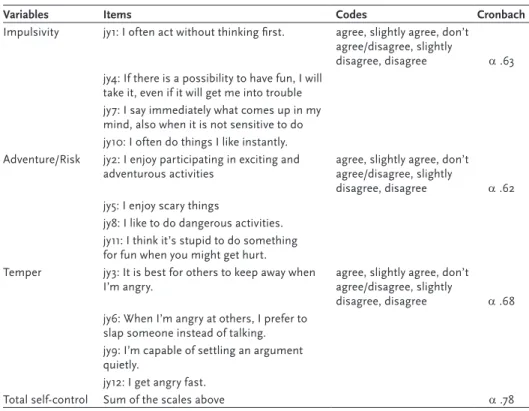
The current thesis addresses general problem behaviour. There are differences in frequen-cy and severity between of problem behaviour. In order to make proper interpretations, several distinctions are created throughout the following studies. The first distinction made is between misbehaviour (or rule breaking behaviour) in school and delinquent be-haviour outside school. The “misbehaviour in school” category has 10 items varying from throwing things in class to “threatening the teacher”. Overall, the items are more char-acterised as rule breaking behaviour. The other category is delinquency outside school. Here, 13 items are asked varying from fare dodging to robbery and car theft.
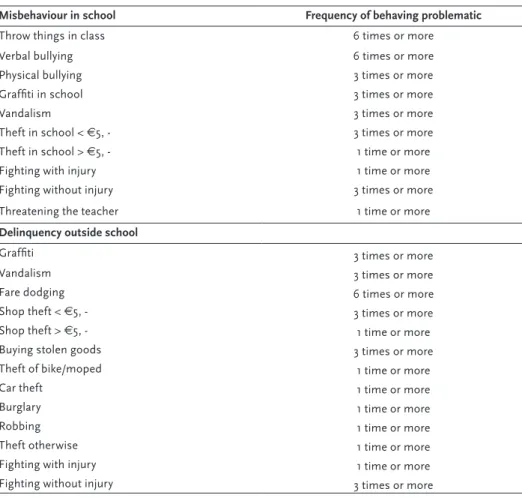
A second distinction that is made throughout the studies regards severity. There is a rough differentiation made by looking inside school and outside school. However, by viewing the total of 23 items separately on severity, current thesis aims to get more hold on the type of offence in relation to the level of psychosocial maturity. Six criminologists were asked to complete an enquiry on severity. All 23 items were displayed and each respondent was asked if they considered the offence type was mild, moderate or severe. An offence is mild when the criminologists thought the behaviour is really deviant and problematic after the adolescent has committed the offence six times or more in a year. An offence is moderately severe when the criminologists evaluated the offence as deviant when it is committed three times or more in a year. Lastly, an offence is severe when the criminologists evaluated the offence as deviant when it is committed one time or more in a year. All interpretations were analysed. Offences were rated according to the interpreta-tion of the majority, and for some offences the authors decided the category of severity as the criminologists’ decision reached a tie. Table 1.3 gives an overview of the items used and the distinctions made per item on category and severity.
Table 1.3 Types of Problem Behaviour and Severity Rate (Mild Severity = 6; Moderate Severity = 3; Severe = 1)
Misbehaviour in school Frequency of behaving problematic
Throw things in class 6 times or more Verbal bullying 6 times or more Physical bullying 3 times or more Graffiti in school 3 times or more
Vandalism 3 times or more
Theft in school < €5, - 3 times or more
Theft in school > €5, - 1 time or more
Fighting with injury 1 time or more Fighting without injury 3 times or more Threatening the teacher 1 time or more
Delinquency outside school
Graffiti 3 times or more
Vandalism 3 times or more
Fare dodging 6 times or more
Shop theft < €5, - 3 times or more
Shop theft > €5, - 1 time or more
Buying stolen goods 3 times or more Theft of bike/moped 1 time or more
Car theft 1 time or more
Burglary 1 time or more
Robbing 1 time or more
Theft otherwise 1 time or more Fighting with injury 1 time or more Fighting without injury 3 times or more
1.8 Outline
This thesis aims to examine whether psychosocial development can contribute to the answering of the question why a juvenile offender increases in misbehaviour or even commits an offence. As such, this thesis describes and tests the relation between psy-chosocial development and the development of problem behaviour from early to mid adolescence. The following paragraph gives a brief description of the four empirical chapters. In Table 1.4 a schematic representation is given of the four chapters4.
Table 1.4 Overview of Empirical Chapters
Chapter 2 Chapter 3 Chapter 4 Chapter 5
Question To what extent is there a relation between delinquent behaviour and the stage of psycho social development?
To what extent do levels of psycho-social development have an independent and complimentary effect on delinquent behaviour besides the effect of different aspects of self-control?
How and to what extent are pathways of psychosocial development related to individual differences in involvement and development of problem behaviour in adolescence?
What is the supplemental contribution of psychosocial development on problem behaviour in early to mid adolescence over and above the influence of parent behaviour and peer influence?
Data – School project Wave 1
– School project Wave 1
– School project Wave 1 & 3
– School project Wave 1 & 3
Dependent variable
– Misbehaviour and
delinquency items
– Mild/Moderate/ Severe misbehaviour – Mild/Moderate/
Severe delinquency
– Mild/Moderate/ Severe misbehaviour – Mild/Moderate/
Severe delinquency
– Total scales of problem behaviour
Independent variable
– Levels of psychosocial development
– Levels of psycho-social development – Self-control
dimensions
– Regressing path of psychosocial development – Stagnating path
of psychosocial development – Lagging path
of psychosocial development – Normative path
of psychosocial development – Precocious path
of psychosocial development
– Precocious path of psychosocial development – Underdeveloping
path of psychosocial development – Parental supervision – Parental Bonding – Exp warmth parents – Time spent parent – Time spent peers
Statistical technique
– Chi-square analysis
– Analysis of (co)-Variance
– Analysis of Variance – Paired sampled
T-test
– Linear Regression analysis
fac-tors. This relation is investigated through the implementation of paths of psychosocial maturity. As such, the study is capable of testing levels (on time 2) and paths (from time 1 to time 2) of psychosocial maturity in relation to the way problem behaviour develops. It is expected that a deviant, troubled psychosocial development associates with serious problem behaviour. At the same time, it is expected that differences are seen in level of problem behaviour between the normative development and deviant development. Although one would expect little or no problem behaviour occurring in a normative development, we tested this as a hypothesis. In Chapter five the longitudinal effect is studied of psychosocial development, peer factors and parental effects on the develop-ment of problem behaviour. This chapter represents to a great deal the central research question from a longitudinal perspective: To what extent is there a relation between psy-chosocial development and problem behaviour in early to mid adolescence over and above
the influence of parent behaviour and peer influence? Chapter six gives a summary of the findings presented in each chapter. Furthermore, we recapitulate the interpretations of the various research questions that have been answered. With the answers found on the various research questions that will be addressed, this thesis aims to provide future theoretical and empirical directions in field of developmental criminology and develop-mental psychology.
1.9 References
Akers, R.L. (1998). Social learning and social structure: A general theory of crime and deviance. Boston: Northeastern University Press.
Bijleveld, C.C.J.H., Bakker, L. & Hendriks, J. (1998). Contact crimes in relation to neuroticism, impulsiveness, conscience formation and intelligence: an exploratory discriminant analysis in juvenile delinquents. Psychology, Crime and Law, 4(4), 341-360.
Bokhorst, C.L., Sumter, S.R., & Westenberg, P.M. (2007). Parents, friends, classmates, and teachers: Age and gender differences in perceived social support in children and adolescents aged 9 to 18 years. Submitted for publication.
CBS (2003). Jeugd 2003, cijfers en feiten [Youth 2003, numbers and facts]. Voorburg (NL): Centraal Bureau voor de Statistiek.
Cohn, L.D. (1998). Age trends in personality development: a quantitative review. In: P.M. Westenberg, A. Blasi & L.D. Cohn (Eds.), Personality development: theoretical, empirical, and clinical investigations of Loevinger’s conception of ego development. Mahwah: Erlbaum (pp. 133-143).
DiNapoli, P.P. (2002). Adolescent violent behavior and ego development. Journal of Adolescent Health, 31, 446-448.
Donker, A. (2004). Precursors and Prevalence of Young Adult and Adult Delinquency. Unpublished Dissertation, Leiden University, Leiden.
Farrington, D.P. (1986). Age and crime. In: Crime and Justice: an Annual Review of Research (Vol. 7, pp. 189-250). Chicago, University of Chicago Press.
Frank, S. & Quinlan, D. (1976). Ego development and female delinquency: A cognitive-developmental approach. Journal of abnormal psychology, 85(5), 505-510.
Grasmick, H.G., Tittle, C.R., & Bursik, J.R.J. (1993). Testing the core empirical implications of Gottfredson and Hirschi’s general theory of crime. Journal of research in crime and delinquency, 30(1), 5-29.
Hauser, S.T., Borman, E.H., Powers, S.I., Jacobson, A.M., & Noam, G.G. (1990). Paths of adolescent ego development: links with family life and individual adjustment.
Psychiatric Clinics of North America, 13(3), 489-510.
Hauser, S.T., Powers, S.I., & Noam, G.G. (1991). Paths through adolescence. In S.T. Hauser, S.I. Powers & G.G. Noam (Eds.), Adolescents and their families. New York: Free Press.
Hennighausen, K.H., Hauser, S.T., Billings, R.L., Schultz, L.H., & Allen, J.P. (2004). Adolescent ego development trajectories and young adult relationship outcomes.
Journal of early adolescence, 24(1), 29-44.
Hirschi, T. (1969). Causes of delinquency. Berkeley and Los Angeles: University of California Press.
Hoeve, M. (2006). Opvoeding en delinquent gedrag: een meta-analyse. In J.R.M. Gerris (Ed.), Gezinsonderzoek: het belang van school, ouders, vrienden en buurt[Family studies: the importance of school, parents, peers and neighbourhoods] (Vol. 20, pp. 49-64). Assen: Van Gorcum.
Junger-Tas, J. (1992). Criminaliteit en leeftijd [Crime and Age]. Justitiële Verkenningen, 18(3), 66-89.
Junger-Tas, J., Haen Marshall, I., & Ribeaud, D. (2003). Delinquency in an International Perspective. The International Self-Reported Delinquency Study (ISRD). Amsterdam: Kugler.
Krettenauer, T., Ullrich, M., Hoffmann, V. & Edelstein, W. (2003). Behavioral problems in childhood and adolescence as predictors of ego-level attainment in early adulthood.
Merrill-Palmer Quarterly, 49(2), 125-153.
Laan, A.M. van der, & Blom, M. (2006). Jeugddelinquentie: risico’s en bescherming: bevindingen uit de WODC Monitor Zelfgerapporteerde Jeugdcriminaliteit [Juvenile delinquency: risks and protection: findings from the WODC-monitor self-reported juvenile delinquency]. (No. Onderzoek & Beleid, vol. 245). Den Haag: WODC / Boom Juridische Uitgeverij.
Laub, J.H., & Sampson, R.J. (2003). Shared Beginnings, Divergent Lives. Delinquent Boys to Age 70. Cambridge: Harvard University Press.
LeBlanc, M. (2005). An integrative personal control theory of deviant behavior: answers to contemporary and theoretical developmental criminological issues. In D.P. Farrington (Eds.), Integrated Developmental & Life-Course Theories of Offending: Advances in Criminological Theory, vol. 14. New Brunswick, NJ: Transaction.
Lilienfeld, S.O., Wood, J.M., & Garb, H.N. (2000). The scientific status of projective techniques. Psychological Science, 1(2), 27-66.
Loeber, R., & Farrington, D.P. (2000). Young children who commit crime: epidemiology, developmental origins, risk factors, early interventions, and policy implications.
Development and psychopathology, 12, 737-762.
Loeber, R., & Stouthamer-Loeber, M. (1986). Family factors as correlates and predictors of juvenile conduct problems and delinquency. In M. Tonry (Ed.), Crime & Justice, A Review of Research (Vol. 7, pp. 29-150). Chicago: University of Chicago Press.
Loevinger, J. (1976). The domain: ego and character. Ego development. San Fransisco, Jossey-Bass: 1-12.
Loevinger, J. (1997). Stages of personality development. In R. Hogan, J. Johnson, & S. Briggs (Eds.), Handbook of Personality Psychology (pp. 199-208). San Diego, CA: Academic Press.
Manners, J., & Durkin, K. (2001). A critical review of the validity of ego development theory and its measurement. Journal of Personality Assessment, 77(3), 541-567. Mertens, N.M, Grapendaal, M., & Docter-Schamhardt, B.J.W. (1998). Meisjescriminaliteit
in Nederland [Girl delinquency in The Netherlands] (No. Onderzoek & Beleid, vol. 169). Den Haag: Ministerie van Justitie.
Miller, J.D., & Lynam, D. (2001). Structural models of personality and their relation to antisocial behavior: a meta-analytic review. Criminology, 39(4), 765-795.
Moffitt, T.E. (1993). Adolescence-limited and life-course persistent antisocial behavior: a developmental taxonomy. Psychological Review, 100(4), 674-701.
Noam, G.G., Hauser, S.T., Santostefano, S., Garrison, W., Jacobson, A.M., Powers, S.I., & Mead, M. (1984). Ego development and psychopathology: a study of hospitalised adolescents. Child Development, 55, 184-194.
Noam, G.G., Paget, K., Valiant, G. Borst, S., & Bartok, J. (1994). Conduct and affective disorders in developmental perspective: a systematic study of adolescent psychopathology. Development and psychopathology, 6, 519-532.
Noam, G.G. Recklitis, Ch.J., & Frome-Paget, K. (1991) Pathways of ego development: contributions to maladaptation and adjustment. Development and psychopathology, 3, 311-328.
Nijboer, J. (1997). Delinquentie en dwang: Ontwikkeling van delinquent gedrag bij leerlingen in het voortgezet onderwijs [Delinquency and force: the Development of delinquent behaviour at student in secondary school]. Groningen: Rijksuniversiteit Groningen. Recklitis, Ch.J., & Noam, G.G. (2004). Aggressive behavior in the adolescent psychiatric
patient: a clinical-developmental perspective. Child Psychiatry and Human Development, 34(4), 341-361.
Steinberg, L., & Caufmann, E. (1996). Maturity of judgment in adolescence: Why adolescents may be less culpable than adults. Behavioral sciences and the Law, 18, 741-760.
Thornberry, T.P. & M.D. Krohn (2003). Taking stock of delinquency: An overview of findings from contemporary longitudinal studies. New York, Kluwer academic / Plenum publishers.
Tremblay, R.E. (2000). The development of aggressive behaviour during childhood: what have we learned in the past century? International Journal of Behavioral Development, 24(2), 129-141.
Westenberg, P.M., Drewes, M.J., Siebelink, B.M., Treffers, Ph.D.A., Jonckheer, J., & Goedhart, A.W. (2000). Zinnen Aanvullijst Curium (ZALC). Een instrument voor het meten van ego-ontwikkeling. [Sentence Completion Test Curium (ZALC). An instrument of measuring ego development]. Lisse, NL: Swets & Zeitlinger.
2
The relation between levels in psychosocial
development and delinquent behaviour in early
adolescence
1In this article we investigate the relation between psychosocial development levels and delin-quency in young adolescents. Questionnaires were administered to approximately 800 (12-13 year old) students who also completed a sentence completion test, the ZALC (based on the WUSCT, a test developed by psychologist Jane Loevinger). The results show a clear pattern over different offences, although strong statistical evidence is lacking for the separate items. First, a relation is found between being in the “Self-protective level” and prevalence of different types of misconduct at school and less serious types of delinquency. Also a clear association between being in the “Impulsive level” and serious and violent delinquency was found. Ado-lescents with a socio-emotional development below the Self-protective level have a 1.5 to 4-fold increased risk of committing aggressive misconducts and offences.
2.1 Introduction
Research has shown that delinquent behaviour increases sharply in early adolescence (starting at 12 years old), peaks around 17-19 years, and from then onwards slowly de-creases (see also Farrington, 1986; Moffitt, 1993). Up till now a general agreement exist on the shape of the curve. However, many of the factors that contribute to the particu-lar shape of the curve remain unclear. Hirschi and Gottfredson (1983) suggest that the relation between age and delinquent behaviour is the same for everyone, rendering the relation invariant. They argue that only the differences in delinquency require an expla-nation. This point of view is incongruent with mainstream criminological perspectives, as most authors agree that an explanation is needed for the development and change in criminal behaviour over time (see for instance Farrington, 1986, 2003; Moffitt, 1993; Warr, 1993). One issue of importance is the increase in delinquent behaviour in early adolescence.
Recently, developmental and life-course criminology has paid considerable attention to: a) the development of problem behaviour and delinquency, b) the risk factors for devel-oping a criminal career and c) the effects of certain life experiences on the course of
1 This chapter has been published in Dutch as an article: Ezinga, M.A.J., Weerman, F.M., West-enberg, P.M., & Bijleveld, C.C.J.H. (2006). De relatie tussen stadia in de persoonlijkheidson-twikkeling en delinquent gedrag in de vroege adolescentie [The relation between levels of per-sonality development and delinquent behaviour in early adolescence]. Tijdschrift voor Criminologie, 43(3), 259-274.
criminal careers (Donker, Kleemans, Van der Laan, & Nieuwbeerta, 2004; LeBlanc & Loeber, 1998). Relatively little attention has been paid to the explanation of the sharp increase in delinquent behaviour at the beginning of the adolescent period. One excep-tion in developmental criminology is Moffitt’s ‘taxonomic’ model. Here, Moffitt offers suggestions to clarify the development of delinquent behaviour in adolescence. She sug-gests that a large group of adolescents starts with relatively mild forms of delinquencies. Eventually, these same adolescents end with this behaviour (Moffitt describes this group as adolescence-limited or adolescence-onset). Along with the main group of limited offend-ers, a small subgroup exists that is active in relatively serious delinquent acts. These adolescents are called life-course persistent (Donker, 2004; Moffitt, 1993).
Delinquent behaviour of persistent offenders can be explained by innate factors, prob-lematic parenting strategies and the interaction between these two attention areas that leads to an escalation of problem behaviour. According to Moffitt, adolescent-onset crime originates from imitating persistent offenders. This imitation takes place when we are faced with a ‘maturity gap’. This occurs when young adolescents seem to grow to physi-cal maturity, but do not get that mature treatment by others in their immediate envi-ronment. Persistent offenders seem to have this status (they own a relative autonomic attitude, possess enough money and are often experienced in sexuality). According to Moffitt this is reason enough for adolescence-onset offenders to imitate the persistent offenders in their criminal behaviour (Moffitt, 1993).
Developmental criminology offers, along with models for the development of delinquent behaviour in different trajectories, many perspectives about risk factors for developing delinquent behaviour. Well known examples are studies on problematic parenting, low socio-economic status in the family (SES), delinquent peers and a negative school- and neighbourhood climate (see Farrington, 2003). Empirical research also shows that per-sonality factors such as impulsivity and thrill seeking (Bijleveld, Bakker, & Hendriks, 1998; Heaven, 1996), ego resilience (Westenberg & Block, 1993), lack of empathic reflec-tions (Carlozzi, Gaa, & Libermann, 1983), and a lagging moral development (Blasi, 1980; Brugman & Aleva, 2004; Nelson, Smith, & Dodd, 1990), play a critical role as risk factors for delinquent behaviour.
These studies assume personality factors to be relative static constructs. At the same time, recent studies show considerable development in moral reasoning, identity and social emotions during adolescence (Meeus, 1993; De Wit, Van de Veer, & Slot, 1995). Theories concerned with the relation between personality characteristics and delinquent behaviour (for instance Eysenck, 1964; Hirschi & Gottfredson, 1990) hardly take into ac-count this developmental trend. Moffitt’s taxonomic model also uses personality factors to explain the behaviour of persistent offenders, thus assuming they are static in nature. It may be quite possible that personality development in adolescence is related, to a cer-tain extent, to the strong increase in delinquent behaviour during that particular period. Then, a dynamic or development-orientated theory of personality could contribute to the explanation of a strong increase of delinquency in adolescence.
to contribute a possible explanation for the changing character of delinquency in ado-lescence.
The current paper is based on data collected from approximately 800 adolescents, and tries to explore a possible relation between delinquent behaviour of early adolescents and the level of psychosocial development they are presently in. In the next paragraph we describe Loevinger’s theory of psychosocial development. Subsequently, we formulate two hypotheses according to the theory and existing empirical results:
– We expect a relation between a stagnating developmental level and serious problem behaviour.
– We expect a relation between a normative developmental level and milder delinquent behaviour.
2.2 Psychosocial development and delinquency
Loevinger’s developmental theory concerns the personal growth of impulse control, in-terpersonal relations, character development and abstracting self-consciousness. The theory is not necessarily concerned with moral development or attachment, but seems most appropriately characterised as a holistic framework of personal growth ( Westenberg, Blasi, & Cohn, 1998). Loevinger spoke, therefore, about ego development and the devel-opment of the central framework of references, on which each individual relates himself with another individual. Considerable research is carried out by Loevinger (and in The Netherlands by Westenberg and colleagues). Each time her theory is, with the help of empirically founded results, extensively studied and optimised.
The original theory distinguishes nine levels of developmental levels (each of which is labelled with E#, the abbreviation of Ego). Empirical studies showed that five develop-mental levels exist that are most prevalent with the cohort of 8-25 year olds. These are the Impulsive (E2), the Self-protective (E3), the Conformist (E4), the Self-awareness level (E5) and the Conscientious level (E6) (Westenberg, Drewes, Siebelink, Treffers, Jonckheer, & Goedhart, 2000). The Conscientious level is relatively scarce in the adolescent period and will be left out in this paper. Table 2.1 briefly describes the four remaining levels that are relevant for adolescence.
Table 2.1 Characteristics of the most frequent developmental levels in early adolescence
Impulsive E2 Combination of impulsivity (key factor), vulnerability, dependency and obedience. Self-protective E3 Unassailable, opportunistic, instrumental relationships, attempt to control own
impulses and emotions. Hedonistic attitude.
Conformist E4 Conformity, equality in relationships, pro-social behaviour, social desirability. Self-awareness E5 Self-aware, emphasizing the singularity, personal relation. Tolerance towards other
opinions.
The Self-protective level (E3) is most prevalent in pre- and early adolescence, from age 10 to age 13, the period in which the steepest increase in prevalence of problem behaviour occurs. Early adolescents in the Self-protective level have an ability to manage things independently and they may feel beyond reproach. This level is qualitatively different from the Impulsive level, which is characterised by dependency on others and in which autonomous behaviour rarely occurs. In the Self-protective level, rules made by others are meant to be broken, as long as one does not get caught or punished. Reactions of adolescents in this level are often opportunistic; adolescents search for, mainly, instru-mental relationships with others. The adolescent attempts to control his/her impulses and emotions, but at the same time he/she denies and fends off negative emotions. As a consequence, the adolescent presents him/herself as being unassailable.
The Conformist level (E4) that generally sets in around the age of 12-13 is, unlike the Self-protective level, characterised by the importance given to equality and reciprocity in relationships. Relations with others are goals that are stand-alone. This level involves an important shift in thoughts of the adolescent: it is a change from the relatively egocentric character of the previous level into a more pro-social attitude towards the world. How-ever, conformist behaviour is also possible towards non-conventional groups; identifica-tion occurs through detecting expressions of social desirable behaviour and criticism or rejection. The prevalence of the Conformist level increases strongly during middle adolescence.
Lastly, the Self-awareness level is characterised by a focus on the inner self. There is atten-tion to the own experienced feelings, even when they are not socially desirable. Singular-ity and sincerSingular-ity are important, just like accepting each others feelings and opinions. Before the Impulsive level there is a level called pre-social, or the Symbiotic level (E1). This level is experienced throughout the first years after birth and is therefore not meas-urable. The levels after the Self-awareness level are the Conscientious level (E6), the In-dividualistic level (E7), the Autonomous level (E8) and the Integrated level (E9)2. Large-scale research on Dutch children and adolescents showed that the Impulsive level is most prevalent until the age of 10; in early adolescence, an increase in prevalence occurs towards the Self-protective level. Prevalence of the Conformist level increases rapidly in mid-adolescence, whereas the Self-awareness level increases during late adolescence (Westenberg et al., 2000).
The relation of psychosocial development with delinquency during the adolescent period could relate in several ways. First of all, we could presume that delinquency relates with stagnation in development (stagnation hypothesis); in that case, delinquency would be more prevalent in the Impulsive level in early adolescents. This approach is most often used within problem behaviour research in developmental psychology. For instance, re-search showed that problem behaviour relates to lagging behind in moral development (Brugman & Aleva, 2004). However, the stagnation hypothesis is not capable of explain-ing why (mild) delinquent behaviour increases in a large group of early adolescents, and decreases afterwards (adolescent-onset delinquency). Nonetheless, the stagnation hypothesis seems useful in explaining more serious and life-course persistent
quency. Perhaps, a joint cause exists for a consistently low psychosocial level and serious delinquency, such as bad parenting. This is a factor that has an empirically established relationship with delinquency (Loeber & Stouthamer-Loeber, 1986).
A second possibility is that adolescent-limited delinquent behaviour relates to normative psychosocial development (normative hypothesis). Loevinger’s theory offers several sup-porting arguments for this postulation. For instance, the self-protective level is norma-tive in early adolescence. Self-protecnorma-tive individuals establish themselves as independent and they decide for themselves what is good and what is wrong. They regard themselves as inviolable and are opportunistic in their actions. Rules are meant to be broken, as long as one does not get caught or punished. These characteristics are normative, develop-ing throughout adolescence, but simultaneously they fit rather well with norm breakdevelop-ing behaviour. Although the previous level has impulsive behaviour as a key character, this individual is compliant at the same time. Parents or teaching authorities should be able to correct them effectively when something wrong is then forbidden. In short, regarding normative psychosocial development we expect at adolescents more problem behaviour and in specific mild problem behaviour, when these adolescents arrive in the self-protec-tive level in early adolescence.
Relatively little research is done regarding the relation between rule breaking behaviour and delinquent behaviour. Frank and Quinlan (1976) showed in their study that delin-quent institutionalised girls found themselves in a lower level of psychosocial develop-ment than girls not institutionalised or girls doing a leadership course. An additional conclusion was that the origin of violence differed considerably in the various levels. Adolescent girls in the Impulsive level acted violently rather impulsively and randomly. Girls in the Self-protective level used violence only when it was considered necessary. Krettenauer and colleagues (2003) showed in their longitudinal study that psychosocial development could predict externalising problems. These problems occur most in the second and third level; respondents who showed externalising problems stagnated in the development around the age of 12 (early adolescence) (Krettenauer, Ullrich, Hofmann, & Edelstein, 2003).
Furthermore, several studies investigated the relation between the developmental levels and variables concerned with externalising problem behaviour (i.e. dysfunctional family configuration, deviant coping strategies and negative stressors). With this information it can be concluded that psychosocial development relates negatively with externalising problem behaviour (Noam, Paget, Valiant, Borst, & Bartok, 1994; Novy, Gaa, Frankie-wicz, Liberman, & Amerikaner, 1992; Recklitis & Noam, 1999); Westenberg & Block, 1993).
2.3 Method
Data collection took place in 2002 and was part of the NSCR School Study (see Harland, Van der Laan, Smeenk, & Weerman, 2005). A questionnaire was given for three con-secutive years, with the baseline starting in 2002. This questionnaire collects data from students in secondary education (comparable to middle- and high schools in the U.S.). The data collected is about misbehaviour in school, delinquency outside school, friends, lifestyle, and bonding. A portion of the sample filled out the ZALC (ZinnenAanvulLijst Curium, Westenberg et al., 2000), a sentence completion test measuring psychosocial development according to established criteria. Through the combination of both datasets we were able to analyse the relation between psychosocial maturity and delinquency. 2.3.1. Participants
A total of 12 schools located in or near The Hague agreed to participate in this longitudi-nal study. Several factors were taken into consideration when approaching the schools, including type of education (technical vs. non-technical education, like health care, eco-nomical and business) and denomination. Survey data was obtained from first and third grade students in the first wave. The sentence completion test is only obtained from first graders, due to the intensive work. This resulted in three schools dropping out of the sample. Two of these participated only with third grade students and one school insisted only to participate in the survey. The final sample consists of students form nine differ-ent schools. Table 2.2 shows which studdiffer-ents participated in the final sample.
Table 2.2 Response rate
No participation 0,7% (7)
SCT-Y only 6,6% (69)
Survey only 15,4% (161)
Participated in both 77,4% (811)
Total 1st graders 100,0% (1.048)
The remaining schools produced a sample of 1.048 students from the first grade. The table shows a total of 811 students who reached the final sample. This is more than 77% of the total first grade-students. They completed both the survey as well as the SCT-Y (correctly).
The SCT-Y is filled out at a different time from the survey. Both questionnaires consisted of a thorough test procedure. All students were given information on the background of the study and the discrete handling of the acquired information. The emphasis was put on the individual response in the questionnaires. When the questionnaires were filled out correctly, students received a music compact-disc coupon (€5,-).
was from ethnic minorities (non-Dutch descent).3 The sample may be considered as a rough representation of juveniles in western Holland following low to average levels of secondary education (see also Weerman, Smeenk, Slotboom, Harland, Den Dijker, Bijleveld, & Van der Laan, 2003; Harland et al., 2005).
2.3.2 Rule breaking behaviour and delinquency
We used 23 self-report questions on rule breaking behaviour and delinquency to answer our research questions. Earlier reports from the NSCR-school project (see Harland et al., 2005) use the definition of rule breaking behaviour in school as misbehaviour, and out-side school as delinquency (for a detailed description of the questionnaire, see Weerman et al., 2003). This method of data collecting is commonly used in criminological studies. In the past, self-report methods were questioned on the basis of validity and reliability (Bruinsma, 1994; Van der Heijden, Sijtsma, & Hart, 1995; Swanborn, 1996). Nowadays most researchers are convinced of the method and its useful results when executed in a proper manner (see for instance Thornberry & Krohn, 2000). We gave particular atten-tion in this study to under-and over reporting, by cleaning the data carefully. We conse-quently deleted useless answering patterns (see Harland et al., 2005).
The current paper used questions on frequency of misbehaviour and delinquency: How many times did the students commit a delinquent act or misbehaviour in the past school year (response categories were 0, 1, 2, 3-5, 6-10, more than 10 times). The answers of the students were heavily skewed; we therefore chose to dichotomise them. We also chose to differentiate in behaviour that is considered a normal frequency and a deviant frequency, instead of yes/no (i.e. it is relatively normative behaviour for the age group of early adoles-cence). After all, our goal was to investigate the relation between psychosocial develop-ment and deviant behaviour.
The dichotomisation was achieved by conducting a small enquiry with six criminolo-gists, not involved in the present study. This enquiry gave us the opportunity to carry out an inter-rater reliability test on the chosen dichotomisation. For each item we deter-mined the best border between deviant and relatively normal behaviour. Six criminolo-gists, not involved in the present study, rated the severity of the offences. This resulted in six categorical subscales: mild misbehaviour, moderate misbehaviour, severe misbe-haviour, mild delinquency, moderate delinquency and severe delinquency. Mild offences were rated at six or more times committing in a year (fare dodging). Moderate severe of-fences are deviant after they have been committed three times or more (fighting without injury). Severe offences are deviant when committed just one or more times a year (car theft). There was a unanimous decision, or majority, for twenty of the offences and the misbehaviours. These offences were scaled in one of the three groups of severity at once. Three offences (verbal bullying, stealing property in school worth <€5,-, buying stolen goods) had an equal distribution between two scales. These items were subsequently placed in a group determined by the authors.
The original instrument measuring psychosocial development is the Washington Uni-versity Sentence Completion Test Youth (WUSCT-Y; Loevinger, Wessler, & Redmore, 1970). In 2000, Westenberg and colleagues developed a Dutch version, called the ZALC. This instrument consists of 32 incomplete sentences. Subjects (with the age range of 8-25) are then asked to complete these sentences from their own point of view. ‘My father…’; ‘when they avoided me…’; ‘raising children…’ are a couple of examples of incomplete sentences. Each completion can be related to a certain level of psychosocial development. Two qualified researchers using a detailed manual independently determined this item score. Following on the scoring is the comparison between the two raters. A definitive score is determined when scores between raters are not conclusive. It is also possible that no score can be found for a sentence completion. These scores are counted missing and do not weigh into the total score of level of psychosocial development. At the initial interpretation of the sentence completions in this study, a total agreement percentage of 86% was reached.
The distribution of the definitive item scores leads to an ultimate level of psychosocial development. There are two ways of calculating the definitive item scores. The first is called the automatic score. Respondents are distributed in one of the levels. The other is called the borderline score. This is a scoring technique that is more precise, because it uses transition levels between the normal psychosocial levels. In this way, individual subjects can be seen as developing from one to the other level.
The reliability of the ZALC has been tested on a regular basis. This is especially impor-tant, because its method of collecting data (sentence completion) is not free from scepti-cism. The test-retest reliability, as well as the internal consistency and stability of the scores, have shown during time that the overall reliability is sufficient.
In a critical review on projective techniques by Lilienfeld Wood and Garb (2000), re-search showed that the use of the sentence completion method by Loevinger is one of the most validated techniques that exist. Furthermore, the technique approaches standards on the academically accepted scale of zero-order and incremental validity (for an over-view see also Lilienfeld et al., 2000).
2.3.3. Analyses
We based our analyses on cross-sectional data. This means that we look at differences in psychosocial development of adolescents in the same age-cohort. We limit ourselves by investigating only the relation between levels of psychosocial development and the prevalence of misbehaviour or delinquent behaviour. Consequently, we are not able to make any comments on the relation between psychosocial development and changes in problem behaviour. That would require longitudinal data.
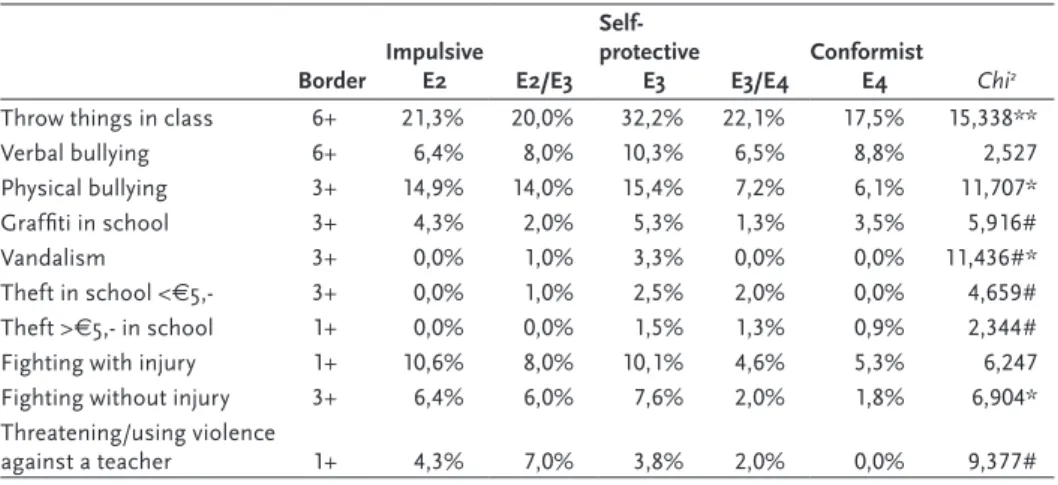
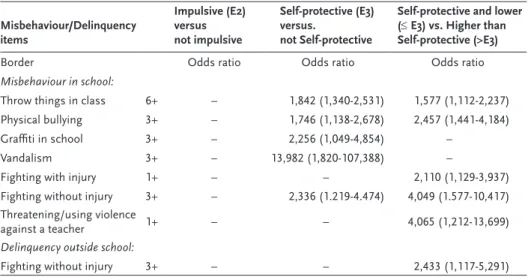
prob-lem behaviour. We also used odds-ratios to investigate the extent to which misbehaviour or delinquent behaviour is more prevalent in a certain level compared to the other.4
2.4 Results
Table 2.3 shows the total sample and the prevalence and mean variation (number of dif-ferent types) of misbehaviours in school and delinquent behaviour outside school, for both male/female. According to the table, quite a few students misbehave and commit offences. However, the mean number of committed offences is not that high. As is often found in criminological research, more boys than girls misbehave and commit offences. Boys also report more variation in misbehaviour and delinquency (see Harland et al., 2005 for detailed descriptive on each item).
Table 2.3 Prevalence of misbehaviour in school and delinquency outside school
Prevalence Total (n=811) Mean variation Boys (n=418) Mean variation Girls (n=393) Mean variation
Misbehaviour
in school 87,1% (706) 2,21 93,3%***(390) 2,67*** 80,4% (316) 1,73
Delinquency
outside school 56,5% (458) 1,17 62,0%**(259) 1,28* 50,6% (199) 1,05
*: p<.05 **: p<.01 ***: p<.001
Table 2.4 shows the distribution of the students with respect to the levels of psychoso-cial development. The upper section shows the distribution according to the automatic scores (levels only). The section beneath shows the distribution according to the transi-tion levels (borderline score). Upcoming analyses will make use of the borderline score distribution.
Table 2.4 Distribution of students between levels of psychosocial development
Total (n=811) Boys (n=418) Girls (n=393) Automatic score
Impulsive level E2 10,9% (88) 16,5% (69) 4,8% (19) Self-protective level E3 64,5% (523) 72,2% (302) 56,2% (221) Conformist level E4 and higher 24,7% (200) 11,2% (47) 38,9% (153)
Borderline score
Impulsive level E2 5,8% (47) 8,1% (34) 3,3% (13) Transition level E2/E3 12,3% (100) 16,5% (69) 7,9% (31) Self-protective level E3 49,0% (397) 58,6% (245) 38,7% (152) Transition level E3/E4 18,9% (153) 12,0% (50) 26,2% (103) Conformist level E4 and higher 14,1% (114) 4,8% (20) 23,9% (94)