IMPROVEMENT OF THE BIOAVAILABILITY OF POLYCYCLIC AROMATIC HYDROCARBONS IN FIELD-CONTAMINATED SOIL
Hongbo Zhu
A dissertation submitted to the faculty of the University of North Carolina at Chapel Hill in partial fulfillment of the requirements for the degree of Doctor of Philosophy in the Department of Environmental Sciences and Engineering, School of Public Health.
Chapel Hill, NC 2008
Approved by:
Michael D. Aitken, Ph.D., Advisor
Richard M. Kamens
Cass T. Miller, Ph.D.
Frederic K. Pfaender, Ph.D.
ABSTRACT
Hongbo Zhu: Improvement of the Bioavailability of Polycyclic Aromatic Hydrocarbons in Field-Contaminated Soil
(Under the direction of Michael D. Aitken)
The contamination of soils by polycyclic aromatic hydrocarbons (PAHs) has posed a serious threat to public health and ecosystems. Bioremediation of PAH-contaminated soils is a low-cost and relatively clean strategy. However, the bioremediation is not always successful, and one of the major causes is the limited PAH bioavailability to microorganisms in the soil system. Surfactant addition is a common strategy to increase the bioavailability of PAHs in the soil. We evaluated two nonionic surfactants, one hydrophobic (Brij 30) and one hydrophilic (C12E8), for their ability to enhance the biodegradation of PAHs and their
influence on groups of PAH-degrading bacteria in the bioreactor community that had previously been identified by DNA-based stable-isotope probing. The effects of each surfactant were evaluated at doses corresponding to equilibrium aqueous-phase concentrations well above the surfactant’s critical micelle concentration (CMC), slightly above the CMC, and below the CMC. The concentrations of all 3- and 4-ring PAHs were significantly reduced in the soil amended with Brij 30 at the two lower doses compared to controls, whereas removal of only the 3-ring PAHs was significantly enhanced at the highest Brij 30 dose. In contrast, C12E8 did not enhance PAH removal at any dose. Brij 30 addition at
C12E8 at the lowest dose actually decreased the desorption of all PAHs. Two groups of
ACKNOWLEDGEMENTS
My sincere gratitude goes to my advisor, Dr. Aitken, for his guidance, encouragement, and patience. Not only was he readily available for me, but he read and responded to the drafts of each chapter of my work even in his vacation. I also thank my committee members whose questions have been very insightful and helpful. It has been a pleasure to work with the other members of the Aitken research group; they taught me so much. I also thank Jack Whaley, our Student Services manager, for his numerous help for years.
TABLE OF CONTENTS
1. INTRODUCTION...1
1.1 PURPOSE AND SPECIFIC OBJECTIVES. ...6
1.2 SPECIFIC OBJECTIVES...7
1.3 DISSERTATION ORGANIZATION...8
2. LITERATURE REVIEW...9
2.1 PAH AND PAH CONTAMINATION...9
2.1.1 Physical properties ...9
2.1.2 PAH contamination ...11
2.2 PAH IN SOIL SYSTEMS...12
2.2.1 Soil organic matter ...12
2.2.2 Combustion residue particulate carbon ...14
2.2.3 Nonaqueous-phase liquids (NAPLs)...15
2.2.4 Mineral surfaces ...15
2.3 AGING PROCESS...16
2.4 BIOREMEDIATION...17
2.4.1 Bioavailability and bioremediation ...18
2.4.2 Desorption of PAHs...21
2.4.3 Biodegradation of PAHs...26
2.4.4 The limiting step of biodegradation...26
2.4.5 Strategies of enhancing performance of bioremediation...27
2.5 ANAEROBIC INCUBATION...27
2.6 EFFECTS OF SURFACTANT ADDITION...28
2.6.1 Surfactant characteristics...28
2.6.2 Surfactant-enhanced desorption of PAHs in soil systems...37
2.6.3 Surfactant-enhanced PAH biodegradation...42
2.6.4 Selection of appropriate surfactants...47
2.6.5 Impact of surfactant addition on microbial community...53
3. EFFECTS OF ANAEROBIC INCUBATION ON THE DESORPTION OF POLYCYCLIC AROMATIC HYDROCARBONS FROM CONTAMINATED SOILS ...55
3.1 ABSTRACT...55
3.2 INTRODUCTION...56
3.3 MATERIALS AND METHODS...58
3.3.1 Soils and anaerobic incubation conditions...58
3.3.2 Other materials...60
3.3.3 Desorption experiments...61
3.3.4 Soil and extract analysis...62
3.3.5 Data analysis ...64
3.4 RESULTS ...65
3.4.1 WP and WPA soils...65
3.4.2 Aerobically Pre-treated MGP soil...69
3.5 DISCUSSION...72
4. SURFACTANT-ENHANCED DESORPTION AND BIODEGRADATION OF POLYCYCLIC
AROMATIC HYDROCARBONS FROM CONTAMINATED SOIL ...77
4.1 ABSTRACT...77
4.2 INTRODUCTION...78
4.3 MATERIALS AND METHODS...80
4.3.1 Chemicals ...80
4.3.2 Samples...80
4.3.3 Sorption of Surfactant to Soil and Solubilization of PAHs ...80
4.3.4 Biodegradation Experiments ...82
4.3.5 PAH Desorption Experiments ...83
4.3.6 Effect of Brij 30 Addition to the Original Contaminated Soil...84
4.4 RESULTS...84
4.4.1 Surfactant Sorption and PAH Solubilization ...84
4.4.2 Biodegradation Experiments ...85
4.4.3 PAH Desorption ...88
4.4.4 Brij 30 addition to feed soil ...89
4.5 DISCUSSION...91
4.6 ACKNOWLEDGEMENTS...96
5. EFFECTS OF NONIONIC SURFACTANT ADDITION ON POPULATIONS OF POLYCYCLIC AROMATIC HYDROCARBON-DEGRADING BACTERIA IN CONTAMINATED SOIL ...97
5.1 ABSTRACT...97
5.2 INTRODUCTION...98
5.3 MATERIALS AND METHODS...100
5.3.1 Chemicals ...100
5.3.2 Samples...100
5.3.3 Experimental Design ...100
5.3.4 Mineralization Assays ...101
5.3.5 Residual Surfactant Concentration...102
5.3.6 qPCR ...103
5.4 RESULTS...103
5.4.1 Preliminary Experiments ...103
5.4.2 Salicylate and PAH Mineralization ...106
5.4.3 Residual Surfactant Concentration...107
5.4.4 Quantitative PCR...108
5.5 DISCUSSION...111
5.6 ACKNOWLEDGMENTS...116
6. CONCLUSIONS AND RECOMMENDATIONS ...117
6.1 THE FOLLOWING CONCLUSIONS ARE DRAWN FROM THE EXPERIMENTAL RESULTS ACCORDING TO THE SPECIFIC OBJECTIVES...117
6.2 RECOMMENDATIONS FOR FUTURE WORK...118
6.2.1 For studies addressing the effect of anaerobic incubation ...118
6.2.2 For studies addressing the effect of surfactant addition...119
APPENDIX A. TEST OF THE FUNCTION OF SODIUM AZIDE AS A BIOCIDE ...121
APPENDIX B. PERCENT PAH RECOVERED AT THE END OF THE DESORPTION EXPERIMENT IN CHAPTER 3 ...122
APPENDIX C. COMPARISON OF THE CORRELATION COEFFICIENTS (R2) OBTAINED FROM THE TWO-SITE DESORPTION MODEL AND ONE-SITE DESORPTION MODEL ...123
APPENDIX D. PERCENT PAH RECOVERED AT THE END OF THE DESORPTION EXPERIMENT IN CHAPTER 3 ...124
APPENDIX F. FRACTION OF PAH DESORBED AFTER 18 D VS. INITIAL CONCENTRATION
FOR THE MGP SOIL SAMPLES...126
APPENDIX G. KINETICS OF SOLUBILIZATION OF PAHS FROM THE REACTOR SLURRY BY BRIJ 30...127
APPENDIX H. PERCENT PAH RECOVERED FROM THE LIQUID AND SOLID PHASES OF THE REACTOR SLURRY INCUBATED WITH BRIJ 30 AT THE HIGHEST DOSE AFTER 4 OR 8 DAYS IN CHAPTER 4 ...129
APPENDIX I. DESORPTION EXPERIMENT TESTING THE ADDITION OF C12E8...130
APPENDIX J. RESIDUAL CONCENTRATION OF BRIJ 30 OR C12E8 IN THE LIQUID PHASE AFTER 18 DAYS...131
APPENDIX K. MINERALIZATION ASSAY WITH 14C-SALICYLATE ...132
APPENDIX L. BIODEGRADABILITY OF BRIJ 30 AND C12E8...133
APPENDIX M. DOSE-DEPENDENT SOLUBILIZATION OF PAHS BY BRIJ 30...135
APPENDIX N. REGRESSION OF SURFACTANT SORPTION ISOTHERMS ...136
LIST OF TABLES
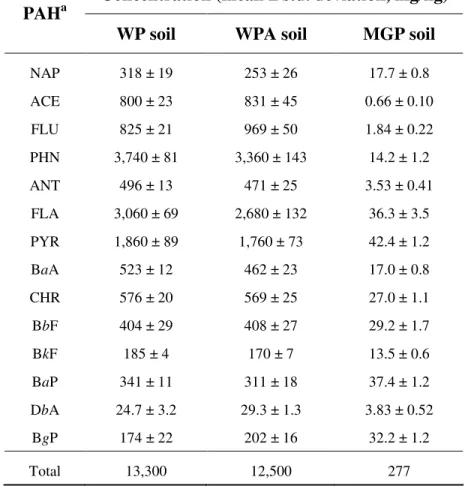
Table 3.1 Concentrations of PAH in soil samples used in desorption experiments…………60
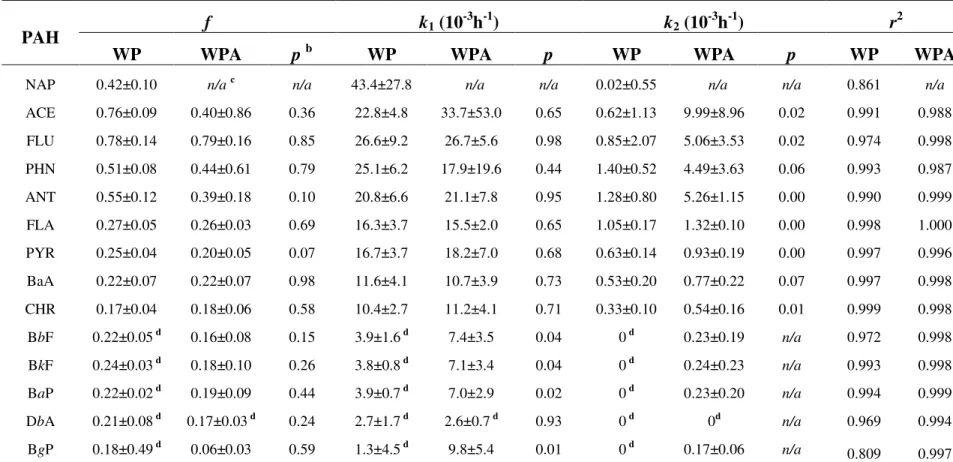
Table 3.2 Fitted kinetic parameter values for the WP and WPA soils………68
Table 3.3 Summary of regression results for the rate coefficient for the slowly desorbing fraction (k2) of the MGP soil incubated under different conditions before desorption
measurements………...71 Table 4.1 Concentrations of PAH in the feed soil or effluent slurry of the reactor…………81
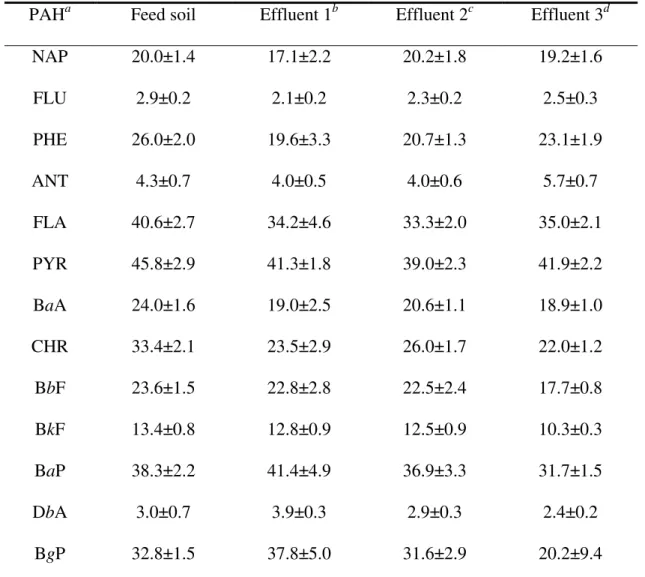
Table 4.2 Doses of the two nonionic surfactants used in this study and their equilibrium aqueous-phase concentrations……….87 Table 5.1 Primers and qPCR conditions………...104
Table 5.2 Effects of Brij 30 addition on PAH degradation in reactor slurry reported in
Chapter 4………112 Table C. Correlation coefficients (r2) obtained from the two-site desorption model and
one-site desorption model………..123 Table E. Summary of regression results for the rapidly desorbing fraction (f) and rate
coefficient for the rapidly desorbing fraction (k2) of the MGP soil incubated under different
LIST OF FIGURES
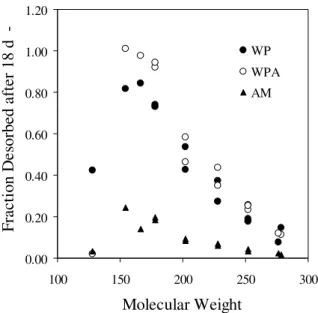
Figure 1.1 Processes involved in studying bioavailability of soil-bound contaminants……..3 Figure 2.1 Structures of the 16 EPA priority pollutant PAHs………10 Figure 2.2 Conceptual model of geosorbent compartment……….…13 Figure 2.3 Conceptual sketches of desorption and biodegradation of PAHs………..20 Figure 2.4 The change of surface tension, amount of surfactant in micelles, and surfactant monomers as a function of the amount of surfactant added to the solution……….31 Figure 3.1 Comparison of the desorption curves of WP soil and WPA soil………...66 Figure 3.2 The fraction of PAH released after 18 days under different incubation conditions for the aerobically pre-treated MGP soil……….70 Figure 3.3 Fraction of PAH desorbed after 18 d vs. molecular weight for various soil
samples……….74 Figure 3.4 Fraction of PAH desorbed after 18 d vs. initial concentration for the
wood-preserving soil samples………..75 Figure 4.1 Sorption isotherm of Brij 30 and C12E8 in the reactor slurry with a solid content of
10%...85 Figure 4.2 Equilibrium liquid-phase concentrations and PAH solubilization as a function of surfactant dose in reactor slurry………...86 Figure 4.3 Percent of PAH removed from reactor slurry under various conditions of
incubation with Brij 30 for 18 days……….88 Figure 4.4 Percent of PAH remaining in the reactor slurry under different incubation
conditions with C12E8 at the end of 18 days………89
Figure 4.5 Percent of PAH mass cumulatively desorbed from the soils after 18 days with Brij 30 addition (5 mg/g) and without surfactant addition………..90 Figure 4.6 Effect of Brij 30 addition (5 mg/g) on PAH concentrations in the original
contaminated soil……….90 Figure 5.1 Mineralization of [14C]acetate in soil slurry with surfactant addition at various
Figure 5.2 Mineralization of [14C]salicylate by the microbial community in soil slurry incubated with various doses of Brij 30 or C12E8 for different periods of time………106
Figure 5.3 Mineralization of [14C]naphthalene, [14C]phenanthrene, [14C]pyrene and
[14C]benzo[a]pyrene in soil slurry without or with Brij 30 addition at 5 mg/g...107 Figure 5.4 Log number per gram soil and relative abundance of total bacterial 16S rRNA genes (BAC) and 16S rRNA genes from specific bacterial groups in the original soil slurry and in slurry incubated with various doses of Brij 30 for 18 days………109 Figure 5.5 Log number per gram soil and relative abundance of total bacterial 16S rRNA genes and 16S rRNA genes from specific bacterial groups in the original soil slurry and in slurry incubated with various doses of C12E8 for 18 days……….110
Figure A. Result of mineralization assays with 14C-naphthalene to test the function of
sodium azide as a biocide………..121 Figure B. Percent PAH recovered from the Tenax beads and from the WP or WPA soil at the end of the desorption experiment……….122 Figure D. Percent PAH recovered at the end of the desorption experiment under different incubation conditions……….124 Figure G. Solubilization of PAH from the reactor slurry by Brij 30 represented as percentage of PAH solubilized in the liquid phase changing with time………..128 Figure H. Mass balance for samples with highest Brij 30 dose at Day 4 or Day 18………129 Figure I. Percent of PAH mass cumulatively desorbed from the soils after 18 days with C12E8 addition (2 mg/g) and without surfactant addition………...130
Figure J. Residual concentration of Brij 30 or C12E8 in the liquid phase after 18 days and
predicted equilibrium liquid-phase concentration of surfactantsat corresponding doses…..131 Figure K. Mineralization of [14C]salicylate by the microbial community in soil slurry
amendedwith various doses of Brij 30 or C12E8, either immediately after the surfactants were
added, or after 2-d incubation with surfactants………...……...132 Figure L. Measurement of biodegradability of Brij 30 and C12E8 and mineralization with
1.
Introduction
The contamination of soils and sediments by polycyclic aromatic hydrocarbons (PAHs) has posed a serious threat to public health and ecosystems. Although much progress has been made in reducing PAH releases at industrial sites, major releases still occur. PAH contamination of soil is a serious problem gaining more and more attention because it can lead to uptake and accumulation of toxic chemicals in food chains, harmful to both humans and the ecosystems (National Toxicology Program 2001).
PAHs are commonly found in soils at manufactured gas plant (MGP) sites (Luthy et al. 1994; Glaser and Potter 1996; US EPA 2004), and are considered relatively recalcitrant to be removed. Molecular stability and hydrophobicity are two primary factors that contribute to the recalcitrance of PAHs, especially high-molecular-weight PAHs (Makkar and Rockne 2003), which refer to PAHs with four or more rings in the present study. The genotoxicity of PAHs also is known to increase with molecular weight (Cerniglia 1992).
contaminated the soil, or sorbed at the mineral surfaces (Luthy et al. 1997).
Bioremediation of PAH-contaminated soils is a promising, low-cost and relatively clean strategy. Bioremediation techniques stimulate the microorganisms to grow and use the contaminants as a carbon and energy source by creating a favorable environment for the microorganisms to degrade the chemicals (National Research Council, 1997). The efficiency of bioremediation is limited by various factors, both biological factors and physical/chemical factors. One of the major causes is the limited PAH bioavailability to microorganisms because of their low solubility and strong sorption to soil, which lead to the adherence and slow release of PAHs from soils. This is a primary obstacle in bioremediation and is challenging the basic concepts about cleanup standards and risks (Luthy et al. 1997). Madsen (2003) stated that understanding the science of mobilizing contaminants out of soils and sediments is analogous to understanding the science of soil bioremediation. Therefore, “contaminant mobilization treatment” is essential in soil bioremediation.
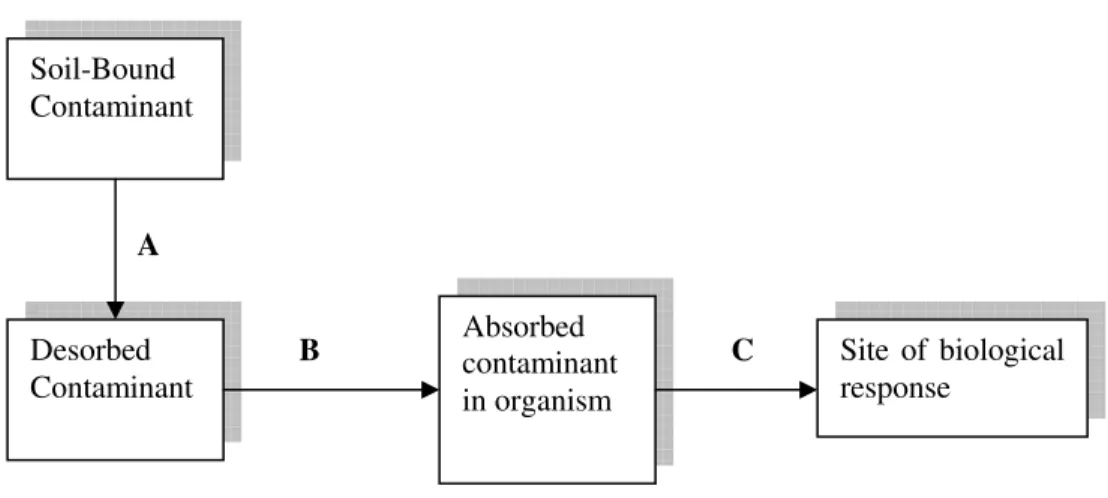
“B” are most relevant.
Figure 1.1 Processes involved in studying bioavailability of soil-bound contaminants (after Ehlers and Luthy, 2003).
For PAH-contaminated soil, bioavailability represents the amount of soil-bound PAHs that are available for microbial transformation and possible toxicity. However, this word is confusing. We usually say “to increase bioavailability of a PAH”, which actually means “to increase bioaccessability of a PAH”, because what is available is available now (Semple et al. 2004). Semple et al. (2004) define the bioavailable compound as that which is freely available to cross an organism’s cellular membrane from the medium the organism inhabits at a given time. Thus bioavailability is an “instantaneous value” changing with time, while bioaccessability is “the integration of bioavailability over time”, which means what is actually bioavailable now plus what is potentially bioavailable. The difference between the two terms is due to the long period of time for equilibrium of PAHs between the soil and aqueous phase. The term “bioaccessability” is not in common use in the literature, so bioavailability can refer to either meaning by most researchers. The term bioavailability is used in the remainder of this dissertation.
To measure the bioavailability of PAHs is to measure the amount of aqueous-phase
Desorbed Contaminant Soil-Bound Contaminant
Absorbed contaminant in organism
Site of biological response
A
PAHs that could be “available” to the microbes directly or indirectly. Therefore, mass transfer measurements could be informative when compared to the rate of biodegradation. If the rate of biodegradation is equal to the rate of mass transfer at a certain time point, mass transfer is limiting the biodegradation. If biodegradation is slower than mass transfer, factors such as microbial activity or toxicity to microbes should be considered to be controlling the whole process. The mass transfer of soil-bound PAHs from the soil to the aqueous phase is called desorption. For two-, three-, or four-ring PAHs, the desorbable fraction could be regarded as the bioavailable fraction (Cornelissen et al. 1998). PAHs with more rings are more difficult to biodegrade, even if they are present in the aqueous phase (Kanaly and Harayama 2000).
improving bioavailability. Essentially, these two perspectives are similar in that they are both aimed at reducing risk. The target of improving the bioavailability is to get rid of the more bioavailable part, so the bioavailability of the residuals diminishes after treatment, which also means less risk. For a specific contaminated site with PAH levels above the regulation standard, which is threatening the environment now, we cannot wait and depend on natural aging to make the entire mass of PAHs unavailable. Quick actions need to be taken to remove the contaminants. Improving bioavailability is not to increase the bioaccessible fraction, but to increase the instantaneous bioavailability at the starting point of treatment, which can greatly shorten the treatment time span. If, for example, the concentration of one PAH is 20 mg/kg higher than the regulation level, a natural process might take five years to release the PAH to the aqueous phase, while it might only take one month for the same soil to release such an amount after improving the bioavailability. Therefore, the objective of this study is to increase the bioavailability of the PAHs in the soil.
components other than a single model PAH and indigenous microorganisms other than isolated degraders.
Anaerobic incubation of contaminated soil is also an approach to increasing the bioavailability of PAHs. It is reported that imposition of anaerobic conditions can lead to changes in both the dissolved organic matter and organic matrix of the soil such that significant mobilization of PAHs occurs (Kim and Pfaender 2005). Anaerobic incubation can result in a more reduced environment, which has been shown to increase the aqueous phase concentration of the PAHs, thus making them more bioavailable (Kim et al. 2005). However, previous studies did not evaluate the desorption kinetics of PAHs from anaerobically incubated soils.
1.1 Purpose and Specific Objectives.
The purpose of this research was to evaluate the effects of two strategies, anaerobic incubation and surfactant addition, on the bioavailability and/or biodegradation of PAHs in field-contaminated soil.
Previous studies have shown that anaerobic environments favor the mobilization of PAHs from organic matter. To our knowledge, no previous work has been done to investigate the corresponding effect of anaerobic incubation on rates of PAH desorption from the solid phase in field-contaminated soils. The effect of anaerobic incubation on the desorption of two field-contaminated soils was evaluated in this study, which would provide some insight for the potential application of this relatively innovative strategy of improving bioavailability of PAHs.
Grasso et al. 2001; Torres et al. 2005). None of the existing research has evaluated the effects of surfactant addition on bioavailability of PAHs in a biologically pretreated soil, in which the biodegradation is more limited by mass transfer kinetics after conventional biological treatment than in the untreated soil. The present study with pretreated field-contaminated soil will expand our knowledge of the effects of surfactant addition on bioavailability and biodegradation of PAHs.
1.2 Specific Objectives
1. Evaluate the effects of anaerobic incubation on the desorption of PAHs from
contaminated soil
(a) Compare the desorption curves of the soils with and without anaerobic incubation; (b) Use an empirical two-site desorption model to quantify the fast- and slowly desorbing
fractions of PAHs and their respective first-order desorption rate constants in the two contaminated soils;
(c) Statistically analyze the model fitting parameters and determine which fraction (fast- or slowly desorbing fraction) the anaerobic incubation affected.
2. Evaluate the effects of surfactant addition on desorption and biodegradation of PAHs
from contaminated soil after pretreatment in an aerobic, slurry-phase bioreactor
(a) Evaluate the effects of surfactant addition on biological removal of PAHs by quantifying the PAH concentrations in solid and liquid phases in reactor slurry incubated without surfactant or with surfactant addition at different doses;
surfactant or with surfactant addition at different doses.
(c) Compare the effects of two surfactants of different hydrophobicity on PAH desorption and biodegradation.
3. Evaluate the effects of surfactant addition on populations of PAH-degrading bacteria in
contaminated soil
(a) Compare the abundances of several known PAH degraders in the treated soil from an aerobic, slurry-phase bioreactor relative to total bacteria obtained by real-time quantitative polymerase chain reaction (qPCR) before and after surfactant addition at different doses;
(b) Investigate the initial rate of mineralization of PAHs by microorganisms in the reactor slurry incubated with surfactant.
1.3 Dissertation Organization
This dissertation is organized into six chapters. Chapter 2 is a literature review which provides background for the work described in the dissertation. Chapter 3 was published in Environmental Toxicology and Chemistry (Zhu et al. 2008). Chapters 4 and 5 are manuscripts
2.
Literature Review
2.1 PAH and PAH contamination 2.1.1 Physical properties
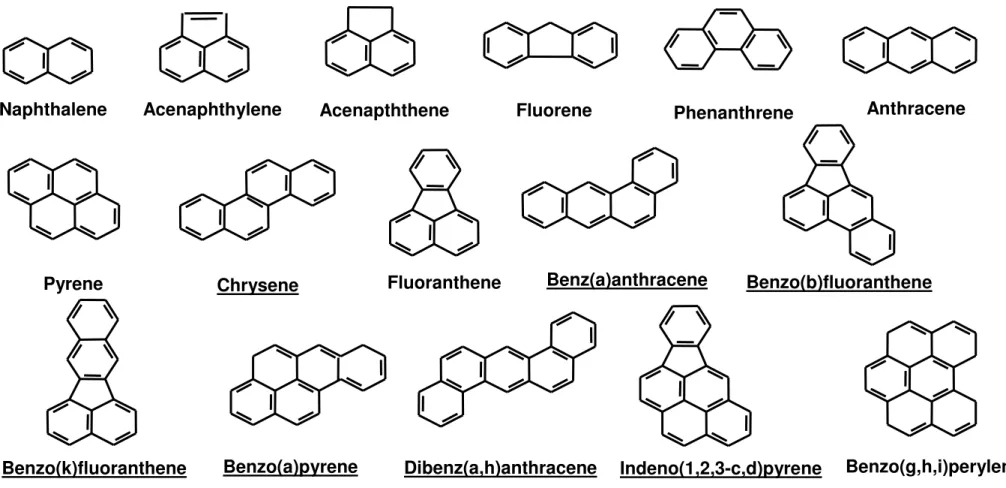
Polycyclic aromatic hydrocarbons (PAHs) constitute a large class of organic compounds which consist of two or more fused aromatic rings. PAHs are mainly produced by incomplete combustion of carbon-containing fuels, in addition to their presence in fossil fuels such as oil and coal (Page et al. 1999). PAHs are pollutants of concern because some compounds have been identified as carcinogenic and mutagenic (US DHHS 1995). The United States Environmental Protection Agency (US EPA) listed 16 priority pollutant PAHs (Figure 2.1) which are frequently analyzed as “indicators” of PAH contamination.
As molecular weight and ring number increase, aqueous solubility decreases (Mackay et al. 1992). The hydrophobicity of PAHs, indicated by the octanol-water partition coefficient (Kow), also increases as molecular weight increases (Mackay et al. 1992). PAHs are known to
Figure 2.1 Structures of the 16 EPA priority pollutant PAHs. EPA Class B2 carcinogens are underlined.
Benzo(g,h,i)perylene
Acenapththene Fluorene
Naphthalene Acenaphthylene
Pyrene Chrysene Benzo(b)fluoranthene
Indeno(1,2,3-c,d)pyrene Benz(a)anthracene
Fluoranthene
Benzo(k)fluoranthene Benzo(a)pyrene Dibenz(a,h)anthracene
Phenanthrene Anthracene
2.1.2 PAH contamination
PAH contamination of soil and sediments is a considerable problem at a variety of waste sites, which include manufactured-gas plant (MGP) sites, wood-preserving sites, or the soil adjacent to a petroleum tank farm.
Starting from the end of World War I, many of the MGPs were decommissioned by removing above-ground structures while the pipelines and below-ground tanks were not removed and still contained liquids. Because of the nature of the gas manufacturing process and the practices at the time, almost all these plants released contaminated materials to the environment. It is estimated that 30,000-45,000 of these sites that probably had releases of hazardous substances have not been investigated and many may need to be cleaned up (US EPA 2004). The types of wastes produced at these sites depended on the production processes and the period in which the plants operated. Six major constituent classes, including PAHs, are potentially present in MGP residuals (Middleton 1995). PAHs in MGP sites are often associated with carbonaceous particles and coal tar, a by-product of all MGP sites at which coal was used, which is a dense, non-aqueous phase liquid (DNAPL).
2.2 PAH in soil systems
Due to their hydrophobicity and low solubility, PAHs tend to associate with the soil phase rather than in the aqueous phase (e.g. pore water) in soil systems. Madsen (2003) summarized six specific mechanisms hypothesized to decrease the bioavailability of chemical waste in soils, most of which can be applied to the sequestration of PAHs in soils: sorption to surfaces, partitioning into NAPL phases, micropore- and nanopore- separation, complexation, insolubility, and partitioning into organic matter.
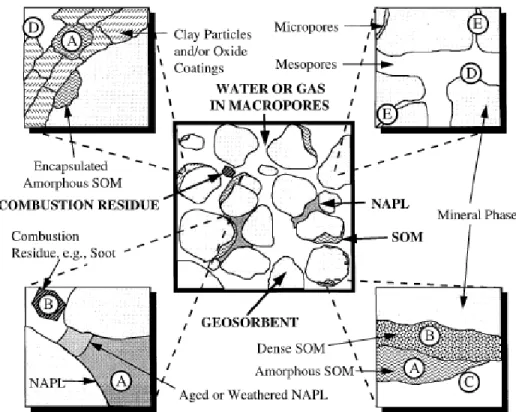
PAHs may be sequestered by any of several components in the soil, and there is a great diversity of physical and chemical principles that govern the interactions between geosorbents (soils and sediments) and PAHs (Figure 2.2). The interactions of PAHs with amorphous organic carbon or NAPLs can be described by absorption, typically corresponding to linear sorption isotherms. But the condensed carbon phase might also have some nonlinear behaviors (Luthy et al. 1997).
2.2.1 Soil organic matter
Figure 2.2 Conceptual model of geosorbent compartments developed by Luthy et al. (1997). The circled letters represent different sorption mechanisms. These compartments include soil organic matter (SOM) or NAPLs (A), combustion residue particulate carbon such as soot (B), organic (C) and mineral (D) surfaces and micropores (E).
that the condensed-phase organic carbon was a good indicator of the potential for desorption resistance in field-contaminated soils (Chai et al. 2006). These two phases of diagenetically young and aged SOM sometimes are called the “rubbery” and “glassy” fractions respectively, between which constant transitions occur until equilibrium is reached (Stevenson 1994). For hydrophobic compounds such as PAHs, whose affinity to mineral sorption is low, the overall sorption and desorption can be dominated by SOM (Luthy et al. 1997). But Khalil et al. (2006) suggested the partitioning behavior of PAHs for MGP impacted soils containing weathered pitch particles might be dominated by the sorption to pitch and not by natural organic matter or black carbon.
2.2.2 Combustion residue particulate carbon
The anthropogenic particulate phase is usually regarded as a different phase than organic matter. A fraction of PAHs is sequestered within the particulate matrix as a result of simultaneous production during combustion (Jonker and Koelmans 2002). For example, soot is a product of incomplete combustion of fossil fuels which might contain high levels of PAHs. More importantly, recent studies showed that soot is a very strong sorption phase for PAHs; as a result, its existence in the soils or sediments may cause very slow desorption of bound PAHs to the aqueous phase (Bucheli and Gustafsson 2000; Jonker et al. 2005). Bucheli and Gustafsson (2000) suggested that the observation of elevated values of the organic carbon/water partition coefficient (Koc) of field samples relative to the theoretical
2.2.3 Nonaqueous-phase liquids (NAPLs)
Adherent or entrapped NAPLs, such as coal tar or creosote, can also function as an important compartment for hydrophobic compounds, which might directly contaminate the soil. In soils directly contaminated by the source materials or by transport of the source materials, PAHs are likely to be associated primarily with NAPLs (Ghosh et al. 2003). A difference between fresh and aged or weathered NAPLs also exists just as for SOM. Diffusion of the hydrophobic compounds within the NAPL phase itself and interfacial mass transfer may be rate-limiting steps for the desorption of these compounds to the aqueous phase. To investigate the desorption mechanism and to model this NAPL compartment, both dissolution kinetics of NAPLs and desorption of the contaminant need to be considered (Kraatz et al. 1997).
2.2.4 Mineral surfaces
The mineral surface includes exposed mineral surfaces and surfaces within pore spaces. The sorption of PAHs to the exposed mineral surfaces should be low because PAHs are hydrophobic and mineral surfaces are hydrophilic. The surfaces within pore spaces might be more important in desorption kinetics, because slow desorption can be partly attributed to diffusion through the pore spaces (Werth and Reinhard 1997). Some micropores can be a barrier to the direct physical contact of PAHs with microorganisms; even excretion of extracellular enzymes might not reach the molecules that diffuse into soil micropores because of their size difference (Ball and Roberts 1991).
2.3 Aging process
Organic compounds aged in soil exhibit a reduction in the amount of chemical available for extraction (Rockne et al. 2002), microbial degradation (Lei et al. 2005), toxicity (Jonker et al. 2006), and bioaccumulation (Lu et al. 2006).
There may be two perspectives to look at the aging process. One is about the diffusion of PAH molecules. The aged fraction of PAHs may be partly due to the slow diffusion of their molecules into the sorption compartments such as organic matter and micropores in soils (Brusseau and Rao 1991; Farrell et al. 1999). It involves the slow movement of the contaminant further into the sorption domains after the contaminant first contacts the solid phase (soil particles). This process can occur for many years (sometimes decades), because that is how long the contamination might have existed before a change, such as remediation, is made. The longer ago the contamination started, the further the PAH molecules will have traveled into sorption domains. Desorption is correspondingly slow from an aged soil partly because it takes a long time for the contaminant to diffuse back out of the sorptive domains and reach the bulk aqueous phase.
Both aging phenomena are the effects of time. The aging process can explain why long-aged contaminated sites are harder to remediate than freshly contaminated sites or spiked soil systems (Huesemann et al. 2004). Many investigators have documented time-dependent alteration in biological and chemical properties of the PAHs by spiking the PAHs in the soil. Significant changes can be observed in desorption and bioavailability after aging for up to one year (Rockne et al. 2002). However, these laboratory-incubated samples are quite different from the field-contaminated soils, which may undergo real-world weathering processes (water infiltration, freeze/thaw cycles, wind, and sunlight exposure) and are likely to have a much more complex contaminant matrix. For example, ter Laak et al. (2006) showed that equilibrium partition models could predict sorption coefficients of freshly spiked and lab-aged soils accurately, but those of field-contaminated soils were orders of magnitude lower than model predictions. Allan et al. (2007) compared the biodegradation of PAH from field-contaminated soil and artificially contaminated soil following 120 days of aging, and found that the spiked PAHs were still significantly more bioavailable than field-aged PAHs. Because a laboratory equilibration period of many years would be impractical, field-contaminated samples should be used more frequently to get more accurate data of desorption and biodegradation relevant to field-scale remediation.
2.4 Bioremediation
allows soil to be treated without being excavated and transported, so it is less of a disturbance to the environment and can reduce worker exposure to hazardous materials; however, the conditions required for optimum biological activity are harder to maintain in situ than in a reactor. The slurry-phase reactor is a common example of above-ground treatment. It can idealize those external limiting factors that are difficult to maintain with in situ treatment. A concerning reality of bioremediation of PAH-contaminated soils is that the biological removal of PAHs tends to be incomplete, even though many PAHs with which we are concerned are ultimately biodegradable (Cerniglia 1992). As discussed above, the association of PAHs with various compartments in the soil decrease their rates of degradation, so the limitation of bioavailability can at least partly explain the inefficacy of bioremediation of PAH-contaminated soils.
2.4.1 Bioavailability and bioremediation
Figure 2.3 summarizes various situations regarding the relationship between bioavailability and biodegradation.
Figure 2.3(a) is a simple representation of what is happening naturally. The PAHs are released slowly to the surrounding aqueous phase as time goes by. Microbial degradation of PAHs is also low because of low substrate concentration, nutrients limitation, relatively low temperature, insufficient oxygen supply in the deep layers, or other limitations. The vertical width of the shaded area represents the fraction free in the environment, which is a hazard currently posed to the ecosystem or human health at a certain time.
Figure 2.3 Conceptual sketches of desorption and biodegradation of PAHs in (a) natural process, (b) bioremediation with ideal microbial activities (mass-transfer limited), (c) field bioremediation without enhancement of bioavailability, (d) field bioremediation with enhancement of bioavailability, and (e) process that applies approaches to decrease bioavailability. In panels (a)–(e), f is the fraction of a given contaminant initially present in the soil. The curves from panel (a) are reproduced in the other panels; the arrows denote the fractions remaining at a certain time point for comparison of the results in different remediation approaches; and the shaded areas represent the difference between cumulative desorption and cumulative biodegradation, or the potential hazard.
where the remediation is only mass transfer limited, namely once the PAHs are released from the soil phase, they can be degraded by the microorganisms immediately. In this condition,
t
t
t t
t
f
f f
f f
(a)
(d) (b)
(c)
(e)
1 1
1 1
1
0 0
0 0
0
rates of desorption and biodegradation should be equal, thus there are no free-moving PAHs as a current risk. However, in many cases, the released PAH cannot all be degraded immediately due to limitations in the abundance of the degraders or in enzyme activity as described in Figure 2.3(c). In these cases, the potential hazard still exists at any time as long as there are free PAHs (shaded area).
Figure 2.3(d) represents the situations in field bioremediation after the enhancement of bioavailability. When strategies such as surfactant addition are applied to increase both the rate and extent of desorption, the biodegraded fraction of PAH would usually increase accordingly. But note that the undegraded fraction, which is the difference between desorbed and biodegraded, is not necessarily larger than that in Figure 2.3(c). Finally, Figure 2.3(e)shows the situation in which bioavailability is decreased. The application of this case is much less common than increasing bioavailability. The release of the PAH would be slower than normal, so that the hazard currently posed to the environment should be less than in a process without any treatment.
concentration’ is proportionately balanced by a lingering reservoir of the chemical
waste in soil and sediments… [S]oil is, by definition, a thermodynamically unstable,
kinetically constrained medium whose chemical composition, including solid, liquid,
and gaseous components, is constantly changing. Thus, the ‘nonbioavailable’ chemical
wastes in this lingering reservoir are always subject to release into soil solution where
the wastes are resubjected to a variety of transport and/or transformation processes.
The fraction of PAH remaining in the soil is shown in Figure 2.3 as well, and the arrows denote the fractions remaining at a certain time point for comparison of the results in different remediation approaches. Combining the remaining fraction and the difference between desorption and biodegradation, what we can get is actually the total amount of PAHs left in all phases after biodegradation (1-fbio). I think this is the most reasonable and
safest rationale until it is demonstrated that soil with a certain amount of tightly-bound PAHs (“nonbioavailable”) is really safe for the environment and human health. It is the premise of all the techniques of improving bioavailability, and implies that it is important to biodegrade as much as possible; if there is a mass transfer limit, just try to remove or reduce that limit, and biodegrade what is made available. This involves both biological and physical/chemical considerations.
2.4.2 Desorption of PAHs
Various approaches have been used to predict bioavailability of PAHs. The indices used to determine bioavailability includes the biota-sediment accumulation factor (BSAF) (Lu et al. 2006), the partition coefficient between organic carbon and water (Koc) (Hawthorne
organic chemicals such as PAHs from contaminated soils often occurs in several stages: an initial stage of rapid release followed by a much slower release of the less labile fraction (Hawthorne et al. 2002; Loehr et al. 2003; Doick et al. 2005), and possibly a third stage of extremely slow release (Jonker et al 2005). The fraction of the residual PAH after the first stage of release is difficult to eliminate by biodegradation (Alexander, 2000), implying that this fraction is less bioavailable. Therefore, identifying the fast-desorbing fraction of PAHs is a reasonable and relatively direct methodology for estimating their bioavailability and has been the topic of many studies.
2.4.2.1 Desorption kinetics measurement
Various techniques have been developed to study bioavailability of PAHs in soil and sediments. In order to assess the bioavailable fraction, knowing the total concentration of the PAHs is essential and foremost. The total concentration is usually obtained and defined by exhaustive extraction of PAHs in soil samples, such as multi-step shaking extraction with strong solvents, soxhlet extraction, ultrasonic extraction (Brilis and Marsden 1990), microwave-assisted extraction (Lopez-Avila et al. 1995), pressurized liquid extraction/accelerated solvent extraction (Richter 1999), supercritical fluid extraction (SFE), and methanolic saponification (Eschenbach et al. 1994).
Some extraction techniques employ non-exhaustive or “mild” organic solvents and relate the extracted fraction to the bioavailable fraction or loosely-bound fraction. Examples include cyclodextrin-based extraction (Reid et al. 2000; Cuypers et al. 2002), persulfate oxidation (Cuypers et al. 2000) and mild solvent extraction (for example, with n-butanol or methanol).
strength of SFE can be significantly varied over a wide range by changing fluid temperature and density. Szolar et al. (2004) used sequential SFE with increasing extraction strength (from “very mild” to “very harsh”) to measure desorption kinetics and final exhaustively extracted PAHs from different soil samples.
Other approaches focus only on the PAHs desorbed from the soil phase. They involve an infinite sink for the desorbed hydrophobic compounds, and thus can be used to follow the time-course of concentration changes in the soil-water system without disturbing the on-going desorption. Desorption kinetics can be formulated from time-course data. The techniques include sorption to Tenax or XAD-2 beads (Cornelissen et al. 1997; Li et al. 2005), gas purging (Resendes et al. 1992), SFE (Jonker et al. 2005), semipermeable membrane device (Booij et al. 1998), poly(oxymethylene)solid phase (POM) (Jonker and Koelmans 2001) , and polymer coated glass sheets or fibers (Wilcockson and Gobas 2001; ter Laak et al. 2006).
Theoretically, the extraction strengths of all the above techniques range from low to high continuously, and should not be discrete. They would not perfectly represent the total PAH concentration, the bioavailable concentration and bioaccessible concentration, but they all give useful data for prediction of PAH desorption and biodegradation in field-contaminated soil. For instance, Cuypers et al. (2000) demonstrated that a three-hour persulfate oxidation would correspond well to residual PAH concentration after 21 days of biodegradation. Hawthorne et al. (2002) compared PAH desorption with XAD2 and supercritical CO2 extraction, and found that the fast-desorbing fraction was the 40-min
fraction with supercritical CO2 while it was the 12-day fraction for water desorption. Another
for water and 20-40 min for SFE) showed excellent agreement (r2 > 0.9) with the removal of individual PAHs obtained with 147-343 days of field bioremediation. In a comprehensive study on rates of PAH desorption from contaminated soil and sediment from MGP sites, Loehr et al. (2003) observed that the rapidly desorbing fraction corresponding to the most bioavailable fraction of PAHs typically desorbs within 7 to 12 d. Another technique uses very different mechanisms to evaluate the desorption of PAHs. “Thermal program desorption mass spectrometry” is said to be able to obtain real-time PAH desorption data through use of a thermal program desorption probe, assuming the availability of a compound sorbed on a solid surface can be described by fugacity (Talley et al. 2004).
2.4.2.2 Two-site desorption model
Much work has been done to analyze the rates and extents of desorption of PAHs from soils with varying components (e.g., organic matter, NAPL, or mineral surface content), so various theories have been developed to explain the desorption mechanism and the desorption resistance phenomena. These theories have brought along different models, e.g., shrinking core model (SCM) (Wells et al. 2005), sorption-retarded pore diffusion model (SRPD) (Ahn et al. 2005), and organic matter diffusion model (OMD) (Pignatello and Xing 1996). One popular empirical model is the two-site or two-compartment desorption model, which suggests that field-aged PAHs desorb via two distinct domains, one with a relatively fast diffusion mechanism and the other a much slower one (Shor et al. 2003; Loehr et al. 2003).
Cs = KpCw = KocfocCw (2.1)
Where Cs is the concentration of PAH present in the soil phase; Cw is the concentration of
PAH present in the aqueous phase; Kp is the soil-water partition coefficient of the PAH; Koc
is the organic carbon – water partition coefficient of the PAH; foc is the fraction of organic
carbon in the soil.
If there are assumed to be two soil organic carbon phases, “rubbery” and “glassy” SOM, a two-site desorption model is plausible for soils with SOM as the most important sorption domain. Assuming linear desorption from each of the sites with their individual rate constant, one of the expressions of the model can be described by the following equation:
) 2 ( )
1
( (1 )
1 k t k t
o t
e f fe
C
C − −
− − −
= (2.2)
where t is time (d); Ct is the concentration of PAH desorbed after time t (mg/kg dry soil); C0
is the initial concentration of PAH in the soil; f is the fast-desorbing fraction; and k1 and k2
are the first-order rate constants for fast and slow desorption, respectively. It has also been suggested that in a typical two-site model, k1 should be at least 10 times k2 (Hawthorne et al.
2002; Loehr et al. 2003). Equation (2.2) could also empirically describe desorption of PAHs from soils with NAPLs as the dominant fast desorbing domain and with black carbon as the slowly desorbing domain.
It was observed that desorption kinetics for very hydrophobic PAHs (Kow > 6) usually
three-site models have been criticized as being purely empirical (Wells 2005), but their rate terms can still be used to compare different systems or different experimental conditions. 2.4.3 Biodegradation of PAHs
Many PAHs are susceptible to biodegradation, which can mean either the complete destruction of the molecular structure to CO2 and water, or partial assimilation of the PAH
molecule by physiological reactions catalyzed by microorganisms (Alexander 1999). In field-contaminated soil, the growth of PAH-degrading microorganisms is dominated by the low bioavailability and persistence of the PAHs (Semple et al. 2004), and cometabolism usually occurs, especially for the degradation of HMW PAHs (Kanaly and Harayama 2000). Despite the low bioavailability of PAHs to allow growth, PAH-degrading communities are able to develop in such environments through various mechanisms, such as enhanced cell-surface hydrophobicity, biofilm formation, biosurfactant production, and chemotaxis (Johnsen et al. 2005).
2.4.4 The limiting step of biodegradation
limited by bioavailability and HMW PAHs was limited by microbial factors. 2.4.5 Strategies of enhancing performance of bioremediation
When it is known which step is limiting the biodegradation, bioavailability of soil-bound PAH or microbial factors, strategies of improving the performance of bioremediation of PAH-contaminated soils can then be selected and implemented accordingly.
If bioavailability is the limiting factor of PAH biodegradation, strategies of improving bioavailability should be effective in enhancing bioremediation performance. Such strategies include mechanical grinding and slurrying (White et al. 1998; Kim and Weber Jr. 2005), the addition of surfactants (Tiehm et al. 1997; Singer et al. 2000; Garcia et al. 2001; Gao et al. 2008), the addition of cosolvents (Chen and Delfino 1997), and the addition of chelating agents (Yang et al. 2001; Subramaniam 2004).
If the biodegradation of PAHs is limited by microbial factors, it is necessary to know whether it is because of the absence of degrading organisms, a lack of nutrients and/or oxygen, or other factors such as the presence of toxic or inhibitory compounds. Biodegradation could be enhanced by inoculation of efficient PAH-degrading organisms to the contaminated soil as a bioaugmentation strategy (Thompson et al. 2005; D'Annibale et al. 2006), by addition of nutrients and supply of oxygen as a biostimulation strategy (Li et al. 2005), or by addition of an inducer of PAH metabolism that might also be a selective carbon source for PAH-degrading bacteria (Powell et al. 2008).
2.5 Anaerobic incubation
redox change under anaerobic conditions, and that the humic acids were more hydrophilic in the reduced state than the oxidized state (Coates et al. 2000). Pravecek et. al. (2005) have shown that anaerobic incubation of PAH-contaminated soil resulted in increased concentrations of PAH in the liquid phase, and that the microbial activity in those systems can influence PAH release by altering pH and dissolved organic matter (DOM). Kim and Pfaender (2005) confirmed that the DOM released under highly reduced conditions was more polar and aromatic, and had a higher sorption capacity for pyrene, than that released under relatively oxic incubations. These effects of anaerobic incubation of contaminated soils were believed to be mediated by microbial activity (Kim and Pfaender 2005; Pravecek et al. 2005).
2.6 Effects of surfactant addition 2.6.1 Surfactant characteristics
enhance its apparent solubility in water. 2.6.1.1 Critical micelle concentration
An important term about surfactants is the critical micelle concentration (CMC). It is defined as the aqueous-phase concentration of a surfactant in solution above which the formation of micelles occurs. Actually, it is generally the concentration above which almost every measurable physical property that depends on size or number of micelles would change remarkably because of micelle formation. There are different shapes of micelles. Spherical, cylindrical, lamellar and vesicle micelles are the most common structures. The shape of a micelle depends on temperature, concentration of surfactant, aggregation number (number of monomeric surfactant units per micelle) and the space occupied by the hydrophilic and hydrophobic groups (Attwood and Florence 1983). The CMC is such an important parameter in surfactant-enhanced treatment that it is common to express the amount of surfactant added as the number of times the CMC for a specific surfactant.
Two crucial properties of surfactants related to micelle formation are solubilization and emulsification. Thus surfactants have generally been used as solubilizing agents and emulsifiers in enhancing desorption and biodegradation of hydrophobic contaminants in soils.
2.6.1.2 Solubilization of PAHs by surfactants
compound which is the sum of the true aqueous (Caq) and micellar (Cmic) PAH
concentrations:
Capp = Caq + Cmic (2.3)
The micellar-phase PAH concentration is typically modeled using a linear partition relationship(Guha and Jaffé, 1996):
Cmic = kmicSmicCaq (2.4)
Where kmic is the PAH-micelle partition coefficient and Smic is the micelle
concentration, which is the difference between the total surfactant concentration and CMC: Smic = Stot – CMC.
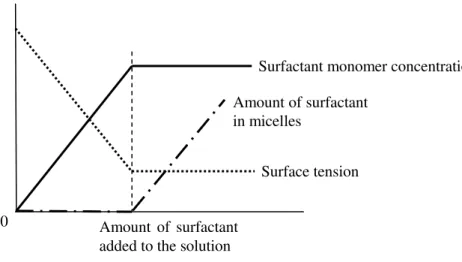
Solubilization of insoluble compounds into water has great practical importance in surfactant-enhanced soil remediation. If the apparent solubility of an insoluble compound is plotted against the dose or concentration of surfactant added to water, the solubility is very small until the CMC is reached (Figure 2.4). Above the CMC, the solubility increases approximately linearly with the concentration of the surfactant.
Figure 2.4 The change of surface tension, amount of surfactant in micelles, and surfactant monomers as a function of the amount of surfactant added to the solution.
Surfactants have been found to be able to enhance desorption of PAHs from NAPLs by solubilization (Garcia-Junco et al. 2003; Bernardez and Ghoshal 2004), enhance the solubilization of the NAPLs themselves (Butler and Hayes 1998; Johnson et al. 1999; Prak et al. 2000; Zhong et al. 2003), or enhance desorption of PAHs from NAPL-contaminated soils (Jayanti et al. 2002; Jawitz et al. 2003). Ramsburg et al. (2004) observed that the concentrations of tetrachloroethylene (another hydrophobic organic compound) were reduced by up to two orders of magnitude within the source zone after a solution of surfactant Tween 80 solution was flushed.
Other researchers have investigated the partitioning and desorption kinetics or other aspects related to solubilization. It was concluded that the octanol-water partition coefficient was the best correlating parameter of the partition coefficient between surfactant micelles and water after studying solubilization of organic compounds (Valsaraj et al. 1986). Bernardez et al. (2004) investigated the equilibrium solubilization behavior of naphthalene and
0 Amount of surfactant
added to the solution
Surface tension
Surfactant monomer concentration
phenanthrene from NAPLs by five different nonionic surfactants, and found that the extent of solubilization of the PAHs in the surfactant micelles increased linearly with the PAH mole fraction in the NAPL. They suggested that solubilization capacity of surfactants was correlated to their molecular structure. Interestingly, the solubilization extent and micelle-water partition coefficient of the PAHs increased with the size of the polar shell region of the micelles rather than the size of the hydrophobic core of the micelle. Hill et al. (2002) also had the same conclusion. In contrast, an increase in solubility of naphthalene was observed to occur with longer-chain hydrophobic tails while the length of the hydrophilic head group had little effect on solubilization (Paria and Yuet 2006). Competitive solubilization exists for mixed PAHs (Prak and Pritchard 2002). It was also observed by Bernardez et al. (2004) that the solubilization of phenanthrene by surfactants Brij 35 and Tween 80 was decreased in the presence of naphthalene as compared to systems that contained phenanthrene as the only solute
Surfactants have also been found to be able to greatly enhance transfer of PAHs from soils by solubilization, which is discussed in detail in a later section.
2.6.1.3 Emulsification of PAHs by surfactants
transparent emulsions). Among these types, microemulsions may play an important role in enhancing the solubility of hydrophobic compounds in water. In the presence of a NAPL, one of the compartments that PAHs might reside in, surfactants concentrate at the NAPL-water interface, reducing the interfacial tension, which may cause dispersion of NAPL droplets and stabilization of emulsions. For example, it was observed that the apparent solubility of chlorinated solvents in microemulsion systems is at least one to two orders of magnitude higher than solubilization for the same surfactant concentration (Shiau et al. 1995). It was also found that formation of NAPL-in-water microemulsions facilitated the removal of NAPLs from contaminated soils (Jayanti et al. 2002; Ouyang et al. 2002). Churchill et al. (1995) observed that the two surfactants they used, Inipol EAP 22 and the biosurfactant rhamnolipid, were able to emulsify some hydrocarbons and make these compounds more available to microorganisms. Such surfactants form stable microemulsions in water and do not exhibit a distinct CMC (Sun and Boyd 1993).
There is much potential in studying the effect of emulsification in surfactant enhanced biodegradation because much less work has focused on emulsification than on solubilization. Though bioreactor emulsification treatment was found to be valuable (Kan and Deshusses 2006), the application of emulsification has limitations. The biggest concern with emulsification in situ is that a DNAPL might be mobilized and sink even deeper into an aquifer, making it more difficult to recover (Ouyang et al. 1995).
2.6.1.4 Hydrophile-lipophile balance
values of 3-6 are lipophilic and can be used to prepare water in oil (W/O) emulsions; surfactants with HLB values of 7-9 are wetting agents; surfactants with HLB values of 8-12 can be used to prepare oil in water (O/W) emulsions; surfactants with HLB values of 12-15 are usually used as detergents; and surfactants with HLB values of 15-20 are solubilizers or hydrotropes. More importantly, the HLB of a surfactant will determine the interactions between the surfactant and the organic contaminants, the aqueous phase and the soil. It has been suggested that the surfactants with an HLB higher than 10 are most successful in treating oil-contaminated soils (Volkering et al. 1998), although there is limited work in field-contaminated systems from which to draw such a conclusion. The work of Torres et al. (2005) showed that maximum biodegradation rates were observed at low HLB values after trying three surfactants with HLB values of 4.3, 11, and 15, respectively, for a diesel-contaminated soil. Their explanation was that water is emulsified into the oily fraction and microorganisms contained in the water are closer to the fraction to biodegrade, since low HLB surfactants can promote W/O emulsions. Moreover, although hydrophobic surfactants exhibit better solubilizing capacities, they could be tolerated by fewer bacteria (Cserhati and Szogyi 1991; Tiehm 1994). Besides the potential effect on biodegradation, HLB is important in choosing the ideal surfactant in order to minimize the loss of surfactant to sorption, which is discussed below.
2.6.1.5 Sorption of surfactants to soil
freely dissolved PAHs, there exist PAHs associated with surfactant monomers (Edwards et al. 1994).
It is important to consider the sorption of a surfactant to soil, because it will lead to a higher surfactant dose to reach the CMC in a soil/water system than in a purely aqueous system. The sorption isotherm of nonionic surfactants in contact with soil usually follows a Langmuirian isotherm, and this sorption is generally reversible (Walters and Aitken 2001; Tadros 2005). However, the work of Brownawell et al. (1997) showed that Freundlich isotherms can also represent their experimental data well. Sorption of surfactants to soils is usually a significant part of surfactant loss in surfactant enhanced soil remediation. Grasso et al. (2001) found that below CMC more than 99% of the surfactant was sorbed to the solid phase.
Sorption of a nonionic surfactant to soil is a phenomenon that depends on both the properties of the surfactant and the soil. In soils with rich content of hydrophobic substances such as black carbon and soil humus, hydrophobic surfactants (low HLB) would preferably sorb to the soil surface. In soils with large mineral surfaces and low organic matter, hydrophilic surfactants (high HLB) could sorb to the soil excessively. For example, the soil studied by Jahan et al. (1995) was characterized by a low foc (0.01%). Sorption of four
nonionic surfactants to the sandy soil was, from greatest to smallest, Brij 35 (HLB: 16.9), Corexit 0600 (HLB: 15.0), Tween 40 (HLB: 15.6) and Triton X-114 (HLB:12.9), generally in the order from the most hydrophilic to relatively hydrophobic. On the contrary, the soil employed by Yeom et al. (1996) had a high organic matter content with an foc of 62%; the
(HLB: 16.9), generally from the most hydrophobic to most hydrophilic. A similar study was conducted by Salloum et al. (2000) with a single nonionic surfactant (Triton X-100, HLB: 13.6) but six different kinds of soils with various contents of organic matter and clay minerals. They found that the mole surfactant sorbed/g sorbent was greater for soils containing large amounts of smectite minerals and that nonlinearity of the Triton X-100 sorption isotherm increased in samples low in organic carbon, which was probably due to the affinity of this relatively hydrophilic surfactant to the minerals. The X-ray diffraction analysis also showed that the ethoxylated group (hydrophilic head group) of Triton X-100 intercalated with the soil mineral montmorillonite. This might be evidence that the main interaction of a hydrophilic surfactant and soils occurs on soil minerals.
The sorption of a surfactant to soil can be relatively fast, but occurs at a time scale long enough to be accounted for in experimental work and field applications. The work of Aitken et al. (1998) showed that it can reach equilibrium in less than 48 hours. Thibault et al. (1996) also determined that equilibrium between the aqueous and soil phases was reached after 20 hours. It has also been shown that the apparent soil-water partition coefficient of the PAHs increases when the surfactant aqueous concentration changed from zero to around the CMC, followed by a decrease at surfactant aqueous concentration greater than CMC (Brownawell et al. 1997; Zhou and Zhu 2005).
concentration above the CMC.
If surfactant addition could enhance the biodegradation of hydrophobic contaminants at concentrations below the CMC (discussed below), there might be one advantage of the surfactant sorption to the soil: it could reduce surfactant toxicity to the microorganisms compared to soil-free microcosms (Tsomides et al. 1995)
2.6.2 Surfactant-enhanced desorption of PAHs in soil systems
2.6.2.1 Surfactant concentrations above the CMC (solubilization) in soil systems
At surfactant doses sufficient to exceed the CMC in soil/water systems, the surfactant will solubilize hydrophobic contaminants initially associated with the soil. Thus, solubilization (which is typically measured by following the concentration of the contaminant in the liquid phase) is directly related to desorption, or the removal of the contaminant from the soil. Surfactants have been found to be able to greatly enhance transfer of PAHs from spiked soils (Chang et al. 2000; Badr et al. 2004; Cheng et al. 2004; Zhou and Zhu 2005; Yang et al. 2006) or from field-contaminated soils (Yeom et al. 1996; Grasso et al. 2001; Torres et al. 2005) by solubilization.
Solubilization only happens when the surfactant aqueous concentration is above the CMC. Yang et al. (2006) used as much as 10,000 mg/L (equilibrium concentration) mixed surfactants of TX100 and SDBS, two orders of magnitude higher than their CMCs, and solubilization of spiked phenanthrene from an artificially contaminated soil was in linear relationship with the surfactant concentrations in this range. When hydroxypropyl-β-cyclodextrin (HPCD) was used as a flushing agent, 80% of naphthalene and
solute, such as naphthalene, the addition of surfactant TX100 did not reduce but increased the adsorption of solute into soil over the whole tested surfactant concentration range (Zhou and Zhu 2005). Thibault et al. (1996) tested the solubilization of pyrene from spiked soil at surfactant concentrations of 0, 2, 5, 10, and 20 times the CMC, and observed overall efficacy of the surfactants increased with increasing concentration.
Studies on micellar solubilization of PAHs from field-contaminated soil are relatively scarce. In Yeom’s study (Yoem et al. 1995), up to 25% of soxhlet-extractable PAHs could be solubilized at surfactant loadings of 0.3 g/g of soil in 16 days at surfactant aqueous concentrations much larger than the CMC. In the work of Grasso et al. (2001), desorption ranging from about 8-18% was achieved within 3-7 days after adding surfactant at aqueous
concentration of 5×CMC.
Little work has been done directly on the kinetics of surfactant-enhanced abiotic desorption from soil compared with desorption using the technique of adding resin beads as an infinite sink of the PAHs. So far, only Yeom et al. (1996) and Grasso et. al. (2001) have carried out such experiments. Yeom et al. (1996) found PAH desorption in surfactant-amended soil was significantly faster and more extensive than desorption measured by the infinite sink method. They suspected it was due to desorption from soil organic matter in addition to micellar solubilization. This is interesting because it seems surfactant micelles can function just like those infinite sinks. The difference between these two approaches is that the resin beads absorb only the PAHs that have already entered the aqueous phase, while micelles can be regarded as a pseudo-phase that can directly contact the PAHs, following normal partition kinetics.
concentrations above the CMC is fast. Aitken et. al. (1998) found it would occur over similar time scales to that of sorption of the surfactant, in less than 48 hours in a field-contaminated soil. In Thibault’s work with spiked soil (1996), maximum desorption occurred after approximately 2 hours.
Studies focusing on solubilization only should create abiotic conditions in order for contaminant loss from the soil not to be confused with biodegradation. Those studies on abiotic solubilization after surfactant addition at concentrations above the CMC generally have positive conclusions because all the adverse effects of large doses of surfactants (with respect to biological activity, as discussed below) were excluded.
2.6.2.2 Surfactant concentrations below the CMC
As stated in Section 2.2, PAHs in a surfactant-amended soil system are partitioned in three separate compartments: soil phases, micellar pseudo-phase, and the aqueous phase. In such a multiphase system, if the surfactant dose is sufficient to reach the CMC, the concentration of surfactant monomers in the aqueous phase is just equal to the CMC.
From the kinetic aspect, the rate of mass transfer from soil to the aqueous phase may depend on three parameters: the concentration gradient of PAHs at the soil-water interface, the area of the interface, and the mass transfer coefficient. For systems with surfactant concentrations greater than the CMC, the enhanced mobilization of PAHs is commonly attributed to the increased concentration gradient at the interface, resulting from the partitioning of PAHs into the micellar pseudo-phase. It was observed by Deitsch et al. (1995) that both the concentration gradient and mass transfer coefficient increased upon washing spiked soil with Triton X-100. They attributed the increased mass transfer coefficient to the change in the tortuosity of the soil organic matter caused by a reduction of interfacial tension between water and the SOM and/or swelling of the soil-organic matrix. Yeom et al. (1996) suggested that the enhanced diffusivity of PAHs in soil organic phases was a more important role than micellar solubilization in improving the mobility of PAHs from their test soil, even at surfactant doses leading to an equilibrium concentration greater than the CMC.
The dispersive effects of surfactant in solid/liquid suspensions have been suggested to cause an increase in the apparent solubility of hydrophobic compounds at surfactant concentrations below the CMC (Churchill et al. 1995). The role of surfactants in dispersion involves wetting of the solid by the liquid, breaking of the aggregates and agglomerates (increased interfacial area), and milling of the resulting particles (reduction of interfacial tension) into smaller units (Tadros 2005). Surfactant addition has also been suggested to reduce the adhesion of coal tar to quartz sufficiently to ensure complete removal of coal tar from sandy soils (Dong et al. 2004).
as 0.001·CMC. Torres et al (2005) added three surfactants at doses from 0.001-0.01CMC to a
diesel-contaminated soil, and for Span 80, a maximum enhancement of 27% biodegraded was observed. Though their work was focusing on biodegradation rather than desorption, it is a common assumption that only desorbed organic compounds can be biodegraded. Their results also showed that diesel removal (measured as total petroleum hydrocarbons, or TPH) was an inverse function of the surfactant dose.
surfactant concentration below or above the CMC in a soil/water/micelle-forming Triton X-100 system: the coefficients increased with increasing surfactant dose at aqueous concentrations below the CMC, but decreased with increasing dose at aqueous concentrations above the CMC (Sun et al. 1995). This suggests that surfactant partitioning to soil can increase the overall sorptive capacity of the soil for hydrophobic contaminants.
2.6.3 Surfactant-enhanced PAH biodegradation