DDE AND PCBs: INTRA-INDIVIDUAL CHANGES, CORRELATIONS, PREDICTORS AND ROLE IN TIMING OF MENOPAUSE
Thao Vo
A dissertation submitted to the faculty of the University of North Carolina at Chapel Hill in partial fulfillment of the requirements for the degree of Doctor of Philosophy in the
Department of Epidemiology
Chapel Hill 2007
Approved by:
Dissertation Chairman: Dr. David Richardson Research Advisor: Dr. Glinda Cooper Reader: Dr. Beth Gladen
©2007 Thao Vo
ABSTRACT
THAO VO: DDE and PCBs: intra-individual changes, correlations, predictors and role in timing of menopause
(Under the direction of David Richardson)
Dichlorodiphenyldichloroethane (DDE) and polychlorinated biphenyls (PCBs) have been suggested to affect the timing of menopause. However, results from studies on
DDE/PCBs and age at menopause have been inconsistent and may be limited by exposure assessment at widely divergent ages, remote from the time of etiologic relevance. Attempts to estimate measures at a commonand etiologically appropriate age have been limited by the paucity of data on the predictors of long-term changes in organochlorines. Understanding the dynamics of individual body burdens of these organochlorines and the factors that predict them would improve exposure assessment, and determining whether DDE/PCBs affect age at menopause would contribute to the knowledge of their public health significance.
Serum DDE and PCBs dramatically declined (median drop of 84% and 55%, respectively) over the follow-up period. Baseline levels were strongly correlated with and predictive of follow-up levels (Spearman correlations (rs): 0.72 for DDE; 0.43 for PCBs). Prediction of follow-up PCBs substantially improved with data on initial concentration, lactation duration, baseline body mass index, and percent change in body fat (rs= 0.75
between predicted and actual follow-up levels), whereas DDE prediction improved slightly (rs= 0.83). Effect estimates for age at menopause were inconsistent across organchlorine
categories (compared to the lowest exposure category, menopause occurred 0.02, 0.4, 0.7, -0.3 years later across ascending categories of DDE, and -0.4, 0.4, 0.8, and 0.6 years later across PCB categories).
DEDICATION
ACKNOWLEDGEMENTS
This dissertation could not have been achieved without the significant contributions of a number of people. First, I would like to thank my committee, beginning with my dissertation chair, David Richardson, for “adopting” me as his student and for making my dissertation process a most pleasant and positive experience, and for sharing his pragmatism in
epidemiology.
I am deeply indebted to Beth Gladen for her selflessness in coming out of retirement to devote a tremendous amount of time, dedication, and expertise to this project and my education and growth—more than what any student can ever hope for. My academic experience has unquestionably been enriched through our interactions and for that, I will always be grateful.
I am grateful to Glinda Cooper for her vision and for giving me the opportunity to work on this fantastic project. Despite the distance, she has readily available and I have benefited from her wonderful advice, both academically and beyond.
I am fortunate to have worked with Marilie Gammon, who has continuously encouraged me from day one and has considered my best interest throughout this dissertation process. It was an honor to tap into her treasure trove of knowledge on menopause and organochlorines and speak with her on a more personal level.
I am lucky to have Julie Daniels as an advisor, as she has provided valuable insights and highly constructive comments on my manuscripts. Her expertise on the dynamics of organochlorines was extremely helpful.
TABLE OF CONTENTS
LIST OF TABLES ... xi
LIST OF FIGURES ... xiii
LIST OF ABBREVIATIONS... xiv
Chapter 1. BACKGROUND AND SIGNIFICANCE...1
1.1 Organochlorines: DDE and PCBs...2
1.1.1 DDT/DDE: Changes in use and exposures ...2
1.1.2 PCBs: Changes in use and exposures ...4
1.1.3 Intra-individual changesin DDE/PCBs over time...6
1.1.4 Correlations between serial DDE/PCB measures ...8
1.15. Predictors of DDE and PCB levels ...9
1.1.6 Predictors of intra-individual change in DDE and PCB levels...13
1.2 Natural Menopause ...16
1.2.1 Definition and Epidemiology...16
1.2.2 Factors associated with the timing of menopause...19
1.2.3 DDE/PCBs and age at menopause ...22
1.3 Discussion and significance of proposed research...26
2. SPECIFIC AIMS ...62
3. MATERIALS AND METHODS...63
3.1 Study Populations ...63
3.1.1 Baseline North Carolina Infant Feeding Study, n=877...63
3.1.2 Follow-up North Carolina Menopause Study, n=512...64
3.2 Organochlorine measurement ...66
3.2.1 DDE and PCBs in baseline study ...66
3.2.2 DDE and PCBs in follow-up study...67
3.3 Methodology for Study Aim 1...68
3.3.1 Accounting for the change in PCB quantitation methods...68
3.3.2 Handling non-detects ...69
3.3.3 Accounting for pregnancy-related increase in DDE and PCBs ...70
3.3.4 Secondary analysis of lipid-adjusted serum measures...71
3.3.5 Statistical analysis ...71
3.4 Methodology for Study Aim 2...72
3.4.1 Predictive model ...72
3.4.2 Potential predictors ...73
3.4.3 Statistical analysis ...75
3.5 Methodology for Study Aim 3...75
3.5.1 Exposure: DDE and PCBs at age 40...76
3.5.2 Outcome: Age at natural menopause ...77
3.5.3 Covariates ...81
REFERENCES ...83
4. MANUSCRIPT 1. DDE and PCBs: intra-individual changes, correlations and predictors...99
4.1 Abstract ...99
4.2 Introduction...101
4.3 Methods...102
4.5 Results...108
4.6 Discussion ...110
REFERENCES ...117
5. MANUSCRIPT 2. DDE/PCB and timing of menopause ...130
5.1 Abstract ...130
5.2 Introduction...131
5.3 Methods...132
5.5 Results...136
5.6 Discussion ...138
REFERENCES ...145
6. DISCUSSION ...155
6.1 Summary of findings...155
6.2 Strengths and limitations of Study Aims 1 and 2 ...158
6.3 Strengths and limitations of Study Aim 3...160
6.4 Implications...162
6.5 Future directions ...163
LIST OF TABLES
Table Page
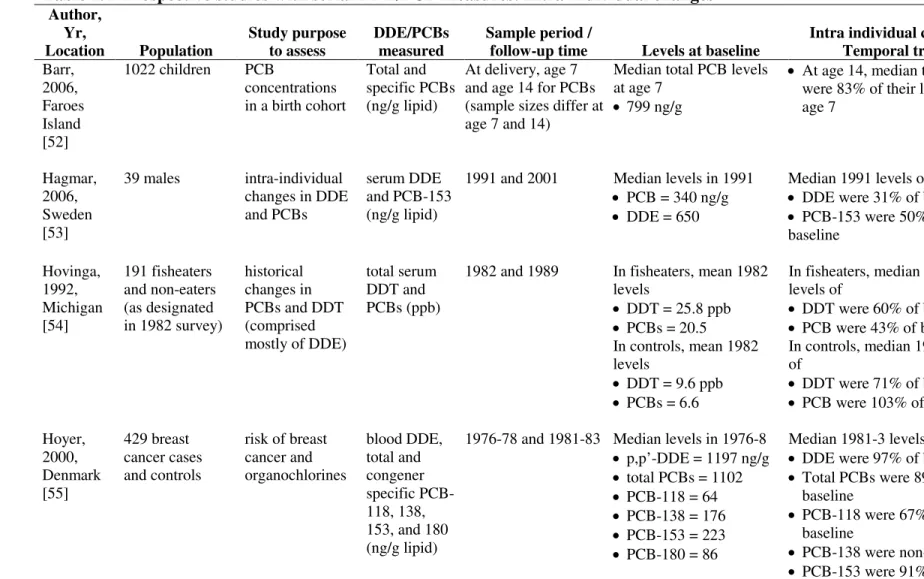
1.1 Prospective studies with serial DDE/PCB measures: Intra-individual changes ...51
1.2 Propsective studies with serial DDE/PCB measures: Correlations and predictors of change ...54
1.3 Studies of DDE and/or PCBs and age at menopause...60
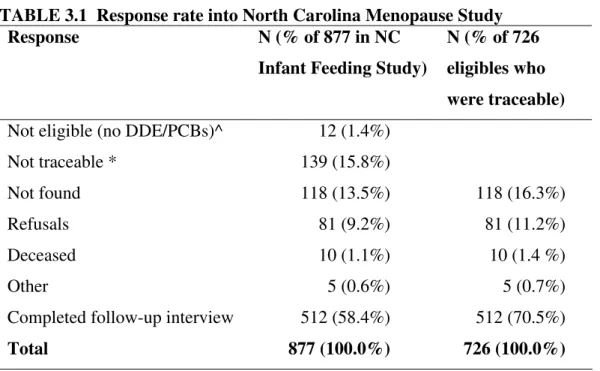
3.1 Response rate in the North Carolina Menopause Study ...86
3.2 Baseline characteristics (N and %) of participants and non-participants in the North Carolina Menopause Study...87
3.3 Data collected in the Menopause Study questionnaire ...88
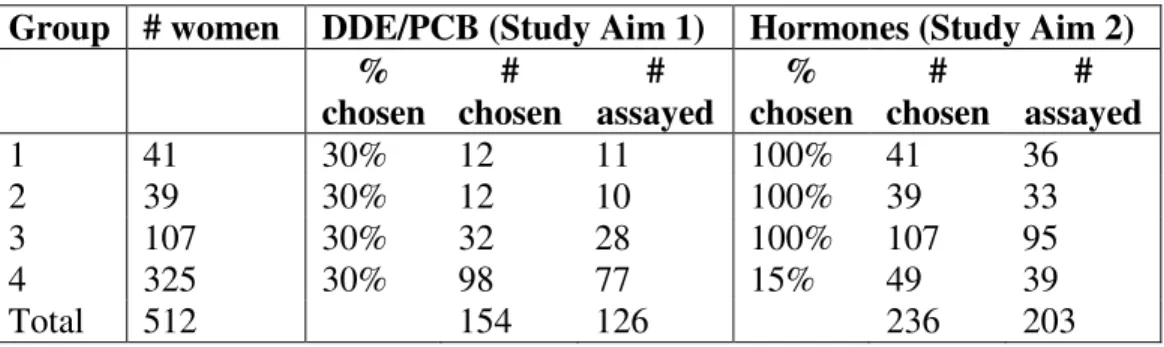
3.4 Derivation of serum subset for organochlorine and hormone analysis...90
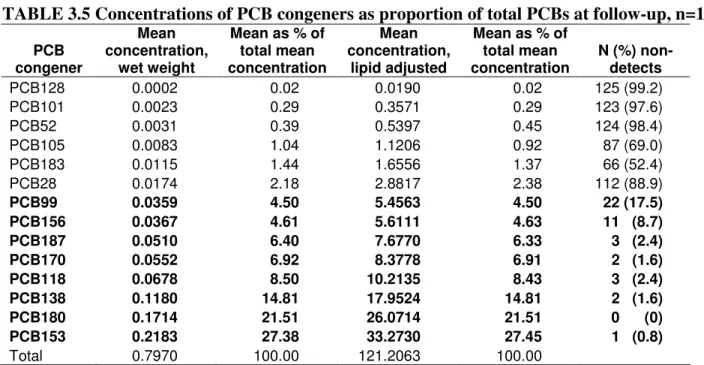
3.5 Concentrations of PCB congeners as proportion of total PCBs at... follow-up, n=126 ...91
3.6 Formulas for transforming baseline organochlorine measures (into measures that are comparable to those at follow-up) ...92
3.7 Hormone algorithm for defining menopausal status (at the blood draw) ...96
3.8 Menopausal status and censoring for survival analysis ...97
4.1 Characteristics of study population, n=123 ...122
4.2 DDE and PCB concentrations in serum, n=123 ...123
4.3 Full model coefficients and standard error for slope of DDE and PCB decline, n=122...126
4.4 Description of successive models for slope, n=122...126
5.1 Menopausal status and censoring for survival analysis, n=512...150
5.3 Regression coefficients for effect of DDE and PCBs at age 40, controlling for covariates, n=511 ...153 5.4 Comparison of DDE & PCB levels in the Menopause Study and the
LIST OF FIGURES
Figure Page
1.1 Chemical structures of DDT and DDE ...50
1.2 Chemical structures of PCBs and a specific coplanar PCB...50
1.3 Correlation between hormone levels and cyclical ovarian and uterine changes ...57
1.4 Hormone levels during the menstrual cycle...58
1.5 Hormone levels during menopausal transition and menopause...59
3.1 Comparison of PCB levels using the follow-up quantitation method to PCBs using baseline converted to follow-up method, n=10...93
3.2 Comparison of actual serum DDE at birth to those estimated by converting composite measures, n=870 with detectable serum levels ...94
3.3 Comparison of actual serum PCBs at birth to those estimated by converting composite measures, n=762 with detectable serum levels ...95
3.4 Survival curve of age at menopause (no covariates), n=512 ...98
4.1 Correlation of baseline with follow-up DDE (ug/L serum), n=123 ...124
4.2 Correlation of baseline with follow-up PCBs (ug/L serum), n=123...125
4.3 Plot of predicted versus observed follow-up DDE (ug/L serum), n=122 ...127
4.4 Plot of predicted versus observed follow-up PCBs (ug/L serum), n=122 ...127
4.3 Predicted DDE curve: follow-up concentration as % of baseline, by years of follow-up, n=122...128
4.3 Predicted PCB curve: follow-up concentration as % of baseline, by years of follow-up, n=122...129
5.1 Survival curves for the effect of DDE (ug/L serum) at age 40, n=512...152
TABLE OF ABBREVIATIONS
Ahr Aryl hydrocarbon receptor
BMI Body mass index
CI Confidence interval CYP Cytochrome p450 enzyme DDE Dichlorodiphenyldichloroethane DDT Dichlorodiphenyltrichloroethane
E2 Estradiol
FMP Final menstrual period
FSH Follicular stimulating hormone
GC-MS Gas chromatography-mass spectrometry
HR Hazard ratio
HRT Hormone replacement therapy IU/L International units per liter kg/m2 Kilogram per meter squared
LH Leutenizing hormone
LMP Last menstrual period LOD Limit of detection OC Oral contraceptives pbb Parts per billion
ng/g Nanogram per gram ng/mL Nanogram per millilter pg/mL Picogram per milliliter rs Spearman correlation rp Pearson correlation S.E. Standard error
TCCD 2,3,7,8-tetrachlorobibenzodioxin TEQ Toxic equivalence factor
1. BACKGROUND AND SIGNIFICANCE
This chapter is organized into three sections pertaining to organochlorines, natural menopause, and the significance and implications of the proposed research. Section 1.1 begins with an overview of DDT/DDE and PCBs and discusses their use, biologic properties, reported health effects, human exposures and changes to those exposures. The goals of the research on the dynamics of these organochlorines were to evaluate the 1) intra-individual changes and 2) correlations in serial measures of p,p’-DDE and PCBs, as well as 3) develop a model for the prediction/estimation of organochlorine levels based on literature on the
predictors of DDE/PCBs. Sub-sections 1.1.3 and 1.1.4 summarizes the epidemiologic studies pertaining to intra-individual changes and correlations in DDE and PCB measures,
respectively. The last two subsections (1.1.5 and 1.1.6) begins with an overview of the literature on the predictors of a single measure of DDE and PCBs and leads into studies of the predictors of organochlorine change—the latter of primary relevance to predictive modeling.
Section 1.3 provides an overview of the findings and limitations of previous studies on the temporal changes, predictors, and possible role of DDE and PCBs in the timing of menopause, as well as the goals and implications of the proposed research to address some of the limitations.
1.1 ORGANOCHLORINES: DDE AND PCBS 1.1.1 DDT and DDE: Changes in use and exposures
Dichlorodiphenyltrichloroethane (DDT) was widely used as a pesticide in the United States starting in the 1940s (FIGURE 1.1). In 1972, DDT was banned from agricultural applications in the United States, and thereafter, in many other parts of the world, as a result of observed toxic effects in wildlife [1]. Today, DDT is still used for emergency or public health purposes in many countries for the prevention of vector-borne diseases, such as malaria.
Technical grade DDT is a mix of primarily isomers p,p’(para-para)-DDT (85%), and to a lesser extent, o,p’ (ortho-para)-DDT and o,o’ (ortho-ortho)-DDT [2]. For the remainder of this document, DDT will refer to the sum of all DDT isomers and metabolites, whereas DDE will refer to p,p’-DDE, unless otherwise noted.
p,p’-DDT is reported to have neurotoxic [2] and carcinogenic [7] properties, while p,p’-DDE has anti-androgenic effects [8]. These properties prompted studies of their potential effects on cancer [9-11], neurodevelopment [12], and reproductive outcomes, such as spontaneous abortion [13, 14], and age at menopause [15, 16]. However, clear
associations have not been established.
Upon introduction into the environment, DDT and DDE become immobilized in the soil and can be transported long distances via water or volatilization into the atmosphere— hence, their ubiquity in the environment and exposure to humans worldwide [1, 17, 18]. DDT use increased significantly until 1959, steadily declined until 1972, and then markedly dropped with its agricultural ban. A concomitant change in environmental concentrations and exposure to DDT and DDE ensued, with the predominant route of exposure via diet. In the Food and Drug Administration Total Diet Studies estimated average adult intakes of DDT from consumption of meat, fish, poultry, and dairy products declined from 240
ug/person/day in 1970 to 0.97 ug/person/day in 1986-91, corresponding to decreasing levels in foodstuffs during the same time period [1]. The sources of exposure and the
corresponding human tissue levels varies with age, with infants having higher levels due primarily to ingestion of pesticide-rich foods (breast milk) and their having lower body fat content, and adults acquiring DDE primarily through fish and meat consumption [3].
population studies [17, 20]. In the United States and Canada, the gradual decrease in the 1960s became progressively sharper in 1975, following their bans [18]. Despite the drop in environmental and human tissue levels, exposure, particularly to DDE, is ongoing due to their accumulation and continued presence in the environment.
1.1.2 PCBs: Changes in use and exposures
In the United States, commercial use of PCBs, marketed under the name Arochlor, was widespread from 1929 until 1977, when production was banned, except in totally closed systems. This ban was enacted because of concerns about their persistence and accumulation in the environment, and potential for causing toxic effects. Due to their chemical stability, they were used as plasticizers, coolants and lubricants in transformers and capacitors, surface coating and adhesives and other applications [21]. PCBs are produced by chlorinating the biphenyl structure at one or more of the 10 positions labeled 2 to 6 and 2’ to 6’ (FIGURE 1.2). The various number and structural arrangements (i.e. ortho-, para-, meta-) of chlorine atoms on the biphenyl ring confer 209 different PCB compounds, referred to as congeners [22]. Isomers are PCBs that have the same number of chlorine atoms but differing
arrangement of the chlorines.
Fish and meatconsumption are the major sources of adult PCB exposure, with secondary exposure via inhalation of contaminated air [23]. Children acquire additional exposure via mother’s milk. Exposure to lower molecular weight PCBs occurs primarily in occupational settings.
PCBs congeners possess broad biologic properties, including both estrogenic and anti-estrogenic effects, activation of the ryanodine-sensitive calcium channels as well as toxicity similar to 2,3,7,8-tetrachlorobibenzodioxin (2,3,7,8-TCDD), which is the most toxic of the non-pesticide organochlorines [2, 33, 34]. Much literature has been published on the latter, with TCDD exerting its effect by interacting with the aryl hydrocarbon receptor (Ah) receptor, thereby inducing the gene expression of metabolic enzymes, such as cytochrome P450, CYP1A1 and CYP1A2 [35, 36]. As determined by their toxic equivalence (TEQ), a measure of PCBs toxicity relative to TCDD, coplanar PCBs, chlorinated at both the para (4,4’) positions and two or more meta positions (3,5,3’ and 5’), have the most potent dioxin-like activity, whereas mono-ortho-substituted PCBs are less potent [25, 36].
Dioxins cause chloracne and liver abnormalities in humans and are linked to other adverse health effects [37, 38]. Occupational exposure studies have consistently associated PCBs with abnormal liver function tests and chloracne [39-41]. Prenatal PCB exposure may also have effects on neurologic development and thyroid function [42-44]. Most
Environmental levels of PCBs have declined most precipitously in the late 1970s to mid-1980s, corresponding to the timeframe when regulatory controls were imposed on PCB use [46]. The Food and Drug Adminstration Total Diet Study showed that PCB levels in the diet in 1993 were significantly less than 1/1000th the levels detected in the mid 1970s [46]. The estimated dietary intake of PCBs for an average adult was approximately 0.03 ug/kg/day in 1978 and declined to <0.001 ug/kg/day by 1991 [23].
Repeated cross-sectional studies of PCB show an overall decline in levels over time across populations [17, 47], reflecting the impact of the ban on PCB usage [46], and hence, environmental exposure levels [17, 46, 47]. However, interpreting and assessing trend from these data can be challenging given the variable component congeners of total PCBs across study populations and the non-standardization of measurement techniques across studies. In a Swedish study of breastfeeding women, where survey data have been collected using a fairly consistent method over time, there is evidence of an upswing in breastmilk PCBs levels in the 1960s followed by a downturn, with total PCB levels in 1997 30% of that in 1972 [47]. Analysis of the data from the National Human Adipose Tissue Survey in the United States shows a steady downward trend in the population percentage of individuals with total adipose tissue PCB levels >3ppm, from a high of nearly 10% in 1977 to 0% in 1983 [19]. Nevertheless, despite the reduction in PCB production and usage, exposure is ongoing due to bioaccumulation.
1.1.3 Intra-individual changes in DDE/PCBs over time
Given the ubiquity and potential health effects of these organochlorines,
occupational cohorts [29, 30, 48, 49] and individuals poisoned by very high acute levels of PCBs [50, 51] have shown dramatic declines in levels over a period of decades. However, long term (>2 year) studies of intra-individual changes in DDE and PCBs among the general population, who are mostly exposed to relatively low, ongoing environmental levels of these pollutants have been limited [52-60] (TABLE 1.1). These studies range in size from 35 to approximately 1500 participants and were conducted in various populations at different time periods (from the 1970s to 2002). Eight of the 10 outlined studies had a follow-up interval of approximately 2 to 10 years, with the longest study about 20 years in duration.
Baseline organochlorine levels and changes in those levels varied widely across studies, depending on the region, study population, study time period, and type of
organochlorine and method of assessment. However, there was an overall decline in intra-individual DDE and PCB levels across all studies. In a series of three studies, conducted from 1973 to 1995, in different subsets of the same cohort of Great Lakes fisheaters (>24 pounds of fish in past year) and their low or non-eating (<6 pounds fish in past year) counterparts, declining levels of serum PCBs were partly attributed to a reduction in fish consumption [58] as well as declining environmental levels in contaminated fish [54]. In studies in which both organochlorines were assessed, the decline was more striking for DDE than for PCBs, particularly when the exposure measures were taken 10 years [53] or 7 years [54] apart. These differences, however, were less noticeable in studies with follow-up measures taken over a span of 2 to 5 years [55, 60].
levels resulting from their respective bans. However, as changes to an individual’s body burden is related to a balance of intake and excretion, other host and environmental factors, including changes in metabolism, diet, weight, lactation, and age, may also play a role in shifting these levels over time.
1.1.4 Correlations between serial DDE/PCB measures
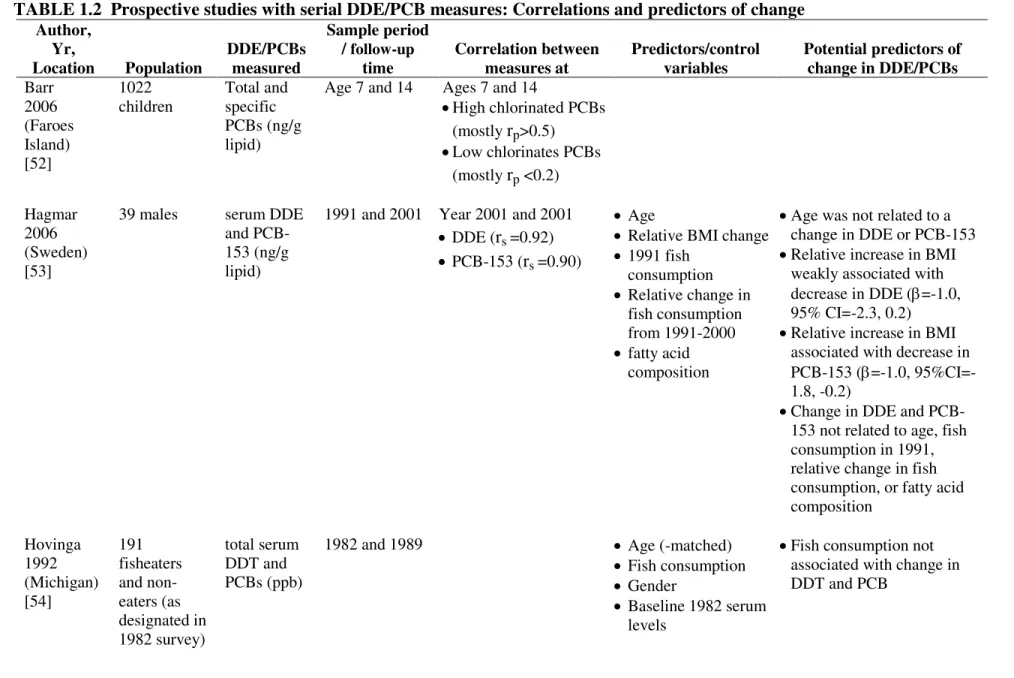
Correlation studies are important with respect to exposure assessment and determination of how well a measure at one time point reflects that at another time. A number of short-term (<2 years) studies report high Spearman correlations (rs>0.8), a measure that evaluates the relationship between rank ordered measures, for serum DDE and/or PCB measures taken on average 2 months apart [61], before and after an overnight fast [62, 63], and across trimesters of pregnancy and shortly afterwards [64]. Similar correlations were found between breast milk DDE samples taken at birth to 6 weeks (rs=0.89), birth to 3 months (0.87) and birth to 6 months (0.86) in an approximately 2 year study of 807 lactating mothers [65]. These respective correlations were lower for total PCBs (0.74, 0.68, and 0.59). It should be noted that in the latter study, lactation is a unique route of elimination that is generally not found at other times. Overall, these short term studies reveal higher correlations among measures taken closer in time to one another than those temporally remote.
various PCB congeners measured at ages 7 and 14, the Pearson correlations evaluating the linear relationship between the two measures, weremostly greater than 0.5 for highly chlorinated PCBs (PCB-118, 153, 156, 157 and 180) and less than 0.2 for less chlorinated PCBs (PCB-18, 28, and 44) [52]. Spearman correlations were higher for DDE than for total PCBs in two studies of breast cancer cases and controls with approximately 2 years of follow-up (0.9 for DDE and 0.8 for PCBs) [60] and 7 years duration (0.79 for DDE and 0.64 for PCBs) [55]. However, these differences were less noticeable when the predominant PCB-153 congener was evaluated; DDE and PCB-153 correlations were respectively 0.92 and 0.90 in a 10-year study of 39 males by Hagmar et al. [53] and 0.79 and 0.68 in the 7-year study by Hoyer et al. [55]. The latter study further showed that correlations between
measures varied by PCB congener.
Overall, these short-term studies (<2 years) reveal relatively high correlations, which weakened the further apart organochlorine measures were taken in time from one another. Studies of 2- to 10-year duration show moderate to high (0.5 to 0.9) correlations for DDE and PCBs—the latter, depending on the specific congener analyzed. These correlations
demonstrate that a measure at one time point may be reflective of those at another time point up to 10 years apart.
1.1.5 Predictors of DDE and PCBs levels
behavioral factors that may predict a single measure of DDE and PCBs, including age, year of birth, gender, ethnicity, dietary factors (e.g. fish consumption), smoking, alcohol use, parity, lactation, measures of weight and adiposity, and relative weight change.
The majority of studies show a positive association between age and concentrations of both DDT/DDE and PCBs [57, 66-71]. The few studies that do not show a relationship, generally, had small sample sizes, a limited age range to allow detection of an age difference, or a low exposure population [61, 72-74]. The positive association may be a function of an age-dependent accumulation. Age may also be a marker for cohort-related changes in
exposure levels, with older individuals being exposed to higher levels in the past [69, 75, 76], as well as amarker for age-related shifts in weight and metabolism.
In the large (n~6000) National Health and Nutrition Examination Survey (NHANES) from 2001-2002, no significant gender differences in levels of p,p’-DDE was reported. However, males had higher mean levels of PCB-153 and PCB-180 than females [25]. In the same study, Mexican Americans had higher levels of p,p’-DDE and PCB-153 than Non-Hispanic Blacks and non-Non-Hispanic Whites. Non-Non-Hispanic Blacks have higher levels of DDE, but similar levels of PCB-153 than non-Hispanic Whites. It is unknown whether these gender and racial differences are associated with pharmacokinetics or due to differences in fat content. Furthermore, differences with respect to occupation or residence (i.e. near agricultural areas that formerly used DDT) may contribute to the observed ethnic differences in DDE levels [76].
Numerous studies report no association between serum DDE and total PCBs and smoking (or smoking intensity) [67, 71, 72, 77], or likewise, no to minimal positive associations with alcohol consumption [67, 77, 82-84].
Lactational transfer is a major route of elimination of organochlorines, with many studies showing an inverse association between lactation duration and DDE and PCB levels [65, 66, 81, 85-89]. Unifying this idea of lactational transfer is the positive associations found between breastfeeding duration and serum organochlorines in breastfed children [83, 90-92]. Studies that found no effect of lactation generally had few women who breastfed or breastfed for long periods (>6 months), or had predominantly older women (>40 years) [71, 80, 93-96]. The effect of lactation may have diminished by this older age.
Placental transfer of organochlorines from mother to fetus has also been documented by the detection and correlation of PCBs or pesticides in both maternal and umbilical cord blood, suggesting that organochlorine levels would decrease with parity [97-99]. However, the effect of parity is mostly secondary to the effect of lactation. Positive associations with parity are found in studies in which a majority of participants lactated [65, 82, 100, 101], whereas no association are generally found in studies with few women breastfeeding [72, 75, 80, 93, 95]. Overall, lactational transfer to the child is considered the major route of
organochlorine excretion in women, as evidenced by the much lower organochlorine concentrations in cord blood compared to maternal blood and breastmilk, despite the high correlations between all three samples [91, 102, 103].
Since fatty tissue is the site of organochlorine sequestration, weight loss or a loss of body fat is expected to release organochlorines from fat, thereby elevating serum
into fat tissue, thereby decreasing serum concentrations. Cross-sectional analyses of the effect of weight change, mostly weight change in the recent past (<2 years), on a single measure of organochlorine have shown either an inverse association [71, 82, 106-108] or no effect[69, 70, 84, 109, 110].
Body mass index (BMI) as a measure of adiposity is not related to DDE [65, 66, 69, 80, 96, 109, 111] or total PCBs [58, 65, 70, 72, 77, 80, 93, 109, 110, 112, 113] in numerous studies, some of which accounted for the effect of lactation or were conducted in young lactating women[65, 69, 80, 96, 109, 110, 112]. Other studies have found positive associations with DDE [68, 70, 71, 93, 106, 113-117] and negative associations with total PCBs [60, 66, 67, 69, 75, 84, 108, 117, 118], although these relationships have not always held [68, 75, 96, 106]. Furthermore, BMI associations with individual PCB congeners do not follow any obvious pattern [71, 94, 114].
These inconsistent associations with body mass index across studies and across organochlorine compounds have been postulated to be an outgrowth of multiple factors, including differential metabolism between heavier and leaner individuals, passive dilution of organochlorines in adipose tissue, and timing of sampling relative to the temporal changes in environmental exposure levels [106, 119]. Alcock et al. further suggested that the exposure patterns over time are a result of these complex interactions with other cohort-related and age-dependent changes in breastfeeding patterns, and dietary intake and composition [120]— relationships which are difficult to evaluate in cross-sectional analyses using a single
1.1.6 Predictors of intra-individual change in DDE and PCB levels
To date, six prospective studies [53-55, 57, 59, 60], with a follow-up period of 2 or more years, have assessed the effects of some of the aforementioned factors on intra-individual change in DDE and PCB levels (TABLE 1.2). Two studies found that a single measure of body mass index at study enrollment was positively correlated with DDE, but not PCB, half-life [59, 60]. Half-life of DDE in the lowest quartile of body mass index was 4 years compared to 7 years for the highest quartile [59]. Another study showed body mass index to be minimally associated (Odds ratio (OR)=1.07, 95% confidence interval (CI)=1.01-1.13) with an increase in total PCBs [57]. Body mass index may be associated with reduced metabolism by xenobiotic-metabolizing enzymes such as cytochrome p450 (CYP). CYPs of the 1A, 2B, and 3A family are most likely involved in the metabolism of various PCB
congeners [23, 33, 121], and obesity has been associated with decreased activity of CYP 3A4 in several studies [122].
An inverse association between relative changes in body mass index or weight and changes in DDE/PCBs has been demonstrated in two studies [53, 55]. Since serum organochlorines are expected to be in passive pharmacodynamic equilibrium with adipose reservoir, an increase in weight may lead to the dilution of serum organochlorine
concentrations, thereby giving a negative association [123].
possible that age, per se, may not be related to metabolism and excretion of these organochlorines, independent of body mass index.
A number of short-term (<2 year) studies provide convincing evidence for the elimination of organochlorines via lactational transfer [65, 85, 86, 88, 89, 91, 125]. These studies show a decline in organochlorine levels with progressive lactations. Wolff et al., however, found no effect of lactation duration on change in DDE or PCBs over a median of 25.4 months of observation [60]. This study had only 35.2% of participants with a history of breastfeeding, and of those, 88% breastfed for 6 months or less, which may have limited the investigators’ ability to see an effect.
Only two studies assessed the change in fish consumption on change in
organochlorine levels over the periods of 1991-2001 [53] and 1982-1989 [54]. Although both studies found an overall reduction in serum DDE and PCB levels, these declines were not associated with altered fish consumption. The authors suggest that the declines in serum levels are more likely to be explained by the reduction in environment levels, following their respective bans, rather than fish consumption.
In addition to the factors mentioned above, initial concentration has also been evaluated as a potential predictor of change in organchlorine levels. Previous studies of occupational cohorts with measures taken prior to and years after their exposure had ceased, demonstrate faster elimination of PCBs with higher initial concentrations [29-31]. Similarly, in a study of 701 women environmentally exposed to PCBs (median 31 months of follow-up), those whose PCBs had decreased were over 3 times more likely to have higher initial concentrations than those who had maintained their levels [57]. Several possible
preferential retention of more slowly metabolized congeners, recent non-equilibrated exposure and greater enzyme induction at higher doses” [28].
In summary, there are few long-term studies that have prospectively assessed the intra-individual changes, correlations and/or predictors of change in DDE and PCBs in populations exposed to relatively low levels. These studies show an overall decline in DDE and PCB levels across various populations and time periods. And these intra-individual changes may be a function of a multitude of factors, including lactation duration [56, 65], body mass index at study enrollment [59, 60], weight change [53, 55], and initial
concentration [57]. Correlations between temporal measures were generally moderate to large (0.5-0.9) for both DDE and total PCBs, particularly higher molecular weight PCBs.
1.2 NATURAL MENOPAUSE 1.2.1 Definition and Epidemiology
Natural menopause is the permanent cessation of menstruation resulting from loss of ovarian follicular activity. In the United States, the median age at menopause ranges from 48 to 52 years, based mostly on samples of Caucasian women [126-129]. The Study of
Women’s Health Across the Nation (SWAN) has estimated median age at menopause for multiethnic samples of US women to be 51.4 years [130]. The distribution of age at menopause includes a Gaussian portion between ages 47-55 years, with an extended lower tail [131-133].
Ovarian failure before age 40 is considered premature and occurs with a frequency of 0.3% to 0.9%[134, 135], whereas by age 45, about 5 to 10% of women have experienced menopause [129, 136]. Possible etiologies for premature ovarian failure include genetic [137, 138] or immune system defects [139-143], as well as ovarian insults, such as radiation [144] or chemotherapy [145].
Aside from the very early age at onset of ovarian senescence, diagnosis of premature ovarian failure is based on a minimum of two elevated measures of follicle stimulating hormone (FSH) taken one or more months apart. Various cutpoints have been used to define elevated FSH, including >20 and >40 international units per liter (IU/L) [146, 147]. In contrast, natural menopause is conventionally defined as the cessation of menstrual periods for at least 12 consecutive months [148, 149], in the absence of known causes, including pregnancy or lactation, and medical interventions [144, 145, 150, 151].
gonadotropin state. Early age at natural menopause may be a marker for damage to the follicular pool or disruption of the hormonal feedback during the menopausal transition period (i.e. peri-menopause), which is typified by irregular menstrual cycle lengths and flow pattern up to five years prior to menopause [152]. Early age at menopause may influence the risk for heart disease [153] and osteoporosis [154], whereas late age at menopause may increase the risk for breast [155] and endometrial cancers [156]. Therefore, determining the factors that affect the timing of natural menopause is of substantial interest.
Approximately 6 million oocytes per ovary are present in-utero. At birth, about 2 million oocytes remain [157] and these steadily deplete as a result of atresia or entry into the growth pool [158]. At any given time, most follicles are “resting” or arrested at prophase I of meiosis. Beginning before birth and continuing throughout reproductive life, some of these resting primordial follicles, under the influence of unknown factors, are recruited into an initial growth phase whereby they transition through morphologically distinct stages: the primordial, primary, secondary (preantral) and antral follicles, the latter of which contain a developing fluid-filled antral cavity [159]. At the preantral and antral stage, most follicles undergo atresia until puberty and the reproductive years are reached, whereupon a few are “rescued” or recruited into a gonadotropin-dependent growth phase defined by the ovarian cycle, and the corresponding, menstrual cycle (See Figure 1.3).
The ovarian cycle is characterized by alternating follicular and luteal phases. The follicular phase is dominated by the presence of a maturing follicle ready for ovulation and fertilization. A complex of hormonal changes occurs with a gradual rise in estrogen (i.e. estradiol or E2) and a surge in the gonadotropins, follicle stimulating hormone (FSH) and
(FIGURE 1.3 and 1.4). This ovulation is followed by the luteal phase, which is characterized by the development of the corpus luteum in preparation for pregnancy. Should fertilization not occur, the endometrial lining of the uterus and its blood vessels degenerate, accompanied by a drop in LH, estrogen, and progesterone, thereby resulting in menstruation and the beginning of a new menstrual cycle.
During the reproductive years, about 400 oocytes will undergo ovulation, and the rest will undergo atresia. At menopause, there are virtually no remaining follicles [160], and the ovary stops producing estrogen, thereby disrupting the feedback mechanism that suppresses FSH and LH production. FSH levels increase 10-20 fold, and LH increase approximately 3 fold [161, 162] during menopause compared to the reproductive years (FIGURE 1.4 and 1.5). The characteristic changes in circulating hormonal levels during transition to menopause allow these ovarian hormones to be used in classifying menopausal status. As previously mentioned, serum FSH can be used in classification, with cutpoints at 20 IU/L or 40 IU/L. Some studies show better prediction of menopause with the latter cutpoint [163, 164]. Ideally, FSH measurement should be timed to the menstrual cycle, as a rise in FSH may be indicative of either menopause or a spike during ovulation. A ratio of FSH to LH greater than 1 or 1.5 has also been used to define postmenopausal status [151, 165], and may be a better discriminator than FSH alone, even among women using oral contraceptives [165-167]. FSH levels rise faster and higher than LH during menopause (FIGURE 1.5), whereas during the reproductive years, LH levels overtake those of FSH (FIGURE 1.4). In addition, estradiol (E2) (<60 picogram per millliter for premenopause and >100 pg/mL for
Ovarian failure is typified by the depletion of the prenatally-determined primordial pool of ovarian follicles [159] and changes to ovarian steroid (estrogen) and gonadotropin (FSH and LH) levels [169]. Theoretical models based on biologic data suggest that the rate of atresia in the resting pool of primordial follicles during reproductive life, rather than the number of oocytes one is born with, has a greater influence on hastening the age at
menopause[170]. It is possible that harmful exposures during menopausal transition can increase the rate of atresia [171] and disturb follicular growth and the ovarian hormonal milieu [172, 173] to a point at which the relatively small remaining pool of follicles cannot sustain recovery. Numerous studies showing a more consistent effect of current smoking, compared to former smoking, on the age at menopause [114, 172, 174] support the notion that menopausal transition may be particularly vulnerable to the effects of potential ovarian toxicants.
1.2.2 Factors associated with the timing of menopause
There is evidence for a strong genetic component to the timing of menopause from twin studies [180, 181]. The effect of family history of early menopause was evaluated in a case-control study of 344 women with early menopause (< age 46) who were age-matched to women who were still menstruating or who had menopause after age 46. Women with early menopause were 6 times more likely to report a family history of menopause before age 46 compared to control women [182]. In another study of 1081 randomly sampled women, ages 45-54, those with premature (<age 40) and early (<age 46) menopause (defined as >6 months of amenorrhea) were also more likely to report a family history of early menopause (OR=6.0, 95%CI=3.4-10.7) as compared to those still menstruating or those who had menopause after age 46, after adjusting for age and smoking status [183].
Other studies have examined the effect of a hysterectomy or unilateral oophorectomy on menopause using hormonal measures of menopausal status [150, 151]. In a longitudinal study of 275 women who had an ovary conserving hysterectomy and 259 who did not have a hysterectomy, menopause (defined as FSH>40 IU/L) occurred 3.7 years earlier (95%CI=1.5-6) in the hysterectomy group [150]. Among those with a hysterectomy, the women (n=28) who had a unilateral oophorectomy reached menopause 4.4 years earlier (95%CI=0.6-7.6) than those who retained both ovaries. Similarly, a cross-sectional study of 1716 women, ages 35-49, found an increased prevalence of FSH>20 IU/L among those having had a hysterectomy with removal of one ovary compared to those who had not had hysterectomies or oophorectomies (OR=2.4, 95%CI=1.3-4.6) [151].
have been reported to have earlier menopause as compared to parous women [130, 175, 184], and increasing parity has been associated with later age at menopause in some studies [185-188]. These observed effects may be explained by the notion that women with an early menopause are likely to have a shorter fertile period compared with women who have a later menopause. Therefore, the relationship between age at menopause and parity may not be causal. On the other hand, studies evaluating oral contraceptive use, irregular menstrual cycles and age at menarche have yielded contradictory findings [127, 130, 175, 185, 189-191].
The association between body mass index and age at menopause has also been inconsistent, with cross-sectional studies reporting no effect [192], earlier [193] as well as later [177, 190, 193] menopause in relation to higher body mass index [177, 191, 194]. However, the association between higher body mass index and later age at menopause may partly be confounded by smoking status, with smokers generally being thinner. A 3-year prospective study enrolling 2014 menstruating women, ages 46-56 years, found no effect of body mass index on timing of menopause (defined as 12 months of amenorrhea), after stratifying on smoking status [178]. Another prospective study of over 66,000 nurses over a 2 year period found a weak relationship with age at menopause across quintiles of relative weight that was confined only to smokers [134].
More recently, organochlorine pollutants, such as DDE and PCBs have been
speculated to affect the timing of menopause. Few studies have investigated the role of these compounds on age at menopause, and their results have been inconsistent. Given the
importance of menopausal age on the risk of late stage diseases and the environmental ubiquity of these organochlorines, further investigations are warranted to clarify their relationship.
1.2.3 DDE/PCBs and age at menopause
Many organochlorines are considered to be endocrine disruptors, in that they interfere with the synthesis or action of hormones in organs of the endocrine system, including the ovary. Little is known about the effect of PCBs and DDE on the timing of menopause. However, there are a number of postulated biological mechanisms for the influence of these chemicals. DDE has been detected in human ovarian follicular fluid [196] and repeated exposure to p.p’-DDE has been shown to decrease estrogen levels in porcine granulosa cells [197]. Whether this might influence age at menopause is unknown. p,p’-DDE also has anti-androgenic properties [8]. The reported effects of androgens on ovarian follicles can vary, and according to recent studies, may depend on the developmental stage of the follicles [198-200]. Androgens have been reported to enhance follicular atresia in immature rats [201, 202] and reduce the number of large follicles [203]. However, recent data in animals, including rhesus monkeys, show that androgens, such as testosterone, directly stimulates the
the exhaustion of early primordial follicles [159], so if androgens increase the rate of their development, early menopause might ensue. The anti-androgenic effects of p,p’-DDE could be hypothesized to delay menopause.
PCBs may lead to premature menopause via the binding and activation of aryl hydrocarbon receptor (AhR), the same mechanism through which smoke-related toxicants [207] and 2,3,7,8-tetrachlorodibenzo-p-dioxin (TCDD) may exert their effects [208]. Ahr binding induces the estrogen-metabolizing enzyme, cytochrome P4501A1 [209], thereby increasing hydroxyestrogen concentrations [210]. Increased concentrations of
2-hydroxyestrogen have been correlated with decreased serum estrogen levels in women who smoke [211]
Some PCBs (e.g. PCB-28, 105, 118, and 156)have AhR binding capabilities and hence dioxin-like toxicity, though to a lesser extent than dioxin [25, 212, 213]. Chronic low dose exposure to TCDD has been reported to hasten reproductive senescence in female rats via the induction of a dose-dependent loss of normal cyclicity and estradiol levels, without a depletion to follicular reserve [208, 214]. Evidence in humans is not clear; one
epidemiologic study of TCDD showed an inverted U-shape dose response relationship between TCDD and risk of early menopause among women accidentally exposed to high levels of TCDD [215].
results were based on sparse data in the exposure categories, as 67% of the samples were below the limit of detection. Similarly, for p,p’-DDE, the authors found an earlier mean age at menopause (1.5 years) for those in the upper quintile of exposure compared to the lowest quintile. However, there is no trend in the mean ages at menopause across the middle three categories of exposures and information on the use of hormone replacement therapy (HRT) is lacking. Because there was no data on HRT use, women who had undergone natural
menopause but were still menstruating because of HRT use, may have been misclassified as being pre-menopausal.
Blanck et al. conducted a prospective study of 874 women, ages 24-60, who were orally exposed to PCBs and polybrominated biphenyls (PBB), and found no effect of
Arochlor 1254 on the timing of menopause [216]. This study had a high proportion (55%) of women with levels below the limit of detection, possibly making it difficult to observe an association.
In a population-based study of breast cancer cases (n=748) and controls (n= 659), ages 21-74, Cooper et al. found little evidence for an association between PCBs and age at menopause [15]. However, women with higher compared to the lowest category of plasma DDE had monotonically higher rates of natural menopause, with those in the highest 10th percentile of DDE having a hazard ratio=1.4, 95% CI=0.9-2.1. In this study, a sizeable proportion (25%) of women who were post-menopausal had their organochlorines measured 20 years after the self-reported age at menopause, and current measures of serum
potential differs from those of the study participants, then biased estimates can result. Lastly, those who reported natural menopause within a year of the interview were classified as pre-menopausal, because it was uncertain whether these women truly were undergoing
menopause. If the last menstrual period (LMP) was actually the onset of menopause and censoring occurred at the interview (instead of at the LMP), this could lead to
misclassification of menopausal status and mismeasurement of age at menopause. Analysis of a cohort of Taiwanese (Yucheng) women, ages 30-59, accidentally
poisoned by high levels of PCBs revealed no difference in the menopausal status or mean age at menopause between women who were exposed and their neighborhood controls [217]. This study was descriptive in nature and did not account for other covariates, and was
furthermore, unique in terms of its study population being exposed to very high, acute levels. The evidence for an effect of DDE and PCBs remains unclear due to the
inconsistencies in results, which may have stemmed from differences in study population and analytical strategies, including classification of menopause, criteria for exclusion/inclusion, and control for potential confounders. One common thread between all of these studies is that organochlorines were measured in women at various ages (from 21-74 years), and for some studies in a large proportion of women who had already undergone menopause. Given that women at different ages have different amounts of time to bioaccumulate
disease (or health outcome) are not the exposures of etiologic relevance. Studies on smoking and age at menopause provide us with clues to possible reference periods. Because current smoking has been consistently associated with the timing of menopause, the menopausal transition period is a likely time period that is sensitive to the effects of ovarian toxicants. Therefore, it is important to standardize organochlorine levels to a common age that is etiologically relevant.
1.3 DISCUSSION AND SIGNIFICANCE OF PROPOSED RESEARCH
DDE and PCBs are ubiquitous environmental pollutants that have been implicated in various health outcomes; more recently, the timing of menopause. The age at menopause can influence the risk for heart disease, osteoporosis, breast and endometrial cancers, and
infertility. Though there is biological plausibility for their effects, the few epidemiologic studies that have investigated the role of these organochlorines on age at menopause have found inconsistent results. While differences and inadequacies in analytical methodologies across studies may partly account for these results, exposure assessment using a single measure at widely divergent ages, temporally remote from the period of etiologic relevance, was a shortcoming in all studies.
Two previous studies have attempted to estimate past DDE and PCB levels using kinetic models that took into account current organochlorine values, the effect of lactation, and decreasing concentrations in the environment (i.e. fatty fish) [6, 218]. Rylander et al. modeled PCB-153 levels in the past (1973-1991) based on current (1995) values and found a higher agreement between predicted and actual past levels as compared to current and actual past levels (kappa statistic (κ) of 0.52 versus 0.30, respectively) [218]. In a follow-up study with similar back-calculations for PCB-153 and DDE, Axmon et al. found a relatively small median difference (40 ng/g lipid) between estimated and actual past (1991) levels for both PCB-153 and DDE. Lactation was found to have a major impact on estimation of past exposure [6].
REFERENCES
1. ATSDR, Toxicological profile for DDT, DDE, and DDD. 2002, Atlanta: Department of Human and Health Services. 15-19.
2. Longnecker, M.P., W.J. Rogan, and G. Lucier, The human health effects of DDT (dichlorodiphenyltrichloroethane) and PCBS (polychlorinated biphenyls) and an overview of organochlorines in public health. Annu Rev Public Health, 1997. 18: p. 211-44.
3. DeVoto, E., B.J. Fiore, et al., Correlations among human blood levels of specific PCB congeners and implications for epidemiologic studies. Am J Ind Med, 1997. 32(6): p. 606-13.
4. Woodruff, T., M.S. Wolff, D.L. Davis, and D. Hayward, Organochlorine exposure estimation in the study of cancer etiology. Environ Res, 1994. 65(1): p. 132-44.
5. Morrison, R. and A. Newell, The cosolvation transport of DDT and Toxaphene in xylene at a pesticide formulation facility. J. Soil Contam, 1999. 8: p. 63-80.
6. Axmon, A. and A. Rignell-Hydbom, Estimations of past male and female serum concentrations of biomarkers of persistent organochlorine pollutants and their impact on fecundability estimates. Environ Res, 2006. 101(3): p. 387-94.
7. IARC, 11th Report on Carcinogens: DDT, I.A.f.R.o. Cancer, Editor. 1989: Lyon, France.
8. Kelce, W.R., C.R. Stone, et al., Persistent DDT metabolite p,p'-DDE is a potent androgen receptor antagonist. Nature, 1995. 375(6532): p. 581-5.
9. Wolff, M.S., P.G. Toniolo, et al., Blood levels of organochlorine residues and risk of breast cancer. J Natl Cancer Inst, 1993. 85(8): p. 648-52.
11. Woods, J.S., L. Polissar, et al., Soft tissue sarcoma and non-Hodgkin's lymphoma in relation to phenoxyherbicide and chlorinated phenol exposure in western
Washington. J Natl Cancer Inst, 1987. 78(5): p. 899-910.
12. Gladen, B.C. and W.J. Rogan, Effects of perinatal polychlorinated biphenyls and dichlorodiphenyl dichloroethene on later development. J Pediatr, 1991. 119(1 ( Pt 1)): p. 58-63.
13. Saxena, M.C., M.K. Siddiqui, et al., Role of chlorinated hydrocarbon pesticides in abortions and premature labour. Toxicology, 1980. 17(3): p. 323-31.
14. Procianoy, R.S. and S. Schvartsman, Blood pesticide concentration in mothers and their newborn infants. Relation to prematurity. Acta Paediatr Scand, 1981. 70(6): p. 925-8.
15. Cooper, G.S., D.A. Savitz, R. Millikan, and T. Chiu Kit, Organochlorine exposure and age at natural menopause. Epidemiology, 2002. 13(6): p. 729-33.
16. Akkina, J., J. Reif, T. Keefe, and A. Bachand, Age at natural menopause and
exposure to organochlorine pesticides in Hispanic women. J Toxicol Environ Health A, 2004. 67(18): p. 1407-22.
17. Solomon, G.M. and P.M. Weiss, Chemical contaminants in breast milk: time trends and regional variability. Environ Health Perspect, 2002. 110(6): p. A339-47.
18. Smith, D., Worldwide trends in DDT levels in human breast milk. Int J Epidemiol, 1999. 28(2): p. 179-88.
19. Kutz, F.W., P.H. Wood, and D.P. Bottimore, Organochlorine pesticides and polychlorinated biphenyls in human adipose tissue. Rev Environ Contam Toxicol, 1991. 120: p. 1-82.
20. Craan, A.G. and D.A. Haines, Twenty-five years of surveillance for contaminants in human breast milk. Arch Environ Contam Toxicol, 1998. 35(4): p. 702-10.
22. Alford-Stevens, A.L., Analyzing PCBs. Environ Sci Technol, 1986. 20(12): p. 1194-99.
23. ATSDR, Toxicological profile for polychlorinated biphenyls. 2000, Atlanta, GA: Department of Human and Health Services. 15-16.
24. Heudorf, U., J. Angerer, and H. Drexler, Polychlorinated biphenyls in the blood plasma: current exposure of the population in Germany. Reviews on Environmental Health, 2002. 17(2): p. 123-34.
25. CDC, Third National Report on Human Exposure to Environmental Chemicals. 2005, DHHS: Atlanta. p. 1-475.
26. Noren, K. and A. Lunden, Coplanar polychlorinated biphenyls in Swedish human milk. Chemosphere, 1990. 20: p. 935-941.
27. Duarte-Davidson, R. and V. Burnett, A congener specific method for the anaylsis of polychlorinated biphenyls (PCBs) in human milk. Chemosphere, 1991. 23(119-131).
28. Shirai, J.H. and J.C. Kissel, Uncertainty in estimated half-lives of PCBS in humans: impact on exposure assessment. Sci Total Environ, 1996. 187(3): p. 199-210.
29. Wolff, M.S., A. Fischbein, and I.J. Selikoff, Changes in PCB serum concentrations among capacitor manufacturing workers. Environ Res, 1992. 59(1): p. 202-16.
30. Phillips, D.L., A.B. Smith, et al., Half-life of polychlorinated biphenyls in occupationally exposed workers. Arch Environ Health, 1989b. 44(6): p. 351-4.
31. Taylor, P.R. and C.E. Lawrence, Polychlorinated biphenyls: estimated serum half lives. Br J Ind Med, 1992. 49(7): p. 527-8.
32. Longnecker, M.P., M.S. Wolff, et al., Comparison of polychlorinated biphenyl levels across studies of human neurodevelopment. Environ Health Perspect, 2003. 111(1): p. 65-70.
34. Pessah, I.N., L.G. Hansen, et al., Structure-activity relationship for noncoplanar polychlorinated biphenyl congeners toward the rayanodine receptor-Ca2+ channel complex type 1 (RyR1). Chem. Res. Toxicology, 2006. 19: p. 92-101.
35. Tritscher, A.M., G.S. Clark, and G.W. Lucier, Dose-response effects of dioxins: species comparison and implications for risk assessment, in Dioxins and Health. 1994, Plenum: New York. p. 525-47.
36. Giesy, J.P., K. Kannan, et al., Dioxin-like and non-dioxin-like toxic effects of polychlorinated biphenyls (PCBs): implications for risk assessment. Cent Eur J Public Health, 2000. 8 Suppl: p. 43-5.
37. Tajimi, M., M. Watanabe, et al., PCDDs, PCdfs and Co-PCBs in human breast milk samples collected in Tokyo, Japan. Acta Paediatrica, 1098. 93(8): p. 1098-102.
38. Ribas-Fito, N., M. Sala, M. Kogevinas, and J. Sunyer, Polychlorinated biphenyls (PCBs) and neurological development in children: a systematic review. Journal of Epidemiology & Community Health, 2001. 55(8): p. 537-46.
39. Lawton, R.W., M.R. Ross, J. Feingold, and J.F. Brown, Jr., Effects of PCB exposure on biochemical and hematological findings in capacitor workers. Environ Health Perspect, 1985. 60: p. 165-84.
40. Chase, K.H., O. Wong, et al., Clinical and metabolic abnormalities associated with occupational exposure to polychlorinated biphenyls (PCBs). J Occup Med, 1982. 24(2): p. 109-14.
41. Smith, A.B., J. Schloemer, et al., Metabolic and health consequences of occupational exposure to polychlorinated biphenyls. Br J Ind Med, 1982. 39(4): p. 361-9.
42. Chen, Y.C., Y.L. Guo, C.C. Hsu, and W.J. Rogan, Cognitive development of Yu-Cheng ("oil disease") children prenatally exposed to heat-degraded PCBs. Jama, 1992. 268(22): p. 3213-8.
44. Koopman-Esseboom, C., D.C. Morse, et al., Effects of dioxins and polychlorinated biphenyls on thyroid hormone status of pregnant women and their infants. Pediatr Res, 1994. 36(4): p. 468-73.
45. Longnecker, M.P., J.J. Ryan, B.C. Gladen, and A.J. Schecter, Correlations among human plasma levels of dioxin-like compounds and polychlorinated biphenyls (PCBs) and implications for epidemiologic studies. Arch Environ Health, 2000b. 55(3): p. 195-200.
46. Fensterheim, R.J., Documenting temporal trends of polychlorinated biphenyls in the environment. Regul Toxicol Pharmacol, 1993. 18(2): p. 181-201.
47. Noren, K. and D. Meironyte, Certain organochlorine and organobromine contaminants in Swedish human milk in perspective of past 20-30 years. Chemosphere, 2000. 40(9-11): p. 1111-23.
48. Brown, J.J.F., R.W. Lawton, et al., Persistence of PCB congeners in capacitor workers and yusho patients. Chemosphere, 1989. 19: p. 829-34.
49. Hara, I., Health status and PCBs in blood of workers exposed to PCBs and of their children. Environ Health Perspect, 1985. 59: p. 85-90.
50. Ryan, J.J., D. Levesque, et al., Elimination of polychlorinated dibenzofurans
(PCDFs) and polychlorinated biphenyls (PCBs) from human blood in the Yusho and Yu-Cheng rice oil poisonings. Arch Environ Contam Toxicol, 1993. 24(4): p. 504-12.
51. Masuda, Y., K. Haraguchi, H. Kuroki, and J.J. Ryan, [The changes of PCBs and PCDFs as well as symptoms in Yusho patients for 30 years]. Fukuoka Igaku Zasshi, 2001. 92(5): p. 149-57.
52. Barr, D.B., P. Weihe, et al., Serum polychlorinated biphenyl and organochlorine insecticide concentrations in a Faroese birth cohort. Chemosphere, 2006. 62(7): p. 1167-82.
54. Hovinga, M.E., M. Sowers, and H.E. Humphrey, Historical changes in serum PCB and DDT levels in an environmentally-exposed cohort. Arch Environ Contam Toxicol, 1992. 22(4): p. 362-6.
55. Hoyer, A.P., T. Jorgensen, P. Grandjean, and H.B. Hartvig, Repeated measurements of organochlorine exposure and breast cancer risk (Denmark). Cancer Causes Control, 2000. 11(2): p. 177-84.
56. Sasamoto, T., S. Horii, et al., Concentration changes of PCDDs, PCDFs, and dioxin-like PCBs in human breast milk samples as shown by a follow-up survey.
Chemosphere, 2006. 64(4): p. 642-9.
57. Sweeney, A.M., E. Symanski, et al., Changes in serum PBB and PCB levels over time among women of varying ages at exposure. Environ Res, 2001. 86(2): p. 128-39.
58. Tee, P.G., A.M. Sweeney, et al., A longitudinal examination of factors related to changes in serum polychlorinated biphenyl levels. Environ Health Perspect, 2003. 111(5): p. 702-7.
59. Wolff, M.S. and H.A. Anderson, Polybrominated biphenyls: sources and disposition of exposure among Michigan farm residents, 1976-80. Eur J Oncol, 1999. 4(6): p. 645-651.
60. Wolff, M.S., A. Zeleniuch-Jacquotte, N. Dubin, and P. Toniolo, Risk of breast cancer and organochlorine exposure. Cancer Epidemiol Biomarkers Prev, 2000. 9(3): p. 271-7.
61. Gammon, M.D., M.S. Wolff, et al., Temporal variation in chlorinated hydrocarbons in healthy women. Cancer Epidemiol Biomarkers Prev, 1997. 6(5): p. 327-32.
62. Phillips, D.L., J.L. Pirkle, et al., Chlorinated hydrocarbon levels in human serum: effects of fasting and feeding. Arch Environ Contam Toxicol, 1989. 18(4): p. 495-500.
64. Longnecker, M.P., M.A. Klebanoff, B.C. Gladen, and H.W. Berendes, Serial levels of serum organochlorines during pregnancy and postpartum. Arch Environ Health, 1999. 54(2): p. 110-4.
65. Rogan, W.J., B.C. Gladen, et al., Polychlorinated biphenyls (PCBs) and
dichlorodiphenyl dichloroethene (DDE) in human milk: effects of maternal factors and previous lactation. Am J Public Health, 1986. 76(2): p. 172-7.
66. Albers, J.M., I.A. Kreis, A.K. Liem, and P. van Zoonen, Factors that influence the level of contamination of human milk with poly-chlorinated organic compounds. Arch Environ Contam Toxicol, 1996. 30(2): p. 285-91.
67. Gerhard, I., B. Monga, J. Krahe, and B. Runnebaum, Chlorinated hydrocarbons in infertile women. Environ Res, 1999. 80(4): p. 299-310.
68. Hanrahan, L.P., C. Falk, et al., Serum PCB and DDE levels of frequent Great Lakes sport fish consumers-a first look. The Great Lakes Consortium. Environ Res, 1999. 80(2 Pt 2): p. S26-S37.
69. Wolff, M.S. and E. Deych, Predictors of organochlorines in New York City pregnant women, 1988-2001. Environmental Research, 2005a. 97(2): p. 170-77.
70. Sala, M., J. Sunyer, et al., Organochlorine in the serum of inhabitants living near an electrochemical factory. Occup Environ Med, 1999. 56(3): p. 152-8.
71. Glynn, A.W., F. Granath, et al., Organochlorines in Swedish women: determinants of serum concentrations. Environ Health Perspect, 2003. 111(3): p. 349-55.
72. DeVoto, E., L. Kohlmeier, and W. Heeschen, Some dietary predictors of plasma organochlorine concentrations in an elderly German population. Arch Environ Health, 1998. 53(2): p. 147-55.
73. Ayotte, P., G. Muckle, et al., Assessment of pre- and postnatal exposure to polychlorinated biphenyls: lessons from the Inuit Cohort Study. Environ Health Perspect, 2003. 111(9): p. 1253-8.
74. Lanting, C.I., V. Fidler, M. Huisman, and E.R. Boersma, Determinants of
75. James, R.A., I. Hertz-Picciotto, et al., Determinants of serum polychlorinated biphenyls and organochlorine pesticides measured in women from the child health and development study cohort, 1963-1967. Environ Health Perspect, 2002. 110(7): p. 617-24.
76. Stehr-Green, P.A., Demographic and seasonal influences on human serum pesticide residue levels. J Toxicol Environ Health, 1989. 27(4): p. 405-21.
77. Hovinga, M.E., M. Sowers, and H.E. Humphrey, Environmental exposure and lifestyle predictors of lead, cadmium, PCB, and DDT levels in Great Lakes fish eaters. Arch Environ Health, 1993. 48(2): p. 98-104.
78. Fiore, B.J., H.A. Anderson, et al., Sport fish consumption and body burden levels of chlorinated hydrocarbons: a study of Wisconsin anglers. Arch Environ Health, 1989. 44(2): p. 82-8.
79. Sjodin, A., L. Hagmar, et al., Influence of the consumption of fatty Baltic Sea fish on plasma levels of halogenated environmental contaminants in Latvian and Swedish men. Environ Health Perspect, 2000. 108(11): p. 1035-41.
80. Laden, F., L.M. Neas, et al., Predictors of plasma concentrations of DDE and PCBs in a group of U.S. women. Environ Health Perspect, 1999. 107(1): p. 75-81.
81. Rylander, L., E. Dyremark, et al., The impact of age, lactation and dietary habits on PCB in plasma in Swedish women. Science of the Total Environment, 1997. 207(1): p. 55-61.
82. Schade, G. and B. Heinzow, Organochlorine pesticides and polychlorinated biphenyls in human milk of mothers living in northern Germany: current extent of contamination, time trend from 1986 to 1997 and factors that influence the levels of contamination. Sci Total Environ, 1998. 215(1-2): p. 31-9.
83. Ribas-Fito, N., J.O. Grimalt, et al., Breastfeeding and concentrations of HCB and p,p'-DDE at the age of 1 year. Environmental Research, 2005. 98(1): p. 8-13.
85. Bakken, A.F. and M. Seip, Insecticides in human breast milk. Acta Paediatr Scand, 1976. 65(5): p. 535-9.
86. Hori, S., Levels of PCDDs, PCDFs, co-PCBs and PCBs in human breast milk at different times of lacation. Organohalogen Compounds, 1993. 13: p. 65-67.
87. Yakushiji, T., I. Watanabe, et al., Long-term studies of the excretion of
polychlorinated biphenyls (PCBs) through the mother's milk of an occupationally exposed worker. Arch Environ Contam Toxicol, 1978. 7(4): p. 493-504.
88. Galetin-Smith, R., S. Pavkov, and N. Roncevic, DDT and PCBs in human milk: implication for breast feeding infants. Bulletin of Environmental Contamination & Toxicology, 1990. 45(6): p. 811-8.
89. Skaare, J.U. and A. Polder, Polychlorinated biphenyls and organochlorine pesticides in milk of Norwegian women during lactation. Archives of Environmental
Contamination & Toxicology, 1990. 19(5): p. 640-5.
90. Carrizo, D., J.O. Grimalt, et al., Physical-chemical and maternal determinants of the accumulation of organochlorine compounds in four-year-old children. Environ Sci Technol, 2006. 40(5): p. 1420-6.
91. Kodama, H. and H. Ota, Transfer of polychlorinated biphenyls to infants from their mothers. Archives of Environmental Health, 1980. 35(2): p. 95-100.
92. Karmaus, W., E.P. DeKoning, et al., Early childhood determinants of organochlorine concentrations in school-aged children.[see comment]. Pediatric Research, 2001. 50(3): p. 331-6.
93. Hunter, D.J., S.E. Hankinson, et al., Plasma organochlorine levels and the risk of breast cancer. N Engl J Med, 1997. 337(18): p. 1253-8.
94. Wolff, M.S., G.S. Berkowitz, et al., Organochlorine exposures and breast cancer risk in New York City women. Environ Res, 2000b. 84(2): p. 151-61.
95. Inmaculada Sanz-Gallardo, M., E. Guallar, et al., Determinants of
96. Moysich, K.B., C.B. Ambrosone, et al., Exposures associated with serum
organochlorine levels among postmenopausal women from western New York State. Am J Ind Med, 2002. 41(2): p. 102-10.
97. Saxena, M.C., M.K. Siddiqui, et al., Placental transfer of pesticides in humans. Arch Toxicol, 1981. 48(2-3): p. 127-34.
98. Siddiqui, M.K., U. Nigam, et al., Association of maternal blood pressure and hemoglobin level with organochlorines in human milk. Hum Exp Toxicol, 2002. 21(1): p. 1-6.
99. Bush, B., J. Snow, and R. Koblintz, Polychlorobiphenyl (PCB) congeners, p,p'-DDE, and hexachlorobenzene in maternal and fetal cord blood from mothers in Upstate New York. Arch Environ Contam Toxicol, 1984. 13(5): p. 517-27.
100. Kostyniak, P.J., C. Stinson, et al., Relation of Lake Ontario fish consumption, lifetime lactation, and parity to breast milk polychlorobiphenyl and pesticide concentrations. Environmental Research, 1999. 80(2 Pt 2): p. S166-S174.
101. Vartiainen, T., J.J. Jaakkola, S. Saarikoski, and J. Tuomisto, Birth weight and sex of children and the correlation to the body burden of PCDDs/PCDFs and PCBs of the mother. Environ Health Perspect, 1998. 106(2): p. 61-6.
102. Jacobson, J.L., G.G. Fein, et al., The transfer of polychlorinated biphenyls (PCBs) and polybrominated biphenyls (PBBs) across the human placenta and into maternal milk. Am J Public Health, 1984. 74(4): p. 378-9.
103. Waliszewski, S.M., A.A. Aguirre, et al., Organochlorine pesticide levels in maternal adipose tissue, maternal blood serum, umbilical blood serum, and milk from
inhabitants of Veracruz, Mexico. Archives of Environmental Contamination & Toxicology, 2001. 40(3): p. 432-8.
104. Chevrier, J., E. Dewailly, et al., Body weight loss increases plasma and adipose tissue concentrations of potentially toxic pollutants in obese individuals. Int J Obes Relat Metab Disord, 2000. 24(10): p. 1272-8.
106. Wolff, M.S., J.A. Britton, et al., Improving organochlorine biomarker models for cancer research. Cancer Epidemiol Biomarkers Prev, 2005b. 14(9): p. 2224-36.
107. Drijver, M., T.J. Duijkers, et al., Determinants of polychlorinated biphenyls (PCBs) in human milk. Acta Paediatr Scand, 1988. 77(1): p. 30-6.
108. Schlaud, M., A. Seidler, et al., Organochlorine residues in human breast milk: analysis through a sentinel practice network. J Epidemiol Community Health, 1995. 49 Suppl 1: p. 17-21.
109. Mussalo-Rauhamaa, H., H. Pyysalo, and K. Antervo, Relation between the content of organochlorine compounds in Finnish human milk and characteristics of the mothers. J Toxicol Environ Health, 1988. 25(1): p. 1-19.
110. Paris-Pombo, A., K.J. Aronson, C.G. Woolcott, and W.D. King, Dietary predictors of concentrations of polychlorinated biphenyls in breast adipose tissue of women living in Ontario, Canada. Arch Environ Health, 2003. 58(1): p. 48-54.
111. Wolff, M.S., B. Aubrey, F. Camper, and N. Haymes, Relation of DDE and PBB serum levels in farm residents, consumers, and Michigan Chemical Corporation employees. Environ Health Perspect, 1978. 23: p. 177-81.
112. Schwartz, P.M., S.W. Jacobson, et al., Lake Michigan fish consumption as a source of polychlorinated biphenyls in human cord serum, maternal serum, and milk. Am J Public Health, 1983. 73(3): p. 293-6.
113. Stellman, S.D., M.V. Djordjevic, et al., Breast cancer risk in relation to adipose concentrations of organochlorine pesticides and polychlorinated biphenyls in Long Island, New York. Cancer Epidemiol Biomarkers Prev, 2000. 9(11): p. 1241-9.
114. Laden, F., S.E. Hankinson, et al., Plasma organochlorine levels and the risk of breast cancer: an extended follow-up in the Nurses' Health Study. Int J Cancer, 2001. 91(4): p. 568-74.
115. van't Veer, P., I.E. Lobbezoo, et al., DDT (dicophane) and postmenopausal breast cancer in Europe: case-control study. Bmj, 1997. 315(7100): p. 81-5.
![FIGURE 1.2 Chemical structures of PCBs and a specific coplanar PCB [2]](https://thumb-us.123doks.com/thumbv2/123dok_us/8313060.2201992/65.918.147.534.491.628/figure-chemical-structures-pcbs-specific-coplanar-pcb.webp)
![FIGURE 1.3 Correlation between hormonal levels and cyclical ovarian and uterine changes [219] O V A R I A N C Y C L E M E N S T R U A L C Y C L E](https://thumb-us.123doks.com/thumbv2/123dok_us/8313060.2201992/72.918.174.725.193.844/figure-correlation-hormonal-levels-cyclical-ovarian-uterine-changes.webp)
![FIGURE 1.4 Hormone levels during the menstrual cycle [220]](https://thumb-us.123doks.com/thumbv2/123dok_us/8313060.2201992/73.918.154.766.159.691/figure-hormone-levels-menstrual-cycle.webp)
![FIGURE 1.5 Hormone levels during menopausal transition and menopause [169]](https://thumb-us.123doks.com/thumbv2/123dok_us/8313060.2201992/74.918.160.784.161.747/figure-hormone-levels-menopausal-transition-menopause.webp)