PERCEPTIONS OF MOTIVATION, ENJOYMENT, AND LEARNING
FROM ONLINE DISCUSSIONS
BY NORTH CAROLINA HIGH SCHOOL STUDENTS IN
ONLINE, ADVANCED PLACEMENT PSYCHOLOGY COURSES
by
Bobby E. Hobgood, Jr.
A dissertation proposal submitted to the faculty of the University of North Carolina at Chapel Hill
in partial fulfillment of the requirements for the degree of Doctor of Education
in the School of Education. Chapel Hill
2007
© 2007
ABSTRACT
BOBBY E. HOBGOOD, JR: Perceptions of Motivation, Enjoyment, and Learning from Online Discussions by North Carolina High School Students in
Online, Advanced Placement Psychology Courses (Under the direction of Professor Barbara D. Day)
The purpose of this research study was to explore the perceptions of high school students with respect to motivation, enjoyment, and learning from online discussions in an online course. A targeted sample of students was selected to share their perceptions through an anonymous online survey administered at the end of their Advanced Placement
Psychology course. Study results are intended to inform the stakeholders in the K-12 online learning arena and include online instructors, guidance counselors, curriculum specialists, administrators and classroom teachers. Specifically, the findings are intended to contribute to a baseline of research for understanding the dynamics of online courses from the student’s perspective. Findings were discussed according to the elements of an effective online course as described in Garrison et al.’s Community of Inquiry model (2000).
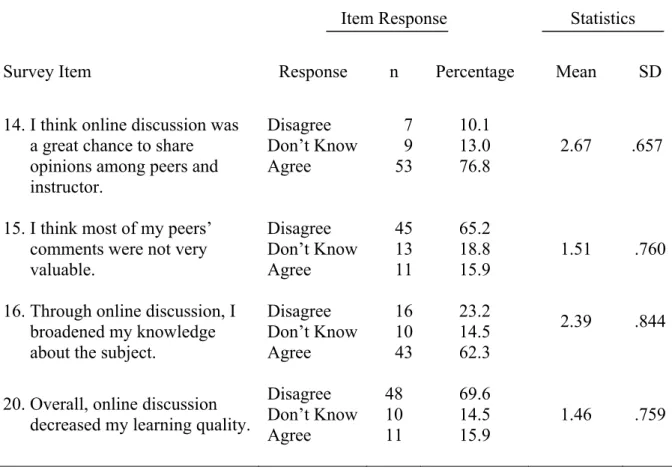
females in this study. Findings indicated that 77% of students agreed that online discussion was a great chance to share opinions among peers and their instructor. Likewise, more than 55% of students expressed an enjoyment of online discussions on four survey items related specifically to that construct. Reaction was mixed to questions related to motivation from online discussions. By contrast, more than 50% of students indicated that they learned from their involvement in online discussions, though responses suggested that they did not learn directly from peers. Findings indicated that 70% of students did not see online discussions as decreasing the quality of learning they experienced.
DEDICATION
To my past, current, and future teachers, In name and by association,
ACKNOWLEDGEMENTS
CONTENTS
Page
LIST OF TABLES... xi
LIST OF FIGURES ... xii
CHAPTER ONE: INTRODUCTION... 1
Problem Statement...4
Purpose of the Study ...6
Research Questions...8
Definition of Terms...9
Significance of the Study ...12
Summary of Introduction...13
CHAPTER TWO: REVIEW OF THE LITERATURE ... 14
Research in Online Learning ...15
The Online Environment...19
Student Perceptions of Learning from Online Discussion...21
Student Motivation and Enjoyment from Online Discussion...22
Prior Experience as an Online Learner ...24
Gender Differences ...25
Summary of the Literature ...31
CHAPTER THREE: RESEARCH DESIGN... 34
Purpose...34
Research Questions...35
Rationale for Design ...36
Role of the Researcher ...37
Site Selection and Participants...37
Access ...37
Steps to Acquire Participants/Sample Size ...38
Population & Number of Participants/Population & Sample Size ...39
Rationale for Choice of Participants/Sample Size ...40
Instrumentation ...41
Background ...41
Validity and Reliability...45
Procedures/Data Collection ...45
Data Analysis ...47
Quantitative Data ...48
Qualitative Data ...48
Summary of Methodology ...49
CHAPTER FOUR: RESEARCH FINDINGS... 50
General Reporting of Results...51
Demographic Results ...51
Open-ended Questions Results ...62
Data analysis through the Community of Inquiry model...66
Cognitive Presence...67
Social Presence ...70
Teaching Presence ...75
Data Analysis through Perceptions of Motivation and Enjoyment ...79
Summary of Research Findings ...82
CHAPTER FIVE: DISCUSSION... 85
Study Conclusions ...86
Prior Experience in Online Discussions ...86
Gender in Online Discussions...88
The Relationship between Motivation and Enjoyment and Learning ...92
Instructor Role ...94
Limitations of the Study...95
Implications for Future Research...97
Implications for Future Practice...99
APPENDIX A: LEARN NC Online Discussion Survey ... 103
APPENDIX B: Academic Affairs Institutional Review Board Approval ... 111
APPENDIX C: Institutional Review Board Application... 112
APPENDIX D: Assent Letter ... 126
APPENDIX E: Parental Consent Letter ... 130
LIST OF TABLES
Table Page
Table 1 Construct Representation by Survey Item ... 43
Table 2 Student Background Information... 53
Table 3 Perceptions of Motivation and Enjoyment ... 55
Table 4 Perceptions of Learning ... 58
Table 5 Role of the Instructor ... 60
Table 6 Response Rate to Open-ended Questions ... 62
LIST OF FIGURES
Figure Page
CHAPTER ONE: INTRODUCTION
Distance learning has experienced tremendous growth due largely to the ubiquitous access to the Internet. Not only has the Internet increased the number of individuals
participating in distance learning, but it has at the same time raised the awareness and ability to collaborate on distance learning initiatives. The Internet has made it possible for one population of learners, high school students, to have access to courses not normally available in the traditional high school setting. For example, students living in rural areas of North Carolina have not traditionally taken Advanced Placement courses since the small size of the school systems precludes offering these courses.
synchronous experiences. This format requires that students meet at a scheduled time, in a scheduled teleconference facility, with their classmates and instructor who are physically located elsewhere. The class interacts via two-way video/audio. Just like the traditional classroom, students can see and hear one another as the class unfolds.
Most recently, asynchronous courses have become a popular format for online course delivery. Schools and school systems find the flexibility of this format more appealing since students can log on or attend class at any time during the day, on any Internet-connected computer, located anywhere on school grounds. Asynchronous learning is not constrained by the requirements of real-time interaction.
From this perspective, online courses appear to be a “win-win” situation for many school systems across the country. School administrators in particular are intrigued by evaluation studies which conclude that student achievement online equals or surpasses achievement seen in traditional settings (Mills & Roblyer, 2003). However, the addition of online courses to a school curriculum requires a change in thinking about how student schedules are organized, how grades are reported, and how schools collaborate with outside providers to increase their course offerings. Perhaps the most essential and most ignored consideration of online courses for high school students is the change that students
ground” classroom. Certainly, these features of online courses have a unique impact on student performance (Bibeau, 2001).
While there is literature to support the economic advantages and issues of equity afforded by online courses, there is an unequal amount of empirical evidence of its effectiveness, impact on student motivation and performance, and benefits for learning (Hannafin, Hill, Oliver, Glazer, & Sharma, 2003). This is not surprising given that the Internet has been widely available to the general public for less than 20 years. The existing research base concentrates on post-secondary education where the technology and money have been available far longer than in the K-12 arena. It should be noted that existing research which looks at student perceptions, motivations, learner characteristics, and other affective aspects of online learning is limited. This can be explained by the relatively short amount of time the Internet has been a part of K-12 education, approximately 10 years. Schools in rural areas have had Internet access for less time than that, with connection speeds far slower than those of their counterparts in urban and suburban areas. The slow pace of Internet integration in these schools helps to explain why access to asynchronous courses has been a recent occurrence for many schools.
environment, learner characteristics, pedagogical strategies, and how students in online courses are motivated to learn (Cereijo, Young, & Wilhelm, 1999; Hartley & Bendixen, 2001). How do online courses address the challenges students and teachers encounter in the face-to-face classroom?
Problem Statement
In the fall of 2002, LEARN NC, a K-12 outreach program of the School of Education at the University of North Carolina at Chapel Hill, began to offer online, Advanced
Placement courses for the first time to students in 13 rural, low-wealth counties in North Carolina. Funded by a grant from the North Carolina Department of Public Instruction, LEARN North Carolina identified and prepared certified Advanced Placement teachers to become online instructors for the program, and served as the hosting institution for the courses. Among these, four teachers were identified and prepared to teach Advanced
Placement Psychology, which was determined to be a course in high demand for high school students.
of providing online courses for high school students as the North Carolina Virtual Public School prepared to open in fall 2007.
The primary function of LEARN NC’s state-wide program was to assist schools in their attempts to increase course offerings, specifically Advanced Placement courses in rural areas (Mills & Roblyer, 2004). During the first year, sixty-eight students were enrolled in six courses. During its fifth year, the period when this study was conducted, the program offered 58 courses with approximately 2,350 students from North Carolina and a few students from other southern states. Participation in the program required a formal application through the North Carolina Department of Public Instruction which dictated that each participating school must provide the following:
a scheduled class period for students taking an online course;
dedicated, reliable, and daily Internet access with specific computer software
and hardware configurations;
a school facilitator who monitors students’ work and assessments,
troubleshoots technical issues, and serves as the official school liaison with the grantee (the North Carolina Department of Public Instruction) and the hosting institution, LEARN North Carolina.
little to no empirical data in general for high school students in online courses as reflected by the literature. This study was designed not only to inform the LEARN NC Online Courses program, but to contribute to a research base for understanding how high school students understand and perform in online courses.
Given the rate at which states were developing virtual high schools and the haste of individual schools to include online courses as a part of their course offerings, little attention had been given to the impact of this learning environment on the learner. At the expense of addressing federal mandates to increase achievement scores, little is known about how high school students perceive their online learning experience. Are they motivated to learn online? Do they enjoy it? Do they believe they are learning from it? Do online courses meet the needs of all students or only those of a few? The excitement and learning potential attributed to online courses appears to overshadow the need to understand how they should be designed and integrated to result in successful learning experiences for these students.
Purpose of the Study
Among the issues of research in online learning are those of student interaction and development of a learning community. The literature indicated that the interaction of the learning community is important for achieving a successful online experience and can also impact student achievement (Jiang & Ting, 2000). Some of this research was based on student perceptions of their interactions with one another and with the instructor and how their perceptions contribute to their success in the course.
Ongoing, collaborative online discussion is considered among the characteristics of a
facilitating online, asynchronous discussions called the Discussion Board. This feature of online courses, housed by the LMS, is where the majority of student and instructor
interaction takes place.
Online discussions can be important tools for developing a learning community among learners who are geographically separated. The learning community is cultured through student and teacher interaction by course features like the Discussion Board. In order to better understand how high school students are affected by the use of online discussion, this study examined student perceptions of motivation, enjoyment, and learning as a result of participating in online discussion. The study explored the potential relationship between motivation, enjoyment, and learning to understand how they are related. While exploring this relationship, the study considered gender differences in online discussion, the impact of prior experience on online discussion, and the role of the instructor to motivate students through online discussion.
Research Questions
The following questions framed the development and implementation of this study. Statistical analyses were used in the analysis of the resulting data to discuss findings of the study related to the major research question and to other research questions which provided focus for the research.
Major Research Question
What are the relationships between student perceptions of motivation and enjoyment and student perceptions of learning from online discussions?
Research Questions
1. Is there a significant difference between students who have taken online courses and those who have not in terms of their perceptions of motivation and enjoyment from online discussions?
2. Is there a significant difference between students who have taken online courses and those who have not in terms of their perceptions of learning from online discussions?
3. Is there a significant difference between male and female students in perceptions of motivation and enjoyment from online discussions?
Definition of Terms
This section defines commonly used terms in the study of online learning as they are used in this study.
Advanced Placementor A.P. is a program offering high school students the opportunity to receive university credit for courses taken while enrolled in high school. The program is administered by the not-for-profit College Board which develops and maintains these courses in various subject areas. Student scores on the end-of-year AP Exam determine whether students can receive college credit for the course. In the context of this study, the site selection for the study sample is comprised of three sections of online Advanced Placement Psychology.
Asynchronous communicationdescribes class interaction that does not occur in real time. It may involve the use of email, threaded online discussions, or listservs. Distance education and online learning make use of both asynchronous and synchronous modes of delivery. In this study, asynchronous communication refers to the interaction of students and instructor through the use of threaded online discussions in the discussion board.
and sharing, assessment management, online communication, and collaboration. Blackboard was the LMS used in this study.
Computer-mediated Communication refers to any form of communication between individuals interacting with one another via separate computers through the Internet, and using software designed to facilitate communication. CMC does not focus on the methods by which two or more computers communicate. Instead, the emphasis is on how
communication occurs between individuals using computers. Computer-mediated Communication is a major area of research in distance education.
Discussionsrefer to an exchange of information that occurs electronically in the online environment. For example, discussions may occur via private email exchanges, through synchronous chats, or via a discussion board. In the context of this study, the term
“discussion”referred to the conversations that occur in the Discussion Board of the courses.
Discussion Boardis a feature of many online courses where discussion forums are housed. This feature is often accessed via a link in the main menu of the course.
Discussion Forum is a Web application within the Discussion Board feature which provides architecture for online discussion, usually in an asynchronous format. Historically,
Distance education refers to education using interactive technologies to connect teacher(s), students, and resources across geographic and temporal distances.
Face-to-Face Classroom is a term used to distinguish between online courses and the traditional classroom in an educational setting. The term Face-to-Face Classroom is used to highlight the ability of students and instructors to interact with one another in real time, in the same physical space.
Learning Communityrefers to a group of learners brought together with a common interest whose collaborative activities drive the growth of the group and its members as learners. In online learning, the learning community is an essential component in successful courses.
Learning Management System (LMS)refers to the software or courseware through which learning content is delivered and managed. Blackboard is an example of a Learning Management System.
Online Learning is a form of distance education involving computer-mediated
communication (CMC) via the Internet. In the context of this study, online learning refers to fully-online, asynchronous courses.
forums where an initial posting or starter thread begins a conversation. The thread of the conversation is visually represented by indenting responses to represent the order of exchange of the conversation. Participants may either respond to a previous comment or launch a new conversation of their own. In the context of this study, the researcher examined students’ perceptions based on the interaction which occurs in the threaded discussions.
World Wide Web, often referred to as the “Web,” refers to the information made available via the Internet that can be accessed via software called a “browser.” Organizations and
individuals can publish information about themselves on “websites” or pages on the Web. In the context of this study, the online courses were accessed via the World Wide Web using the Internet Explorer browser.
Significance of the Study
The majority of research in online learning comes from studies conducted at the post-secondary level of education. By contrast, there is a paucity of research at the K-12 level. Though the results of some studies may be extended to the K-12 environment, careful consideration must be given to the fact that the body of current research is primarily concerned with adult learners, and therefore likely to be influenced by the expectations of adult learning theory. There is a need to understand the effects of online learning for
discussions function to motivate students and how they are sources of student learning within the course environment. At the time of this study, the researcher could not identify the existence of empirical studies which offer insight into issues in online learning at the K-12 level with the exception of national studies on the adoption and impact of online courses from a demographic perspective. Literature reviews and meta-analyses of online learning were all focused on online learning in higher education.
Summary of Introduction
This chapter has described the current status of online learning in the K-12
educational setting in North Carolina and makes an appeal for research studies like this one. The feverish adoption of Internet technologies, including online courses, had not been met with equal attention to understanding the cognitive, social, and pedagogical implications of online courses for high school students. The LEARN North Carolina program is a course provider offering online courses to high school students in North Carolina. This organization and others like it will benefit from greater insight into the dynamics of online courses for K-12 education. This study examined student perceptions of the discussions within the Discussion Board feature. Their responses to an online survey were an important source of data for understanding the value of online discussions. A Definitions section clarified key terms related to online learning used throughout the study.
CHAPTER TWO:
REVIEW OF THE LITERATURE
Online learning has become the predominant format for conducting distance
education in the 21st century. Far removed from the first model for distance education which occurred by mail in Europe during the 1700s (Sherry, 1996), online learning has developed as a continuum of alternative delivery modes for teaching and learning. At one extreme, instructors in traditional face-to-face courses use resources from the World Wide Web to supplement or enhance their classes (Web-enhanced). Somewhere in the middle, a hybrid mode occurs when classes meet occasionally in the face-to-face setting. The course materials, assignments, and discussions occur via the Internet. This approach is considered a
transitional stage for instructors who are not yet ready to relinquish the face-to-face contact with their students. At the opposite end of the spectrum are courses where the entire
curriculum of a class if offered via the World Wide Web. Students participate in the course regardless of their geographic location, and independent of time and place (Harasim, Hiltz, Teles, & Turoff, 1995). Interaction occurs asynchronously over the World Wide Web and students may never meet in a face-to-face setting in order to complete the course. This study was concerned with the asynchronous method of delivery.
needed to provide clarity and understanding of the circumstances under which high school students enroll in online courses. Nonetheless, post-secondary research does hold some relevance given that the demographics of online students continues to shift to younger learners (Roblyer, 1999). This Review of the Literature examines what is known about online learning while controlling for the age of the learner. In other words, this Review discusses aspects of online learning that are seemingly extensible to all learners. As such, general research about online learning, the phenomenon of the online environment, student perceptions of learning from online discussion, student motivation and enjoyment from online discussion, prior experience as an online learner, gender differences, and instructor role in online discussion are examined.
Research in Online Learning
Research in the K-12 arena has centered on implementation and policy issues. Despite the scarcity of literature on the effectiveness of online learning at the K-12 level, many states have forged ahead with the creation of their own virtual high schools, modeling their programs after the first study of the Concord Consortium’s Virtual High School by SRI International and the subsequent book by two SRI staff, The Virtual High School: Teaching Generation V (Yamashiro & Zucker, 1999; Zucker & Kozma, 2003). The frenetic growth of virtual high schools is apparent in organizations like the Florida Virtual High School and the Concord Consortium’s Virtual High School.
school year. According to the report, 8,200 public schools, or 9% of all public schools nationwide had students enrolled in distance education courses. Within these schools, approximately 45,300 students were enrolled in Advanced Placement or college-level distance education courses. Asynchronous courses were the primary delivery mode of computer-based instruction in medium and large districts. Superintendents in these districts reported that 92% of the students enrolled in distance education courses accessed them from school, with 60% accessing them from home, and 8% accessing the courses from other locations like a community center or public library. The primary reasons for offering distance education courses included offering courses not otherwise available at school (80% of districts), meeting the needs of specific groups of students (59%), and offering Advanced Placement or college-level courses (50%). And finally, on a policy level, there is the push to embrace online learning as a mechanism for preparing tomorrow’s leaders to thrive in an information-based economy (Information Infrastructure Task Force, 1993; President’s Committee of Advisors on Science and Technology, 1997).
On a cognitive level, online learning makes it possible for the learner to take all the time necessary to process new information before engaging in discussion with classmates and the instructor (Berge, 1997; Harasim, 1990; Simonson et al., 2000) . Unlike the face-to-face classroom, the online classroom does not demand an immediate response to a question, placing the learner “on the spot.” This affordance of the online classroom makes it possible for students to work at their own pace, a particular advantage for English language learners, shy students, students with disabilities, or students whose learning style is more conducive to a pace which they control (Navarro & Shoemaker, 1999; Simonson et al., 2000). Finally, the ability of the Web to conceal personal identities, to strip away those aspects of who we are, that can lead to prejudice or discrimination of any kind, means that all students can
participate equally in online learning regardless of their race, sex, appearance, or any other personal attribute (Simonson et al., 2000).
As can be expected, there are disadvantages associated with online learning. Among these, one of the most prominently cited is limited interaction or lack of “teacher immediacy” behaviors (Arbaugh, 2001; Johnson, Aragon, Shaik, & Palma-Rivas, 2000; Vonderwell, 2003). Teacher immediacy behaviors are influenced by numerous variables like prior experience of the instructor in teaching online, instructor decisions of how to use the
communication tools of the Learning Management System, personal philosophy of teaching, and instructor role in the online environment, to name a few.
environment, or they experience technical problems caused by the Learning Management System. In these instances, students spend an inordinate amount of time negotiating barriers of the environment with little time left to engage in the course material. Further, student performance is hindered when students falsely believe that their online course will be easier than a face-to-face course.
Most of the disadvantages to the student come from a lack of attention to the best practices research on learning design, deployment, and pedagogy (Elbaum, McIntyre, & Smith, 2002; Palloff & K., 1999; Sunal, Sunal, Odell, & Sundberg, 2003; Vonderwell, 2003). Instructors may have received little or no preparation to design and teach their online
courses. The information provided to the student from the host institution may have been confusing. Unclear directions and awkward use of the course features on the part of the instructor can cause students to “check out” of the course in a relatively short amount of time.
Fortunately, there are an equal number of studies that identify best practices in online learning, citing key course elements and teaching strategies. Sunal et al. (2003) conducted a meta-analysis of best practices in asynchronous and synchronous online instruction in higher education. Among their findings, they observed that while the literature supports the idea that the medium, i.e., the Learning Management System, does not supplant effective practice in online learning, the medium alone is not responsible for student learning. Instead, their research supports Robert Kozma’s (1994) belief that both media and methods are essential components in the effective instructional design of an online course.
embrace online learning in the K-12 arena and beyond. This question has been posed from the very beginning by many researchers, in particular those naysayers who caution against the widespread implementation of online courses. There is an increasing body of research, sprinkled with some program evaluation studies, indicating there is no significant difference in student achievement online versus achievement in traditional classrooms (Coates et al., 2000; Johnson et al., 2000; Ocker & Yaverbaum, 1999; Sunal et al., 2003). Studies indicate that students perform no worse in online courses, yet little empirical evidence has indicated that students achieve greater academic success in the online environment. No empirical evidence can be found indicating differences between student performance in required online courses versus those courses taken as electives or taken due to their convenience.
The Online Environment
the individual.” Lack of awareness of the affordances of the medium may likely impede the potential success of both students and instructors.
The learning community is perhaps the most essential affordance of an online course (Hiltz, 1997; Palloff & K., 1999; Rovai, 2002; Swan, 2002; Wegerif, 1998). The interactions in the form of discussions that occur in the discussion forum and elsewhere in an online course are elements for building and sustaining a learning community. Not to be confused with a “community of learners,” the learning community is the vibrant component which drives the learning experience in any successful online course. Because students and instructor are in different physical locations, and may never see one another, the instructor must nurture this learning community so that no individual student feels isolated or “lost in cyberspace.” The theoretical framework of this study provides more details on the relevance of the learning community in online courses, with an emphasis on the “Community of Inquiry” which best defines a successful online course (D. Randy Garrison et al., 2000).
can be observed through learner interaction, instructor interaction, learner-content interaction, and learner-interface interaction (Zirkin & Sumler, 1995).
Student Perceptions of Learning from Online Discussion
With all of the attention given to the implementation of online courses, what is known about how students perceive their learning experiences online? Do they feel that the online course environment is effective toward achieving learning goals?
Numerous studies take a look at student perceptions of various components of the online course environment like course structure, learner autonomy, course interface, and interaction (Fulford & Zhang, 1993; Huang, 2002; Picciano, 2002; Wu & Hiltz, 2004). These studies indicate that students are impacted by the attention given to course design, pedagogy, and attempts to cultivate a learning community. A significant part of most online, asynchronous courses is the Discussion Board feature. Some describe the Discussion Board as a tool that contributes significantly to positive perceptions of learning. Such was the case with a mixed-methods study where students felt they had a better experience in courses emphasizing online discussion (Jiang & Ting, 2000). Swan’s (2002) study of the course design factors that impact successful asynchronous courses revealed a strong preference for active discussions by students across 73 courses. Just prior to the widespread use of online discussion forums, Altaus (1997) found that students who participated in computer-mediated discussion reported they learned more and had higher grades than those students in the study control group in a study using an electronic mail configuration to simulate threaded
discussions.
topic and take the discussion to higher levels of thinking. Students are more careful about what they write and more thoughtful knowing that their classmates, in addition to their instructor, will read what they write (Chizmar & Walbert, 1999; Petrides, 2002; Vonderwell, 2003). Such is the case in studies that explore the role of the discussion forum and its relationship to higher-order thinking (Meyer, 2003). These studies indicate that students appreciate the opportunity to learn more as they collaborate and engage in critical thinking skills (Hiltz, 1994; McAteer, Tolmie, Duffy, & Corbett, 1997). Further, content analysis of student postings in several studies reveals that, although students may post few times to a discussion forum, their responses are lengthy, cognitively deep, and embedded with peer references (DR, Webb, & Cochrane, 1997; Hara, Bonk, & Angeli, 2000).
The Community of Inquiry model, the theoretical framework for this study, holds that student perceptions of learning are closely aligned with their perceptions of social presence through online discussions. Student and instructor interactions in the discussion board foster a greater sense of social presence. The literature indicates that student perceptions of
learning are greater in those instances where students perceive a high level of social presence in areas like the discussion board (Richardson & Swan, 2003; Wu & Hiltz, 2004).
Student Motivation and Enjoyment from Online Discussion
program requirements that are conducive to a hectic lifestyle. In the case of K-12 students, the motivation for enrolling in an online course is more likely linked to the opportunity to access courses not available in their setting or to advance their academic standing, as is often the case when students enroll in Advanced Placement courses. The intrigue for this study was situated in the potential extrinsic motivation whose locus is situated in online
discussions.
Because students must assume more responsibility for their own learning in online courses, motivation to learn and be successful are linked to student achievement (White, 1999). When students know that others will view their work and their “thoughts” in online discussions, they are more motivated to work diligently and to complete all assignments (Hiltz, 1997). In an earlier study, Hiltz (1994) found that students who make best use of various online tools like the discussion board have the most positive attitudes about the online learning experience. The mere integration of discussion board activities in an online course can motivate students who realize participation has been equalized since everyone has the same amount of time to contribute to a discussion (Procter, 2000). The absence of tools like the discussion board can isolate students from their peers, decreasing the likelihood of interaction, and consequently impacting students’ motivation to excel and complete the course (Abrahamson, 1998).
incentives. For example, responses that include expressions of approval or indications of interest in a particular student can originate from fellow students as well as the instructor of the course. When this happens, students come to see themselves as valued contributors, experts or discussion leaders. They come to value the online discussion as an integral part of the course. Shea et al. (2001) corroborate these findings in their major study of 3,800
students enrolled in 264 courses of the SUNY Learning Network (SLN) where they found a strong relationship between satisfaction, interaction, and performance as measured by grades. They concluded that when value is attributed to online discussion, i.e., graded, when the discussion is authentic and frequent, and when interactions are positive and enthusiastic, students are happier and learn more.
Prior Experience as an Online Learner
There is the general tendency to believe that teenagers of the 21st century, the “N-Geners,”(Tapscott, 1998) are well-equipped for participating in online courses. They have known technology in the form of the personal computer and the Internet for most of their lives. Consequently, there is the assumption that they will adapt more readily to online courses than adult learners. Though this may be the case, there will always be a time of adaptation and role adjustment for the learner who is new to online courses. Prior experience in online learning can provide a distinct advantage to the learner who begins a new online course. Students with prior experience already understand the way in which they must behave, i.e., how they must adjust their behavior and role as students to achieve success.
others to contradict these findings. In the absence of a depth of research on the effects of prior experience in online courses, instructors must bear in mind how the usefulness and ease of use of an online course could influence the student’s attitude toward online learning, thereby increasing the likelihood of the student enrolling in another online course (Arbaugh, 2000b). The same philosophy applies to face-to-face courses. As such, Yellen’s (1998) work indicates that motivation, expectation, and experience are critical factors for success for students in both settings.
Gender Differences
Historical accounts of the use of technology in the face-to-face setting have indicated distinct differences in adoption, response to, and role of technology with respect to gender. Though thoroughly studied in the traditional classroom setting, how does gender impact behavior in the online classroom? In the online learning arena, the research is again limited to post-secondary courses; therefore, research on female motivation and lifestyle as it relates to gender differences in online learning in higher education can not be extended to the K-12 arena though it does provide some insight into this aspect of online learning.
Research into gender differences in online discussion in the 1990’s shows a male dominance of online discussions (Kramarae & Taylor, 1993; Spender, 1995). This may be explained by the predominantly male Internet population at a time when online
tended to exhibit separate, individual learning styles, while females were more connected in the way they learned. Unfortunately, this study also reported male domination of the discussion forum with disparaging remarks from male participants about the technical prowess of women.
As the number of female Internet users has increased, it is likely that the male voice will no longer dominate. With a now larger percentage of females online than males, perhaps online discussions are now more suitable to the learning styles of female students. For example, Richardson and Swan (2003) found that females perceived more social
presence than males in a study of 97 students in online courses through Empire State College. However, caution should be taken in such observations given the potential for bias of survey instruments or small sample sizes.
Arbaugh found that there were no significant differences in learning between males and females (Arbaugh, 2000a). He did find that males indicated greater difficulty interacting with classmates throughout the course. When online communication is used primarily to disseminate information, males appear to be more satisfied. However, keeping in mind that a learning community requires interaction and collaboration, gender research indicates that females would more likely succeed, indicating their responsiveness and preference for a supportive, nurturing environment via online discussions. (Hipp, 1997; M Moore & Kearsley, 1996). Likewise, an Internet and Web design course favored women and older students who were more motivated, better at scheduling their learning, and adept at communicating online (McSporran & Young, 2001).
have known the Internet for more than half of their life. They are among the first “Digital Natives” we have known. They turn to the Internet first as their source of information unlike the “Digital Immigrants” who, as adult learners, did not grow up with the need to understand digital literacies in order to function in the world (Presky, 2001). The gender differences currently reported in the literature do not account for the new population of students in online courses who will enter post-secondary education with prior experience in online learning.
Instructor Role in Online Discussion
Much has been written about the role of the instructor in online courses. In particular, research into best practices online describes the instructor as more of a facilitator than the traditional teacher (Berge, 1997; D. Randy Garrison et al., 2000; Harasim et al., 1995; Palloff & K., 1999; Simonson et al., 2000). The instructor can play an integral role in motivating students to participate and succeed through teacher immediacy behaviors (Robert LaRose & Pam Whitten, 2000).
Research on instructor role in online learning identifies numerous variables which impact student success. In the context of this study, this complexity was not examined. Instead, the study design considered only whether the instructor plays a critical role to motivate discussions among students.
Theoretical Framework
level. Secondary schools have embraced asynchronous courses since they can be easily incorporated into any school’s existing daily schedule.
The learning community developed in an asynchronous online course, though ever-changing, is comprised of several key elements that are essential to a successful experience for students. Research models for framing what happens in the online environment are informed by researched models that prove successful in the traditional classroom. Caution must be taken to not overlook the apparent differences between the two as models are reinterpreted for the online environment. The National Research Council’s Commission on Behavioral and Social Sciences and Education promotes a researched model of effective learning environments in the publication How People Learn (Bransford, Brown, Cocking, Donovan, & Pelligrino, 2000). Here, the authors present a framework of four components which describe an effective learning environment as learner centered, knowledge centered, assessment centered, and community centered. These components ask those involved in crafting a learning environment to consider the following:
1. Knowledge centered– The environment is designed to achieve learning outcomes.
2. Learner centered– The environment takes into consideration the “uniquities,” strengths, and weaknesses of the learners and helps them to better understand how they learn. The environment bridges new learning with what is already known and capitalizes upon learners’ interests to drive the learning
3. Assessment centered– The environment offers numerous ways for learners to make their learning visible and to obtain ongoing feedback to assist in
monitoring progress.
4. Community centered– The environment promotes collaborative learning in a safe environment where learners are encouraged to take risks. Learning is made relevant through connections to the outside world as learners become more self-directed in their learning.
The components of an effective learning environment, though not specifically designed to represent the online environment, do reinforce research on the essential
components of online courses. These components can be seen in the Community of Inquiry model (D. Randy Garrison et al., 2000), Figure 1, which identifies the major elements necessary to achieve an effective learning community online.
As explained, the elements of Bransford’s model do not map directly onto the
only reconceptualized (Carr-Chellman & Duchastel, 2000; Knowlton, 2000). In order to learn, students must engage in dialogue with one another and with their instructor as they collaborate to achieve learning outcomes (Anderson, 1998; Jonassen, Davidson, Collins, Campbell, & Haag, 1995; Kearsley & Shneiderman, 1998; Savery & Duffy, 1995). They must proactively engage their co-learners while processing the content of the course in different ways than they may have been accustomed to doing in the traditional classroom.
From this philosophical perspective, Garrison et al.’s Community of Inquiry model defines the three core constructs of any effective online course environment as follows:
1. Cognitive Presence is concerned with the exploration, construction, resolution, and confirmation of understanding through collaboration and reflection in a community of inquiry.
2. Teaching Presence concerns the selection, organization, and presentation of the content as well as the development of learning activities and assessment. Teaching presence moderates the behaviors coming from cognitive presence and social presence. Of note, the facilitation of learning associated with teaching presence may be performed by instructor or student.
Figure 1 Community of Inquiry Model
When students engage in online discussion, the likelihood that a community of inquiry, a learning community, will be cultivated is increased. Student interaction through discussions can manifest the three constructs of cognitive, teaching, and social presence. The
Community of Inquiry model lends theoretical support to the importance of online discussion in the development of a learning community, and ultimately the development of an effective online course.
Summary of the Literature
Courses for Public Elementary and Secondary School Students: 2002-2003” (Setzer & Lewis, 2005).
The literature is filled with studies documenting the advantages of online learning (Jiang & Ting, 2000; Rourke et al., 2001; Simonson et al., 2000; Ward & Newlands, 1998). Most prominent are those which address the ubiquitous access to the online environment, socio-cognitive advantages to the learner, and equality of educational opportunity.
Disadvantages include potential isolation due to lack of physical contact, environmental and technological barriers, poor instructional design, and lack of instructor preparation.
Meanwhile, substantial attention has been given to the identification of best practices in online pedagogy and instructional design (Sunal et al., 2003).
The theoretical framework of this study, the Community of Inquiry Model (D. Randy Garrison et al., 2000) provided a focus for the research literature while providing a structure for the design and analysis of this study.
Student perceptions of learning from online discussions give insight into the role of various course features and phenomena. Topics include course structure, learner autonomy, course interface and course interaction (Fulford & Zhang, 1993; Huang, 2002; Picciano, 2002; Wu & Hiltz, 2004). The learning potential afforded by online courses is discussed in studies that look at the development of a learning community through collaboration and activities that promote critical thinking skills (Hiltz, 1994; McAteer et al., 1997).
context of student perceptions and achievement (Blum, 1999; Kramarae & Taylor, 1993; Richardson & Swan, 2003; Spender 1995). The literature reflects a change in the role that gender plays in more recent studies (Arbaugh, 2000a).
The instructor role in online discussions and online courses is an area of increasing interest for researchers. The literature conceptualizes the instructor’s role more as a
facilitator than a knowledge-giver (Berge, 1997; D. Randy Garrison et al., 2000; Harasim et al., 1995; Palloff & K., 1999; Simonson et al., 2000). While not a major emphasis of this study, the role of the instructor in online discussions and online courses cannot be ignored.
It is not enough to know that online learning is an effective environment for teaching and learning. The research literature is moving in the direction of “why” it is so. The issues discussed in this review of the literature beg for more research in the area of K-12 online learning to provide a complement for the existing research which is primarily focused on post-secondary education. This research study provided initial insight into some of the issues already documented for adult learners.
CHAPTER THREE: RESEARCH DESIGN
This chapter details the research methods and procedures, including purpose, rationale of design, role of the researcher, site selection and participants, and discussions of sample and sample size. The survey instrument is discussed according to the constructs examined during the study: Perceptions of Motivation and Enjoyment and Perceptions of Learning. A single item looks at the role of the instructor. The chapter concludes with details of procedures, data collection, and analysis.
Purpose
does the instructor play in online discussions? Though discussions can occur via various online tools, this study considered only those discussions which take place in a well-known feature of many Learning Management Systems like Blackboard, the Discussion Board. Many instructors take advantage of this architecture to create an opportunity for students to engage in the content of the course, to reflect on their learning, to socialize, and to
collaborate with their classmates on learning activities.
Research Questions
This study proposed the following questions for examination:
Major Research Question
What are the relationships between student perceptions of motivation and enjoyment and student perceptions of learning from online discussions?
Research Questions
1. Is there a significant difference between students who have taken online courses and those who have not in terms of their perceptions of motivation and enjoyment from online discussions?
2. Is there a significant difference between students who have taken online courses and those who have not in terms of their perceptions of learning from online discussions?
4. Is there a significant difference between male and female students in perceptions of learning from online discussions?
Rationale for Design
This study used a non-experimental approach to correlate student perceptions of motivation and enjoyment with their perceptions of learning from online discussions in three Advanced Placement Psychology courses for high school students. Data were collected via an online survey instrument administered at the end of the course. Given the design of the study, it was essential to identify online courses that take advantage of the discussion forum feature. Further, to control for the effects of the course subject matter and variation in instruction, this study targeted participants from three sections of Advanced Placement Psychology. All three sections used the same course layout and design, and all three used the same discussion activities throughout the course. The courses had different instructors, with one course being taught by a husband and wife team. It is important to note, however, that the four instructors were all prepared to teach online for LEARN NC at the same time, using the same original course, and have
Role of the Researcher
The researcher in this study managed all aspects of this study. All communication with instructors, site facilitators, study participants, and the host institution, LEARN NC, were handled by the researcher. In this capacity, the researcher communicated with students using theMessages feature of Blackboard. Communication with course instructors and the Site Facilitators occurred via email. The researcher assisted in the work to place the survey online using Snap software. When all surveys had been submitted, the researcher collected all of the data and maintained the security of the data by ensuring that both the survey data housed on the server and on the researcher’s personal laptop were always secure and not accessible to others. Finally, the researcher analyzed the data using Snap survey software (Snap, 2005), SPSS software (SPSS, 2005), and QDA Miner software (Provalis, 2004).
Site Selection and Participants
Access
The site for this study is unique in that it is not a physical location as normally expected in research studies. Instead, the site existed in the virtual world as a collection of online, asynchronous courses housed by the host institution, LEARN NC (www.learnnc.org), a program of the School of Education at UNC, but funded directly by the State of North Carolina (http://www.learnnc.org/students/9-12/courses/). All courses through LEARN NC were designed and taught asynchronously using Blackboard, a Learning Management System (LMS) that had become an industry standard for developing and teaching online courses.
logged into their online class during the same school period. Each school site provided a period during the day, Monday through Friday, when the student accessed the course. This daily time varied from one school to the next depending upon the school schedule, but did not impact the student’s ability to take part in the course. Students were able to access the course beyond the end of the school day on any computer with Internet access.
A site facilitator was physically present while all students accessed their courses. The site facilitator monitored and supported student participation on a daily basis. This individual served as a liaison between the course instructor and the host institution, LEARN NC. The Site Facilitator performed numerous functions for the program like monitoring daily
participation, proctoring online assessments, communicating grades from the instructor to the school, and troubleshooting technical issues.
The instructors of these courses, like their students, were geographically located around the state. The instructors were not on faculty at UNC, but functioned as contract employees through LEARN NC. All were employed as classroom teachers in North Carolina high schools. The instructors were certified as Advanced Placement teachers, had advanced teaching degrees, and had been teaching online for the same amount of time.
This site was chosen because of the ease of entry resultant from the researcher’s employment by the host institution and peripheral involvement with the K-12 Online Courses Program at LEARN NC.
Steps to Acquire Participants/Sample Size
of informal contact, the researcher had discussed the plan to survey students in this program with the aforementioned Directors of LEARN NC. Formal communication of the study to both the Executive Director and the Director of Online Learning was made via hard copy letter detailing the study’s research design, research questions, procedures, and timeline. The researcher explained that results would be shared with LEARN NC and how these results would benefit the organization. The Director of Online Learning assisted the
researcher in the identification of courses that satisfied the requirements of the study design. The Director of Online Learning served as a liaison to introduce the researcher to the online course instructors. The researcher communicated the study’s research design, research questions, procedures, and timeline to those instructors via email. The same information was shared with the Site Facilitators via email at each of the school sites where students were participating in the study.
The researcher sent initial contact letters via the Site Facilitators to the parents of students in the participating courses. The letter contained the same information
communicated to course instructors: the study’s research design, research questions,
procedures, and timeline. Following, assent was obtained from students participating in the study and parental consent was obtained from students who were considered minors. All forms were returned to the researcher via mail.
Population & Number of Participants/Population & Sample Size
The population targeted by this study was North Carolina high school students enrolled in online, asynchronous courses through LEARN NC. The study targeted 92 high school students from high schools across the state enrolled in one of the three online
graduation, but elected to do so for different reasons. The course lasted one year to accommodate the scheduling of the Advanced Placement examination held in the spring of each year. At the time of the study, the LEARN NC Online Courses Program had an enrollment of 1,600 students across 31 courses. All students had been participating in the course since the beginning of the 2005-2006 academic year.
The instructors were four licensed teachers who had Advanced Placement
certification, advanced teaching degrees, and who had been prepared by LEARN NC to teach online. All instructors had from 8 to 25 years of teaching experience. All of the instructors were in their fourth year of teaching Advanced Placement Psychology online for LEARN NC, having begun teaching online in the 2002-2003 school year. These courses and their instructors had been chosen as previously stated because they all used the Discussion Board in the same way. As important, all three courses were sections of the same course, Advanced Placement Psychology, and all three had been designed from the same master course, using the same activities in the Discussion Board throughout the year. These factors were essential in course selection to control for differences in subject matter, course design, and use of the
Discussion Board feature.
Rationale for Choice of Participants/Sample Size
which were as similar as possible so as not to introduce any of the variables mentioned above which would interfere with isolation of study variables. Convenience sampling was used here given the researcher’s ease of access to the students. The Advanced Placement Psychology courses were chosen since they collectively offered the largest sample size possible while controlling for the aforementioned variables (Gall, Borg, & Gall, 1996). The enrollment for these courses totaled 92 students. Since convenience sampling was used, a nonprobability sampling method, a potential limitation of the study was the extent to which the sample actually represented the entire population.
Instrumentation
Background
The research model for the current study posited that the online discussion forum should motivate students to engage in the content of the course, to think about major
concepts through discussion with their peers. Further, if it is believed that discussions should be student-dominated rather than instructor-dominated, then students should enjoy their interaction with peers. Consequently, the research model that framed the development of the original survey was based on the concepts of motivation and enjoyment from online
discussions. The instrument includes eight questions which together form an index of
student perceptions of motivation and enjoyment. The original design of the instrument intended to measure these as separate constructs; however a confirmatory factor analysis indicated that all eight items comprise a single construct, not two. They were thus combined into a single index.
Eleven items in the survey were indexed to a single construct called the Perceptions of Learning variable. The original study posited that the intervening variables of motivation and enjoyment should explain the variations in students’ perceptions of learning. Table 1 organizes the items according to the constructs they represent. And finally, one item was included to solicit students’ perceptions of the instructor’s role in online discussions.
Whether viewing his role as central to discussions or otherwise, the instructor can play a role in the way students perceive online discussions.
The independent variables “gender” and “prior experience” in online courses were examined to provide further insight into student perceptions of motivation and enjoyment and learning. Given the research on differences in communication styles and gender bias
Likewise, familiarity with the online environment and prior use of electronic discussion boards or forums might also have an impact on student perceptions of online discussions. As with any environmental setting, students should feel less anxiety and stress if they are already familiar with an essential component of the learning environment.
Table 1
Construct Representation by Survey Item
Construct Item
5. Through participating in online discussion, I was motivated to learn more. 7. I disliked online discussion.
8. I enjoyed online discussion.
9. Through discussing with my peers online, I became more interested in the subject.
10. Online discussion wasted too much time.
13. Through online discussion, I was motivated to do my best work.
18. In the online discussion environment, my learning interest was frustrated. Perceptions of
Motivation and Enjoyment
19. In the online discussion environment, I enjoyed sharing my prior experience with peers to improve my learning quality.
1. By participating in online discussion, I learned a great deal from peers. 2. Through online discussion, my ability to integrate facts was greatly
improved.
3. Through online discussion, my ability to develop generalizations was improved.
4. I think online discussion was useless to my learning. Perceptions of
Learning
Table 2 (Continued)
Construct Representation by Survey Item
Construct Item
11. Through online discussion with my classmates and teacher(s), I developed the ability to communicate clearly about the subject
12. I think online discussion provided useful social interaction.
14. I think online discussion was a great chance to share opinions among peers and instructor.
15. I think most of my peers’ comments were not very valuable.
16. Through online discussion, I broadened my knowledge about the subject. Perceptions of
Learning
20. Overall, online discussion decreased my learning quality.
Instructor Role 17. In the online discussion environment, the instructor(s) played a critical role to motivate effective discussions.
The four open-ended questions were designed to provide students with the
opportunity to elaborate on any of the issues presented in the Likert-scale questions, and to furnish additional information about the course. The open-ended questions are:
1. What do you like best about the online discussions in the Discussion Board? 2. What do you think would improve participation in online discussions? 3. Why do you like/dislike online discussion? Please elaborate and provide
examples when necessary.
Validity and Reliability
The instrument was chosen because the two index variables, “perceived motivation and enjoyment from online discussions,” and “perceived learning from online discussions,” were found to be highly reliable as indexes for this study. A confirmatory factor analysis indicated that the perceived motivation and enjoyment variable yielded a Cronbach’s Alpha of 0.9006. The perceived learning variable yielded a Cronbach’s Alpha of 0.9049. When administered as a part of the original study, both were correlated using Pearson’s R with a value of .477 at the 0.01 level (2-tailed). The instrument was based on questions from the research on the virtual classroom by Dr. Starr Roxanne Hiltz who served as an expert judge in the validation of the instrument.
Because the instrument was used in an environment that uses Blackboard, not WebBoard or WebCT, the researcher engaged in focusing the questions by removing
references to WebBoard and WebCT from the original survey. This act in no way shifted the meaning of the questions nor jeopardized the validity and reliability of the instrument.
Procedures/Data Collection
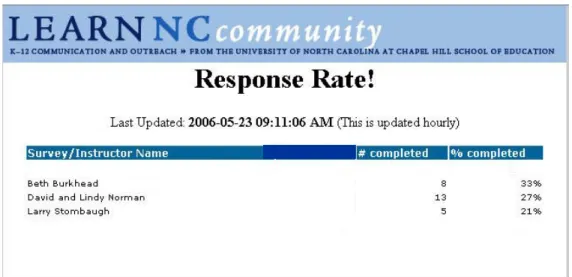
Data for this study were collected in a single phase once all surveys had been submitted online. Based on Johnsen and Christensen (2000), a recommended return rate of 50% plus one was necessary to analyze the data. In this case, at least 47 students needed to respond in order to analyze the data. The researcher anticipated a higher return rate than this given the students’ ability to use technology, the caliber of students who would take online Advanced Placement Psychology, and their ease of access for completing the survey.
described the role of the site facilitators to distribute and later collect parental consent and assent forms from students. It also detailed the role of the instructors to publicize the study via an announcement on the front page of their courses.
At the end of March 2007, students received an invitation to participate in the study through the Messages system, an internal, private communication function similar to email housed within their online course. In cooperation with LEARN NC and the researcher, course instructors were asked to post an announcement written by the researcher to the
Announcements page of the course alerting students of this communication. The site facilitators received the letter of assent and the parental consent forms for students under 18 via email. These forms were printed and given to the students to return to the site facilitator who mailed them to the researcher in a postage-paid envelope previously provided by the researcher.
Students were allowed time to complete the survey on the day of deployment as per an agreement with LEARN NC, the course instructors, and the site facilitators. The
researcher coordinated the optimal date of survey deployment with the course instructor to avoid conflicts with assessments or other critical class assignments. The survey required 5-12 minutes to complete. Average completion time according to the Snap Survey software was 7 minutes, though it should be noted that this figure may not accurately portray the actual amount of time spent on taking the survey, only the time measured from the initial login until the “submit” button had been clicked.
Data Analysis
In order to minimize variables that could affect study results, careful consideration was given to the identification of courses for this study. Three psychology courses were chosen to achieve an adequate sample size of N=92. Given that participants in this study accessed the Internet daily for their course, and were thereby accustomed to using technology to complete online assessments/surveys, a response rate at or near 100% was anticipated. Further, the caliber of student who enrolled in Advanced Placement courses would
presumably be more likely to complete a survey which is described as improving the quality of the course.
the open-ended questions were coded to determine frequency of occurrence. Reverse-coding was applied to the following items before calculating the construct variables:
4. I think online discussion was useless to my learning. 7. I disliked online discussion.
10. Online discussion wasted too much time.
15. I think most of my peers’ comments were not very valuable.
18. In the online discussion environment, my learning interest was frustrated. 20. Overall, online discussion decreased my learning quality.
Quantitative Data
The following analyses were conducted on data from Part II of the survey, the 20-item Likert-scale questions:
1. Descriptive statistics were computed for the 20 Likert-scale questions: response rates, means, and standard deviations, per item.
2. Correlation Analysis (Pearson’s R) was computed for the following variables at the 0.01 level (2-tailed):
a. Perception of Learning from Online Discussion Index b. Perception of Motivation and Enjoyment Index
3. Student’s T-test using the following grouping variables was computed: a. Gender
b. Prior experience in online courses
Qualitative Data
data were used to further interpret the quantitative data and to suggest areas of future study. The qualitative software QDA Miner facilitated the development of code categories and codes for the creation of the codebook and the subsequent analysis of qualitative data.
Summary of Methodology
This chapter has described the procedures used in this study. The purpose of the study, research questions, rationale for design, role of the researcher, site selection, and participants were presented. The chapter continued with a discussion of the population and the rationale for choosing participants.
CHAPTER FOUR: RESEARCH FINDINGS
This chapter describes the results of the data analysis. The raw data were analyzed using SPSS statistical software and QDA Miner qualitative software. This chapter is organized into two major sections. The first section is a general reporting of the results, organized according to the three parts of the survey. General demographic data from Part I of the survey are reported first. Next, the results of the Part II Likert-scale questions and their associated statistical analysis as described in Chapter 3 are presented. Finally, the results of the qualitative analysis of the 4 open-ended questions from Part III are reported.