An Evaluation of Palliative Care Education at the UNC School of Medicine: Redesigning an Undergraduate Medical Curriculum
By Courtney Hardy
Senior Honors Thesis Health Policy and Management University of North Carolina at Chapel Hill
Table of Contents
Executive Summary ... 3
Introduction ... 5
University of North Carolina at Chapel Hill (UNC) School of Medicine ... 6
Research Questions ... 7
Background ... 8
Methods ... 13
Theoretical Frameworks ... 13
Study Design ... 14
Sample Selection ... 14
Data Collection ... 15
Data Analysis ... 16
Ethical Considerations ... 16
Findings ... 17
Interview Respondents from UNC School of Medicine ... 17
Importance of Palliative Care and Quality of Education at UNC School of Medicine... 17
Current Palliative Care Opportunities at UNC School of Medicine ... 19
Expanding Palliative Care Opportunities ... 20
Key Themes from Interviews at UNC School of Medicine ... 24
Other Medical Schools ... 25
University of Rochester School of Medicine and Dentistry ... 27
Northeast Ohio Medical University ... 29
Discussion ... 32
Relation to Prior Literature ... 32
Implications for Curriculum Design ... 33
Limitations ... 33
Future Directions ... 34
Plan for Action ... 35
Appendix A: Faculty Interview Guide ... 39
Appendix B: Student Interview Guide ... 41
Appendix C: Code Book for Interview Analysis ... 43
Appendix D: Map of UNC Undergraduate Medical Curriculum ... 45
Appendix E: Summary Tables of Interview Respondents’ Ideas to Enhance Curriculum ... 46
Appendix F: Brief Summary of Plan for Action ... 47
Executive Summary
Traditionally, medicine has focused on curative treatment and prolonging life but the field of palliative medicine, which focuses on improving the quality of life for seriously ill patients, has increasingly been recognized as an important part of patient care. The problem is that many physicians feel inadequately prepared to practice elements of palliative care. Since undergraduate medical education is an important part of physician training, it is sensible to expect medical schools to sufficiently prepare students. However, there are no national standards or requirements for undergraduate palliative care education to guide schools.
The TEC Individualization Phase Committee at the UNC School of Medicine has a desire to improve palliative care training for its medical students so a program evaluation was
conducted through an evaluative case study. Four second year medical students (MS2s) and six faculty members were interviewed to understand their feelings towards palliative care and palliative care education. They also described the current opportunities students have to study and practice palliative care, and possible opportunities for offering more palliative care training at the UNC School of Medicine. The Patient Centered Care (PCC) and Professional
4
5
Introduction
Palliative medicine is gaining traction as one of the most effective ways to care for
patients. Research has shown that palliative care for critically ill patients improves quality of life, lengthens patient lifespan, and helps patients and their families cope with grief.1 Despite its proven benefits, the United States trails behind other developed nations in its provision of palliative care.2 Integrating palliative care into general physician care practices has become a recognized need.
The World Health Organization defines palliative care as “an approach that improves the quality of life of patients and their families who are facing problems associated with
life-threatening illness. It prevents and relieves suffering through early identification, correct assessment and treatment of pain and other problems, whether physical, psychosocial, and spiritual”.3 Although they are often used interchangeably, palliative care includes much more
than end-of-life care. It also encompasses hospice, advance care planning, and patient-centered and family-centered care.4 It can include pain management, the utilization of patient preferences to decide treatment pathways, and the creation of advance directives and living wills.5 Initiating
palliative discussions does not mean providers will cease treating the patient because it can be delivered alongside traditional curative treatments.6 The main purpose is to prompt patients and their families to think about their priorities. Is living longer most important? Does the patient prefer to stay out of the hospital and live comfortably at home? Does the patient wish to remain active with their family for as long as possible? These are topics that may be considered during palliative discussions between patients, providers, and family members or caregivers.
U.S. medical education primarily focuses on teaching how to treat the biological
processes and prolonging life.7 Students have been traditionally trained to try every treatment to
6
If the system is going to embrace palliative care, medical education must be reformed. Most palliative care education is currently offered in residency programs and fellowships, allowing physicians to specialize in the subject.5 As of September 2015, there are over 100 accredited palliative care fellowships in the United States.8,9 While creating a specialty is important, our system needs to embrace palliative care in all health organizations, especially primary care, home health, and managed care.3,5 Targeting medical school curricula is crucial to achieving this. Medical programs are incorporating palliative care at increasing rates but it is not enough to cover the demand.5
With the increasing focus on quality of care and patient quality of life, palliative care training is a growing need that is not being met.2 There are more programs that teach palliative medicine but it is evident that many physicians feel inadequately trained to have these difficult discussions with their patients.5 Since physicians receive their first training in medical school, it
is important to analyze medical curricula to determine what opportunities are available to expand palliative care education. This study will evaluate the palliative care training offered at the University of North Carolina (UNC) School of Medicine to determine whether it is sufficiently preparing medical students to be able to incorporate palliative care into their patient interactions.
University of North Carolina at Chapel Hill (UNC) School of Medicine
The UNC School of Medicine is ranked second for primary care, fifth in rural medicine, and twenty-second for research by the U.S. News & World Report Best Medical School
7
palliative care education. In August 2014, the university launched a new undergraduate medical curriculum, entitled Translation Education at Carolina (TEC), to increase the amount of time students spend in clinical experiences.12 The TEC Individualization Phase Committee, who focuses on designing elective and research opportunities for students, aims to modify the curriculum to better incorporate palliative medicine.
Research Questions
The purpose of this study is to provide the TEC Committee with enough information to begin the process of modifying the UNC medical curriculum to include more palliative care education. The necessary information was gathered by answering the following research questions:
1. How are palliative care topics being incorporated into medical education at UNC School of Medicine?
2. How do current UNC medical students feel about their palliative care training thus far? 3. How satisfied are the School of Medicine faculty members with the current incorporation
of palliative care into the curriculum?
4. How are peer institutions incorporating palliative care into their curriculum?
8
Background
While health care providers and policy experts widely accept the importance of palliative medicine, physicians have yet to regularly incorporate it into practice partly due to inadequate training.13 In fact, stakeholders within medical schools value palliative care topics, especially end-of-life care. They support palliative medicine education and wish to revise medical curricula to reflect their attitudes but this is not a simple task.13–15 It can be difficult to design learning opportunities because national competencies for palliative care education have not been officially established for medical schools.13 The absence of approved and accepted guidelines
creates an opportunity for the subject to be inadequately taught.13 Modifying curricula also becomes more difficult when stakeholder groups assume others do not value palliative care education as highly.15 They make are less likely to push for change because they do not believe others care as much. The variance in palliative care curricula makes it difficult to determine which instructional methods are most effective for teaching this subject. Researchers and schools have made a concerted effort to determine best practices and provide better palliative care
training.
Due to the increasingly recognized importance of palliative medicine, medical schools are including aspects of it within their medical curricula, residencies, and fellowships. However, the specifics of these curricular designs can vary substantially between schools. Standards presented by the Liaison Committee on Medical Education (LCME), the accrediting body for U.S. medical schools, requires schools to teach end-of-life care but does not specifically mention palliative care.16 The absence of national standards and guidelines have allowed medical schools to teach palliative care to varying degrees.1,17 Several boards and associations like the American Board of Medical Specialties, Accreditation Council for Graduate Medical Education,18 the
9
American Medical Colleges16 have crafted suggested competencies but they do not fully align with each other and medical schools are not required to meet them for general undergraduate medical education. The ability of academic centers to incorporate the subject without abiding by certain guidelines can result in the provision of ineffective palliative care education. Some schools offer weeks of classroom and clinical training while others only offer a couple of instructional hours.17
Medical students across the country have consistently self-reported they believe they have received little or no education on the subject. They also feel ill-equipped to handle
situations involving palliative consultations.13 Palliative experts wish to create national standards for palliative care education to increase the consistency and effectiveness of the training received by physicians.1 Even so, these experts are approaching the issue in different ways. Some are focusing on specialty-specific palliative medicine that would mostly affect residents and fellows while others are trying to develop general competencies applicable to medical students. Since this study will be evaluating an undergraduate medical curriculum, the research presented will focus on creating standards for medical students.
One study amended a set of fellowship competencies to suit medical students.1 Researchers tested the validity of the new competencies and prioritized them by surveying palliative care educators across the country. By doing this, they identified communication and pain and symptom management as the most important palliative care domains for medical students to learn. The top five competencies considered essential for graduation by those
10
skills during their undergraduate education. They can be reinforced and applied to hard skills during clinical practice.
Creating competencies is not enough. It is important for leaders within medical education to understand current attitudes when attempting to improve curricula. Having programs that primarily focus on end-of-life care perpetuates the fallacy that palliative care only applies to dying patients. Many researchers and specialists want to navigate away from that perception and teach all students that palliative care encompasses more than end-of-life or hospice care. Stigma remains around the phrase “palliative care” primarily due to the tendency for some physicians to associate it with end-of-life care.13 Despite the growing number of health care professionals acknowledging its importance, it has been hard for experts to conquer the stigma and correct this fallacy.
In addition to misunderstanding the objective of palliative medicine, professionals often underestimate how much their peers value it. Studies have directly assessed how medical students, residents, faculty, and administrative leaders feel about integrating end-of-life into curricula.14,15 The more authority stakeholders have over the curriculum, the more they value end-of-life care education but they seem to underestimate how important the subject is to other stakeholders. For example, 53% of students believe end-of-life care education is very important but they believe their faculty value it less.15 This is an incorrect assumption because 75% of faculty think end-of-life care education is very important for students to learn (demonstrating faculty actually value it more than students).15 Furthermore, 84% of associate deans for medical education or curricular affairs stated it is very important for students to receive end-of-life care education.14 They also drastically underestimated how many students are interested in the
11
importance, it is worrisome that they underestimate the importance of it to each other. Breaking down these misperceptions may further facilitate the incorporation of end-of-life care, and palliative care overall, into curricula.
Since leadership within medical schools tend to support palliative care education, it is important for them to understand what experts deem the best teaching practices. National competencies have yet to be created so best practices have been taken from research about existing medical curricula. Weissman et al. proposes effective hospice and palliative care curricula for medical students consist of five components: supervised educational opportunities, communication practice and feedback, knowledge transfer, reflective time, and interdisciplinary participation.19 Supervised experiential opportunities are patient encounters that allow the
student to assess, examine, and develop a care plan under the supervision of a palliative medicine physician. Communication is critical to patient relationships so students should observe and reflect upon communication encounters. Then they should be given the opportunity to practice with patients using either standardized patients or, ideally, real patients. Knowledge transfer involves the process of learning the principles and competencies of palliative care. Working with patients who suffer from seriously ill conditions can have an emotional impact on students which is why reflective time is important. Students need time to explore their own emotions to improve self-awareness. Finally, students should work with a palliative care team on a patient to better understand the interdisciplinary nature of caring for seriously ill patients.
The need for more experiential opportunities in palliative care is echoed by other researchers.20–22 Longitudinal instruction incorporated throughout the four years of medical school is emerging as a common way of teaching palliative medicine to students.14,20 This is due
12
curriculum.14,17 Incorporating concepts into already established courses, clerkships, and rotations is an effective way to educate without taking time away from other subjects in the curriculum. However, some programs have managed to create space in their curricula for required palliative care courses or clerkships.20,23
This study further examines other medical schools’ curricula to determine how they have incorporated palliative care education. It evaluates the UNC School of Medicine curriculum to understand how key stakeholders feel about it, how palliative care education is currently being provided, and examines opportunities to enhance the UNC School of Medicine medical
13
Methods
This study sought to determine how palliative care is currently being taught at the UNC School of Medicine, how students feel about their palliative care training, faculty satisfaction with students’ training, and opportunities for expanding palliative care education. It also reviewed the curricula of eight other medical schools to provide the TEC Individualization Committee with examples of different palliative care instruction. The theoretical frameworks used for the methodology and findings, the design of study including sample selection, the interview design, and ethical considerations will be described in detail.
Theoretical Frameworks
Damschroder et al. developed the Consolidated Framework for Implementation Research (CFIR) that helps guide implementation science and research using common implementation theories.24 While this study primarily focused on modifying a curriculum instead of
implementing an entirely new curriculum, it was important to collect information about various factors that may ease the implementation process later. The CFIR framework assisted in the development of the interview questions in order to determine what information would be most relevant to collect from stakeholders. The Complexity, Structural Characteristics,
14
Study Design
This is a evaluative case study of the UNC School of Medicine which is the bounded system that characterizes this case study.25 Palliative care education within the undergraduate curriculum is the topic of investigation, or program, for this particular case. Case study was chosen as the design because they are better at understanding the “how” and “why” and are useful for program evaluations.25 In order to conduct an evaluation of palliative care education at UNC, the curriculum needed to be described and explained in order to provide insight for future changes. Due to the lack of instructional requirements for undergraduate palliative care
education, determining what an effective program should look like is difficult. This thesis used a collective case study25 as part of the larger case study to review the undergraduate medical curricula of eight institutions of interest to stakeholders.
Sample Selection
Faculty and students within the UNC School of Medicine were selected for interviews using purposive sampling25. The faculty consisted of professionals who teach non-palliative specific courses because they are vested stakeholders in the curriculum design. Any changes to palliative education could likely affect their courses and instructional methods. Palliative specialists were also interviewed because they have unique expertise in teaching the targeted subject matter. Second year medical students were interviewed as well. These students brought a different perspective because they could identify the palliative concepts they have already learned and describe the instructional methods that work best for themselves.
15
students are MS2s who just entered the Application Phase of the curriculum. MS3s and MS4s were not selected because they are completing the old curriculum track.
For the inner collective case study, medical institutions were either selected for being cited in peer-reviewed literature or for being potential competitors to UNC. The University of Rochester School of Medicine, Northeast Ohio Medical University, Weill Cornell Medical College, Stanford Medicine School of Medicine, and University of Washington School of Medicine have been specifically cited in peer-reviewed literature for their palliative care education so their curricula have been chosen for study.16,26,27 Duke University School of Medicine, Wake Forest School of Medicine, and Brody School of Medicine at East Carolina University were selected because their competition with UNC for North Carolina students makes them of interest to stakeholders.
Data Collection
This study utilized semi-structured interviewing, meaning there were predetermined questions but follow-up questions were improvised depending on respondents’ answers to gain more information.25 Open-ended questions were used to allow for the greatest exploration of key
16
Data Analysis
All interview responses are transcribed with the help of Easytranscript software. The interview transcripts are coded to identify themes and recurring ideas among respondents using Atlas.ti 7 qualitative software. A code book devised by the researcher guides this process. A preliminary code book, consisting of anticipated themes, was drafted before interviews began. It was later revised during open coding25 to more accurately reflect the themes presented in the interviews. These open codes were grouped into categories according to similar themes or concepts in a process referred to as analytical coding.25 The themes aided the researcher in summarizing the results in a casual network diagram.28 For benchmarking analysis, a comparison of the courses and instructional tools used by the other medical schools was presented in a
partially ordered meta matrix.28
Ethical Considerations
17
Findings
Interview Respondents from UNC School of Medicine
Ten stakeholders within the UNC School of Medicine were interviewed. Four of them were second year students, MS2s, entering the Application Phase. The other six were faculty representing the fields of geriatrics, family medicine, neurology, palliative medicine,
pulmonology, and critical care. Respondents provided their personal feelings regarding the importance of palliative care and the quality of palliative care education at UNC as well as information about current palliative care educational opportunities and potential areas for improvement.
Importance of Palliative Care and Quality of Education at UNC School of Medicine
Each interview began with questions regarding the respondent’s perception of palliative care and feelings towards palliative care education at UNC. Table 5 is a summary display of this first section of interview questions. It is interesting that 40% of respondents, and which include three out of the four students interviewed, defined palliative care as end-of-life care. The other six respondents provided more comprehensive definitions of palliative care that were similar to the World Health Organization’s (WHO) definition. As mentioned earlier in the literature review, there is a general misconception that palliative care is synonymous with end-of-life care even though it actually encompasses much more than that. For those three students and one faculty member, they were provided with the WHO’s definition. It was important that they understood what elements of medicine are included in palliative care in order to accurately answer the remaining interview questions.
18
specialty, to be able to deliver some level of it to their patients and families. Only 40% of respondents also believe UNC is sufficiently preparing medical students to be able to provide palliative care. The rest believe the school should be doing more to prepare students.
Table 5. Summary of Respondents’ Feelings towards Palliative Care Education
Students (4) Faculty (6) Total (10)
Gave a definition synonymous with end-of-life care
75% (3) 16.7% (1) 40% (4)
Gave a definition that aligns with that of the
World Health Organization
25% (1) 83.3% (5) 60% (6)
Important for patients and families to receive palliative care
100% (4) --- ---
Important for medical students to learn how to provide palliative care
100% (4) 100% (6) 100% (10)
UNC is doing a
sufficient job with preparing medical students to provide palliative care
50% (2) 33.3% (2) 40% (4)
UNC is not doing enough to prepare medical students to provide palliative care
50% (2) 66.7% (4) 60% (6)
--- = respondents were not asked this question
Since the responses for the second and third sections of the interview (regarding current palliative educational opportunities and possible ways to expand those opportunities,
19
Current Palliative Care Opportunities at UNC School of Medicine
Respondents identified several key areas where palliative care topics and skills are systematically taught to undergraduate medical students. Those areas include courses that all students take and ones that are elective. Within the required classes that are completed by all medical students, these topics can be found in the PCC, PD, Hematology, and Transition courses. A map of the undergraduate curriculum is included in Appendix D for reference.
PCC (Patient Centered Care): PCC is an 18 month-long course in the Foundation Phase that builds clinical skills and teaches clinical reasoning. It was commonly cited by respondents as an area where there is an entire session dedicated to delivering bad news and another one focused on advance directives like living wills and Do Not Resuscitate (DNR) forms.
PD (Professional Development): PD, also offered during the first 18 months, covers general communication skills and teaches students how to interact with patients. Communication is a large part of providing palliative care so respondents believed the PD course to be relevant.
Hematologic System: The course about hematology during the first semester has a formal lecture dedicated to palliative care. Students revealed that was the only lecture they had specific to palliative medicine.
20
Those courses were the only ones identified as areas where all students will receive instruction on topics related to palliative care. Two electives were identified as areas where students may receive additional exposure to the field if they choose to participate.
Elective on Aging, MEDI286: MEDI286 requires students to read Being Mortal by Atul Gawande. This book describes how medicine worries about more about prolonging life even at the expense of patient suffering and quality of life. Students in this elective read it as an introduction to palliative care. In addition, students are divided into community groups where one group has to visit a hospice. After the visit, they report to the class about what they observed and learned.
Ambulatory Selective: In the 4th year, students may take an Ambulatory Selective in
which they spend time with a palliative care team and learn about the field through didactic lectures, experiential experiences, and practice exams. There are usually about 10 students who take this selective.
Expanding Palliative Care Opportunities
21
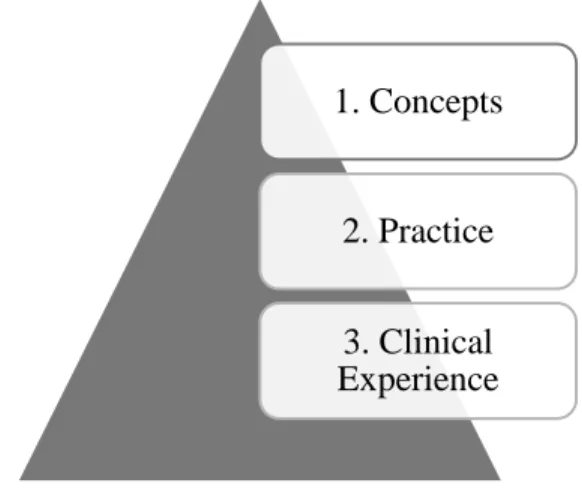
Figure 2. Three-tiered Approach to Teaching Palliative Care
As mentioned before, there are small introductions to palliative care topics spread throughout the Foundation Phase but most respondents believed that to be insufficient. The following are areas identified by respondents where palliative care instruction could be enhanced:
Opportunity 1: Palliative Care Class Session – One PCC session should be devoted entirely towards palliative care. Students believed they would get more out of this than the one lecture they receive during the Hematology course.
Opportunity 2: Patient Presentations – One respondent believed a patient should be invited to class to talk about their experience with palliative care. Classes already invite patients to talk about their experiences and this student thinks it would be impactful to do the same with palliative care.
Opportunity 3: Clinical Observations – There was the suggestion that students should be allowed to observe palliative specialists in the field during the PCC course. Students would receive a list of specialties they must observe during the 18 months and then fulfill that requirement outside of class.
1. Concepts
2. Practice
22
Opportunity 4: Emotional Vulnerability Workshop – Another respondent believed the key to teaching students how to communicate openly and be vulnerable with patients is by teaching them how to be open and vulnerable with themselves. The idea is that time should be dedicated in class to showing students how emotional vulnerability translates to patient relationships.
In order for students to practice learned skills in the classroom (tier 2), the following ideas were presented:
Opportunity 1: Standardized Patients – Respondents suggested the school should
continue using tools that it has been implementing. Standardized patients are actors who portray patients to help students practice communication skills. They are already being used to help students practice delivering bad news. Respondents believe they should continue to be utilized with other palliative care topics.
Opportunity 2: Case Studies and Discussions – Case studies and small discussion groups were also proposed as ways to help students practice in the classroom. Case studies focus on the application of learned skills to hypothetical, or sometimes real, scenarios.
Discussion groups allow students to share their thoughts and debrief.
Respondents tended to place the most emphasis on clinical experiences (tier 3). There was a shared belief that clinical experience is most important to ensuring students fully
23
Opportunity 1: Expand Upon Existing Rotations - Add palliative care components to existing rotations using debriefings with palliative specialists. Respondents believe this is a feasible way to insert palliative care topics into existing rotations and tailor them to those specialties. Palliative specialists would meet with students to discuss how
palliative care could, or did, help with observed situations. Case discussions were also proposed to add to existing rotations in order to make connections to palliative care if situations did not present themselves while students were on the wards.
Opportunity 2: Application Phase Courses – The Intensive Integration course, that lasts the duration of the Application Phase, was identified as an opportune place to start having related discussions. It was suggested that instructors wait to have these
discussions until after students complete the first couple of rotations because students will be comfortable with interacting with physicians and patients. Community-Based Longitudinal curriculum section and Care of the Hospitalized Patient course (both during the Application Phase) were also acknowledged as appropriate places to insert specific teaching to palliative care, particularly during the hospice rounds.
Opportunity 3: Required Palliative Care Rotation: A group of palliative care courses could be created for 4th year students similarly to what has been done for critical care. This group of courses would then become required for all students to complete during the last year of medical school.
There were some perceived barriers to expanding the number of palliative care
24
180 medical students which means multiple specialists, or at least one whose primary role is to help with the undergraduate curriculum, would be needed to feasibly carry out some of the proposed ideas. Time and competing priorities were also identified as barriers to implementation. The curriculum is already full of very important material with faculty believing some material should be prioritized over others. It can be difficult finding the right place to insert more palliative care material or getting faculty to believe that it is important to make these changes. And finally, some respondents also expressed concern over not knowing when it is most appropriate to introduce palliative concepts to students. They believe it would be helpful to consult with the specialists to help determine appropriate timing.
Key Themes from Interviews at UNC School of Medicine
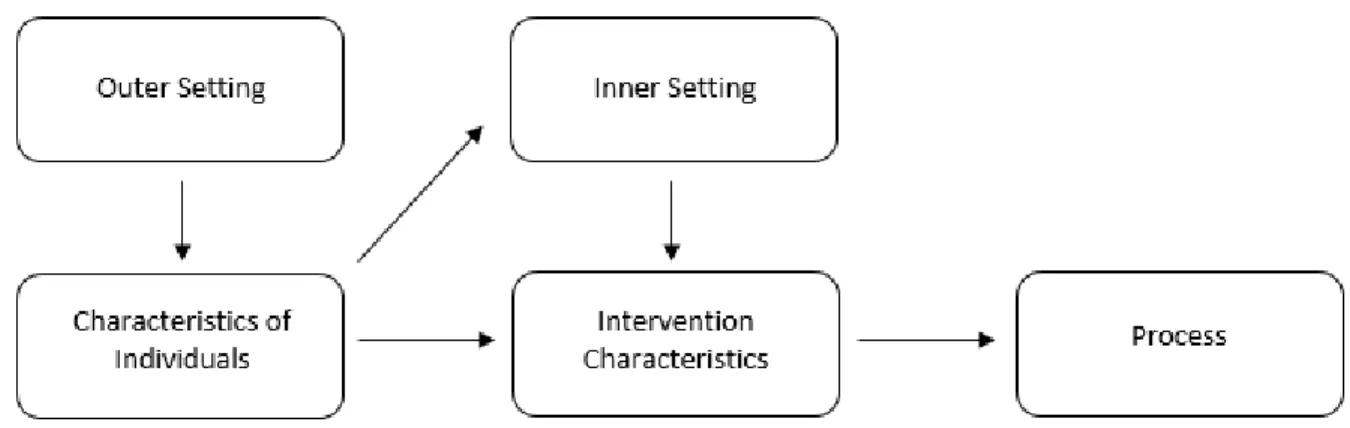
Since the interview questions were drafted with the CFIR in mind, responses corresponded to the constructs. The constructs fit into the overarching themes for
implementation science which can be found in the network diagram (Figure 1). This diagram shows the general themes that arose in the interviews and how they relate to one another. Respondents identified the need for palliative care by patients as a factor in the Outer Setting, outside the full scope of the medical school, which affects their knowledge and beliefs
surrounding palliative care and palliative care education. That knowledge is just one aspect of the Characteristics of Individuals that shape both the Inner Setting and Intervention
25
Characteristics determine the process for implementation. Respondents had a particular focus on engaging relevant stakeholders to ensure the successful implementation of curricular changes. The full listing of the codes with their corresponding themes can be found in Appendix C.
Figure 1. Evaluation Findings: Process Map of Factors Shaping Desired Intervention Proposals by Interview Respondents
Other Medical Schools
26
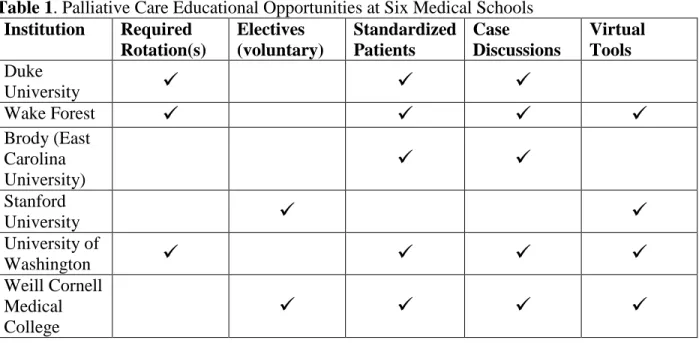
Six medical schools were examined to determine how the incorporate palliative care skills and topics into their curricula. Required rotations or clerkships typically take place during the clinical years of medical school. Some rotations include palliative care topics whether or not they were actually specifically labeled as “palliative care”. Only one school specifically stated that it offers a voluntary palliative care elective in the 4th year for students to take if interested. The other institutions may as well but that information was not readily available. Standardized patients were sometimes denoted as tools used to help students learn about general
communication and how to deliver bad news, talk about advance directives, or end-of-life issues. Cases are also popular methods of having students think critically about palliative care and end-of-life topics. There were a few medical schools that also supplemented learning with virtual tools like online modules and virtual patients. Table 1 indicates which of these courses and tools each institution has. It is important to emphasize that this is not a comprehensive listing of everything palliative care-related each school may be doing. This only reflects the information that was available for each.
Table 1. Palliative Care Educational Opportunities at Six Medical Schools
Institution Required
Rotation(s) Electives (voluntary) Standardized Patients Case Discussions Virtual Tools Duke
University
Wake Forest
Brody (East Carolina University)
Stanford
University
University of
Washington
Weill Cornell Medical College
27
University of Rochester School of Medicine and Dentistry
The University of Rochester began its mission of integrating palliative care into its already overburdened curriculum in 1996.27 It focused on creating small changes over the course of several years to create an undergraduate palliative care program. The goal was to create a program and curriculum that would be continuously improved and refined over time. They drafted a list of palliative care concepts and skills that were most important for their students to learn. Rochester completed an analysis of the aspects of palliative care to which students were already being exposed and compared that to the list of competencies they had generated. It helped them identify and target the gaps in their students’ education. They implemented changes to various areas within the 4 year curriculum to enhance student learning.
The Anatomy course in Year 1 was the first target. Students dissect a cadaver in that course which presented an opportunity to address the various emotions and reactions surrounding death. Their emotional reactions to working with a dead body were acknowledged and discussed with one another and faculty. At the conclusion of the course, faculty from the divinity school had dissection groups honor the donated bodies through personal statements, music, and poems. This ceremony was already part of the curriculum but it was further supported and reinforced during the implementation of the palliative care program. In Year 1, students also worked in small groups on cases specifically designed to include palliative care and end-of-life issues. They also added half-day sessions on communication and advance directives.
28
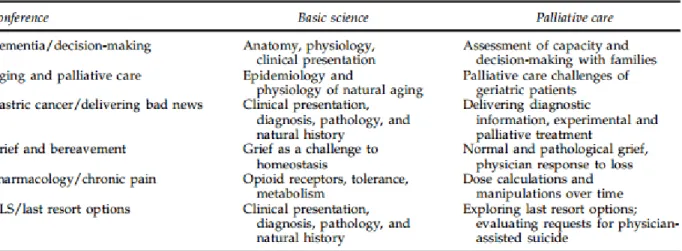
discussion about relevant palliative care and end-of-life issues. Throughout the second year, students also meet with an instructor with whom they work on cases and see patients with. They are required to see more seriously ill patients and discuss palliative care issues towards the end of second year.
Table 2. University of Rochester Year 2 Palliative Care Integration Sessions
Quill TE, Dannefer E, Markakis K, et al. An Integrated Biopsychosocial Approach to Palliative Care Training of Medical Students. J Palliat Med. 2003;6(3):365-380. doi:10.1089/109662103322144682.
29 Northeast Ohio Medical University
The Northeast Ohio Medical University (NEOMED), known as the Northeastern Ohio Universities Colleges of Medicine and Pharmacy (NEOUCOM) until 2011, implemented a 4-year longitudinal palliative care program for undergraduate medical students.26 Similarly to the University of Rochester, it built upon the established curriculum foundation by filling the gaps where palliative care most feasibly fit. It took several years to plan and begin implementing the new parts of the palliative care program but NEOMED was successful.
In the preclinical years (typically 1st and 2nd years), students are given introductory
lectures, observe interdisciplinary team meetings, conduct discussions with standardized patients, and write reflective essays to ease them into the field of palliative medicine. NEOMED also formed a palliative care student interest group that offered additional activities to supplement the classroom learning. Interest in the student group grew as students became more exposed to palliative care.
Third year students must complete 6 required rotations in the areas of internal medicine, family medicine, pediatrics, surgery, OB/GYN, and psychiatry. The school decided to implement tailored palliative care activities into each rotation. This ensured every student was fully exposed to the field and understood that palliative medicine can vary when applied to different
30
time of publishing, work was still in progress to add palliative care education to the OB/GYN and psychiatry rotations.
Fourth year students had more elective opportunities to work with palliative care. More students began to choose palliative care electives after the inception of the student interest group. The program believes it even encouraged some students to pursue palliative medicine
fellowships after graduation. At the culmination of their undergraduate medical career, students take a Clinical Epilogue course. Students participate in small groups specific to the specialty they wish to enter. Faculty from those specialties lead the small groups and palliative care faculty act as facilitators to highlight key issues from cases that students will likely face in residency. The Clinical Epilogue reinforces the various aspects of palliative medicine the students have learned over the course of four years. NEOMED went beyond simply creating a palliative care
curriculum. It created a program with its own office and task force to oversee that curriculum. The program was developed with its own competencies (Table 3) and curriculum map (Table 4).
Table 3. Palliative Care Objectives
31 Table 4. Curricular Map
32
Discussion
UNC School of Medicine provides some formal instruction for palliative care topics in the Foundation Phase of the curriculum. However, students and faculty believe more formal instruction is needed for students to fully understand palliative medicine. This is evident by the three students and one faculty member who defined palliative care as another name for end-of-life care. Respondents also determined the school needs to develop a way to ensure all students gain experience with practicing palliative care on real patients. Many other medical schools seem to teach palliative care in ways similar to UNC. However, some schools like the University of Rochester and Northeast Ohio Medical University made targeted efforts to graduate all of their students with the ability to provide palliative care to the patients within their specialty. These findings have important implications for the TEC Committee and course directors at the UNC School of Medicine.
Relation to Prior Literature
Overcoming the stigma and fallacies surrounding palliative care is a large obstacle. There have been efforts to educate physicians and medical students about it but more work needs to be done. The findings from this case study coincide with those of other studies13,16 in which students and faculty may not have a negative perception of palliative care but fallacies still persist. The UNC School of Medicine should increase its efforts to negate the belief that palliative care is the same as end-of-life care.
The findings of this study are similar to the best practices for teaching palliative care found in the literature. Experts suggest that didactic and experiential learning in palliative care effectively prepare students to be able to care for seriously ill patients.20 Medical schools like the University of Rochester and Northeast Ohio have been dedicated to providing numerous
33
to care for these kinds of patients.26,27 UNC provides some didactic training and experiential learning in palliative care but both students and faculty have expressed a desire for more. Most of their ideas coincide with those suggested in the literature such as mandatory palliative care rotations, observing interdisciplinary teams, and allowing time for reflection.19,20
Implications for Curriculum Design
The findings from the student and faculty interviews will help guide any changes to the curriculum. Ensuring students receive a formal introduction to palliative care beyond delivering bad news during the Foundation Phase was a concern among respondents. There is a desire for students to receive a basic foundation that they will remember and be able to apply. Creating a systematic way to guarantee every student has the opportunity to observe and apply palliative care skills to patients during the clinical years was also a primary concern. Several ideas were presented that do not require drastic changes to the curriculum. Respondents recognized the constraints and feasibility of large change so most of their suggestions focus on small modifications to existing courses and clerkships. However, many factors still need to be considered before implementing even the smaller changes.
Limitations
This study has several limitations. Sampling bias is likely because some faculty interviewees were selected based on recommendations by the TEC Individualization Phase Committee. Random sampling is ideal but professionals tend to be more responsive when there is a mutual connection. Recall bias is also likely because students and instructors were asked to recall how palliative care concepts have been integrated into their courses. Students, in
34
for misclassification was reduced by providing a definition at the beginning of the interview. All responses should have been given with that definition in mind. This results of this study cannot be generalized to other medical schools because the questions and responses from interviews were specifically tailored to UNC.
Future Directions
35
Plan for Action
This study outlines what the UNC School of Medicine is currently doing and what it can do to offer more palliative care educational opportunities to medical students. I propose UNC School of Medicine and the TEC Individualization Phase Committee work towards enhancing the palliative care curriculum for undergraduate students by taking the following steps. They are inspired by Damschroder et al.’s Consolidated Framework for Implementation Research24 and
John Kotter’s organizational change theory29. The CFIR guides implementation science to
determine what interventions will work in certain settings and why.24 Kotter’s theory for
organizational change provides eight steps to show how successful leaders guide change within their organizations, regardless of the size or type.29 These two theories are excellent guides for planning change actions. A table summarizing the following action steps can be found in Appendix F.
1. Establish a guiding coalition.29
To create change, a coalition with enough power needs to be assembled. The coalition will consist of the change agents who will plan and execute the new palliative care curriculum. The UNC School of Medicine has already established TEC committees to oversee assigned parts of the undergraduate medical curriculum. It would be most convenient to use these committees to form the coalition. It may be necessary to form an entirely different coalition but it is important to acknowledge this takes time and concerted effort. There will need to be a champion to
36
Northeast Ohio Medical University26 to understand how those institutions designed their processes and implemented their curricular changes.
2. Obtain administrative buy-in.29
The coalition needs to attract the support from UNC School of Medicine administrators like Dr. Julie Byerley, Vice Dean of Medical Education. This support will be crucial when barriers arise. As identified by one of the interview respondents, other faculty members who have competing priorities may become barriers. They may not wish to modify their course syllabi to be more inclusive of palliative care topics. Administrators have the power to advocate for these changes and persuade others to be accepting of them.
3. Determine the level of knowledge students should have.24
In order to definitively know how well students are currently being educated, UNC needs to determine which aspects of palliative care students should know by graduation. This may involve developing a list of palliative care competencies that students should learn. Several examples of competencies are already available. The palliative care residency program at UNC already has a competency list and peer-reviewed literature also suggest competencies for undergraduate medical programs1,16,18,26. These are avenues from which the TEC Committees can draw inspiration.
4. Find the gaps.
Once the school has decided the concepts and skills students should be learning, the
37
curriculum. Finding these areas helps create a more targeted approach to improving the curriculum. Designing the plans for change can begin.
5. Identify facilitators and barriers.24
Anticipating possible facilitators and barriers to modifying the curriculum increases the chances for successful change. Facilitators will help aid the process and should be utilized. Identifying barriers allows the coalition to be proactive about possible setbacks. Administrative buy-in is just one way to help counteract barriers.
6. Engage stakeholders.29
At this point, plans for change are being drafted. There will be stakeholders who are not involved with the coalition but will be affected by these plans. These will most likely be course directors and other faculty involved with clerkships. Plans should be discussed with those most affected to gain their buy-in and determine which resources are needed to implement the changes. When they are engaged, plans can be designed to be feasible and effective. The implementation process tends to be smoother when there is open communication.
7. Secure resources.24
38 8. Evaluate.29
39
Appendix A: Faculty Interview Guide
Thank you for agreeing to speak with me today. I am a senior undergraduate Health Policy and Management student within the School of Public Health. I am completing an honors thesis in conjunction with the medical school to design palliative care education for medical students. My thesis will focus on understanding how the new curriculum is currently structured, how other schools are teaching palliative care, and how best to incorporate palliative medicine into UNC’s new curriculum. I have reached out to you because I wish to hear your thoughts about the role of palliative care within the curriculum. This interview should take no more than 45 minutes. To ensure accurate data collection, I will be recording this interview. Identifying information will be removed before responses are shared with anyone besides myself. You are not obligated to answer any questions that make you uncomfortable.
1. What is your name and official position title?
2. What courses do you teach within the medical school?
I would like to begin by discussing your feelings and perceptions regarding palliative care education.
3. What does palliative care mean to you?
a. Thank you for that definition. This study uses the WHO definition which describes palliative care as “an approach that improves the quality of life of patients and their families who are facing problems associated with
life-threatening illness. It prevents and relieves suffering through early identification, correct assessment and treatment of pain and other problems, whether physical, psychosocial, and spiritual”.
4. How important do you believe it is to prepare all medical students to incorporate palliative care topics and skills into their practice? Top priority, moderate priority, low priority, or not a priority at all?
a. Tell me more about how you feel about that.
5. How well do you believe the UNC School of Medicine is preparing medical students to provide palliative care to patients and families? Most students will graduate with the ability to provide palliative care as part of their routine care, most students will graduate with the ability to provide palliative care with the assistance of palliative specialists, or most students will graduate with little ability to provide palliative care.
a. Please explain further.
6. What opportunities within the new curriculum do you see to further prepare medical students to provide palliative care?
Your responses are very helpful. Now I would like to discuss your instructional material and how it may relate to palliative care.
40
8. Soft skills are typically defined as communication, interpersonal skills, leadership, and managing people. Experts argue they are just as important in providing medical care in addition to medical knowledge. How do you currently, if at all, incorporate soft skills related to palliative care into your course(s) or clerkships? These can include skills like communication, having difficult conversations, managing patient and personal emotions, or explaining complex conditions and treatments.
9. (If they don’t currently teach any of these topics) How supportive are you of including some of these concepts into your teaching material?*
10.What kind of assistance, if any, would you need to incorporate palliative concepts and clinical skills into your course(s) or clerkship?*
a. If the interviewee is having trouble, prompt with these common teaching barriers: More time; teaching materials (i.e. case discussions, syllabi, or lectures); more expertise; are there any other barriers they can think of?
Additional questions for those who are currently teaching students about palliative care:
11.What do you believe are the best methods of teaching palliative medicine to increase the likelihood that students will practice it?
12.What is your desired level of student exposure to this topic? a. Please explain further.
b. Do you believe achieving that level of exposure is realistic within the new curriculum?
Thank you again for your time. Your assistance has not only helped my thesis project, but it will allow us to improve the UNC School of Medicine’s curriculum.
41
Appendix B: Student Interview Guide
Thank you for agreeing to speak with me today. I am a senior undergraduate Health Policy and Management student within the School of Public Health. I am completing an honors thesis in conjunction with the medical school to design palliative care education for medical students. My thesis will focus on understanding how the new curriculum is currently structured, how other schools are teaching palliative care, and how best to incorporate palliative medicine into UNC’s new curriculum. I have reached out to you because I wish to hear your thoughts about palliative care within the medical school curriculum. This interview should take no more than 45 minutes. To ensure accurate data collection, I will be recording this interview. Identifying information will be removed before responses are shared with anyone besides myself. You are not obligated to answer any questions that make you feel uncomfortable.
1. What is your name and current year in medical school?
I would like to begin by discussing your feelings and perceptions regarding palliative care. 2. What does palliative care mean to you?
a. Thank you for that definition. This study uses the WHO definition which describes palliative care as “an approach that improves the quality of life of patients and their families who are facing problems associated with
life-threatening illness. It prevents and relieves suffering through early identification, correct assessment and treatment of pain and other problems, whether physical, psychosocial, and spiritual”.
3. How important do you believe it is to provide palliative care to patients and families? Top priority, moderate priority, low priority, or not a priority at all?
a. Tell me more about how you feel about that.
4. How important do you believe it is for all medical students to learn about palliative medicine? Top priority, moderate priority, low priority, or not a priority at all?
a. Tell me more about how you feel about that.
5. How well do you believe the UNC School of Medicine is preparing medical students to provide palliative care to patients and families? Most students will graduate with the ability to provide palliative care as part of their routine care, most students will graduate with the ability to provide palliative care with the assistance of palliative specialists, or most students will graduate with little ability to provide palliative care.
a. Please explain further.
Your comments are very helpful. Now I wish to learn more about your exposure to palliative care concepts.
6. First, I would like to hear about your education around palliative concepts like end-of-life care, hospice, pain and symptom management, advance care planning.
42
b. Please describe your informal educational exposure to these topics. Informal experiences occur outside the traditional education setting and may include your patient interactions through rotations or clerkships.
7. Soft skills include communication, interpersonal skills, leadership, and managing people. Please describe your exposure to soft skills related to palliative care. These can include skills like general patient communication, having difficult conversations, managing patient and personal emotions, or explaining complex conditions and treatments.
a. How have your formal educational experiences incorporated these skills? b. How have your informal educational experiences incorporated these skills? 8. Have you taken, or would you take, any electives or voluntary educational opportunities
that have a specific palliative medicine focus? a. Tell me more about how you feel about that.
I would like to conclude the interview by hearing more about your thoughts regarding the curriculum and palliative education here at UNC.
9. At what time(s) do you believe it would be appropriate to introduce the subject within the curriculum? During 1st year, 2nd year, 3rd year, 4th year, or the subject does not need to be introduced at all?
a. Please explain your response further.
10.What would be the best ways in which you could learn this material to increase the likelihood that you will incorporate it into practice?
11.Do you have anything else to add about how the UNC School of Medicine can strengthen its curriculum, or teaching, in palliative care?
43
Appendix C: Code Book for Interview Analysis
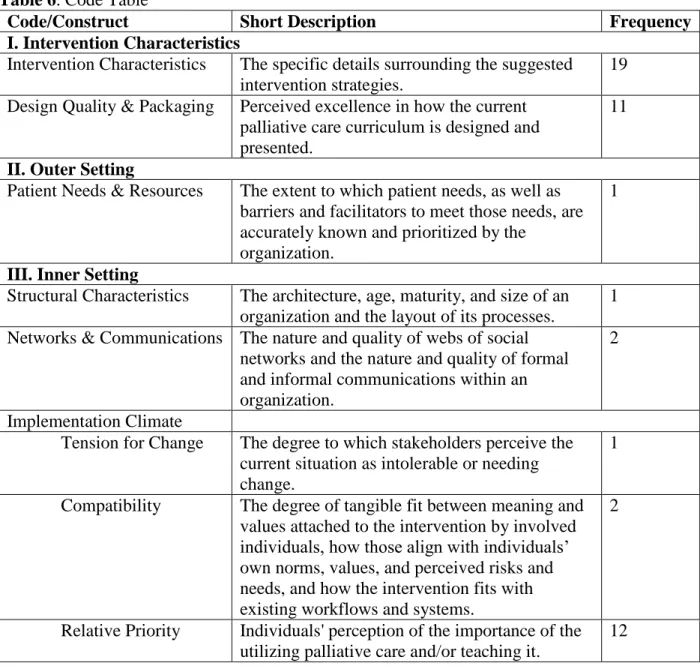
As mentioned earlier, these codes were adapted from the Consolidated Framework for Implementation Research (CFIR). Even though this study does not entirely fall under the field of implementation science, it is important to think about successful implementation while designing a new program or intervention. The CFIR constructs continued to appear throughout the
interviews. Out of the 39 constructs and sub-constructs, 17 appeared during the interviews. They were found during responses regarding their personal feelings and perceptions towards palliative care education, current curriculum offerings, and ideas for modifying or expanding the palliative care educational offerings at UNC. Table 6 is a summary of the codes used and their frequency of appearance. Each code falls under a general theme which is designated by the bolded headings accompanied by Roman numerals. This is a modified version of the original CFIR construct table.
Table 6. Code Table
Code/Construct Short Description Frequency
I. Intervention Characteristics
Intervention Characteristics The specific details surrounding the suggested intervention strategies.
19 Design Quality & Packaging Perceived excellence in how the current
palliative care curriculum is designed and presented.
11
II. Outer Setting
Patient Needs & Resources The extent to which patient needs, as well as barriers and facilitators to meet those needs, are accurately known and prioritized by the
organization.
1
III. Inner Setting
Structural Characteristics The architecture, age, maturity, and size of an organization and the layout of its processes.
1 Networks & Communications The nature and quality of webs of social
networks and the nature and quality of formal and informal communications within an organization.
2
Implementation Climate
Tension for Change The degree to which stakeholders perceive the current situation as intolerable or needing change.
1
Compatibility The degree of tangible fit between meaning and values attached to the intervention by involved individuals, how those align with individuals’ own norms, values, and perceived risks and needs, and how the intervention fits with existing workflows and systems.
2
Relative Priority Individuals' perception of the importance of the utilizing palliative care and/or teaching it.
44
Learning Climate Indicators of the current palliative care learning climate at UNC School of Medicine.
24 Readiness for
Implementation Leadership Engagement
Commitment, involvement, and accountability of leaders and faculty members with palliative care-related education.
6
Available Resources The level of resources dedicated for implementation and on-going operations, including money, training, education, physical space, and time.
4
Access to Knowledge & Information
Ease of access to digestible information and knowledge about the intervention and how to incorporate it into work tasks.
2
IV. Individual Characteristics Knowledge & Beliefs about Palliative Care (or
Curriculum)
Individuals' attitudes toward and value placed on palliative care as well as familiarity with facts, truths, and principles related to it.
14
Self-efficacy Individual belief in their own capabilities to execute courses of action to achieve
implementation goals.
1
Other Personal Attributes Includes other personal traits such as intellectual ability, motivation, values, professional
aspirations, competence, capacity, and learning style.
6
V. Process
Engaging Attracting and involving students and faculty in the implementation and use of the intervention through a combined strategy of social marketing, education, role modeling, training, and other similar activities.
6
Opinion Leaders Individuals in an organization who have formal or informal influence on the attitudes and beliefs of their colleagues with respect to implementing the intervention.
45
Appendix E: Summary Tables of Interview Respondents’ Ideas to Enhance
Curriculum
Tier 1: Teach Concepts Tier 2: Practice Learned
Skills
Tier 3: Clinical Experience
Palliative care class session during PCC
Standardized patients Expand upon existing rotations
Patient presentations about their experience(s) with palliative care
Case studies and discussions Target application phase courses
Clinical observations Create a required palliative
care rotation Emotional vulnerability
47
Appendix F: Brief Summary of Plan for Action
Action Step Brief Description
1. Establish a guiding coalition.
Create a coalition to lead the change efforts. The TEC Committees are an already well-established coalition with the power to create this kind of change.
2. Obtain administrative buy-in.
Garner the support of top administrators within the UNC School of Medicine. Dr. Byerley is a great one to start with.
3. Determine the knowledge level for students.
Develop a list of palliative care competencies.
4. Find the gaps. Determine which competencies are currently being taught and which ones need to be incorporated into the
curriculum. 5. Identify facilitators and
barriers.
Anticipate factors that may help or hinder the change process.
6. Engage stakeholders. Seek the buy-in of affected medical school faculty who whose aid will be needed in the change effort.
7. Secure resources. Identify the resources that will be needed for the desired changes to occur.
48
References
1. Schaefer KG, Chittenden EH, Sullivan AM, et al. Raising the Bar for the Care of Seriously Ill Patients. Acad Med. 2014;89(7):1024-1031.
doi:10.1097/ACM.0000000000000271.
2. Economist Intelligence Unit. The Quality of Death: Ranking End-of-Life Care Across the World.; 2010.
3. Organization WH. Palliative Care: Fact Sheet.
http://www.who.int/mediacentre/factsheets/fs402/en/. Published 2015.
4. Institute of Medicine. Dying in America: Improving Quality and Honoring Individual Preferences near the End of Life.; 2014.
5. Association of American Medical Colleges. New opportunities for palliative care in medical education. https://www.aamc.org/newsroom/reporter/july2012/297224/palliative-care.html. Published 2012.
6. Center to Advance Palliative Care & National Palliative Care Research Center. National Palliative Care Registry Annual Survey Sumary-Results of the 2012 National Palliative
Care Registry Survey, as of July 2014.; 2014.
7. von Gunten C, Ferrell B. Palliative Care: A New Direction for Education and Training. Health Affairs. http://healthaffairs.org/blog/2014/05/28/palliative-care-a-new-direction-for-education-and-training/. Published 2014.
8. Clinical Training in Hospice and Palliative Medicine: Hospice and Palliative Medicine Fellowship Training. American Academy of Hospice and Palliative Medicine.
http://aahpm.org/career/clinical-training.
9. Accreditation Council for Graduate Medical Education. Palliative Care Programs.
https://apps.acgme.org/ads/Public/Programs/Search?specialtyId=153&orgCode=&city=&s pecialtyId=153&orgCode=&city. Published 2015.
10. U.S. News and World Report. University of North Carolina-Chapel Hill. http://grad-
49
11. UNC School of Medicine. Mission. https://www.med.unc.edu/www/about/about-the-school-of-medicine-1/mission. Published 2015.
12. UNC School of Medicine. Curriculum Overview.
https://www.med.unc.edu/md/curriculum/curriculum-overview/tec-curriculum-information. Published 2015.
13. Aldridge MD, Hasselaar J, Garralda E, et al. Education, implementation, and policy barriers to greater integration of palliative care: A literature review. Palliat Med. 2015. doi:10.1177/0269216315606645.
14. Sullivan AM, Warren AG, Lakoma MD, Liaw KR, Hwang D, Block SD. End-of-life care in the curriculum: a national study of medical education deans. Acad Med.
2004;79(8):760-768. http://www.ncbi.nlm.nih.gov/pubmed/15277133.
15. Sullivan AM, Lakoma MD, Block SD. The status of medical education in end-of-life care: A national report. J Gen Intern Med. 2003;18(9):685-695.
doi:http://dx.doi.org/10.1046/j.1525-1497.2003.21215.x.
16. Horowitz R, Gramling R, Quill T. Palliative care education in US medical schools. Med Educ. 2014;48(1):59-66. doi:10.1111/medu.12292.
17. DeCoste-Lopez J, Madhok J, Harman S. Curricular Innovations for Medical Students in Palliative and End-of-Life Care: A Systematic Review and Assessment of Study Quality.
J Palliat Med. 2015;18(4):338-349. doi:10.1089/jpm.2014.0270.
18. Sanchez-Reilly S, Ross JS. Hospice and Palliative Medicine: Curriculum Evaluation and Learner Assessment in Medical Education. J Palliat Med. 2012;15(1):116-122.
doi:10.1089/jpm.2011.0155.
19. Weissman D.E., Quill T.E., Block S.D. Missed opportunities in medical student education.
J Palliat Med. 2010;13(5):489-490. doi:10.1089/jpm.2010.9838.
50
21. Fraser HC, Kutner JS, Pfeifer MP. Senior Medical Students’ Perceptions of the Adequacy of Education on End-of-Life Issues. J Palliat Med. 2001;4(3):337-343.
doi:10.1089/109662101753123959.
22. Anderson WGMS, Williams JE, Bost JE, Barnard DJD. Exposure to Death is Associated with Positive Attitudes and Higher Knowledge About End-of-Life Care in Graduating Medical Students. J Palliat Med. 2008;11(9). doi:10.1089/jpm.2008.0058.
23. Case AA, Orrange SM, Weissman DE. Palliative Medicine Physician Education in the United States: A Historical Review. J Palliat Med. 2013;16(3):230-236.
doi:10.1089/jpm.2012.0436.
24. Damschroder LJ, Aron DC, Keith RE, Kirsh SR, Alexander JA, Lowery JC. Fostering implementation of health services research findings into practice: a consolidated framework for advancing implementation science. Implement Sci. 2009;4(1). doi:10.1186/1748-5908-4-50.
25. Miriam SB. Qualitative Research: A Guide to Design and Implementation. 3rd ed. San Francsico: Wiley; 2014.
26. Radwany SM, Stovsky EJ, Frate DM, et al. A 4-Year Integrated Curriculum in Palliative Care for Medical Undergraduates. Am J Hosp Palliat Med. 2011;28(8):528-535.
doi:10.1177/1049909111406526.
27. Quill TE, Dannefer E, Markakis K, et al. An Integrated Biopsychosocial Approach to Palliative Care Training of Medical Students. J Palliat Med. 2003;6(3):365-380. doi:10.1089/109662103322144682.
28. Miles MB, Huberman AM. Qualitative Data Analysis: An Expanded Sourcebook. 2nd ed. Thousand Oaks: Sage; 1994.