A QUALITY IMPROVEMENT NURSE LED INITIATIVE TO DECREASE THE RATE OF CATHETER ASSOCIATED URINARY TRACT INFECTIONS AT A LONG TERM ACUTE
CARE HOSPITAL.
Jacqueline F. Mawoneke
A project submitted to the faculty at the University of North Carolina at Chapel Hill in partial fulfillment of the requirements for the degree of Doctor of Nursing Practice in the Doctor of
Nursing Practice Program in the School of Nursing.
Chapel Hill 2017
Approved by:
Diane Caruso
Hugh Waters
ii
© 2017
iii ABSTRACT
Jacqueline F. Mawoneke: A Quality Improvement, Nurse Led Initiative to Decrease the Rate of Catheter Associated Urinary Tract Infections at Kindred Hospital.
(Under the direction of Diane Caruso)
Background: Catheter-associated urinary tract infections (CAUTIs) are challenging to manage in long-term acute care hospitals (LTACHs). Patients in these facilities need long hospital stays because they have complex medical needs, which make them susceptible to infection. They are also likely to be admitted with a urinary catheter lengthening their catheter duration, which increases their risk of acquiring CAUTI.
Purpose: The purpose of this project was to implement an educational program for nurses and nursing assistants in a LTACH and evaluate the changes in the (1) rates of proper documentation of CAUTI rounding components by the infection control nurse and (2) CAUTI rates after the teaching.
Methods: Education on the facility policy and procedure and the catheter discontinuation protocol was provided to bedside RNs and CNAs at the annual skills fair. CAUTI rounding was conducted weekly with the benchmark goal of 80% to indicate compliance with measures.
Results: Results from this project indicated statistical significance in the differences between CAUTI rounding documentation before and after the intervention (p<.001 for catheter necessity, statlock and bag placed appropriately and between pre- and post-test results from staff education for both RNs and CNAs).
iv
TABLE OF CONTENTS
LIST of TABLES ... vii
LIST OF FIGURES ... viii
LIST OF ABBREVIATIONS ... ix
CHAPTER 1: INTRODUCTION ... 1
Background and Significance ... 1
Problem Statement ... 3
Project Purpose ... 3
CHAPTER 2: REVIEW OF LITERATURE ... 5
Causes of CAUTI ... 5
Standards of Practice... 6
Effective Strategies in Decreasing CAUTI ... 7
CAUTIs and LTACHs ... 9
CHAPTER 3: CONCEPTUAL FRAMEWORK ... 11
CHAPTER 4: METHODOLOGY ... 14
Project Background ... 14
Setting ... 14
Subjects ... 16
Educational Intervention ... 16
v
Data Analysis ... 22
Process Measures ... 23
CHAPTER 5: RESULTS ... 24
CAUTI Rounding: Pre-intervention ... 24
CAUTI Rounding: Post-intervention ... 24
CAUTI Rate: Pre intervention ... 26
CAUTI Rate: Post intervention ... 27
Staff Education Pre and Post-test Results ... 28
Process Measures: Catheter LOS and Catheter Removal ... 28
CHAPTER 7: DISCUSSION ... 32
Conceptual Framework ... 32
CAUTI Rounding... 32
CAUTI Rate ... 34
Staff Education... 36
Staff Input ... 37
Limitations ... 38
Recommendations ... 40
Conclusion ... 41
APPENDIX 1: PRE AND POST TEST ... 42
APPENDIX 2: INDWELLING URINARY CATHETER STANDARDS OF PRACTICE ... 43
APPENDIX 3: DISCONTINUATION PROTOCOL ... 46
vi
vii
LIST OF TABLES
Table 1: Pre-intervention CAUTI rounding documentation ... 24
Table 2: Post-intervention CAUTI rounding documentation ... 25
Table 3: t Test Results for CAUTI rounding documentation ... 26
Table 4: Pre-intervention CAUTI rate ... 26
Table 5: Post-intervention CAUTI rate ... 27
viii
LIST OF FIGURES
ix
LIST OF ABBREVIATIONS
CAUTI Catheter Associated Urinary Tract Infection CDC Centers for Disease Control and Prevention CLABSI Central Line-associated Bloodstream Infection C-diff Clostridium Difficile
CNA Certified Nursing Assistant DQM Director of Quality Management EMR Electronic medical record
HAI Healthcare Associated Infections
ICU Intensive care unit
LTACH Long- term Acute Care Hospital
LOS Length of Stay
MDRO Multi-drug resistant organism PACU Post Anesthesia Care Unit
1
CHAPTER 1: INTRODUCTION
Background and Significance
Indwelling urinary catheters are used for bladder drainage and are commonly associated with urinary tract infections, which are reported to be the most common type of health care associated infection (HAI) (Moola & Konno, 2010; CDC, 2015). Between 15% and 25% of hospitalized patients receive urinary catheters during a hospital stay (CDC, 2015). These catheters may be inserted for any of the following reasons: surgery, accurate measurement of input and output, relief of urinary retention and institution protocol. Thirty to thirty-six percent of all infections reported by acute care hospitals are CAUTIs (CDC, 2009). There were 93,300 CAUTIs in acute care hospitals in the United States in 2011 (HAI Data and Statistics, 2016).
2
related to the treatment of concurrent infections such as bloodstream infections. The cost of symptomatic CAUTI was $1,200-$4,700 per incident which may have been paid for by the facility or the insurance or the patient (Umscheid et al., 2011). This is an increase from the NHSN estimate of $758 per event (National Healthcare Safety Network, 2009). Preventable CAUTIs cost $115 million to $1.82 billion annually (Umscheid et al., 2011). Reducing the incidence of CAUTI could also save between 225 and 9,031 lives per year (Umscheid et al., 2011).
Adverse outcomes of CAUTI include the following: longer hospital stays, reservoirs for multi-drug resistant organisms (MDROs) secondary opportunistic infections such as sepsis or bloodstream infections, increased morbidity and mortality, and late onset sequelae such as osteomyelitis and meningitis (CDC, 2009; Guide to the Elimination of Catheter-associated Urinary Infections, 2008). Other non-infectious negative outcomes that can occur are nonbacterial urethral inflammation, urethral stricture, mechanical trauma, and mobility impairment (Hollingsworth et, al., 2013).
3
implementation of evidence-based practice to curb CAUTI as part of its national patient safety goals (The Joint Commission, 2016). These goals ensure that safe and effective high quality care is provided to each patient in the hospital (The Joint Commission, 2016).
Problem Statement
Management of CAUTI in patients in long term acute care hospitals (LTACHs) is challenging. Chitnis et al. (2010) report that LTACHs are a high risk setting for HAIs and have higher rates of CAUTI compared to Intensive Care Units (ICUs). LTACHs provide care to chronically sick patients who have several comorbidities and may require long-term use of urinary catheters. Prolonged catheterization (greater than 6 days) increases the risk of CAUTI with a notable relative risk of between 5.1-6.8 (Guide to the Elimination of Catheter-associated Urinary Infections, 2008). Prevention of CAUTI in LTACHs requires an involved staff and the use of evidence-based strategies. A nurse-led CAUTI prevention program using the CDC guideline together with an updated policy and procedure may lead to a decrease in the rate of infections at a long-term acute care facility.
Project Purpose
4
respiratory failure requiring weaning from mechanical ventilators, rehabilitation from complicated and non-healing surgical interventions, the presence of gastrostomy tubes, total parenteral nutrition (TPN) needs, malnutrition, post-operative or post-trauma related infections and renal failure (Weinstein & Price 2009). Sepsis and wound care are also common. LTACH patients have high rates of antibiotic use and device use (e.g., urinary catheters and central venous lines) and have a high risk of being colonized with MDROs (Weinstein & Price 2009). These conditions are in addition to their chronic diseases such as diabetes, hypertension, hypothyroidism, kidney disease, anemia or chronic obstructive pulmonary disease. Some of these patients require long-term use of urinary catheters due to their disease processes, which increases their susceptibility to CAUTIs and other HAIs (CDC, 2009; Guide to the Elimination of Catheter-associated Urinary Infections, 2008).
The guideline from the CDC contains recommendations to minimize the use of urinary catheters and the duration of use for patients at higher risk for CAUTI or mortality from
5
CHAPTER 2: REVIEW OF LITERATURE
CAUTIs occur when bacteria enter the urinary tract through the urinary catheter and cause infection (CDC, 2009). CAUTIs have been associated with increased morbidity, mortality, healthcare costs, and longer hospital lengths of stay (CDC, 2009). CAUTI can lead to the
development of secondary infections such as central line associated bloodstream infections (CLABSI), increased use of antibiotics, increased incidence of MDROs, complications of antibiotic therapy such as C-diff and late onset sequelae such as osteomyelitis and meningitis (IHI, 2016; McaVane, 2016; Curran & Murdoch, 2009; Townsend, Anderson & Meeker, 2013; Guide to the Elimination of Catheter-associated Urinary Infections, 2008). As a result, many hospitals strive to decrease the occurrence of CAUTI within their population.
Causes of CAUTI
6
System-related causes of CAUTI pertain to the conditions within the hospital, which include: inadequate knowledge and use of current guidelines in the management of CAUTI; routine catheter changes; inappropriate antibiotic use; outdated policy and procedure manuals; and, limited involvement of bedside staff in formulating and implementing policy and procedure pertaining to the use of urinary catheters (Curran & Murdoch, 2009; Guide to the Elimination of Catheter-associated Urinary Tract Infections, 2008; IHI 2016). Current research indicates that prolonged use of a catheter (i.e., for more than 6 days) increases the risk of developing an infection and the IHI (2016) maintains that the daily risk of developing a UTI ranges from 3-7% when a catheter is in place.
Standards of Practice
CAUTI prevention can be achieved by following the current guideline together with facility policy and procedures. Typically, these policies and procedures provide the basic standards of practice for staff to follow and, when correctly followed, lead to positive patient outcomes. The CDC CAUTI guideline outlines the standards of practice, which include: 1) Assessing the patient for accepted indications/necessity and alternatives to indwelling
urinary catheter use. The accepted indications from the CDC include: a) Management of acute urinary retention or obstruction.
b) Perioperative use for selected surgical procedures, such as:
i) Urologic surgery or other surgery on contiguous structures of the genitourinary tract. ii) Anticipated prolonged duration of surgery (catheters inserted for this reason should
be removed in PACU).
7
c) Healing of open sacral or perineal wounds in incontinent patients (CDC, 2009).
d) Patient requires prolonged immobilization (e.g., potentially unstable thoracic or lumbar spine, multiple traumatic injuries such as pelvic fractures) (CDC, 2009).
e) To improve comfort for end of life care if needed (CDC, 2009).
f) Need for accurate measurements of urinary output in critically ill patients (CDC, 2009). 2) Using alternatives to indwelling catheters such as intermittent catheterization or external
catheterization (CDC, 2009).
3) Adhering to aseptic technique for placement, manipulation, and maintenance of indwelling urinary catheters, which may include:
a) Hand hygiene before and after insertion.
b) Ensuring that trained personnel insert the catheter. c) Maintaining a closed drainage system.
d) Maintaining an unobstructed urine flow by keeping the collecting bag below the bladder, emptying the bag regularly, preventing the bag from overfilling and avoiding kinking of the catheter.
e) Securing the catheter after insertion to prevent movement and urethral traction (use of a stat lock or a strap) (CDC, 2009).
4) Discontinue indwelling urinary catheters promptly as soon as indications expire (Elpern, 2016).
Effective Strategies in Decreasing CAUTI
8
when no indication is found are effective in CAUTI reduction. According to Cornia, Amory, Fraser, Saint and Lipsky (2003), the strongest predictor of catheter-associated bacteriuria is the duration of use, thus shortening the length of time reduces the risk of infection.
Printed or computer based reminder systems for providers and nurses have been utilized in reducing unnecessary catheter use (Mori, 2014). Cornia et al. (2003) found that a computer- based reminder system for providers in an academic teaching hospital was effective in reminding physicians to renew or discontinue the urinary catheter order after 72 hours. This strategy
increased the rate of documentation of indwelling urinary catheter placement from 29% to 92% and shortened the duration of catheterization from 5 days to 3 days (p=.03, 95% confidence interval [CI]). Saint, Kaufman, Thompson, Rogers, and Chenowith (2005) found that a paper reminder system was effective in decreasing the catheterization duration in their intervention group by 7.6% (p=.007, 95% CI). Apisarnthanarak et al. (2007) used the nurse as a clinician reminder during bedside rounding and found this to be effective in reducing the rate of
inappropriate urinary catheterization, thereby also reducing the rate of CAUTI (mean rate, 21.5 pre-intervention vs. 5.2 post-intervention infections per 1,000 catheter-days [p<.001, 95% CI]), decreasing the duration of urinary catheterization (pre-intervention vs. post-intervention, 11 vs. 3 days [p<.001, 95% CI]), and the total length of hospitalization.
9
have mutual relationships with providers, positive patient outcomes occur (Aiken et al., 1999; Aiken, Clarke, & Sloane, 2000).
Aseptic catheter insertion and hand hygiene have been found to be effective in decreasing CAUTI rates. The CDC guideline (2009) recommends hand hygiene immediately before and after insertion of a urinary catheter or when there is any manipulation of the device or site. Bundles that include these techniques have been created and are used as checklists by staff members. CAUTI bundles include hand washing, aseptic technique with the insertion of a catheter, proper maintenance of the catheter and education provided for staff members who are directly involved with bedside care (John et al., 2015; Love & Rodrigue, 2013 & Phelps, Rhee, Huggins, & Castillo, 2010). Bundling interventions facilitates the active implementation of evidence-based medicine in facilities as well as consistency and teamwork in patient care (Jain, Miller, Belt, King & Berwick, 2006).
CAUTIs and LTACHs
10
high risk of being colonized with MDROs (Weinstein & Price 2009). They are more likely to be immune compromised and susceptible to infection due to longer hospital stays. They are
exposed to pathogens from other patients, from poor hand hygiene by staff and visitors, unclean surfaces, additional lines and drains used for feeding, delivery of medications, and for drainage purposes (Chitnis et al., 2010).
The treatment and management of CAUTI presents a challenge in the LTACH setting due to patient disease processes, comorbidities, and the occurrence of higher rates (compared to ICUs) of CAUTI associated with resistant organisms such as Vancomycin Resistant
Enterococcus (VRE) and multidrug resistant Pseudomonas aeruginosa (Chitnis et al., 2010). Creative ways of decreasing the high rate of CAUTI, given that the patient, caregiver, and systems factors are connected in prevention strategies, are necessary for positive patient
11
CHAPTER 3: CONCEPTUAL FRAMEWORK
The advanced practice registered nurse (APRN) recognizes the importance and impact of the other sciences on the practice of nursing (The Essentials of Doctoral Education for Advanced Practice, 2006). Understanding the scientific underpinnings of nursing is important given the current changes to healthcare access and reimbursement. In CAUTI prevention, recognizing that the patient, the caregiver, and the system interact in the process of infection prevention is
important because it guides prevention strategies (especially when implementing a new policy to direct care).
Change theories explain the processes involved in change and how to maintain the changes made on a long-term basis. Lewin’s Change Theory is a three-stage model of change that is known as the unfreezing-change-refreeze model (Lewin, 1947). According to Lewin, behavior is a dynamic balance of driving and restraining forces working in opposing directions (Current Nursing, 2011). Driving forces push employees in the desired direction promoting change but restraining forces impede change. Knowledge of this dynamic is important when implementing a quality improvement protocol because staff members are called to change the status quo, which affects their equilibrium. Increasing the driving forces and decreasing the restraining forces allows change to occur seamlessly.
12
analysis illustrating discrepancies between the desired state and the current state (Shirey, 2013). In this quality improvement CAUTI prevention project, the director of quality management (DQM) identified a problem in the rate of CAUTI when compared to other like facilities (LTACHs) within the organization and realized that there was a need for change. To unfreeze the staff, hints of the new policy and procedure to become effective at the end of the year were given at the monthly staff meetings. The goal of decreasing the incidence of CAUTI is
important because it impacts the overall performance of the hospital.
The second stage of Lewin’s theory is movement or change. In this stage, creating a detailed plan of action and engaging people to realize the benefit of the proposed change is essential (Shirey, 2013). Staff education about the problems with CAUTI in the hospital can be a driver of change as it gives them an opportunity to realize their impact on hospital benchmarks. Clearly communicating the reasons behind the anticipated change, the goals of the change, the target result, and engaging the staff is important as it increases buy-in (Current Nursing, 2011; Shirey, 2013). Increased staff engagement promotes a more successful and seamless
implementation. However, the person leading this change must acknowledge the restraining forces that hinder the implementation, such as fear and uncertainty, and minimize these forces (Shirey, 2013)
13
will lead to decreased CAUTI rates and increased adherence in following the components of the CAUTI rounding tool for surveillance.
14
CHAPTER 4: METHODOLOGY
Project Background
A nurse-driven quality improvement project was implemented at Kindred Hospital in Greensboro, North Carolina (NC) to decrease the rate of CAUTI and to increase the rate of charting and compliance in CAUTI rounding by the infection control nurse. This project was exempt from review by the University of North Carolina’s Institutional Review Board (IRB). In June 2016, Kindred Hospital updated its CAUTI Standards of Practice and added a new Discontinuation of Catheters Protocol based on the CDC CAUTI guideline of 2009. Educating the RNs and CNAs on these two new policies would be important because it would increase their knowledge and enable them to better follow the guidelines associated with decreases in CAUTI incidence. Therefore, an educational program was implemented during an end of year, annual skills fair and a majority of subjects attended the fair.
Setting
Kindred Hospital is a LTACH in Greensboro, NC, providing services to patients who need longer hospital stays. On average, patients stay at the hospital for 25 days (Medicare, 2016) but it is not uncommon for patients to be in this hospital for 6 months to a year depending on their comorbidities. These patients are admitted after discharge from a short-term acute care hospital and have complex medical needs with several comorbidities. Patients are admitted for treatment related to respiratory failure requiring weaning from mechanical ventilators,
15
tubes, diabetes complications such as amputations, total parenteral nutrition (TPN) needs, malnutrition, post-operative or post-trauma related infections, sepsis, extensive wound care post surgery or due to stage III and stage IV pressure ulcers, and renal failure. They also have chronic disease processes, including diabetes mellitus Type 2, chronic obstructive pulmonary disease (COPD), hypertension, anemia, hypothyroidism, chronic pain syndromes, Alzheimer’s disease, heart disease and arthritis. They may also have a high utilization of devices, e.g., urinary catheters, central venous lines, dialysis catheters, and endotracheal or tracheostomy tubes. Patients at Kindred Hospital are at a high risk for infections such as CLABSI, ventilator associated pneumonia (VAP), Methicillin-resistant Staphylococcus aureus (MRSA), MDROs and C-diff due to their illnesses and the treatments for some of these illnesses.
Kindred Hospital has three floors and four units including a medical surgical floor where some patients have long-term ventilators and feeding tubes, a sub-acute unit where none of the patients are on ventilators, astep-down unit from the ICU, and the ICU. The number of patients varies from 30 to 60 and between 33% and 50% of the patients will have an indwelling urinary catheter. These catheters typically have been placed at the prior institution, increasing the catheter duration.
16
removal of urinary catheters and the bladder scan protocol, central venous line maintenance bundle, and bedside procedure order set.
The staff mix involved in clinical care includes registered nurses (RNs), certified nursing assistants (CNAs), respiratory therapists, physical therapists, occupational therapists, speech therapists, and the attending physician/provider. This project was aimed at educating the nurses and nursing assistants who perform daily bedside care.
Subjects
All bedside RNs and CNAs participated in this project. Most staff members are cross-trained and float to all units, so the teaching was not specific to any particular floor. There are 66 bedside RNs and 56 CNAs. Of these, 52 RNs and 40 CNAs attended the skills fair and participated in the quality improvement study. The staff members that did not attend the skills fair had their education provided by the education nurse when they were at work so that they could remain in compliance. These staff members took the post-test but did not take the pre-test. Their results were not included in the final statistical analysis of testing data outcomes.
Educational Intervention
Prior to the education session at the skills fair, nursing staff members were informed at their monthly meetings that there would be a change in the policy and procedure pertaining to urinary catheters. This was to “unfreeze” them in preparation for the change. A PowerPoint presentation was created and presented to the RNs and CNAs at the mandatory annual skills fair, which was held over two days. Computers were available to show staff where to find the policy and procedure, where to find the CAUTI library of interventions, and where to chart in
17
knowledge of the topics to be covered, and the same test was administered at the end of the teaching to gauge learning. The topics covered in the education session included:
1. Importance of CAUTI prevention and its impact:
(a) Some 30%-36% of all infections in hospitals are CAUTI and 17%-69% are preventable.
(b) Complications of CAUTI include increased cost, longer hospital stays,
secondary opportunistic infections such as sepsis and CLABSI, and late onset sequelae such as osteomyelitis and meningitis.
(c) The financial impact of CAUTI is $1200-4700 per incident per patient nationwide.
(d) There is no reimbursement from Medicare/Medicaid and major insurance companies when CAUTI occurs after a hospital admission.
2. Who is affected by CAUTI? Any occurrence of CAUTI affects patients, families, hospital staff, and hospital outcomes.
3. Why CAUTI occurs in LTACHs:
(a) LTACH patients have an increased susceptibility to infection due to their comorbidities; longer hospital stays and increased use of devices such as ventilators, drainage tubes and central venous lines.
(b) LTACH patients have a long duration of catheter use. Any use < 6 days increased the rate of infection and daily risk of bacteriuria at 3%-7% each day of use of a urinary catheter.
18
(a) Following the facility policy and procedure for insertion, maintenance and standard precautions.
(b) Assessing the patient for accepted indications/necessity based on the CDC guideline and the facility policy and procedure.
(c) Using other alternatives to indwelling urinary catheters. 5. Inappropriate uses of catheters:
(a) Using urinary catheters for incontinence or as a substitute for nursing
assessment and care would be inappropriate. Staff members were encouraged to consider treatable reasons for incontinence including delirium, infection, medication side effects, overactive bladder, stool impaction and restricted mobility, and to seek treatment for these conditions.
(b) Using catheters for urine specimen collection.
6. Alternatives to urinary catheters including: bedpans, bedside commodes, two-hour toileting, condom catheters and straight catheterization.
7. Following the policy on catheter insertion, maintaining the sterile environment at insertion, asking for assistance as needed, and using a securement device (statlock or catheter strap) after catheter insertion.
8. Tips for appropriate catheter maintenance:
(a) Hand hygiene before and after insertion or any manipulation of the catheter. (b) Maintaining unobstructed downward urine flow and a continuously closed
drainage system.
(c) Emptying drainage bag twice a shift.
19
(e) Maintaining the seal between the catheter and the drainage bag tubing. (f) Avoiding routine screening or asymptomatic bacteriuria in catheterized
patients.
9. Proper urine culture collection:
(a) Process of collection from the sampling port and urine collection must occur prior to initiating antibiotic therapy.
(b) Inserting a new catheter for specimen collection if old catheter has been in place for 15 or longer.
(c) Catheterization is not needed if the patient can void or straight catheterization can occur.
10. Discontinuation of catheters:
(a) Promoting early discontinuation when possible.
(b) Daily assessment of catheter necessity and indication for use.
(c) Empowering of nurses to remove urinary catheters, based on daily assessment, without physician’s order, which is within their scope of practice and per the new discontinuation policy.
11.Bladder scanning protocol after urinary removal.
a) Perform bladder scan if patient does not spontaneously void or voids <250 ml within 4 hours after urinary catheter removal.
b) If bladder volume is ≥350 ml, perform straight cath.
c) If bladder volume is <350 ml, rescan in 2 hours if patient has not
20
d) Call physician if urinary output is <250 ml in over 8 hours.
e) If bladder volume is <250 ml and patient is voiding, continue to monitor I &O. f) Document the patient outcome of the post urinary catheter removal in the
medical record.
12.Appropriate catheter documentation for insertion and removal in ProTouch (the nurses were able practice doing this in ProTouch using a pseudo patient).
13.Charting on daily necessity of urinary catheter on each patient in ProTouch (the nurses were able to do this in ProTouch using a pseudo patient).
14.The location where the participants (RNs and CNAs) could find the new policy and procedure on Kindred Hospital’s intranet.
All subjects who attended the skills fair were given a paper copy of the Indwelling Urinary Catheter Standards and Practice and the Indwelling Urinary Catheter Discontinuation Protocol (Appendices 2 and 3). At the end of their session, staff members could ask questions pertaining to the education they had received and any gaps they had in their learning. At the conclusion of the teaching, the same test was administered to evaluate learning. A score of 80% or greater on the test indicated appropriate understanding of the material that had been taught.
After the teaching, the television bulletin boards on each of the four floors were used to reinforce what had been taught at the skills fair. The bulletin boards provide updates, new information and any pertinent information about current policy and procedures. Any findings needing remediation based on the results of the weekly CAUTI rounding were also included on these boards. These reminders included: checking for catheter necessity, alternatives to
21
and questions pertaining to appropriate catheter care and problems that hindered them from following the policy and procedure correctly were addressed during the data collection period. Outcome Measures
The primary outcome was the rate of CAUTI rounding documentation. CAUTI rounding occurred for a consecutive eleven weeks during the post intervention period. A large component of this project was the use of consistent CAUTI rounding, which would assist in determining that the following processes or actions which affect the development of CAUTI: catheter necessity; bag placement below the bladder; stat-lock or strap in place; seal in place; drainage bag not overfilled; and patient name label on removal container were being done appropriately. The rates of proper and consistent documentation of CAUTI rounding by the infection control nurse in the 11 weeks prior to the intervention were compared to the rates of proper and consistent documentation of CAUTI rounding after the intervention and a t test was used to determine if any statistical significance was present. The target goal of documentation was 80% to meet compliance and scores below this benchmark indicated that processes were not being performed as intended and that staff needed some remediation.
The incidence of CAUTI at Kindred Hospital was another outcome measured. The DQM collects CAUTI rate information monthly and reports this to the NHSN. The data from three months prior to the intervention (August 2016, September 2016 and October 2016) were compared to data from the post-implementation period (November 2016, December 2016, and January 2017). A t-test was used to determine significance.
22 Data Analysis
The CAUTI rounding processes: catheter necessity, bag placement, stat-lock or strap intact, seal in place, drainage bag not overfilled, patient label on removal container or graduate were analyzed using an independent t test to determine if differences obtained were statistically significant. These differences would reflect changes in the consistency and the regularity of rounding.
The monthly CAUTI rate during the intervention was calculated using the formula
(# 𝑜𝑓 𝑢𝑟𝑖𝑛𝑎𝑟𝑦 𝑐𝑎𝑡ℎ𝑒𝑡𝑒𝑟 𝑑𝑎𝑦𝑠# 𝑜𝑓 𝑠𝑦𝑚𝑝𝑡𝑜𝑚𝑎𝑡𝑖𝑐 𝐶𝐴𝑈𝑇𝐼 )x1000 (used by Kindred Hospital). This formula was used to enable
accurate comparison of the CAUTI rates prior and post intervention. To determine a CAUTI diagnosis, the facility follows the NHSN criteria that have three categories and the patient has to have at least one of them. The three categories considered before a patient can be diagnosed with CAUTI are (1) when a catheter has been in place for >2 days on the date of event with the date of placement being day 1 or if the catheter is removed before the date of event; (2) the patient has to have at least one of the following symptoms: fever (>38.0C), suprapubic
tenderness or costovertebral pain/tenderness with no other recognized cause, urinary frequency, urgency or dysuria; (3) the patient has a urine culture with no more than two species of
organisms and one is at least bacterium of ≥105
CFU/ml (Catheterout.org, 2009; Device Associated Module UTI, 2017; Nicolle 2014).
23
ending October 2016 (before the staff education) were compared to post-intervention CAUTI rate (November 2016, December 2016 and January 2017).
Differences between the staff pre-test score and the post-test scores were analyzed using the paired t test to determine if there had been significant changes in staff knowledge resulting from the educational intervention. The paired t test was appropriate because it compared before-and-after observations on the same subjects.
Process Measures
Other data measured included the catheter LOS since there is a relationship between incidence of CAUTI and the length of time the catheter is in place (Guide to the Elimination of Catheter-associated Urinary Infections, 2008). Prolonged catheterization (more than 6 days) increases the risk of CAUTI (Guide to the Elimination of Catheter-associated Urinary Infections, 2008). Measuring catheter LOS allows the staff to have an idea of how long their patients have catheters in and should be used when considering removing the catheter. In this project, weekly CAUTI rounding was done using both the Kindred Hospital CAUTI rounding tool (Appendix 4) and an additional tool that included patient age, gender, catheter length of stay, disease process, and when the catheter was removed and when this was documented (Appendix 5).
24
CHAPTER 5: RESULTS
CAUTI Rounding: Pre-intervention
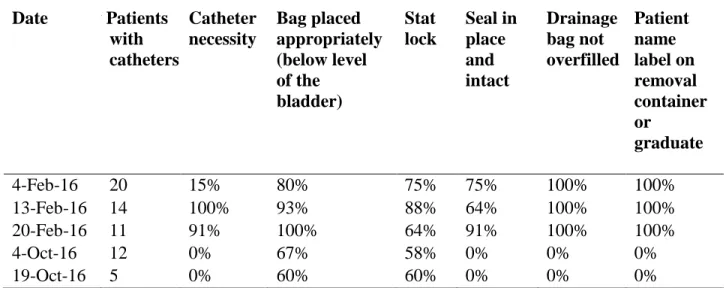
Comparison of how often CAUTI rounding occurred before the intervention and after the intervention revealed that this process was not being done consistently (i.e. weekly as expected) and accurately (some data was not recorded on the form). Table 1 illustrates CAUTI rounding prior to the intervention. The mean scores for CAUTI rounding documentation prior to the intervention are indicated in Table 3.
Table 1: Pre-intervention CAUTI rounding documentation
Date # Patients with catheters Catheter necessity Bag placed appropriately (below level of the bladder) Stat lock Seal in place and intact Drainage bag not overfilled Patient name label on removal container or graduate
4-Feb-16 20 15% 80% 75% 75% 100% 100%
13-Feb-16 14 100% 93% 88% 64% 100% 100%
20-Feb-16 11 91% 100% 64% 91% 100% 100%
4-Oct-16 12 0% 67% 58% 0% 0% 0%
19-Oct-16 5 0% 60% 60% 0% 0% 0%
CAUTI Rounding: Post-intervention
25
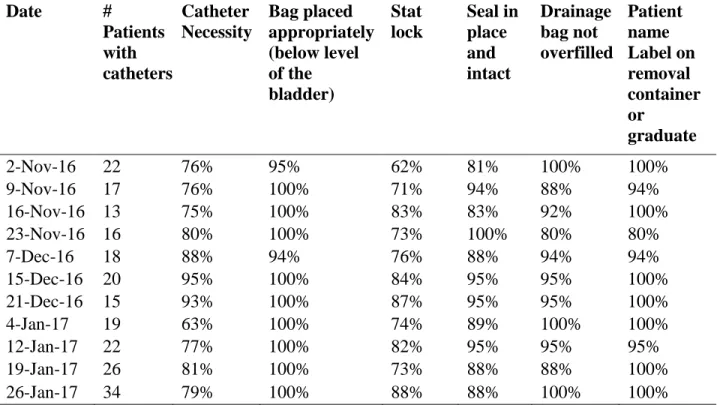
catheter. The target goal was met in week 4, 5, 6, 7, and week 10. Stat locks or urinary catheter straps constituted another process that was routinely not met at 6/11 times during the rounding.
Data were collected pertaining to documentation of placement of the urinary catheter bag below the level of the bladder, seal in place, patient name label on the urine removal graduate and the drainage bag overfilled processes consistently met the target for each of the 11 weeks of rounding. Based on the data collected, the staff was able to meet all process at or above the target goal during week 6 and 7 of the CAUTI rounding. Table 2 illustrates the weekly CAUTI rounding data collected. The mean scores for CAUTI rounding documentation post intervention are indicated in Table 3.
Table 2: Post-intervention CAUTI rounding documentation
Date #
Patients with catheters Catheter Necessity Bag placed appropriately (below level of the bladder) Stat lock Seal in place and intact Drainage bag not overfilled Patient name Label on removal container or graduate
2-Nov-16 22 76% 95% 62% 81% 100% 100%
9-Nov-16 17 76% 100% 71% 94% 88% 94%
16-Nov-16 13 75% 100% 83% 83% 92% 100%
23-Nov-16 16 80% 100% 73% 100% 80% 80%
7-Dec-16 18 88% 94% 76% 88% 94% 94%
15-Dec-16 20 95% 100% 84% 95% 95% 100%
21-Dec-16 15 93% 100% 87% 95% 95% 100%
4-Jan-17 19 63% 100% 74% 89% 100% 100%
12-Jan-17 22 77% 100% 82% 95% 95% 95%
19-Jan-17 26 81% 100% 73% 88% 88% 100%
26-Jan-17 34 79% 100% 88% 88% 100% 100%
26
in place and intact, catheter necessity and drainage bag not overfilled was found to be
statistically significant t = (p<.001, d=282, CI 95%) as noted in Table 3. However, the rate for CAUTI rounding process documentation was not statistically significant for the patient name label on removal container or graduate t (p<.133).
Table 3: t Test Results for CAUTI rounding documentation
Reported item Mean score for
pre-intervention Mean score for post-intervention p-value
Bag placed appropriately (below level of the bladder)
82.4 99 <.001
Catheter Necessity 44 80.2 <.001
Statlock 71.5 77.8 <.001
Seal in place and intact 75.5 90.2 .003
Drainage bag not overfilled 100 94 .048
Patient name label 100 97.1 .133
CAUTI Rate: Pre intervention
In the 3 months prior to the intervention Kindred Hospital had 5 CAUTIs reported to the NHSN. The calculated rate was 2.4 CAUTIs per 1000 foley catheter days, which was higher than Kindred Hospital’s target goal of 1.62 per 1000 foley catheter days. The data also indicated no change in the catheter utilization rate, which ranged between 0.37 and 0.48. Table 4
illustrates the pre-intervention CAUTI rate.
Table 4: Pre-intervention CAUTI rate
Reported item August
2016 September 2016 October 2016 Total
Number of CAUTI 2 2 1 5
Number of Foley catheter days 753 586 714 2,053
CAUTI rate (per 1,000 days) 2.7 3.4 1.4 2.4
27 CAUTI Rate: Post intervention
A total of five CAUTIs occurred in the post intervention period. Of these, three occurred within the first month of the intervention, one in the second month and one in the third month. The rate of CAUTI was 5.6 per 1000 days in November, 1.70 in December and 1.3 in January (Table 5). The overall rate of CAUTI during the time of the data collection was 2.7 per 1000 days, which exceeded the target rate of 1.62 per 1000 foley catheter days per Kindred Hospital’s benchmarks. The data also indicated no change in the catheter utilization rate, which ranged between 0.33 and 0.42 during the intervention period. This rate was lower than the Kindred Hospital benchmark of <0.47.
Table 5: Post-intervention CAUTI rate
Reported item November
2016
December 2016
January 2017
Total
Number of CAUTI 3 1 1 5
Number of Foley catheter days 538 562 770 1,870
CAUTI rate (per 1,000 days) 5.6 1.7 1.3 2.7
Catheter utilization rate 0.33 0.33 0.42
There was no statistical significance noted (p= .408951) in the difference of the rates of CAUTI between the post and the pre-intervention period.
28 Staff Education Pre and Post-test Results
Fifty-two RNs and 40 CNAs attended the skills fair and took the pre and post-test. The results from the paired t test (Table 6) indicated that there was a significant difference in the pre-test and post-pre-test scores for learning in both the RNs and CNAs. This showsthat the educational intervention regarding CAUTI resulted in increased knowledge of the procedures to decrease the rate of CAUTI in the hospital.
Table 6: Improvements in RN and CNA CAUTI rate knowledge resulting from educational
intervention
Discipline Mean score for pretest
Mean score for posttest
Mean difference p-value
RN n=52 6.92 9.56 2.635 <.001
CNA n=40 6.05 9.38 3.325 <.001
(p<.05 CI 95%)
Process Measures: Catheter LOS and Catheter Removal
Data pertaining to catheter LOS and time to catheter removal was collected post
29 Figure 1: Catheter LOS
The data collected included how long it took the nurse or the assistant to remove a catheter once an order for removal was entered into the chart either directly by the provider or as an order (verbal, telephone or written) from the provider. Of the 17 instances where an order for removal was received from the provider, the urinary catheter was removed within 20 minutes to more than 6 hours after the order. This data is illustrated in Figure 2.
0 2 4 6 8 10 12 14 16 1-5 days 6-10 days 11-15 days 16-20 days 21-25 days 26-30 days 31-35 days 36-40 days 41-45 days 46-50 days 51-55 days 56-60 days 61-65 days 65-70 days Num b er of p at ients
30 Figure 2: Time to removal after order received
On average the removal occurred within 2-3 hours after the order had been placed in the chart. Some catheters were removed on the same day as the patient discharge, which was in line with the provider order and nurse assessment, but increased the catheter LOS. The nursing policy allowed RNs to initiate the removal of the catheter based on their assessment, but the data obtained from the electronic chart provided limited information on whether the nurse initiated the removal. RNs could create an additional note in ProTouch concerning the removal if they initiated it but there were no additional notes entered pertaining to nurse initiated catheter removal in the charts reviewed.
Occasionally, the order for removal of the catheter was not followed correctly. For instance, one patient had orders for removal on 12/13/16, 12/20/16, 12/27/16 and 1/2/17; the primary nurse made a note acknowledging that the order was received but the order was not followed so that the patient had a non-indicated/not necessary catheter in for 19 days longer than needed. There were also two incidences where the order for removal was entered and the nurse removed the catheter but did not record the removal in the lines, tubes and drains flow-sheet (per
0 1 2 3 4 5 6
<1 hr 1-2 hr 2-3 hr 3-4 hr 4-5 hr 5-6 hr 6 & above
Nu
m
b
er
o
f
p
ati
en
ts
Time in hours
31
32
CHAPTER 7: DISCUSSION
Conceptual Framework
Lewin’s Change Theory was the most appropriate conceptual framework for this project because it was used in the planning, implementation, and maintenance of the change processes. Aligning the education process with the required annual skills fair was an effective strategy to implement this quality improvement project, since the agency supported the effort and RNs and CNAs were engaged in changing the system for the benefit of patients. The implementation phase was effective with all topics pertaining to the new policy and the updated standards of practice discussed and promoted by stakeholders. To enhance “refreezing” of the information learned, the television bulletin board was utilized and the PI maintained contact with staff for questions and recommendations in order to continue reinforcement of the learned information and solicit information about the effect of the new policy and procedure at the facility. This process was successful and most evident in the change in CAUTI rounding scores (Table 3) and pre and post intervention test scores (Table 6)
CAUTI Rounding
Consistent CAUTI rounding and documentation of the information gathered is imperative at Kindred Hospital. This had not been done regularly and completely prior to the intervention. CAUTI rounding in both the pre-intervention and the post-intervention periods provided
33
missed the benchmark of 80% in the pre intervention period (mean, 44%) and was slightly above the benchmark in the post intervention period (mean, 80.2%). However, statistical significance was noted (p<.001), indicating improvement, and need for continued intervention. This was an important finding because two of the CAUTIs that occurred were in patients who had no
indication for a catheter according to the guideline (CDC, 2009). Currently, one person is tasked with doing the rounding on a weekly basis and the floor/primary nurse records daily catheter necessity in the computer. The record may not be accurate if a full and comprehensive assessment is not done and if the nurse does not check the medical record completely for an indication of catheter necessity. Incomplete or inadequate catheter necessity information results in increased catheter LOS that can lead to preventable CAUTI. With proper remediation using this intervention, this outcome has the potential to improve over time.
All other aspects of CAUTI rounding documentation improved significantly (p<.001 for
bag placed appropriately below level of the bladder, catheter necessity, statlock; p<.003 for seal
in place; p<.048 for drainage bag not overfilled and intact), except the name of the patient’s name label on the removal container (p =.133). This was because the staff members could easily perform these tasks and had been doing them as part of their daily patient care. These tasks were
not particular to a discipline and any clinical staff member could perform them.
The Kindred Hospital CAUTI rounding sheet does not include information pertaining to the catheter length of stay (LOS) and this data is necessary to increase provider and staff
34
the need for removal if indicated. Increasing awareness can create a CAUTI conscious staff that communicates consistently about the need for removal promptly. This would indeed assist in decreasing the current catheter LOS which has been found effective in decreasing CAUTI (Mori, 2014).
In October 2016, a new infection control nurse took over the position. This may have affected the CAUTI rounding data collected in October since she was getting acclimated to the position. However, at the end of the project, the same infection control nurse continued with CAUTI rounding one floor per day such that some patients were rounded on twice during the week (there are three floors in the hospital). This benefitted patients by promoting prompt remediation of the RNs and CNAs based on the results of the CAUTI round. Another benefit was timely communication to the provider or the nurse when indications for catheter use were no longer applicable and catheter removal occurred, shortening catheter LOS. Essentially, the infection control nurse became the reminder system to both nurses and providers which has been found to be an effective way of decreasing CAUTI (Apisarnthanarak et al., 2007).
CAUTI Rate
35
Hospital. The documentation of the catheter necessity process, although improved (p =<.001) was right at the benchmark at 80%. If this can continue to improve, perhaps additional and avoidable CAUTI could be avoided.
The catheter necessity benchmark may have been consistently missed due to limited communication with the provider when nurses were unsure of the indications for catheter removal and could not easily find documented necessity in the patient’s electronic medical record. Communication between nurse and provider mainly depends on the provider. Some providers round or ask for an update from the nurses, but others do not do this because there is no set time for rounding. Although some indications for catheter use (e.g., open sacral or perineal wounds in incontinent patients, strict input and output), were easy to locate when doing a chart review in ProTouch, it was often difficult and time-consuming to locate other reasons indicated by the CDC guideline (CDC, 2009); therefore, nurses made an educated guess or did not address the indication when charting.
Currently, Kindred Hospital’s policy and procedure allows nurses to remove a urinary catheter based on their assessment, but with limited indication information, nurses may hesitate and instead wait for an order from the provider or any one of the supervisors (who can add a verbal or telephone order on behalf of the provider after the IDT meeting). This in turn increases the average catheter LOS. Ideally, setting up this process such that it is simple for the nurses to find the information needed for their assessment will enhance the their participation in early catheter removal.
36
catheter LOS of 19.1 days have a considerably increased likelihood of becoming infected. Since catheter necessity impacts LOS, the same reasons mentioned with respect to necessity likely influenced this result. However, considerations must be made for the patient population that is receiving carein this type of facility. Their age and their many comorbidities require a lengthy use of catheters, making them susceptible to CAUTI and other HAI’s. In these cases, it is
essential to continue to practice hand hygiene, use catheter straps or statlocks, practice consistent and effective perineal care and urinary catheter care, and use alternative methods such as
condom catheters where applicable. Staff Education
As Table 6 suggests, the educational intervention was effective in increasing staff knowledge about CAUTI prevention, Kindred Hospital policy and procedures and effects of CAUTI on Kindred Hospital patients and the system. Consequently, the goal of increasing knowledge was achieved as all staff members passed the post-test. However, maintenance of this knowledge is necessary. This is important for any change process because when change is not maintained, staff members return to their old ways of performing their tasks, which might be outdated and not based on the current evidence. Going forward, all nursing staff will be
educated in keeping with Kindred Hospital’s policy and procedure concerning indwelling catheter insertion, prompt removal, and catheter care. This is in line with recommendations by Wilson et al., (2009), who also recommended that CAUTI prevention strategies be made with the patient mix in mind. The patient mix in the LTACH is such that these patients are quite
37
also tend have high device use (tracheostomies, drainage bulbs and central lines), which creates easy reservoirs for infection. Given these factors, it is important for staff to be well educated on the correct and effective way of decreasing the likelihood of CAUTI and other infections in these patients. CAUTI education has now been added to new staff orientation so that all staff
members know about the policy and where to find it. The teaching will also continue to occur at the annual skills fair to reinforce learning especially for tenured staff members.
Staff Input
Staff members provided feedback about the rounding process and their concerns about the CAUTI process at Kindred Hospital. The consensus was that there are some patients who refuse to use the statlock or strap or had wounds on their lower extremities, because these methods of securing the device were not effective. A change was made in the rounding process to accommodate for this variance. These patients were not counted as being noncompliant. This was important feedback from the staff as it showed that they were involved in the process and felt empowered to communicate their needs. Feedback from staff members also led to new order sets for catheter removal and the connected bladder scan protocol to ease the process of entering orders into the chart.
Some comments made by staff members related to the ease of use of a foley catheter compared to using alternatives such as bedpans, bedside commode or a condom catheter. Some felt that this added more work, but discussions about the cost to staff and patients (e.g., entering new orders for specimen collection, taking specimen to lab, waiting for results, calling results to MD then starting antibiotic therapy) seemed to alter this opinion.
38
commented that they had started being more mindful when performing thorough perineal care in the effort to curb CAUTI at the facility.
Although RNs knew that they could remove catheters without the provider order, some were uncomfortable doing this and commented that they would “rather wait for the provider to put in an order”. It is challenging to change this opinion but continued reinforcement may lead to desired outcomes.
Limitations
Although some staff members had an idea that a policy and procedure change was supposed to occur, the majority had not attended the monthly meetings, thus had a difficult time “unfreezing” from the status quo. Ideally, more driving forces for change should have been employed by increasing the number of stakeholders and change agents besides the DQM, Kindred Hospital’s education department, and the infection control nurse. This could have assisted in updating staff attitudes about the new policy and procedure since more stakeholders and change agents besides people in leadership positions would have been involved. In the unfreezing stage, surveys to gauge staff involvement, thoughts about the effect of CAUTI on Kindred Hospital, and their role in CAUTI prevention would have assisted in building the teaching program.
Another constraint to this project was that it lasted 11 weeks. A longer time period would allow the facility to notice the effectiveness of the intervention. Kindred Hospital now has tools to continue this project for a longer period to determine the ongoing effects of the intervention and possibly change some processes to decrease the rate of CAUTI.
39
bag should be when they are doing therapy, teaching effective perineal care for patients who have new deficits and are learning new techniques for self care, or emptying the catheter drainage bag if they find it full, can increase knowledge about ways they can prevent CAUTI. The providers should also have been included in the project because increasing their awareness could possibly lead them to remember their catheters when taking care of their patient.
Additionally, educating them about nurse empowerment to remove catheters without their order could have made the transition easier for nurses and providers alike.
The PI is a nurse at the hospital; when staff members were aware of the PI’s presence, they tried to correct the items they knew would be checked and documented on a CAUTI round. This observer-related bias could have been a limitation of the study as it could have led to
increased compliance only when the PI was present. Instead of having the same person
performing the rounding, changing the observer may lead to more accurate data. Added to that, much of the rounding occurred in the late afternoon going into the night shift. Data collected on the night shift could be different based on the staff on each shift.
This paper did not explore staff years of experience, which could have assisted in
creating an effective “unfreezing” state for the RNs and CNAs. It is possible that the newer staff were willing to change and follow the new policy and procedure, whereas the more
40
This project occurred in a small hospital with a convenience sample. It is possible that the results obtained may not be generalized to other LTACHs. There are other like facilities in the area and it would be ideal to find out how they are managing CAUTI and what has been effective.
Recommendations
To maintain the gains made so far, staff members must remain engaged and several CAUTI champions including the PI are needed. At this time, the CAUTI champions are the DQM and the infection control nurse. Several CAUTI champions on each of the floors to include a mix of clinicians in different roles can benefit the hospital and continue to promote different and creative ideas leading to CAUTI prevention. Providers must be educated on the need for a consistent charting and rounding to include urinary catheter necessity/indications and removal orders. Increasing provider and nurse awareness that nurses can remove catheters without the provider order is also necessary because there are positive outcomes for patients when this is done consistently.
41
7 days. The nurse who sees that this order has not been checked can remind the provider to renew or can give recommendations based on the nurse’s assessment.
Adding a no cosign required option for nurses who need to put in an order for removal based on their assessment is another method to improve the rates of nurses following the
discontinuation protocol (Appendix 3). Some providers do not cosign when they have not given the specific order for removal but the charting system requires that the nurse enter a physician name when they put in the order. This may empower more nurses to remove catheters without the provider order, which is within their scope of practice
The last recommendation is for the infection control nurse to continue with consistent rounding to catch each patient at least once a week and if possible twice a week to increase compliance with the components on the CAUTI rounding sheet and to continue to reinforce the new knowledge that has been gained by the staff.
Conclusion
Although this project did not reduce the rate of CAUTI at Kindred Hospital, it did increase the rate of CAUTI rounding documentation. These are processes that are necessary as they can lead to a reduction the incidence of CAUTI in facilities. Involvement of all staff and providers during the implementation stage of an intervention and the sustainability of that intervention are effective strategies in reducing incidence. LTACH patients, although
42
APPENDIX 1: PRE AND POST TEST Kindred Hospital of Greensboro
WRITTEN COMPETENCY CAUTI Prevention
NAME: __________________________________ DATE: ___________ SCORE:____
1. The urinary tract is the most common site of nosocomial (hospital-acquired) infections. T or F
2. It is appropriate to insert an indwelling urinary catheter to reduce the risk of patient fall. T or F
3. Urinary retention is an appropriate indication for placement of an indwelling urinary catheter. T or F
4. The most effective strategy to prevent a CAUTI is not to insert an indwelling urinary catheter. T or F
5. Best practice for care of the indwelling urinary catheter includes: a. Keeping the catheter secured
b. Replacing the catheter every 30 days
c. Performing catheter care every shift & PRN d. a & c only
6. List three steps as proper technique when obtaining a urine specimen for culture from a patient with an indwelling urinary catheter:
a. ________________________________________________________________ b. ________________________________________________________________ c. ________________________________________________________________
7. Staff should obtain a new measuring container (graduate) every day for each patient with an indwelling urinary catheter. T or F
8. Hand hygiene should be performed immediately before and after any manipulation of the catheter drainage system. T or F
9. All patients with an indwelling urinary catheter should have a daily needs
assessment done to determine if the patient continues to meet acceptable criteria. T or F
43
APPENDIX 2: INDWELLING URINARY CATHETER STANDARDS OF PRACTICE
Indwelling Urinary Catheter
Standards and Practice H-PC 03-004
Release Date:
06/2016 Patient Care HD Manual Page 1 of 3 Original Date:
06/2016
Section 03
Clinical Programs
Facility Specific Addendum Attached - Review All of Policy and Addendum Pages (Check if State Specific and/or Facility Specific Policy Addendum is attached)
POLICY
1. Indwelling urinary catheters will be inserted only when clinically indicated and only after careful consideration of alternative methods.
2. Indwelling urinary catheters will be removed as soon as they are no longer indicated according to the facility indwelling urinary catheter discontinuation protocol.
RATIONALE
To reduce the risk and incidence of catheter associated urinary tract infections (CAUTIs) by following evidence-based guidelines.
COMPONENTS
1. The insertion of an indwelling urinary catheter requires a physician order and specific indication.
2. All patients admitted to the hospital with an existing indwelling urinary catheter will be assessed by a registered nurse during the admission assessment for a clinical indication according to the facility indwelling urinary catheter discontinuation protocol.
3. Patients with urinary catheters will be assessed each shift by a registered nurse according to the facility indwelling urinary catheter discontinuation protocol.
4. All healthcare workers providing urinary catheter care will be educated in the epidemiology of and infection prevention and control procedures for preventing CAUTI’s (Catheter Associated Urinary Tract Infection). 5. All registered nurses and licensed practical nurses will complete an annual return demonstration competency
on indwelling urinary catheter insertion. 6. Limit Unnecessary Indwelling Urinary Catheters
Rationale: One of the most important infection prevention measures is to limit the use of urinary catheters for carefully selected patients, thereby reducing the size of the population at risk.
a. Recommended indications for urinary catheter use include the following:
i. Urinary retention including obstruction and neurogenic bladder when the patient is unable to pass urine because of an enlarged prostate, blood clots, or an edematous scrotum/penis or is unable to empty the bladder because of neurologic disease/medication effect.
ii. Continuous and/or intermittent bladder irrigation.
iii. When a neurologist and/or urologist is involved in the patient’s care. iv. When a critical care patient requires hourly monitoring of urine output.
v. When a critical care patient is hemodynamically unstable, paralyzed, and/or sedated. vi. To assist in healing of Stage III or IV perineal and sacral/coccygeal wounds and in
incontinent patients to prevent further deterioration of wound and skin. vii. When patient is hospice/comfort care or palliative care.
b. Indwelling urinary catheters should not be inserted to manage urinary incontinence 7. Alternatives to Indwelling Urinary Catheters
44
Indwelling Urinary Catheter
Standards and Practice H-PC 03-004
Release Date:
06/2016 Patient Care HD Manual Page 2 of 3 Original Date:
06/2016
Section 03
Clinical Programs
b. Intermittent catheterization for
i. Patients requiring chronic urinary drainage for neurogenic bladder ii. Patients with urinary retention
c. Use of a portable ultrasound devices to assess urine volume to reduce unnecessary catheterizations 8. Catheter Insertion
a. Indwelling urinary catheters will be inserted using aseptic technique and sterile equipment b. The perineal area will be cleansed with soap and water prior to disinfection with betadine c. A securement device will be utilized on all patients with a urinary catheter unless contraindicated 9. Urinary Catheter Maintenance
a. Hand hygiene should be done immediately before and after any manipulation of the catheter site or apparatus.
b. Maintain a sterile, continuously closed drainage system. If disconnection is necessary, a new urinary catheter will be inserted.
c. Avoid irrigation of urinary catheter. Closed continuous irrigation may be used to prevent obstruction. d. Maintain unobstructed, downward urine flow by keeping the drainage bag below the level of the
patient’s bladder at all times.
i. Position the drainage bag so that it does not have contact with the floor. ii. Keep the tubing free of kinks and obstruction.
iii. Position bag towards bottom of bed on bed frame when patient in bed or on stretcher-do not hang from railing.
e. Empty the urinary drainage bag aseptically and frequently enough to maintain urine flow and prevent reflux. When emptying, use a clean, labeled container for each patient and avoid contact between the emptying port and the container.
f. Change gloves and practice good hand hygiene patients in the same room when emptying each patient’s drainage system.
g. Catheter care includes gently cleaning of the perineal area with soap and water at least once a shift. Remove any gross debris from the catheter, always moving from the urethra down to the connection site of the catheter to the bag tubing. Do not manipulate the catheter more than is absolutely necessary. Do not pull on the catheter during cleaning. Verify that catheter securement device remains secure and in a position not to pull on the catheter.
h. Only change indwelling catheters when medically indicated rather than at arbitrarily fixed intervals. i. If an indwelling catheter has been in place for greater than 2 weeks at the onset of a CAUTI
and is still indicated, remove catheter and replace with a new catheter. v NOTE: Unless contraindicated such as surgical placement.
i. Do not routinely screen for asymptomatic bacteruria in catheterized patients 10.Urine culture collection
a. A urine specimen for culture should be obtained prior to initiating antimicrobial therapy
b. The urine culture should be obtained from the freshly placed catheter if in place greater than 15 days. c. Obtain urine samples from sampling port using aseptic technique and standard practice guidelines. d. If use of the catheter can be discontinued, a culture of a voided midstream urine or straight catheter
specimen should be obtained following standard practice guidelines.
45
Used with permission from Kindred Hospital, Greensboro
Indwelling Urinary Catheter
Standards and Practice H-PC 03-004
Release Date: 06/2016
HD Manual
Page 3 of 3 Patient Care
Original Date:
06/2016 Clinical Programs Section 03
Wong, E. (with Hooton, T. and Working Group). (n.d.). Guideline for Prevention of Catheter-associated Urinary Tract
Infections. Retrieved from http://www.cdc.gov/ncidod/hip/guide/uritract.htm
Hooton, T.M., Bradley, S.F., Cardenas, D.D., Colgan, R., Geerlings, S.E., Rice, J.C…. Nicolle, L.e.( 2009). Diagnosis, Prevention, and Treatment of Catheter Associated Urinary Tract Infection in Adults: 2009 International Clinical Practice Guidelines from the Infectious Diseases Society of America. Clinical Infectious Diseases. 50, (625-663). Retrieved from http://cid.oxfordjournals.org/content/50/5/625.full.pdf+html
APIC.(2014). APIC Implementation Guide: Guide to Preventing Catheter Associated Urinary Tract Infections. Retrieved from
http://apic.org/Resource_/EliminationGuideForm/0ff6ae59-0a3a-4640-97b5-eee38b8bed5b/File/CAUTI_06.pdf
National Patient Safety Goal 2012, NPSG elements of performance 07.07.01