PERFORMANCE ENHANCEMENT BY AN ENERGY ADEPT
PE-AODV WITH LINK FAILURE PREDICTION
1M. SAKTHIVEL, 2Dr. V. PALANISAMY
1Associate Professor, Department of Information Technology, Adhiyamaan College of Engineering,
Hosur-635109, Tamilnadu, India
2
Principal, Info Institute of Technology, Kovilpalayam, Coimbatore - 641107, Tamilnadu, India
Email:
1 [email protected], [email protected]ABSTRACT
Mobile Ad hoc Network (MANET) is a wireless network which has dynamic nature with infrastructure less without a central administration. In MANETs link failure occurs due to topological changes of mobile node which causes high data loss and delay, so the performance is enhanced by predicting the link break in prior. The most challenging fact in the routing process is affording the energy proficiency and load balancing with Quality of Service(QoS), Ad-hoc On Demand Vector protocol (AODV) possess load balancing but to get QoS metrics a new protocol with Energy Adept AODV is embarked. The protocol is intended to quest the overloaded, variable nodes by considering the interface queue length compared with a threshold value. Performance Enhanced Ad-hoc On Demand (PE-AODV) is used for predicting the link failure prior and forwarding the data packets in an alternate route which reduces end to end delay and increases Packet Delivery Ratio (PDR). Finally energy proficient load balancing is obtained by engulfing packet delivery ratio, end to end delay, load distribution and node energy as major parameters with a performance enhanced PE-AODV is obtained.
Keyword: AODV, LINK BREAK, MANET, PE-AODV, QoS.
1. INTRODUCTION
A mobile ad hoc network (MANET), is a network which has no fixed infrastructure by a dynamic set of mobile nodes without depending on any central supervision. Mobile nodes used in MANET are to make specific the roles that were guarantee by the potential fixed infrastructure in conventional networks. This is a difficult task, as these devices have limited resources. Moreover, the network's background has some features that add additional difficulty, such as the frequent topology modify reason by nodes’ moving, and the non reliability and the bandwidth restriction of wireless channels. Energy consumption is a crucial factor for the designing of energy proficient protocols. The basic objective of MANET is to maximize energy efficiency, throughput and network life time in addition to minimize the end to end delay in the network.
In MANETs, changes in network topology may dynamically occur in an unpredictable manner since nodes have liberty to
move anywhere arbitrarily. Routing is an important part of MANETs as it gives the better selection of paths. Thus they require efficient routing protocols for providing better communication. For any data communication packets are transmitted in store and forward manner from a source to destination with the help of intermediate nodes. Since the intermediate nodes move randomly, link breaks occur frequently and packet loss occurs. This degrades the performance of the MANETs protocols. In order to reduce the dropping of packets, the idea of link breakage prediction is introduced. In this new approach, the source node of an active route, after being informed about a link breakage in its current used route, will construct a new route which avoids the use of any link from the current used route. That means excluding all the links in the current route. So, the new constructed route will be completely different from the current used one. This approach has been implemented on the well-known reactive routing protocol AODV.
delivery of the packets to the destination. Energy is limited in case of Ad-hoc networks. Energy is a scarce resource in ad hoc wireless networks . Each node has the functionality of acting as a router along with being a source or destination. Thus the failure of some nodes operation can greatly impede performance of the network and even affect the basic availability of the network, i.e., routing, availability, etc. Thus it is of paramount importance to use energy efficiently when establishing communication patterns. Energy management is classified into battery power management, transmission power management, system power management.
In this paper the related work enable us to understand the routing protocols and the process. Along with this the existing system provides the value of the proposed system which uses the energy adept AODV with enhancing the performance by predicting the link break in prior and forward the data packets in an alternate route. Then the protocol is simulated under the simulation environment that evaluates the protocol and generates the graph for the required throughput with energy as the parameter
2. RELATED WORK
The Ad-hoc On-demand Distance-Vector (AODV) is a routing protocol designed for ad hoc mobile networks. Operations of unicast routing on AODV can be simply divided into three parts: route request, route reply and route maintenance [3, 4]. It maintains these routes as long as they are needed by the source node. AODV is capable of both unicast and multicast routing.
When the node mobility speed rises or the transmission path is long, the probability of link failures in active routes also rises. The upstream node of the broken link will initiate the local repair process. It broadcasts a RREQ messages to the intermediate nodes for forwarding the data packets to the destination. The process may cause the flooding of RREQ messages to the entire network. To limit the hop count from the upstream node to the destination, the TTL field of the RREQ message which is broadcasted by the upstream node of the broken link will be set to a limited number which is the last known distance to the destination. On the other hand, to prevent the forming a loop by flooding of RREQ messages, the new sequence number which is incremented by one, for the destination is also assigned to the RREQ message. If the RREQ message is delivered to the destination successfully, an alternate path is
established. If the first attempt of route repair is unsuccessful, the upstream node of the broken link will send a RERR message to the source node. After receiving the RERR message, the source node will initiate a new route discovery process. Based on AODV routing protocol, Sung-Ju Lee and Mario Gerla proposed a new scheme called AODV-BR (Backup Route) [5] which can improve the performance of the AODV routing protocols by constructing a mesh structure and providing multiple alternate routes. When establishing the mesh and multi-path routes, the AODV-BR algorithm takes advantage of the RREPs (Route Replies) messages of AODV without generating additional control messages. In AODV-BR, the alternate routes are constructed by the RREP messages. Each neighboring node overhears the RREP messages and records the source of one of RREP messages as the next hop to the destination into its alternate route table. The establishments of alternate routes rely on the overhearing of Route Reply (RREP) messages and data packets. No additional messages are required during the establishment of alternate routes. With the help of these backup routes, AODV-BR can offer more stable connections than AODV.
Load Aware Routing in Adhoc, the protocol define a new metric for routing called traffic density to represent the necessity in the medium access control layer (LARA). [7] Load Balanced Aware Routing, it is a traffic based protocol. The function is based on the active path activity and also considers the activities of neighboring nodes. It has two phases: (1) Route discovery, has Setup messages, Nodal activity, Traffic interference, Ack messages. (2)Route maintenance, has error message, alternate least loaded path list (LBAR). [8] Load Sensitivity Routing, it utilizes the network load information and encompass it as the main route selection criterion (LSR). [9] Correlated Load Aware Routing, it reduces power depletion and queuing delay at node in heavily loaded environment and considers the traffic around neighboring nodes as primary route selection metrics (CLAR). [10] Alternate Path Routing, it selects the diverse path to protect the route failure (APR). The need of load balancing is to reduce the traffic that occurs in the topology. Thus by moving the occurring traffic from areas that are above the optimal to less loaded areas to achieve better performance.
All the protocols discussed will concentrate on traffic balancing which is the part of the proposed protocol Energy Adept AODV and to encompass energy issues, the AODV protocol is considered.
Although we consider energy issues the proposed scheme performs the load balancing along with it energy proficiency that at last improves the topology life time.
3. EXISTING SCHEME
A number of routing protocols proposed for MANET’s use shortest route in terms of hop count for data transmission. It may lead to quick depletion of resources of nodes falling on the shortest route. It may also result in network congestion resulting in poor performance. Therefore, instead of hop count a routing metric is used that can consider the node’s current traffic and battery status while selecting the routing path that consists of nodes with higher residual battery power and hence longer life.
We define the required parameters, as follows: the terms used in this system have been defined as follows:
1. Route energy (RE): The route energy of a path is the minimum of residual energy of nodes (rei) falling on a route. Higher the route energy, lesser is
the probability of route failure due to exhausted nodes.
2. Traffic queue (tq): The traffic queue of a node is the number of packets queued up in the node’s interface. Higher is its value, more occupied the node is.
3. Average Traffic Queue (ATQ): It is the mean of traffic queue of nodes from the source node to the destination node. It indicates load on a route and helps in determining the heavily loaded route.
4. Hop count (HC): The HC is the number of hops for a feasible path.
The derivation below derives the function of the system. A path between two nodes u and v is given as P(u, v) = {P1, P2, ……, Pn}.
The equation to calculate the weight of the path is given as
W(Pi)= W * RE(Pi) – W * ATQ(Pi)-W * HC(Pi). Where
RE = Residual energy of the node in the path i. RE(P)=min{ren1, ren2, . . . ,renm}.
Where n are the nodes makes the path. ATQ= Average Traffic Queue of the path i. ATQ(Pi) = (tqn1+tqn2+…+tqnm)/m-1. HC = hop count of the path.
Let the maximum weight of the topology be W (Pi) = max {W (P1), W (P2), ….., W (Pn)}. In case of adaptive nodes,
W (P) = (1-α) * RE (Pi) – α/2 *(ATQ (Pi) + HC (Pi),
Where, α = min (RE (Pi))/IE; 0≤α≤ 1.
Here when 1-α increases route energy parameter increases
4. PROPOSED SCHEME
The proposed scheme possesses load balanced and energy proficient routing with PE-AODV. The protocol briefly explains the functions of routing. The proposed protocol Energy Adept AODV will make the list of changes to existing protocol as described below,
• Paths are selected based on the hop count and queue length.
• Load is balanced via alternate paths if queue length processes a certain threshold value.
• RREQ packets are forwarded or discarded depending on the queue length.
Our approach PE-AODV possesses positive attributes from both AODV-BR and AODV–LR disadvantages to overcome it. A triggering threshold is added to our schemes to improve the performance. To reduce the time and control message after link breaks, AODV-BR plays a more visible role. However, when the primary route breaks, there arise some problems which are discussed as following:
(1) There will be a time interval used to select the alternate routes that lead to data packet loss and delay increase.
(2) If there are more than one alternate route, then it must be considered which route is to be selected.
(3) AODV-BR and AODV-LR has no action to repair link, but simply uses information of alternate routing table, and it cannot well adapt to MANETs. For these above-mentioned problems, we propose a link failure prediction mechanism in order to reduce the time interval after primary route breaks. It sets up an effective metric of alternate routes based on improved PE-AODV, select alternate route whose communicating power is stronger by comparing metric to participate in forwarding of data packets.
In this way the protocol computes multiple paths to get stable single congestion less path for routing. The working of the proposed protocol is classified into three parts 1) Load balancing in Energy Adept AODV. 2) Energy proficient routing in Energy Adept AODV. 3) PE-AODV for link failure prediction
4.1 Load balancing in Energy Adept AODV
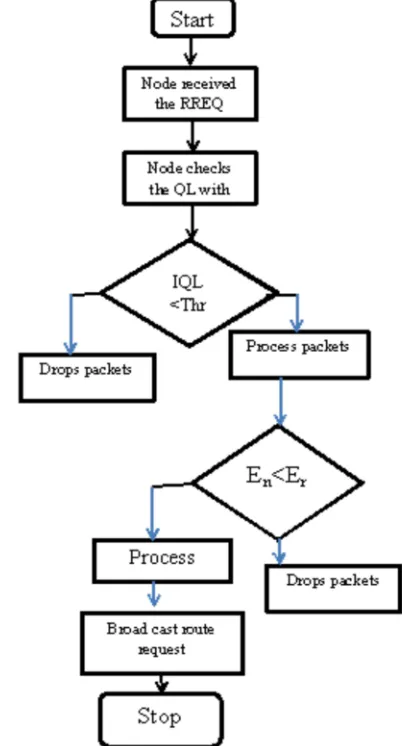
Load balanced routing aims to move traffic from the areas that are above the optimal load to less loaded areas. so that the entire network achieves better performance. Basically the traffic occurs during the communication between the source and the destination that is when the source node wants to communicate with the destination node and has no available routing information about the destination. It will flood a route request to find a route by broadcasting a RREQ message. But not every immediate node that receives the message will respond to the (RREQ) route request. Before broadcasting the (RREQ) route request again, the intermediate node itself first makes a decision if it is qualified. If its interface queue length is under
the threshold value, the node is qualified and able to broadcast it.
The queue length means the number of packets waiting to be transmitted in interface queue. If the node’s queue length is over the threshold value, it isn’t qualified and drops the request. The threshold variable changes adaptively with the current load status of network.
The method to calculate the nodes average queue length (avg ql) is by using the nodes current queue length in local area.
Average queue length,
Avg ql = (cnql + Σ(݊݊ݍ݈)݊݅=1) n+1. Where,
cnql is current node’s queue length. nnql is neighbor node’s queue length. N is the number of node.
Sum of the queue length,
Sum ql =Σ((cnql + Σ(݊݊ݍ݈)݊݅=1) n+1))݇݅=0. Threshold value,
Thr = (Avg ql +Sum ql)/K+1. Thr=
(cnql+(K+1)Σ(݊݊ݍ݈݅)݊݅=1+Σ(ܿ݊ݍ݈݅)݇݅=1)/(݊+1)+( k+1).
The proposed protocol Energy Adept AODV performs the flow of action they are
• Paths are selected based on the hop count and queue length .
• Load is balanced through paths if queue length processes a certain threshold value.
• RREQ packets are forwarded or discarded depending on the queue length.
• Based on the threshold value the route request packets will be forwarded.
Later energy efficient routing is done to deliver the packets to end the communication between the source and destination.
4.2 Energy Adept routing Broadcast message
The nodes which have no work to be done will go to sleep mode, to conserve power.
4.2.1 Path discovery
In order to send the packets from source to destination, the source node will find lists of neighbors that are the address of the nodes that are able to transmit data from the source. Broadcast messages are exchanged between the nodes. The Frame Format of Broadcast messages as shown below:
SD HC SN RE RSS DD
Where it consists of Source ID (SD), Hop Count (HC), Sequence Number (SN), Required Energy threshold (RE), Required Signal Strength (RSS), Destination ID (DD).
Unlike other energy-aware routing protocols which find minimum energy-cost path, this protocol provides efficient energy path. When an intermediate node receives the broadcast message it checks its available energy. If available energy is less than threshold the node simply discards the route request and if the node has sufficient, the node measures the strength of receiving signal. If the distance between the receiving node and source node is far off then the signal is weak. If not then one node is within the same signal strength threshold and has enough energy. Then there is chance for message collision to occur. To overcome this rebroadcast immediately, a MAC layer with back-off delay scheme is applied.
4.2.2 Neighbor discovery
Initially sending data to the destination, a node must start the neighbor discovery process to create a neighbor list that is the address of all nodes that are able to transmit data from the source. During this process broadcast messages are exchanged between the nodes. The broadcast message show above now consists of the source address, hop count, sequence number to differentiate the message originating from the source, required energy threshold to transmit the packets and required signal strength threshold and destination address.
In order to overcome this, broadcast message is not rebroadcasted immediately; a back-off delay scheme is applied. After the end of the current message transmission, the nodes chosen to forward the message being broadcast is selected by associating with back off timer. Upon receiving the
broadcast message reception, the nodes start timers that implement broadcast back-off delay.
In order to find optimal routes, each receiving node calculates its broadcast back-off delay as a function of its distance away from the destination(this delay decreases along with the each hop). When a node’s back-off timer expires. It sends the broadcast message, which also sends an implicit Acknowledgement (ACK) to the previous sender of this packet. Before its timer expires it cancels its back-off timer and packet transmission. So, in most cases, the nodes with the smallest number of hops to the destination will be selected to forward the packets, simultaneously making other nodes aware of its selection. The concept described above may result in more than one node selecting itself because, not all
[image:5.612.346.547.320.693.2]receiving nodes may be in the broadcast range of the first selected node to overhear.
Using the above mechanisms fig. 1, the path to the destination is built utilizing some energy-sufficient nodes. The path request reaching the destination contains one such energy-sufficient path. Thus the node which is having the largest energy among the sender neighbor is the one which is selected.
4.3.3 Route reply
[image:6.612.128.298.322.528.2]The destination node, upon receiving a new broadcast message, will respond with a route reply packet. The packet of this header contains the same fields as those of the request packets, as well as an expected hop count field indicating the expected number of hops needed for the packet to travel to reach the target node( in this case, the destination). Unlike the broadcast message, the route reply packets does not rely on flooding to find its return path back onto the source; it just uses the nodes through which it received the broadcast message
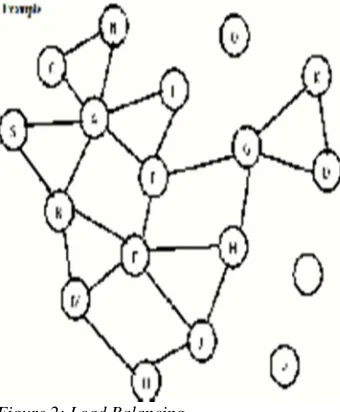
Figure 2: Load Balancing
The example fig. 2,here describes about the communication between the source node S and the destination node D. when S wants to communicate with D without any routing information, it will initiate a route discovery by flooding RREQ message. Any intermediate node receiving the RREQ will compare its current queue length with its threshold before broadcasting it again. If queue length is greater than the threshold, the RREQ will be dropped simply, such as nodes J and I. they do not broad cast the RREQ so the established path will bypass these nodes. Otherwise, the nodes will deal with RREQ normally, such as nodes A, B and E.
In above scheme the threshold value plays the major role in selecting node whether or
not to forward RREQ. Every time an intermediate node receives a RREQ, it will recalculate the threshold according to the nodes queue length around the backward path. The protocol performs following steps for the effective load balancing. They are,[1] calculate the average queue length using the nodes current queue length in local area. Here the average queue length for the node A is calculated by the queue length of the current node similarly done for the nodes C, S, E and J and here n equals to 4. The source will calculate its average current nodes queue length and utilize it to calculate the sum of the queue length of the nodes. Which is an additional field of RREQ.[2] The node’s threshold value should be calculated from the above derived derivation. Thus the threshold of node G can be calculated by its own average queue length of the nodes and the sum of the queue length of the nodes which received the RREQ like S, A and E nodes.[6] The node compares its current queue length with the threshold. When the node gets its threshold it will compare the value with current interface queue length value, it will respond to the RREQ as usual. Otherwise, it will simply drop it or else process the packets.
As shown in the figure there are many intermediate nodes, available in the network. All nodes within the radio range of the nodes receive the broadcast message at the same time. When the destination initially broadcast the message, the nodes A, E and G receive the message. Assume that the available energy at A is larger than at J also A is within the required signal strength threshold; hence node A is selected to broadcast the message to the neighboring nodes. The process continues and node E which is received by node G and H, it is found that both G and H have the same energy level and are within the required signal strength threshold. So both G and H start a back-off timer and if the back-off timer of node G ends before H an implicit acknowledgement is sent by node G stops its back-off timer as shown in the figure drew above. The broadcast message is sent to K and then to destination D. The destination transmits the route reply packets through the nodes it received the broadcast message.
4.3 Link Failure Prediction Mechanism
In MANETs, the strength of the packet signal which the node receives may be defined as eq. (1).
Pr = Pt Gt Gr Ht2 Hr2 (1) d4
transmitter, Ht - antenna altitude of the transmitter, Hr - antenna altitude of the receiver, d - distance between the sending node and the receiving node. d can be defined as,
(2)
Suppose each node has the same transmit power from eq. (2), then the changing strength of the received packet node signal reflects the fluctuation of the distance among those nodes. Therefore, we can define a receiving power warning threshold Pr_critical. When Pr is lower than Pr_critical, it determines that the link is in the warning stage. The link state is unstable and there may be possible interrupts at any time. So when the node in primary route detects Pr < Pr_critical, immediate access to the alternate route selecting process is carried out. After selection, the primary route switches to alternate routes in order to eliminate the required time interval to rebuild route.
4.3.1 Select Alternate Node
An alternate route is selected based on strength of the two adjacent nodes to identify the strong or weak communication signals. Communication signals divide the neighbor's communication channel into "strong channel" and "weak channel". Choose "strong channel" corresponding to the node as a selected alternate node. Its communications ability can be set up by eq (3).
M =f (V, Pr, D) = A* V+ B* Pr- C* D (3)
Among them, V is transfer rate, unit is packets/s. D is transfer delay, unit is ms. A, B, and C are constants. M retains one after the decimal point. To avoid the alternate nodes having the same metric, we add a random number of 0.001-0.099 to it. Finally put the calculated value of M stored in the alternate routing table. The criticality value M
critical, reflects stability of communication ability.
When metric M < M critical in the alternate routing table, we determine that alternate route is unstable, and unfit for use. When M ≥ M critical, we will select a higher metric in the alternate route information to forward the data packets from the upstream node.
Simulation environment
In this session we apply load balancing approach in AODV and proposed protocol that is Energy Adept AODV and evaluate the performance of the AODV with the Energy Adept AODV in the simulation environment as in Table 1. Energy Adept AODV which is energy efficient on the demand distance vector selects an path with a lower hop counts and discards routes with higher hop count.
Here ns-2 is used to conduct the simulation for 50 mobile hosts with transmission range 250 meters:
The average size of the rote tables of all the nodes along the path is minimal and average residual power of all the nodes is maximal comparing with outer paths. It is being expressed below;
Minimize [1/N sizeof [number of enteries in the routing table of node i / residual energy of the node݊݅=1]].
Where N is Total number of nodes participating in the route
The energy adopted is given by: Energy = power * Time
The time needed for processing packets is defined as:
Time = 8 * Packet size/ Bandwidth. Therefore energy needed for processing the transmitting and receiving the packets is calculated. Thus the total energy for forwarding the packets is
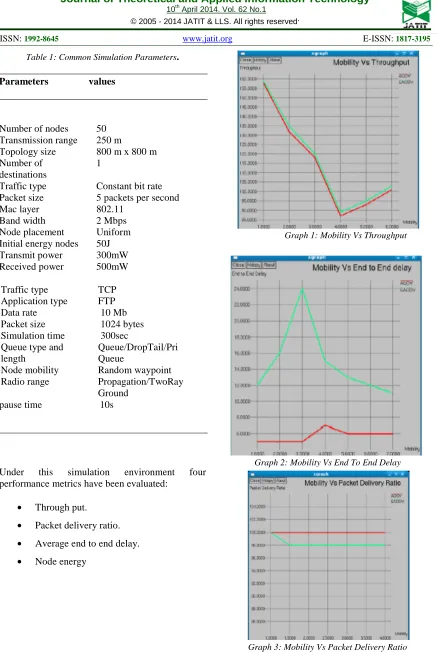
Table 1: Common Simulation Parameters.
Parameters values
Number of nodes 50 Transmission range 250 m
Topology size 800 m x 800 m Number of
destinations
1
Traffic type Constant bit rate Packet size 5 packets per second Mac layer 802.11
Band width 2 Mbps Node placement Uniform Initial energy nodes 50J Transmit power 300mW Received power 500mW
Traffic type TCP Application type FTP Data rate 10 Mb Packet size 1024 bytes Simulation time 300sec Queue type and
length
Queue/DropTail/Pri Queue
Node mobility Random waypoint Radio range Propagation/TwoRay
Ground pause time 10s
Under this simulation environment four performance metrics have been evaluated:
• Through put.
• Packet delivery ratio.
• Average end to end delay.
• Node energy
Graph 1: Mobility Vs Throughput
Graph 2: Mobility Vs End To End Delay
Graph 4: Mobility Vs Energy
To evaluate the performance improvements made by our prediction mechanism, we compare the simulation results of the AODV protocol, AODV-BR and energy adept PE-AODV. The simulations are based on the ns-2 network simulator as in
Table 1.
There are 50 mobile nodes in the simulation environment that moves at the rate of 0-10m/s. The length of the data packet is 1024 bytes. The simulation time is 300s. Nodes are set up at antenna height 2.0m, transmitting power to 0.281838 w. We assume distance between nodes to be more than 230m as into the warning stage. According to the formula (1), Pr_critical ≈ 1.396
Pr _ min =1.61155636e-9 w. (Pr _ min is strength
of received signal at the edge of communication range of 250m). In the formula (3),
A=1/4096(sec/packets), B =1e8 (1/w), C
=1000(1/ms). And we assume that critical M =1.0.
Graph 5: Packet Delivery Ratio (AODV, AODV-BR, PE-AODV)
Graph 6: End-To-End Delay (AODV, AODV-BR, PE-AODV)
Packet Delivery Ratio (PDR) and end-to-end delay are presented in graph 5 and graph 6. Maximum speed of each node is 10m/s. As expected, three improvements significantly enhance the PDR and reduce the end-to-end delay compared with AODV-BR. PE-AODV has better adapted to frequent topology changes in MANETs, and ensure higher PDR. Although PE-AODV has longer end-to-end delay than AODV, it delivers more packets through alternate routes.
Graph 8: Maximum Speed Of Node Vs. End-To-End Delay (AODV, AODV-BR, PE-AODV)
5. CONCLUSION
In this scheme each node checks its interface queue length to determine whether it responds to the received RREQ or not. This criterion for the destination is a threshold value, which is calculated by each node when a RREQ is received. It is a variable along with the queue occupancy of the nodes around backward path. Therefore, the threshold is adjusted adaptively according to the load status of the network and this scheme can distribute the traffic evenly among the nodes in an Adhoc network. The AODV and AODV-BR routing protocol are analyzed in this paper, and some problems on link failure are pointed out. We propose PE-AODV based on improved AODV-BR which predicts the failure in link between nodes and forwards the data packets in alternate route without dropping it. The simulation results show that it provides a higher PDR, reducing the delay which guarantees the communication quality and also optimizes the network performance. At present, routing protocol in MANETs seems complex, for the special nature of nodes; therefore the protocol awaits further optimization and promotion.
REFERENCES
[1] Higaki, H. and S. Umeshima, 2004. Multiple-Route Ad hoc on-Demand Distance Vector(MRAODV) routing protocol. Proceeding of the 18th International Parallel and Distributed Processing
Symposium,Apr.26-30,IEEE Xplore Press Japan,pp:237-237.
DOI:10.1109/IPDS.2004.1303288
[2] Jiang, M.H. and R.H.Jan,2001. An efficient multiple paths routing protocol for ad-hoc networks. Proceeding of the 15th International Conference on Information Networking, Jan 31-Feb, 2, IEEE Xplore Press Hsinchu, pp: 544-549. DOI:10.1109/ICOIN.2001.905507
[3] Li, Q., Liu, c., and Jiang, H. (2008). The routing protocol AODV based on link failure prediction. ICSP IEEE. 2008. .
[4] C.E. Perkins, E. Royer, Ad hoc on-demand distance vector routing, Proceedings of IEEE WMCSA (1999).
[5] S.J. Lee, M. Gerla, and AODV-BR: Backup routing in Ad Hoc networks, Proceedings of IEEE WCNC 2000. Chicago, IL, (2000). [6] Johnson, D., B. Maltz, A. David and H.
Yin-Chun,2004. The dynamic source routing protocol for mobile Ad Hoc Networks(DSR). [7] Lee, S.J. and M. Gerla, 2000. AODV-BR:
Backup routing in ad hoc networks. Proceedings of the IEEE Wireless Communications and Networking
Conference, Sept. 23-28, IEEE Xplore Press Chicago,IL.., pp:
1317-1316. DOI:10.1109/WCNC.2000.904822. [8] Marina, M.K. and S.R.Das, 2001. On-Demand
multipath distance vector routing in ad hoc networks. Proceedings of the 9th International Conference on Network Protocols, Nov 11-14,IEEE Xplore Press USA, pp: 14-23. DOI:10.1109/ICNP.2001.992758.