1
Master Thesis Clinical Neuropsychology
Faculty of Behavioral and Social Sciences – Leiden University (July, 2018)
Student number: s1372181
Daily Supervisor: Dr. C.J.M. Van der Ham, Department of Health, Medical and Neuropsychology; Leiden University
CNP-co-evaluator: Dr. I. Schuitema, Department of Health, Medical and Neuropsychology; Leiden University
Remembering what, where and how: A study on the
relation between working memory components and
navigation ability
2
Abstract
Large individual differences in spatial navigation ability exist and it is not yet known why. It might be that working memory is an important factor because of the required integration and manipulation of environmental information in spatial navigation. The present study focused on the relation
between visuospatial, visual, and verbal working memory capacity and landmark-, location- and path-based navigation ability. 119 healthy participants (60 women) completed a virtual navigation task in which their knowledge of landmarks, locations and paths was assessed. Visual and verbal working memory capacity was measured as well. The present study used an extreme group design; for each working memory task we created a high and low performance group (1st and 4th quartile) and compared their score on each navigation strategy (ANOVA). The results showed that individuals with a high visuospatial working memory capacity have a better memorization of landmarks than individuals with a low visuospatial working memory capacity (p = .004; ηp2 = .141). Likewise,
individuals with a high verbal working memory capacity seem to better memorize landmarks than individuals with a low verbal working memory capacity (p = .024; partial η2 = .092). Individuals
with a high visuospatial working memory capacity seem to have a better representation of spatial relations between the landmarks compared to individuals with a low visuospatial working memory capacity (p = .028; partial ηp2 = .083). No effect of visual working memory capacity on navigation
ability was found for all strategies. The results suggest that the visuospatial sketchpad and
3
Introduction
Spatial navigation or navigation ability can be defined as finding one’s way in an
environment, determining a route between places and moving along it (Wolbers & Hegarty, 2010; Migo et al., 2016). This can concern simple daily activities as cycling home, or walking through the city center of one’s hometown, but might also be needed in environments which are new; when going on vacation for instance. Different studies showed that brain damage/disorders negatively affect spatial navigation ability (Takahasi & Kawamura, 2002; Caglio, Castelli, Cerrato, & Latini-Corazzini, 2011; Bottini, Cappa, Geminiani, Sterzi, 1990), which in turn negatively affects autonomy.
It is proposed that navigation impairment exists in different forms, resulting from damage to neuroanatomical areas (Aguirre & D’Esposito, 1999). In order to understand the organization of neural systems for way finding and navigation impairment, single-case studies have shown to be of use. Using case reports and its patterns of impairments, Aguirre and D’Esposito (1999) defined four distinctive types of navigation impairment: (1) egocentric disorientation, in which patients have trouble representing the location of objects in relationship to themselves, (2) heading disorientation, in which patients are unable to derive directional information from landmarks, (3) landmark agnosia, in which patients are unable to use landmarks for the purpose of orientation, and (4) anterograde disorientation, in which patients are unable to create new representations from environmental information. Aguirre & D’Esposito’s distinction has proven to be informative for the assessment of navigation impairment (Claessen & van der Ham, 2017). In 2017, Claessen and van der Ham updated Aguirre & D’Esposito’s (1999) work by providing a systematic overview of case studies. Analysis of the types of navigation impairment and their patterns resulted in three main categories of navigation impairments. These categories relate to three types of representations that are considered highly relevant for accurate navigation: (1) knowledge of landmarks, (2) knowledge of locations, and (3) knowledge of paths. Landmark-based navigation is the recognition of landmarks in familiar environments and/or obtaining information about landmarks in novel environments. Location-based navigation is recalling of location knowledge for familiar environments or learning this information for novel environments. Location-based navigation can be either egocentric (from a self-centered frame of reference) or allocentric (locations as opposed to each other).Path-based navigation is the recall of paths in familiar environments and/or acquiring information about paths in novel
4
represent the ‘what’, ‘where’ and ‘how’ of navigational knowledge (Claessen & van der Ham, 2017). Classifications such as Aguirre and D’Esposito (1999) and Claessen and van der Ham (2017)
provided, offer guidelines in assessment and treatment of navigation-related problems in neurological patients (Claessen & van der Ham, 2017).
Looking at what cognitive modalities facilitate navigation, Hegarty, Montello, Richardson, Ishikawa, and Lovelace (2006) state that working memory is a key factor in environmental learning, because the environment cannot be grasped and remembered in one single view but environmental information needs to be integrated and manipulated (Wolbers & Hegarty, 2010). However, the concept of working memory is complex. Baddeley and Hitch (1974) proposed a working memory model containing of three interacting components. These are the central executive, which is a system for controlling attention, and its two ‘slave subsystems’: the phonological loop and visuospatial sketchpad. The phonological loop holds speech-based information and the visuospatial sketchpad holds visual and spatial information. Logie (1995) proposed a division of the visuo-spatial sketchpad into separate visual, ‘what’, and spatial, ‘where’, subsystems. The visual subsystem, also called ‘visual cache’, is responsible for retaining basic visual information of objects, such as shape and color. The spatial subsystem, also called ‘inner scribe’, holds information concerning the location and movement of objects. So, according to Logie (1995) working memory consists of a verbal, visual and spatial component. The role of working memory in navigation ability is often investigated by a dual task paradigm in which researchers look at a change in task performance when a second task is executing while encoding, maintaining or retention of information. In such a study, Baumann, Skilleter, and Mattingley (2011) found that participants with good navigational ability rely
exclusively upon spatial working memory to remember locations of landmarks and objects, whereas poor navigators rely on a combination of both spatial and verbal working memory. However,
Meilinger, Knauff, and Bülthoff (2008) also found interference of a verbal secondary task in
encoding wayfinding knowledge. So according to these studies, both verbal, visual as well as spatial working memory seem to interact with good navigational ability.
5
Taking Baddeley and Hitch’s (1974) working memory model and Logie’s (1995) subsystem division, we expected that there was a difference in landmark (what), location (where), and path (how) based navigation ability between individuals with high and low visuospatial working memory capacity (visuospatial sketchpad, ‘where’ + ‘what’ subsystem). More specifically, we expected that high visuospatial working memory capacity related to more knowledge of landmarks, locations and paths compared to low visuospatial working memory. Secondly, we expected that there was a difference in landmark (what) based navigation ability, but not in location (where) and path (how) based navigation ability between individuals with high and low visual working memory capacity (visuospatial sketchpad, ‘what’ subsystem). So, we expected that a high visuospatial working
memory capacity was related to more landmark knowledge compared to low visual working memory capacity. And thirdly, because this study contained visual environmental input, we expected that there was no difference in landmark (what), location (where), and path (how) navigation ability between individuals with high and low verbal working memory capacity (phonological loop). However, since all three working memory tasks compromise cognitive functions, it is probable that they all somehow related to navigation ability.
The research outcomes gave detailed information concerning individual differences in navigation ability, which offers guidance in the development of evidence-based navigation training programs (Claessen, van der Ham, Jagersma & Visser-Meily, 2016).
Methods Design
In the present study, we used an extreme group design (Borich & Godbout, 1974). Based on working memory capacity, we created low (1st quartile) and high (4th quartile) performance groups.
The present study was part of a larger study on individual differences in navigational ability.
Participants
6
Measures
Working memory. The Backward Corsi Block-Tapping Task (Corsi, 1972; Kessels, van Zandvoort, Postma, Kappelle, & de Haan, 2000) was used to measure visuospatial working memory capacity. The Backward Digit Span task (Wechsler, 1997) was used to measure verbal working memory capacity. Because the forward span only required memorization, and not manipulation, of items, we used only the backward span (Kessels, van den Berg, Ruis, & Brands, 2008). We valued visuospatial and verbal working memory capacity by taking the product of memory span (number of digits of the longest correctly repeated sequence) and total score (one point per correctly repeated sequence), so that both working memory capacity as well as performance consistency were taken into account (Kessels et al., 2000). Scores ranged from 4 through 96 for the Corsi Block-Tapping Task and from 8 till 120 for the Digit Span task. Visual working memory capacity was measured with a picture task. In this task, the participant saw fifteen target images, each displayed for 200 milliseconds. The target pictures concerned: a cat, a train, a bowl of fruit, the Brazilian flag, bare feet, field hockey, tools, a clock, a beach, the Big Ben, a women’s face with daisies, a traffic sign, an iPhone, a pen and, a hat.Afterwards, the participant viewed 30 consecutive images: fifteen target images and fifteen distractors, in random order. The distractors were each categorically matched to a target image. The distractors concerned: a cat, a bus, a bowl with vegetables, a yellow and green flag, feet in sandals, field hockey, tools, a clock, a desert, the Eiffel Tower, daisies, a traffic sign, an iPhone, a pencil, and a hat. The participant needed to indicate whether the image was shown before or whether it was new (50% chance level). Scores ranged from 0-30.
Navigation ability. To measure navigational ability, we used a virtual environment, displayed on a 15-inch screen. The participant received the following instruction: ‘You are an astronaut who has been sent to an unknown planet. It is your job to explore the planet. You walk a route through a forest where you encounter different objects. You will see a video of this exploration. It is your mission to remember as much information about the environment as possible. You will receive questions about this later.’ The video could not be paused or repeated and took 1.10 minutes. During the route the participant came across 9 objects in the following sequence: oil barrels, green spaceship, safety box, wooden boat, yellow car, green container, float, purple crystal, white
7
To measure landmark recognition, participants were asked to indicate whether they saw a certain object during the route or not. The instruction was as follows: ‘You get to see a number of objects. Indicate for each item whether you have seen this in the video. The green button stands for seen, the red button stands for not seen.’ This task consisted of eight trials with four targets and four
distractors (50% chance level). Participants randomly got trials from either trial A or B, with the
targets in trial A being: oil barrels, safety box, yellow car, float and in trial B being: purple crystal,
wooden boat, green container, green spaceship. Both trials contained the same distractors: sundial,
water-well, treasure chest, airplane engine. The targets and distractors in each trial followed each other randomly. Scores ranged from 0-8.
To measure location-based navigation the participant needed to locate objects, from a self-centered frame of reference (egocentric) as well as the locations as opposed to each other
(allocentric). The instruction for questions concerning egocentric location based navigation was as follows: 'You see an object from the video. Where is the white spaceship (end point of the route) when you are at the object? Choose the picture with the arrow pointing in the right direction.' This task consisted of 4 trials random out of 8 (16,6% chance level) with distinction in distractors. The targets were: oil barrels, green spaceship, safety box, wooden boat, yellow car, green container, float, purple crystal. The instruction for questions concerning allocentric location based navigation was as follows: ‘You see an object from the video and a map of the area. Indicate on the map where you came across this item. Choose one of the four possible locations.’ This task consisted of 4 trials random out of 8 (25% chance level) with distinction in distractors. The targets were: oil barrels, green spaceship, safety box, wooden boat, yellow car, green container, float, purple crystal. In this
research, to say something about location based knowledge as a whole, egocentric and allocentric based knowledge have been taken together. Scores ranged from 0-8.
To measure path-based navigation ability the participant answered questions about the route, which were either about route based knowledge (continuation of the route) or survey based
knowledge (distance comparison). The instruction for route based knowledge was as follows: ‘You now see a crossroad, indicate in which direction the route went.’ This task contained four trials random out of eight (25-33% chance level), being: oil barrels, green spaceship, safety box, wooden boat, yellow car, green container, float, purple crystal. The instruction for survey based navigation ability was as follows: ‘You now see 3 objects from the video. Two of these objects are closest (as the crow flies). Click on these two objects.’ This task contained four trials (33% chance level), with the targets being: wooden boat/green spaceship/green container; oil barrels/safety box/yellow car;
8
something about path based knowledge as a whole, route and survey based knowledge have been taken together. Scores ranged from 0-8.
Procedure
The Ethical Committee of Leiden University approved the current study. The appointment took place at the Faculty of Social Sciences (Leiden University) and took approximately 90 minutes. This study was part of a larger study on factors influencing navigation ability. In this section, we only discussed the procedure relevant to the current study. At first, the participant was informed about the study. The goal and program were explained, possible questions were discussed and written informed consent was given by the participant. After this introduction, the participant started with the navigation task, as described earlier. It was explained that the task started with general questions concerning demographic information (age, gender, education level) followed by a video and questions concerning this video. A note was made that the video could not be paused or repeated and questions could not be answered. After finishing the navigation task, the participant saw a
diagram showing his or her distribution in navigation strategies (landmark, egocentric and allocentric navigation). The experimenter gave information about these strategies. Following the navigation task, three working memory tasks were carried out. Starting with the Corsi Block Tapping task-backwards and the Digit Span task-task-backwards, in which the experimenter explained to the participant that in this task (s)he will be reproduce an increasing sequence of blocks/digits in backward order. The visual memory task was presented on a 15-inch laptop. The experimenter explained that the participant will see pictures coming by at a fast pace which (s)he needs to remember. Afterwards, the participant will see another set of pictures of which (s)he needs to indicate which of these were exactly the same as the participant saw before. At the end of the appointment the experimenter explained the participant about the value of his participation, thanked him/her for taking part in this study and, lastly, the participant received a compensation.
Statistical analyses
Via descriptive statistics we rated the highest and lowest quartile of product scores on the verbal working memory task. We computed a new variable of which the scores in the lowest quartile became the ‘low visuospatial/visual/verbal working memory’ group and the scores in the highest quartile became the ‘high visuospatial/visual/verbal working memory’ group. For each working memory task, we checked for differences on age, education level and gender between the high and low performance group. Three 2 x 3 (Working memory capacity [low, high] x Navigation ability [landmark, location, path) One-Way ANOVA’s have been executed to compare landmark-, location-, and path-based navigation performance between individuals with high and low
9
education level and distribution of gender, an extra analysis was executed containing this variable as covariate.
Results
The participants (N = 119, of which 49.6% is male) were distributed over four age groups (see Table 1 for group characteristics). These groups were matched oneducation, χ2(6) = 5.022, p =
.541), and gender, χ2(3) = .026, p = .999. For each hypothesis a (group) distinction in high and low
visuospatial-, visual-, and verbal working memory task performance is made. We aimed to take the lowest and highest quartile for each group, but given the extent of possible scores and the
performance of the group this resulted in slightly altered percentages.
Table 1
Group Characteristics
Age Education N (total) N (male)
Age group M SD M SD
18-30 24.03 2.57 5.80 0.71 30 15
31-45 36.20 5.31 5.97 0.67 30 15
46-60 54.30 3.95 5.73 0.69 30 15
61-75 66.00 4.41 6.03 0.78 29 14
Note. Education level = 1-7; from low education to high education (Verhage, 1964). All values represent raw, nonstandardized scores.
Visuospatial working memory. The scores of the low performance group ranged from 4 through 42, which was 25.2 cumulative percent. The high performance group scores ranged from 63 through 96, which was 78.2 cumulative percent (see Table 2 for group characteristics). There were no significant group differences for gender, χ2(1) = .672, p = .412, and education, χ2(2) = 3.039, p =
10 Table 2
Visuospatial Working Memory Group Characteristics
Age Education N (total) N (male)
Group M SD M SD
Low PF 53.30 16.69 5.90 .76 30 15
High PF 38.07 17.11 6.11 .63 28 17
Note. PF = performance. Education level = 1-7; from low education to high education (Verhage, 1964). Significant differences were detected for age and not for education and gender.
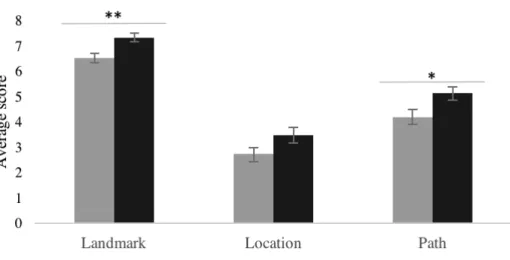
There was a significant effect of visuospatial working memory capacity on landmark-based navigation performance, F(1, 56) = 9.181, p = .004; ηp2 = .141. The high performance group (M =
7.32; SD = .945) performed significantly better on the landmark based navigation task than the low performance group (M = 6.50; SD = 1.106). There was a significant effect of visuospatial working memory capacity on path-based navigation performance, F(1, 56) = 5.093, p = .028; ηp2 = .083, with
the high performance group (M = 5.11; SD = 1.423) performing better than the low performance group (M = 4.17; SD = 1.724). There was a trend level effect of visuospatial working memory capacity on location-based navigation performance, F(1, 56) = 3.709, p = .059; ηp2 = .062, with
again the high performance group (M = 3.46; SD = 1.575) performing better than the low
11
Figure 1. Average score on landmark-, location- and path-based navigation of the high and low visuospatial working memory performance group. * p <.05. ** p < .01.The error bars displayed in the figure represent the standard errors of the mean.
Visual working memory. The scores of the low performance group ranged from 20 through 24, which was 33.9 cumulative percent. The high performance group scores ranged from 27 through 30, which was 76.3 cumulative percent (see Table 3 for group characteristics). There were no significant group differences for gender, χ2(1) = .420, p = .517, and education, χ2(2) = 4.128, p =
.127, but there were for age, t(80) = 3.766, p < .001.
Table 3
Visual Working Memory Group Characteristics
Age Education N (total) N (male)
Group M SD M SD
Low PF 52.35 17.33 5.85 .74 40 20
High PF 38.50 15.97 5.86 .57 42 18
12
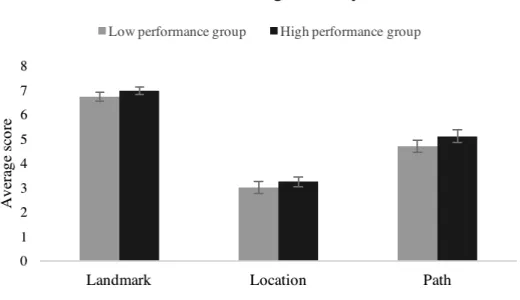
There was no significant effect of visual working memory capacity on landmark-based navigation performance, F(1, 81) = 1.089, p = .300, ηp2 = .013, as well as on location-based
navigation performance, F(1, 81) < 1, and path-based navigation performance, F (1, 81) = 1.208, p = .275; ηp2 = .015. Figure 2 displays the average score of the low and high visual working memory
performance group on the landmark-, location- and path-based navigation task.
Figure 2. Average score on landmark-, location- and path-based navigation of the high and low visual working memory performance group. No significant differences were found between the high and low group. The error bars displayed in the figure represent the standard errors of the mean.
Verbal working memory. The scores of the low performance group ranged from 8 through 24, which was 21.0 cumulative percent. The high performance group scores ranged from 60 through 120, which was 74.8 cumulative percent (see Table 4 for group characteristics). There were no significant group differences for gender, χ2(1) = .875, p = .349, age, t(53) = 1.627, p = .110, but there
13 Table 4
Verbal Working Memory Group Characteristics
Age Education N (total) N (male)
Group M SD M SD
Low PF 48.44 15.25 5.60 .65 25 11
High PF 41.73 15.61 6.17 .75 30 17
Note. PF = performance. Education level = 1-7; from low education to high education (Verhage, 1964). Significant differences were detected for education and not for age and gender.
There was a significant effect of verbal working memory capacity on landmark-based navigation performance, F(1, 53) = 5.386, p = .024; ηp2 = .092. The high performance group (M =
7.20; SD = 1.031) performed significantly better on the landmark-based navigation task than the low performance group (M = 6.56; SD = 1.003). There was no significant effect of verbal working memory capacity for location-based navigation performance, F (1, 53) = 2.804, p = .100; ηp2 = .050,
as well as for path-based navigation performance, F(1, 53) < 1. Figure 3 displays the average score of the low and high verbal working memory performance group on the landmark, location and path based navigation task.
14
Covariate. The results showed a significant difference in age between the low and high
visuospatial working memory performance group, t(56) = 3.431, p = .001, so we added age as a covariant in the model. The results showed that for visuospatial working memory capacity, age significantly predicts path-based navigation, F(1, 55) = 7.437, p = .009, ηp2 = .119, with the high
performance group, with a lower age (M = 38.07, SD = 17.11), performing better than the low performance group, with a higher age (M = 53.30, SD = 16.69). So, age took over the effect of visuospatial working memory in this model, F(1, 55) = 1.060, p = .308, ηp2 = .019. There was no
significant effect of age on location-based navigation performance, F(1, 55) = 1.211, p = .276, ηp2 =
.022, and landmark-based navigation performance, F(1, 55) = 1.478, p = .229, ηp2 = .026, preserving
the effect of visuospatial working memory capacity on landmark-based navigation performance, F(1, 55) = 10.710, p = .002, ηp2 = .163.
Secondly, the results showed a significant difference in age between the low and high visual working memory performance group, t(80) = 3.766, p < .001. Adding age as a covariant in the model showed a trend level effect of age on path-based navigation performance, F(1, 79) = 3.471, p = .066,
ηp2 = .042, with the high performance group, with a lower age (M = 38.50, SD = 17.33), performing
better than the low performance group, with a higher age (M = 53.25, SD = 15.97). Age had no significant effect on landmark-based navigation performance, F(1, 79) < 1, and location-based navigation performance, F(1, 79) < 1.
Thirdly, the results showed a significant difference in education between the low and high verbal working memory performance group, χ2(2) = 8.009, p = .018. Adding education as a covariate
in the model showed no significant effects of education on landmark-based navigation performance, F(1, 52) < 1, location-based navigation performance, F(1, 52) = 1.356, p = .250, ηp2 = .025, and
path-based navigation performance, F(1, 52) < 1.
Discussion
15
of navigation ability. We wanted to know whether there was a difference in navigational ability between individuals with a low and high visuospatial, visual, and verbal working memory capacity. It was expected that individuals with a high visuospatial working memory capacity would have a higher landmark-, location-, and path-based navigation ability as compared to individuals with a low visuospatial capacity. Secondly, it was expected that individuals with a high visual working memory capacity would have a higher landmark-based navigation ability as compared to individuals with a low visual working memory capacity. Lastly, it was expected that individuals with a high and low verbal working memory capacity would not differ in landmark-, location-, and path-based navigation ability.
Looking at our first hypothesis, our results imply that the visuospatial sketchpad supports the
memorization of landmarks and the spatial relations between them. This is in line with previous
studies pointing to a strong role of the visuospatial working memory in successful wayfinding
(Baldwin & Reagan, 2009; Baumann et al., 2011; Hund, 2016) and the formation of a good spatial
representation (Nori, Grandicelli, and Giusberti (2009). Looking at the visuospatial working memory
task and path-based navigation task, we found the relation between the two not surprising since the
two tasks showed similarities. The path based navigation task required route knowledge and
representation of spatial relationships between places or landmarks (Latini-Corazzini et al., 2010)
and the visuospatial working memory was about spatial relationships as well, but then on a small
scale. The fact that an individual is good in discovering and remembering spatial relationships
between landmarks could go hand in hand with better memorization of landmarks itself. We think it
is probable that an individual uses the landmarks in order to enlarge path knowledge (Collett &
Collett, 2000; Denis, Mores, Gras, Gyselinck & Daniel, 2014; Sharma et al., 2017). An interesting
finding was that the relation between visuospatial working memory capacity and path-based
navigation ability was affected by age, while this was not the case for landmark-based navigation
ability. Head and Isom (2010) and Wilkniss, Jones, Koral, Gold, and Manning (1997) clarify this by
showing that older adults are relatively poorer than younger adults at associative learning tasks, such
as landmark-direction association, temporospatial ordering of landmarks, and the usage of spatial
representations in navigation while, on the other hand, the recognition of landmarks of older adults
seem to be as good as younger adults. Moreover, Zhong and Moffat (2016) suggested that better
landmark recognition memory in older adults might be at the expense of linking the landmarks to the
route. This suggestion is applicable to our study and helps us understand why path-based navigation
ability was affected by age and landmark-based navigation ability was not. A result harder to clarify
location-16
based navigation ability than for landmark- and path-based navigation ability. One might say that
location-based navigation ability relies less upon the visuospatial sketchpad than landmark- and path-
based navigation ability. However, we do not believe this is the case. For this form of navigation, we
cannot rule out an effect of the virtual environment and that it might have made a difference whether
individuals saw a route or walked a route. Klatzky, Loomis, Beall, Chance and Golledge (1998)
showed in their experiment that individuals who saw a route using virtual reality (consisting of two
legs and one turn) showed more errors in the updating of self-position and heading when they needed
to face the starting point of the route at the end, as compared to individuals who walked the route
themselves. In our location-based navigation task, participants needed to update their self-position as
well in order to point out the direction of the end point of the route; comparable to the experiment of
Klatzy et al. (1998). We suggest this might have attenuated the effect of visuospatial working
memory capacity on location-based navigation performance but seen the importance of visuospatial
working memory in navigation shown by other studies (e.g., Garden, Cornoldi, & Logie, 2002;
Labate. Pazzaglia, & Hegarty, 2014; Meneghetti, Borella, Carbone, Martinelli & De Beni, 2016), we
do not think of a lesser effect of it on location-based navigation ability.
As expected, we saw no relation between visual working memory capacity and location- and
path-based navigation ability, with which we suggest that these forms of navigation do not rely on
visual working memory capacity as they posit a spatial aspect. An interesting finding was that for
landmark-based navigation ability no relation was found as well. This confirms earlier studies
suggesting that the spatial component of the visuospatial sketchpad seems to be more important in
navigating than the visual component (Baumann et al., 2011; Meilinger et al., 2008). We suggest that
the processing of visual information might appeal to verbal working memory capacity more
compared to visual working memory capacity. In the visual working memory task, participants saw
images containing, probably, familiar objects or scenes such as a train, tools, or fruit. Hamburger and
Röser (2014) showed that well-known landmarks are better recognized than unfamiliar one,
indicating semantic influence. Moreover, it seems that familiar objects (Winter, 2003) and objects
that can easily be named (Wahl, Hamburger, & Knauff, 2008 are more often used as landmarks and
that the visual salience of landmarks (i.e. landmark characteristics) has minimal contribution to better
recognition and navigation performance (Röser, Hamburger, & Knauff, 2011).
The possible role of the phonological loop in landmark recognition is confirmed when we
look at the relation between verbal working memory and landmark-based navigation ability. Our
results suggest that individuals indeed verbally remember what landmark they saw (i.e. a boat, a
17
Gyeselinck, Perrussel, Orriols, & Piolino, 2012; Hamburger & Röser, 2014; Röser, Hamburger, &
Knauff, 2011). Our results highlight the importance of verbal working memory capacity in
navigation ability, even when no verbal information is provided (Gyeselinck, Grison, & Gras, 2015;
Meilinger & Knauff, 2008).
A possible disadvantage of our study might have been the fact that navigation ability was
measured using a virtual environment, which makes it debatable whether the results are generalizable
to real life situations (Parsons, 2015). Future studies might implement a hybrid or real life
environment in order to increase ecological validity (van der Ham, Faber, van Kreveld & Löffler,
2015). A strength of current study’s methodology was that it contained a large sample with equal age
groups within the range of 18 till 75 that were matched in gender and education level, promoting the
external validity.
The present study showed that individuals with high and low visuospatial and verbal working
memory capacities performed differently on navigation tasks. A higher visuospatial working memory
capacity was related to better landmark- and path-based navigation ability, and a higher verbal
working memory capacity was related to better landmark-based navigation ability. With these
research outcomes we showed that individuals with different working memory capacities make use
of different strategies while navigating, indicating that navigation training programs need to be
customized to an individuals’ capacities in order to be successful. For instance, according to our
results, one might benefit from verbal coding of landmarks while navigating, while another might
benefit from paying attention to spatial relations.
To conclude, with the present study we offered evidence for individual differences in
navigation ability based on visuospatial, visual, and verbal working memory capacity. Our study
confirmed a relation between the spatial subsystem of the visuospatial sketchpad and successful
navigation ability and gave rise to the involvement of the phonological loop in landmark-based
navigation ability even when no verbal information is provided. With the results we contributed to
the growing amount of knowledge about individual differences in navigation and navigation as a
cognitive function, which offers guidance in the development of evidence-based navigation training
18
References
American Psychiatric Association. (2013). Diagnostic and statistical manual of mental disorders (5th
edition). Washington, DC: Author.
Baddeley, A. D., & Hitch, G. J. (1974). Working memory. In: Bower GA, ed. The psychology of
learning and motivation Vol VIII (pp. 47-90). New York: Academic.
Baldwin, C. L. & Reagan, I. (2009). Individual differences in route-learning strategy and associated
working memory resources. Human Factors, 51(3), 368-377.
Baumann, O., Skilleter, A. J., & Mattingley, J. B. (2011). Short-term memory maintenance of object
locations during active navigation: which working memory subsystem is essential? PLoS
One, 6(5),1-7.
Bottini, G., Cappa, S., Geminiani, G., & Sterzi, R. (1990). Topographic disorientation – a case
report. Neuropsychologia, 28,309-312.
Borich, G. D., & Godbout, R. C. (1974). Extreme group designs and the calculation of statistical
power. Educational and psychological measurement, 34, 663-675.
Caglio, M., Castelli, L., Cerrato, P., & Latini-Corazzini, L. (2011). Pure topographical disorientation
in a patient with right occipito-temporal lesion. Neurosciences, 16(1), 60-65.
Claessen, M. J. G., & van der Ham, I. J. M. (2017). Classification of navigation impairment: A
systematic review of neuropsychological case studies. Neuroscience and Biobehavioral
Reviews, 73,81-97.
Claessen, M. J. G., van der Ham, I. J. M., Jagersma, E., & Visser-Meily, J. M. A. (2016). Navigation
strategy training using virtual reality in six chronic stroke patients: A novel and explorative
approach to the rehabilitation of navigation impairment. Neuropsychological Rehabilitation,
26(5-6),822-836.
Collett, M. & Collett, T. S. (2000). How do insects use path integration for their navigation?
Biological Cybernetics, 83, 245-259.
Corsi, P. M. (1972). Human memory and the medial temporal region of the brain. Unpublished
doctoral dissertation. Montreal, QC: McGill University.
Denis, M., Mores, C., Gras, D., Gyselinck, V., & Daniel, M. P. (2014). Is memory for routes
enhanced by an environment’s richness in visual landmarks? Spatial Cognition &
Computation, 14(4),284-305.
Garden, S., Cornoldi, C., & Logie, R. H. (2002). Visuo-spatial working memory in navigation.
19
Gras, D., Gyeselinck, V., Perrussel, M., Orriols, E., & Piolino, P. (2012). The role of working
memory components and visuospatial abilities in route learning within virtual environment.
Journal of Cognitive Psychology, 25(1), 38-50.
Gyeselinck, V., Grison, E., & Gras, D. (2015). Learning virtual routes: What does verbal coding do
in working memory? Canadian Journal of Experimental Psychology, 69(1), 104-114.
Head, D., & Isom, M. (2010). Age effects on wayfinding and route learning skills. Behavioural
Brain Research, 209(1), 49–58.
Hegarty, M., Montello, D. R., Richardson, A. E., Ishikawa, T., & Lovelace, K. (2006). Spatial
abilities at different scales: Individual differences in aptitude-test performance and
spatial-layout learning. Intelligence, 34(2),151–176.
Hund, A. M. (2016). Visuospatial working memory facilitates indoor wayfinding and direction
giving. Journal of Environmental Psychology, 45, 233-238.
Kaup, A. R., Drummond, S. P. A., & Eyler, L. T. (2014). Brain functional correlates of working
memory: reduced load-modulated activation and deactivation in aging without
hyperactivation or functional reorganization. Journal of International Neuropsychological
Society, 20(9),945-950.
Kessels, R. P. C., van den Berg, E., Ruis, C., & Brands, A. M. A. (2008). The backward span of the
Corsi Block-Tapping Task and its association with the WAIS-III Digit Span. Assessment,
15(4),426-434.
Kessels, R. P. C., van Zandvoort, M. J. E., Postma, A., Kappelle, L. J., & Haan de, E. H. F. (2000).
The Corsi Block-Tapping Task: Standardization and normative data. Applied
Neuropsychology, 7(4),252-258.
Klatzky, R. L., Loomis, J. M., Beall, A. C., Chance, S. S., & Golledge, R. G. (1998). Spatial
updating of self-position and orientation during real, imagined, and virtual locomotion.
Psychological Science, 9(4),293-298.
Korthauer, L. E., Nowak, N. T., Frahmand, M., & Driscoll, I. (2017). Cognitive correlates of spatial
navigation: Associations between executive functioning and the virtual Morris Water Task.
Behavioural Brain Research, 317,470-478.
Labate, E., Pazzaglia, F., & Hegarty, M. (2014). What working memory subcomponents are needed
in the acquisition of survey knowledge? Evidence from direction estimation and shortcut
20
Latini-Corazzini, L., Nesa, M. P., Ceccaldi, M., Guedj, E., Thinus-Blanc, C., Cauda, F., Dagata, F.,
& Péruch, P. (2010). Route and survey processing of topographical memory during
navigation. Psychological Research, 74(6),545-559.
Logie, R. H. (1995). Visuo-spatial working memory. Hove, England: Lawrence Erlbaum Associates
Inc.
Malinowski, J. C. (2001). Mental rotation and real-world wayfinding. Perceptual and Motor Skills,
92(1),19-30.
McCabe, D. P., Roediger III, H. L., McDaniel, M. A., Balota, D. A., & Hambrick, D. Z. (2010). The
relationship between working memory capacity and executive functioning: evidence for a
common executive attention construct. Neuropsychology, 24(2),222-243.
Meilinger, T. & Knauff, M. (2008). Ask for directions or use a map: A field experiment on spatial
orientation and wayfinding in an urban environment. Journal of Spatial Science, 53(2), 13-23.
Meilinger, T., Knauff, M., & Bülthoff, H. H. (2008). Working Memory in Wayfinding – A Dual
Task Experiment in A Virtual City. Cognitive Science, 32(4), 755-770.
Meneghetti, C., Borella, E., Carbone, E., Martinelli, M., & De Beni, R. (2016). Environment learning
using descriptions or navigation: The involvement of working memory in young and older
adults. British Journal of Psychology, 107,259-280.
Migo, E. M., O’Daly, O., Mitterschifthaler, M., Antonova, E., Dawson, G. R., Dourish, C. T., Craig,
K. J., Simmons, A., Wilcock, G. K., McCullogh, E., Jackson, S. H. D., Kopelman, M. D.,
Williams, S. C. R., & Morris, R. G. (2016) Investigating virtual reality navigation in amnestic
mild cognitive impairment using fMRI. Aging, Neuropsychology, and Cognition, 23(2),
196-217.
Nori, R., Grandicelli, S., & Giusberti, F. (2009). Individual differences in visuo-spatial working
memory and real-world wayfinding. Swiss Journal of Psychology, 68(1),7-16.
Parsons, T. D. (2015). Virtual reality for enhanced ecological validity and experimental control in the
clinical, affective and social neurosciences. Frontiers in Human Neuroscience, 9(660), 1-19.
Röser, F., Hamburger, K., & Knauff, M. (2011). The Giessen virtual environment laboratory: human
wayfinding and landmark salience. Cognitive Processing, 12(2), 209-214.
Sharma, G., Kaushal, Y., Chandra, S., Singh, V., Mittal, A. P., & Dutt, V. (2017). Influence of
landmarks on wayfinding and brain connectivity in immersive virtual reality environment.
Frontiers in Psychology, 8(1220), 1-12.
Takahashi, N., & Kawamura, M. (2002). Pure topographical disorientation – anatomical basis of
21
Van der Ham, I. J. M., Faber, A. M. E., van Kreveld, M. J., & Löffler, M. (2015). Ecological validity
of virtual environments to assess human navigation ability. Frontiers in Psychology, 6(637),
1-6.
Verhage, F. (1964). Intelligentie en leeftijd: onderzoek bij Nederlanders van twaalf tot
zevenenzeventig jaar. Assen: Van Gorcum.
Wahl, N., Hamburger, K., & Knauff, M. (2008). Das navigationssystem in uns: Wie die salienz von
landmarken und die instruktion die leistung beim wegefinden beeinflusst. Fachtagung der
Gesellschaft für Kognitions, 9.
Wechsler, D. (1997). WAIS-III administration and scoring manual. San Antonio, TX: The
Psychological Corporation.
Wilkniss, S. M., Korol, D. L., Gold, P. E., Jones, M. G., & Manning, C. A. (1997). Age-related
differences in an ecologically based study of route learning. Psychology and Aging, 12(2),
372-375.
Winter, S. (2003). Route adaptive selection of salient features. In: Kuhn, W., Worboys, M. F., &
Timpf, S., Spatial information theory: Cognitive and computational foundations of
geographic information science (pp. 37-50). Berlin: Springer.
Wolbers, T., & Hegarty, M. (2010). What determines our navigational abilities? Trends in Cognitive
Sciences, 14(3),138–146.
Zhong, J. Y., & Moffat, S. D. (2016). Age-related differences in associative learning of landmarks
and heading directions in a virtual navigation task. Frontiers in Aging Neuroscience, 8(122),
1-11.