• No results found

5950.pdf

N/A
N/A
Protected

Academic year: 2020

Share "5950.pdf"

Copied!
189
0
0

Loading.... (view fulltext now)

Full text

(1)

CRAFT AND JOB SATISFACTION:

NORTH CAROLINA LIBRARY AND INFORMATION SCIENCE GRADUATES

Chad Henderson Morgan

A dissertation submitted to the faculty of the University of North Carolina at

Chapel Hill in partial fulfillment of the requirements for the degree of Doctor of

Philosophy in the School of Information and Library Science.

Chapel Hill

2013

Approved by:

Joanne Gard Marshall

Thomas R. Konrad

Barbara Moran

Irene Owens

(2)

ii

© 2013

(3)

iii

ABSTRACT

Chad Henderson Morgan: Craft and Job Satisfaction: North Carolina Library and

Information Science Graduates

(Under the direction of Joanne Gard Marshall)

This dissertation examines the sources of job satisfaction among 1,833

library and information science (LIS) master’s program graduates in North

Carolina from 1964-2009. Only respondents who identified themselves as

librarians were included in the analysis. The study first examined the effects of

traditional work-related variables such as income, flexibility, co-workers, fringe

benefits, and setting on job satisfaction. Based on the outcomes of the first

regression analysis, the study goes on to examine perceptions of change in the

profession over the previous five years and, in particular, the effects of change

on older workers. Finally, the analysis introduces variables related to the notion

of craft, professional achievement, and family dynamics to determine what

impact they have on job satisfaction. The analysis also examines work-related

variables that may have been masking the influence of craft, professional

achievement and family dynamics. Craft combines the wish to perform one’s

work well independent of extrinsic factors or influences and the desire of the

worker to create a quality final outcome or product which can be certified as such

(4)

iv

professional achievement are the largest determinants of job satisfaction among

LIS graduates. Meanwhile, variables such as marital status, whether or not one

has children, and breadwinner status had no discernible bearing on job

satisfaction. Supportive co-workers, being a woman, and membership in

professional organizations likewise correlate with job satisfaction, while being a

full-time worker, anxiety over job security, and working in an academic library

setting contributed to dissatisfaction. Although LIS graduates generally report

being very content in their jobs, this study suggests that they are anxious about

changes such as the increasing number of temporary and freelance jobs and the

(5)

v

Acknowledgements

One incurs enormous debt in the writing of any dissertation and this is

especially true in my case. I wish to thank first of all my colleagues and especially

my boss, Dean Irene Owens, at North Carolina Central University’s School of

Library and Information Sciences for the patience shown me in the process of

completing this process and the many special allowances that have been made

for me so that I could. I would like, too, to thank my students at NCCU SLIS

whose incisive comments during class discussions have often pushed me in the

direction of new insights.

I must also thank the members of my dissertation committee, Drs. Bob

Konrad, Barbara Moran, Irene Owens, and Zeynep Tufekci. Their comments both

prior to and during my defense suggested to me new ways of thinking about the

data and helped me to make sense of phenomena whose meanings initially

escaped my comprehension. The staff at the University of North Carolina at

Chapel Hill’s School of Information and Library Science has helped me clear

administrative obstacles at every step of my academic career there. In this

connection, Lara Bailey, Student Services Coordinator, deserves special thanks.

Professionally, Dr. Joanne Marshall is the one person without whom

completion of this dissertation would have been unthinkable. She has been there

(6)

vi

Triangle Research Libraries Network Fellow. Beyond helping with the

dissertation, Joanne made possible my entire professional career in LIS since

2005.

(7)

vii

TABLE OF CONTENTS

LIST OF TABLES………...xi

CHAPTER 1: PURPOSE, BACKGROUND, AND

RESEARCH QUESTIONS ……….1

Section 1.1 Background………..1

Section 1.2 Statement of Problem ……….2

Section 1.3 Research Questions………..2

Section 1.4 Conceptual Framework………..3

Section 1.5 Organization of the Dissertation………5

CHAPTER 2: LITERATURE REVIEW………..7

Section 2.1 Introduction………..7

Section 2.2 Job Satisfaction and LIS……….7

Section 2.3 Craft and Information Work………..12

Section 2.4 The Development of Professions………22

CHAPTER 3: RESEARCH DESIGN AND METHODOLOGY……….29

Section 3.1 Data Source………29

Section 3.2 Data Subset………33

Section 3.3 Data Analysis Plan………34

CHAPTER 4: DATA ANALYSIS………...39

(8)

viii

Section 4.2 Descriptive Results: Job Satisfaction……….40

Section 4.3 Analytic Strategy: Model 1: JOBSAT:

Conditions/Benefits Variables………..42

Section 4.4 Measurement: Type of Library Context……….43

Section 4.5 Measurement: Organization Size………45

Section 4.6 Measurement: Age………46

Section 4.7 Measurement: Sex………49

Section 4.8 Measurement: Race/Ethnicity……….51

Section 4.9 Measurement: Full-time Worker or Not……….54

Section 4.10 Measurement: Income………55

Section 4.11 Measurement: Working Conditions and Benefits…………...56

Section 4.12 Results: Conditions/Benefits Variables………62

Section 4.13 Age and New Skills/Proliferating Tasks Variables………….64

Section 4.14 Measurement: Learn New Skills………...65

Section 4.15 Measurement: Job Security………...66

Section 4.16 Measurement: New Tasks……….66

Section 4.17 Measurement: More Difficult Tasks………..67

Section 4.18 Measurement: More High-Tech Tasks………68

Section 4.19 Measurement: Wider Variety of Tasks……….70

Section 4.20 Measurement: Organization of Task Work……….70

Section 4.21 Results: Age and New Skills/Proliferating

Tasks Variables………..74

(9)

ix

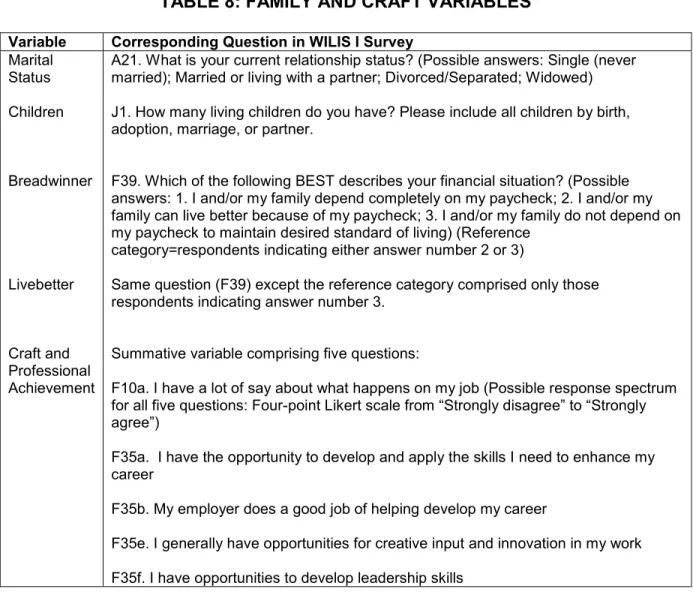
Section 4.23 Family Dynamics Variables: Marital Status,

Children, Breadwinner, Livebetter ………...77

Section 4.24 Measurement: Craft and

Professional Achievement……….80

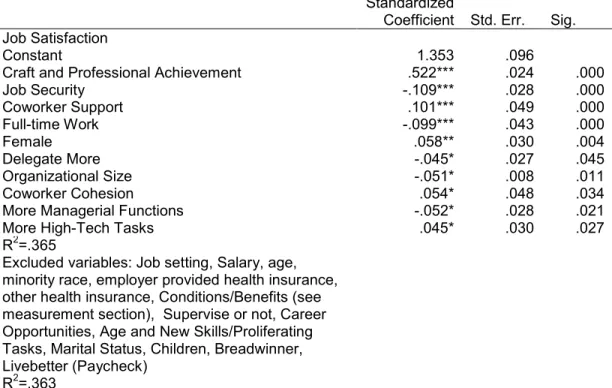
Section 4.25 Results: Family Dynamics and

Craft/Professional Achievement Variables……….83

Section 4.26 Stepwise and Block Regression Models……….85

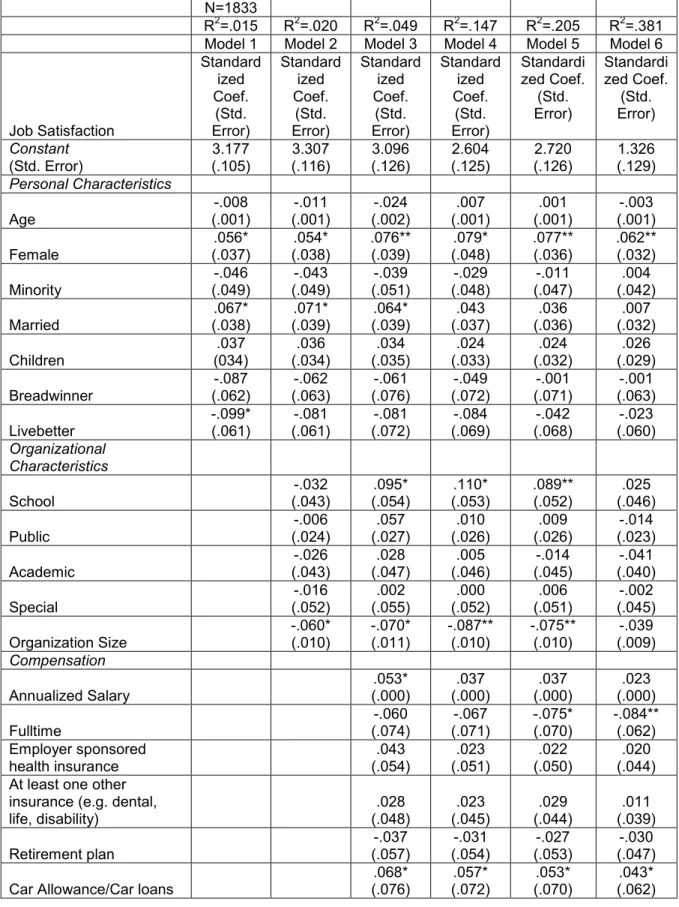
CHAPTER 5: CONCLUSIONS……….92

Section 5.1 Introduction……….92

Section 5.2 Craft and Professional Achievement………..94

Section 5.3 Technology and Craft………99

Section 5.4 Professional Achievement……….105

Section 5.5 Sex and Job Satisfaction………108

Section 5.6 Older Workers………..109

Section 5.7 Academic and School Librarians………..113

Section 5.8 Pay……….118

Section 5.9 Coworkers………119

Section 5.10 Family Dynamics………...126

Section 5.11 Tensions between Age Groups………..130

Section 5.12 Task Variety and Continuous Learning……….134

Section 5.13 The LIS Risk Economy……….138

Section 5.14 Limitations………..144

Section 5.15 Discussion………..146

(10)

x

APPENDIX II: BIBLIOGRAPHIC NOTE ON

THE DEVELOPMENT OF LIBRARIANSHIP IN NORTH CAROLINA ………….152

APPENDIX III: JOB SATISFACTION SURVEY ITEMS ……….158

APPENDIX IV: PEARSON CORRELATIONS: JOB SATISFACTION………….160

APPENDIX V: ANALYSIS OF VARIANCE: JOB SATISFACTION WITH

TYPER OF LIBRARY, AGE CATEGORIES, AND CURRENT JOB

TENURE CATEGORIES……….168

APPENDIX VI: COLLINEARITY DIAGNOSTICS:

JOB SATISFACTION………..172

(11)

xi

List of Tables

Table 1: Open-ended WILIS1 Questions Analyzed………..38

Table 2: LIS Graduate Job Satisfaction………..42

Table 3: Job Settings Variables………44

Table 4: Type of Library Job Setting………45

Table 5: Conditions/Benefits Variables………...53

Table 6: New Skills/Proliferating Tasks Variables……….65

Table 7: Correlations: Age and New Skills/Proliferating Tasks………...75

Table 8: Family and Craft Variables………77

Table 9: The Craft-Careerism Continuum………..82

Table 10: Stepwise Regression predicting Job Satisfaction………86

(12)

Chapter 1

Purpose, Background, and Research Questions

1.1

Background

The origins of the present work lay in the researcher’s longstanding

fascination with the lives of working people which dates at least back to an

occupational folklore graduate seminar taken in the mid-1990s. Recent high-profile

works by public intellectuals Sennett (2008) and Crawford (2009) emphasizing the

need for craft in modern work coincided roughly with data collection for the

Workforce Issues in Library and Information Sciences Study (WILIS). The fact that

the WILIS survey asked several questions that seemed to the researcher to pertain

directly to craft in information work presented a chance to test Sennett and

Crawford’s arguments among a large modern information workforce.

Library and Information Science (LIS) workers represent an attractive group

of workers to test the importance of craft in modern work because they seemed to

embody a paradox. On one hand, they were the kinds of office information workers

whose deskbound lives many of the critics of modern work decried. Yet in survey

after job satisfaction survey, LIS workers reported being overwhelmingly satisfied in

their work when contrasted with most other information professions. This paradox is

at the heart of what made LIS particularly attractive to the author. If craft played a

(13)

2

phenomenon could hold lessons for other information professions, whose

practitioners rarely reported being as happy as LIS workers. In addition, the large

population and large number of questions in the survey presented the opportunity to

look at how an unusually large number of variables impacted LIS job satisfaction,

including non-workplace variables.

1.2 Statement of Problem

The purpose of this research is to examine sources of job satisfaction among

LIS graduates. Specifically it looks at whether and how structural and technological

change in the profession is affecting traditionally high levels of librarian job

satisfaction. Given this focus, only respondents who identified themselves as

librarians are included in the analysis. In addition to focusing on the effects of

demographics and traditional workplace variables such as flexible hours, pay, fringe

benefits, and co-workers, it also seeks to find how factors that have not been studied

in the LIS literature have affected job satisfaction. It will examine job satisfaction in

three major contexts: job satisfaction in North America since the 1950s; the central

role of craft in LIS work; and LIS in competition with other professions.

1.3 Research Questions

1.

How do job satisfaction levels of librarians vary across age, sex, job level, job

type, length of career, and other workplace factors?

2.

How do household dynamics affect job satisfaction? Are breadwinners more

(14)

3

3.

What role does craft and professional achievement play in job satisfaction?

1.4 Conceptual Framework

There are two distinct but overlapping conceptual frames for this dissertation.

The first is the large body of scholarship devoted to job satisfaction. Notable

precursors to the systematic study of job satisfaction include the establishment and

evolution of scientific management in the 1910s, the Hawthorne Studies at Harvard

Business School in the 1920s and 1930s, and Abraham Maslow’s pioneering

Hierarchy of Needs Theory, propounded in the 1950s. New models and approaches

to job satisfaction have proliferated in the decades since. Notable among them,

Locke’s Range of Affect Theory (1976) argues that one’s level of job satisfaction

increases as the gap between what one wants in a job and what one has in a job

narrows. Dispositional Theory holds that employees’ innate temperament

predisposes them to a certain range of satisfaction independent of the objective

merits or features of a given job (Judge, Locke, and Durham, 1997). Equity Theory

stresses the importance of the perception of fair and equal treatment to one’s level

of contentment (Huseman and Miles, 1987). Frederick Herzberg’s Two-Factor

Theory proposed that, while one set of factors tended to lead to worker satisfaction

(including achievement, recognition, advancement, and growth), a completely

separate group of factors caused dissatisfaction (such as salary, company policy,

supervision, relationship with one’s boss and peers, and security) (1968). In addition,

there exist several recognized instruments for measuring job satisfaction. Among

(15)

4

Satisfaction (BIAJS), the Minnesota Satisfaction Questionnaire (MSQ), and the Job

Satisfaction Survey (JSS). The job satisfaction literature will be discussed in greater

detail in the literature review (section 2.2), although it is worth mentioning here that

there has been a trend in the job satisfaction literature in the last decade and more

to address the changing nature of work in the information age. The Workforce and

Aging in the New Economy (WANE) study looked specifically at how, with the

decline of internal labor markets and job security, tech workers in recent years came

to view their career and carved out meaningful professional lives for themselves

(McMullin and Marshall, 2010). In the spirit of WANE, the Workforce Issues in

Library and Information Science study (WILIS) seeks to examine how sources and

understanding of job satisfaction is changing for information workers as long-held

assumptions about what a job could and should be are challenged.

The second conceptual frame is an intellectual tradition which dates back at

least to Marx but which has found its fullest expression in the recent work of the

philosopher Richard Sennett (2000, 2008). Along the way, scholars as eminent and

diverse as historian Christopher Lasch, economist Harry Braverman, and

management thinker Peter Drucker have contributed to this discourse (Lasch, 1978,

1987; Braverman, 1998; Drucker, 1967, 1977, 1998). Though never formally codified

as its own school of thought, the trait that unifies thinkers in this tradition might be

described as an overriding concern with mastery of, and connection to, one’s work.

For the purposes of the present work, that concept will denoted by its historical label:

(16)

5

As a concept, craft has been a preoccupation chiefly of sociologists,

historians, and philosophers. LIS job satisfaction studies have meanwhile been more

apt to look at the related concept, borrowed from scientific management, of “intrinsic

rewards.” The present study employs craft because it describes a much more

specific relationship to work than “intrinsic rewards.” The latter suggests only that

one finds one’s work enjoyable. Some workers may, perversely, enjoy tedious work

at which they are incompetent, and such enjoyment would fall under the umbrella of

intrinsic rewards. Craft, on the other hand, implies that one enjoys work because he

or she is good at it and because the final product is a quality one. Even when the

research questions in this dissertation are not explicitly about craft, they are implicitly

so. When the dissertation addresses job satisfaction, it does so in the context of a

more precarious economic situation than Americans have known, perhaps, since the

early 1940s, one in which connection to one’s work assumes a new importance as

job stability declines. The discussion of librarianship’s new place in the information

work system of professions is likewise informed by consideration of craft, which may

simultaneously be one of librarians’ best defenses against professional incursions

into traditionally safe areas of professional practice and one of their most promising

future sources of continuing satisfaction in a changing professional marketplace.

1.5 Organization of the Dissertation

This dissertation will unfold across five chapters. This first chapter provides

the problem statement, research questions, and conceptual frame. Chapter Two will

(17)

6

describe the data set and methodology used in the study. Chapter Four is the data

analysis chapter. It (a) examines the job satisfaction of the study’s dataset,

graduates of North Carolina’s six LIS programs; (b) explores the results of

regression analyses designed to isolate the variables which most accounted for

satisfaction; (c) looks at the impact of household dynamics on librarian job

satisfaction; and (d) analyzes the role played by craft in librarian job satisfaction.

Chapter Five will discuss conclusions of the study as a whole, what they suggest for

the LIS in terms of how the field has and continues to change.

(18)

7

Chapter 2

Literature Review

2.1 Introduction

This review surveys three literatures that frame the present dissertation: job

satisfaction and LIS; craft in work; and the evolution of professions with an emphasis

on librarianship and the information professions.

2.2 Job Satisfaction and LIS

In their 2005 book,

The New American Workplace

, anthropologists James

O’Toole and Edward E. Lawler III neatly summed up the major findings of more than

50 years of job satisfaction studies. The key findings included overall lower levels of

satisfaction and high turnover and absenteeism. Job satisfaction did not beget

better job performance but quality performance was a huge predictor of satisfaction.

Satisfaction tended determined by whether workers felt like they are being

adequately rewarded for their work. There existed a direct correlation between

worker and customer satisfaction. Also happy workers are less likely to want to

unionize (2005). There were some persistent demographic features of the job

satisfaction literature. First, there was a small but consistent correlation between

advancing age and job satisfaction. Women reported being happier in their work

(19)

8

(Hodson, 1989; Clark, 1997). Much of this makes a great deal of intuitive sense.

More to the point for the present study, it makes sense in the context of a deskilled

work world described by critics of the decline of craft in modern work.

Traditional ideas about career development often do not correspond to the

reality of work in the current economy. They are, in truth, not even all that traditional.

In the mid-20th century, career development was tied closely to internal labor

markets. Employees entered an organization at or near the bottom and worked their

way through a succession of job titles meant to indicate upward movement through

the organization (Doeringer and Piore, 1985). Ultimately, as global competition

required companies to make their workforces more flexible, organizations found it

easier and more cost-effective to go with a managerial core supplemented by a

periphery of temporary and/or marginally skilled workers (Ellig, 2005; Barley and

Kunda, 2006). This allowed them to downsize more quickly when times got lean and,

conversely, to add workers in flush times without taking on the risk of adding

employees who stayed on their employment rolls for the next 30 years and earned

pensions.

In the new economy, firms—and particularly the small IT firms that have

proliferated in the new economy—tended to grow cautiously. They attempted to

foster job satisfaction through more open communication practices and less

hierarchical company structures in the manner described by management scholars

such as Douglas McGregor. Findings of the WANE (Workforce Aging in the New

(20)

9

fluid, piecemeal, and ephemeral than in the recent past. A bare majority of the IT

workers in WANE suggested they had a “clear sense” of how they wished for their

careers would unfold, and few expressed a high level of confidence in their careers

playing out as they hope. All of this suggests a fairly fraught employment situation in

which new economy workers—despite more communication and more collaborative

working arrangements—would seem to experience an unusually high level of career

anxiety when contrasted with their old economy counterparts (McMullin and

Marshall, 2010).

Until very recently, librarians would appear to have experienced relatively little

of the anxiety that other new economy workers have. For decades, they have been

subject to dozens of job satisfaction studies, which suggest that they are “happy

enough” in the words of Eva and McCormick (2008). Librarians most often

expressed satisfaction about the importance of their work and the pleasure they took

in performing it. Factors that most often weighed against satisfaction included low

salaries and a perceived lack of opportunities. According to the results of three

nationwide surveys published by Library Journal since 1994, reference librarians,

librarians in smaller libraries, professional librarians (i.e., those holding a graduate

LIS degree), and librarians working with new technologies were all more likely to

express satisfaction with their careers/jobs (St. Lifer, 1994; Gordon and Nesbeitt,

1999; Berry, 2007). Another general librarian job satisfaction survey found that the

happiest librarians were those who were older and had more professional

experience, those who held an MLS, and those who worked directly with the public

(21)

10

librarian job satisfaction compared unfavorably with the national average, which

makes it an outlier in the wider literature (Van Reenan, 1998). So obviously this

dissertation hardly represents the first time that librarian job satisfaction has been

placed under the microscope.

Aside from the

Library Journal

surveys, LIS scholars have come at the topic of

librarian job satisfaction from several angles since at least the 1970s. Academic

librarians have been a particular focus of job satisfaction studies. This is perhaps

due to the fact that, among librarians, those working in university settings feel a

unique pressure to publish (discussion of which will follow in Chapter 5). Among the

more notable works from this diffuse literature, Chwe (1978) showed reference

librarians in university settings happier in their work than their peers in technical

services. Glasgow’s survey of American academic librarians (1982) found that

librarians’ “perception of their work”—the constellation of factors other job

satisfaction scholars have termed “intrinsic rewards”—to be the most accurate

predictor of satisfaction. Predictably, salary, rank, and opportunities for advancement

also correlated with a positive view of one’s job. Examining the same population

roughly a decade later, Mirfakhrai (1991) found that, while opportunities to move up

within the organization remained important, other key factors promoting job

satisfaction were the size of the library (the smaller the better) and co-worker

relationships. Meanwhile, perceived supervisor incompetence and career immobility

ranked first among variables predicting dissatisfaction. Lim (2008) showed that, for

IT workers in academic libraries, the principal correlates for job satisfaction were

(22)

11

acceptance, job autonomy and promotion opportunities.” Together, these studies

paint a remarkably consistent picture of the factors contributing to academic

librarians’ job satisfaction over the course of several decades.

The other setting to attract the attention of LIS job satisfaction researchers

has been the public library. Schneider (1991) compared the stress levels of “public

service” and technical services workers at a large urban public library and found

them noticeably lower among the former. Bartlett (1998) specifically looked at how

supervisor activity related to worker satisfaction in Wake County, North Carolina and

concluded, unsurprisingly, that when bosses “self-disclosed,” offered assistance to

those working under them, and provided frequent feedback, they were better able to

cultivate happy workers. A pair of articles by Goulding (1991, 1995) isolated factors

contributing to satisfaction on the part of public library support staff and

paraprofessionals. These included frequent interaction with the public, having a

stake in the organization’s success, and other strictly work-related factors typically

grouped under the “intrinsic rewards” label. As this brief survey suggests, public

librarian job satisfaction studies tend to focus more or less narrowly on one aspect of

satisfaction, whether that be a single aspect of the job or one sector of the

workforce. Similarly, these studies tend to focus on a single public library or library

system. On balance, though, their results jibed with what was found about academic

(23)

12

2.3 Craft and Information Work

The use of

craft

—defined as “intellectual power; skill; art”—in English dates

back at least to 808 AD per the OED. Its close cousin

craftsmanship

—“The

performance or occupation of a craftsman; skill in clever or artistic work; skilled

workmanship”—is a relative neophyte having come into use only circa 1652. As

befits their vintage the words evoke the world of pre-industrial artisans, of smiths,

coopers, wheelwrights, glaziers, braziers, cobblers, and the whole cast of skilled

workers who made things before machines did. Craft and craftsmanship, terms

used synonymously here, did not go by the boards with the introduction of the

spinning jenny. For present purposes, Richard Sennett’s flexible definition of those

terms is used. (See Appendix I for this and all definitions.) “‘Craftsmanship’ may

suggest a way of life that waned with the advent of industrial society—but this is

misleading,” Sennett wrote. “Craftsmanship names an enduring, basic human

impulse, the desire to do a job well for its own sake” (2008).

This definition is notable

for a couple reasons. First, Sennett’s identification of craft as “an enduring, basic

human impulse” frees the concept from its etymologically imposed cage. Craft is not

some dusty relic of the pre-industrial past (the Guilded Age?) but part of what it

means to be human, and it is timeless. “Craftsmanship cuts a far wider swath than

manual labor,” he elaborates. “It serves the computer programmer, the doctor, and

the artist; parenting improves when it is practiced as a skilled craft, as does

citizenship.” This is a sweeping claim but not, as will hopefully become clear, one

without supporting evidence. People define themselves and are defined by their

(24)

13

universal need. But, as Sennett is careful to point out, craft properly understood

doesn’t allow for airy, personal standards of success. Rather, “craftsmanship

focuses on objective standards, on the thing in itself” (2008). There are no green

participant ribbons in the world of craft. Either the wheel fits the axle or it does not.

Either the patient is cured or he is not. Either the program works or it does not.

The idea that happiness in work is intimately related to the results of one’s work

did not, of course, originate with Sennett. The first critic of the declining

craftsmanship to place the phenomenon in a full-fledged theoretical framework was

Marx, who propounded his theory of worker alienation in the 1840s. It held, in brief,

that alienation of the industrial worker was two-fold. First, unlike artisans and

craftsmen, industrial workers did not own the means of production. They had to do

as directed by capital; they had little job autonomy in the parlance of 20th and 21st

century job satisfaction researchers. Second, industrial workers were alienated from

the products of their work; they only performed a part of the process and they left the

finished product with the employer.

Among actual workers, in contrast to theorists, the sense of something having

been lost with the decline of craft dates to the 18

th

century and the beginnings of the

Industrial Revolution. This first alienation is outlined in E. P. Thompson’s seminal

The Making of the English Working Class

(1966)

,

which traced the rise of English

labor radicalism from the 1790s through the Chartist movement of the 1830s and

1840s. Unlike Marx and traditional Marxist historians, Thompson was not a historical

determinist, and he did not view the formation of a self-conscious working class as

(25)

14

Thompson’s view, the crucial development was the formation of class

consciousness—not the objective fact of social class as it had been for Marx. That is

to say that Thompson emphasized the development of the working class’s

awareness of itself

as a class

and the recognition of its discrete class interests as

the point at which class could become a motor for history. In a complex world, there

are a lot of potential sources of identity; nationality, religion, race, ethnicity, and

gender foremost among them. There was nothing inevitable and, taking the long

view, something quite rare about class being the defining issue in society. It

transpired that Marx happened to have lived and written during one of those rare

times, and he projected his experience backward (and forward) across the entirety of

human experience. Seen through Thompson’s lens, Marx was a great scholar, yes,

but very much a peculiar product of his particular place and time.

In the U.S., the New Labor Historians of 1970s and 1980s likewise went

somewhat beyond the traditional Marxist critique of de-skilling and the alienation of

the workers from the products of their labor. Drawing on Thompson, they took as

their subject changing work habits and the culture of work. Nor, per this new school,

was class consciousness the lens through which to view most workers’ lived

experience. Recall that Thompson documented one of the relatively few episodes in

all history in which class can be said to have had primacy. The New Labor Historians

suggested that small-c culture—the complex of norms, values, and customs all

internalize mostly without realizing it—defined workers’ existence more than

anything as high-minded as labor relations. This was particularly the case in a nation

(26)

15

workers found satisfaction within rich ethnocultural communities and the various

cultural practices therein: religion, song, sport, cuisine, extensive kin networks, etc.

One of the myriad cultural expressions through which workers located identity and

meaning was pride in craft. In short, the New Labor History took a much more

inclusive view of working people’s experience. They found that workers created

meaning for themselves in any number of ways that had nothing to do with class

warfare. This was Thompson with a twist: the agency of working people still took

center stage but that agency was not always, or even usually, exercised to advance

class interests conventionally understood. The key works in this tradition are

Gutman’s

Work Culture and Society in Industrializing America

(1976), a collection of

essays from over a decade’s worth of work which promoted the idea that working

lives were far too complex to be understood solely through the lens of labor

relations. Wilentz explored the political dimension of artisans’ lives in Jacksonian

New York (1983), arguing that workers expressed their anger at industrialization and

the decline of craft—and, by the way, having to complete with free black and slave

craftsmen, a point often elided by white liberal historians—through the vehicle of

radical Jacksonian Democratic activism. In a Southern context, the New Labor

History is most associated with Hall et al.’s

Like a Family

(1988), which documented

the relationships and folkways which sustained southern millworkers in the late

nineteenth and early twentieth centuries.

Beginning in the 1930s and continuing over the following two decades, AT&T

executive and management thinker Chester Barnard consistently emphasized both

(27)

16

improve organizational efficiency (Mahoney, 2002). For the psychologist Abraham

Maslow, who influenced a generation of management thought beginning in the

1940s, self-actualization rested atop his famous pyramid of human needs (1997).

Other leading lights of twentieth century management thought have followed up on

this central insight. McGregor sought to instill a new set of assumptions about

workers which he termed Theory Y, stressing workers’ capacity to assume

responsibility and initiative in their jobs so long as they understood their stake in the

organization and were able to work toward goals they understood (2005). Over a

long and mind-numbingly productive career as a management scholar and

consultant, Peter Drucker advocated for managers bringing workers into the

decision-making and goal-setting processes. Among other things, workers often

knew as much or more about the workings of an organization than managers.

Moreover, Drucker’s thinking went, giving employees a stake in the planning and

outcomes of an organization would naturally make them more motivated workers

(1967; 1977; 1998). Someone of a Marxian bent could, with a minimum of

intellectual contortion, characterize much management thought of the twentieth

century as seeking to re-connect alienated workers with the products of their labor

without having management relinquish fundamental control of the process.

Such a reconnection became necessary because of the rise and the uniquely

alienated circumstances of the modern information professional. According to

communications scholar Beniger

(1986), information work went from accounting for

less than one percent of the US civilian labor force 1800 to roughly half of it in 1980.

(28)

17

vary according to one’s definition of information work. It may be more accurate to

say that while people who work with their hands continue to make up over 30

percent of the U.S. workforce at a conservative estimate, information work has

constituted a larger and larger part of their job or, alternatively, that the lines

between information and other kinds of work have increasingly blurred. Workers

with an information-work component to their job would approach 100 percent in the

developed world. This point will emerge more fully later in the review. For now, it is

enough to note that the problem of having more information workers in a society,

from a job satisfaction perspective, is a problem precisely to the extent that such

work tends to be more abstract in nature than most kinds of manual labor, and its

results commensurately less observable. When information work really began to

take root in the nineteenth century, it did so in large corporations. Once companies

reached a certain critical mass, in order to keep track of large and complex

operations, they required dedicated workers for this task; bean counters just count,

do not actually produce, beans. Information work is thus “born” alienated in the

Marxist sense. And as corporate/governmental operations grew ever more

distended, the information professionals charged with managing them tracked ever

smaller pieces of the overall operation. Not only, then, were they alienated from any

sort of productive labor in the traditional sense but as organizations grew, like

de-skilled industrial workers, their contribution often grew increasingly smaller to the

point of being imperceptible.

More recently, Crawford (2005) has placed information workers’ alienation in a

(29)

18

University of Virginia and owner of a small motorcycle repair concern in Richmond,

Crawford counsels that one answer to the problems posed by information work is to

leave the office altogether and learn a manual trade. Become a mechanic or a

plumber. Enter careers which cannot be outsourced, which will always be around,

and which, lastly, pay better than the typical cubicle-track job. He posits a kind of

localistic resistance to globalizing tendencies akin to the setting up of farmer’s

markets and co-ops. According to Crawford, only an irrational cultural prejudice

against blue-collar work prevents people who would be better served learning a

trade from doing so. There is one not-insubstantial roadblock to the fulfillment

Crawford’s vision of a virtuous, neo-Jeffersonian republic of small craftsmen.

Namely, unless the world adopts Crawford’s and the anti-globalists’ call to halt

globalization in its tracks—and there is no indication this is happening in any

meaningful way—his book amounts to an unusually erudite self-help manual. Some

small number of office drones may be able to learn a craft and find happiness that

way. Since the majority of jobs being created in the global economy are for

information work, what good does Crawford’s advice do all the people who must fill

those positions? Crawford’s advice, in other words, may be taken by this or that

individual, but it is hardly good advice for society as a whole. Or as Kelefa Sanneh

asked in her

New Yorker

review of Crawford’s polemic, “if the demand for mechanics

is basically inelastic, how can [the mass migration of former office workers into the

trades] offset other trends?”

Modern information workers would thus seem caught in a tightening vise of

(30)

19

English workers, the modern information worker cannot find solace in class solidarity

(most wear white or off-white collars). And unlike American industrial workers of the

19

th

and 20

th

centuries, the deracinated workers of the new economy are less likely

to take comfort or find meaning in close-knit ethnocultural communities. Sennett has

been particularly pointed in his criticism of the new economy, and he is especially

keen on this point: i.e., the absence of community, traditionally defined, and the

implications that has for modern work. In

The Corrosion of Character

, he tracks the

decline of a Boston bakery.

Formerly an exclusively Greek bakery, specializing in

Greek baked goods and with Greek employees, it had expanded and now made

what the market required: 100 bagels today, 100 loaves of French bread tomorrow.

The workforce was no longer even nominally Greek. And yes, this was not one’s

traditional information work job. Except that it was. The process of baking bread was

broken down into tens of timed components, Ray Kroc-style. The “bakers”

themselves manipulated screens to do their work but they did not have the skills

actually to fix the machines, let alone any concrete understanding of how to make

bread. The problem, as Sennett saw it, was not that the machines are hostile to

them and are taking away their craft in the sense that 19

th

-century workers were

rendered redundant by industrial technology. The problem was that the machines

were

too

user-friendly. They did all the work. Task difficulty is anathema in a world

where a flexible workforce is the rule. Employers need their transient workforce to be

able to pick up the skills to bake bread (or perform whatever task) quickly, and that

means having a user-friendly system in place where machines do most of the work

(31)

20

resistance, we create the very conditions of uncritical and indifferent activity on the

part of the users.” In other words, the needs of our global, dynamic,

information-centric society demand that work be simplified. And this militates against the any

real self-actualization in work. Here Sennett seems to channel American historian

Christopher Lasch who made an almost tiresome habit of excoriating Frederick

Winslow Taylor and scientific managers generally for their “expropriation of craft

knowledge formerly controlled by the workers” (1987).

Another aspect of a flexible, polyglot workforce always in flux is that it weighs

against the growth of the kinds of cultural communities that made life meaningful for

many nineteenth-century industrial workers. Even though they may not have found

meaning in their work, they were able to find meaning in their culture, their

community. With satisfaction at work on the wane and no similarly robust traditional

communities to tap into, the question becomes how information workers will find

meaning or identity. Florida (2003) has provided something of a counterweight to the

doom and gloom of Marx, Sennett, Crawford, et al. Citing the growth of

“knowledge-based professionals,” he argues that “The numbers of people doing creative work

has increased vastly over the past century and especially over the past decade.”

This rise will continue, Florida predicts, and those cities, regions, nations who do the

most to attract the creative classes will benefit commensurately.

There is some evidence for Florida’s optimism in the LIS literature. Indiana

University librarian Mark Tyler Day wrote as early as the mid-1990s about the need

to “humanize information technology” and how his library tried to do this with

(32)

21

project. The project obviously picked up considerable momentum since then with

the establishment and growth of countless online cultural repositories. In “The

Knowledge Smiths: Librarianship as Craftship of Knowledge,” Yonathan Mizrachi

(1998) made the connection between a new kind of librarianship and craft explicit.

He argued that the growth of the internet and more complex information

environments meant that “librarians and information specialists can no longer

maintain their traditional, relatively passive role, and should aspire to become active

participants in knowledge seeking.” Instead, they will “be called to intervene and

assist users in context of higher levels of information processing (knowledge,

understanding, reflection, and application).” He modestly concluded that the “main,

and perhaps the somewhat revolutionary, implication” of his article was that “the

centre of gravity in the information professional’s practice and training should move

from data and information retrieval and mediation to nothing short of acting as

knowledge seekers, editors, and interpreters.” Computer Scientist William Waite

similarly invoked an element of craft as essential to “

the design, construction and

operation of efficient and economical structures, equipment and systems” (1996).

And of course, craft is assumed by the metaphor of information architecture.

Whether and to what extent librarians see themselves as practicing a craft and

whether the more “active” role for librarians posited by Mizrachi has materialized in

the years since his article is one of the central questions addressed by this

(33)

22

2.4 The Development of Professions

Although some professions like medicine and law trace their origins `to medieval

times or even antiquity, it was really only in the nineteenth century that professions

developed as they are constituted today, with formal associations, licensure, codes

of ethics, and the other barriers to practice. According to Bledstein (1977),

professionalization occurred in the U.S. first with the establishment of scientific

medicine over its folksier competitors and then with the creation of the first

university-level professional schools, notably in accounting, architecture, various

branches of the professoriate, and the law. The formal study of professionalization

began in the 20th century with the full emergence of various flavors of social

science, especially sociology. There exist four major schools of thought on the

subject: Functionalism, Monopolism, what may be termed the “Professions as

Embodiment of Pre-Modern Values” school, and “System-ism.”

Early studies of professionalism from the 1930s and 1940s tended to focus on

case studies of individual professions and on the enumeration of professional

characteristics such as education, organization, and ethics. According to the

Functionalists, the most prominent being Talcott Parsons, professions were the

logical upshot of the emergence of experts in various fields. The very fact that

scientifically trained experts now existed, in contrast to pre-modern specialists

whose knowledge was grounded in trial-and-error and folk wisdom, required

patients/clients to recognize this expertise and defer to it. And it required

(34)

23

Professions, in other words, were the logical conclusion of the emergence of the first

real experts.

A product of the politically radicalized atmosphere of the 1960s and 1970s,

Monopolists argued that professions emerged not as a natural consequence of

expertise but because groups of “experts” aggressively tried to claim for themselves

pieces of the emerging white-collar work landscape for themselves and to control

them. According to Larson (1977), professions were first and foremost creatures of

the market, created to exercise control over, and derive profits from, given areas of

practice. This line of thinking was taken to its logical, endearingly nutty extreme by

Collins in his 1979 book

The Credential Society

. Collins posited the growth of a

“sinecure sector” dedicated to “political” (i.e., non-productive) labor as more and

more actual work was done by machines. Since all these sinecures by definition did

not perform meaningful work, there was no way to determine the best fit for a given

professional job. Credentialing bodies and systems emerged to determine which

nonentity got to occupy which superfluous post.

In a similar vein, the historian Samuel Haber argued that the rise of

professionalism represented something of an anti-meritocratic backlash to modern

work culture. According to Haber, the professions occupy a singular place in the

universe of modern work. Unlike the functionalists and the monopolists, Haber saw

professions not as forward-looking exemplars of modernity nor as cynical faux-guilds

but as throwbacks to the pre-modern values of authority, honor, and duty. That is to

say that in an increasingly impersonal world in which labor is debased,

(35)

24

meaning. In this sense, Haber sounds very like the critics who decry the decline of

craft in modern work and seems to see in professionalism a response to the same

processes that deskilled artisans. While professions freed their members up from

some of the more vexing aspects of supervision and protected them from the

vagaries of the market, they also provided them with a sense of community and

purpose. Haber likewise opposed the view of professions as constituting a system

(more about which below). He instead portrayed the world as a place where people

are not always rational actors, where they act on mixed motives, and where they

sometimes adopt values that may not seem to accord with the world in which they

live.

Propounded by sociologist Andrew Abbott in the late 1980s, “system-ism”

represents the most widely accepted model of how professions rise and evolve.

Although diametrically opposed, Abbott pointed out, functionalists and monopolists

shared some basic assumptions: They saw professions as an occupational group,

and they saw them as mostly exclusive. By contrast, Abbott emphasized the

interrelation and competition between professions; professions cannot be

understood by isolated case studies of given professions, but must be understood in

relation to one another. It is true, Abbott thought, that professions are formed to

control an area or, more accurately, areas of practices. What previous

interpretations missed, though, was that professions are constantly at war with other

professions at the edge of their expertise. Only within the context of this struggle

(36)

25

feel the need to create the AMA if their expertise was sufficient to ensure their

status?

The particular focus of this dissertation, of course, is the information

professions. Abbott defined them as those professions which sought to “help clients

overburdened with material from which they cannot retrieve usable information”

(1988). According to Beniger in The Control Revolution (1988), the advent of large

numbers of information professionals (in what Abbot calls the “quantitative task

area”) is the logical outcome of the industrial revolution. Only once industrialists and

corporations were producing a certain number of widgets did it become incumbent

on them to hire armies of clerks, accountants, and middle managers. According to

Abbott, information work can be divided into two mostly distinct categories: the

qualitative and quantitative task areas.

The qualitative task area comprises, effectively, librarians. Or at least it did

when

The System of Professions

came out in 1988. Another example of a

profession in this area is journalism. Although there are schools of journalism,

professional associations, etc. it is not particularly successful as a profession

because it is highly permeable. The historically larger and more market-oriented of

the two branches of information work, the quantitative work task area has also had

the more contested history. Accounting is the anchor profession of the quantitative

task work area, which also encompasses economists, statisticians, and business

consultants.

In the US, librarians originally carved out the niche of handling the printed

(37)

26

(Garrison, 1979). Librarians made attempts to expand their function to include

education and outreach in the 19th century, but were rebuffed by teachers and

subject specialists. Under the leadership of Melvil Dewey, in the late nineteenth

century the profession began to take the shape it would retain for over a century. It is

rare to be able to claim that individuals have much agency in shaping history. But

one has to say that Dewey’s decisions, personality, and organizational zeal in the

late nineteenth century did a lot to shape the profession over the course of following

century and more (Wiegand, 1986). Special librarianship was one of the few

attempts by librarians to expand their purview. It was an example of librarians trying

to stake out professional space for themselves within private companies, and it met

with limited success.

The emergence of librarianship in the late nineteenth century makes perfect

sense in the context of the US’s unprecedented transformation during this period.

According to the historian Robert Wiebe in his historical synthesis of the Gilded Age

and Progressive-Era U.S., “America during the nineteenth century was a society of

island communities,” characterized by poor communication, limited knowledge

accumulation, intense localism, close kinship, and community ties. Transportation

and market revolutions upset this deeply parochial scheme. In island communities,

“power was personal.” Interested parties could easily discern the power brokers in

their locality, and make sense of their small cosmos. Increasingly, though,

knowledge of the local community was insufficient to account fully for one’s situation.

For the first time, state and national authorities and global markets began to impinge

(38)

27

emanating from state capitals made subsistence farming lifestyles—which had

characterized settled human existence since the invention of agriculture—

impracticable for most, fluctuations in grain and cotton prices based on production of

the same goods in Africa or Asia rendered farm production for the market

increasingly problematic. All the while, urbanization, mass immigration, and mass

communication contributed to a more and more “distended society,” which could no

longer be understood in local terms. There were two responses to this. One could

resist centralizing forces as in the cases of the populist movement and radical labor

unionism. Alternatively, one could try to order a world made incomprehensible by

ill-understood forces in the manner of the Progressive reformers of the early 20th

century. Librarianship was of a piece with the efforts of Progressives to introduce

order into a radically disordered society.

The literature on Southern librarianship specifically resembles the literature on

professions during its functionalist phase: i.e., there are many case studies but very

few attempts at synthesis as yet. Still, there is a lot material, much of it quite good.

For North Carolina alone, the selection is rich. To begin, there are the superb

biographical studies of Louis Round Wilson by Robert S. Martin and Maurice F.

Tauber. Noteworthy, too, are articles by Patrick Valentine, which variously explore

antebellum print culture in North Carolina, the state’s public library movement in the

first half of the 20th century, and the story of Raleigh’s first black public library. A

series penned by Elizabeth H. Smith for

North Carolina Libraries

ably laid out the

major milestones for the state’s libraries from 1905 forward. When one casts his or

(39)

28

the number of useful works multiplies. Much of the focus has been on ways in which

libraries and library schools served as loci of early integration (Churchwell, 1998;

Graham, 1998; Lipscomb, 2004) or as centers of learning for underserved

African-American populations (Albritton, 1998; Graham,, 1998; Spooner, 2001; Valentine,

1998; Wheeler, 2004). This literature also includes an article on libraries as an

expression of the South’s “Culture of Resentment” (Carmichael, 2005), which, while

a real enough phenomenon, does not really pass muster as an explanation of library

expansion. Beyond that, there have been few efforts to venture a unified theory of

“Southern librarianship” as such. The fact is, the South has always been more

diverse than has been generally supposed and libraries in the upper South have

always had as much in common with those in lower tier northern states as with those

in the Deep South. For an extended meditation on the evolution of librarianship in

(40)

29

Chapter 3

Research Design and Methodology

3.1 Data Source

This study used survey data collected by the Workforce Issues in Library and

Information Science (WILIS) study funded by the Institute of Museum and Library

Services (IMLS) between 2005 and 2012 (http://www.wilis.unc.edu/). The purpose

of WILIS 1 was to “to build an in-depth understanding of educational, workplace,

career and retention issues faced by LIS graduates” (Marshall et al., 2009). More

broadly, it was to discern patterns in the careers of LIS graduates over time and

across programs.

A collaborative effort on the part of the University of North Carolina at Chapel

Hill’s School of Information and Library Science and UNC Institute on Aging, WILIS

is a study in three phases. The first phase, WILIS 1, was an in-depth retrospective

career study that included all graduates of five LIS master’s degree programs and

one paraprofessional program in the state from 1964 to 2005. Programs included in

the survey were the Appalachian State University Library Science Program; the East

Carolina University Department of Library Science and Instructional Technology; the

North Carolina Central University School of Library and Information Sciences; the

(41)

30

Science; the University of North Carolina at Greensboro Department of Library and

Information Studies; and the paraprofessional Central Carolina Community College

Library and Information Technology Program. Graduates of UNC-Chapel Hill SILS

up to 2007 were also surveyed. The diversity of the programs studied is one of the

signal strengths of the WILIS 1 data. They ranged from programs at Research I

universities rated among the best iSchools in the nation to ALA-accredited programs

with significant online, night, and weekend offerings to accommodate working adults

to departments in larger schools tasked with training school librarians to the

community college paraprofessional program. The diversity of types of LIS schools

in one state is one of the rare if not unique advantages to setting the study in North

Carolina.

The second phase, WILIS 2, used the recent graduates’ portion of the WILIS

1 survey to create and test an alumni tracking system that all LIS master’s programs

could conceivably use in the future. WILIS 3 is preparing and archiving the WILIS 1

and two datasets in the Dataverse Network system maintained by the Odum Institute

for Research in Social Sciences at UNC Chapel Hill (http://arc.irss.unc.edu/dvn/).

The present work makes use only of the data from the original WILIS 1

survey. The first step in building the census was to have the six participating

programs furnish alumni lists. From there, the study staff attempted to confirm

contact information utilizing web searches, the AlumniFinder Search Service, and

postcards advertising the study and requesting subject replies. In addition, the staff

posted announcements of the study to potential subjects on relevant discussion

(42)

31

The WILIS 1 survey instrument was modeled after that of the WANE

(Workforce Aging in the New Economy) study and used many of the same career

questions, making it ideal for comparative purposes. WANE was a three-phase

international comparative study of information technology employment carried out by

academic researchers in Australia, Canada, the European Union, and the United

States. It attempted to determine what counted as work in the IT industry; whether IT

firms were cognizant of aging workforces; if so, how and if they accommodated

aging workers; what barriers existed to entry into IT work; and how companies

fostered new skills (http://www.wane.ca/overview.htm). Since WANE was something

of the model for WILIS1 particularly and since it speaks to a lot of the concerns

addressed herein in a different but related context, the corpus of work produced by

the WANE team since 2002 will be something of a measuring stick against which the

results of the present study may be profitably compared. WANE provides, in other

words, valuable context for this dissertation across national and professional

borders. Since it deals specifically with IT workers, it also offered opportunities for

comparison with the WILIS data (McMullin and Marshall, 2010).

The WILIS one survey came in two versions: one for professionals and one

with wording changes for paraprofessionals. Both versions were available to

respondents online but could be physically mailed to them upon request. The survey

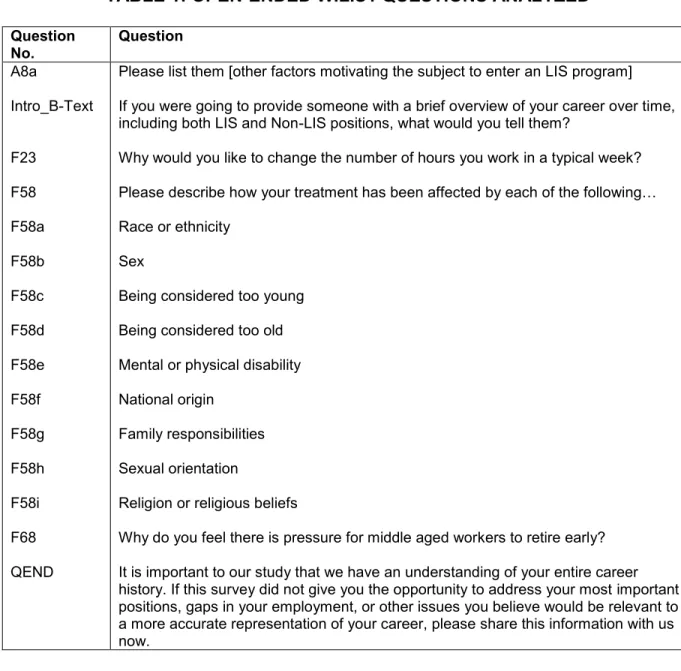
combined closed- and open-ended questions. It asked respondents about up to six

jobs: one’s job before entering an LIS program, first job after the LIS degree, current

(43)

32

respondents about several potential sources of job satisfaction including pay,

benefits, mobility, intrinsic rewards, nature of work, autonomy, and co-workers.

The WILIS team took preliminary measures to ensure the validity of the

survey instrument and an adequate response rate. In the first instance, a pilot study

was conducted in March 2007 with 750 random subjects from the population. In the

second, the WILIS team carried out a survey of 400 random non-responders to

ascertain causes of non-response and to try to adapt the framing of the study

accordingly to potential subjects. One-hundred forty-four non-responders took the

time to take this second survey. The most important common reason cited for failure

to participate in the pilot study (33%) was lack of time. One upshot of these efforts

was that the WILIS team concluded the respondent pool to be representative of the

population they wished to study. Another was a general “tightening-up” of the survey

in which researchers validated the survey skip logic and edited the document to

render it as concise as was consistent with getting a reasonably complete overview

of subjects’ LIS careers. As a result of these efforts, the final research instrument is

simultaneously exhaustive and taut. In printed form, the full survey stretches to some

93 pages and provides a solid impression of subjects’ education, career trajectory,

and sources of job satisfaction as LIS workers. One respondent pointed out a

potential difficulty with the long format. “This is a very, very long survey that took a

long time to complete,” she wrote. “I wonder how that fact will affect the final results.

Will it mostly describe the situations of the extremely passionate and the extremely

Figure

TABLE 1: OPEN-ENDED WILIS1 QUESTIONS ANALYZED
TABLE 2: LIS GRADUATE JOB SATISFACTION
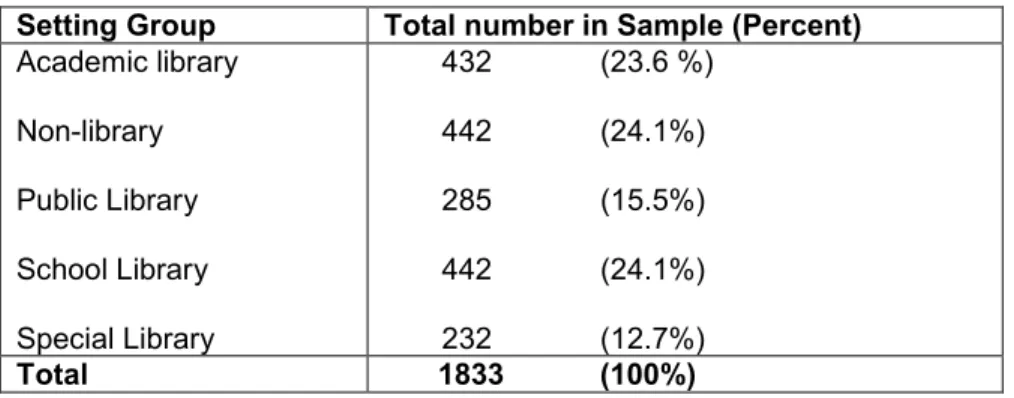
TABLE 4: TYPE OF LIBRARY JOB SETTINGS
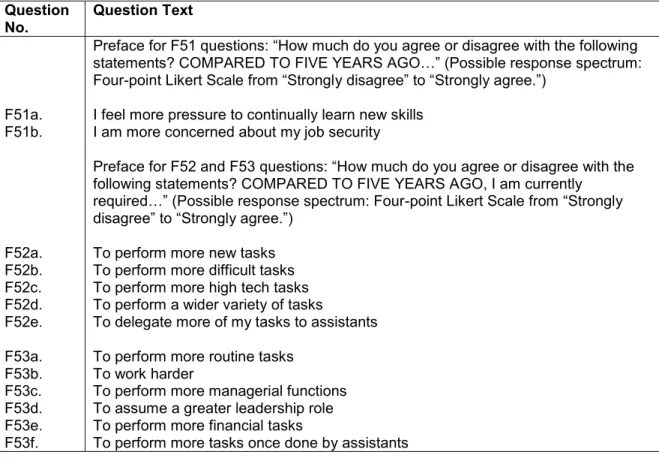
TABLE 6: NEW SKILLS/PROLIFERATING TASKS VARIABLES
+5

References

Related documents

Whilst approximately a quarter ( 26 per cent) of the services purchased by the NHS in 2011 / 12 were provided by non-statutory (i.e. private and third sector) organisations

Studies using firm-level data similar to those being used in this study include Weiss (1984) and Sicherman (1996).. predict employee quits. The employees also have a clear interest

• Conducted research and analysis on the performance of PV systems using Cadmium Telluride thin film modules in hot and humid climates such as in Morelos, Mexico for Sandia

It is a dictionary of Chinese morphemes, listing nearly 2,000 of the most frequent monosyllabic morphemes ( y ǔ sù ) of Standard Chinese with a detailed analysis of

eventually imposing inclusionary obligations that developers would not freely choose. Moving from Regime One to Regime Two in this manner has two effects on the

Evidence-based instructional practices ( EBIP s) have been associated with positive student outcomes; however, institutions struggle to catalyze widespread adoption of

Especially, isoform switching of kinase gene CDK5 was found in prostate cancer and benign tissues, which suggests its regulatory role in AR phosphorylation via alternative

This study explores the efficacy of using novel sentiment indicators from Market Psych, which analyses social media in addition to newsfeeds to quantify various levels of individual’s