Washington, DC 20375-5320
NRL/FR/5542--93-9591
A Taxonomy of Computer Program
Security Flaws, with Examples
Carl E. Landwehr Alan R. Bull John P. McDermott William S. Choi
Center for Computer High Assurance Systems Information Technology Division
November 19, 1993
Abstract
An organized record of actual flaws can be useful to designers, implementors, and evaluators of computer systems. This paper provides a taxonomy for computer program security flaws together with an appendix that carefully documents 50 actual security flaws. These flaws have all been described previously in the open literature, but in widely separated places. For those new to the field of computer security, they provide a good introduction to the characteristics of security flaws and how they can arise. Because these flaws were not randomly selected from a valid statistical sample of such flaws, we make no strong claims concerning the likely distribution of actual security flaws within the taxonomy. However, this method of organizing security flaw data can help those who have custody of more representative samples to organize them and to focus their efforts to remove and, eventually, to prevent the introduction of security flaws.
Subject terms: security and protection, security flaw, access controls, error/defect classification
been adjusted accordingly. Please send comments or requests for additional copies of this report, by e-mail to [email protected], or retrieve PostScript via URL
http://www.itd.nrl.navy.mil/itd/5540/publications/index.html (e.g., using Mosaic), or by anonymous ftp from
chacs.itd.nrl.navy.mil under directory /pub/chacs.
INTRODUCTION . . . 1
What Is a Security Flaw in a Program? . . . 1
Why Look for Security Flaws in Computer Programs?. . . 2
Previous Work . . . 2
Taxonomy . . . 3
FLAW CLASSIFICATION . . . 4
By Genesis . . . 7
Malicious Flaws . . . 7
Intentional, Nonmalicious Flaws . . . 8
Inadvertent Flaws . . . 9 By Time of Introduction . . . 10 During Development. . . 11 During Maintenance . . . 13 During Operation . . . 14 By Location . . . 14 Software . . . 14 Hardware. . . 16 DISCUSSION . . . 17 ACKNOWLEDGMENTS . . . 17 REFERENCES . . . 20
INTRODUCTION
Knowing how systems have failed can help us build systems that resist failure. Petroski [1] makes this point eloquently in the context of engineering design, and although software failures may be less visible than those of the bridges he describes, they can be equally damaging. But the history of software failures, apart from a few highly visible ones, [2,3] is relatively undocumented. This report collects and organizes a number of actual security flaws that have caused failures, so that designers may do their work with a more precise knowledge of what has gone before.
Computer security flaws are any conditions or circumstances that can result in denial of service, unauthorized disclosure, unauthorized destruction of data, or unauthorized modification of data [4]. Our taxonomy attempts to organize information about flaws so that, as new flaws are added, users will gain a fuller understanding of which parts of systems and which parts of the system life cycle are generating more security flaws than others. This information should be useful not only to designers, but also to those faced with the difficult task of assessing the security of a system already developed. To accurately assess the security of a computer system, an analyst must find its vulnerabilities. To do this, the analyst must understand the system thoroughly and recognize that computer security flaws that threaten system security may exist anywhere in the system.
There is a legitimate concern that this kind of information could assist those who would attack computer systems. Partly for this reason, we have limited the cases described here to those that already have been publicly documented elsewhere and are relatively old. We do not suggest that we have assembled a representative random sample of all known computer security flaws, but we have tried to include a wide variety. We offer the taxonomy for the use of those who are presently responsible for repelling attacks and correcting flaws. Their data, organized this way and abstracted, could be used to focus efforts to remove security flaws and prevent their introduction. Other taxonomies [5,6,7] have recently been developed for organizing data about software defects and anomalies of all kinds. These are primarily oriented toward collecting data during software development that will lead to improvements in the development process. We are primarily concerned with security flaws that are detected only after the software has been released for operational use; our taxonomy, while not incompatible with these efforts, reflects this
perspective.
What Is a Security Flaw in a Program?
This question is akin to ‘‘what is a bug?’’. In fact, an inadvertently introduced security flaw in a program is a bug. Generally, a security flaw is a part of a program that can cause the system to violate its security requirements. Finding security flaws, then, demands some knowledge of system security requirements. These requirements vary according to the system and the application, so we cannot address them in detail here. Usually, they concern identification and authentication of users, authorization of particular actions, and accountability for actions taken.
We have tried to keep our use of the term ‘‘flaw’’ intuitive without conflicting with standard terminology. The IEEE Standard Glossary of Software Engineering Terminology [8] includes definitions of
• error: human action that produces an incorrect result (such as software containing a fault), • fault: an incorrect step, process, or data definition in a computer program, and
• failure: the inability of a system or component to perform its required functions within specified performance requirements.
A failure may be produced when a fault is encountered. This glossary lists bug as a synonym for both error and fault. We use flaw as a synonym for bug, hence (in IEEE terms) as a synonym for fault, except that we include flaws that have been inserted into a system intentionally, as well as accidental ones.
IFIP WG10.4 has also published a taxonomy and definitions of terms [9] in this area. These define faults as the cause of errors that may lead to failures. A system fails when the delivered service no longer complies with the specification. This definition of ‘‘error’’ seems more consistent with its use in ‘‘error detection and correction’’ as applied to noisy communication channels or unreliable memory components than the IEEE one. Again, our notion of flaw corresponds to that of a fault, with the possibility that the fault may be introduced either accidentally or maliciously.
Why Look for Security Flaws in Computer Programs?
Early work in computer security was based on the ‘‘penetrate and patch’’ paradigm: analysts searched for security flaws and attempted to remove them. Unfortunately, this task was, in most cases, unending: more flaws always seemed to appear [10,11]. Sometimes the fix for a flaw introduced new flaws, and sometimes flaws were found that could not be repaired because system operation depended on them (e.g., cases I3 and B1 in the Appendix).
This experience led researchers to seek better ways of building systems to meet security requirements in the first place instead of attempting to mend the flawed systems already installed. Although some success has been attained in identifying better strategies for building systems [12,13], these techniques are not universally applied. More importantly, they do not eliminate the need to test a newly built or modified system (for example, to be sure that flaws avoided in initial specification haven’t been introduced in implementation).
Previous Work
Most of the serious efforts to locate security flaws in computer programs through penetration exercises have used the Flaw Hypothesis Methodology developed in the early 1970s [14]. This method requires system developers to first become familiar with the details of the way the system works (its control structure), then to generate hypotheses as to where flaws might exist in a system; to use system documentation and tests to confirm the presence of a flaw; and finally to generalize the confirmed flaws and use this information to guide further efforts. Although Ref. 14 provides lists of generic system functional flaws and generic operating system attacks, it does not provide a systematic organization for security flaws.
In the mid-70s both the Research in Secured Operating Systems (RISOS) project conducted at Lawrence Livermore Laboratories, and the Protection Analysis project conducted at the Information Sciences Institute of the University of Southern California (USC/ISI), attempted to characterize operating system security flaws. The RISOS final report [15] describes seven categories of operating system security flaws:
inconsistent parameter validation,
implicit sharing of privileged/confidential data, asynchronous validation/inadequate serialization, inadequate identification/authentication/authorization, violable prohibition/limit, and
exploitable logic error.
The report describes generic examples for each flaw category and provides reasonably detailed accounts for 17 actual flaws found in three operating systems: IBM OS/MVT, Univac 1100 Series, and TENEX. Each flaw is assigned to one of the seven categories.
The goal of the Protection Analysis (PA) project was to collect error examples and abstract patterns from them that, it was hoped, would be useful in automating the search for flaws. According to the final report [16], more than 100 errors that could permit system penetrations were recorded from six different operating systems (GCOS, MULTICS, and Unix, in addition to those investigated under RISOS). Unfortunately, this error database was never published and no longer exists [17]. However, the researchers did publish some examples, and they did develop a
classification scheme for errors. Initially, they hypothesized 10 error categories; these were eventually reorganized into four ‘‘global’’ categories:
• domain errors, including errors of exposed representation, incomplete destruction of data within a deallocated object, or incomplete destruction of its context;
• validation errors, including failure to validate operands or to handle boundary conditions properly in queue management;
• naming errors, including aliasing and incomplete revocation of access to a deallocated object; and
• serialization errors, including multiple reference errors and interrupted atomic operations. Although the researchers felt that they had developed a very successful method for finding errors in operating systems, the technique resisted automation. Research attention shifted from finding flaws in systems to developing methods for building systems that would be free of such errors.
Our goals are more limited than those of these earlier efforts in that we seek primarily to provide an understandable record of security flaws that have occurred. They are also more ambitious, in that we seek to categorize not only the details of the flaw, but also the genesis of the flaw and the time and place it entered the system.
Taxonomy
The taxonomy of security flaws proposed in this report classifies each flaw according to how, when, and where it was introduced into the system. The description of each flaw category refers to applicable cases (listed in the Appendix). Open-literature reports of security flaws are often abstract and fail to provide a realistic view of system vulnerabilities. Where studies do provide examples of actual vulnerabilities in existing systems, they are sometimes sketchy and incomplete lest hackers abuse the information. Our criteria for selecting cases are:
(1) the case must present a particular type of vulnerability clearly enough that a scenario or program that threatens system security can be understood by the classifier, and (2) the potential damage resulting from the vulnerability described must be more than
Each case includes the name of the author or investigator, the type of system involved, and a description of the case.
The taxonomy and the cases summarized here can help system builders, administrators, and users beware of the types of security flaws they imply and develop strategies to prevent or counter them. At the same time, we know that the selected cases are but a small sample, and we caution against unsupported generalizations based on the flaws they exhibit. In particular, readers should not interpret the flaws recorded in the Appendix as indications that the systems in which they occurred are necessarily more or less secure than others. In most cases, the absence of a system from the Appendix simply reflects the fact that it has not been tested as thoroughly or had its flaws documented as openly as those we have cited. Readers are encouraged to communicate additional cases to the authors so that we can better understand where security flaws really occur.
FLAW CLASSIFICATION
We distinguish the nature of a flaw from the nature of its exploitation, and we focus on the former. For example, although the covert channel used in the TENEX password compromise scheme (case DT in the Appendix) could be exploited maliciously, it was introduced innocently. Consequently, we place this flaw, and similar covert channels, in the ‘‘Nonmalicious’’ category for genesis. Virtually all exploitations of flaws, except those done as part of penetration testing, could be categorized as malicious to some degree.
A given case may reveal several kinds of security flaws. For example, if a system
programmer inserts a Trojan horse that exploits a covert channel to disclose sensitive information, both the Trojan horse and the covert channel are flaws in the operational system; the former will probably have been introduced maliciously, the latter inadvertently. Of course, any system that permits a user to invoke an uncertified program is vulnerable to Trojan horses. Whether the fact that a system permits users to install programs also represents a security flaw is an interesting question. The answer seems to depend on the context in which the question is asked. Permitting users of, say, an air traffic control system or, less threateningly, an airline reservation system, to install their own programs seems intuitively unsafe; it is a flaw. On the other hand, preventing owners of PCs from installing their own programs would seem ridiculously restrictive.
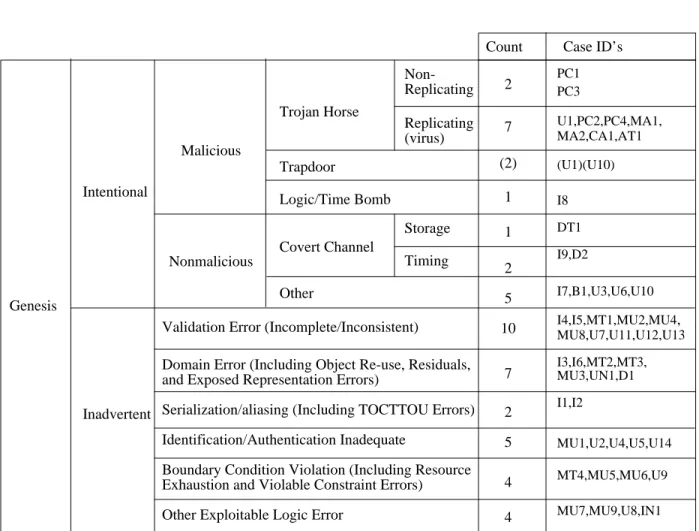
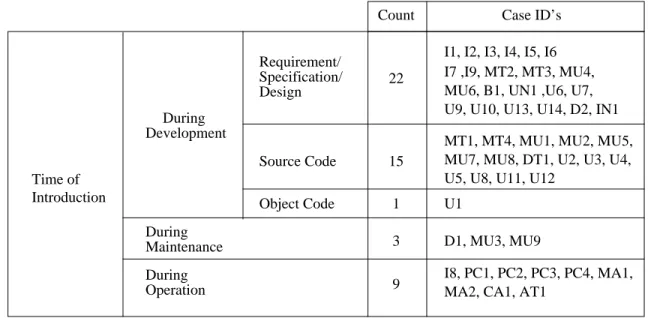
This report classifies security flaws according to genesis, time of introduction, and location (Figs. 1-3). Note that this classification does not partition the set of possible security flaws: the same flaw will show up at least once in each of these categories. The motive is to provide several different perspectives from which to consider possible sources of flaws in the system under study.
Within each of these categories, divisions and subdivisions are provided. Where feasible, these subdivisions define sets of mutually exclusive and collectively exhaustive categories. Often however, especially at the finer levels, such a partitioning is infeasible, and completeness of the set of categories cannot be assured. In general, we have tried to include categories only where they might help an analyst searching for flaws or a developer seeking to prevent them. A category for hardware flaws is included under ‘‘Location’’ for completeness. We understand that the increasing embedding of programs in hardware may yield increasing numbers of flaws that are in that ‘‘place,’’ but our focus is on flaws in programs, wherever they are found. A flaw in a program that has been frozen in silicon is still a program flaw to us; it would be placed in the appropriate category under ‘‘Operating System’’ rather than under ‘‘Hardware.’’ We reserve the use of the latter category for cases in which hardware exhibits security flaws that did not originate as errors in programs. We solicit proposals for additional categories.
Count Case ID’s Genesis Intentional Malicious Trojan Horse Non-Replicating Replicating (virus) Inadvertent Trapdoor Logic/Time Bomb Covert Channel Storage Timing Nonmalicious Other
Validation Error (Incomplete/Inconsistent)
Domain Error (Including Object Re-use, Residuals, and Exposed Representation Errors)
Serialization/aliasing (Including TOCTTOU Errors) Identification/Authentication Inadequate
Boundary Condition Violation (Including Resource Exhaustion and Violable Constraint Errors) Other Exploitable Logic Error
2 PC1PC3 7 U1,PC2,PC4,MA1, MA2,CA1,AT1 (2) 1 1 2 5 10 7 2 5 4 4 I4,I5,MT1,MU2,MU4, MU8,U7,U11,U12,U13 (U1)(U10) I8 DT1 I9,D2 I7,B1,U3,U6,U10 I3,I6,MT2,MT3, MU3,UN1,D1 I1,I2 MU1,U2,U4,U5,U14 MT4,MU5,MU6,U9 MU7,MU9,U8,IN1
Time of Introduction During Development During During Operation Maintenance Requirement/ Specification/ Design Source Code Object Code
I1, I2, I3, I4, I5, I6 I7 ,I9, MT2, MT3, MU4, MU6, B1, UN1 ,U6, U7, U9, U10, U13, U14, D2, IN1 MT1, MT4, MU1, MU2, MU5, MU7, MU8, DT1, U2, U3, U4, U5, U8, U11, U12
U1
D1, MU3, MU9
I8, PC1, PC2, PC3, PC4, MA1, MA2, CA1, AT1
22
15 1 3 9
Count Case ID’s
Fig. 2. Security flaw taxonomy: flaws by time of introduction
Location Software Operating System Support Hardware System Initialization Memory Management Process Management/ Scheduling Device Management (including I/O, networking) File Management Identification/Authentication Other/Unknown Privileged Utilities Unprivileged Utilities Application 8 2 10 3 5 1 10 1 1 3 6
Count Case ID’s
U5, U13, PC2, PC4, MA1, MA2, AT1 ,CA1
MT3, MU5
I6, I9, MT1, MT2, MU2, MU3 MU4, MU6, MU7, UN1 I2, I3, I4
I1, I5, MU8, U2, U3, U9 MU1, DT1, U6, U11, D1 MT4
I7, B1, U4, U7, U8, U10, U12, U14, PC1, PC3
U1 I8
MU9, D2, IN1 Fig. 3. Security flaw taxonomy: flaws by location
By Genesis
How does a security flaw find its way into a program? It may be introduced intentionally or inadvertently. Different strategies can be used to avoid, detect, or compensate for accidental flaws as opposed to those intentionally inserted. Our goal in recording this distinction is, ultimately, to collect data that will provide a basis for deciding which strategies to use in a particular context.
Characterizing intention is tricky: some features intentionally placed in programs can at the same time inadvertently introduce security flaws (e.g., a feature that facilitates remote debugging or system maintenance may at the same time provide a trapdoor to a system). Where such cases can be distinguished, they are categorized as intentional but nonmalicious. Not wishing to endow programs with intentions, we nevertheless use the terms ‘‘malicious flaw,’’ ‘‘malicious code,’’ and so on, as shorthand for flaws, code, etc., that have been introduced into a system by an individual with malicious intent. Although some malicious flaws could be disguised as inadvertent flaws, this distinction should be easy to make in practice—inadvertently created Trojan horse programs are hardly likely! Inadvertent flaws in requirements or specifications ultimately manifest themselves in the implementation; flaws may also be introduced inadvertently during maintenance.
Malicious flaws presumably are more difficult to detect and are more likely to result in serious degradation of system security than inadvertent ones. Nevertheless, an inadvertent flaw that is exploited by a malicious intruder can be just as damaging to system security as a malicious flaw.
Malicious Flaws
Malicious flaws have acquired colorful names, including Trojan horse, trapdoor, time-bomb, and logic-bomb. The term ‘‘Trojan horse’’ was introduced by Dan Edwards and recorded by James Anderson [18] to characterize a particular computer security threat; it has been redefined many times [4,18-20]. It generally refers to a program that masquerades as a useful service but exploits rights of the program’s user—rights not possessed by the author of the Trojan horse—in a way the user does not intend.
Since the author of malicious code needs to disguise it somehow so that it will be invoked by a nonmalicious user (unless the author means also to invoke the code, in which case he or she presumably already possesses the authorization to perform the intended sabotage), almost any malicious code can be called a Trojan horse. A Trojan horse that replicates itself by copying its code into other program files (see case MA1) is commonly referred to as a virus [21,22]. One that replicates itself by creating new processes or files to contain its code, instead of modifying existing storage entities, is often called a worm [23]. Denning [26] provides a general discussion of these terms; differences of opinion about the term applicable to a particular flaw or its exploitations sometimes occur [22,3].
A trapdoor is a hidden piece of code that responds to a special input, allowing its user access to resources without passing through the normal security enforcement mechanism (see case U1). For example, a programmer of automated teller machines (ATMs) might be required to check a personal identification number (PIN) read from a card against the number keyed in by the user. If the numbers match, the user is to be permitted to enter transactions. By adding a disjunct to the
condition that implements this test, the programmer can provide a trapdoor, shown in italics below:
if PINcard=PINkeyed OR PINkeyed=9999 then {permit transactions}
In this example, 9999 would be a universal PIN that would work with any bank card submitted to the ATM. Of course the code in this example would be easy for a code reviewer, although not an ATM user, to spot, so a malicious programmer would need to take additional steps to hide the code that implements the trapdoor. If passwords are stored in a system file rather than on a user-supplied card, a special password known to an intruder mixed in a file of legitimate ones might be difficult for reviewers to find.
It might be argued that a login program with a trapdoor is really a Trojan horse in the sense defined above, but the two terms are usually distinguished [19]. Thompson [25] describes a method for building a Trojan horse compiler that can install both itself and a trapdoor in a Unix password-checking routine in future versions of the Unix system.
A time-bomb or logic-bomb is a piece of code that remains dormant in the host system until a certain ‘‘detonation’’ time or event occurs (see case I8). When triggered, a time-bomb may deny service by crashing the system, deleting files, or degrading system response-time. A time-bomb might be placed within either a replicating or non-replicating Trojan horse.
Intentional, Nonmalicious Flaws
A Trojan horse program may convey sensitive information to a penetrator over covert channels. A covert channel is simply a path used to transfer information in a way not intended by the system’s designers [27]. Since covert channels, by definition, are channels not placed there intentionally, they should perhaps appear in the category of inadvertent flaws. We categorize them as intentional but nonmalicious flaws because they frequently arise in resource-sharing services that are intentionally part of the system. Indeed, the most difficult ones to eliminate are those that arise in the fulfillment of essential system requirements. Unlike their creation, their exploitation is likely to be malicious. Exploitation of a covert channel usually involves a service program, most likely a Trojan horse. This program generally has access to confidential data and can encode that data for transmission over the covert channel. It also will contain a receiver program that ‘‘listens’’ to the chosen covert channel and decodes the message for a penetrator. If the service program could communicate confidential data directly to a penetrator without being monitored, of course, there would be no need for it to use a covert channel.
Covert channels are frequently classified as either storage or timing channels. A storage channel transfers information through the setting of bits by one program and the reading of those bits by another. What distinguishes this case from that of ordinary operation is that the bits are used to convey encoded information. Examples would include using a file intended to hold only audit information to convey user passwords—using the name of a file or perhaps status bits associated with it that can be read by all users to signal the contents of the file. Timing channels convey information by modulating some aspect of system behavior over time, so that the program receiving the information can observe system behavior (e.g., the system’s paging rate, the time a certain transaction requires to execute, the time it takes to gain access to a shared bus) and infer protected information.
The distinction between storage and timing channels is not sharp. Exploitation of either kind of channel requires some degree of synchronization between the sender and receiver. It also requires the ability to modulate the behavior of some shared resource. In practice, covert channels are often distinguished on the basis of how they can be detected: those detectable by information flow analysis of specifications or code are considered storage channels.
Other kinds of intentional but nonmalicious security flaws are possible. Functional
requirements that are written without regard to security requirements can lead to such flaws; one of the flaws exploited by the ‘‘Internet worm’’ [3] (case U10) could be placed in this category. Inadvertent Flaws
Inadvertent flaws may occur in requirements; they may also find their way into software during specification and coding. Although many of these are detected and removed through testing, some flaws can remain undetected and later cause problems during operation and maintenance of the software system. For a software system composed of many modules and involving many programmers, flaws are often difficult to find and correct because module interfaces are inadequately documented and global variables are used. The lack of documentation is especially troublesome during maintenance when attempts to fix existing flaws often generate new flaws because maintainers lack understanding of the system as a whole. Although inadvertent flaws do not usually pose an immediate threat to the security of the system, the weakness resulting from a flaw may be exploited by an intruder (see case D1).
There are many possible ways to organize flaws within this category. Recently, Chillarege [6] and Sullivan [28] have published classifications of defects (not necessarily security flaws) found in commercial operating systems and databases. Efforts by Bisbey et al., [16] and Abbott [15] provide classifications specifically for security flaws. After trying these classifications, as well as one we developed, on the set of examples included in the Appendix, we found the taxonomy described below, which draws primarily on the work of Bisbey and Abbott, most descriptive. This part of the taxonomy is probably the one with the greatest overlap among its categories.
Inadvertent flaws can be classified as flaws related to validation errors,
domain errors,
serialization/aliasing errors,
errors of inadequate identification/authentication, boundary condition errors, and
other exploitable logic errors.
Validation flaws occur when a program fails to check that the parameters supplied or returned to it conform to its assumptions about them. These assumptions may include the number of parameters provided, the type of each, the location or maximum length of a buffer, or the access permissions on a file. We lump together cases of incomplete validation (where some but not all parameters are checked) and inconsistent validation (where different interface routines to a common data structure fail to apply the same set of checks).
Domain flaws occur when the intended boundaries between protection environments have holes. For example, a user who creates a new file and discovers that it contains information from a file deleted by a different user has discovered a domain flaw. (This kind of error is sometimes
referred to as a problem with object reuse or with residuals.) We also include in this category flaws of exposed representation [16] in which the lower-level representation of an abstract object, intended to be hidden in the current domain, is in fact exposed (see cases B1 and DT1). Errors classed by Abbott as ‘‘implicit sharing of privileged/confidential data’’ will generally fall in this category.
A serialization flaw permits the asynchronous behavior of different system components to be exploited to cause a security violation. These flaws can be particularly difficult to discover. A security-critical program may appear to correctly validate all of its parameters, but the flaw permits the asynchronous behavior of another program to change one of those parameters after it has been checked but before it is used. Many time-of-check-to-time-of-use (TOCTTOU) flaws will fall in this category, although some may be classed as validation errors if asynchrony is not involved. We also include in this category aliasing flaws, in which the fact that two names exist for the same object can cause its contents to change unexpectedly and, consequently, invalidate checks already applied to it.
An identification/authentication flaw is one that permits a protected operation to be invoked without sufficiently checking the identity and authority of the invoking agent. These flaws could perhaps be counted as validation flaws, since presumably some routine is failing to validate authorizations properly. However, a sufficiently large number of cases have occurred in which checking the identity and authority of the user initiating an operation has in fact been neglected to keep this as a separate category.
Boundary condition flaws typically reflect omission of checks to assure constraints (e.g., on table size, file allocation, or other resource consumption) are not exceeded. These flaws may lead to system crashes or degraded service, or they may cause unpredictable behavior.
Finally, we include as a catchall a category for other exploitable logic errors. Bugs that can be invoked by users to cause system crashes, but that don’t involve boundary conditions, would be placed in this category, for example.
By Time of Introduction
Classifying identified security flaws, both intentional and inadvertent, according to the phase of the system life cycle in which they were introduced can help us understand both where to look for more errors and where to focus efforts to prevent their introduction. The software engineering literature includes a variety of studies [6,29] that have investigated the general question of how and when errors are introduced into software.
Software security flaws can be classified broadly as having been introduced during the development or maintenance stage of the software life cycle or by unauthorized modification of operational software (e.g., by a virus). Flaws introduced during development can usually be attributed to erroneous or incorrectly implemented requirements or specifications. However, it is important to understand that flaws can originate throughout the software life cycle. A flaw introduced early in the software life cycle may propagate as the system grows and become quite costly to rectify. A major flaw in a requirement, for instance, is not unusual in a large software system. If such a flaw affects security and its correction is not deemed cost-effective, the system and the flaw may remain. For example, an early multiprogramming operating system performed some I/O-related functions by having the supervisor execute code located in user memory while in
supervisor mode. By the time this was recognized as a security flaw, its removal would have caused major incompatibilities with other software, and it was not fixed.
It is also important to recognize the possibility of malicious intrusion into the system during both development and maintenance. The security analyst needs to assure that utilities used to build the system (e.g., compilers, linkers, macro-assemblers, and software testing tools) are free of malicious code (note Thompson’s example [25] and a limited defense posed by McDermott [30]).
The original designers and programmers of a system are rarely involved in its maintenance; flaws introduced during maintenance are often attributable to the maintainer’s lack of
understanding of the system as a whole. Not infrequently, an attempt to correct one flaw will create another. Vigilance is also required to thwart malicious attempts to introduce security flaws through software maintenance. Installation of a new version of software is often considered a routine activity, yet the installer may have complete control over both software and hardware during the installation.
During Development
Flaws introduced during development of the software can originate in requirements and specifications, source code, or object code. Although the software life cycle is normally planned and described as though requirements are fully defined prior to system specification, and
specification strictly precedes coding, in practice there is iteration in each of these steps and across steps. Thus in fact, identification of the time a security flaw is introduced overlaps the definition of the place (requirements document, specification, or code) it occurs. Issues of concern to the security analyst for each of these subcategories are discussed here.
Requirements and Specifications
Ideally, software requirements describe what a particular program or system of programs must do. How the program or system is organized to meet those requirements (i.e., the software design) is typically recorded in a variety of documents, referred to collectively as specifications. Specifications with various scopes and levels of detail may be written for a software system or its components, and they may be called interface specifications, module specifications, functional specifications, detailed specifications, and so on. Typically, the specifications define the functions of software modules and the parameters associated with them. They are the basis on which the source code is built. The specifier is often responsible for implementing the
specification as well.
If written according to good engineering practice, the requirement and specification documents should make the software design clear to the security analyst. At a minimum, the specification should completely document the interfaces of all modules. This information should be detailed enough that maintenance programmers can determine whether and how a modification of one module will affect others. Specifications that do not meet this criterion are more likely to contain security flaws.
Apart from checking for specification completeness, the security analyst must assure that the security requirements themselves are complete, that they mesh with the system’s functions, and that the specifications are consistent with the requirements. Errors are more likely to occur if the functional requirements and security requirements have been developed and documented independently than if they have been coordinated.
Requirements and specifications are relatively unlikely to contain maliciously introduced flaws. They are normally reviewed extensively, so a specification for a trapdoor or a Trojan horse would have to be well-disguised to avoid detection. More likely are flaws that arise because of competition between security requirements and other functional requirements. For example, security concerns might dictate that programs never be modified at an operational site. But if the delay in repairing errors detected in system operation is perceived to be too great, there will be pressure to provide mechanisms in the specification to permit on-site reprogramming. Such mechanisms can provide built-in security loopholes. Also possible are inadvertent flaws that arise because of missing requirements or undetected conflicts among requirements.
Source Code
The source code implements the design of the software system given by the specifications. Most flaws in source code, whether inadvertent or intentional, can be detected through a careful examination of it. The classes of inadvertent flaws described previously apply to source code.
For a large software system, inadvertent flaws in source code are frequently a by-product of inadequately defined module or process interfaces. Programmers attempting to build a system to inadequate specifications are likely to misunderstand the parameters to be passed across an interface, the requirements for synchronizing concurrent processes, or the proper formats for data input or output. These misunderstandings manifest themselves as source code flaws. Many such flaws in a system may indicate poor system documentation and may require system documents to be rewritten.
Intentional but nonmalicious flaws can be introduced in source code for several reasons. A programmer may introduce mechanisms that are not included in the specification but that are intended to help in debugging and testing the normal operation of the code. However, the test scaffolding may circumvent security controls. If the scaffolding is left in place in the operational system, it provides a security flaw. One of the attacks used by the Internet Worm exploited just such a mechanism; this mechanism permitted remote execution of an operating system command without requiring user authentication (case U10). Programmers may also decide to provide undocumented facilities that simplify maintenance but provide security loopholes—the inclusion of a ‘‘patch area’’ that facilitates reprogramming outside the scope of the configuration
management system would fall in this category.
Technically sophisticated malicious flaws can be introduced at the source code level. A programmer, whether an authorized member of a development team or an intruder, working at the source code level can invoke specific operations that will compromise system security. Although malicious source code can be detected through manual review of software, much software is developed without any such review; source code is frequently not provided to purchasers of software packages (even if it is supplied, the purchaser is unlikely to have the resources necessary to review it for malicious code). If the programmer is aware of the review process, he may well be able to disguise the flaws he introduces.
A malicious source code flaw may be introduced directly by any individual who gains write access to source code files, but source code flaws can also be introduced indirectly. For example, if a programmer authorized to write source code files inadvertently invokes a Trojan horse editor (or compiler, linker, loader, etc.), the Trojan horse could use the programmer’s privileges to modify source code files. Instances of subtle indirect tampering with source code are difficult to
document, but Trojan horse programs that grossly modify all a user’s files, and hence the source code files, have been created.
Object Code
Object code programs are generated by compilers or assemblers and represent the machine-readable form of the source code. Because most compilers and assemblers are subjected to extensive testing and formal validation procedures before release, inadvertent flaws in object programs that are not simply a translation of source code flaws are rare, particularly if the compiler or assembler is mature and has been widely used. When such errors do occur as a result of errors in a compiler or assembler, they typically show themselves through incorrect behavior of programs in unusual cases, so they can be quite difficult to track down and remove.
Because this kind of flaw is rare, the primary security concern at the object code level is with malicious flaws. Because object code is difficult for a human to make sense of (if it were not, software companies would not have different policies for selling source code and object code for their products), it is a good hiding place for malicious security flaws (again, see Thompson [25]). Lacking system and source code documentation, an intruder will have a hard time patching source code to introduce a security flaw without simultaneously altering the visible behavior of the program. The insertion of a malicious object code module or replacement of an existing object module by a version of it that incorporates a Trojan horse is a more common threat. Writers of self-replicating Trojan horses (viruses) [21] have typically taken this approach: a bogus object module is prepared and inserted in an initial target system. When it is invoked, perhaps during system boot or running as a substitute version of an existing utility, it can search the disks mounted on the system for a copy of itself and, if it finds none, insert one. If it finds a related, uninfected version of a program, it can replace it with an infected copy. When a user unwittingly moves an infected program to a different system and executes it, the virus gets another chance to propagate itself. Instead of replacing an entire program, a virus may append itself to an existing object program, perhaps as a segment to be executed first. Creating a virus generally requires some knowledge of the operating system and programming conventions of the target system; viruses, especially those introduced as object code, typically cannot propagate to different host hardware or operating systems.
A direct penetration at the object code level occurs when a user or intruder maliciously alters object code or introduces bogus object code. Unwitting propagation of a virus by a user is a form of indirect penetration.
During Maintenance
Inadvertent flaws introduced during maintenance are often attributable to the maintenance programmer’s failure to understand the system as a whole. Since software production facilities often have a high personnel turnover rate, and because system documentation is often inadequate, maintenance actions can have unpredictable side effects. If a flaw is fixed on an ad hoc basis without performing a backtracking analysis to determine the origin of the flaw, it will tend to induce other flaws and this cycle will continue. Software modified during maintenance should be subjected to the same review as newly developed software; it is subject to the same kinds of flaws. Case D1 graphically shows that system upgrades, even when performed in a controlled environment and with the best of intentions, can introduce new flaws. In this case, a flaw was inadvertently introduced into a subsequent release of a DEC operating system following its
successful evaluation at the C2 level of the Trusted Computer System Evaluation Criteria (TCSEC) [12].
System analysts should also be aware of the possibility of malicious intrusion during the maintenance stage. In fact, viruses are more likely to be present during the maintenance stage, since viruses by definition spread the infection through executable codes.
During Operation
The well-publicized instances of virus programs [26,31,32] dramatize the need for the security analyst to consider the possibilities for unauthorized modification of operational software during its operational use. Viruses are not the only means by which modifications can occur: depending on the controls in place in a system, ordinary users may be able to modify system software or install replacements; with a stolen password, an intruder may be able to do the same thing. Furthermore, software brought into a host from a contaminated source (e.g., software from a public bulletin board that has, perhaps unknown to its author, been altered) may be able to modify other host software without authorization.
By Location
A security flaw can be classified according to where in the system it is introduced or found. Most computer security flaws occur in software, but flaws affecting security may occur in hardware as well. Although this taxonomy principally addresses software flaws, programs can with increasing facility be cast in hardware. This fact and the possibility that malicious software may exploit hardware flaws motivate a brief section addressing them.
Software
In classifying the place a software flaw is introduced, we adopt the view of a security analyst who is searching for such flaws. Where should one look first? Because operating system flaws are likely to have the most severe effects, this is probably the best place to begin. But the search needs to be focused. The taxonomy for this area suggests particular system functions that should be scrutinized closely. In some cases, implementation of these functions may extend outside the operating system perimeter into support and application software; in this case, that software must also be reviewed.
Software flaws can occur in operating system programs, support software, or application (user) software. This is a rather coarse division, but even so the boundaries are not always clear.
Operating System Programs
Operating system functions normally include memory and processor allocation, process management, device handling, file management, and accounting, although there is no standard definition. The operating system determines how the underlying hardware is used to define and separate protection domains, authenticate users, control access, and coordinate the sharing of all system resources. In addition to functions that may be invoked by user calls, traps, or interrupts, operating systems often include programs and processes that operate on behalf of all users. These programs provide network access and mail service, schedule invocation of user tasks, and perform other miscellaneous services. Systems often must grant privileges to these utilities that they deny to individual users. Finally, the operating system has a large role to play in system initialization. Although in a strict sense initialization may involve programs and processes outside the operating system boundary, this software is usually intended to be run only under highly controlled
circumstances and may have many special privileges, so it seems appropriate to include it in this category.
We categorize operating system security flaws according to whether they occur in the functions for
system initialization, memory management, process management,
device management (including networking), file management, or
identification/authentication.
We include an other/unknown category for flaws that do not fall into any of the preceding classes. System initialization, although it may be handled routinely, is often complex. Flaws in this area can occur either because the operating system fails to establish the initial protection domains as specified (for example, it may set up ownership or access control information improperly) or because the system administrator has not specified a secure initial configuration for the system. In case U5, improperly set permissions on the mail directory led to a security breach. Viruses commonly try to attach themselves to system initialization code, since this provides the earliest and most predictable opportunity to gain control of the system (see cases PC1-4, for example).
Memory management and process management are functions the operating system provides to control storage space and CPU time. Errors in these functions may permit one process to gain access to another improperly, as in case I6, or to deny service to others, as in case MU5.
Device management often includes complex programs that operate in parallel with the CPU. These factors make the writing of device handling programs both challenging and prone to subtle errors that can lead to security flaws (see case I2). Often, these errors occur when the I/O routines fail to respect parameters provided them (case U12) or they validate parameters provided in storage locations that can be altered, directly or indirectly, by user programs after checks are made (case I3).
File systems typically use the process, memory, and device management functions to create long-term storage structures. With few exceptions, the operating system boundary includes the file system, which often implements access controls to permit users to share and protect their files. Errors in these controls, or in the management of the underlying files, can easily result in security flaws (see cases I1, MU8, and U2).
The identification and authentication functions of the operating system usually maintain special files for user IDs and passwords and provide functions to check and update those files as appropriate. It is important to scrutinize not only these functions, but also all of the possible ports of entry into a system to ensure that these functions are invoked before a user is permitted to consume or control other system resources.
Support Software
Support software comprises compilers, editors, debuggers, subroutine or macro libraries, database management systems, and any other programs not properly within the operating system boundary that many users share. The operating system may grant special privileges to some such
programs; these we call privileged utilities. In Unix, for example, any ‘‘setuid’’ program owned by ‘‘root’’ effectively runs with access-checking controls disabled. This means that any such program will need to be scrutinized for security flaws, since during its execution one of the fundamental security-checking mechanisms is disabled.
Privileged utilities are often complex and sometimes provide functions that were not anticipated when the operating system was built. These characteristics make them difficult to develop and likely to have flaws that, because they are also granted privileges, can compromise security. For example, daemons, which may act on behalf of a sequence of users and on behalf of the system as well, may have privileges for reading and writing special system files or devices (e.g., communication lines, device queues, mail queues) as well as for files belonging to individual users (e.g., mailboxes). They frequently make heavy use of operating system facilities, and their privileges may turn a simple programming error into a penetration path. Flaws in daemons providing remote access to restricted system capabilities have been exploited to permit unauthenticated users to execute arbitrary system commands (case U12) and to gain system privileges by writing the system authorization file (case U13).
Even unprivileged software can represent a significant vulnerability because these programs are widely shared, and users tend to rely on them implicitly. The damage inflicted by flawed, unprivileged support software (e.g., by an embedded Trojan horse) is normally limited to the user who invokes that software. In some cases, however, since it may be used to compile a new release of a system, support software can even sabotage operating system integrity (case U1). Inadvertent flaws in support software can also cause security flaws (case I7); intentional but nonmalicious flaws in support software have also been recorded (case B1).
Application Software
We categorize programs that have no special system privileges and are not widely shared as application software. Damage caused by inadvertent software flaws at the application level is usually restricted to the executing process, since most operating systems can prevent one process from damaging another. This does not mean that application software cannot do significant damage to a user’s own stored files, however, as many victims of Trojan horse and virus programs have become painfully aware. An application program generally executes with all the privileges of the user who invokes it, including the ability to modify permissions, read, write, or delete any files that user owns. In the context of most personal computers now in use, this means that an errant or malicious application program can, in fact, destroy all the information on an attached hard disk or writeable floppy disk.
Inadvertent flaws in application software that cause program termination or incorrect output, or can generate undesirable conditions such as infinite looping have been discussed previously. Malicious intrusion at the application software level usually requires access to the source code (although a virus could conceivably attach itself to application object code) and can be
accomplished in various ways. Hardware
Issues of concern at the hardware level include the design and implementation of processor hardware, microprograms, and supporting chips, and any other hardware or firmware functions used to realize the machine’s instruction set architecture. It is not uncommon for even widely distributed processor chips to be incompletely specified, to deviate from their specifications in special cases, or to include undocumented features. Inadvertent flaws at the hardware level can
cause problems such as improper synchronization and execution, bit loss during data transfer, or incorrect results after execution of arithmetic or logical instructions (see case MU9). Intentional but nonmalicious flaws can occur in hardware, particularly if the manufacturer includes
undocumented features (for example, to assist in testing or quality control). Hardware mechanisms for resolving resource contention efficiently can introduce covert channels (see case D2).
Malicious modification of installed hardware (e.g., installing a bogus replacement chip or board) generally requires physical access to the hardware components, but microcode flaws can be exploited without physical access. An intrusion at the hardware level may result in improper execution of programs, system shutdown, or, conceivably, the introduction of subtle flaws exploitable by software.
DISCUSSION
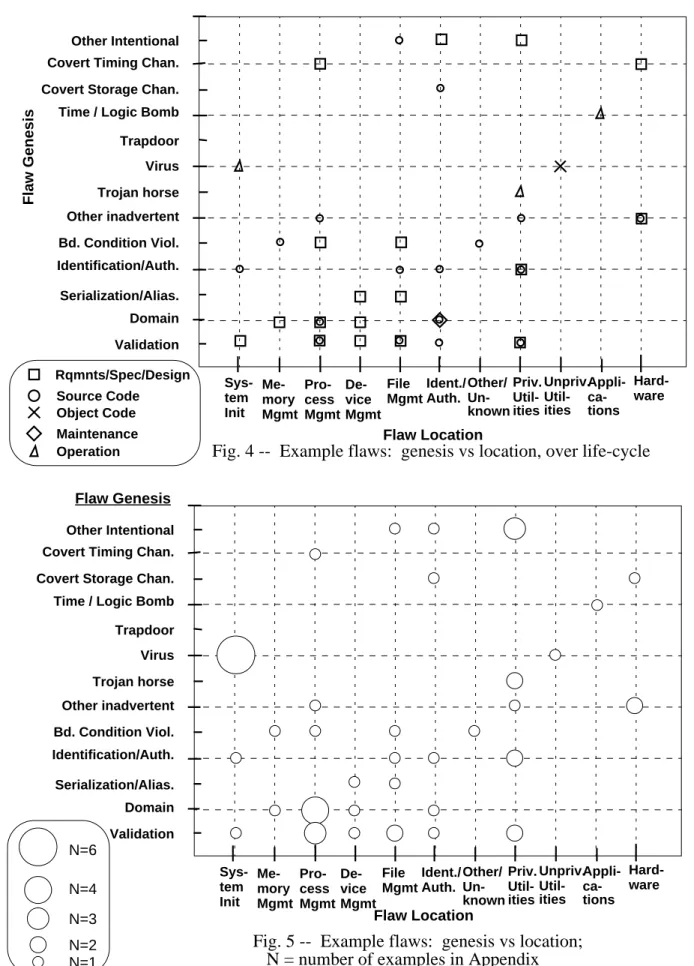
The scatter plots in Figs. 4-7 illustrate the characteristics of the cases included in the Appendix. Because we do not claim that this selection of security flaws is statistically
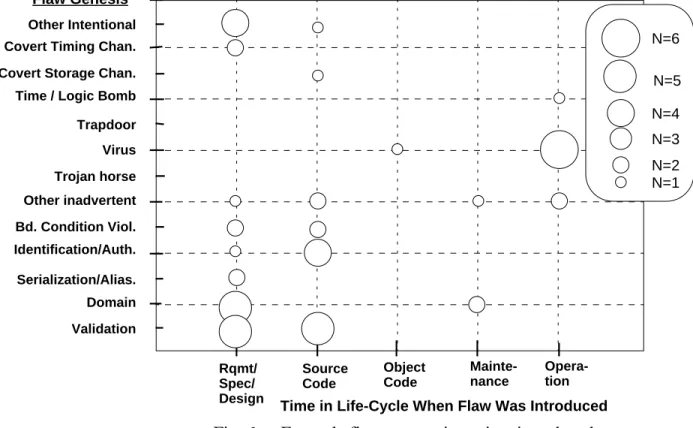
representative, we cannot use these plots to draw strong conclusions about how, when, or where security flaws are most likely to be introduced. However, we believe that the kinds of plots shown would be an effective way to abstract and present information from more extensive, and perhaps more sensitive, data sets. Each symbol plotted in Fig. 4 captures one or more flaws described in the Appendix according to its genesis, location, and time of introduction. Figure 5 plots flaw genesis against location again, but uses symbol size to reflect the number of cases in the appendix for a particular point. Figures 6 and 7 use the same technique, plotting genesis vs time of
introduction and location vs time of introduction, respectively.
We also have some observations based on our experiences in creating the taxonomy and applying it to these examples. It seems clear that security breaches, like accidents, typically have several causes. Often, unwarranted assumptions about some aspect of system behavior lead to security flaws. Problems arising from asynchronous modification of a previously checked parameter illustrate this point: the person who coded the check assumed that nothing could cause that parameter to change before its use—when an asynchronously operating process could in fact do so. Perhaps the most dangerous assumption is that security need not be addressed—that the environment is fundamentally benign, or that security can be added later. Both Unix and personal computer operating systems clearly illustrate the cost of this assumption. One cannot be surprised when systems designed without particular regard to security requirements exhibit security flaws. Those who use such systems live in a world of potentially painful surprises.
ACKNOWLEDGMENTS
The idea for this report was conceived several years ago when we were considering how to provide automated assistance for detecting security flaws. We found that we lacked a good characterization of the things we were looking for. It has had a long gestation and many have assisted in its delivery. We are grateful for the participation of Mark Weiser (then of the University of Maryland) and LCDR Philip Myers of the Space and Naval Warfare Combat Systems Command (SPAWAR) in this early phase of the work. We also thank the National Computer Security Center and SPAWAR for their continuing financial support. The authors gratefully acknowledge the assistance provided by the many reviewers of earlier drafts of this paper. Their comments helped us refine the taxonomy, clarify the presentation, distinguish the true computer security flaws from the mythical ones, and place them accurately in the taxonomy. Comments from Gene Spafford,
Other Intentional Covert Timing Chan. Covert Storage Chan. Time / Logic Bomb Trapdoor Virus Trojan horse Other inadvertent Bd. Condition Viol. Identification/Auth. Serialization/Alias. Domain Validation Sys-tem Me-mory Mgmt Pro-cess Mgmt Init De-vice Mgmt File Mgmt Ident./ Auth. Other/ Un-known Priv. Util-ities Unpriv. Util-ities Appli- ca-tions Hard-ware Other Intentional Covert Timing Chan. Covert Storage Chan. Time / Logic Bomb Trapdoor Virus Trojan horse Other inadvertent Bd. Condition Viol. Identification/Auth. Serialization/Alias. Domain Validation Sys-tem Me-mory Mgmt Pro-cess Mgmt Init De-vice Mgmt File Mgmt Ident./ Auth. Other/ Un-known Priv. Util-ities Unpriv. Util-ities Appli- ca-tions Hard-ware Flaw Location Flaw Genesis
Fig. 4 -- Example flaws: genesis vs location, over life-cycle
Flaw Location
Fig. 5 -- Example flaws: genesis vs location; N = number of examples in Appendix Flaw Genesis Rqmnts/Spec/Design Source Code Object Code Maintenance Operation N=6 N=4 N=3 N=2 N=1
Hardware Applications Unpriv.Utilities Priv. Utilities Other/Unknown Ident./Auth. File Mgmt. Device Mgmt. Process Mgmt. Memory Mgmt. System Init. Rqmt/ Spec/ Design Source Code Object Code Mainte-nance Opera-tion Time in Life-Cycle When Flaw Was Introduced Fig. 7 -- Example flaws: location vs time of introduction;
N = number of examples in Appendix Flaw Location
Other Intentional Covert Timing Chan. Covert Storage Chan. Time / Logic Bomb Trapdoor Virus Trojan horse Other inadvertent Bd. Condition Viol. Identification/Auth. Serialization/Alias. Domain Validation Rqmt/ Spec/ Design Source Code Object Code Mainte-nance Opera-tion Time in Life-Cycle When Flaw Was Introduced Fig. 6 -- Example flaws: genesis vs time introduced;
N = number of examples in Appendix Flaw Genesis N=6 N=4 N=3 N=2 N=1 N=5 N=6 N=4 N=3 N=2 N=1 N=5
Matt Bishop, Paul Karger, Steve Lipner, Robert Morris, Peter Neumann, Philip Porras, James P. Anderson, and Preston Mullen were particularly extensive and helpful. Jurate Maciunas Landwehr suggested the form of Fig. 4. Thomas Beth, Richard Bisbey II, Vronnie Hoover, Dennis Ritchie, Mike Stolarchuck, Andrew Tanenbaum, and Clark Weissman also provided useful comments and encouragement; we apologize to any reviewers we have inadvertently omitted. Any remaining errors are, of course, our responsibility.
REFERENCES
1. H. Petroski, To Engineer is Human: The Role of Failure in Successful Design (Vintage Books, New York, NY, 1992).
2. N.G. Leveson and C.S. Turner, ‘‘An Investigation of the Therac-25 Accidents,’’ UCI TR 92-108, Inf. and Comp. Sci. Dept, Univ. of Cal.-Irvine, Irvine, CA.
3. E.H. Spafford, ‘‘Crisis and Aftermath,’’ Comm. ACM 32(6), 678-687 (June 1989).
4. C.E. Landwehr, ‘‘Formal Models for Computer Security,’’ ACM Computing Surveys 13(3), 247-278 (September 1981).
5. C.L. Brehmer and J.R. Carl, ‘‘Incorporating IEEE Standard 1044 into Your Anomaly Tracking Process,’’ CrossTalk, J. Defense Software Engineering, 40, 9-16 (January 1993).
6. R. Chillarege, I.S. Bhandari, J.K. Chaar, M.J. Halliday, D.S. Moebus, B.K. Ray, and M-Y Wong, ‘‘Orthogonal Defect Classification—A Concept for In-process Measurements,’’ IEEE Trans. on Software Engineering 18(11), 943-956 (Nov. 1992).
7. W.A. Florac, ‘‘Software Quality Measurement: A Framework for Counting Problems and Defects,’’ CMU/SEI-92-TR-22 (Software Engineering Institute, Pittsburgh, PA, Sept. 1992.).
8. ANSI/IEEE Standard 610.12-1990, IEEE Standard Glossary of Software Engineering Terminology (IEEE, New York, NY, 1990).
9. J.C. LaPrie (ed.), Dependability: Basic Concepts and Terminology, Vol. 6, Springer-Verlag Series in Dependable Computing and Fault-Tolerant Systems, New York.
10. P.G. Neumann, ‘‘Computer Security Evaluation,’’ 1978 National Computer Conference, AFIPS Conf. Proceedings 47 (1978) pp. 1087-1095.
11. R.R. Schell, ‘‘Computer Security: the Achilles Heel of the Electronic Air Force?,’’ Air University Review 30(2), 16-33 (Jan.-Feb. 1979).
12. Department of Defense, Trusted Computer System Evaluation Criteria, DoD 5200.28-STD, December 1985.
13. C.E. Landwehr, ‘‘The Best Available Technologies for Computer Security,’’ COMPUTER
16(7), 86-100, Los Alamitos, CA (July 1983).
14. R.R. Linde, ‘‘Operating System Penetration,’’ AFIPS National Computer Conference (1975) pp. 361-368.
15. R.P. Abbott, J.S. Chin, J.E. Donnelley, W.L. Konigsford, S. Tokubo, and D.A. Webb, ‘‘Security Analysis and Enhancements of Computer Operating Systems,’’ NBSIR 76-1041 (National Bureau of Standards, ICST, April 1976).
16. R. Bisbey II and D. Hollingworth, ‘‘Protection Analysis Project Final Report,’’ ISI/RR-78-13, DTIC AD A056816, USC/Information Sciences Institute (May 1978).
17. R. Bisbey II, private communication, 26 July 1990.
18. J.P. Anderson, ‘‘Computer Security Technology Planning Study,’’ ESD-TR-73-51, Vols I and II, NTIS AD758206, Hanscom Field, Bedford, MA (October 1972).
19. D.E. Denning, Cryptography and Data Security (Addison-Wesley Publishing Company, Inc., Reading, MA, 1982).
20. M. Gasser, Building a Secure Computer System (Van Nostrand Reinhold, New York, NY, 1988).
21. C.P. Pfleeger, Security in Computing (Prentice Hall, Englewood Cliffs, NJ, 1989).
22. F. Cohen, ‘‘Computer Viruses: Theory and Experiments,’’ 7th DoD/NBS Computer Security Conference, 240-263, Gaithersburg, MD (Sept. 1984).
23. J.F. Schoch and J.A. Hupp, ‘‘The ‘Worm’ Programs—Early Experience with a Distributed Computation,’’ Comm. ACM 25(3), 172-180 (March 1982).
24. J.A. Rochlis and M.W. Eichen, ‘‘With Microscope and Tweezers: The Worm from MIT’s Perspective,’’ Comm. ACM 32(6), 689-699 (June 1989).
25. K. Thompson, ‘‘Reflections on Trusting Trust,’’ Comm. ACM 27(8), 761-763 (August 1984). 26. P.J. Denning, ‘‘Computer Viruses,’’ American Scientist 76, 236-238 (May-June 1988). 27. B.W. Lampson, ‘‘A Note on the Confinement Problem,’’ Comm. ACM 16(10), 613-615
(October 1973).
28. M. Sullivan and R. Chillarege, ‘‘A Comparison of Software Defects in Database Management Systems and Operating Systems,’’ Proc. 22nd Int. Symp. on Fault-Tolerant Computer (FTCS-22) (July 1992).
29. D.M. Weiss and V.R. Basili, ‘‘Evaluating Software Development by Analysis of Changes: Some Data from the Software Engineering Laboratory,’’ IEEE Trans. Software Engineering
SE-11(2), 157-168 (February 1985).
30. J.P. McDermott, ‘‘A Technique for Removing an Important Class of Trojan Horses from High Order Languages,’’ Proc. 11th National Computer Security Conference, NBS/NCSC, Gaithersburg, MD, pp. 114-117, October 1988.
31. P. Elmer-DeWitt, ‘‘Invasion of the Data Snatchers,’’ TIME Magazine, 62-67 (Sept. 26, 1988). 32. D. Ferbrache, A Pathology of Computer Viruses (Springer-Verlag, New York, NY, 1992).
SELECTED SECURITY FLAWS
The following case studies exemplify security flaws. Without making claims as to the completeness or representativeness of this set of examples, we believe they will help designers know what pitfalls to avoid and security analysts know where to look when examining code, specifications, and operational guidance for security flaws.
All of the cases documented here (except possibly one) reflect actual flaws in released software or hardware. For each case, a source (usually with a reference to a publication) is cited, the software/hardware system in which the flaw occurred is identified, the flaw and its effects are briefly described, and the flaw is categorized according to the taxonomy.
Where it has been difficult to determine with certainty the time or place a flaw was
introduced, the most probable category (in the judgment of the authors) has been chosen, and the uncertainty is indicated by the annotation ‘?’. In some cases, a flaw is not fully categorized. For example, if the flaw was introduced during the requirements/specification phase, then the place in the code where the flaw is located may be omitted.
The cases are grouped according to the systems on which they occurred (Unix, which accounts for about a third of the flaws reported here, is considered a single system), and the systems are ordered roughly chronologically. Since readers may not be familiar with the details of all of the architectures included here, brief introductory discussions of relevant details are provided as appropriate.
The codes used to refer to systems: . Flaw
Code System Page
Flaw
Code System Page
Flaw
Code System Page
I1 IBM OS/360 25 MU5 Multics 32 U10 Unix 42
I2 IBM VM/370 25 MU6 Multics 33 U11 Unix 43
I3 IBM VM/370 25 MU7 Multics 33 U12 Unix 43
I4 IBM VM/370 26 MU8 Multics 33 U13 Unix 44
I5 IBM MVS 26 MU9 Multics 34 U14 Unix 44
I6 IBM MVS 27 B1 Burroughs 34 D1 DEC VMS 45
I7 IBM MVS 27 UN1 Univac 35 D2 DEC SKVAX 45
I8 IBM 28 DT1 DEC Tenex 36 IN1 Intel 80386/7 46
I9 IBM KVM/370 28 U1 Unix 37 PC1 IBM PC 47
MT1 MTS 29 U2 Unix 38 PC2 IBM PC 48
MT2 MTS 29 U3 Unix 38 PC3 IBM PC 48
MT3 MTS 30 U4 Unix 39 PC4 IBM PC 48
MT4 MTS 30 U5 Unix 39 MA1 Apple Macintosh 49
MU1 Multics 31 U6 Unix 40 MA2 Apple Macintosh 49
MU2 Multics 31 U7 Unix 40 CA1 Commodore Amiga 50
MU3 Multics 31 U8 Unix 41 AT1 Atari 50
IBM /360 and /370 Systems
In the IBM System /360 and /370 architecture, the Program Status Word (PSW) defines the key components of the system state. These include the current machine state (problem state or supervisor state) and the current storage key. Two instruction subsets are defined: the problem state instruction set, which excludes privileged instructions (loading the PSW, initiating I/O operations, etc.) and the supervisor state instruction set, which includes all instructions.
Attempting to execute a privileged operation while in problem state causes an interrupt. A problem state program that wishes to invoke a privileged operation normally does so by issuing the Supervisor Call (SVC) instruction, which also causes an interrupt.
Main storage is divided into 4K byte pages; each page has an associated 4-bit storage key. Typically, user memory pages are assigned storage key 8, while a system storage page will be assigned a storage key from 0 to 7. A task executing with a nonzero key is permitted unlimited access to pages with storage keys that match its own. It can also read pages with other storage keys that are not marked as fetch-protected. An attempt to write into a page with a nonmatching key causes an interrupt. A task executing with a storage key of zero is allowed unrestricted access to all pages, regardless of their key or fetch-protect status. Most operating system functions execute with a storage key of zero.
The I/O subsystem includes a variety of channels that are, in effect, separate, special-purpose computers that can be programmed to perform data transfers between main storage and auxiliary devices (tapes, disks, etc.). These channel programs are created dynamically by device driver programs executed by the CPU. The channel is started by issuing a special CPU instruction that provides the channel with an address in main storage from which to begin fetching its instructions. The channel then operates in parallel with the CPU and has independent and unrestricted access to main storage. Thus, any controls on the portions of main storage that a channel could read or write must be embedded in the channel programs themselves. This parallelism, together with the fact that channel programs are sometimes (intentionally) self-modifying, provides complexity that must be carefully controlled if security flaws are to be avoided.
OS/360 and MVS (Multiple Virtual Storages) are multiprogramming operating systems developed by IBM for this hardware architecture. The Time Sharing Option (TSO) under MVS permits users to submit commands to MVS from interactive terminals. VM/370 is a virtual machine monitor operating system for the same hardware, also developed by IBM. The KVM/370 system was developed by the U.S. Department of Defense as a high-security version of VM/370. MTS (Michigan Terminal System), developed by the University of Michigan, is an operating system designed especially to support both batch and interactive use of the same hardware.
MVS supports a category of privileged, non-MVS programs through its Authorized Program Facility (APF). APF programs operate with a storage key of 7 or less and are permitted to invoke operations (such as changing to supervisor mode) that are prohibited to ordinary user programs. In effect, APF programs are assumed to be trustworthy, and they act as extensions to the operating system. An installation can control which programs are included under APF. RACF (Resource Access Control Facility) and Top Secret are security packages designed to operate as APF programs under MVS.