Research Article
Novel Adaptive Bacteria Foraging Algorithms for
Global Optimization
Ahmad N. K. Nasir, M. O. Tokhi, and N. Maniha Abd. Ghani
Department of Automatic Control & Systems Engineering, The University of Sheffield, Sheffield S1 3JD, UK Correspondence should be addressed to Ahmad N. K. Nasir; anq [email protected]
Received 5 August 2013; Revised 11 February 2014; Accepted 20 February 2014; Published 25 March 2014 Academic Editor: Cheng-Jian Lin
Copyright © 2014 Ahmad N. K. Nasir et al. This is an open access article distributed under the Creative Commons Attribution License, which permits unrestricted use, distribution, and reproduction in any medium, provided the original work is properly cited.
This paper presents improved versions of bacterial foraging algorithm (BFA). The chemotaxis feature of bacteria through random motion is an effective strategy for exploring the optimum point in a search area. The selection of small step size value in the bacteria motion leads to high accuracy in the solution but it offers slow convergence. On the contrary, defining a large step size in the motion provides faster convergence but the bacteria will be unable to locate the optimum point hence reducing the fitness accuracy. In order to overcome such problems, novel linear and nonlinear mathematical relationships based on the index of iteration, index of bacteria, and fitness cost are adopted which can dynamically vary the step size of bacteria movement. The proposed algorithms are tested with several unimodal and multimodal benchmark functions in comparison with the original BFA. Moreover, the application of the proposed algorithms in modelling of a twin rotor system is presented. The results show that the proposed algorithms outperform the predecessor algorithm in all test functions and acquire better model for the twin rotor system.
1. Introduction
Bacteria foraging algorithm is one type of bioinspired opti-mization algorithm that is gaining popularity due to its capability in dealing with numerous real world applications [1]. The strategy is based onEscherichia coli (E. coli)bacteria behaviour to find nutrient or food source during their lifetime which consists of several phases. The most prominent phase that determines the performance of the algorithm is the chemotaxis mechanism through random tumble and swim actions. In this phase, the bacteria movement can be made faster if they move with a large step from one location to another location. However, the risk of this option is that the bacteria may be unable to locate the optimum food source location if it is positioned in a remote area. From an optimization point of view, this results in faster convergence but low accuracy. On the contrary, the optimum food source location might be easily found if the bacteria are moving with smaller step size. Nevertheless, with this choice, bacteria require more time and more steps need to be considered in order to reach the optimum food source. In other words, the convergence speed of the algorithm is slower
but high accuracy can be achieved. In order to overcome such problems, variation of bacteria step size throughout the search operation might be introduced. This can be realized through adaptation of a certain relationship such as using mathematical formulation and fuzzy logic approach.
There are several adaptation mechanisms previously adopted by researchers to improve BFA performance. Ref-erence [2] employed Takagi-Sugeno fuzzy logic scheme to establish relationship between bacteria step size and mini-mum value of actual cost function at every iteration. Four fuzzy rules based on triangular membership function were used in the adaptation scheme. Another adaptive scheme using fuzzy logic approach was presented by [3]. In the work, the authors used Mamdani-type fuzzy inference with Gaussian membership function which established relation-ship between bacteria step size and nutrient value. This tech-nique also was used by [4] to solve congestion management problem. Another popular adaptation technique is through incorporation of mathematical formulation. Reference [5] proposed a simple linear formulation to vary the step size within [0, 1]based on fitness value at every iteration. The analytical work on the formulation was conducted by [6],
Volume 2014, Article ID 494271, 7 pages http://dx.doi.org/10.1155/2014/494271
which showed that it was capable of improving convergence speed of BFA. Reference [3] presented a similar adaptive scheme with nonlinear equations where they offer more flex-ible range of bacteria step size, which can be defined within [0, 𝐶max], where 𝐶max is maximum step size. Alternatively, instead of using cost function value, the bacteria step size can be varied based on number of iterations. References [7–9] utilized the total number of chemotaxis or bacteria lifetimes and index of chemotaxis to vary the step size within a specified range[𝐶min 𝐶max]. Reference [10] used the index of reproduction, elimination, and dispersal loops to adjust the step size. References [11–13] incorporated the total number of iterations and current iteration to introduce bacteria step size within user defined range[𝐶min 𝐶max]. Through these approaches, bacteria move with maximum step size 𝐶max at the early search operation and they continuously move with smaller step until reaching𝐶minwhen approaching last iteration.
In this work, the bacteria step size is dynamically varied based on the combination of index of iteration and index of bacteria in the population and the combination of all indexes and fitness value. Linear and nonlinear adaptive formulations are established which effectively improve the BFA performance. The rest of the paper is organized as follows. Section 2 provides detailed explanation about the proposed adaptive BFA algorithms. Validation of the pro-posed algorithm in comparison to its predecessor algorithm with unimodal and multimodal benchmark functions as well as in optimizing parameters of an autoregressive with exogenous inputs (ARX) model for a twin rotor system is presented in Section3. Section4provides conclusion of the paper.
2. Adaptive Bacteria Foraging Algorithm
The details of adaptive schemes for bacteria foraging algo-rithm are presented in this section. The full elaboration of original BFA can be referred to in [1]. The modification here is the chemotactic step size in the chemotaxis phase of BFA, which has a significant impact on the BFA performance. The introduction of the adaptive schemes into chemotaxis phase in BFA aims to improve the convergence speed and fitness accuracy of the algorithm. This can be done if the exploration and exploitation stages throughout the search operation are kept balanced. Adopting a relationship between bacteria step size and the combination of iteration index, bacteria index, and fitness value in the population to replace constant step size is a proposed solution to the problem.2.1. Linear Adaptive Bacteria Foraging Algorithm. The
math-ematical equation for linear adaptive bacteria foraging algo-rithm (LBFA) is defined as
𝐶LBFA=
𝐶max
𝑚 × [𝑖 × 𝑗 × 𝑘 × 𝑙] + 𝑞, (1) where 𝐶LBFA, 𝑖, 𝑗, 𝑘, and 𝑙 are bacteria step size, index of
total number of bacteria in the population, index of total number of chemotaxis or bacteria lifetimes, index of total
0 5000 10000 15000 0 1 2 3 4 5 6
2-dimensional Ackley function
Iteration Fi tnes s val u e BFA LBFA NLBFA FIBFA
Figure 1: Convergence plot for Ackley function.
number of reproduction, and index of total number of elimination and dispersal events, respectively. The constant 𝑚is a rate of convergence, which has a very high impact on the performance.𝐶maxis bacteria maximum step size and𝑞is constant equal to 0 or 1. Notice that the equation is rearranged such that it is reciprocal to the product of iteration index and bacteria index. This approach enables bacteria to move with large step if[𝑖 × 𝑗 × 𝑘 × 𝑙]is small, making it a good strategy for exploration thus resulting in faster convergence. On the contrary, bacteria move with smaller step size when approaching last iteration or when[𝑖 × 𝑗 × 𝑘 × 𝑙]is large so that the location of optimum point can be traced accurately due to better exploitation technique. In the equation, the step size is varied within [0, 𝐶max] if constant 𝑞is defined as 1. On the other hand, the range of step size is changed within [0, ∞]if constant𝑞 is set to 0. Small value of𝑚 produces large range of step size, which increases convergence speed while large value yields smaller step size range thus leading to slower convergence.
2.2. Nonlinear Adaptive Bacteria Foraging Algorithm. The
mathematical equation for linear adaptive BFA is further modified as a nonlinear adaptive bacteria foraging algorithm (NLBFA). It is defined as
𝐶NLBFA=
𝐶max
𝑚 × ([𝑖 × 𝑗 × 𝑘 × 𝑙])𝑛+ 𝑞, (2) where the constant𝑛 ̸= 0is the order of the equation while the other parameters are the same as in (1). Defining𝑛away from zero increases step size range, which can accelerate bacteria movement and contribute to faster convergence. The
0 1 2 3 0 500 1000 1500 2000 2500 3000
30-dimensional Sphere function
Iteration Fi tnes s val u e BFA LBFA NLBFA FIBFA ×104
Figure 2: Convergence plot for Sphere function.
selection of𝑚and𝑛is crucial in determining performance of the algorithm.
2.3. Fitness-Iteration Based Adaptive Bacteria Foraging
Algo-rithm. Fitness and iteration index based adaptive BFA
(FIBFA) is a technique to vary bacteria step size through a relationship based on a combination of fitness value of bacteria in each iteration and index of total iteration of BFA. Equations (1) and (2) are further modified and FIBFA can be mathematically defined as
𝐶FIBFA
= 𝐶max
[𝑚 × ([𝑖 × 𝑗 × 𝑘 × 𝑙])𝑛/𝑎 × 𝐽 (𝑖, 𝑗, 𝑘, 𝑙)𝑝] + 𝑞, (3)
where the constant𝑝 ̸= 0 is the order of the equation, the constant𝑚is a rate of convergence, and𝐽(𝑖, 𝑗, 𝑘, 𝑙)is fitness value of bacteria in each iteration while the other parameters are the same as in (1) and (2). Apart from the schemes presented in (1) and (2), FIBFA is designed such that𝐶 is increased and approaching 𝐶max when J is large and 𝐶 is reduced towards zero when𝐽is small. Moreover, with the introduction of𝐽into the equation, different step sizes for every bacterium can be realised in each iteration.
3. Implementation and Results
The section presents the implementation of the proposed algorithms to find global optimum point for two unimodal and two multimodal functions. In order to see the effec-tiveness of the proposed schemes, each function is defined
0 2000 4000 6000 −190 −180 −170 −160 −150 −140 −130 −120
2-dimensional Shubert function
Iteration Fi tnes s val u e BFA LBFA NLBFA FIBFA
Figure 3: Convergence plot for Shubert function.
with different dimensions, ranging from low to high order. Moreover, the application of the proposed algorithms in determining high order dynamics model of twin rotor system is also presented.
In this work, as a matter of comparison, the number of bacteria, 𝑆 = 20, number of swims, 𝑁𝑠 = 4, number of iterations, and initial position of bacteria are kept the same in all cases. This provides equal chances for the algorithms to locate the global optimum point.
3.1. Unimodal Ackley Function. Ackley function is defined as
𝑓 (𝑥) = − 20exp(−0.2√(1 𝑛 𝑛 ∑ 𝑖=1 𝑥2 𝑖)) −exp(1 𝑛 𝑛 ∑ 𝑖=1 cos(2𝜋𝑥𝑖)) + 20 + 𝑒. (4)
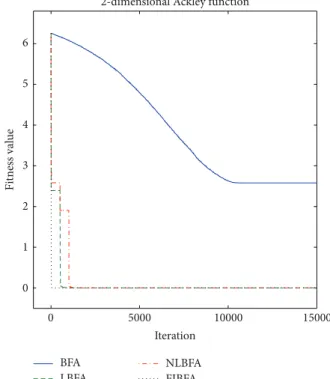
The function has global minimum at 𝑥𝑖 = [0, 0, . . . , 0] with fitness𝑓(𝑥) = 0. The Ackley function was considered with dimension 𝑛 = 2 and variable 𝑥𝑖 in the range [−32.768, 32.768]. The total number of chemotaxis,𝑁𝑐= 500, total number of reproduction,𝑁re = 6, and total number
of elimination and dispersal,𝑁ed = 6, were chosen for all
algorithms while bacteria step size𝐶 = 0.00005was selected for BFA. The parameters for LBFA were defined as𝐶max= 1, 𝑞 = 1, and𝑚 = 0.5and for NLBFA the parameters were defined as 𝐶max = 1, 𝑞 = 1, 𝑚 = 0.5, and 𝑛 = 2. The parameters for FIBFA were𝐶max = 0.99,𝑞 = 1, 𝑚 = 1, 𝑛 = 1, 𝑎 = 1, and𝑝 = 1. The convergence plot for two-dimensional Ackley function is depicted in Figure1. Notice
0 1 2 3 4 0
50 100
150 10-dimensional Rastrigin function
Iteration Fi tnes s val u e BFA LBFA NLBFA FIBFA ×104
Figure 4: Convergence plot for Rastrigin function.
Tail rotor Main rotor Counterbalance Pitch axis Yaw axis Pitch angle Interface PC z x y 𝜃 𝜓Yaw angle TRMS33-220
Figure 5: Schematic diagram of a twin rotor system [14].
+ Adaptive bacteria foraging algorithm Parametric model Twin rotor system u(t) y(t) e(t) ̂y(t) − ∑
Figure 6: Modelling approach for twin rotor system.
0 500 1000 1500 0 50 100 150 200 250 300
Convergence plot for TRMS vertical channel
Iteration Fi tnes s val u e 1350 1400 1450 1500 1550 6 8 10 12 14 16 BFA LBFA NLBFA FIBFA
Figure 7: Comparison of convergence plots in modelling phase.
that FIBFA achieved the fastest convergence speed and all the proposed algorithms performed better than BFA.
3.2. Unimodal Sphere Function. Sphere function is defined as
𝑓 (𝑥) =∑𝑛
𝑖=1
𝑥𝑖2. (5)
The function has global minimum at 𝑥𝑖 = [0, 0, . . . , 0] with fitness𝑓(𝑥) = 0. The Sphere function was considered with 30 dimensions and variable𝑥𝑖in the range[−5.12, 5.12]. The parameters𝑁𝑐 = 1000, 𝑁re = 6, and 𝑁ed = 6were
chosen for all algorithms while bacteria step size𝐶 = 0.002 was selected for BFA. The parameters for LBFA were defined as𝐶max = 1,𝑞 = 1, and𝑚 = 0.1while𝐶max = 1,𝑞 = 1, 𝑚 = 0.1, and𝑛 = 0.8for NLBFA. The parameters for FIBFA were𝐶max= 1,𝑞 = 1,𝑚 = 0.1,𝑛 = 0.8,𝑎 = 0.1, and𝑝 = 0.1. The convergence plot for 30-dimensional Sphere function is depicted in Figure2. Notice that the NLBFA had better convergence speed compared to FIBFA, LBFA, and BFA.
3.3. Multimodal Shubert Function. Shubert function is
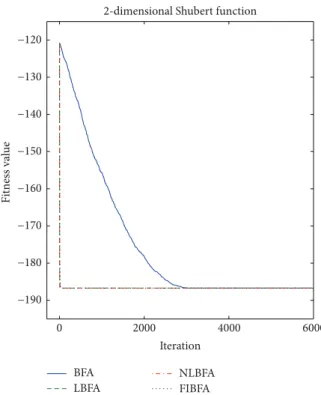
defined as 𝑓 (𝑥) =∑5 𝑖=1 𝑖cos((𝑖 + 1) 𝑥1+ 𝑖) 5 ∑ 𝑖=1 𝑖cos((𝑖 + 1) 𝑥2+ 𝑖) . (6) The function has global minima at various locations with fitness𝑓(𝑥) = −186.7309 and is considered with variables 𝑥1and𝑥2each in the range[−10, 10]. The parameters𝑁𝑐 =
0 2000 4000 6000 0
0.5
1 TRMS vertical channel response
Sample V er tica l c h an nel (rad) Actual BFA LBFA NLBFA FIBFA −0.5 −1
Figure 8: Comparison of vertical channel responses in modelling phase.
Table 1: The best fitness of the BFA, LBFA, NLBFA, and FIBFA on the benchmark functions.
Algorithm Ackley Sphere Shubert Rastrigin
BFA 2.5799 0.0033 −186.7309 21.8891
LBFA 3.2 × 10⁻⁶ 5.2 × 10⁻⁴ −186.7309 4.9748
NLBFA 2.7 × 10⁻⁸ 1.8 × 10⁻⁴ −186.7309 5.9698 FIBFA 4.4 × 10⁻¹⁵ 1.1 × 10⁻⁷ −186.7309 2.3601
1000,𝑁re = 7, and𝑁ed = 7were chosen for all algorithms
while bacteria step size𝐶 = 0.000045was selected for BFA. The parameters for LBFA were defined as𝐶max = 1,𝑞 = 1, and𝑚 = 1while𝐶max = 1,𝑞 = 1,𝑚 = 1, and𝑛 = 1.3for NLBFA. The parameters for FIBFA were𝐶max= 0.008,𝑞 = 1, 𝑚 = 10,𝑛 = 2,𝑎 = 10, and𝑝 = 2. The convergence plot for a 2-dimensional Shubert function is depicted in Figure3. Note that FIBFA had smoother response compared to others.
3.4. Multimodal Rastrigin Function. Rastrigin function is
defined as
𝑓 (𝑥) =∑𝑛
𝑖=1
[𝑥2𝑖 − 10cos(2𝜋𝑥𝑖) + 10] . (7)
The function has global minimum at 𝑥𝑖 = [0, 0, . . . , 0] with fitness𝑓(𝑥) = 0. The Rastrigin function was considered with 10 dimensions and variable𝑥𝑖in the range[−5.12, 5.12]. The parameters𝑁𝑐= 1000,𝑁re= 7, and𝑁ed= 7were chosen
for all algorithms while bacteria step size𝐶 = 0.000045was selected for BFA. The parameters for LBFA were defined as
0 2000 4000 6000 0 0.05 Sample Er ro r
Error in modelling phase
−0.05
BFA LBFA
NLBFA FIBFA
Figure 9: Comparison of errors in modelling phase.
𝐶max = 1, 𝑞 = 0, and𝑚 = 0.1 while𝐶max = 1,𝑞 = 0, 𝑚 = 0.2, and𝑛 = 0.8for NLBFA. The parameters for FIBFA were𝐶max = 0.1, 𝑞 = 1,𝑚 = 0.09, 𝑛 = 1.9,𝑎 = 10, and 𝑝 = 3.1. The convergence plot for 10-dimensional Rastrigin function is shown in Figure4. Note that the FIBFA achieved the best accuracy compared to others.
Numerical values of the best fitness accuracy achieved by the algorithms under study are summarized in Table1.
Notice that, in Figures1,3, and4, the proposed adaptive BFA algorithms show spikes in the beginning of their con-vergence graphs as a result of setting large step size in the early iterations. However, towards the end of the iteration process, the figures show that the graphs become smoother and display higher convergence speed and better accuracy. Table1shows that FIBFA achieved the best fitness accuracy for Ackley, Sphere, and Rastrigin functions. On the other hand, all algorithms gave perfect result for Shubert function.
3.5. Modelling of Twin Rotor System. Twin rotor system is
a highly unstable nonlinear dynamic system, which is often used as a platform to test a controller. It is laboratory scale equipment that mimics a real helicopter in hovering mode. A schematic diagram of the twin rotor system is shown in Figure5. The main rotor moves the system up and down while the tail rotor rotates the system horizontally about yaw axis. Complex body construction and inputs multi-outputs nature cause the dynamic modelling for the vertical and horizontal channels of the twin rotor system is difficult.
An effective solution to model such a system is through system identification approach. The advantage of this method is that a complex dynamic system can be modelled accurately
0 500 1000 1500 2000 −1
−0.5 0 0.5
1 Vertical channel response in validation phase
Iteration V er tica l c h an nel (rad) Actual BFA LBFA NLBFA FIBFA
Figure 10: Comparison of vertical channel responses in validation phase.
even when there is no prior information about the physical system available [14]. Moreover, through incorporation of optimization algorithm, the optimum parameters of the model may be determined effectively. A schematic diagram for modelling of twin rotor system in hovering mode (vertical channel) optimized by adaptive bacteria foraging algorithms is represented in Figure6, wherê𝑦(𝑡)is the estimated output while𝑦(𝑡)and 𝑢(𝑡)are recorded output-input from exper-imental exercise. In this work, a fifth-order ARX structure is considered for modeling of vertical channel of twin rotor system. The ARX model can be represented in discrete transfer function form as
̂𝑦𝑧 = 𝑏1𝑧7+ 𝑏2𝑧6+ 𝑏3𝑧5+ ⋅ ⋅ ⋅ + 𝑏7𝑧 + 𝑏8
𝑧8+ 𝑎
1𝑧7+ 𝑎2𝑧6+ ⋅ ⋅ ⋅ + 𝑎7𝑧1+ 𝑎8.
(8) Therefore, there were 10 parameters required to be opti-mized making it a 10-dimensional problem. In this modelling task, as a matter of comparison,𝑆 = 10,𝑁𝑠 = 4,𝑁𝑐 = 100, 𝑁re = 4,𝑁ed = 4, and initial position of bacteria were kept
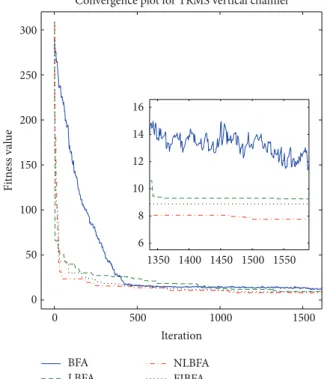
the same for all algorithms. This provides equal chances for the algorithms to trace the global optimum point. Moreover, for simplicity, 𝐶max = 1 was chosen for all problems in determining adaptive step size of bacteria. The constant step size𝐶 = 0.00575was selected for BFA. The parameters for LBFA were defined as𝑞 = 0and 𝑚 = 0.7while𝑞 = 0, 𝑚 = 0.5, and𝑛 = 0.8for NLBFA. The parameters for FIBFA were 𝐶max = 0.1, 𝑞 = 1, 𝑚 = 0.6, 𝑛 = 0.8, 𝑎 = 1, and𝑝 = 0.8. The comparisons of convergence plot, vertical channel response, and modelling error for all optimization
0 500 1000 1500 2000 −0.06 −0.04 −0.02 0 0.02 0.04
0.06 Error in validation phase
Sample Er ro r BFA LBFA NLBFA FIBFA
Figure 11: Comparison of errors in validation phase.
Table 2: Performance of the BFA, LBFA, NLBFA, and FIBFA in modelling twin rotor system.
Algorithm Fitness accuracy Error range in modelling phase Error range in validation phase BFA 11.4488 [−0.0329 0.0347] [−0.0706 0.0453] LBFA 9.2216 [−0.0343 0.0270] [−0.0405 0.0378] NLBFA 8.2616 [−0.0400 0.0321] [−0.0710 0.0407] FIBFA 9.4190 [−0.0306 0.0263] [−0.0617 0.0400]
algorithms, in the modelling phase, are depicted in Figures7,
8, and9, respectively.
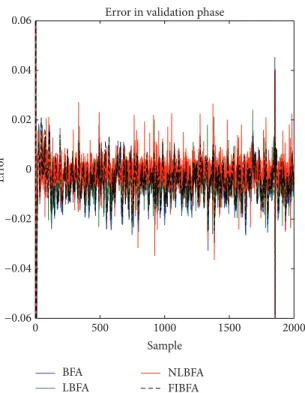
On the other hand, the comparisons of vertical channel response, its corresponding error, and power spectral density, in validation phase, are shown in Figures 10, 11, and 12, respectively.
Notice that all the proposed adaptive algorithms con-verged faster than standard BFA. Moreover, NLBFA had the best fitness accuracy of 8.2616 followed by LBFA, FIBFA, and BFA, with best fitnesses of 9.2216, 9.4190, and 11.4488, respectively. The vertical channel responses in modelling and validation phases show that all the algorithms successfully followed the actual response with very small error. It can be clearly seen from Figures9and11that LBFA had the smallest error range.
The numerical values of the time domain response in both modelling and validation phases are summarized in Table2. The table reveals that LBFA had the smallest error range. The power spectral density plot in validation phase shows that the acquired model had dominant mode frequency at 0.35 Hz, which is consistent with the previously reported work [14].
0 1 2 3 4 5 Power spectral density for vertical channel
Frequency (Hz) P o w er s p ec tr al den si ty (dB/H z) BFA LBFA NLBFA FIBFA 100 10−2 10−4 10−6
Figure 12: Comparison of power spectral densities in validation phase.
4. Conclusion
Novel linear and nonlinear adaptive bacteria foraging algo-rithms have been proposed. The introduction of adaptive schemes into bacteria foraging algorithm balances the explo-ration and exploitation parts and hence provides more efficient search strategy. Simulations with unimodal and multimodal benchmark functions with various dimensions have shown that the proposed algorithms improve the speed of convergence and fitness accuracy which implies that the proposed schemes find better optimum point in shorter time. Moreover, the application of the proposed algorithms to estimate a high order dynamics model for vertical channel of twin rotor system has shown that the proposed algorithms outperform their predecessor algorithm in terms of fitness accuracy, time domain, and frequency domain responses of the estimated model. The application of the proposed algorithm to other real world problems such as optimization of intelligent controller parameters for flexible systems will be investigated in future studies.
Conflict of Interests
The authors declare that there is no conflict of interests regarding the publication of this paper.
Acknowledgments
Ahmad Nor Kasruddin Nasir is on study leave from Faculty of Electrical & Electronics Engineering (FKEE), Universiti
Malaysia Pahang (UMP), and is sponsored by Ministry of Higher Education (MOHE), Malaysia.
References
[1] K. M. Passino, “Biomimicry of bacterial foraging for distributed optimization and control,”IEEE Control Systems Magazine, vol. 22, no. 3, pp. 52–67, 2002.
[2] S. Mishra, “A hybrid least square-fuzzy bacterial foraging strategy for harmonic estimation,”IEEE Transactions on Evo-lutionary Computation, vol. 9, no. 1, pp. 61–73, 2005.
[3] H. Supriyono and M. O. Tokhi, “Adaptation schemes of chemotactic step size of bacterial foraging algorithm for faster convergence,”Journal of Artificial Intelligence, vol. 4, no. 4, pp. 207–219, 2011.
[4] C. Venkaiah and D. M. Vinod Kumar, “Fuzzy adaptive bacte-rial foraging congestion management using sensitivity based optimal active power re-scheduling of generators,”Applied Soft Computing Journal, vol. 11, no. 8, pp. 4921–4930, 2011.
[5] R. Majhi, G. Panda, B. Majhi, and G. Sahoo, “Efficient prediction of stock market indices using adaptive bacterial foraging opti-mization (ABFO) and BFO based techniques,”Expert Systems with Applications, vol. 36, no. 6, pp. 10097–10104, 2009. [6] S. Dasgupta, S. Das, A. Abraham, and A. Biswas, “Adaptive
computational chemotaxis in bacterial foraging optimization: an analysis,”IEEE Transactions on Evolutionary Computation, vol. 13, no. 4, pp. 919–941, 2009.
[7] Y. Chen and W. Lin, “An improved bacterial foraging optimiza-tion,” inProceedings of the IEEE International Conference on Robotics and Biomimetics (ROBIO ’09), pp. 2057–2062, Guangxi, China, December 2009.
[8] I. A. Farhat and M. E. El-Hawary, “Modified bacterial foraging algorithm for optimum economic dispatch,” inProceedings of the IEEE Electrical Power and Energy Conference (EPEC ’09), pp. 1–6, Montreal Quebec, Canada, October 2009.
[9] W. Huang and W. Lin, “Parameter estimation of Wiener model based on improved bacterial foraging optimization,” in Proceed-ings of the International Conference on Artificial Intelligence and Computational Intelligence (AICI ’10), pp. 174–178, Sanya, China, October 2010.
[10] Y. Chu, H. Mi, H. Liao, Z. Ji, and Q. H. Wu, “A fast bacterial swarming algorithm for high-dimensional function optimiza-tion,” in Proceedings of the IEEE Congress on Evolutionary Computation (CEC ’08), pp. 3135–3140, Hong Kong, China, June 2008.
[11] B. Niu, Y. Fan, P. Zhao, B. Xue, L. Li, and Y. Chai, “A novel bacterial foraging optimizer with linear decreasing chemotaxis step,” in Proceedings of the 2nd International Workshop on Intelligent Systems and Applications (ISA ’10), pp. 1–4, Wuhan, China, May 2010.
[12] X. Yan, Y. Zhu, H. Chen, and H. Zhang,Improved Bacterial Foraging Optimization with Social Cooperation and Adaptive Step Size, Springer, Berlin, Germany, 2012.
[13] X. Xu, Y. H. Liu, A. M. Wang, G. Wang, and H. L. Chen, “A new adaptive bacterial swarm algorithm,” inProceedings of the 8th International Conference on Natural Computing (ICNC ’12), pp. 991–995, Chongqing, China, May 2012.
[14] S. F. Toha, S. Julai, and M. O. Tokhi, “Ant colony based model prediction of a twin rotor system,”Procedia Engineering, vol. 41, pp. 1135–1144, 2012.
Submit your manuscripts at
http://www.hindawi.com
Computer Games Technology International Journal of
Hindawi Publishing Corporation
http://www.hindawi.com Volume 2014
Hindawi Publishing Corporation
http://www.hindawi.com Volume 2014 Distributed Sensor Networks International Journal of Advances in
Fuzzy
Systems
Hindawi Publishing Corporation
http://www.hindawi.com Volume 2014
International Journal of Reconfigurable Computing
Hindawi Publishing Corporation
http://www.hindawi.com Volume 2014
Hindawi Publishing Corporation
http://www.hindawi.com Volume 2014
Applied
Computational
Intelligence and Soft
Computing
Advances inArtificial
Intelligence
Hindawi Publishing Corporation http://www.hindawi.com Volume 2014 Advances in Software EngineeringHindawi Publishing Corporation
http://www.hindawi.com Volume 2014
Hindawi Publishing Corporation
http://www.hindawi.com Volume 2014 Electrical and Computer Engineering
Journal of Journal of
Computer Networks and Communications
Hindawi Publishing Corporation
http://www.hindawi.com Volume 2014 Hindawi Publishing Corporation
http://www.hindawi.com Volume 2014
Multimedia
International Journal of
Biomedical Imaging
Hindawi Publishing Corporation
http://www.hindawi.com Volume 2014
Artificial
Neural Systems
Advances in
Hindawi Publishing Corporation
http://www.hindawi.com Volume 2014
Robotics
Journal ofHindawi Publishing Corporation
http://www.hindawi.com Volume 2014 Hindawi Publishing Corporationhttp://www.hindawi.com Volume 2014 Computational Intelligence and Neuroscience
Hindawi Publishing Corporation
http://www.hindawi.com Volume 2014
Modelling & Simulation in Engineering
Hindawi Publishing Corporation
http://www.hindawi.com Volume 2014
The Scientific
World Journal
Hindawi Publishing Corporation
http://www.hindawi.com Volume 2014
Hindawi Publishing Corporation
http://www.hindawi.com Volume 2014 Human-Computer Interaction
Advances in
Computer EngineeringAdvances in
Hindawi Publishing Corporation