CONTENTS
Executive Summary ... 1
Introduction ... 7
Part I: Health IT in Different Countries ... 8
Adoption of Electronic Health Record Systems ... 9
Adoption of EHR Systems by Primary Care Providers ... 9
Adoption of EHR Systems by Hospitals ... 10
Adoption of Computerized Physician Order Entry Systems ... 11
Adoption of CPOE Systems by Primary Care Physicians ... 11
Adoption of CPOE Systems in Hospitals ... 12
Use of Electronic Prescribing... 13
Availability of Online Health Portals ... 15
Implementation of Telehealth ... 20
Teleradiology ... 22
Part II: Lessons from Global Leaders in Health IT ... 24
National Leadership to Promote Health IT Adoption ... 24
Health Care System Organization and Financing ... 27
Financial Incentives for Health IT ... 28
Government Mandates to Spur Health IT ... 30
Size of a Country’s Population ... 31
Structural Issues in the Health Care Sector ... 31
Societal and Cultural Factors Related to Health IT ... 33
Privacy Issues Related to Health IT Systems ... 34
Policies to Support Telehealth ... 36
Common Health IT Infrastructure ... 37
Robust Standards to Support Health IT ... 40
Use of Unique Patient Identifiers ... 42
Part III: Conclusion... 44
Part IV: Recommendations for U.S. Policymakers ... 45
List of Tables
Table 1: Use of EHR Systems by Primary Care Physicians ... 10
Table 2: Use of EHR Systems in Hospitals ... 11
Table 3: Use of Electronic Ordering of Laboratory Tests by Primary Care Physicians ... 12
Table 4: Use of CPOE Systems in Hospitals ... 13
Table 5: Use of Electronic Prescribing by Primary Care Physicians ... 14
Table 6: Electronic Transmission of Prescriptions by Primary Care Physicians ... 15
Table 7: Use of Internet-Enabled Monitoring Devices in U.S. Hospitals, by Condition ... 22
Table 8: Use of Unique Patient Identifiers in Seven Developed Countries ... 43
List of Boxes Box 1: Technologies for Reducing Medication Errors in Hospitals ... 16
Box 2: Nationally Standardized Machine-Readable Patient ID Cards in the United States ... 18
Box 3: Self-Serve Computer Kiosks in Hospitals ... 19
THE INFORMATION TECHNOLOGY AND INNOVATION FOUNDATION |SEPTEMBER 2009 PAGE 1
Perhaps no factor is more important in
explaining why some countries lead in
health IT adoption than strong
national-level leadership.
Executive Summary
reater use of information technology (IT) in health care can help achieve many health care reform goals. Health IT can improve the effectiveness and efficiency of health care by reducing costs, improving the quality of care, and increasing access to health care services and information. Health IT also contributes to broader health care goals such as creating a more patient-centric health care system by empowering individuals to better manage their own health care and enabling them to communicate more easily with their health care providers. Finally, health IT increasingly serves as the foundation for medical research, opening up new pathways for drug discovery and enabling comparative effectiveness research. However, progress in the adoption of health IT varies significantly between nations, suggesting that progress is not limited by the
costs, quality or usefulness of the technology, but rather by other factors that nations can influence.
The purpose of this report is to identify which countries
are leading in the
deployment of health IT and to draw lessons that might be useful for other countries. The first section of the report gives an overview of the current state of and trends in health IT adoption in the United States and several other developed countries. Our analysis of available literature and data indicate that three countries—Denmark, Finland, and Sweden—are definitively ahead of the United States and most other countries in moving forward with their health IT systems. These three Nordic countries have nearly universal usage of electronic health records (EHRs) among primary care providers, high rates of adoption of EHRs in hospitals, widespread use of health IT applications, including the ability to order tests and prescribe medicine electronically, advanced telehealth programs, and portals that provide online access to health information. All three countries have embraced IT as the foundation for reforming their
health care systems and have successfully implemented changes that reach every patient. These nations show the transformations possible in health care today through the greater use of IT. Any nation that is not at or ahead of this level is missing substantial opportunities.
The second section of the report identifies the factors that have led to success in these countries and the lessons that can be learned by other nations to drive health IT adoption. These factors include the following:
National leadership to promote health IT adoption. Perhaps no factor is more important in explaining why some countries lead in health IT adoption than strong national-level leadership. Implementing health IT involves a complex set of
relationships among
individuals and organizations with competing goals and
priorities. The global
leaders—Denmark, Finland,
and Sweden—have all
implemented national-level strategies to drive and coordinate health IT adoption. In contrast, the de facto strategy in the United States has focused on building the network from the bottom up by establishing regional health information organizations (RHIOs) or health information exchanges (HIEs). The U.S. approach, including its lack, up until now, of national-level executive leadership, has failed
to produce a nationwide system of
interoperable EHR systems. For example, the majority of these regional initiatives are not yet operational, with only 57 HIEs operational out of 193 active HIEs nationwide.1 Without strong national-level leadership, progress will likely continue to be incremental at best.
Health care system organization and financing. The organization of a country’s health care system and health care financing
G
THE INFORMATION TECHNOLOGY AND INNOVATION FOUNDATION |SEPTEMBER 2009 PAGE 2
Adoption of health IT in the United States
is made more difficult by the fact that over
two-thirds of physicians work in solo or
small group practices.
can have a significant impact on health ITadoption. In Denmark, Finland, and Sweden, and other countries with single-payer health care systems, the costs and benefits of investing in health IT systems are better aligned than they are in countries such as the United States, where multiple governmental and nongovernmental entities pay for health care. Moreover, in these nations governments can afford to take a longer term view and make investments that might not pay off fully in the short term. More government involvement in health care also leads to more accountability. One of the reasons that Finland and Denmark have achieved significantly higher rates of EHR adoption in hospitals than other countries is that their hospital systems are government-run. Thus, political leaders have direct accountability for the quality of the care delivered at these institutions, and the government can prioritize needed upgrades
and recoup public
investment in hospital IT systems.
Financial incentives for health IT. Researchers consistently identify the high initial cost of EHR systems as a barrier to
more widespread health IT adoption.2
Financial incentives for health IT adoption by health care providers therefore can be an effective policy tool, and they have been used effectively in Australia, Denmark, the Netherlands, and the United Kingdom, among others, to spur the use of health IT.
Government mandates to spur health IT. Many countries use government mandates to achieve broad or universal health IT adoption. Governments can mandate either the use of specific functionality or the use of specific technology. Denmark and Norway, for example, have achieved high rates of e-prescribing by making e-e-prescribing mandatory for primary care providers.3
Size of a country’s population. Large countries with a diverse group of stakeholders appear to be at a disadvantage when deploying health IT. Arguments can be made for both a positive and a negative correlation between a country’s population size and health IT adoption. On the one hand, economies of scale would suggest that deploying health IT in larger countries would be cheaper and thus larger countries would be more likely to have higher rates of health IT adoption. Conversely, smaller countries may be more likely to lead in health IT adoption because their smaller size allows easier coordination between various stakeholders. Indeed, a significant challenge with health IT is the difficulty of coordinating and bringing together various stakeholders to work towards a shared vision and overcome
obstacles such as interoperability.
Coordination is often easier in smaller countries in part because the ability to collaborate is closely related to the number of competing stakeholders, such as the
number of health IT
vendors. Some mid-sized nations, like the United Kingdom, have also been able to achieve a level of success coordinating the deployment of health IT because they have a more centralized health care system.
Structural issues in the health care sector. Several structural issues in the health care sector can have a significant impact on technology adoption including the average size of medical practices (larger practices make it easier to adopt health IT), the number of vendors for health IT systems (fewer vendors make it easier to adopt health IT), and the number of competing pharmacies (fewer pharmacies make it easier to adopt health IT). Consolidation to achieve economies of scale generally facilitates deployment of health IT. For example, Sweden was able to more easily introduce a national e-prescribing system because of the existing state monopoly on pharmacies. Adoption of health IT in the
THE INFORMATION TECHNOLOGY AND INNOVATION FOUNDATION |SEPTEMBER 2009 PAGE 3 United States is made more difficult by the fact
that over two-thirds of physicians work in solo or small group practices.4
Societal and cultural factors related to health IT. A number of factors, including the level of technological sophistication of the population, peer influences, and cultural norms, have a significant impact on health IT adoption. Denmark, Finland and Sweden all have a relatively technologically sophisticated population, a fact which contributes to high expectations from patients to have their doctors use IT in health care. In Denmark, for example, as early as 1998, patients would consider their doctor “second-rate” if he or she did not have a personal computer in the office.5 Peer pressure from other doctors to adopt health IT has also contributed to the mostly voluntary adoption of health IT in countries like Denmark and Sweden.
Privacy issues related to health IT systems. Concerns about medical privacy should not be used to impede adoption of health IT. Deploying EHR systems with robust technical controls, including encryption, electronic identification, and audit logs can improve the privacy and security of personal medical data. In Denmark, for example, patients have access to health information through the official Danish e-health portal Sundhed.dk and can control many privacy functions through this portal, including monitoring who has accessed or modified their personal medical records. As a result, privacy advocates generally supported efforts to implement health IT. In the United States, health privacy advocates have often opposed efforts to implement health IT and have succeeded in advocating for overly restrictive laws and rules that have limited implementation of health IT. In general, privacy regulations are most effective when they strike a balance by reassuring citizens that their privacy is being protected while not implementing restrictive measures that reduce data sharing and result in lower quality care.
Policies to support telehealth. Many nations have enacted policies designed to either encourage or impede the use of telemedicine including funding mechanisms, licensing and regulatory barriers. To support telemedicine, medical insurance reimbursement schedules need to include appropriate funding for telemedicine applications, interstate and international licensing standards should be promoted, and regulatory barriers should be minimized.
Common health IT infrastructure. Building shared IT infrastructure—that is, technology that can be used by multiple health care providers—helps lower costs and increase interoperability by creating a shared platform for health care organizations to use. Examples of common health IT infrastructure include shared EHR systems, online authentication services, electronic billing systems, secure e-mail, online portals, and health data networks. For example, Sweden has developed Sjunet, a national broadband network for the secure exchange of health information connecting all hospitals, primary care centers, and many other health centers. Sjunet is used for multiple clinical and administrative purposes in Sweden, including video-conferencing, teleradiology, secure e-mail, electronic data interchange, and e-learning in medical education.
Robust standards to support health IT. Robust standards are critical to the effective application of health IT and play an important role in spurring the use of new technology. To facilitate the standard-setting process, many governments actively engage with all stakeholders, including those from the private sector, to coordinate the development of
standards. In Denmark, for example,
MedCom, the Danish health care organization responsible for setting standards for health IT systems, acts as a coordinating body to bring together health care providers, laboratories, vendors, and others to develop interoperable standards.
THE INFORMATION TECHNOLOGY AND INNOVATION FOUNDATION |SEPTEMBER 2009 PAGE 4
Congress could fund the deployment and
evaluation of next-generation hospital IT
applications, including robotics, wireless
mobile technology, and RFID, in select
hospitals within the Veterans Health
Administration.
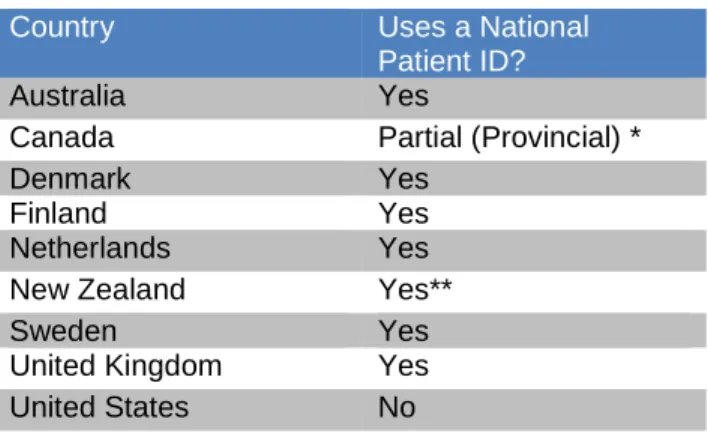
Use of unique patient identifiers. Unique patient identifiers help facilitate data sharing between different health care organizations and benefits of their use include reduced risk of medical error, improved efficiency, and better privacy protections for patients. The use of unique patient identifiers is common in many of the global leaders in health IT, including Denmark, Finland and Sweden. Notably, the United States has not adopted a system of unique patient identifiers—in large part because of unwarranted fears about a loss of privacy—a fact that has been identified as being a hindrance to using data from EHRs for research.6
Although there is no one-size-fits-all set of rules for achieving widespread health IT adoption, government policymakers can learn many lessons from the global health IT leaders about how to spur progress in modernizing
their health care systems. Some of the factors that
influence health IT,
including the type of health care system, are entrenched in the nation and not likely to change. Yet other factors, including organizational challenges, technical hurdles, and societal issues, are more
amenable to change by national policy. Our analysis demonstrates that national government policies can play an important role in shaping and facilitating a country’s health IT adoption and use, regardless of the structure and organization of that nation’s health care system. For example, the United States does not need to adopt a single-payer system to make more robust progress in health IT.
The United States has many opportunities to improve its use of health IT by learning from the global leaders in the field. Some of these lessons mentioned have already been implemented in the health IT provisions of the American Recovery and Reinvestment Act of 2009. Further actions for policymakers to spur use and maximize benefits of health IT include the following:
Provide strong national-level leadership on health IT. Every nation leading in health IT has a comprehensive national strategy for e-health, with clear metrics and goal posts to measure progress. Strong national leadership is needed for the United States to break through existing barriers on health IT adoption and
make progress towards a future of
interconnected health data systems.
Provide sufficient funding for health IT adoption. The American Recovery and Reinvestment Act of 2009 has provided a needed boost in funding for deploying EHR systems in the United States; however, additional funding may be necessary. If necessary, Congress should consider providing additional financial incentives, including entitlement spending and direct grants, or the use of mandates and penalties, to spur adoption of qualified EHR systems. Congress should also continue to fund pilot programs and demonstration projects for innovative, new applications of health IT,
including telemedicine,
health record data banks and
“smart” hospitals. For
example, Congress could fund the deployment and evaluation of next-generation hospital IT applications, including robotics, wireless mobile technology, and RFID, in select hospitals within the Veterans Health Administration.
Build and share tools for health IT. Although the United States has pursued a decentralized approach to building a nationwide system of interoperable EHRs, as other nations have demonstrated, policymakers should support efforts to build common infrastructure to spur more widespread adoption of health IT systems. In particular, the United States would likely benefit from the development of common infrastructure for routine tasks, such as electronic authentication for patients, which should be performed by
THE INFORMATION TECHNOLOGY AND INNOVATION FOUNDATION |SEPTEMBER 2009 PAGE 5 every health care information system. In cases
where de facto national tools have been developed by the private sector, the federal government can support these tools by actively using them.
Encourage the creation of health record data banks. Many countries appear to be moving towards a centralized repository for health information. Given the resistance to a government-run solution in the United States, health record data banks run by the private sector may offer a compelling, and perhaps even more effective, alternative. Health record data banks would help create the necessary market incentives to spur adoption of EHR systems and provide patients with a single portal through which they could get access to and manage their medical records. They would also allow patients to maintain control over their medical records.
Encourage personal health records with data sharing. A personal health record is a health record that is initiated and maintained by an individual. Individuals need access to their EHRs, maintained by health care providers, to use personal health record systems such as Microsoft HealthVault and Google Health, which help empower patients to make better health care decisions. To encourage the use of personal health records, Congress should require doctors to provide patients with a no-cost electronic copy of their health information upon request.7 In addition,
the Office of the National Coordinator for Health Information Technology in the U.S. Department of Health and Human Services should include the ability to export data to personal health record managers as part of the definition of “meaningful use” used to determine which EHR systems qualify for stimulus funding.
Address legitimate privacy concerns. Privacy advocates have raised many objections to health IT initiatives that have slowed progress with this technology in the United States. U.S. policymakers need to recognize
that some privacy objections have more to do with general issues concerning medical privacy than with specific technology. Taking a lesson from some of the global leaders in health IT, U.S. policymakers should encourage the use of technical controls to ensure privacy, such as the use of electronic identification, authentication and audit trails in health IT systems. In addition, a national discussion is needed so that policymakers and the public fully understand the costs that certain privacy measures impose on society and the benefits that come from a more liberal data-sharing environment, such as better use of decision support systems and improved medical research.
Eliminate barriers to health IT adoption. Policymakers in the United States must work to identify and overcome existing barriers to the adoption and use of health IT—including legislative, regulatory, and societal obstacles. Thus, for example, policy leaders must continue to work with the Drug Enforcement Administration to pass regulations to allow physicians to prescribe controlled substances electronically. In addition, the Centers for Medicare and Medicaid Services should be directed to ensure that it develops fair reimbursement regulations for telemedicine.
Leverage federal resources to support health IT initiatives. Congress should use the federal government’s substantial buying power to support health IT initiatives. For example, to help spur the adoption and use of health IT, Congress should cover the monthly access fees to participate in a health record data bank for all Medicare, Medicaid, and CHIP enrollees. In addition, Congress should require that health plan insurers for federal employees include access to health record data banks as part of their covered services. Because supporting broader use of health IT will lead to cost savings for health care payers, in this case the federal government, this strategy will help ensure a positive return on investment for federal health care dollars.
THE INFORMATION TECHNOLOGY AND INNOVATION FOUNDATION |SEPTEMBER 2009 PAGE 6
Encourage “in silico” health research. Ultimately health IT has the potential to dramatically improve the quality of medical research as more and more medical data is digitized. To benefit from the full potential of health informatics, the United States should develop the capability to share medical data for authorized research in a timely and efficient
manner.8 This includes developing a
comprehensive legal framework to address challenges to sharing research data, such as the appropriate use of de-identified medical data. Policymakers should also consider functional requirements for EHR systems to allow the secondary-use of medical data for research. Finally, health care leaders should work to develop a national data-sharing infrastructure to support health informatics research, including the development of rapid-learning health networks, rather than relying on the current system of isolated, project-specific research databases.9
Collaborate and partner with all stakeholders. Stronger federal leadership in health IT in the United States should not come at the expense of a collaborative relationship with other health care stakeholders. The federal government should work to bring together health care providers, insurers, and the health IT industry to spur meaningful use of e-health applications. The U.S. government must partner with the private sector to continue to develop standards and certification criteria for health IT systems. Health care providers must be involved throughout the planning and implementation stages to ensure widespread acceptance from physicians and health care workers. In addition, the United States should seek out more international partnerships to engage in the development of global standards for health IT and to continue to learn from the insights and experiences of the global leaders in health IT.
THE INFORMATION TECHNOLOGY AND INNOVATION FOUNDATION |SEPTEMBER 2009 PAGE 7
Introduction
ountries all over the world, large and small, rich and poor, have embraced health information technology (IT) as a critical component of health care reform. It has become increasingly clear to governments and health care leaders that IT is central to delivering high-quality health care, improving patient outcomes, and controlling health care costs. Health care around the world is entering the digital age, with applications of IT ranging from the use of IT to train nurses in Kenya to advanced telemedicine applications in Sweden.10 Although many countries
have made progress in deploying health IT on a national level, a few developed countries have emerged as global leaders. The global leaders in health IT not only have a high rate of usage of critical health IT applications such as electronic health records (EHRs) but also look to utilize IT at every step in the health care system.
The purpose of this report is to identify which countries are leading in the deployment of health IT and to draw lessons that might be useful for other countries. The report begins with an overview of the current state of and trends in health IT adoption in the United States and several other developed countries. The basis for any country’s e-health system is a robust system of EHRs. An EHR is a longitudinal electronic record of patient health information generated by one or more encounters in any health care delivery setting.11 An EHR is a critical and necessary
component of many advanced health care applications. The adoption of EHR systems generally occurs along two separate trajectories— one for primary care providers and one for hospitals. To identify the countries that are leading in health IT adoption, we analyze available data to see which nations are furthest along in both of these adoption paths. We also analyze several other indicators of progress in the adoption of health IT, including the adoption of computerized physician order entry (CPOE) systems that enable physicians to directly enter orders for medication and other medical care into a computer, electronic
prescribing, online health portals, and the use of telecommunication for health care or “telehealth” (also referred to as “telemedicine”).
Our analysis of available English-language literature and data indicate that three developed countries—Denmark, Finland, and Sweden—are definitively ahead of the United States and most other countries in moving forward with their health IT systems. These three Nordic countries have nearly universal usage of EHRs among primary care providers, high rates of adoption of EHRs in hospitals, widespread use of health IT applications, including the ability to order tests and prescribe medicine electronically, advanced telehealth programs, and portals that provide online access to health information. All three of these countries have embraced IT as the foundation for reforming their health care systems and have successfully implemented changes that reach every patient. Other developed countries, including Australia, the Netherlands, New Zealand, Norway, Singapore, and the United Kingdom, also have advanced health IT platforms. In addition, some countries, such as Spain and Italy, have regional health IT projects that rival the scope and complexity of some national projects. To be sure, no country has all of the answers or a perfect health care system. Neither does any one country lead across every metric. But all nations can learn from the leaders. The second half of the report analyzes the policies implemented by the Nordic and other developed countries that lead in health IT and evaluates factors that may have contributed to their success. The factors discussed include national leadership, health care system financing, financial incentives, government mandates, health IT infrastructure, and others. The report concludes with recommendations for the United States to learn from other nations’ successes in adopting and using health IT. The global leaders in health IT provide useful lessons for the United States and other nations that aspire to implement world-class health IT applications.
C
THE INFORMATION TECHNOLOGY AND INNOVATION FOUNDATION |SEPTEMBER 2009 PAGE 8
Part I: Health IT in Different Countries
n this section, we present our analysis, based on existing literature and data, of the United States’ and other developed countries’ progress with respect to several metrics of the adoption and use of health IT:
Adoption of electronic health record (EHR) systems. EHRs are critical and necessary components of many advanced health care applications, and EHR systems are the fundamental building blocks of any national health information system. Widely
deployed EHR systems can provide
population-level health information that can be used by epidemiologists and other researchers. Thus, a robust system of EHRs makes it feasible to use clinical data to improve health care.
Adoption of computerized physician order entry (CPOE) systems. CPOE systems are systems that enable physicians to enter orders for medication and other medical care (e.g., laboratory, microbiology, pathology, radiology tests) directly into a computer. Directly entering orders into a computer has the benefit of reducing errors by minimizing the ambiguity of hand-written orders, and the combination of CPOE and clinical decision support tools offers additional benefits.
Use of electronic prescribing. Electronic prescribing, or “e-prescribing,” is the computer-based generation of a prescription for medication, taking the place of paper and faxed prescriptions. Some e-prescribing systems allow a health care provider not only to enter the prescription electronically but also to transmit it electronically to the pharmacy.
Availability of online health portals. The development of patient-centric, online portals is in line with a broader trend in health care to use IT to create a more patient-centric approach to health care. Online health portals range from basic portals that provide patients with basic medical information on illnesses and
drugs, to more advanced portals that provide online access to health care services, to even more advanced portals that provide access to personalized medical information.
Applications of telehealth. Health care applications delivered via telecommunications, or “telehealth,” have great potential to facilitate the provision and receipt of high quality health care by reducing geographic barriers to care. Telehealth can be applied to almost any medical field from telepathology to telesurgery to teledermatology.
Comparing the progress of different countries with respect to health IT is challenging. Levels of health IT adoption are always changing, albeit gradually, and the publication of survey results typically lags data collection by a few months to a year or more. Moreover, direct comparisons between countries, even when data are available, are often complicated by divergent methodologies used to derive national statistics on the usage of certain technologies. The rate of adoption and use of the various technologies only tell part of the story— these numbers do not reflect the varying levels of quality of the information systems in use. Survey methods and definitions used in different studies may vary, making direct comparison inaccurate, and sometimes, even misleading. In addition, the quality of the data varies. Numerous studies analyzing the level of health IT adoption and usage throughout various countries have been published, and no single study can definitively capture the state of e-health systems in a nation.
Nonetheless, our analysis indicates that Denmark, Finland, and Sweden are definitively ahead of the United States and other countries in the deployment and use of health IT. It also shows that no single country leads or lags across every metric of success in health IT just as no single country leads or lags across every metric of success in its health care system (e.g., the United States has a high 5-year cancer survival rate but a low 5-year kidney transplantation survival rate).12 Countries
that do well on one metric of progress in health IT
THE INFORMATION TECHNOLOGY AND INNOVATION FOUNDATION |SEPTEMBER 2009 PAGE 9
The adoption of EHR systems generally
occurs along two separate trajectories—one
for primary care providers and one for
hospitals.
do not always do well on others (e.g., Finland hasone of the highest rates of adoption of EHRs yet has no system in place for transmitting prescriptions electronically from physicians to pharmacies).
Adoption of Electronic Health Record Systems
The adoption of EHR systems generally occurs along two separate trajectories—one for primary care providers and one for hospitals. To identify the leaders in health IT adoption for this report, we analyzed available data to see which nations were furthest along in both of these adoption paths. Some EHR systems are far more sophisticated than others.
As early as 1991, the Institute of Medicine envisioned an EHR as “an electronic patient record that resides in a system specifically designed to support users through availability of complete
and accurate data,
practitioner reminders and alerts, clinical decision support systems, links to
bodies of medical
knowledge, and other aids.”13
More recently, a study
commissioned by the
principal federal entity charged with coordination of nationwide efforts to implement and use the most advanced health IT in the United States—the Office of the National Coordinator for Health Information Technology (ONC) in the U.S. Department of Health and Human Services (HHS)—identified four functional criteria for EHR systems: (1) collecting patient demographic and clinical information; (2) displaying and managing laboratory test results; (3) allowing health care providers to enter orders for medication and other medical care (e.g., laboratory, microbiology, pathology, radiology tests) and (4) supporting clinical decisions (e.g., through computer reminders and alerts to improve the diagnosis and care, including screening for correct drug selection and dosing, preventive health reminders for vaccinations and screenings, and clinical guidelines for treatment).14
Not all EHR systems currently in existence include all of these capabilities. Thus, for example, some EHR systems allow a provider to record patients’
demographic and clinical information
electronically but do not offer clinical decision support at the point of care. EHR systems also vary as to whether they store data centrally or distribute data across multiple information systems. Finally, the level of interoperability and portability of the electronic records stored in EHR systems varies greatly from one system to another.
Adoption of EHR Systems by Primary Care Providers
Our analysis of the use of EHR systems by primary care providers in Australia, Canada,
Denmark, Finland, Germany, Japan, the
Netherlands, New Zealand, Sweden, the United Kingdom, and the United States is based on data drawn from multiple sources. For seven countries—Australia, Canada, Germany, the Netherlands, New Zealand, the United Kingdom, and
the United States—the
primary source of data is a survey of primary care providers on their use of IT in their practices that was conducted on behalf of the Commonwealth Fund by Harris Interactive between February and July 2006.
That survey yielded a comprehensive,
multinational data set on the use of EHR systems by primary care providers in these seven countries.15 For Denmark, Finland, Sweden, and Japan, four countries that were not included in that survey, we used other data sources.16
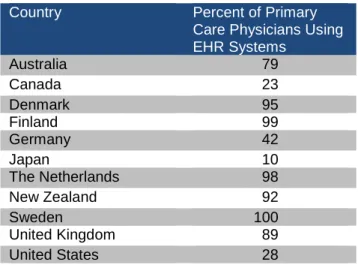
As shown in Table 1, the global leaders in the adoption and use of EHR systems by primary care physicians in our analysis were Sweden, Finland, the Netherlands, and Denmark, where EHRs were used, respectively, by 100 percent, 99 percent, 98 percent, and 95 percent of primary care physicians. Other countries leading in the adoption of EHR systems by primary care physicians were New Zealand, and the United Kingdom, all with EHR adoption rates among primary care physicians of close to 90 percent.
THE INFORMATION TECHNOLOGY AND INNOVATION FOUNDATION |SEPTEMBER 2009 PAGE 10 The United States was far behind the global
leaders. In 2006, only 28 percent of primary care doctors in the United States reported using an EHR system. Measurements of the level of adoption of EHRs among primary care providers in the United States vary based on a variety of factors such as size of practice (small or large) or setting (outpatient or inpatient care). The 2005 National Ambulatory Medical Care Survey, for example, found that EHR adoption rates among primary care physicians in the United States for at least partial use of an EHR ranged from 16 percent for solo practitioners to 46 percent among physicians in practices with more than 10 physicians. When an EHR system was defined as a more comprehensive system that provides “health information and data, results management, order entry and support, and decision support,” EHR adoption rates by primary care physicians in the United States in 2006 dropped to 4 percent in solo practices and 21 percent in practices with 11 or more physicians.17
Table 1: Use of EHR Systems by Primary Care Physicians
Adoption of EHR Systems by Hospitals
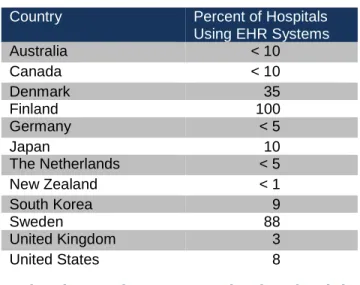
As shown in Table 2, our analysis indicates that Finland, Sweden, and Denmark are clearly among the global leaders in adoption of EHR systems by hospitals. In Finland, 100 percent of hospitals have adopted EHR systems.18 In Sweden, 88 percent of
all medical records in hospitals are digital, far surpassing the progress of most other countries.19 In Denmark, 35 percent of hospitals use EHR
systems.20 Finland has shown perhaps the most
remarkable success in deploying EHR systems in hospitals. In 1999, only 4 of the 21 hospital administrative districts in Finland had deployed any EHR systems; as of 2007, EHR systems were in use in all 21 of Finland’s hospital districts. More impressively, 19 of the hospital districts reported that the intensity of usage was over 90 percent. The intensity measures the degree to which actions are electronic; in this case 9 out of every 10 patient records were recorded electronically.21
In most countries, the rates of adoption of EHR systems by hospitals have been much lower than EHR adoption rates among primary care physicians. Even in the Netherlands where 98 percent of primary care physicians use EHR systems, the EHR adoption rate in hospitals is below 5 percent. A 2008 assessment of health IT use in seven nations by Jha et al. found that none of the countries reviewed—the United States, Canada, the United Kingdom, Germany, the Netherlands, Australia, and New Zealand—had hospital-based EHR use greater than 10 percent.22
The study noted two primary reasons for this slow progress: first, policymakers in most of these countries have shown little interest in modernizing hospitals; second, hospitals often have legacy systems that must be integrated, often with much expense, with newer EHR systems.
Japan has also had little success deploying EHR systems in hospitals. A 2008 study in Japan found that 10 percent of hospitals had adopted an EHR system, but the rate of adoption was much higher at public hospitals and university hospitals.23 Public
hospitals and university hospitals both tend to be larger institutions. It is unclear whether the size of the institution or the type was a determining factor.
The lack of progress in modernizing hospitals can certainly be seen in the United States. A study released in 2009 found that 7.6 percent of acute care hospitals in the United States had EHRs present in at least one clinical unit and that only 1.5 percent of acute care hospitals in the United States had implemented EHRs in all clinical units.24 That study also found that “hospitals were
Country Percent of Primary
Care Physicians Using EHR Systems Australia 79 Canada 23 Denmark 95 Finland 99 Germany 42 Japan 10 The Netherlands 98 New Zealand 92 Sweden 100 United Kingdom 89 United States 28
THE INFORMATION TECHNOLOGY AND INNOVATION FOUNDATION |SEPTEMBER 2009 PAGE 11 more likely to report having an electronic-records
system if they were larger institutions, major teaching hospitals, part of a larger hospital system, or located in urban areas and if they had dedicated coronary care units.”25 It found no correlation
between hospitals’ rate of adopting EHRs and whether the hospitals were public or privately owned.
Table 2: Use of EHR Systems in Hospitals
Country Percent of Hospitals
Using EHR Systems
Australia < 10 Canada < 10 Denmark 35 Finland 100 Germany < 5 Japan 10 The Netherlands < 5 New Zealand < 1 South Korea 9 Sweden 88 United Kingdom 3 United States 8
Adoption of Computerized Physician Order Entry Systems
One potential benefit of using IT in health care is reducing medical errors. In 1999, a study by the Institute of Medicine estimated that between 44,000 to 98,000 people in the United States die every year as a result of medical errors.26 This
statistic has since been disputed, but there is little question that more progress is needed to improve patient safety.27 A variety of IT-based applications
can improve patient safety by providing feedback to medical providers on potential hazards and best practices. Among these are computerized physician order entry (CPOE) systems. As noted earlier, CPOE systems enable physicians to enter orders for medical care ranging from prescription medicine to orders for medical tests into a computer rather than on paper; these orders are then integrated with patient information, including laboratory and prescription information.28 CPOE
systems can help reduce medical errors by improving the legibility of medical orders,
increasing access to on-demand medical
information, and warning of potential adverse drug
effects. In many developed countries, the adoption rate of CPOE in primary care practices corresponds to the adoption rate of EHR systems for the simple reason that that many EHR systems include this functionality.
The use of CPOE to improve patient care has been endorsed by a variety of organizations in the United States, including the Institute of Medicine and the Leapfrog Group.29 The Leapfrog Group,
for example, identifies CPOE use as the top priority safety initiative for hospitals and estimates 522,000 serious medical errors could be avoided annually in the United States if all non-rural hospitals used CPOE.30 Clinical decision support
systems in CPOE systems can integrate patient information to indicate, for example, if a new prescription will likely interfere with other medications or conditions. In addition to improving patient safety, CPOE can help reduce costs and increase operational efficiency. Although the level of adoption of CPOE provides a good indicator of progress, the effectiveness of CPOE systems depends on the skill with which the system has been integrated into a medical practice’s workflow and procedures. Indeed, a CPOE system should not be thought of as a “plug-and-play” technology, but instead a health care tool that is only as effective as those wielding it.
Adoption of CPOE Systems by Primary Care Physicians
One indicator of a successful implementation of CPOE systems among primary care providers is the ability of primary care physicians to place orders for medical tests (e.g. laboratory, microbiology, pathology, radiology tests) electronically. (Another indicator of the successful
implementation of CPOE use, electronic
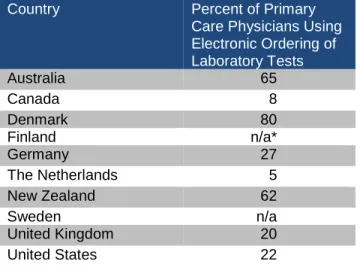
prescribing, is discussed in a separate section below.) As shown in Table 3, using the ability of primary care physicians to order medical tests electronically as a proxy for the use of CPOE among primary care providers, we find that Denmark leads in this area. Approximately 80 percent of primary care providers in Denmark report being able to order medical tests electronically.31
THE INFORMATION TECHNOLOGY AND INNOVATION FOUNDATION |SEPTEMBER 2009 PAGE 12 Finland has not published data on primary care
doctors’ ability to order laboratory tests electronically, but 72 percent of primary health care centers in that country have the capability to receive laboratory results electronically.32 For
Sweden, we were unable to locate data on the ability of primary care doctors to order laboratory tests electronically; however, one scholar notes that “most GPs receive laboratory results from hospitals over local networks but few are sending their lab requests electronically.”33 Other
developed countries that rank high in the routine use of computers to order medical tests among primary care providers include Australia and New Zealand, with adoption rates of 65 percent and 62 percent, respectively.34 The United States lags these nations in the ability of primary care physicians to order medical tests electronically, as it does in the adoption of EHR systems. Only 22 percent of primary care providers use CPOE systems to order medical tests.35
Table 3: Use of Electronic Ordering of Laboratory Tests by Primary Care Physicians
Country Percent of Primary
Care Physicians Using Electronic Ordering of Laboratory Tests Australia 65 Canada 8 Denmark 80 Finland n/a* Germany 27 The Netherlands 5 New Zealand 62 Sweden n/a United Kingdom 20 United States 22
* Although Finland has not published data on the ability of primary care doctors to order laboratory tests electronically, 72 percent of primary health care centers in that country have the capability to receive laboratory results electronically.
Other nations where the use of electronic ordering of laboratory results is low include Germany and Canada, with adoption rates of 27 percent and 8 percent respectively.36 Interestingly, the
Netherlands, a leader in the use of EHR systems, ranks low in this category too, with only 5 percent
of primary care providers reporting the ability to order medical tests electronically. One explanation for this situation is that many laboratories in the Netherlands did not see the short-term value of implementing a system that would enable primary care physicians to order medical tests electronically because in most cases a physical transfer would still need to occur—i.e., either a patient or a sample would have to be sent to the laboratory. Instead, laboratories in the Netherlands invested in information systems to share data. Given that 72 percent of primary care providers in the Netherlands report the ability to receive laboratory results electronically, this program appears to have been a successful one. At present, however, a new laboratory program is under development in the Netherlands that includes the electronic ordering of medical tests.37
Adoption of CPOE Systems in Hospitals
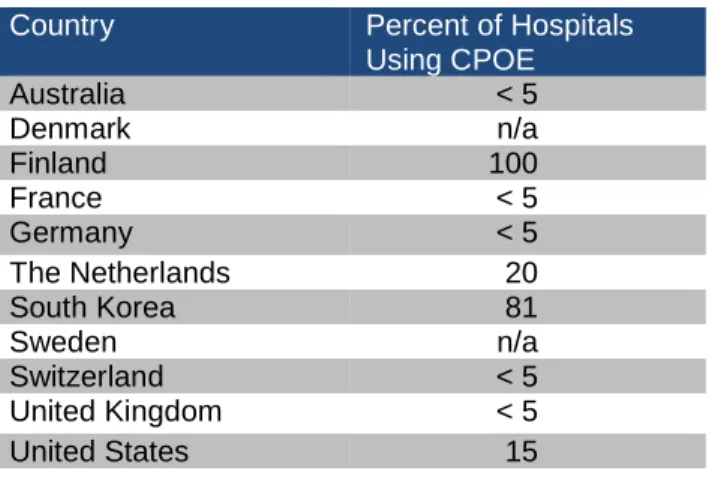
Although the value of CPOE systems is likely to be amplified in a hospital setting where patients interact with multiple caregivers, Table 4 shows that most countries’ progress in deploying CPOE systems in hospitals has been slow. The exception is South Korea, which reports that CPOE systems are available in 81 percent of hospitals—an unexpectedly high rate given the low level of EHR adoption in hospitals in that country.38 In contrast,
six of the countries reviewed in a 2008 study by Jha et al.—Australia, Canada, Germany, the Netherlands, New Zealand, and the United Kingdom—did not have hospital CPOE adoption rates above 5 percent; the United States had a slightly higher hospital CPOE adoption rate, in the range of 5 percent to 10 percent.39 A 2009 survey
of the literature from seven countries similarly
found that Australia, France, Germany,
Switzerland, and the United Kingdom had hospital CPOE adoption rates of less than 5 percent; but it found that the United States had a hospital CPOE adoption rate of approximately 15 percent; and the Netherlands had a hospital CPOE adoption rate of 20 percent.40
Other surveys of CPOE use in U.S. hospitals have reached similar conclusions. A 2002 survey of U.S. hospitals found that 9.6 percent of hospitals reported full availability of a CPOE system and 6.5
THE INFORMATION TECHNOLOGY AND INNOVATION FOUNDATION |SEPTEMBER 2009 PAGE 13 percent reported partial availability. More striking
was that of the hospitals that had implemented a CPOE system, only 46.2 percent of them required physicians to use the systems. The remainder of the hospitals either encouraged, but did not require its use, or made usage optional.41 A more recent
study in 2009 found that CPOE for medication had been implemented in 17 percent of hospitals.42 One factor contributing to the low level of adoption of CPOE systems by hospitals in most countries is that integrating CPOE systems in the hospital environment, which typically already has some information systems, is complex.43
Explanations for the low levels of adoption of CPOE in American hospitals have centered primarily on the high cost of such systems. In fact, some studies have concluded that a CPOE system does not pay for itself, although it does lead to better patient outcomes, more hospital efficiency, and other potential benefits, including reduced malpractice costs.44 Cost alone, however, does not
explain the low levels of CPOE adoption in hospitals in the United States. One study found that the primary determinant of whether a hospital invested in a CPOE system in the United States was hospital ownership. Government hospitals in the United States were “three times as likely as nonprofit hospitals and seven times as likely as for-profit hospitals to satisfy the requirements for a ‘good early-stage effort.’”45 CPOE use is not a
federal requirement for hospitals, but various states have implemented patient safety mandates requiring hospitals to take steps to reduce medical errors, which can include implementing CPOE. Further progress in the United States will likely require additional financial incentives for CPOE systems, increasing doctor acceptance of such systems and a renewed focus by hospitals on patient safety.
The use of CPOE in hospitals appears to be higher in the Nordic countries of Denmark, Finland, and Sweden than in many other countries, although we could not find comparable data for each country. Denmark ranks high in hospitals’ use of CPOE, as evidenced by the high proportion of electronic messages exchanged between hospitals and laboratories in that country. As of early 2009,
the percentage of messages exchanged by all Danish health care providers (hospitals, primary care providers, dentists, specialists, etc.) ranged from 68 percent of messages in the lowest ranked region to 99 percent of messages in the highest ranked region.46 In addition, by 2004, virtually all
hospitals had laboratory information systems in place.47 Finland, too, has widespread use of CPOE. In Finland, laboratory information systems allow physicians to order laboratory tests electronically and receive test results. These systems not only provide feedback on the usage of the test but also provide information to physicians about the performance of the laboratories. Laboratory information systems are in use in all 21 of the hospital districts in Finland.48 In Sweden, we could not find any data on the adoption of CPOE systems in hospitals, but the adoption of CPOE systems in Sweden is reported as being “very common” by experts.49
Table 4: Use of CPOE Systems in Hospitals
Country Percent of Hospitals
Using CPOE Australia < 5 Denmark n/a Finland 100 France < 5 Germany < 5 The Netherlands 20 South Korea 81 Sweden n/a Switzerland < 5 United Kingdom < 5 United States 15
Use of Electronic Prescribing
Electronic prescribing, or “e-prescribing,” is an important component of many CPOE systems and often includes decision support features. Instead of using the pen-and-paper prescriptions of the past, doctors can now use desktop computers, tablet personal computers, personal digital assistants, or even mobile phones to generate a prescription electronically. Some e-prescribing systems simply have a doctor generate a paper-based prescription print-out for the patient to take to a pharmacy, but more advanced e-prescribing systems have the capability to send prescriptions
THE INFORMATION TECHNOLOGY AND INNOVATION FOUNDATION |SEPTEMBER 2009 PAGE 14 directly to the pharmacy of the patient's choice,
including online pharmacies.
By reducing the need for paper prescriptions, e-prescribing can improve efficiency in the delivery
of care. Paper-based prescriptions cost
pharmacists and doctors substantial time and money—in fact, using faxes and the telephone to communicate with pharmacists accounts for up to 20 percent of the time of the staff at a doctor's office and 25 percent of the time of pharmacists. One study found that the administrative cost of filling a paper prescription for a Medicaid patient in California was $13.18 per prescription.50
Moreover, the transmission of prescriptions directly to a pharmacy may save time and money for patients.
Perhaps more importantly, e-prescribing has the potential to improve the safety and quality of medical care by reducing medication errors, some of which are due to illegible handwriting. Decision support features in e-prescribing systems can allow doctors and pharmacies to have access to proper dosage information at their fingertips and alert them to possible drug interactions or warnings. Access to a comprehensive profile of a patient’s medical history is necessary, however, for decision support tools to be most effective. In e-prescribing systems with formulary decision support, generic alternatives can be presented to the doctor and patient at the time of prescribing, giving patients access to lower cost medicine. Formulary decision support has been found to increase the use of generics among doctors who use e-prescribing. One study found the average annual savings of formulary decision support to be $8.45 per patient.51
Moreover, e-prescribing has the potential to enable a whole host of additional benefits in health care. As an example, doctors who use e-prescribing can easily generate a list of their patients receiving a certain drug if a more effective product comes on the market. Pharmacists can use electronic prescription information to improve patient safety when dispensing medicine by checking for incorrect dosing and warning of possible drug interactions. Similarly, drug manufacturers may be
able to alert their customers if a drug needs to be recalled or if new risks emerge. E-prescribing might even be a tool in stemming the abuse of prescription drugs. For drug enforcement agents, the possibility of monitoring physicians’ prescribing patterns or receiving alerts if patients are seen filling multiple prescriptions for the same drug at different pharmacies in a short period of time may improve their ability to prevent prescription fraud and drug abuse.
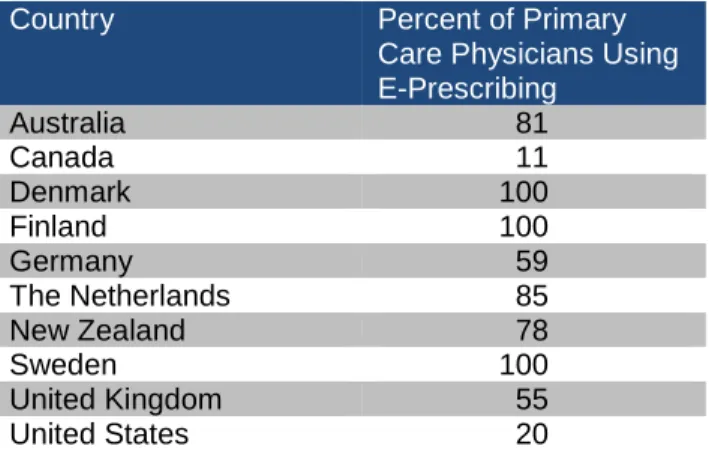
As shown in Table 5, primary care providers in Denmark, Finland, and Sweden routinely prescribe drugs electronically, with e-prescribing adoption rates at nearly 100 percent in each country.52
E-prescribing rates among primary care providers in the seven countries included in the 2006 Harris
Interactive/Commonwealth Fund survey—
Australia, Canada, Germany, the Netherlands, New Zealand, the United Kingdom, and the United States—varied widely. The Netherlands, with 85 percent of primary care physicians routinely prescribing medicine electronically, had the highest rate of e-prescribing among primary care providers, followed by Australia at 81 percent and New Zealand at 78 percent.53 The United
States lagged significantly behind these countries in 2006, with only 20 percent of primary care providers reporting that they routinely prescribe medicine electronically.54
Table 5: Use of Electronic Prescribing by Primary Care Physicians
Country Percent of Primary
Care Physicians Using E-Prescribing Australia 81 Canada 11 Denmark 100 Finland 100 Germany 59 The Netherlands 85 New Zealand 78 Sweden 100 United Kingdom 55 United States 20
The electronic transmission of prescriptions from the physician at the point of care to the dispensing pharmacy requires connectivity between the
THE INFORMATION TECHNOLOGY AND INNOVATION FOUNDATION |SEPTEMBER 2009 PAGE 15 provider’s office, the pharmacy, and sometimes
other intermediaries (e.g., pharmacy benefit manager, health plan). In many countries, the progress with respect to the electronic transmission of prescriptions to the pharmacy lags behind the use of computers to order prescriptions. In Germany, for example, 59 percent of doctors reported the ability to order prescriptions electronically, but the electronic transmission of prescriptions to the pharmacy in that country is uncommon.55
Table 6 compares three Nordic countries, the United Kingdom, and the United States with respect to the routine electronic transmission of prescriptions by primary care physicians. In the United Kingdom where 55 percent of primary care physicians surveyed reported e-prescribing capabilities, only 24 percent of daily prescription messages are transmitted through the United Kingdom’s Electronic Prescription Service.56 Denmark and Sweden rank high in the electronic transmission of prescriptions to pharmacies. In Denmark, 85 percent of prescriptions were transmitted electronically as of 2003 and today virtually every doctor transmits prescriptions electronically.57 Sweden has rapidly deployed
e-prescribing throughout the country. In 2004, only 25 percent of prescriptions in Sweden were transmitted electronically; as of October 2008, 75 percent of all prescriptions were being transmitted electronically directly to a pharmacy.58 Finland ran
an e-prescribing pilot project between 2004 and 2006 but discontinued the project. Thus, although Finnish physicians almost universally have access to an EHR system that allows prescription entry at present, they cannot transmit prescriptions electronically to the pharmacy.59
The number of prescriptions transmitted
electronically in the United States has been growing rapidly in recent years, but still represents only a small fraction of all the prescriptions written. In 2007, 35 million prescriptions in the United States were transmitted electronically (2 percent); in 2008, the number increased to 100 million (7 percent).60 In addition, health care
providers in the United States have transitioned
from the use of standalone e-prescribing systems to the use of integrated EHR systems with prescribing capabilities. In 2004, 95 percent of e-prescriptions in the United States were created using a standalone application; in 2008, 40 percent of prescriptions were created using a standalone system and 60 percent were created using an EHR system.
Table 6: Electronic Transmission of Prescriptions by Primary Care Physicians
Country Percent of Primary
Care Physicians Using Electronic Transmission of Prescriptions Denmark 100 Finland 0 Sweden 75 United Kingdom 24 United States 7
Availability of Online Health Portals Online health portals provide individuals a single
online destination to access web-based
applications and services to manage their various health care needs. Health portals range from basic portals that provide patients with basic medical information on illnesses and drugs, to more advanced portals that provide online access to health care services, to even more advanced portals that provide access to personalized medical information. The development of e-health portals is in line with a broader trend in health care to use IT to create a more patient-centric approach to health care. Patient-centric e-health portals help empower individuals and others to make good medical decisions.
Several developed countries have government-run e-health portals that provide individuals with access to information related to medicine and health care. A 2009 survey of European countries found that Denmark, Estonia, Finland, Portugal, Sweden, and the United Kingdom provided 24/7 access to Web or phone-based health care information. Other countries, including Germany, the Netherlands, and Norway, provided less access
THE INFORMATION TECHNOLOGY AND INNOVATION FOUNDATION |SEPTEMBER 2009 PAGE 16 Box 1: Technologies for Reducing Medication Errors in Hospitals
According to the Institute of Medicine, medication errors are among the most common medical errors, harming at least 1.5 million people in the United States every year. 61 In hospitals, errors are common during every step of the medication process—procuring the drug, prescribing it, dispensing it, administering it, and monitoring its impact—but they occur most frequently during the prescribing and administering stages. These medication errors are undoubtedly costly—to patients, their families, their employers, and to hospitals, health-care providers, and insurance companies.
To improve patient safety by reducing medication errors, some U.S. hospitals have invested in technologies that rely on health IT for dispensing and administering medications. As of 2006, 61.8 percent of hospitals in the United States used automated dispensing machines, 7 percent used robots, and 26.1 percent relied on barcoding to help prevent medication errors. The goal of these initiatives is to eliminate some forms of human error, such as misreading a medication label of similarly named drugs or misreading dosage information while dispensing or administering medications.
In 2004, the U.S. Food and Drug Administration (FDA) mandated that all human medications have machine-readable National Drug Code-format barcodes on their labels by 2006. It has been estimated that this change will prevent almost 500,000 adverse events and errors over 20 years and save $93 billion.62
Automated dispensing machines and robots can function because pharmaceutical companies place bar codes on the drugs they manufacture.
Automated dispensing machines can help hospitals ensure accurate medication dispensing to prevent medication errors; can help ensure medication is available to doctors and nurses in an emergency or when the pharmacy is closed; and can make hospital billing and inventory maintenance more efficient and accurate.
A drug-dispensing robot can similarly help prevent medication errors. St. Francis Hospital and Medical Center in Hartford, Connecticut, implemented such a robot in 2003. As described by one reporter, “each vial of medicine moves along a kind of production line until the machine spits out the finished syringe. Load the device with vials of the most prescribed medicines, and it begins filling a prescription by grabbing the appropriate drug vial and reading the bar code. The machine then shoots four digital photographs of the vial label, removes the cap and swabs the vial with alcohol. If the drug is a powder or concentrated liquid, the machine will mix in the correct amount of liquid. Then the device inserts a needle into the vial, extracts the needed amount of medicine and fills an intravenous syringe.”63
To reduce errors when administering drugs to hospitalized patients (e.g., when a nurse gives medication to a patient), hospitals use barcoding at medication administration and electronic medication administration records. Studies have found that using barcoding at medication administration can reduce errors by 65 percent to 85 percent.64 A 2006 study found few hospitals use barcoding at medication administration with adoption levels at only 4.7 percent. The 2006 study found higher rates of use of electronic medication administration records with adoption at 25.9 percent of U.S. hospitals.65 Providing prepackaged,
patient-specific medication with barcodes, for example, allows a nurse to use a computer to verify that the right patient is receiving the right medicine at the right dosage at the right time.66 Using this technology also reduces the workload on nurses allowing them to focus on other care-giving tasks. In Canada, Centre hospitalier de l'Université de Montréal (CHUM) estimates that the robotics system it implemented has allowed nurses to devote 30 more minutes per day to other patient-care activities.67