Research Student
Handbook
Table of Contents
1 Introduction ... 6
1.1 The purpose of this Guide and other documents ... 6
1.2 Current Developments and Research Degrees Regulations ... 7
1.3 Code of Practice for Research Students ... 8
1.4 Research Degrees Committee and University of Wales’ DAAB ... 8
1.4.1 University of Wales: Trinity Saint David Research Degrees Committee ... 8
1.4.2 Student Representation and feedback ... 8
1.5 Research Programmes offered by UW: Trinity Saint David ... 9
1.6 MRes degrees ... 9
1.7 Professional Doctorates ... 9
1.8 The University’s Language Policy ... 10
2. The University ... 10
2.1 The Postgraduate Research Office ... 10
2.2 Faculties and Schools ... 10
2.3 Support Units ... 11
2.3.1 The Learning Resources ... 11
2.3.2 Student Services – ... 12
2.3.3 Information Services ... 12
2.3.4 Student Union ... 12
2.4 Virtual Learning Environment (VLE) and MYTSD portal ... 12
2.5 International Students ... 12
3. Required periods of study ... 12
3.1 MPhil/PhD by Research ... 13
3.2 Professional Doctorates * ... 13
3.3 MRes ... 13
3.4 PhD by Published Works ... 13
4. Re-enrolment ... 14
4.1 Re-enrolment procedures ... 14
4.2 Student Numbers ... 15
5. Induction programme ... 15
5.1 Non-accredited Generic Skills Module ... 15
5.2 Graduate Teaching Assistants ... 16
6. Roles and responsibilities of postgraduate research students ... 16
6.1 Rights and responsibilities of the Student ... 16
6.2 Participation in Research Environment ... 16
6.2.1 Facilities ... 17
6.2.2 What to expect from your supervision ... 17
6.3 Maintaining Regular Contact ... 18
6.5 Satisfactory Progress (MPhil / PhD by research) ... 19
6.5.1 Satisfactory Progress (MRes and Professional Doctorate programmes of study) ... 20
6.6 Cause for Concern and Unsatisfactory Progress ... 20
6.7 A Cause for concern or Unsatisfactory Report... 21
6.8 Formal warning ... 21
6.9 Concerns about the relationship with the Director of Studies or other supervisors ... 21
6.10 Student Support ... 22
7. Roles and responsibilities of supervisors ... 22
7.1 Supervisory Team ... 22
7.2 Director of Studies ... 23
7.3 Second Supervisor(s) and Advisers ... 23
7.4 Collaborative partnership institutions ... 23
8. Designing, Planning and Managing the Research Project ... 24
8.1 Introduction ... 24
8.2 What to expect from research ... 24
8.3 The Research Proposal ... 24
8.4 Ethics ... 24
8.5 IP and Risk Assessment ... 25
8.6 Professional Development Plan (PDP) ... 25
8.7 Guidance on format ... 25
8.8 Planning the Thesis ... 25
8.8.1 Aims and objectives ... 26
8.8.2 Literature review ... 26
8.8.3 Research methodology ... 26
8.8.4 Timetable ... 27
8.8.5 Organisation ... 27
8.8.6 Keeping a logbook/PDP ... 27
8.8.7 Regular writing or record keeping ... 27
8.8.8 Support ... 27
8.9 References and bibliography ... 27
8.9.1 Recommended reading ... 28
9 Transferring from MPhil to PhD Research and Professional Doctorates ... 28
9.1 Transfer from MPhil to PhD ... 28
9.1.1 Stage one ... 28
9.1.2 Stage two ... 28
9.1.3 Stage three... 29
9.1.4 Stage four ... 29
9.2 Transfer from part 1 to part 2 of an MRes programme of study or a Professional Doctorate ... 29
9.2.2 Stage Two ... 30
10. Employment ... 30
11. Changing a mode of study ... 30
12. Extension or Suspension of Studies ... 30
13. Submission and Viva Examination ... 31
13.1 Financial requirements ... 31
13.2 Submission of the thesis ... 31
13.3 Early submission of thesis ... 31
13.4 The Examining Board... 32
13.5 Examination ... 33
13.5.1 Written Text Examination... 33
13.5.2 The Viva Voce ... 33
13.6 Preparing for a viva voce ... 34
13.7 The viva examination process ... 34
13.8 Possible outcomes ... 34
13.9 Notification of results ... 34
13.9.1 Corrections and Amendments to thesis ... 35
13.9.2 Resubmission of thesis ... 35
13.9.3 Submit as an MPhil (only in the case of a PhD submission) ... 35
13.9.4 Fail ... 35
13.10 Appeal ... 36
13.11 Permanent binding of thesis ... 36
14. Unfair practice ... 36
14.1 Avoiding unfair practice ... 36
14.2 Penalties for unfair practice ... 37
15. Research governance ... 37
16. Research misconduct ... 37
17. Complaints and Appeals ... 38
17.1 Complaints ... 38
17.2 Appeals ... 38
18 Your conduct at the University ... 38
18.1 General Regulations ... 38
18.2 Appropriate Behaviour ... 38
18.3 Academic requirements ... 39
18.4 Financial requirements ... 39
18.5 Health and Safety ... 40
18.6 Regulations Governing the Use of Information Technology ... 41
18.7 Liability for Loss or Damage ... 41
18.8 Student Debt to the University ... 41
19. Student Support... 42
19.1 Carmarthen Campus ... 42
19.2 Lampeter Campus ... 42
19.3 London campus ... 42
19.4 Swansea campus... 43
20. Abbreviations ... 43
21. General Information ... 43
21.1 Contact information ... 43
Appendix 1 - Student Lifecycle ... 45
Appendix 2 ... 47
Appendix 3 ... 49
1 . Format of the Thesis ... 49
1 Introduction
Welcome to the University of Wales Trinity Saint David. We hope that you will enjoy your time studying for a research degree with us. You will find studying for a research degree quite exciting but different from studying at the undergraduate level or even for a ‘taught’ Masters’ degree. You will be focused on your specialist research area and you will soon know more about this than most people, including your supervisors. You are, after all, intending to make an original contribution to learning for a PhD or an original critical evaluation of existing knowledge for an MPhil. You will also need to be much more independent and self-sufficient in your study.
Although this will be challenging, the process for following a research degree programme has been established over many years and your tutors (if you are on part I of an MRes or Professional Doctorate) and supervisory team are here to guide you through it. Your tutors will guide you through the taught stages of any research degree. Your supervisory team will explain the stages of formulating your research question or hypothesis, reviewing the literature, understanding research paradigms and selecting the most appropriate methodology for your particular research, collecting and analysing data, reviewing your findings in relation to your original research question or hypothesis and drawing conclusions as to its effect on existing knowledge. At appropriate times, you will be directed to seminars and workshops to help you undertake these parts of your study.
There may be opportunities to publish some of your work either as a sole author or, more likely, as a joint author as the study proceeds. Your supervisory team will guide you about this also. Whether or not you write such articles, it is important that from day one you keep notes and list all details of every source of information at the time that it passes across your field of view or through your hands. This will enable you to review the source information at a subsequent time and eventually to construct your bibliography.
Studying for your research degree will enable you to meet with like-minded researchers both within your own specialist field and in other subject areas. Welcome to the world of research degree study. Make the most of your opportunities!
1.1
The purpose of this Guide and other documents
This handbook provides you with information about the various procedures and regulations you will encounter at the university and is intended to guide students throughout their Programme of Study. The guide makes frequent reference to a number of other important sources of information relating to the University, including the Academic Quality Handbook -
in particular the ‘Research Degree Regulations’ chapter and the Code of Practice for Research Degrees. These documents are available on the University’s website and the Virtual Learning Environment (VLE).
Students who are not based at one of the University’s campuses (e.g. distance learning students) will also find additional valuable information in the Distance Learning Student Guide which gives information specific to students studying through this mode of study. This document is also available on the University’s website and the VLE.
This handbook is for all research degrees students studying on any of the campuses of UWTSD and for all research degrees students studying for an award validated through the University of Wales: Trinity Saint David at a collaborative partnership institution. In addition to this handbook, students may receive additional information from the Faculty, School, or a collaborative partnership institution. For example, students enrolled on a Professional
Doctorate or an MRes programme of study will in addition also receive a programme handbook upon enrolment. Such a handbook will, for example, give detailed information about all the taught modules of part one of the degrees. Students enrolled through collaborative partnership institutions may also receive additional information from the collaborative partnership institution.
The University has made every effort to ensure that this information is as full and as accurate as possible, but please note that minor changes are made from time to time. We aim to keep any such changes to a minimum and students receive advance warning in the event of any alteration. Students are also encouraged to suggest any changes that might helpful be introduced into future guides [email protected]
1.2
Current Developments and Research Degrees Regulations
The regulations and procedures outlined in the Academic Quality Handbook and the Code of Practice are applicable to all research degrees students enrolled on UW TSD degrees. For students that are enrolled for University of Wales’ awards there is additional oversight at every stage of candidature by the University of Wales, through its Degrees and Academic Awards Board (DAAB).
The regulations as set out in Chapter 8 of the Academic Quality Handbook will apply to all research degrees students with the following exceptions:
1) The word count regulations have changed for research degrees students studying for a practice-based PhD / MPhil by research (e.g. within the areas of Film and Media or Creative Writing). Students who started their degrees before October 2012 will continue to work towards the word limit and structure of their programme as stipulated by the regulations when they started their degrees. All students who started their degree on or after October 2012 will follow the regulations as set out in the current regulations;
2) Current students on either the DMin programme or the PhD in Applied Archaeology will continue to study according to the regulations that were in force when they started their programmes; the current Professional Doctorate regulations do not apply to students on those programmes.
3) University of Wales candidates and TSD candidates that enrolled before September 2014 will continue to work towards the resubmission period of candidature as specified in the regulations when they enrolled. The new regulations will only apply to UWTSD candidates that started from September 2014.
The unfair practice regulations, suspension regulations, appeal and complaints regulations as well as all disciplinary regulations will be applied to all students in accordance with the regulations as they are set out in the current Academic Quality Handbook, in chapter 8. The Academic Quality Handbook can be found on the university website at:
www.trinitysaintdavid.ac.uk/en/academicoffice
Please note that whereas students studying for an MRes degree or a professional doctorate study for a ‘named’ award, students studying for a MPhil or PhD are studying for an MPhil or PhD by research rather than for an MPhil or PhD in a defined subject area. This includes research students working within practice-based areas of research.
1.3
Code of Practice for Research Students
In addition to the regulations, the University of Wales: Trinity Saint David has a Code of Practice for Research Degrees. The Code elaborates on the research degrees regulatory framework. The Code of Practice provides information about the processes involved in the administration of research degree study, from admissions to graduation.
Where there appears to be ambiguity in advice given in the different documents, the Regulations take precedence, and the Code of Practice should be regarded as more authoritative than this Postgraduate Research Student Guide.
1.4
Research Degrees Committee and University of Wales’ DAAB
The regulations and procedures for research degrees are governed by the University of Wales: Trinity Saint David’s Research Degrees Committee. For students that are enrolled on degrees awarded by the University of Wales there is additional oversight of every stage of candidature by the University of Wales’ DAAB.
1.4.1 University of Wales: Trinity Saint David Research Degrees Committee
The Research Degrees Committee oversees all aspects of the research degrees programme. This committee, which has representation from all Faculties, reports to the Research Committee and the Academic Quality and Standards Committee on the effectiveness of the arrangements for maintaining appropriate academic standards and enhancing the quality of postgraduate research programmes.
The Research Degrees Committee meets on a regular basis, normally about once a month, to discuss all matters relating to research degrees, including, for example, all applications and extension requests from students. It is also charged with developing all procedures that support, monitor, and review all aspects of the University’s research degrees provision. Membership and the terms of reference of the Research Degrees Committee can be found in chapter 2 of the Academic Quality Handbook.
1.4.2 Student Representation and feedback
Three student representatives attend the Research Degrees Committee on behalf of all students enrolled on Research Degree Programmes; one to represent the Lampeter/Carmarthen, one for the London campus, and one for the Swansea campus. In addition, there may also be the opportunity for representation at Faculty level. Student representatives are normally elected for a period of three years.
‘Attendance’ at this committee may take the form of video-conferencing or participation through Skype; in other words if you are a distance learning student this does not mean that you could not become a student representative. If you wish to raise an issue with the Research Degrees Committee, you should contact the student representative who will feed the comments to the Committee and report back to you. You can, of course, also contact the PGRO or discuss your issue with your Faculty who can then take the issue to RDC through the Faculty representation system.
Students can give formal feedback through surveys such as the PRES and, for example, through annual monitoring forms. There is, of course, also always the opportunity to give informal feedback, whether that is on the systems and processes that the University uses for research degrees, on the administration of research degrees, on supervision and research culture, or on this handbook. Feedback is always welcome and you can give your comments
to your supervisory team, your representatives, staff in your Faculty or staff within the Postgraduate Research Office.
1.5
Research Programmes offered by UW: Trinity Saint David
The qualifications that are offered at research level are: A range of MRes programmes of study Master of Philosophy by Research (MPhil) Doctor of Philosophy by Research (PhD) Professional doctorates, e.g.
Doctor of Business Administrator (DBA) Doctor of Applied Archaeology (DAA) Doctor of Ministry (DMin)
Doctor of Professional Practice (DProf) Doctor of Philosophy by Published Works
Full details of the requirements for each qualification are provided in the Academic Quality Handbook (chapter 8).
1.6
MRes degrees
Students following MRes should also refer to the Postgraduate Student Guide (Taught Degrees) in relation to the first 60 to 90 taught credits of their programme.
The MRes programme comprises of 180 credits at level 7 (Master’s level), with between 60-90 taught credits for part one of their degrees and a research project of either between 90 and 120 credits depending on the size of part one. Your programme of study handbook will detail how many credits have been allocated to each part.
All work for the taught assessment purposes must be handed in to meet deadlines. Students are informed of these deadlines by their tutors. If you need an extension for a piece of coursework, for example because of illness, please follow the guidelines and regulations outlined in chapter 7 of the Academic Quality Handbook.
If the taught part of your programme of study contains an examination and you have support needs, you need to get in touch with your Programme Director as soon as possible so that appropriate arrangements can be made. More information about support for disabled students can be found in the Academic Quality Handbook and can be obtained from Student Services.
Once the taught element has been passed by the examining board, candidatures may apply to transfer onto the research element of the programme. Please contact your Programme Director for further details of this process and see section 9.2 of this handbook. Regulations for the MRes can be found in Chapter 8 of the Academic Quality Handbook.
1.7
Professional Doctorates
Students following Professional Doctorate Programmes should also refer to the Postgraduate Student Guide (Taught Degrees) in relation to the first 180 taught credits of their programme and to section 9.2 in this guide.
The Professional Doctorate programme comprises of 540 credits with 180 credits at level 7 (Master’s level) and a minimum of 360 credits at research level 8 (doctoral level). All
work for the taught assessment purposes must be handed in to meet deadlines. Students are informed of these deadlines by their tutors. If you need an extension for a piece of coursework, for example because of illness, please follow the guidelines and regulations outlined in Chapter 7 of the Academic Quality Handbook.
If the taught part of your programme of study contains an examination and you have support needs, you need to get in touch with your Programme Director as soon as possible so that appropriate arrangements can be made. More information about support for disabled students can be found in the Academic Quality Handbook and can be obtained from Student Services.
Once the taught element has been passed by the examining board, candidatures may apply to transfer onto the research element of the programme. Please contact your Programme Coordinator for further details of this process and see section 9.2 of this handbook. Regulations for Professional Doctorates can be found in Chapter 8 of the Academic Quality Handbook.
1.8
The University’s Language Policy
The University’s Language Policy confirms that the University gives equal status to both the Welsh and English languages throughout its activities. This policy gives the right to all who are associated with the University to correspond and to receive a service in their chosen language of either Welsh or English. The University sees its natural bilingual context as a strength and will develop and extend its provision of bilingual opportunities for the community it serves.
2.
The University
2.1
The Postgraduate Research Office
The Postgraduate Research Office is responsible for the enrolment, admission and support of research degree students throughout their time at the University, including the submission and examination of theses. In close consultation with the supervisory teams and programme coordinators and the Faculty’s Director of Research Degrees Studies, the Postgraduate Research Office offers support to all research degree students throughout their candidature. You can contact the Postgraduate Research Office at:
Email: pgresearch@ uwtsd.ac.uk Telephone: 01570 424900
The Postgraduate Research Office works closely together with a whole range of support units to provide research degrees students with support throughout their candidature (e.g. Registry, Finance, International Office, Student Services, Information Services). The Postgraduate Research Office functions as the first port-of-call for research degrees students. If you are not sure about something or have any questions please do contact staff in the office.
2.2
Faculties and Schools
The University is composed of five Faculties with responsibility for the academic work of the institution. Every Faculty consists of a number of Schools, each of which focuses upon one
or more academic disciplines. Some Faculties have Schools on more than one campus. Details of the Faculties and Schools can be obtained from the website.
The structure for the Faculties in 2014/2015 is as follows: Faculty of Architecture, Computing and Engineering School of Applied Computing
School of Automotive Engineering
School of Architecture, Built and Natural Environments School of Engineering and Logistics
Faculty of Art and Design School of Design and Applied Art School of Fine Art and Photography School of Film and Digital Media School of Visual Communication
Faculty of Business and Management School of Business, Finance and Management School of Tourism and Hospitality
School of Sport, Health and Outdoor Education Wales Institute for Work Based Learning Faculty of Education and Communities SWW Centre of Teacher Education School of Early Years Education School of Social Justice and Inclusion School of Psychology and Counselling School of Welsh and Bilingual Studies
Faculty of Humanities and Performing Arts School of Archaeology, History and Anthropology School of Classics
School of Cultural Studies
School of Theology, Religious Studies and Islamic Studies School of Performing Arts
2.3
Support Units
The University provides a range of support services for research students for which further information can be found on the university website at:
http://www.trinitysaintdavid.ac.uk/en/supportservices/
2.3.1 The Learning Resources
For information regarding Learning Resources for Lampeter, Carmarthen and Swansea campuses go to: www.uwtsd.ac.uk/library/
2.3.2 Student Services –
Further information can be found in section 19. Or at: www.uwtsd.ac.uk/student-services
2.3.3 Information Services
Lampeter, Carmarthen & London Campuses:
Telephone: 0300 500 5055 www.uwtsd.ac.uk/its/ Swansea Campus: Telephone: 01792 481134
www.uwtsd.ac.uk/its/ Opening Hours: 08:45 – 17:00 (Mon-Thurs) 08:45- 16:30 (Friday)
2.3.4 Student Union
Go to: Lampeter and Carmarthen campuses: http://www.tsdsu.co.uk/
Swansea Campus: http://www.tsdsu-swansea.co.uk/
2.4
Virtual Learning Environment (VLE) and MYTSD portal
The management and day to day support of VLEs is the responsibility of the Information Services. More detailed information about the relevant VLE for your studies is available through the following link:
Moodle: https://dysgu.ydds.ac.uk/login/index.php
2.5
International Students
Attendance of all students on Tier 4 visas is monitored in accordance with UKVI guidelines. Students will receive full information about what will be required from them with respect to attendance on enrolment. The University’s monitoring policy for research degrees students can be found on the VLE.
3.
Required periods of study
Further details on the required periods of study, including information about direct entry and RPEL (recognition of prior and experiential learning) can be found in Chapter 8 of the
Academic Quality Handbook. The tables below give the ‘standard’ minimum and maximum
periods of enrolment. Please note that the minimum period of study is also called the ‘expected period of study’ and that the period between minimum and maximum period of candidature is called the ‘continuation period’.
3.1
MPhil/PhD by Research
Full-time candidates
Degree Minimum Maximum
MPhil 2 year 3 years
PhD 3 years 5 years
Part-time candidates
Degree Minimum Maximum
MPhil 3 years 5 years
PhD 5 years 9 years
3.2
Professional Doctorates *
Full-time candidates
Minimum Maximum
3 years 5 years
Part-time candidates
Minimum Maximum
5 years 9 years
* Please note that not all Professional Doctorates are available full-time.
3.3
MRes
Full-time candidates
Minimum Maximum
1 year 3 years
Part-time candidates
Minimum Maximum
2 years 5 years
3.4
PhD by Published Works
Minimum Maximum
Full time 1 year Part time 2 years
4.
Re-enrolment
4.1
Re-enrolment procedures
Throughout their candidature, postgraduate research students are required to re-enrol annually and this is conditional on a satisfactory annual review. International students will be required to re-register in addition at the start of every semester: October/February/June. In May of each academic year, an annual monitoring form must be completed by both the student and supervisory team. This provides both parties with an opportunity to evaluate the progress made and to signal any developmental concerns or requirements. A central Annual Monitoring Board considers all forms to ensure that the appropriate academic standards are being met by both the student and supervisory team, and that the quality of the supervision is appropriate. Approval must then be given by the Research Degrees Committee before re-enrolment can take place. Re-re-enrolment for the next academic year is conditional on a satisfactory annual report; students that have been given an action plan following a ‘cause for concern’ or ‘unsatisfactory’ judgement may only be re-enrolled provisionally and their candidature could be terminated during the academic year if the conditions of the action plan have not been met and no satisfactory progress is made. Please note that students can also only re-enrol when they have completed and signed the annual monitoring form.
For students who started their studies in February the first ‘annual’ review will come in May of the same year and staff will take into account the length of candidature when they fill in the review form for candidates who are in this situation.
A re-enrolment pack will then be sent to you by the Postgraduate Research Office asking you to complete the re-enrolment and, where appropriate, tuition fee forms. Your enrolment for the next academic year cannot be completed until you have completed and submitted all the relevant paperwork. On completion of the standard fee paying period (= minimum candidature period), your enrolment will roll over to the maximum period of enrolment, during which an annual ‘continuation’ fee will be paid until either you submit your thesis or your candidature expires, whichever occurs first. There is no continuation fee for candidates that started their studies prior to October 2011. Please note, that you will be required to pay the full fees for the minimum candidature period even if you submit your thesis within this period. You should always discuss the submission of your thesis with your supervisory team prior to submitting it. For further guidelines in relation to early submission please see the Code of Practice.
It is vitally important that the Postgraduate Research Office has an accurate record of each student’s personal details at all times. It is equally important that students ensure that they are registered on the correct Programme of Study. Failure to inform the Postgraduate Research Office of any changes in this respect is likely to cause some or all of the following problems:
delay in obtaining funding, e.g. US federal loans;
UKVI problems as a result of a delay in obtaining a Tier 4 visa; failure to keep students generally informed;
failure to contact students in an emergency.
Students must inform the Postgraduate Research Office and supervisory team in writing of any change to term-time and/or home address or any other contact details at the earliest opportunity.
4.2
Student Numbers
When students first register, they are allocated a unique student number. It is important that students use their student number as well as their name when communicating with staff in different parts of the University. This will not only improve the efficiency of many administrative processes; it will also reduce the possibility of error.
5.
Induction programme
The postgraduate research students’ induction programme is intended to introduce students to postgraduate life at UW TSD and to provide them with the essential tools for the start of their research programme. The initial intensive Induction Programme takes place at the start of each enrolment period on the University’s campuses. This induction programme will introduce students to the regulatory framework and will include introductions to the resources and facilities available at UWTSD and outside, such as the National Library of Wales There will also be a range of seminars designed to help students to start their programmes successfully, with sessions on academic writing, ethics, developing the research proposal etc. all included.
All newly enrolled residential research degrees students are expected to attend the induction sessions. Distance learning students are encouraged to attend an induction programmes in person if at all possible, but an induction programme will also be made available electronically through the VLE.
The induction programme will start the Professional Development Planning (PDP) process for all research degrees candidates and build on the training analysis that was done as part of the admission process. For further information about PDP see section 8.5 in this guide, as well as the Code of Practice.
Additional induction activities may also be organised by your Faculty or School and you will be informed about these by your supervisory team. Some of these may be compulsory to attend.
5.1
Non-accredited Generic Skills Module
Once enrolled, all new students, with the exception of those that have been given direct entry to the PhD and explicit exemption of this part of the programme, are expected to complete the non-accredited Generic Skills for Research Students module that has been set up on Moodle. The units in this module aim at helping to guide you through the starting phase of your research. The work associated with units should be completed and submitted to your Director of Studies during the first 6 months (12 months for part-time students) of your research. Completion of the module is monitored through the Annual Monitoring process. The generic skills module comprises of the following units:
Unit 1 Support and Supervision Unit 2 Reviewing the Literature Unit 3 Ethical Issues
Unit 4 Project Management Unit 5 Refining your Research
Unit 6 Looking Forward – Writing your thesis
The Generic Skills for Research Students module can be accessed once you are fully enrolled and have obtained access to Moodle. Information Services provides all new
students with access to the VLE. A VLE guide, giving information about how to access the VLE can be found on the University’s website (https://dysgu.ydds.ac.uk/login/index.php). If there are any problems, please contact Information Services (for contact details see section 2.3.3).
Faculties may, depending on specific discipline requirements, add additional information or units, for example in relation to practice-based research degrees.
5.2 Graduate Teaching Assistants
If you are undertaking any teaching during your studies, you must be enrolled on and complete the University’s accredited Teaching in Higher Education programme for Graduate Teaching Assistants. Please contact the PGRO for any details in relation to this programme.
6. Roles and responsibilities of postgraduate research students
6.1
Rights and responsibilities of the Student
The rights and responsibilities of the student are as follows:
a. Acknowledge receipt of the regulations, Code of Practice and Research Student handbook;
b. Familiarise themselves with the University regulations and guidelines, processes and procedures;
c. Enrol with UW TSD at the start of each academic year;
d. Have regular contact with their supervisory teams and attend all formal and informal meetings scheduled;
e. Attend any classes that are part of part I of an MRes or Professional Doctorate
f. Make the supervisory team aware of any specific needs or circumstances likely to affect their work;
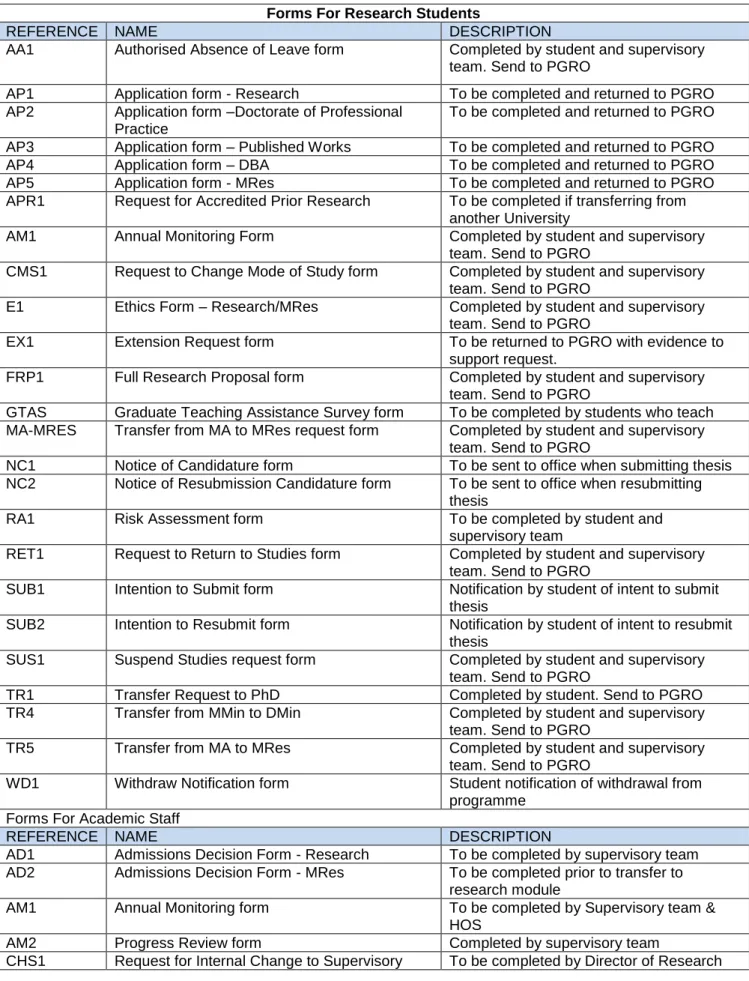
g. Complete all necessary forms and paperwork used by the university to monitor progress and performance;
h. Take ownership of his/her research plan. A record of training, progress reports, conference contributions etc. are expected to be recorded in a Personal Development Profile (PDP);
i. Attend the research seminars and training events provided by the Faculty whether in person or, for distance learning students, electronically;
j. Follow the requirements for submission of the thesis, especially the requirement for referencing according to a consistent and recognised standard.
6.2
Participation in Research Environment
The University encourages (in fact, strongly recommends) that students become as involved in the research environment and culture of the University as possible. Not only will this enable students to meet other researchers (research by its very nature being quite solitary), but will also give students a stronger voice and a feeling of involvement. Information of events will be posted on the University website and on many occasions students will be informed of events by mail. It is therefore important that students check their university e-mail address on a regular basis.
The University provides several ways for students to become involved in research culture, which include the following:
Completion of the Initial Experience Questionnaire; Completion of the Annual Review Form;
Participation in surveys (Postgraduate Research Experience Survey) Representation at the Research Degrees Committee or at Faculty level; Invitations to hear guest speakers;
The opportunity to attend the annual Graduate Research Summer School on the Lampeter campus;
The opportunity to attend research seminars organised by the University, Faculties or Schools or listen to these through podcasts;
Participation in on-line forums through the VLE;
Invitations to attend research seminars, workshops and conferences both inside the University and externally and, where appropriate and possible, get involved in their organisation.
It is as important for distance learning students to be and feel included within the University’s research environment as it is for residential students. The University therefore, for example, aims to make as many research seminars as possible available as podcasts via the VLE and many distance learning students have found attendance at the annual Graduate Research Summer School extremely beneficial. Information about this summer school is sent to all students by the Postgraduate Research Office.
6.2.1 Facilities
For research projects that are studio or laboratory-based, students will usually have access to a range of facilities within the Faculty. Faculties will inform students about regulations in relation to the access to dedicated areas or specific equipment. For example, students may need to book a studio within time-tabled slots. Faculties will also inform students if there is a dedicated space available on campus for study for research degrees students.
The University will certainly strive to ensure that students have sufficient access to space and equipment in order to fully pursue their project. Any possible problems with facilities should immediately be brought to the attention of the supervisory team.
6.2.2 What to expect from your supervision
Research projects within the University cover a vast range of areas, and whilst no one pattern of progression and assessment is appropriate for all the formal monitoring pattern falls into a universal pattern which is designed to be helpful to students but provides the necessary assurances to the University that all is well with their work.
However, some common features will probably include the following: Regular meetings with your supervisor(s)
Regular contact with your supervisors is essential and students as well as supervisors have an obligation to initiate these meetings.
Oral presentations of your work
Each Faculty organises research seminars and there is also an annual research degrees student conference and the annual graduate summer school. On occasion students will be
expected to present your results at these ‘informal’ settings. Not only will this allow discussion amongst peers of any research problems you may be facing, but it will also enable you to further strengthen your presentation skills. Assistance with such skills will be given where needed and the student should record this personal development in their PDP file.
Written presentations of your work
Again depending on the precise work that students are conducting they will at intervals be required to present written reports on your progress. These range from weekly one-page summaries to formal typed interim reports or drafts of chapters. Although the latter in particular may require a lot of work, they will make an excellent basis for embarking on the completion of annual reports and theses. Computer skills will feature heavily in most cases and are regarded as an important generic outcome of research training.
Formal monitoring of progress
There are a number of formal monitoring points during each research degree programme. More information about these is given below and an overview of the research degrees students’ ‘life cycle’ is given in appendix 1.
6.3
Maintaining Regular Contact
Students are expected to meet their supervisory team on a regular basis throughout their period of study: for full-time students there are expected to be ten formal meetings per year, for part-time students there are expected to be five formal meetings per year. This is irrespective of whether you are a residential or distance learning student and irrespective of the stage of candidature. Full details of what is expected can be found in the University’s monitoring policy for research degrees and the Code of Practice.
Regular contact between the student and supervisory team is essential for the successful outcome of the research candidature. It has been shown that regular contact and supervision substantially improves the quality and academic standards of a thesis and improves the probability of a successful viva within the period of candidature. If a student does not maintain regular contact, supervisory teams may become concerned that the student is not making satisfactory progress. These concerns will be raised with the Dean of Faculty, Head of School or their Faculty Director of Research Degrees and the Postgraduate Research Office, where the student will be asked to contact their supervisory team or submit work. If regular contact does still not continue, this will be reported on the annual review form or directly to the Research Degrees Committee and the student’s progress may be deemed unsatisfactory and re-enrolment onto the next academic year may not be permitted.
Of course, unforeseen personal or professional problems may occur to impede progress; if this is the case, it is essential that the student contacts both their Director of Studies and the Postgraduate Research Office to inform them of the situation. Advice will be given on how to proceed with the matter.
Where students do not feel comfortable discussing a problem with a member of the supervisory team (for example when the problem concerns a member of the supervisory team or when the candidate is a member of staff) this should be raised initially and immediately with the Dean of Faculty, Head of School, their Director of Research Degrees Studies or the Postgraduate Research Office in order for the matter to be resolved.
6.4
Completing annual reports
Postgraduate research students and supervisory teams are required to complete a formal report of progress and achievements each year, together with plans for the completion of the research programme, before the postgraduate research students can re-enrol. The supervisory team fills the detailed form in first; students then see the comments made about their progress and performance and are required to fill in the student feedback part of the form, completing again a detailed set of questions. All students are required to fill in this form and to sign that they have read and understood the supervisory team’s assessment. If a student is concerned about the assessment from the supervisory team, then they need to contact their Dean of Faculty, Head of School, or their Director of Research Degrees Studies in the first instance.
This annual monitoring process usually takes place in May and June, with the central Annual Monitoring Board meeting in July. The minutes of this meeting are ratified by the Research Degrees Committee and recommendation is made to the University about the postgraduate research student’s continued enrolment. Follow-up boards are held in relation to any student classified as ‘cause for concern’ or ‘unsatisfactory’. All students will be sent a letter by the Postgraduate Research Office following the Annual Monitoring Board to inform them about the outcome of the board.
Students may submit an additional report at any time, without any contribution from the supervisory team, if the student wishes to bring a matter of concern to the attention of the Research Degrees Committee. If this is the case, the report should be sent to the Postgraduate Research Office in the first instance.
6.5
Satisfactory Progress (MPhil / PhD by research)
The progress of a postgraduate research student’s studies is continually monitored throughout the period of candidature in a variety of ways which include:
Submission of a Full Research Proposal by the first formal review (3 months for full-time candidates, 6 months for part-full-time) giving details of the work to be carried out, the techniques to be used, how any skills are to be acquired and the planned time-frame for the completion of the project. This is also an opportunity to assess the research for any ethical issues not previously identified with approval of the University Ethics Committee required via the submission of an ethics form before progress can be confirmed. Similarly, any risk assessment or IP arrangements that have not been completed yet need to be finalised at this stage. A written literature review will also be submitted to support the Full Research Proposal. The review should show a satisfactory grasp of the rules for written presentations, and a justification of the research project. The Full Research proposal must include a detailed schedule of work.
Transfer from MPhil/PhD to PhD. The transfer interview and application must be completed and submitted to the Research Degrees Committee within the initial 18 month period for full-time candidates (30 months for part-time candidates). Details of this process are discussed in section 9.
A revised and more substantial plan for the thesis, as part of the annual monitoring report should be submitted at the end of the first year of full-time study (second for part-time candidates). This revised plan should aim to include a reliable estimate of the likely completion date.
A first draft of the thesis submitted to the Director of Studies in good time before the prospective date of completion. Candidates should aim to submit a substantially complete draft for the formal meeting with supervisors held six months into their third year of full-time study (the end of the fourth year for part-time candidates) and at this meeting, ideally, an Examining Board should have been identified and a submission date agreed.
6.5.1 Satisfactory Progress (MRes and Professional Doctorate programmes of study)
Students following MRes or Professional Doctorate Programmes that include both a taught and research element, should also refer to the Postgraduate Student Guide (Taught Degrees) in relation to the first 180 taught credits of their programme and to the relevant section in this research degrees guide, for transferring from the Master to the Doctoral element of the programme and to Chapters 6 and 8 of the Academic Quality Handbook. The progress of an MRes and Professional Doctoral research student’s studies is continually monitored throughout the period of candidature in a variety of ways which include:
All work for the taught assessments must be submitted to meet each deadline. Students are informed of these deadlines by their supervisors. Information about extensions to assessments can be found in Chapter 7 of the Academic Quality Handbook.
Transfer from Part 1 (Taught) to Part 2 (Research). Once the taught element has been completed and passed by the Examining Board, candidatures may apply to transfer onto the Research element of the programme.
Once students have entered the research phase of their studies, submission of a Full Research Proposal by the first formal review (3 months for full-time candidates, 6 months for part-time) giving details of the work to be carried out, the techniques to be used, how any skills are to be acquired and the planned time-frame for the completion of the project. This is also an opportunity to assess the research for any ethical issues not previously identified. A written literature review will also be submitted to support the Full Research Proposal. The review should show a satisfactory grasp of the rules for written presentations, the ability to analyse and summarise published work and a justification of the research project.
A revised plan for the portfolio/thesis, as part of the annual monitoring report. This revised plan should aim to include a reliable estimate of the likely completion date. A first draft of the portfolio/ thesis submitted to the Director of Studies in good time
before the prospective date of completion. Candidates should aim to submit a substantially complete draft in good time. Ideally, an Examining Board should have been identified and a submission date agreed at least three months before the end of candidature.
6.6
Cause for Concern and Unsatisfactory Progress
If the supervisory team is concerned about the rate of a student’s progress there are several opportunities at which this can be identified and discussed with the student. There may be personal reasons explaining the lack of progress, in which case the supervisory team may be able to provide the student with, or direct the student to, relevant advice. It is essential that you keep your supervisory team informed of your progress; if unsatisfactory progress
continues, it will be reported to the Annual Monitoring Board and the student’s progress may be deemed to give ‘cause for concern’ or be ‘unsatisfactory’.
Further details of what constitutes as satisfactory’, ‘cause for concern’ and ‘unsatisfactory’ can be found in the Code of Practice. If a student has any concerns relating to their progress they should be discussed with their Director of Studies as soon as possible.
6.7
A Cause for concern or Unsatisfactory Report
The Annual Monitoring Board will decide whether a student’s annual review report is satisfactory, gives cause for concern or is unsatisfactory. The minutes of this Board are ratified at the Research Degrees Committee. If the progress gives cause for concern or is unsatisfactory, the University will decide on an appropriate action. This can vary from an action plan for a specified period, conditional re-enrolment, to termination of the programme of studies. The student will be informed of this decision and given the opportunity to inform the Research Degrees Committee of any circumstances that they would like to have taken into account which are not already in the documents sent to the Research Degrees Committee. It is therefore crucial that students complete the student section on the annual monitoring form and give full information to the Annual Monitoring Board and students will need to explain why they had not given information on the annual monitoring form if they decide to disclose information at a later date.
In the case of a cause for concern or unsatisfactory report, the University may decide that a student should be allowed to re-enrol, but will usually attach conditions to this permission. Alternatively, the decision may be taken to terminate the student’s enrolment. In this case the student will be informed in writing of the decision and of how they can appeal against the decision.
6.8 Formal warning
Generally a postgraduate research student will be given a formal warning if the supervisory team are seriously concerned that, despite advice, progress continues to be unsatisfactory or give cause for concern. An action plan will be set up to re-establish satisfactory progress, including how that progress will be monitored. Subsequent failure to make satisfactory progress without a good reason will usually result in a recommendation to the Research Degrees Committee that enrolment should be terminated. If a student is not satisfied with the supervisory team’s position the student can discuss the matter informally with the Head of School or Dean of Faculty and/or appeal formally against the decision taken by the Research Degrees Committee.
6.9
Concerns about the relationship with the Director of Studies or other
supervisors
Either a postgraduate research student or the Director of Studies or any other supervisor within the supervisory team may feel that the postgraduate research student/supervisor relationship has deteriorated or is unsatisfactory, to the possible detriment of the postgraduate research student’s progress. It is essential to seek early advice on this, through the supervisory team in the first instance. If the student cannot resolve the problem with the supervisory team, the Head of School (or nominee), Faculty Director of Research Degrees, or Dean of Faculty should be approached for advice. Ultimately, if problems cannot be
resolved, either the student or their Director of Studies may ask the Research Degrees Committee for a change to the supervisory team.
6.10 Stude
nt Support
The University aims to support students as much as possible during the course of their studies and to provide them with opportunities to develop their research and employability skills. The University recognises that studying for a research degree is a long and challenging process and is on hand at all times to help in any way it can.
UW TSD students have access to the full range of student support services offered by the University.
For information about the student support services that are offered to students on the London campus, please see the following website: (http://www.tsd.ac.uk/en/studentservices/).
Student Services offers a range of services to distance-learning students including: Careers Service;
Student Counselling Service;
Study Skills Support – advice on studying, preparing and presenting assignments etc via the OUTREACH team based at the Lampeter campus;
Support for disabled students;
Financial support (for eligible students) from the Financial Contingency Fund (UK-domiciled students), and the University’s Scholarships and Bursaries package including a limited number of awards for international students;
Money Doctors – general student finance advice including advice on managing student debt.
Details of how students can access these services, including e-mail and phone contact details are available on the Student Services pages of the University website and through the Distance Learning Study guide. Most of the services are delivered throughout the year, whilst some services are limited to University term-time only.
The University is firmly committed to enhancing the support services available to distance learning students and will work to improve the range and quality of services provided.
In addition, students can join the National Union of Students through UW TSD. As members of the NUS they have access a range of services, including counselling, provided by the Union at UWTSD campuses.
7.
Roles and responsibilities of supervisors
7.1
Supervisory Team
The responsibilities of the Director of Studies and Supervisory team are set out in the Code of Practice and the Supervisor Handbook. The supervisory team will consist of a minimum of two academic staff within the research area and possibly a third member, if required. The Director of Studies is usually the main contact for the student. However, it is often the case that the second supervisor offers expertise in a specific area and complements the expertise of the Director of Studies. Regular contact should be maintained with all members of the supervisory team.
Meetings between Directors of Studies and candidates are often informal and based on discussions surrounding advice on the research project. However, a proper written record should be kept by candidates and supervisory teams of agreed actions. The requirements for formal meetings are given above in section 6.3.
The supervisory team are also able to give advice on other processes of the candidature including the transfer from MPhil to PhD, information on conferences and events within the subject area, advice on publishing papers, preparing for the viva, and the submission of the thesis. The University and Postgraduate Research Office provide training events throughout the year for both students and staff as well as administrative support to the supervisory teams and students.
Students registered on the London campus will have in addition to the individual sessions with their supervisory teams, ‘group’ sessions where a group of research degrees students meets on a regular basis for training, peer presentations, and discussion of each other’s projects. Where such sessions are organised, the Faculty Director of Research Degrees Studies will give students information about these as well as a schedule of contacts.
7.2
Director of Studies
The Director of Studies is responsible for the day-to-day supervision of the research student and for managing the supervisory team. The Director of Studies is appointed in relation to his or her relevant academic expertise in the area of the student’s research. The Director of Studies is also responsible for the submission of all research degree paperwork to the Research Degrees Committee and for assessing the training needs of the student for determining the required research methods training as appropriate.
Where the expertise with an aspect of the student’s research lies with another supervisor, it may be appropriate for the Director of Studies to share day-to-day responsibilities for this aspect of the postgraduate research student’s project with the other supervisor.
Where a Director of Studies is absent for short periods (three months or less), another member of the supervisory team will assume their responsibilities, either through formal or informal arrangements.
7.3
Second Supervisor(s) and Advisers
Postgraduate research students must have at least one additional supervisor for their project, and in some cases may have two additional supervisors. Together the Director of Studies and supervisor(s) will form a team that can academically support the student through the term of their candidature by providing the appropriate research knowledge and experience. In some cases, such as the case of joint projects or multi-disciplinary work, you may have a further supervisor or advisers, especially when there is an employer or organisation outside the University involved.
7.4
Collaborative partnership institutions
Some students are enrolled through a collaborative partnership institution with the University. It is crucial that supervisory teams work closely together so that they are able to assess the progress and quality of the research that is being undertaken and that throughout the student’s candidature there is a close relationship between the University and the collaborative partnership institution. Further information about collaborative provision and research degrees can be found in Chapter 9 of the Academic Quality Handbook.
8.
Designing, Planning and Managing the Research Project
8.1
Introduction
It is important to recognise that whilst a research degree constitutes an academic achievement it is also training in the discipline of high-level research. An important part of that discipline is time management which includes submitting work in on time, and adjusting the project on a regular basis. The student research life-cycle calendar can be found on Moodle and on the intranet.
Things can go wrong in any research project and there will be unanticipated obstacles to overcome. If the project methodology has been properly designed, it should be anticipated that the successful completion of the research degree is within the period of candidature.
8.2
What to expect from research
Research degrees at UW TSD conform to the descriptors laid down in the Framework for Higher Education Qualifications in England, Wales and Northern Ireland in January 2001 and to chapter B11 of the QAA Code of Practice for Research Degrees. These can be found on the Quality Assurance Agency for Higher Education website at www.qaa.ac.uk. Descriptors for research awards are provided in the Academic Quality Handbook.
8.3
The Research Proposal
After enrolment, candidates must produce a detailed research proposal. This is required within the first 3 months for full-time candidates (6 months for part-time candidates). In most cases candidates will have submitted a short proposal to the School with the application for admission, but this will need significant elaboration and enhancement before it can be formally approved by the Research Degrees Committee. Each proposal must include a detailed schedule of work, with clear targets for each stage and section of the thesis.
8.4
Ethics
Consideration must be given to ethical issues at an early stage so that steps can be taken if necessary to incorporate ethical considerations into the research design and methodology of the project. All projects will require the approval from the Ethics Committee prior to its commencement.
The essence of good practice in ethical consideration relating to research is that research students are responsible for ensuring that, as far as possible, the wellbeing (physical, social and psychological) of those participating in research is not detrimentally affected by the research. The supervisory team will discuss any possible ethical issues with the candidate in the early stages of proposal.
If ethical issues are deemed to arise, after completion of the full research proposal or at any point during the research period, the supervisory team and student will complete an ethics form and submit it to the Ethics Committee for approval. The outcome of the report will be reported to the Research Degrees Committee who will confirm whether the project can proceed. Students should not undertake any aspects of the research that are subject to ethical review until they receive approval from Ethics Committee.
Students can obtain guidance on ethics approval of their research from their supervisory team, their Director of Research Degrees, or the PGRO.
8.5 IP and Risk Assessment
Where the research carried out for certain project carries a high level of risk, a full risk assessment needs to be carried out that will need to be checked by the University’s Health and Safety Manager and be reported to RDC. A risk assessment form is available from the intranet pages of the PGRO.
The University has an Intellectual Property policy and all research projects with IP implications need to follow the procedures outlined in this policy. A copy of the policy can be found on the intranet pages of the PGRO.
8.6
Professional Development Plan (PDP)
All research degrees students are required to have a Professional Development Plan (PDP) which is meant to include a record of your progress and achievements with your personal views and critical reflection of the learning experience associated with your research. Your supervisory team will support the development of your PDP and will formally review it during the year at your supervisory meetings and as part of the annual monitoring process.
The University encourages supervisory teams and students to use the VITAE Researcher Development Framework and expects all students and supervisory teams to have a Professional Development Plan. The PDP should contain a detailed record of all courses undertaken, conferences attended, presentations made, and other achievements such as the award of travel bursaries, studentships and prizes. Students are asked to reflect on these achievements and their training needs as part of the annual monitoring process.
PDPs may be expanded to include a reflective diary as well as a record of courses attended, skills gained and plans for the development of skills for and beyond the PhD. They provide a valuable resource for developing professional Curriculum Vitae, making job applications and providing evidence of professional development for professional bodies.
Advice on PDPs and reflective practice is included in the induction programme. Further information about PDP can be found in the Code of Practice.
8.7
Guidance on format
Full details of the required format of the thesis are laid down in appendix 3 of this Research Student Handbook to which reference should be made when preparing the work for submission. If there are any special aspects of the thesis or any special needs in relation to the examining process, these need to be flagged up as soon as possible with the supervisory team and the Research Degrees Committee. For information about the possibility of requesting a bar on access to the thesis, please see the relevant regulation in Chapter 8.
8.8
Planning the Thesis
The supervisory team is responsible for helping the postgraduate research student develop and draft the proposal and will comment and advise on that proposal until it is ready for
submission to the Research Degrees Committee for approval. In addition, the supervisory team will advise the postgraduate research student on questions of ethics in research, if applicable. The Research Degrees Committee will be looking for clear evidence that the work proposed is soundly based and is likely to meet the criteria for the award of the degree the student is studying for.
The proposal should provide: Clear aims and objectives;
A method that is clearly mapped onto those objectives; A realistic time-scale for each of these objectives; Adequate referencing and context to the research; A detailed plan of work.
8.8.1 Aims and objectives
The principal aim of the research programme should be to drive and direct a student’s research. The aim should reflect a well-defined gap in current knowledge. Postgraduate research is expected to produce a significant contribution to knowledge so it is essential that the aim will direct you towards accomplishing this. The aim should be regularly referred to and reinforced to maintain focus and prevent unnecessary or irrelevant work.
The principal objects of the research programme are the specific outcomes of your research. They are connected to the aim of your thesis but outline the particular targets you will achieve with the thesis. Objectives should be therefore well defined in terms of the content of your thesis and in light of your research area.
8.8.2 Literature review
The literature review is usually the chapter after the introduction in any research study. The importance of the review cannot be overstated. It is the foundation of the entire study and a poor review may be difficult or impossible to recover from in the study period allowed. A well-conducted and timely review will lead to increased confidence and definite goals being set for the rest of the study.
The review has many purposes. It should enable the research student to: develop a sound knowledge of the field of study;
develop core research skills: reading, library, networking, interview and communication;
develop an understanding of previous research and the research currently underway; identify key institutions and individuals in the field of study;
identify gaps in the current knowledge that the study will address; develop reporting and writing skills.
The literature review is one of the main methods for a student to demonstrate that they satisfy one of the criteria for the award of a doctoral degree.
8.8.3 Research methodology
Research students should ensure that they have a good understanding of research methodologies used in their particular field and seek training where necessary. Students should ensure that the scope of the intended project is manageable within the normal time-scale of the study and this should be a part of the initial discussions with the supervisory team.