Cisco Intelligent Contact Management
Summary
Network-based call center services are gaining importance in the call center market. Cisco Intelligent Contact Management (ICM) software covers this market segment providing network-based contact routing capabilities. Based on open industry standards, it builds an enterprisewide customer contact platform by integrating multiple carrier networks and vendor switches, automatic call distribution systems (ACD), interactive voice response (IVR), Web-servers, and desktop applications. ICM software allows network service providers to offer enterprises advanced routing capabilities, network-to-desktop computer telephony integration, IVR and workforce management integration, remote agents, and Web-interaction capabilities. Reporting and real-time management from heterogeneous resources are centralized into ICM software. But what advantages does ICM software provide to the enterprise?
Table of Contents
Overview Analysis Pricing Competitors Strengths Limitations Insight
List Of Tables
Table 1: Overview Cisco ICM Table 2: ICM Architecture Table 3: Enterprise CTI
Table 4: Enterprisewide Real-Time and Reporting Features Table 5: IVR Integration Capabilities
Table 6: Customer Interaction Suite Overview
List Of Figures
Figure 1: ICM Architecture Figure 2: ICM Connectivity
Corporate Headquarters
Cisco System, Inc. 170 West Tasman Drive
San Jose, CA 95134-1706, U.S.A. Phone: +1 408 526 4000
Fax: +1 408 526 4100 Internet: www.cisco.com
Overview
Cisco’s customer contact portfolio incorporates Intelligent Contact Management (ICM), IP Contact Center (IPCC), and Customer Interaction Suite.
Cisco ICM software provides network-based contact routing solutions. It is deployed by network service providers and targeted for mid-to-large-size enterprises. Based on industry standards such as Microsoft Windows NT, Microsoft SQL, and PowerSoft InfoMaker; ICM software creates a virtual contact center platform integrating multicarrier networks and vendor switches, automatic call distribution (ACD) systems, voice response systems (IVR), Web servers, databases, desktop applications, and agents distributed at different locations. The ICM solution comprises Pre-routing and Post-routing functions, network-to-desktop computer telephony integration (CTI), Web interaction and remote agent capabilities, as well as IVR and Workforce management integration. It provides centralized management control and enables consolidated reporting across heterogeneous and geographically dispersed resources.
Cisco IP Contact Center is an IP-based contact center which combines the Cisco IP telephony (AVVID system— Architecture for Voice, Video and Integrated Data) and the ICM solution. It provides a migration path from legacy call center infrastructure to the IP-based customer contact. IPCC can be implemented in a single-site environment or integrated into a multisite contact center enterprise. Specific capabilities include intelligent call routing, ACD functionality, network-to-desktop CTI, IVR integration, call queuing, and consolidated reporting.
Customer Interaction Suite provides multichannels' interaction capability to a call center. It combines e-mail response management and interactive Web sessions such as text chat, Web form share, frame share, and collaborative Web browsing. The Customer Interaction suite includes the modules E-mail Manager, Collaboration Server, Media Blender, and Media Manager.
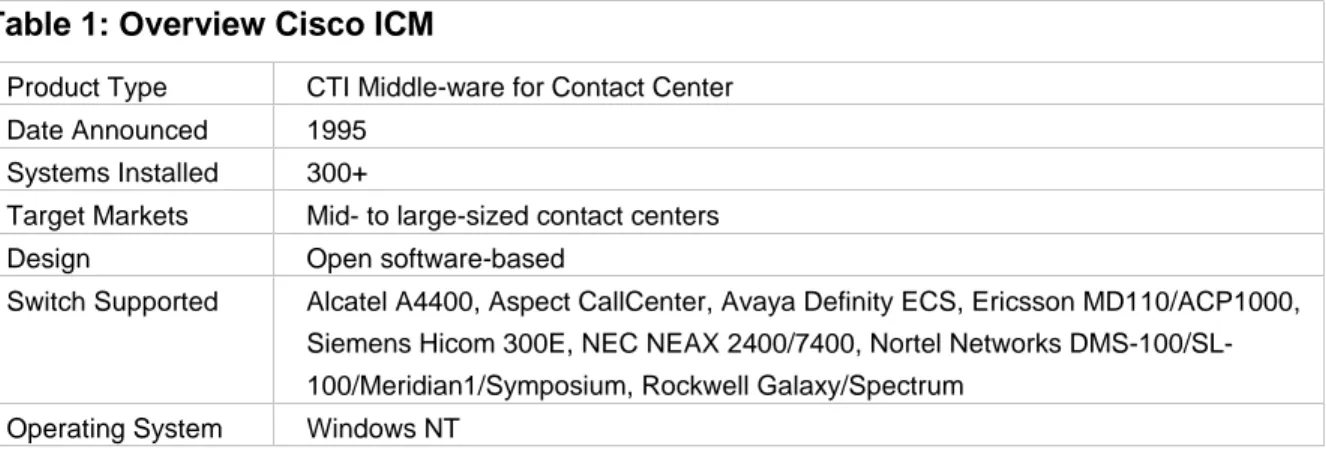
Table 1: Overview Cisco ICM
Product Type CTI Middle-ware for Contact Center Date Announced 1995
Systems Installed 300+
Target Markets Mid- to large-sized contact centers Design Open software-based
Switch Supported Alcatel A4400, Aspect CallCenter, Avaya Definity ECS, Ericsson MD110/ACP1000, Siemens Hicom 300E, NEC NEAX 2400/7400, Nortel Networks DMS-100/SL-100/Meridian1/Symposium, Rockwell Galaxy/Spectrum
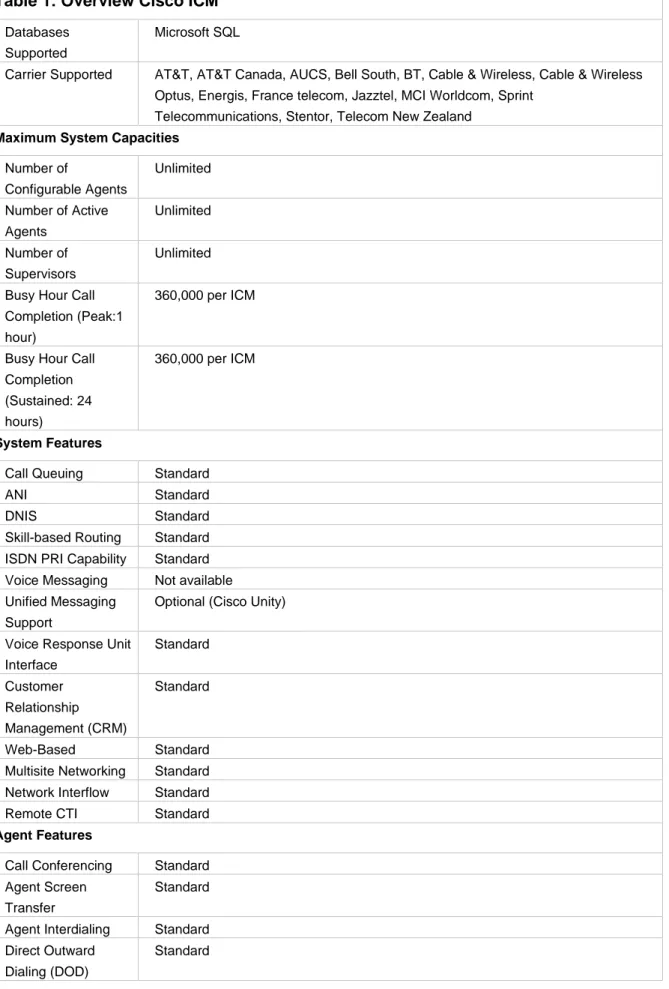
Table 1: Overview Cisco ICM
Databases Supported
Microsoft SQL
Carrier Supported AT&T, AT&T Canada, AUCS, Bell South, BT, Cable & Wireless, Cable & Wireless Optus, Energis, France telecom, Jazztel, MCI Worldcom, Sprint
Telecommunications, Stentor, Telecom New Zealand Maximum System Capacities
Number of
Configurable Agents
Unlimited
Number of Active Agents
Unlimited
Number of Supervisors
Unlimited
Busy Hour Call Completion (Peak:1 hour)
360,000 per ICM
Busy Hour Call Completion (Sustained: 24 hours)
360,000 per ICM
System Features
Call Queuing Standard
ANI Standard
DNIS Standard
Skill-based Routing Standard ISDN PRI Capability Standard Voice Messaging Not available Unified Messaging
Support
Optional (Cisco Unity)
Voice Response Unit Interface Standard Customer Relationship Management (CRM) Standard Web-Based Standard
Multisite Networking Standard Network Interflow Standard Remote CTI Standard Agent Features
Call Conferencing Standard Agent Screen
Transfer
Standard
Agent Interdialing Standard Direct Outward
Dialing (DOD)
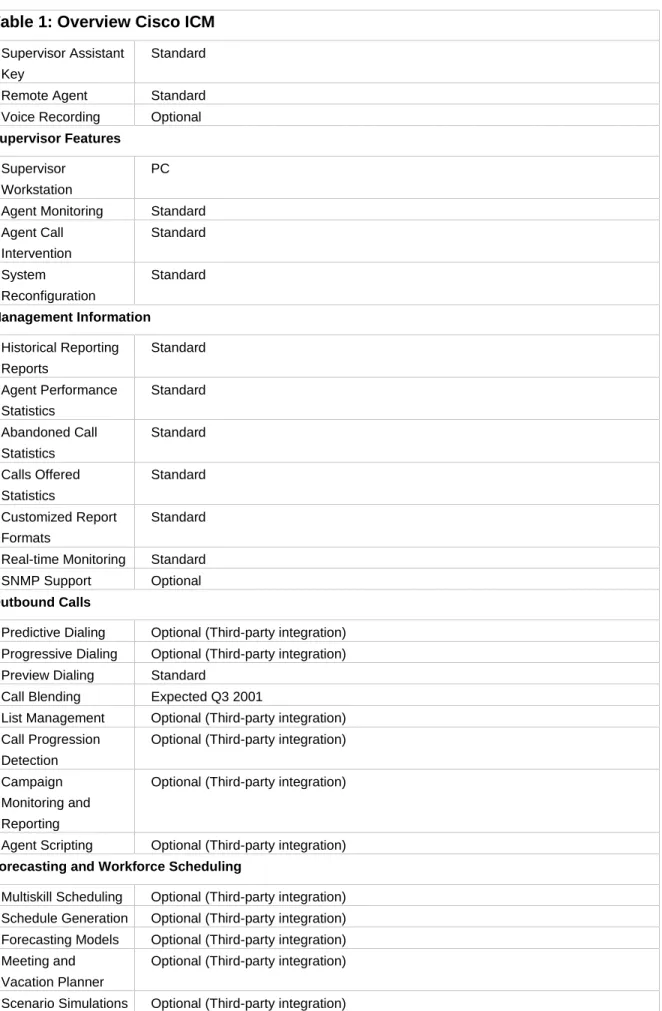
Table 1: Overview Cisco ICM
Supervisor Assistant Key
Standard
Remote Agent Standard Voice Recording Optional Supervisor Features
Supervisor Workstation
PC
Agent Monitoring Standard Agent Call Intervention Standard System Reconfiguration Standard Management Information Historical Reporting Reports Standard Agent Performance Statistics Standard Abandoned Call Statistics Standard Calls Offered Statistics Standard Customized Report Formats Standard
Real-time Monitoring Standard SNMP Support Optional Outbound Calls
Predictive Dialing Optional (Third-party integration) Progressive Dialing Optional (Third-party integration) Preview Dialing Standard
Call Blending Expected Q3 2001
List Management Optional (Third-party integration) Call Progression
Detection
Optional (Third-party integration)
Campaign Monitoring and Reporting
Optional (Third-party integration)
Agent Scripting Optional (Third-party integration) Forecasting and Workforce Scheduling
Multiskill Scheduling Optional (Third-party integration) Schedule Generation Optional (Third-party integration) Forecasting Models Optional (Third-party integration) Meeting and
Vacation Planner
Optional (Third-party integration)
Table 1: Overview Cisco ICM
Web Interface for Supervisors and Agents
Optional (Third-party integration)
Real-Time Adherence
Optional (Third-party integration)
ICM software is a complex product with many options. It is important to emphasize its architecture and component description.
Table 2: ICM Architecture
Central Controller (CC)
-CallRouter and Logger
The CallRouter provides the central intelligence for routing decisions, using real-time call handling and agent status data. It receives routing requests from the network and contact centers systems and processes them through call routing scripts. It returns the destination address to the NIC for forwarding to the network service provider. CallRouter is capable of routing queries from alternative media such as Internet, fax, and e-mail.
Performance and contact detail information is consolidated in a database, called Logger. This information can be combined with data coming from ACDs, PBXs, IVRs, and networks. This database is accessible via ICM software utilities and third-party SQL and ODBC tools.
ICM Network Interface Controller (NIC)
NIC provides an interface between the Central Controller and the carrier network. For each incoming call, the NIC receives the route request from the network, it passes to the CC, and then it returns a destination address.
ICM Peripheral Gateway (PG)
It provides the interface between the Central Controller and premise-based systems (ACDs, PBXs, IVRs, Web and e-mail servers, and agent desktop applications). Its purpose is to collect information about agent status, performance, queue status, IVR availability, and other variables, and sends them to the CC for routing decisions. It tracks events per agent and interaction basis.
Admin Workstation (AW)
The AW is the management workstation for the ICM system, running on the Microsoft Windows operating system. It enables supervisors to define and modify routing scripts, monitor the contact center activity, create historical reports, and ensure system security.
ICM software components and application links provide distributed fault tolerance at both hardware and software levels, with real-time application fail-over capability. It is resilient to hardware component failures, communications network failures, and asynchronous software errors.
For multisite deployment, the ICM software enables a company to partition its system across divisional entities; each entity maintains autonomy over contact center operations such as scripts, enterprise skill groups, schedules, and procedures. Partition is an optional feature of the ICM software.
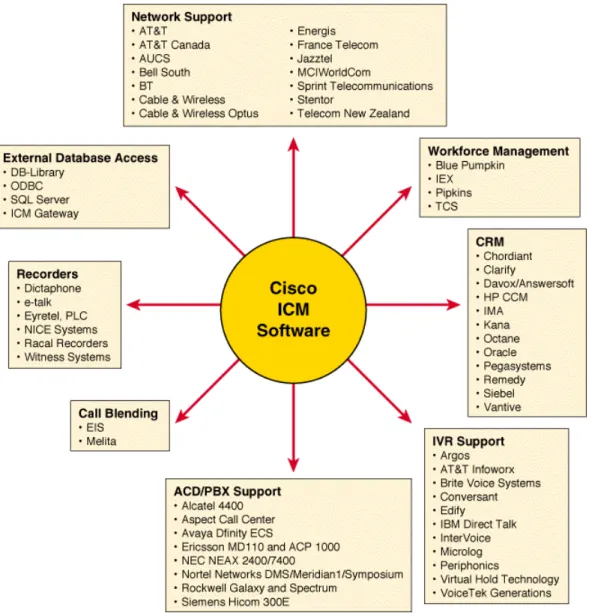
Figure 2: ICM Connectivity
Source: Cisco Systems
ICM Solution Options
Pre-Routing Function
Pre-routing is the routing process applied by the ICM software at the carrier level. With the pre-routing function, the NIC receives a routing request from the carrier and passes the call information to the ICM software. The software processes the routing request through a call script, which defines how the call
sent to a call center. The ICM software uses real-time call center data that is continually gathered by the PGs at different sites in the network. This function enables the ICM software to segment customers and balance calls across the enterprise. Pre-routing function requires the NIC, CallRouter, Logger, Admin workstation, and PG.
Post-Routing Function
It allows making secondary routing decisions once the call is already connected to a peripheral such as ACD, PBX, or IVR systems in a company’s private network. Post-routing is only executed when redirection of a call to another agent or site is required. For this, the peripheral system submits a routing request to the ICM software, and this one executes scripts to process the routing request. The ICM software instructs the peripheral to send the call to the appropriate resource.
Gateway SQL
The Gateway SQL option is used to query an external Microsoft SQL Server database to assist the routing process. The database lookup can be based on Calling Line ID (CLID), Dialed Number (DN), or Called Entered Digits (CED).
Gateway
The Gateway option allows the ICM software to interact with a host system that is running another contact center application, such as a predictive dialer. This option is implemented in a call-routing script; it instructs the ICM software to communicate with an external application, or sends information to an external application. The script evaluates the response from the external application and then the routing decision is made.
Enterprise Computer Telephony Integration (CTI)
The Enterprise CTI option provides an interface between the ICM software and agent desktops or server applications. It takes call and transaction data from different systems and provides it to the agent desktop or CTI server. Information from these systems is used to trigger integrated desktop telephony applications such as screen pops and voice and data transfers. Data elements can include dialed numbers, calling line ID (CLID), customer-entered digits (CED), information submitted on a Web form, information extracted from a database, voice processing, and agent transaction.
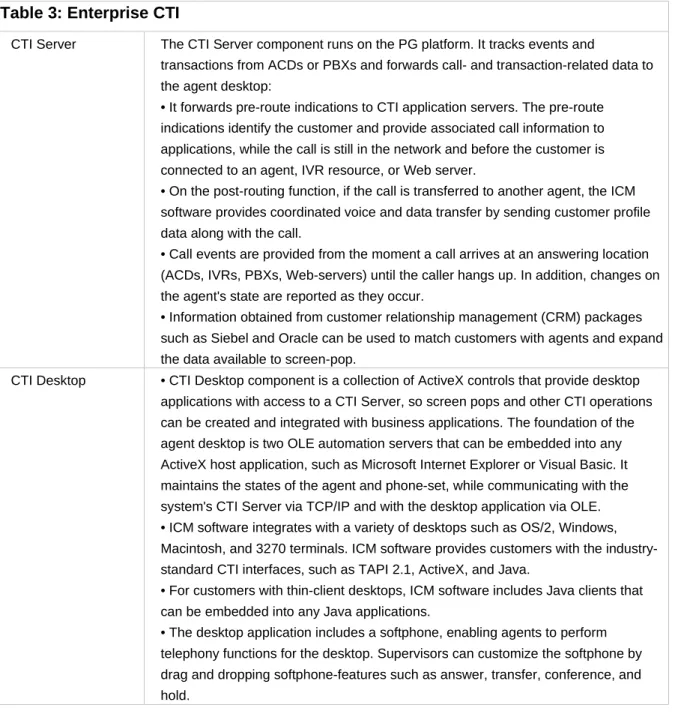
Table 3: Enterprise CTI
CTI Server The CTI Server component runs on the PG platform. It tracks events and
transactions from ACDs or PBXs and forwards call- and transaction-related data to the agent desktop:
• It forwards pre-route indications to CTI application servers. The pre-route indications identify the customer and provide associated call information to applications, while the call is still in the network and before the customer is connected to an agent, IVR resource, or Web server.
• On the post-routing function, if the call is transferred to another agent, the ICM software provides coordinated voice and data transfer by sending customer profile data along with the call.
• Call events are provided from the moment a call arrives at an answering location (ACDs, IVRs, PBXs, Web-servers) until the caller hangs up. In addition, changes on the agent's state are reported as they occur.
• Information obtained from customer relationship management (CRM) packages such as Siebel and Oracle can be used to match customers with agents and expand the data available to screen-pop.
CTI Desktop • CTI Desktop component is a collection of ActiveX controls that provide desktop applications with access to a CTI Server, so screen pops and other CTI operations can be created and integrated with business applications. The foundation of the agent desktop is two OLE automation servers that can be embedded into any ActiveX host application, such as Microsoft Internet Explorer or Visual Basic. It maintains the states of the agent and phone-set, while communicating with the system's CTI Server via TCP/IP and with the desktop application via OLE. • ICM software integrates with a variety of desktops such as OS/2, Windows, Macintosh, and 3270 terminals. ICM software provides customers with the industry-standard CTI interfaces, such as TAPI 2.1, ActiveX, and Java.
• For customers with thin-client desktops, ICM software includes Java clients that can be embedded into any Java applications.
• The desktop application includes a softphone, enabling agents to perform telephony functions for the desktop. Supervisors can customize the softphone by drag and dropping softphone-features such as answer, transfer, conference, and hold.
Real-Time Information and Reporting
The ICM software collects real-time and historical data for contact center reporting. It consolidates the information from carrier networks, the Internet, ACDs, IVRs, Web servers, databases, business applications, and individual agent desktops. Interaction, customer, and peripheral data are collected and stored in a Microsoft SQL server database for use in real-time, historical reporting, and in-routing decisions made by the pre-routing and the post-routing functions.
Table 4: Enterprisewide Real-Time and Reporting Features
Real-Time Data The ICM software collects events from multisite contact centers in realtime. Realtime data provides information about skill groups, services, trunk groups, peripherals, agents, and routes. Historical data is stored in 5- and 30-minute intervals. Thresholds can be established to alert supervisors when traffic flows deviate from preset parameters. Realtime monitoring can be done continuously or on demand using Microsoft Internet Explorer or Netscape Navigator.
Reporting The reporting package enables users to generate reports based on historical information collected from single or multisite call centers, about each skill group, service, trunk group, route, and peripheral services. The data collected from different resources on eventbyevent basis is converted into a single format and stored on the ICM central server database. The system collects performance data through the life of each call. It can combine data from different parts of the contact center (ACDs, PBXs, and IVRs). ICM software includes more than 100 predefined report templates. Custom reports can be created using a client’s database access tool based on Powersoft Infomaker. All reports can be scrutinized to see specific statistics, including data of individual agents; they can be printed manually or scheduled. Data can be exported to industry-standard third-party file formats. Reports and routing scripts can be monitored continuously or on demand using Microsoft Internet Explorer or Netscape Navigator.
Remote Agent Support
The ICM software provides CTI, call distribution, and reporting capabilities to branch-office and small office/home office agents. In addition to skill-based routing, it provides softphone, screen pop, and third-party call-control functionality for remote agents. Each agent has access to personal statistics, such as number of calls handled, average call work time, average talk time, cumulative available time, and total log-in time. On the skill-based pre-routing function, remote agents are grouped according to skills. The ICM software makes routing decisions based on real-time agent and call status information from each agent’s desktop, it can reserve the remote agent to ensure availability. On the post-routing function, the ICM software allows a remote agent to request a new destination for a call from within the desktop application. The software will make the routing decision based on real-time and enterprise-wide resource availability. The new resource can be a skill group or service or another remote agent. Basic telephone service or Centrex lines are supported for home agents. The capability to perform transfers, conferences, or consultations is available if the voice service has been extended with a multiparty calling feature. For branch-office agents, the ICM software supports agents connected to a PBX or key system via direct inward dial (DID) trunks. Remote agent capability operates on the PG.
IVR Integration
The IVR interface option enables the ICM software to communicate directly with IVR systems from multiple vendors, manage IVR port utilization, and request specific IVR scripts. IVR Integration supports customer identification and segmentation, skill-based routing, IVR load balancing, call queuing at a premise or network base, consolidated reporting capability, and delivery of IVR data to answering resources across the enterprise. IVR Interface is based on industry-standard Computer Supported Telephony Applications (CSTA) protocol. IVR Integration capability operates on the PG.
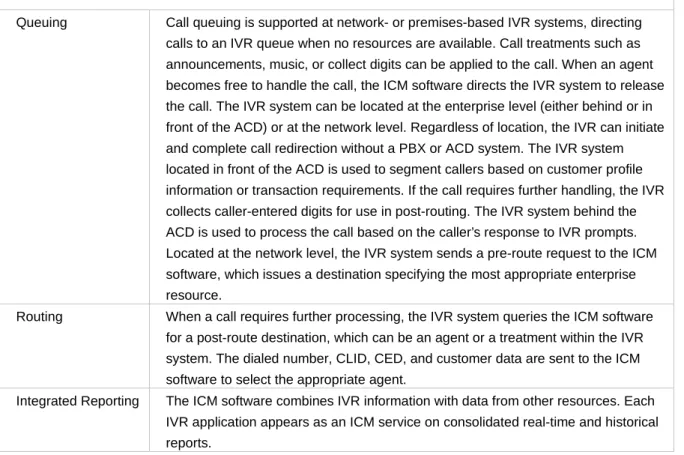
Table 5: IVR Integration Capabilities
Queuing Call queuing is supported at network- or premises-based IVR systems, directing calls to an IVR queue when no resources are available. Call treatments such as announcements, music, or collect digits can be applied to the call. When an agent becomes free to handle the call, the ICM software directs the IVR system to release the call. The IVR system can be located at the enterprise level (either behind or in front of the ACD) or at the network level. Regardless of location, the IVR can initiate and complete call redirection without a PBX or ACD system. The IVR system located in front of the ACD is used to segment callers based on customer profile information or transaction requirements. If the call requires further handling, the IVR collects caller-entered digits for use in post-routing. The IVR system behind the ACD is used to process the call based on the caller’s response to IVR prompts. Located at the network level, the IVR system sends a pre-route request to the ICM software, which issues a destination specifying the most appropriate enterprise resource.
Routing When a call requires further processing, the IVR system queries the ICM software for a post-route destination, which can be an agent or a treatment within the IVR system. The dialed number, CLID, CED, and customer data are sent to the ICM software to select the appropriate agent.
Integrated Reporting The ICM software combines IVR information with data from other resources. Each IVR application appears as an ICM service on consolidated real-time and historical reports.
Workforce Management Integration
The ICM software interfaces with workforce management systems to allocate daily resources based on interactions’ traffic forecast and agent schedules generated by the workforce management system. The ICM software can import schedule data from a workforce management database and use the data for call routing and reporting purposes. The workforce integration tool can be used also to export data from the ICM database to an external workforce management system. The Workforce Management Integration tool is installed on the Admin Workstation.
Site ICM
Site ICM provides the core for integrating ACD, IVR, and desktop applications. It is designed for a single contact center, including CTI capability, IVR integration, and real-time and reporting features.
Network Applications Manager (NAM)
Network Applications Manager (NAM) is the carrier-class version of the ICM software. It is a software-based call processing application that enables carriers or network service providers to manage multiple ICM systems and to offer virtual call center services to its customers. NAM can function like a Service Control Point (SCP) by distributing calls to individual network service customers based on the dialed number, point of origin, caller entered data, and database lookup. NAM can also be connected to an existing SCP. The software supports all major Intelligent Network (IN), VoIP standards and proprietary network interfaces. On the one hand, NAM system controls the interfaces to carrier networks as well as any service platforms (such as IVRs) or applications provided on a shared-customer basis. On the other hand, it controls the collection of ICM systems corresponding to individual customers. Each ICM system is connected to the customer’s own workstations and peripherals, such as ACDs or premises’ IVR systems.
• The standard ICM software is a single customer system that resides on a customer's premises. • On the NAM architecture, NAM software and the ICM software (including NIC and CC) are deployed
on the service provider network. All central routing controller functionality is implemented in the service provider's network rather than at the customer site. In addition, one ICM system can pass call routing requests to another ICM system.
By subscribing to NAM services, customers do not need to administer the ICM system themselves. NAM can be implemented with different options such as toll-free numbers, network IVR prompting, virtual call center services, and network CTI services.
Web Interaction
Web Interaction option provides a Web server interface to the ICM software. The ICM software routes Web requests using the same business rules applied to calls arriving from a carrier network. A routing decision is made for each Web request before it is sent to a contact center resource. The Post-Routing function provides the distribution of Web requests already in session with an agent. When the request requires redirection, ICM software applies the routing rules and sends it to the best available agent in the enterprise. An agent can be defined on the ICM software as capable of voice and-or Web media.
Following WebLine Communication acquisition, Cisco offers Customer Interaction Suite as a solution for multichannel interaction management. It is structured with several modules such as E-Mail Manager, Collaboration server, Media Manager, and Media Blender.
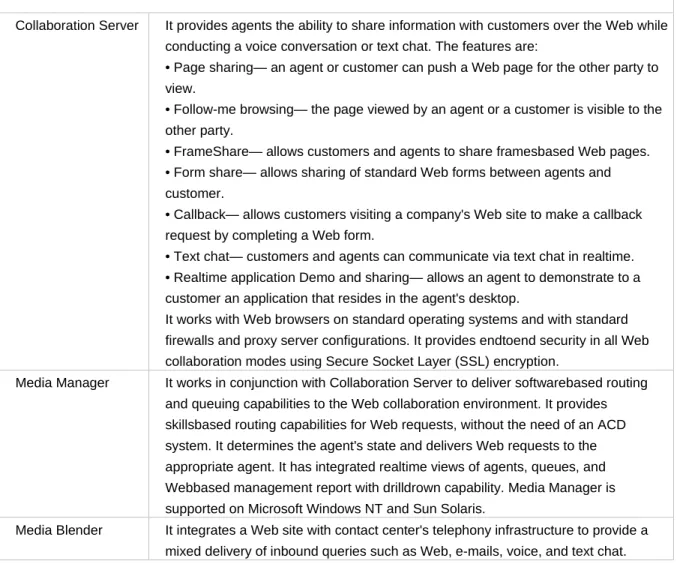
Table 6: Customer Interaction Suite Overview
E-Mail Manager It processes customer messages directing them to the appropriate agent, categorizing and prioritizing them, sending automatic replies, or suggesting response templates. Web-based interface provides access to tools for reading and responding to messages in queues. Agents can examine communication history, internal notes, status, and priority for each message. Templates from a list of suggested replies could be inserted directly into response fields. Supervisors can monitor and manage the queues and generate reports on message traffic, system, agent, and group performance. Realtime monitoring provides information on agent activity, performance, and personal and skill group and queue status. An open Application Programming Interface (API) enables customers or third parties to integrate E-Mail Manager with CRM packages and external data sources.
Table 6: Customer Interaction Suite Overview
Collaboration Server It provides agents the ability to share information with customers over the Web while conducting a voice conversation or text chat. The features are:
• Page sharing— an agent or customer can push a Web page for the other party to view.
• Follow-me browsing— the page viewed by an agent or a customer is visible to the other party.
• FrameShare— allows customers and agents to share framesbased Web pages. • Form share— allows sharing of standard Web forms between agents and customer.
• Callback— allows customers visiting a company's Web site to make a callback request by completing a Web form.
• Text chat— customers and agents can communicate via text chat in realtime. • Realtime application Demo and sharing— allows an agent to demonstrate to a customer an application that resides in the agent's desktop.
It works with Web browsers on standard operating systems and with standard firewalls and proxy server configurations. It provides endtoend security in all Web collaboration modes using Secure Socket Layer (SSL) encryption.
Media Manager It works in conjunction with Collaboration Server to deliver softwarebased routing and queuing capabilities to the Web collaboration environment. It provides skillsbased routing capabilities for Web requests, without the need of an ACD system. It determines the agent's state and delivers Web requests to the appropriate agent. It has integrated realtime views of agents, queues, and Webbased management report with drilldrown capability. Media Manager is supported on Microsoft Windows NT and Sun Solaris.
Media Blender It integrates a Web site with contact center's telephony infrastructure to provide a mixed delivery of inbound queries such as Web, e-mails, voice, and text chat.
Analysis
In 1999, Cisco acquired Geotel, which was a leading provider of software solutions for distributed voice call centers for enterprise and service provider customers. Geotel’s ICR product was renamed Cisco ICM software. That same year, Cisco acquired WebLine Communications Corp., which was a provider of customer interaction management software for Internet customer service. The resulting product from this acquisition is the Cisco Customer Interaction Suite. Both acquisitions allow Cisco to be a player on the network-based contact center market, aligning Cisco’s convergence strategy. The integration of both products is not fully implemented; media blending reporting, administration, and desktop integration are still lacking. Cisco indicates full integration with the new version of ICM software (V5), due in the second half of 2001.
ICM solution provides significant advantages for an enterprise trying to implement a multisite call center having different infrastructure investments at each location. Instead of routing calls across expensive private or public lines to reach other call center sites, carriers or network service providers manage the call distribution via their own network. Calls are identified when they are in the carrier network and routed to a destination site prior to being assigned to a queue. Each premise’s resource provides real-time information to the ICM software, enabling it to select the most appropriate site to answer the request and to better allocate calls among different resources-load balancing. Another advantage is to locate IVR equipment at the network level, allowing customer segmentation grabbing the customer’s input in the network, then using this information to route the call. The ICM software provides also centralized
management; supervisors have an overall picture of the status of the call centers geographically dispersed, with the possibility to view details of each site or agent if necessary.
ICM software has an extensive list of connectivity with telecommunication carriers as well as with PBXs, ACDs, and IVR systems. Some concerns may appear on the connectivity of the ICM Peripheral Gateway and ACD systems whether the PG could not support some ACD’s latest features and software releases. This intention aligns with Cisco’s convergence strategy, trying aggressively to position IPCC solution as a replacement of legacy systems, presenting it as a migration path from the "old call center technology" to IP-based services.
Pricing
Pricing is dependent on configuration.
GSA Pricing
No.
Competitors
The following systems compete independently with different areas of Cisco ICM software: • Network routing levels: Genesys Suite G6, IEX's TotalNet.
Genesys Suite G6, present internationally, provides advanced network- and enterprise-based routing solutions for multichannels interactions, workforce management, outbound dialer, and campaign management.
IEX TotalNet, principally present in North America, provides multisite call routing and workforce management software:
• Enterprise routing level and Internet interaction: Genesys Suite G6, Aspect's portal, Quintus, IBM Call Path.
Strengths
• Cisco ICM software is one of the pre-routing market leaders. Historically GeoTel has dominated the network-based call routing market with the ICR product, now called Cisco ICM software. It stands as a highly resilient product, deploying large call centers.
• ICM software's open system architecture uses industry-standard protocols and has broad interoperability with multiple vendor systems— an advantage for enterprises or telecom operators with different infrastructure investments at each location.
• Web requests and e-mails are routed through the ICM software using the same business rules applied to calls arriving from a carrier network. A routing decision is made for each request before it is sent to a contact center resource.
• The ICM software is available in North America, Europe, Asia-Pacific, and Latin-America.
Limitations
• A system integrator and considerable customization are generally required to integrate the Cisco ICM software with multiple carriers and premises switches, ACDs, IVRs, and databases. This can be lengthy and costly due to compatibility issues across products and platforms.
• In terms of flexibility, ICM solution does not scale down to small environments; today the entry-level is 25 agents. The result is an expensive solution unless there are hundreds of agents involved.
Insight
From a product stand point, Cisco ICM software is undeniably a proven network-based call-routing solution, based on the philosophy of openness and targeted for mid-to-large enterprises. The ICM software is a good solution for enterprises with geographically dispersed call centers and heterogeneous infrastructure. Adding WebLine's technology (formerly Cisco Customer Interaction Suite) to the ICM software allows network service providers to offer virtual contact center services. Some doubts exist, however, concerning the lack of integration of both solutions and the partnership between Cisco and Kana Communications, a provider of e-business and customer interaction management solutions, which may not encourage Cisco to enhance WebLine's applications.