TECHNICAL UNIVERSITY OF CLUJ-NAPOCA
ACTA TECHNICA NAPOCENSIS
Series: Applied Mathematics, Mechanics, and Engineering Vol. 61, Issue III, September, 2018
METHODOLOGY OF REALISING THE DIGITAL TWINS OF
EXOSKELETON-CENTRED WORKPLACES
Carmen CONSTANTINESCU, Daniela POPESCU, Oliver TODOROVIC, Ovidiu VIRLAN, Vlad TINCA
Abstract: Wearable robotics – Exoskeletons - combining the advantages of both industrial manipulators and human-robot collaboration represents enabling technology for ergonomic optimisation of manufacturing workplaces. The Exoskeletons fuse the flexibility, intelligence and human-centred control of human-robot systems with the high payload, endurance, precision and sensor-based guidance. This paper presents a generic and innovative methodology aiming at develop the Digital Twins of workers wearing Exoskeletons in human centred-workplaces. This methodology is validated by coupling a commercial Exoskeleton to the Digital Humanoid of one of the key providers of digital manufacturing technologies. Several workplace optimisations by employing the developed Digital Twins are performed, as well.
Key words: Exoskeleton, Digital Twin, Modelling and Simulation
1. PROBLEM STATEMENT
1.1 Exoskeletons-centred workplaces
The term “exoskeleton” is currently the main word to describe all kinds of wearable robotics that provide some manner of physical interaction with the person wearing it. The exoskeleton could provide a physical boost, hinder the user on purpose or support the weight of an object that the user would otherwise have to support themselves [1].
Wearable robotics designed to be used in an industrial setting is the fastest growing field of exoskeleton development. Exoskeletons for work and industry can be used at construction sites, manufacturing factories, dry-docks, warehouses and even surgical rooms. Exoskeletons for working in industry can be clustered into six categories differing from the supported area of the worker body: back, power gloves, tool holding, chairless chairs, full body powered suits, and additional / supernumerary robotics [2].
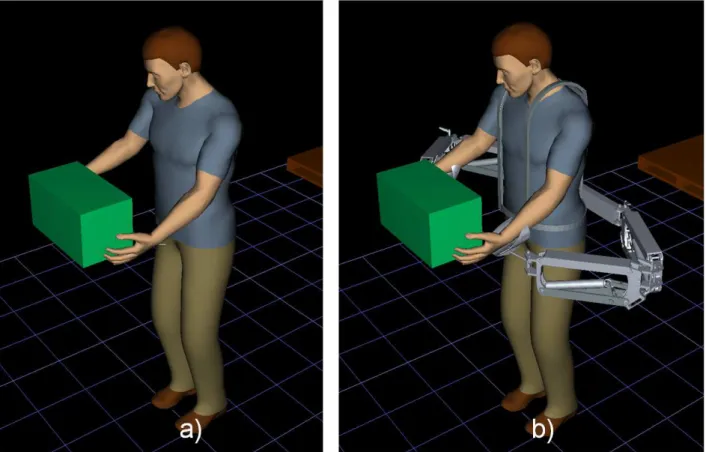
In Figure 1 two states of the same workplace where heavy parts are manipulated (>10kg) are
shown: 1a) the digital model of this simple task where the manipulation of heavy good is repetitive and 1b); the exoskeleton-centered workplace with a commercial passive exoskeleton supporting the worker.
1.2 Digital Twins of Exoskeleton-centred workplaces
Hand-Arm Vibration disorders or Whole Body Vibration disorders [3].
A possible solution for these problems is to integrate an exoskeleton to these workplaces in order to relive the tension of the worker and protect him from possible health issues.
Exoskeletons are more and more employed in industry. The number of companies building and selling exoskeletons is also rising. With the growing diversity of exoskeletons it is becoming increasingly difficult to find the best type of exoskeleton for the specific task without renting the exoskeleton from the producer and doing “on the job” experiments to determine if it is adequate, which can be cost-intensive and time consuming [4].
The comprehensive digitalization of workplaces give the industry the possibility for easy and cheap changes of workplaces without endangering the health of the worker and to try different possible solutions. The development of the digital twin of exoskeleton-centered workplaces effaces the challenge of lack of a methodology for coupling the exoskeleton to the digital humanoid, thus increasing the costs and time to implement/optimize an exoskeleton-centered workplace [5].
By enabling the industry to easily manipulate/optimize the digital twins of exoskeleton-centered workplaces, it will encourage the adoption of exoskeletons for manufacturing tasks in a large number of industry sectors.
Fig. 1. Digital model of a workplace without and with an integrated commercial integrated exoskeleton (©Fraunhofer IAO).
2. METHODOLOGY OVERVIEW
In order to develop the Digital Twin, a new methodology for coupling the digital models of a generic and then many commercial exoskeletons to a generic and then specific digital humanoid was developed. The overview and the main steps of this methodology are
presented in detail in the next sections. The followed approach is a bottom-up one with respect that a specific digital humanoid, Jack from Siemens Industry Solutions and commercial exoskeleton provided by German Bionic System – GBS (www.germanbionic.de) have been used.
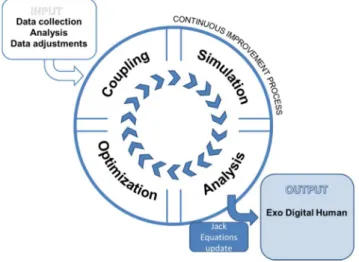
The developed coupling methodology consists of six phases presented schematically in Figure 3.
Fig. 3. Overview of the coupling methodology (©Fraunhofer IAO)
The process flow and the corresponding steps of each phase are presented in detail as follows:
Phase 1 - Input
Data collection is the first step in the series of successive activities required to couple the digital exoskeleton to the digital humanoid aiming at create the so-called Jack©Exo, a new digital resource used in planning and optimizing the workplaces with integrated Exoskeleton.
Fig. 4. Importing steps (© Fraunhofer IAO).
Collecting the required input data is often a tedious process, as there complex bureaucracy due to copyright aspects could make it difficult to retrieve data. Based on the NDA between German Bionic Systems (www.germanbionic.de) and Fraunhofer IAO, the CAD files of Cray X (active Exoskeleton)
commercial exoskeleton could be handed out. The only accepted file format by Siemens Classic Jack, for the CAD files is .JT, so all CAD files used for the construction of the exoskeleton must be converted beforehand. After the conversion, the files are imported in the software to assemble the exoskeleton as is presented in figure 4.
Phase 2 - Coupling
Fig. 5. Positioning left ball mark (© Fraunhofer IAO).
The coupling process consists of creating sites, constraints and joints for the CAD models of the digital exoskeleton and then attaching them to the digital humanoid (Jack©).
The structure of the exoskeleton will be rebuild, all the kinematics are created manually at the same time with the joints and all parts becoming one long kinematic chain. For every component of the exoskeleton points of interest must be marked on them in the spots where joints, constraints or attachments will be placed, these points are called “Sites”. The particularities of the coupling differ depending on the type of exoskeleton used for the coupling. The exoskeleton can be coupled to Jack with the help of spheres attached to the body of the digital humanoid in key points and then a stable link between Jack and the exoskeleton is created by constraining these spheres to the exoskeleton. The attached spheres are not visible in simulations due to the fact that they are not part of the exoskeleton.
Phase 3 – Simulation
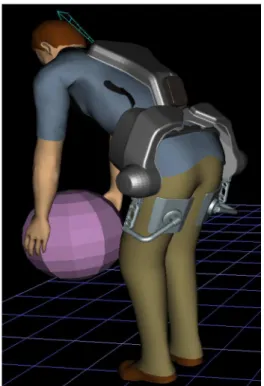
humanoid with the coupled exoskeleton is picking up from the floor a 10 kg object.
Fig. 4. Picking up a 10 kg object (© Fraunhofer IAO).
Phase 4 - Analysis
The completion of the simulation reveals the mistakes made during the coupling process or some gaps. Different solutions are being applied to fix the problems.
Fig. 5. Poor coupling (©Fraunhofer IAO).
After simulating a very simple scene, all the coupling problems and gaps appear, moving parts which are not suitable coupled will change further more orientation and position. In figure 5 the result of a simulation is presented where the plates connected to the legs have moved from their positions. These plates are constrained to the spheres attached to the body of the digital humanoid, the blue axes represent the displacement of the sites that have been used to create the constraint.
For better results, the problematic parts are re-coupled and new solutions for the general coupling are found.
Phase 5 – Optimization
This phase consists in implementing the solutions found in the analysis phase of the problems that have arisen.
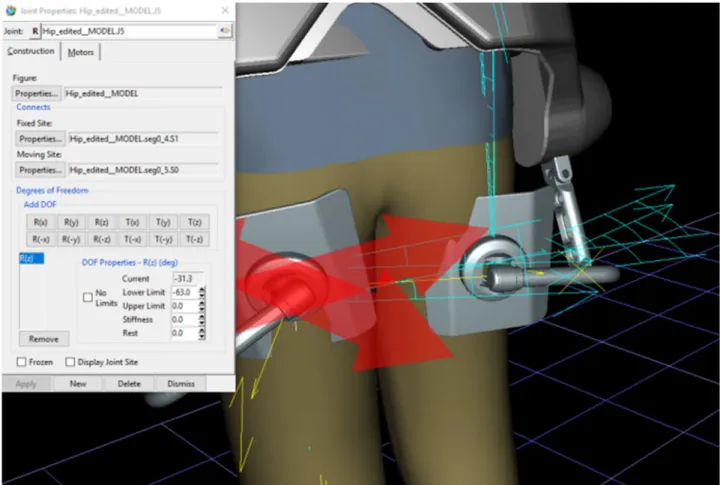
The diagnose mades in the previous phase shows us some parameters that need to be modified in order to match the reality. To resolve the error in the coupling presented before, the joint has been limited to restrict its movement, as is presented in figure 6.The joint has a single degree of freedom, a rotation on the z axis and has been limited to be able to rotate only 63 degrees, thus the plate will remain correctly attached to the leg of the digital humanoid.
All the adjustments are made in this phase and the Continuous Improvement Process is repeated until the coupling is properly done.
Phase 6 – Output
Fig. 6. Setting the right parameters (©Fraunhofer IAO).
Fig. 7. Vision of a GUI for coupled exoskeleton (© Fraunhofer IAO).
In Figure 7 a draft design of the possible Graphic User Interface for an easy selection of the exoskeleton is shown. All the exoskeleton CAD files are stored in an online cloud, constantly updated, and with the help of a
simplified interface, the process planers work will be much more productive.
3. IMPLEMENTATION USE CASE:
ACTIVE COMMERCIAL EXOSKELE-TON DIGITAL TWIN
3.1 GBS Exoskeleton: Overview
German Bionic Systems (GBS) (www.germanbionic.de) is the first manufacturer of powered industrial exoskeletons in Germany.
Table 1 Technical characteristics of the GBS exoskeleton.
It is a start-up of the EU FP7-NMP project Robo-Mate with the full title “Intelligent exoskeleton based on human-robot interaction for manipulation of heavy goods in Europe’s Factories of the Future” (www.robo-mate.eu). GBS successfully exploits the Robo-Mate prototype by realizing and offering its final commercial product Cray X, which is currently integrated in several European companies from the automotive, logistics and machinery sectors.
3.2 Digital Twins and manipulating heavy weights in the digital world
The term digital twin was first defined by NASA in 2010 regarding a simulation that is based on both available and newly created physical models to recreate a twin as close as possible to reality. Short said it is a system or a vehicle that respects all the real physics and behaviour as close as possible in the virtual world [7].
A digital twin continuously learns and updates itself from the outside world, from the real parameters, all the working conditions and values are optimized every time when the real process is changed or a problem appears in the system. This digital twin system learns from:
• itself, using sensors data;
• human experts, such as engineers; • similar fleets of machines;
• larger systems and environments; • historical data.
The term “digital twin” will slowly change its meaning over time due to the adding of more
data for an accurate representation, and in the future it may contain historical data, simulation models, installation guidelines, alarm and events definition, handbooks, proprietary function blocks etc. and will internally communicate with its physical asset, the digital twin becoming a multi-facetted digital counterpart of the real asset [8].
Using the digital twin of an workplace in which heavy weights are manipulated by humans, to optimise it, will considerably reduce the risk of unforeseen health issues due to the simulation being able to process analyses and show the data for hundreds or thousands of work cycles in a matter of seconds as opposed to experimenting with the changes made in the actual workplace, which can take considerably longer for the data to be collected and analysed. Thus the best configuration of the workplace can be implemented using simulations in a short time, cheaper and with no risks for the worker.
The reliability of the data produced by a simulation is only influenced by the volume and accuracy of the input data for the simulation and the digital twin of the workplace. As the term “digital twin” is evolving so will the data produced by simulations be more precise and reliable and reveal information that would be hard to obtain through traditional means about the workplace.
As with any new technology, the costs for implementation are high and can be discouraging for medium and small enterprises to use it, only big companies being able to handle the costs and assume the risk that the technology will not be compatible with the workplace. Thus, there is a need for digital twins of exoskeleton-centred workplaces to cut the costs and time of implementation and optimisation, hence encouraging the adoption of exoskeletons in industry [9].
4. CONCLUSIONS AND FUTURE WORK
In a workplace in which heavy weights are manipulated, robots or conveyor belts are usually used, but if the workplace requires flexibility as well, a human has to do the job and to protect the human worker a new technology is beginning to be used: exoskeletons that are integrated in to the workplaces. Exoskeletons are a new technology in industry that are continuously developed and will have a place in to Industry 4.0 [10]. Thus the need for a methodology for the digital coupling of exoskeletons to digital humanoids presented in this paper.
In the future the focus should be taken on the python code, embedded in Siemens Classic Jack, for coupling the Exoskeleton, updating analysis tools and integrating the Exoskeleton’s controller.
5. ACKNOWLEDGEMENT
We would like to express our special thanks of gratitude to our partners German Bionic Systems for making available to us their commercial exoskeleton as well as Siemens for supporting us with new and improved solutions for accomplishing the best results.
6. REFERENCES
[1.] Carmen Constantinescu; Popescu, Daniela; Muresan, Paul; Stana, Sebastian: “Exoskeleton-centered process optimization in advanced factory environments”, 48th CIRP Conference on Manufacturing Systems - CIRP CMS 2015, Naples, Italy.
[2.] Constantinescu, Carmen; Mureșan Paul Cristian, Gînța SM; Todorovic O.: "Modelling and simulation of advanced factory environments integrating intelligent exoskeleton". In: "Proceedings of the 2014 International Conference on Production Research - Regional Conference Africa, Europe and the Middle East and 3rd International Conference on Quality and Innovation in Engineering and Management, Cluj-Napoca", 1-5 July; 2014. ISBN 978-973-662-978-5. p. 100-105.
[3.] Carmen Constantinescu; Popescu, Daniela; Muresan, Paul; Oliver, Todorovic: “Optimisation of advanced manufacturing environments with integrated intelligent Exoskeletons”, 2016 International Conference on Production Research – Africa, Europe and the Middle East, Cluj-Napoca, Romania, 24-27 July, 2016 (in publication). [4.] Christian Dahmen; Frank Wöllecke;
Carmen Constantinescu: Challenges and possible solutions for enhancing the workplaces of the future by integrating smart and adaptive exoskeletons, 11th CIRP ICME Conference, Elsevier, Procedia CIRP, Volume 67, 2018, Pages 268-273.
[5.] Carmen Constantinescu; Oliver Todorovic; Wilhelm Bauer: “Exoskeletons as digital resource - Workplace simulation and optimization through integrated intelligent exoskeletons [Exoskelettbasierte Arbeitsplatzgestaltung.
Arbeitsplatzsimulation und Optimierung mit integriertem intelligenten Exoskelett], 2017. In: WT Werkstattstechnik 107 (6), S. 387– 391. Disponibil online la https://www.scopus.com/inward/record.uri?e
id=2-s2.0-5027005344&partnerID=40&md5=51a4995 e29b3c691f2e5143dae407eda.
[6.] Geman Bionic System - Exoskelet (Available at: https://www.germanbionic.de/ueber).
[7.] M. Shafto; M. Conroy; R. Doyle; E. Gleassgen; C. Kemp; J. LeMoigne and L. Wang: Draft modelling, simulation, information technology &processing roadmap. Technology Area, vol 11, 2010. [8.] D. Rainer, The digital twin: The evolution
of a key concept of industry 4.0. Published in J. Beyerer, Fraunhofer IOSB – visIT [Industrial IOT – Digital Twin], (2018). [9.] Constantinescu, Carmen; Muresan,
Paul-Cristian; Simon, Gabriel-Marian: “JackEx: the new digital manufacturing resource for optimization of Exoskeleton-based factory environments”, 26th CIRP Design Conference, 14-17 June, 2016, Stockholm. [10.] Christian Dahmen; Frank Wöllecke;
workplaces: metrics and assessment criteria, 2018. In: 51st CIRP Conference on Manufacturing Systems, Elsevier, Procedia
CIRP, PROCIR394514, S2212-8271(18)30344-5.
Metodologia de realizare a gemenelor digitale ale locurilor de muncă centrate pe exoskeleton
Rezumat: Robotica purtătoare - Exoskeletons - combinând avantajele ambelor manipulatoare
industriale și colaborarea robot-om reprezintă o tehnologie care permite o optimizare ergonomică a locurilor de muncă de fabricație. Exoskeleton-urile îmbină flexibilitatea, inteligența și controlul centrat pe om asupra sistemelor robotului uman, cu încărcături mari, rezistență, precizie și orientare bazată pe senzori. Această lucrare prezintă o metodologie generică și inovatoare care urmărește să
dezvolte Digital Twins al lucrătorilor care poartă Exoskeletons în locurile de muncă centrate pe om. Această metodologie este validată prin cuplarea unui Exoskeleton comercial la Digital Humanoid a unuia dintre furnizorii cheie ai tehnologiilor digitale de fabricație. Se efectuează și mai multe optimizări la locul de muncă prin angajarea dezvoltatorilor Digital Twins.
Carmen CONSTANTINESCU, Fraunhofer Institute for Industrial Engineering, FhG-IAO, [email protected]
Daniela POPESCU, Technical University of Cluj-Napoca, Faculty Machine Building, Cluj-Napoca, Romania, [email protected]
Oliver TODOROVIC, Fraunhofer Institute for Industrial Engineering, FhG-IAO, [email protected]
Ovidiu VIRLAN, Fraunhofer IAO, Stuttgart, Germany, [email protected]