INNOVATION IN
HEALTH INFORMATICS
The use of video consulting in general
practice: semi-structured interviews
examining acceptability to patients
Sophie Johnston
c/o Brian McKinstry, Usher Institute of Population Health Sciences and Informatics, University of Edinburgh, UK
Margaret MacDougall
Usher Institute of Population Health Sciences and Informatics, University of Edinburgh, UK
Brian McKinstry
E-Health Group, Usher Institute of Population Health Sciences and Informatics, University of Edinburgh, UK
ABSTRACT
Background and Objective To increase patient access to healthcare, the U.K.
Government has encouraged new technology-based approaches including tele-phone consulting, email-consulting, short message service messaging and video consulting over the Internet. However, little is known about patient acceptance of video consulting as a consulting method. We aimed to explore primary care patients’ views on the possible utility of video consulting.
Method and Results We used semi-structured interviews to survey 270 patients
in Lothian. Three diverse general practices were purposively chosen. Sequential patients attending the practice at different times of day were invited to participate. Patients were asked to indicate their level of computer proficiency and provide their views on the use of video consulting and what specific applications it might have. We found that 50% (95% Confidence Interval (CI) 43.9%–56.1%) of patients would use video consulting. Patients under 60 years were over two times more likely to use it (Odds Ratio (OR) 2.2, 95% CI 2.1–6.6) and evidence of a positive trend between increasing computer proficiency and those who would video consult was found (χ2= 43.97, p < 0.0005, n = 270). Patients who had used commercial video
services (such as Skype) were approximately six times more likely to favour video consulting than those who had not (OR 5.9, 95% CI 3.5–9.9).
Conclusions This suggests strong patient interest in video consulting in primary care. However, it is possible that in the short to medium terms, there may be access inequality favouring younger and more technically able people. Further studies are needed to determine the content, safety, efficacy and cost effectiveness of employ-ing this medium.
Research article
Cite this article: Johnston S, MacDougall M, McKinstry B. The use of video consulting in general practice: semi-structured interviews examining acceptability to patients. J Innov Health Inform. 2016;23(2):493–500.
http://dx.doi.org/10.14236/jhi.v23i2.141
Copyright © 2016 The Author(s). Published by BCS, The Chartered Institute for IT under Creative Commons license http://creativecommons.org/ licenses/by/4.0/
Author address for correspondence Brian McKinstry
E-Health Group
Usher Institute of Population Health Sciences and Informatics
Edinburgh, UK
Email: [email protected]
Accepted May 2016
INTRODUCTION
Promoting fast and easy access to healthcare has been a pri-ority over a number of years1,2, but with increasing demand
on the U.K. National Health Service, new ways are being sought in which to deliver this. The U.K. Government has recently prioritised flexible access by promising that email, Skype and telephone consultations will be used to supple-ment face-to-face appointsupple-ments with general practitioners (GPs).3 Investigations into alternative methods of contact
between doctors and patients have been conducted4,5 with
a focus on the use of information technologies. These have described perceived low patient demand by health-care pro-fessionals and concerns about the reliability, security and con-fidentiality of these technologies.5–8 Patients have described
both advantages and disadvantages of telephone consulting, which is now used widely. However, there is little high qual-ity evidence exploring the efficacy and applicabilqual-ity of these alternative technologies, particularly in a U.K. setting.5,9–11
Previous research into alternative technologies has mainly focused on telephone consulting6,10 and has contributed to
progress in understanding its application12 and impact on the
doctor–patient relationship,13–15 particularly in primary12,15
and out-of-hours care.16 The possible utility of email and
short message service has also been investigated.17,18
Recently, attention has turned to video consulting, since free video communication services such as Skype, FaceTime, Jabber and Google Hangout have become increasingly popular in both social media and business sectors.6,19 Whilst
in the past video consulting has been used within telemedi-cine to improve access for patients living remotely,19,20 the
advent of free video communication services may allow viable, fast and easy alternatives to face-to-face consulting for all patients with supporting devices.9 These include smart
phones, tablets, laptops and desktop computers. The views of healthcare professionals7 and practice managers in
pri-mary care8 regarding the utility and likelihood of the uptake
of video consulting have previously been described although the studies were carried out prior to the large-scale adoption of these technologies by the general public. In addition, no similar survey of patient views has been undertaken.
Aims of study
This is the first study to investigate patient attitudes towards video consulting with their GP. We sought to establish how widely used video communication, for social and business
reasons, is amongst primary care patients and whether there is a demand for using it as an alternative method of consult-ing. This included demographic evaluations to investigate access inequality, which had been highlighted as a concern for the elderly and socio-economically deprived.4,6,7
METHOD
We conducted semi-structured interviews. As no formal evaluation tool existed10 in this field, our interview outline
was based on elements of innovation adoption theory21
(including experience and knowledge of the intervention or related technology and the perceived advantage of the pro-posed technology to different social groups. See Box 1 for
the
full description). The schedule was piloted on a conve-nience sample (n = 12) and subsequently adjusted. Ethical approval was through a process approved by the University of Edinburgh research committee for medical undergraduate students pursuing low-risk research.What this study adds:
• Novel evidence is provided for patient acceptance of video consulting as an alternative consulting technology.
• Accepting patients belonged to a specific subgroup that were younger, more computer proficient and had used commercial video services before. • Patients identified video consulting as useful for minor illness and general
advice, highlighting that it could save their time.
• Video consulting was viewed as inappropriate for consultations where an examination is required and concern was expressed for it being less personal.
Box 1
Diffusion of innovations theory aims to describe a mechanism as to why and how quickly ideas and novel technology are adopted by societies. Rogers21
proposes that four fundamental features influence how new ideas spread: the innovation itself, communication channels, time and the social system. This process is heavily dependent on the existing knowledge, skills, experience and training existing in the society into which the innovation is introduced. The innovation has to be adopted widely in order to become self-sustaining. The theory describes a point during the adoption at which an innovation reaches critical mass and categorises adopters into five groups: innovators, early adopters, early majority, late majority and laggards.
throughout the opening hours in order to gain a representative sample of the primary care population. All patients aged 18 years or older attending their practice for an appointment were approached in the waiting room and asked if they were willing to participate in a five-minute interview. Consenting patients were initially asked questions concerning their postcode, age, sex, GP attendance, access to computer devices that permit-ted video communication and self-rapermit-ted computer proficiency. Participants were asked to describe their computer proficiency as ‘good’, ‘average’ or ‘poor’. We then asked patients about their use and enjoyment of video communication socially or at work. Finally, patients were asked to indicate whether they thought they would use video consulting with their GP. Free response questions followed to explore both their reasoning and potential applications for video consulting, with specific patient types or health problems.
The data was analysed using SPSS version 21 and Minitab version 17.0. We used the exact method for obtaining a 95% confidence interval for the proportion of patients who would use video consulting with their GP and the proportion of patients who reported having regular access to a computer device either at home or at work. The remaining analyses involved the use of odd ratios and corresponding 95% confidence intervals, the chi-square test of association and the chi-square test of linear trend. Using the Scottish Government’s Postcode Lookup,22
patient Scottish Index of Multiple Deprivation (SIMD) quintiles were determined from respondent postcodes. Patient ages were categorised into an ‘older’ group aged 60 years or over, based on the WHO recommendations,23 with the remainder
forming a ‘younger’ group. We explored patient access and use of technology according to demographic factors. In addi-tion, we tested for a monotonic trend in each of patients’ access to technology and patients’ previous video call usage accord-ing to level of affluence. Also, we analysed patient willaccord-ingness to use video consulting with their GP in relation to their demo-graphic background and previous experience of video call use.
We tested for an association between this response and each of patients’ SIMD quintile and computer proficiency. We also tested separately for evidence for an increasing monotonic trend in willingness to use video consulting according to each level of computer proficiency and the extent of previous video call usage. Furthermore, we tested for an association between willingness to use video consulting and each gender and age group. A significance level of 0.05 was assumed for all hypoth-esis tests. We used a thematic coding frame to analyse free text answers. This involved reading answers multiple times and coding them so that each distinct patient comment was given a separate code. This allowed multiple codes to apply to a single patient response. Code frequencies were then counted and analysed.
RESULTS
Demographic findings
A total of 270/296 (91.2%) patients consented to being inter-viewed. Patients declined mostly on the grounds of feeling too unwell, anxiety about missing their appointment or poor understanding of the English language. The demography of the sample is presented in Table 1. The sample represented a range of ages, social deprivation and gender. Postcode dis-closure was declined by 29 patients (11%) and year of birth by 22 (8%).
Technology access and Use
Most respondents (229/270, 84.8%, 95% CI 80.0–88.9) reported having regular access to a computer device either at home or at work; and 43% of patients rated themselves ‘good’ in terms of computer proficiency with 31.9% rating themselves ‘average’ and 25.2% rating themselves ‘poor’. A good level of computer proficiency was reported by more patients under 60 years than those 60 years or over (52.4% 18–59 years versus 19.2% ≥ 60 years: χ2 = 50.334,
Table 1 Demographic profile of respondents (n=270)
Demographic variable % of Respondents Frequency of respondents
Gender Male 40.0 108
Female 60.0 162
Age (years) 18-59 63 170
60+ 28.9 78
SIMD quintile
1 13.3 36
2 19.6 53
3 13.3 36
4 13.0 35
5 30.0 81
Frequency of GP attendance per year
1-2 26.7 72
3-5 27.8 75
6-10 20.0 54
11-15 15.9 43
p < 0.0005). There was also evidence of a decreasing mono-tonic trend across levels of computer proficiency for older patients, with 56.4%, 24.4% and 19.2% of patients of age 60 years or over reporting poor, average and good levels of proficiency, respectively (χ2 = 50.334, p < 0.0005).
Furthermore, patients under 60 years were nearly seven times more likely to have regular access to a computer device (OR 6.8, 95% CI 3.3–14.0). There was evidence for an association between affluence and regular access to computer devices (90.1% of SIMD quintile 5 (most afflu-ent) versus 75.0% of SIMD quintile 1, χ2 = 4.590, p = 0.032,
n = 117). There was not, however, evidence of a consistent positive trend towards regular access across levels of afflu-ence, with 75.0%, 71.7%, 83.3%, 94.3% and 90.1% of those reporting regular access falling under quintiles 1 to 5, respec-tively. There was an association between level of affluence and computer proficiency (51.9% from SIMD quintile 5 versus 25.0% from SIMD quintile 1, χ2 = 9.632, p = 0.008, n = 117).
Video communication had been used by 51.9% (140 out of 270) of patients. Those under 60 years were approximately four times more likely to have used it than those 60 years or over (OR 3.7, 95% CI 2.1–6.6, n = 248). There was an asso-ciation between level of affluence and previous video call usage (61.7% from SIMD quintile 5 versus 33.3% from SIMD quintile 1, χ2 = 8.067, p = 0.005, n = 117) with evidence for
an increasing monotonic trend in previous usage according to level of affluence with 33.3%, 45.3%, 44.4%, 60.0% and 61.7% of those reporting previous access falling under SIMD quintiles 1 to 5, respectively (χ2 = 9.799, p = 0.002, n = 241).
Willingness to use video consulting
When asked whether they would use video consulting with their GP, 135/270 (50%, 95% CI 43.9%–56.1%) of patients responded ‘yes’. There was an association between willingness to use video consulting and computer proficiency (χ2 = 48.420, p <0.0005, n = 270) and evidence for an increasing
monotonic trend towards this positive response accord-ing to level of computer proficiency, with 7.4%, 34.8% and 57.8% who reported ‘yes’ rather than ‘no’ falling under SIMD quintiles 1 to 5, respectively (χ2 = 43.970, p < 0.0005, n = 270).
Participants who had previously used video communication were approximately six times more likely to give a ‘yes’ response (OR 5.9, 95% CI 3.5–9.9, n = 270). There was an association between the frequency of previous video com-munication usage and this response (χ2 = 12.696, p = 0.013,
n = 134) with an increasing monotonic trend in willingness to use video consulting according to the extent of previous video communication usage (χ2 = 11.152, p = 0.001, n = 134).
Patients under 60 years were more than twice as likely to be willing to video consult their GP than those 60 years or over (OR 2.2, 95% CI 1.3–3.8, n = 248). However, there was a lack of evidence for an association between the response to this question and any one of the gender (χ2 = 1.543, p = 0.214,
n = 270) or the level of affluence, both on comparison across all five SIMD quintiles (χ2 = 1.543, p = 0.214, n = 270) and on
comparison across SIMD quintiles 1 and 5 only (χ2 = 1.376,
p = 0.241, n = 117).
Free text questions
Of the 270 respondents, 139 (51.5%) gave reasons about why they would or would not video consult with their GP. Figures 1 and 2 list reasons for using and not using video consulting, respectively, with the most common positive rea-son mentioned being that it would save time (n = 19) and the most common reason for not using it simply that patients preferred seeing their GP face to face (n = 22).
When respondents were asked to identify the types of person who, in their opinion, might find video consulting with a GP most useful, 74.8% (n = 202) patients responded. Younger (n = 69), technologically able people (n = 37) and housebound people (n = 37) were among those groups most often chosen (Figure 3).
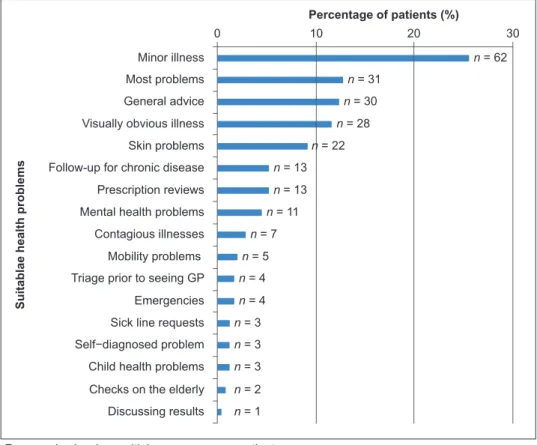
Respondents were finally asked to suggest health prob-lems that they deemed suitable for a video call consultation with a GP and by contrast, less suitable problems. Of the 270 participants, 65.6% (n = 177) identified suitable health problems and 53.7% (n = 145) suggested unsuitable health problems. Minor illness (n = 62) was cited as the most com-mon health problem that could be dealt with by a video call, followed by the belief that most problems seen by a GP would be suitable for a video call (n = 31) (Figure 4). The majority of respondents responded that video consulting would be less suitable for health problems requiring a physical examination (n = 65) (Figure 5).
DISCUSSION
Principal findings
Fifty percent of patients in this study indicated that they would use video consulting with their GP. Perhaps unsurprisingly, this was associated with greater computer proficiency and experience of personal video communication use and also with the age of the participants.
Implications of findings
There is a clear desire among a relatively large proportion of the population for video consulting with their GP for a range of problems. Although 85% of respondents had reg-ular access to appropriate technology, we also found that there was a clear socio-economic and age divide in access to this technology and ability to use it. This has been iden-tified in other studies relating to eHealth.4,6,7 However,
despite this, participants’ socioeconomic status was not a significant factor in their desire to use video consulting. The finding that non-users are significantly more likely to be older has important implications since the elderly are known to utilise GP services more frequently and are more likely to have mobility problems.24 It is not known if the use
Percentage of patients (%)
n = 11
0 10 20 30 40 50
n = 7
n = 7
n = 3
n = 2 Would save travel time
Would save travel cost
Could stay at home when feeling ill
Reasons for using video consultin
g
Faster access to GP than waiting for normal appointment
Would save time
Wouldn’t need any time off work
aFrequencies involve multiple responses per patient
n = 19
0 10 20 30
Percentage of patients (%)
Reason for not using video consulting
Prefer face-to-face interaction with GP Don’t know how to use Less personal Difficult and cumbersome to use Don’t enjoy using technology Intrusion on privacy Poor diagnosis over video calling Service doesn’t need to change Disability prevents computer use Language barrier would prevent use Expensive to use
n = 22
n = 19
n = 12
n = 9
n = 9
n = 6
n = 5
n = 4
n = 2
n = 1
n = 1
aFrequencies involve multiple responses per patient
Younger people
0 10 20 30
Technologically able people Housebound patients Full-time workers People with poor mobility Everyone Elderly Busy people
Ty
pe of perso
n
Percentage of patients (%)
Parents of young children
People living remotely Disabled people
People who dislike attending the GP Anyone in adverse weather conditions Anyone away on holiday
aFrequencies involve multiple responses per patient n = 1
n = 2
n = 5
n = 6
n = 11
n = 13
n = 13
n = 14
n = 14
n = 26
n = 26n = 37
n = 37
n = 69
Figure 1 Patient reasons for using video consultinga
Figure 2 Patient reasons for not using video consultinga
aFrequencies involve multiple responses per patient
Minor illness Most problems General advice Visually obvious illness Skin problems Follow-up for chronic disease Prescription reviews Mental health problems Contagious illnesses Mobility problems Triage prior to seeing GP Emergencies Sick line requests Self−diagnosed problem Child health problems Checks on the elderly Discussing results
0 10 20 30
Percentage of patients (%)
n = 62
n = 31
n = 30
n = 28
n = 22
n = 13
n = 13
n = 11
n = 7
n = 5
n = 4
n = 4
n = 3
n = 3
n = 3
n = 2
n = 1
Suitablae health problems
Figure 4 Suitable health problems identified for discussion in a video consultationa
Figure 5 Unsuitable health problems identified for discussion in a video consultationa
aFrequencies involve multiple responses per patient
0 10 20 30 40 50
Percentage of patients (%)
n = 65
n = 35
n = 16
n = 10
n = 7
n = 6
n = 6 None
If emotional support is needed Mental health problems Emergencies Sensitive or personal problems Complex or serious illness If examination is required
Unsuitablae health problems
Comparison with the literature
The considerable proportion of patients accepting of video consulting contrasts greatly with the previously held per-ception by healthcare professionals that there is low patient demand for alternative consulting methods.7,8 Whilst this
is the first study to investigate patient acceptance of video consulting, our results are similar to the studies of other consulting technologies such as telephone and email,18,24
where participants identified time and financial savings as
advantages of alternative technologies. It is worth noting, however, that research has demonstrated an increase in repeat consultations in the two weeks following a telephone consultation,25 which may negate the time saved if the same
considered likely to benefit. Again, this parallels findings from research into telephone consulting.13,26
A discussion of minor illness and general health advice was identified as most suitable content for a video call consulta-tion by patients. This aligns with safety concerns regarding other forms of alternative technology where both patients and doctors expect to discuss only simpler problems.13,27,28
Although patients were not forthcoming with their reasoning in this study, previous work has shown that GPs feel uneasy with alternative technologies due to perceived increased clinical uncertainty, with the absence of visual clues.6,24,29
However, previous research dealt mainly with non-visual forms of communication and it has been postulated that using video consulting may alleviate this uncertainty since a degree of visual assessment could be made.28 Patients
did seem to recognise the potential benefit for ‘visually obvi-ous’ illness in their comments, but further evidence will be needed to ensure that video consulting is clinically safe for this purpose. Among the other identified suitable problems, follow-up for chronic disease and prescription reviews have also featured in previous research,10,30 which may indicate
an opportunity for video consulting to meet this particular need. Another area where video consulting has been found to be particularly appropriate is in the management of men-tal health problems,31 where telephone consulting has been
considered in previous qualitative research to fall short due to the loss of visual cues.28
Patients identified the need for examination as a barrier to video consulting, which has also been highlighted as a concern by GPs24,28,29 using telephone consulting. This
may be why patients also perceived the discussion of complex or serious illness to be unsuitable for video call consultations.
Strengths and limitations
The high response rate (91.2%) ensured that responses were representative of those attending the practices. However,
the majority of participants fell into the under 60 years category and the most common SIMD quintile for partici-pants was quintile 5. This may have allowed sample bias in favour of using newer technologies since patients from these categories were also found to be more computer pro-ficient and have better access to technologies. Likewise, it is possible that differences between age groups may reflect access to the appropriate technology and training, rather than any bias against it. The practices sampled also already used telephone consulting extensively, which may have strengthened patient predisposition towards video consulting.12,19 In addition there was missing data, mainly
due to declined postcodes (11%) and ages (8%), but we feel that this is unlikely to affect our conclusions. Our study was conducted in three practices in one U.K. region, which may limit its generalizability. Interpreters were not used in the study and so people who did not have a good com-mand of spoken English were excluded. This group has difficulty with telephone consultation28 and the same may
be true of video consulting. The brief interview technique perhaps limited the comments from participants and con-ducting further in-depth interviews and focus groups may have yielded further information regarding the exact place video consulting has within general practice.
CONCLUSIONS
This project has found evidence that video consulting is accepted as an alternative consultation method by many primary care patients. These patients were younger, more computer proficient and had more experience of video com-munication socially or in business. However, before full-scale implementation of such a service can be considered, further research is required to determine how such consultations dif-fer from more traditional consultations in terms of complex-ity of problems; content; safety; impact on equcomplex-ity; and both patient and clinician resource use.
REFERENCE
1. NHS Scotland. Partnership for Care: Scotland’s Health White Paper. Edinburgh, Crown Copyright 2003.
2. Department of Health. The NHS Plan: A summary. London, Crown Copyright 2000.
3. BBC News. Cameron promises more flexible GP hours. British Broadcasting Company. 2013. Available from: www. bbc.co.uk/news/uk-politics-24339484. Accessed November 2014
4. King G, Heaney DJ, Boddy D, O’Donnell CA, Clark JS and Mair FS. Exploring public perspectives on e-health: findings from two citizen juries. Health Expectations 2011;14(4):351–360. http:// dx.doi.org/10.1111/j.1369-7625.2010.00637.x. PMID:21029283.
5. Miller EA. Solving the disjuncture between research and practice: Telehealth trends in the 21st century. Health Policy
2007;82(2):133–141. http://dx.doi.org/10.1016/j.health-pol.2006.09.011. PMID:17046097.
6. Hanna L, May C and Fairhurst K. The place of information and communication technology-mediated consultations in primary
care: GPs’ perspectives. Family Practice 2012;29(3):361–366. http://dx.doi.org/10.1093/fampra/cmr087. PMID:22006040.
7. Fairhurst K, May C and Hanna L. Non face to face consultations in primary care: professionals’ experiences, interests and con-cerns. Scottish Government Health Directorates Chief Scientist Office, Edinburgh. June 2008.
8. Hanna L, May C and Fairhurst K. Non-face-to-face consulta-tions and communicaconsulta-tions in primary care: the role and per-spective of general practice managers in Scotland. Informatics in Primary Care 2011;19(1):17–24. http://dx.doi.org/10.14236/ jhi.v19i1.789. PMID: 22118332.
9. Armfield NR, Gray LC and Smith AC. Clinical use of Skype: a review of the evidence base. Journal of Telemedicine and Telecare 2012;18(3):125–127. Available from: http://dx.doi. org/10.1258/jtt.2012.SFT101. PMID:22362829.
10. Chapman JL, Zechel A, Carter YH and Abbott S. Systematic
2004;54(502):374. Available from: http://www.ncbi.nlm.nih.gov/ pmc/articles/. PMid:15113523; PMCid:PMC1266174.
11. Finch TL, Mort M, Mair FS and May CR. Future patients?
Telehealthcare, roles and responsibilities. Health & Social Care in the Community 2008;16(1):86–95. Available from: http://dx.doi. org/10.1111/j.1365-2524.2007.00726.x. PMID:18181818.
12. McKinstry B, Watson P, Elton RA, Pinnock H, Kidd G and Meyer
B et al. Comparison of the accuracy of patients’ recall of the con-tent of telephone and face-to-face consultations: an exploratory study. Postgraduate Medical Journal 2011;87(1028):394–399. Available from: http://dx.doi.org/10.1136/pgmj.2010.101287. PMID:21378007.
13. McKinstry B, Hammersley V, Burton C, Pinnock H, Elton R and
Dowell J et al. The quality, safety and content of telephone and face-to-face consultations: a comparative study. Quality and Safety in Health Care 2010;19(4):298–303. Available from: http://dx.doi.org/10.1136/qshc.2008.027763. PMID:20430933.
14. Hewitt H, Gafaranga J and McKinstry B. Comparison of
face-to-face and telephone consultations in primary care: qualitative analysis. The British Journal of General Practice
2010;60(574):e201. Available from: http://dx.doi.org/10.3399/ bjgp10X501831. PMID:20423575.
15. Innes M, Skelton J and Greenfield S. A profile of communication
in primary care physician telephone consultations: application of the Roter Interaction Analysis System. . The British Journal of General Practice 2006;56(526):363. Available from: http://www. ncbi.nlm.nih.gov/pmc/articles/PMC1837845. PMID: 16638252.
16. Lattimer V, George S, Thompson F, Thomas E, Mullee M and
Turnbull J et al. Safety and effectiveness of nurse telephone consultation in out of hours primary care: randomised controlled trial. British Medical Journal 1998; 17; 317(7165): 1054–9. PMID: 9774295.
17. Neville RG, Marsden W, McCowan C, Pagliari C, Mullen H and
Fannin A. Email consultations in general practice. Informatics in Primary Care 2004;12(4):207–214. http://dx.doi.org/10.14236/ jhi.v12i4.128. PMID: 15808022; PMCID:PMC1324809.
18. Neville RG, Reed C, Boswell B, Sergeant P, Sullivan T and
Sullivan FM. Early experience of the use of short message service (SMS) technology in routine clinical care. Informatics in Primary Care 2008;16(3):203–211. PMID: 19094407.
19. Currell R, Urquhart C, Wainwright P and Lewis R. Telemedicine
versus face to face patient care: effects on professional prac-tice and health care outcomes. The Cochrane Database of Systematic Reviews 2000;2(2). PMID: 10796678.
20. Miller EA. The technical and interpersonal aspects of
tele-medicine: effects on doctor–patient communication. Journal of Telemedicine and Telecare 2003;9(1):1–7. PMID: 12641885.
21. Rogers EM. Diffusion of Innovations. Free Press:New York,
2003.
22. The Scottish Government. Full Scotland Postcode Lookup.
Crown Copyright August 2013. Available from: http://www. scotland.gov.uk/Topics/Statistics/SIMD/SIMDPostcodeLookup. Accessed November 2014.
23. World Health Organisation. Definition of an older or elderly
per-son. Copyright WHO 2014. Available from: http://www.who.int/ healthinfo/survey/ageingdefnolder/en/. Accessed November 2014.
24. Car J and Sheikh A. Telephone consultations. British Medical
Journal 2003;326(7396):966. Available from http://dx.doi. org/10.1136/bmj.326.7396.966. PMID: 12727771.
25. Campbell JL, Fletcher E, Britten N, Green C, Holt TA and
Lattimer V et al. Telephone triage for management of same-day consultation requests in general practice (the ESTEEM trial): a cluster-randomised controlled trial and cost-consequence analysis. Lancet 2014;384(9957):1859–68. http://dx.doi. org/10.1016/S0140-6736(14)61058-8. PMID: 25098487.
26. McKinstry B and Sheikh A. Unresolved questions in
tele-phone consulting. Journal of the Royal Society of Medicine
2006;99(1):2–3. Available from: http://dx.doi.org/10.1258/ jrsm.99.1.2. PMID: 16388044.
27. Goodyear-Smith F, Wearn A, Everts H, Huggard P and
Halliwell J. Pandora’s electronic box: GPs reflect upon email communication with their patients. Informatics in Primary Care
2005;13(3):195–202. PMID: 16259859
28. McKinstry B, Watson P, Pinnock H, Heaney D and Sheikh A.
Telephone consulting in primary care: a triangulated qualitative study of patients and providers. The British Journal of General Practice 2009;59(563):e209. Available from http://dx.doi. org/10.3399/bjgp09X420941. PMID: 19520019.
29. Foster J, Jessopp L and Dale J. Concerns and confidence of
general practitioners in providing telephone consultations. The British Journal of General Practice 1999;49(439):111. Available from http://www.ncbi.nlm.nih.gov/pmc/articles/PMC1313344/. PMID: 10326262.
30. Neal RD, Pascoe SW and Allgar VL. Alternative forms of
con-sulting: survey of patients and GPs about their consultations.
Family Practice 2004;21(2):140–142. http://dx.doi.org/10.1093/ fampra/cmh205. PMid:15020380 .
31. Hilty DM, Ferrer DC, Parish MB, Johnston B, Callahan EJ and