Rationale for Hypertonic Saline Therapy for
Cystic Fibrosis Lung Disease
Robert Tarran, Ph.D.,
1Scott Donaldson, M.D.,
1and Richard C. Boucher, M.D.
1ABSTRACT
Cystic fibrosis (CF) is caused by alterations in the CF transmembrane conduc-tance regulator (CFTCR) gene. More than 1400 mutations in theCFTCRgene have been described, but the most common mutation (noted in 70% of CF chromosomes) isDF508. Alterations in the CFTCR gene result in deranged sodium and chloride ion transport channels. This leads to failure of airway epithelia to hydrate their surfaces normally, particularly in response to infectious or toxic insults. Additional effects include mucus adhesion to airway surface, chronic inflammation, and infections. The concept that airway surface dehydration can cause CF-like lung disease is supported by in vitro data and in vivo animal models. Rehydrating airway surfaces may reduce or prevent lung injury and damage. Short- and longer term studies have shown that inhalation of hypertonic saline is well tolerated and improves lung function, reduces exacerbations, and improves quality of life in CF patients. This review discusses the importance of airway epithelial sodium and chloride channels in the pathogenesis of CF, and strategies (particularly the use of inhaled hypertonic saline) to reverse or minimize lung inflammation and injury in this disease.
KEYWORDS:Cystic fibrosis, cystic fibrosis transmembrane conductance regulator (CFTCR) gene, hypertonic saline, sodium and calcium channel, osmotic gradient
T
he syndrome of cystic fibrosis (CF) reflects a spectrum of more than 1400 mutations in the CF transmembrane conductance regulator (CFTCR) gene.1 The CFTCR gene is large, 250 kb, and resides on chromosome 7.2,3The CFTCR protein encoded by theCFTCRgene is a 1480 amino acid protein that typically resides in the plasma membrane of epithelial cells.4This protein appears to have many functions, but a unifying theme is that it acts at virtually all sites as a protein kinase C and cyclic adenosine monophosphate (cAMP)-regulated chloride (Cl) channel.5,6Interestingly, in the sweat duct, CFTCR acts as a Clabsorptive channel; in the pancreas, it serves to secrete Cl, which is exchanged
for bicarbonate (HCO3); and in the lung, it is involved in secretion of Cl. Importantly, in the lung, the CFTCR protein has a second function acting as a regulator of the epithelial sodium (Naþ) channel (ENaC) and hence Naþabsorption.7,8
There are five classes of mutations in theCFTCR
gene that produce disease. The most common mutation, which occurs on 70% of all CF chromosomes, is a three-base-pair deletion that leads to a deletion of phenyl-alanine at position 508 of the CFTCR protein and is designated asDF508. The molecular pathogenesis of this class ofCFTCRmutations is relatively well understood. Typically, the absence of a phenylalanine at position 508
1Cystic Fibrosis/Pulmonary Research and Treatment Center, The University of North Carolina at Chapel Hill, Chapel Hill, North Carolina.
Address for correspondence and reprint requests: Richard C. Boucher, M.D., Cystic Fibrosis/Pulmonary Research and Treatment Center, CB#7248 7011 Thurston-Bowles Bldg., The University of North Carolina at Chapel Hill, Chapel Hill, NC 27599-7248 (e-mail:
Pediatric Pulmonology; Guest Editors, Bruce K. Rubin, M.D., Andrew Bush, M.D.
Semin Respir Crit Care Med 2007;28:295–302. Copyright#2007 by Thieme Medical Publishers, Inc., 333 Seventh Avenue, New York, NY 10001, USA. Tel: +1(212) 584-4662.
DOI 10.1055/s-2007-981650. ISSN 1069-3424.
leads to problems in intracellular protein folding and maturation that are part of the normal biosynthetic pathway of membrane proteins.9,10 Consequently, the
DF508 CFTCR protein is ‘‘edited’’ out of the cell by molecular chaperones and a variety of intracellular deg-radative pathways. Hence, the molecular pathogenesis of this most common form ofCFTCRmutation reflects the absence of a functioning CFTCR polypeptide in the plasma membrane. Other mutations can produce a non-functioning CFTCR Clchannel at the apical mem-brane and/or a mutant CFTCR with abnormal ion permeation characteristics.
CYSTIC FIBROSIS LUNG DISEASE
CF lung disease fundamentally reflects a failure in the capacity of airway epithelia to normally hydrate their surfaces, particularly in response to infectious or toxic insults. Poor hydration of airway surfaces leads to re-duced mucociliary clearance, adhesion of mucus to air-way surfaces, and, ultimately, chronic bacterial infection of airway surfaces (Fig. 1).
Data from an in vitro well-differentiated cell culture model interfaced to a confocal microscope to measure airway surface liquid (ASL) volume were key in elucidating the importance of airway surface hydration in lung defense.11,12The hydration of the normal airway surface (i.e., the volume of ASL), is determined in a highly water-permeable epithelium such as airway epi-thelia by ion transport processes that control the mass of salt (NaCl) on airway surfaces.13Normal airway epithelia have the capacity to remove (absorb) NaCl from or add (secrete) NaCl to airway surfaces (Fig. 2A). The absorp-tive pathway reflects the capacity to acabsorp-tively absorb Naþ ions, with Naþentering the cell from ASL through the
ENaC. Naþ ions exit the cell via the activity of a basolateral Naþ-Kþ-adenosine triphosphate (ATP)ase. Chloride may be secreted from the cell by an apical membrane CFTCR Cl channel or a Ca2þ-activated Clchannel (CaCC), with Clentering the cell princi-pally via an Naþ-Kþ-2Cl- cotransporter. Regulation of the balance between absorption and secretion deter-mines the net transport of ions across the epithelium and, hence, the mass of salt on an epithelial surface.
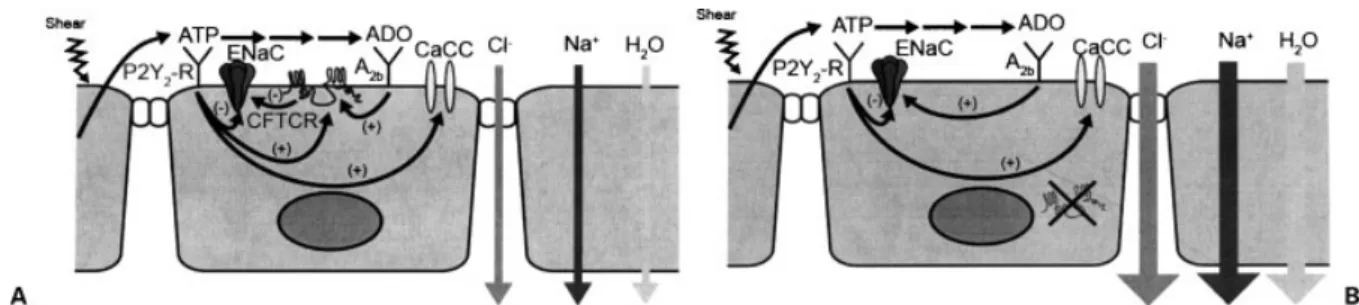
The processes that regulate the balance between Naþabsorption and Clsecretion are beginning to be elucidated (Fig. 2A). Important signals that are con-tained within the ASL itself include the triphosphate adenine nucleotide, ATP, and the adenine nucleoside, adenosine (ADO).14 ATP, interacting with luminal P2Y2 receptors, can slow the rate of Naþ absorption and initiate/accelerate Clsecretion via PKC-mediated actions on CFTCR and Ca2þ-mediated actions on CaCC.15 Adenosine can initiate Cl secretion via cAMP-dependent activation of CFTCR and CFTCR-dependent inhibition of ENaC. Recent data have sug-gested that both systems are operative and important in regulating the balance of Naþ absorption versus Cl secretion in normal airway epithelia.16The quantities of ATP, and its metabolic product ADO, on airway surfa-ces are determined by the mechanical stresses imparted to airway epithelia during breathing that regulate the rate of ATP release from epithelial cells into ASL.17A key concept is that the ATP signaling and the ADO signaling systems are redundant and, hence, ensure sufficient hydration under many conditions in the normal lung.
CF airway epithelia are vulnerable to dehydration because of the absence of the CFTCR protein in the plasma membrane (Fig. 2B). Specifically, the adenosine-A2b receptor system is functional, cAMP-dependent activation of PKA is functional, but the absence of CFTCR protein in the membrane renders the Cl secretory and Naþinhibitory effects of ADO signaling ineffective. In contrast, the ATP-P2Y-R signaling sys-tem is effective in CF airway epithelia in inhibiting ENaC and initiating CaCC-mediated Clsecretion.15 In vitro studies demonstrate that, under conditions that reprise tidal breathing in vivo, CF airway epithelia are covered by sufficient ASL to mediate normal mucociliary clearance, but they are missing a liquid reserve observed on normal airway cells.16Importantly, the CF hydration capacity collapses if the lung is confronted with circum-stances that degrade the efficacy of the ATP signaling system. A relevant in vitro observation is that infection of CF airway epithelia with paramyxoviruses, such as respiratory syncytial virus (RSV), induces CF airway epithelia to upregulate extracellular ATPase expres-sion.16 This increased ATPase activity is sufficient to degrade the ATP in ASL and diminish/abolish P2Y2inhibition of Naþ absorption and stimulation of
Figure 1 Schema depicting relationship of Naþand Cl
trans-port to mucus clearance and lung defense. (L) In health, Naþ
absorption and Clsecretion are coordinated to optimize airway
surface hydration and promote the clearance of mucus from
airway surfaces. (R) In cystic fibrosis, unregulated Naþabsorption
and diminished Clsecretion produce a propensity for airway
CaCC-mediated Clsecretion. Under these conditions, unregulated salt and liquid absorption occurs, the CF airway surface becomes dehydrated, mucus transport is abolished, and mucus stasis ensues. It has been specu-lated that a similar event may occur in CF patients in vivo during viral infections, leading to sludging of dehydrated mucus in virus-infected areas of the lung and spread of bacterial infection from bronchiectatic areas to produce an acute exacerbation.18,19
The concept that airway surface dehydration can produce CF-like lung disease was tested in an in vivo model to ascertain whether the in vitro observations cited here were pertinent to lung defense in vivo. As a test of this hypothesis, subunits of the epithelial Naþ channel were transgenically overexpressed in mice under the control of an airway-specific promoter in an attempt to tip the balance toward Naþ absorption over Cl secretion.20Analysis of the ion transport characteristics of mice overexpressing thebENaC subunit revealed that Naþ absorption was increased threefold over controls, whereas the ability to generate Clsecretion in response to nucleotide-activated CaCC activity was not per-turbed. The disturbance of the balance between absorp-tion and secreabsorp-tion produced the predicted depleabsorp-tion of ASL volume, which resulted in mucus stasis, and death due to mucus obstruction in 50% of transgenic ani-mals. Unexpected but important findings were that the reduction in ASL volume also produced neutrophilic inflammation and goblet cell hyperplasia that are typical features of CF lung disease. Thus, these observations provided strong evidence that a disturbance of the balance between Naþabsorption and Clsecretion, in this case by transgenically raising Naþ transport rates without disturbing Clsecretion, could produce airway surface dehydration and a phenotype quite typical of CF-like lung disease.
Finally, data from human clinical studies are consistent with the notion that dehydration is a central
feature of CF lung disease.21–23Clinical studies have also employed inhaled hypertonic saline (HS), which osmoti-cally draws water from epithelial cells/interstitium into the airway lumen, to test whether this action restores mucus clearance and improves pulmonary function. Initial studies conducted approximately a decade ago suggested that short-term (2 week) administration of HS to CF patients was associated with an improvement in lung function.24,25 More recently, a pair of papers revealed that the inhalation of HS (7%, delivered by a jet nebulizer) by CF patients over a 2-week period could increase the rates of mucociliary clearance and improve pulmonary function tests, and, over a 1-year interval, reduce exacerbations and improve quality of life.26,27 Importantly, the inhalation of HS for 1 year was not associated with any untoward events (e.g., increased airways inflammation or increased bacterial densities).27 These studies have spurred intense interest in the pos-sibility that HS and other ‘‘hydration therapies’’ may provide a new form of therapy that treats CF lung disease at its basic cause.
RATIONAL USE OF HYPERTONIC SALINE
There are many interesting and important concepts that underlie the use of HS in CF subjects. The first is to understand reasons why HS is more effective in CF patients than in normal subjects. Second, it is important to understand that HS probes the passive permeability properties of the epithelium, and its actions should not be confused with the functions of the epithelium under physiological active ion transport modes. Some of these important concepts can be evaluated in the context of Fig. 3.
Beginning with normal airway epithelia, under baseline conditions, when ASL Naþ and Cl concen-trations are isotonic, Naþis absorbed through ENaC in response to the apical membrane–cellular electrochemical
Figure 2 Constitutive and shear-dependent release of adenine triphosphate (ATP) into airway surface liquid (ASL), coupled with
metabolic enzymes, produces levels of ATP and its metabolic product adenosine (ADO) that regulate the ion transport paths which
control the mass of salt and ultimately water on airway surfaces. (A) In normal airways, ATP signaling through P2Y2receptors and ADO
signaling through A2breceptors provide redundant inhibition via the epithelial sodium channel (ENaC) (directly via P2Y2-R and indirectly
via A2b-CFTCR mechanisms) and regulation of both CFTCR- and CaCC-mediated Clsecretion. The typical net result is a modest rate of
NaCl and water absorption to remove ASL continually transported proximally from distal pulmonary regions. (B) In cystic fibrosis, the absence of CFTCR function at the apical membrane removes the ADO contribution to inhibition of ENaC and the CFTCR contribution to
Clsecretion. Indeed, the ADO-A2bregulation is redirected toward activation of ENaC. The ATP-P2Y2-R system remains intact and is the
sole system to inhibit ENaC and regulate CaCC-mediated Clsecretion. The net effect is a tendency for increased and inappropriate
gradient favoring Naþentry28,29(Fig. 3A). Despite the fact that there is a partially active CFTCR Clchannel in the apical membrane of the normal airway epithelium, Cl is not absorbed with Naþ transcellularly, because
there is no electrochemical driving force for Cl move-ment across the cell membrane.30–32 Thus, Cl is ab-sorbed with Naþvia the paracellular path, in response to the transepithelial electric potential difference (lumen
Figure 3 Ion and water transport under basal active ion transport conditions and after aerosol deposition of 7% NaCl on airway
surfaces. (A) Normal active ion transport: The net rate of active ion transport is determined by the rate of active Naþtransport, which is a
product of the electrochemical gradient favoring Naþentry across the apical membrane (DF
aNaþ¼ þ60 mV) and Naþextrusion across
the basolateral membrane by the NaþKþATPase pump. Because there is no net driving force for Clflow through the apical membrane
CFTCR, Clis absorbed paracellularly in response to the transepithelial electric potential difference (V
t) to preserve electroneutrality.
Water accompanies NaCl transport through cellular and paracellular paths. Note, ASL is isotonic; that is, [NaCl]¼ 140 mM.39,40(B)
Normal airways after hypertonic saline (HS) deposition. Airway surface liquid (ASL) NaCl concentrations are acutely raised (1000 mM
at 7% NaCl). The increased concentrations of Naþand Clincrease the chemical driving force component for Naþentry into the cell and
generate a large gradient favoring cellular Clentry (i.e., absorption). The Naþand Clentering the cell exit the basolateral membrane via
the pump (Naþ), cotransporters (Naþand Cl), and a basolateral Clchannel. In parallel, there is a relatively smaller increase in Naþand
Clabsorption through the paracellular path, which is nonselective for ions, in response to the chemical gradients generated by HS
deposition. Water moves in the opposite direction in response to the transient NaCl osmotic gradient generated by HS deposition. (C) Cystic fibrosis (CF) airway epithelial, active ion transport. The absence of CFTCR in the apical membrane removes a major inhibitor of the
epithelial sodium channel (ENaC), producing higher basal rates of Naþtransport and limiting the ability to regulate ENaC at low ASL
volumes. The high rate of Naþtransport generates a raised transepithelial potential difference (PD) (Vt), which provides the driving force
for Clabsorption via the paracellular path to match Naþabsorption. The raised net rate of NaCl absorption produces raised H2O
absorption and a tendency for ASL volume depletion (i.e., dehydration). (D) CF airway epithelia, post-HS deposition. Again, the
concentration of NaCl is raised in CF ASL by this maneuver to1000 mM. Despite a large chemical driving force favoring Clentry into
the cell from ASL, the absence of CFTCR in the membrane prevents entry of Clinto the cell. Despite the presence of a functioning
ENaC, transcellular Naþabsorption is limited by the block of cellular Clentry. Therefore, virtually all the NaCl absorption occurs via the
negative) generated by active Naþtransport. Isotope flux and ion-selective electrode data suggest that the overall ion conductance of the cellular path is approximately twofold greater than through the paracellular path in normal airway epithelia.33,34 Recent data suggest that water is absorbed with the actively transported Naþand Clions via cellular aquaporin water channels.
For illustrative purposes, we will assume that the entire quantity of 7% HS is deposited undiluted on the airway surface (note, the argument will hold with any exogenously increased Naþ or Cl concentration in ASL). It is important to note that the addition of NaCl to airway surfaces via inhalation of hypertonic NaCl is an artificial, unphysiological situation that produces an exogenously induced Naþand Clchemical gradient across the epithelium. In the normal airway epithelium, the increase in Naþconcentration increases the electrochemical driving force for Naþto enter the cell and generates the electrochemical driving force for Naþ to move through the paracellular path (Fig. 3B). Importantly, the increase in the Cl concentration in ASL now generates an electrochemical driving force for Clto enter the cell via an active CFTCR and/or CaCC Clchannel, with the residual Clmoving through the paracellular path. The Naþand Clthat enters the cell in response to the aerosolized HS-induced NaCl con-centration gradient on the airway surface exits the cell through the basolateral Naþ-Kþ-ATPase, a basolateral Cl channel, and likely through the Naþ-Kþ-2Cl cotransporter. Based on the estimates of the relative permeabilities of the cell and paracellular paths for Naþ and Cl, it is estimated that approximately two thirds of the NaCl may move through the transcellular path in response to these imposed chemical gra-dients.33,34 Note that the aerosol-induced increase in NaCl concentration on airway surfaces produces a gra-dient for water to move through water channels in the opposite direction to that generated by active ion trans-port (i.e., there is osmotically induced water flow from the submucosa to the airway surface). Because NaCl is absorbed rapidly through the normal cell as well as the paracellular path after the imposition of the salt gradient, the osmotic gradient generated by NaCl on normal airway surfaces dissipates relatively rapidly, and only a modest amount of water moves to airway surfaces in response to this challenge (see Fig. 3B).
For CF airway epithelia, under baseline active ion transport conditions, the rate of Naþabsorption is often accelerated due to the absence of CFTCR-mediated inhibition of ENaC (Fig. 3C). Interestingly, the absence of the CFTCR Clconductance per se and the absence of CFTCR inhibition of ENaC actually produces an elec-trochemical driving force for Clto be absorbed across the apical membrane of CF airway epithelia.31,32 How-ever, because of the absence of the CFTCR Clchannel in this barrier, Clmust move through the paracellular
path to accompany the transcellular absorption of the Naþcation. The driving force that serves to match the rate of transepithelial Clabsorption with Naþ absorp-tion is the relatively high transepithelial potential differ-ence (30 mV, lumen negative) generated by a high rate of transcellular Naþabsorption. The increase of Naþand Cl transport in CF airway epithelia compared with normal airway epithelia produces an increase in osmoti-cally entrained water absorption from the airway lumen to the submucosa via airway epithelial water channels.
In the case where an aerosol of 7% HS has been used to increase the NaCl concentration on CF airway surfaces, the differences in the passive ion permeabilities of the CF airway epithelium versus normal airway epithelium are revealed. As for normal airway epithelia, when a high NaCl concentration in the ASL is gener-ated by aerosol deposition of HS on ASL, an increase in the electrochemical gradient for Naþentry into the cell is developed (Fig. 3D). Despite the fact that an increased electrochemical gradient for cellular Cl entry is also generated, Clcannot enter the cell due to the absence of the CFTCR Cl channel in the apical membrane. The only available path for cellular Clto be absorbed across the CF airway epithelium, in response to the chemical gradients generated by the deposition of NaCl via aerosols in ASL, is the paracellular path.
Data from radioisotopic and electrophysiological techniques suggest that the paracellular path permeabil-ity to NaCl is not different in CF versus normal airway epithelial cells.7,30–32,35 Therefore, because CF airway epithelia can absorb the aerosol-deposited NaCl only via the paracellular path, the rate of absorption/dissipation of the salt gradient will be reduced by60 to 70% as compared with normal airway epithelia, reflecting the absence of a cellular route for Cl absorption in CF airway epithelia. The slower rate of NaCl absorption leads to a relative retention of NaCl on CF airway surfaces. Thus the osmotic gradient favoring water flow generated by the aerosolized NaCl persists for longer periods of time in CF than normal airway epithelia, leading to increased volumes of water on CF versus normal epithelial surfaces (see Fig. 3D). Interest-ingly, this inability to absorb Cl passively via an artificially imposed Cl gradient, producing increases in ASL volume, may be the only ‘‘break’’ CF patients get with respect to therapy of their lung disease.
Note, at the large NaCl concentration gradients (10s to 100s mM) generated by HS deposition on CF airway surfaces, the Clconductance of the paracellular path is limiting for Naþand, hence, net NaCl absorption. Under baseline conditions where CF active ion transport determines ASL volume, active Naþtransport generates
resolve the apparent paradox of the importance of the absent cellular CFTCR Cl conductance in the response of the CF airway to aerosolized HS versus the relative unimportance of the cellular Clconductance in the abnormal NaCl absorptive states that are a feature of CF airways under basal conditions.
THE EFFECT OF AMILORIDE
PRETREATMENT ON HYPERTONIC SALINE EFFICACY
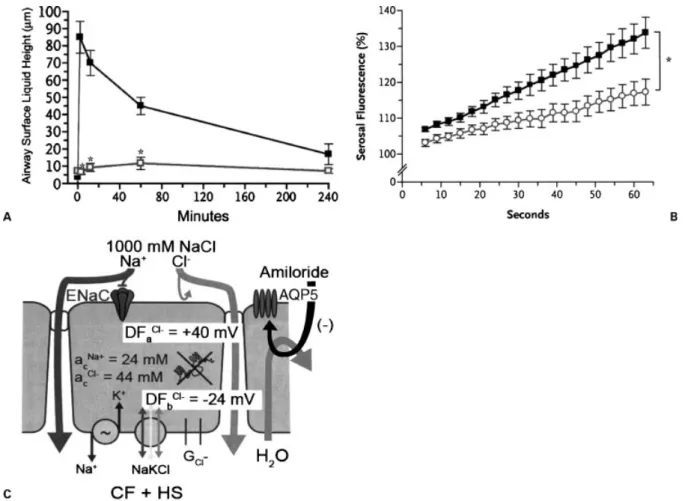
An observation that led to some confusion and contro-versy pertaining to the paper of Donaldson et al26 was the fact that amiloride blunted the responses of CF airway epithelia to HS36 (see Fig. 4A). It had been predicted that by blocking the cellular path for Naþ
absorption, the amiloride-induced block of ENaC would slow the active epithelial absorption of Naþ(and Cl) across the epithelium. This effect was predicted to promote a longer duration of the aerosolized HS depos-ited on airway surfaces that would subsequently be rendered isotonic via the osmotically driven movement of water.37 Surprisingly, what was observed was that administration of amiloride blocked the initial volume response so that it was not possible to ascertain whether amiloride slowed the subsequent active absorption of ASL (Fig. 4A). Because it seemed implausible that amiloride would accelerate the absorption of Naþand Cl across the CF airways epithelium, studies were initiated to ascertain whether amiloride had a second action on airway epithelial salt and water transport (e.g., blocked epithelial water permeability). These studies
Figure 4 Effect of amiloride on hypertonic saline (HS)-induced airway surface liquid (ASL) volume responses. (A) Confocal
measurements of ASL height/volume in cystic fibrosis (CF) airway epithelia in response to 7% HS without (&) and with (&) amiloride
(3104M) pretreatment. *Different from HS alone (p<.05). (B) Effect of amiloride on osmotically induced water flow across CF
airway epithelia. Cultured CF airway epithelia were placed on a confocal microscope with a fluorescent, impermeant probe in the
basolateral bath. Att¼0, hypertonic mannitol was placed in the luminal bath and the flow of water from the basolateral to the luminal
bath measured from the increase in serosal bath fluorescence (i.e., concentration of the serosal bath probe increased as water moved
into the luminal compartment). This assay was performed without (&) and with () amiloride (3104M) administration to the lumen
10 minute prior to osmotic challenge. *Different from without amiloride pretreatment (p<0.05). (C) Speculated cellular action of
amiloride on transepithelial water flow after HS administration. The deposited HS produces the increase in ASL [NaCl], as depicted in
Fig. 3D. Again, the absence of a path for Clabsorption limits NaCl absorption to the paracellular path. It is speculated that amiloride
revealed that amiloride at high concentrations blocked transepithelial water flows in response to osmotic gra-dients generated by added NaCl or a nonionic solute, mannitol (Fig. 4B). Although the precise mechanisms are not known, it appears from subsequent studies that amiloride may block the aquaporin 5 channel that is an important water channel in the apical membrane of normal and CF airway epithelia. Thus, as shown in Fig. 4C, a partial block of the apical membrane water channel slows water movement toward the lumen in response to the aerosol-imposed NaCl gradient, allow-ing the NaCl gradient to be dissipated through the paracellular path. Thus the ‘‘kinetic horse race’’ between the absorption of NaCl via the paracellular path versus the movement of water toward the lumen via the cellular path is tipped in favor of paracellular NaCl absorption via the actions of amiloride. The net effect is a reduced volume response to the aerosol-generated salt gradient.
Interestingly, amiloride might have been thera-peutically useful if given after HS rather than as a pretreatment. That is, amiloride would have blocked the active absorption of Naþ (and Cl). Because, as noted earlier, the gradients of NaCl across the epithe-lium generated by active Naþ(and Cl) absorption are very low (mM) as compared with aerosol deposition of salt (mM), any amiloride block of water flow would have negligible effects on osmotic water flow coupled to active ion transport. However, the clinical utility of delivering amiloride after HS may be minimal because the half-life of amiloride on airway surfaces is short (30 min).
THE FUTURE OF HYDRATION THERAPIES
A central question will be the position of HS within the spectrum of therapies available to CF patients. On one level, because HS may treat the initiating cause of CF lung disease, it may make sense to make HS the ‘‘base’’ therapy for CF patients. However, the current experi-ence principally reflects administration of HS with pressure-driven nebulizers to adolescents and young adults . Studies are under way to transition the delivery of HS to more time-efficient devices (e.g., ultrasonic devices) that can also be more easily interfaced to infants. Thus important studies that will soon be initiated are ones designed to test whether inhaled HS in infants over a 1-year period can forestall the decrements in lung function and the abnormalities in CT (air trapping/ bronchiectasis) that characterize this period. Similar studies are under way in 4- to 6-year-old cohorts to ascertain whether HS can arrest the decrement of lung function typically seen in this age group.
Because the initiating events of many acute ex-acerbations in CF are viral infections that may induce mucus sludging in airways that were previously ‘‘quasi-normally’’ hydrated via the actions of ATP (see earlier), it may make sense to study relationships between HS
therapy and exacerbations. Because this thesis has not been tested, it will be important to generate randomized trials to ascertain whether maximization of HS therapy at the time the CF patient clinically senses a ‘‘virus’’ will forestall an exacerbation. In parallel, studies may also be warranted to test whether maximization of HS-medi-ated hydration will shorten the interval of the exacer-bation and improve the outcome of therapy for exacerbations.
Finally, HS does have limitations with respect to the therapy of CF lung disease. For example, HS at 7% can be irritating to some patients and cause broncho-constriction. Similarly, particularly in children, the taste of HS is a detriment to chronic use of this agent. Perhaps most importantly, it is difficult to deliver HS efficiently to the very large surface area of the small airways/ bronchioles that appear to be the site of initiation of CF lung disease.38–40 This phenomenon reflects the simple aerosol physics parameters of the modern nebu-lizer, which deposits approximately equal volumes of aerosol on the relatively small surface area of central airways compared with the relatively large surface area of small airways. Because the hydration effect of HS is a linear function of the amount of salt deposited on airway surfaces, the small airways will always be less well treated by HS. Thus, it may be advantageous in the future to utilize approaches that hydrate airway surfaces by induc-ing secretion of NaCl via receptor-mediated pathways that can be fully activated by potent ligands delivered to small airway surfaces, for example, stabilized nucleotide molecules (INS37217), or by the coadministration of new, potent, long-acting Naþchannel blockers that will retain all NaCl added to small airway surfaces to amplify the hydrating effects of HS in this region. It is likely that the requirement to effectively treat the bronchiole will be a central feature of any hydrating regimen to, in a most assured fashion, prevent and/or arrest the progression of lung disease in CF patients.
REFERENCES
1. Davis PB. Cystic fibrosis since 1938. Am J Respir Crit Care Med 2006;173:475–482
2. Kerem B, Rommens JM, Buchanan JA, et al. Identification of the cystic fibrosis gene: genetic analysis. Science 1989;245: 1073–1080
3. Riordan JR, Rommens JM, Kerem B-T, et al. Identification of the cystic fibrosis gene: cloning and characterization of complementary DNA. Science 1989;245:1066–1073 4. Guggino WB, Stanton BA. New insights into cystic fibrosis:
molecular switches that regulate CFTCR. Nat Rev Mol Cell Biol 2006;7:426–436
5. Anderson MP, Rich DP, Gregory RJ, Smith AE, Welsh MJ. Generation of cAMP-activated chloride currents by expres-sion of CFTCR. Science 1991;251:679–682
fibrosis transmembrane conductance regulator by protein kinase A. J Biol Chem 1997;272:4978–4984
7. Boucher RC, Stutts MJ, Knowles MR, Cantley L, Gatzy JT. Naþtransport in cystic fibrosis respiratory epithelia:
abnor-mal basal rate and response to adenylate cyclase activation. J Clin Invest 1986;78:1245–1252
8. Stutts MJ, Canessa CM, Olsen JC, et al. CFTCR as a cAMP-dependent regulator of sodium channels. Science 1995;269:847–850
9. Cheng SH, Gregory RJ, Marshall J, et al. Defective intracellular transport and processing of CFTCR is the molecular basis of most cystic fibrosis. Cell 1990;63:827–834 10. Riordan JR. Assembly of functional CFTCR chloride
channels. Annu Rev Physiol 2005;67:701–718
11. Matsui H, Grubb BR, Tarran R, et al. Evidence for periciliary liquid layer depletion, not abnormal ion compo-sition, in the pathogenesis of cystic fibrosis airways disease. Cell 1998;95:1005–1015
12. Matsui H, Randell SH, Peretti SW, Davis CW, Boucher RC. Coordinated clearance of periciliary liquid and mucus from airway surfaces. J Clin Invest 1998;102:1125–1131 13. Matsui H, Davis CW, Tarran R, Boucher RC. Osmotic
water permeabilities of cultured, well-differentiated normal and cystic fibrosis airway epithelia. J Clin Invest 2000;105: 1419–1427
14. Tarran R, Trout L, Donaldson SH, Boucher RC. Soluble mediators, not cilia, determine airway surface liquid volume in normal and cystic fibrosis superficial airway epithelia. J Gen Physiol 2006;127:591–604
15. Mall M, Wissner A, Gonska T, et al. Inhibition of amiloride-sensitive epithelial Na(þ) absorption by extrac-ellular nucleotides in human normal and cystic fibrosis airways. Am J Respir Cell Mol Biol 2000;23:755–761 16. Tarran R, Button B, Picher M, et al. Normal and cystic
fibrosis airway surface liquid homeostasis: the effects of phasic shear stress and viral infections. J Biol Chem 2005; 280:35751–35759
17. Tarran R, Button B, Boucher RC. Regulation of normal and cystic fibrosis airway surface liquid volume by phasic shear stress. Annu Rev Physiol 2006;68:543–561
18. van Ewijk BE, van der Zalm MM, Wolfs TF, van der Ent CK. Viral respiratory infections in cystic fibrosis. J Cyst Fibros 2005;4(Suppl 2):31–36
19. Abman SH, Ogle JW, Butler-Simon N, Rumack CM, Accurso FJ. Role of respiratory syncytial virus in early hospitalizations for respiratory distress of young infants with cystic fibrosis. J Pediatr 1988;113:826–830
20. Mall M, Grubb BR, Harkema JR, O’Neal WK, Boucher RC. Increased airway epithelial Naþ absorption produces
cystic fibrosis-like lung disease in mice. Nat Med 2004;10: 487–493
21. Matthews LW, Spector S, Lemm J, Potter JL. Studies on pulmonary secretions, I: The overall chemical composition of pulmonary secretions from patients with cystic fibrosis, bronchiectasis, and laryngectomy. Am Rev Respir Dis 1963; 88:199–204
22. Potter JL, Matthews LW, Spector S, Lemm J. Studies of pulmonary secretions, II: Osmolarity and the ionic environ-ment of pulmonary secretions from patients with cystic fibrosis, bronchiectasis and laryngectomy. Am Rev Respir Dis 1967;96:83–87
23. Zuelzer WW, Newton WA Jr. The pathogenesis of fibrocystic disease of the pancreas: a study of 36 cases with special reference to the pulmonary lesions. Pediatrics 1949; 4:53–69
24. Eng PA, Morton J, Douglass JA, Riedler J, Wilson J, Robertson CF. Short-term efficacy of ultrasonically nebulized hypertonic saline in cystic fibrosis. Pediatr Pulmonol 1996; 21:77–83
25. Robinson M, Regnis JA, Bailey DL, King M, Bautovich GJ, Bye PT. Effect of hypertonic saline, amiloride, and cough on mucociliary clearance in patients with cystic fibrosis. Am J Respir Crit Care Med 1996;153:1503–1509
26. Donaldson SH, Bennett WD, Zeman KL, Knowles MR, Tarran R, Boucher RC. Mucus clearance and lung function in cystic fibrosis with hypertonic saline. N Engl J Med 2006; 354:241–250
27. Elkins MR, Robinson M, Rose BR, et al. A controlled trial of long-term Inhaled hypertonic saline in patients with cystic fibrosis. N Engl J Med 2006;354:229–240
28. Willumsen NJ, Boucher RC. Sodium transport and intra-cellular sodium activity in cultured human nasal epithelium. Am J Physiol 1991;261(2 Pt 1):C319–C331
29. Willumsen NJ, Boucher RC. Transcellular sodium transport in cultured cystic fibrosis human nasal epithelium. Am J Physiol 1991;261(2 Pt 1):C332–C341
30. Willumsen NJ, Davis CW, Boucher RC. Cellular Cl
transport in cultured cystic fibrosis airway epithelium. Am J Physiol 1989;256(5 Pt 1):C1045–C1053
31. Willumsen NJ, Davis CW, Boucher RC. Intracellular Cl activity and cellular Clpathways in cultured human airway
epithelium. Am J Physiol 1989;256(5 Pt 1):C1033–C1044 32. Willumsen NJ, Boucher RC. Shunt resistance and ion
permeabilities in normal and cystic fibrosis airway epithelium. Am J Physiol 1989;256(5 Pt 1):C1054–C1063
33. Knowles MR, Stutts MJ, Spock A, Fischer N, Gatzy JT, Boucher RC. Abnormal ion permeation through cystic fibrosis respiratory epithelium. Science 1983;221:1067–1070 34. Knowles M, Murray G, Shallal J, et al. Bioelectric properties and ion flow across excised human bronchi. J Appl Physiol 1984;56:868–877
35. Willumsen NJ, Boucher RC. Activation of an apical Cl conductance by Ca2þ ionophores in cystic fibrosis airway epithelia. Am J Physiol 1989;256(2 Pt 1):C226–C233 36. Levin MH, Sullivan S, Nielson D, Yang B, Finkbeiner WE,
Verkman AS. Hypertonic saline therapy in cystic fibrosis: evidence against the proposed mechanism involving aqua-porins. J Biol Chem 2006;281:25803–25812
37. Tarran R, Grubb BR, Parsons D, et al. The CF salt controversy: in vivo observations and therapeutic approaches. Mol Cell 2001;8:149–158
38. Sood N, Bennett WD, Zeman K, et al. Increasing concen-tration of inhaled saline with or without amiloride: effect on mucociliary clearance in normal subjects. Am J Respir Crit Care Med 2002;167:158–163
39. Knowles MR, Robinson JM, Wood RE, et al. Ion composition of airway surface liquid of patients with cystic fibrosis as compared to normal and disease-control subjects. J Clin Invest 1997;100:2588–2595