Agata Jurgelevic
T6615KA
Moisture problems and building
de-fects in basement
Bachelor’s thesis
Building Services Engineering
January 2016
Date of Bachelor’s thesis
Author’s
Agata Jurgelevic
Degree program and options
Double Degree Programme in Building Services Engineering
Name of the bachelor’s thesis
Moisture problems and building defects in basement Abstract
This work studies moisture problems in the basement. What possible outside and inside factors create having moisture in the basement. Furthermore, possible solutions of how it is possible to lower moisture in the basement. The study is carried out on an existing building in Kuopio, Finland. The existing building has moisture problems in the basement, to decrease moisture problems fan was installed to take drier air from the outside and bring it inside to dehumidify the basement.
In order to study this situation, calculations are carried out. Data of relative humidity and temper-ature is collected from the eleven months. The graphs are carried out in order to understand the better situation. Moisture content calculations are carried out to find out real situation in the base-ment.
The main conclusions of this work are to find out the fan operating principle and does it runs correctly. During this work findings, show that fan operating principle is incorrect. Possible solu-tions are carried out in order to lower moisture problem in the basement.
Subject headings, (keywords)
Moisture in basement, moisture problems, basement, building defects Pages
37
Language English
URN
Remarks, notes, and appendices
Tutor
Martti Veuro
1 INTRODUCTION... 2
1.1 Methods ... 3
2 CAUSES OF MOISTURE PROBLEMS ... 4
2.1 Condensation problems during seasons ... 7
3 CONSEQUENCES OF MOISTURE ... 8
4 MOISTURE IN BASEMENT ... 10
4.1 Symptoms ... 11
4.2 Sources of moisture in basement ... 12
4.3 Moisture movement mechanisms ... 13
4.4 Moisture problems causes and solutions in basement... 16
4.5 Solutions for moisture problems in basement ... 18
5 MEASUREMENTS AND CALCULATIONS ... 24
5.1 Measurements ... 25
5.2 Calculations ... 27
5.3 Analysis of results ... 32
1 INTRODUCTION General overview
According to World Health Organization, the definition of moisture is “any visible, measurable, or perceived outcome caused by excess moisture indication indoor climate or problems of durability in building assemblies caused by various leaks of water”. Fur-thermore, it also said that “moisture can be transported in both liquid and vapor phases by capillary suction, wind pressure, diffusion, convection and gravity (water pressure)”. /1/.
Moisture problems are common in buildings. According to the studies, 76 percent of the buildings have moisture problems. Due to building envelopes defects, moisture problems are more common. Around 75-80 percent of studied houses, had moisture problems due to building defects/1/.
A lot of money is used to fix this issue. A study was carried out in Finland in 450 build-ings which were built in different decades. They had the same moisture problem. In 80% of studied houses leakage problem was noticed. Surveyors admitted that one part of water leakage was due to flaws in the construction and another half was due to the aging of the materials. Furthermore, certain defects were characteristic for houses build in a certain decade. Especially it was seen on the construction side/2/.
Water in the building is also one of the reasons that can lead to the sick building syn-drome. Moisture in the building is the main source of poor indoor quality, mold growth and a symptom of the unhealthy building. /3./There are many ways for moisture to enter the building like rainwater that can enter through windows, walls, doors, and roof. It is possible for groundwater entering through the basement. /1/.The investigation of these defects in building structure and moisture problems will be carried out in this thesis.
The first part of this bachelor thesis is theoretical. In this part, moisture problems and building defects are investigated in the buildings that could be caused by rainwater, condensation, and groundwater. While explaining the existing problems also, possible solutions are carried out to solve these problems.
In the second part of this thesis, an existing building is examined. The building has moisture problems in the basement. The fan was installed in order to minimize moisture content in the basement. In order to find out if the fan is working properly, moisture content calculations were made. The results are shown in the graphical and numerical form.
Aims
The aim of this work is to investigate the fan operating principle during the whole year. The fan was installed in order to use outside more dry air and take it to the inside of the basement and in that way dry the basement.
1.1 Methods
The evaluation of existing building is carried out. The location of the building is in Kuopio, Finland. The building is for elderly people and it is built next to the lake. Due to that, the building had excess moisture in the basement. A supervising company “Schneider” has installed the fan. The fan operating principle is simple. It takes dryer air from the outside and brings it into the basement in order to dehumidify. The fan works by the principle of relative humidity difference. If the relative humidity is lower outside, then it starts to run at full capacity, if not then it only runs with 30 percent of its full capacity. The investigation is done by the fan, does it works properly. The data is gathered from 0.1.12.2014 till 18.10.2015. The data is recorded every ten minutes. In the basements, there are three data lockers for temperature measurements on one for humidity measurements. Outside of the building one temperature and one humidity sen-sors is installed. The average value of humidity and temperature value is calculated per hour. The graphs are carried out for easier understanding of existing situation. Then moisture calculations are carried out.
2 CAUSES OF MOISTURE PROBLEMS
World Health Organization (WHO) in 2009 have defined that there are ten common moisture problems in the buildings; plumbing leaks and spill (1), groundwater or rain-water leaking through building envelopes (2), condensation (3), rain-water licking by capil-lary suction through porous materials in the foundation (4) poorly vented or unvented swimming pools (5), insufficient dehumidification by ventilation systems (6), usage of wet materials during constructions (7), infiltration of warm or moisturized outside air (8), poorly compensated drainage due to air conditioning, heating and ventilation sys-tem deficiency (9), and exfiltration of moist or warm indoor air through holes and cracks in the enclosure during cold weather (10)/1/.
The leakage causes the biggest moisture problem in buildings. Water leaking through the building envelopes such as roof, windows, doors and ceiling causes a lot of moisture issues. A study carried out by Chew. M.Y.L. in his paper “Defect Analysis in Wet Areas of Buildings. Construction &building materials” he identifies major defects in the walls and also floors such as; water leakage through joints, water leakage through cracks. 53 percent of all moisture problems are caused by a lot of defects on walls and floors /4/.
Moisture and, of course, vapor penetrates through the walls (external to the internal wall). The World Health Organization has identified that moisture can go through the cracks and holes creating condensation on the walls and ceiling. /1./ Nevertheless, En-vironmental Protection Agency (EPA) has created recommendations for moisture con-trol. First, to control condensation, and controlling water entering the premises and sec-ond, wet areas should be dried and dehumidified when it is necessary. It is very im-portant that all the materials during construction are dry, and in the case they are not dry, they need to be dried immediately to avoid dampness or any other symptoms that wetness of the materials can cause /5/.
Moisture problems occur in the buildings especially in the basements due to improper design, the environment, poor handiwork and ventilation factors /1/.
Improper design
For moisture appearance design factor has a huge impact. Architects should avoid and minimize irregular forms in the building construction because they might collect mois-ture like water and dust. One of the wrong decisions is a bad choice of the materials. The conducted study by Chew M.Y.L stated that the most important thing to have a sustainable and durable building is the selection of the materials which could prevent and help to control defects occurrence in the building /4/.
Environment
The environment has the biggest impact on the building. Changes in climate during the year affect the building the most. The wind, rainwater and temperature changes during the year cause moisture problems in the buildings. In the northern countries, the weather conditions are systematically humid and wet during spring and autumn. During winter, humidity is very high outside due to heavy snowfalls. Absolute humidity is the highest during summertime in July and August. This has the biggest influence on the building structure, mostly on the façade of the building because of the contraction stress and expansion /6/. The envelope of the building is designed to protect the inside of the build-ing from weather impact on the buildbuild-ing sustainability. The defects in the roof that can allow leaks in the building cause huge damage to the structure of the building. Not only the structure is damaged but also interior which could lead to the sick building syndrome and it could cause serious impact on indoor air quality/3/. /18/.
Poor handiwork
One of the main factors that lead to the building defects is the poor workmanship /6./ A study was carried out by the division of environmental health, National health Institute in Kuopio, Finland (1998) in 450 buildings which were built in different decades and were checked for signs of water leakage in the structures. The results were shocking. Leakage problem was noticed in 80 percent of the studied buildings. Surveyors admit-ted that the one part of the water leakage were due to flaws in the construction and the
other half were due to the aging of the materials. More than 55 percent of all inspected buildings needed to be refurbished. Furthermore, certain defects were determined and were characteristic of the certain decade of the building. Especially it was seen on the constructional side method used in different decade’s /2/.
Ventilation
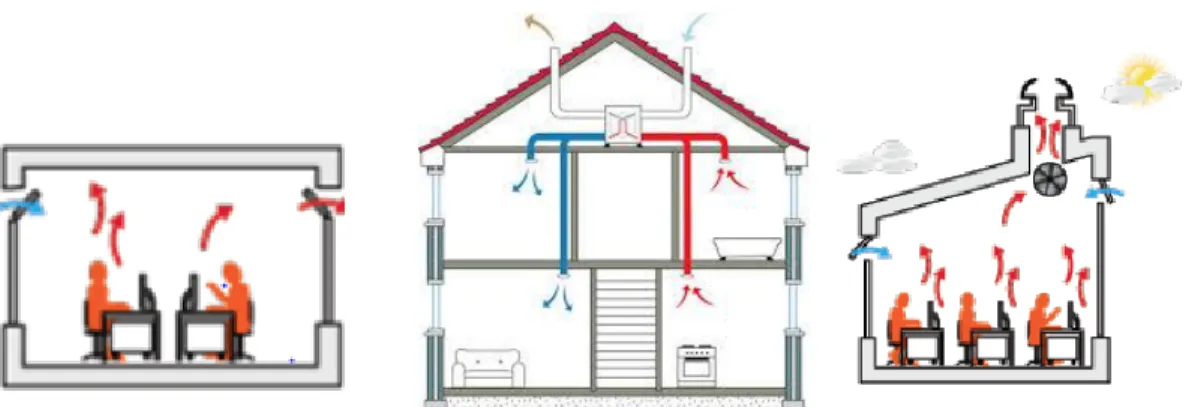
Ventilation is also one of the sources that help moisture to enter the building. There are three categories of ventilation in the buildings they are (1) mechanical ventilation for supply and exhaust air in the building (2) natural ventilation which depends on the open-ings of envelopes such as windows etc. and air movement in the premises and (3) hybrid or in other words mixed ventilation which is seen in figure 1. It uses natural or fan with low energy consumption which is combined with an independent mechanical ventila-tion system. /5/.
FIGURE 1. Examples of Natural, Mechanical and Hybrid ventilation /7/ /8/ /9/
One of the main functions of the ventilation system is to control the humidity level in the premises. Mechanical ventilation, for example, should have a very good dehumidi-fication capacity in order to remove moisture from the premises and control the dew point. Basements or crawl spaces could increase the same amount of humidity level in the building during the day as all combined premises in the building /5/.
2.1 Condensation problems during seasons
Condensation problems during cold weather
In cold weather conditions, condensation occurs on the inside of the external walls or on the roof assemblies. The temperature will be near the outdoor temperature on the cladding and sheeting on the outer layer of insulation. The surface temperature of the windows is often much colder than the temperature of the walls and condensation will occur on the windows most likely first. If the temperature of the indoor wall is lower than the dew point of the surroundings, it means that most likely condensation may occur in the air gap between insulation layers of the wall. In case, there is a hole in the wall and the building is under negative pressure the infiltration of cold air can pass through the insulation and may lower the temperature of indoor wall surface to the tem-perature below the dew point /5/.
Often condensation occurs within the assembly. As an example could be shown the joint of the steel tie that is located inside the wall and goes to the external wall which is colder than an internal wall of the building. Since the tie conducts, heat from the inside faster than the insulation more humid indoor air will go through that joint and due to that condensation will occur on the tie /10/.
Most of the times the issues within roof and walls assemblies are hidden and could be accepted as the rainwater problems. A swimming pool hall can be taken for an example where the air is much more humid and warmer. For this air, it is easier to leak through the ceiling and insulation to the attic during the cold season. This moisture of air can freeze and accumulate in the attic. It could stay up there till the warm season. During this period, it would start melting and go back to through the ceiling. If it is found during the rainy day it could be misleading to the surveyors and they would think that it oc-curred due to rainwater. /5/.
Condensation problems during hot weather
During hot weather season, there is the possibility of having condensation. Mostly it happens in the buildings equipped with air conditioning systems. These systems are usually very big and it is hard to control them properly. Air conditioning (AC) systems
can provide of having condensation inside the building. There are six possible ways how condensation can occur on the premises. Air conditioning system cools down all surfaces indoors, some more than the others (1) when system is not being used for de-humidification for a long time, air conditioning system removes air without removing moisture, it increases the dew point of the air and there is a bigger chance for conden-sation to occur (2) air in the room is warmer than the supplied air in ducts, refrigerant or in diffusers (3) when exhausted air from the building is higher than the makeup air it leads to outdoor air to come through holes and cracks in the building envelope and that air will condensate on the chilled surface of the AC system (4) when sun is shining on the wet surfaces of masonry wood or stucco it raises the temperature of the material, when temperature is high enough the evaporation of the water will occur forcing at the same time forcing fluid to enter the assembly if that happens it could reach the cold surface of indoor wall (5) during cooling conditions condensation on the inside surfaces of exterior walls might be caused by intentional or accidental vapor barrier (6). For example, when from the ground vapor is going to the basement it might condensate when it touches the vapor barrier on inside of basement wall /5/.
3 CONSEQUENCES OF MOISTURE Mold and bacteria
Ishak stated in his Journal of building appraisal that poor ventilation in the building could lead to the growth of mold. The high amount of water in the air can encourage mold and bacteria growth Figure 2 shows what kind of problems and what kind of bac-teria grow with a certain point of relative humidity. If the relative humidity is lower than 40% it is the best environment for bacteria, viruses, respiratory infections etc. to grow. On the other hand, if the humidity is too high then it is a good environment for bacteria, viruses, fungi and mites etc. to grow. In order to have a clean indoor air, the humidity should be between 40-60 percent./11/., /12/.
FIGURE 2. Indirect health effects of relative humidity in indoor environments /14/
Increasing or reducing humidity to avoid dampness or condensation problems are not always good solutions because the water vapor content in the air is not changing alt-hough if the temperature is changing. Condensation will occur on the windows and walls most likely first. So that water wouldn’t condensate on the cold surface of the wall, the dew point of the air has to be above the temperature of the surface of the wall. /5/., /12/., /14/.
Micro-organisms in ventilation system
All ventilation systems and air conditioning systems should be planned, manufactured and maintained in such a way to avoid growth of hazardous micro-organisms. With high values of relative humidity or high amounts of water content provides a nutrient sub-strate for growth of microorganisms. In ventilation system, all materials should be “closed pored” which means the material should not absorb any humidity or release odors to the premises. Furthermore, it has to provide an unpleasant environment for the growth of microorganisms. The best environment for the microorganism to grow is in water or in humid surfaces such as on the humidifiers or on cold surfaces with conden-sate liquid. These are the best environments for legionella, algae, and molds to grow. /12/., /14/.
4 MOISTURE IN BASEMENT
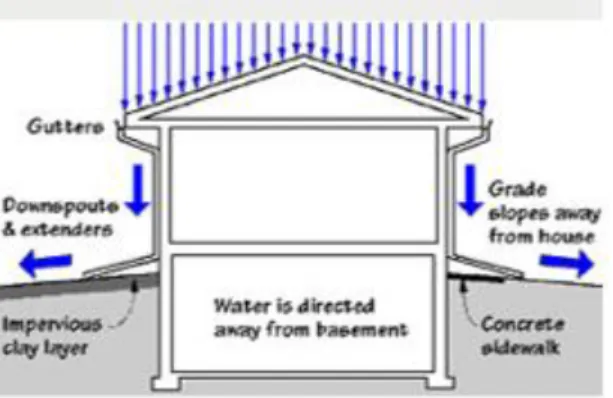
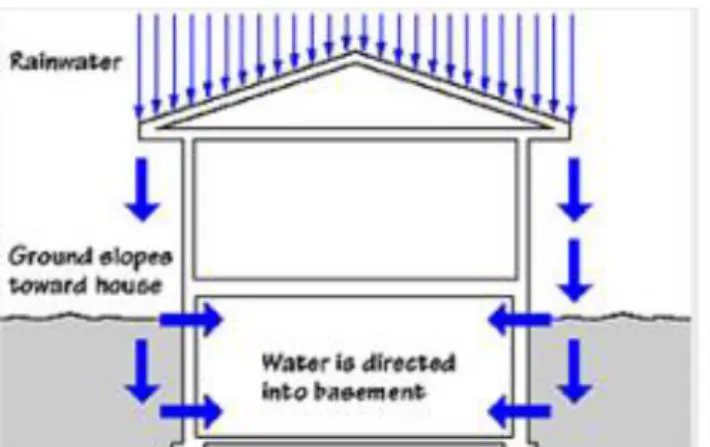
Moisture and water problems are well known to everyone who has a basement in his house or in any other building. This problem is well known but very frequently not well understood and properly treated. When the basement is rarely used and is separated from the living area, it may not cause any problem at all. However, if the basement is used quite often moisture problems can become rather annoying and uncomfortable. They could even lead to health problems. In figure no. 3 we can see a properly built house. In this case, rainwater cannot enter the house/13/.
FIGURE 3. Properly build house to avoid moisture inside the house /13/
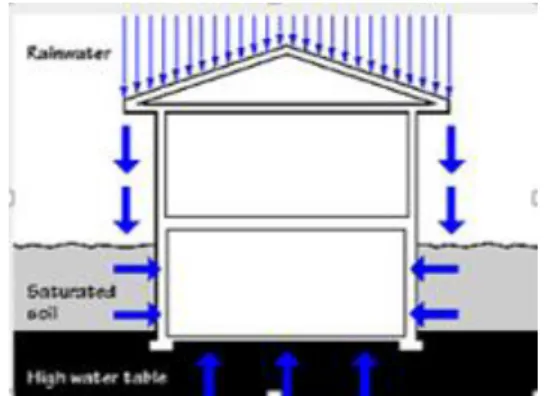
However, rainwater is not the only problem that leads to having moisture in the ment. Figure 4 shows that there is also a possibility for groundwater to enter the base-ment and ruin it.
Having moisture in the basement is the perfect environment for mildew and mold to grow humid carpets and beneath coverings of the wall. Finishing basement without fix-ing the moisture problem in it may result in mold and mildew occurrence and also mak-ing health conditions even worse. It is possible to solve the water problem in the basement. However, it is very expensive to do it right /13/.
To fix moisture problems in the basement, it is very important to understand where the water source is. What causes water to enter in the basement in the first place? There are three main sources of moisture appearance in the basement. The first source is, of course, the water from the rain and ground water that enters the basement because it is located at the lowest point in the building. The second source of moisture problems in the basement it could occur from humidifiers, bathrooms, unvented clothes dryers as well as the moisture in the concrete after construction. The third source is the exterior dump that enters the basement and condensates on the cold surfaces/13/.
There are four mechanisms that transfer moisture from the outside to inside liquid water flow, air movement, vapor diffusion and capillary suction. Occasionally due to poor construction having cracks in foundation may lead to moisture getting through into the building and causing more damage. In most of the cases, nevertheless, basements and the house itself structurally can be well built but are not well build to be able to handle water drainage system. It is very common that the failure occurs on the slope of the ground surface away from the foundation from the walls or there is not enough of good spout drainage system. Relatively frequently the lack or non-functioning subsurface drainage systems can lead to water entering the building. All of these problems can be fixed if it is done step by step /13/.
4.1 Symptoms
The basement needs to be refurbished if there are any of the following symptoms: 1) water dripping from the walls, 2) waters standing on floor, 3) very humid and damp air, 4) during summer there is condensation on the cold walls and floor, mildew, 5) mold and unpleasant odors, 6) deterioration of wood or any carpets or furniture, 7) staining and blistering of wall coverings /5/.
4.2 Sources of moisture in basement
Rain and groundwater
In 1 cm of rainwater, there are 1863 liters of the water which fall down on the roof top of 20 square meter house. Without the proper installation of downspout, grading and gutter some of this water may enter the basement. The groundwater may also rise due to flooding, longer rainy days or seasonal site conditions. That’s why to drain tile system is needed around the basement walls no matter if the soil is sandy or it is gravel /5/.
FIGURE 5. Water entries to the building /13/
The figure above represents how the water can enter the building. There are possibilities that it might enter the ground in cases of flooding, or through the rooftop during the rain.
Ventilation with outside air
During summertime, the windows in the basements are often opened for fresh air to enter the premises as shown in figure 6. The outside air is warmer and more humid during summertime it makes condensation on the cold surfaces of the walls and floors in the basement /5/.
FIGURE 6. Ventilation with outside humid air /5/
People who own basement will notice the moisture on the walls and will consider the fact that they have water leakage through the walls. However, the real reason for mois-ture occurrence on the walls is condensation on the cold surface of the wall.
4.3 Moisture movement mechanisms
Capillary suction
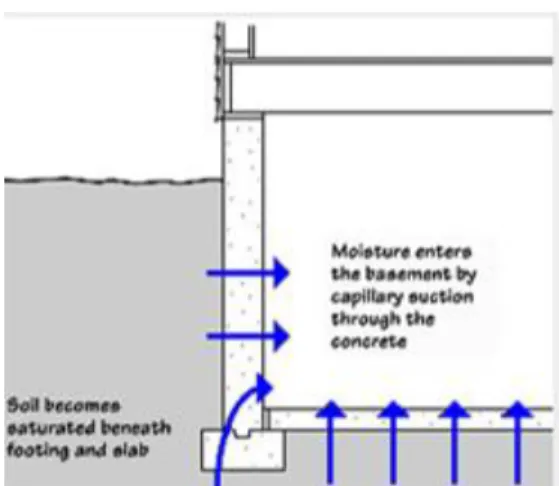
The definition of capillary suction explains moisture movement through porous mate-rials. Waters is drawn up through pores in the concrete footing and slab and through the walls. Due to this, it creates dampness which is seen on the basement walls. Most of the time it is seen on the metal cold joints which are connected to the concrete. Due to that water rises by capillary draw significantly /11/.
Figure 7 represents how moisture due to capillary suction enters the building base floor. These pores even if they are small are more dangerous than the big cracks in the walls. This is due to capillary suction ability. The smaller the pores are the more power they have to draw the liquid inside. The example could be given for the blood test. When you are donating the blood, the nurse sticks the needle to your vain and the glass tube fills very fast although the diameter of the needle is very small /11/.
FIGURE 7. Capillary suction of porous materials /13/
The same process occurs with capillary suction in the concrete walls, where the liquid travels through the pores. The smaller they are more liquid they can absorb, which leads having moisture on the walls.
Air leakage
Stack effect is the movement of air entering and leaving the building. Figure 8 repre-sents how the air movement is created due to stack effect.
FIGURE 8. Stack effect in two story house /15/
Air is leaving the building through the chimneys, through stacks or any other containers resulting from the bouncy of the air. Buoyancy in the building occurs due to density difference in the air, temperature difference and the difference in water vapor content in the air /16/.
FIGURE 9. Air leakage through walls and floor /16/
Stack effect is created due to warm air rising upward almost in all houses. This makes negative pressure in the basement and draws moist air through the cracks, openings which are in the foundation. Due to that sumps have to have an airtight covering. If the block cores are left open it makes moist air be drawn through concrete block founda-tion/5/.
Vapor diffusion
Vapor diffusion could be defined as the movement of water vapor through the building material. It shows the conductivity of the building material and the difference of driving vapor force difference /17/.
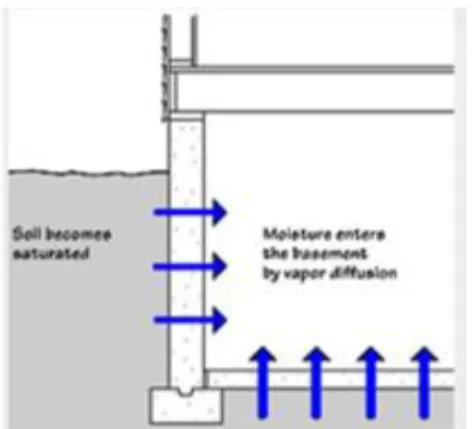
FIGURE 10. Vapor diffusion through foundation /17/
Very often in basements water can diffuse from the ground through the concrete walls and floors because it could be wet due to flooding and underground water. Due to that water will travel to drier place in the basement, which means the dampness will go up.
To slow down this process all kind of insulation needs to be used, for example, water-proof insulation or polyethylene insulation layer stops water from coming from the ground to dry basement premises /17/.
4.4 Moisture problems causes and solutions in basement Insufficient grading
If the ground next to the building is in level with the building or the ground has the slope towards the house this causes that all the water is directed directly to the basement as shown in figure 11. This could happen when the soil next to the house is not backfilled without proper compaction. This causes that ground settles after some time and it could shrink in some places next to the building, which leads to water to come easier to the basement/13/.
FIGURE 11. Insufficient grading /13/
This mostly happens under the foundation where water is collected next to the wall of the basement. The solution for this kind of problem would be to place earth next to the foundation that it would have an inclination of at least 3 cm per one meter of length. Due to that, this situation of water leakage into the basement could be avoided/13/.
Imperfect or no gutters and downspouts
If the gutters and downspouts are missing this it causes that rainwater can reach the foundation of the building much easier as is it shown in figure 12.
FIGURE 12. No gutters and downspouts /6/
The downspout with no splash block is even worse than no gutters or downspout at all. This is because it is making a huge volume of the water from the roof to fall on one particular concentrated area near the basement. The best solution for this situation would be to place every 15 meters downspout. The extensions should be placed and the length of them should be at least one meter. Sidewalk with a slope next to the foundation of the building is very efficient. They help to prevent water leakage into the basement during rainfall /6/.
Improperly designed windows
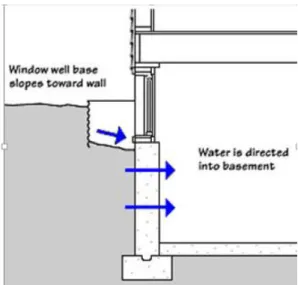
Window openings in the basement can cause the same problem as drains next to the wall when they are installed improperly. As it is shown in figure 13 windows are in-stalled below the ground level. Very often when they are improperly built water has
direct flow into the basement. It is more likely that water will enter through the windows rather than from the foundation. To solve a problem like this, the extra drain should be installed with an extension from the foundation. It will help that water wouldn’t be able to come directly to the window opening/5/.
Cracks in structure
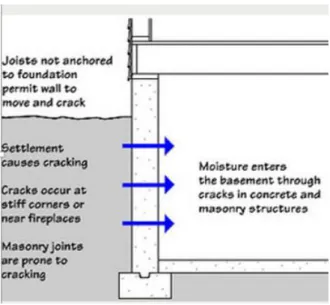
Blocks of concrete and concrete itself during the year of exploitation usually develop cracks. These cracks could be very serious for example one of the reasons could be if the joints are nor properly connected to the foundation. If it happens it makes a wall to be unstable and to move. This movement and makes the cracks. They also can occur due to soil movement, when the soil after construction is settling down. As it is shown in figure 14. Most of the time drainage system prevent water entering to the basement through the cracks, but refurbishment is needed /5/.
FIGURE 14. Structural cracks /5/
Most common solution to this kind of issue would be proper design and proper connec-tion between foundaconnec-tion and structure which are above.
4.5 Solutions for moisture problems in basement
The best solution to any kind of problem in the building is to repair the things that are easy and have low cost. Then logical order should be approached. It should be solved
with the most positive result and of course as small as possible expenses. Having mois-ture problems, the best way would be to remove or to control the moismois-ture source/5/.
Condensation on the wall can occur in the summer too. If it does occur it is not allowed to ventilate basement with warm humid outside air. It is recommended to ventilate with air conditioning system, with a heat exchanger and dehumidifier /13/.
Dehumidification also could be one of the options to remove moisture and odors in the basement, but it doesn’t solve the problem and it’s not a complete solution for this kind of issue. Actually, if the dehumidifier is used in this kind of basement it could make even more damage than it was before. Drying the basement air, moisture can get to the basement faster causing efflorescence and spalling of concrete/5/.
One of the less expensive solutions for moisture problems in the basement would be to use membrane or coating inside of the walls in the basement. The water remains there but this kind of coating forces water to move to another direction/4/.
Another solution is to evaluate and check the gutters, downspouts and the surface around the building. It has to be fixed in the first place. If the moisture problem remains the same then the drainage (interior and exterior) system should be checked /4/.
Proper installation of downspouts and gutters
Most of the basement problems can be solved simply just directing rainwater to another direction using gutters and downspouts. It is a simple solution to carry out the water from the foundation. Figure 15 represents how rain water is carried away from the foun-dation by installing proper gutters and downspouts.
FIGURE 15. Properly installed gutters and downspouts /5/
Soil next to the house should have slopes to make water flow to another direction. The soil should also be covered either by sidewalk or by a clay layer. These solutions may solve the problem of water entering into the basement. Even is drainage system needs to be installed, it is very important to remove as much as possible water at the source/5/.
External drainage system
One of the most expensive but most effective water control in the basement is installing an external drainage system. It is done by digging the area around the foundation of the existing building and reconstructing it, the same way as building a new one/13/.
Sometimes it is necessary that foundation should be repaired too. Most of the time the external drainage system uses sand. It is necessary to install leveled drain pipe at the foundation level. Drain tile would be recommended to put beside or on the top of the footing. A minimum 30 centimeters of caroused aggregate should be put next to the drain tile. Figure 16 represents how this situation would look like in real life. Using cross section, we can see there drain pipe should be placed and how the water would travel using this method.
Drainage channel above concrete slab
Most of the time when moisture and water are found in basement internal drainage system are installed. One of the simplest and not expensive method is used. The drainage channel is put on the foundation wall and the base floor slab. Water is collected and then through drainage system is drained into the sump. On the top of the slab, there is used another channel. Thanks to this channel water travel to the sump basin. The cover of the sump has to be airtight and childproof/4/. The more detail view is seen in figure 18.
FIGURE 17. Internal drainage channel/12/
This solution would suit the best a concrete with a lot of cracks. It would not solve the problem in very big masonry walls because water would stay in it. Using this method water is not removed completely. As the result in the basement, there could be still problems with mold, mildew, humidity. It also doesn’t solve groundwater problems /12/.
Drainage channel within slab edge
There is also the possibility to place a drainage on the top of the footing at the base of the wall. The concrete next to the slab edge has to be removed. Drainage channels have to be connected to the drain pipe which will end at the sump. As in the previous case, it has to have a cover that is air tight and childproof /5/. The more detailed picture is shown in figure 18.
FIGURE 18. drainage channel with slab edge/5/
It is very good solution for a building with masonry walls and water problem because it helps to drain the block cores. Holes are drilled in order to permit water staying in one place. It is also required to remove some concrete from the foundation as shown in figure 18 to fit the drill in. The cost of this kind of system depends on the manufacturer which was selected. Moisture is allowed to penetrate through concrete, it is important to cap the tops and put vapor moderator coating on the walls /5/.
Drainage system beneath the slab
Drainage system which is installed at the perimeter of the footing is one of the most effective systems of the internal drainage systems. To have this kind of drainage system, it is necessary to remove and replace concrete at the slab edge. The pipe is put beneath the slab. Due to this pipe, it drains all moisture to the area below. It is very similar to an external system which at the end is connected to the sump. As in previous cases is has to have waterproof and airtight cover/13/. The more detailed picture of this kind of sit-uation is represented in figure 19.
FIGURE 19. Drainage system beneath the slab /12/
The dimpled sheeting is used in this approach. It is placed on the base of the wall and beneath the edge of the slab. This method is less expensive than other specialized sys-tems /12/.
Studied case
The case studied building is using outside dry air and brings it to the basements and in this way it dries out the humid inside air in it. This situation is shown in figure 20.
FIGURE 20. Drying basement with dry outside air
As it was mentioned before the supervision company installed the fan in order to take the dry air from the outside and to dehumidify more moist air indoors. The more about this solution is told in the following paragraph.
5 MEASUREMENTS AND CALCULATIONS
Building Description
The case building location is in Kuopio, Finland. It is four-storey building for elderly people. This building has moisture problems in the basement. This is because the ground water level is high in this area and nearby there is a small lake. The building area of this building is 2811.5 m2. Figure 21 and 22 contains a picture of the exterior completed
house and the cross section of it. The more detailed plan is shown in Appendix 1.
FIGURE 21. Elderly house in Kuopio
To avoid condensation in the basement, an exhaust air fan was installed. The idea of this fan installation is to dry basement space air with drier outside air which is taken from small openings in the basement wall and then removed with the fan. The fan can work in two ways either with full speed or 30 percent of a full speed.
In the basement, there are three sensors measuring the temperature inside and one hu-midity sensor inside there are also sensors for temperature and huhu-midity monitoring outside the building. The fan is controlled by the humidity level in the basement. It starts to run when humidity level outside is lower than inside. The difference between outside relative humidity and inside relative humidity is about 15%. The data is stored every ten minutes.
The fan was installed in 2014. After half a year supervising company “Schneider” no-ticed that after fan installation the conditions in the basement didn’t change. Having data for from December 2014 till October 2015 the graphics and calculations were car-ried out.
5.1 Measurements
After receiving data from “Schneider” company, the received data was analyzed. The data was simplified. Since data was collected every ten minutes. It was simplified and an average of the hour was extracted. The following results were obtained. Table 1 rep-resents a short example how the data was simplified to an average per hour.
TABLE 1. Simplified data
Aver-age pre hour M.PL2/PF3.1-TE1 ALAPOHJA LÄMPÖTILA (Basement tempera-ture) Aika Arvo °C (Time) (Value °C) 1.12.2014 0:00:00 13.6 13.6 1.12.2014 0:10:00 13.6 1.12.2014 0:20:00 13.6 1.12.2014 0:30:00 13.6
1.12.2014 0:40:00 13.6 1.12.2014 0:50:00 13.6 1.12.2014 1:00:00 13.6 13.6 1.12.2014 1:10:00 13.6 1.12.2014 1:20:00 13.6 1.12.2014 1:30:00 13.6 1.12.2014 1:40:00 13.6 1.12.2014 1:50:00 13.6 1.12.2014 2:00:00 13.6 13.6 1.12.2014 2:10:00 13.6 1.12.2014 2:20:00 13.6 1.12.2014 2:30:00 13.6 1.12.2014 2:40:00 13.6 1.12.2014 2:50:00 13.6
Figure 23 and 24 show graphs of temperature and humidity variation. In graph 25 the fan speed is shown during June because in summer (2015 year) the fan is running not only 30 percent of its full speed as in winter, but it is boosting the air in the basement, it works with full capacity (100 percent). More graphs of temperature and humidity values can be found in appendix 2.
FIGURE 23. December outdoor and indoor humidity and temperature in base-ment 75 80 85 90 95 100 105 -30 -20 -10 0 10 20 R el at ive hum idi ty % Tem per atu re °C
December
Outdoor temperature Indoor temperature Outdoor relative humidity Indor relative humidity
FIGURE 24. June outdoor and indoor humidity and temperature in basement
FIGURE 25. Fan speed during June
When we are looking at these figures and fan operation principle it seems that the fan works properly, and it has to take moisture from the basement. However, moisture is still remaining in the basement, and the fan doesn’t help. Calculations were carried out in order to find out real situation what is happening in the basement. All the calculations are shown in the next chapter.
5.2 Calculations
To find out why there is moisture in the basement, the moisture content in the basement is calculated. In order to calculate moisture content, the following formulas were used. The examples are shown for the calculations of December and June months.
In order to find out moisture content in the air, first of all, the pressure of saturated water vapor is found. Approximation of it is found in formula (1).
0 20 40 60 80 100 120 0 10 20 30 40 2 01 5. 6. 1 20 15 .6 .2 2 01 5. 6. 3 2 01 5. 6. 4 2 01 5. 6. 5 2 01 5. 6. 6 2 01 5. 6. 7 2 01 5. 6. 8 2 01 5. 6. 9 20 15 .6 .1 0 20 15 .6 .1 1 20 15 .6 .1 2 20 15 .6 .1 3 20 15 .6 .1 4 20 15 .6 .1 5 20 15 .6 .1 6 20 15 .6 .1 7 20 15 .6 .1 8 20 15 .6 .1 9 20 15 .6 .2 0 20 15 .6 .2 1 20 15 .6 .2 2 20 15 .6 .2 3 20 15 .6 .2 4 20 15 .6 .2 5 20 15 .6 .2 6 20 15 .6 .2 7 20 15 .6 .2 8 20 15 .6 .2 9 20 15 .6 .3 0 H um idi ty % Tem per at ur e °C
June
Indoor temperature Outdoor temperature Outdoor humidity Indoor humidity
0 20 40 60 80 100 120 20 15 .6 .1 20 15 .6 .6 20 15 .6 .1 1 20 15 .6 .1 6 20 15 .6 .2 1 20 15 .6 .2 6
Fan Speed
𝑝′ =exp(77.345+0.0057𝑇− 7235 𝑇 ) 𝑇8.2 (1) Where: 𝑇 − 𝑜𝑢𝑡𝑑𝑜𝑜𝑟/𝑖𝑛𝑑𝑜𝑜𝑟 𝑡𝑒𝑚𝑝𝑒𝑟𝑎𝑡𝑢𝑟𝑒, 𝐾
After this, the partial pressure has to be calculated. It could be calculated using formula 2:
𝑝ℎ = 𝑝′ ∙ 𝜑 (2)
Where:
𝑝′ − 𝑝𝑟𝑒𝑠𝑠𝑢𝑟𝑒 𝑜𝑓 𝑠𝑎𝑡𝑢𝑟𝑎𝑡𝑒𝑑 𝑤𝑎𝑡𝑒𝑟 𝑣𝑎𝑝𝑜𝑟
𝜑 − 𝑜𝑢𝑡𝑑𝑜𝑜𝑟/𝑖𝑛𝑑𝑜𝑜𝑟 𝑟𝑒𝑙𝑎𝑡𝑖𝑣𝑒 ℎ𝑢𝑚𝑖𝑑𝑖𝑡𝑦
Moisture content in the air can be calculated using formula 3:
𝑥 = 0.622 ∙ 𝑝ℎ/(𝑝0− 𝑝ℎ) , g/kg (3)
Moisture removed from the indoor air is calculated by the formula 5:
𝑥′ =𝑞𝑚(𝑥𝑖𝑛𝑑−𝑥𝑜𝑢𝑡)
1000 , 𝑔/𝑠 (4)
Example:
The example is given for December and for the June, to show the difference in moisture content during summer and winter period.
December:
Temperature outside and insides in °C into Kelvins: Tout= -0.3 °C → Tout =273+ (-0.3) = 272.7 K
Tins=13.6 °C → Tins = 273+ 13.6 = 286.6 K
Using 1 equation we are calculating pressure of saturated water vapor:
𝑝′𝑜𝑢𝑡 =exp(77.345+0.0057∙272.7−
7235 272.7)
𝑝′ 𝑖𝑛𝑠 =
exp(77.345+0.0057∙286.6−286.67235)
286.68.2 = 1537.73
The partial pressure of water vapor:
𝑝ℎ 𝑜𝑢𝑡 = 589 ∙ 1 = 589
𝑝ℎ 𝑖𝑛𝑠 = 1537.73 ∙ 0.95 = 1460.8
Outdoor and indoor moisture content is calculated x:
𝑥𝑜𝑢𝑡 = 0.622 ∙ 589
101325−2.14∙ 1000 = 3.64 𝑔/𝑘𝑔
𝑥𝑖𝑛𝑑= 0.622 ∙ 1460.8
101325−1460.84∙ 1000 = 9.1 𝑔/𝑘𝑔
For a better understanding how moisture is removed from the basement figure 26 is made below.
FIGURE 26. Moisture from the ground removing principle
When the fan is running full speed the exhaust system takes 135 l/s from the basement. During December fan, is running with 30percent of its full capacity, since that it takes 40.5 l/s →0.0405 m3/s. Mass flow rate, in this case, is 𝑞𝑚 = 1.2 ∙ 0.0405 =0.0486 kg/s →48.6 g/s. Moisture taken from the basement is:
𝑥′ =48.6∙(9.1−3.6)
1000 = 0.27 , 𝑔/𝑠
TABLE 2: Example of one-day calculations in December
June:
Temperature outside and insides in °C into Kelvins: Tout= 14.1 °C → Tout =273+14.1 = 287.1 K
Tins=14 °C → Tins = 273+ 14 = 287K
Using 1 equation we are calculating pressure of saturated water vapor: 𝑝′𝑜𝑢𝑡 = exp(77.345+0.0057∙287.1− 7235 287.1) 287.18.2 = 1588.56 𝑝′ 𝑖𝑛𝑠 = exp(77.345+0.0057∙287−7235287) 2878.2 = 1578.27
Partial pressure of water vapor is calculated using 2 equation:
𝑝ℎ𝑜𝑢𝑡 = 1588.56 ∙ 1 = 1588.56 𝑝ℎ𝑖𝑛𝑑 = 1578.27 ∙ 0.97 = 1530.92 0 -0.3 13.6 1.00 0.95 0.0405 272.7 286.6 589.8 1537.7 589.8 1460.8 3.6417 9.1 0.0486 48.6 0.3 954.8 1 -0.3 13.6 1.00 0.95 0.0405 272.7 286.6 589.8 1537.7 589.8 1460.8 3.6417 9.1 0.0486 48.6 0.3 954.8 2 -0.6 13.6 1.00 0.95 0.0405 272.4 286.6 575.6 1537.7 575.6 1466.0 3.5536 9.1 0.0486 48.6 0.3 975.9 3 -0.8 13.6 1.00 0.95 0.0405 272.2 286.6 568.6 1537.7 568.6 1466.0 3.5103 9.1 0.0486 48.6 0.3 983.4 4 -1.0 13.6 0.98 0.95 0.0405 272.0 286.6 561.7 1537.7 550.5 1460.8 3.3977 9.1 0.0486 48.6 0.3 997.5 5 -1.3 13.6 0.96 0.95 0.0405 271.7 286.6 548.1 1537.7 526.2 1463.4 3.2471 9.1 0.0486 48.6 0.3 1026.6 6 -1.3 13.6 0.95 0.95 0.0405 271.7 286.6 548.1 1537.7 520.7 1460.8 3.2131 9.1 0.0486 48.6 0.3 1029.8 7 -1.7 13.6 0.98 0.95 0.0405 271.3 286.6 531.6 1537.7 520.9 1453.2 3.2144 9.1 0.0486 48.6 0.3 1021.0 8 -1.8 13.4 0.99 0.94 0.0405 271.3 286.4 530.3 1517.8 525.0 1426.7 3.2394 8.9 0.0486 48.6 0.3 987.5 9 -2.1 13.3 0.97 0.94 0.0405 270.9 286.3 516.1 1507.9 500.6 1417.4 3.0883 8.8 0.0486 48.6 0.3 1003.6 10 -2.2 13.3 0.96 0.94 0.0405 270.8 286.3 512.9 1507.9 492.4 1412.4 3.0374 8.8 0.0486 48.6 0.3 1007.0 11 -2.2 13.3 0.94 0.94 0.0405 270.8 286.3 512.9 1507.9 482.1 1409.9 2.9738 8.8 0.0486 48.6 0.3 1015.3 12 -2.8 13.3 0.92 0.93 0.0405 270.2 286.3 491.2 1507.9 451.9 1404.9 2.7863 8.7 0.0486 48.6 0.3 1042.6 13 -3.2 13.3 0.97 0.93 0.0405 269.8 286.3 476.1 1507.9 461.9 1402.4 2.8482 8.7 0.0486 48.6 0.3 1029.0 14 -3.2 13.3 0.95 0.93 0.0405 269.8 286.3 476.1 1507.9 452.3 1402.4 2.7892 8.7 0.0486 48.6 0.3 1039.3 15 -3.2 13.3 0.99 0.93 0.0405 269.8 286.3 476.1 1507.9 471.4 1402.4 2.9072 8.7 0.0486 48.6 0.3 1018.7 16 -3.2 13.3 1.00 0.93 0.0405 269.8 286.3 476.1 1507.9 476.1 1402.4 2.9367 8.7 0.0486 48.6 0.3 1013.5 17 -2.9 13.3 1.00 0.93 0.0405 270.1 286.3 488.1 1507.9 488.1 1399.9 3.0110 8.7 0.0486 48.6 0.3 997.7 18 -2.7 13.3 1.00 0.94 0.0405 270.3 286.3 494.2 1507.9 494.2 1412.4 3.0487 8.8 0.0486 48.6 0.3 1005.0 19 -2.7 13.3 1.00 0.94 0.0405 270.3 286.3 494.2 1507.9 494.2 1417.4 3.0487 8.8 0.0486 48.6 0.3 1010.6 20 -2.7 13.3 1.00 0.94 0.0405 270.3 286.3 494.2 1507.9 494.2 1417.4 3.0487 8.8 0.0486 48.6 0.3 1010.6 21 -2.5 13.3 1.00 0.94 0.0405 270.5 286.3 500.4 1507.9 500.4 1420.0 3.0869 8.8 0.0486 48.6 0.3 1006.6 22 -2.2 13.3 1.00 0.95 0.0405 270.8 286.3 512.9 1507.9 512.9 1432.5 3.1646 8.9 0.0486 48.6 0.3 1006.9 23 -2.2 13.3 1.00 0.95 0.0405 270.8 286.3 512.9 1507.9 512.9 1432.5 3.1646 8.9 0.0486 48.6 0.3 1006.9 Outdoo r relative humidit y Indor relativ e humidi ty outdo or tem K moistu re taken by fan from ground g/s moistur e taken by fan from ground g/h 1 .1 2 .2 0 1 4 Indo or temp eratu re Outdo or temp eratur e m^3/s outdoor kg/s g/s 2) Partial pressu re of water vapou r OUT 2) Partial pressur e of water vapour IND phs(T) phs(T) Outdoor moisture content g/kg Indoor moistu re conten t g/kg Indoor tem K
Outdoor and indoor moisture content is calculated x:
𝑥𝑜𝑢𝑡 = 0.622 ∙ 1588.56
101325−1588.56∙ 1000 = 9.9 𝑔/𝑘𝑔
𝑥𝑖𝑛𝑑= 0.622 ∙ 1530.92
101325−1530.921000 = 9.5 𝑔/𝑘𝑔
During summer fan is running at full capacity 100 percent. When it is running with the full speed it takes 135 l/s →0.135 m3/s. The mass flow rate, in this case, is:
𝑞𝑚= 1.2 ∙ 0.135 =0.162 kg/s→162 g/s,
When the fan is running with 30percent of its full capacity as in the previous case in winter in December it takes 40.5 l/s →0.0405 m3/s. Mass flow rate in this case is:
𝑞𝑚= 1.2 ∙ 0.0405 =0.0486 kg/s →48.6 g/s,
Moisture taken from the basement is calculated in the following steps:
𝑥′ =48.6∙(9.5−9.9)
1000 = −0.01774 , 𝑔/𝑠
𝑥′ = −0.01774 ∙ 3600 = −63.85 𝑔/ℎ
TABLE 3: Example of one-day calculations in June
5.3 Analysis of results
After analyzing the results, the moisture from the basement is taken away during winter, spring and autumn seasons. During summer time, moisture is brought into the basement, during summer time fan is running at full capacity. Even though the relative humidity is low during summer but moisture content is the highest during summer. It can be ex-plained using Moeller chart in figure 27.
0 14.1 14 1 100 0.97 97 30 0.0405 287.1 287 1588.556 1578.273 1588.556 1530.925 9.9069 9.5420 0.0486 48.6 -0.01774 -63.8471 1 13.85 14 1 100 0.97 97 30 0.0405 286.85 287 1562.959 1578.273 1562.959 1530.925 9.7448 9.5420 0.0486 48.6 -0.00986 -35.4803 2 13.45 14 1 100 0.97 97 30 0.0405 286.45 287 1522.758 1578.273 1522.758 1530.925 9.4903 9.5420 0.0486 48.6 0.002512 9.042427 3 13.3 14 1 100 0.972 97.17 30 0.0405 286.3 287 1507.918 1578.273 1507.918 1533.555 9.3964 9.5586 0.0486 48.6 0.007884 28.38061 4 13.3 14 1 100 0.978 97.83 30 0.0405 286.3 287 1507.918 1578.273 1507.918 1544.077 9.3964 9.6252 0.0486 48.6 0.01112 40.03248 5 13.63 14 1 100 0.97 97 30 0.0405 286.6333 287 1541.069 1578.273 1541.069 1530.925 9.6062 9.5420 0.0486 48.6 -0.00312 -11.2328 6 14.72 14 0.96 96 0.97 97 30 0.0405 287.7167 287 1653.275 1578.273 1587.144 1530.925 9.8980 9.5420 0.0486 48.6 -0.0173 -62.2825 7 16.13 14 0.863 86.33 0.963 96.33 30 0.0405 289.1333 287 1810.795 1578.273 1563.32 1520.403 9.7471 9.4754 0.0486 48.6 -0.0132 -47.5291 8 16.63 14 0.828 82.83 0.963 96.33 30 0.0405 289.6333 287 1869.453 1578.273 1548.53 1520.403 9.6534 9.4754 0.0486 48.6 -0.00865 -31.1454 9 18.05 14 0.842 84.17 0.97 97 30 0.0405 291.05 287 2044.797 1578.273 1721.037 1530.925 10.7474 9.5420 0.0486 48.6 -0.05858 -210.899 10 19.55 14 0.79 79 0.97 97 30 0.0405 292.55 287 2246.004 1578.273 1774.343 1530.925 11.0862 9.5420 0.0486 48.6 -0.07505 -270.178 11 19.47 14 0.802 80.17 0.97 97 30 0.0405 292.4667 287 2234.387 1578.273 1791.234 1530.925 11.1937 9.5420 0.0486 48.6 -0.08027 -288.975 12 19.88 14 0.788 78.83 0.97 97 30 0.0405 292.8833 287 2293 1578.273 1807.649 1530.925 11.2981 9.5420 0.0486 48.6 -0.08535 -307.248 13 20.88 14 0.738 73.83 0.957 95.67 30 0.0405 293.8833 287 2439.193 1578.273 1800.938 1509.881 11.2554 9.4089 0.0486 48.6 -0.08974 -323.071 14 21.55 14 0.69 69 0.945 94.5 30 0.0405 294.55 287 2541.126 1578.273 1753.377 1491.468 10.9529 9.2924 0.0486 48.6 -0.0807 -290.525 15 23.47 14 0.625 62.5 0.955 95.5 30 0.0405 296.4667 287 2855.214 1578.273 1784.509 1507.251 11.1509 9.3922 0.0486 48.6 -0.08547 -307.696 16 24.55 14 0.575 57.5 0.96 96 30 0.0405 297.55 287 3047.324 1578.273 1752.211 1515.142 10.9455 9.4421 0.0486 48.6 -0.07306 -263.031 17 25.22 14 0.507 50.67 0.96 96 30 0.0405 298.2167 287 3171.07 1578.273 1606.676 1515.142 10.0218 9.4421 0.0486 48.6 -0.02817 -101.409 18 28.8 14 0.415 41.5 0.968 96.83 30 0.0405 301.8 287 3914.18 1578.273 1624.385 1528.295 10.1340 9.5254 0.0486 48.6 -0.02958 -106.49 19 32.23 14 0.378 37.83 0.98 98 30 0.0405 305.2333 287 4763.913 1578.273 1802.347 1546.708 11.2644 9.6419 0.0486 48.6 -0.07885 -283.867 20 33.65 14 0.358 35.83 0.98 98 30 0.0405 306.65 287 5158.668 1578.273 1848.523 1546.708 11.5583 9.6419 0.0486 48.6 -0.09314 -335.298 21 24.58 14 0.538 53.83 0.98 98 30 0.0405 297.5833 287 3053.41 1578.273 1643.752 1546.708 10.2568 9.6419 0.0486 48.6 -0.02989 -107.589 22 21.27 14 0.662 66.17 0.98 98 100 0.135 294.2667 287 2497.358 1578.273 1652.419 1546.708 10.3118 9.6419 0.162 162 -0.10853 -390.691 23 18.73 14 0.725 72.5 0.99 99 100 0.135 291.7333 287 2134.409 1578.273 1547.447 1562.49 9.6466 9.7418 0.162 162 0.015431 55.54984 moisture taken by fan from ground g/s moisture taken by fan from ground g/h Outdoor moisture content g/kg Indoor moisture content g/kg kg/s outdoor s g/s 2 0 1 5 .6 .2 1 phs(T) phs(T) 2) Partial pressure of water vapour OUT 2) Partial pressure of water vapour IND Indoor humidity Fan Spee d m^3/s outdoo r outdoor tem K Indoo r tem K Outdo or tempe rature Indo or tem pera ture Outdoor humidity
FIGURE 27.Moeller Chart
Blue lines represent moisture content during December. As we can see the humidity level outside is high 100 percent, but moisture content is low 3.64 g/kg and inside rela-tive humidity is 95% and moisture content is 9.1 g/kg. During winter time, it is recom-mended to ventilate basement with outside air because it is drier. However, during summertime, the outdoor relative humidity is lower 80 percent and moisture content is 9.9 g/kg indoor relative humidity is 56 % and moisture content is 5.2 g/kg. During summertime, moisture is brought inside from the outdoor air. During that time fan is running 100 percent so it is boosting the moisture to the inside of the basement. Due to that, it is not recommended to use a fan with full capacity during summertime because it is bringing moisture to the basement. The fan should be boosted during winter time autumn and spring seasons when the moisture contents in the air are lower. Only then basement could be dried from the moisture in outside air.
Conclusions
As a result, of this work the investigation on the fan working principle was done. Based on the monthly graphs conclusions can be done. Humidity level is changing in the base-ment according to the temperature and the humidity of the outside air. The fan runs at full capacity only during the summer time, during others seasons, it remains working with constant speed, 30 percent. After investigating this situation, the conclusions were made that fan works according to the relative humidity level. If the outdoor relative humidity is lower by 10-15 percent than the inside relative humidity then the fan starts to boost the air in the basement and starts to run at full capacity. This situation occurs during summertime. However, even after boosting the fan, the basement still remains “wet”.
The calculations were carried out and the moisture content of the air was calculated. The results were made for winter and summer period. During winter season even though the humidity level was high the moisture content in the air remains very low. However, summer time situation is totally different. The relative humidity level is quite small, but moisture content is very high. Furthermore, the fan is working at full capacity. This means that the fan is bringing the moisture to the basement during summertime, and during the winter, it only ventilates with 30 percent of its full speed.
The recommendation for this situation would be simple. In order to ventilate basement with outside air, it should be done during winter, spring and autumn seasons because the moisture content outdoors is the smallest. It actually can help to remove moisture from the basement. During summer time, it is not recommended to ventilate basement with outside air because moisture ratio is very high. The fan has to run with minimum power 30 percent of its full capacity. During other seasons, the fan can be boosted in order to dry the basement.
The air handling unit with heat recovery and dehumidifiers could be installed too. The solution is more expensive but very effective. Not only energy would be recovered but also, it would be dehumidified and the basement would be dry.
One of the less expensive solutions for moisture problems in the basement would be to use membrane or coating inside of the walls in the basement. The water remains there but this kind of coating forces water to move to another direction.
Another solution is to evaluate and check the gutters, downspouts and the surface around the building. If the moisture problem remains the same then the drainage (inte-rior and exte(inte-rior) system should be checked. The main idea of checking the ground is that it would have a slope in other word inclinations from the building. These slopes help to direct the water from the building.
References
1. World Health Organization. WHO Guidelines for Indoor Air Quality: Dampness and Mould. Germany. PDF.2009.
2. A. Nevalainen, P. Partanen, E. Jääskeläinen, A. Hyvärinen, O. Koskinen, T. Meklin, M. Vahteristo, J. Koivisto, T. Husman. Prevalence of Moisture Problems in Finnish Houses. 1998 (45-65)
3. Nilsson Per Erik. Achieving the Desired Indoor Climate: Energy Efficiency Aspects of System design. Studentlitteratur. 2003.
4. Chew, M.Y.L Defect Analysis in Wet Areas if Buildings. Construction & Building Materials. School of Design and Environment, National University of Singapore. 2005
5. EPA. Moisture Control Guidance for Building Design, Construction and Maintenance from U.S. Environmental Protection Agency. PDF. 2013.
6. Chew, M.Y.L. Tan, S.S., &Soemara, E. Serviceability of Materials. Journal of Architectural Engineering. 10(2). 69-76. 2004.
7. http://www.build.com.au/mixed-mode-hybrid-ventilation
8. http://newlearn.info/packages/clear/thermal/buildings/active_systems/mv/inde x.html
9. https://www.bca.gov.sg/zeb/daylightsystems.html
10.Veuro Martti. Heating Systems Introduction and principles of design heat loss calculations. Mikkeli University of Applied Sciences. 2015.
11.Ishak, S.N.H., Chohan, A.H.,& Ramey, A., Implications of Design Deficiency on Building Maintenance at the first occupational stage. Journal of Building Architecture, 3(2), 115-124. 2007.
12.Rehva NO: 9 Hygiene Requirement for ventilation and air-conditioning systems and –units. 2003
13.University of Minnesota Extension. 2006. http://www.extension.umn.edu/ Updated: 10/09/2015. Referred 10/09/2015.
14.Sullivan Lydia. 2015. Controlling Your Home’s humidity means fewer allergy and asthma triggers. Updated: 12/09/2015, Referred 12/09/2015.
15. AA Designs. 2015. Insulation and Energy losses. http://www.aadesigns.net/fix-it-now/insulation-energy-losses Updated: 15/09/2015, Referred: 15/09/2015. 16. Hassanain, S.N.H., Choham, A.H., & Ramly, A. Priorities in Building Envelope
Design. Journal of Architecture engineering 4(2). 47-52. 1998.
17.http://personal.cityu.edu.hk/~bsapplec/water1.htm Updated: 05/03/2000, Referred: 10/09/2015.
(1). 0 20 40 60 80 100 120 -25 -20 -15 -10 -5 0 5 10 15
January
Outdoor temperature Indoor temperature Outdoor humidity Indor humidity
75 80 85 90 95 100 105 -30 -20 -10 0 10 20 1 . 1 2… 4 . 1 2… 8 . 1 2… 1 2 . 1… 1 6 . 1… 2 0 . 1… 2 4 . 1… 2 8 . 1… 3 1 . 1… Rel at ive hum idi ty % Tem per at ur e °C
December
(2). 0 20 40 60 80 100 120 -15 -10 -5 0 5 10 15 Tem per at ur e °C
March
inddoor temperature OUToor temperature Outdoor humidity Indor humidity 0 20 40 60 80 100 120 0 5 10 15 20 25 30 Tem per at ur e °CMAY
(3). 0 20 40 60 80 100 120 0 5 10 15 20 25 30 35 40
June
(4). 0 20 40 60 80 100 120 H um idi ty % Tem per at ur e °C
August
Indoor temperature Outdoor temperature Outdoor humidity Indoor humidity(5). 0 20 40 60 80 100 120 -4 -2 0 2 4 6 8 10 12 14 16 H um idi ty % Tem per at ur e °C
October
Indoor temperature Outdoor temperature Outdoor humidity Indoor humidity(1). 0 -0.3 13.6 1.00 0.95 0.0405 272.7 286.6 589.8 1537.7 589.8 1460.8 3.6417 9.1 0.0486 48.6 0.27 954.8 1 -0.3 13.6 1.00 0.95 0.0405 272.7 286.6 589.8 1537.7 589.8 1460.8 3.6417 9.1 0.0486 48.6 0.27 954.8 2 -0.6 13.6 1.00 0.95 0.0405 272.4 286.6 575.6 1537.7 575.6 1466.0 3.5536 9.1 0.0486 48.6 0.27 975.9 3 -0.8 13.6 1.00 0.95 0.0405 272.2 286.6 568.6 1537.7 568.6 1466.0 3.5103 9.1 0.0486 48.6 0.27 983.4 4 -1.0 13.6 0.98 0.95 0.0405 272.0 286.6 561.7 1537.7 550.5 1460.8 3.3977 9.1 0.0486 48.6 0.28 997.5 5 -1.3 13.6 0.96 0.95 0.0405 271.7 286.6 548.1 1537.7 526.2 1463.4 3.2471 9.1 0.0486 48.6 0.29 1026.6 6 -1.3 13.6 0.95 0.95 0.0405 271.7 286.6 548.1 1537.7 520.7 1460.8 3.2131 9.1 0.0486 48.6 0.29 1029.8 7 -1.7 13.6 0.98 0.95 0.0405 271.3 286.6 531.6 1537.7 520.9 1453.2 3.2144 9.1 0.0486 48.6 0.28 1021.0 8 -1.8 13.4 0.99 0.94 0.0405 271.3 286.4 530.3 1517.8 525.0 1426.7 3.2394 8.9 0.0486 48.6 0.27 987.5 9 -2.1 13.3 0.97 0.94 0.0405 270.9 286.3 516.1 1507.9 500.6 1417.4 3.0883 8.8 0.0486 48.6 0.28 1003.6 10 -2.2 13.3 0.96 0.94 0.0405 270.8 286.3 512.9 1507.9 492.4 1412.4 3.0374 8.8 0.0486 48.6 0.28 1007.0 11 -2.2 13.3 0.94 0.94 0.0405 270.8 286.3 512.9 1507.9 482.1 1409.9 2.9738 8.8 0.0486 48.6 0.28 1015.3 12 -2.8 13.3 0.92 0.93 0.0405 270.2 286.3 491.2 1507.9 451.9 1404.9 2.7863 8.7 0.0486 48.6 0.29 1042.6 13 -3.2 13.3 0.97 0.93 0.0405 269.8 286.3 476.1 1507.9 461.9 1402.4 2.8482 8.7 0.0486 48.6 0.29 1029.0 14 -3.2 13.3 0.95 0.93 0.0405 269.8 286.3 476.1 1507.9 452.3 1402.4 2.7892 8.7 0.0486 48.6 0.29 1039.3 15 -3.2 13.3 0.99 0.93 0.0405 269.8 286.3 476.1 1507.9 471.4 1402.4 2.9072 8.7 0.0486 48.6 0.28 1018.7 16 -3.2 13.3 1.00 0.93 0.0405 269.8 286.3 476.1 1507.9 476.1 1402.4 2.9367 8.7 0.0486 48.6 0.28 1013.5 17 -2.9 13.3 1.00 0.93 0.0405 270.1 286.3 488.1 1507.9 488.1 1399.9 3.0110 8.7 0.0486 48.6 0.28 997.7 18 -2.7 13.3 1.00 0.94 0.0405 270.3 286.3 494.2 1507.9 494.2 1412.4 3.0487 8.8 0.0486 48.6 0.28 1005.0 19 -2.7 13.3 1.00 0.94 0.0405 270.3 286.3 494.2 1507.9 494.2 1417.4 3.0487 8.8 0.0486 48.6 0.28 1010.6 20 -2.7 13.3 1.00 0.94 0.0405 270.3 286.3 494.2 1507.9 494.2 1417.4 3.0487 8.8 0.0486 48.6 0.28 1010.6 21 -2.5 13.3 1.00 0.94 0.0405 270.5 286.3 500.4 1507.9 500.4 1420.0 3.0869 8.8 0.0486 48.6 0.28 1006.6 22 -2.2 13.3 1.00 0.95 0.0405 270.8 286.3 512.9 1507.9 512.9 1432.5 3.1646 8.9 0.0486 48.6 0.28 1006.9 23 -2.2 13.3 1.00 0.95 0.0405 270.8 286.3 512.9 1507.9 512.9 1432.5 3.1646 8.9 0.0486 48.6 0.28 1006.9 Outdoo r relative humidit y Indor relativ e humidi ty outdo or tem K moistur e taken by fan from ground g/s moistur e taken by fan from ground g/h 1 .1 2 .2 0 1 4 Indo or temp eratu re Outdo or temp eratur e m^3/s outdoor kg/s g/s 2) Partial pressu re of water vapou r OUT 2) Partial pressur e of water vapour IND phs(T) phs(T) Outdoor moisture content g/kg Indoor moistu re conten t g/kg Indoor tem K
(2). 0 -5.3 12.3 1 100 0.88 87.8 0.041 267.7 285.3 406.4491 1412.195 406.4491 1239.907 2.5051 7.7057 0.0486 0.0405 48.6 0.252747 909.8908 1 -5.6 11.9 1 100 0.87 87.333 0.041 267.4 284.9 397.2723 1375.429 397.2723 1201.208 2.4483 7.4623 0.0486 0.0405 48.6 0.243678 877.2419 2 -6.2 11.8 1 100 0.87 87 0.041 266.8 284.77 379.4696 1363.362 379.4696 1186.125 2.3382 7.3675 0.0486 0.0405 48.6 0.244423 879.9218 3 -6.717 11.7 1 100 0.87 86.833 0.041 266.28333 284.7 364.7121 1357.364 364.7121 1178.644 2.2469 7.3205 0.0486 0.0405 48.6 0.246573 887.6632 4 -7.133 11.7 1 100 0.86 86.167 0.041 265.86667 284.7 353.1853 1357.364 353.1853 1169.595 2.1757 7.2636 0.0486 0.0405 48.6 0.247273 890.1833 5 -7.633 11.7 1 100 0.87 86.833 0.041 265.36667 284.7 339.7821 1357.364 339.7821 1178.644 2.0928 7.3205 0.0486 0.0405 48.6 0.254063 914.6257 6 -7.8 11.7 1 100 0.86 85.833 0.041 265.2 284.7 335.4161 1357.364 335.4161 1165.071 2.0658 7.2352 0.0486 0.0405 48.6 0.251229 904.4247 7 -8.133 11.7 1 100 0.86 85.5 0.041 264.86667 284.7 326.8338 1357.364 326.8338 1160.546 2.0128 7.2067 0.0486 0.0405 48.6 0.252425 908.7299 8 -8.3 11.7 1 100 0.86 85.5 0.041 264.7 284.7 322.6164 1357.364 322.6164 1160.546 1.9868 7.2067 0.0486 0.0405 48.6 0.253691 913.2886 9 -8.383 11.7 1 100 0.85 85.167 0.041 264.61667 284.7 320.526 1357.364 320.526 1156.021 1.9738 7.1783 0.0486 0.0405 48.6 0.252938 910.5756 10 -8.8 11.7 1 100 0.85 85.333 0.041 264.2 284.7 310.2537 1357.364 310.2537 1158.284 1.9104 7.1925 0.0486 0.0405 48.6 0.256712 924.1635 11 -8.8 11.7 1 100 0.84 84.167 0.041 264.2 284.7 310.2537 1357.364 310.2537 1142.448 1.9104 7.0931 0.0486 0.0405 48.6 0.251878 906.7625 12 -9.217 11.7 1 100 0.84 83.833 0.041 263.78333 284.7 300.2759 1357.364 300.2759 1137.923 1.8488 7.0647 0.0486 0.0405 48.6 0.253493 912.5731 13 -9.8 11.7 1 100 0.84 83.833 0.041 263.2 284.7 286.7876 1357.364 286.7876 1137.923 1.7655 7.0647 0.0486 0.0405 48.6 0.25754 927.1441 14 -10.22 11.7 1 100 0.83 83.167 0.041 262.78333 284.7 277.4866 1357.364 277.4866 1128.874 1.7081 7.0079 0.0486 0.0405 48.6 0.257569 927.2494 15 -10.63 11.7 1 100 0.83 83.167 0.041 262.36667 284.7 268.4556 1357.364 268.4556 1128.874 1.6523 7.0079 0.0486 0.0405 48.6 0.260278 937.0013 16 -10.8 11.7 1 100 0.83 83.333 0.041 262.2 284.7 264.9173 1357.364 264.9173 1131.136 1.6305 7.0221 0.0486 0.0405 48.6 0.26203 943.3064 17 -11.22 11.7 1 100 0.83 82.667 0.041 261.78333 284.7 256.2529 1357.364 256.2529 1122.087 1.5770 6.9653 0.0486 0.0405 48.6 0.261867 942.7215 18 -11.72 11.5 1 100 0.82 82.333 0.041 261.28333 284.53 246.1901 1342.469 246.1901 1105.3 1.5150 6.8599 0.0486 0.0405 48.6 0.259764 935.1496 19 -11.8 11.2 1 100 0.82 82 0.041 261.2 284.2 244.5477 1313.111 244.5477 1076.751 1.5048 6.6808 0.0486 0.0405 48.6 0.251553 905.5891 20 -12.05 11.3 1 100 0.82 81.833 0.041 260.95 284.27 239.6791 1318.937 239.6791 1079.33 1.4748 6.6970 0.0486 0.0405 48.6 0.253798 913.6731 21 -12.3 11.3 1 100 0.81 81.333 0.041 260.7 284.3 234.8972 1321.858 234.8972 1075.112 1.4453 6.6705 0.0486 0.0405 48.6 0.253946 914.2045 22 -12.38 11.3 1 100 0.81 81 0.041 260.61667 284.3 233.3222 1321.858 233.3222 1070.705 1.4356 6.6429 0.0486 0.0405 48.6 0.253075 911.0696 23 -12.8 11.3 1 100 0.81 81 0.041 260.2 284.3 225.5882 1321.858 225.5882 1070.705 1.3879 6.6429 0.0486 0.0405 48.6 0.255393 919.4139 2 0 1 5 .1 .1 0
(3). 0 1.3 12 0.528 52.8 0.92 92 0.0405 274.3 285 662.2585 1384.541 349.6725 1273.778 2.1540 7.9188 0.0486 0.0405 48.6 0.280173 1008.624 1 1.367 12 0.517 51.667 0.9267 92.667 0.0405 274.3667 285 665.4425 1384.541 343.812 1283.008 2.1177 7.9770 0.0486 0.0405 48.6 0.284758 1025.13 2 0.367 12 0.605 60.5 0.9267 92.667 0.0405 273.3667 285 619.0776 1384.541 374.542 1283.008 2.3077 7.9770 0.0486 0.0405 48.6 0.275525 991.8905 3 -1.55 12 0.728 72.833 0.93 93 0.0405 271.45 285 2.048831 1384.541 1.492232 1287.623 0.0092 8.0060 0.0486 0.0405 48.6 0.388647 1399.131 4 -2.88 12 0.803 80.333 0.9267 92.667 0.0405 270.1167 285 1.951948 1384.541 1.568065 1283.008 0.0096 7.9770 0.0486 0.0405 48.6 0.387212 1393.965 5 -3.22 12 0.782 78.167 0.92 92 0.0405 269.7833 285 1.928307 1384.541 1.507294 1273.778 0.0093 7.9188 0.0486 0.0405 48.6 0.384406 1383.861 6 -3.05 12 0.748 74.833 0.915 91.5 0.0405 269.95 285 1.940099 1384.541 1.451841 1266.855 0.0089 7.8753 0.0486 0.0405 48.6 0.382304 1376.296 7 -2.38 12 0.765 76.5 0.9117 91.167 0.0405 270.6167 285 1.987841 1384.541 1.520699 1262.24 0.0093 7.8462 0.0486 0.0405 48.6 0.380872 1371.139 8 -1.05 12 0.657 65.667 0.9017 90.167 0.0405 271.95 285 2.086133 1384.541 1.369894 1248.394 0.0084 7.7591 0.0486 0.0405 48.6 0.376682 1356.055 9 0.7 12 0.618 61.833 0.9 90 0.0405 273.7 285 634.204 1384.541 392.1495 1246.087 2.4166 7.7445 0.0486 0.0405 48.6 0.258937 932.1732 10 2.117 12 0.58 58 0.8983 89.833 0.0405 275.1167 285 702.2081 1384.541 407.2807 1243.779 2.5102 7.7300 0.0486 0.0405 48.6 0.253681 913.2526 11 3.867 12 0.553 55.333 0.8983 89.833 0.0405 276.8667 285 795.0718 1384.541 439.9397 1243.779 2.7124 7.7300 0.0486 0.0405 48.6 0.243856 877.8809 12 5.7 12 0.518 51.833 0.895 89.5 0.0405 278.7 285 903.8486 1384.541 468.4949 1239.164 2.8893 7.7010 0.0486 0.0405 48.6 0.233849 841.8548 13 7.45 12 0.477 47.667 0.895 89.5 0.0405 280.45 285 1019.734 1384.541 486.0733 1239.164 2.9982 7.7010 0.0486 0.0405 48.6 0.228554 822.7961 14 9.367 12 0.41 41 0.885 88.5 0.0405 282.3667 285 1161.519 1384.541 476.2229 1225.319 2.9372 7.6139 0.0486 0.0405 48.6 0.227288 818.2381 15 10.87 12 0.342 34.167 0.895 89.5 0.0405 283.8667 285 1284.319 1384.541 438.809 1239.164 2.7054 7.7010 0.0486 0.0405 48.6 0.242785 874.0255 16 10.95 12 0.33 33 0.9083 90.833 0.0405 283.95 285 1291.464 1384.541 426.1832 1257.625 2.6272 7.8172 0.0486 0.0405 48.6 0.25223 908.027 17 9.867 12 0.35 35 0.91 91 0.0405 282.8667 285 1201.25 1384.541 420.4376 1259.932 2.5917 7.8317 0.0486 0.0405 48.6 0.254664 916.791 18 6.617 12 0.433 43.333 0.91 91 0.0405 279.6167 285 963.0109 1384.541 417.3047 1259.932 2.5723 7.8317 0.0486 0.0405 48.6 0.255607 920.1838 19 4.367 12 0.518 51.833 0.91 91 0.0405 277.3667 285 823.5251 1384.541 426.8605 1259.932 2.6314 7.8317 0.0486 0.0405 48.6 0.252732 909.8346 20 3.05 12 0.565 56.5 0.91 91 0.0405 276.05 285 750.4646 1384.541 424.0125 1259.932 2.6138 7.8317 0.0486 0.0405 48.6 0.253589 912.9193 21 2.9 13 0.565 56.5 0.905 90.5 0.0405 275.9 286 742.5165 1478.62 419.5218 1338.151 2.5860 8.3244 0.0486 0.0405 48.6 0.278885 1003.988 22 3.317 13 0.553 55.333 0.9 90 0.0405 276.3167 286 764.7804 1478.62 423.1785 1330.758 2.6086 8.2778 0.0486 0.0405 48.6 0.27552 991.8737 23 2.983 13 0.578 57.833 0.9 90 0.0405 275.9833 286 746.9229 1478.62 431.9704 1330.758 2.6631 8.2778 0.0486 0.0405 48.6 0.272875 982.3508 2 0 1 5 .3 .1 7
(4). 0 11.6 13.3 0.534 53.4 0.9 91 30 0.0405 284.6 286.3 1348.41 1507.918 720.0508 1378.237 4.4518 8.5772 0.0486 48.6 0.200495 721.7828 1 10.58333 13.3 0.557 55.7 0.9 92 30 0.0405 283.583 286.3 1260.284 1507.918 701.5584 1392.311 4.3367 8.6660 0.0486 48.6 0.210406 757.4632 2 9.333333 13.3 0.578 57.8 0.9 93 30 0.0405 282.333 286.3 1158.912 1507.918 670.2376 1402.364 4.1418 8.7295 0.0486 48.6 0.222962 802.6634 3 8.333333 13.3 0.762 76.2 0.9 93 30 0.0405 281.333 286.3 1083.06 1507.918 824.9307 1394.824 5.1055 8.6819 0.0486 48.6 0.17381 625.7148 4 8.25 13.3 0.84 84 0.9 93 30 0.0405 281.25 286.3 1076.941 1507.918 904.6307 1402.364 5.6032 8.7295 0.0486 48.6 0.151934 546.9613 5 9.25 13.3 0.872 87.2 0.9 92 30 0.0405 282.25 286.3 1152.417 1507.918 1004.524 1389.798 6.2282 8.6501 0.0486 48.6 0.117708 423.7479 6 9.833333 13.3 0.768 76.8 0.9 92 30 0.0405 282.833 286.3 1198.565 1507.918 920.8972 1387.285 5.7049 8.6343 0.0486 48.6 0.142367 512.521 7 11.91667 13.3 0.622 62.2 0.9 90 30 0.0405 284.917 286.3 1376.944 1507.918 856.0002 1362.153 5.2995 8.4757 0.0486 48.6 0.154367 555.7204 8 13 13.3 0.633 63.3 0.9 92 30 0.0405 286 286.3 1478.62 1507.918 936.4592 1382.258 5.8022 8.6026 0.0486 48.6 0.136096 489.9474 9 14.75 13.3 0.59 59 0.9 91 100 0.135 287.75 286.3 1656.839 1507.918 977.5348 1374.719 6.0592 8.5550 0.162 162 0.404318 1455.545 10 16.25 13.3 0.468 46.8 0.9 92 100 0.135 289.25 286.3 1824.336 1507.918 854.3972 1382.258 5.2895 8.6026 0.162 162 0.536724 1932.208 11 17.41667 13.3 0.435 43.5 0.9 92 100 0.135 290.417 286.3 1964.703 1507.918 854.6457 1389.798 5.2910 8.6501 0.162 162 0.54418 1959.049 12 18.26667 13.3 0.398 39.8 0.9 92 100 0.135 291.267 286.3 2072.846 1507.918 825.6839 1387.285 5.1102 8.6343 0.162 162 0.570896 2055.226 13 20.26667 13.3 0.363 36.3 0.9 92 100 0.135 293.267 286.3 2348.108 1507.918 853.146 1379.745 5.2816 8.5867 0.162 162 0.535421 1927.516 14 20.66667 13.3 0.353 35.3 0.9 92 100 0.135 293.667 286.3 2406.845 1507.918 850.4184 1384.771 5.2646 8.6184 0.162 162 0.543318 1955.943 15 21.56667 13.3 0.343 34.3 0.9 91 100 0.135 294.567 286.3 2543.721 1507.918 873.3443 1369.692 5.4078 8.5233 0.162 162 0.504714 1816.97 16 21.23333 13.3 0.36 36 0.9 91 100 0.135 294.233 286.3 2492.253 1507.918 897.211 1367.179 5.5569 8.5074 0.162 162 0.477991 1720.767 17 21.73333 13.3 0.338 33.8 0.9 92 100 0.135 294.733 286.3 2569.802 1507.918 869.4497 1387.285 5.3835 8.6343 0.162 162 0.526635 1895.887 18 19.48333 13.3 0.395 39.5 0.9 92 100 0.135 292.483 286.3 2236.707 1507.918 883.4991 1387.285 5.4712 8.6343 0.162 162 0.512419 1844.708 19 17.23333 13.3 0.503 50.3 0.9 91 30 0.0405 290.233 286.3 1942.037 1507.918 977.492 1374.719 6.0589 8.5550 0.0486 48.6 0.121308 436.7104 20 14.05 13.3 0.678 67.8 0.9 91 30 0.0405 287.05 286.3 1583.407 1507.918 1074.078 1372.205 6.6640 8.5391 0.0486 48.6 0.09113 328.0685 21 12.3 13.3 0.813 81.3 0.9 92 30 0.0405 285.3 286.3 1412.195 1507.918 1148.586 1387.285 7.1316 8.6343 0.0486 48.6 0.07303 262.9066 22 10.3 13.3 0.983 98.3 0.9 93 30 0.0405 283.3 286.3 1236.647 1507.918 1216.036 1397.337 7.5555 8.6977 0.0486 48.6 0.055512 199.8426 23 9.633333 13.3 1 100 0.9 94 30 0.0405 282.633 286.3 1182.563 1507.918 1182.563 1414.93 7.3451 8.8088 0.0486 48.6 0.071136 256.0903 2 0 1 5 .5 .2 9