Introduction
This module demonstrates how scientifi c theories develop as more experimental
evidence becomes available. Star maps were drawn in ancient times, and in 905 a
Persian astronomer recorded the Andromeda galaxy for the fi rst time. He could see it
as a patch of light rather than a point star. In 1054 Chinese and Japanese
astronomers were the fi rst to record a supernova. The Crab nebula, its remnants, can
still be seen using modern telescopes, as in the photograph on this page.
When Galileo used the fi rst telescope in 1509 he saw the moons of Jupiter for the
fi rst time. Newton improved telescopes by using mirrors rather than lenses, and this
led to the discovery of millions more stars than could previously be seen. Large
modern telescopes can see around a trillion (10
12) stars in the Andromeda galaxy
alone.
The use of methods to detect electromagnetic radiation other than light has spurred
further huge developments in astronomy. X-rays can be detected from many regions
of the sky, often in pulses, and may come from neutron stars or black holes. Other
objects at a great distance can be detected with radio telescopes. Some are intense
radio sources called quasars and pulsars. You will learn how background radio
waves have contributed to our knowledge of the universe. Infrared photographs, too,
provide information, particularly about nebulae, large gas clouds in space.
In addition to the discovery and description of the different types of body in the
universe, astronomers have discovered that the universe itself is expanding. By
working backwards in time we can conclude there must have been a ‘big bang’.
This is when time began!
In this module you will learn about:
•
the structure of the solar system and the universe
•
Olbers’ paradox and Hubble’s law
•
the life history of stars
•
the evolution of the universe.
Module 5
Modelling the universe
UNIT
2
Test yourself
1
Why are reflecting telescopes able to give clearer images
than refracting telescopes?
2
What is the numerical value of the speed of light?
How far does light travel in one year? (This is a distance
called a light-year.)
3
List the following objects in order of increasing mass.
Sun Moon meteorite galaxy comet Earth
4
What is your estimate of the order of magnitude of the
age of the Earth?
10
17s 10
21s 10
29s 10
33s
5
What happens to the frequency of light from an object
moving away from you?
1
The structure of the universe
2
The development of a star
3
Other bodies in the universe
4
Astronomical distances
5
The redshift
6
The expanding universe
7
The evolution of the universe
8
The future of the universe
9
Critical density
212
By the end of this spread, you should be able to …
✱ Describe the principal components of the universe.✱ Describe the Solar System in terms of the Sun, planets and planetary satellites.
The scale of the universe
Everything about the size of the universe is vast. One might say, correctly, it is
‘astronomical’. The word ‘astronomical’ is used in everyday speech for something very big. The only way of dealing with masses, times and distances when dealing with the universe is by using standard forms. For example, the order of magnitude of:
• the time since the Big Bang is 1017 seconds
• the mass of the Sun is 1030 kilograms
• the distance to the furthest galaxy is 1023 metres.
When you think of sums of money, just one order of magnitude seems a big jump. £1 is almost trivial, £10 is affordable, £100 makes you think, and £1000 is out of range. All of these are covered by just 3 orders of magnitude, yet in the list above, a jump of 30 orders of magnitude is necessary to go from the mass of a bag of sugar to the mass of the Sun.
The components that make the universe
Here we will look at only the main features of the universe. There are several groups of bodies that will be omitted from this initial list, and there is a large quantity of matter in the universe, called dark matter, about which little is known. The arrangement here is starting from the largest components and working down in size. Any numerical values given in this section are typical values to give you an idea of size only.
Galaxy
A galaxy is a cluster of many billions of stars rotating slowly around its own centre of gravity. Two galaxies are shown in Figures 1 and 2. Figure 1 is a spiral galaxy similar to our own galaxy, the Milky Way. In this photo, ignore all the white dots. The spiral galaxy is way beyond all of those stars. The photo had to be taken through the curtain of stars that is the Milky Way. Figure 2 is a photo of the closest galaxy to the Milky Way, named the Andromeda Galaxy. Two other galaxies are shown in the photo. One is the star-like dot directly above Andromeda’s nucleus, and the other is the blurred smudge to the lower left of the Andromeda Galaxy.
Galaxies usually have a nucleus where the concentration of stars is greatest. Near the nucleus, there is a bulge in the galaxy (Figure 3). All the stars in a galaxy rotate around its nucleus. The stars further away from the nucleus take longer to complete one orbit than those near to the core. The Sun takes about 230 million years to complete one revolution. In the universe, there are thought to be at least 100 million galaxies.
Figure 1 A spiral galaxy seen through a
cloud of stars in our own galaxy, the Milky Way
Figure 2 The Andromeda Galaxy, seen
with two other smaller galaxies, one of them bottom left, and the other, appearing like a star, directly above the
nucleus of the Andromeda Galaxy
Figure 3 A spiral galaxy seen edge-on shows increased
thickness towards the nucleus
Position of the Sun in our own galaxy, the Milky Way
Nucleus of galaxy
2.5
1
The structure of the universe
213 Star
The stars are the powerhouses of the universe. They emit electromagnetic radiation, which is how we know about them. Their energy supply is from fusion. As you will find in later spreads, there are many different types of star. They are categorised by their brightness and their colour, but brightness can be misleading. An extremely bright star a long way away may appear much fainter than a star much less bright but closer to the Earth. The stars visible from Earth with the naked eye number a few thousand. When viewed through a telescope, that number increases to billions. To get a good view of the stars without a telescope, a few things are necessary. They are worth doing, as the panorama of the night sky is then quite startling.
• First you need to have a good, clear, night sky with no Moon.
• Second, you need to be somewhere it is really dark. Street lights limit visibility. • Third, you need to wait at least a quarter of an hour in complete darkness. This gives
your eye a chance to form a substance called visual purple. This increases the sensitivity of your eye considerably. You will have noticed this effect frequently when, in the middle of the night, you switch on an ordinary lamp. It seems unduly bright because, while you were asleep in the dark, your eye becomes more than usually sensitive.
Planet
A planet is a relatively cold object in a nearly circular orbit around a star. Very little is known about planets other than the planets that orbit around our own star, the Sun. Telescopes only now have sufficient accuracy to detect the slight wobble of some stars as a result of planets rotating around them. All the stars apart from the Sun are too far away for their planets, if they have any, to be seen. Size and distance are two problems with trying to see planets. Another major difficulty is that they are not hot enough to radiate any visible radiation, though the infrared of a few planets around distant stars has been detected. Even the planets in orbit around the Sun, the Solar System, are in many cases difficult to see. When they are visible, it is only because they reflect light from the Sun. Figure 4 shows a collection of photos of the planets in the Solar System. Mercury is small and close to the Sun. It is possible to see it only just after sunset or just before dawn. Venus, Mars, Jupiter and Saturn are readily visible if you look in the right place at the right time. Occasionally, Venus and Mercury line up between the Earth and the Sun. This is known as a transit. The photo in Figure 5 shows Venus moving across the face of the Sun in June 2004. Uranus and Neptune are a long way away and so are only dimly lit by sunlight. A telescope and its accurate positioning are needed to see them. Pluto is not now regarded as a planet, as it is too small. There are actually many millions of lumps of rock, some large, some small, in orbit around the Sun. Most of these are between the orbits of Mars and Jupiter in a region called the asteroid belt.
Moon
A moon is a satellite of a planet. It does not radiate any visible radiation. A moon, when visible, is seen by reflected radiation from a star – in the case of the Earth’s Moon, the Sun (Figure 6). The phase of the Moon depends on how much of the Moon’s illuminated surface is visible from the Earth, as the Moon rotates around the Earth each month.
Questions
1 Why are transits of planets across the Sun possible only with Venus and Mercury? 2 Why are eclipses of the Sun from any point on Earth rare events but eclipses of the
Moon from the same point more frequent?
3 The mass of the Sun is 2.0 × 1030 kg; its radius is 7.0 × 10⁸ m. What is its mean density?
Give one reason for this value being much smaller than the mean density of the Earth. 4 The radii of the orbits of Venus and the Earth are 1.08 × 10¹¹ and 1.50 × 10¹¹ m
respectively.
(a) Calculate the ratio of the maximum angular size of Venus to its minimum angular size when viewed from Earth.
(b) Using data from Question 3 and Figure 5, estimate the diameter of Venus.
The structure of the universe
Figure 4 A collection of photos showing the planets of the Solar System
Figure 6 A telephoto picture of the Moon rising over the city of Vancouver, Canada
Figure 5 A composite image of the transit of Venus that took place on 8 June 2004. The first image was taken at 05:41 GMT and the last at 11:04 GMT. This was the first transit since 1882
214
By the end of this spread, you should be able to …
✱ Describe the formation of a star.✱ Describe the probable evolution of a star such as the Sun.
The formation of a star
Most of the universe is space. In places, the density of the universe is such that, unlike in a solid, where atoms are likely to be about 10–10 metres apart, in much of space the
distance between atoms may be as much as 102 metres. Since the ratio between these
two terms is 10–12, the ratio of the density of space to the density of a solid is 10–36. Put
another way, an atom in space has 1036 times more space to move in than an atom has
in a solid. However, the density of space is not constant; there are some regions where the density is larger, and these regions therefore have a greater gravitational attraction towards themselves than the regions where the density is very low. Given enough time, these areas will very gradually become more dense, and the density will rise at an ever increasing rate until some of the gases in the area become hot enough to glow. This means that they can be detected through telescopes designed to observe infrared radiation. The regions are called nebulae, and two well-known ones are shown in Figures 1 and 2. The first is the Orion Nebula, the photo of which was taken using infrared radiation. The second is the Horsehead Nebula, and this image was taken using visible light. In this case, the nebula glows because it is ionised by radiation from
comparatively near hot stars. Nebulae are the birthplace of stars. Figure 1 The Orion Nebula. This photo
was taken using a telescope designed to take photos in the infrared spectrum
Figure 2 The Horsehead Nebula seen in
the visible spectrum. The gases in the nebula are ionised by comparatively near hot stars
As the density of the gases in a nebula increases, the atoms in them, attracted towards each other, lose potential energy and so gain kinetic energy. This results in an increase in temperature. The sequence of attraction, concentration and increasing internal energy results in a large core of material known as a protostar. The protostar continues to attract material and so increases in mass and surface temperature until it is large enough to emit light. Once the core of any star becomes sufficiently dense, the pressure becomes very large as well as the temperature. Under these conditions, fusion of nuclei becomes possible. During this process, hydrogen fuses into helium with the release of energy, as explained in spread 2.3.15.
The process of forming a star is relatively short. The time taken varies from star to star, because some stars form in denser parts of the universe and are very massive once formed; others have less material in their vicinity and will be smaller. The time of formation for a small star can be as little as 10 000 years; larger stars can take around a million years to form. During this process, some of the material that does not form into the protostar remains circling around the star and eventually becomes the planets of the star.
2.5
2
The development of a star
215
The formation of the Sun
The Sun and its planets were formed from a dust cloud around 5000 million years ago. The Sun has a core temperature of about 100 million kelvin, in comparison with a surface temperature of 6000 kelvin. During the last 4500 million years, during which Earth has existed as a planet, the Sun will have been a remarkably stable main sequence star. It remains stable because it has reached thermal equilibrium. It radiates electromagnetic energy out into space at a rate determined by the rate at which fusion reactions occur. At the present size and temperature of the Sun, the power generated by fusion is about 4 × 1026 W – so the power of the emitted radiation at the existing temperature of the
surface is also 4 × 1026 W. This massive power is reducing the mass of the Sun only by
a fraction, a mere 6 × 10⁻⁸ every million years. Since it will stay around the same size
for any million-year period, it will keep the same rate of fusion – and the same output power. (There is no way the hydrogen itself will run out, since the Sun is mostly hydrogen.) The Sun will therefore stay as a main sequence star for at least another 5000 million years.
The eventual fate of the Sun
Eventually the rate of hydrogen fusion will decrease in the core of the Sun as much of it will then be fusion products, mostly helium. Some hydrogen fusion will continue in a shell around the core, but the core itself will contract. This is expected to have a strange effect. The loss of potential energy on contraction will mean an increase in kinetic energy and hence an increase in temperature and therefore pressure of the core. The huge pressure in the core will cause the entire Sun to grow. It will gradually absorb into itself Mercury, Venus and, in time, Earth. The surface temperature of this massive star will be much lower than now. It will become a red giant. During this stage of its evolution, some fusion of helium will take place in the very high-temperature core.
The entire red-giant stage will last only about 15% of the time it spends as a main sequence star. Once the fusion of helium finishes, the star becomes unstable, and much of its mass is radiated outwards in huge ion sprays. (This is the effect referred to above that causes the Horsehead Nebula to be visible.) The rest of the Sun will shrink to become a white dwarf. Its diameter will then be only 1% of its present diameter, and its density will increase from its present value of 1400 kg m–3 to about 700 million kg m–3. As
a result of loss of potential energy, its surface temperature will rise again, perhaps to as high as 20 000 kelvin. After the white dwarf stage, the Sun will gradually cool. The changes across the development of the Sun are shown, not to scale, in the sequence of diagrams, Figures 3 (a)–(d). The Sun is not big enough to become a neutron star, or a black hole, or a supernova. It will just fade away to a lump of cold, very dense, matter.
The development of a star
Questions
1 (a) In one region of a nebula, the mean separation of atoms is 2.3 × 10⁻³ m. What
volume of the nebula contains enough atoms to make a star, similar to the Sun, of radius 7.0 × 10⁸ m
within which the mean distance between atoms is 1.0 × 10⁻¹⁰ m?
(b) Use the data from (a) and the Sun’s density, 1400 kg m–3, to estimate the
mass of the Sun.
2 (a) Use E = mc2 to estimate the
rate of loss of mass of the Sun, given that its power output equals 4 × 1026 W.
(b) How long will it take for the mass of the Sun to fall to 99% of its present value, assuming a constant rate of loss of mass? (Use the answer from Question 1 for the mass of the Sun.) Figure 3 The probable development of the Sun from its present size until
several billion years from now Sun now, diameter 1.4 � 106 km.
Surface temperature 5500 K Hydrogen coreproviding energy
Helium core Hydrogen shell providing energy Sun expands to become a red
giant. Its diameter will engulf Mercury, Venus and the Earth. Surface temperature 1500 K?
Sun collapses to a white dwarf, very dense and very hot, 20 000 K? Cold dense matter
Surface temperature a few kelvin (a)
(b)
(c) (d)
216
By the end of this spread, you should be able to …
✱ Describe comets.✱ Describe the formation of neutron stars and black holes.
Introduction
The main categories of objects in the universe were listed in spread 2.5.1. There are other objects in the universe, however, and this spread will describe some of them.
Comets
Comets are fragmented bodies consisting of ice and rock together with a cloud of gas, and originate in a region of rock and ice called the Kuiper Belt outside the orbit of
Neptune. Some comets travel around the Sun along elongated elliptical paths and others along a hyperbolic path. As can be seen in Figure 1, only those travelling in an ellipse move around the Sun at regular intervals. Those on hyperbolic paths appear once and are never seen again. Halley’s Comet is shown in Figure 2. It returns to the Sun every 76 years and can then be seen from the Earth. It last appeared in 1985 and will next appear in 2061. The faint tail of a comet appears only when it is near the Sun. The solar wind, an emission of ions from the Sun’s surface, causes the gases associated with the comet to spread out, to become ionised and hence to glow.
Meteorites and meteors
Meteorites are commonly called shooting stars. In fact, this could not be more incorrect. They are usually tiny fragments of rock from interplanetary space that happen to enter the Earth’s atmosphere and heat up as a result of friction with the atmosphere. They are visible for a second or so when at a high temperature. Figure 3 is a time exposure of the night sky showing their tracks. Most vaporise, so they never reach the ground, but occasionally a large meteorite collides with the Earth. The surface of the Moon shows the effect of large meteor collisions that have taken place over the last 4000 million years.
Binary stars
Photographs cannot show stars as anything other than points of light, because they are too far away. Any width to an image of a star is a diffraction pattern, with the width dependent on such things as the focal length and the quality of the lens. The photo of the binary star in Figure 4(a) is an image taken by the Faint Object Camera on board the Hubble Space Telescope. Mira A, on the right, is a variable (unstable) red giant with a diameter about 700 times that of the Sun. It rotates around its companion star, which is a hot white dwarf. They are 70 times further apart than the Earth and Sun are. Figure 4(b) shows two stars of Alpha Centauri, part of the nearest star system to the Earth, at a distance of only 4.3 light years. These two stars rotate around each other once every 80 years. Figure 2 Halley’s Comet. The tail is only
faintly visible. Notice that all the stars
seen in the photo appear as short lines because a time exposure was necessary for the photo, and during that time the rotation of the Earth seemed to make the stars move
Figure 3 On 17 November each year, the Earth, in its orbit around the Sun, passes
through the debris from a comet, giving rise to a shower of meteorites, as shown
Figure 1 The paths of comets around
the Sun. Comet A is on an elliptical path and will pass the Sun at regular intervals.
The tail of the comet always points away
from the Sun. Comet B is on a hyperbolic path. After passing the Sun, it will
disappear for good Comet A Sun Comet B Sun Comet A Sun Comet B Sun
Figure 4 (a) The binary star Mira – the
star on the right is a red giant; the one on the left is a white dwarf, and the two stars rotate around one another; (b) the binary
star Alpha Centauri
(a)
(b)
2.5
3
Other bodies in the universe
217 Supernovae and neutron stars
If a star is big enough, it reaches a stage at the end of its red-giant phase when further nuclear fusion reactions in its core can occur at temperatures rising in stages, as it collapses, to billions of kelvin. During this stage the immense pressure causes protons to absorb electrons to become neutrons. When the final collapse takes place, it may take only a few days. The collapse produces intense heating followed by an explosive blowing out of the outer shell and compression of the core. The huge release of energy is called a supernova. In a supernova, particle energies are high enough to create all the elements in the Periodic Table. The Earth and all the elements in it are the remains of a supernova explosion. One such explosion, seen on Earth in 1054 AD, formed the Crab Nebula. Its remains, which can be seen today in powerful telescopes, will become the birthplace of future stars after more of the hydrogen in space is attracted to it (Figure 5).
Under certain conditions the nucleus of a supernova explosion can remain intact. This is a neutron star. Its density will be such that a neutron star of mass equal to that of the Sun would have a diameter of only 30 km. These stars rotate rapidly and emit very accurately defined electromagnetic waves. There is one in the Crab Nebula that emits electromagnetic radiation over a broad spectrum from gamma rays to radio waves and with a spin
frequency of 30.2 Hz. The magnetic field of the neutron star must be large, and the frequency at which the pulses of radiation are emitted is assumed to be the rate at which the star, and its associated magnetic field, rotates. The star sends out this radiation somewhat like the revolving beam of a lighthouse. Such neutron stars are pulsars.
Black holes
A further stage of development is possible in the case of supergiant stars. Theoretically, the pressure on the core could become so large that the neutron star would collapse to a point at which the density would become infinite. Whether normal laws of physics apply at this stage is debatable, but if the density is high enough, the gravitational field in a region around the point will be so large that nothing, not even light, can escape it. This region is known as a black hole. Work on certain stars suggests that their centripetal movement makes them one of a binary pair – but the other one of the pair cannot be seen. Perhaps the other star is a black hole. This seems likely for a star in the Milky Way called Cygnus X-1. It emits X-rays and could be a binary star with a black hole. Gases from it would be accelerated towards a black hole and would gain sufficient energy to emit the high-frequency X-rays observed.
Quasars
Quasars are very distant objects with phenomenal brightness – perhaps as much power output as a trillion (1012) Suns. They have black holes at their centre and are probably
forming galaxies.
Questions
1 The path of a comet in a hyperbolic path around the Sun is shown in Figure 6(a). The path of an alpha particle being deflected by a gold nucleus is shown, on a vastly larger scale, in Figure 6(b).
(a) On sketches of the two figures, show the forces acting on the comet and on the alpha particle in both of the positions shown.
(b) State one similarity and one difference between the two situations.
2 A binary star consists of one star of mass M and another of mass m a distance d apart. They both rotate in circles around their common centre of mass C as shown in Figure 7.
(a) State the force acting on each star in terms of M, m, d and G, the gravitational constant.
(b) Deduce the values of R and r in terms of M, m and d.
(c) Explain why the two stars must have the same period of rotation T. (d) Deduce the value of T in terms of M, m, d and G.
Other bodies in the universe
Figure 5 The Crab Nebula
Figure 6 (a) A comet in its hyperbolic orbit around the Sun; (b) an alpha particle
being deflected by a gold nucleus
Alpha particle Sun Comet Gold nucleus (a) (b)
Figure 7 A binary star
M C m
R r
218
By the end of this spread, you should be able to …
✱ Define distances measured in astronomical units (AU), parsecs (pc) and light years (ly). ✱ State the approximate values of these units in metres in standard form.
✱ State and interpret Olbers’ paradox.
Introduction to distance units
The problem of units for measurements of astronomical distances has resulted in four different units being currently used by astronomers. You will need to know what these units are and approximate conversion factors from one to the other. (Astronomers are inclined not to use standard form. Instead they tend to use multiplying factors such as k, for kilo, and M, for mega. This just adds to the danger of making mistakes. As always with arithmetic of this kind, answers need to be double-checked.)
The astronomical unit of distance (AU)
The astronomical unit of distance is the mean distance from the centre of the Earth to the centre of the Sun. The astronomical unit is used for studies of the Solar System. Its value has been measured to 8 significant figures and is given in standard form to 4 significant figures as
1 astronomical unit (AU) = 1.496 × 10¹¹ metres
The Earth’s orbit around the Sun is elliptical. In January the Earth is 1.471 × 10¹¹ m from
the Sun, and in July it is slightly further away at a distance of 1.521 × 10¹¹ m. The
average of these two is 1.496 × 10¹¹ m, 1 AU. (Note that summer and winter have
nothing to do with these distances. The seasons are in fact determined by the angle of the Earth’s axis to the plane of the Earth’s orbit.)
The parsec (pc)
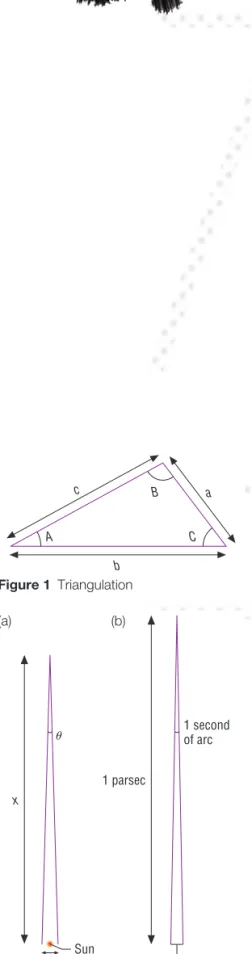
Distances to stars were first measured using triangulation, which is a method similar to the one first used for mapping. It is illustrated in Figure 1. In this, a base line of known length b is taken, and the angles A and C are measured. This enables the distances a and c to be obtained. Unfortunately, when the process is repeated for stars, using a base line on the Earth, the angles A and C are always both 90º. This gives the distance to the star as infinity. However, if, having taken one reading of the position of a star against the background of distant stars, you wait for six months before taking the second reading, you will effectively have a base line that is 2 AU long. This is just long enough to be able to get two different readings for the angles for stars comparatively close to the Earth and hence to calculate their distances from Earth. This method is illustrated in Figure 2(a). The angle u will always be small, so the distance x to a star in this position will be given by
sin u = 2 AU _____ x ≈ u in radians for small angles. This gives x = 2 AU _____
u .
The parsec is a unit related directly to this method of measuring astronomical distances. One parsec is the distance from a baseline of length one astronomical unit (1 AU) when the angle is one second of arc (Figure 2(b)). That angle is 1/3600 of a degree. Measured in radians, the angle is 4.848 × 10⁻⁶ radians.
The conversion to the astronomical unit is therefore given by 1 AU/1pc = 4.848 × 10⁻⁶ rad.
This gives 1 pc = 2.063 × 10⁵ AU to 4 sig. figs.
Conversion to metres in standard form gives 1 pc = 2.063 × 105 × 1.496 × 1011
= 3.086 × 10¹⁶ m Figure 1 Triangulation A C B b c a
2.5
4
Astronomical distances
Figure 2 (a) and (b) Determining distances to stars using a triangulation method over periods of time
x 1 parsec Sun 1 AU 2 AU 1 second of arc � (a) (b) 180 A2 physics.U2 M5.indd 218 20/9/08 11:46:04
219 The light year (ly)
One light year is the distance light will travel through a vacuum in one year. Note that a light year is a distance. It is not a time.
To obtain an answer to 4 significant figures, an Earth year is
365.25 × 24 × 60 × 60 = 3.1558 × 10⁷ s, and the speed of light is 2.9979 × 10⁸ m s–1.
This gives a light year as 9.461× 10¹⁵ m.
Olbers’ paradox
Once measurements to find the distance to close stars had succeeded, astronomers began to wonder how much further the distant stars were. Many thought that the universe was infinite, arguing that, if it were finite, gravitational forces would cause its collapse. Figure 3 is needed for the explanation of Olbers’ paradox, together with the facts that we are dealing with spheres rather than circles and that the surface area of a sphere is 4πr2.
Olbers’ reasoning went like this: • The universe is infinite.
• On a large enough scale, stars are spread evenly throughout the universe, with n stars per unit volume.
• The thin shell A of stars has volume 4πr2t (surface area × thickness) and contains
4πr2tn stars.
• The thin shell B of stars has volume 4π(2r)2t and contains 16πr2tn stars.
• The brightness of any star is inversely proportional to its distance squared.
• The brightness at the Earth due to the stars in shell A = k4πr2tn/r2 = k4πtn where k is a
constant.
• The brightness at the Earth due to the stars in shell B = k16πr2tn/(2r)2 = k4πtn.
• Every shell produces the same brightness at the Earth, and there are an infinite number of shells.
• The Earth is infinitely bright because of starlight.
The paradox is that, from a seemingly correct starting point and correct mathematics throughout, the result is obviously not true.
Olbers’ deduction from his paradox was that the universe is not infinite. Olbers’ paradox is sometimes written as follows:
With an infinite number of stars in an infinite universe, it does not matter what direction you look in – you will always see a star along the line of sight. Therefore, the night sky will be as bright as the day sky.
However, this statement misses out much of Olbers’ original deduction, which caused much scientific argument when it was published in 1826. More detail about the uniformity of the universe will be given in spread 2.5.6.
Questions
1 (a) (i) What defines a year?
(ii) If you had lived in Roman times, how could you have measured a year accurately?
(b) (i) What defines a day?
(ii) Using an accurate watch, could you now measure a day by observing the apparent movement of stars?
2 What is the distance of the Earth from the Sun, in terms of light years (ly)?
3 The nearest star to the Earth (apart from the Sun) is Proxima Centauri. It is approx. 4.5 ly from the Earth, as shown in Figure 4. As viewed from the Earth when in position A and six months
later from position B, the parallax angle, ½u, is as shown. Calculate the value of u.
Astronomical distances
Key definition
1 astronomical unit (AU) = 1.496 × 10¹¹ m
1 parsec (pc) = 3.086 × 10¹⁶ m
1 light year (ly) = 9.461 × 10¹⁵ m
Figure 3 The Earth is considered at the centre of two spherical shells of equal thickness t: one of radius r and the other of radius 2r. Earth receives light from stars within both shells
Thickness t A B
Earth
r
2r
Figure 4 The sighting of Proxima Centauri from two positions of the
Earth (not to scale) Position A of Earth Sun Star Proxima Centauri Position B of Earth six months later 4.5 ly U
220
By the end of this spread, you should be able to …
✱ Select and use the equations Dλ ≠ λ = v ≠ c.✱ Describe and interpret Hubble’s redshift observations. ✱ State and interpret Hubble’s law.
✱ Convert the Hubble constant H0 from its conventional units to SI.
In the laboratory the wavelength of the blue line in the hydrogen spectrum is 434.0 nm. The light from a distant quasar shows that the corresponding line has a wavelength of 616.3 nm. How fast is the quasar receding? Answer
The change in wavelength = 616.3 nm – 434.0 nm = 182.3 nm.
Dλ/λ = 182.3 nm/434.0 nm = 0.420.
This is a fraction; the units cancel out.
Therefore, v/c = 0.420 and v = 0.420 × 3.00 × 108 m s–1 =
126 million metres per second.
Worked example
2.5
5
The redshift
The Doppler effect
In spreads 2.4.8 and 2.4.11 the Doppler effect was explained for ultrasound, and we saw how the effect could be used for measuring the speed of blood flow in a baby’s heart. Exactly the same effect can be used for electromagnetic waves from stars. The original frequency f of a wave from a source moving towards an observer with velocity v has a higher frequency f′ at the observer. The relationship was shown to be
f′ __
f = _____ f + Df f = 1 + __ Dff = 1 + __ c v
where c is the speed of the wave. This gives 1 + __ Df
f = 1 + __ c v or __ Dff = __ v c
Since c = fλ, the expression can be given in wavelength terms rather than frequency. It then becomes
Dλ ___
λ = __ c v
where Dλ is the change in wavelength and λ is the original wavelength. Note that, for an approaching source, the frequency rises and the wavelength falls. The opposite is true for a receding source – in this case, the wavelength increases and the frequency falls.
The redshift of stars
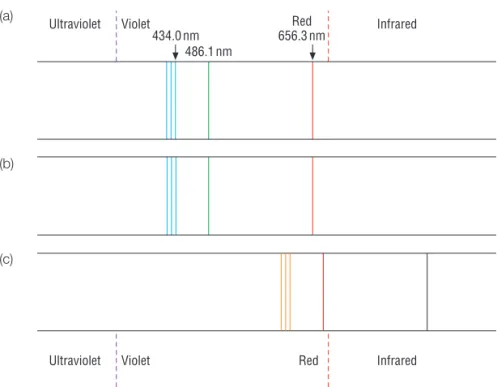
A sketch of a photo taken in a laboratory of a hydrogen spectrum is shown in Figure 1(a). When the hydrogen spectrum from a star in the Milky Way is observed, it looks the same as it was in the laboratory – see Figure 1(b). However, careful measuring showing a very slight movement towards the red end of the spectrum had been noticed as early as 1868. When Hubble looked at data for some galaxies, he found the spectrum for one of them like that shown in Figure 1(c). This did not fit any known element, but the pattern was the same as that for hydrogen but shifted a large distance towards the red end of the spectrum. One of the lines even became invisible in the infrared. Hubble was convinced that the shift was due to the Doppler effect. The shift corresponded to the galaxy having a speed of recession much larger than anything found previously. Since then, over 100 000 quasars have been discovered. These quasars are receding even faster.
Figure 1 (a) shows the spectrum of hydrogen as seen in a laboratory; (b) shows the same spectrum from a star in the Milky Way, our own galaxy; (c) shows a large redshift in the same spectrum from a distant galaxy
Ultraviolet Violet Ultraviolet Violet 434.0 nm 656.3 nmRed Red Infrared Infrared 486.1 nm (a) (b) (c) 180 A2 physics.U2 M5.indd 220 20/9/08 11:46:21
221
Hubble’s law
Hubble knew the distances to some comparatively close galaxies. He found the small redshift for these galaxies and calculated their corresponding speed of recession. When he plotted a graph of speed of recession against distance from the Earth, he obtained a straight line graph (Figure 2).
Hubble’s law summarises his findings. It states: The speed of the recession of a galaxy is directly proportional to its distance from the Earth. The law can be expressed mathematically as
_________________ speed of recession
distance from Earth = H0 where H0 is a constant known as the Hubble constant.
The Hubble constant
The gradient of the graph of speed of recession against distance from the Earth, Figure 2, gives the Hubble constant.
Its value is H0 =
speed of recession _________________
distance from Earth = 175 000 km s
–1
______________
2500 Mpc = 70 km s–1 Mpc–1.
There are several problems with this constant. One of them is about its units; the more fundamental problem concerns what its value actually is. The unit problem stems from its historical use. It was originally, and often still is, given in terms of km s–1 Mpc–1, that is,
kilometres per second (the unit of speed of recession) per megaparsec (the unit of distance from Earth). This can be converted into SI units as follows:
1 km s–1 = 1000 m s–1 1 Mpc = 106 pc × 3.09 × 1016 m/pc = 3.09 × 10²² m Therefore H0 = 70 km s–1 Mpc–1 = 70 × 1000 m s______________ –1 3.09 × 10²² m = 2.3 × 10 –18 s–1
The other problem with the Hubble constant is that it is very difficult to obtain an accurate value of it. The problem is that the most accurate values of distance and recession speeds are those obtained from close stars and galaxies. Even here the problem is complicated by the fact that both stars and galaxies are rotating as well as receding. Near galaxies are in a cluster of galaxies, of which the Milky Way is one. The value of H0 above, (70 ± 2) km s–1 Mpc–1, is the latest value, but over the last 50 years,
values between 50 and 100 km s–1 Mpc–1 have also been given. It is hoped that a more
accurate value can be achieved using the Hubble Space Telescope. The Hubble
Telescope can provide images from distant galaxies that are millions of times clearer than even the best ground-based telescope.
Hubble showed that the whole universe is expanding. This means that the distance between any point in the universe is getting further away from every other point as a result of this expansion. This automatically means that the speed of recession between any two points must be directly proportional to their separation, with the constant of proportionality being the Hubble constant. The Hubble constant is a property of the expansion and has the same value at every point in the universe. There is therefore nothing special about the position of the Earth.
Hubble’s law is now used to calculate the distance to galaxies at the edge of the observable universe. Since the speed of light puts a limit on the speed of recession of a galaxy, it also means that the universe is not infinite in size. This then resolves Olbers’ paradox. Put simply, the sky is dark at night because the universe is expanding. The next spread will go into more detail about the expansion of the universe.
The redshift
Questions
1 Explain why stars in the Milky Way show little or no redshift. 2 A distant galaxy shows a
different redshift from one edge of the galaxy to the redshift from its opposite edge. What could be deduced from:
(a) the mean redshift?
(b) the difference between the two values from opposite edges?
3 The wavelength of a particular calcium absorption line in a spectrum when measured in a laboratory is 3.969 × 10⁻⁷ m.
When the same line is viewed in a spectrum of light from the galaxy known as the Boötes Cluster, its wavelength is found to be 4.485 × 10⁻⁷ m. Calculate
the speed of recession of the Boötes Cluster.
Figure 2 A graph showing how the
speed of recession of a galaxy is proportional to its distance from the Earth
200 000 Recession speed/km s � 1 150 000 100 000 50 000 0 0 1000 2000 Distance/Mpc 3000
Key definition
Hubble’s law states that the speed of the recession of a galaxy is directly proportional to its distance from the Earth.
Examiner tip
Put the units into conversion equations as shown in the text here. If the units are correct after cancelling, this will ensure not only that the conversion factors are correct but also that they are used the right way around. You will not then get nonsense such as 500 kg m–3 = 0.500 g m–3 because
222
By the end of this spread, you should be able to …
✱ State the cosmological principle.✱ Describe and explain the significance of the 3 K microwave background radiation.
✱ Explain that the big bang model implies a finite age for the universe, and use the expression
age of universe ≈ 1 ≠ Ho.
The cosmological principle
From the viewpoint of Earth, it seems obvious that Earth itself is the largest object in the universe, with the Sun as the dominant object in the sky, followed by the Moon and then the planets and a large number of stars circling around us. Since all the stars appear to travel around us at the same rate, it is not surprising that all ancient writings stated these ideas as facts. No one understood that the apparent movement of the Sun and stars was because the Earth was slowly rotating. The Earth seemed to them to be fixed. Gradually, though, over the years, each of these so-called facts has been found to be false.
The following principle is the modern view of the universe.
The cosmological principle states that on a large scale the universe is uniform.
In effect, the principle states the opposite of all the ancient writings. It says that nowhere is special – every galaxy is moving away from every other galaxy, and there is no
preferred direction along which all matter is concentrated or rotating. This is not to say that there are no local concentrations of matter or centres of rotation. The Sun is the centre of the Solar System, about which the planets rotate. There is a point at the centre of our Galaxy, the Milky Way, about which the Galaxy rotates. What there is not,
however, is a point where, if you look one way you will see the universe, and if you look in the opposite direction you will see nothing. Our view of the universe is, basically, exactly the same as it would be from anywhere else in the universe. The density of the universe is constant everywhere, provided you use a large enough unit of volume. That is, the universe is isotropic and homogeneous.
The background radiation
In 1965, Penzias and Wilson used a radio telescope to examine the radio spectrum of various parts of the sky. Wherever their radio telescope pointed, they picked up unwanted noise. But the strange thing about this noise was that it had the same frequency peak from all points in the sky where there seemed to be nothing. It did not vary from day to night or winter to summer. Not only did the frequency not vary, but neither did the amplitude. It was not, therefore, associated with just the Solar System, but pervaded all space. They made a calculation to find the temperature of the source of the radio waves, which had a maximum intensity at wavelength of 1.1 cm, and found it to be 2.7 K.
The significance of this background radiation was that it settled a scientific argument that had lasted for some time. Some astrophysicists thought that the universe was static and had existed for ever and that matter was continually being generated from nothing to account for the expansion of the universe. This is the steady-state theory. (One person went as far as to suggest that the universe would need only one hydrogen atom to be formed in a space equivalent to the volume of St. Paul’s Cathedral per year.) Other astrophysicists proposed the ‘big bang’ theory. They calculated that from the big bang the universe would expand and cool and that a background radiation would exist at a few degrees kelvin. Thus, the eternally old steady-state universe would be cold, and there would be no background radiation. Penzias and Wilson’s discovery of the so-called cosmic microwave background (CMB) radiation, at just the right temperature, therefore confirmed the big bang theory.
Key definition
The cosmological principle states that on a large scale the universe is uniform. That is, the universe is
• isotropic – the same in all directions • homogeneous – of uniform density as long as a large enough volume is used.
2.5
6
The expanding universe
223
Radiation from hot bodies is well understood. When the ring on an electric cooker is switched on, you can feel the infrared radiation from it before you can see any light. Once the ring is emitting light, it is long-wavelength, deep red light. As the temperature rises, the ring turns more orange as shorter wavelength light is emitted. Filament bulbs at a temperature of 2000 K do not emit much violet light, so they seem rather yellow compared with light from the Sun, emitted at a temperature of 5600 K. This is shown in Figure 1. The wavelength of peak emission λmaxis inversely proportional to the Kelvin
temperature.
Question
At a temperature of 5600 K, the peak of the graph occurs at a wavelength of 5.2 × 10⁻⁷ m. What will be the wavelength at the peak of the graph for a temperature of 2.7 K?
STRETCH and CHALLENGE
Figure 1 Radiation emitted from hot bodies Wavelength Red Power 5500 K 3000 K 800 K 1000 K 300 K 50 K Violet Diagram not to scale
The age of the universe
The acceptance of the big bang theory of the universe poses the immediate question ‘How long ago did it happen?’ The Hubble graph, Figure 2 on spread 2.5.5, gives information about this. Look at the graph. Note that more readings are available for comparatively close galaxies. Values for the distant galaxies are less certain, so the reliability of the gradient of the graph is poor.
A galaxy at a distance of 2000 Mpc has a recession speed of 140 000 km s–1. The time it
would take for the galaxy to reach this position at this speed from the time of the big bang is the distance divided by the speed, which is therefore the reciprocal of the Hubble constant. Working from first principles gives
time = ________ distance speed = 2000 Mpc ______________ 140 000 km s–1 = 2000 Mpc × 3.09 × 1022 m Mpc–1 _____________________________ 1.4 × 10⁸ m s–1 = 4.4 × 10¹⁷ s = _________________ 4.4 × 10¹⁷ s 3.15 × 10⁷ s year–1 = 1.4 × 10 10 year
This value of the age of the universe, 14 billion years, is somewhat on the high side. It is therefore preferable to write
age of universe ≈ ___ 1 H0
The approximate value comes from realising that several approximations have been made during the deduction. These are as follows:
• The major approximation is to assume that the galaxy in question has been travelling at the same speed throughout its existence. In practice, it must have gained some gravitational potential energy during its lifetime, which will mean it has lost some kinetic energy. This has the effect of slowing down the rate of expansion of the universe. The present speed of a galaxy is therefore below its average speed. If the average speed is used in the above calculation, therefore, the time since the big bang will be lower. • The uncertainty in the value of the Hubble constant itself will make the age of the
universe uncertain.
• There is a problem at the time of the big bang itself. The galaxies did not form all at once. Any time delay at this stage has been ignored.
The best value to date (2008) for the age of the universe is 13 ± 1 billion years.
Questions
1 Calculate the value, in SI units, for the age of the universe from the following data.
A galaxy at a distance of 1.0 × 10¹⁰ ly recedes from the
Earth with a speed of 2.0 × 10⁸ m s–1.
2 A star at a distance of 11 ly from the Earth provides us with a power per unit area of
1.7 × 10⁻¹² W m–2. Calculate the
power output of the star and suggest how such a small rate of supply of energy might be measured.
3 The star Sirius is a bright white star whose surface temperature is in the region of 20 000 K. Using information from the Stretch and Challenge box, deduce its wavelength of peak emission. In what region of the electromagnetic spectrum does this wavelength lie?
224
By the end of this spread, you should be able to …
✱ Describe the evolution of the universe from 10–43 s after the big bang to the present.
Introduction
The universe as we know it today has been examined in great detail. Way back in 781 BC, the Chinese were recording eclipses. In the time of the classical Greeks and Romans, calculations of the position of stars, of the length of a year and the radius of the Earth were being made. These data were needed for navigational and agricultural reasons. Later, in the Middle Ages, the detailed work carried out by scientists such as Copernicus, Brahe, Kepler, Galileo and Newton laid the framework for the current understanding of the Solar System. It is worth pointing out that throughout this course you have assumed all orbits to be circular. All these scientists did not make this simplification. They worked with the ellipses that are actually the shape of the orbits. A great leap forward was made when Galileo realised the importance of the telescope. This greatly enlarged the range of knowledge, and further advances have taken place as bigger and better telescopes have been constructed. Major advances during the twentieth century have been Einstein’s theory of relativity, the development of the quantum theory, the vastly greater understanding of atomic and nuclear structure, and the ability to view the universe from space, where the absence of obscuring atmosphere has led to much greater detailed knowledge. Not only is there now a wealth of detail, but powerful computers are also able to manipulate the mass of data that is now produced from any experiment. The twenty-first century promises to start well, with results on particle physics from the new CERN accelerator about to be published.
The sequence of events after the big bang
The standard model of the universe depends on two fundamental features. The first is that there was a big bang. The second concerns what we know about the present-day universe. In practice the theoretical development of the standard model was worked backwards in time from the present phase of the universe until the big bang. Calculations using the full theory have now reached the stage where the earliest time used in the theory is within a very small fraction of a second of the big bang itself. At this stage, there is doubt as to whether the usual laws of physics hold. An illustration of the big bang is shown in Figure 1. It is, of course, an image from the imagination of the artist. There is a fundamental flaw in this type of sketch. It presumes that the whole process can be viewed from outside the universe – but because the universe is everything, in reality there is no ‘outside’. The universe expanded from a point at the time of the big bang and has been expanding ever since. Everything is therefore the universe. There is no need to use the words ‘inside’ and ‘outside’. They give an erroneous mental image.
The sequence of events from the big bang to the present follows. The timings and temperatures are all typical values and do not represent sudden changes except at the very start.
Temperature infinite; time zero
The big bang. All matter and energy concentrated at a single point.
Temperature 1027 K; time 10–43 s
All four types of force (gravitation, electromagnetic, strong and weak) are unified: rapid expansion occurring.
Figure 1 A somewhat problematic
imaginary view of the big bang (see text)
2.5
7
The evolution of the universe
225 Temperature 1022 K; time 10–34 s
Gravitation force separating from the other three forces: the primordial quark soup stage plus photons.
Temperature 1016 K; time 10–16 s
Strong force separates from electromagnetic force and weak force: leptons form from photons. For some unknown reason, there is already more matter than antimatter in the minuscule universe.
Temperature 1010 K; time 10–3 s
The weak and the electromagnetic forces separate: quarks exist only in particles such as protons and neutrons. The ratio of protons to neutrons is about 4 to 1. Much
combination of matter and antimatter occurring, increasing the ratio of matter to antimatter still further, until all antimatter disappears, at least from the region that becomes our galaxy.
Temperature 107 K; time 100 s
Helium and lithium nuclei being formed, but the temperature is becoming too low for further fusion to occur. The matter in the universe is in plasma form. This is a state in which protons and electrons are not bound to one another, because the temperature is too high. (In the present, the concentration of elements in the universe is 70% hydrogen, 27% helium and 3% everything else. Clearly, just after the big bang, there has to be more than 70% hydrogen to allow for all the fusion that has taken place in stars ever since.)
Temperature 104 K; time 100 000 years
The temperature is low enough for atoms to be formed. Gradually, as the temperature falls, more of the electrons will become attached to the protons present: photons travel freely, the universe is transparent. This is when the cosmic microwave background (CMB) was formed.
Temperature 6000 K; time 1 million years
Density fluctuations result in the first structure of the universe.
Temperature 17 K; time 1 billion years
More structures formed: heavy elements formed as a result of the gravitational collapse of stars.
Temperature 2.7 K; 13 billion years
The present time: life on Earth. The ratio of protons to neutrons is still about 4 to 1. Figure 2 is also artwork but with more scientific facts shown. It is a pictorial graph. Time began at a point about 12 billion years ago. As you look across the picture, time is increasing, and you can see both the size of the universe, shown by the height of the pattern, and the gradual formation of the galaxies from simpler clouds of matter.
The evolution of the universe
Figure 2 The history of the universe in a pictorial graph
Questions
1 Draw a time line using the data given in this spread and showing the development of the universe from just after the big bang until the present. Since the line will cover about 60 orders of magnitude, you will need to make the timescale logarithmic. Start at log 10–43 and finish at
log 1018.
2 Use the time line you have drawn in Question 1 to sketch a graph of log T against log t, where T is the kelvin temperature and t is the time. Is there a simple relationship between time and temperature?
226
By the end of this spread, you should be able to …
✱ Explain that the ultimate fate of the universe depends on its density.
✱ Define the term critical density and explain that the density of the universe is currently
believed to be close to it.
✱ Select and use the expression for critical density of the universe ρc= 3H02/8πG. ✱ Explain that the universe may be ‘open’, ‘flat’ or ‘closed’, depending on its density.
Introduction
Consider a rocket taking off from the Earth and rising vertically. It fires its engines for a few minutes and reaches a high speed. What can happen to it? If it is going too slowly (less than 11.2 km s–1) it will lose all its kinetic energy in gaining potential energy and will
stop and fall back to Earth. A rocket going faster than this will have some kinetic energy left over after gaining all its potential energy in leaving the Earth’s gravitational well, and it will continue out into space, albeit at a lower speed than its initial speed.
The question for the universe is essentially the same. Are the galaxies going fast enough now to go on for ever, or if they do not have enough kinetic energy, will they fall back to a ‘big crunch’ at some time in the future?
Figure 1 A galaxy of mass m at a distance r from an arbitrary point in space. It is travelling directly away from that point. The expansion of space following the big bang means that v is directly proportional to r. The shaded circle shows the area containing all the galaxies with a smaller value of r
v r Galaxy A of mass m Site of big bang Region within which all galaxies lie at present
You should be able to work through the following proof. It will not be tested, but you should be able to see where the final equation comes from.
Figure 1 shows a galaxy A of mass m at a distance r from a point in the universe. The mass of all the other galaxies with a smaller distance from the point is M. For A to travel outwards for ever, it needs to overcome the attractive forces of the galaxies of mass M.It needs to gain potential energy E given by
Ep = GMm/r
(The proof of this equation requires calculus.)
When A is travelling with velocity v, its kinetic energy Ek= ½mv2.
Using the Hubble constant H0, its velocity v = H0r,and so its kinetic energy is Ek = ½m H02r2
If the kinetic energy is greater than the potential energy, it will travel on for ever. If it is less than the required amount of potential energy, it will stop and fall back into a big crunch.
The calculation can be continued by realising that
M = Vρ = 4 __ 3 πr3ρ so Ep 4πGr3ρm _________ 3r = 4πGr2ρm _________ 3 where ρ is the present mean density of the universe. The limiting condition therefore is when Ep = Ek, giving
4πGr3ρm _________
3 =
mH_______ 02r2
2 which for this limiting condition gives ρc = 3H02 _____ 8πG
whereρc is the critical density.
STRETCH and CHALLENGE
2.5
8
The future of the universe
227
The mean density of the universe
Using the cosmological principle that the universe is homogeneous, we consider that the total mass of all the matter in all the galaxies divided by the current volume of the
universe to be the mean density ρ of the universe. Its value is given, very approximately, as 10–27 kg m–3.
The equation deduced above gives the critical mean density of the universe. If the present density of the universe is less than ρc, the universe will go on expanding for ever.
If it is greater than ρc, the universe will at some time stop expanding and collapse,
eventually producing the big crunch.
Using the equation for the critical density, we find its value as ρc = 3H02 _____ 8πG = 3 × (2.3 × 10–18)2 _______________ 8π × 6.67 × 10–11 = 9.5 × 10 –27 kg m–3
As you can see, the critical density and the actual density have the same order of magnitude. Since neither the actual density nor the critical density is known very accurately, at present it is not possible to say which is larger. Some think that the two figures may be identical.
Possible fates of the universe
Figure 2 shows three possible outcomes for the universe over the next 20 billion years or so. The graph shows the present time as zero on the x-axis, so the future is positive x and the past negative x.
Some facts are now known to within about 10%. These are: • the average separation of any two galaxies
• the rate of expansion of the universe.
This means that the position where each line crosses the y-axis is known and that the gradient at that point is the same for all three graphs.
The graph for the closed universe outcome shows the situation where ρ is greater than ρc. This would mean that
the actual density of the universe is so high that gravitational forces will prevent galaxies going on out into space for ever. Instead, they will slow down, stop and then return to a big crunch, after more additional time than the universe has already existed.
The graph for the open universe outcome represents the situation where ρ is less than ρc. This would mean that the actual density of the universe is not high enough for
gravitational forces to prevent galaxies from going out into space for ever. Each galaxy will reach a constant velocity when sufficiently far apart from one another for the gravitational force on each to be negligible. At these velocities, galaxies will continue to separate from each other for ever.
The graph for the flat universe is the situation where ρ is equal to ρc. This boundary
condition is unlikely, because it implies that the galaxies will gradually slow down over a very long time but never quite stop.
You can see from the graph that each possibility implies a different time in the past for the big bang. When greater accuracy of measurement is possible for this time and for H0,
the fate of the universe could be determined.
As always in physics, the solution of one problem leads to many other questions. There is always plenty to discover, and there is no end of possible questions.
The future of the universe
Questions
1 What is the average amount of space available for each atom in the universe? 2 Why does the text say that a
flat universe, in which the galaxies will slow down but never quite stop, is ‘unlikely’? 0 The present Average separation of two galaxies The past Possible times for the big bang
The future The big crunch Flat universe Open universe Time Closed un ivers e
228
White dwarf
Red giant
Binary stars
Assumptions
Age of the universe
H
1
0
Hubble’s
constant
=
H
0�
d
�
�
d
=
v
c
�
l
l
Cosmological
principle
3.086 × 10
16m
1 AU = 1.496 × 10
11m
AU
Parsec
Distance
light travels
in one year
1 ly
�
9.461 × 10
15m
Light year
Pulsar
Black hole
Sun
Supernova
Super red giant
S
Main sequence
Neutron star
r
cMean density
Open/closed/flat
Nebula
Big
bang!
Larger star
Life cycle
Moon
Planet
Star
Galaxy
Comets
Quasars
Cosmic
background
radiation
Finite
universe?
Olbers’ paradox
Expanding
universe
Components
Scale
Hubble’s
law
Modelling the
universe
Redshift
0 The present Average separation of two galaxies The pastPossible times for the big bang
The future The big crunch Flat universe Open universe Time Closed univer se
2.5
Modelling the universe summary
229
1 The nearest star, Proxima Centauri, is at a distance of
4.3 light years from the Earth.
Calculate the distance to Proxima Centauri in:
(a) metres
(b) AU
(c) parsecs.
2 Hydrogen gas in a discharge tube in the laboratory can be excited to emit a line spectrum. The strongest wavelength
in the visible spectrum is at a wavelength of 660 nm.
(a) Light from the discharge tube is viewed through a
diffraction grating that has 600 lines per mm. Show that the 660 nm line will appear at an angle of about
23° from the zero order.
(b) The zero and first-order lines at 660 nm seen through the grating are shown in Figure 1.
Zero order Figure 1
The light from a star, moving away from the Earth, is
redshifted. Copy Figure 1 and draw on it possible
positions of the same spectral lines from the star seen through the grating.
(c) The wavelengths of light from the star Regulus are
found to be redshifted by 0.0020%. Calculate the
velocity of recession of Regulus relative to the Earth.
3 Hubble’s law states that the velocity of recession of a galaxy is proportional to the distance to the galaxy as measured from the Earth. The constant of proportionality is called Hubble’s constant, H0.
(a) State the observational evidence that supports
Hubble’s law.
(b) Figure 2 shows a graph for the observed speed of recession v of a number of distant galaxies against their distance d from our galaxy.
(i) Explain how the graph illustrates Hubble’s law.
(ii) Calculate the value of H0 given by the graph. Give
your answer in units of s–1.
v /km s � 1 d/Mpc 3000 2000 1000 0 40 30 20 10 0 Figure 2
(c) The value of 1/H0 gives an estimate of the time passed
since all the galaxies were close together, that is, an estimate of the age of the universe.
(i) Use your value of H0 to estimate the age of the
universe in years.
(ii) Suggest one reason that the age of the universe
may be larger than your answer to (c) (i).
4 The age of an old star can be calculated using the
radioactive decay of uranium-238. By observing the
spectra in the star’s light, astronomers can determine how
much uranium-238 it contains. This is compared with the amount of uranium-238 present in a young star of the same type. The half-life of uranium-238 is 4.5 × 10⁹ y.
(a) The old star has only 1/8 of the amount of uranium
compared to the young star. Calculate the age of the old star.
(b) This method of finding the age of a star gives a
minimum age for the universe. Explain why this age:
(i) is the least possible age of the universe
(ii) helps to give an upper limit to Hubble’s constant
H0.
5 An object of mass m travels from outer space and falls down onto the surface of the Earth. In doing so, it is said to have fallen into the Earth’s gravitational well, and its loss in
potential energy in joules is given by 6.26 × 10⁷m.
(a) What minimum speed must a rocket have near ground level if it is to be able to escape from the Earth’s
gravitational well without firing its engines again?
(b) A rocket near the Earth’s surface is travelling directly away from the Earth with speed 17.0 km s–1. With what
speed will it be travelling when it is a long way from the
Earth? Assume that it is not under the influence of any
other body and that its engines are switched off.