Knowledge On Ethical Behavior Of Junior High
School Students
Adelaido P. Pinawin, Mat
Department of Education – Division of Quezon, San Francisco B National High School Lopez, Quezon, Philippines, PH-0063 908 896 3352
Abstract: This paper aimed to determine the knowledge on ethical behavior of junior high school students. The descriptive type of research and the stratified random sampling were employed. There were 209 respondents drawn from Junior High School (JHS) students of San Francisco B National High School, Lopez, Quezon during the School Year 2018 – 2019. Collection of data was accomplished through survey questionnaire. The statistical treatment used are frequency, percentage, ranking, weighted mean and Chi-square. The result of the study revealed that most of the respondents were ages 13 – 14, female, 85% to 89% general average (previous grade), and wearing improper uniform as major school offense committed, the knowledge on ethical behavior of JHS students obtained a composite mean of 3.84 and interpreted as “sufficient”, age and sex showed significant relationship with the knowledge on ethical behavior of the respondents, this led to the rejection of the null hypothesis. Based on the results, the self-assessment checklist is designed to monitor the ethical behavior of JHS students likewise to provide guidance and counselling services as the need arises.
Key words: behavior, ethics, counselling, guidance, students, values education,
Introduction
Ethics is the study of moral principles or values that determines whether actions are right or wrong and outcomes are good or bad [1]. Such definition focuses on moral principles and seems to have little relation to our daily activities as researchers, teachers, students and practitioners [2]. Basically, this concerns the development of holistic person who has an ability to live up to the moral standards and to demonstrate changes as evidence of learning. As a discipline, it is concerned about what in our action is moral and immoral, good and bad, acceptable and unacceptable [3]. It is considered that every individual has direct relation to ethical concerns, codes, rules and regulations which are indicators of the willingness to accept responsibility for defining appropriate conduct and a commitment to self-regulation of members by a profession [4]. In spite of all these regulations, some unethical problems may arise in educational environments. In the Philippines, the Department of Education (DepEd) as an academic institution and center of values formation emphasizes the good manner and right conduct through its core values which include Maka-Diyos, Maka-Tao, Makakalikasan at Makabansa. It is a set of standards that every learner has to follow inside and outside the classroom to develop strong relations with others. DepEd prepares members of a society into not only for its structures and functioning but also students’ future lives as well. For this cause, every academician helps their students gain knowledge, develop their skills, learn values and acquire attitudes necessary for understanding themselves. As a result, programs that focus on “practical arts” have been increasing in numbers [5] while programs that encourage deeper understandings of the human condition have been dwindling. In today’s generation, a picture of 21st century learner has been very alarming scenario as some of them never care about demeanors and right behavior. Regardless of the number of offenses/instances recorded, the students still looked unpretentious and incautious. The students’ purpose varies such as they enroll in order to acquire a good “liberal education” that prepares them to meet the challenges of adult life. Other students make themselves ready for employment opportunities. The integration of values
education in every subjects seemed ineffective; more so a set of behavioral standards is violated instead the fast-pacing technology became the center of many activities. This change in students’ objectives and programs has resulted in more cognitive achievement and less development of character than in the past [6]. Education is a critical process at all levels. In this respect, the presence of an ethical atmosphere, confidence and trust grounded in mutual respect and behaving accordingly is crucial to successful learning as everyone deserves respect and well-being as a central motivation in educational settings [7]. In this process, students have different behaviors that affect other students deeply either in a positive or negative way. Amidst these crises, every academic institution remains desirous to produce academically excellent and morally upright individuals. This paper focused on the knowledge on ethical behavior of the JHS students, as grades 7 to 10 have different traits. Findings serve as important contribution to the ethics literature and learning outcome, particularly in junior high school. It provides insight on how students will deal when given with ethical situations. Towards the end, this research offers intervention technique through a Self-Assessment Checklist, a tool monitoring the ethical and unethical acts of the students.
Research Questions
This research aimed to determine the knowledge on Ethical Behavior of Junior High School Students in San Francisco B National High School, Lopez, Quezon during School Year 2018 – 2019. Specifically, it sought answers to the following questions.
1. What is the profile of the respondents in terms of: 1.1 Age
1.2 Sex
1.3 General Average (as of previous grade) 1.4 Types of School Offenses Committed
2. What is the knowledge on ethical behavior of junior high school students?
4. What is the proposed intervention based on the results?
Hypotheses
1. Null Hypothesis (Hס): There is no significant relationship between the age and the knowledge on ethical behavior of the respondents.
2. Null Hypothesis (Hס): There is no significant relationship between the sex and the knowledge on ethical behavior of the respondents.
3. Null Hypothesis (Hס): There is no significant relationship between the general average and the knowledge on ethical behavior of the respondents. 4. Null Hypothesis (Hס): There is no significant
relationship between the types of school offenses committed and the knowledge on ethical behavior of the respondents.
Methodology
The descriptive type of research and the stratified random sampling were employed. Descriptive research design is used to gather information on current situation and conditions [2]. Further, this study describes the knowledge on ethical behavior of junior high school students. Collection of data was accomplished through survey questionnaire. A survey questionnaire which is composed of two components: (1) a profile of the respondents and (2) a fifteen-item survey statement about the knowledge on ethical behavior of the students was used. The statistical treatment used are frequency, percentage, ranking, weighted mean and Chi-square. The data were gathered and treated statistically using various formulas. Statistical treatment was necessary to determine the natural tendencies of responses. The researchers used the following statistical tools:
Slovin’s Formula. This was used to determine the sample size of the respondents.
The formula is:
2 1 Ne
N n
Where: n = sample size, N = total number of respondents, and e = margin of error
Frequency, Percentage and Ranking. These were used to determine the population of the respondents indicating specific responses in each item. Weighted Mean. This was used in determining the knowledge on ethical behavior of the students. The weighted mean obtain was then interpreted in terms of the criteria based on the following Likert scale:
Options Scale range Verbal Interpretation
4 3.26 – 4.00 Very Sufficient 3 2.51 – 3.25 Sufficient 2 1.76 – 2.50 Fairly Sufficient 1 1.00 – 1.75 Insufficient
Chi-Square. This is frequently used to compare the differences of two or more variables with data that can be readily transferred into frequencies. This was used to determine the relationship between the profile and the knowledge on ethical behavior of the students.
Results and Discussion
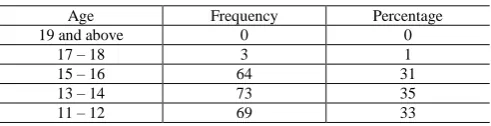
Table 1: Age of the Respondents
Age Frequency Percentage
19 and above 0 0
17 – 18 3 1
15 – 16 64 31
13 – 14 73 35
11 – 12 69 33
It indicates that ages 13 – 14 obtained 73 or 35 percent. Ages 11 – 12 obtained 69 or 33 percent. Ages 15 – 16 obtained 64 or 31 percent. Ages 17 – 18 obtained 3 or 1 percent. And ages 19 and above got 0. This implies that most of the respondents are grade 7 and 8 students who are on adjustment period between elementary and high school levels [8].
Table 2: Sex of the Respondents
Sex Frequency Percentage
Male 99 47
Female 110 53
It indicates that female obtained 110 or 53 percent while male obtained 99 or 47 percent. It implies that most of the students are females who are said to be more ethical than male students [9].
Table 3: General Average
General Average Frequency Percentage
95 and above 2 1
90 – 94 42 20
85 – 89 82 39
80 – 84 73 35
75 – 79 10 5
It indicates that 85 – 89 obtained 82 or 39 percent. 80 – 84 obtained 73 or 35 percent. 90 – 94 obtained 42 or 20 percent. 75 – 79 obtained 10 or 5 percent. And 95 and above obtained 2 or 1 percent. This implies that most of the students have Very Satisfactory performance in all subject areas [10].
Table 4: Types of School Offenses Committed
Types of School
Offenses Frequency Percentage
Bullying 53 28
Cheating 16 8
Physical Trouble 11 5
Vandalism 2 1
Improper Uniform 73 35
Cigarette Smoking 5 3
Liquor Drinking 3 146
Others 46 22
status, distance of residence from the school and weak
implementation of the school rules [11].
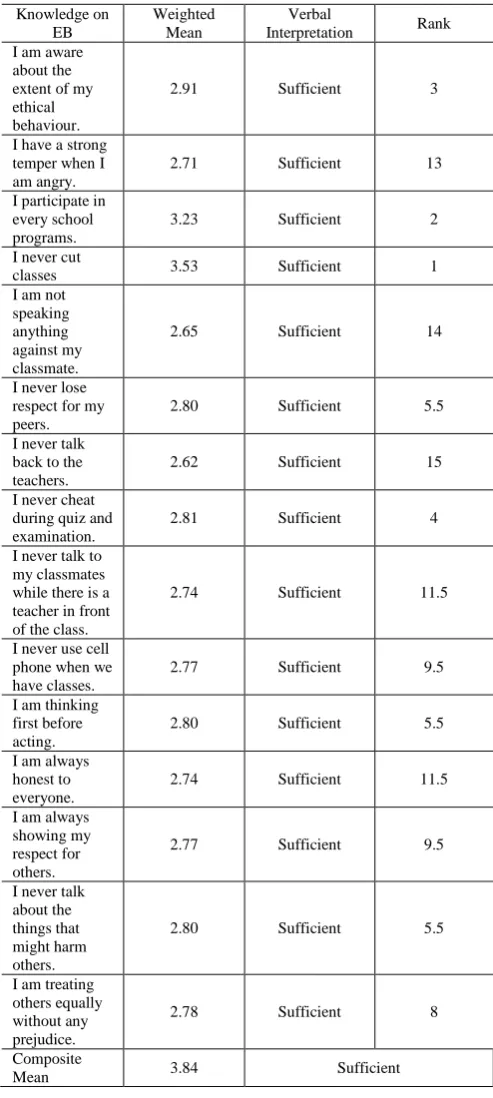
Table 5: Knowledge on Ethical Behavior (EB)
Knowledge on EB
Weighted Mean
Verbal
Interpretation Rank
I am aware about the extent of my ethical behaviour.
2.91 Sufficient 3
I have a strong temper when I am angry.
2.71 Sufficient 13
I participate in every school programs.
3.23 Sufficient 2
I never cut
classes 3.53 Sufficient 1
I am not speaking anything against my classmate.
2.65 Sufficient 14
I never lose respect for my peers.
2.80 Sufficient 5.5
I never talk back to the teachers.
2.62 Sufficient 15
I never cheat during quiz and examination.
2.81 Sufficient 4
I never talk to my classmates while there is a teacher in front of the class.
2.74 Sufficient 11.5
I never use cell phone when we have classes.
2.77 Sufficient 9.5
I am thinking first before acting.
2.80 Sufficient 5.5
I am always honest to everyone.
2.74 Sufficient 11.5
I am always showing my respect for others.
2.77 Sufficient 9.5
I never talk about the things that might harm others.
2.80 Sufficient 5.5
I am treating others equally without any prejudice.
2.78 Sufficient 8
Composite
Mean 3.84 Sufficient
It suggests that JHS students have sufficient knowledge on ethical behavior thus they never cut classes at 3.53, they participate in every school activities at 3.23, they are aware about the extent of their ethical behavior at 2.91, they never cheat during quiz and examination at 2.81 and they never lose respect for peers, they are thinking first before acting, and they never talk about the things that might harm others at 2.80. Students’ perception of ethics is positively influenced by ethics education and that their perception also changes over time [12].
Table 6: Relationship Between the Profile and the Knowledge on Ethical Behavior
Profile Df t Decision Ho Interpretation
Age 12 21.026 33.9953 Reject Significant
Sex 3 7.815 8.3609 Reject Significant
General
Average 12 21.026 7.9553 Accept
Not Significant School
Offenses 21 32.671 20.7661 Accept
Not Significant
It can be gleaned that age and sex showed significant relationship with the knowledge on ethical behavior of the respondents. Older students have higher ethical perceptions when compared to younger students [8]. On the other hand, some empirical studies found that younger people render stricter ethical judgments than older people [9]. In terms of sex, gender does influence one’s level of ethics, female students are more ethical than male students [4]. Gender is a significant variable with regard to perceptions regarding ethical behaviour [13]. Age obtained a computed Chi-square value of 33.9953 which was greater than the critical Chi-value of 21.026 at 12 degree of freedom at 0.05 level of significance and sex obtained a computed Chi-square value of 8.3609 which was greater than the critical Chi-value of 7.815 at 3 degree of freedom at 0.05 level of significance that leads to the rejection of the null hypothesis. It can be meant that it has significant relationship on the knowledge on ethical behavior. On the other hand, it can be observed that general average and school offenses have no significant relationship with the knowledge on ethical behavior among respondents. Many studies fail to find a link between education and ethical judgments [14].
Proposed Intervention
Self-Assessment Checklist
Directions: For each statement below, ask yourself “how
often is this true for me?” then circle the appropriate number that represents your answer. Using the score guide below, compute the total and refer to corresponding interpretation. The more honest your answers are, the more you identify your strengths and weakness.
Ethical Behavior
Almost
Never Seldom Sometimes Usually
Almost Always
Self-awareness
Am I aware of my attitudes, values, biases and prejudice?
1 2 3 4 5
Do I engage in activities that build good relationship with others?
1 2 3 4 5
Do I pay attention on how my language may comprehend by other persons?
1 2 3 4 5
Do I know my abilities and limitations on respecting my life and others?
1 2 3 4 5
impose discipline to myself?
Practical Behavior
Do I lead others by setting a positive mind?
1 2 3 4 5
Do I act in accordance to what I have said?
1 2 3 4 5
Do I understand my
responsibilities ?
1 2 3 4 5
Am I able to control over my behaviors?
1 2 3 4 5
Do I take initiative on a task within the groups?
1 2 3 4 5
Total
Scoring and Interpretation: 1 – 9 = Weak Behavior; 10 – 18 = Unstable Behavior; 19 – 28 = Stable Behavior; 29 – 37 =
Strong Behavior; 38 and above = Excellent Behavior
Conclusions
Based on the results, following conclusions were drawn: 1. The demographic profile showed that most of the
respondents were ages 13 – 14, female, 85% to 89% general average (previous grade), and wearing improper uniform as major offense;
2. The knowledge on ethical behavior of JHS students obtained a composite mean of 3.84 and interpreted as “sufficient”;
3. Age and sex and number of family members showed significant relationship with the knowledge on ethical behavior of JHS students this led to the rejection of the null hypothesis;
4. The self-assessment checklist is designed to monitor the ethical and unethical behavior of JHS students.
Recommendations
In view of the findings and conclusions, the following recommendations are formed:
1. Teachers/class advisers are enjoined to use the Self-assessment checklist to monitor the students’ behavior;
2. The Self-assessment checklist be face-validated by
experts and tried-out with a sample population; 3. The content of the Self-assessment checklist may be
replicated with slight modifications when it is needed; 4. The result of this study may serve as basis for future
decision making and policy assembly.
5. The teachers shall conduct evaluation of the effectiveness of the Self-assessment checklist;
References
[1]. Merriam-Webster Dictionary (2015). Retrieved on
November 18, 2018.
http://www.merriamwebster.com/dictionary/ethics.
[2]. Cassell, J., & Jacobss, S. E. (1987). Handbook on ethical issues in anthropology. Washington, American Anthropological Association.
[3]. Colnerud, G. (1997). Ethical conflicts in teaching. Teaching and teacher education, 13(6), 627-635.
http://dx.doi.org/10.1016/S0742-051X(97)80005-4
[4]. Keith-Spiegel, P. C., Tabachnick, B. G., & Allen, M. (1993). Ethics in academia: Students’ view of professors’ actions. Ethics & behavior, 3, 149-162.
http://dx.doi.org/10.1207/s15327019eb0302_1
[5]. Brint, S., Riddle, M., Turk-Bicakci, L., & Levy, C. (2005). From the liberal to the practical arts in American colleges and universities: Organizational analysis and curricular change. The Journal of Higher Education, 76(2), 152-180.
[6]. Kuh, G., Kinzie, J., Schuh, J., & Whitt, E. (2005). Student success in college: Creating conditions that matter. San Francisco: Jossey-Bass.
[7]. Haynes, J. (2002). Freedom and the urge to think in philosophy with children. Gifted education international,22(2-3) 229-237.
[8]. DepEd Learner’s Information System - San Francisco B National High School, School Year
2018 – 2019.
http://www.lis.com/depedquezon/students.
[9]. School-Based Management Report - San Francisco B National High School, School Year 2018 – 2019.
[10].DepEd Order No. 8. s. 2015 Policy Guidelines on Classroom Assessment for the K-12 Basic Education Program
[11].Ede F. O., Panigrahi B., Stuart J., & Calcich S. 2000.Ethics in small minority businesses. J Bus Ethics; 26(2):133–46.
[12].Shurden, S., Santandreu, J., and Shurden, M. 2010. How Student Perceptions of Ethics Can Lead to Future Business Behavior. Journal of Legal, Ethical and Regulatory Issues, 13(1), 117-127.
[13].Lawson, R. A. 2004. Is classroom cheating related to business students' propensity to cheat in the "real world"? Journal of business ethics 49: 189-199.