Australian Journal of Basic and Applied Sciences
ISSN:1991-8178Journal home page: www.ajbasweb.com
Corresponding Author: Noor’Aini Ismail, Faculty of Information Management University Technology MARA Shah Alam, Selangor Malaysia
E-mail: [email protected]
An Empirical Study On Effectiveness of Erp System
Noor’Aini Ismail, Saiful Farik Mat Yatin & Razilan Abdul Kadir
Faculty of Information Management University Technology MARA Shah Alam, Selangor Malaysia
A R T I C L E I N F O A B S T R A C T Article history:
Received 30 September 2014 Received in revised form 17 November 2014 Accepted 25 November 2014 Available online 6 December 2014
Key words:
Enterprise Resource Planning (ERP), Telecommunications, IS Success Model, Reliability
Enterprise Resource Planning (ERP) system is nothing new to business entities and in fact is a very demanding system in Malaysia. ERP system is uniquely positioned to provide business solutions in the aim of rendering higher revenue generation, where industrial sectors like telecommunication industries, rigorously need to stay rival with their competitor. This paper presents findings from on-going study where an updated version of D&M IS model is adopted. The proposed conceptual framework is developed using five success dimensions i.e. information quality, system quality, service quality, user satisfaction and net benefits. Survey method is opted to measure the constructs as defined by Delone & McLean. Reliability analysis is therefore performed to observe whether individual items (or sets of items) developed for the survey produce results consistent with the overall questionnaire. The reliability results appeared that all item to be worthy of retention due to good internal consistency (all dimensions’ > 0.95).
© 2014 AENSI Publisher All rights reserved. To Cite This Article: Noor’Aini Ismail, Saiful Farik Mat Yatin & Razilan Abdul Kadir., An Empirical Study On Effectiveness of Erp System. Aust. J. Basic & Appl. Sci., 8(23): 144-150, 2014
INTRODUCTION
Enterprise Resource Planning (ERP) system is nothing new to business entities and in fact is a very demanding system in Malaysia. ERP system is uniquely positioned to provide business solutions in the aim of rendering higher revenue generation, where industrial sectors like telecommunication industries, rigorously need to stay rival with their competitor. More than two decades DeLone and McLean had introduced D&M IS success model to bring some awareness and structure to the “dependent variable” –IS success – in IS research (DeLone & McLean, 2003). Since then, it receives mixed feedback from researchers and academicians. Apart from adopting or extending the original model, DeLone and McLean as well received negative comments of their first IS model (Noor'Aini, Shazana, Razilan, & Saiful Farik, 2013).
The effectiveness of the information system (IS) became the most impactful reasons why researchers performed a study in IS. Moreover, other studies like critical success factors (CSF) and internal/external factors likely contributing to IS success are extensively discussed by researchers (Ahmad Saleh & Zulkifli, 2012; Dezdar & Ainin, 2011; Freeze, Alshare, Lane, & Wen, 2010; Gable, Sedera, & Chan, 2003; Kronbichler, Ostermann, & Staudinger, 2010; Maditinos, Chatzoudes, & Tsairidis, 2012; Noor'Aini et al., 2013; Nur Faizah & Cao, 2009; Wong, 2011).
The objective of this research paper is to review past published works related to measuring the effectiveness of Enterprise Resource Planning (ERP) system for telecommunication company. This paper also highlights the current framework used in the study as well as the reliability analysis on the study instruments.
Enterprise Resource Planning (ERP):
software, which integrates the whole functions of an enterprise into one unified database and is considered as a business solution (Khaleel & Sulaiman, 2013).
ERP becomes demanding in telecommunication industry owing to their capabilities that can streamline simplify all the operational and managerial works. Besides telecommunication industries, industries like supply chain management and small and medium-sized (SME), likewise do not miss the opportunity to deploy such robust system. With comprehensive modules offered by this system, most companies adopted this system for a variety of reasons including integration of all information in organization into unified database, for decision making, increased company profits and better customers satisfaction (Khaleel & Sulaiman, 2013; Movahedi & Koupaei, 2011; Noor'Aini et al., 2013; Zulkifli et al., 2012). The ERP also enhances the efficiency of the whole business operations in an organization and increase the optimal income (Yousef & Riza, 2013).
MATERIALS AND METHODS
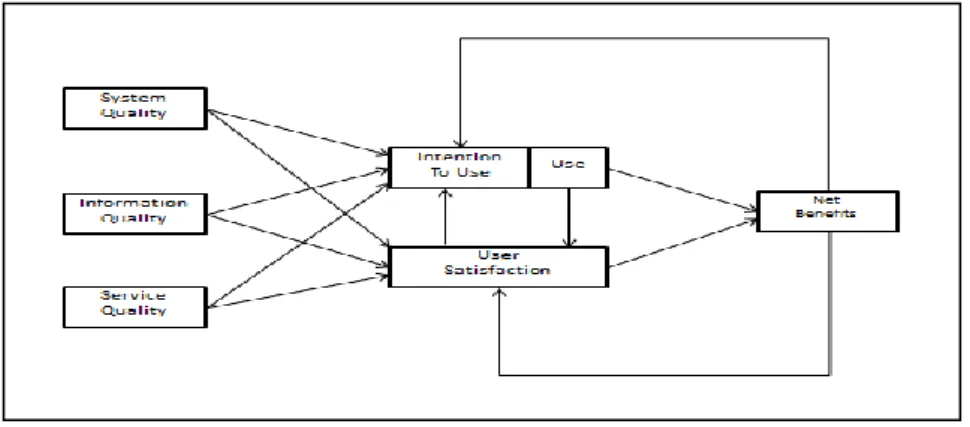
This study purely adopt updated D&M IS success model for the research base framework. This updated model (Figure 1) is the enhancement of DeLone and McLean model in 2003 based on the previous model (Figure 2) introduced in 1992.
The first model built in 1992, DeLone and McLean identified six interdependent dimensions of IS success:
information quality, system quality, use, user satisfaction, individual impact and organizational impact. However, recent study revealed that these six variables are not independent success measure, but are interdependent variables (Petter, DeLone, & McLean, 2008). After a decade, they proposed minor refinements to the model based on measuring e-commerce system success which treated to be current and future measurement of IS success (DeLone & McLean, 2003; Noor'Aini et al., 2013). Figure 1 shows that DeLone and McLean updated the model with three dimensions; service quality, intention to use and net benefits. With these additional dimensions, they believe that service quality may become the most important variable, intention to use indicates users attitude towards the system and net benefits is a measure of an impact groups (individual and organizational) (DeLone & McLean, 2003; Noor'Aini et al., 2013).
Fig. 1: Updated DeLone & McLean IS Success Model (2003)
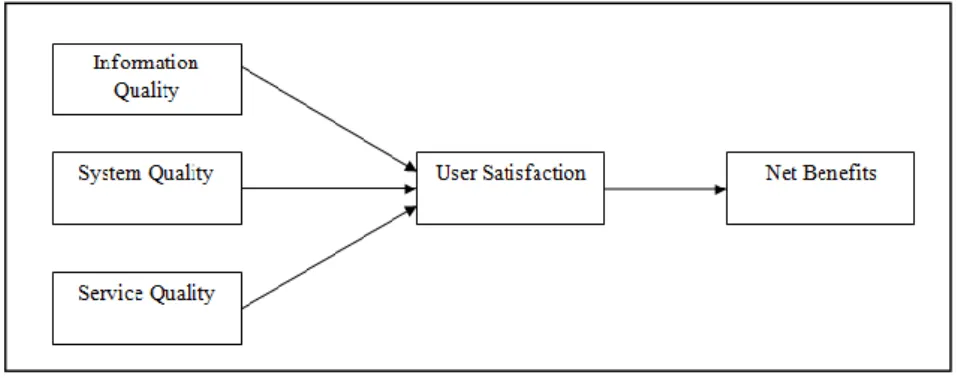
In the past conceptual paper, Noor’Aini et al. (2013) proposed a conceptual framework (refer to Figure 3). The framework omitted the dimensions of intention to use and user satisfaction due to reason their research aim is to investigate ERP effectiveness and its impact to the net benefits.
Fig. 3: The Conceptual Framework
The research is still in progress and researchers believe the necessity to drop Intention to Use and Use
dimensions from this conceptual framework. It is acted upon by reason of these two dimensions are more related to user attitude and frequent usage of the system. Moreover, this study argues these constructs (intention to use and use) from being measured since users are already obligated to use the application in their everyday tasks. Furthermore, employees are required to use such systems in their organisation or otherwise they cannot perform their job tasks (Ononiwu, 2013). Thus, the study adds a dimension of User Satisfaction to ensure it has impact to
net benefits dimension. The result of the revised conceptual framework is shown in Figure 4 where this framework becomes the theoretical framework for this study.
Fig. 4: The Theoretical Framework
A survey method is used in conducting this study. Survey is useful in gaining data from a large population or a sample through some form of approach like questionnaire and interview. Generally, there are three types of survey methods used in social science which are written, oral and electronic. However, for the purpose of this study, the researcher embarked only in written survey due to convenience reason. As discussed earlier, a questionnaire was employed as our research instrument for this study.
Categories of questionnaires are based on delivery and collection questionnaire approach where the questionnaires will be delivered to the appointed officer in the organisation and collect them after all the questionnaires returned back to the appointed officer. The structure of the questionnaire is as follow: Section 1: To collect respondents’ like demographic profiles age, gender, position, education and level of business that they serve in the organization and etc. This section also includes information related to respondents’ nature of using the system. Section II: To gather information of the dimensions and constructs of Information Quality,
System Quality, Service Quality, User Satisfaction and Net Benefits. All the questions in this section are measured using Likert scale from 1(strongly disagree) to 7(strongly agree).
Through a thorough literature review on IS success, this study found that measures of Information Quality
was profoundly discussed in the past studies. DeLone and McLean (1992) anticipate information as the output of an information system or the message in a communication system, where it can be measured at different levels such as technical level, semantic level, and effectiveness level. While the research study done by Petter, DeLone, and McLean (2008) defined dimension Information Quality as desirable characteristics of the system outputs, that is, management reports and Web pages. For example: relevance, understandability, accuracy, conciseness, completeness, currency, timeliness and usability.
(10) items to measure Information Quality: importance, availability, usability, understandability, relevance, format, content accuracy, conciseness, timeliness and uniqueness. In order to attain more interpretable and parsimonious factor solution, four items were dropped respectively. Hence, items remained are availability, usability, understandability, relevance, format and conciseness (Sedera & Gable, 2004). Nonetheless, Walther et al. (2013) added that Information Quality can be measured through completeness, accuracy, format, currency, relevance and understandability. Besides, information quality characteristics also can be measured through accuracy, precision, reliability, currency, completeness, format and volume (Wixom & Todd, 2005). Based on the literature review on the previous study, this study concluded that Information Quality can be measured through complete, accurate, well formatted, recent information, relevant and easy to understand.
Dimension of System Quality can be described as the desirable characteristics of an information system (DeLone & McLean, 1992). For example: ease of use, system flexibility, system reliability, and ease of learning, as well as system features of intuitiveness, sophistication, flexibility, and response times (Petter et al., 2008). The System Quality construct is designed to capture how the system performs from a technical and design perspective (Sedera, Gable, & Chan, 2004). While Gable et al. (2008) opined that System quality is a measure of the performance of [the IS] from a technical and design perspective.
Gable et al. (2008) identified 15 items in measuring system quality. They are data accuracy, data currency, database contents, ease of use, ease of learning, access, user requirements, system features, system accuracy, flexibility, reliability, efficiency, sophistication, integration and customization. In order to attain more interpretable and parsimonious factor solution, of the 15 system quality, 6 items were dropped respectively. Hence, items left are ease of use, ease of learning, user requirements, system features, system accuracy, flexibility, sophistication, integration and customization (Sedera & Gable, 2004, 2010).
The measurement of system quality can be determined through reliability, flexibility, integration, accessibility, ease of use, response time, functionalities, security, ease of learning, user requirements, ease of update and customization (Walther et al., 2013). Wixom & Todd (2005) identified 6 characteristics of system quality that researchers can measure. They are accessibility, timeliness, language, flexibility, integration and efficient.With all the measurement that were highlights from the previous studies, this study opined that reliability, flexibility, easy to success, easy to use, timely, meet user requirements and easy to learn were the best measurement for System Quality.
User satisfaction remains as an important means of measuring our customers’ opinions on e-commerce system and should cover the entire customer experience cycle from information retrieval through purchase, payment, receipt, and service. The overall measures of user satisfaction are repeat purchases, repeat visits and user surveys (DeLone & McLean, 2003). Shrivastava & Dave (2011) opined that three factors that influencing user satisfaction. They have grouped them into three heads which are core team or consultant team’s interaction and expertise. The former are two heads are ERP product’s features and capability and the latter is employee’s knowledge and understanding of the system.
End-User Computing Satisfaction(EUCS) model become famous among researchers when Doll and Torkzadeh introduced this model in 1988. Since last two decades, EUCS has continuously attracted the attention and interests in research community. The most well-known factors adopted many researchers are content,
accuracy, format, ease of use and timeliness. In electronic government, timeliness, content and accuracy of information systems are found to be the key contributors to end-user satisfaction (Norshidah, Husnayati, & Ramlah, 2009). Zaied (2012) emphasized that user satisfaction can be measured by self-efficacy, repeat visits, personalization, perceived risk and enjoyment. Hence, selected measurements of user satisfaction are sufficient, format, user friendly and up-to-date.
In this study, the pre-test and pilot tests are conducted before the actual test begins. The pre-test was an initial test of the overall instrument to ensure the consistency of the instrument and able to be understood by respondents. The questionnaire was distributed to a heterogeneous sample of participants: including professors, associate professors, doctoral students, and employees of cloud ES providers, including sales and consulting which have direct customer access, and customers (Walther et al., 2013). The goal of this pre-test to get the initial or preliminary feedback from professors or the targeted respondents on wording, length, sentence structural and the instructions of answering the questions. As for the pre-test, it was done with the senior IT officers in the organization and associate professor from the university.
Pilot test can help researcher to obtain some assessment of the questions’ validity and the likelihood of data reliability. Preliminary analysis using the pilot test data can be undertaken to ensure that the data collected will enable your investigative questions to be answered (Saunders, Lewis, & Thornhill, 2012). The questionnaires were distributed to 30 respondents in the organization. The indicators were measured using Likert scale from 1 (strongly disagree) to 7 (strongly agree). A total of 30 set of questionnaires were returned back to the researcher, making it a hundred percent of response rate.
The closer Cronbach’s alpha is to 1, the higher the internal consistency reliability (Sekaran, 2003; Sekaran & Bougie, 2009). All Cronbach’s Alpha results in pilot study were above the 0.60 level. Therefore, suggesting that the instrument is reliable and can be used to measure the dimensions and constructs of the study. No modification was made to the items in questionnaire after the pilot test.
RESULTS AND DISCUSSION
In the actual survey, 150 questionnaires were distributed to the respondents. With unexpected results, again, this study received a 100% of response rate due to good networking with a liaison officer and close monitoring among respondents. SPSS version 22.0 is used as data analysis tool.
Table 1: Population of Respondents Gender
Frequency Valid Percent (%)
Male 77 51.3
Female 73 48.7
Total 150 100.0
The proportion of respondents gender is not differed much where male respondents is 77 (51.3%) whereas female, 73 (48.7%). In terms of education level, most of the respondents possess bachelor’s degree (80.0%) from 150 respondents. It is obvious that majority of management and assistant manager in the organization participated in the survey (94 respondents), as compared to other position. With respect to having the targeted sample, the study indeed achieve its target by having respondents who are directly and frequently using the ERP system. Finding indicates that the highest percentage of overall usage is in favour using more than once a day, which is 40 (26.7%).
Based on the objectives highlighted earlier, this study aims to investigate the ERP effectiveness in telecommunication industries by proposing five dimensions based on the updated D&M IS success model. Hence, the reliability of the three dimensions Information Quality, System Quality and User Satisfaction are analysed. The use of research instruments to measure perceptions requires that these research instruments need to be consistent, reliable and respondents can give a good respond to them. Consistency in the research instruments depends on the correlation between these instruments (Saiful Farik, 2010). Consistency is determined via the Cronbach’s Alpha value which corresponds to a correlation coefficient. The close the Crobanch’s Alpha value to 1, the higher the consistency of the research instruments.
Table 2: Values of Cronbach’s Alpha for the three dimensions
Dimensions No. of Statements Cronbach’s Alpha
Information Quality IQ1, IQ2, IQ3, IQ4, IQ5, IQ6 0.958
System Quality SQ1, SQ2, SQ3, SQ4, SQ5, SQ6, SQ7 0.953
User Satisfaction US1, US2, US3, US4, US5, US6, US7 0.966
Table 2 above, shows that all of the three dimensions’ Cronbach’s alpha values are more than 0.95. The reliability results appeared that all item to be worthy of retention due to good internal consistency. Therefore, all the research instruments proposed are consistence and reliable. Information Quality shows the highest value with 0.958, User Satisfaction (0.957) and System Quality (0.953).
Conclusion:
This paper presents an overview of a current and ongoing research work. Preliminary finding which covers the survey instruments used in the study, for the scope of reliability analysis, is discussed in this paper. In-depth research work is still on-going to investigate the ERP effectiveness in telecommunication industry. Subsequent research stage will be on preliminary analysis i.e. exploratory data analysis (EDA). The rationale for the preliminary analysis for the study is to ensure the generalizability and to avoid bias in the parameter estimations (Razilan, 2014). Statistical measures and assumptions will be deployed to handle problem like missing data, sample size, non-normality and non-response bias in order to preserve the generalizability of the findings.
REFERENCES
Ahmad Saleh, S., and M.U. Zulkifli, 2012. Enterprise resource planning system global and Malaysian perspective. UACEE International Journal of Computer Science and its Applications, 2(3): 253-268.
DeLone, W.H., and E.R. McLean, 1992. Information systems success: The quest for the dependent variable. Information Systems Research, 60-95.
DeLone, W.H. and E.R. McLean, 2003. The DeLone and McLean model of information systems success: A ten-year update. Journal of Management Information Systems, 19(4): 9-30.
Dezdar, S., and S. Ainin, 2011. The influence of organizational factors on successful erp implementation. Management Decision, 49(6): 911-926.
Freeze, R., D. Alshare, K.A., Lane, P.L. and H.J. Wen, 2010. IS success model in e-learning context based on students' perceptions. Journal of Information Systems Education, 21(2): 173-184.
Gable, G.G., D. Sedera and T. Chan, 2003. Enterprise systems success: A measurement model. Proceedings Twenty-Fourth International Conference on Information Systems, pp: 576-591.
Gable, G.G., D. Sedera and T. Chan, 2008. Re-conceptualizing information system success: The IS-Impact measurement model. Journal of the Association for Information Systems, 9(7): 377-408.
Khaleel, Y., and R. Sulaiman, 2013. A system development menthodology for erp systems in SMEs of Malaysian manufacturing sectors. Journal of Theoretical and Applied Information Technology, 47(2): 504-513.
Kronbichler, S.A., H. Ostermann and R. Staudinger, 2010. A comparison of ERP-Success measurement approaches. Journal of Information Systems and Technology Management, 7(2): 281-310.
Maditinos, D., D. Chatzoudes and C. Tsairidis, 2012. Factors affecting erp system implementation effectiveness. Journal of Enterprise Information Management, 25(1): 60-78.
Movahedi, M.M., and M.N. Koupaei, 2011. A framework for applying erp in effective implementation of TQM. Middle-East Journal of Scientific Research, 10(4): 489-495.
Noor'Aini, I., M. Shazana, A.K. Razilan and M.Y. Saiful Farik, 2013. Measuring erp effectiveness in telecommunications industry. International Symposium on Information Science and Information Management, 1-15.
Norshidah, M., H. Husnayati and H. Ramlah, 2009. Measuring user's satisfaction with Malaysia's electronic government systems. Electronic Journal of e-Government, 7(3): 283-294.
Nur Faizah, E., and L. Cao, 2009. Validating the IS-Impact model: Two exploratory case studies in China and Malaysia. Pacific Asia Conference on Information Systems (PACIS).
Ononiwu, Chidi Gerard, 2013. A delphi examination of inhibitors of the effective use of process industry enterprise resource planning(ERP) systems: A case study of New Zealand's process industry. The Electronic Journal Information Systems Evaluation, 16(2): 114-131.
Petter, S., W.H. DeLone and E.R. McLean, 2008. Measuring information system success: Models, dimensions, measures, and interrelationships. European Journal of Information Systems, 17: 236-263.
Razilan, A.K., 2014. An assessment of the performance of digital libraries based on an information systems success model. (Ph.D Thesis), University Malaya.
Saiful Farik, Mat Yatin, 2010. Documents imaging systems: Factors influencing usage and effectiveness in Malaysian public organizations. (Ph.D Thesis), Universiti Teknologi MARA.
Saunders, M., P. Lewis and A. Thornhill, 2012. Research Methods for business students (6th ed.). England: Pearson Education Limited.
Sedera, D., and G.G. Gable, 2004. A factor and structural equation analysis of the enterprise systems success measurement model. Twenty-Fifth International Conference on Information Systems, pp: 449-464.
Sedera, D., and G.G. Gable, 2010. Knowledge management competence for enterprise system success. The Journal of Strategic Information Systems, 19(4): 296-306.
Sedera, D., G.G. Gable and T. Chan, 2004. Measuring enterprise systems success: the importance of a multiple stakeholder perspective. 12th European Conference on Information Systems.
Sekaran, Uma, 2003. Research methods for business: a skill-building approach (4th ed.). United States of America: John Wiley & Sons, Inc.
Sekaran, Uma, and Bougie, Roger (Eds.), 2009. Research methods for business : a skill building approach
(5th ed.): John Wiley & Sons Ltd.
Walther, S., D. Sedera, S. Sarker and T. Eymann, 2013. Evaluating operational cloud enterprise system success: An organizational perspective. European Conference on Information Systems (ECIS), pp: 1-12.
Wixom, B.H. and P.A. Todd, 2005. A theoretical integration of user satisfaction and technology acceptance. information Systems Research, 16(1): 85-102.
Wong, Zachary, 2011. A proposed revision to the DeLone and McLean's IS success model. 2010 International Conference on E-Business, Management and Economics, 3.
Zaied, Abdel Nasser H., 2012. An integrated success model for evaluationg information system in public sectors. Journal of Emerging Trends in Computing and Information Sciences, 3(6): 814-825.