AUSTRALIAN JOURNAL OF BASIC AND
APPLIED SCIENCES
ISSN:1991-8178 EISSN: 2309-8414 Journal home page: www.ajbasweb.com
Open Access Journal
Published BY AENSI Publication
© 2016 AENSI Publisher All rights reserved
This work is licensed under the Creative Commons Attribution International License (CC BY). http://creativecommons.org/licenses/by/4.0/
To Cite This Article: Mr M Satya Srinivas, Dr A Yesubabu, Dr G Pradeepini., Cost Sensitive Class Imbalance Learning using ANFIS. Aust. J. Basic & Appl. Sci., 10(5): 144-149, 2016
Cost Sensitive Class Imbalance Learning using ANFIS
1Mr M Satya Srinivas, 2Dr A Yesubabu, 3Dr G Pradeepini
1Research Scholar at K L University, Tadepalligudem 2Prof. & HOD CSE Dept, CRR College of Engineering 3Assoc. Prof. CSE Dept, K L University
Address For Correspondence:
Mr M Satya Srinivas, Research Scholar at K L University, Tadepalligudem E-mail:[email protected]
A R T I C L E I N F O A B S T R A C T Article history:
Received 12 January 2016 Accepted 22 February 2016 Available online 1 March 2016
Keywords:
Class Imbalance Problem, cost differentiation, ANFIS, misclassification rate.
In many real world problems the data to be classified may be imbalanced which might be a major problem for effective classification. Due to imbalance nature of Data, the classifier was biased towards majority class. The classes to be classified may also have cost differentiation (Minority class samples may have high cost). Due to imbalance nature and cost differentiation misclassification rate may be high. There are various methods to solve class imbalance and cost sensitive problems e.g, AdaBoost, CSSVM, KSVM, FSVM and Neural networks. We conducted experiments on various datasets using Neural Networks, Adaboost, Support vector machines, Cost sensitive SVM, Cost sensitive neural networks and Cost sensitive C45 and analyzed the performance based on Area under ROC curve(AuC) values. This paper proposes, the performance of classifier can be improved by using Advanced Neuro Fuzzy Inference system(ANFIS).
INTRODUCTION
Class Imbalance Problem:
From decades of years Data mining plays a major role in providing solutions for real world problems. In some real world problems such as Oil spill detection, Fraud detection and Network intruder detection systems the data to be classified was imbalanced. Due to Imbalance nature of the data the constructed classifier may be biased towards majority class and hence minority class samples might be misclassified. For example In Intruder Detection systems, the strength of non intrusive class is high compared to intrusive. So the constructed classifier was biased towards non intrusive. Due to this biasing the intrusive samples may be misclassified as non intrusive.
There are various methods for balancing the dataset. Over sampling balances the dataset by generating new samples in minority class. Under sampling balances the dataset by eliminating samples in majority class until the strengths of both classes are approximated.
1.2 Cost Sensitive Problem:
In real world datasets, the classes may have cost differentiation, which means cost of misclassifying a sample form different classes may be different. For example, In Intruder detection systems, the misclassifying cost of intrusive is high compared to non intrusive. In such applications, the performance of classifier will be judged by total misclassification cost rather than error rate.
The misclassification cost of misclassifying sample ‘x’ can be determined by using formulae
Where P(j/x) is probability of classing a sample belong to class ‘x’ as class ‘j’ Cij is cost of misclassifying sample ‘i’ as ‘j’
In this paper, Section III discuss about various algorithms for class Imbalance and cost sensitive problems in classification. Section IV discuss about
2 Related Work:
Many methods have been proposed for balancing imbalanced data by considering experimentation on various data set. A survey on methods for learning from imbalanced dataset (Haibo He,2010). To address cost sensitive class imbalance problem, Zhi-Hua Zhou and Xu-Ying Liu introduced neural networks method (Zhi-Hua Zhou 2006). Support vectors machines with granular computing can used for training highly imbalanced dataset, this can be found in (Y Tang 2010). Yanmin Suna proposed boosting methods for cost sensitive classification of imbalanced data (Y suna, 2007). A lot progressing was carried in network intruder detection with data mining, Qinglei Zhang proposed Support Vector machines for classifications of intruder detection dataset (Q Zhang 2007). Yang Yi extended the research by using incremental SVM for classification of IDS dataset (Yang Yi 2011). In FSVM method different membership values are assigned to different example to reflect their importance (R Batuvita 2010).
3. Back Ground: 3.1 Adaboost:
Adaboost algorithm works by
1.constructing weak learners hi=X→[0,1] ‘X’ is set of inputs and [0,1] is the desired output
2. Find a weak learner that minimizes total weighted error Et= ΣWi,te-yih(xi)
3. Choose αt=ln{
i i
E
E
−
1
}/2 (2)
4 Add to ensemble 5 Update weight vector 6 Renormalize the weights.
3.2 CSSVM:
SVM constructs a classifier by maximizing margin in a hyper plane which separates classes. However, it is overwhelmed by the majority class instances in the case of imbalanced datasets because the objective of regular SVM is to maximize the accuracy. Cost Sensitive SVM assigns variable costs to support vectors. The hyper plane will be shifted towards high cost support vectors, such that the probability of misclassification of high cost support vectors will be reduced and hence decreases misclassification rate (Y Tang, 2010).
3.3 GSVM(Granular based SVM):
GSVM follows Divide & conquer strategy. GSVM works by grouping majority class samples and minority class samples into granules. The granules are separated by hyper plane. The advantage of GSVM is the efficiency of separation will be improved if they are separated as granules(Y Tang 2010).
3.4 FSVM(Fuzzy SVM):
In FSVM method different examples are assigned with different membership values which reflects their importance[8]. More important examples are assigned with high membership values while less important examples are assigned with low membership values such that SVM soft margin optimization problem is formulated as
Min(
2
1
W*W+C*
∑
=l
i
m
1
iεi) s.t yi(W.Ф(xi)+b)≥1- εi and εi > 0 (3)
3.5 Cost Sensitive Neural Networks:
Most of the neural network classifiers are constructed using multi layer perceptron model with back propagation algorithm in tandem with gradient descendent rule. The error function in back propagation algorithm is defined as
E(w) =
∑
(
−
)22
1
k
k
O
t
(4)Where w is the ste of weights and tk and ok are the target and actual outputs. Gradient descendent rule is
=
∆
W
n -η(
(
n))
w
W
E
d
d
(5)
In cost sensitive neural networks the cost is included in learning rate, error computation and weight adjustments. The key ideas of this approach are 1)Decrease learning rate for costly examples 2) Include penalty factor for error computation of costly examples 3) Assign more weights for computation of weight adjustments of costly examples.
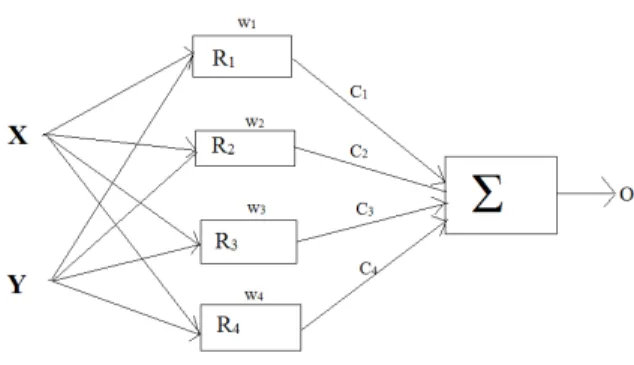
Another popularly used neural network for constructing classifier is RBFN(Radial Basis Functional Network)
RBFNs are based on interpolation and approximation theory. RBFNs are functionally equivalent to Fuzzy inference system. RBFNs are constructed by using receptive field units. The activation value of the ith receptive field unit is defined as
Wi =Ri(x)= Ri(|| x-µi||/σi) i=1,2,...H
x is the input vector and µi is the mean of the input vectors belonging to the same receptive field. H is the
number of receptive fields. Ri(.) is the ith receptive field function. Generally Gaussian function is used as radial
basis function.
Fig. 1: RBFN
The output of RBFN is computed in two ways. One simple method is the weighted sum of receptive field associated with each unit.
d(x) =
∑
=H
i i i
W
C
1
(6)
Another method is the overall output is the weighted average of receptive field associated with each unit.
d(x)=
∑
∑
= =
H
i i H
i i i
W
W
C
1 1
(7)
4 Empirical Study:
We conducted experiments using Multi layer perceptrons using Back propagation(MLP BP) , Radial Basis function Networks(RBFN), Adaboost, Support vector machines(SVM), Cost sensitive neural networks(CS NN), Cost sensitive SVM and Cost sensitive C45.
The average performance of cost sensitive SVM found to be satisfactory compared to remaining algorithms for most of the datasets.
CS_NN MLP_BP SVM Ada Boost CS_SVM CS_C45 RBFN
wisconsin 0.77086 0.96236 0.96657 0.9665606 0.9707 0.96363 0.95981
iris 1 1 1 0.99 1 0.99 0.99
new-thyroid1 0.91944 0.85992 0.98293 0.9686507 0.98293 0.97460 0.94881
glass1 0.60694 0.58716 0.49629 0.7875264 0.62640 0.71600 0.77901
haberman 0.57646 0.62446 0.50361 0.5815277 0.61969 0.57517 0.58779
segment0 0.5 0.50202 0.99267 0.9916433 0.99646 0.99189 0.77409
5 ANFIS:
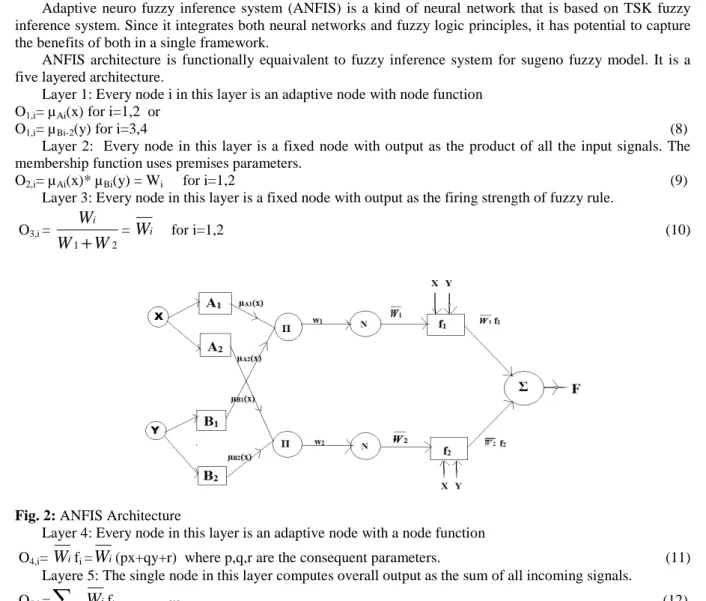
Adaptive neuro fuzzy inference system (ANFIS) is a kind of neural network that is based on TSK fuzzy inference system. Since it integrates both neural networks and fuzzy logic principles, it has potential to capture the benefits of both in a single framework.
ANFIS architecture is functionally equaivalent to fuzzy inference system for sugeno fuzzy model. It is a five layered architecture.
Layer 1: Every node i in this layer is an adaptive node with node function O1,i= µAi(x) for i=1,2 or
O1,i= µBi-2(y) for i=3,4 (8)
Layer 2: Every node in this layer is a fixed node with output as the product of all the input signals. The membership function uses premises parameters.
O2,i= µAi(x)* µBi(y) = Wi for i=1,2 (9)
Layer 3: Every node in this layer is a fixed node with output as the firing strength of fuzzy rule.
O3,i =
2
1
W
W
W
i+
=W
i for i=1,2 (10)Fig. 2: ANFIS Architecture
Layer 4: Every node in this layer is an adaptive node with a node function
O4,i=
W
ifi =W
i(px+qy+r) where p,q,r are the consequent parameters. (11)Layere 5: The single node in this layer computes overall output as the sum of all incoming signals.
O5,i =
∑
i i
W
fi. [9] (12)5.2 Cost sensitive ANFIS:
Cost sensitivity in class imbalance problem can be solved by using ANFIS architecture.
In ANFIS architecture Layer 1 and layer 4 are the adaptive layers with premise and consequent parameters respectively.
There are two approaches to apply cost sensitivity to ANFIS architecture. 1. Apply cost sensitivity to consequent parameters
2. Apply cost sensitivity to premises parameters
5.2.1. Apply cost sensitivity to consequent parameters:
Consequent parameters are identified by method of least squares
ϴ =(AT A)-1ATY (13) Where ‘ϴ’ is the set of consequent parameters(p,q,r).
‘A’ is the matrix of coefficients of variables in training set ‘Y’ is the set of target values.
The error in least square estimator can be calculated by
E(ϴ)=(Y-A ϴ)T*(Y-A ϴ) (14) By applying cost sensitivity, the weight(cost) vector of the training samples is included in computation of error function and hence the error function is
Ew(ϴ)=(Y-A ϴ)T*W*(Y-A ϴ) (15)
5.2.2. Apply cost sensitivity to premises parameters:
=
∆
W
n -η(
(
n))
w
W
E
d
d
(16)
Cost sensitivity can be applied by including cost vector to adjust the weight vector in multilayer perceptron and hence the weight adjustment becomes
=
∆
W
n -η*C*(
(
n))
w
W
E
d
d
(17)
Η is learning rate and ‘C’ cost vector and W is weight vector.
Experiments & Results:
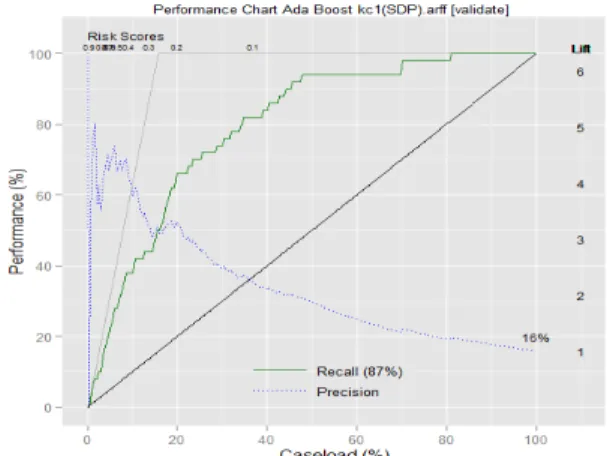
We considered Software defect prediction dataset, the performance of the classifier is determined by precision, recall, F-measure and G-mean.
Precision=True Positives/(True Positives +False Positives)
Recall = True Positives/(True Positives +False Negatives) (18) We conducted the experiments by using R and Rattle software, the performance of various algorithms adaboost,KSVM, ANOVA SVM, Neural Networks and ANFIS are assessed and the results of ANFIS are found satisfactory compared with Precision and recall values to ada boost, KSVM, ANOVA SVM and Neural networks using SDP dataset.
Fig. 3: Performance of KSVM Fig. 4: Performance of Ada Boost
Fig. 5: Performance of ANOVA SVM Fig. 6: Performance of Neural Network
Conclusion:
Cost sensitivity class imbalance problem is solved by various algorithms like Ada boost, CS SVM,FSVM
REFERENCES
Haibo He, Edwardo A. Garcia, 2009. Learning from Imbalanced dataset. IEEE TRANSACTIONS ON KNOWLEDGE AND DATA ENGINEERING. IEEE Press, New York.
Hamid Taheri Shahraiyni, Sahar Sodoudi, 2015. A new structure identification scheme for ANFIS and its application for the simulation of virtual air pollution monitoring stations in urban areas. Engineering Applications of Artificial Intelligence.
https://github.com/KarloKnezevic/ANFIS.
Jang, Tsai sun, Mijutani, 1997. Supervised learning Neural networks. Neuro-Fuzzy soft computing, 231-241.
Jang, Tsai sun, Mijutani, 1997. ANFIS: Advanced Neuro Fuzzy Inference system Neuro-Fuzzy modelling, 335-340.
Md Hasan and Md Nasser, 2014. Support Vector machines and Random Forest Modelling for Intrusion Detection Systems. JILSA.
Nitesh V. Chawla, Bowyer, 2002. SMOTE: Synthetic Minority Oversampling Technique. Journal of Artificial Intelligence Research.
Qinglei Zhang, Wenying Feng, 2009. Network Intrusion Detection by Support Vectors and Ant Colony. Proceedings of the 2009 International Workshop on Information Security and Application.
Raghav Pant, Theodore B. Support Vector Machine classification of Uncertain and Imbalanced Data using Robust optimization. Recent Research in computer Science.
Rukshan Batuvita , vasile palade, 2010. FSVM-CIL Fuzzy support vector machines for class imbalance learning. IEEE Transactions in Fuzzy systems.
Haykin, S., 1997. Neural Networks: A comprehensive Foundation, Prentice Hall, USA.
Shirbhate, S.V., Dr V.M. Thakare and Dr S.S. Sherekar, Data Mining Approaches For Network Intrusion Detection System. International Journal of Computer Technology and Electronics Engineering (IJCTEE)
Shaoning Pang, Lei Zhu, Gang Chen, Abdolhossein Sarrafzadeh, Tao Ban,Daisuke Inoue, 2013. Dynamic class imbalance learning for incremental LPSVM. Neural networks, Elsevier publications.
Yanmin Suna, Mohamed S. Kamela, Andrew K.C.Wongb,YangWangc, 2007. Cost-sensitive boosting for classification of imbalanced data. pattern recognition society, Elsevier publication
Yang Yi, Jiansheng Wu., Wei Xu, 2011. Incremental SVM based on reserved set for network intrusion detection. Expert Systems with Applications 38
Yanmin Sun, Mohamed S. Kamel, Andrew K.C. Eong, Yang Wong, 2007. Cost sensitive boosting for classification of imbalanced data. Pattern Recognition, Elsevier publication.
Tang, Y., V. Chawla, 2009. SVMs Modelling for Highly Imbalanced classification. IEEE Transactions on Systems, MAN, and Cybernatics, IEEE Press, New York.
Yueh-Min Huang,Chun-Min Hung, Hewijin Christine Jiau, 2006. Evaluation of neural networks and data mining methods on a credit assessment task for class imbalance problem. Non linear analysis: Real world applications, Elsevier Publications.
Yuchun Tang, Yan-Qing Zhang, Nitesh V. Chawla, Sven Krasser, 2010. SVMs Modeling for Highly Imbalanced Classification. IEEE TRANSACTIONS ON SYSTEMS, MAN, AND CYBERNETICS, IEEE Press, New York.