ISSN: 2147-611X
www.ijemst.com
Comparison the Fee of Cell Phone
Companies: Collaborative Study between
a Mathematics Teacher-Trainee and High
School Students
Ana Rosa Corica
Consejo Nacional de Investigaciones Científicas y Técnicas (CONICET)
NIECyT-Facultad de Ciencias Exactas -UNCPBA, Argentina
To cite this article:
Corica, A.R. (2020). Comparison the fee of cell phone companies: Collaborative study
between a mathematics teacher-trainee and high school students.
International Journal of
Education in Mathematics, Science and Technology (IJEMST), 8
(1), 16-33.
This article may be used for research, teaching, and private study purposes.
Any substantial or systematic reproduction, redistribution, reselling, loan, sub-licensing,
systematic supply, or distribution in any form to anyone is expressly forbidden.
Authors alone are responsible for the contents of their articles. The journal owns the
copyright of the articles.
Volume 8, Number 1, 2020
Comparison the Fee of Cell Phone Companies: Collaborative Study
between a Mathematics Teacher-Trainee and High School Students
Ana Rosa Corica
Article Info
Abstract
Article History
Received: 23 July 2019
This paper reports on the results of the design and implementation of a didactic device proposed by a mathematics teacher-trainee. This student did a course designed for didactic - mathematical training with the aim of adopting a non-traditional didactic model based on research, while linking mathematics with other disciplines. The teacher-trainee developed its implementation in a senior- course of an Argentine high school. This didactic device is based on the analysis of a real and present situation whose study allows to make some gestures of the questioning world paradigm, in the current conditions of an Argentine high school.
Accepted: 25 November 2019
Keywords
Teacher trainees Mathematics
Anthropological theory of the didactic
Function defined by pieces
Introduction
The Anthropological Theory of the Didactic (Chevallard, 1999, 2013a, 2017) proposes to introduce in the educational systems a new perspective of the mathematics teaching, characterized by the paradigm of world questioning (PWQ). Its educational objective is to create new positions towards learning characterized by the attitude of problematization, associated with the herbartian, procognitive and exoteric character (Chevallard, 2013b). In this sense, the learning engine is the receptive attitude towards the questions formulation and unresolved problems (herbartian attitude), some of these questions become problems for at least one group of people (problematization attitude), the knowledge is to be discovered and not to be the review of knowledge already discovered (procognitive attitude), and there is always place for new knowledge about a discipline (exoteric attitude).
To introduce the perspective of the PWQ in the current Argentine high school requires changes in the teaching conception of mathematics teachers. This impels to renew the mathematics teacher training, involving them in processes of studies compatible with the PWQ. In this paper it is assumed that the teacher-trainees have to take part in those teaching processes which possess the characteristics of the way they intend to teach (Ponte, Chapman, 2008). Following this perspective, a course aimed at mathematics teacher-trainees (MTT) was designed and started to be experimented (Corica and Otero, 2015, 2016a). The objective of the proposal is that MTT can adopt a non-traditional didactic model based on research, while linking mathematics with other disciplines. The course has three phases.
This paper reports on the results of the design and implementation of a didactic device (DD) by an MTT that experienced the course of didactic-mathematical training. The DD implemented by the MTT is an adaptation of the DD developed in Corica (2018). This DD focuses on studying a current situation which compares cell companies’ plans. In this study, mathematics recovers its utility from modeling through functions defined by pieces. In this paper it is proposed to answer the following research questions: What conditions and restrictions does the MTT have to face to manage the DD? What PWQ gestures can the community the MTT teaches do?
Framework
The Anthropological Theory of the Didactic (ATD) (Chevallard, 1999, 2007a, 2013b, 2013c) assumes the didactic of mathematics as the science that studies the diffusion and acquisition of mathematical knowledge (Chevallard, Sensevy, 2014), locating its problematic at an epistemological and institutional level. In particular, Gascón (2014) indicates that the mathematic didactic is understood as the science that constructs, describes and explains didactic phenomena. Several researchers have identified didactic phenomena in the mathematics teaching at different educational levels (García et al., 2019). The evolution of the ATD has generated the hypothesis that all these phenomena are linked to the validity of a dominant didactic paradigm in school institutions (Garcia et al., 2019): the paradigm of visiting works (PVW) (Chevallard, 2013a). In the PVW the mathematical works are presented to the students as crystallized human works, valuable in themselves, but devoid of the issues that gave rise to their origin, or at least of the questions to which they could give an answer and which would therefore give a sense to his study. Faced with this paradigm, Chevallard (2013a) advocates the need to establish a new didactic paradigm: it is proposed to introduce functional study processes into teaching systems instead of studying unmotivated knowledge, in response to questions whose origin is unknown or hidden. It requires the study of umbilical questions that demand material and conceptual tools, useful to study and answer questions, always in an unfinished way. The Study and Research Path (SRP) are devices that would allow facing the phenomenon of knowledge monumentalism from a new school epistemology based on the world questioning (Chevallard, 2013a). Carrying out the methodology of the new paradigm requires incorporating a set of didactic gestures, which imply radical modifications with respect to the teaching in the PVW. The teacher's role would not be to present the work O to the students so that they can visit it, but to conduct a process of inquiry guided by living and fruitful questions, assuming both students and teacher the responsibility of seeking answers to these questions, analogously how scientists act in their field of research. In particular, teaching by SRP presupposes addressing a process of collective inquiry in which the starting point is a problematic question Q0, with sufficient power to generate the process of inquiry, causing the formulation of new Qk questions. This means that the study process can have a certain open and indeterminate character. The study of the question Q0 and those that derive from it, give rise to a shared and collaborative process of inquiry, characterized by the search and study of possible
R
responses elaborated in other institutions that could help answer the questions. In this way, the didactic medium M is made up of all the elements available for the study of Q0. The access to these answers and works is determined by the media accessible to the study community. Media is understood as any system that represents a part of the natural or social world addressed to a specific audience, such as: a mathematics article, a magazine, a book, a website, texts edited by the teachers themselves, etc. (Chevallard (2007b). The study process culminates with the development of a possibleR
, tentative and provisional response. This response may include mathematical and non-mathematical objects, which constitute the official answer given by the class [X, Y] within their institution.R
will be significant insofar as it offers an adequate response to Q0 and to the derived questions Qk. The dynamics of the elements that constitute the structure of these study processes is described in terms of dialectics (Chevallard, 2007a, 2013b, 2013c): The study and research dialectic. A research implies the study of the combination of questions and pre-established answers. This dialectic is the engine of teaching for SRP. We cannot research without studying and, in turn, a genuine study is the generator of questions to be researched.
The individual and group dialectic. The students with the study director must distribute the tasks and negotiate everyone s responsibility.
Dialectic of praxeological analysis-synthesis and didactic analysis-synthesis. The construction of a response to a question requires the analysis of this knowledge and determines what is useful, functional for the construction of the sought response.
Dialectic dark boxes and the light boxes. This refers to the need to establish whether a work deserves to be studied, clarified analyzed, etc., or some knowledge is approached at grey level. Here it is not essential to answer the brainstorming questions and its derivate questions.
Dialectic of the parachutist and the truffles. It refers to the status of explorers assumed by the actors of the didactic system. They have to take a great distance from the problem and explore the terrain from the very top. This inspection hardly ever finds what is sought at once, and requires gestures of approach, to analyze the usefulness of what is found. This dialectic is opposed to the school habit of immediacy in the search for solutions, where immediate and trivial responses are studied.
Dialectic of the media and the medium? The productions of provisional successive answers require pre-established answers, accessible by means of communication and diffusion: the media (book, paper, class note, etc.). These answers are the product of conjecture, therefore they must be checked before being transformed and incorporated to the medium.
Dialectic of reading and writing. It refers to the process of avoiding the formal transcription of existing responses. It is about taking from them the useful part and rewriting them in summary notes, glossaries, etc.
Dialectic of production and reception. It is necessary to disseminate and defend the response developed by the study community. Knowledge is not important by itself, but it becomes relevant because the mathematical activity provides answers considered valuable by the study community.
Methodology
This paper proposes a qualitative research methodology of exploratory, descriptive and interpretative character (Hernández, Fernández, Baptista, 2014). Results of the management of a DD by an MTT are reported. The MTT was a fourth-year student of a mathematics teaching career at a National University of Argentina, who experimented the didactic-mathematical course designed for the vocational training in Maths (Corica and Otero, 2016a, 2016b, 2017). This MTT lacks teaching experience yet he knows the high school first-hand as well as by his training process at University.
The DD starts with the analysis of a situation aimed at comparing cell phone plans, analyzing the real condition of the plans offered by different companies (Corica, 2018). This DD turns out to be compatible to make some PWQ gestures. The implementation of the DD was developed in a senior- course at a public high school of private management in Argentina. In this course three hours per week are devoted to study mathematics, segmented in two-hour and one-hour stimuli. The study required 13 sessions (20 hours). The course was composed of N = 32 students whose ages ranged from16 to 17. The students were grouped in sets of 3 to 5 members. Students had access to the Internet and used personal computers.
Despite being trained in traditional teaching, the students showed interest in participating and explaining their proposals to others regardless of whether the techniques used were appropriate or not. The MTT participated as an assistant to the teacher of the course for two months before implementing his DD. This allowed him to get to know the group and their study techniques; what contributed to the students` interaction with whom, in a short time, would be their teacher.
The general audio was recorded and field notes were made of each session during implementation. At the end of each session, the written productions of the students were collected and returned the following lesson. Likewise, the MTTs log was collected. In this log, he expressed his daily experience throughout its implementation, stating his didactic decisions. This allowed to explicitly have his decisions and to understand the management of the study.
Praxeological Reference Model
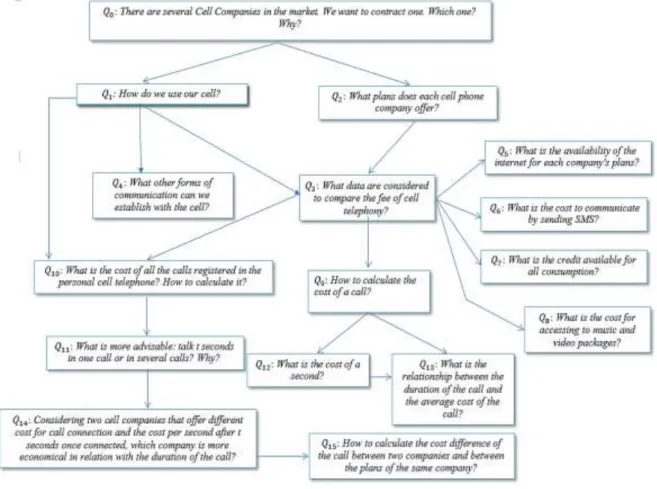
Below, the essential characteristics of a PRM around the study of the issueare presented: : There are several Cell Companies in the market. We want to contract one. Which one? Why? In the Figure 1 it is proposed a tree diagram of possible issues derived from .
Figure 1. Praxeological reference model
In the PRM , the following questions, among others, are intended to inquire about each client s cell phone usage, and define what his needs are.: : How do we use our cell? and : What other forms of communication can we establish with the cell?
: What plans does each cell phone company offer? has as objective to inquire about the characteristics of the different plans offered by each company. This exploration results in the study of the following questions: :
What data are considered to compare the fee of cell telephony? The latter invites us to ask ourselves: : What is the availability of the internet for each company's plans?, : What is the cost to communicate by sending SMS?, : What is the credit available for all consumption?, : What is the cost for accessing to music and video packages?, : How to calculate the cost of a call?
, and can be answered quickly, reviewing the information provided by each company. However, and require further deepening in relation to the response obtained from , making the initial situation problematic. The duration of the communications by means of calls and the amount of SMS that can be sent depend on the minutes and free SMS indicated by the companies and the credit available for all consumption. In particular, the following questions are derived from : : What is the cost of all the calls registered in the
relation with the duration of the call?, : How to calculate the cost difference of the call between two companies and between the plans of the same company?
The possible answers to the questions derived from , require to go through mathematical praxeologies that, in the curricular design of the Argentine high school, appear little articulated, or they are absent. These praxelogies are: descriptive statistics, constant function, linear function, rational function, function defined by pieces, ceiling function, floor function, module function, rounding and truncation estimation, linear equations and inequalities, system of linear equations, continuous and discrete domain, continuous and discontinuous function, limit of functions at infinity. The study of allows to rediscover the usefulness of the different mathematical praxeologies and link them to study a current situation (Corica, 2018).
Characteristics of the DD proposed by the MTT
In the first instance, before beginning the study, the MTT made the work guidelines explicit: small work groups to foster further discussions with the entire study community, procedure, purpose of collecting the student’s productions, and evaluation (Annex I). Then, the MTT proposed the study of the following situation
q
0:We want to hire a cell phone company. We have the description of the current costs of Movistar, Claro and Personal. Which cell phone company should we hire if we communicate through local calls?
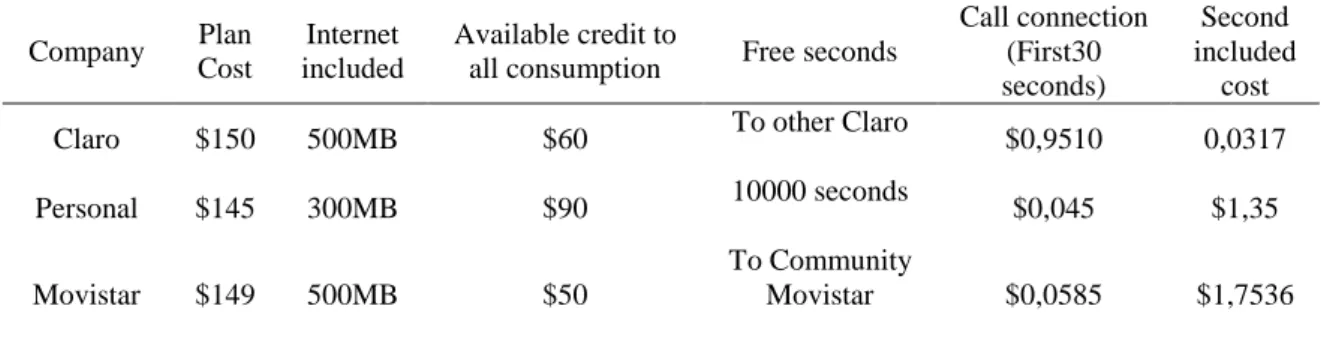
For the study, the MTT provided the information on the plan of three cell phone companies in Argentina available at the time of implementing the DD (Annex II). This information is summarized in the Table 1:
Table 1. Information on the plan of three cell phone companies Company Plan
Cost
Internet included
Available credit to
all consumption Free seconds
Call connection (First30 seconds)
Second included
cost
Claro $150 500MB $60 To other Claro $0,9510 0,0317
Personal $145 300MB $90 10000 seconds $0,045 $1,35
Movistar $149 500MB $50
To Community
Movistar $0,0585 $1,7536
The information provided by the MTT refers to the most economical plans of the three selected companies. This decision of the MTT constitutes a first restriction in the management of the DD, since it restricted the study to analyze those plans selected by himself. The offer of each company is broader than that provided by the MTT, since the companies offer different plans. For each plan, information is indicated on the use of the internet, communication by SMS, cost by communication through calls (those that have a fixed cost for the first 30 seconds of communication and then start being charged per second the communication lasts), numbers to communicate without cost and for the plan of each company, different amounts are indicated as available to be used in different forms of communication. Thus, the exploratory moment is determined by the MTT`s decision despite the fact the students have access to the Internet and their personal computers.
The decision of the MTT to limit the analysis of the situation depends on the teacher of the course´s request that the proposal should be finished in approximately 12 meetings. In addition, it is an institution strongly regulated by evaluation. The students are continually submitted to evaluation instances, which made the MTT plan situations in order to have all the records requested by the institution. In the following section, the results of the management of the situation q0 by the MTT are discussed.
Discussion of study management by MTT
[1) Which is the cheapest? 2) How much does the second of a local call cost in each company? 3) What benefits does each company give me? 4) What is the signal quality like? 5) Which companies have unlimited numbers? 6) Which companies have benefits for calls between cell phones of the same company? 7) What discounts does each one have? 8) Should we use the MOVISTAR plan that gives us the first 30 seconds for free every second of 0.0585 or the Personal that every second is worth $ 0.45? 9) How do we know what the final price of each company's local call is? 10) Adding the benefits and costs, which company has the best final price? 11) What determines the price difference
between the companies? 12) Does the company with the cheapest price have the same amount of benefits as the rest? 13) What is the relationship between final price and credit for calls? 14) Is the final price relative to the quality of the service? 15) For the best final price, is
it convenient to consider how much the call per second is?]
Image 2. Questions proposed by Group 1
The first question that Group 1 proposes is to establish which company is the most economical. If the study of this question is carried out in depth, it is necessary to inquire not only about the cost of the plan but also about the entire offer of the plan. Likewise, the students also propose specific questions related to what the plan of each company offers, in particular, regarding the cost of the call and the quality of the signal. The MTT said that there were no elements to carry out the analysis of the quality of the signal. However, through the use of the Internet it is possible to know the coverage area of the companies based on the analysis of an interactive map (for example at: https://www.claro.com.ar/personas/institucional/cobertura/) and in this way address the question asked by the students. After the exchange of the proposal of each group, the following set of questions were agreed:
q2: Which company has unlimited numbers?
q3: Which companies have benefits for calls between cell phones of the same company?
q4: What discounts does each one have?
q5: How much does the local call second cost in each company?
q6: Which company has the best final price?
q7: Should we use the MOVISTAR plan that gives us the first 30 seconds for free every second of 0.0585
or the Personal that every second is worth $ 0.45?
The questions q2 and q3 admit immediate response since it is enough to review the terms and conditions established by each company. The question q4moves away from the purpose of the situation formulated by the MTT because of the breadth involved in its study. Questions q1 and q5 refer to the same type of task T1:
Determine the cost per second of call for each company. Questions q6 and q7 refer to the type of task: T2:
Compare the cost of local calls for each of the cell phone companies. The MTT agreed with the group of students to begin studying the questions q6 and q7. In particular, q7 was discussed together with q6 because they refer to aspects of the cost of the call, but q7 formulation shows an inadequate interpretation of the information provided by the companies. Thus, the group expanded the set of questions, proposing the following:
q8:Does the company with the cheapest price have the same amount of benefits as the rest?
q9: Why is the price between the companies different?
q10: What is the relationship between final price and credit for calls?
q11: How do we know the final price of each company's local call?
q12: Added the benefits and costs, which has the best final price?
The questions q8, q9 and q12 are beyond MTT´s plan. The proposal of the MTT was to limit this set of questions again and to study q10 and q11. To study these questions, one of the students indicated: Give us a certain amount
of time. Let's make a call from each company. In this way, the proposal was orientated to analyze the situation of specific calls duration. Some groups proposed to analyze the cost for 30-seconds calls, where the response can be obtained quickly from the information provided by the companies, without the need to problematize the situation. Other students proposed to study the cost for 60-seconds calls. The students of Group 7 made the following proposal (Image 3):
[Always the cheapest company will be Claro]
Image 3. Calculate the cost of a 60-second call for each company by Group 7
The students claimed that if the calls costs of a set time in the different companies were compared, they could determine which would be the most economical. This statement is based on the fact that if the call is cheaper for a certain time, it will always be. This does not problematize the situation and does not answer the question q11:
How do we know the final price of each company's local call? This required that the MTT intervened and proposed to address the question: q13: How long can I talk with the available credit? This is a central question, because it allows to analyze that, the available credit to establish communication through calls is even lower although the communication costs are cheaper. For example, the Claro company offers a plan with the cost of establishing calls and cost of the second lower than the Personal plan which offers a credit for all consumption longer to establish communications through calls.
an analysis on the domain of validity. Within the context of the initial situation, the analysis turns out to be interesting because the intervals in which each branch of the function is defined depend on the credit for all consumption that determines the plan of each company. Thus, notions that are proposed for the first years of high school, such as estimation, rounding and truncation, become meaningful. The proposals of the students focused on establishing a function to calculate the cost of the call for each particular case of each company, for example, in Image 4 an arithmetical resolution was proposed that constituted the first formulations that later derived in algebraic expressions.
Image 4. Arithmetical resolution proposed by Group 3
As it can be observed in the Image 5 the proposal of the Group 4 contains the first algebraic formulations:
Image 5. Cost function proposed by Group 4
In addition, the context of the problem leads to truncate the result of the calculation of the function´s domain as, due to the company charging policy, the fractions of a second do not make sense because they are lost by the user, the companies only charge for the duration of the communication. Finally, the group produced expressions of the type indicated below:
( ) { ( ) [
] where
Being c: the cost of the call,
c
e: the cost for establishing the call;c
s: cost per second after the expiration of 30 seconds of the call establishment,c
r: credit available for any consumption.Next, the MTT proposed to leave the topic to study notions of functions defined by pieces. These tasks refer to the following tasks types:
T1: Establishing the validity domain of expressions defined by pieces.
T2: Establishing the image of functions defined by pieces.
T3: Find intersection points of functions defined by pieces with the coordinate axes.
T4: Graph graphically defined functions by pieces.
T5: Establishing intervals of positivity and negativity of functions defined by pieces.
T6: Find the expression of functions defined by pieces represented graphically.
T7: Establishing continuous and discontinuous functions.
In this proposal it was sought that the students become familiar with certain specific techniques of the study of functions defined by pieces and to have more knowledge to analyze q1: Which company has the cheapest call
second? and q5: How much does the local call second cost in each company? The analysis of these questions derived in the study of functions defined by pieces composed of rational functions. This also turns out to be some new knowledge for senior students that intend to study in high school in Argentina (Dirección General de Cultura y Educación de la Provincia de Buenos Aires, 2011). The students reformulated their proposals, providing centralized response in analyzing particular cases, as it can be seen in the proposal of Group 2 (Image 6), who used the data provided by the company Movistar to write the expression:
Image 6. Average cost function proposed by Group 2
Finally, the students, together with the study aids provided by the MTT, proposed expressions of the type indicated below:
( ) {
( )
[ ] where
Being
c
m: the average cost, ce: the cost per establishment of the call; cs: cost per second after the expiration of 30 seconds of the call establishment, cr: credit available for any consumption.This was the first meeting of the students with the rational function. Therefore, the MTT proposed to study rational functions through tasks represented by the following tasks types:
T1: Establishing the validity domain of rational expressions.
T2: Establishing the image of rational functions.
T4: Represent rational functions graphically.
T5: Establish intervals of positivity and negativity of rational functions.
T6: Find the expression of rational functions represented graphically.
Finally, with the aim of recovering the analysis made OF the plans offered by the cell phone companies and of providing answers to the initial situation q0, the MTT proposed the following task to the students.
Review all the study conducted on cell phone companies and prepare a report outlining the answer to What cell phone company should we hire if we communicate through local calls?
The tasks were carried out in groups. The proposal of the students recovered what had been done from the beginning of the situation, deepening in the usefulness of mathematics to the analysis of the situation. The productions obtained for the final task focus on summarizing what was studied in the 12 sessions. In this way, the students did not inquire beyond the limits devised by the teacher. For example, in previous sessions the companies' way of charging calls was deepened, but no specific questions were asked such as those proposed for the company Movistar. This applies an additional cost depending on the distance of the call and has other benefits such as landline calls at no cost.
In this way, the students could have formulated and studied questions such as: Which company should I hire if the calls are long distance? How are landline telephone calls charged? From what second of the call is one plan more convenient than another? Also, to decide which company to hire, it is necessary to define the usage that each user makes of their cell phones. For example, for communications through calls, the plan offered by the Claro company proposes lower costs than Personal, the latter offers more credit for all consumption and 10000 seconds for free calls (approximately 166 minutes), while Claro offers unlimited calls to cell phones of the same company. The exploration of information made by students is superficial and without going beyond the limits that were studied in previous sessions. This is attributed to the previous training of students, who are used to a traditional and instantaneous teaching of mathematics where tasks have unique and immediate answers, and where formulating and answering their own questions is not part of their responsibilities.
Conclusion
This paper describes the results of the implementation of a DD by a MTT in regular math classes at a high school in Argentina. The DD has the peculiarity of allowing gestures of the QWP. The study was rich in the set of derived questions, thus transiting one of the fundamental gestures of the pedagogy of research: the dialectic of study and research. The formulation of questions is of vital importance in this type of study and the MTT managed to make the group formulate and study their own. The study aids offered by the MTT were fundamental to advance and sustain the problematization of the initial situation. However, his didactic decisions caused the study to be restricted. These decisions were made to rush the times and comply with institutional demands. The high school students who participated in the research are accustomed to a traditional and instantaneous mathematics teaching, where the tasks have unique and immediate answers, and evaluation is the core of the system. This is one of the fundamental conditions and restrictions that the MTT had to face in order to manage the study.
Despite the fact that the analysis of the questions derived from q0 was regulated by the MTT, the students assumed the responsibility of searching for answers, proposing and studying specific situations. The answers were validated by the students' own experience and knowledge and by the verification between the work groups and the MTT. This corresponds to one of the gestures characteristic of the pedagogy of research: the dialectic of the collective and the individual. This was partially addressed, because the students shared the same answers although the study medium was originated from the proposal of each small group.
design and the temporary space assigned, the MTT could not expand the study of necessary notions to deepen the analysis, such as those related to statistics.
During the direction of the study, more liberal and more arbitrary instances were alternated. The liberal instances correspond to the formulation of questions derived from q0. This, even when the MTT indicated how to deepen the analysis of q0 and the derived questions, provided new questions to deepen the exploration of the study. Here, the decisions taken were the result of collective deliberation, under the supervision of the MTT. While the study became arbitrary when the MTT required the study of specific mathematical tasks. He decided not only what purely mathematical tasks to study about function defined by pieces and rational function but also with what level of deepening according to the previous training of the students. This made the dialectic of entering and leaving the subject and the dialectic of the clear and black boxes to be totally directed by the MTT. This is also attributed to the teaching inexperience of the MTT, the temporary restriction, the need to comply with a curricular design, the projected tasks for the study proposed by the teacher of the course and the evaluating system prevailing in the institution. Future work continues to focus on forming MTT in the study and management of didactic devices in which mathematics regains its functionality. Although the DD managed in this work is not an open SRP, it allows to move some of the own gestures that involves teaching by research by MTT (who are not experts in the ATD), in the current conditions of the high school in Argentina.
References
Chevallard, Y. (1999). L’analyse des pratiques enseignantes en théorie anthropologique du didactique.
Recherches en Didactique des Mathématiques, 19/2, 221-266.
Chevallard, Y. (2007a). Passé et présent de la théorie anthropologique du didactique. Recuperado de: http://yves.chevallard.free.fr
Chevallard, Y. (2007b). Un concept en émergence: la dialectique des médias et des milieux. Actes du séminaire national de didactique des mathématiques, 344-366. Disponible en : http://yves.chevallard.free.fr/spip/spip/IMG/pdf/YC_-_Sem_nat_DDM_-_23_mars_2007.pdf
Chevallard, Y. (2013a). Enseñar Matemáticas en la Sociedad de Mañana: Alegato a favor de un contraparadigma emergente. REDIMAT, 2(2), 161-182.
Chevallard, Y. (2013b). Journal du Seminaire TAD/IDD. Théorie Anthropologique du Didactique & Ingénierie Didactique du Développement. Recuperado de: http://yves.chevallard.free.fr/
Chevallard, Y. (2013c) Éléments de didactique du développement durable. Leçon 3. Recuperado de: http://yves.chevallard.free.fr/
Chevallard, Y. (2017). ¿Por qué enseñar matemáticas en secundaria? Una pregunta vital para los tiempos que se avecinan. La Gaceta de la RSME, Real Sociedad Matemática Española, 20 (1), 159–169.
Chevallard, Y., & Sensevy, G. (2014). Anthropological approaches in mathematics education, French perspectives. En S. Lerman (Ed.), Encyclopedia of Mathematics Education (pp. 38-43). Dordrecht, Holanda: Springer.
Corica, A. (2018) Teaching through research: proposal of a didactic device for high school. In W. Wu, O. Ozturk (Ed.), Research Highlights in Education and Science 2018. USA: ISRES Publishing, International Society for Research in Education and Science (ISRES), pp.30-44.
Corica, A.; Otero, M. (2015). The Mathematics Teacher’s Profession: the Perspective of Future. European Journal of Science and Mathematics Education. 3(2), 145 - 158.
Corica, A.; Otero, M. (2016a). Diseño e Implementación de un Curso para la Formación de Profesores en Matemática: una Propuesta desde la TAD. Boletim de Educaçáo Matemática. 30(55), 763-785.
Corica, A.; Otero, M. (2016b). Estudio de dispositivos didácticos propuestos por futuros profesores de Matemática: un análisis desde la TAD. Perspectiva Educacional. 55(2), 21-37.
Corica, A.; Otero, M. (2017). Análisis de un dispositivo didáctico propuesto por futuros profesores de matemática formados en la TAD. Avances de Investigación en Matemática Educativa, 12, 79-95.
Fonseca, C.; Gascón, J.; Lucas, C. (2014). Desarrollo de un modelo epistemológico de referencia en torno a la modelización funcional. Revista Latinoamericana de Investigación en Matemática Educativa, 17(3), 289-318
García, F., Barquero, B., Florensa, I., Bosch, M. (2019). Diseño de tareas en el marco de la Teoría Antropológica de lo Didáctico. Avances de Investigación en Educación Matemática, 15, 75-94.
Gascón, J. (2014). Los modelos epistemológicos de referencia como instrumentos de emancipación de la didáctica y la historia de las matemáticas. Educación Matemática, n. 25 años, 99-123.
Ponte, J., & Chapman, O. (2008). Preservice Mathematics Teachers´Knowledge and development In L. English (Ed.), Handbook of International Research in Mathematics Education (pp. 225- 236). New York, NY: Routledge.
Author Information
Ana Rosa Corica
Consejo Nacional de Investigaciones Científicas y Técnicas (CONICET)
NIECyT - Facultad de Ciencias Exactas – UNCPBA Pinto 399, 7000 Tandil, Buenos Aires
Argentina
Annex I
• It is proposed to study the different problems in groups. The groups will be made up of 2 or 3 students, who will be maintained throughout the lessons.
• At the end of each session, the productions of all the students will be withdrawn in order to study the work of the students during the session and project the continuation of the study process. They will also be taken into account as a record for the preparation of the conceptual qualification required in the evaluation form.
• When resolving the different activities, students are requested not to delete the resolutions. In the event that each student considers a resolution incorrect, he is asked to mark it with a cross. The focus of study are the productions of each student, beyond whether the final result of the task is successful or not. • It is intended that students perform the tasks during the class and participate in the subsequent sharing. • It is requested that the student's name, the group number and the sheet number be identified on the
sheets that the students write.
Annex II
Smart Control $150
$150 Unlimited $60 50MB 100 Bonus
A month
Calls to others Claro
Credit for all consumption
Internet Included
SMS Included
Plan Details Sm art pla ns Intern et Inclu ded Calls to others Claro SMS Inclu ded Credit for all consump tion Natio nal long distan ce Call establish ment Establish ment of surplus calls Secon d inclu ded Seco nd surpl us Surpl us SMS Surpl us Inter net Sm art pla ns $15 0 500 MB Unlimi ted
100 $60 Bonu
s
$0,9510 $2,20 $0,03 17 $0,07 33 $1,1 5 $3,5 0 the day
Unlimited Calls: Only national calls to mobile destinations in Claro of Argentina. Bonus service for 6 months, at 7th moth the price of the service will be $70 end/month.
Terms and Conditions
Community Plan Mas $149
The Community Mas plans allow you to always be connected, they contain a monthly credit that, once consumed, you can receive up to two automatic credit extensions per month (which will be paid on the charge for the following month). If they consumed the total credit they will be able to make refills in traditional media. $149
Internet 500 MB + Internet per day plus.
$50 gift, plus credit extension
X5 Speed 4G Free calls to the
Movistar Community.
Talk and Navigate Community Plan I - $149
The plan includes the following services:
[Personal
Mobile phones to any company $ 145
The Subscription Plan Día Full to any company $ 45 is a plan with monthly fixed bill.
Discount $11,90 end per day (promotional price up 31/07/2015, after that date the plan will cut $ 12.90 per day) of credit of your subscription with your first national call to Personnel and other companies or sending SMS. It includes 10,000 seconds for calls to other Personnel and / or any company and 1000 sms. It includes internet service.
Monthly Payment $ 145
Monthly credit $ 90
Internet Included x moth 300MB
SMS 1000
First block $1,35 Second place $0,045 Value to be discounted per day $11,90 x day Call to personal and other companies 10000 seconds
Benefits included $ 40 initial credit without expiration
Legal
National scope plan. Valid from 06/05/2015 to 07/29/2015. Applies for new registrations and / or change of plan. Prices for final consumers. Does not include 1% ENARD charge. Activation benefit: $ 40 initial credit. Includes $ 90 monthly credit. Price of the day $ 12.90, which will be discounted with the first SMS sent or first call to a local number of Personnel and other companies, granting 10,000 seconds and 1000 SMS (excluding Premium SMS, Contents, International and landline) to use until 11:59 p.m. on the same day. exceeded the units included: Final National SMS Final Price: $ 1.05. Initial block value (30 seconds) local $ 1.35 final. Final price of the second local air: $ 0.045 for local calls to Personnel numbers and other companies. Does not apply in International Roaming.