Introduction
Multiple myeloma (MM) is an incurable hematologic malignancy that mainly affects elderly individuals, and is characterized by the proliferation of plasma cells.1Five-year
relative survival rates have been shown to diminish with increasing patient age; however, improved survival rates have been reported in newly diagnosed MM (NDMM) patients in recent years since the introduction of novel agents such as thalidomide, lenalidomide, and bortezomib.2-4
Melphalan and prednisone (MP) combined with thalido-mide (MPT) or bortezomib (MPV) are considered standard first-line treatment options in elderly NDMM patients who are ineligible for autologous stem cell transplantation.5-13
Although lenalidomide in combination with low-dose dex-amethasone (Rd) is an established standard treatment option
in patients with relapsed/refractory MM, recent data have emerged on the efficacy of this combination in patients with NDMM.1,5,10,11,14-18
The randomized pivotal phase III FIRST trial (Frontline Investigation of lenalidomide/dexamethasone [Rev/Dex] ver-sus Standard Thalidomide; IFM 2007-01/MM-020; clinicaltri-als.gov identifier: 00689936; EudraCT No. 2007-004823-39) compared the efficacy and safety of Rd, administered contin-uously until progressive disease (PD) or for a fixed 18-month duration (Rd18), with MPT given for 18 months in NDMM patients who were aged 65 years or over, or who were aged under 65 years and ineligible for stem cell transplantation. Continuous Rd showed improved progression-free survival (PFS) and overall survival (OS) benefit at interim analysis compared with MPT.19
Although extending survival is clearly the ultimate treatment ©2015 Ferrata Storti Foundation. This is an open-access paper. doi:10.3324/haematol.2014.120121
The online version of this article has a Supplementary Appendix.
Manuscript received on November 14, 2014. Manuscript accepted on March 6, 2015. Correspondence: [email protected]
We compared the health-related quality-of-life of patients with newly diagnosed multiple myeloma aged over 65 years or transplant-ineligible in the pivotal, phase III FIRST trial. Patients received: i) continuous lenalidomide and low-dose dexamethasone until disease progression; ii) fixed cycles of lenalidomide and low-dose dexamethasone for 18 months; or iii) fixed cycles of melphalan, prednisone, thalidomide for 18 months. Data were collected using the validated questionnaires (QLQ-MY20, QLQ-C30, and EQ-5D). The analysis focused on the EQ-5D utility value and six domains pre-selected for their perceived clinical relevance. Lenalidomide and low-dose dexametha-sone, and melphalan, prednidexametha-sone, thalidomide improved patients’ health-related quality-of-life from baseline over the duration of the study across all pre-selected domains of the QLQ-C30 and EQ-5D. In the QLQ-MY20, lenalido-mide and low-dose dexamethasone demonstrated a significantly greater reduction in the Disease Symptoms domain compared with melphalan, prednisone, thalidomide at Month 3, and significantly lower scores for QLQ-MY20 Side Effects of Treatment at all post-baseline assessments except Month 18. Linear mixed-model repeated-measures analyses confirmed the results observed in the cross-sectional analysis. Continuous lenalidomide and low-dose dexamethasone delays disease progression versusmelphalan, prednisone, thalidomide and has been asso-ciated with a clinically meaningful improvement in health-related quality-of-life. These results further establish continuous lenalidomide and low-dose dexamethasone as a new standard of care for initial therapy of myeloma by demonstrating superior health-related quality-of-life during treatment, compared with melphalan, prednisone, thalidomide.
Health-related quality-of-life in patients with newly diagnosed multiple
myeloma in the FIRST trial: lenalidomide plus low-dose dexamethasone
versus
melphalan, prednisone, thalidomide
Michel Delforge,1Leonard Minuk,2Jean-Claude Eisenmann,3Bertrand Arnulf,4Letizia Canepa,5Alberto Fragasso,6 Serge Leyvraz,7Christian Langer,8Yousef Ezaydi,9Dan T. Vogl,10Pilar Giraldo-Castellano,11Sung-Soo Yoon,12 Charles Zarnitsky,13Martine Escoffre-Barbe,14Bernard Lemieux,15 Kevin Song,16Nizar Jacques Bahlis,17Shien Guo,18 Mara Silva Monzini,19Annette Ervin-Haynes,19Vanessa Houck,19 and Thierry Facon20
1Universitair Ziekenhuis Leuven, Campus Gasthuisberg, Leuven, Belgium; 2London Health Sciences Centre, London, ON, Canada; 3Hôpital Emile Muller, Mulhouse, France; 4Hôpital Saint-Louis, Paris, France; 5Clinica Ematologica, A.O.U. San Martino di Genova,
Italy; 6Unità Operativa di Oncoematologia, Ospedale di Matera, Italy; 7Centre Hospitalier Universitaire Vaudois (CHUV), Lausanne,
Switzerland; 8Klinik für Innere Medizin III, Ulm, Germany; 9Royal Hallamshire Hospital, Sheffield, UK; 10Abramson Cancer Center,
University of Pennsylvania, Philadelphia, PA, USA; 11CIBER Enfermedades Raras (CIBERER), Translational Research Unit, Miguel
Servet University Hospital, Zaragoza, Spain; 12Seoul National University Hospital, Korea; 13Rhumatologie Nord, Hôpital J. Monod, Le
Havre, France; 14CHRU Hôpital de Pontchaillou, Rennes, France; 15CHUM Hôpital Notre-Dame, Montreal, QUE, Canada; 16Vancouver
General Hospital, Vancouver, BC, Canada; 17Tom Baker Cancer Centre – University of Calgary, Calgary, AL, Canada; 18Evidera,
Lexington, MA, USA; 19Celgene Corporation, Summit, NJ, USA; and 20Hôpital Claude Huriez, Lille, France
goal of myeloma therapy, reducing disease-related symp-toms and improving quality-of-life (QoL) are equally impor-tant. MM patients have a high symptom burden, including pain and fatigue, which are associated with reduced overall health-related QoL (HRQoL), particularly in relation to physical functioning.20-23In this population, treatment
objec-tives should be to improve disease management by delay-ing disease progression, optimizdelay-ing response, and prolong-ing survival. In addition, it is particularly important in elder-ly patients to maintain QoL and minimize treatment-relat-ed toxicity and discomfort.24,25Therefore, we incorporated
patient-reported measures in the FIRST trial to determine if the choice of initial therapy regimen resulted in differences in symptom burden and HRQoL over time.
Methods
Trial design
The FIRST trial was a pivotal phase III, randomized, open-label, 3-arm, international study. Study details have been published pre-viously.18Briefly, transplant-ineligible NDMM patients were
ran-domized to continuous Rd in 28-day cycles until PD (n=535), to Rd18 (Rd in 28-day cycles for 18 cycles; 72 weeks) (n=541), or to MPT in 42-day cycles for 12 cycles (72 weeks) (n=547). HRQoL was a secondary end point, and data were collected for a maxi-mum of 18 months or until PD using three validated question-naires. For the purpose of this HRQoL analysis, and because the continuous Rd and Rd18 regimens were identical over the 18 months, the two lenalidomide arms were collated into one “Rd” arm in a post hocfashion. The trial protocol was approved by each study site’s Independent Ethics Committee or Institutional Review Board, and the study was conducted in accordance with the Declaration of Helsinki.
HRQoL assessments
HRQoL was evaluated with the myeloma-specific QLQ-MY20 questionnaire as well as with the general oncology-related QLQ-C30 and the generic EuroQoL EQ-5D surveys.26-35 These
question-naires were administered in paper format at the hospital. Patients completed the questionnaires at several time points: baseline; at the end of Cycle 1 (after 4 weeks of treatment with Rd and after 6 weeks of treatment with MPT); after 3, 6, 12, and 18 months of treatment; and at study discontinuation. These questionnaires are among the most extensively validated in MM36 and can be easily
completed with minimal patient burden.37,38 The analysis focused
on the EQ-5D utility value and six pre-selected and clinically rele-vant HRQoL domains: two from the QLQ-MY20 (Disease Symptoms and Side Effects of Treatment); and four from the QLQ-C30 (Global Health Status, Physical Functioning, Fatigue, and Pain). These domains were chosen before data analysis fol-lowing a workshop discussion with hematologists, and were based on perceived clinical relevance. Full results from all domains are presented in the Online Supplementary Appendixand are gener-ally in line with the results presented.
EQ-5D, QLQ-MY20, and QLQ-C30 domains were scored in accordance with their published guidelines.27,28,32,37,38 Results were
transformed into scales ranging from 0 to 100 for QLQ-MY20 and QLQ-C30. For the functional scales (Global Health Status and Physical Functioning), higher scores indicate better HRQoL, whereas for the symptom scales (Fatigue, Pain, Disease Symptoms, and Side Effects of Treatment), lower scores indicate a better health state. Health utility values were derived from the EQ-5D using the UK general population weights algorithm,28
which provides a range of scores from worst imaginable health state (−0.594) to best imaginable health state (1.000).
Statistical analyses
Compliance rates at each scheduled assessment were calculated as the number of compliant patients divided by the number of patients with clinical data at that assessment. Analyses were per-formed on intention-to-treat patients; data cut off was May 24, 2013, corresponding to a median follow up of 37 months. In accor-dance with scoring requirements, patients were considered com-pliant if half of the questions from the QLQ-MY20 and QLQ-C30 were completed, and if all the questions from the EQ-5D were answered. Cross-sectional and longitudinal HRQoL analyses and estimation of overall treatment effects were performed and are described in detail in the Online Supplementary Appendix.
In order to assess if statistical differences translated into clinical-ly meaningful differences/improvements, the minimal important difference (MID) associated with each domain was considered. MM-specific MIDs were applied to the C30 and QLQ-MY20 domains: Global Health Status (MID=7); Physical Functioning (MID=9); Pain (MID=12); Fatigue (MID=10); Disease Symptoms (MID=10); and Side Effects of Treatment (MID=6).30,39,40The Walters and Brazier41 MID of 0.07 was applied
to the EQ-5D utility. Rigorous MID methods, in which the mean and 95% confidence intervals (CI) of change must meet the MID, were applied and are reported where relevant.
Table 1. Base-line characteristics of patients included in the health-related quality-of-life analysis.
Characteristic Rd MPT
(n=1076) (n=547)
Age, years Median (range) 73.0 (40.0-91.0) 73.0 (51.0-92.0) Age group <65 years 65 (6.0) 27 (4.9)
65-75 years 632 (58.7) 332 (60.7) >75 years 379 (35.2) 188 (34.4) Sex Male 567 (52.7) 287 (52.5) Race White 954 (88.7) 491 (89.8) Asian 83 (7.7) 44 (8.0) Other 39 (3.6) 12 (2.2) Region Europe 739 (68.7) 374 (68.4) North America 263 (24.4) 133 (24.3) Other 74 (6.9) 40 (7.3) ECOG PS 0 318 (29.6) 156 (28.5) 1 520 (48.3) 275 (50.3) 2 232 (21.6) 111 (20.3) ≥3 4 (0.4) 2 (0.4) Missing 2 (0.2) 3 (0.5) ISS stage 1-2 641 (59.6) 323 (59.0) 3 435 (40.4) 224 (41.0) Myeloma type IgG 665 (61.8) 350 (64.0) IgA 280 (26.0) 123 (22.5) Other 131 (12.2) 74 (13.5) β2 microglobulin, ≤5.5 625 (58.1) 312 (57.0) mg/L >5.5 448 (41.6) 234 (42.8) Missing 3 (0.3) 1 (0.2) Albumin level, g/L ≤3.5 401 (37.3) 223 (40.8) >3.5 674 (62.6) 324 (59.2) Missing 1 (0.1) 0 CrCl, mL/min <30 92 (8.6) 55 (10.1) ≥30 to <50 246 (22.9) 126 (23.0) ≥50 738 (68.6) 366 (66.9)
All values n (%) unless stated otherwise. CrCl: creatinine clearance; ECOG PS: Eastern Cooperative Oncology Group performance status; Ig: immunoglobulin; ISS: International Staging System; MPT: melphalan, prednisone, thalidomide; Rd: lenalido-mide and low-dose dexamethasone.
To complement the patient-reported Side Effects of Treatment data (QLQ-MY20 domain), a selection of the most predominant and clinically meaningful hematologic and non-hematologic grade 3-4 adverse events (AEs) is presented up to 24 months for patients receiving continuous Rd. The selected AEs presented here reflect closely those in previous reports of the FIRST study.18,19
Results
Base-line characteristics
The FIRST study randomized a total of 1623 patients to Rd (n=1,076) versusMPT (n=547). Base-line patients’ charac-teristics were well balanced between treatment arms (Table
1), and no statistically significant differences in HRQoL scores between groups were observed at baseline (Table 2).
Compliance
Rates with each of the questionnaires were high, partic-ularly at the end of Cycle 1, and after 3 and 6 months (≥84%), and were similar between treatment arms. However, at Month 12 and Month 18, compliance rates were significantly lower in the MPT arm versusthe Rd arm for all questionnaires (Table 3). Compliance at the study discontinuation visit was the lowest (approx. 53%-59%) of all the assessment visits in both treatment arms, but was not statistically significantly different between groups (Table 3).
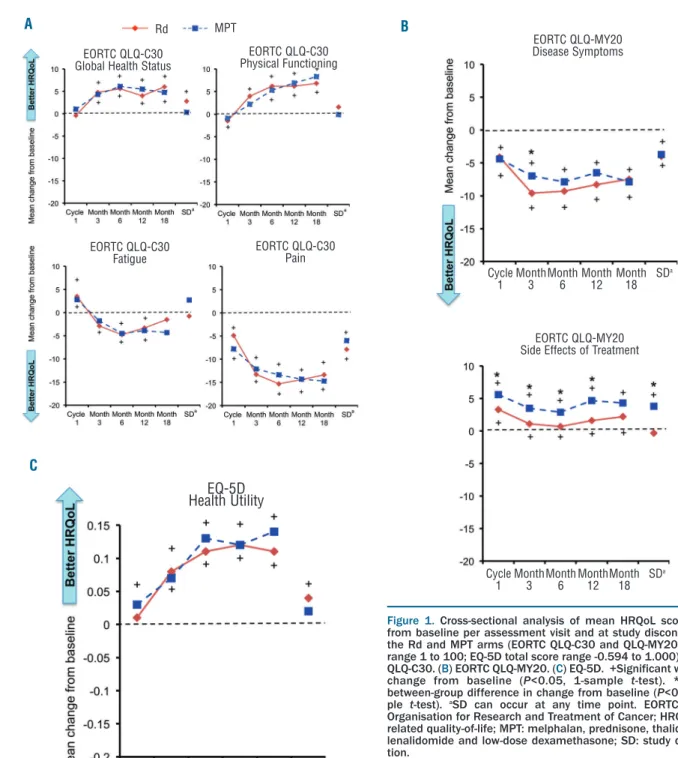
Figure 1. Cross-sectional analysis of mean HRQoL score changes from baseline per assessment visit and at study discontinuation in the Rd and MPT arms (EORTC QLQ-C30 and QLQ-MY20 total score range 1 to 100; EQ-5D total score range -0.594 to 1.000). (A) EORTC QLQ-C30. (B) EORTC QLQ-MY20. (C) EQ-5D. +Significant within-group change from baseline (P<0.05, 1-sample t-test). *Significant between-group difference in change from baseline (P<0.05, 2-sam-ple t-test). aSD can occur at any time point. EORTC: European
Organisation for Research and Treatment of Cancer; HRQoL: health-related quality-of-life; MPT: melphalan, prednisone, thalidomide; Rd: lenalidomide and low-dose dexamethasone; SD: study discontinua-tion.
EORTC QLQ-C30 Global Health Status
EORTC QLQ-C30 Physical Functioning
EORTC QLQ-MY20 Disease Symptoms
EORTC QLQ-MY20 Side Effects of Treatment Rd MPT EORTC QLQ-C30 Fatigue EORTC QLQ-C30 Pain EQ-5D Health Utility
Cycle Month Month Month Month SDa
1 3 6 12 18
Cycle Month Month MonthMonth SDa
1 3 6 12 18 Cycle Month Month Month Month SDa
1 3 6 12 18
A
C
HRQoL results
Statistically significant symptom relief, as measured by the QLQ-C30 Pain and Fatigue domains and QLQ-MY20 Disease Symptoms domain, was achieved in both arms. Both treatment arms showed statistically significant (P<0.05) reductions in pain (C30 Pain and QLQ-MY20 Disease Symptoms domains) at all post-baseline assessments (Figure 1A and B). When an MID score of 12 for Pain (including the lower bound 95% CI) was applied, Rd demonstrated clinically meaningful improvement at Months 6 and 12, whereas MPT showed no clinically meaningful improvement. Rd demonstrated a significantly greater reduction in QLQ-MY20 Disease Symptoms com-pared with MPT at Month 3 (P=0.04), and an overall lower symptom score across all assessments (Figure 1B). The Rd arm also showed significant improvement in Fatigue from baseline at Month 3, Month 6, and Month 12 (Figure 1A). Although both arms showed worsening in the Side Effects of Treatment domain, as measured by the QLQ-MY20, the Rd arm showed consistently lower scores (fewer/less severe side-effects) across all post-baseline assessments,
with all but Month 18 being statistically significantly (P<0.05) lower than the MPT arm (Figure 1B). The Side Effects of Treatment MID of 6 was not reached by any regimen; for Rd, the maximum score was 3.3 and for MPT it was 5.6.
To assess the tolerability of prolonged administration of lenalidomide and low-dose dexamethasone (continuous Rd arm), we analyzed selected grade 3-4 AEs by time of onset in the continuous Rd arm for patients who received lenalidomide for more than 24 months; the selected events occurred in 201 of 532 patients (Table 4). During the over-all study period, neutropenia was the only grade 3-4 AE
Table 2. Mean scores of the selected HRQoL domains at baseline. HRQoL domains.
HRQoL domains Rd MPT (n=1076) (n=547) QLQ-C30 Global Health Status 51.7 (24.4) 50.8 (24.2) Physical Functioning 61.5 (27.0) 59.9 (28.8) Fatigue 44.8 (27.8) 46.0 (28.4) Pain 44.7 (33.6) 45.3 (35.4) QLQ-MY20 Disease symptoms 30.1 (22.3) 30.3 (22.7) Side effects of treatment 19.8 (15.6) 20.1 (15.9) EQ-5D Health utility 0.5 (0.4) 0.5 (0.4)
All values mean (standard deviation). HRQoL: health-related-quality-of life; MPT: mel-phalan, prednisone, thalidomide; Rd: lenalidomide and low-dose dexamethasone.
Table 3.Health-related quality-of-life reporting compliance.
Rd MPT (n=1076) (n=547) EORTC Compliance Quotient QLQ-C30
Cycle 1a 918/997 (92.1) 438/482 (90.9) Month 3 876/927 (94.5) 412/439 (93.8) Month 6 784/871 (90.0) 368/417 (88.2) Month 12 634/702 (90.3)* 263/325 (80.9) Month 18 506/593 (85.3)* 189/282 (67.0) Study discontinuation 492/843 (58.4) 267/461 (57.9) EORTC Compliance Quotient QLQ-MY20
Cycle 1a 916/997 (91.9) 433/482 (89.8) Month 3 869/927 (93.7) 410/439 (93.4) Month 6 780/871 (89.6) 366/417 (87.8) Month 12 632/702 (90.0)* 262/325 (80.6) Month 18 507/593 (85.5)* 188/282 (66.7) Study discontinuation 490/843 (58.1) 267/461 (57.9) Compliance Quotient EQ-5D Cycle 1a 868/997 (87.1) 414/482 (85.9) Month 3 829/927 (89.4) 392/439 (89.3) Month 6 739/871 (84.8) 350/417 (83.9) Month 12 600/702 (85.5)* 245/325 (75.4) Month 18 473/593 (79.8)* 182/282 (64.5) Study discontinuation 450/843 (53.4) 252/461 (54.7)
All data n/N (%). aWeek 4 assessment for Rd arm and week 6 assessment for MPT
arm. *P<0.05. EORTC: European Organisation for Research and Treatment of Cancer; MPT: melphalan, prednisone, thalidomide; Rd: lenalidomide and low-dose dexametha-sone.
Table 4. Selected grade 3-4 adverse events reported in more than 2% of patients by onset period for patients in the lenalidomide and low-dose dexamethasone arm.
System Organ Class preferred terma Incidence (%)
Month Month Month Month
0-6 6-12 12-18 18-24 Hematologic Anemia 6.0 2.0 2.5 2.0 Neutropenia 14.9 10.9 10.0 6.5 Leukopenia 3.0 1.0 2.0 1.0 Thrombocytopenia 2.0 3.0 2.5 0.5 Non-hematologic Infection 7.5 8.5 3.5 9.0 Pneumonia 1.5 2.5 1.0 1.5 Diarrhea 1.0 1.5 2.0 2.0 Constipation 1.5 0.5 0.0 0.5
Peripheral sensory neuropathy 0.0 0.5 2.0 2.0
Deep-vein thrombosis 5.5 1.0 1.0 1.0
Pulmonary embolism 1.5 0.5 0.5 1.5
Cataract 0.5 1.5 2.0 3.5
aCoded using the Medical Dictionary for Regulatory Activities (MedDRA) version 15.1. If the same adverse event was reported multiple times within a given preferred term, only
reported in 10% or over of patients receiving prolonged treatment, and was reported most frequently during the first six months. The incidence of anemia was highest dur-ing the first six months and decreased over time.
Both Rd regimens and MPT improved patients’ HRQoL from baseline over the duration of the study across all pre-selected domains of the QLQ-C30 and EQ-5D question-naires, but HRQoL dropped at progression. Statistically significant improvement (P<0.05) from baseline was observed in both treatment arms for functional scales Global Health Status, Physical Functioning, and EQ-5D Health Utility (Figure 1A and C) at all time points after Cycle 1. No statistically significant differences between treatment arms were reported for Global Health Status, Physical Functioning, and EQ-5D Health Utility. However, the Rd treatment arm demonstrated consistent clinically meaningful improvement in HRQoL as measured by EQ-5D at all post-baseline assessments except at Month 1. The MPT treatment arm demonstrated clinically meaning-ful improvement only at Month 3.
Mixed-model analysis
Results of the linear mixed-model repeated-measures analyses confirmed those observed in the cross-sectional analysis. Significant within-treatment improvements over time were observed in both treatment arms in all domains except Fatigue and Side Effects of Treatment (Figure 2A). A significant (P<0.0001) between-group difference in mean change from baseline was observed for the Side Effects of Treatment domain in favor of the Rd arm, indi-cating fewer severe side effects than the MPT arm (Figure 2B).
Effect of age on HRQoL outcomes
We compared the difference in mean change from base-line between the Rd and MPT arms for patients aged 75 years or under (Rd, n=697; MPT, n=359) and over 75 years (Rd, n=379; MPT, n=188) in a post hocanalysis (Figure 3). Overall, within- and between-treatment HRQoL out-comes in patients aged 75 years or under were consistent with those observed for the overall study population, except Fatigue, which significantly improved from base-line in the Rd arm (P=0.0002), but not in the MPT arm. Changes in Side Effects of Treatment on the MM-specific QLQ-MY20 questionnaire showed a statistically signifi-cant benefit (fewer/less severe side effects) for Rd over the MPT arm in both age groups (P<0.05) (Figure 3A). In patients aged over 75 years, Pain and Disease Symptoms both showed significant improvement across treatment arms. Rd demonstrated statistically significant improve-ment for Health Utility. Fatigue significantly declined in both treatment arms. Physical Functioning scores declined significantly in the MPT arm, but not in the Rd arm, and were significantly (P<0.05) better in the Rd arm versusthe MPT arm (Figure 3B).
Discussion
We show that the improved PFS with Rd is accompa-nied by an improvement in HRQoL, showing both statis-tically significant and clinically meaningful changes from baseline. Rd showed statistical superiority to MPT in Side Effects of Treatment, and no evidence of inferiority to MPT in any of the pre-selected HRQoL domains. This finding is of importance because it demonstrates that the
improved PFS in this study does not come at a cost of increased symptoms or decreased HRQoL.
The FIRST study is the largest phase III trial conducted in transplant-ineligible elderly NDMM patients to date, and the first to evaluate HRQoL in NDMM patients receiving Rd. Primary efficacy results from this study indi-cated that continuous Rd administration significantly improved PFS and OS at the interim analysis compared with the MPT regimen,19highlighting a double paradigm
change in a setting in which alkylating agents and fixed-Figure 2. Linear mixed-model repeated-measures analysis of mean change from baseline and mean difference in change from baseline at 18 months in the Rd and MPT arms. (A) Mean change from base-line at 18 months. (B) Least-squares mean difference in change from baseline for Rd versusMPT at 18 months. Error bars represent 95% confidence intervals. *P<0.05. EORTC: European Organisation for Research and Treatment of Cancer; HRQoL: health-related quality-of-life; MPT: melphalan, prednisone, thalidomide; Rd: lenalidomide and low-dose dexamethasone. A B Functional scores Rd MPT EORTC QLQ-C30 EORTC QLQ-C30 EORTC QLQ-C30 EORTC QLQ-C30 EORTC QLQ-MY20 EORTC QLQ-MY20 EQ-5D EQ-5D Functional scores Symptom scores Symptom scores
duration chemotherapy have long been considered treat-ment standards. Indeed, non-MP regimens are increasingly challenging traditional melphalan-based approaches in NDMM patients, as seen from randomized phase III trial data, including E4A0314 and UPFRONT.42 The observed
differences in HRQoL between continuous Rd and MPT likely reflect both the good tolerability of the Rd regimen (leading to fewer side effects of treatment) and prolonged time to progression with continuous Rd. Improvements in HRQoL have previously been reported during treatment with melphalan, prednisone, lenalidomide followed by lenalidomide maintenance (MPR-R) in patients with NDMM,39,43and the addition of thalidomide to MP did not
negatively affect HRQoL.44However, our results contrast
with the HRQoL trade-off reported with bortezomib in the VISTA trial, which compared MPV versus MP in NDMM patients and in which MPV had superior PFS and OS efficacy, but where patients’ HRQoL was significantly compromised, especially in the first four cycles of treat-ment.45,46
In the FIRST trial, although HRQoL was improved and maintained during the progression-free state, it deteriorat-ed when disease progression occurrdeteriorat-ed, regardless of the treatment received. This finding augments the clinical importance/benefit of the prolonged PFS, and time to pro-gression observed with Rd versusMPT,19as a longer PFS in
this comparison is associated with better HRQoL. Rd treatment demonstrated significant improvement in the Disease Symptoms domain and significantly lower scores for the MM-specific QLQ-MY20 Side Effects of Treatment domain at specific time points versusMPT (although not to the level of MID). Improvements corresponded with a lower incidence of neurotoxicity and hematologic AEs with Rd, a higher discontinuation rate with MPT, and improved response rates with continuous Rd and Rd18 (75.1% and 73.4%, respectively,versus 62.3% with MPT), as seen in the primary efficacy data.19 Treatment with
MPT was associated with greater HRQoL worsening in the Side Effects of Treatment domain compared with Rd treatment. Indeed, higher rates of grade 3-4 neutropenia, leukopenia, constipation, and peripheral neuropathy were observed in the MPT arm,19 which may explain the lower
rate of HRQoL compliance among patients randomized to MPT. Indeed, previous studies have reported that the addition of thalidomide to MP results in increased grade 3-4 toxicity.6,47In our study, the Rd doublet regimen was
bet-ter tolerated than MPT over time. Patients who received MPT discontinued treatment sooner and experienced AEs leading to study drug discontinuation prior to PD more frequently than those randomized to Rd.19We have now
shown that HRQoL improved after treatment initiation and was generally maintained while patients were pro-gression-free, but deteriorated with PD. The HRQoL decrease upon PD captured quantitatively here is also con-sistent with qualitative results on the burden of relapse on MM patients’ emotional and physical well-being.48 This
adds additional support to the validity of the HRQoL measures included in the FIRST trial; further evidence of their reliability was also seen in the similarity in base-line scores between the FIRST, VISTA,45 and HOVON 4949
studies.
Analysis by age showed that, compared with MPT, Rd treatment did not negatively affect general HRQoL in patients aged over 75 years. Indeed, only Rd showed a sta-tistically significant improvement in EQ-5D Health Utility
in this age group, and also showed significantly less wors-ening of Physical Functioning scores compared with MPT. Both treatment arms showed improvement in the pain scales.
The sustained improvement in HRQoL reported in the present study is indicative of good tolerability. One caveat, however, is that we did not collect HRQoL data beyond 18 months of treatment; therefore, we are unable to draw conclusions on the effects of long-term continuous Rd Figure 3. Linear mixed-model repeated-measures analysis: change from baseline at 18 months in patients aged ≤75 years in the Rd and MPT arms. (A) Patients aged ≤75 years. (B) Patients aged >75 years. *P<0.05 for between-group estimated difference in mean change from baseline. EORTC: European Organisation for Research and Treatment of Cancer; HRQoL: health-related quality-of-life; MPT: mel-phalan, prednisone, thalidomide; Rd: lenalidomide and low-dose dex-amethasone. A B Functional scores Functional scores Symptom scores Symptom scores Rd MPT EORTC QLQ-C30 EORTC QLQ-C30 EORTC QLQ-C30 EORTC QLQ-C30 EQ-5D EQ-5D EORTC QLQ-MY20 EORTC QLQ-MY20
treatment on patients’ HRQoL. This is of particular signif-icance as, in addition to the FIRST trial, several clinical studies support the value of continuous versus fixed-dura-tion treatment, making it important that the improved clinical outcomes do not come at the cost of reduced HRQoL. To try to answer this question, we carried out an exploratory analysis to look for trends in AEs during up to two years of treatment. The analysis did not show an increase in incidence of AEs during Months 18-24, sug-gesting that, from the perspective of side effects, HRQoL does not deteriorate beyond 18 months of treatment. Furthermore, during the MM-015 phase III trial, with a median follow up of 30 months, more patients treated with MPR-R achieved minimal important improvements in HRQoL outcomes compared with those on MP, and there were no significant differences in HRQoL outcomes between patients on continuous treatment versus place-bo.39,43
Although not all the statistically significant changes reached the MID threshold, Rd showed evidence of clini-cally meaningful improvement in Pain and in HRQoL as measured by EQ-5D, whereas MPT failed to demonstrate a clinically meaningful improvement in any domain (with the exception of 1 time point in EQ-5D). Neither treat-ment showed a clinically significant worsening of HRQoL in any domain. With regard to the Side Effects of Treatment domain, MID analysis showed that patients in the MPT arm approached the negative MID threshold of 6, whereas those in the Rd arm did not.
Future analyses should investigate MID at the individual patient level to understand what proportion of patients experienced a clinically meaningful improvement in each treatment group and whether there is a difference between groups.
In summary, efforts to improve progression-free intervals and survival are essential in the case of an incurable disease
such as MM. However, it is just as important to ensure that a patient’s HRQoL is maintained and not compromised dur-ing the extended survival period and that the side-effects of treatment are not worse than the disease symptoms. Continuous lenalidomide treatment has been shown to fur-ther improve PFS and disease outcomes, and improved sur-vival rates have been reported in NDMM patients in recent years. The manageable and favorable toxicity and HRQoL profiles of Rd versusMPT may facilitate patient adherence, positioning the alkylator-free oral Rd regimen as a very effi-cient and well-tolerated treatment in a first-line setting. Our results further establish the combination of lenalidomide and low-dose dexamethasone as a new standard of care for initial therapy of myeloma by demonstrating superior QoL during treatment compared with MPT, although longer-term follow up data (>18 months) on cumulative toxicity and HRQoL are needed.50
Funding
This work was supported by Celgene Corporation.
Acknowledgments
We thank the patients who participated in this study, the staff members at the study sites who cared for them, and the represen-tatives of the sponsors who were involved in data gathering and analyses. We thank Vanessa Gray-Schopfer (PhD) and Ron Hogg (PhD), OmniScience SA, Adam Hutchings, Dolon Ltd, and Keisha Peters, Excerpta Medica, who provided medical writ-ing services and assistance funded by Celgene Corporation. The authors were fully responsible for all content and editorial deci-sions for this manuscript.
Authorship and Disclosures
Information on authorship, contributions, and financial & other disclosures was provided by the authors and is available with the online version of this article at www.haematologica.org.
References
1. Palumbo A, Anderson K. Multiple myelo-ma. N Engl J Med. 2011;364(11):1046-1060. 2. Brenner H, Gondos A, Pulte D. Recent
major improvement in long-term survival of younger patients with multiple myelo-ma. Blood. 2008;111(5):2521-2526. 3. Kristinsson SY, Landgren O, Dickman PW,
Derolf AR, Bjorkholm M. Patterns of sur-vival in multiple myeloma: a population-based study of patients diagnosed in Sweden from 1973 to 2003. J Clin Oncol. 2007;25(15):1993-1999.
4. Kumar SK, Dispenzieri A, Lacy MQ, et al. Continued improvement in survival in mul-tiple myeloma: changes in early mortality and outcomes in older patients. Leukemia. 2013;28(5):1122-1128.
5. National Comprehensive Cancer Network. NCCN Clinical Practice Guidelines in Oncology. Multiple myeloma. Version 1.2014. Available at: http://www.nccn.org. 6. Facon T, Mary JY, Hulin C, et al. Melphalan
and prednisone plus thalidomide versus melphalan and prednisone alone or reduced-intensity autologous stem cell transplantation in elderly patients with multiple myeloma (IFM 99-06): a ran-domised trial. Lancet. 2007;370(9594):1209-1218.
7. Fayers PM, Palumbo A, Hulin C, et al. Thalidomide for previously untreated eld-erly patients with multiple myeloma: meta-analysis of 1685 individual patient data from 6 randomized clinical trials. Blood. 2011;118(5):1239-1247.
8. Hulin C, Facon T, Rodon P, et al. Efficacy of melphalan and prednisone plus thalido-mide in patients older than 75 years with newly diagnosed multiple myeloma: IFM 01/01 trial. J Clin Oncol. 2009;27(22):3664-3670.
9. Kapoor P, Rajkumar SV, Dispenzieri A, et al. Melphalan and prednisone versus melpha-lan, prednisone and thalidomide for elderly and/or transplant ineligible patients with multiple myeloma: a meta-analysis. Leukemia. 2011;25(4):689-696.
10. Ludwig H, Miguel JS, Dimopoulos MA, et al. International Myeloma Working Group recommendations for global myeloma care. Leukemia. 2014;28(5):981-992.
11. Moreau P, San Miguel J, Ludwig H, et al. Multiple myeloma: ESMO Clinical Practice Guidelines for diagnosis, treatment and fol-low-up. Ann Oncol. 2013;24(Suppl 6):vi133-vi137.
12. San Miguel JF, Schlag R, Khuageva NK, et al. Bortezomib plus melphalan and pred-nisone for initial treatment of multiple myeloma. N Engl J Med.
2008;359(9):906-917.
13. Palumbo A, Attal M, Roussel M. Shifts in the therapeutic paradigm for patients newly diagnosed with multiple myeloma: maintenance therapy and overall survival. Clin Cancer Res. 2011;17(6):1253-1263. 14. Rajkumar SV, Jacobus S, Callander NS, et al.
Lenalidomide plus high-dose dexametha-sone versus lenalidomide plus low-dose dexamethasone as initial therapy for newly diagnosed multiple myeloma: an open-label randomised controlled trial. Lancet Oncol. 2010;11(1):29-37.
15. Dimopoulos M, Spencer A, Attal M, et al. Lenalidomide plus dexamethasone for relapsed or refractory multiple myeloma. N Engl J Med. 2007;357(21):2123-2132. 16. Dimopoulos MA, Chen C, Spencer A, et al.
Long-term follow-up on overall survival from the MM-009 and MM-010 phase III trials of lenalidomide plus dexamethasone in patients with relapsed or refractory mul-tiple myeloma. Leukemia. 2009;23(11):2147-2152.
17. Weber DM, Chen C, Niesvizky R, et al. Lenalidomide plus dexamethasone for relapsed multiple myeloma in North America. N Engl J Med. 2007;357(21):2133-2142.
18. Benboubker L, Dimopoulos MA, Dispenzieri A, et al. Lenalidomide and
dex-amethasone in transplant-ineligible patients with myeloma. N Engl J Med. 2014;371(10):906-917.
19. Facon T, Dimopoulos MA, Dispenzieri A, et al. Initial phase 3 results of the FIRST (Frontline Investigation of Lenalidomide + Dexamethasone versus Standard Thalidomide) trial (MM-020/IFM 07 01) in newly diagnosed multiple myeloma (NDMM) patients (pts) ineligible for stem cell transplantation (SCT). Blood. 2013;122(21):Abstract 2.
20. Molassiotis A, Wilson B, Blair S, Howe T, Cavet J. Unmet supportive care needs, psy-chological well-being and quality of life in patients living with multiple myeloma and their partners. Psychooncology. 2011;20(1): 88-97.
21. Mols F, Oerlemans S, Vos AH, et al. Health-related quality of life and disease-specific complaints among multiple myeloma patients up to 10 yr after diagnosis: results from a population-based study using the PROFILES registry. Eur J Haematol. 2012;89(4):311-319.
22. Poulos AR, Gertz MA, Pankratz VS, Post-White J. Pain, mood disturbance, and qual-ity of life in patients with multiple myelo-ma. Oncol Nurs Forum. 2001;28(7):1163-1171.
23. Johnsen AT, Tholstrup D, Petersen MA, Pedersen L, Groenvold M. Health related quality of life in a nationally representative sample of haematological patients. Eur J Haematol. 2009;83(2):139-148.
24. Palumbo A, Mina R. Part II: role of mainte-nance therapy in transplant-ineligible patients. J Natl Compr Canc Netw. 2013;11(1):43-49.
25. San Miguel JF, Mateos MV. Advances in the treatment for newly diagnosed multiple myeloma patients ineligible for autologous stem cell transplantation. Leuk Suppl. 2013;2(S1):S21-S27.
26. Aaronson NK, Ahmedzai S, Bergman B, et al. The European Organization for Research and Treatment of Cancer QLQ-C30: a quality-of-life instrument for use in international clinical trials in oncology. J Natl Cancer Inst. 1993;85(5):365-376. 27. Cocks K, Cohen D, Wisloff F, et al. An
international field study of the reliability and validity of a disease-specific question-naire module (the QLQ-MY20) in assessing the quality of life of patients with multiple myeloma. Eur J Cancer. 2007;43(11):1670-1678.
28. Dolan P. Modeling valuations for EuroQol health states. Med Care. 1997;35(11):1095-1108.
29. Gulbrandsen N, Wisloff F, Brinch L, et al. Health-related quality of life in multiple myeloma patients receiving high-dose chemotherapy with autologous blood
stem-cell support. Med Oncol. 2001;18(1): 65-77.
30. Kvam AK, Fayers PM, Wisloff F. Responsiveness and minimal important score differences in quality-of-life question-naires: a comparison of the EORTC QLQ-C30 cancer-specific questionnaire to the generic utility questionnaires EQ-5D and 15D in patients with multiple myeloma. Eur J Haematol. 2011;87(4):330-337. 31. Pickard AS, Wilke CT, Lin HW, Lloyd A.
Health utilities using the EQ-5D in studies of cancer. Pharmacoeconomics. 2007;25(5): 365-384.
32. Stead ML, Brown JM, Velikova G, et al. Development of an EORTC questionnaire module to be used in health-related quality-of-life assessment for patients with multi-ple myeloma. European Organization for Research and Treatment of Cancer Study Group on Quality of Life. Br J Haematol. 1999;104(3):605-611.
33. Uyl-de Groot CA, Buijt I, Gloudemans IJ, Ossenkoppele GJ, Berg HP, Huijgens PC. Health related quality of life in patients with multiple myeloma undergoing a dou-ble transplantation. Eur J Haematol. 2005;74(2):136-143.
34. Wisloff F, Eika S, Hippe E, et al. Measurement of health-related quality of life in multiple myeloma. Nordic Myeloma Study Group. Br J Haematol. 1996;92(3): 604-613.
35. Wisloff F, Hjorth M. Health-related quality of life assessed before and during chemotherapy predicts for survival in mul-tiple myeloma. Nordic Myeloma Study Group. Br J Haematol. 1997;97(1):29-37. 36. Osborne TR, Ramsenthaler C, Siegert RJ,
Edmonds PM, Schey SA, Higginson IJ. What issues matter most to people with multiple myeloma and how well are we measuring them? A systematic review of quality of life tools. Eur J Haematol. 2012;89(6):437-457.
37. EORTC QLQ-C30 Scoring Manual. EORTC, Brussels. 3rd ed., 2001. Available from: http://groups.eortc.be/qol/manuals. 38. Cheung K, Oemar M, Oppe M, Rabin R.
On behalf of the EuroQol Group. EQ-5D User Guide. Basic information on how to use EQ-5D. version 2.0., March 2009. Available from: http://www.euroqol.org. 39. Dimopoulos MA, Delforge M, Hajek R, et
al. Lenalidomide, melphalan, and pred-nisone, followed by lenalidomide mainte-nance, improves health-related quality of life in newly diagnosed multiple myeloma patients aged 65 years or older: results of a randomized phase III trial. Haematologica. 2013;98(5):784-788.
40. Kvam AK, Fayers P, Wisloff F. What changes in health-related quality of life matter to multiple myeloma patients? A
prospective study. Eur J Haematol. 2010; 84(4):345-353.
41. Walters SJ, Brazier JE. Comparison of the minimally important difference for two health state utility measures: EQ-5D and SF-6D. Qual Life Res. 2005;14(6):1523-1532.
42. Niesvizky R, Flinn IW, Rifkin R, et al. Patient-reported quality of life (QoL) in eld-erly, newly diagnosed multiple myeloma (MM) patients receiving bortezomib-based combinations: results from all randomized patients in the community-based, phase 3b UPFRONT study. Blood. 2011; 118(21): Abstract 1864.
43. Dimopoulos MA, Palumbo A, Hajek R, et al. Factors that influence health-related quality of life in newly diagnosed patients with multiple myeloma aged ≥ 65 years treated with melphalan, prednisone and lenalidomide followed by lenalidomide maintenance: results of a randomized trial. Leuk Lymphoma. 2014;55(7):1489-1497. 44. Verelst SG, Termorshuizen F, Uyl-de Groot
CA, et al. Effect of thalidomide with mel-phalan and prednisone on health-related quality of life (HRQoL) in elderly patients with newly diagnosed multiple myeloma: a prospective analysis in a randomized trial. Ann Hematol. 2011;90(12):1427-1439. 45. Delforge M, Dhawan R, Robinson D Jr, et
al. Health-related quality of life in elderly, newly diagnosed multiple myeloma patients treated with VMP vs. MP: results from the VISTA trial. Eur J Haematol. 2012;89(1):16-27.
46. Sonneveld P, Verelst SG, Lewis P, et al. Review of health-related quality of life data in multiple myeloma patients treated with novel agents. Leukemia. 2013;27(10):1959-1969.
47. Palumbo A, Bringhen S, Caravita T, et al. Oral melphalan and prednisone chemother-apy plus thalidomide compared with mel-phalan and prednisone alone in elderly patients with multiple myeloma: ran-domised controlled trial. Lancet. 2006; 367(9513):825-831.
48. Hulin C, Hansen T, Laurenson S, Lawrence J, Streetly M. A European study of the emo-tional and physical impact of relapse on patients with multiple myeloma. Haematologica. 2014;99(Suppl 1):Abstract P635.
49. Wijermans P, Schaafsma M, Termorshuizen F, et al. Phase III study of the value of thalidomide added to melphalan plus pred-nisone in elderly patients with newly diag-nosed multiple myeloma: the HOVON 49 Study. J Clin Oncol. 2010;28(19):3160-3166. 50. Van de Donk NW, Gorgun G, Groen RW, et
al. Lenalidomide for the treatment of relapsed and refractory multiple myeloma. Cancer Manag Res. 2012;4:253-268.