Crossing Boundaries
TECNOSCIENZA
Italian Journal of Science & Technology Studies 8 (2) pp. 175-219 - ISSN 2038-3460
www.tecnoscienza.net 2017
Data Platforms and Cities
Anders Blok SODAS University of Copenhagen (DK)
Antoine Courmont
Sciences PO, Paris (FR)
Rolien Hoyng
The Chinese University of Hong Kong (CN)
Clément Marquet
Télécom Paris Tech (FR) Kelton Minor SODAS University of Copenhagen (DK)
Christian Nold Univesity College
London (UK)
Meg Young University of Washington (US)
Abstract: This section offers a series of joint reflections on (open) data plat-form from a variety of cases, from cycling, traffic and mapping to activism, environment and data brokering. Data platforms play a key role in contempo-rary urban governance. Linked to open data initiatives, such platforms are of-ten proposed as both mechanisms for enhancing the accountability of admin-istrations and performing as sites for 'bottom-up' digital invention. Such prom-ises of smooth flows of data, however, rarely materialise unproblematically. The development of data platforms is always situated in legal and administra-tive cultures, databases are often built according to the standards of existing digital ecologies, access always involves processes of social negotiation, and interfaces (such as sensors) may become objects of public contestation. The following contributions explore the contested and mutable character of open data platforms as part of heterogeneous publics and trace the pathways of data through different knowledge, skills, public and private configurations. They also reflect on the value of STS approaches to highlight issues and tensions as well as to shape design and governance.
Keywords: data platforms; data labour and reuse; environmental sensors; urban governance; transparency.
Submitted: September 20, 2017 – Accepted: April 30, 2017
Corresponding author: Anders Blok, Department of Sociology, University of Copenhagen, Øster Farimagsgade 5, Postboks 2099, 1353 København K, CSS - Building: 16.1.58. Email: [email protected]
Towards Data-driven Urban STS?
Anders Blok and Kelton Minor
Whenever new and power-laden techno-political projects emerge, sci-ence and technology studies (STS) should consider itself invited to the fray. In recent years, visions and materialities of data-driven (so-called) ‘smart urbanism’ have come to constitute such a project, with consequences petit and profound for urban governance around the world. Against a backdrop of increased datafication, whereby daily personal routines in the city now generate digital traces in granular detail, public and private urban actors seek to harvest, process, refine and serve up civic data to power their deci-sion-making processes. As STS researchers, it is tempting (to say the least!) in this situation to dust off still-valid critiques of technological determinism and to re-deploy long-standing analytical commitments to socio-technical contingency in city-making, whether of the urban technological frames, politics of urban design or heterogeneous urban assemblage variety (see Farías and Blok 2017). However, what does one do upon realizing that so-cio-technical contingency is just what urban authorities are looking to har-ness and extend through the deployment of new data formats, techniques and infrastructures embedded into the urban fabric?
In this short reflection piece, we want to deploy a local and perhaps parochial example, drawn from our own recent research experience, in or-der to raise some more general questions about the stakes of STS in data-driven urban governance. The example in focus pertains to a set of urban ambitions, coordinated in and around the municipality of Copenhagen, Denmark, to extend its commitment to cycling as a climate-friendly mode of transportation via the ‘smarter’ planning capacities conveyed by ‘bigger and better’ data on bicycle mobilities (see Boellstorff and Maurer 2015). More precisely, we want to dwell on a specific participatory event, in which planners, consultants, businesses and researchers from several European cities – ourselves included1 – were invited to assist the Copenhagen munic-ipality in thinking through its data-infrastructural options and imagining, purportedly, innovative solutions.
Two conditioning parameters of this event immediately stand out. First, the way data and its promises are harnessed and channeled in this setting must be seen as responding to a quite specific situation of urban govern-ance in Copenhagen, a city keen to extend its transnational ‘front-runner’ position in domains of bicycle infrastructures, in particular, and urban greening and low-carbon transition more generally (see Blok 2012). In this
1 In actual fact, only one of this text’s authors (Kelton) participated in the event.
sense, the event exemplifies how capacities of data to exert effects within urban governance are likely to be strategically co-shaped by a whole range of situated urban realities, interests and trajectories, which come to be latched onto and nested within each other. Indeed, a long history of STS reflection on infrastructures (e.g. Star 1999) would lead one to expect as much: new data infrastructures are perhaps less what ‘drives’ urban gov-ernance as what may come to exert effects in wider, more distributed and more layered assemblages of urban techno-politics. In a city like Copenha-gen, such data assemblages have latched onto bicycle, low-carbon and other existing urban infrastructural projects.
Second, as should be clear, our own situated format of engagement with this setting, as researchers working on data and urban-related issues at the University of Copenhagen, is one of interiority and participation rather than external observation. To start with, this is not so much a matter of us, as ‘proto-STS’ urban researchers, striving to make a reflexive point.2 Ra-ther, it is more about how our own everyday research trajectories have con-stituted us, in the midst of doing other things and being ‘otherwise en-gaged’ (Harvey and Knox 2008), as now belonging to the diverse field of ‘knowledge-based stakeholders’ with something to contribute to the ‘tech-nical’ side of the Copenhagen event. More generally, we might say, it has to do with how specific forms of interdisciplinary research, in one capacity or another, are already integral to the ongoing ‘infrastructuring’ (Dantec and DiSalvo 2013) of such data relations in the service of local urban change and emergent publics.
The point we wish to make on this basis is less one of action-oriented STS being involved in self-conscious intervention in this field of urban practice, nor one of the performativity of STS across domains of techno-scientific politics in general (see e.g. Zuiderent-Jerak and Jensen 2007). It is a much more modest and situated point, related to a reflection on how it is that our own collective research trajectory has come to be relevant to other actors, with other agendas and concerns, in this particular urban mi-lieu (as Isabelle Stengers would term it) – and conversely, how this mimi-lieu has come to be relevant to our research (see Savransky 2016). As we will suggest, this event of relevance seems to us to pertain to the specific ways in which technical, political and ethical aspects co-implicate each other in this milieu of data-driven urban governance, with implications also, we ar-gue, for how STS might envisage its own stakes in it.
To briefly set the stage: the participatory event in question, called the “Big Data for Cyclists Workshop”, took place in the House of Innovation in Copenhagen on February 15 2017, under the joint auspices of the mu-nicipality’s Technical and Environmental Administration and the so-called Climate-KIC Nordic network, a public-private innovation partnership
2 We return towards the end to the notion of ‘proto-STS’. Suffice to say that it
sponsored partly by the European Commission. Evidently, in a context of mushrooming ‘living laboratories’ for urban sustainability transition (Ev-ans and Karvonen 2011), and the way these intersect with location-sensitive data technologies for the production of ‘speculative’ urban futures (Leszczynski 2016) and the participatory design of new public ‘things’ (Dantec and DiSalvo 2013), this workshop is easily recognizable as one version of a more general pattern. What interests us here are some details of the staging of data promises during the workshop.
From the outset, municipal organizers were adamant to frame the work-shop around an unfortunate asymmetry of traffic planning: whereas Co-penhagen planners are in possession of fairly detailed locational data on car- and bus-based mobilities in the city, no comparable data exists for those roughly 41% of trips undertaken by bicycle. Stated otherwise in the city’s supporting information brief, while sensors around the city count ag-gregate bicycle numbers, this data allows for no extrapolation on routes and trip times needed by the city to respond to “congestion, accidents, stalled cars/lorries parked on bike lanes, road works exceeding their per-mits, debris, and unplanned events” that can inconvenience “tens of thou-sands of cyclists” that use the city’s central corridors each day. In the face of strong political commitments to increase the share of bicycle-based traf-fic to 50% by 2025, planners thus face an obvious challenge: how to opti-mize interventions aimed to improve bicycle infrastructures – and, correl-atively, the attractiveness of choosing bikes over cars – with little solid in-formation on current bicycle practices.
In short, the promises of data staged in the workshop were politically infused from the start, framed within a specific narrative of low-carbon transition in Copenhagen traffic planning. Notably, however, the potential perils of privacy violations were absent from the organizers’ stated list of criteria by which ideas solicited from external stakeholders would be judged. Indeed, to help solve this planning-based challenge through ‘bold’ and ‘radically innovative’ uses of urban data was the very mandate through which the organizers elicited data experts (ourselves included) for partici-pation in the workshop.
Concretely, prior to the workshop, each participant had to submit a brief pitch of her or his prototype ‘big data for cyclists’ idea. At the begin-ning of the workshop, these pitches were then enacted by their creator(s) for an audience of both in-person attendees along with remote viewers watching via video links from a small constellation of universities and workplaces scattered across Europe. Towards the end of the day, a judging panel – consisting of, among others, a former Danish minister of traffic and the Dutch ambassador to Denmark (!) – selected three prototype ideas for further concept development.3
3 We mention this to signal how the workshop was also trans-local in ways
More of a platform for competition than collaboration, the workshop floor was thus a bazar of self-contained data-promises rather than a space for creative cross-fertilization and experimentation (contrast Perng, Kitchin and Evans 2016). This tension between modes of engagement was further enacted when the event organizers instructed participants (our-selves included) to physically root them(our-selves in different parts of the room to develop their ideas independently. In our experience, this physical dis-placement and separation formed individual islands of interest visible on the floor and constrained the melding of isolated concepts – an observation also duly noted by one of the judges at the event’s conclusion. Hence, while participatory in name, the workshop enacted its own specific modes of (non-)cooperation.
The fact that we found ourselves in this workshop situation speaks to a certain intersection with our own collective research trajectory – albeit, like much else in this rather heterogeneous setting, that the connection is or-thogonal and indirect, rather than fully cooperative (so to speak). For a number of years, we have both partaken in a large-scale interdisciplinary research project known as the Copenhagen Social Networks Study, involv-ing anthropologists, economists, philosophers, physicists, psychologists, sociologists and others.4 Set up via a self-built data infrastructure, the pro-ject deploys mobile phones as devices for studying social networks – via call and SMS logs, Bluetooth and Wi-Fi records, GPS coordinates and so on – among a freshman class of approximately 800 engineering students at the Danish Technical University (DTU), located north of Copenhagen. As such, it joins the emerging frontier of digital trace-based computational so-cial science, while at the same time experimenting ethnographically and otherwise with the many ethical and political questions thereby opened up (see Blok and Pedersen 2014).
Accordingly, while the Study branches off in many different substantive directions, one recurrent theme reverberating through our interdiscipli-nary dialogues has taken the shape of a participatory, ‘proto-STS’ interest in the infrastructural technicalities and the political ramifications of data ethics. From the very construction of privacy-protecting databases and data practices at DTU, data ethics has increasingly and recursively become a research topic in its own right for members of our group, as we have sought also to build relations beyond our academic platform. More than this, an ability to speak credibly on data ethics issues has emerged as some-thing of a resource for us, as we have realized the sheer salience of such issues amongst everyone from architects to municipal planners. In short, as a team, we have gradually come to inquire into what an ethical data infra-structure might be and what it may become.
4 Over the years, the project has carried several names, including SensibleDTU
Set within such a generative trajectory, the big data idea submitted for the bicycle workshop by Kelton Minor (co-author of this text), on behalf of our research team, might be said to reflect a collective realization, very much along STS lines, as to the inseparability of technical, ethical and po-litical dimensions when dealing with any digital data infrastructure. The idea, in essence, would be to build on lessons learned during the DTU study on how to use mobile phone-based GPS and Wi-Fi traces to trace bodily mobility routes in sufficiently granular ways to also infer the means of transportation (i.e. bicycles). Such database building would be enabled, in turn, via a two-tiered infrastructure, one based on ‘passively’ recording anonymized, randomized and encrypted mobile device IDs and the other based on ‘actively’ eliciting civic data donations from citizens via an opt-in mobile app as an emergent form of urban volunteerism. Together, the two data-eliciting techniques would provide a proprioceptive picture of aggre-gated bicycle activity patterns in order to assist the city to sense how citi-zens are using its extensions (and the hurdles they encounter in doing so). Through the app-based data donations, this approach activates an ele-ment of citizen science, thus working towards engaging urban data citizens and publics into the forging of the algorithmic bicycle city (Paulos, Honicky and Hooker 2009). Conversely, as is immediately obvious, the key to the passive recording of mobile device data and its further processing for planning purposes is how this infrastructure would deal with privacy issues and concerns given the granularity of the data. Here, automated pro-cesses of de-identification and randomization ensures that a high level of privacy protection is, so to speak, built into the design of the data infra-structure from the outset. Figuratively speaking, the infrainfra-structure works as a community garden-like data commons: while data remains only per-sonally accessible for each individual owner’s ‘plot’ (via app-based data feedbacks), the municipality attains an in-principle de-identified, aggregate overview of the entire ‘garden’ (the city bicycle infrastructure).
The fate of our prototype big data-for-cyclists idea remains yet to be decided within the involved public-private settings of Copenhagen’s gov-ernmental entities. As such, it is once again in the hands of more powerful others, pursuing mixed agendas and oriented to additional rationales be-yond just our collective research intentions and values enacted in the Co-penhagen Social Networks Study. Likewise, it remains to be seen what kind of relevance this foray into the milieus of data-driven urban governance will attain in our future research endeavors (this short text constituting of course only a preliminary start to be sure). So far, we count it as confirma-tion on our part that a certain sensibility to the contingent co-shaping of the material and the social, the technical and the ethical, within data infra-structures is fast becoming not only the topic of urban STS, but also – and this is the point we have wanted to make – a potential resource for its fur-ther development.
As such, while acknowledging the risk of parochialism and self-indul-gence, we have attempted in this short piece to deploy our own situated experiences in the service of perhaps eliciting something critically general: what might a data-driven urban STS come to look like? In this sense, we have attempted to use the Copenhagen workshop also metonymically, as a placeholder for all those relatively underdetermined, inquiry-conducive and awkwardly engaged encounters and distributed spaces that are also part of the power-laden and otherwise over-coded landscape of smart ur-banism and data governance. We further suggest that, far from being mar-ginal to such spaces and encounters, STS insights into socio-technical con-tingency might be seen as entirely integral to them – provided, that is, that we as STS researchers are willing to have our ‘proto-STS’ insights shared across more heterogeneous assemblages of interdisciplinary relations and to recognize their localized embedding in specific urban contexts.5
If data is always a contingent socio-technical relation, then a data-driven urban STS might be that endeavor which takes such relations and their urban infiltrations as its own starting and ending point for research, exper-imentation and critique. Like other forms of digitally informed research, it would constitute an ‘interface method’ (Marres 2017), shaping up in an as-yet indistinct space of interdisciplinary and extra-academic engagements in the city. Along the way, it will have to come to terms with novel entities and relations, including those emerging urban data publics that remain for us so far only on paper. Plenty of scope persists, then, for improving on this first beta version of data-driven urban STS. We hope other passengers, and drivers, will want to join in the fray to explore the epistemic, technical, ethical and political ramifications that encompass this incipient crossroads.
5 As should have become clear, this text is itself the product of such an
References
Boellstorff, T. and Maurer, B. (eds.) (2015) Data, Now Bigger and Better!, Chicago, Prickly Paradigm Press.
Blok, A. (2012) Greening cosmopolitan urbanism? On the transnational mobility of low-carbon formats in Northern European and East Asian cities, in “Envi-ronment and Planning A”, 44 (10), pp. 2327-2343.
Blok, A. and Pedersen, M.A. (2014) Complementary social science? Quali-quanti-tative experiments in a big data world, in “Big Data and Society”, 1(2), pp 1-6. Dantec, C.A.L. and DiSalvo, C. (2013) Infrastructuring and the formation of
pub-lics in participatory design, in “Social Studies of Science”, 43(2), pp. 241-264. Evans, J. and Karvonen, A. (2011) Living laboratories for sustainability: exploring
the politics and epistemology of urban transition, in H. Bulkeley et al. (eds.) Cities and Low-Carbon Transition, London, Routledge, pp. 126-141.
Farías, I. and Blok, A. (2017) STS in the city, in U. Felt et al. (eds.) The Handbook of Science and Technology Studies (Fourth Edition), Cambridge, MA, The MIT Press, pp. 555-581.
Harvey, P. and Knox, H. (2008) ”Otherwise engaged”: Culture, deviance and the quest for connectivity through road construction, in “Journal of Cultural Econ-omy”, 1(1), pp. 79-92.
Leszczynski, A. (2016) Speculative futures: Cities, data, and governance beyond smart urbanism, in “Environment and Planning A”, 48(9), pp. 1691-1708. Marres, N. (2017) Digital Sociology: The Reinvention of Social Research, London,
Wiley.
Paulos, E., Honicky, R. and Hooker, B. (2009) Citizen science: Enabling participa-tory urbanism, chap. XXVIII in M. Foth (ed.) Handbook of Research on Urban Informatics. Hershey, PA, IGI Global, pp. 414-436.
Perng, S.Y., Kitchin, R. and Evans, L. (2016) Locative media and data-driven com-puting experiments, in “Big Data and Society”, 3 (1), pp. 1-12
Savransky, M. (2016) The Adventure of Relevance: An Ethics of Social Inquiry, London, Palgrave Macmillan.
Star, S. L. (1999) The ethnography of infrastructure, in “American Behavioral Sci-entist”, 43 (3), pp. 377-391.
Zuiderent-Jerak, T. and Jensen, C.B. (2007) Editorial introduction: unpacking “in-tervention” in science and technology studies, in “Science as Culture”, 16(3), pp. 227-235.
Open data re-use and data frictions. The tension
between attachment, detachment and reattachment
.
Antoine Courmont
Open data and smart cities policies underscore the implementation of the ideology of information liberalism into the urban government. This ide-ology was theorized by the French scholar Benjamin Loveluck through a political genealogy of Internet (Loveluck 2015). He claims that information is at the core of contemporary liberalism. Information must circulate freely in order to solve various problems in the context of cybernetic theories. The information liberalism is based on the assumption that data exist, are autonomous and can easily circulate.
Based on an ethnographic investigation inside the Metropolis of Lyon (France), I question this assumption. Indeed, the analysis of the open data policy in the making reveals a tension between attachment and detachment that needs to be addressed to allow a smooth circulation of data (Courmont 2016). Attached to vast socio-technical networks, data must be detached from their initial environment to circulate, before being re-attached to new users. Following traffic data from its production to its reuse (a perspective similar to a data journeys approach (Bates, Lin, and Goodale 2016), I will consecutively highlight the attachment between data and local transporta-tion policies, the trials of detachment to make data circulate, and the data reattachment to secondary uses. The description of each of these steps il-lustrates how open data transform urban government.
Attachments: produce traffic data
Data are never autonomous neither immaterial. They are always entan-gled with and gifted by a collective of objects, people, techniques, ideolo-gies, etc. Data are composed of various attachments (Gomart and Hennion 1999), which form a sociotechnical network made of heterogeneous enti-ties. For instance, traffic data are part of a long chain from road sensors to traffic lights remote control in real-time by a specialized team inside a cen-tral control room. Algorithms, fiber optic network, data storage and even the traffic regulation policy cannot be separated from traffic data.
local transportation authority to its network through a convention defined to regulate road traffic.
Detachments: make traffic data circulate
To make data circulate, it is necessary to recompose the sociotechnical network of the data by untying some associations – the detachment – and constituting new ones – the reattachment. Indeed, the challenge is not to make data autonomous, but to ensure it can be well-attached to new users. The process of opening data is the result of a series of uncertain trials, dur-ing which the characteristics of the data, the producers and the users, are simultaneously re-defined. These trials of diffusibility recompose the soci-otechnical networks of the data. To detach data from their initial environ-ment, their previous ties are questioned in the light of their future attach-ment to prefigured users (Akrich 1992). This process changes the data. Moving from a trial to another one, data differs by the network it deploys. Data as stable and unchanging entity is a fiction.
While open data activists ask public bodies to release their data without thinking about the re-uses, in practice, prefigured users are constructed by the producers to decide to open or not their data, and, especially, how to open it. These usage scenarios vary depending on the producer or the data. A common fear is the risk of misuses or uses that may backfire on them. As instance, as Martin - a data producer - told me:
We do not want to cause any trouble to some projects defended by our colleagues. For instance, what if some people misuse historical traffic data to oppose infra-structure projects? Indeed, data may be used in the right way, but, these data are very technical, and it could also be quite difficult to interpret them correctly.
These prefigured uses determine the sensitiveness of the data. To over-come reluctances of the producers, the perceived risks are weighed by po-tential gains. Beneficial scenarios are also constructed and allow the de-tachment of the data from its initial environment and its atde-tachment to new users. For instance, the open data project leaders often took as an example the case of a carrier using traffic data to optimize his delivery journey is often put forward, a re-use of open data aligned with the public policy.
producer has decided to release a “rawer” data which now include occu-pancy and flow rates.
The release of data is the result of a simultaneous process of detachment of the data from its information infrastructure and its attachment to a new environment. Nevertheless, on the contrary of the processes of innovation analyzed by Goulet and Vinck (Goulet and Vinck 2012), the release of data does not imply the dissociation of all the ties linking the data and its initial environment. Firstly, because the data continue to be daily produced and used by public organizations. Secondly, because the attachment to new us-ers cannot be successful if the data is fully detached from its initial envi-ronment: data will not be actualized, etc. That’s why the challenge of open-ing data is to achieve dealopen-ing with this tension between detachment and attachment.
Reattachment: re-use open data
In order to follow the chain of open data, we need to analyze their use by external actors. Far from enthusiastic hopes of economic development and democratic renewal, the first evaluations of open data policies noticed the relatively low uses of released data. A French open data advocates noted in a blog post in January 2013:
organizations are going through a period of doubts and depression: the data blues. […] the multitude of technical, juridical, cultural and organizational challenges have left a bitter taste in the mouth of data re-users” 6.
This reaction highlights the fact that an offer of data does not automat-ically meet a demand of data. The reuse of data raises coordination issues between heterogeneous social worlds. A lot of operations of cleaning, crossing, standardizing or articulating data are required to allow their at-tachment to a new information environment. While some mediations are removed, other are added, changing the socio-technical networks of the data. I would like to emphasize three politics of reattachment of data to new users: the consolidation, the homogenization and the articulation.
Consolidation
Produced to meet a specific use, the dissociation of the ties between the producer and the user of data endangers the solidity of open data. While it is impossible to be sure that the modalities of production meet the needs of the secondary users, data are threatened with deliquescence (Didier
6 Source:
2009). For instance, produced for the traffic regulation, the public data-base describing the road networks cannot be used to calculate routes as Jacques, a data re-user, explained:
These data are inoperable to make graph transversal, that is to say to move from a point to another one, because there are no structural nodes, which allow to say “From here to there, we can go, from there to here, we cannot.
To be used in another social world while preserving their solidity, data must become boundary-objects (Star and Griesemer 1989). The open data as boundary-object need to be both adaptable to be used in various context and robust enough to maintain a common representation of the urban space between the actors. Data have to obtain two crucial properties: an interpretive flexibility and a common infrastructure between these social worlds (Trompette and Vinck 2009). These two characteristics are not in-herent to the data but depends on the situation where they are used.
Before all secondary uses, re-users realize two operations: “sourcing” and “cleaning” the data. The first one consists of the identification, the understanding and the estimation of the liability of the data, to be sure it will fill the re-user’s needs. The second one represents all the preliminary actions on the data before integrating it in a new informational environ-ment. The two operations strengthen the consolidation of open data by estimating their interpretive flexibility, that is to say to check they can meet a secondary use without lose their initial meaning. However, they are not sufficient to allow the open data to become a boundary-object. A shared infrastructure between the producer and the re-user is required. Open data can easily cross organizational borders if it fills with the particular conven-tions of a professional field. If the traffic data are published in a standard format, it will be easily used by a traffic specialist and integrated in his own information system. For instance, this dataset was used by several compa-nies specialized in traffic information: to publish real-time information in mobile apps or to make traffic prediction. As a result, open data as bound-ary-object allow the coordination of various actors through a common rep-resentation of the urban space defined by local authorities.
Homogenization
and integration are largely invisible. However, they are crucial to smooth the numerous frictions which are inherent to the establishment of a rela-tionship between informational infrastructures.
The construction of this homogenized database requires an equivalence convention in order to obtain a standardized representation of road net-works all over the world. Unlike national statistical system, the definition of these conventions is no longer the sole privilege of the State or public actors. Private actors, like Here Maps, establish their own equivalence con-ventions, exposing public bodies to a loss of control over their public pol-icies. Traffic regulation policies represent a good example of this risk. In this domain, public information services are in competition with private GPS services. The latter’s road databases are based on an equivalence con-vention which differs from the hierarchy of roads defined by local trans-portation authorities. This difference of representation is not neutral: it is a prescriptive force to drivers through routes offered by GPS services. This is particularly apparent in case of congestion when the traffic is relocated to roads public authorities considered not suitable (minor road, etc.). The hierarchy of roads set by public authorities are no longer the convention, which reduces its ability to regulate the traffic regulation policy.
Articulation
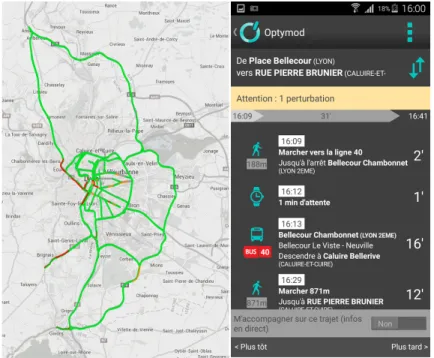
The articulation is the third modality of open data reuse. It is charac-terized by the linking between various data through a common attribute. The heterogeneity of each data is preserved. For instance, the project Op-timod, an intelligent transport system developed by the Great Authority of Lyon, whose aim is to gather, articulate and analyze data from all modes of transportation to offer multimodal information services. The differences of structuration of each data make impossible their homogenization in a com-mon database. The challenge is to preserve the data inheritance by linking the datasets without change the way they are produced. An articulation work (Strauss 1988) is thus necessary using a common denominator. In the project Optimod, a geographic frame of reference, describing all the road network, was produced to allow the relationship between databases that were incompatible.
The outcome of this data articulation work is a new representation of the urban space. While transportation data represented the transportation network as a whole, data articulation offers a representation of all available transport modes according to the user’s location.
From a representation of flow of vehicles to a specific representation for each traveler.
particularization. Using articulated data, it is no longer the “we” which is governed, but each individual that becomes governable.
Figure 1 – From a representation of flow of vehicles to a specific representation for each traveler.
Conclusion
- The consolidated data is a boundary-object allowing the coordi-nation of various actors through a common representation of the urban space. The consolidation gives the producer new regulation opportunities by gathering these actors around his data.
- The homogenized data offers an alternative representation of ur-ban space by the establishment of a new equivalence convention. The producer loses his control of the representation of the city which is a risk in case of conflict between these heterogeneous points of view.
- The articulated data gathers a diversity of points of view on a same object. In this way, it makes visible the singularity of each of these entities and makes possible their individual government.
This attachment/detachment framework opens new perspectives to an-alyze the reconfiguration of urban government in the age of information liberalism.
References
Akrich, M. (1992) The De-Scription of Technical Objects, in W.E. Bijker and J. Law (eds.) Shaping Technology/Building Society Studies in Sociotechnical Change, Cambridge, MIT Press, pp. 205-224.
Bates, J., Lin Y. and Goodale P. (2016) Data Journeys: Capturing the Socio-Mate-rial Constitution of Data Objects and Flows, in “Big Data & Society”, 3(2), pp. 1-12.
Bowker, G.C., Baker K., Millerand F. and Ribes D. (2010) Toward Information Infrastructure Studies: Ways of Knowing in a Networked Environment, in J. Hunsinger, L. Klastrup and M. Allen (eds.), International Handbook of Inter-net Research, New York, Springer, pp. 97-118.
Courmont, A. (2016) Politiques Des Données Urbaines. Ce Que L’open Data Fait Au Gouvernement Urbain, Paris, Sciences Po.
Denis, J., and Goëta S. (2015) La Fabrique Des Données Brutes. Le Travail En Coulisses de L’open Data, in C. Mabi, J.-C. Plantin and L. Monnoyer-Smith (eds.) Penser L’écosystème Des Données. Les Enjeux Scientifiques et Poli-tiques Des Données Numériques, Paris, Editions de la Maison des Sciences de l’Homme.
Desrosières, A. (2002) The Politics of Large Numbers. A History of Statistical Rea-soning. Cambridge, Harvard University Press.
Didier, E. (2009) En Quoi Consiste l’Amérique? Les Statistiques, Le New Deal et La Démocratie, Paris, La Découverte.
Edwards, P., Jackson S., Bowker G.C. and Williams R. (2009) Introduction: An Agenda for Infrastructure Studies, in “Journal of the Association for Infor-mation Systems”, 10(5), pp. 364-374.
Goulet, F. and Vinck D. (2012) Innovation through Withdrawal. Contribution to a Sociology of Detachment, in "Revue Française de Sociologie", 53 (2), pp. 117-146.
Loveluck, B. (2015) Réseaux, Libertés et Contrôle. Une Généalogie Politique D’in-ternet, Paris, Armand Colin.
Star, S.L. and Griesemer J.R. (1989) Institutional Ecology, ‘Translations’ and Boundary Objects: Amateurs and Professionals in Berkeley’s Museum of Ver-tebrate Zoology, 1907-39, in "Social Studies of Science", 19(3), pp. 387-420. Strauss, A. (1988) The Articulation of Project Work: An Organizational Process. in
"The Sociological Quaterly", 29(2), pp. 163-178.
Trompette, P. and Vinck D. (2009) Retour Sur La Notion D’objet-Frontière in "Revue D’anthropologie Des Connaissances", 3(1), pp. 5-27.
* * *
Transparency in the Rupture? Open Data and the
Datafication of Society
Rolien Hoyng
According to the handbook by the non-profit organization Open Knowledge International, Open Data’s definition centers on the availabil-ity of (digital) datasets “at no more than a reasonable reproduction cost,” “in a convenient and modifiable form,” and regardless of the fields of en-deavor where they are applied.7 In this essay, I am interested in Open Data’s coalescing with larger processes of datafication and the contradic-tions stemming from the combination of a discourse of transparency with the expedience of data for capitalism and algorithmic governance in the so-called smart city. That is to say, a profound ambiguity exists regarding what Open Data is all about. On the one hand, there is a promise for transpar-ency, oversight, and mastery, building on Enlightenment epistemologies and notions of agency. Yet, on the other hand, we witness compounding datafication, namely the rendering into data of social processes and every-day life by means of (self)tracking in order to govern populations, markets, and cities (Cukier and Mayer-Schoenberger 2013). Despite its promotional discourse, Open Data does not reveal or open up a terrain of “pure” trans-parency and unmediated visibility. Instead, Open Data (re)produces re-gimes of visibility, enacting particular modes and distributions of percep-tion and cognipercep-tion (Birchall 2015; Flyverbom et al. 2016; Halpern 2014). In this essay, I address the implications of so-called ‘smart’, data-driven
urbanism for citizenship.
Yet rather than associating the smart city’s datafication with all-encom-passing oversight and efficient control, I emphasize the messy and specu-lative character of data-driven applications, the productive role of errors and failure, and the elicitation of socio-technical emergence in smart ur-banism. I argue that the critical import of ‘transparency’ needs to be re-assessed in relation to these dynamics. If data activism should not be ori-ented onto ‘opening up’ the black-boxed smart city in order to restore transparency, what might it target instead?
Open Data draws from histories that invigorate the value of transpar-ency and reinforce supposed relations between seeing, knowing, and act-ing. Bratich (2016, 178) raises the question of what the Enlightenment era would be “without a will to transparency?” He (178) continues: “[H]ow would modern communication persist without a similar desire—for open-ness, for clear channels, for a world without obscurity?” Transparency is connected to the dream of an entirely visible society, in which there is no “dark” corner remaining. Data and information play a key role in rendering society governable, but also governors accountable (Ananny and Crawford 2016, 2-3; Foucault 1979, 195-228). Accordingly, Open Data practices abide by a regime of visibility centered on “representation.” Data function as evidence for what exists “out there” and possess a referential capacity (Halpern 2014, 46-51). Ordering data (through capturing, structuring, ag-gregating, and visualizing) forms part and parcel of ordering society as well as eradicating irrationalities, inefficiencies, and corruption. Especially the release of public service data carries with it the promise of rendering gov-ernance more efficient and holding governments accountable. For in-stance, Open Data initiatives can publish datasets on air or beach water quality that enable others to build apps or otherwise inform people about when to go out or swim. But with the data at hand, people could also find ways to track environmental quality over time in different areas in order to hold governors accountable for the state of affairs. Other datasets pertain-ing to government operations may assist in analyzpertain-ing and visualizpertain-ing poli-ticians’ voting behaviors or governments’ budget expenditures.
with the interfaces of data-driven governance, they are often merely inter-pellated as data operators, who input data and act upon the feedback (Gab-rys 2014). Interactivity is enabled as much as constrained by the design and protocols of the interface and often does not provide oversight of larger processes beyond self-tracking, let alone capacity for sovereign decision-making. As discussed in Young’s contribution (in this issue), corporations are primary users of public datasets, as they combine Open Data with, for instance, social media data and data gained by tracking eye and body move-ments. Whereas this enables corporations to segment markets with in-creased granularity and predict consumers’ behaviors and proclivities, whatever data their activities generate remain proprietary, as do the algo-rithmic applications deployed to process data. At stake is the paradox that Open Data despite its allusions to open access and transparency may be implicated in the advancement of digital enclosure (Andrejevic 2007) and empower corporate actors rather than citizens and the public at large.
thing. In this context, constant testing and versioning replaces decisive con-ceptualization of failure and loss.
The messy character of algorithmic governance somehow corresponds to smart urbanism’s organizational models. Whereas the tactical, specula-tive interventions of data-driven governance undermine disciplinary tech-niques of statecraft, state authority (at least to some degree) relinquishes centralized organization, overview, and control. Though such narratives still demand critical engagement, smart urbanism evokes scenarios accord-ing to which cognition is not centralized and rational (as is state authority); instead it takes its cues from swarms, insect colonies, and chaotic systems that inform models for self-organization (Halpern et al. 2013). In this pre-sent issue, Blok and Minor’s discussion of governance practices such as ‘living laboratories’ and participatory design provides an empirical account of the extent to which smart city governance seeks to harness a degree of socio-technical contingency, rather than contain it, in order to multiply the effects of data across the smart-city environment. Accordingly, Thrift (2014, 6) proposes to see sentient cities as “spaces of ramification as differ-ent kinds of edge structure” and “as refuges that encourage experimdiffer-ent, tinkering and other adaptive practices” that offer “new ways to produce chaos out of order […].”
If data tracking in the smart city has to do with tactical intervention and tapping socio-technical emergence in environments that collide failure and success, where does this leave the value of transparency? Should critical analysis and data activism revolve around regaining transparency vis-a-vis the black-boxed smart city? The role of data in the production of order on the basis of reason – in other words, data as part of the coupling of power/knowledge – is challenged. But so is the value of transparency in the service of accountability in that the latter might not be able to tackle the open-ended quality of smart systems and processes of socio-technical emergence that exploit failure and are enabled by incompleteness. Discuss-ing algorithmic systems operative in areas of public governance rangDiscuss-ing from transport to healthcare and policing, Ananny and Crawford (2016, 9-10) argue that even system designers themselves might not be able to pro-vide a clear picture of complex and dynamically changing, adaptive sys-tems. But more, the demand to “open up” the smart city’s black boxes and see any systems does not yet account for less immediate and more complex socio-technical ramifications and (unintended) emergences.
Accordingly, data activism includes scraping, rescuing, and “freeing” data. In such instances, data are not simply accessible and “open” but seized and motile in order to be processed in various ways. To the extent that activism preys on infrastructural “cracks” and systematic weaknesses in order to seize and “free” data, it is not smart urbanism’s success and failure (as in test-bed urbanism) that start to merge but resistance and failure.
To sum up, regardless of the fact that smart urbanism is stimulated by actual governments – utilizing the public service Open Data these govern-ments provide – datafication unfolds at the expense of centralized state power and statecraft. It implies an increase of proprietary data relative to public data as a result of smart urbanism undertaken by the private sector, even though states and especially their security and intelligence units can demand access to this data, too (Taylor and Broeders 2015; Van Dijck 2014, 203). The ensuing technological cognitive nonconscious (Hayles 2014) is however messier and less controllable than often assumed. Smart urbanism challenges disciplinary modes of statecraft intended to produce order by means of transparent oversight, notwithstanding the fact that the very linkage between data, transparency, and order undergirds the promise of fortified governance efficiency and accountability in Open Data dis-courses. The encounter between Open Data and datafication as the de facto un-mappable expansion of society’s technological nonconscious gen-erates contradictions and concocts a field of struggle. “Seizing” data and rendering it motile could form a tactic of resistance intended on releasing data in more radical ways than Open Data initiatives generally do. Critical questions are: what does it take for Open Data to become a site and me-dium for the expression of antagonistic struggles, in ways that belie Open Data’s semblance of neutrality rendered through claims to indiscriminately support all uses of open datasets? For instance, in what ways could tactical interventions exploit Open Data’s regimes of visibility in order to generate alternative modes and distributions of perception and cognition? And, how would such interventions radicalize the construction of “openness” in Open Data? But also, data activism itself requires more critical attention. Is it necessary to actually distinguish between failure and resistance and hence to further qualify those seizures and motilities that would be able to counter the disempowerment of variably-positioned bodies and different subjectivities in the smart city? Especially, if smart urbanism already is characterized by a degree of chaos and decentralization, in what ways could the seizures and motilities inflicted by data activism disrupt the ongoing disruptions incurred by smart urbanism?
References
Ananny, M. and Crawford, K. (2016) Seeing without knowing: limitations of the transparency ideal and its application to algorithmic accountability, in “New Media and Society”, Article first published online.
Andrejevic, M. (2007) Surveillance in the digital enclosure, in “The Communica-tion Review”, 10 (4), pp. 295-317.
Birchall, C. (2015) “Data.gov-in-a-box” delimiting transparency, in “European Journal of Social Theory”, 18 (2), pp. 185-202.
Bratich, J. (2016) Occult(ing) transparency: an epilogue, in “International Journal of Communication”, 10, pp. 178–181.
Coté, M. (2014) Data motility: The materiality of big social data, in “Cultural Stud-ies Review”, 20 (1), pp. 121-49.
Cukier, K. and Mayer-Schoenberger, V. (2013) The rise of big data: how it’s chang-ing the way we think about the world, in “Foreign Affairs”, May-June, pp. 28-40.
Deleuze, G. (1992) Postscript on the societies of control, in “October” 59, Winter, pp. 3-7.
Flyverbom, M., Leonardi, P.M., Stohl, C. and Stohl, M. (2016) The management of visibilities in the digital age: introduction, in “International Journal of Communication”, 10, pp. 98–109.
Foucault, M. (1979) Discipline and Punish: The Birth of the Prison, New York, Vintage.
Gabrys, J. (2014) Programming environments: environmentality and citizen sensing in the smart city, in “Environment and Planning D: Society and Space”, pp. 32 (1), pp. 30-48.
Halpern, O. (2014) Beautiful Data: a History of Vision and Reason since 1945, Durham, Duke University Press.
Halpern, O., LeCavalier, J., Calvillo, N. and Pietsch. W. (2013) Test-bed urbanism, in “Public Culture”, 25(2), pp. 273-306.
Hayles, N.K. (2014) Cognition everywhere: the rise of the cognitive nonconscious and the costs of consciousness, in “New Literary History”, 45 (2), pp. 199-220.
Lyon, D. (2001) Facing the future: seeking ethics for everyday surveillance, in “Eth-ics and Information Technology”, 3, pp. 171-181.
Taylor, L. and Broeders, D. (2015) In the name of development: power, profit and the datafication of the global south, in “Geoforum”, 64, pp. 229-237. Thrift, N. (2014) The ‘sentient’ city and what it may portend, in “Big Data &
Soci-ety”, 1 (1), pp. 1-21.
Van Dijck, J. (2014) Datafication, dataism and dataveillance: big data between sci-entific paradigm and ideology, “Surveillance & Society”, 12 (2), pp. 197-208.
The ecologies of open data labor. A case study of the
coproduction of an open geographical data base
Clément Marquet
This contribution concerns the collaboration between Transilien, a public transport operator on the region Île-de-France8 and the association Open Street Map (OSM) France. OSM is an open crowdsourced geo-graphical data base, mainly produced by volunteers (Goodchild 2007). The partnership aims at asking the OSM volunteers to map the accessibility for the disabled equipments in 90 of the 380 railway stations composing Tran-silien’s network. The mapping has to be done during the summer 2013, between June and September. Indeed, as part of Transilien open data pol-icy, these geographical data has to be valued during a hackathon9 in No-vember, in order to test how useful they can be for software developers.
However, in September 2013, Vincent, Transilien’s chief of project dis-covers that only half of the mapping has been done. The volunteers did not respond to the call made by the association. With the spokesperson and the president of OSM France, Vincent has to contribute to the mapping, mainly during his free time. Though the mobilization of the volunteers is seen as a failure, the geographical data are widely used by the participants during the hackathon and Transilien decides to keep mapping its station on OSM. But the mapping can’t rely anymore on the volunteers, Transilien considers paying people for that. As we will see, mapping is a tedious ac-tivity, and we will wonder how this tiresome and volunteered practice is turned into a paid work, within the open data ideology of “doing more with less”.
Having to produce the data one wants to open is a typical situation in open data projects, as Jérôme Denis and Samuel Goëta have shown (Goëta 2016; Denis and Goëta 2017). Data rarely exist in the format desired and opening data necessitates a lot of work of identification, extraction, clean-ing, etc. On the same trend, Antoine Courmont (2015) states that opening one’s data implies reframing one’s information infrastructure (Star and Ruhdeler 1996) to take into account cleaning processes and alternative uses of data by external actors.
Collaboration between Transilien and OSM implies producing an “open” data base in two dimensions: first, one that can be reused by soft-ware developers, second, one that can be completed by anyone (the only condition is to be registered in OSM). Wondering how the OSM data plat-form becomes a boundary-object (Star and Griesemer 1989) between OSM
8 Transilien is a subsidiary company of Société Nationale des Chemins de Fer
(SNCF), the main railway transport company in France.
community and a public transport operator, we will pay a close attention to the organizational and labor transformations: what forms of data labor are invented by Transilien? What kind of competences are recognized in geographical mapping? How does those transformations relate to the OSM community?
1/ Mapping practice
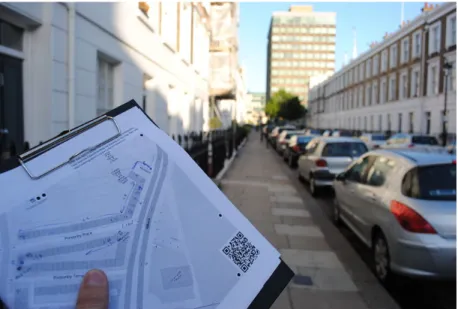
To understand the lack of mobilization of the volunteers, it is important to have a clearer idea of what kind of an activity mapping is. OSM is gen-erally presented as a platform where everyone, once registered, should be able to contribute. To take part in drawing the map, one does not need expensive tools: the basic process is to print the area to be mapped on “walking papers” (figure 2) and start listing the items lacking in the public space, whether those items would be buildings and roads, or traffic lights, trees and pedestrian crossings. To help her in her task, one could use a GPS or smartphone, to record geographical position and take pictures of the area.
Figure 2 – Walking paper. Source: http://wiki.openstreetmap.org/wiki/File-:Surveying_with_walking_papers.jpg (CC-BY-SA 2.0+).
the volunteer has a various set of free software to use, more or less user friendly, according to his level of expertise. User has to draw dots, lines, polygons, and tag them using information resources already in the software or coordination tools available online.
Thus, mapping starts with outdoor activity, or indoor, concerning the stations. However, having to go in each station on the railway network is not an appealing perspective for the volunteers. Furthermore, the specific accessibility equipment is difficult to be seen for one who isn’t used to see-ing it. Last and not least, mappsee-ing is also presented as a meticulous and tedious activity. OSM volunteers describe themselves as “the ants” and Gael does not hesitate to qualify as “fucking boring” the moments when one “is counting steps under the rain” or adding data “until your hands hurt”. But, he adds, “at the end it’s perfect, and that is what makes the beauty of it.”
2/ Paying the mappers: from dirty work to external expertise
Organizing the production of data in OSM is not a linear process for Transilien, but rather a trial and error process. From October 2014 to June 2016, Transilien uses three methods to produce data about its network.
A/ Mapping as a dirty work
To produce a large amount of data on the 290 stations left in a short period of time, Transilien hires students. Sixteen students are trained to OSM software and field mapping by OSM France leaders. They have roughly access to the same material and information as OSM contributors: specification note, walking papers, camera and smartphone GPS. The kind of contract linking the student to the firm is quite loose. As a precarious job, students are paid “at the station”. Some will never go through all the stations they should do, others will complaint that the data they harvested have been changed or rejected by contributors. According to Vincent, this experience was tough because of the problems of skills and the lack of co-ordination.
Here, mapping appears to be a dirty work (Hughes 1962). If we recall the tedious process described by Gael, we understand that this process is delegated by Transilien to students. As they do not see the beauty of it and as the added value to their formation is quite slim, recognition is hard to be found. Their coordinator clearly states that this is far from being it is main project at the time.
B/ Internalizing competences through an OSM contributor
and he is temporarily replaced by an OSM contributor, Florian. He ex-plains that the work of the students was too messy: the tags weren’t coher-ent enough, the mapping was not accurate. He doesn’t blame them, as they were nearly starting from blank slate. However, most of their work is finally erased and Florian reorganizes the mapping procedure. Hence, he draws map from his office, using architects’ plans, rather than going on the field. Once he has drawn the 379 stations, he goes checking what has changed, what could be added or deleted. However, despite of his efforts, 8 stations resist to the mapping. The most complex, multilevel stations are far too difficult to be mapped from the only basis of architect plans, even for an experienced mapper.
C/ High expertise mapmaking: OSM contributors as service providers
Through Florian, Transilien contacts a geomatics company named Cartocité. This agency is composed by three regular OSM contributors specialized in hardware and software development, and in geomatics. It is the first time the agency signs a contract to realize OSM mapping. Such a structure was necessary in particular because of confidentiality contracts. Indeed, mapping the stations gives the agency access to the architectural layouts of the station, as non public areas should not be mapped in OSM. When interviewed Antoine sees this as a privilege, in his point of view, many OSM mappers would have been delighted to be authorized to map a station through architects layouts, without even being paid for that. Once they have the layouts, Cartocité employees enter in a three months process, involving software and hardware development (a four camera pod to take 360° pictures), plus the advanced knowledge of geomatics and OSM soft-ware.
The first steps of the production of railway stations open data reminds classic information gathering across history, from the birth of statistic poll-ing, which consisted in hiring unemployed people (Didier 2009), to recent practices of inquiries which also rely on law qualified jobs (Caveng 2012). Data harvesting is considered by Transilien as a dirty work (Hughes 1962), that could be done with little investment. However, contrary to opinion polls, the geographic data expected by Transilien needs high accuracy. Fur-thermore, mapping is not considered as a dirty work for everybody. As a relational notion, what is dirty and boring to some is not for others: most of OSM contributors see mapping activity as a – tedious – leisure (Dufeal et al. 2016).
done to make it “open”. Taking this work into consideration needs, as we will see, to rethink the ecology of data labor.
3/ Maintaining the data: coordinating experts, agents and the crowd.
However, having turned stations into data isn’t enough to have an open data platform. Opening data aims at the circulation of data, which means that many operations are required to let the data flow (Courmont this is-sue). Data have to be updated to follow up the transformation of the phys-ical spaces. Other forms of data labor and organizational transformations are needed. To deal with data maintenance, Transilien divides the issue in two dimensions, both reframing data labor: updating and surveillance.
A/ An app to update the map
To have data up to date, and considering the failure of relying on the only OSM regular contributors to do so, Florian have the idea to develop a smartphone app. The aim of the app is to simplify the contribution pro-cess on the station. Anyone could add data in a few seconds, avoiding the more or less user-friendly editing software that are repulsive to the new-comers. In June 2017, a prototype is delivered. According to the manage-ment, it should be used by the travelers but also by the agents.
Thus, by doing this application, Transilien and OSM contributor Flo-rian are opening another potential transformation in the OSM model of data production. By simplifying the addition of data, the app could move the model of production from a community level, in which volunteered are getting more and more entangled with professionals, to a crowd model, which allows a widening of the contributors but also lightens the links be-tween them (Haythornwaite 2009).
B/ Surveilling data
With the open data base, the company faces new risks such as malevo-lence, errors or “tag wars”, which corresponds to disagreement between contributors regarding how to tag an item (Mooney 2011). The company could not accept this kind of volatility if services rely on the open data base. To overcome this situation, Transilien hires Cartocité. The agency has to develop software to monitor data activity on the stations. This makes the agency accountable enterprise for the station’s data and stabilizes the role of the company as an “OSM professional”.
C/ New roles for the agents
At the intersection of both the surveillance and the updating program, we can find transformations in the mundane work of Transilien agents. In-deed, Cartocité’s surveillance process is to send the dubious data to Tran-silien employee who then send the data to the head of the station, who asks the agents to check whether the modified items are corresponding to the reality or not. Furthermore, the updating app, Mapmagare, has a version dedicated to agents. Thus, either checking what has been modified, or registering fresh transformations, agents become in charge of the stations data.
This second moment in the organization of the open data infrastructure let us see the production of an ecology of data maintenance articulating external companies, Transilien managers agents and a hypothetical crowd. The issue is not anymore about the harvesting of data but concerns the management of the “data lifecycle” across time, which demands more co-ordination, mostly assumed by the production of new software: monitoring software, for Cartocité, mapping software, for the agents and the crowd.
The transformation in Transilien organization also have effects in the OSM community, as the OSM France association is now wondering how to deal with the professionalization of the contributors. Should the associ-ation get paid workers to be able to respond to demands such as Transil-ien’s one? In June 2017, the bureau of OSM France have decided that its role would be to give visibility on their website to the self declared “OSM professional”, but that they will not recommend one or another not to cre-ate inequalities amongst them.
Conclusions
By focusing on the collaboration between various kinds of actors to produce a geographical data set in an open data base, this commentary gives an insight of the situated inventions of open data labor and of the organizational transformation that goes with this invention.
Along this common goal we can see many attempts from Transilien to fine a suited coordination of actors to map its station. Indeed, though Tran-silien accepts to play by OSM rules in the production of data, the company also tried to make this production as cheap as possible. Paying a close at-tention to the production and the maintenance of the data reveals the vari-ety of the forms of data labor experimented in the collaboration along with the coordination of various models of data maintenance, articulating OSM community with a wider crowd, agents mundane work and a surveillance company.
Finally, we can see how open data platforms and the original public private partnerships made around them (Young this issue) contribute to blur the boundaries of what counts as work (Strauss and Star 1999) in the liberal information society.
References
Courmont, A. (2015) Open data et recomposition du gouvernement urbain: de la donnée comme instrument à la donnée comme enjeu politique, in “Infor-mations sociale”, 191(5), pp. 45-50.
Demaziere, D., Horne, F. and Zune, M. (2009) Les développeurs de logiciels libres: militants, bénévoles, professionnels? in D. Demazière and C. Gadéa (eds.), Sociologie des groupes professionnels, Paris, La Découverte, pp. 285-295. Denis, J. and Goëta, S. (2017) Rawification and the careful generation of open
gov-ernment data, in “Social Studies of Science”, 30 (5), pp. 604-629
Didier, E. (2009) En quoi consiste l'Amérique? les statistiques, le New Deal et la démocratie. Paris, La Découverte.
Duféal, M., Jonchères, C. and Noucher, M., (2016) Ecce carto – Des espaces de la contribution à la contribution sur l’espace - Profils, pratiques et valeurs d’engagement des contributeurs d’OpenStreetMap (OSM), UMR 5319. Goëta, S. (2016) Instaurer des données, instaurer des publics Une enquête
soci-ologique dans les coulisses de l’open data, PhD Dissertation, Télécom ParisTech.
Goodchild, M. (2007) Citizens as sensors: The world of volunteered geography, in “GeoJournal”, 69, pp. 211-221.
Goodchild, M. and Linna L. (2012) Assuring the quality of volunteered geographic information, in “Spatial statistics” 1, pp. 110-120.
Haythornthwaite, C. (2009) Crowds and communities: Light and heavyweight models of peer production, in “System Sciences, 2009. HICSS'09. 42nd Hawaii International Conference IEEE”, pp. 1-10.
Hughes E. (1962) Good People and Dirty Work, in “Social Problems”, 10(1), 3-11.
Caveng R. (2012) La production des enquêtes quantitatives, in “Revue d'anthro-pologie des connaissances” 6(1), 65-88.
Mooney, P. (2011) The evolution and spatial volatility of VGI in OpenStreetMap, in “Hengstberger Symposium Towards Digital Earth: 3D Spatial Data In-frastructures”, Heidelberg, September, pp. 7-8.
Star, S.L., and Griesemer, J. R. (1989) Institutional ecology, translations' and boundary objects: Amateurs and professionals in Berkeley's Museum of Vertebrate Zoology, 1907-39, in “Social studies of science”, 19(3), pp. 387-420.
Star S.L. and Ruhleder, K. (1996) Steps toward an ecology of infrastructure: Design and access for large information spaces, in “Information systems research”, 7(1), pp. 111-134.
Star, S. L., & Strauss, A. (1999) Layers of silence, arenas of voice: The ecology of visible and invisible work, in “Computer supported cooperative work (CSCW)”, 8(1), pp. 9-30.
* * *
Neo-Environmental Sensing: Ontological approaches
to public data
Christian Nold
Introduction
was often attributed to the newfound public access to global positioning systems (GPS) and Web 2.0 technologies. Neogeography brought a new range of people to develop and use geographical mapping systems in ways that did not follow established protocols: “rather than making claims on scientific standards, methodologies of Neogeography tend towards the in-tuitive, expressive, personal, absurd, and/or/artistic, but may just be idio-syncratic applications of ‘real’ geographic techniques” (Eisnor 2006). The fact that neogeography did things ‘differently’ led to a range of epistemic and ontological tensions about how mapping practices can create truths (Warf and Sui 2010). In practice this often emerges as conflicts around data quality and power dynamics with volunteers, as illustrated in the text by Marquet (this issue). My paper involves a preliminary sketch of ‘neo-envi-ronmental’ sensing to identify how it differs from existing environmental monitoring that is based on specialised, calibrated sensor hardware. Some observers are already starting to question the impact of this new sensing paradigm (Kumar et al. 2015). My paper suggests ‘neo-environmental’ sensing presents a challenge to pollution-affected communities but also of-fers potential for ontological translation and contestation. In addition it creates a new role for academic researchers to help communities translate ‘smart’ data into matters of concern. The paper is based on my PhD re-search where I analysed four ‘neo-environmental’ devices over a period of years from design, usage and output (Nold 2017).
Environmental sensing via publicity
sensing network where the
planet earth will don an electronic skin. [...] It consists of millions of embedded electronic pollution detectors, cameras, microphones [...] These will probe and monitor cities and endangered species, the atmosphere, our ships (Gross 1999, par. 2).
The argument is that digital networked sensing will lead to new ecolog-ical management as illustrated by articles such as How Two Billion Smartphone Users Can Save Species! (Preece 2017). Smart technologies allow the cost and labour of environmental sensing to be passed onto the public (Silvertown 2009). Some suggest these networked sensing platforms will become alternatives to governmental institutions (Townsend et al. 2010) and generate new technological citizenship (Kera et al. 2013). Kresin (2013, par. 3.) argues,
we know how to measure ourselves and our environment, to visualise and analyse the data, to come to conclusions and take action. [...] We are ready. But, as yet, our government is not.
Other researchers suggest that gathering environmental data will make participants more supportive of technological and scientific progress (Bon-ney et al. 2009) and shape environmentally beneficial behaviour (Mai-sonneuve et al. 2010; EveryAware 2011). In this framing, environmental sensing devices are no longer just sensors of external pollutants but become persuasion actuators that attempt to transform the user of the sensing de-vice. In contrast, older, analog sensing devices such as diffusion tubes are hardly mentioned within the participatory sensing literature. Diffusion tubes have been used in the UK since 1976 (AEA Energy and Environment 2008) and consist of small plastic containers coated with chemical reagent that after exposure are sent to a certified laboratory. They are cheap and accurate ways of measuring air pollution, yet are not part of ‘neo-environ-mental’ sensing, since they do not contribute to global digital networks and mediagenic publicity.