1
KNOWLEDGE ABSORPTIVE CAPACITY AND PROCESS INNOVATION: THE MODERATING EFFECT OF ENVIRONMENTAL DYNAMISM
Khoo Kah Kheng, Jasmine A.L. Yeap, T. Ramayah School of Management
Universiti Sains Malaysia
Abstract
A firm’s absorptive capacity through its knowledge-processing capabilities is crucial in increasing the firm’s innovation performance and fostering competitive advantage. The purpose of this study, therefore, was to investigate the relationship between firms’ absorptive capacity and their process innovation performance by taking into consideration absorptive capacity as a multidimensional, dynamic construct consisting of knowledge acquisition, dissemination and utilization capabilities. Furthermore, this study examined the moderating effect of environmental dynamism on the relationship between firms’ absorptive capacity and innovation performance. Data was gathered from 69 manufacturing firms operating in the northern region of Malaysia. The analyses results showed that knowledge dissemination and utilization had a significant, positive relationship with process innovation. It was also found that in highly dynamic environmental conditions, the impact of knowledge acquisition on process innovation is less pronounced. In stark contrast, the impact of knowledge dissemination on process innovation is enhanced during highly dynamic environmental conditions.
Keywords: Absorptive capacity, innovation, knowledge acquisition, knowledge dissemination, knowledge utilization, environmental dynamism, moderating effect.
Introduction
In a world of greater globalization and tougher competition, firms have become increasingly knowledge-based in order to survive and compete against with each other. The concept of manufacturing today is not solely concerned with transforming raw material into products on a factory floor, rather it is becoming more holistic, involving a wide range of skills, knowledge and competency that need to be managed over functional, corporate and cultural borders. In short, the sources of manufacturing competitiveness have shifted from managing tangible resources efficiently into both the integration and co-ordination of knowledge (Kogut & Zander, 1996) and the creation of valuable and idiosyncratic organizational capabilities (Helfat & Lieberman, 2002; Helfat & Peteraf, 2003; Makadok, 2001). Manufacturing firms, therefore, face the challenge of nurturing existing knowledge and developing novel knowledge in order to create new business opportunities.
The fast and changing business environment characterizing many firms today indicates that absorptive capacity should be an important focus for all firms. With greater availability of external as well as internal knowledge sources, a firm’s absorptive capability, which revolves around its ability to target, absorb and deploy the knowledge necessary to feed its internal innovation process, becomes a crucial source of competitive advantage. A higher absorptive capacity helps a firm comprehend developments taking place in various technological fields and incorporate the new knowledge into its own innovations.
2
opportunities, to reconfigure its knowledge assets, competencies and complementary assets essentially contribute to innovative performance and constitute its dynamic capabilities. As asserted by Jantunen (2005), a firm may be sensitive enough to recognize changes in the market and may be able to identify opening opportunities, but without the necessary capabilities to transform its knowledge into valuable products or profitable business models, it still would not improve its performance.
The purpose of this study, therefore, was to investigate the relationship between firms’ innovation performance and absorptive capacity by taking into consideration absorptive capacity as a multidimensional, dynamic construct consisting of organizational knowledge-processing capabilities in the form of knowledge acquisition, dissemination and utilization. Furthermore, this study examined the moderating effect of environmental dynamism on the relationship between firms’ absorptive capacity and innovation performance. It is a wide known fact that knowledge represents a critical resource to create value and to develop as well as sustain competitive advantages (Teece et al., 1997). However, rapidly changing environments and rules of competitiveness exacerbate the challenges organizations face in their knowledge-processing capabilities such as knowledge creation (Camisón & Forés, 2010). Thus, examining the role of environmental dynamism as a contingency factor would provide a closer understanding on how firms respond in dynamic or turbulent environment versus more stable or stagnant environment.
The context of research is Malaysia, with an emphasis on manufacturing firms located in the northern region of the country. Malaysia is currently migrating from a production-based economy to a knowledge-based economy. As such, the findings of this study would make a valuable contribution towards Malaysia’s vision of progressing into a knowledge-based industry. Knowledge is the key to innovation, and therefore it is of great importance for an organization to be able to absorb knowledge from all available sources. It is hoped that the knowledge gained from this study can improve the absorptive capacity capabilities of the manufacturing firms, which is a vital key element to enhance the firm’s innovation performance.
The rest of this chapter is structured as follows. The upcoming section reviews absorptive capacity and its components, innovation performance and environmental dynamism with reference to previous literature. Subsequently, the development of this study’s research model is explained along with its hypotheses. This is followed by the research methodology employed and then the data analyses and results. Finally the paper concludes with a discussion of the key findings derived from analysis, the implications, limitations as well as suggestions for future research undertakings.
Literature Review
Absorptive Capacity
Several years ago, Cohen and Levinthal (1990) identified the problems suffered by firms, with such gaps in capabilities and knowledge, in effectively managing inwards technology transfer and R&D programs. This led them to introduce the term absorptive capacity which is defined as a highly important organizational capability to recognize value and assimilate external knowledge in order to increase firm’s innovativeness. A firm’s absorptive capacity consists of its abilities to recognize the value of new information, assimilate it, and apply it to commercial ends or to evaluate and utilize outside knowledge (Cohen & Levinthal, 1990).
3
internal routines, management competences and culture. According to Todorova and Durisin (2007), the capability to recognize the value of new external knowledge represents an important component of absorptive capacity because the valuing is not automatic, it is biased, and it needs to be fostered to allow the absorption to begin at all.
Mowery and Oxley (1995) defined absorptive capacity as a broad set of skills needed to deal with the tacit component of transferred knowledge and the need to modify this imported knowledge. Kim (1998) offered another definition of absorptive capacity by conceptualizing absorptive capacity as learning capability and problem-solving skill that enable a firm to assimilate knowledge and create new knowledge. Combining all the definitions, the general consensus is that absorptive capacity is a multidimensional construct involving the ability to acquire, assimilate, and exploit knowledge (Liao et al., 2003).
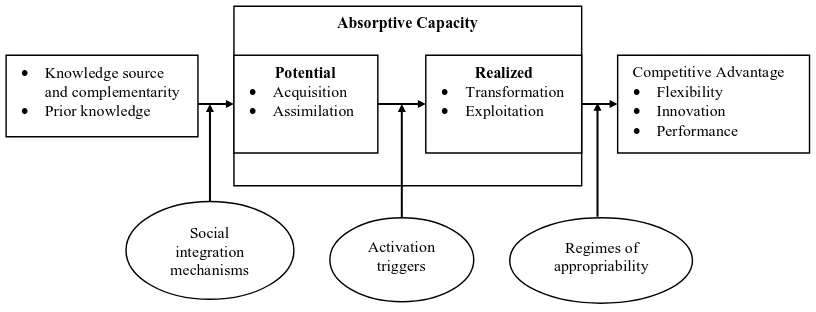
More recently, Zahra and George (2002) conceptualized the construct of absorptive capacity as a dynamic capability pertaining to knowledge creation and utilization that enhance a firm’s ability to gain and sustain a competitive advantage. They divided absorptive capacity into potential absorptive capacity (PAC) and realized absorptive capacity (RAC). PAC refers to the firm’s ability to be receptive to external knowledge, while RAC reflects the firm’s capacity to leverage the knowledge that has been absorbed. Figure 1 provides a look at the absorptive capacity model developed by Zahra and George (2002).
Figure 1: A model of absorptive capacity based on Zahra and George (2002)
Knowledge Acquisition, Dissemination and Utilization
In their model of absorptive capacity, Zahra and George (2002) placed acquisition as the first component of a firm’s capability to identify and acquire externally generated knowledge that is critical to its operations. Knowledge acquisition capabilities consist of processes and mechanisms for collecting information and creating knowledge from internal and external sources. Acquisition of external knowledge reflects the identification function, which represents the “generator” of intelligence for the organization. External environmental signals are identified, and information on those signals is gathered and transmitted across the organizational boundary. The more knowledge that can be collected over a given period, the better the acquisition capability works.
Information and knowledge may be acquired through several processes from a variety of source and media, by learning when observing other organizations, and by grafting knowledge-possessing components and by intentional search and monitoring. There is some indication that the
Absorptive Capacity
Knowledge source and complementarity
Prior knowledge
Potential
Acquisition
Assimilation
Realized
Transformation
Exploitation
Competitive Advantage
Flexibility
Innovation
Performance
Activation triggers Social
integration mechanisms
4
most important areas of knowledge come from competitors and customers. Even so, the organization uses many more than the usual data collection sources from competitors and customers (Liao et al., 2003). The intensity and speed of a firm's efforts to identify and gather knowledge can determine the quality of a firm's acquisition capabilities. The greater the effort, the more quickly the firm will build requisite capabilities (Kim, 1997).
The information and knowledge gathered from the individuals or business environment has to be converted into a transferable form and distributed internally through the internalization process that requires dissemination and assimilation. The second component of absorptive capacity, i.e., dissemination, involves the communication of the generated knowledge to all relevant departments and individuals (Liao et al., 2003). The dissemination of knowledge does not always happen spontaneously. This is particularly true for people with a technical background who are often regarded as highly individualistic and do not disseminate knowledge naturally (Van der Bij et al., 2003). Therefore, knowledge dissemination must be fostered by the organization. The organization must be well structured so that both formal and informal networks are maximized to transfer knowledge within the organization and across different functional departments. The best ways to disseminate knowledge are through interdepartmental meetings or cooperation and a primary system or network to store all the lessons learned (know-how) and others.
The third component in the absorptive capacity model is knowledge utilization. Knowledge utilization or knowledge exploitation is crucial in the development of successful new products. Knowledge utilization refers to an organization’s timely response to technological change by utilizing the acquired knowledge generated into new products and processes. A firm with advanced knowledge utilization capabilities is quick to respond to signals it receives. Knowledge utilization is evident, for example, in new ventures that capture knowledge from their market, competition, and customers, and then in which knowledge is used to create new competencies. Often enough, firms that practice the knowledge-processing capabilities obtain different result. The key to this difference involves not just the quality and quantity of information and knowledge that firms acquire and assimilate but, above all, the velocity with which they can move through the cycle (McKenna, 1995).
Innovation Performance
Innovation can be defined as new products, business processes and organic changes that create wealth or social welfare (The Economist, 2007). Williams (1999) described it as the implementation of both discoveries and inventions and the process by which new outcomes, whether products, systems or processes come into being. It is about the fresh thinking that creates value. Many business organizations and government departments profess innovation as part of their strategic intent. They all recognize that the age of optimization (product, process, business etc.) is quickly giving way to the age of innovation. Management gurus insist that innovation is the only strategy for maintaining competitive advantage. For one, Peter Drucker has gone as far as saying that a company which is not capable of innovation is doomed to decline and extinction. Gary Hamel affirmed that innovation is the fuel for growth. When a company runs out of innovation, it runs out of growth.
Past research has reveal that numerous variations have been used to measure the innovation performance of organizations. Fosfuri and Tribo (2006) measured innovation performance by the percentage of total annual sales that consists of new or substantially improved products introduced over a period of time. Nieto and Quevedo (2005) measured the innovative behavior of the firm in terms of effort to innovate. There are also other variables that are used to measure innovation performance such as number of patents obtained (Kim & Inkpen, 2005), firm’s net profit (Zahra & Hayton, 2008) and intellectual property (Rajiv & Karuna, 2006).
5
performance. Prajogo and Ahmed (2006) built the construct for measuring product and process innovation on the basis of several criteria that were conceptualized and used in previous empirical studies of innovation. These criteria are the number of innovations, the speed of innovation, the level of innovativeness (novelty or newness of the technological aspect) and being the “first” in the market. These four characteristics of innovation were transposed into two major areas of innovation, namely product innovation and process innovation. Conceptually, product innovation is concerned with generating ideas or the creation of something entirely new or significantly improved with respect to its capabilities which are reflected in changes in the end product or service offered by the organization, such as improved software, user friendliness, components or sub-systems. On the other hand, process innovation represents changes in the way firms produce end-products or services through the diffusion or adoption of an innovation developed elsewhere or new practices developed internally (Prajogo & Ahmed, 2006). This can be the implementation of new or significantly improved production process, distribution method, or support activity for the firm’s goods and services.
Environmental Dynamism
Duncan (1972) defined the environment as the relevant physical and social factors outside the boundary of an organization that are taken into consideration during organizational decision- making. It is widely acknowledged that the external environment is a primary source of uncertainty for managers responsible for identifying opportunities and threats (Duncan, 1972; Galbraith, 1974; Miller & Frisen, 1983; Teece & Pisano, 2004). The environment is perceived as dynamic or turbulent if the number of events per period of time is high for key characteristics, such as consumer preferences, number of new customers, new products, number and position of competitors, size of the market, use of technology, and regulations (Liao et al., 2003).
According to organizational information processing theory, organizations need quality information to cope with environmental uncertainty and improve their decision-making. Environmental uncertainty stems from the complexity of the environment and dynamism, or the frequency of changes to various environmental variables (Galbraith, 1974). The theory states that organizations have two strategies to cope with uncertainty and increased information needs: (1) develop buffers to reduce the effect of uncertainty, and (2) implement structural mechanisms and information processing capabilities to enhance the information flow and thereby reduce uncertainty.
Teece et al. (1997) argued that organizational and technological skills and routines may offer sustainable competitive advantage to the firm in the rapidly changing market only if it is able to recognize relevant changes, and reconfigure its asset base and processes continuously to match the requirements of the changing environment. Rapid technological change and changing customer preferences mean that the continuous introduction of product improvements and the development of new products is imperative for firms involved in manufacturing activities and in the production of services (Jantunen, 2005). Therefore, there is much reason to believe that firms operating in dynamic business environments will posses higher level of absorptive capacity and stronger innovation performance.
Research Model
6
after knowledge assimilation like in Zahra and George’s (2002) model but represents an alternative process linked to assimilation by multiple paths. They also argued that PAC and RAC did not hold anymore and they introduced an alternative approach namely, the efficiency of absorptive capacity. Schmidt (2005) argued that the transformation dimension need not be made explicit, as it is an integral part of the “exploitation” component. In short, the understanding of knowledge transformation is rather scarce. There is no consensus among researchers on how to measure knowledge transformation. Each study that measured it tended to do so using its own unique operationalization. Thus, this study did not include knowledge transformation as one of its component. Cohen and Levinthal (1990), Liao et al. (2003), Van Den Bosch et al. (2003) as well as Jantunen (2005) studied only three dimensions of knowledge processing capabilities, namely ability to recognize, assimilate and utilize useful external knowledge. Thus, consistent with those studies mentioned, this study examined absorptive capacity as consisting of three major components, i.e., knowledge acquisition, knowledge dissemination and knowledge utilization.
According to Prajogo and Ahmed (2006), innovation performance can be assessed through two major areas, namely product innovation and process innovation. Product innovation concerns the creation of something entirely new or considerably improved which is ultimately reflected in the changes in the end product or service offered by the firm. Nevertheless, innovation is not entirely focused on new or enhanced inventions. New products might be an important part of the process but they are not the essence of it. These days much innovation happens in processes and services. Therefore, this study chose to focus on process innovation as a measure of a firm’s innovation performance. Instead of end products or services, process innovation in a firm would refer to its implementation of new or significantly improved production process, distribution method or support activity for its goods and services.
Previous studies have pointed out the importance of absorptive capacity in improving performance (Cohen & Levinthal, 1990; Fosfuri & Tribo, 2006; Liao et al., 2003; Zahra & George, 2002). In particular, it has been shown that absorptive capacity has a positive effect on the productivity of innovative activities and improves the efficiency of developmental processes of new products (Cohen & Levinthal, 1990; Fosfuri & Tribo, 2006; Jantunen, 2005; Nieto & Quevedo, 2005; Zahra & George, 2002). Kostopoulos et al. (2011) stated that absorptive capacity contributes to firms’ innovation performance in two ways - firstly as a tool for processing new external knowledge and secondly as a catalyst for transferring the necessary knowledge for cross-organizational innovation activities. Gebauer et al. (2012) asserted that absorptive capacity can lead not only to product or service innovation but also strategic innovation.
The ability to acquire and utilize knowledge effectively is argued to be critical for the firm’s innovation activities and performance (Cohen & Levinthal, 1990). Effective innovation processes require the collection of information about new technology and new knowledge development. Greater dissemination of knowledge leads to a better understanding of technology capabilities and trends. This knowledge helps in guiding R&D design and contributes to technical development. It also helps manufacturing firms to generate better manufacturing-process designs. Darroch (2005) postulated and proved that knowledge acquisition as well as knowledge dissemination positively affect innovation. Thus, it is hypothesized that:
H1: Knowledge acquisition capability is positively related to firms’ process innovation. H2: Knowledge dissemination capability is positively related to firms’ process innovation. H3: Knowledge utilization capability is positively related to firms’ process innovation.
7
environmental dynamism with the changed behaviors of firms. Some researchers have hypothesized and shown that the relationship between absorptive capacity and organizational outcomes is moderated by environmental dynamism (Becherer & Maurer, 1997; Chandler et al., 2000; Duncan, 1972; Liao et al., 2003; Miller & Frisen, 1983). For example, Lev et al. (2009) discovered that organizations’ manage absorptive capacity stocks to enhance performance in response to environmental competitiveness.
Miller and Frisen (1983) found that, for a sample of successful firms, increased environmental turbulence has an inclination to lead to high levels of innovation and analysis. Environmental turbulence creates threats to the existing fit between the firms and the environment. In the meantime, it also provides the possibility of creating a better fit. In either case, firms have to rely on their absorptive capacity to discern opportunities from threats and respond accordingly. According to Duncan (1972), environmental complexity is a dimension of uncertainty. He argued that environmental variability or turbulence was most important to organizational adaptation. Therefore, in a fast-changing, dynamic environment, firm must react and innovate faster just to survive as the product cycles are undeniably getting shorter. This leads to the following hypotheses:
H4: The positive relationship between knowledge acquisition capability and firms’ process innovation performance will be stronger when the environmental dynamism is high.
H5: The positive relationship between knowledge dissemination capability and firms’ process innovation performance will be stronger when the environmental dynamism is high.
H6: The positive relationship between knowledge utilization capability and firms’ process innovation performance will be stronger when the environmental dynamism is high.
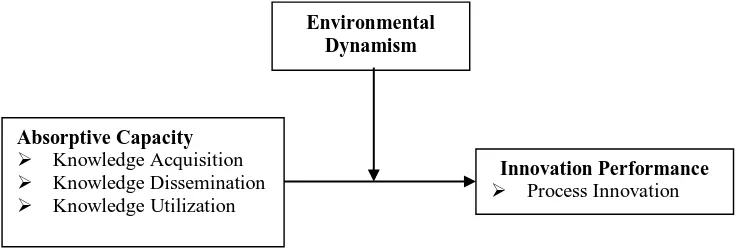
Figure 2 presents the research model of this study.
Figure 2: Research model
Methodology
Population and Sample
The population for this study consists of all manufacturing firms located in the northern region of Malaysia. The manufacturing firms surveyed were selected randomly from the directory of Federation of Malaysian Manufacturers (FMM). These manufacturing firms cover various industries such as fabricated metal products, furniture, electric & electronic products and others. Senior managers, managers and engineers or executives from factory supply chain, production, quality or engineering who possess direct contact with the manufacturing line or knowledge of present
Absorptive Capacity
Knowledge Acquisition
Knowledge Dissemination
Knowledge Utilization
Innovation Performance
Process Innovation Environmental
8
organizational practices relating to innovation-related aspects in organization were the targeted respondents representing their manufacturing firms. The snowballing sampling method was also applied in this study whereby some additional respondents were obtained from the referral of initial respondents. As this study involves process innovation, the focus of study was limited to one manufacturing site (or plant) per firm/organization.
As many as 350 questionnaires were sent out to the manufacturing firms from various industries in the northern region of Malaysia. A total of 69 responses were finalized from the data collection procedure, out of which only 77 firms responded with 8 of them deemed non-usable. Hence, the total sample size of this study is 69 manufacturing firms, with a usable return rate of 20%.
Measures and Scale
Absorptive capacity (knowledge-processing capabilities) is a multidimensional construct comprising of three dimensions; knowledge acquisition, knowledge dissemination and knowledge exploitation. Four items measuring knowledge acquisition were adopted from Jantunen (2005) and Jansen et al. (2005). Five items were used to measure knowledge dissemination and all the items were adopted from Jantunen (2005) while knowledge utilization was measured by five items adopted from Jantunen (2005) and Jansen et al. (2005). The items of all three knowledge-processing capabilities were operationalized on a 5-point Likert scale ranging from “1=strongly disagree” to “5=strongly agree”.
A total of four items were used to measure process innovation. All the items were adopted from Prajogo & Ahmed (2006). A 5-point Likert scale ranging from “1=worst in the industry” to “5=best in the industry” was used to measure how the respondent’s organization has been doing so far relative to the major competitors in their respective industry. Environmental dynamism was measured using seven items adopted from Jantunen (2005) and anchored on a 5-point Likert scale ranging from “1=strongly disagree” to “5=strongly agree”.
Analyses and Results
Profile of Respondents
Respondents who represented their manufacturing firms in answering the survey were largely from the senior management or middle management level. Around 37.7% of them were directors or senior managers and 37.7% of them were managers or assistant managers. Lower management level (section head/senior engineer/senior executive) contributed 15.9% while others (include company secretary, engineer, officer and administrator) contributed the remaining 8.7%. The respondents’ working experience in their current organizations ranged from 1 to 37 years with an average of 16 years.
9
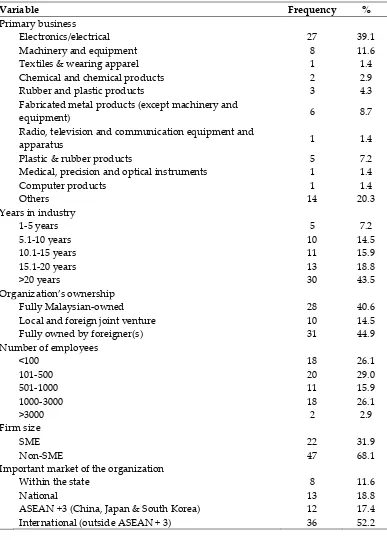
Table 1: Summary of respondents’ organization profile
Variable Frequency %
Primary business
Electronics/electrical 27 39.1
Machinery and equipment 8 11.6
Textiles & wearing apparel 1 1.4
Chemical and chemical products 2 2.9
Rubber and plastic products 3 4.3
Fabricated metal products (except machinery and
equipment) 6 8.7
Radio, television and communication equipment and
apparatus 1 1.4
Plastic & rubber products 5 7.2
Medical, precision and optical instruments 1 1.4
Computer products 1 1.4
Others 14 20.3
Years in industry
1-5 years 5 7.2
5.1-10 years 10 14.5
10.1-15 years 11 15.9
15.1-20 years 13 18.8
>20 years 30 43.5
Organization’s ownership
Fully Malaysian-owned 28 40.6
Local and foreign joint venture 10 14.5
Fully owned by foreigner(s) 31 44.9
Number of employees
<100 18 26.1
101-500 20 29.0
501-1000 11 15.9
1000-3000 18 26.1
>3000 2 2.9
Firm size
SME 22 31.9
Non-SME 47 68.1
Important market of the organization
Within the state 8 11.6
National 13 18.8
ASEAN +3 (China, Japan & South Korea) 12 17.4
International (outside ASEAN + 3) 36 52.2
Goodness of Measures
10
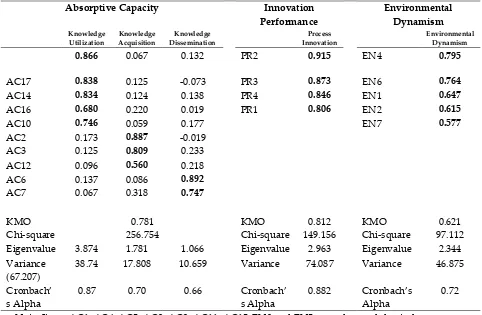
Knowledge Dissemination, Knowledge Utilization, Process Innovation and Environmental Dynamism. Table 2 presents the results of the assessment.
The KMO measure of sampling adequacy for Absorptive Capacity was 0.781 with a Chi-Square value of 256.754 (p<0.01). Three factors were extracted with Eigenvalues greater than 1 explaining 67.207% of the variance. According to Hair et al. (2006), factor loadings should be 0.50 or higher and ideally, 0.70 or higher. Out of 17 items, 10 items were retained, each with a factor loading above 0.50. They were labelled as Knowledge Acquisition, Knowledge Dissemination and Knowledge Utilization.
For Environmental Dynamism, the KMO sampling adequacy was 0.621 with a Chi-Square value of 97.112 (p<0.01). A single factor was extracted, explaining 46.875% of the variance. Even though the total variance explained was less than 50%, this factor was retained for practical reasons. Being the moderating variable, it is an important variable in this study. All five items measuring this construct were retained as their factor loadings were above 0.50. For process innovation, the KMO score was 0.812 with a Chi-Square value of 149.156 (p<0.01). One factor emerged with an Eigenvalue greater than 1. All factor loadings for this construct were above 0.50 and thus were retained.
The Cronbach Alpha values for all constructs except Knowledge Dissemination exceeded the minimum threshold of 0.70 suggested by Nunnally (1978). However, the Alpha value of 0.66 for Knowledge Dissemination still met the acceptable limit of 0.50 suggested by Helmstadter (1964).
Table 2: Results of the factor and reliability analyses
Absorptive Capacity Innovation
Performance
Environmental Dynamism
Knowledge Utilization
Knowledge Acquisition
Knowledge Dissemination
Process Innovation
Environmental Dynamism
1.
0.866 0.067 0.132 PR2 0.915 EN4 0.795
AC17 0.838 0.125 -0.073 PR3 0.873 EN6 0.764
AC14 0.834 0.124 0.138 PR4 0.846 EN1 0.647
AC16 0.680 0.220 0.019 PR1 0.806 EN2 0.615
AC10 0.746 0.059 0.177 EN7 0.577
AC2 0.173 0.887 -0.019
AC3 0.125 0.809 0.233
AC12 0.096 0.560 0.218
AC6 0.137 0.086 0.892
AC7 0.067 0.318 0.747
KMO 0.781 KMO 0.812 KMO 0.621
Chi-square 256.754 Chi-square 149.156 Chi-square 97.112
Eigenvalue 3.874 1.781 1.066 Eigenvalue 2.963 Eigenvalue 2.344 Variance
(67.207)
38.74 17.808 10.659 Variance 74.087 Variance 46.875
Cronbach’ s Alpha
0.87 0.70 0.66 Cronbach’
s Alpha
0.882 Cronbach’s Alpha
0.72
11 Descriptive and Correlation Analyses
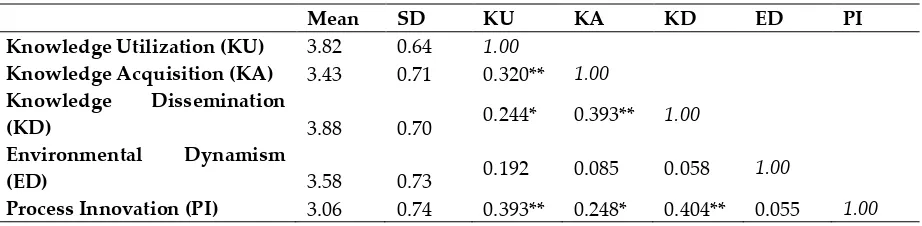
Table 3 presents the descriptive statistics and the intercorrelations among the constructs. All the variables were measured on 5-point Likert scale. The mean for all variables were higher than the mid-point of the respective rating scale. The standard deviation for all variables was uniform without extreme value, supporting the validity to further analysis. Based on the correlation coefficient values in Table 3, it can be seen that the independent variables (Knowledge Acquisition, Knowledge Dissemination and Knowledge Utilization) were significantly correlated with the dependent variable (Process Innovation). In addition, the correlation values between the independent variables were not higher than 0.6 confirming there is no multicollinearity issue (Pallant, 2001).
Table 3: Descriptive statistics and intercorrelations among variables
Mean SD KU KA KD ED PI
Knowledge Utilization (KU) 3.82 0.64 1.00
Knowledge Acquisition (KA) 3.43 0.71 0.320** 1.00 Knowledge Dissemination
(KD) 3.88 0.70 0.244* 0.393** 1.00
Environmental Dynamism
(ED) 3.58 0.73 0.192 0.085 0.058 1.00
Process Innovation (PI) 3.06 0.74 0.393** 0.248* 0.404** 0.055 1.00 *p<0.05; **p<0.01
Hierarchical Regression Analysis
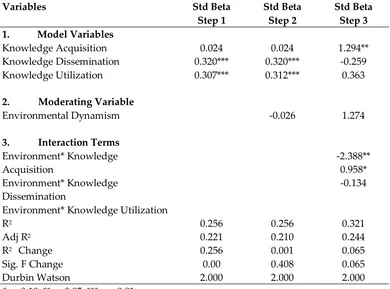
A 3-step hierarchical regression analysis was conducted to test the moderating effect of Environmental Dynamism on the relationship between Absorptive Capacity and Process Innovation. The ENTER method was selected to enable each set of predictors to be included into the regression equation and estimated simultaneously before the next set of subsequent variables are achieved in similar fashion. The predictor variables of Process Innovation (i.e. Knowledge Acquisition, Knowledge Dissemination and Knowledge Utilization) were first estimated. The moderator, Environmental Dynamism was then entered and estimated at the 2nd step. Finally the interaction between the predictors and moderator were entered and estimated at the 3rd step of the equation. The relative differences in the contribution of the set of variables (in each step) on the dependent variable are reflected in the R-squared change statistic. Table 4 shows the results of the hierarchical regression analysis.
Results in the 1st step of the hierarchical regression revealed that the predictor variables explained 25.6 percent (R2=0.256) of total variance in Process Innovation. Knowledge Dissemination (β = 0.320, p <0.01) and Knowledge Utilization (β = 0.307, p < 0.01) were found to have a significant positive impact on Process Innovation. Hence, only H2 and H3 were supported.
In the 2nd step, Environmental Dynamism was introduced into the model together with the predictor variables. The inclusion of Environmental Dynamism did not increase the R2 and the change of 0.001 in the R2 is considered negligible.
12
Acquisition*Environmental Dynamism (β = -2.388, p <0.05) and Knowledge
Dissemination*Environmental Dynamism (β = 0.958, p<0.10).
Table 4: Hierarchical regression results
Variables Std Beta
Step 1
Std Beta Step 2
Std Beta Step 3 1. Model Variables
Knowledge Acquisition Knowledge Dissemination Knowledge Utilization 0.024 0.320*** 0.307*** 0.024 0.320*** 0.312*** 1.294** -0.259 0.363
2. Moderating Variable
Environmental Dynamism -0.026 1.274
3. Interaction Terms Environment* Knowledge Acquisition
Environment* Knowledge Dissemination
Environment* Knowledge Utilization
-2.388** 0.958* -0.134
R2 Adj R2 R2 Change Sig. F Change Durbin Watson 0.256 0.221 0.256 0.00 2.000 0.256 0.210 0.001 0.408 2.000 0.321 0.244 0.065 0.065 2.000 * p<0.10; ** p<0.05; *** p < 0.01
Interaction Plots
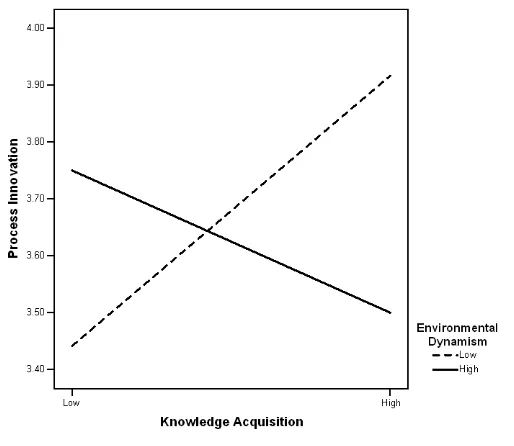
To show how Environmental Dynamism functioned as a moderator variable, further step was taken to plot out a graph depicting the relationship between Knowledge Acquisition as well as Knowledge Dissemination and Process Innovation at different levels of Environmental Dynamism. Knowledge Acquisition, Knowledge Dissemination and Environmental Dynamism were split into 2 subgroups (low and high).
13
Figure 3: The moderating effect of Environmental Dynamism on the relationship between Knowledge Acquisition and Process Innovation
Figure 4 depicts the moderating effect of Environmental Dynamism on the relationship between Knowledge Dissemination and Process Innovation. Unlike Figure 3, it can be seen from Figure 4 that the relationship between knowledge dissemination capability and process innovation performance will be stronger when the environmental dynamism is high, thus indicating that the influence of knowledge dissemination on a firm’s process innovation performance would be greater in a highly dynamic environment. Hence, H5 is supported.
14 Discussion and Implications
The purpose of this research was to investigate the effect of firms’ absorptive capacity on their innovation performance specifically process innovation by taking into consideration absorptive capacity as a multidimensional construct consisting of knowledge acquisition, dissemination and utilization capabilities. The study was targeted at manufacturing firms in the northern region of Malaysia.
The findings showed that no significant relationship was detected between knowledge acquisition and firms’ process innovation performance. However, knowledge dissemination and knowledge utilization were found to have a positive effect on firms’ process innovation performance. The findings generally concur with the findings of Jantunen (2005), Zahra and George (2002), Fosfuri and Tribo (2006) and Todorova and Durisin (2007). Having knowledge is one thing. In order to be innovative, it is what is done with that knowledge that matters. Knowledge must flow freely around the firm whereby the better the dissemination and utilization of knowledge, the greater the likelihood of innovation to occur as more people across levels and departments of the organization are exposed to new knowledge that interacts with existing knowledge (Darroch, 2005). These results do not, however, undermine the importance of knowledge acquisition. Compared to knowledge dissemination and utilization, knowledge acquisition may have more of an indirect or supporting role in innovation activities.
The findings also showed that firms operating in a dynamic, fast-changing environment acquire less external knowledge than those operating in more stable and predictable conditions. The finding contradicted Jantunen’s (2005) findings. This suggests that, for innovative firms, the influence of external knowledge acquisition on firms’ innovation performance would be greater in a low or less dynamic environment than that in a greater dynamic one. This finding was supported by Liao et al. (2003). This may be due to the fact that firms possess limited resources and have a limited degree of specialization in information acquisition. More often than not, top management is usually the one responsible for this important activity. As the environment becomes more dynamic, firms’ management face a greater volume and complexity of both information and knowledge. At times like these, it seems that they choose to be more internally-focused by developing disseminating and utilization capabilities, buffering them from being overloaded with information and reducing organizational uncertainty (Liao et al., 2003).
In stark contrast, firms were found to disseminate more knowledge, which then leads to process innovation, in dynamic and fast-changing environment. When environmental dynamism is high, knowledge flows within the organization becomes crucial for sustaining innovative performance. The findings lent no support for the interaction effect between environmental dynamism and knowledge utilization capability. However, the relationship between knowledge utilization and firms’ process innovation performance was significant even without environmental dynamism as the moderator. It seems that the dynamism of the environment does not affect the firms’ knowledge utilization capability. Firms are consistently utilizing the available information and knowledge to upgrade their processes despite whatever environmental conditions.
15
companies. Thus, in order to sustain innovative processes in a dynamic environment, firms must work on their ability to constantly update and renew their knowledge base.
Limitations and Future Research
The findings of this study should be interpreted in light of its limitations. Firstly, the feedbacks were self-assessments from the respondents. Although several steps in both the design and testing phases have been taken to limit concerns regarding single-informant data, the issues of key informant bias and common method bias cannot be totally ruled out. However, confidentiality that was assured for respondents reduced the concern that respondents artificially inflated or disguised their responses. Furthermore, the respondents had a senior status in their company, it appeared that common-method variance should not be a considered a serious problem.
Secondly, this study was confined to the northern region of Malaysia only due to time and resources constraints. Consequently, the sample size of this study is relatively small. There is no specific reason to believe that other parts of Malaysia might cause the results to be biased in a predictable direction. However, by extending this research throughout the whole of Malaysia, the generalizability of the findings would increase. Fortunately, this is a very feasible avenue for future research.
Finally, the data employed in this study were cross-sectional. It may give a very static view of the innovation process. It is clear that in order to establish the causal claims of the model one needs longitudinal data. Hence, our results should be interpreted as association among variables and not in terms of causality.
The present study provides several issues for future research. Future research may examine the relationship between organizational practice and innovation performance, such as formalization, job rotation, cultural factor, leadership and others. Future studies may also incorporate multiple levels of analysis. The use of the concept of absorptive capacity has not been limited to the firm level; it ranges from the level of the individual to that of entire nations (Van Den Bosch et al., 2003; Narula, 2004).
Concluding Remarks
16 References
Andreeva, T., & Kianto, A. (2011). Knowledge processes, knowledge intensity and innovation: A moderated-mediation analysis. Journal of Knowledge Management, 15(6), 1016-1034.
Becherer, R.C., & Maurer, J. G. (1997). The moderating effect of environmental variables on the entrepreneurial and marketing orientation of entrepreneur-led firms. Entrepreneurship Theory & Practice, 22(1), 47–58.
Camisón, C., & Forés, B. (2010). Knowledge absorptive capacity: New insights for its conceptualization. Journal of Business Research, 63(7), 707-715.
Chandler, G. N., Keller, C., & Lyon, D. W. (2000). Unraveling the determinants of an innovation-supportive organizational culture. Entrepreneurship Theory & Practice, 25(3), 59-76.
Chapman, R., & Magnusson, M. (2006). Continuous innovation, performance and knowledge management: An introduction. Knowledge and Process Management, 13(3), 129-131.
Cohen, W. M., & Levinthal, D. A. (1990). Absorptive Capacity: A New Perspective on Learning and Innovation. Administrative Science Quarterly, 35(1), 128-152.
Darroch, J. (2005). Knowledge management, innovation and firm performance. Journal of Knowledge Management, 9(3), 101-115.
Duncan, R. G. (1972). Characteristics of organizational environments and perceived environmental uncertainty. Administrative Science Quarterly, 17(3), 313-327.
Fosfuri, A., & Tribo, J. A. (2006). Exploring the antecedents of potential absorptive capacity and its impact on innovation performance. Omega, 36(2), 173-187.
Galbraith, J. R. (1974). Organization design: An information processing view. Interfaces, 4(3), 28-36. Gebauer, H., Worch, H., & Truffer, B. (2012). Absorptive capacity, learning processes and combinative
capabilities as determinants of strategic innovation. European Management Journal, 30(1), 57-73. Goll, I., Johnson, N. B., & Rasheed, A. A. (2007). Knowledge capability, strategic change, and firm
performance: The moderating role of the environment. Management Decision, 45(2), 161-179. Hair, J. F. Jr., Black, W.C., Babin, B. J., Anderson, R.E., & Tatham, R.L. (2006). Multivariate Data
Analysis (6th ed.). Upper Saddle River, New Jersey: Pearson Prentice-Hall.
Helfat, C., & Lieberman, M. (2002). The birth of capabilities: Market entry and the importance of pre- history. Industrial and Corporate Change, 11(4), 725-760.
Helfat, C., & Peteraf, M. (2003). The dynamic resource-based view: Capability lifecycles. Strategic Management Journal, 24(10), 997-1010.
Helmstadter, G. C. (1964). Principles of Psychological Measurement. New York: Appleton-Century-Crofts.
Jansen, J. J. P., Van Den Bosch, F. A. J., & Volberda, H. W. (2005). Managing potential and realized absorptive capacity: How do organizational antecedents matter? Academy of Management Journal, 48(6), 999-1015.
Jantunen, A. (2005). Knowledge-processing capabilities and innovative performance: an empirical study. European Journal of Innovation Management, 8(3), 336-349.
Kim, L. (1997). Imitation to Innovation: The Dynamics of Korea’s Technological Learning. Boston, MA: Harvard Business School Press.
Kim, W.C. (1998). Crisis construction and organizational learning: Capacity building in catching up at Hyundai Motor. Organization Science, 9, 506-521.
Kim, C.-S., & Inkpen, A. C. (2005). Cross-border R&D alliances, absorptive capacity and technology learning. Journal of International Management, 11(3), 313-329.
Kogut, B., & Zander, U. (1996). What firms do? Coordination, identity, and learning. Organization Science, 7(5), 502-518.
17
Lev. S., Fiegenbaum, A., & Shoham, A. (2009). Managing absorptive capacity stocks to improve performance: Empirical evidence from turbulent environment of Israeli hospitals. European Management Journal, 27(1), 13-25.
Liao, J., Welsch, H., & Stoica, M. (2003). Organizational absorptive capacity and responsiveness: An empirical investigation of growth-oriented SMEs. Entrepreneurship: Theory & Practice, 28(1), 63-85.
Makadok, R. (2001). Toward a synthesis of the resource-based view and dynamic-capability views of rent creation. Strategic Management Journal, 22(5), 387–401.
McKenna, R. (1995). Real time marketing. Harvard Business Review, July-August, 87-95.
Miller, D., & Frisen, P. H. (1983). Strategic making and environment: The third link. Strategic Management Journal, 4(3), 221–235.
Mowery, D.C., & Oxley, J.E. (1995). Inward technology transfer and competitiveness: The role of national innovation systems. Cambridge Journal of Economics, 19(1), 67-93.
Narula, R. (2004). Understanding absorptive capacities in an "innovation systems" context: Consequences for economic and employment growth. MERIT Research Memorandum 2004. Nieto, M., & Quevedo, P. (2005). Absorptive capacity, technological opportunity, knowledge
spillovers, and innovative effort. Technovation, 25(10), 1141-1157. Nunnally, J. C. (1978). Psychometric Theory (2 ed.). New York: McGraw-Hill. Pallant, J. (2001). SPSS Survival Manual. Maidenhead, PA: Open University Press.
Prajogo, D. I., & Ahmed, P. K. (2006). Relationships between innovation stimulus, innovation capacity, and innovation performance. R&D Management, 36(5), 499-515.
Rajiv, S. N., & Karuna, J. (2006). A new framework to understand the technological innovation process. Journal of Intellectual Capital, 7(2), 174 - 186.
Sekaran, U. (2003). Research Methods For Business: A Skill-Building Approach (4th ed.). New York: John Wiley & Sons, Inc.
Schmidt, T. (2005). What determines absorptive capacity. Dynamics of Industry and Innovation: Organizations, Networks and Systems. Copenhagen, Denmark.
SME Corp Malaysia (2013). Definition of SMEs. Retrieved from http://www.smecorp.gov.my/v4/node/14
The Economist (2007, October 11). Something new under the sun: A special report on innovation. Retrieved from http://www.economist.com/node/9928154
Teece, D.J. (1998). Capturing value from knowledge assets: The new economy, markets for know-how and intangible assets. California Management Review, 40(3), 55-79.
Teece, D.J., & Pisano, G. (2004). The Dynamic Capabilities of Firms. In C. W. Holsapple (Ed.), Handbook on Knowledge Management 2: Knowledge Directions (pp. 195-213). Heidelberg: Springer-Verlag.
Teece, D.J., Pisano, G., & Shuen, A. (1997). Dynamic capabilities and strategic management. Strategic Management, 18(7), 509-533.
Todorova, G., & Durisin, B. (2007). Absorptive capacity: Valuing a reconceptualization. Academy of Management Review, 32(3), 774-786.
Van der Bij, H., Michael Song, X., & Weggeman, M. (2003). An Empirical Investigation into the Antecedents of Knowledge Dissemination at the Strategic Business Unit Level. Journal of Product Innovation Management, 20(2), 163-179.
Van Den Bosch, F.A.J., Van Wijk, R., & Volberda, H.W. (2003), Absorptive Capacity: Antecedents, Models, and Outcomes., Blackwell Handbook of Organizational Learning & Knowledge Management, 278-301.
Williams, A. (1999). Creativity, Invention and Innovation. Sydney: Allen and Unwin.
18
19 Appendix
Questionnaire items
Knowledge Acquisition
AC1 - We actively observe and adopt the best practices in our sector.
AC2 - We continuously gather economic information on our operations and operational environment. AC3 - We collect industry information through informal means (e.g. lunch with industry friends, talks with trade partners).
AC4 - We periodically organize special meetings with customers or third parties to acquire new knowledge.
Knowledge Dissemination
AC5 - We have a lot of documented information on the successes and failures related to product development and marketing.
AC6 - We use a lot of time to figure out why our project succeeded. AC7 - We use a lot of time to figure out why our project failed.
AC 8 - In our company we are not used to documenting in writing the things that are learned by experience. (reverse)
AC9 - We often update our instructions.
Knowledge Utilization
AC10 – Employee record and store newly acquired knowledge for future reference.
AC11 - Our organization quickly recognizes the usefulness of new external knowledge to existing knowledge.
AC12 - Employees hardly share practical experiences. (reverse)
AC13 - It is clearly known how activities within our unit should be performed. AC14 - Our organization has a clear division of roles and responsibilities. AC15 - We constantly consider how to better exploit knowledge.
AC16 - We change our practices when customer feedback gives us reason to change.
AC17 - When someone in our company needs information about customers or marketing, he/she knows to whom to turn.
Environmental Dynamism
EN 1 - In our field of business the life cycle of products is typically long. (reverse) EN 2 - In our field of business customers’ preferences are quite stable. (reverse) EN 3 - In our field of business knowledge and know-how go quickly out of date.
EN 4 - In our field one cannot succeed if one is not able to launch new products continuously. EN 5 - Our operational environment changes slowly.
EN 6 - Technological development is rapid in our field of business.
EN 7 - In our field of business no one yet has the know-how needed a few years hence.
Process Innovation
PR1 - The technological competitiveness of our organization.
PR2 - The speed with which we adopt the latest technological innovations in our processes. PR3 - The updatedness or novelty of the technology used in our processes.