295
IMPROVING THE ENERGY CONSUMPTION OF AN INTENSIVE
RECIRCULATING ACQUACULTURE SYSTEM USING A WATER-WATER
TYPE HEAT PUMP
LAZA E.A.1), CABA I.L.1), COSTACHE M.2), MATACHE A.3), DUMITRU D.N.4), SÎRBU F.D.5), ANDREI P.6)
1)
INMA Bucharest / Romania; 2) S.C.D.P. Nucet / Romania; 2)SAFE SMART SYSTEM Câmpina; 4)
SC IOR SA Bucharest / Romania; 5) AGROMAD Crops SRL / Romania; 6)SC CALORIS SA Bucharest / Romania
E-mail: [email protected]
Keywords: recirculating aquaculture system, energy consumption
ABSTRACT
Aquaculture efficiency practiced in recirculating systems depends on a variety of factors, among which the most important is the energy consumed by the whole system. In order to assure a high degree of energy conservation, in a recirculating aquaculture system has to be maximized the recirculating water degree and has to be imposed the use of renewable energy sources for heating, respective for cooling the water within system as well as of hall. Maintenance of an appropriate climate in a recirculating aquaculture system involves high energy
consumption, determined by high water quantities which have to be heat or cool, as well as determined by maintaining water temperature and of breeding space.
An optimal solution for replacing conventional systems of heating/cooling and optimizing of energy consumption is the use of the heat pumps. In the present paper are presented experimental results performed with a heat pump of water-water type at different water-water replacing rates and two different water flows for demonstrating efficiency of a heat pump for improving energy consumption of a RAS.
INTRODUCTION
Worldwide, the aquaculture practiced in recirculating system presents a high interest especially valuable fish species.
Recirculating aquaculture systems in comparing with aquaculture practiced in traditional way in ponds present the advantage of land and water resources economy and allow fish growing in
controlled environment conditions
(Cristea V., et al., 2002; David E-A, et al. 2014).
This type of system allows water treatment by removal of residual solids,
ammonia and nitrites oxidation,
elimination of carbon dioxide, aeration
and/or oxygenation and water
disinfection, if necessary (Cristea V., et al., 2002; David E-A. et al. 2014).
The efficiency of aquaculture practiced within recirculating systems depends of a variety of factors, among which the most
important is the system energy
consumption. To ensure a high degree of conservation of energy in a recirculating aquaculture system, the water recycling degree has to be maximized and has to be imposed the use of renewable energy resources for heating or cooling water or hall has to be imposed. In this purpose the optimal solution is to use water heating/cooling by a heating pump (Gavrilescu R., 2003, David E-A. et. al, 2014).
Maintaining an appropriate climate in a recirculating aquaculture system involves high energy consumption, determined by high water quantities which have to be heated or cooled.
An optimal solution for replacing
conventional systems of heating,
296
energy consumption is using of the heat pumps.
The main heat pumps used in the present in function of the nature of the cool source are of air-water, water-water and soil-water types (David E-A, et al. 2014; Florescu A., et al. 1985; Gavrilescu R., 2003; Pop A. and David P., 2007).
By comparative analysis of different types of heat pump, depending on the nature of the source of the used energy, result the following data within table no.1. (Gavrilescu R., 2003; Pop A. and David P., 2007).
Table 1
Types of heat pumps according to the type of energy source used Type/Characteristic Air – Water Water –Water Soil – Water
Value COP small big big
Variation COP Depending on the
climate conditions variable constant
relatively constant
Installing costs small big very big
Operating safety small big big
Thermic power small very big big
Possibility of passive cooling no yes only models with
vertical wells
In which COP is the coefficient of real performance and is defined as a ratio between the produced thermic energy
and electric energy consumed for
producing it.
The operation of heating / cooling water from the RAS heat pump type water - water is shown in the figure below. The system consists of five different circuits.
A – primary circuit of groundwater
extracted from the well, (cool source), B – circuit of refrigerant,
C – intermediate circuit of warm or cold
water,
D – circuit of passive cooling,
E – circuit of recirculating aquaculture
system, RAS.
For carrying out the heat, the groundwater extracted from the well (1) by means of the submerged pump (2) reaches the evaporator of the heat pump (4), where it gives off heat of the refrigerant, which evaporates.
Groundwater which is initially at a temperature of 8 ÷ 10°C, while passing through the evaporator is cooled to approx. 5°C, to about 3 ÷ 5°C.
This water is reintroduced into the second well (drain well). Refrigerant, which has boiling temperature at -2°C, takes heat from the groundwater and
turns into vapor. The vapor are
compressed in the compressor and go to a temperature of + 73.5°C, after which
get the condenser, where by
condensation give off heat (latent heat of evaporation) to the water from an
intermediate circuit. The refrigerant
returns to a liquid state and the cycle continues. The water heated in the intermediate circuit at 65 ÷ 68°C is
introduced into the external heat
exchanger (6), where it gives up heat to the water re-circulated from the basins of the fish growing.
The cooling process is carried out in a similar manner, only the water circuits of the heat pumps reverse. Water reaches the secondary circuit evaporator where the refrigerant gives off heat that vaporizes and groundwater takes heat from the refrigerant in the condenser (Răduleț R. et al., 1957-1966). The water
cooling process is used only in
exceptional cases (at very high
297
This operating mode is particularly advantageous because it consumes only
electricity required for driving the
submersible pump (David E-A, et al., 2014; Florescu A. et al. 1985; Pop A. and David P., 2007; Pop A., 2007).
The functioning scheme of a heat pump for RAS
MATERIAL AND METHOD
The recirculating aquaculture system on which has been executed the experiments in order to determine the energy consumption using the heat pump was composed of: 9 basins for fish
growing with a volume of 5.65 m3
water/basins, water supply systems and drainage, in and from the basins, a group of pumps, an UV sterilizing apparatus,
biologic filter, installation of
heating/cooling with heat pump, heat exchanger, aeration and oxygenation systems, continuous monitoring devices of the physical-chemical parameters of the water (probes for the determination of oxygen dissolved, temperature, nitrate and nitrite, pH, conductivity, and turbidity of the suspended solids, ammonium), control and automation installation and drilling for cleaning water.
For the water heating experiment, the
storage basins was filled with water after which the valves of the basins have been open. The water volume contained in the system was:
VT = n x VB + VBS = 9 x 5,65 + 21,2
m3 = 72,05 m3
where: VT [m³] – total volume of water
contained in the system; VB [m³] – real
volume of the tank used for growing; VBS
[m³] – real volume of the storage basin; n – number of the breeding basins;
Within calculation was neglected the water amount contained in the pipes as it is about 0.01% of the total volume of water. Since the drilling system for the fresh water supply is equipped with a
pump of small capacity (for cca.7 m3/h),
filling the entire system was performed in several steps, in total in 36 hours. Because of the operation duration, the temperature of the water in the system, t1, has come to ambient temperature ta.
T1 = ta = 14°C
It has been scheduled the operating temperature of the system to be:
T2 = 20°C
Was started the water circulation in the system with the circulation pumps. As water circulation through filters does not influence the thermal balance, in order to avoid water losses and useless energy
consumption the basins evacuation
system was directly connected to
298
Then, it was performed pump heat operation. It was chosen an operating regime which allows the water heating from the secondary circuit flow to 35°C. It has been found that after approximately 10 hours of operation, water within the system has reached the temperature t2 = 20°C.
For water heating within the system has been consumed a total amount of
electrical current, Ec = 99 kWh [2,3,6].
Finally, we determined the performance coefficient of the heat pump:
COP =
99 9 . 546
c T E E
5.52
The next stage o the experiment was to maintain the operating temperature of
the system at Ts = 20°C, with different refresh rates of water. Thus, there were carried out refresh rates of the water system with 10 %/24 hours, 20 %/24 hours and 30 %/24 hours
Water replacement rate: 10 %/24 hours
The volume of the recirculating system is: Vr= 9 x 5.65 ≈ 50 m3
The amount of water for substitution is:
V1 = 10% x 50 = 5 m³/24h
After replacing an amount of about 5m³, the water temperature in the basin reached 20°C at:
T1 = 18°C
RESULTS AND DISCUSSIONS
Measurements were carried out on a heat pump water-water type for heating and cooling regimes and the obtained results were filled in the tables below.
It has been calculated the thermal energy used to heat the water up to
temperature t2 = 20°C and has been read
the electricity consumption. The experiments were repeated for different rates of replacement of the water in the system. The obtained results are shown in table no. 2.
Table 2 COP results on the rate and amount of water replacement for heating the
water in the system
Den. no.
Replacement rate [%/24 ore]
Water amount of replacement
[m3/24 ore]
Temperature t1
[ºC]
Temperature t2
[ºC]
ET
[kWh]
Ec
[kWh] COP
1 10 5 18 20 51.99 9.65 5.39
2 20 10 16 20 87.24 16.04 5.44
3 30 15 15 20 128.12 23.60 5.43
Results an average performance coefficient:
COPMedium = 5.42
The difference towards the theoretical COP is due to heat loss into the environment due on account of low degree of insulations.
Tests for water cooling were carried
299
Table 3 Measured values for water cooling
Den.
no. ta [ºC] t1 [ºC] t2 [ºC] Ec [kWh] ET [kWh] EER
1 18 25 20 69.03 462.48 6.7
2 18 24 20 56.42 377.99 6.7
3 18 23 20 43.80 293.49 6.7
4 18 22 20 31.19 208.99 6.7
Where: ta [ºC] = room temperature;
T1[ºC] = water temperature in the
system at the start of test;
T2 [ºC] = water temperature in the
system at the end of test;
Ec [kWh] = consumed electricity;
ET [kWh] = thermal energy;
EER = cooling power efficiency is the ratio of consumed electric energy and generated cooling power.
Technology for fish growing in recirculating aquaculture system is a technology of high energy consumption.
Maintaining an appropriate environment within a recirculating aquaculture system
for fish growing supposes high energy consumption as a consequence of high water quantity which has to be heated or cooled, as well as through maintaining water temperature and air in the hall.
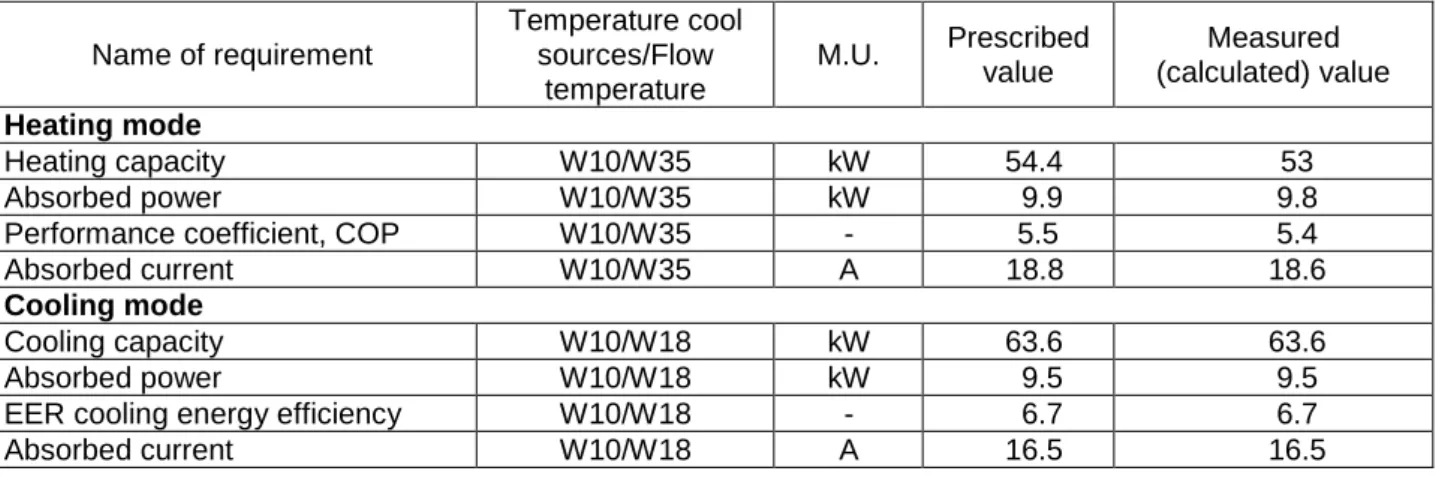
A significant share from production costs are represented by expenses with energy consumption for heating and cooling water within the basins. For this reason it is recommended to use the most efficient solutions for thermal energy producing, necessary for the system. In the table 4 are summarized the results from measurements made with a heat pump water-water type.
Table 4
Values obtained from measurements made on a heat pump type water-water for heating and cooling mode
Name of requirement
Temperature cool sources/Flow
temperature
M.U. Prescribed
value
Measured (calculated) value
Heating mode
Heating capacity W10/W35 kW 54.4 53
Absorbed power W10/W35 kW 9.9 9.8
Performance coefficient, COP W10/W35 - 5.5 5.4
Absorbed current W10/W35 A 18.8 18.6
Cooling mode
Cooling capacity W10/W18 kW 63.6 63.6
Absorbed power W10/W18 kW 9.5 9.5
EER cooling energy efficiency W10/W18 - 6.7 6.7
Absorbed current W10/W18 A 16.5 16.5
CONCLUSIONS
The technology for fish growing in recirculating aquaculture system is a technology of high energy consumption.
The most efficient method from economic point of view for heating and cooling the water from RAS is to use heat pumps.
300
BIBLIOGRAPHY
1. Cristea V., Grecu I. Ceapă C. 2002–
Engineering of recirculating aquaculture system, Ed. Didactical and Pedagogical R.A. Publishing, Bucharest, p.13-27;
2. David E-A, Pop A., Andrei Sorin -
Theoretical considerations regarding
improving energy consumption of a
recirculating aquaculture system of
superintensive fish growing, ISB INMA TEH’ 2014, International Symposium, 30
october – 1 november Bucharest, ISSN
2344-4118.
3. Florescu A. Duicu T., Burchiu N.
1985 – Installations of heating pumps,
Technical Publishing, Bucharest,
4. Gavrilescu R. 2003 – Heating pumps,
Matixrom Publishing, Bucharest;
5. Pop A., David P. 2007– Utilization of
heat pumps for water heating/cooling in
fish superintensive recirculating breeding systems., "INMATEH 2007-V c" no.23,
I.N.M.A. Bucharest, Publishing,
November 2007, ISSN 1583 – 1019, p.
209-214;
6. Pop A. 2007 – Research and
development of a technology of fish
superintensive breeding within a
recirculating system with optimization of technological parameters and assuring the sanitary-veterinary protection, PN II Programme 4 "Partnerships in Priority Areas" 2007 – 2013. Contract nr.51- 054 / 14.09.2007, p. 95-114;
7. Răduleț R. et alt., 1957-1966–