STUDENTS’ PERCEPTION ON THE IMPLEMENTATION OF
ORAI APPLICATION IN CLL METHOD IN TEACHING SPEAKING
Halimah1, Ninuk Lustyantie2, & Gufran Ali Ibrahim3 Universitas Suryakencana, Indonesia1
Universitas Negeri Jakarta, Indonesia2
Badan Pengembangan dan Pembinaan Bahasa, Indonesia3
[email protected], [email protected]2, & [email protected]
Abstract: This study aims to examine EFL learners’ perception toward the application of Orai App in CLL method in teaching speaking. The study employed likert-scale questionnaires to enable researchers to collect massive data. The total of 24 first year students of a private university in East Java – Indonesia, comprising of 5 male and 19 female students participated in this study. Data were analyzed using descriptive statistic by finding out the total score per item. The results of this study illustrated that Orai application helps students alleviate the fear of speaking. It can also help students in increasing their speaking ability on the aspects of pronunciation, intonation as well as the speaking speed. Based on the data analysis, CLL method assisted by Orai application is strongly recommended to be used to assist the students to be better speaker.
Key words: CLL Method, Orai application
INTRODUCTION
bring them success in academic work, job interviews, and their future working life – it’s the most transferable of all their skills, and a critical part of their professional development (Emden & Becker, 2004).
In Indonesia, English is considered as foreign language that is taught in a formal education setting. The key factor in the area of learning English is being able to use it and to communicate through it (Savaşçı, 2014). Widely, people do speaking to communicate. It creates the interaction with others, share ideas, thought, desire, knowledge and opinion. For students, speaking well in public will enable them to explain their ideas and persuade others to their opinions.
One of English subjects learned by the students in the university is public speaking. In line with this idea, Ahkayak & Indramawan (2013) argued that public speaking is one of the competences that should be acquired by the university students in which it has many aspects of speaking, such as pronunciation, structure, vocabulary, text structure, content, and fluency. Hence, mastering English is not an easy task even for either English student or teacher (Alharbi, 2015). It needs a big effort from both students and also the teacher of English. Moreover, speaking in front of public can cause fear of public speaking, which is referred to as communication apprehension (CA) (Grapsy, 2010). For many learners there is a genuine fear of performing to speaking that is known as speaking anxiety which can hinder performance and achievement (Zhiping & Pramasivan, 2013). Students tend to keep silent and passive in the learning process. They doubt that any action could produce results. For that reason, students tend not to speak during the speaking class.
speaking activities would more enjoyable and meaningful. One of the innovative teaching methods that is able to reduce the students’ anxiety during the teaching and learning process is Community Language Learning (Ariza, 2002) and hereafter is called as CLL.
Teaching method should be integrated together with an appropriate media as an assistant on the application in the classroom. In the preliminary stage, teachers used tape recorder as a technological device to assist students learn language. As the conventional teaching method, using this device seems to be outdated. The modern technologies can be used as a supplement to the classroom teaching method to have a lively atmosphere in the classroom. It is the need of the hour to integrate modern technologies to upgrade the level of English teaching. The modern technologies relax the mind of the students to get into the subject with full involvement rather than a difficult task to do (Bahadorfar & Omidvar, 2014). In this study Orai application as one kind of teaching media is orchestrated into CLL method to teach speaking. In addition, Orai application can help assuage students’ fears and prepare them to speak confidently in front of others (Hardman, 2018).
As an educator in this era, an English teacher should be able to integrate a teaching method with appropriate media to bring together in the classroom in order to gain the goal of teaching and learning effectively in an enjoyable way. As a consequence, a teacher of EFL in this digital era should be able to blend between the teaching method and the media technology and bring it together into the classroom to be applied in the teaching and learning. There are plenty of applications as the product of technology that can be used in the language teaching and learning such as grammarly Checker, Speech notes, Text to speech, Duolingo, and Orai application.
Language Learning), Pod casting, Quick Link Pen and Quicktionary. They said further that Technology gives learners a chance to engage in self-directed actions, opportunities for self-paced interactions, privacy, and a safe environment in which errors get corrected and specific feedback is given. Feedback by a machine offers additional value by its ability to track mistakes and link the student immediately to exercises that focus on specific errors. Some studies show the importance of qualitative feedback in software. Machmud & Abdulah (2017), for example, discovered that the use of mobile phone can minimize students’ anxiety in speaking English and in turn will improve their speaking skill. A study by Lan, Sung, & Chang (2007) revealed that mobile devices can help students in learning reading. Head, Xu, & Wang (2014) also found that ToneWarsthat is available in mobile device can improve language acquisition. Another study by Bachore (2015) showed that Mobile Assisted Language Learning (MALL) contributed significantly to the quality of education. Liu (2016) explored the use of WeChat Mobile Learning in Business English Teaching and Taki (2011) applied mobile phone to teach vocabulary. A research conducted by Eqbali & Nushi (2003) found that Duolingo reassures learners that they can achieve their learning goals and relieves their fear of doing something so demanding as learning a language.
Those researchers used media technology in language teaching. Yet, over those researches, the use of Orai application in teaching and learning speaking has not ever been revealed by the researchers. Moreover, over the teaching speaking methods, the researcher found that the CLL was a teaching method that had a courtesy on the students’ feeling, desire, love, opinion, and self of belonging.
This article reports the results of the research dealing with the application of orchestrating Orai application into CLL method by answering the follows research questions:
2. What are the students’ perceptions toward the use of Orai application in teaching and learning speaking?
LITERATURE REVIEW
General View of CLL Method
At the previous part of this study, it has been written that anxiety is a situation in which can block a foreign language learners’ ability to acquire the language successfully. One way of creating an efficient language learning environment and supporting the personal growth of learners is using a humanistic language teaching approach. CLL is one of the features which help to increase foreign language learners` confidence and motivation, lower negative affective factors, and encourage students to interact with their peers (Nurhasanah, 2015). CLL advises teachers to consider their students as a person who has feeling, instinctive, desire, love, that need to get attention from teacher during the process of teaching and learning.
In community language learning, the student determines what is to be learned, and makes the role of the teacher as the facilitator in learning activity. CLL method aims to remove anxiety from learning by changing the relationship between the teacher and students. CLL method can stimulate the students to express their mind in the class. It happens because CLL concerns with their sight sense and can be seen by them. Students are helped to raise their intrinsic motivation by which they are expected to learn English for their enjoyment and knowledge themselves (Nagaraj, 2009).
CLL Method in Speaking Class
during or after various activities to allow students to express how they feel about the language and the learning experience, and the teacher indicates. In reflective listening, students listen to their own voices on the recorder in a relaxed and reflective environment and transcribe their conversation. In self-correction, the teacher gives the students opportunity to self-correct on the transcript. In small group tasks, students work in small groups to create new sentences using the transcript, afterwards sharing them with the rest of the class. From what has been suggested by Laser-Freeman, it can be concluded that the core of learning using CLL method are recording, listening, correcting, and repeating.
CLL method promotes the student-centered learning process and decreased the teacher-centered learning. Through the stages of the learning process, the teacher’s role is as a facilitator and a counselor. There are five stages in learning process that students pass through as they learn a foreign language. The first stage is the learner fully dependent upon the teacher for everything. Stage two rises when the beginner starts to use the second language, but still need the teacher’ support frequently. Stage three occurs when the advanced student who become an independent language learner, and my resist teacher’ correction. Stage four is characterized by the role reversal, as the student is very fluent and the teacher attempts to understand. Stage five is called the independent stage. The student has completely understood the register as well as grammatically correct language use. In this stage they may become counselors to less advanced students while profiting from content with their original knower (Ariza, 2002).
Orai Application
The nature of Orai 2.0
Orai is one of the most popular Android mobile Application (Bodana, 2017). It is an application to help people to be better speakers. It is developed by Danish Dhamani. Orai gives people the confidence and skills to speak powerfully on stage, in front of public, or in everyday life (Chang, 2017). It serves as people speech coach (Takahashi, 2017). Orai is powered by artificial intelligence, which gives immediate, personalized feedback on users’ public speaking prowess (Douglas, 2017).
Orai is targeting young professionals, high school students, and college students. This app is simply equivalent of speaking into a mirror. Yet it offers an interesting solution to a common problem.
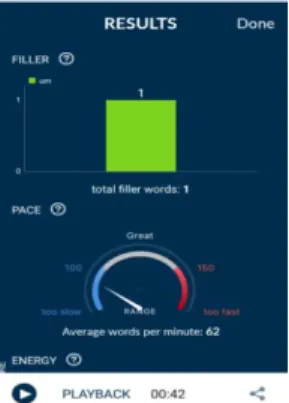
Orai picks up on filler words like ―um‖. For instance, the record app tracks the number of ―ums‖ that is uttered and points them out to speaker as unnecessary filler words that are signs of hesitation, tells speaker if she/he is speaking too fast… or too slow and provides his/her a transcript of what speaker just said - which highlights speaker’s varying energy or lack thereof. It also tells the speaker how clearly speaker is enunciating words and counts the number of words that speaker says in a minute, monitoring the pace of her/his speech.
Orai measures the ―energy‖ of speaker speech, like whether she/he speaks in a monotone that will put people to sleep or whether she/he emphasizes certain words (Takahashi, 2017).
Key Features
Bodana (2017)stated that Orai application works with machine in which it gives instant speech feedback using Artificial Intelligent (AI). It has some cool features include:
1) a recording practice and instant receiving insights which cover: - the number of filler words (um, you know, basically, you
know, and learn how to reduce them, )
- Your energy level, and gain feedback on how to improve it. It includes vocal clarity, micro-lessons on public speaking, detailed, performance tracking, audio recording and playback, accurate transcript of what you say, save your previous recordings, ability to share your recording and transcript with friends/colleagues, freestyle mode to practice anytime, anywhere, script mode to practice a prepared speech; simply copy/paste it into the app and tap record.
Figure 1 The Key Feature of Orai application
2) an ultimate speech improvement process from day 1 to day 30 to stay motivated with lesson designed to guide through.
3) a nuance and pattern in real-time speech delivery using deep-learning technologies to provide us with instant speech insight and voice analytics.
Figure 3 Vocal Analytic in Orai Application
Orai Application in Students’ Speaking Practice
Orai application is very simple to use (Hardman, 2018). It has an accurate result analysis. It analyzes users’ speech for three critical factors (Macthar, 2017). First, it looks for the overuse of ―filler words‖—the ―ums,‖ ―uhs,‖ and ―likes.‖ There’s pacing – how fast you’re talking. Then there’s energy, which has to do with vocal variation, the changes in pitch or volume that make speeches sound interesting. Then, the app presents users with feedback and tips to improve.
Figure 4 Orai application Image
The app offers several prompts to get started (Macthar, 2017). There are some stages that are done in applying Orai application in the speaking activity. Firstly, choose ―Free Style‖ which suggested the students talk about their speech. Secondly, hit the record button and speak on the microphone for the suggested 60 seconds. When it was done a feedback page popped up immediately. It consists of the numbers of the filler occur, the energy of the speech, the rapid of speech, the result summary, speech clarity, and transcript. To listen to the speech, push the playback sign. In the transcript screen, it can be seen three analysis results; filler, pace, and energy.
METHOD
The purpose of this study is to report how a mobile technology applyed in speaking class to trigger the students to learn inside and outside the class and to help them to be better speakers. With this specific aim, the researcher wants to describe how CLL method and
Orai application are applied together in the speaking class as well as to show the students’ perception on using Orai application in assisting them learning speaking. Therefore, this study applied qualitative descriptive method.
Participants
academic year of 2017/2018. The participants consisted of 24 adults aged between 18 and 25. 19 of them were female and 5 of them were male. The participants’ native language is Bahasa Indonesia and they are advanced-level English students.
Material
An informal likert-scale questionnaire was created in light of the in-class observation by the researcher who is also the instructor of the speaking course. A 16-item informal likert scale was created by the researcher. The data was elicited through five options which ranged from 1 ―Strongly disagree‖ to 5 ―Strongly agree‖ (Dörnyei, 2003). The participants were instructed to choose one of the choices reflecting their thoughts. The researcher then evaluated the results using MS Excel.
Data collection procedures
To answer the first question, the researcher observed the application of CLL and Orai application in the speaking class. Following the observation, the writer gave questionnaire to the participants. The participants were given a 16-item likert-scale questionnaire. The items were introduced to the participants until they demonstrate an adequate understanding of the procedure and they were all tested individually. This questionnaire was given to answer the second question.
Analysis
There were some steps in analyzing the questionnaire; coding and entering the data into computer, and calculating using MS Excel. The formula used to calculate the likert scale is by finding out the total score per item by using the formulation 𝑇 𝑥 𝑃𝑛, in which, T is the total of respondent’s response and Pn is Likert Score.
from: tℎ𝑒 𝑚𝑎𝑥𝑖𝑚𝑎𝑙 𝑙𝑖𝑘𝑒𝑟𝑡 𝑠𝑐𝑜𝑟𝑒 𝑥 𝑛𝑢𝑚𝑏𝑒𝑟 𝑜𝑓 𝑟𝑒𝑠𝑝𝑜𝑛𝑑𝑒𝑛𝑡. The minimum score was obtained from:
𝑡ℎ𝑒 𝑚𝑖𝑛𝑖𝑚𝑢𝑚 𝑙𝑖𝑘𝑒𝑟𝑡 𝑠𝑐𝑜𝑟𝑒 𝑥 𝑛𝑢𝑚𝑏𝑒𝑟 𝑜𝑓 𝑟𝑒𝑠𝑝𝑜𝑛𝑑𝑒𝑛𝑡.
After that the writer found the Index by using the following formula:
I % = 𝑇𝑜𝑡𝑎𝑙 𝑠𝑐𝑜𝑟𝑒𝑌 𝑥 100.
Finally, the researcher tried to find out the Interval score by counting
100
number of likert option (Sugiyono, 2010)
FINDINGS
The Practice of Orai Application Orchestrated in CLL Method in Teaching Speaking
Over the observation, the writer found a new formula in using CLL method in teaching speaking. This formula consists of four stages; recording, listening, correcting, and repeating. The writer called this formula as RLCR. The stages of the activities are described as follows:
The first stage of students’ activity was recording. In this state the students were recording their utterances or speaking. Hence, before they record their voice, the students were allowed to ask the teacher about what they were going to utter in L1, then the teacher translated the utterances in the target language. The students uttered the utterance modeled by the teacher. The students then practiced in uttering the utterance many times. The purpose of this activity is to get the students fluency. It was supported by Muhammad (2017) stating that repetition activity can help students’ fluency. After they were sure about their pronunciation and intonation and confident enough to record their utterances, then they did recording. Only the target language was recorded using Orai application.
direct feedback to the students. The feedback covered pronunciation, tone, energy, filler as well as the clarity of the students’ speech as well as the score of the speech. The result of the analysis of pronunciation can be seen in the transcribe sheet. When there was a blank sheet, it meant that the students produced incorrect pronunciation. The students’ result of speaking energy was indicated by the graphic of energy. There were two colors in it; yellow color indicated that students’ speaking was monotonous and purple color indicated the students’ speck energy. The students’ useless filler was also analyzed. At the end, students were able to get their scores of clarity. The students also got suggestion from the device. Due to the suggestions, the students then listened to their recording speech. In this stage the students would highlight their mistakes occurred.
Having reading the result or the analysis, the students might make some corrections dealing with the mispronunciation, the tone, the filler, or the energy suggested by the device. In this stage they discussed with their fellow or consulted to the teacher dealing with the error. By having discussion mean they were chanced to make communication within friend and the teacher to build a relationship between students-students and student-teacher. In stage the students practiced reading the correct speech.
The final stage was repeating. Once the students corrected their speech, they might do some repetitions in practicing the speech through the recording. As the score increased and they felt comfort with the score they might submit the score to the teacher together with the transcription of the text.
Students’ Perceptions toward the Use of Orai Application
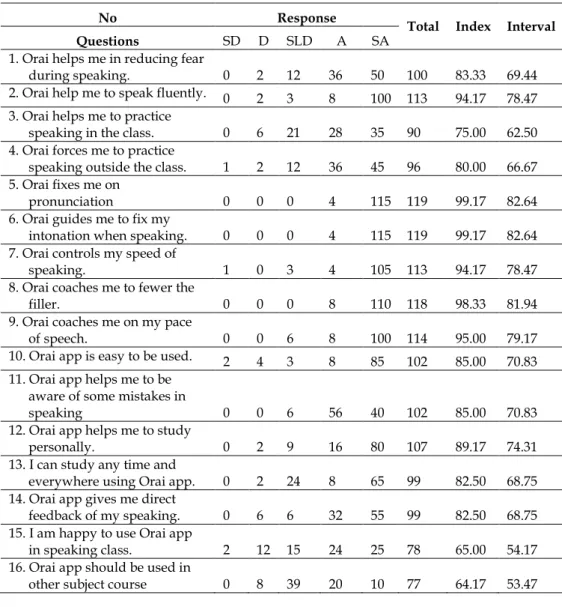
The data on students’ perception toward the use of Orai Application is presented in table 1.
Table 1 Students’ perceptions toward the use of Orai Application
No Response
Total Index Interval
Questions SD D SLD A SA
1. Orai helps me in reducing fear
during speaking. 0 2 12 36 50 100 83.33 69.44
2. Orai help me to speak fluently. 0 2 3 8 100 113 94.17 78.47
3. Orai helps me to practice
speaking in the class. 0 6 21 28 35 90 75.00 62.50
4. Orai forces me to practice
speaking outside the class. 1 2 12 36 45 96 80.00 66.67
5. Orai fixes me on
pronunciation 0 0 0 4 115 119 99.17 82.64
6. Orai guides me to fix my
intonation when speaking. 0 0 0 4 115 119 99.17 82.64
7. Orai controls my speed of
speaking. 1 0 3 4 105 113 94.17 78.47
8. Orai coaches me to fewer the
filler. 0 0 0 8 110 118 98.33 81.94
9. Orai coaches me on my pace
of speech. 0 0 6 8 100 114 95.00 79.17
10. Orai app is easy to be used. 2 4 3 8 85 102 85.00 70.83
11. Orai app helps me to be aware of some mistakes in
speaking 0 0 6 56 40 102 85.00 70.83
12. Orai app helps me to study
personally. 0 2 9 16 80 107 89.17 74.31
13. I can study any time and
everywhere using Orai app. 0 2 24 8 65 99 82.50 68.75
14. Orai app gives me direct
feedback of my speaking. 0 6 6 32 55 99 82.50 68.75
15. I am happy to use Orai app
in speaking class. 2 12 15 24 25 78 65.00 54.17
16. Orai app should be used in
other subject course 0 8 39 20 10 77 64.17 53.47
minimum score is 24. The interval score is 20 and summarized as follows: 0%–19.99% means strongly disagree, 20%–39.99% means
disagree, 40%–59.99% means slightly agree, 60%–79.99% means agree, and 80%–100% means strongly agree.
From the table, some inferences could be taken. In relation to students’ response toward the role of Orai applicationin helping the students in reducing fear during speaking, it is in the interval 69.44%.It indicates that students agree that Orai application helps students alleviate the fear of speaking so that when students are not fearful, then students’ participation to be engaged in the activities will be encouraged. The students also agree that the use of Orai application
can help their speaking fluency (interval 78.47%).
The students respond positively or agree toward the role of
Orai application in helping them to practice speaking in the class as indicated by interval 62.50% in item 3. This positive response occurs as well in item 4 (interval 66.67%). It revealed that students agree toward the idea that Orai application forces them to practice speaking outside the class. Moreover, students strongly agree that Orai application helps them to fixes on pronunciation as indicated by interval 82.64%in item 5. The same response (strongly agree) is also given by the students in perceiving the role of Orai application in guiding them to fix their intonation during speaking (interval 82.64% in item 6).
In relationto question or item 7, interval 78.47% shows that the students agree that Orai applicationcan control students’ speed of speaking. Interval 81.94% of item 8 shows that they strongly agree that Orai application coaches them to fewer the filler. In addition, the students show their agreement in some of the following aspects; Orai application coaches them on their pace of speech (interval 79.17% of item 9), Orai application is easy to use (interval 70.83% of item 10),
Orai application gives them direct feedback of their speaking (68.75% of item 14). However, the result of students’ response toward item 15 and 16 indicates that they slightly agree toward these two aspects; their feeling of happiness to use Orai application in speaking class (interval 54.17% of item 15) and the continuation of Orai application
use in other subject course (interval 53.47 % of item 16).
DISCUSSION
Being afraid of speaking in front of other is common for the students even for English department students. English teacher should be able to find a better solution to help students to cover their fear of speaking. One of the things than can be done is by applying an appropriate teaching method which does not only make the students active and creative in the teaching and learning process but also which pays attention on the students’ psychology. The teacher also should be creative in using a media in applying the teaching method in order to create a joyful teaching and learning process. Community Language Learning (CLL) method is an innovative teaching method that pays attention on the students’ feeling, desire, and opinion during the process of teaching and learning. In the application, this method is assisted by a tape recorder. As this device does not stay any longer in this era, it is substituted by an application of mobile technology called Orai that can be downloaded from Google play store to Smartphone. Then, this application and CLL method are orchestrated to be applied in speaking class in order to help students to be better in speaking skill.
Orai application is a unique and excellent app to be used as a supporting media for speaking course. It provokes the students to lean actively and happily in the classroom. They not to be worry of making mistake during practice speaking for the app gives them feedback directly and gives suggestion what should they do.
Capitalism Student Business Plan Competition, winning $40,000 in prize money so far (Macthar, 2017). The app also leads to increase levels of confidence in learning a new language (Chang, 2017; Hardman, 2018) and it promises to make anyone become a better speaker via artificial intelligence (Takahashi, 2017).
Based upon the result of students’ responses toward questionnaire, it is proved that Orai application helps students alleviate the fear of speaking so that when students are not fearful, then students’ participation to be engaged in the activities will be encouraged. It is in line with what has been said by Hardman (2018) that Orai application can help assuage fear and prepare speaker to speak confidently in front of crowd. This to some extent allows for students’ interest in the classroom, particularly in speaking class.
Orai application can help students in increasing their speaking and all aspects of speaking. For instance, the app tracks the number of ―ums‖ that the students utter and point them out to the students as unnecessary filler words as hesitation sign. As the students are able to manage the use of filler during the speaking, it shows that they can speak fluently. It is reinforced by (Takahashi, 2017)
In addition, Orai application also helps students to fix their pronunciation, intonation as well as their speed of speaking. It is supported by Douglas (2017). The app uses artificial intelligence (AI), developed by Gupta, to track users’ speech and give instantaneous, personalized feedback based on three indicators: use of filler words like ―um‖ and ―er‖, speed of speech (130-150 words per minute is the optimum), and energy or variation in tone.
Despite these good features in Orai application, there are a few cautionary notes. First, Orai’s voice recognition software didn’t always get it right. In fact, many of the words in students’ transcripts were incorrect or replaced with an underscore, symbolizing that the software did not understand. This made the students frustration of their words. This seemed to skew other areas of feedback as well, such as counting the number of filler words used. In addition, the app would give users more incentive to use it if it provided cumulative feedback over time. For instance, if it kept track of the number of filler words a speaker used over the course of several months, their pace, or energy levels, users would be able to track their long-term progress in specific areas.
CONCLUSION
This study was carried out to describe how mobile technology device called Orai application was orchestrated in a language teaching method named CLL to be used in teaching speaking that helps the students to become better speaker and to report students’ perception on the use of Orai application speaking in speaking course. In this study, the formula to implement Orai application in CLL method in teaching speaking consists of four stages; recording, listening, correcting, and repeating which is called by the researcher as RLCR. The result of the questionnaire indicates that the students have positive perception toward the use of Orai application in CLL method to teach speaking. Therefore, orchestrating CLL method and Orai application is strongly recommended for both the teacher and students in order to help them to be better speaker.
REFERENCE
Afiqah, S. N. (2011). Using Mobile Technology in Teaching Grammar in Higher Education Institutions : The i-MoL Tool Today’s, 8–9.
Indonesia. International Journal of Language and Literature, 1(2), 18– 24.
Alharbi, H. A. (2015). Improving students’ English speaking proficiency in Saudi public schools. International Journal of Instruction, 8(1), 105–116.
Ariza, E. N. (2002). Resurrecting ― old ‖ language learning methods to reduce anxiety for ... Bilingual Research Journal; Fall, 717.
Bachore, M. M. (2015). Language Learning through Mobile Technologies : An Opportunity for Language Learners and Teachers, Journal of Education and Practice,6(31), 50–53.
Bahadorfar, M., & Omidvar, R. (2014). Technology in teaching speaking skill. Acme International Journal of Multidisciplinary Research, 2(4), 9–13.
Bodana, R. (2017). Orai - Improve Public Speaking App for Android, iOS download review & Troubleshooting.Retreived form https://apptricker.in/orai-improve-public-speaking-app-for-android-ios-download-review-troubleshooting/
Chang, M. (2017). Interview with Danish Dhamani, Co-Founder of Orai – AI Airtisan.Retrieved from
https://aiartisan.wordpress.com/2017/11/27/interview-with-danish-dhamani-co-founder-of-orai/
Dörnyei, Z. (2003). Questionnaires in Second Language. Questionnaires in Second Language. New Jersey: Lawrence Erlbaum Associates.
Douglas, L. (2017). Want to captivate an audience like Obama? There’s an app for that. Retrieved from:
https://www.theguardian.com/small-business- network/2017/jul/14/obama-app-orai-public-speaking-artificial-intelligence
Grapsy, B. R. P. (2010). Speaking with confidence.Retreived from: http://www.publicspeakingproject.org/
Hardman, S. (2018). New Learning Times Article Before You Make That Speech, Check Out Orai. Retrieved from: https://newlearningtimes.com/cms/article/4227/before-you-make-that-speech-check-out-orai
Head, A., Xu, Y., & Wang, J. (2014). Tonewars: Connecting language learners and native speakers through collaborative mobile games. Lecture Notes in Computer Science (Including Subseries Lecture Notes in Artificial Intelligence and Lecture Notes in Bioinformatics), 8474 LNCS, 368–377.
https://doi.org/10.1007/978-3-319-07221-0_46
Lan, Y., Sung, Y., & Chang, K. (2007). A Mobile-Device-Supported Peer-Assisted Learning, Language Learning & Technology, 11(3), 130–151.
Liu, P. (2016). Mobile English Vocabulary Learning Based on Concept-Mapping Strategy, Language Learning & Technology,
11(3), 130–151.
Lys, F. (2013). the Development of Advanced Learner Oral Proficiency Using Ipads. Language Learning & Technology, 17(173), 94–116.
Machmud, K., & Abdulah, R. (2017). Using Smartphone-Integrated Model of Teaching to Overcome Students ’ Speaking Anxiety in Learning English as a Foreign. Journal of Arts & Humanities, 6(9), 1–11.
https://doi.org/http://dx.doi.org/10.18533/journal.v6i9.1249
Macthar, E. (2017). An App to Make You a Better Public Speaker Innovation Smithsonian.Retrieved from:
Emphasize for Reading Fluency or Accuracy in Improving Students’ Reading Comprehension in EFL Context. Ethical Lingua, 3448, 127–138.
Nagaraj, P. (2009). Application of Community Language Learning for Effective Teaching. The Modern Journal of Applied Linguistics , 1(3), 174–181.
Novalia, T. (2017). Using Noddy Cartoon to Improve the Writing Skill of the First Year Students of SMK Terpadu Mega Rezky Makassar. Ethical Lingua, 3448, 127–138.
Nurhasanah, S. (2015). The Use of Community Language Learning Method to Increase the Students’ Participation in Classroom Conversation. Register, 8(1), 81–98.
Savaşçı, M. (2014). Why are Some Students Reluctant to Use L2 in EFL Speaking Classes? An Action Research at Tertiary Level. Procedia - Social and Behavioral Sciences, 116, 2682–2686.
Sugiyono. (2010). Metode Penelitian Pendidikan Pendekatan Kuantitatif, kualitatif, dan R&D. Bandung: Alfabeta.
Takahashi, D. (2017). Orai app uses AI to help you become a better public speaker.Retreived from:
https://venturebeat.com/2017/05/06/orai-app-uses-ai-to-help-you-become-a-better-public-speaker/
Taki, S. (2011). Learning Vocabulary via Mobile Phone : Persian EFL Learners in Focus, Journal of Language Teaching and Research,2(6), 1252–1258.
Ulfa, M. (2014). Enhancing Speaking Skills Using Enhancing Speaking Skills Using. UnpublishedThesis.Universitas Wijaya Putra.
Zhiping, D., & Pramasivan, S. (2013). Anxiety of Speaking English in Class Among International Students in a Malaysian University.