35
PROTECTED BILLING SCHEME FOR MOBILE
COMMUNICATIONS
INDUMATHI P Dr.S.RAJALAKSHMI M.E., Ph.D.,
PG scholar Associate Professor,
Department of Computer Science and Department of Computer Science and
Engineering, Engineering,
Jay Shriram Group of Institutions, Jay Shriram Group of Institutions ,
Avinashipalayam. Avinashipalayam.
ABSTRACT
Now a day’s Mobile devices get more involved as media delivery platforms; the worth of advertising on these devices becomes significant. With billions of Mobile users worldwide, it is indeed a potentially huge market for advertising. Moreover, considering that a decent fraction of these users having Smartphone’s or tablets certainly expands this opportunity. These users spend significant time browsing the different multimedia and gaming capabilities of their devices, making them more exposed to ads. Hence to preserve the user privacy is more important one. We propose a system for delivering context, location, time, and preference-aware ads to mobiles with a novel architecture to preserve privacy. The main attacker in our model is the server distributing the ads, which is trying to identify users and track them, and to a lesser extent, other peers in the wireless network. When a node is interested in an ad, it forms a group of nearby nodes seeking ads and interested to cooperate to achieve privacy. Peers combine their interests using a shuffling mechanism in an ad-hoc network and send them through a main peer to the ad-server. In this way, preferences are masqueraded to request custom ads, which are then provided by the primary peer. Another mechanism is proposed to implement the billing process without disclosing user identities.
Keywords
Smart Phones, Mobile Ad’s, Privacy . 1. INTRODUCTION
Communications with mobiles are one of today's fastest growing industries. In a less amount of time, mobile phones have become multimedia devices also evolved into personal assistants. They are used not only for making phone calls also for data services, surfing the internet and for various multimedia applications. New mobile application domains adapt a new paradigm that specifically aims the mobile business environment. In markets, mobile advertising has two distinct meanings in distinct: advertisements moving from place to place, like advertisements displayed on the sides of vehicles, and advertisements
delivered to mobile devices such as mobile phones and personal digital assistants (PDAs). Advertisers generally use a variety of delivery methods to maximize the number of different adverts displayed, and thus maximize their overall exposure to target audiences. In this work we study the latter, focusing on delivering advertisements to our clients' mobile devices. The term wireless advertising is used to refer to mobile advertising. Mobile advertisement is a growing area of development.
36
particular, in the advertisement area. Harris Interactive, a market research company that specializes in public opinion research using both telephone and surveys on online panels, published the results of new research into consumer acceptance of mobile phone advertisements. The research judge’s current levels of consumer interest in mobile phone advertisements preferred advertising formats and the willingness of consumers to be profiled. According to the study, a surprising 35 percent of adult cell phone users are willing to accept incentive based an advertisement which indicates a potential market to invest in.Advertising in mobiles enhances communication with consumers, the messages without a required permission from the consumer cause privacy violations. Actually no matter how well advertising messages are designed, if consumers do not have confidence that their privacy will be protected, this will hinder their widespread deployment. A number of important new concerns emerged mainly stem from the truth that mobile devices are intimately personal and are always with the user, and four major concerns can be identified: mobile spam, personal identification, location information and wireless security. Experts noticed fear of spam as the strongest negative influence on consumer attitudes towards SMS advertising. So advertisers should have permission and convince consumers to “optin” before sending advertisements. A simple registration ensures sending relevant messages to an interested audience. We propose a system for delivering user- or application requested ads, tailored to match users’ preferences whilst preserving their privacy and taking into consideration context, time, and location. This is done by aggregating requests and sending them through one of the users, who later anonymously contacts the server with the list of aggregated interests. After receiving the ads, the designated user distributes them to the users in the same way they were collected, through an ad-hoc connection. Billing reports of clicks ads are managed much in the
same manner, and piggybacked on requests for ads. This prohibits the server distributing the ads from identifying users or associating them with preferences, times, and locations.
2. RELATED WORKS
Barwise and Strong studied the effectiveness of SMS (Short Message Service) advertising in the UK. They identified six types of mobile advertisements: brand building, special offers, timely media teasers, service or information requests, competitions and polls. Kaasinen analyzed user needs for mobile location-aware services. In her interviews, most users did not mind being pushed information, as long as they really needed the information. Thus, location itself is not enough to trigger pushed advertisements, but it has to be complemented with personalization. This need for personalization is recognized in a number of other studies as well. Yunos et al. addressed the challenges and opportunities of wireless advertising. They studied previous advertisers like Vindigo, SkyGo and AvantGo, and approaches and technologies currently in use. They also presented five business models applicable to mobile advertising.
37
Figure 1: The BlueMall System Architecture.The overall network structure is based on the cooperation of an edge wireless network and a core wired network. The edge side is solely based on Bluetooth technology used by mobile devices like phones or PDAs. The core network is based on a fixed 100 Mbps Ethernet local area network used to connect the Blue Mall edge infrastructure with the central database and file server. We developed client and server code, providing routines to handle detection of mobile devices, client information gathering and file deliver.
The Figure 1 shows a representation of Blue Mall's system architecture. The system considers three types of software entities: client mobile devices, Blue Mall Access Points (APs) and the Central Database and File Server. A user provided with a Bluetooth enabled mobile device is the basic example of a mobile client. There are several APs scattered all along the mall, and each AP is pre-configured to serve a different zone or area of the mall, although there can be some APs serving the same zone without disturbing each other. While wandering around the mall, a client with a Bluetooth enabled mobile device will occasionally become within range of a well-placed AP. When the user’s mobile device is spotted by the AP, the latter will contact the Central Server, searching for information
about that client. If the client didn't receive some of the advertisements and/or general store information belonging to the zone the AP is serving, our AP will retrieve it from the server and delivers it to the client.
Blue Mall is able to provide advertisements to clients without requiring any user interaction or any additional device configuration. The system is capable of determining where the user is located by detecting proximity to an AP and sending the specific advertisements based on this information. Advertisements are carefully kept and managed in the Central Server, who controls when an advertisement is outdated or what information is going to be delivered in each mall zone. These advertisements are literally pushed into the user's device, waiting for a final confirmation to be trans- mitted and stored inside the client's mobile device memory.
Another related work is on personalized mobile marketing. Short messages are regarded as the most efficient mode. Unsolicited messages, commonly known as spam, stifle user acceptance. To support personalization, messages should be appropriately tailored before sending to consumers. Advertisers should have permission and convince consumers to “optin” before sending advertisements, such as user registration for interested messages. Solutions have been deployed to personalize text messages based on the user’s local time, location, and preferences, e.g. directions to the nearest vegetarian restaurant open at the time of request. Personalization in mobile marketing means collecting and storing information about a particular person, such as monitoring of user behavior. This causes privacy concerns. To the best of our knowledge, there is no work that well solve above two challenging objectives of privacy and personalization.
3 . CHALLENGES AND CONTRIBUTIONS
38
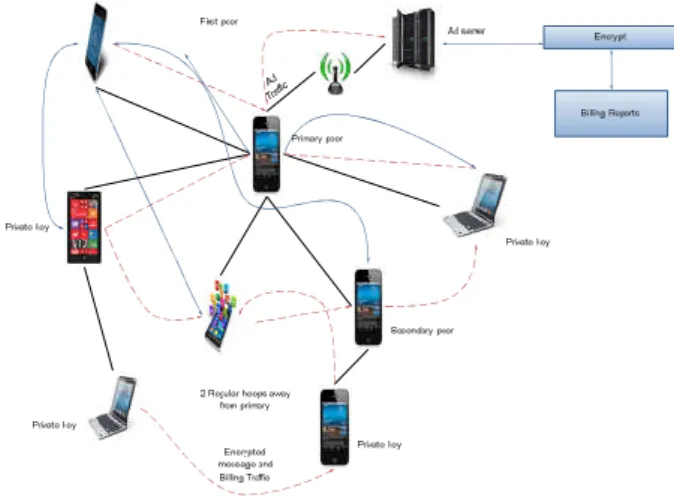
who usually subscribe to host ads for profit making. When a user accesses an application subscribed to an ad-server, the application requests an ad from the server with the user location and id. The server then checks based on the id the interests of the user through an online profile, and delivers targeted ads that refer to service providers in the vicinity of the user which are relevant to his interests. The system preserves privacy through aggregation and cooperation among peers. The group formation starts when a peer broadcasts an ad announcement. Peers who hear the message and need ads will reply with an acknowledgement and join the group. Some peers cannot hear the announcement, but can still hear the broadcast of peers that have joined the group. They too will become part of the group through the nearby peers.
After choosing the primary peer, all participants in the group generate interests based on context, time, location, and personal preference, and encrypt these interests along with billing reports, which capture their clicks on previous ads, using the primary peer’s public key. With this process, peers hide their data from each other. Next, each peer randomly chooses another peer in the group and encrypts the encrypted message with his public key, before broadcasting it. With this mechanism, only that particular peer will be able to decrypt this message before transmitting it to the primary peer. This procedure, which we call shuffling hides the identity of the peers from the primary peer, and prohibits it from colluding with the ad server. As the primary peer receives these packets, it decrypts them using its private key, and aggregates them to be sent to the server. When the ad server receives the interests, it replies with ads to the primary peer, who will then broadcast them to the group. Each peer will filter out his own ads, and rebroadcasts the ads to ensure reach ability of all peers.
Figure 2 :Depicts the Architecture diagram of the MRSE Implementation.
39
BILLING SCHEME:Billing reports are generated and stored locally on the client mobile device, until the need for requesting ads arises, at which time they are piggybacked on these requests and aggregated the same way the interests are. The billing system needs an anonymous authentication protocol with the ad sever that prevents sybil attacks.
4. METHODOLOGY OVERVIEW
ALGORITHM EXPLANATION:
First Peer broadcasts ad announcement Transmission (Tx)
After announcement the request peer join the group and then primary peer was selected.
The requesting peers are encrypts their interest send that message to the server by the primary peer.
Request peer selects Random Peers and encrypts message Processing
Request peer sends doubly encrypted ad to Request Peers and transmitted the message
Request Peer decrypts and send to primary peer for Processing.
Primary Peer decrypts received messages shuffled the message by using shuffling mechanism
Primary Peer sends messages to Ad Server for ad
Ad server replies with ads to Primary Peer
Primary Peer broadcast ads to the group Processing
Request Peers gets its own requested ads processing.
IMPLEMENTATION:
Users are connected to the internet through a network operator, and also have Wi-Fi wireless cards with ad-hoc communication capability.
Each node has a pair of public/private keys.
An authentication server is available for providing key dispensers to peers.
The first peer broadcast the ad an ad announcement.
After choosing the primary peer, all the add request send to the server through this primary peer.
Before the request send to the primary peers the secondary peer encrypt the request message and remove the user details on the request by adding nonce message.
Then the request are shuffled in the primary peer and then transmitted to the ad server, the server decrypts the request send an response to the each user.
The response broadcast by the primary peer and each peer decrypt the their request add by their nonce message, only the which peer add the message only know the location of the nonce message.
When the user clicks the ad the piggybacked message from the peer send to the server.
The server verifies the user before billing process .the billing process using anonymous authentication to prevent from the malicious attacks.
CONCLUSION AND FUTURE WORKS
40
ads and distribute them to each other, and to implement a mixing algorithm to hide the interests of users from each other and their identities from the server. We added an integrated billing scheme that serves to make the system more complete. The experimental results reveal a downright privacy level which indicates the effectiveness of the design. We presented at the end of the paper a general method that provides a rough measure of the economic value of subscribing to the ad-server and using its services.
REFERENCES
[1] L. Aalto, N. Gothlin, J. Korhonen, and T. Ojala, “Bluetooth and WAP push based location-aware mobile advertising system,” in Proc. 2nd Int. Conf. Mobile Syst., Appl., Serv., 2004, pp. 49–58.
[2] knowonlineadvertising.com [Online]. Available: http://www. knowonlineadvertising.com/ad-specs-list/, 2012.
[3] C. Andersson, M. Kohlweiss, L.A. Martucci, and A. Panchenko, “A self-certified and Sybil-free framework for secure digital identity domain buildup,” in Proc. 2nd IFIP WG 11.2 Int. Conf. Inf. Security Theory Practices: Smart Dev., Convergence Next Generation Netw., May 2008, pp. 64–77.
[4] Antutu benchmark,
https://play.google.com/store/apps/
details?id=com.antutu.ABenchMark&hl=en, 2014.
[5] Apple Inc. (2010) Apple customer privacy policy [Online] Available:
http://www.apple.com/privacy/
[6] R. Bulander, M. Decker, G. Schiefer, and B. Klmel, “Advertising via mobile terminals— Delivering context sensitive and personalized advertising while guaranteeing privacy,” in Proc. 2nd Int. Conf. E-Bus. Telecommun. Netw., 2007, pp. 15–25.
[7] R. Bulander, M. Decker, G. Schiefer, and B. Kolmel, “Comparison of different approaches for mobile advertising,” in Proc. 2nd IEEE Int. Workshop Mobile Commerce Serv., 2006, pp. 174–182.
[8] A. Bureau. (2012). Internet Advertising Revenues Set First Quarter Record at $8.4 Billion. www.iab.net/about the iab/recent press releases/press release archive/press
release/pr-061112.
[9] H. Choi, W. Enck, J. Shin, P. D. McDaniel, and T. F. La Porta, “ASR: Anonymous and secure reporting of traffic forwarding activity in mobile ad hoc networks,” Wireless Netw., vol. 15, pp. 525–539, 2009.
[10] G. Danezis, R. Dingledine, and N. Mathewson, “Mixminion: Design of a type III anonymous remailer protocol,” in Proc. Symp. Security Privacy, 2003, pp. 2–15.
[11] S. Debroy, S. De, S. Das, A. Chakbraborty, P. Das, and S. Paul, “My-PULSE: Mobile yellow pages with user interest and location sensing ensemble,” in Proc. IEEE Region 10 Conf., 2009, pp. 1–6.