254
THE SOILS STUDY IN LENAUHEIM COMMUNE PERIMETER,
TIMIŞ COUNTY
STROIA M.S1., MAZĂRE V1., STROIA M.C1., MIHUŢ CASIANA1
1University of Agricultural Sciences and Veterinary Medicine of Banat, Timisoara, Calea Aradului nr.119, zip code 300645, e-mail: [email protected]
Key words:soil, properties, Timiş, morphological caracterization, nutrients.
ABSTRACT
From the geomorphological point of view Lenauhein commune territory is situated in the great unit of relief of Banato - Crişana plain, specially in Nordic Banat plain on Galaţca – Beregsău interfluve.
Characteristic for the forest steppe area, natural vegetation in commune territory has been replaced, in a large measuring tool, by agricultural crops
Morphological characterization of the major physical and chemical soil types accurately depict current status for the supply of their products with the most important nutrients: humus, nitrogen, phosphorus and potassium. So by analyzes carried out it has been found that the best physico-chemical properties soil is Chernozemic soil.
INTRODUCTION
Detailed knowledge of productive and technological characteristics of each portion of territory, both in terms of capacity and current characteristics and possibilities in terms of real change for the better of them, ensures for every farmer a tool in the application of techniques or making economic decisions and social leading to full and efficient use of land resources.
MATERIAL AND METHOD
Samples were processed, being carried out following analyzes, and used these methods:
Determining physical accomplishments:
Soil texture was determined by the method Cernikova (the basic principle of the dripping method is the sedimentation with different speed of the particles in a liquid, depending on their size, according to Stokes's law).
Determining chemical accomplishments:
Determination of soil humus was performed by tritimetric method respectively Tiurin method.
The principle of the method consists in the oxidation soda hummus with a solution of anhydride chrome passivation or potassium bichromate, in the presence of sulfuric acid. Determination of soil reaction (pH) was performed by the method of potentiometric pH-sensitive glass electrode, at a ratio soil: water 1:2.5;
Degree of base saturation (V) - defines the rate at which colloidal complex is saturated with basic cations.
Low values of V% reflects a strong leaching, horizons debasification and reaction of an acid and properties of less favorable soil for plant growth and development of the culture.
RESULTS AND DISSCUSIONS
255
action role of each factor in the formation pedogenetic soils , varies both in space and in time, as well as in fact linking all pedogenetic factors.
In general solidification processes in this territory have evolved under the influence of bioclimatic predominant natural factors to which have been added and some special characteristics.
Batigleic typical chernozem:
Morphological:
Aţk - 0 - 5 cm layer of celery, mixed with the mineral medium clay, blackish, makes
moderate effervescence.
Amk – 5 - 50 cm, silty medium dark brown with white spots towards the base, with
good structure dezvoltstă, glomerular small and medium high porosity, netasat, brittle, thin plastic, making moderate effervescence - strong efflorescence of CO3Ca, and neoformation biogenic (bunks hatchlings, coproloite, crotovine, cervotocine).
ACkac - 50 - 75 cm, silty medium dark brown - gray, thick whitish spots; structure
developed moderate average porosity big - very big, loose-netasat makes strong effervescence, has many biogenic neoformation (crotovine, coprolite , cornevine, cervotocine and places of larvae) and unformatted common soluble salts of carbonates (sparkling spots).
Ccaac - 75 - 200 cm, silty medium gray to yellowish base under 164 cm, rusty
yellow with purple spots, unstructured, do effervescence, is poorly compacted, containing concretions of calcium carbonate and soluble salts.
Taxonomic unit soil: batigleic typical chernozem, groundwater wet, moderately
controlled sodium between 50-100 cm, carbonate weak loess material deeply the medium, silty medium / clayey medium.
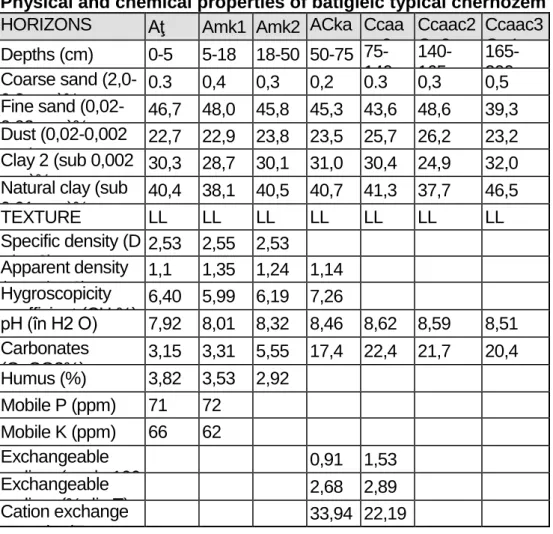
Table 1.
Physical and chemical properties of batigleic typical chernozem
HORIZONS Aţ Amk1 Amk2 ACka c
Ccaa cg2
Ccaac2 Go3
Ccaac3 Go4 Depths (cm) 0-5 5-18 18-50 50-75
75-140
140-165
165-200 Coarse sand
(2,0-0,2 mm)%
0.3 0,4 0,3 0,2 0.3 0,3 0,5 Fine sand
(0,02-0,02 mm)%
46,7 48,0 45,8 45,3 43,6 48,6 39,3 Dust (0,02-0,002
mm)%
22,7 22,9 23,8 23,5 25,7 26,2 23,2 Clay 2 (sub 0,002
mm)%
30,3 28,7 30,1 31,0 30,4 24,9 32,0 Natural clay (sub
0,01 mm)%
40,4 38,1 40,5 40,7 41,3 37,7 46,5 TEXTURE LL LL LL LL LL LL LL Specific density (D
g/cm3)
2,53 2,55 2,53 Apparent density
(DA g/cm3)
1,1 1,35 1,24 1,14 Hygroscopicity
coefficient (CH %)
6,40 5,99 6,19 7,26
pH (în H2 O) 7,92 8,01 8,32 8,46 8,62 8,59 8,51 Carbonates
(CaCO3%)
3,15 3,31 5,55 17,4 22,4 21,7 20,4 Humus (%) 3,82 3,53 2,92
Mobile P (ppm) 71 72 Mobile K (ppm) 66 62 Exchangeable
sodium (me la 100 g sol)
0,91 1,53 Exchangeable
sodium (% din T)
2,68 2,89 Cation exchange
capacity (T me/100 g sol)
256
Ca2+ (me/100 g sol)
0,65 0,53 Mg2+ (me/100 g
sol)
0,50 0,77 Na+ (me/100 g
sol)
0,28 0,65 K + (me/100 g sol) 0,013 0,103
Coarse sand values are subuinitare, oscillators, between 0.2% ACkac horizon and 0.5% Ccaac3 horizon. The fine sand is well represented with high Ccaac3 between 39.3% and 48.6% in Ccaac2 horizon.
Dust has values between 27.7 % in horizon Aţk and 26,2 % in Ccaac2 horizon . The fraction argiloază shows values which oscillates between 24.9 % in Ccag2 horizon and 32.0 % in Ccaac3 horizon.
Apparent density value (DA) is extremely low in the Aţk horizon surface has the value 1.10 g/cm3 between 18-75 cm, and low in Amk2 horizon has the value 1.35 g/cm3.
Soil reaction is low to moderately alkaline values between 7,92 in Aţk horizon and 8,62 in Ccaac1 horizon.
Up to 50 cm soil depth is weak and moderately carbonated with values between 3.15% and 5.55% CaCO3, after becoming heavily carbonated depth with values between 17.4% and 22.4% CaCO3.
The values of the humus content of the soil are between 2,92 % in Amk2 horizon and 3,82 % in Aţk horizon, middle soil being provisioned with humus.
Soil is well provisioned with P mobile and thin provisioned with K mobile.
Cation exchange capacity (T) shows values medium-sized between 22,19 me/100 g soil and 33,94 me/100 g soil.
Medium texture and glomerular structure provides good aeration and good water and air permeability, good water retention capacity useful and less resistance to soil tillage, giving it the highest agroproductive potential. Being located in an area still low and unevenly distributed rainfall, require facilities primarily for irrigation.
To maintain and restore soil fertility is necessary organic and mineral weight gain.
Cambic chernozem:
Morphological:
Ap - 0 to 18 cm, medium loamy clay, structure disturbed by tillage, wet is brittle - strong, plastic and adhesive dry moderately weak cohesive contains biogenic neoformations, thin roots and places of hatchlings.
Apt - 18 to 36 cm, clay loam environment, structure and sagging through the work disturbed soil, wet it is friable - firm, plastic and adhesive; in the dry state is low moderate cohesive, contains roots slim and neoformation biogenic sources, coprolite and places of hatchlings.
AB - 30 - 48 cm, clay loam environment is dark, medium polyhedral structure subangulară moderately developed, is compact in moist condition is firm, plastic and adhesive dry very hard, very low porosity, contains coprolite, cervatocine and places of hatchlings.
Bv - 48 - 73 cm, clay loam environment is dark, well-developed prismatic structure + polyhedral great, very compact, containing coprolite, cervotocine and places of hatchlings.
Ca - 73-96 cm, medium loamy clay, colors and shades yellow, very firm, slightly plastic and hard concrete content, efflorescence and stains effervescent calcium carbonate is strong.
Ccagsc-ac - 96-160 cm, medium loamy clay, colors and shades of 10.5 yr and
257
strong, weak plastic hard film contains concretions, carbonate efflorescence and stains, making strong effervescence.
CcaGosc-ac - 160-200 cm, medium loamy clay, lighter than Ca and intense
marbling (15-20%) reduction in color, contains as above film, efflorescence and stains readily soluble salts (carbonates and sodium bicarbonate) and concretions of CaCO3.
Taxonomic unit soil: cambic chernozem, gleyed weak hiposalic and controlled
sodium below 100 cm, low decarbonated the loess medium fine, medium clay loam / clay loam environment.
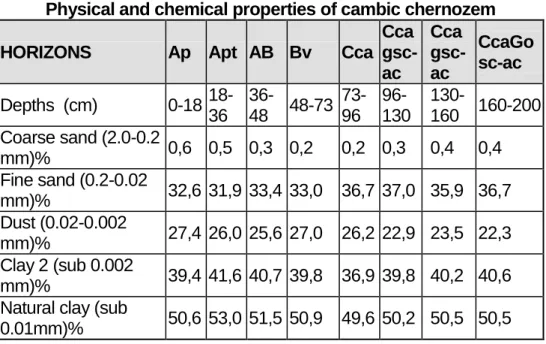
Subunit coarse sand values are between 0.2% and 0.6% Ca horizon Ap horizon. The fine sand is well represented with values that increase from upper horizon Apt from 31.9% to 37.0% in horizon-needle Ccagsc. Dust profile values are oscillating between 22.3% on the horizon CcaGosc-ac and 27.4% in Ap horizon. Clay fraction has values ranging from 36.9% in Cca horizon to 41.6% in Apt horizon.
Based on soil composition in class size texture "fine textured" subclass clay loam medium size fits the profile.
Apparent density value (DA) is very low (1.08 g/cm3) in horizon Ap, medium sized in the range from 18-48 cm (1,33 -1,44 g/cm3) and large (1.48 -1,55 g/cm3) between 48 and 96 cm.
Total porosity (PT) has small toward medium-sized values ranging from 42.80 % in horizon BV and 50,55 % in horizon AB.
Values of aeration porosity (PA) are small in the Ap horizon (11.08%) and medium AB horizon (17.01%).
Compacted soil is moderate (13.32%) in the Ap horizon, and poorly compacted (2.08%) in the AB horizon.
In the first part of the profile is neutral soil reaction (pH 7.03 to 7.18) and in the second half reaction is slightly alkaline (pH 8.25 to 8.49).
The carbonates are present at depth of 73 cm. The value of CaCO3 content being between 10.4 % in horizon Cca and 16.7 % in horizon Ccagsc-ac, soil is moderate to heavy carbonatat.
Middle ground is provisioned with humus in the range 0-36 cm (2.84-2,43 % ), and thin provisioned (1,03 -1,90 %) in the range 36-75 cm.
Table 2
Physical and chemical properties of cambic chernozem
HORIZONS Ap Apt AB Bv Cca
Cca gsc-ac
Cca gsc-ac
CcaGo sc-ac
Depths (cm) 0-18 18-36
36-48 48-73 73-96
96-130
130-160 160-200 Coarse sand (2.0-0.2
mm)% 0,6 0,5 0,3 0,2 0,2 0,3 0,4 0,4 Fine sand (0.2-0.02
mm)% 32,6 31,9 33,4 33,0 36,7 37,0 35,9 36,7 Dust (0.02-0.002
mm)% 27,4 26,0 25,6 27,0 26,2 22,9 23,5 22,3 Clay 2 (sub 0.002
mm)% 39,4 41,6 40,7 39,8 36,9 39,8 40,2 40,6 Natural clay (sub
258
TEXTURE TT TT TT TT TT TT TT TT
Specific density (D
g/cm3) 2,67 2,67 2,69 2,71 2,72 Apparent density (DA
g/cm3) 1,08 1,44 1,33 1,55 1,48
Total porosity (PT%) 44,5 6
46,0 6
50,5
5 42,80 45,5 8 Aeration porosity
(PA%)
11,0 1
11,7 4
17,0 1 9,45
13,1 4 Degree of
compaction (GT %) 13,3 2
11,0
3 2,08 16,86 10,6 3
pH in (H2O) 7,11 7,03 7,18 7,04 8,25 8,38 8,49 8,49
Carbonates
(CaCO3%) 10,4 16,7 14,7 14,2
Humus (%) 2,84 2,43 1,90 1,03
Humus reserve (t/ha) 75,6 5
62,9 8
30,3
2 3,19 Exchangeable
sodium (%din T) 0,66 0,33
Exchangeable
hydrogen(SH me/100 g sol)
6,07 1,15
Ca+2 (me /100 g sol) 0,10 0,10 Mg-+2 (me /100 g sol) 1,4 0,8 Na+ (me /100 g sol) 0,6 0,7 K+ (me /100 g sol) 0,21 0,32
The humus is low (62,98 -75,65 t/ha) in processed horizon and very small 60 t/ha for underlying horizons.
Cambic chernozem have a good fertility and are cultivated with cereals, technical plants, vegetables, and trees. Application complete irrigation during dry periods water scarcity, management of organic fertilizers and minerals contribute to higher yields.
CONCLUSIONS
In the investigated area the dominant soil types is chernozem, occupying 82.5% of the agricultural area;
Physical and chemical morphologic characterization soil types faithfully reflect the current state of their supply of the most important nutrients: humus, nitrogen, phosphorus and potassium.So in analyses found that soils with the best physicochemical properties is batigleic typical chernozem.
In view of the full value of the soil cover will take into consideration actions to correct the pH (soil acidity) and corresponding land fertilization based on agrochemicals mapping permitted and ameliorative measures and cultural agro-pedo-current aimed at achieving balanced soil aerohidric. regime with optimal functioning.
259
BIBLIOGRAPHY
Blaga, G., Filipov, F., Rusu, I., Udrescu, S., Vasile, D. – 2005, Pedologie, Ed.
AcademicPres, Cluj-Napoca
Canarache, A. – 1990, Fizica solurilor agricole, Ed. Ceres, Bucureşti
Chiriţă, C.D. – 1974, Solurile României, Ed. Agro-Silvică, Bucureşti
Duma-Copcea, A., Stroia,M. S. – 2007, Ştiinţele solului, Ed. Agroprint Timişoara
Ianoş, G. – 1995, Geografia solurilor, partea I, Pedologie, Ed. Mirton, Timişoara
Ianoş, G. -1999, Pedogeografia, Ed. Mirton, Timişoara
Ianoş, G., Puşcă, I., Goian, M. – 1997, Solurile Banatului Vol. II, Ed. Mirton,
Timişoara
Rogobete, G. – 1993, Ştiinţa solului, Vol. I, Bazele ştiinţei solului, Ed. Mirton,
Timişoara
Rusu, I., Ştefan, V., Niţă, L., Stroia, M., Duma-Copcea, A. – 2002, Favorabilitatea
solurilor din judeţul Timiş pentru principalele culturi agricole – Lucrări ştiinţifice, Vol. XXXIV, Facultatea de Agricultură, Ed. Orizonturi universitare
XXXX - 2012, Sistemu Român de Taxonomia solurilor (SRTS), Ed. SITECH, Craiova.
XXXX - 2003, Ghidul excursiilor celei de a XVII-a conferinţe naţionale pentru ştiinţa