135
PRESENTATION OF THE HYDRIC AND CHEMICAL INDICES OF THE
MAIN TYPES OF SOIL IN RECAS VITICULTURE CENTRE, TIMIS
COUNTY
KOCIS ELISABETA1, ADALBERT OKROS1, CASIANA MIHUȚ1, LUCIAN NIȚĂ1, ANIȘOARA DUMA COPCEA1
, MARIUS BOLDEA1 1
USAMV Timisoara, Calea Aradului,Nr. 119, Timisoara, e-mail: [email protected]
Key words: soil, hydric and chemical indices, pH, analyses, land, viticulture centre
ABSTRACT
In order to reach the aim of this paper, we established the following objectives that we researched in the field and in the laboratory:
identification of the soils and of soil units and land units
morphological, physical and chemical characterization of the main types of soil,
We made use of several research methods that are specific for pedology: soil mapping, morphological description, expeditive field determinations, laboratory analyses, processing the data referring to soils, etc. Thus, we identified nine genetic types of soil in the perimeter under research, after direct observations made recently in the field and processed in the laboratory.
INTRODUCTION
Soil, a means of production and object of human work, is defined in the reference literature through a wide range of physical characteristics and socio-economic features, different from any other means of production because of some unique elements it possesses (Niţă L. D., 2004):
land is a creation, and it represents a product of human intervention only to a small extent;
in the process of production, land is not “consumed“ if it is used in a rational way, but on the contrary, its quality can be improved;
it is limited in space and cannot be multiplied.
The production capacity of lands is extremely varied, which determines great differences in the productivity of agricultural producers (Țărău D., 2006).
As a matter of fact, the choice of the "right" place or making sure that a certain place is suitable for certain uses and crops was the first concern of agriculturists (after the stage of itinerant agriculture), and this skill was acquired intuitively and was transmitted from generation to generation. (Blaga Gh., Rusu I., Udrescu S., Vasile D., 1996).
MATERIAL AND METHOD
136
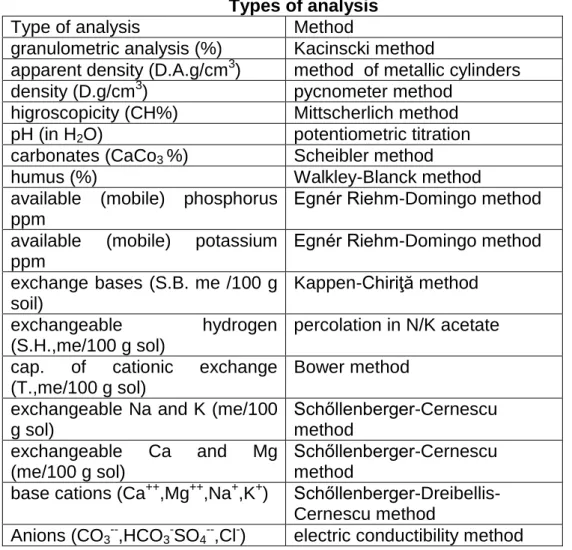
physical and hydrophysical characteristics, we sampled soil in natural setting in metallic cylinders of known volume, with the soil humidity at the time, in cardboard boxes (made specially for this); then we could perform the micro-morphological characterisation.In order to make the physical, chemical and partially biological characterisation, we took samples in the modified setting. The samples were placed in bags, on every genetic horizon. We also took agrochemical samples (from the toiled layer) in order to determine certain specific chemical indices. The study of the ecopedological conditions and the morphological description of the soil were performed in conformity with "Sistemul Român de taxonomie a solurilor" ("The Romanian Soil Classification System") (1980), completed and/or modified by "Metodologia elaborării studiilor pedologice" ("The Methodology of Performing Pedological Studies" - vol. I, II, III), issued by The Research Institute for Soil Science and Agrochemistry from Bucharest in 1987. The analyses and other determinations were performed in laboratories pertaining to the Office for Soil Science and Agrochemistry from Timişoara, and to Banat University of Agricultural Sciences and Veterinary Medicine from Timişoara. They were performed in compliance with national norms and standards, approved by A.S.R.O. (The Romanian Standards Association). Thus, the following analyses were performed (Table 1):
Table 1 Types of analysis
Type of analysis Method
granulometric analysis (%) Kacinscki method
apparent density (D.A.g/cm3) method of metallic cylinders
density (D.g/cm3) pycnometermethod
higroscopicity (CH%) Mittscherlich method
pH (in H2O) potentiometric titration
carbonates (CaCo3 %) Scheibler method
humus (%) Walkley-Blanck method
available (mobile) phosphorus ppm
Egnér Riehm-Domingo method
available (mobile) potassium
ppm
Egnér Riehm-Domingo method
exchange bases (S.B. me /100 g soil)
Kappen-Chiriţă method
exchangeable hydrogen
(S.H.,me/100 g sol)
percolationin N/K acetate
cap. of cationic exchange
(T.,me/100 g sol)
Bower method
exchangeable Na and K (me/100 g sol)
Schőllenberger-Cernescu method
exchangeable Ca and Mg
(me/100 g sol)
Schőllenberger-Cernescu method
base cations (Ca++,Mg++,Na+,K+) Schőllenberger-Dreibellis-Cernescu method
Anions (CO3--,HCO3-SO4--,Cl-) electric conductibility method RESULTS AND DISCUSSIONS
137 Stagnic preluvisol, slightly stagnogleized
Vertic reddish preluvisol, slightly gleized in-depth Vertic reddish preluvisol with in-depth stagnogleization Stagnic vertic preluvisol
Stagnic vertic preluvisol, slightly stagnogleized Stagnic vertic preluvisol with slight stagnogleization
Stagnic vertic preluvisol strongly stagnogleized
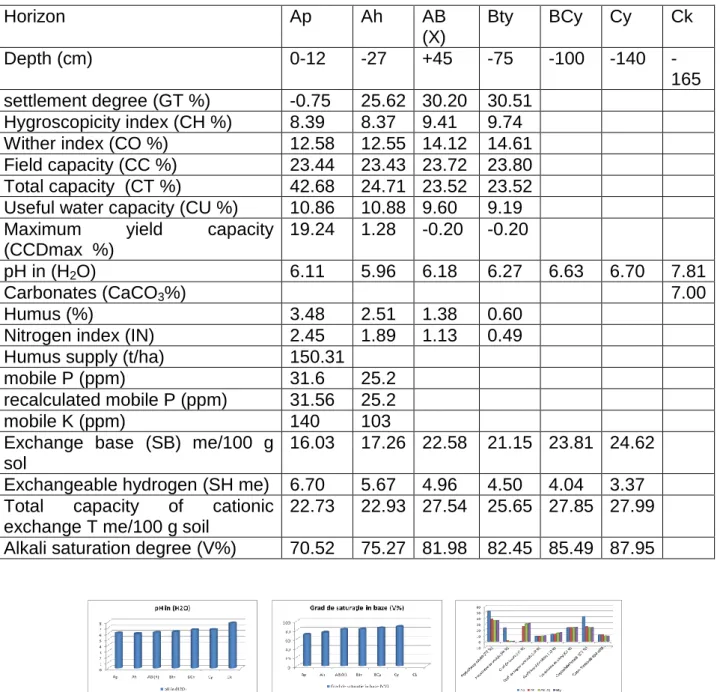
Thus, we obtained the following data regarding vertic reddish preluvisol with in-depth stagnogleization (Table 2): the values of the withering coefficient increase together with depth, from 12.58% Ap horizon to 14.61% in Bty horizon, being high. The values of the field capacity increase from 23.44% Ap horizon, to 23.80% in Bty horizon, being medium.
138
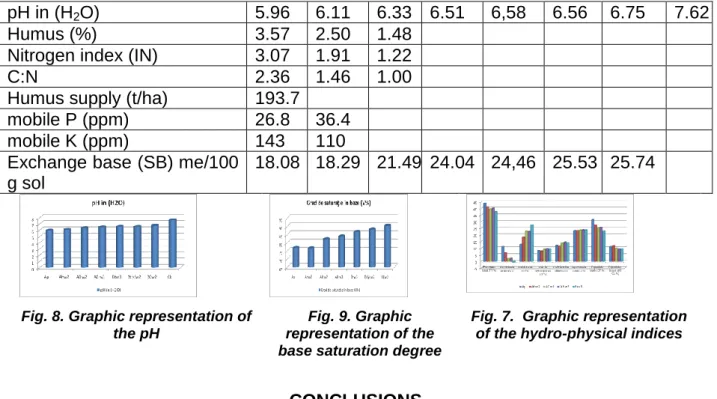
the depth, from 18.08 me/100g soil in Ap horizon to 25.74 me/100g soil in BCw2 horizon, being medium. Exchangeable hydrogen has values that range from 5.58 me/100g soil in Ahw2 horizon and 2.76 me/100g soil in BCw2 horizon, being medium at the surface and very small in-depth. Total capacity of cationic exchange has values that increase together with the depth from 23.55 me/199 g soil in Ap horizon to 28.93 me/100g soil in Btw2 horizon, being medium. The values of alkali saturation degree increase as we go deeper into the soil, from 76.62% in Ahw2 horizon to 90.31 in BCw2 horizon, the soil being eubasic (fig. 9).
Table 2. Hydro-physical and chemical properties of vertic-reddish preluvisol with in-depth
stagnogleization
Horizon Ap Ah AB
(X)
Bty BCy Cy Ck
Depth (cm) 0-12 -27 +45 -75 -100 -140
-165
settlement degree (GT %) -0.75 25.62 30.20 30.51
Hygroscopicity index (CH %) 8.39 8.37 9.41 9.74
Wither index (CO %) 12.58 12.55 14.12 14.61
Field capacity (CC %) 23.44 23.43 23.72 23.80
Total capacity (CT %) 42.68 24.71 23.52 23.52
Useful water capacity (CU %) 10.86 10.88 9.60 9.19
Maximum yield capacity
(CCDmax %)
19.24 1.28 -0.20 -0.20
pH in (H2O) 6.11 5.96 6.18 6.27 6.63 6.70 7.81
Carbonates (CaCO3%) 7.00
Humus (%) 3.48 2.51 1.38 0.60
Nitrogen index (IN) 2.45 1.89 1.13 0.49
Humus supply (t/ha) 150.31
mobile P (ppm) 31.6 25.2
recalculated mobile P (ppm) 31.56 25.2
mobile K (ppm) 140 103
Exchange base (SB) me/100 g sol
16.03 17.26 22.58 21.15 23.81 24.62
Exchangeable hydrogen (SH me) 6.70 5.67 4.96 4.50 4.04 3.37
Total capacity of cationic
exchange T me/100 g soil
22.73 22.93 27.54 25.65 27.85 27.99
Alkali saturation degree (V%) 70.52 75.27 81.98 82.45 85.49 87.95
Fig. 2. Graphic representation of the
pH
Fig. 3. Graphic representation of the
V%
139
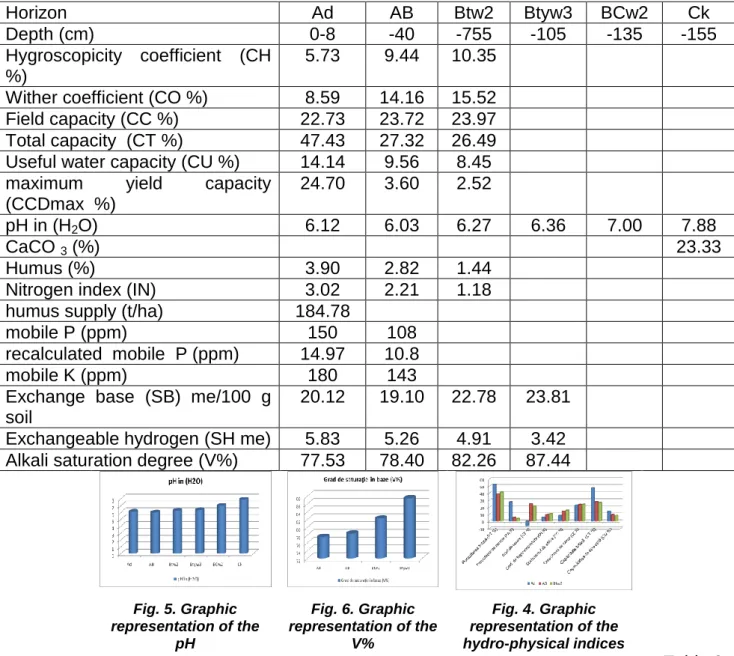
Table 2.
Hydro-physical and chemical properties of slightly stagnogleized
stagnic-vertic preluvisol
Horizon Ad AB Btw2 Btyw3 BCw2 Ck
Depth (cm) 0-8 -40 -755 -105 -135 -155
Hygroscopicity coefficient (CH %)
5.73 9.44 10.35
Wither coefficient (CO %) 8.59 14.16 15.52
Field capacity (CC %) 22.73 23.72 23.97
Total capacity (CT %) 47.43 27.32 26.49
Useful water capacity (CU %) 14.14 9.56 8.45
maximum yield capacity
(CCDmax %)
24.70 3.60 2.52
pH in (H2O) 6.12 6.03 6.27 6.36 7.00 7.88
CaCO 3 (%) 23.33
Humus (%) 3.90 2.82 1.44
Nitrogen index (IN) 3.02 2.21 1.18
humus supply (t/ha) 184.78
mobile P (ppm) 150 108
recalculated mobile P (ppm) 14.97 10.8
mobile K (ppm) 180 143
Exchange base (SB) me/100 g soil
20.12 19.10 22.78 23.81
Exchangeable hydrogen (SH me) 5.83 5.26 4.91 3.42
Alkali saturation degree (V%) 77.53 78.40 82.26 87.44
Fig. 5. Graphic representation of the
pH
Fig. 6. Graphic representation of the
V%
Fig. 4. Graphic representation of the hydro-physical indices
Table 3. Hydro-physical and chemical properties of slightly stagnogleized stagnic preluvisol
Horizon Ap Ahw2 A0
w2
AB w3 Btw3 Bt(y)w BCw2 Ck
Depth (cm) 0-22 -35 -53 -68 -88 -123 -150
-200
Higroscopicity coefficient
(CH %)
7.99 7.67 9.16 9.74 9,46
Wither coefficient (CO %) 11.99 11.50 13.74 14.61 14,19
Field capacity (CC %) 23.33 23.25 23.65 23.80 23,73
Total capacity (CT %) 31.43 27.45 25.12 25.41 23,12
Useful water capacity (CU %)
11.34 11.75 9.91 9.19 9,54
Maximum yield capacity
(CCDmax %)
140
pH in (H2O) 5.96 6.11 6.33 6.51 6,58 6.56 6.75 7.62
Humus (%) 3.57 2.50 1.48
Nitrogen index (IN) 3.07 1.91 1.22
C:N 2.36 1.46 1.00
Humus supply (t/ha) 193.7
mobile P (ppm) 26.8 36.4
mobile K (ppm) 143 110
Exchange base (SB) me/100 g sol
18.08 18.29 21.49 24.04 24,46 25.53 25.74
Fig. 8. Graphic representation of the pH
Fig. 9. Graphic representation of the base saturation degree
Fig. 7. Graphic representation of the hydro-physical indices
CONCLUSIONS
Recaş viticulture centre is situated in the south-west of Romania, in a moderate temperate-continental climate, with shorter and milder winders; it is frequently under the influence of cyclones and hot-air masses coming from the Mediterranean sea and the Adriatic sea. Of the morphological, chemical, physical and hydro-physical characteristics that have a direct influence on the composition and growth environment of plants, and which have a determining role in other soil characteristics, the following play a greater part: gleyzation, salination, alkalization, CaCO3 content, soil reaction, humus supply, texture, porosity, useful edaphic volume and permeability. These features are more stable in time and easier to determine, even with the equipments that the specialized institutions currently have. Resulting from soil water regime, predominantly phreatic, gleization is useful for separating the soil varieties and some subtypes, while at the same time causing different favorabilities for certain cultivated plants.Hygroscopicity index vacillates between 6.61 – 9.49 %, and the wither index presents high values, between 9.2% and 14.23%.Field capacity for water in Ao horizon is medium, with values between 22.7% and 23.74% and with a clear tendency to increase in Bt horizon. Useful water capacity presents the same dynamics per soil profile, with values from 13.5% to 11.95% in Ao horizon and lower in Btz, reaching 9.59%. Humus content in cultivated preluvisols is medium, with values ranging from 3.3% to 2.46% and with a supply of 171 t/ha for 0-40 cm deep. Under forests, the humus supply is bigger. Soil reaction in Ao horizon is slightly cid, with pH values of 6.3 – 6.7. Total capacity of cationic exchange (T) is higher than 21 m.e/100 g soil, and the alkali saturation degree (V%) varies from 62% to 88%.
BIBLIOGRAPHY
Blaga Gh., Rusu I., Udrescu S., Vasile D., 1996, Pedologie, Editura Didactică şi Pedagogică. R. A., Bucureşti,
Niţă L. D., 2004, Pedologie, Ed. Eurobit Timişoara,
Țărău D., 2006, Cartarea și bonitarea solurilor și evaluarea terenurilor, Ed. Eurobit Timișoara,