Development of a Directional Supply Chain
Management Framework: A Case from the
Semiconductor Manufacturing Industry
Research Paper
Heng Aik Joo John
School of Business and Communications PSB Academy
Singapore
Boon Leing Tan
School of Postgraduate Studies PSB Academy
Singapore
Xiangmeng Huang
School of Economics and Management Changshu Institute of Technology Suzhou, China
About the authors
research interests include Supply Chain Management, Logistics Management as well as International Business Management. He conducts interactive and simulating lectures bringing in the real practical environment from his 20 years of working experience.
Boon Leing Tan is currently Academic Director at PSB Academy where he is also in-charge of the School of Postgraduate Studies as well as the School of Accounting and Finance, and heads two Academic Centres. His research interests include e-business management, technology management, supply-chain management, business process re-engineering, knowledge management and total quality management.
Xiangmeng Huang, Ph.D, is currently working as an Assistant Professor at School of Economics and Management, Changshu Institute of Technology in Suzhou, China. She conducts lectures on Supply Chain Management, Operational Management, Marketing, Consumer Behaviors and other related courses. Her research interests include green supply chain management, development of small and medium sized enterprises and service supply chain management.
Abstract
The purpose of this paper is to increase the understanding of supply chain management (SCM) by investi-gating how it can be enhanced in an international manufacturing company. The main emphasis has been on the continuous improvement strategy embedded in a single case study with significant international presence. Data were collected from in-depth interviews with key personnel representing senior and middle management and those suppliers involved in providing the raw materials in the case company.
In the case study organization, due to the continuous need to be competitive, the integration is about developing synergies between the supply chain and the customers. The project proposed an extended SCM framework where the five-stage framework process was developed based on findings from the literature review and case study. The authors developed a directive, procedural and integrative form of SCM, with the lead role played by the principal buyer, and the utilisation of common logistics service provider (CLSP) synchronised with the first-, second- and third-tier suppliers along the SC as they work towards integrating the extended SCM in a manufacturing organisation along the SC. This is necessary in markets characterized with intensive competition, high uncertainty, large amounts of customer-adapted products, and short product life cycles. This research work is limited to one US company; however, the case company has large international presence and is in top ten in their industry measured by sales, which provides some ground for the generalization of the research.
The major contribution of this paper gives an insight for managers and practitioners to the significance of power in a SCM relationship. Leadership provides the potential benefit of eliminating duplicate services as well as redundant inventory. This paper proposed a framework to better understand how power through leadership in the supply chain environment can enhance the coordination in practice.
Abbreviations:
CSCMP : Council for Supply Chain Management Professionals DSCM : Directional Supply Chain Management
SC : Supply Chain
SCM : Supply Chain Management
SMUS : Semiconductor Manufacturing US (pseudo name of case study company) US : United States
VP : Vice President
Introduction
The ever-increasing competitive environment resulting from never-ending globalisation, rapid technological advancement, more sophisticated customers and increasing availability of products are forcing management to source completely diverse methods for their organisations to succeed in the marketplace. Improving their company’s operational competitive advantage has nowadays become a priority and critical to the profitability and even survival of manufacturing organisations (Hayes and Wheelwright, 1984; Swamidass and Newell, 1987; Ward and Durray, 2000; Holweg and Helo, 2014; Liu and Liang, 2014). One way of achieving this is to effectively formulate and implement competitive strategies in a business environment.
Numerous factors, resources and management play a significant role in formulating and implementing competitive strategies for each organisation in a modern society. Cost, however, is widely recognised as the most important factor in formulating and implementing competitive strategies, especially in manufacturing organisations nowadays. The need to be cost competitive for their survival has made manufacturing organi-sations consider and adopt strategic approaches like Supply Chain Management (SCM) over the last decade. It is widely recognised that effective SCM can reduce overall costs and improve organisational productivity (Davis, 1993; Christopher, 1997; Cooper et al., 1997). SCM has continued to be an important way to enhance competitive strength (Vaaland and Heide, 2007; Ellram and Cooper, 2014). The importance of SCM can be directly related to its ability to encourage sustainability and also the flexibility in integrating green intiatives (Huang et al. 2012; 2015; Brandenburg et al., 2014; Turker and Altuntas, 2014). While SCM has become a popular strategic tool, there are, in fact, few examples of organisations that have initiated an integrated SC (Handfield and Nichols, 1998). Others, on the other hand, have focused on the lack of success in many SCM endeavours (Handfield et al., 2000).
LITERATURE REVIEW
SCM can be seen to coordinate the overall SC from raw materials suppliers to the ultimate consumer, while some organisations use SCM as a strategic and competitive weapon (Cohen and Roussel, 2005). SCM continues to be implemented by organisations as the method of sustainable competitive advantage creation (Ireland and Webb, 2007). Research has also been carried out within SMEs to look at these benefits (Rezaei, 2015). As a management philosophy, SCM views the SC as using one consolidated system approach, as a single collective entity, rather than as a set of fragmented parts, each with its own function to perform (Ellram and Cooper, 1990; 2014). In other words, the philosophy of SCM extends the concept of strategic alliance into a multiple-layered effort to manage the entire flow of goods or services from the supplier to the final customer (Jones and Riley, 1985; Ellram, 1991; Mentzer et al., 2001). SCM is a set of beliefs that each and every member involved in the SC directly and indirectly affects the performance of all the other SC members and ultimately the overall SC performance (Cooper et al., 1997). Langley and Holcomb (1992) further suggest that the objective of SCM should be the synchronisation of all SC activities to create customer value.
SCM philosophy suggests that the boundaries of SCM include not only logistics but also all other functions within the SC of an organisation and to create customer value and satisfaction. In this context, understanding customers’ values and requirements is essential (Ellram and Cooper, 1990; 2014; Tyndall et al., 1998). This SCM philosophy drives SC members towards being customer-focused. Understanding the unpredictable changing customer needs and accordingly, design the SC to deliver products will assist organisations to outperform the competition. Mentzer et al. (2001) suggest that SCM as a management philosophy has the following characteristics:
• A total system view taking an holistic approach toward the SC managing the entire flow of goods inventory from the supplier to the ultimate customer;
• A strategic, concerted effort to synchronise and make intra- and inter-firm operational and strategic
capabilities into a complete whole; and
• Customer-focused to create unique and individualised sources of customer value, leading to higher
customer service level.
Viewing SCM philosophy as a management process, members must share information among fellow SC members (Ellram and Cooper, 1990; 2014; Novack et al., 1995; Cooper et al., 1997; Tyndall et al., 1998). Cooper et al. (1997) emphasise consistent information updating among the chain members for effective SCM. The sincerity of sharing of information such as inventory levels, forecasts, sales promotion strategies and marketing strategies reduces unpredictability between supply partners and results in enhanced performance (Lewis and Talayevsky, 1997).
to long-term cooperation among the SC members (Ellram and Cooper, 1990; Novack, et al., 1995; Cooper et al., 1997; Tyndall et al., 1998). Cooperation commences with joint planning initiatives and concludes with joint control activities, to evaluate the performance of the SC components, as well as the SC as a whole (Heide and John, 1990; Cooper et al., 1997; Ellram and Cooper, 1990, 2014; Novack et al., 1995; Tyndall et al., 1998). The establishment of a common goal, couple with SC members giving the same priority and focus is a form of policy integration. Lassar and Zinn (1995) suggest that a successful relationship comes from integrating SC policy to avoid productivity and efficiency lost through redundancy and overlay, while seeking a level of collaboration that allows participants to be more effective at lower cost levels. This was further investigated by Schoenherr et al. (2014) on how partners upstream and downstream can work together to tap on each other’s strengths. Policy integration is possible if there are compatible cultures and management beliefs among the SC members.
At every stage more suppliers from different levels become involved. Noshad and Awasthi (2015) discussed the needs and challenges of supplier development, highlighting a range of published best practices. Stevens (1989) identifies four stages of SC integration discusses the planning and operating implications of each stage:
• Stage 1 describes the collection of individuals and isolated operations that are internalised in an
organisation that is characterised by staggered inventories at different locations, independent and incompatible control systems and procedures, and functional segregation. There is no or little inte-gration of the SC processes at this level. The organisation in this situation cannot respond rapidly to changes in the market and finds it impossible to exploit materials flow or market information.
• Stage 2 describes the internal functional integration where some of the departments may be com-bined. The major advantage comes from cost reduction rather than performance improvement, buffer inventory, initial evaluations of internal trade-offs, and reactive customer service.
• Stage 3 describes the internal corporate integration that is characterised by complete transparency or
visibility of effective interfaces through an SC. This includes medium-term planning, a tactical rather than strategic focus, emphasis on efficiency, extended use of electronic connectivity for linkages, and a continued reactive approach to customers.
• Stage 4 describes full SC integration by extending the scope of integration beyond an organisation’s
boundaries to embrace intra-organisation and inter-organisation across the SC. The organisation seeks deliberately to manage the interfaces as a complete chain between organisations to generate a reliable, flexible and responsive system of long-term collaboration.
In order to get to Stage 4, organisations have to understand their competitive environment completely. They need to analyse their own SCM and its present performance and relevance to that competitive envi-ronment and they have to develop and implement a strategy and a tactical plan.
includes a whole range of activities needed to plan, implement and deliver from the origin of raw resources to the ultimate consumption. In essence, SCM involves linking the various individual logistics systems of each individual member involved in the movement of goods and services along the entire SC, in one totally integrated seamless pipeline. This is similar to Cavinato’s (1992) definition of logistics as the management of all inbound and outbound materials.
The professional organisation most closely associated with the logistics profession is the Council of Lo-gistics Management, defining loLo-gistics (as in Lambert and Cooper, 2000, p. 67) as: “LoLo-gistics is that part of the supply chain process that plans, implements, and controls the efficient, effective flow and the storage of the goods, services and related information from the point of origin to the point of consumption in order to meet customers’ requirements.”
The key reasons for focusing on logistics includes: Firstly, logistics is viewed by some as one of the ‘4 Ps’ (product, price, place, promotion) of marketing, within the place function (Murphy and Poist, 1996). Failure to receive materials at the proper time can cause costly production shutdowns and place a firm in a disadvantageous competitive position (Lambert and Stock, 1993). Secondly, logistics contributes heavily to customer service, which has been recognised as the key link between logistics and marketing (Coyle et al, 2000), which acts as the binding and unifying force for all of the logistics management activities. Landeros and Monczka (1989) and Womack et al. (1990) argue that the tasks of buying and selling firms are interdependent and interconnected and that such a relationship becomes a conduit of information between manufacturers and suppliers. Apart from its contribution to achieving customisation, a logistics service provider can also contribute to the integration of the SC. When the logistics service provider expands the scope of its contribution to value adding by offering more services, there is significant impact on the relationship beyond the boundaries of organisations. It may well be that through the expansion of such alliances and the offering of supplementary logistics services, the provider will penetrate functional areas that are outside the traditional operating areas.
Therefore, the scope of logistics between sellers and buyers is critical, especially to manufacturers where time-based and cost competitiveness are critical to satisfying market demands. Thus, Cooper et al. (1997) argued that SCM is more comprehensive than logistics so that SCM means the management of multiple business processes through integrating beyond the buyer-seller interfaces, including logistics processes across the SC. In 2005, Council of Logistics Management’s Executive Vice President, Maria McIntyre, changed its name to Council of Supply Chain Management Professional (CSCMP) to better reflect that Council of Logistics Management is evolving as well to suit environmental needs (McIntyre, 2005). The CSCMP (2007) defines logistics management as “that part of Supply Chain Management that plans, implements, and controls the efficient, effective forward and reverse flow and storage of goods, services and related information between the point of origin and the point of consumption in order to meet customers’ requirements”. This is to confirm the understanding that logistics management is a large and integral part of SCM.
depend-ability, quality and scope of activities like products. Skinner (1985) proposes numerous competitive factors, including facilities and equipment, production management, human resource management, product design and engineering, project and development, and management. Krajewski and Ritzman (1996) consider cost, time, quality and flexibility the most critical. Ding et al. (2015) further studied the implications of human resources management practices on logistics and supply chain competencies, concluding that conventional practices may be insufficient to meet the changing needs. On the other hand, Chardine-Baumann and Botta-Genoulaz (2014) proposed a framework to evaluate SCM practices, looking at economic, environmental and social fields, achieving this through the use of a 3-level analytical assessment model and aggregating these fields into sustainable indexes.
Cost considerations have driven a host of strategic decisions including consideration of business cycles, global manufacturing rationalisation, outsourcing, downsizing and implementing sustainability and green concepts into processes as firms continue to seek ever lower labour and materials costs (Hennart, 2010; Jael and Lopez, 2014; Huang et al. 2012; 2015). Lin et al. (2002) demonstrate that higher level of information sharing is associated with lower total cost and shorter order cycle time. However, it should be noted that while the sharing of information is crucial, its impact on the performance of a supply chain depends on what information is shared, how it is shared, and with whom (Byrne and Heavey, 2006; Li and Lin, 2006). However, even the seamless real-time integration introduced since the conception of SCM does not indicate how the processes were developed and used in actual practice to achieve improvements in a SC.
The realisation of the need for a cultural change, a review of the main SCM concepts, processes and issues gathered from the SCM literature, and based on the authors’ knowledge and experience, have all provided the basis to enhance the existing variables that are found within the SCM domain. This resulted in an expansion and development of a theoretical framework of a set of SCM processes that should enable better integration beyond buyer-seller interfaces. Azadnia et al. (2015) thus looked at the area of supplier selection and lot order-size, suggesting that these relationships are best when based on a single objective cost-based model.
In the light of the issues from the literature review, a solid combination of directed integration through the leadership is the necessary ingredient for the successful development and enhancement of SCM (Hoyt and Blascovich, 2003). As such, a case study to determine the factors which can improve the implementation of SCM is carried out.
RESEARCH METHODOLOGY
shown that a case study is one of the most powerful project tools in the development of new theory (Voss et al., 2002) such as the Directional Supply Chain Management (DSCM). Others suggest that the case study not only acts as a means to understand theory development but as a platform to extend existing concepts (Stuart et al., 2002). Case research enables the study of complexity management within its “natural” setting, thereby yielding richer insights through observing actual practice in context (Weick, 2007).
Ellram (1996, p. 100) supports the use of a single case study when appropriate and suggests that “it is suitable when the case presents a critical case to test a well formulated theory, an extreme or unique case, or a case which reveals a previously inaccessible phenomenon”. Utilizing a case study approach reveals details at multiple levels and perspectives of a little known phenomenon and facilitates theory building (Eisenhardt and Graebner, 2007). The case study in this project potentially provides for a richer understanding of how one company, Semiconductor Manufacturing US (SMUS), a leading company in the design, manufacture and support of bonder equipment for the semiconductor industry, has successfully implemented SCM. The company had initially been unable to link and synchronise its highly complex and demanding business activities. During 2003, the company was facing difficulty in sustaining its market share and, to make matters worse, its first-tier suppliers were not responding fast enough to provide cost-effective materials. In this case study, the researcher is primarily interested in determining the driving factors behind successful SCM.
One of the authors, an employee of SMUS at the time of data collection, was not only involved with the management of the different first-tier suppliers to SMUS, but also with the whole spectrum of SC and logistics management. The said-author thus also became an informant in the case study. The other participants from SMUS were selected because of their superior knowledge and understanding of strategic developments and the relations the company has with other external organisations. The participants selected were the Vice-president of Global Supply Chain as well as the director, the strategic procurement managers, and the purchasing manager of the Asia Supply Chain department. These individuals from Asia Supply Chain report directly to the VP of Global Supply Chain. Documents from SMUS such as contract prices of materials purchased, reports, financial statements and intranet sites were used to further enhance the richness of the materials collected. The range of data collected also serve the purpose of minimising insider-biasness through such triangulation of data.
Case Study Company: Semiconductor Manufacturing US (SMUS)
commit-ment to customer service. Presently, SMUS is the leading supplier of semiconductor assembly equipcommit-ment. The company provides customers with semiconductor assembly equipment along with the complementary packaging materials and products that come into contact with the surface of the customer’s semiconductor devices.
The ability to control all assembly-related products is unique to SMUS. It allows the company to develop system solutions to the new technology challenges inherent in assembling and packaging next-generation semiconductor devices and products. This includes a variety of wafer probe cards, board interface assemblies and PC boards for wafer testing, as well as test sockets for all types of packaged semiconductor devices. SMUS employs close to a thousand worldwide and has an annual turnover exceeding hundreds of millions. The demand for the company’s products in today’s competitive semiconductor industry is concentrated on lowest cost with highest level of reliability. However, potential market penetration, high cost of research and development, and fierce competition from foreign suppliers have forced SMUS to change its manufacturing strategy.
SMUS was continuously facing competitive business pressures. It was constantly looking for sources of supply that were able to reduce its costs and improve the quality of its products. The company’s mission was to establish a global SC management infra¬structure that was able to respond with competitively cost materials. The traditional highly hierarchical organisation structures (multi-layer departments) commonly suffered from slow, poor and uncoordinated communications (Gattorna, 2003). The organisational structure for the SC in Asia shows that reports go directly to the Vice President Global SC as shown in Figure 1. SMUS has a flat hierarchical structure so that communication occurred at shorter intervals.
The total data collection period lasted slightly over 2 years. The information and data from the first-tier suppliers were captured from the period July-September 2003 to October-December 2005. Top management staff from SMUS, together with executive members from the different levels of suppliers, met in Suzhou, China from 12th to 14th May 2003 for the workshop. With the director from SMUS leading the initiatives, the goal was explained to, and understood by, the different levels of suppliers along the SC during a discussion. In May 1999, the manufacturing facility was moved to Singapore. As part of the strategy to further reduce the cost of materials and in light of the significant potential growth of the domestic market in China, SMUS intended to purchase sub-assembled components and component materials from China. This was to sustain and improve business performance by using an internal integrated business model. The migration of suppliers allowed SMUS to improve cost efficiency and simultaneously improve customer satisfaction.
KEY FINDINGS AND DISCUSSIONS
Inability to Lower Overall Costs
Vice President Operations
General Manager Operations
Vice President Global Supply Chain
Director of Material
Strategic Proc. Manager
Purchasing/ Inv. Cntrl.
Manager
Flow Team Manager
Materials Logistics Manager
IPO Manager
Fig. 1 Organisational structure of SMUS Company
SMUS would furnish any shipment to any logistics service providers that offered the lowest rate. SMUS continued with the traditional tender or contract biding processes.
In the past, SMUS had been operating in a free market with a ‘don’t come too close’ attitude towards its suppliers. The method adopted was to treat each contract on an individual basis and tender any work to a number of potential suppliers. Upon receiving quotations, the various suppliers would be assessed and the contract awarded to suitable suppliers, i.e. to those who could satisfy most of the necessary criteria. With this approach considerable negotiations were likely to take place between the customer and the various suppliers until the best possible deal could be struck. The greatest disadvantage of this approach was that it was very short-term and did not allow SMUS to build closer ties to achieve lower overall costs.
Poor Supply Chain Partner Communications
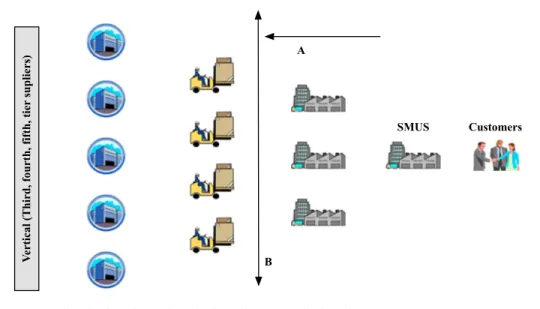
The “pass´e” approach to SCM in SMUS solely relied on the three main first-tier suppliers as shown in Figure 2. There were limited direct business dealings and communications with the second and third-tier suppliers. The communication link was only with its first-tier suppliers. This situation resulted in slowness to respond to sudden unaccountable demand as there was no visibility extended to the other levels of suppliers.
SMUS Customers A
B
3rd Tier Suppliers 2nd Tier Suppliers 1st Tier Suppliers
V
ertical (Third, fourth, fifth, tier
supliers)
Fig. 2 The “Pass´e” SCM framework
that SMUS would take the initiative to implement the extended framework. More specifically, the strategy adopted by SMUS was that it declared itself the ‘principal buyer’, by actually taking the lead in providing direction, getting more involved not only with the first- but also the second- and third-tier suppliers, and formulating a system of sharing information by all suppliers along the SC.
The “Pass
´
e” SCM
The “pass´e” approach to SC management often describes the manufacturer in an SC process as solely reliant on the three first-tier suppliers as shown in Figure 2 (indicated as arrow B). The purchasing scenario was that SMUS purchased from 1st tier, 1st tier from 2nd, and 2nd tier suppliers from 3rd tier suppliers who were the upstream suppliers. There are hardly, if ever, any direct business dealings and communications beyond 2nd and 3rd tier suppliers.
More specifically, the manufacturer usually only has communication links with its first-tier suppliers (see Figure 2, indicated as arrow A). The dealings beyond the 2nd tier of suppliers were left to the discretion of the 1st tier suppliers. A major shortcoming of this approach is that the overall response time will be slow with respect to new demand trends. If demand starts to pick up, it is likely to be transferred to the next level of suppliers. These suppliers will then react to these new demands. If another sales demand enters the SC, suppliers will again react to these new demands and soon the system of accommodating the accumulation of demands will induce an inefficient lagged response.
firm, SMUS. Having only a direct link with the first-tier suppliers, the SMUS organisation was slow in responding to an environment where customers were becoming more demanding and less forgiving. It was also losing its competitiveness. This undesirable situation prompted the researcher to seek other alternatives. The need for a new framework is clearly highlighted by a director of SMUS stating: “SMUS wants its supply chain as a whole to be able to respond to demand changes, optimise the use of SC resources, access information technology, and achieve higher overall performance levels……SMUS sees DSCM clearly as the way to circumvent the problems inherent in the traditional approach to SC management.”
PROPOSED REVISED FRAMEWORK: DIRECTIONAL SUPPLY
CHAIN MANAGEMENT
Extended SCM Framework: Five-Stage Framework
The strategy was to design a new high-level SC process that would enable organisations along the SC as a whole to respond better to the dynamic market conditions. The development stage of the extended framework considered the following: components of relationships, functionality assigned to components and links, planning/execution of components in the networks, integration of the networks and level of integration.
Identification of, and Change Managing by, Principal Buyer
Identification and Articulation of SC Objective
Adoption of Intergrated Process View of SCM and Logistics Management
Identification of Key Process and Process Attributes
Selection of Key Segment for Improvement
Roll Out
Roll Out
Roll Out 1st Tier Suppliers
2nd Tier Suppliers
3rd Tier Suppliers
Direction Direction
Fig. 3 Framework for integrating Extended SCM (DSCM)
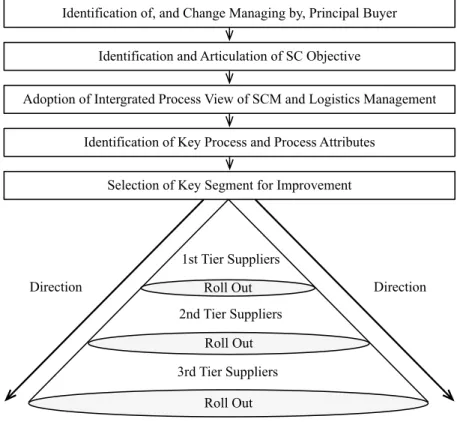
frame-work process was initiated, developed and subsequently tested in the case study (see Figure 3). The researcher developed a directive, procedural and integrative form of SCM, with the lead role played by the principal buyer, and the utilisation of CLSP synchronised with the first-, second- and third-tier suppliers along the SC as they work towards integrating the extended SCM in a manufacturing organisation along the SC. Each of these is briefly discussed in the following sections.
Stage 1: Identification of, and Change Managing by, Principal Buyer
Success in these endeavours requires the identification of the principal buyer to provide direction and be responsible for the rollout, implementation and control of the five-stage framework process. In addition, the principal buyer needs to devise a comprehensive communication program to continuously engage the different levels of suppliers and the people involved, and explain the reasons for the change. The continuing emphasis on this theme aims at effective communication in the belief that such change is beneficial to the SC (Waterhouse, 1995). Miscommunication is minimised by having a single focus of control (Manrodt and Vitasek, 2004). The principal buyer is also functioning as a leader who acts as an important driver of successful change (Dale, 1999).
The principal buyer, in this case SMUS, was proposed to take the lead in the integrative process with the first-, second- and third-tier suppliers. The principal buyer would also be involved in direct negotiations, recommendations and selection of the third-tier suppliers who would then be used by the second-tier suppliers. Similarly, SMUS would do the same for the second-tier suppliers who would then be used by the first-tier suppliers. The different levels of suppliers along the SC were given specific instructions and responsibilities in terms of sharing information, management of operational processes and control of individual roles within suppliers by SMUS.
Stage 2: Identification and Articulation of SC Objective
The larger, all-encompassing SC objectives must be clearly articulated to all the various members of the SC by the principal buyer. Each member must know how collective efforts impact the strategy, and ultimately the profitability of all firms along the SC. This will enable the principal buyer to explain how integrating beyond the buyer-seller interfaces would benefit all organisations along the SC. The importance of this can be seen from the comment of the director: “It was evident in the process that SMUS had a clearly articulated strategy that was understood not only by its employees, including its managers, but also by the different levels of suppliers along the SC.”
Stage 3: Adoption of Integrated Process View of SCM and Logistics Management
The common logistics service provider (CLSP) takes over the whole spectrum of the logistics of the different levels of suppliers from the raw materials right up to SMUS. CLSP steps in as an intermediate player in coordinating logistics services and providing a single point of contact to the different levels of suppliers. Knowing the principal buyer’s orders and suppliers’ operations and capabilities, the CLSP can coordinate the movement of goods, finances and information in a complete and integrated way. In order to enable a close working relationship between CLSP and principal buyer, a certain level of integration of information technology systems is required. The CLSP uses an advanced transportation tracking system to locate the shipment. The electronic tracking system supports a large number of transactions of suppliers’ orders, and is capable of checking the transit inventory moving through the delivery channel.
While initially the organisations are traditionally organised, as in standalone silos and are slow to change, the management staffof the principal buyer must create a compelling event that will encourage new behaviour (Keebler et al., 1999). An example of a compelling event is a competitor offering a product at a lower cost; losing a key customer; or new technology making the organisation’s offerings less attractive.
Stage 4: Identification of Key Process and Process Attributes
After adopting a process view of the SCM, the principal buyer must decide which segment and process are more critical and important. It is anticipated that given the large number of organisations involved, each will differ widely in defining the processes that are critical to the members along the SC, based on each individual firm’s strategy. Several techniques can be used to identify and map the segments to check for criticality, and this method should be familiar to those using process mapping techniques.
Stage 5: Selection of Key Segment for Improvement
Once the impacts of processes and process attributes have been determined and deemed necessary and important by the principal buyer, the processes and process attributes should be selected for standardisation and improvement along the SC. The standard is to be adopted by the rest of the members along the SC.
DSCM can be used as a means of direct involvement and participation, not only by the key suppliers but also by the second-tier suppliers and a multitude of other suppliers. More specifically, the principal buyer is involved in this process through negotiation, approval and finalisation of all suppliers, up to the 3rd tier suppliers, along the SC, instead of leaving to the discretion of the 1st tier suppliers as shown in the “pass´e” SCM framework.
seek to coordinate information sharing in an attempt to make relevant, accurate and timely information available to the decision makers (Lee, 2000). The simultaneous electronic inter-connectivity between the different levels of suppliers has become a competitive necessity to reduce cost and improve service (Bhatt, 2000).
In agreement with the above process, Manrodt and Vitasek (2004) and Lambertet al. (1999) stress that in any business relationship there is a need for a firm to assume the leadership role. Bowersox and Closs (1996) also argue that the SC needs leaders as much as individual organisations. Ellram and Cooper (1990) propose that an SC leader is like a channel captain in a delivery channel and plays a key role in coordinating, directing and overseeing the whole SC. An evaluation of this framework offers insight into ways to implement the DSCM that has a positive impact on the firm’s overall performance. As El-Ansary (1992, p. 4) noted: “Managing customer and supplier relationship is to ensure the delivery of the desired service level and service quality to the final consumers. The channel communication and information system is the spinal cord of ambitious inter-organisational management strategies designed to effectively manage these relations.”
This provides consistency to all individuals or partners along the SC from one source established by the principal buyer. Given that the principal buyer is the power source and the different level of suppliers are the targets, the SC as a whole enables a stronger buyer-seller relationship that has a significant positive effect on performance throughout the chain. The principal buyer’s source of influence stems from the behaviours exhibited by the organisation in the form of standards, policies, procedures, and the interactions of boundary spanning of different levels of suppliers (Defee, 2007; Lee et al., 2004). Maloni and Benton (2000) believe that a tight buyer-supplier relationship allows for better achievement of SC objectives. The powerful principal buyer who creates a more effective and integrated SC will be better able to position itself in the SC as market leader and subsequently benefit both itself and the different tiers of suppliers.
Through the implementation of a common communication and information management framework, the SMUS director stated that: “…… members along the SC, including SMUS, were able to greatly increase the efficiency and effectiveness of the entire chain. The shared database was of enormous importance in eliminating the duplication of activities, preventing errors, reducing cycle time in product development, and improving customer expectations in products and services.”
The diagrammatic model of the SCM concepts and processes as understood from the literature review is discussed and presented, creating an understanding of the issues in the implementation of the “pass´e” SCM. Building on the literature review, and the researcher’s knowledge and on-the-floor experience the proposed five-stage framework above provides for the successful integration of the SCM beyond the buyer-seller interfaces in an organisation.
needed.
Conclusion
The successful implementation of DSCM needs the integration of the processes across time and place in the SC from sourcing to manufacturing to delivery (Cooper et al., 1997). Integrating beyond the buyer-seller interfaces represents a promising but intricate tool that is used as to create sustainable competitive advantage.
The authors strongly affirm that there should be agreements among the SC members pertaining to leadership as this impact on the coordination and oversight of the entire SC. As demonstrated in the case study, DSCM is concerned with improving both efficiency (cost reduction) and effective competitiveness (growth) that together will ultimately bring profitability and better organisational performance. Other researchers have argued that SCM is only feasible when the principal buyer is in a position of power or dominance over its network of suppliers (Cox, 2001; Cox and Thompson, 1998).
This project contributes to an understanding of the significance of power where it allows the principal buyer to provide directions to be established for other members along the SC. Partnerships provide the potential benefit of eliminating duplicate service as well as redundant inventory. These benefits include critical factors such as availability and variety of product/service offerings and in the case of SMUS they were achieved by integrating buyer-seller interfaces with the lead taken by the principal buyer. It is under-stood that suppliers know when to start up production carriers when to provide additional equipment and distributors when to provide added throughput capacity. This will enable products to speed through the SC, thereby increasing the velocity of the throughput, unimpeded by uncertainty, start inertia, flow interruption or paperwork delays (Sabath, 1995). In the SC context, information technology has been used both inter-nally and exterinter-nally to increase integration. Lewis and Talayevsky (1997) find that increased integration typically yields significant benefits, including reduced inventories and improved financial performance. Also, elimination of non-value adding processes and the streamlining processes can help to increase collaboration among employees (Barua and Lee, 1997).
processes as communication protocols and standards can be better-managed. Many organisations can easily adopt these standards to reduce the overall cost of communication. Integrating beyond buyer-seller interfaces through DSCM can enhance a company’s performance. Directed buyer-supplier relationships have both a positive and significant effect on the performance of the manufacturer as the power source, the different levels of suppliers as the power target, and the SC as a whole. This suggests that a directed buyer-seller relationship can translate into better achievement of SC objectives.
Those who are able to create a more effective and integrated SC will be better able to position them-selves as market leader using the strengths of the SC and subsequently benefit both themthem-selves and their suppliers. The SC power holder enables an organisation to become the leader which is to be the focal point for the development, communication and coordination of supply chain-wide strategies (Defee and Stank, 2005). Without commitments from its supplier, an organisation will find it difficult to develop a competitive advantage. It is important to understand that a firm which seeks to take the lead to integrate beyond buyer-seller interfaces must become fully conscious of its power and effectively manage it to support the overall integration strategy. By capitalising on the synergistic coordination of an integrated SC, the organisation and its suppliers are able to respond quickly to competitive pressure within the industry to achieve superior performance (Maloni and Benton, 2000). The overall findings may be summarised as follows:
• Power to establish direction for members plays a significant role in SC and its positive source of power
has a positive effective upon the strategic alliances. Both the recipients and the power source must recognise the presence of such power and then follow the lead given by the principal buyer to reconcile the SC accordingly.
• A stronger buyer-seller relationship will enhance performance as a cohesive SC. This necessitates SC
integration as a key element of corporate strategy and promotes the need for more transparency and understanding of the integration process.
• Organisations are building new and distinctive capabilities through leadership that will enable them
to take advantage of the benefits derived from integrating beyond buyer-seller interfaces; in particular they are better able to:
– Manage a single standard of information sharing;
– Manage a common logistical process through a single nominated forwarder; and
– Appreciate the velocity and speed to react as a major driver.
References
Azadnia, A. H., Saman, M. Z. Mat. and Wong, K. Y., 2015. “Sustainable Supplier Selection and Order Lot-sizing: An Integrating Multi-Objective Decision-Making Process”, International Journal of Production Research, Vol. 53, Issue 2, pp. 383-408.
Barua, A. and Lee, B., 1997. “An Economic Analysis of the Introduction of an Electronic Data Interchange Systems”, Information Systems Research, Vol. 8, Issue 4, pp. 398-422.
Bhatt, G. D., 2000. “An Empirical Examination of the Effects on Information Systems Integration on Busi-ness Process Improvement”, International Journal of Operation & Production Management, Vol. 20, Issue 11, pp. 1331-1359.
Bowersox, D. J. and Closs, D. J., 1996. Logistical Management: The Integrated Supply Chain Process. New York, USA: McGraw-Hill.
Brandenburg, M., Govindan, K., Sarkis, J. and Seuring, S., 2014. “Quantitative Models for Sustainable Supply Chain Management: Developments and Directions”, European Journal of Operational Research, Vol. 233, Issue 2, pp. 299-312, Elsevier.
Byrne, P.J. and Heavey, C., 2006. “The Impact of Information Sharing and Forecasting in Capacitated Industrial Supply Chains: A Case Study”, International Journal of Production Economics, Vol. 103, Issue 1, pp. 420-437.
Cai, S. and Yang, Z., 2014. “On the Relationship between Environment and Competitive Priorities: The Role of Performance Frontiers”, International Journal of Production Economics, Vol. 151, pp. 131-145. Cavinato, J. L., 1992. “A Total Cost/Value Model for Supply Chain Competitiveness”, Journal of Business
Logistics, Vol. 13, Issue 2, pp. 285-301.
Chardine-Baumann, E. and Botta-Genoulaz, V., 2014. “A Framework for Sustainable Performance Assess-ment of Supply Chain ManageAssess-ment ‘ractices”, Computers & Industrial Engineering, Vol. 76, pp. 138-147. Christopher, M., 1997. Marketing Logistics. Oxford, UK: Butterworth-Heinemann,
Cohen, S. and Roussel, J., 2005. Strategic Supply Chain Management. NY, USA: McGraw-Hill,
Cooper, M. C., Lambert, D. M. and Pagh, J. D., 1997. “Supply Chain Management: More than a New Name for Logistics”, The International Journal of Logistics Management, Vol. 8, Issue 1, pp. 1-13. Council of Supply Chain Management Professionals (CSCMP), 2007. “Supply Chain
Man-agement and Logistics Management Definitions”. Accessed on December 12th, 2008. ww.cscmp.org/Website/AboutCSCMP/Definitions/Definitions.asp.
Cox, A., 2001. “Understanding Buyer and Supplier Power: A Framework for Procurement and Supply Competence”, Journal of Supply Chain Management, Vol. 37, Issue 2, pp. 8-15.
Cox, A. and Thompson, I., 1998. “On the Appropriateness of Benchmarking”, Journal of General Manage-ment, Vol. 23, Issue 3, pp. 1-20.
Dale, D., 1999. Managing Quality. Oxford, USA: Blackwell Publisher Inc..
Davis, T., 1993. “Effective Supply Chain Management”, Sloan Management Review, Vol. 34, Issue 4, pp. 35-46.
Defee, C. C., 2007. Supply Chain Leadership. Knoxville, TN: The University of Tennessee.
Defee, C. C. and Stank, T. P., 2005. “Applying the Strategy Structure-Performance Paradigm to the Supply Chain Environment”, International Journal of Logistics Management, Vol. 16, Issue 1, pp. 28-50. Ding, M. J., Kam, B. H., Zhang, J. Y. and Jie, F., 2015. “Effects of Human Resources Management
Prac-tices on Logistics and Supply Chain Competencies - Evidence from China Logistics Service Market”, International Journal of Production Research, Vol. 53, Issue 10, pp. 2885-2903.
Eisenhardt, K. M. and Graebner M. E., 2007. “Theory Building from Cases: Opportunities and Challenges”, Academy of Management Journal, Vol. 50, Issue 1, pp. 25-32.
El-Ansary, Adel I., 1992. “A Strategic Perspective of Communication and Information Systems in Marketing Channels”, Journal of Marketing Channels, Vol. 1, Issue 4, pp. 3-16.
Ellram. L., 1991. “Supply Chain Management: The Industrial Organization Perspective”, International Journal of Physical Distribution and Logistics Management, Vol. 21, Issue 1, pp. 13-22.
Ellram, L., 1996. “The Use of a Case Study Method in Logistics Research”, Journal of Business Logistics, Vol. 17, Issue 2, pp. 93-139.
Ellram, L. and Cooper, M., 1990. “Supply Chain Management, Partnerships, and the Shipper-Third-Party Relationship”, The International Journal of Logistics Management, Vol. 1, Issue 2, pp. 1-10.
Ellram, L. and Cooper, M., 1993. “Characteristics of Supply Chain Management and the Implication for Purchasing and Logistics Strategy”, International Journal of Logistics Management, Vol. 4, Issue 2, pp. 1-10.
Ellram, L. M. and Cooper, M. C., 2014. “Supply Chain Management: It’s all about the Journey, Not the Destination”, Journal of Supply Chain Management, Vol. 50, Issue 1, pp. 8-20, Wiley.
Gattorna, J., 2003. Handbook of Supply Chain Management. Aldershot, UK: Gower Publishing.
Goodhue, D. L., Quillard, J. A. and Rockart, J. F., 1988. “Managing the Data Resources: A Contingency Perspective”, MIS Quarterly, Vol. 12, Issue 3, pp. 372-391.
Gurin, R., 2000. “Real-time Decision-making Fuels SCM Growth”, Automatic I. D. News, Vol. 15, Issue 10, pp. 1-3.
Handfield, R. B. and Nichols, E. L. Jr., 1998. An Introduction to Supply Chain Management. Upper Saddle River, NJ, USA: Prentice Hall.
Handfield, R. B., Krause, D., Scannell, T. and Monczka, R., 2000. “Avoid the Pitfalls in Supplier Develop-ment”. Sloan Management Review, Vol. 41, Issue 2, pp. 37-49.
Hayes, R. H. and Wheelwright, S. C., 1984. Restoring Our Competitive Edge: Competing through Manu-facturing. NY, USA: John Wiley & Sons,
Heide, J. and John, G., 1990. “Alliance in Industrial Purchasing: The Determinants of Joint Action in Buyer-Supplier Relationship”, Journal of Marketing Research, Vol. 27, Issue 1, pp. 24-36.
Issue 3, pp. 257-269.
Holweg, M. and Helo, P., 2014. “Defining Value Chain Architectures: Linking Strategic Value Creation to Operational Supply Chain Design”, International Journal of Production Economics, Vol. 147 (B), pp. 230-238,
Hoyt, C. L. and Blascovich, J., 2003. “Transformational and Transactional Leadership in Virtual and Phys-ical Environments”, Small Group Research, Vol. 34, Issue 6, pp. 678-715.
Huang X., Tan, B. L and Ding, X., 2012. “Green Supply Chain Management Practices: An Investigation of Manufacturing SMEs in China”, International Journal of Technology Management and Sustainable Development, Vol 11, Issue 2. Accessed on June 30, 2015. http://www.intellectbooks.co.uk/journals/view-Article,id=15008/.
Huang X., Tan, B. L and Ding, X., 2015. “An Exploratory Survey of Green Supply Chain Management in Chinese Manufacturing Small and Medium-sized Enterprises: Pressures and Drivers”, Journal of Manu-facturing Technology Management, Emerald (in press).
Ireland, R. D. and Webb, J. W., 2007. “A Multi-Theoretic Perspective on Trust and Power in Strategic Supply Chains”, Journal of Operations Management, Vol. 25, Issue 2, pp. 482-497.
Jael, R. N. F. and Lopez, J. I., 2014. “Entry, Trade Costs and International Business Cycles”, Journal of International Economics, Vol. 94, Issue 2, pp. 224-238.
Jones, T. and Riley, D. W., 1985. “Using Inventory for Competitive Advantage through Supply Chain Management”, International Journal of Physical Distribution and Materials Management, Vol. 15, Issue 5, pp. 16-26.
Keebler, J. S., Manrodt, K. B., Durtsche, D. A. and Ledyard, D. M., 1999. Keeping Score: Measuring the Business Value of Logistics in the Supply Chain. Chicago, USA. Council of Logistics Management. Krajewski, L. J. and Ritzman, L. P., 1996. Operations Management: Strategy and Analysis, 4th Ed..
Read-ing, MA, USA: Addison-Wesley.
Lambert, D. M. and Cooper, M. C., 2000. “Issues in Supply Chain Management”, Industrial Marketing Management, Vol. 29, Issue 1, pp. 65-83.
Lambert, D. M., Garcia-Dastugue, S. J. and Croxton, K. L., 2005. “An Evaluation of Process-Oriented Supply Chain Management Frameworks”, Journal of Business Logistics, Vol. 26, Issue 1, pp. 25-51. Lambert, D. M. and Stock, J. R., 1993. Strategic Logistics Management, 3rd Ed.. NY, USA: McGraw-Hill
Companies, Inc.
Lambert, D. M., Stock, J. R. and Ellram, L. M., 1999. Fundamentals of Logistics Management. Boston, MA, USA: McGraw-Hill Companies, Inc.
Landeros, R. and Monczka, R. M., 1989. “Cooperative Buyer/Seller Relationships and a Firm’s Competitive Posture”, Journal of Purchasing and Materials Management, Vol. 25, Issue 3, pp. 9-18.
Langley, C. J. Jr. and Holcomb, C. M., 1992. “Creating Logistics Customer Value”, Journal of Business Logistics, Vol. 13, Issue 2, pp. 1-27.
Lee, D. J., Sirgy, M. J., Brown, J. R. and Bird, M. M., 2004. “Importers’ Benevolence toward Their Foreign Export Suppliers”, Journal of the Academy of Marketing Science, Vol. 32, Issue 1, pp. 32-48.
Lee, H. L., 2000. “Creating Value through Supply Chain Integration”, Supply Chain Management Review, Vol. 4, Issue 4, pp. 30-36.
Lewis, I. and Talayevsky, A., 1997. “Logistics and Information Technology: A Coordination Perspective”, Journal of Business Logistics, Vol. 18, Issue 1, pp. 141-157.
Lin, F., Huang, S. and Lin, S., 2002. “Effects of Information Sharing on Supply Chain Performance in Electronic Commerce”, IEEE Transactions on Engineering Management, Vol. 49, Issue 3, pp. 258-268. Li, S. and Lin, B., 2006. “Accessing Information Sharing and Information Quality in Supply Chain
Manage-ment”, Decision Support Systems, Vol. 42, Issue 3, pp. 1641-1656.
Liu, Y. and Liang, Y., 2014. “Evaluating and Developing Resource-based Operations Strategy for Compet-itive Advantage: An Exploratory Study of Finnish High-Tech Manufacturing Industries”, International Journal of Production Research, Vol. 53, Issue 4, pp. 1019-1037. Taylor and Francis.
Maloni, M. and Benton, W. C., 2000. “Power Influences in the Supply Chain”, Journal of Business Logistics, Vol. 21, Issue 1, pp. 49-73.
Manrodt, K. B. and Vitasek, K., 2004. “Global Process Standardization: A Case Study”, Journal of Business Logistics, Vol. 25, Issue 1, pp. 1-23.
Martin, J. and Leben, J., 1989. Strategic Information Planning Methodologies, 2nd Ed.. Englewood Cliffs, NJ, USA: Prentice-Hall.
McIntyre, M., 2005. “Organization Becoming Council of Supply Chain Management Professional”, http://www.cscmp.org/Website/Marketing/Maria.asp. Accessed on October 2, 2005.
Mentzer, J. T., Dewitt, W., Keebler, J. S., Min, S., Nix, N. M., Smith, C. D. and Zacharia, Z. G., 2001. “Defining Supply Chain Management”, Journal of Business Logistics, Vol. 22, Issue 2, pp. 1-25.
Murphy, P. R. and Poist, R. F., 1996. “Comparative views of Logistics and Marketing: Practitioners Re-garding Inter-Functional Co-ordination”, International Journal of Physical Distribution & Logistics Man-agement, Vol. 26, Issue 8, pp. 17-28.
Noshad, K and Awasthi, A., 2015. “Supplier Quality Development: A Review of Literature and Industry Practices”, International Journal of Production Research, Vol. 53, Issue 2, pp. 466-487.
Novack, R. A., Langley, C. J. Jr. and Rinehart, L. M., 1995. Creating Logistics Value. Oak Brook, IL, USA: Council of Logistics Management,
Piatkowski, M., 2012. “Factors Strengthening the Competitive Position of SME Sector Enterprises: An Example for Poland”, 8th International Strategic Management Conference in Procedia - Social and Be-havioural Sciences, Vol. 58, pp. 269-278.
Rezaei, J., Ortt, R. and Trott, P., 2015. “How SMEs Can Benefit From Supply Chain Partnerships”, Inter-national Journal of Production Research, Vol. 53, Issue 5, pp. 1527-1543.
Sabath, R., 1995. “Volatile Demand Calls for Quick Response: the Integrated Supply Chain”, Logistics Information Management, Vol. 8, Issue 2, pp. 49-52.
Development Competence in Supply Chains: Process, Integration and Contingency Effects among SMEs”, International Journal of Production Research, Vol. 52, Issue 16, pp. 4916-4929.
Skinner, W., 1985. Manufacturing: The Formidable Weapon. New York, USA: John Wiley & Sons.
Stevens, G. C., 1989. “Integrating the Supply Chains”, International Journal of Physical Distribution and Materials Management, Vol. 8, Issue 8, pp. 3-8.
Stuart, I., McCutcheon, D., Handfield, R., McLachlin, R. and Samson, D., 2002. “Effective Case Study in Operations Management: A Process Perspective”, Journal of Operations Management, Vol. 20, Issue 5, pp. 419-433.
Swamidass, P. M. and Newell, W. T., 1987. “Manufacturing Strategy, Environmental Uncertainty and Per-formance: A Path Analytical Model”, Management Science, Vol. 29, Issue 4, pp. 509-524.
Turker, D. and Altuntas, C., 2014. “Sustainable Supply Chain Management in the Fast Fashion Industry: An Analysis of Corporate Report”, Europe Management Journal, Vol. 32, Issue 5, pp. 837-849. Elsevier. Tyndall, G., Christopher, G., Partsch, W. and Kamauff, Jr., J. W., 1998. Supercharging Supply Chains:
New Ways to Increase Value Through Global Operational Excellence. NY, USA: John Wiley & Sons. Vaaland, T., Heide, M., 2007, “Can the SME Survive the Supply Chain Challenges?”, Supply Chain
Man-agement: An International Journal, Vol. 12, Issue 6, pp.20-31.
Voss, C., Tsikriktsis, N. and Frohlich, M., 2002. “Case Research in Operations Management”, International Journal of Operations & Production Management, Vol. 22, Issue 2, pp. 195-219.
Ward, P. T. and Durray, R., 2000. “Manufacturing Strategy in Context: Environment, Competitive Strategy and Manufacturing Strategy”, Journal of Operations Management, Vol. 18, Issue 2, pp. 123-138.
Waterhouse, P., 1995. Better Change: Best Practice for Transforming Your Organization. NY, USA: McGraw-Hill.
Weick, K. E., 2007. “The Generative Properties of Richness.” Academy of Management Journal, Vol. 50, Issue 1, pp. 14-19.
Womack, J., Jones, D. and Roos, D., 1990. The Machine that Changed the World. NY, USA: Rawson Associates.
Yin, R. K., 2003. Case Study Research: Design and Methods. CA, USA: Sage Publications Thousand Oaks. Yin, R. K., 2014. Case Study Research: Design and Methods, 5th ed.. CA, USA: Sage Publications Thousand