Investigating the Effect of Polythin and Polydrill
on the Properties of Drilling Fluids
A. R. Nasiri1*, M. Valizadeh1, H. Norouzi2, and M. Hemmati1 1. Research Institute of Petroleum Industry, RIPI
2. Islamic Azad University, Science and Research Branch [email protected]
Abstract
In this study, synthetic sulfonated polymers were used in order to enhance the rheological proper-ties of drilling fluids. The capability of these polymers in reducing the effects of environmentally friendly, but harmful, pollutants such as cement, calcium chloride, gypsum as well as pH changes were investigated. In the present work, two sulfonated synthetic polymers, namely Polythin and Polydrill, which are considered to be environmentally friendly polymers, were used. Polydrill con-trols the fluid loss and is resistant to high temperatures and also pollutants. The injection of this polymer into drilling fluid slightly increases the viscosity levels. Polythin prevents the precipitation of bentonite at high temperatures and facilitates fluid pumping by reducing its rheological and static shear strength. Polythin polymer also prevents the formation of bentonite gelation (precipitation of bentonite) at higher temperatures and is stable up to 260 °C. This polymer is also capable of com-pleting the effects of fluid loss additives and reduction of filtration in HTHP drilling fluids. Further more, this polymer reduces rheology, strength, and static shearing values and facilitates pumping of the drilling fluid. The combination of aforementioned polymers improves the thermal resistance of drilling muds while maintaining the rheology and reducing the amount of filtrate for HTHP drill ing fluids. In these experiments, the rheological properties of the fluid including apparent viscosity (AV), plastic viscosity (PV), yielding point (YP), gelation resistance or gel strength (GEL), fluid loss (FL), and the pH of the fluid were studied before and after the addition of the pollutants. The results indicate that certain proportions of these two polymers increase the rheological properties of drilling fluids and can significantly change the weight percentages of pollutants. It is also notable that the rheological properties were normally constant. However, in some cases, smaller values of rheological parameters enhanced the efficiency in the presence of pollutants. In the case of calcium chloride, rheological parameters (AV, PV, YP, and gel strength) are almost constant, while fluid loss greatly increases.
Key words:
Drilling Fluid, Rheology, Filter Loss, Sulfonated Polymer, Contamination Tolerant Additives, Environmentally FriendlyIntroduction
The injection of drilling fluids into a well serves different purposes. One of the most important ones is to transfer drilling debris from the bottom of the well to the surface. Drilling fluids undergo significant changes by the pas sage of time and therefore their chemical compositions have successively been modified [1]. They are normally composed of a liquid and a solid phase. The liquid phase is usually water (salt, fresh, or sea water). The solid phase may include weighting materials, viscosifiers, and fluid loss controllers. Nowadays, various polymers, which can be in the form of natural (e.g. starch), syn-thetic, and/or modified (e.g. carboxymethyl cellulose or CMC) polymers, are used in order to control the fluid
loss and viscosity. Drilling fluids should be environmen tally friendly and contain the lowest possible amount of pollutants. Therefore, care should be taken in the selec-tion and formulaselec-tion of raw materials [2].
filtration control additives. Important members within this group are starch and cellulose gums like carboxy-methyl cellulose and PAC. Recently developed synthet-ic organsynthet-ic polymers provide superior HT stability and electrolyte tolerance compared with the semi-synthetic starch and cellulose products [4].
The thermal limit of cellulose type polymers necessi-tated the use of the temperature stable vinyl sulfonate/ vinyl amide (VS/VA) copolymers during the rather early stage of making the hole. In many cases, these copoly-mers provided sufficient Ca2+ and temperature stability, but their major disadvantage was excessive cost [5]. The presence of salt and bacteria also reduces the ef-ficiency of polymers. The transformed polymers are stable up to certain concentrations of salt, but decom-position begins at higher concentrations. Another factor to be considered is acidity or basicity levels of drilling site. At high pH values and in the presence of calcium ions, polymers begin to hydrolyze and consequently lose their properties. Also, polymer chains may get trapped in cavities and lower the efficiency. Under these condi tions, certain amounts of acid should be applied in order to minimize the harmful effects [3].
In this study, two sulfonated synthetic polymers, namely Polythin (Pt) and Polydrill (Pd) were used; these mers are considered to be environmentally friendly poly-mers. Polythin is a highly active solution of synthetic polymer thinner, which is soluble in fresh water and salt muds. The product is a brown liquid with a density of ap-proximately 1.3 kg/l and a pH of 7.0-7.5. It contains no heavy metals and is environmentally safe [6]. Polythin controls the high temperature gelation of bentonite and other clays in all water based drilling fluids and prevents their flocculation at high temperatures up to 205 °C (400 °F). Polythin stabilizes a mud against most contamina-tion by salt, calcium, magnesium, and CO2. This is due to its unique chemistry, which tolerates all common drilling fluid contaminants [7].
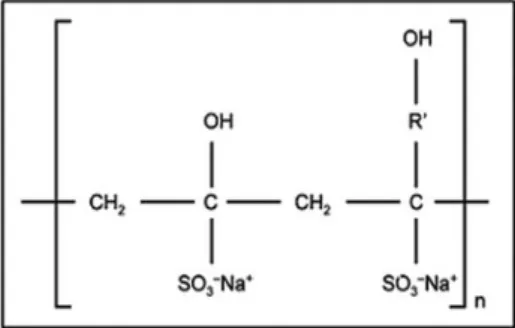
Polydrill is a sulfonated polymer fluid loss control addi tive (Figure 1), which stabilizes rheology in a wide range of drilling and completion fluid systems.
Polydrill is resistant to most forms of contamination to which drilling fluids may be exposed. Polydrill is resistant to sodium and KCl to the point of saturation. Polydrill also tolerates high levels of calcium and CO2. Polydrill performs effectively where contamination,
Figure 1- Polydrill polymer structure
high temperature, and elevated densities occur. Polydrill is non-damaging to the formation and environmentally safe [8]. The polymer has a molecular weight of 200,000, which gives it the advantage of slightly increasing rhe-ology. Polydrill achieves fluid loss control by reducing the pore size of the filter cake and plugging these pores. The polymer has an enormous water binding capability, which ties up much of the free water. Polydrill controls the fluid loss amounts and is resistant to high tempera tures and pollutants. An injection of this polymer into drilling fluid slightly increases the viscosity levels and is therefore usually added to high density solid phase (2.4S.G-20 lb/gal) in the temperature range of 65-230 °C (150-450 °F) [9]. One of the outstanding features of Pd polymer is its stability in seawater based mud systems in the presence of calcium or salt, which makes it the best option for the reduction of fluid loss in high temperature and high pressure (HTHP) muds. Another characteristic of this polymer is the reduction of friction rates, which results in lower torque, drag values, and the adhesion of pipes to the surface of well. Pt polymer also prevents bentonite gelation at higher temperatures and is stable up to 260 °C (500 °F) [5]. This polymer is also capable of completing the effects of fluid loss additives and reduc tion of filtration in HTHP drilling fluids. Furthermore, this polymer reduces rheology, strength, and static shear-ing values and facilitates pumping of the drilling fluid. Therefore, using low amounts of this polymer makes it possible to transform a gelated mud into its initial condi-tion. The combination of Pd and Pt enhances the thermal resistance of the drilling fluids and reduces the filtration amounts of HTHP fluids while having the lowest effect on rheology [10].
Experimental
While drilling, different pollutants might penetrate through the mud system and therefore change its proper-ties. Among these are calcium chloride, gypsum, and/or unhardened cement present in the well. Also, the pres-ence of harmful corrosive or acidic gasses such as H2S might change pH and other properties of the drilling fluid. Therefore, these pollutants should be taken into account while designing the drilling fluids. This can be achieved by the addition of suitable additives in order to avoid any change in the chemical composition of the drilling fluid.
An attempt was made to study the effects of pollutants such as CaCl2, CaSO4
,
and cement and pH changes caused as a result of NaOH and HCl addition. Also, various properties of the drilling mud such as rheologi-cal behavior, fluid loss values, and pH were measured at ambient temperature, before and after the addition of pollutants.Note: These concentrations of Pd (Polydrill) and Pt (Polythin) are the optimum concentrations obtained from previous tests.
- Investigating the effects of the addition of 6 lb Pd and 2 lb Pt on the properties of the drilling fluid containing 20 g of CaCl2.
- Investigating the effect of CaSO4 addition on the prop-erties of polymeric mud containing 6 lb of Pd and 2 lb of Pt.
- Investigating the effect of cement addition on the prop-erties of polymeric mud containing 6 lb of Pd and 2 lb of Pt.
- Investigating the effect of pH on the properties of poly-meric mud containing 6 lb of Pd and 2 lb of Pt.
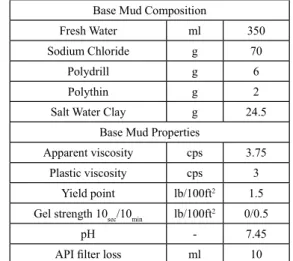
In these experiments, the rheological properties of fluid including apparent viscosity (AV), plastic viscosity (PV), yielding point (YP), gel strength (GEL), fluid loss (FL), and pH of the base mud before and after the addition of the pollutants were studied. The base mud composition and properties are given in Table 1.
Table 1- Base mud composition and properties before contamination Base Mud Composition
Fresh Water ml 350
Sodium Chloride g 70
Polydrill g 6
Polythin g 2
Salt Water Clay g 24.5
Base Mud Properties
Apparent viscosity cps 3.75
Plastic viscosity cps 3
Yield point lb/100ft2 1.5
Gel strength 10sec/10min lb/100ft2 0/0.5
pH - 7.45
API filter loss ml 10
The Effects of CaCl
2Added on Drilling Fluid
Properties Containing 6 lb Pd and 2 lb Pt
In this test, the mud properties of contaminated base mud
(without Polydrill and Polythin) with 20 g of calcium chloride were measured before and after the addition of 6 lb of Polydrill and 2 lb of Polythin. The results of these experiments are presented in Figure 2. It can be observed that the rheological properties of mud are almost con-stant, but fluid loss values have drastically decreased. This means that the addition of Pt and Pd to the fluid has greatly reduced the fluid loss values.
The Effect of CaSO
4Added on Polymeric Mud
Properties Containing 6 lb Pd and 2 lb Pt
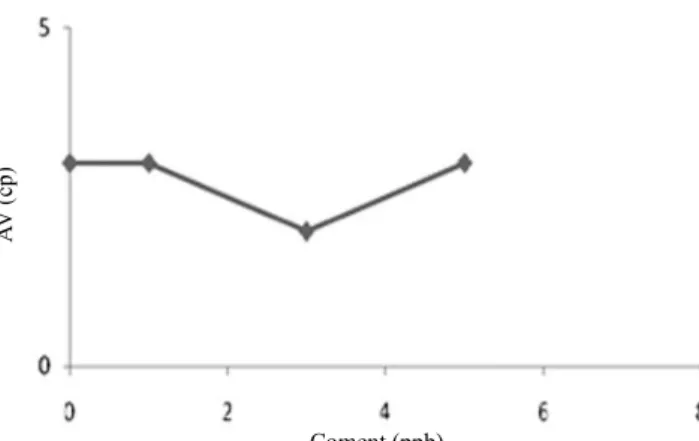
In this experiment, 1, 3, and 5 lb of gypsum were added to the base fluid (Table 1). The rheological properties, fluid loss, and pH values were measured before and after the addition of gypsum. The results are shown in Figures 3-4. It can be concluded that:
- Higher values of CaSO4 have no effect on the apparent viscosity (AV). This means that the pollution of the drill-ing mud does not change AV.
- Higher gypsum additions reduce the plastic viscosity (PV), while the yield point (YP) of the fluid slightly in creases at 5 lb.
- Gel strength is nearly a constant value. Although the addition of gypsum is expected to significantly increase the fluid loss, the presence of Pd and Pt has caused a slight increase in this value. Also, pH remains constant in the system.
It can be concluded that these polymers do not allow CaSO4 pollutants to change the rheological properties of the drilling fluid and even in some cases these properties are enhanced. Also, a slight increase in fluid loss in the presence of gypsum is one of the unique effects of these polymers.
The Effect of Cement Added on Polymeric Mud
Properties Containing 6 lb Pd and 2 lb Pt
Similar to previous test, the properties of the base mud were studied before and after the addition of 1, 3, and 5 g of cement (Table 1).
Figure 3- Effect of CaSO4 on the properties of the polymeric mud containing 6 lb of Pd and 2 lb of Pt
Figure 4- Effect of CaSO4 on the gelation properties of the polymeric mud containing 6 lb of Pd and 2 lb of Pt
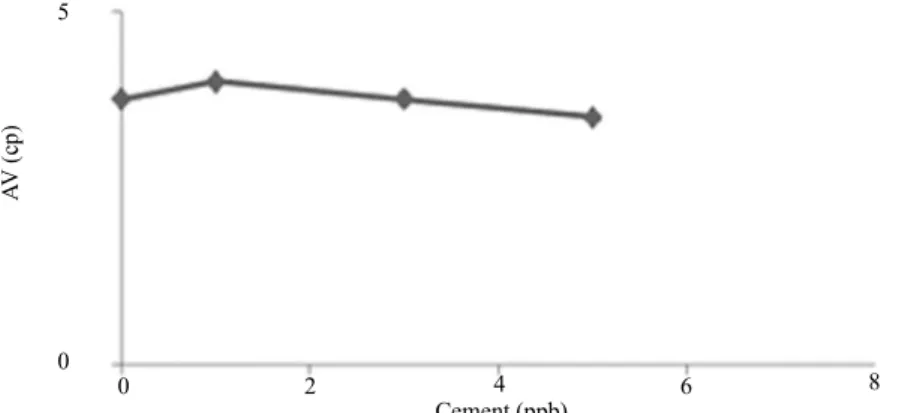
Figures 5-9 have been drawn based on these results and one may summarize the results obtained as follows: - According to these diagrams, the rheological properties of the drilling fluid have been enhanced in the presence of cement. Therefore, Pd and Pt polymers are very ef-ficient in the presence of cement.
- FL values slightly increase at higher contents of ce-ment. This means that these polymers have neutralized the harmful effects of cement on drilling fluids. - The basicity index of the system is constant even after the addition of cement.
According to Figure 9, pH increases to 10 and then re-mains constant. This is due to the presence of Pd and Pt
polymers.
Investigating the Effect of pH Values on Polymeric Mud Properties
In these series of tests, the pH values of base muds were controlled by the addition of NaOH and HCl and rheo-logical properties and FL were studied. The results are presented in Figures 10-11. As it can be seen, AV and PV are constant at higher pH values. These two parameters begin to decrease at the pH values equal to or greater than 10. YP was constant throughout the test and FL changes were inconsiderable. It can be concluded that pH values do not have any effect on the efficiency of the system.
Figure 5- Effect of cement on the apparent viscosity of the polymeric mud containing 6 lb of Pd and 2 lb of Pt CaSO4 (pbb)
First gel
Second gel CaSO4 (pbb)
5
0
Cement (ppb)
Figure 6- Effect of cement on the plastic viscosity of the polymeric mud containing 6 lb of Pd and 2 lb of Pt
Figure 7- Effect of cement on the yield point of the polymeric mud containing 6 lb of Pd and 2 lb of Pt
Figure 8- Effect of cement on the fluid loss of the polymeric mud containing 6 lb of Pd and 2 lb of Pt
Figure 9- Effect of cement on the pH of the polymeric mud containing 6 lb of Pd and 2 lb of Pt Coment (ppb)
Coment (ppb)
Coment (ppb)
Figure 10- Effect of pH on the fluid loss of the polymeric mud containing 6 lb of Pd and 2 lb of Pt
Figure 11- Effect of pH on the rheological properties of the polymeric mud containing 6 lb of Pd and 2 lb of Pt
Conclusion
In this study, the effects of synthetic sulfonated polymers on the properties and efficiency of drilling fluids were investigated in the presence of pollutants such as cement, calcium chloride, and gypsum at different pH values. The results indicate better rheological properties due to the presence of such polymers. In the case of calcium chloride, rheological parameters are almost constant, while FL has greatly increased. The addition of cement and gypsum results in smaller values of rheological pa-rameters, while it causes a slight increase in FL. Also, pH changes lead to smaller AV and PV values. However, YP and FL are nearly constant.
References
[1] George R., Gray H. and Darley C.H., “Composition and Properties Of Oil Well Drilling Fluids”,Gulf Pub lish Company Book Division, Fourth Eddition, Houston, London, Paris, Tokyo,1980.
[2] Adam T., Bourgoyne Jr., Martin E.C., Keithk. F.S., and Young Jr., “Applied Drilling Engineering”, SPE Text Book Series”, Vol 2, pp. 4082, 1991.
[3] Carico R.D. and Bagshaw F.R., “Description and Use Of Polymers Used In Drilling, Workovers and Completions”,SPE 7747, 1978.
[4] Plank J.P., SKW Trostberg A.G. and Gossen, F.A., SKW Chemicals Inc. “Visualization of Fluid-Loss Poly-mers in Drilling-Mud Filter Cakes”, SPE Drilling Engi neering journal, Vol. 6, No. 3, pp. 203-208, September 1991.
[5] Ujma K.H.W., Preussag A.G. Erdol und Erdgas; Plank, J. P. and SKW Trostberg A.G.“ New Calcium-Tol-erant Polymer Helps to Improve Drilling-Mud Perfor-mance and To Reduce Costs”, SPE Drilling Engineering journal, Vol. 4, No. 1, pp. 41-46, Mar. 1989.
[6] ADVANTAGE MUD SYSTEM Ltd, www.advan-tagemud.com, Available on September 2011.
[7] POLYTHINpolymeric deflocculant for water based drilling fluids, www.oilfieldsolutions.basf.com , Avail able on June 2007.
[8] Plank J.P., Hamberger J.V. and SKW Trostberg AG., “Field Experience with a Novel Calcium-Tolerant Fluid-Loss Additive for Drilling Muds”, European Petroleum Conference, 16-19 October 1988, London, United King-dom.
[9] Pigott Shaft Drilling Limited, www.psdmud.co.uk, Available on September 2011.
[10] Son Adelina J., IMCO Services; Ballard, Thomas M., IMCO Services and Loftin, Royal E., IMCO Servic-es, “Temperature-Stable Polymeric Fluid-Loss Reducer Tolerant to High Electrolyte Contamination”, SPE Drill ing Engineering, Vol. 2, No. 3, pp. 209-217, September 1987.
pH