The Random Hypergraph Assignment Problem
Ralf Borndörfer
Zuse Institute Berlin, Takustr. 7, 14195 Berlin, Germany E-mail: [email protected]
Olga Heismann
Zuse Institute Berlin, Takustr. 7, 14195 Berlin, Germany E-mail: [email protected]
Keywords:assignment, hyperassignment, random, expected value Received:July 13, 2014
Parisi’s famous (proven) conjecture states that the expected cost of an optimal assignment in a complete bipartite graph onn+nnodes with i. i. d. exponential edge costs with mean 1 isPn
i=11/i
2, which
con-verges to an asymptotic limit ofπ2/6asntends to infinity. We consider a generalization of this question to complete “partitioned” bipartite hypergraphsG2,nthat contain edges of size two and proper hyperedges of size four. We conjecture that for i. i. d. uniform hyperedge costs on[0,1]and i. i. d. exponential hyper-edge costs with mean 1, optimal assignments expectedly contain half of the maximum possible number of proper hyperedges. We prove that under the assumption of this number of proper hyperedges the asymp-totic expected minimum cost of a hyperassignment lies between 0.3718 and 1.8310 if hyperedge costs are i. i. d. exponential random variables with mean 1. We also consider an application-inspired cost function which favors proper hyperedges over edges by means of an edge penalty parameterp. We show how results for an arbitrarypcan be deduced from results forp= 0.
Povzetek: V ˇclanku je opisana analiza komplektnosti dvojno povezanih grafov na osnovi razširitve Parisi-jevega izreka.
1
Introduction
A way to gain a better understanding of the structure of a combinatorial optimization problem is to analyze the opti-mal values of random instances. For the assignment prob-lem, such results were conjectured after extensive com-putational experiments and then proven theoretically. In particular, the famous (proven) Conjectures of Mézard and Parisi [Mézard and Parisi, 1985] state that the expected op-timal cost value of an assignment problem on a complete bipartite graph with i. i. d. uniform edge costs on [0,1]or i. i. d. exponential edge costs with mean 1 converges to
π2
6 = 1.6449. . . if the number of vertices tends to infin-ity. The limit is equal for both distributions since it can be proven that only the density at 0 is relevant, which coin-cides for both distributions [Aldous, 1992]. For a survey on therandom assignment problemand several of its variants, see [Krokhmal and Pardalos, 2009].
We consider a generalization of this setting to a class ofbipartite hypergraphsin terms of what we call the ran-dom hypergraph assignment problem (HAP). This prob-lem is an idealized version of vehicle rotation plan-ning problems in long-distance passenger rail trans-port, see [Borndörfer et al., 2011] for further details and [Maróti, 2006] for a survey on railway vehicle rotation planning.
We will deal with HAPs in a special well-structured type
of bipartite hypergraphsG2,n, that contain on each siden “parts” of size 2 each. In this case, the HAP is already NP-hard [Borndörfer and Heismann, 2012] and therefore inter-esting to analyze. The hyperedge set of such a partitioned hypergraphG2,nconsists only of edges of size 2 and proper hyperedges of size 4, and it has a structure that makes it easy to view a hyperassignment as a combination of two assignments, one consisting only of edges, and the other one consisting only of proper hyperedges (that can also be viewed as edges). Despite this simple general idea, how-ever, combining the two assignments involves a choice over an exponential number of possibilities which is quite diffi-cult to analyze. We will explain this in more detail in Sec-tion 2 after introducing the problem.
for the random assignment problem.
In hypergraph assignment problems that arise from prac-tical applications, proper hyperedges represent unions of edges. Such hyperedges have costs that are smaller than the sum of the costs of the edges that they contain; these edges are considered to be similar and a solution with much sim-ilarity is desirable [Borndörfer et al., 2011]. We consider a setting withregularity-rewardingcost functions, in which the number of proper hyperedges in a solution and the op-timal value of a random HAP inG2,ndo not only depend on the number of vertices n but also on an edgepenalty parameterp. We will show how the number of proper hy-peredges and the value of an optimal solution for every p
can be deduced from results forp= 0in Section 4. The paper ends in Section 5 with a discussion of the re-sults.
A short conference version of this paper has already been published as [Heismann and Borndörfer, 2013].
2
The hypergraph assignment
problem
We consider in this paper hypergraph assignment problems on a special type of bipartite hypergraphs.
Definition 2.1. LetG2,n = (U, V, E)be thebipartite hy-pergraphwithvertex sets
U =
n
[
i=1
Ui, V =
n
[
i=1
Vi
with
Ui={ui, u0i}, Vi={vi, v0i}
andhyperedge setE=E1∪E2where
E1={{u, v}:u∈U, v∈V}
are theedgesand
E2={Ui∪Vj:i, j∈ {1, . . . , n}}
are theproper hyperedges of size 4. The setsUi andVi,
i ∈ {1, . . . , n}are called thepartson theU- andV-side, respectively.
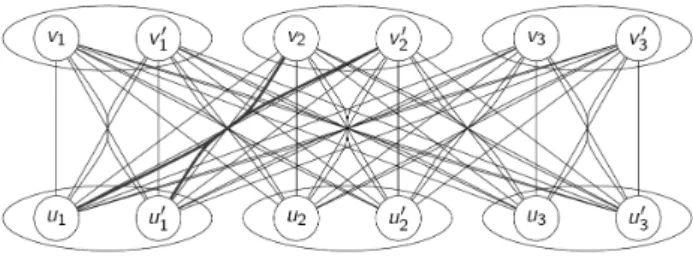
For a visualization of such a hypergraph, see Figure 1. Note that every hyperedge in G2,n connects a part on theU- and a part on theV-side. We remark that the HAP can be formulated in the same way for more general bipar-tite hypergraphs, with less structure and possibly contain-ing hyperedges which contain more than four vertices, see [Borndörfer and Heismann, 2012].
Figure 1: Visualization of the bipartite hypergraph G2,3. The thick hyperedge is the proper hyperedge U1 ∪ V2 = {u1, u01, v2, v02}.
Definition 2.2. For a vertex subsetW ⊆U∪V we define theincident hyperedges
δ(W) :={e∈E:e∩W 6=∅, e\W 6=∅}
to be the set of all hyperedges having at least one vertex in bothW and(U∪V)\W.
AhyperassignmentinG2,nis a subsetH ⊆Eof pair-wise disjoint hyperedges that coverU andV, i. e., for all
e1, e2 ∈ H,e1∩e2 = ∅, andSH = U ∪V. Given a cost functioncE :E →R, the cost of a hyperassignment isP
e∈HcE(e). Thehypergraph assignment problemwith input(G2,n, cE)consists of finding a hyperassignment in
G2,nof minimum cost w. r. t.cE.
For bipartite hypergraphsG2,n, the hypergraph ment problem can be seen as a combination of two assign-ment problems. Namely, observe that for every hyperas-signmentH and every partUiandVi,i∈ {1, . . . , n}, the set of incident hyperedgesδ(Ui)∩H andδ(Vi)∩H con-sists either of one proper hyperedge or of two edges. If we decide for every part Ui andVi whether the hyperassign-ment to be constructed is incident to one proper hyperedge or to two edges, we can restrict the hyperedge set ofG2,n to
– the set of edges connecting pairs of vertices from the partsUi,Vithat will be incident to edges—this is the first assignment problem, and
– the proper hyperedges {Ui ∪Vj}for Ui andVj that will be incident to proper hyperedges—viewing Ui andVj as composite vertices and the hyperedges as edges connecting them—this is the second assignment problem.
Solving these two assignment problems independently pro-duces the minimum cost hyperassignment subject to the fixed edge and hyperedge incidences.
3
Expected optimal values for the
random HAP with exponential or
uniform costs
Predicting the optimal value of a random hypergraph as-signment problem inG2,ninvolves a prediction of the ber of proper hyperedges in an optimal solution. This num-ber depends on how advantageous it is to choose a proper hyperedge instead of two edges (so that one has just one number adding to the cost instead of two) compared to the disadvantage of having less freedom (there are fewer pos-sibilities to cover a single vertex with a proper hyperedge than with an edge) when searching for a hyperassignment with the least possible cost. We conjecture that one can expect that an optimal hypergraph assignment inG2,n con-tains half of the possible number of proper hyperedges. Conjecture 3.1. The expected number of proper hyper-edges in a minimum cost hyperassignment in G2,2n with cost functioncE such that allcE(e),e ∈ E are i. i. d. ex-ponential random variables with mean 1 or i. i. d. uniform random variables on[0,1]isn.
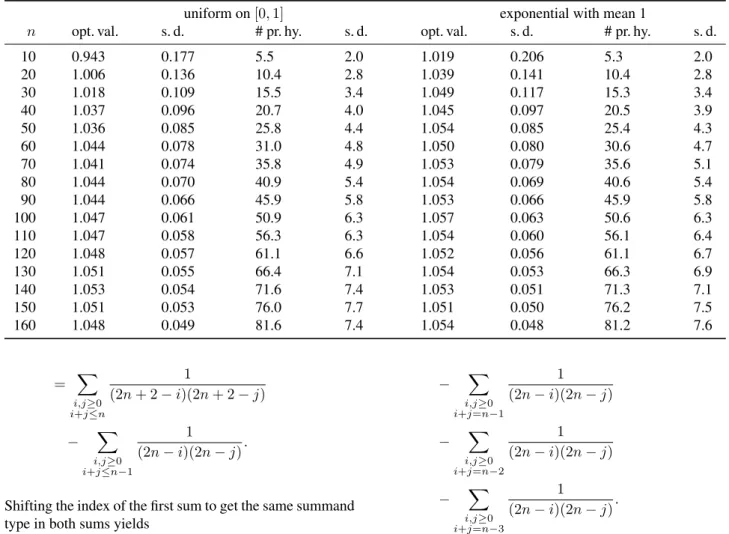
Table 1 backs this conjecture. It gives computational re-sults for the random hypergraph assignment problem in the bipartite hypergraphG2,nwith i. i. d. uniform random vari-ables on[0,1]and i. i. d. exponential random variables with mean 1 as hyperedge costs. For every n, we report the mean value and the standard deviation of the optimal cost value and the number of proper hyperedges in the optimal solution for 1000 computations. The HAPs were solved as integer programs using CPLEX 12.5.
The first column (n) of Table 1 shows the number of parts on the U- and V-side. Columns 2 and 6 (opt. val.) give the mean optimal values. Their standard deviations can be seen in columns 3 and 7 (s. d.) for the two cost func-tion distribufunc-tions, respectively. Columns 4 and 8 (# pr. hy.) show the number of proper hyperedges in the optimal so-lutions found, columns 5 and 9 (s. d.) show their standard deviations. The important finding w. r. t. Conjecture 3.1 is that the values in columns 4 and 8 are about half the values in column 1 in each row.
The computational results also suggest that the expected optimal cost converges to a value around 1.05 for both dis-tributions. Although for largernmore hyperedges are con-tained in a hyperassignment, the optimal value does not in-crease much. This can be intuitively explained by noting that for largernthere are also more possible ments to select from, and the chances to find a hyperassign-ment that has a low cost are therefore still good even if it will contain more hyperedges.
We will now compute a lower and upper bound on the expected value of a minimum cost hyperassignment in
G2,2n withn proper hyperedges for the exponential dis-tribution. To this end, we will use the following result: For a complete bipartite graph with vertex sets of sizemandn
and with i. i. d. exponential random variables with mean 1
as edge costs, the expected minimum value of the sum ofk
pairwise disjoint edges (this is called a partial assignment) is
E(m, n, k) := X
i,j≥0 i+j≤k−1
1 (n−i)(m−j).
This result was conjectured in
[Coppersmith and Sorkin, 1999] and first proved in [Linusson and Wästlund, 2004]. The latter paper also shows that form=n=kthis term can be written as
E(n, n, n) =
n
X
i=1
1 i2.
That this formula gives the expected value of a random as-signment is Parisi’s Conjecture.
Theorem 3.2. LetEbe the expected value of the minimum cost of a hyperassignment inG2,2n = (U, V, E)with ex-actlynproper hyperedges and cost functioncEwith i. i. d. exponential random variables cE(e) with mean 1 for all
e∈E. The following holds forn→ ∞:
0.3718<E<1.8310.
Proof. By definition,
E(n) :=E(2n,2n, n) = X
i,j≥0 i+j≤n−1
1
(2n−i)(2n−j).
UsingE(n), we can bound the expected value of a hyperas-signment inG2,2nwith i. i. d. exponential random variables with mean 1 as hyperedge costs restricted to the hyperas-signments withnproper hyperedges as follows.
For the lower bound, observe that in the best possible hyperassignment the selectednproper hyperedges can be only as good as thenpairwise disjoint proper hyperedges with the least possible cost sum in G2,2n. Also, the se-lected 2n edges can be only as good as the2npairwise disjoint edges with the least possible cost sum in G2,2n. Thus,E(n) +E(2n)is a lower bound forE.
On the other hand, choosing the n pairwise disjoint proper hyperedges with the least possible cost sum in
G2,2n and finding the best possible edges for the remain-ing “unused” vertices leads to an upper bound ofE(n) + E(2n,2n,2n)forE.
To transform the two-indexed sum describingE(n)to a sum with only one index, we calculate the difference
D(n) :=E(n+ 1)−E(n)and use the recursive formula
E(n) =E(1) +
n−1
X
i=1
D(i) = 1 4+
n−1
X
i=1
D(i). (1)
We get
D(n) =E(n+ 1)−E(n)
Table 1:Computational results for random hypergraph assignment problems inG2,nfor i. i. d. uniform random variables on[0,1]or
i. i. d. exponential random variables with mean 1 as hyperedge costs. The mean optimal values (column 2 and 6) and their standard deviations (column 3 and 7) are rounded to the third decimal place. The number of proper hyperedges in the optimal hyperassignments (column 4 and 8) and their standard deviations (column 5 and 9) are rounded to one decimal place. 1000 computations were done for each value ofnand each distribution. The values in columns 4 and 8 are about half the value of column 1 in each row. This supports Conjecture 3.1.
uniform on[0,1] exponential with mean 1
n opt. val. s. d. # pr. hy. s. d. opt. val. s. d. # pr. hy. s. d.
10 0.943 0.177 5.5 2.0 1.019 0.206 5.3 2.0
20 1.006 0.136 10.4 2.8 1.039 0.141 10.4 2.8
30 1.018 0.109 15.5 3.4 1.049 0.117 15.3 3.4
40 1.037 0.096 20.7 4.0 1.045 0.097 20.5 3.9
50 1.036 0.085 25.8 4.4 1.054 0.085 25.4 4.3
60 1.044 0.078 31.0 4.8 1.050 0.080 30.6 4.7
70 1.041 0.074 35.8 4.9 1.053 0.079 35.6 5.1
80 1.044 0.070 40.9 5.4 1.054 0.069 40.6 5.4
90 1.044 0.066 45.9 5.8 1.053 0.066 45.9 5.8
100 1.047 0.061 50.9 6.3 1.057 0.063 50.6 6.3
110 1.047 0.058 56.3 6.3 1.054 0.060 56.1 6.4
120 1.048 0.057 61.1 6.6 1.052 0.056 61.1 6.7
130 1.051 0.055 66.4 7.1 1.054 0.053 66.3 6.9
140 1.053 0.054 71.6 7.4 1.053 0.051 71.3 7.1
150 1.051 0.053 76.0 7.7 1.051 0.050 76.2 7.5
160 1.048 0.049 81.6 7.4 1.054 0.048 81.2 7.6
= X
i,j≥0 i+j≤n
1
(2n+ 2−i)(2n+ 2−j)
− X
i,j≥0 i+j≤n−1
1
(2n−i)(2n−j).
Shifting the index of the first sum to get the same summand type in both sums yields
= X
i,j≥−2 i+j≤n−4
1 (2n−i)(2n−j)
− X
i,j≥0 i+j≤n−1
1
(2n−i)(2n−j).
We now split the sums to sums with index rangei, j ≥0,
i+j≤n−4so that they can cancel. The remainder is as follows. For the first sum, it is used that it is symmetric in
iandj. The term 4(n+1)(4n+3)2(2n+1)2 2 is the sum of the values
where−2 ≤ i, j ≤ −1. This has to be subtracted from the first term as otherwise these values would be counted twice.
D(n) = 2· X
−2≤i≤−1,j≥−2 i+j≤n−4
1 (2n−i)(2n−j)
− (4n+ 3) 2
4(n+ 1)2(2n+ 1)2
− X
i,j≥0 i+j=n−1
1 (2n−i)(2n−j)
− X
i,j≥0 i+j=n−2
1 (2n−i)(2n−j)
− X
i,j≥0 i+j=n−3
1
(2n−i)(2n−j).
Splitting the first sum into two parts withi=−1andi=
−2and substitutingjbya−iwherei+j=ayields
D(n) =
n−3
X
j=−2
2 (2n+ 1)(2n−j)
+
n−2
X
j=−2
2
(2n+ 2)(2n−j)
− (4n+ 3) 2
4(n+ 1)2(2n+ 1)2
− n−1
X
i=0
1
(2n−i)(n+ 1 +i)
− n−2
X
i=0
1
(2n−i)(n+ 2 +i)
− n−3
X
i=0
1
Using the notation Hn = P n i=1
1
i for then-th harmonic number and partial fraction decomposition to get denomi-nators linear innfor the last two summations, we get
D(n) =2H2n+2−2Hn+2
2n+ 1 +
2H2n+2−2Hn+1
2n+ 2
− (4n+ 3) 2
4(n+ 1)2(2n+ 1)2 −
2H2n−2Hn
3n+ 1
−2H2n3n−+ 22Hn+1 −2H2n3n−+ 32Hn+2
=2H2n+
2 2n+1+
2
2n+2−2Hn− 2 n+1−
2 n+2
2n+ 1
+2H2n+
2 2n+1 +
2
2n+2−2Hn−n+12
2n+ 2
− (4n+ 3) 2
4(n+ 1)2(2n+ 1)2 −
2H2n−2Hn
3n+ 1
−2H2n−2Hn− 2 n+1
3n+ 2
−2H2n−2Hn− 2 n+1−
2 n+2
3n+ 3 .
Finally, simplification yields
D(n) =−(H2n−Hn)·
9n2+ 11n+ 4
3(n+ 1)(2n+ 1)(3n+ 1)(3n+ 2)
+ 8n
2+ 13n+ 6
12(n+ 1)2(2n+ 1)2(3n+ 2).
To get bounds onE(n)using Equation (1), we first use that
∞
X
n=1
8n2+ 13n+ 6
12(n+ 1)2(2n+ 1)2(3n+ 2)
=−1 4−
π
√
3+ π2
9 −
10 ln(2)
3 + ln(27). (2)
Then, observe thatH2n−Hnis a non-negative number monotonically increasing withn. Also, this is an alternat-ing harmonic number that forn→ ∞converges toln(2). Forn= 80,H2n−Hncan be calculated and results in a fraction, which is>0.69. Therefore, forn≥80,
0.69< H2n−Hn<ln(2) (3) Now, computing the partial sum
79
X
n=1
−(H2n−Hn)
9n2+ 11n+ 4
3(n+ 1)(2n+ 1)(3n+ 1)(3n+ 2)
exactly and the limes
∞
X
n=80
−(H2n−Hn)
9n2+ 11n+ 4
3(n+ 1)(2n+ 1)(3n+ 1)(3n+ 2)
after substituting forH2n−Hnthe lower and upper bounds given by (3), Equations (1) and (2) yield
0.1859< lim
n→∞E(n)<0.1860.
Thus, we get for the lower bound
lim
n→∞(E(n) +E(2n)) = 2·nlim→∞E(n)
>2·0.1859
= 0.3718
and for the upper bound
lim
n→∞(E(n) +E(2n,2n,2n)) = limn→∞E(n)
+ lim
n→∞E(2n,2n,2n)
<0.1860 +π
2
6 <1.8310.
We remark that the upper bound computed in Theo-rem 3.2 is greater than the expected optimal value of the random assignment problem π62 = 1.6449. . .. We believe that it must be possible to reduce it, because moving from an assignment problem in a complete bipartite graph with
4nvertices on each side to a HAP inG2,2nadds more pos-sibilities (still all assignments are feasible solutions but us-ing hyperassignments with proper hyperedges gives addi-tional ones). Indeed, it is clear that if we do not prescribe the number of proper hyperedges in an optimal solution, the expected optimal value of a hyperassignment inG2,2n will tend to some number ≤ π62. As already discussed, the computational results shown in Table 1 suggest that the correct number is some value around 1.05, much smaller than π62.
4
Regularity rewarding costs
Definition 4.1. LetG= (U, V, E)be a partitioned hyper-graph. Fore∈E, let
E(e) :={E0 ⊆E1: e1∩e2=∅ ∀e1, e2∈E0 withe16=e2,
[
E0=e}
be the set of all pairwise disjoint edge sets with unione. For some penaltyp ≥ 0, we call a cost functioncpE : E → Rregularity-rewardingif for all proper hyperedges
e∈E2,
cE(e) = min E0∈E(e)
X
e0∈E0
cE(e0)−p· |E0|
!
.
The greater p, the more irregularity is punished and regularity rewarded. We remark that the cost of a hy-peredge in a vehicle rotation planning model depends on several other parameters such as an additional irregularity penalty for hyperedges that are not inclusion-wise maximal [Borndörfer et al., 2011]. This is the reason why we callp
a penalty and not a bonus or a reward.
A way to define a regularity-rewarding random cost function cpE is to draw a random basic cost re for each edge e ∈ E1, e. g., from a uniform distribution on [0,1] or an exponential distribution with mean 1, and then to set
cpE(e) :=
re+p ifeis an edge,
minE0∈E(e)Pe0∈E0re0 ifeis a proper
hyperedge. In the following, we will assume thatcpE is structured in this way with arbitraryre.
For a given bipartite hypergraphG2,n = (U, V, E)and random basic costsrefor the edgese∈E1, we denote by
z(h, p)the minimal cost value of a hyperassignment with penaltypthat contains exactly0 ≤h ≤ nproper hyper-edges.
Obviously, the number of proper hyperedges and the value of an optimal solution will depend on p. Ifp = 0, there is no reward for choosing a proper hyperedge. For every solution using proper hyperedges, we can find a solu-tion with the same value that contains only edges by replac-ing each proper hyperedge{ui, u0i, vj, vj0}by either the two edges{ui, vj},{u0i, vj0}or the two edges{ui, vj0},{u0i, vj} depending on which two edges have the lower cost sum. On the other hand, ifpis very large, choosing edges for a solution becomes so disadvantageous that the number of proper hyperedges in an optimal solution will become very high.
Fortunately, knowledge about the casep = 0gives in-formation about all other penalties as the following theo-rem shows. Thus, we do not need to analyze random HAPs for regularity-rewarding cost functions separately for each penaltyp.
For some random basic cost distribution, we denote by
Z(h)the expected value ofz(h,0)with respect to this dis-tribution. Althoughz(h,0)is defined only for integralh,
we will viewZ(h)as a continuous, monotonically increas-ing, differentiable function on [0, n]. This will allow us to formulate our result in a much easier way than if we would have to replace the derivative by its discretization. We can requireZ(h)to be monotonically increasing, be-causez(h,0)is monotonically increasing with increasing
h. The reason is that, as described above, using proper hyperedges in the solution cannot lead to smaller optimal values than using only edges in the casep= 0.
Theorem 4.2. Consider the complete bipartite hypergraph
G2,n = (U, V, E)and let re, e ∈ E1 be random basic costs chosen from some random distribution. Denote by
h1 d, . . . h
k
dthe solutions to the equationZ0(h) = 2pand let
h∗= arg min
h∈{0,h1
d,...,hkd,n}
(Z(h)−(2n−2h)p)
Then the expected number of proper hyperedges in an op-timal solution to the HAP inG2,nw. r. t.c
p
Ewith basic ran-dom costsreish∗ and the expected optimal value of the random HAP is
Z(h∗)
−(2n−2h∗)p.
Proof. First, observe that
z(h, p) =z(h,0) + (2n−2h)p
holds since the cost of each hyperassignmentH w. r. t.cpE
is
cpE(H) =X
e∈E
cpE(e)
= X
e∈E1
cpE(e) + X
e∈E2 cpE(e)
= X
e∈E1
(re+p) +
X
e∈E2 min
E0∈E(e)
X
e0∈E0 re0
= X
e∈E1
re+|E1∩H|p
+ X
e∈E2 min
E0∈E(e)
X
e0∈E0 re0
= X
e∈E1
re+ (2n−2|E2∩H|)p
+ X
e∈E2 min
E0∈E(e)
X
e0∈E0 re0
=X
e∈E
c0E(e) + (2n−2|E2∩H|)p
=c0E(H) + (2n−2|E2∩H|)p.
Since this holds for all random basic costs, it also holds for the expected value of all random basic cost distributions and we get
E(z(h, p)) =Z(h) + (2n−2h)p.
5
Discussion
In this paper, we have presented results on the expected minimum cost of the random hypergraph assignment prob-lem for two types of cost functions.
For the first type, i. i. d. exponential random variables with mean 1 or i. i. d. uniform random variables on[0,1], we conjectured that the number of proper hyperedges in an optimal solution is expected to benfor the hypergraph
G2,2n, and showed computational results supporting this conjecture. Assuming this number of proper hyperedges in an optimal solution, we proved bounds on the expected op-timal value for a vertex number tending to infinity. A proof of our conjecture as well as convergence results and either sharper bounds or an exact limit would be a natural contin-uation of our work towards a generalization of Mézard and Parisi’s Conjecture. A first step is to extend the proof of our bounds to fixed numbers of hyperedges other thannby altering the computation.
For the second type of regularity-rewarding cost func-tions, we established a connection between results for dif-ferent penalty values. This result could be extended by an analysis similar to that for the first cost function type in future.
All our results hold for complete partitioned hypergraphs
G2,n. A further line of research could try to extend these results to bipartite hypergraphs with larger part sizes or even bipartite hypergraphs that are not partitioned or/and not complete.
Our results show how to approach the random HAP using results for the random assignment problem. Prob-ably approaches using more sophisticated probability-theoretical results are needed to understand more about the problem.
References
[Aldous, 1992] Aldous, D. (1992). Asymptotics in the ran-dom assignment problem. Probability Theory and Re-lated Fields, 93:507–534.
[Borndörfer and Heismann, 2012] Borndörfer, R. and Heismann, O. (2012). The hypergraph assignment problem. Technical Report 12-14, ZIB.
[Borndörfer et al., 2011] Borndörfer, R., Reuther, M., Schlechte, T., and Weider, S. (2011). A Hyper-graph Model for Railway Vehicle Rotation Planning. In Caprara, A. and Kontogiannis, S., editors, 11th Workshop on Algorithmic Approaches for Transporta-tion Modelling, OptimizaTransporta-tion, and Systems (ATMOS 2011), volume 20 ofOpenAccess Series in Informatics (OASIcs), pages 146–155, Dagstuhl, Germany. Schloss Dagstuhl–Leibniz-Zentrum fuer Informatik. ZIB Report 11-36.
[Coppersmith and Sorkin, 1999] Coppersmith, D. and Sorkin, G. B. (1999). Constructive bounds and exact
expectations for the random assignment problem. Random Structures & Algorithms, 15(2):113–144.
[Heismann and Borndörfer, 2013] Heismann, O. and Borndörfer, R. (2013). The random hypergraph assign-ment problem. InProceedings of the 16th International Multiconference INFORMATION SOCIETY – IS 2013.
[Krokhmal and Pardalos, 2009] Krokhmal, P. A. and Pardalos, P. M. (2009). Random assignment prob-lems. European Journal of Operational Research, 194(1):1–17.
[Linusson and Wästlund, 2004] Linusson, S. and Wästlund, J. (2004). A proof of Parisi’s conjec-ture on the random assignment problem. Probability Theory and Related Fields, 128(3):419–440.
[Maróti, 2006] Maróti, G. (2006). Operations research models for railway rolling stock planning. PhD thesis, Technische Universiteit Eindhoven.