The Effect of Various Forms and Doses of Selenium
Supplementation of the Hens Diet on Selected Qualitative
Parameters and Freshness of Table Eggs
Henrieta Arpášová
1, Peter Haš
č
ík
2, Miroslava Ka
č
ániová
3,
Branislav Gálik
4, Jozef Golian
5, Martin Mellen
31Slovak Agricultural University - Department of Poultry Science and Small Animal Husbandry1, Department of Animal Products Evaluation and Processing2, Department of Microbiology3, Department of Animal Nutrition4,
Department of Food Hygiene and Safety5, 949 76-Nitra, Tr. A. Hlinku 2, Slovak Republic
Abstract
In this experiment the effects of supplementing of the diet for laying hens with sodium selenite (SS) or selenized yeast (SY) on the quality and content of some minerals of eggs were studied. Hy-Line Brown chickens were randomly divided on the day of hatching into 4 groups (12 birds per group). The birds were fed from day 1 of life till 9 months of age with diets differing in amounts and/or forms of selenium. The control group received a basal diet (BD) containing selenium naturally occurring in feeds (0.1 mg Se/kg of dry matter (DM)). The first and second experimental groups were fed by the same BD enriched with Se at a dose of 0.4 mg/kgDM from sodium selenite or selenized yeast, respectively. The feed for the third experimental group consisted of BD supplemented with selenized yeast to a final selenium content of 1.0 mg/kg DM. The results showed that supplementation of SY to the diet significantly affected egg weight and Haugh units.The Haugh units in both hybrids were higher in all experimental groups of hens fed with feed supplement of selenium in both forms, with significant differences only in the groups with addition of organic forms at both doses compared to the control group (84.52±3.87, 86.60±3.80, 87.21±4.10*, 86.93±3.56*, P<0.05), respectively. Freshness of eggs was positively influenced by the addition of selenium, but with no statistically significant difference (P>0.05). Higher values were recorded in each of the four analyzes in the groups with the addition of selenium in the form of selenized yeast. Analyzing after three weeks of storage showed an obvious decrease of Haugh units in relation to the decreasing quality of the internal contents of eggs (75.39±3.07, 76.15±2.97, 78.77±4.32, 78.24± 4.84, P>0.05) but still retained a tendency to higher values in groups with the addition of selenium, especially organic form.
Keywords: egg albumen quality, egg weight, freshness of table eggs, laying hens, selenized yeast, sodium selenite
1. Introduction
Poultry is breeded in conditions of mass production at high concentrations. Stress conditions are accompanied by an overproduction of free radicals and
potentially
cause tissue damage [1].*Coresponding author: Henrieta Arpášová,
Email: [email protected]
Dietary antioxidant supplementation in general and organic Se supplementation in particular is considered to be major protective measures for maintaining high productive and reproductive characteristics in poultry [2].
other forms. Foods may contain different amounts and chemical forms of Se [5].
In nature, it can be found in the elemental form as well as incorporated into both inorganic and organic compounds [6]. Selenium in the form of another amino acid, selenocysteine, is the central structural component of specific selenoenzymes including glutathione peroxidases, iodothyronine deiodinases, thioredoxin reductases, selenophosphate synthetase and many others. The best understood selenoenzyme is cytosolic glutathione peroxidase (cGPx), which works as the antioxidant by removing reactive oxygen species [7].
The chemical similarity of selenomethionine and methionine allows the organism its mutual substitution in protein synthesis. This allows the creation of reserves of selenium in the body (mainly muscle). Selenomethionine are able to synthesize only plants and yeast.
Since animals are not able to synthesize selenomethionine, any reserves of selenium in the body can not occur, unless the animals have been given only inorganic selenium. Other forms of selenoaminoacids (eg selenocysteine) are not reserve forms of this trace element. This principal difference explains why organic selenium is particularly effective in stressful situations than the inorganic sources [8].
The increase of selenium content in the eggs of commercial laying hens is expressed in stronger antioxidant protection of yolk, prolonged stability and nutrition value of eggs [9]. Replacement of sodium selenite by organic selenium in the laying hen diet was shown to improve feed conversion ratio, shell quality, egg freshness during storage, decrease lipid peroxidation during storage [10]. Selenomethionine increases egg production, antioxidant status, accelerating of feathers growth after feather loosing of layers at saddle and back sections [11], and has positive influence on storage ability of eggs.
The aim of this study was to compare the effects of feed supplementation with sodium selenite and Se-yeast on egg weight, physical qualitative parameters of egg albumen and freshness of table eggs.
2. Material and methods
Animal, Diets and Treatments
Hens of the laying hybrid Hy-Line Brown (n=48) were randomly divided at the day of hatching into 4 groups (n=12) and fed for 9 months with diet containing different amounts and forms of selenium. The appropriate diets were fed ad libitum in rearing and breeding period for healthy development of laying hens. The composition of the final BD with Premix HYD-10 fed to the laying hens from the 23rd week up to the age of 9
months is presented in Table 1.
Table 1. The composition of the feed mixture HYD-10
1 kg of basal diet contained, IU: vit. A 13469; vit. D3
3106; mg: vit. E, 19; vit. K 2.49; tiamine, 5.6;
riboflavin 6.6; pyridoxine 6.1; niacin, 59; pantothenic acid 13.86; biotin 0.09; folic acid 0.86; Se 0.1; Zn 64.2; I 0.77; Co 0.06; Mn 100.13; Cu 13.96; Fe 192.55; g: lysine 8.7; metionine 4.267; μg: cyanocobalamin 0.35
Chickens in control group were fed with BD with native content 0.1 mg Se/kg of dry matter (DM). Firstand secondexperimental group received the same BD supplemented with equivalent dose of Se 0.4 mg/kg DM of either sodium selenite (SS) or selenized yeast (SY) (Sel–Plex, Alltech Inc., USA), respectively. The BD for the third experimental group was supplemented with SY at a dose 0.9 mg Se/kg DM. The diets for all experimental groups were fortified with corresponding amounts of the yeast extract without Se (NUPRO, Alltech, USA), to obtain the same final levels of yeast extract as in the diet for the third experimental group (81.9 g per 100kg of feed).
At the beginning of the experiment, the chickens were placed in one–level cage technology in groups. After rearing the birds were kept in three– etage cage battery for laying hens in standard bio-climatic conditions. All birds had free access to water and feed.
Component
g/kg
Wheat, 10.5% CP 366
Barley, 12% CP 200
Maize, 8.3% CP 50
Soyabean meal, 45% CP, 1.5% fat 90
Limestone 82
Vitamin-mineral premix 35
Soyabean oil 7
Sample Analysis
Eggs of laying hens of Hy-Line Brown hybrid were collected regularly twice a month (n= 30 per group) and were assessed immediately after collection. Observed qualitative parameters were as follows: egg weight (g), egg albumen weight (g), egg albumen percentage (%), egg albumen high (mm), Haugh units (HU). All these parameters were detected using routine methods [12]. Weight parameters were detected using analytical weighting machine and the percentage content was calculated from weight data. Haught units (HU) detected egg quality as relation of albumen weight and egg weight [100 log.(dense albumen height – 1.7x egg weight0.37 + 7.6)].
To determine the impact of various forms of selenium additions to the freshness of table eggs were conducted four separate analyses of the eggs. Eggs from each group (n=8) were first analyzed fresh, then after one week of storage, after two weeks of storage and after three weeks of storage. Eggs were stored at 4°C.
Statistical analysis
Statistical analysis was done using one-way analysis of variance (ANOVA) and the post hoc Tukey’s multiple comparison test.
3. Results and discussion
Table 2 presents the changes in egg weight, egg albumen quality and freshness caused by Se supplementation.
The average weight of eggs analyzed in all groups receiving selenium enriched diets was (60.58±3.87; 61.23±5.63; 62.30±5.97*,
62.12±3.17 x ±SD, P<0.05). Higher was in all groups, when hens received the feed enriched with selenium in both forms, with statistically significant difference in the group with the addition of Se-yeasts in the highest dose of 0.9 mg/ kg compared to the control group (P<0.05). In accordance with our results egg weight increase after administration of selenium found Lark et al. (2006). Sahin et al. (2003) [16] reported a beneficial effect of supplementation of feed hens with inorganic selenium and vitamin E. On the contrary Reis et al. [14] reported in this indicator no significant differences.
Albumen weight was higher in both groups with the addition of Se-yeast, which is related to significantly higher average weight of eggs analyzed in this group. The values were in the order of groups (40.53±3.23, 40.78±3.37, 41.56±2.92, 41.50±2.46 x ±SD, P>0.05).
The addition of selenium to the hens feed mixture of both hybrids did not affect the percentage of whites, or the amount of solid whites (P>0.05). In accordance with our results Chinsrari et al. (2009) [15] have not found any significant effects of additions of sodium selenite, Se-yeast and selenium-enriched sprouts on egg production or quality.
The Haugh units in both hybrids were higher in all experimental groups of chickens fed with feed supplement of selenium in both forms, with significant differences only in the groups with addition of organic forms in both doses compared to the control group (84.52 ± 3.87, 86.60 ± 3.80, 87.21 ± 4.10 *, 86.93 ± 3.56 *, x ± SD, P <0.05). Inorganic selenium supplementation with vitamin E beneficially affected the value of Haugh units of egg whites in experiment of Sahin et al. (2003) [16].
Similarly, Pappas et al. (2005) [17] found a positive correlation between selenium intake and Haugh units. Also, the results of the experiment Pan et al. (2001) [18] suggested that Se contents, GPX activity, and HU of eggs were affected by the dietary Se level.
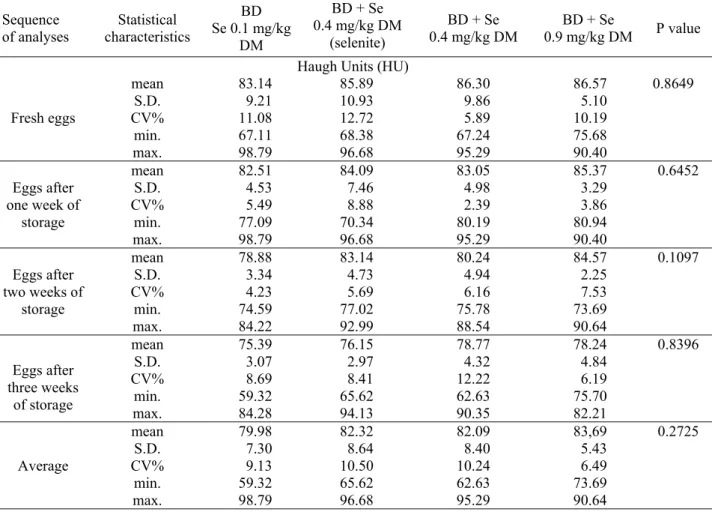
Analysis of white stability in the Haugh units showed in each of the four analyzes higher quality of the white in groups in chickens fed with supplement of selenium in both forms.
mg.kg-1. Despite the tendency of higher values of
Haugh units in groups of selenium supplement, especially organic, differences among groups in different analyzes and on average were not statistically significant (P>0.05).
Our results agree with the findings of the authors Baylan et al. (2011) [19] in the experiment those selenium supplementation with yeast was
significantly affected, besides other indicators of quality, HU and albumen index were affected as well. The HU decreased with increased storage time and temperature.
Higher levels of Se-yeast administration resulted in greater HU compared to the selenite and control groups.
Table 2. The changes in egg weight and egg albumen quality caused by supplementation of sodium selenite and Se-yeast into basal diet (BD) for laying hens
Statistical characteristics
BD Se 0.1 mg/kg
DM
BD + Se 0.4 mg/kg DM
(selenite)
BD + Se 0.4 mg/kg DM
(Se-yeast)
BD + Se 0.9 mg/kg DM
(Se-yeast) P value
Egg weight (g)
mean 60.58 61.23 62.30* 62.12 0.0126
S.D. 3.87 5.63 5.97 3.17
CV% 6.38 9.19 9.58 5.08
min. 51.00 54.00 56.00 58.00
max. 72.00 78.00 82.00 85.00
Egg albumen weight (g
mean 40.53 40.78 41.56 41.50 0.5310
S.D. 3.23 3.37 2.92 2.46
CV% 7.97 8.26 7.03 5.93
min. 34.4 31.5 32.28 33.26
max. 52.3 53.2 54.5 55.8
Egg albumen percentage (%)
mean 66.88 66.71 66.69 66.81 0.8151
S.D. 2.49 3.20 1.95 1.99
CV% 3.73 4.79 2.92 2.98
min. 52.81 52.00 48.2 50.89
max. 85.13 92.23 87.24 90.36
Egg albumen high (mm)
mean 7.26 7.57 7.33 7.58 0.0536
S.D. 0.62 0.65 0.54 0.62
CV% 8.54 8.58 7.36 8.17
min. 6.0 6.0 6.0 7.0
max. 9.0 9.5 9.0 9.5
Haugh units (HU)
mean 84.52 86.60 87.21* 86.93* 0.0180 S.D. 3.87 3.80 4.10 3.56
Table 3. Changes in the freshness of eggs due to the addition of various forms and doses of selenium expressed in the Haugh units
Sequence
of analyses characteristicsStatistical
BD Se 0.1 mg/kg
DM
BD + Se 0.4 mg/kg DM
(selenite)
BD + Se
0.4 mg/kg DM 0.9 mg/kg DM BD + Se P value
Haugh Units (HU)
Fresh eggs
mean 83.14 85.89 86.30 86.57 0.8649
S.D. 9.21 10.93 9.86 5.10
CV% 11.08 12.72 5.89 10.19
min. 67.11 68.38 67.24 75.68
max. 98.79 96.68 95.29 90.40
Eggs after one week of
storage
mean 82.51 84.09 83.05 85.37 0.6452
S.D. 4.53 7.46 4.98 3.29
CV% 5.49 8.88 2.39 3.86
min. 77.09 70.34 80.19 80.94
max. 98.79 96.68 95.29 90.40
Eggs after two weeks of
storage
mean 78.88 83.14 80.24 84.57 0.1097
S.D. 3.34 4.73 4.94 2.25
CV% 4.23 5.69 6.16 7.53
min. 74.59 77.02 75.78 73.69
max. 84.22 92.99 88.54 90.64
Eggs after three weeks
of storage
mean 75.39 76.15 78.77 78.24 0.8396
S.D. 3.07 2.97 4.32 4.84
CV% 8.69 8.41 12.22 6.19
min. 59.32 65.62 62.63 75.70
max. 84.28 94.13 90.35 82.21
Average
mean 79.98 82.32 82.09 83,69 0.2725
S.D. 7.30 8.64 8.40 5.43
CV% 9.13 10.50 10.24 6.49
min. 59.32 65.62 62.63 73.69
max. 98.79 96.68 95.29 90.64
Number of eggs in each group n=8; (P≤0.05) – statistically significant difference
Gajcevic et al. (2009) [20] investigated the effect of selenium on the quality of fresh egg whites and stored whites (14 and 28 days at 4°C). Analysis in accordance with the results of our experiment showed favorable HU values with increasing proportion of organic forms of selenium. In the experiment of Mohito-Asli et al. (2010) [21] Se and vitamin E supplementation did not affect hen performance, whereas Haught unit increased. Also the results in the experiment of Pan et al. (2011) [18] showed affected Se contents, GPX activity, and HU of eggs by the dietary Se level. The combination of selenium with probiotics signigicantly slowed down the drop of Haught units (HU) of eggs stored at room temperature.
Conclusions
In conclusion, the results of this experiment show that addition of selenium, especially the organic
forms can favorably affect the value and weight of the egg whites and their Haugh units. In other indicators of quality it has not been found any significant effect of selenium addition. The analyzes performed to determine the possible impact of selenium on egg freshness by Haugh units showed a positive influence, but with no statistically significant difference compared to the control group.
Acknowledgement
This study was supported by Grant Agency for Science, VEGA of Slovak Republic, Grant No. 1/0493/12
References
stimulátorov rastu a úloha organického selénu vo výžive hydiny. In Mojmírove: Alltech, 2001, pp. 6-24 2. Surai, P.F., Selenium in poultry nutrition. L. Antioxidant properties, deficiency and toxicity, World Poultry Science, 58, 2002, 333–347
3. Rayman, M.G., The importance of selenium to human health, Lancet, 2000, 15, (356), 9225, 233-241 4. Zuberbuehler, C.A., Messikommer, R.E., Wenk, C., Choice feeding of selenium-deficient laying hens affects diet selection, selenium intake and body weight. Journal of. Nutrition, 2002, 132, 11, 3411-3417. 5. Finley, J.W., Increased intakes of selenium-enriched foods may benefit human health, Journal of the Science of Food and Agriculture, 2007, 87, 9, 1620-1629
6. Schrauzer, G.N., Anticarcinogenic effects of selenium, Cellular and Molecular Life Sciences, 2000, 57, 13-14, 1864 - 1873
7. Kyriakopoulos, A., Behne, D., Selenium-containing proteins in mammals and other forms of life, Reviews of Physiology, Biochemistry and Pharmacology, 2002, 145, 1-46
8. Surai, P.F., Nové možnosti v doplňovaní selénu. Zdravá hydina, funkčné potraviny, zdravá ekonomika. Piešťany: Alltech, 2001, pp. 2-11
9. Hess, J.B., Cowns, K.M., Bilgili, S.F., Selenium nutrition and poultry meat quality. Nutritional Biotechnology in the Feed and Food Industries. Proceeding of the 19th Annual Symposium. Nottingham University Press, Nottingham, UK, 2003, pp. 107-112 10. Fisinin, V.I., Papazyan, T.T., Surai, P.F., Producing specialist poultry products to meet human nutrition requirements. Selenium enriched eggs. In World’s Poultry Science Association,2008, vol. 64, no. 1, pp. 85 – 97.
11. Edens, F.W., Practical applications for selenomethionine: Broiler breeder reproduction. Proceeding of the 18th Annual Symposium: Nutritional Biotechnology in the Feed and Food Industry. Nottingham University Press, Nottingham, 2002, pp. 29-42
12. Arpasova, H., Capcarova, M., Kalafova, A., Lukac, N., Kovacik, J., Formicky, G., Massanyi, P., Nickel induced alteration of hen body weight, egg production and egg quality after an experimental peroral administration, Journal of Environmental Science and Health, 2007, 42, 8, 913-918
13. Sahin, N., Sahin, K., Onderci, M., Vitamin E and selenium supplementation to alleviate
cold-stress-associated deterioration in egg quality and egg yolk mineral concentrations of Japanese quails, Biological Trace Elements Research,2003, 96, 179-189
14. Reis, R.N., Vieira, S. L., Nascimento. P.C., Pena, J.E., Barros, R., Torres, C.A., Selenium contents of eggs from broiler breeders supplemented with sodium selenite or zinc-L-selenium-methionine, Journal of Applied Poultry Research, 2009, 18, 2, 151-157
15. Chinrasri, O., Chantiratikul, P., Thosaikham, W., Atiwetin, P., Chumpawadee, S., Saenthaweesuk, S., ChantiratikuL, A., Effect of Selenium-enriched Bean Sprout and Other Selenium Sources on Productivity and Selenium Concentration in Eggs of Laying Hens, Asian-Australasian Journal of Animal Sciences, 2009, 22, 12, 1661-1666.
16. Sahin, N., Sahin, K., Onderci, M., Vitamin E and selenium supplementation to alleviate cold-stress-associated deterioration in egg quality and egg yolk mineral concentrations of Japanese quails, Biological Trace Elements Research,2003, 96, 179-189
17. Pappas, A.C., Adamovic, T., Sparks, N.H.C., - Surai, P.F., Mcdevitt, R.M., Effects of supplementing broiler breeder diets with organic selenium and polyunsaturated fatty acids on egg quality during storage, Poultry Science, 2005, 84, 865-874
18. Pan, C.L., Zhao, Y.X., Liao, S.F.F., Chen, F., Qin, S.Y., Wu, X. S., Zhou, H., Huang, K.H., Effect of Selenium-Enriched Probiotics on Laying Performance, Egg Quality, Egg Selenium Content, and Egg Glutathione Peroxidase Activity, Journal of Agricultural and Food Chemistry, 2011, 59, 21, 11424-11431
19. Baylan, M., Canogullari, S., Ayasan, T., Copur, G., Effects of Dietary Selenium Source, Storage Time, and Temperature on the Quality of Quail Eggs, Biological Trace Element Research, 2011, 143, 2, 957-964
20. Gajcevic, Z., Kralik, G., Has-Schon, E., Pavic, V., Effects of organic selenium supplemented to layer diet on table egg freshness and selenium content, Italian Journal of AnimalScience, 2009, 8, 2, 189-199