A Framework of Indexation and
Document Video Retrieval Based
on the Conceptual Graphs
Mounir Zrigui, Mubarak Charhad and Anis Zouaghi
Research Unit of Technologies of Information and Communication (UTIC), Faculty of Science, Monastir University, Tunisia
Most of the video indexing and retrieval systems suffer from the lack of a comprehensive video model capturing the image semantic richness, the conveyed signal infor-mation and the spatial relations between visual entities. To remedy such shortcomings, we present in this pa-per a video model integrating visual semantics, spatial and signal haracterizations. It relies on an expressive representation formalism handling high-level video de-scriptions and a full-text query framework in an attempt to operate video indexing and retrieval beyond trivial low-level processes, semantic-based keyword annotation and retrieval frameworks.
Keywords: video indexing and retrieval, visual content, conceptual graphs, visual semantics facet, signal facet
1. Introduction
Video data can be modeled based on its visual content (such as color, motion, shape, and in-tensity) [1], [17] and semantic content in the form of text annotations [6]. Because machine understanding of the video data is still an un-solved research problem, text annotations are usually used to describe the content of video data according to the annotator’s understanding and the purpose of that video data.
Although such content descriptions may be bi-ased, incomplete and inaccurate, they still pro-vide much of semantic content that cannot be obtained by current computer vision or voice recognition techniques.
In the case of video, there are a number of speci-ficities due to its multimedia aspect. For in-stance, a given concept(person, object. . .)can be present in different ways: it can be seen, it
can be heard, it can be talked of, and combi-nation of these representations can also occur. Of course, these distinctions are important for the user. A query concerning X as “Show me a picture of X.” or as “I want to know what Y has said about X.” are likely to give quite different answers.
The first one would look for X in the image track while the second would look in the audio track for a segment in which Y is the speaker and X is mentioned in the transcription.
Also, among all possible relations that could be represented in conceptual graphs, some are especially appropriate for content-based video indexing.
Based on the traditional keywords approach to video information retrieval is that usually too many or erroneous results are returned. To overcome this inconvenience, a solution is to include conceptual descriptions when the doc-uments are indexed. Let us consider, for exam-ple, the following query: “documents dealing with the president of the United States”. Us-ing the currently existUs-ing search techniques like keywords approach, we extract some words as for example “president”, “United States” and search the collection of documents with a query that combines these keywords. The problem arising here is that there is no way to specify that the expected answer to this query is a person, and thus several wrong results can be obtained in return of such a query.
documents allowing the consideration of infor-mation from each of the modalities(image, text, sound)and implement this model within a sys-tem of indexing and search by content of video documents.
2. Related Works
As far as indexing and retrieval techniques for the visual content are concerned, the first sys-tems(content-based) [12]propose a set of meth-ods based on low-level features such as colors, textures. . . fully automatic, and able to process queries quickly. Several frameworks dealing with the automatic extraction of the image se-mantic content have been proposed [7], [14],
[11]. Their main disadvantage relies however on the specification of restrained and fixed sets of semantic classes. Indeed, regarding the fact that several artificial objects have high degrees of variability with respect to signal properties such as color and texture variations, an inter-esting solution is to extend the extracted visual semantics with signal characterizations in order to enrich the image indexing vocabulary and query language. Therefore, a new generation of systems integrating semantics and signal de-scriptions has emerged and the first solutions
[15],[19]are based on the association of textual annotations with relevance feedback(RF). Pro-totypes such as iFind[15]offer loosely-coupled solutions based on textual annotations to char-acterize semantics and on a RF scheme oper-ating on low-level signal features. These ap-proaches present two major drawbacks: first, they lack to exhibit a single framework unifying signal features and semantics, which penalizes the performance of the system in terms of re-trieval efficiency and quality. Then, regarding the query process, the user is to query both textu-ally in order to express high-level concepts and through several and time-consuming RF loops to complement his initial query. Therefore, it is impossible for such systems to process complex queries combining semantic and signal concepts as well as relations linking them such as “find Bill Clinton and a striped red, white and blue flag behind him”.
All previous works in visual case can’t describe the video content in much depth. The solu-tion consists of combining signal and symbolic
characterizations in order to reinforce the se-mantic gap and to take into account the generic and multifacets descriptions for video content indexing and retrieval.
3. A Multi-facetted Framework for Video Retrieval
As for textual document, video has a specific organization. A video is composed of scenes, each of which describes an event.
A video scene itself is composed of a number of shots, each of which is an unbroken image se-quence captured continuously by the same cam-era. A shot could legitimately be compared to a word, as they are both the basic entities struc-turing respectively a video sequence and a text fragment.
The visual content of a video shot can be rep-resented by its key frames. Key-frames are im-ages providing a compact representation of the video shots. They can serve as pointers to the given portion of the video content for index-ing and retrieval process. Generally, the key frame extraction process is integrated with the processes of shot segmentation. Each time a new shot is identified, the key-frame extrac-tion process is invoked, using parameters al-ready computed during shot boundary detec-tion(SBD) [17]. These parameters are related to visual data such as color, or camera motions descriptors. Key frame selection can differ de-pending on the application needs. For example, we require only a few key frames (1-2) for a video-captured meeting since camera motions are sparse [17], [5]. Whereas, in a broadcast news document, we find more animation ( re-lated to visual aspects)so we have more shots and key-frames. In our approach, the key-frame is selected as the most stable image of a given shot(i.e. image that appears many times at the same shot).
context, is itself an aggregation of two basic facets:
— The visual semantics facet describes the im-age semantic content and is based on la-belling image objects with a visual semantic concept.
— The signal facet describes the image signal content in terms of symbolic perceptive fea-tures and consists of characterizing image objects with signal concepts. It is itself di-vided into two sub-facets. The color sub-facet features the image signal content in terms of symbolic colors. E.g., the image object (USA flag) is associated with sym-bolic colors Blue, Redand White. The tex-ture subfacetdescribes the signal content in terms of symbolic texture features.
At the core of the image model is the notion of image object (IO), abstract structure repre-senting a visual entity within an image. Its specification is an attempt to operate visual in-dexing and retrieval operations beyond simple low-level processes or object-based techniques
[14] since Ios convey the visual semantics and signal information.
3.1. Representation Formalism
In order to instantiate this model as an image re-trieval framework, we need representation for-malism capable of representing image objects as well as the visual semantics, spatial and sig-nal information they convey. Moreover, this representation formalism should make it easy to visualize the information related to an image. It should therefore combine expressivity and a user-friendly representation. As a matter of fact, a graph-based representation and particularly conceptual graphs (CGs) [15] are an efficient solution to describe an image and characterize its components. The asset of this knowledge representation formalism is its flexible adapta-tion to the symbolic approach of image retrieval
[16],[8]. It allows indeed to uniformly represent components of our architecture and to develop expressive and efficient index and query frame-works.
Formally, a CG is a finite, bipartite, connex and oriented graph. It features 2 types of nodes: the first one between brackets in our CG al-phanumerical representation (i.e. as coded in
our framework) is tagged by a concept, how-ever, the second between parentheses is tagged by a conceptual relation. E.g., the CG:
[ICTA]←(Name) ←[Conference] →(Location)→[Tunisia]
is interpreted as: the ICTA conference is held in Tunisia.
Concepts and conceptual relations are organized within a lattice structure partially ordered by the IS-A(≤)relation. E.g., Person≤Man denotes that the concept Man is a specialization of the concept Person, and will therefore appear in the offspring of the latter within the lattice orga-nizing these concepts. Within the scope of the model, CGs is used to represent the video shot content in the logical facet.
The indexing module provides a representation of a video shot document in the corpus with re-spect to the multi-facetted image model. It is a CG called document index graph.
Also, as far as the retrieval module is concerned, a user full text query is translated into a video shot conceptual representation: the video shot query graph corresponding to the multi-facetted shot description.
After presenting our representation formalism, we now focus on the visual semantics facet and propose conceptual structures handling seman-tics. We then specify its CG representation.
3.2. The Visual Content Modeling
3.2.1. The Visual Semantics Facet a) Automatic extraction of semantic
concepts
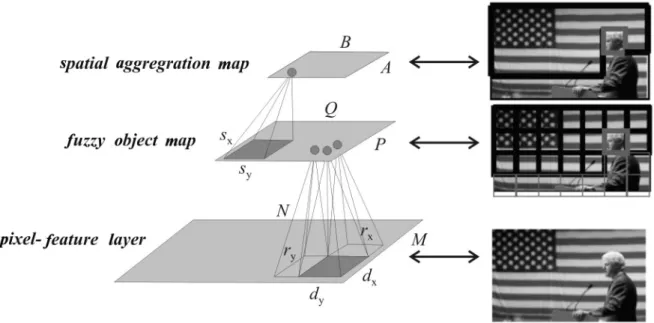
Figure 1.Architecture for visual semantics extraction: The tiled key-frame(1)is subjected to visual token recognition and recognition(2)results are then spatially aggregated to determine semantic concepts(3).
be encountered in these scenes. This list(in par-ticular concepts related to individual names)is enriched with concepts provided by Video An-nex[11]and a total of 72 visual semantic con-cepts to be learned and automatically extracted are specified.
Figure 1 presents the architecture for automatic extraction of visual semantic concepts: a 3-layer feed-forward neural network with dynamic node creation capabilities is used to learn these concepts from 1000 labelled key-frame patches cropped from the training and annotation corpus of the TRECVID 2003 search task. Color and texture features are computed for each training region as an input vector for the neural net-work. Once the network has learned the visual vocabulary, the approach subjects a tiled key-frame to be indexed to multi-scale, view-based recognition against these visual semantic con-cepts. A key-frame to be processed is scanned with windows of several scales within theFuzzy Object Map in Figure 1. Each one represents a visual token characterized by a feature vector constructed with respect to the feature vectors of visual semantic concepts exhibited previously. Recognition results are then reconciled across multiple resolutions and aggregated according to configurable spatial tessellation within the
Spatial Aggregation Map.
b) Model of the visual semantics facet
Image objects are represented by Io concepts and visual semantic concepts are organized within a multi-layered lattice ordered by a spe-cific/generic partial order (we propose a part of the lattice in Figure 2). An instance of the visual semantics facet is represented by a set of canonical CGs, each one containing an Io
type linked through the conceptual relationvsc
to a visual semantic concept. The basic graph controlling the generation of all visual semantic facet graphs is:
[Io]→(vsc)→[VSC]
E.g., the representation of the visual semantics
facet for our example image in Figure 1 is
[Io1]→(vsc)→[Clinton]
and
[Io2]→(vsc)→[f lag]
translated as the first IO represents Clinton and the second IO a flag.
3.2.2. The Signal Facet
The integration of signal information within the conceptual level is crucial since it enriches the indexing framework and expands the query lan-guage with the possibility to query over both semantics and visual information. After pre-senting our formalism, we will now focus on the signal facet and deal with theoretical impli-cations of integrating signal features within our multifaceted conceptual model. This integra-tion is not straightforward as we need to charac-terize low-level signal features at the conceptual level, and therefore specify a rich framework for conceptual signal indexing and querying. We first propose conceptual structures for the color and texture subfacets and then thoroughly specify their CG representation
3.2.2.1. The Color Subfacet
Integrating signal features within a high-level conceptual framework is not straightforward. The first step is to specify conceptual signal data which correspond to low-level features, therefore specifying a correspondence process between color names and color stimuli. Our symbolic representation of color information is guided by the research carried out in color nam-ing and categorization [2] stressing a step of correspondence between color names and their stimuli. We will consider the existence of a formal system Snc of color categorization and naming which specifies a set of color words Cat with a cardinal Ccat. These color words are the Ci. Within the scope of this paper, 11 color words:
C1=red, C2=white, C3=blue, C4=grey, C5=cyan, C6=green, C7=yellow, C8=purple, C9=black,
C10=skin, C11=orange
spotlighted in [29] are described in the HVC perceptually uniform space by a union of bright-ness, tonality and saturation intervals.
a) Conceptual specification
Each IO is indexed by a color index concepts
(CICs) feature the color distribution of image objects by a conjunction of color words and their corresponding integer pixel percentages. The second image object (Io2) corresponding to the semantic conceptflagin Figure 1 is char-acterized by the CIC:
<r: 40,w: 45,b: 15,g: 0. . . > interpreted as Io2 having 40% of red, 45% of white and 15% of blue.
CICs are elements of partially ordered lattices, organized with respect to the query operator processes: either a Boolean or a quantifica-tion operator (at most, at least, mostly, few)
explicited in [21] [22]. Index color graphs link anIotype through the conceptual relation
has colorto a CIC:
[Io]→(has color)→[CIC].
b) Automatic generation of color subfacet CGs
Here is the algorithm summarizing the auto-matic generation of all conceptual structures of the color subfacet:
• Given an IO
• compute the RGB value of each of its pixels • Map it to tonality, brightness & saturation
values in the HVC perceptive space
• Determine the associated color word consid-ering the HVC perceptive color word parti-tion[9]
• Store for each color word the percentage of associated pixels
• Generate the associated CIC and the al-phanumerical color CG:
[IO]→(has color)→[CIC]
E.g., the representation of the color subfacet for our example image in Section 1 is:
[Io2]→(has color)
TW B C D I L M N S Sp U W
% 83.7 85.2 88.9 91.9 94.5 89 86.8 83.4 90 97.3 81.4
Table 1.Cross-validation percentages.
translated as the second image object (Io2) is associated with the CIC :
<r: 40,w: 45,b: 15,g: 0. . . >
(i.e. 40% of red, 45% of white & 15% of blue).
3.2.2.2. The Texture Sub Facet
The study of texture in computer vision has led to the development of several computational models for texture analysis used in several CBIR architectures [7]. However, these texture ex-traction frameworks mostly fail to capture as-pects related to human perception. Therefore, we propose a solution inspired by the work in
[12] specifying a computational framework for texture extraction which is the closest approxi-mation of the human visual system. The action of the visual cortex, where an object is decom-posed into several primitives by the filtering of cortical neurons sensitive to several frequencies and orientations of the stimuli, is simulated by a bank of Gabor filters. However, as opposed to their work operating at a global level of an image, we will focus on computational texture extraction at the object level. We will therefore characterize each image object by its Gabor en-ergy distribution within seven spatial frequen-cies covering the whole spectral domain and seven angular orientations. Each image object is then represented by a 49-dimensions vector, with each dimension corresponding to Gabor energy.
a) Conceptual texture characterization
Although several studies have been proposed for the analysis of the characteristic texture, few proposals were made for the symbolic recogni-tion of this feature. Our symbolic representarecogni-tion of texture is based on research in naming and categorizing textures proposed by Bhushan[3]. We consider the following concepts of texture as a representation of each of these categories:
bumpy, cracked, disordered, interlaced, lined, marbled, netlike, smeared, spotted, uniform and whirly.
These 11 high-level texture words, foundation of our framework for texture symbolic charac-terization are automatically mapped to the 49-dimensions vectors of Gabor energies through support vector machines [20]. We adopt the one-against-rest approach where a separate clas-sifier is designed for each of the eleven texture words for reasons of optimized inter-class sepa-ration. We also associate a confidence value for the classification defined. For this, we use the distance from an IO i to be characterized with texture word t to the decision boundary ft(i)
(whereftis the trained discriminate function on the one-against-rest classification problem in-volving texture wordt)and map it on posterior probabilities of recognition. In order to achieve this mapping, we use a 1D logistic classifier which maximizes the likelihood of the classi-fied training IOs. For each of the eleven texture words, the best cross-validation rate is given in Table 1. Let us note that the SVMs are able to label new instances of unknown textures with corresponding texture words with a high accu-racy, cross-validation percentages being higher than 80%.
b) Conceptual specification
Each IO is indexed by a texture concept (TC). A TC is supported by a vector structure twith eleven elements corresponding to texture words
twi. Values t[i], i ∈ {1, . . . ,11} are booleans stressing that the texture distribution of the con-sidered IO is characterized by the texture word twi.
E.g., the second IO(Io2)corresponding to the semantic conceptflag in Figure 2 is character-ized by the TC:
<B: 0. . .D: 0. . .L : 1. . .U : 1. . . >
Io type through the conceptual relation tx to a texture concept:
[Io]→(has tx)→[TC]
c) Automatic generation of texture subfacet CGs
Here is the algorithm summarizing the auto-matic generation of all conceptual structures of the color subfacet:
• Given an IO
• Compute its associated 49-dimensions vec-tor of Gabor energies
• Map it to the linked texture words through the explicated SVM architecture
• Compute the posterior recognition probabil-ities of association
• Generate the associated TC & the texture CG:
[Io]→(has tx)→[TC]
E.g., the representation of the texture subfacet for our example image in Figure 1 is
[Io2]→(has tex)
→[<B: 0. . .D: 0. . .L: 1. . .U: 1. . . >]
translated as the second image object(Io2, rep-resenting the semantic concept flag) is asso-ciated with the TC < B : 0. . .D : 0. . .L : 1. . .U : 1. . . >(i.e. striped/lined).
3.2.2.3. The Spatial Subfacet
In order to model spatial data, we first consider a subset of the topological relations explicited in the RCC-8 theory [5]; 4 relations which are exhaustive and relevant for image querying are chosen. Considering 2 image objects(Io1 and
Io2), these relations are:
— s1= (C,Io1,Io2): Io1 covers/is in front of Io2(thereforeIo2 is behindIo1).
— s2= (P,Io1,Io2): Io1 is a part ofIo2.
— s3 = (T,so1,so2): Io1 touches Io2(
exter-nally connected or overlaps).
— s4= (D,so1,so2): Io1 is disconnected with Io2.
Directional relations Right(s5=R), Left(s6=
L), Above(s7=A), Below(s8=B)are
invari-ant to basic geometrical transformations( trans-lation, scaling).
Two relations specified in the metric space are based on the distances between image objects. They are the Near(s9 = N)and Far (s10 = F)
relations.
An instance of the spatial facet is represented by a set of CGs, each one containing 2Iotypes linked through the previously defined spatial re-lations(more details are found in[18],[23]). An IO is characterized by its centre of grav-ity io g as well as two pixel sets: its interior, notedio iand its boundary, notedio b. To deal with the automatic computation of topological relations[9], two image objectsIo1 andIo2 are characterized by intersections of their interior and boundary sets:
io1 i∩io2 i, io1 i∩io2 b, io1 b∩io2 i
andio1 b∩io2 b.
Each topological relation is mapped to the re-sults of these intersections, e.g. (DC,so1,so2)
iff.
io1 i∩io2 i=∅, io1 i∩io2 b=∅,
io1 b∩io2 i=∅andio1 b∩io2 b=∅.
The interest of this computation method relies on the association of topological relations to the previous set of necessary and sufficient condi-tions involving attributes of spatial objects(i.e. interior and boundary). The computation of di-rectional relations betweenIo1 andIo2 relies on the relative position of their centers of gravity. Finally, to distinguish between near and far re-lations, we use theDnf constant given by
Dnf =d(0,0.5∗[σ1,σ2]T)
whered is the Euclidean distance between the null vector0 and[σ1,σ2]Tis the vector of
a) Conceptual specification
Each pair of IOs are related through a spa-tial concept (SpC), compact structure summa-rizing spatial relationships between these IOs. A SpC is supported by a vector structure sp
with ten elements corresponding to the previ-ously explicited spatial relations. Values sp[i], i∈{1,. . .,10}are booleans stressing that the spa-tial relation si links the two considered IOs. E.g., Io1 and Io2 are related through the SpC:
<C: 1, P: 0. . .N : 1, F: 0>
translated asIo1 covering and being near toIo2
(Io2 being therefore behindIo1). SpCs are el-ements of a partially ordered lattice explicited in[21]. The basic graph controlling the gener-ation of all spatial subfacet graphs links two Io types through the conceptual relationsagent 1 andagent 2 to a SpC:
[Io1]←(agent 1)←[SIC]→(agent 2)
→[Io2].
b) Automatic generation of spatial subfacet CGs
Here is the algorithm summarizing the auto-matic generation of all conceptual structures of the spatial subfacet:
• Given a pair of IOs,Io1 andIo2
• Associate a topological relation to the results of interior and boundary sets ofIo1 andIo2 • Compare the centers of gravity of both IOs to determine the directional relations linking them
• ComputedEuc(Io1 g,Io2 g)and compare it toDnf to determine the near/far relations
betweenIo1 andIo2
• Generate the associated SIC and the alphanu-merical spatial CG:
[Io1]←(agent 1)←[SIC]→(agent 2) →[Io2].
E.g., the representation of the spatial subfacet for our example image in Figure 1 is [io1] ←
(agent 1) ← [< c : 1,p : 0. . .n : 1,f : 0 > ] → (agent 2) → [io2], translated asio1 cov-ering and being near toio2.
4. The Query Module
Our conceptual architecture is based on a uni-fied full-text framework allowing a user to query over the visual layer.
This obviously optimizes user interaction since the user is in ‘charge’ of the query process by making his information needs explicit to the system. The retrieval process using CGs relies on the fact that a query is also expressed under the form of a CG. The representation of a user query in our model is, like image index rep-resentations, obtained through the combination
(joint operation)of CGs over all the facets of vi-sual layers. Without going into details, a simple grammar composed of a list of the previously introduced visual concepts, as well as the spec-ified visual relations is automatically translated into an alphanumerical CG structure.
We distinguish several categories of requests: — Request Event: The application event
in-volves actions(often real)in the document. For example, the query: “find the video seg-ments showing a rally”. Representation with the formalism of conceptual graph of this query is given.
Figure 3.Example query event.
— Temporal request: The temporal request in-tegrates constraints from the temporal as-pect. For example, the query: “find the video segments showing both events ending at the same time”. Representation with the formalism of conceptual graph of this query is given in the following figure:
— Audio semantic request: The audio semantic request combines the descriptions connected with the audio contents. For example, the request: “find the video segments in which Bill Clinton spoke”. Representation with the formalism of conceptual graph of this query is given in the following figure:
Figure 5.Example query semantics audio. — Visual semantic request: The visual
seman-tic request combines the descriptions con-nected with the visual contents. For exam-ple, the request: “find the video segments showing Bill Clinton”. Representation with the formalism of conceptual graph of this query is given in the following figure:
Figure 6.Example of visual semantic query.
— Semantic request signal: The semantic re-quest signal can search the video based on low-level descriptions. For example, the re-quest: “Find the video segments showing a flag with a red, white and blue striped tex-ture”.
[Flag]→(has color)→[<C1 : 1,C2 : 1,
C3 : 1, . . . ,C9 : 0>].
→(has texture)→[<T1 : 0,T2 : 0,
T3 : 0,→T4 : 0,T5 : 1, . . . >]
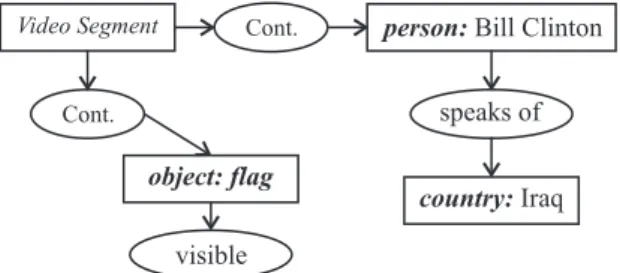
— Multimodal request: The multimodal re-quest allows searching the video based on a description from several modalities ( im-age, audio or text). For example, the request: “Find the video segments showing Bill Clin-ton speak on Iraq and where at least part of
the American flag is visible”. Representa-tion with the formalism of conceptual graph of this query is given in the following figure:
Figure 7.Example of multimodal semantic query.
5. The Matching Process
The correspondence between a document d(d
may be a video or a segment of video document) and a queryqis determined using the operator of projection of the graph Gq representing the
request in the graphGd representing the
docu-ment. There is a projection of the graphGqon a graphGdif there is one under graphG
dofGd
which is a restriction ofGq.
Given a queryqand documentd, there may be zero, one or more such projections. We denote
(q,d)all of these projections.
When many documents match the query in ac-cordance with such correspondence, it is neces-sary to order them. For this, we calculate the relevance for each video shot VS(document). It is calculated by combining the measures called for exhaustivity and specificity. This correla-tion model is based on an extension of the logic model of VanRijsbergen logical model proposed in[13]. We use a functionFto combine exhaus-tivity and specificity measures:
Relevance(VS,Q) =F[E(VS→Q),
S(Q→VS)]
The function F values are to be proportional to the values of the exhaustivity and specificity functions: it takes its values in the[0,1].
F(a,b) =0if a=0or b=0;
F(a,b) =1if a=1and b=1;
We have chosen the trivial multiplication oper-ation.
F(a,b) =a∗b;
6. Application: TRECVID Topic Search
Our prototype called CLOVIS1implements the
theoretical framework exposed in this paper and validation experiments are carried out on the TRECVID 2004 corpus comprising 128 videos segmented in 48817 shots, each one itself rep-resented by a key-frame.
The search task is based ontopic retrievalwhere a topic is defined as a formated description of an information need, therefore involving multi-ple characterizations. The commulti-plexity inherent in topic search revolves around the difficulty to design the intended meaning and interrelation-ships between the various characterizations. We therefore design the evaluation task in the con-text of manual search, where a human1expert
in the search system interface is able to inter-pret a topic and propose an optimal query to be processed by the system. 24 multimedia topics developed by NIST for the search task express the need for video concerning people, things, events, locations. . . and combinations of the former. The topics are designed to reflect many of the various sorts of queries real users pro-pose: requests for video with specific people or people types, specific objects or instances of object types, specific activities or locations or instances of activity or location types. We com-pare our system with the mainstream TRECVID 2004 systems operating manual search[10].
Carnegie Mellon Universityproposes a manual search system using text retrieval based on ASR and closed captioning to find candidate shots and then re-ranking the candidates by linearly combining scores from multimodal features or re-ranking weights trained by logistic regres-sion.
The manual search system of theNational Uni-versity of Singaporeis based on a generic query analysis module. They use 6 query-specific models and the fusion of multi-modality fea-tures such as text, OCR, visual concepts. . . their work being inspired by text-based question-answering techniques.
Finally, theLowlands team (CWI Amsterdam & Twente University)proposed a generative prob-abilistic model for video retrieval based on dy-namic(at the shot level), static(at the key-frame level)and audio/language(using ASR) charac-terizations. Their queries are created by manual construction and selection of visual examples. The Recall/Precision curves in Figure 8 illus-trate the average results in terms of mean av-erage precision obtained for the 24 multime-dia topics. The average precision of CLO-VIS(0.0868)is approximately 14.2%, 19% and 22.3% higher over respectively the average pre-cisions of the CMU(0.076), Lowlands(0.073)
and NUS (0.071) systems. This clearly indi-cates that, on average, the first video shots re-turned by our system are particularly relevant compared to the first video shots retrieved by other systems.
Figure 8.Recall/Precision curves for TRECVID topics.
The obtained results allow us to state that when performing topic search and therefore dealing with elaborate queries which combine multiple sources of information (here visual and audio semantics, signal features) and thus require a higher level of abstraction, the use of an “intel-ligent” and expressive representation formalism
(here the CG formalism within our framework)
is crucial. As a matter of fact, our framework outperforms state-of-the-art TRECVID 2004
systems by proposing a unified full-text frame-work optimizing user interaction and allowing querying with precision over visual and au-dio/speech descriptions.
7. Conclusion
We proposed the specification of a framework combining semantics, signal and spatial char-acterizations within a strongly-integrated archi-tecture to achieve greater retrieval accuracy. We introduced image objects, abstract structures representing visual entities in order to oper-ate video indexing and retrieval operations at a higher abstraction level than state-of-the-art frameworks. We specified the multiple facets, their conceptual representation and finally pro-posed a full-text unified and rich query frame-work.
Our experimental contribution consists of the
(partial)implementation of the CLOVIS proto-type. We have integrated the proposed model in the video indexing and retrieval system by content in order to evaluate its contributions in terms of effectiveness and precision. Experi-mental results on a TRECVID corpus allowed us to validate our approach which aims to solve several problems such as:
— Exploit semantic descriptions of content — Facilitate handling and access to large video
databases based on the description level sym-bolic
— To gather descriptions from different sub-media in the same schema modelling. In further work, we propose in the short term to exploit the results of visual analysis(signal)and integrate different representations at the level of the modeling, then complete the integration of model in a video search system for assessing the contribution of the proposed model on another corpus. On the long run, we propose to use ex-ternal knowledge to enrich the descriptions in the schema modeling.
References
[1] G. AMATO&AL., An Approach to a Content-based Retrieval of Multimedia Data. Multimedia Tools Appl.7, pp. 9–36., 1998.
[2] B. BERLIN, P. KAY, Basic Color Terms: Their Universality and Evolution. UC Press, 1991.
[3] N. BHUSHAN, & AL., The Texture Lexicon:
Un-derstanding the Categorization of Visual Texture Terms and Their Relationship to Texture Images.
Cognitive Science21(2), pp. 219–246, 1997.
[4] J. S. BORECZKY, L. A. ROWE, Comparison of video
shot boundary detection technique. InIS&T/SPIE, USA, February 1996.
[5] E. ETIEVENT&AL., Assisted Video Sequences
In-dexing: Motion Analysis Based on Interest Points.
ICIAP, 27–29, 1999.
[6] R. FABLET, P. BOUTHEMY, Statistical motion-based
video indexing and retrieval. Conf. on Content-based Multimedia Information Acces, Vol. 1, pp. 602–619, Paris, France, 2000.
[7] S. FENG, &AL., Multiple Bernoulli Relevance
Mod-els for Image and Video Annotation. CVPR, pp. 1002–1009, 2004.
[8] J. L. GAUVAIN&AL., The LIMSI Broadcast News
Transcription System.Speech Communication37, pp. 89–108, 2002.
[9] Y. GONG&AL., Image Indexing and Retrieval Based
on Color Histograms.Multimedia Tools and App. II, pp. 133–156, 1996.
[10] W. KRAAIJ, A. SMEATON& P. OVER, TRECVID
2004 – An Overview.
[11] J. H. LIM, Explicit query formulation with visual keywords.ACM MM, pp. 407–412, 2000.
[12] C.-Y. LIN&AL., VideoAnnEx: IBM MPEG- 7 An-notation Tool for Multimedia Indexing and Concept Learning.IEEE on ICME, 2003.
[13] Y. LU&AL., A unified framework for semantics and feature based RF in image retrieval systems.
ACM MM, pp. 31–37, 2000.
[14] J. NIE, An outline of a General Model for Informa-tion Retrieval Systems.SIGIR(1998)pp. 495–506.
[15] I. OUNIS ANDM. PASCA, RELIEF: Combining
ex-pressiveness and rapidity into a single system.
SIGIR, pp. 266–274, 1998.
[16] J. F. SOWA, Conceptual structures: information processing in mind and machine. Addison-Wesley, 1984.
[17] G. QUNEOT´ , Shot Boundary Detection Task: CLIPS
[18] V. VAPNIK,Statistical Learning Theory. Wiley, NYC
1998.
[19] J. YANG & AL., Finding Person X: Correlating Names with Visual Appearances.CIVR, pp. 21–23, 2004.
[20] X. S. ZHOU& T. S. HUANG, Unifying Keywords
and Visual Contents in Image Retrieval.IEEE Mul-timedia9(2), pp. 23–33, 2002.
[21] M. CHARHAD, Mod`eles des documents video bases
sur le formalisme des GCs pour l’indexation par le contenu S´emantique. PhD Thesis, UJF, Grenoble France, 2005.
[22] M. CHARHAD, M. ZRIGUI& G. QUENOT´ , Une
ap-proche conceptuelle pour la mod´elisation et la struc-turation s´emantique des documents vid´eos.SETIT, 2005.
[23] M. CHARHAD, M. ZRIGUI& H. AFLI, A Framework Integrating Signal/Semantic Visual Characteriza-tions for Conceptual Video Retrieval.International Conference on Artificial Intelligence and Pattern Recognition (AIPR-09), Orlando, Florida, USA, July 13–16, pp. 325–332, 2009.
Received:April, 2009
Revised:January, 2010
Accepted:March, 2010
Contact addresses:
Mounir Zrigui Mubarak Charhad Anis Zouaghi Monastir University, Faculty of Science Research Unit of Technologies of Information and Communication(UTIC), Tunisia e-mail:[email protected]
MOUNIRZRIGUIreceived his PhD from the Paul Sabatier University, Toulouse, France in 1987 and his HDR in computer science from the Stendhal University, Grenoble, France in 2008. Since 1986, he was a Computer Science Professor at Brest University, France, and later at the Faculty of Science of Monastir, Tunisia. He started his research, focused on all aspects of automatic processing of natural language( writ-ten and oral), in RIADI laboratory and continued it in UTIC Laboratory
(Tunisia). He has run many research projects and has published many research papers in reputed international journals/conferences.
MUBARAKCHARHADreceived his PhD degree in computer science from the University of Grenoble(France), in 2005. Currently, he is an As-sociate Professor at the Computer Science Department, University of Gab`es, Tunisia. His research areas include artificial life and pattern recognition.