Measuring True Performance of
the Work Function Algorithm for
Solving the On-line
k
-Server Problem
Tomislav Rudec
1, Alfonzo Baumgartner
1and Robert Manger
21Faculty of Electrical Engineering, University of Osijek, Croatia 2Department of Mathematics, University of Zagreb, Croatia
This paper deals with the work function algorithm
(WFA) for solving the on-line k-server problem. The paper is concerned with assessing actual performance of the WFA in terms of its serving costs. First, an efficient implementation of the WFA is briefly described. Next, some experiments are presented, where the performance of the implemented WFA has been measured on very large problem instances. Thereby, the problem instances have been selected from some frequently studied classes where sharp theoretical estimates of performance are available. Finally, the measured performance of the WFA is compared with the corresponding theoretical estimates and with some other algorithms.
Keywords: on-line problems, on-line algorithms, k -server problem, work function algorithm(WFA), exper-iments
1. Introduction
In the k-server problem[11] one has to decide how kmobile servers should serve a sequence of requests appearing at various locations of a metric space with altogether m locations. It is usually required that the solution is produced in on-line fashion [6], so that each request is served before the next request arrives. Serv-ing is accomplished by movServ-ing a server to the appropriate location. In addition to processing requests on time, a good on-line algorithm for solving the k-server problem also tries to min-imize the total cost of serving, where the cost is estimated as the total distance crossed by all servers. A desirable property of such quasi-optimal serving is called competitiveness [14]. Vaguely speaking, an algorithm is competitive if its cost is only a bounded number of times worse than optimal.
Among various on-line algorithms for solving thek-server problem, the best characteristics re-garding competitiveness exhibit thework func-tion algorithm(WFA) [4]. Still, in spite of its interesting theoretical properties, the WFA has seldomly been used in practice due to its pro-hibitive computational complexity. Thus, with lack of practical evidence, it is not quite clear whether the competitive, but complex WFA can really provide better service than much simpler, but non-competitive heuristics[6,11].
In a recent paper [13]we developed a new im-plementation of the WFA, which is fast enough to run on very large request sequences and with many servers. Thanks to our implementation, it has become possible to measure experimentally actual serving costs of the WFA and compare it with theoretical estimates and/or other algo-rithms.
The text is organized as follows. After the intro-duction, all necessary preliminaries are listed in Section 2. Section 3 briefly describes our im-plementation of the WFA. Section 4 presents the chosen experimental results. The final Sec-tion 5 gives the conclusion.
2. Preliminaries
An instance of the k-server problem is given by the initial configuration of k serversS(0) = (s(10),s(20), . . . ,s(k0)), wheres(j0)specifies the ini-tial location of the j-th server, and with the sequence of n requests σ = (r1,r2, . . . ,rn),
where ri determines the location of the i-th
request. In its i-th step, an on-line algorithm for solving the k-server problem serves the re-quest ri by moving a server to the location of
ri. Thereby the current server configuration
S(i−1)=(s1(i−1),s2(i−1), . . . ,s(ki−1))transforms in-to a new configurationS(i) = (s(1i),s(2i), . . . ,s(ki)). The decision which server to move may be based only on the requests already seen r1, r2,
. . . ,ri. Whenever the algorithm moves a server
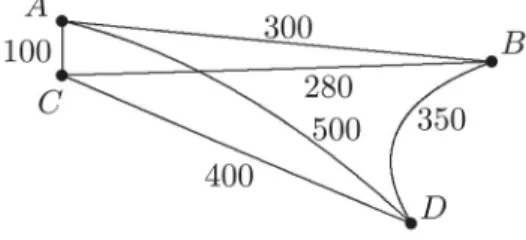
from a locationato a locationb, it incurs a cost equal to the distanceD(a,b)amongaandb. As a concrete instance of thek-server problem, let us consider the space of m = 4 locations shown in Figure 1 with distances given. Sup-pose that k = 3 servers are initially located at locationsA,BandD. If the first request appears in C, then our on-line algorithm has to decide which of the servers should be moved to that location. One possibility is to move the nearest server from A. But maybe it is better to move the farthest server fromD— such move would be optimal if all forthcoming requests appeared inA,BandC, and none inD.
The simplest on-line method for solving thek -server problem is therandom algorithm(RAND)
Figure 1.Ak-server problem instance.
[6], where each request is served by a randomly chosen sever. The most popular heuristic is the
greedy algorithm(GREEDY) [6], which serves the current request by sending the nearest server to the requested location. Another heuristic is the balanced algorithm (BALANCE) [11], which attempts to keep distances moved by var-ious servers roughly equal, thus employing the server whose cumulative distance traveled so far, plus the distance to the requested location, is minimal.
This paper is concerned with the work func-tion algorithm (WFA) [4]. In its i-th step the WFA serves the request ri by switching from
the current server configurationS(i−1)to a new configurationS(i)chosen so that
F(S(i)) =COPT(S(0),r1,r2, . . . ,ri,S(i))
+D(S(i−1),S(i))
becomes minimal. Thus the objective function
F(S(i)) is defined here as a sum of two parts. The first part is the minimum total cost of start-ing fromS(0), serving in turnr1,r2, . . . ,ri, and ending up in S(i). The second part is the dis-tance traveled by a server to switch fromS(i−1) toS(i).
Now we give a formal definition of competi-tiveness[14]. Let ALG be an on-line algorithm. Let OPT be the optimal off-line algorithm that knows the whole input in advance and serves the whole request sequence at minimum total cost. Denote with CALG(S(0),σ)the total cost incurred by ALG on the problem instance given by the initial server configurationS(0) and the request sequenceσ. Denote withCOPT(S(0),σ)
the minimum total cost on the same input data. For a given constantα, we say that ALG isα
-competitive if there exists another constant β such that on everyS(0)and everyσ it holds:
CALG(S(0),σ)≤α ·COPT(S(0),σ) +β.
Finally, it has been proved in [8,10] that the WFA is(2k−1)-competitive. It is believed that the WFA is in factk-competitive, thus achieving the best possible bound. However, this hypothe-sis has been proved only for some special cases, e.g. if the locations form a line [1,3], if all but two locations are covered by servers [9], or if there are exactly two servers[11].
3. Implementation
Our implementation of the WFA is based on the network flow techniques [2], and it combines the following three features:
• a compact network model, which reduces each step of the WFA to only one minimal-cost maximal flow problem instance;
• a customized algorithm for computing opti-mal network flows, which takes into account special properties of the involved networks;
• parallelization of most demanding parts of the algorithm, so that the workload is dis-tributed among several cores of a multi-core processor.
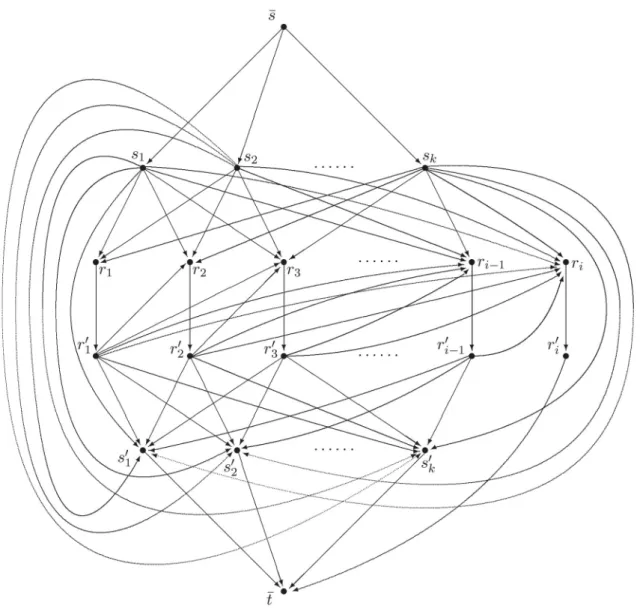
Our network model corresponding to the i-th step of the WFA is shown in Figure 2. Thus the network consists of a source ¯s, a sink ¯t, and four additional layers of nodes. The first layer represents the initial server configurationS(0), i.e. eachsj (j= 1,2, . . . ,k)corresponds to the
starting location of one server. The second and third layers together represent the request se-quence; thereby bothrpandrp(p=1,2, . . . ,i)
correspond to the location of the p-th request. The fourth layer specifies the current server con-figuration S(i−1), i.e. each s
j (j = 1,2, . . . ,k)
corresponds to a location covered by a server immediately before thei-th step of the WFA. All arcs in the network shown in Figure 2 have unit capacities. The arcs leaving ¯s or ri have zero costs. The cost of an arc rp → rp is −L,
whereLis a suitably chosen very large positive number. The cost of an arcsl →t¯is
1
k−1
k
q=1
D(sq,ri)−D(sl,ri).
The remaining arcs have costs equal to distances
D( , )among the corresponding locations. The i-th step of the WFA is implemented by finding the minimal-cost maximal flow in the network from Figure 2, by determining the unique node sx in the fourth layer that is not saturated by the computed flow, and by sending the server from the location specified bysxto the location of thei-th request ri. The correctness
proof is given in[13].
Computing the minimal-cost maximal flow in the network from Figure 2 is based on a general flow augmentationmethod[2]. The method re-duces to exactlykiterations, and each of those it-erations reduces to a single-source shortest path problem instance in a so-called displacement network. With some preprocessing of arc costs
[5], any shortest path problem instance can be solved by Dijkstra’s procedure[7].
Our customized algorithm has been obtained from the general flow augmentation method by modifying each of its iterations separately. Thus, each iteration of the algorithm tries to find the required shortest path faster than it would be possible with the standard Dijkstra’s proce-dure. All modifications rely on special proper-ties of particular displacement networks. Here are some details.
• In each iteration arcs or nodes are identified, which cannot influence the remaining part of the algorithm. Such arcs or nodes are removed from the network.
• In the first iteration, it is observed that the shortest path sought is almost completely de-termined in advance, only one arc has yet to
be chosen. Consequently, the shortest path is constructed directly, by consideringk pos-sibilities.
• In the second iteration, it is observed that the displacement network is acyclic. Thus the shortest path is found by scanning of nodes in topological order, which is much faster than with Dijkstra.
• In the remaining iterations, the shortest path is found by a slightly customized Dijkstra, with preprocessing of arc costs.
More details about each iteration can be found in[12], where an analogous implementation of OPT has been described.
The most demanding parts of the algorithm that are being parallelized are preprocessing of arc costs prior to the application of Dijkstra’s proce-dure, and the Dijkstra’s procedure itself. For a moderate number of cores up to 8, the obtained speedup is quite satisfactory.
4. Experiments
In order to perform experiments, we realized our implementation of the WFA as a C++ pro-gram. To allow comparison, we also realized two heuristics, GREEDY and BALANCE, as well as the random algorithm RAND and the optimal off-line algorithm OPT. All programs are available for download from our web site
http://art.etfos.hr. The realized software has been used in various experiments, where the same problem instances have been solved by different algorithms for comparison. The full list of obtained results is constantly updated, and it can also be found on the above mentioned web site.
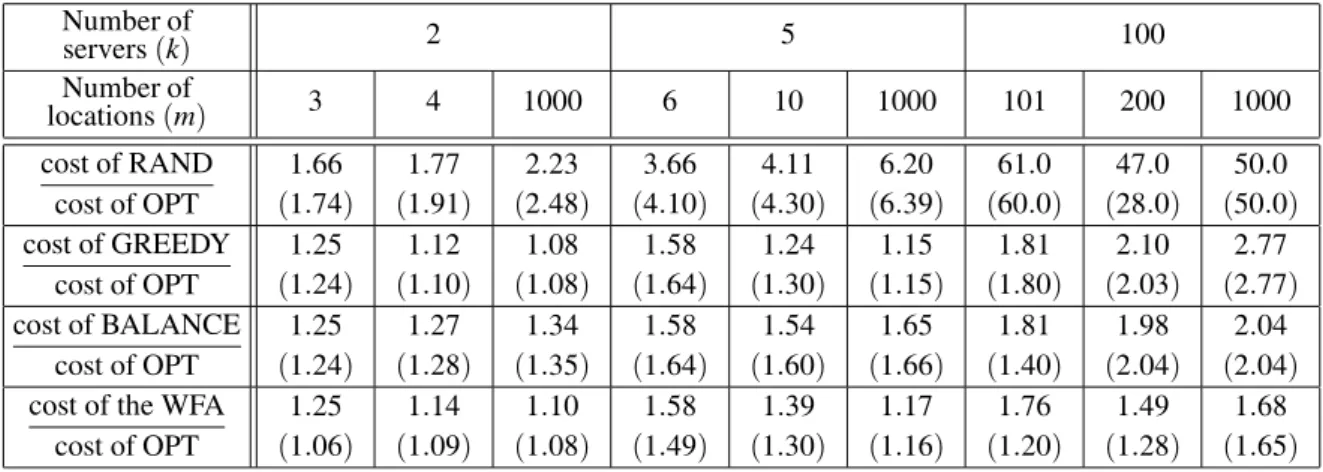
initial configuration of servers is chosen so that the servers are evenly spread through the space. In our experiments, special consideration has been given to distribution of requests among lo-cations, which can be uniform or non-uniform. Non-uniform distribution means that certain lo-cations occur more frequently than the others, thus allowing the WFA to learn from “history”. The results of the experiments are summarized in Tables 1 and 2. The first table refers to metric spaces where the locations are arranged equidis-tantly along a line. The second table involves metric spaces whose locations are organized as equidistant square grids, and wherek=m−2. Within each table, a column corresponds to problem instances with a given combination of k and m. Actually, there are exactly two such instances, and they differ only in the way how their requests are distributed among loca-tions - uniformly or non-uniformly. A table row
corresponds to a particular algorithm: RAND, GREEDY, BALANCE, and the WFA, respec-tively.
A single table entry contains two values, and it records the performance(total cost)of the cor-responding algorithm on the corcor-responding two problem instances. The upper value refers to uniform distribution of requests, and the lower value in brackets to non-uniform distribution. In both cases, performance is expressed relatively, as the ratio between the cost incurred by the corresponding algorithm and the optimal cost incurred by OPT. In this way, we obtain some kind of empirical measurement of competitive-ness.
From the data presented in Tables 1 and 2 the following facts can be observed.
• The measured competitiveness bound of the WFA is between 1 and 3, which is much lower thanksuggested by theory.
Number of
servers(k) 2 5 100
Number of
locations(m) 3 4 1000 6 10 1000 101 200 1000
cost of RAND cost of OPT
1.66
(1.74)
1.77
(1.91)
2.23
(2.48)
3.66
(4.10)
4.11
(4.30)
6.20
(6.39)
61.0
(60.0)
47.0
(28.0)
50.0
(50.0)
cost of GREEDY cost of OPT
1.25
(1.24)
1.12
(1.10)
1.08
(1.08)
1.58
(1.64)
1.24
(1.30)
1.15
(1.15)
1.81
(1.80)
2.10
(2.03)
2.77
(2.77)
cost of BALANCE cost of OPT
1.25
(1.24)
1.27
(1.28)
1.34
(1.35)
1.58
(1.64)
1.54
(1.60)
1.65
(1.66)
1.81
(1.40)
1.98
(2.04)
2.04
(2.04)
cost of the WFA cost of OPT
1.25
(1.06)
1.14
(1.09)
1.10
(1.08)
1.58
(1.49)
1.39
(1.30)
1.17
(1.16)
1.76
(1.20)
1.49
(1.28)
1.68
(1.65)
Table 1.Experimental results – locations form a line – requests distributed(non-)uniformly.
Number of
locations(m) 4 5 10 50 100
cost of RAND cost of OPT
1.61
(1.87)
1.96
(2.12)
3.53
(3.41)
10.0
(10.2)
15.2
(13.5)
cost of GREEDY cost of OPT
1.22
(1.24)
1.46
(1.67)
1.97
(2.14)
2.75
(2.76)
2.65
(3.01)
cost of BALANCE cost of OPT
1.38
(1.47)
1.61
(1.71)
2.15
(2.15)
3.55
(3.19)
2.78
(2.59)
cost of the WFA cost of OPT
1.30
(1.17)
1.58
(1.65)
2.23
(2.09)
3.02
(2.76)
3.16
(2.48)
• Performance of the WFA is similar to GRE-EDY, or even slightly better if the distri-bution of requests among locations is non-uniform.
• The WFA is usually better than BALANCE, and always better than RAND.
5. Conclusion
In this paper we have studied the work func-tion algorithm (WFA) for solving the on-line
k-server problem. Although the WFA is very interesting from the theoretical point of view, its true performance in terms of serving costs is hard to assess due to its extremely large com-putational complexity. With this paper, we are trying to give a modest contribution to such an assessment.
The experimental results presented in the pa-per clearly show that, at least for the considered classes of problem instances, the actual perfor-mance of the WFA is in fact much better than the corresponding theoretical estimates would suggest, although those estimates are already on their best possible limits. Also, the results demonstrate that the WFA performs similarly or only slightly better than a simple heuristic such as the greedy algorithm, although according to theory it should perform much better. Thus, to summarize, the true performance of the WFA is quite different from what one would expect according to theory.
From a more general perspective, the results of this paper clearly confirm that the available the-oretical estimates about the WFA and related algorithms do not reflect their typical behavior, but only their pathological worst cases. Conse-quently, there is an urgent need to devise some other theoretical mechanisms apart from com-petitiveness, which would allow more accurate ranking of on-line algorithms.
References
[1] Y. BARTAL, E. KOUTSOUPIAS, On the competitive ratio of the work function algorithm for the k -server problem.Theoretical Computer Science, 324
(2004), pp. 337–345.
[2] M.S. BAZARAA, J.J. JARVIS, H.D. SHERALI,Linear
Programming and Network Flows. Third edition,
Wiley, New York, 2004.
[3] M. CHROBAK, H. KARLOFF, T.H. PAYNE, S. VISH -WANATHAN, New results on server problems.SIAM Journal on Discrete Mathematics, 4 (1991), pp. 172–181.
[4] M. CHROBAK, L.L. LARMORE, The server prob-lem and online games.DIMACS Series in Discrete Mathematics and Theoretical Computer Science, 7
(1992), pp. 11–64.
[5] J. EDMONDS, R.M. KARP, Theoretical improve-ments in algorithmic efficiency for network flow problems. Journal of the ACM, 19 (1972), pp. 248–264.
[6] S. IRANI, A.R. KARLIN, Online computation. In:D.
Hochbaum, editor; Approximation Algorithms for NP-Hard Problems, PWS, Boston MA,(1997), pp. 521–564.
[7] D. JUNGNICKEL,Graphs, Networks and Algorithms. Second edition, Springer, Berlin, 2005.
[8] E. KOUTSOUPIAS, C. PAPADIMITROU, On thek-server conjecture.Journal of the ACM, 42(1995), pp. 971– 983.
[9] E. KOUTSOUPIAS, C. PAPADIMITROU, The 2-evader problem. Information Processing Letters, 57
(1996), pp. 249–252.
[10] E. KOUTSOUPIAS, Weak adversaries for thek-server problem. In: P. Beame, editor; The 40th Annual Symposium on Foundations of Computer Science 1999 Oct 17–18, New York. IEEE, (1999), pp. 444–449.
[11] M. MANASSE, L.A. MCGEOCH, D. SLEATOR, Com-petitive algorithms for server problems.Journal of Algorithms, 11(1990), pp. 208–230.
[12] T. RUDEC, A. BAUMGARTNER, R. MANGER, A fast implementation of the optimal off-line algorithm for solving the k-server problem. Mathematical Communications, 14(2009), pp. 123–138.
[13] T. RUDEC, A. BAUMGARTNER, R. MANGER, A fast work function algorithm for solving the k-server problem. Submitted for publication, 2009.
[14] D. SLEATOR, R.E. TARJAN, Amortized efficiency of list update and paging rules.Comm of the ACM, 28
Received:June, 2010
Accepted:November, 2010
Contact addresses:
Tomislav Rudec Faculty of Electrical Engineering University of Osijek Kneza Trpimira 2b 31000 Osijek Croatia e-mail:[email protected]
Alfonzo Baumgartner Faculty of Electrical Engineering University of Osijek Kneza Trpimira 2b 31000 Osijek Croatia e-mail:[email protected]
Robert Manger Department of Mathematics University of Zagreb Bijeniˇcka cesta 30 10000 Zagreb Croatia e-mail:[email protected]
TOMISLAVRUDECreceived the MSc degree(2001)in mathematics from the University of Zagreb. Currently, he is a lecturer at the Faculty of Electrical Engineering, Josip Juraj Strossmayer University in Osijek. His research interests include combinatorial optimization, analysis of algorithms, on-line computation, and teaching of mathematics. He has published 5 scientific papers in international journals or in conference proceedings, and 6 professional papers.
ALFONZOBAUMGARTNERreceived the PhD degree(2010)in computer science from the Josip Juraj Strossmayer University in Osijek, Croatia. Currently, he works as an assistant professor at the Faculty of Elec-trical Engineering, Josip Juraj Strossmayer University in Osijek. His research interests include on-line problems, parallel algorithms applied to combinatorial optimization problems, and other algorithms which use efficient data structures. He has published 7 papers in international scientific journals or in conference proceedings.
ROBERTMANGERreceived the BSc (1979), MSc(1982), and PhD