Original Research Article
Evaluation of adverse effect of second line ART in PL HIV patients
treated by second line ART
Narendra Singh
1*, Lalit Kumar
2, Desh Nidhi Singh
3INTRODUCTION
AIDS first recognized in United States in summer of 1981 when the U. S. Centre for disease control and prevention (CDC) reported the unexplained occurrence of pneumocystis Jiroveci in previously healthy homosexual men in Los Angeles And Kaposi sarcoma (KS) with and without P. Jiroveci and other opportunistic infections in 26 previously healthy homosexual men in New York San Francisco and Loss Anglees. HIV is having two strain
Immunodificiency Syndrome (HIV) was isolated from a patient of Lymph-adinopathy and by 1984 it was demonstrated clearly causative agent of AIDS. In 1985 A sensitive enzyme-linked Immunosorbent assay (ELISA) was developed.1 from that time scope and evolution of
HIV altimately among developing nations throughout world. HIV1 was transmitted from Chimpanzees and HIV 2 is transmitted from Sooty Mangabey Monkey. HIV1 is the cause of the global pandemic while HIV2 progress very slowly and restricted mainly to Western Africa.2 and
has spread in the last decade to India and Europe HIV 2 is
ABSTRACT
Background: AIDS was first recognized in USA Subject whose viral load was very high more than 5000 copy and CD4 count remain below 100 for 6 months and decrease 50% of base line call as ART failure. There are grade 1, 2, 3 and 4 adverse effect can be seen .in treating of PL. HIV by ART2.
Methods: It was Single centre hospital based clinic pathological study and continuous longitudinal, prospective and retrospective , observational, in ART PLUS Centre considering of all patient on 1st line ART who are screened for treatment failure based on clinical, immunological and virological criterias as decided by SACEP from 2016 to 2018.
Results: This study shows increase in serum bilirubin from 5 to 13 in study subject and there was increase in no from 4 to 5 in subject of less than 9 Haemoglobin and in the group of 9 to 10 level Haemoglobin of subjects no. increase from 4 to 5 but more than 10 subject decrease from 110 to 108. Subject increase 6 to 10 of serum creatinine level >1.5mg /dl., This shows second line ART have adverse effect on liver , kidney and hematology. There is some adverse effect is seen as nausea, vomiting, headache, skin rash, abdominal pain and muscle pain, there was some serious adverse effect that required hospitalization.
Conclusions: Study show that ART2 have adverse effect on liver and kidney function and anaemia. Some general adverse effect seen that also required treatment.
Keywords: Art, CD4, Human immunodificiency syndrome, SACEP
1Department ofMedicine KPS Institute of Medicine, GSVM Medical College, Uttar Pradesh, India
2Department of Medicine KPS PG Institute of Medicine GSVM Medical College, Kanpur, Uttar Pradesh, India 3Department of Microbiology, Rama Medical College, Hospital and Research Centre, Kanpur, Uttar Pradesh, India
Received: 13 March 2019
Revised: 08 May 2020
Accepted: 13 May 2020
*Correspondence:
Dr. Narendra Singh,
E-mail: [email protected]
Copyright: © the author(s), publisher and licensee Medip Academy. This is an open-access article distributed under the terms of the Creative Commons Attribution Non-Commercial License, which permits unrestricted non-commercial use, distribution, and reproduction in any medium, provided the original work is properly cited.
less pathogenic and has slower disease progression and a longer asymptomatic stage and also slower decline in CD4 count. HIV 2 is having lower viral load while asymptomatic and smaller gain in CD4 count response to antiretroviral treatment. The diagnosis of HIV either It is HIV 1 or HIV 2 is very crucial for treatment because HIV2 is resistance to NNRTI.3 HIV 1 have three sub
group as M; O; N; M (major), O (outlier), N (non-major) in which M (major) was worldwide distribution and O(outlier) and N (non-major) restricted to West Africa. M (major) consisted in as nine subtypes as A-D, F-H, J and K. subtypes E and I is recombinant of other type of subtype.
Subtype C is restricted mostly in India and Africa. Subtype B is predominant in Western Europe, the America and Australia. Subtype A is slower progression
and Subtype D is faster progression.4 Person with positive
HIV serology who have ever had a CD4 lymphocyte count below 200celles/mc and CD4 lymphocyte percentage below 14% are considered to have AIIDS.
HIV infected patient in World- wide are about 37.9 million and 23.3 million patient taking antiretroviral treatment that only 62% of infected patient .Africa have about 25.7 % of total infected patient that is largest but patient taking ART is also in Africa about 16.3% of whole World.
Patient not responding to ART1 then second line ART started. About 1.25 million (4%) patient on second line art in asea. In India about 18.13% lakhs is estimated the total number of PLHIV patient and 6.5 lakhs are taking first line ART.
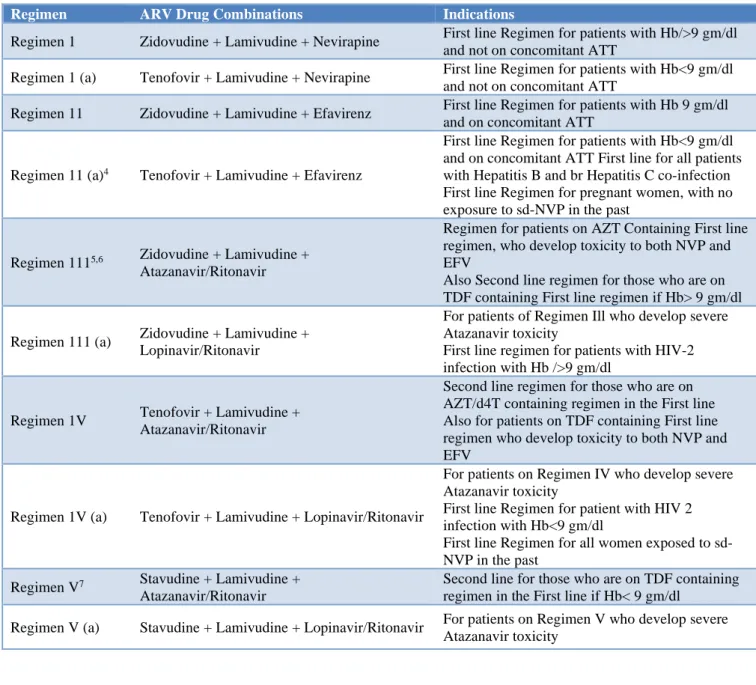
Table 1: Tabular representation of regimens and it drugs combination with its Indications.5
Regimen ARV Drug Combinations Indications
Regimen 1 Zidovudine + Lamivudine + Nevirapine First line Regimen for patients with Hb/>9 gm/dl and not on concomitant ATT
Regimen 1 (a) Tenofovir + Lamivudine + Nevirapine First line Regimen for patients with Hb<9 gm/dl and not on concomitant ATT
Regimen 11 Zidovudine + Lamivudine + Efavirenz First line Regimen for patients with Hb 9 gm/dl and on concomitant ATT
Regimen 11 (a)4 Tenofovir + Lamivudine + Efavirenz
First line Regimen for patients with Hb<9 gm/dl and on concomitant ATT First line for all patients with Hepatitis B and br Hepatitis C co-infection First line Regimen for pregnant women, with no exposure to sd-NVP in the past
Regimen 1115,6 Zidovudine + Lamivudine +
Atazanavir/Ritonavir
Regimen for patients on AZT Containing First line regimen, who develop toxicity to both NVP and EFV
Also Second line regimen for those who are on TDF containing First line regimen if Hb> 9 gm/dl
Regimen 111 (a) Zidovudine + Lamivudine + Lopinavir/Ritonavir
For patients of Regimen Ill who develop severe Atazanavir toxicity
First line regimen for patients with HIV-2 infection with Hb />9 gm/dl
Regimen 1V Tenofovir + Lamivudine + Atazanavir/Ritonavir
Second line regimen for those who are on AZT/d4T containing regimen in the First line Also for patients on TDF containing First line regimen who develop toxicity to both NVP and EFV
Regimen 1V (a) Tenofovir + Lamivudine + Lopinavir/Ritonavir
For patients on Regimen IV who develop severe Atazanavir toxicity
First line Regimen for patient with HIV 2 infection with Hb<9 gm/dl
First line Regimen for all women exposed to sd-NVP in the past
Regimen V7 Stavudine + Lamivudine +
Atazanavir/Ritonavir
Second line for those who are on TDF containing regimen in the First line if Hb< 9 gm/dl
First line ART is the regimen use for ART naive patient that consist of at least two NRT and one NNRT and second line ART is the regimen used in immediately after first line ART failed Second line ART consist of two agent of NRT in which one is new agent and Ritonavir based protease inhibitor.
India ranks third among the countries having most number of HIV - infected patients and HIV related deaths in the world. In India, ART at public sector hospital is provided free of charge under the National AIDs Control Organization (NACO). The second line ART regimens comprised of zidovudine (ZDV), lamivudine (3TC), tenofovir (TDF), and boosted Lopinavir/ritonavir (LPV/r) have been introduced recently in a phase wise manner at limited centres. The criteria to switch on second line ART includes clinical and/or immunological and/or virologic failure in a patient who had received 6 months or more of standard first-line ART.
The patient qualify for second line ART if they demonstrate CD4 decline to pre-ART values, CD4 drop to less than 50% of peak on-treatment value, failure to achieve CD4 greater than 100 c/mm3 (immunologic
failure), or develop a new WHO stage III/IV AIDS-defining illness (clinical failure) or those with HIV RNA 5,000 c/ml or greater (virological failure).
WHO Clinical staging6 There is 4 clinical staging
Clinical stage 1
• Asymptomatic
• Persistent Generalized Lumphadenopathy.
Clinical stage 2
• Unexplaned moderate weight loss ( <10%) of presumed or measured body weight )
• Recurrent respiratory tract infections (sinusitis, tonsillitis ,oitits media , pharyngitis)
• Herpes zoster
• Angular cheilitis.
• Papular pruritic eruptions.
• Seborrheoic dermatitis.
• Fungal nail infections
Clinical stage 3
• Unexplained 2 severe weight loss (<10 % of presumed body weight )
• Unexplained chronic diarrhoea for longer than one month.
• Unexplained persistent fever (above 37.5 OC intermittent or constant for longer than one month
• Persistent oral candidiais
• Severe bacterial infectons (e.g. pneumonia, emphysema, bone or joint infections.
• Acute necrotizing ulcerative stomatitis, gingivitis, periodontitis.
• Unexplained anaemia (<8/dl), neutropenia (<0.5 *109/litre) and or chronic thrombocytopenia (<50*109/litre3).
Clinical stage 4
• HIV wasting syndrome
• Pneumocystic pneumonia
• Recurrent severe bacterial pneumonia
• Chronic herpes simplex infection ( oralabial , genital or anorectal of more than one month’s duration or visceral at any site
• Oesophageal candidiasis (or candidiasis of trachea, bronchi or lungs.)
• Extrapulmonary Tuberculosis
• Kaposi sarcoma
• Cytomegalovirus infection ( retinitis or infection of other organs
• Central nervous system Toxoplasmosis.
• HIV encephalopathy.
• Extrapulmonary Cryptococcosis.
• Lymphoma
• Atypical disseminated Leismaniasis.
Adverse reaction and toxicity of antiretroviral drugs7
TDF
There is many adverse effects thats are weakness, lack of energy, headache, diarrhea, nausea and vomiting.
There is more serious adverse effect as liver or kidney failure and pancrease disease .Bone marrow density loss.
ATV
This have adverse effect as hyperglycemia, fat maldistribution, hyperlipidemia hyperbilirubinia and skin rash.
3TC
It have adverse effect as cough, diarrhea, dizziness, headach, loss of appetite, mild stomach cramp, muscle ache nasea and tingling pain in hand.
ZDU
Persistant GI intolerance and haematological toxicity.
NVP
EFV
Persistent CNS toxicity
Severity grading of clinical and laboratory toxicity8
Grade 1
Transient or mild discomfort no limitation of activity, no medical intervention/therapy required
Grade 2
Mild to moderate limitation of activity ,some assistance may be needed ,no or minimal intervention /therapy required
Grade 3
Marked limitation of activity, some assistance usually required ,medical intervention /therapy required and hospitalization may be required.
Grade 4
Extreme limitation of activity, significant assistance required, significance medical intervention /therapy required and hospitalization required.
Aim of this study evaluation the adverse effect of second line of ART medication in PL HIV patients.
METHODS
Single centre hospital based study was conducted in ART plus centre KPS PG Institute of Medicine (GSVM Medical College, Kanpur) tertiary care teaching hospital (GSVM Medical College, Kanpur).
This was clinical (assessment with investigation) continuous longitudinal, prospective and retrospective, observational, single centre hospital based study at ART plus Centre, Kanpur.
All the patient on 1st line ART treating attending in our centre will be screen for treatment failure of based on clinical, immunological and virological criterias as decided by SACEP.
Inclusion criteria
• Patient over the age of 18 years at pre-inclusion and monitored under outpatient condition.
• Documented HIV-1 (group m) infection regardless of clinical stage and CD4 lymphocyto-count (taken in 6 months)
• Patient with treatment failure after first-line antiretroviral treatment with a combination including a non-nucleoside reverse transcriptase inhibitor and
two nucleoside reverse transcriptase inhibitors, failure.
• Adherence (>80%) to first-line antiretroviral treatment (questionnaire) at pre inclusion.
• Patient agrees not to take any concomitant medication during the trial without informing the investigator.
• Informed consent
• For women in childbearing age: negative pregnancy test at inclusion, with no plan of pregnancy in the coming 12 months and agreeing to use mechanical contraception (with or without hormonal contraception) during the study.
Exclusion criteria
• Infection with HIV-2 or HIV-1 groups O or N or HIV 1+2.
• Adherence (<80%) to first-line antiretroviral treatment at pre inclusion.
• Participation in any other clinical trial.
• Presence of an uncontrolled, ongoing opportunistic infection or of any severe of progressive disease.
• First-time treatment with a protease inhibitor, Abacavir.
• Not interested to participate in study.
• Severe hepatic insufficiency.
• Creatinine clearance calculated by Cockcroft-Gault formula <50 ml/min.
• Hb
8 g/dl• Platelets < 50,000 cells / mm3
• Neutrophiles <500 cells / mm3
• Pregnancy or lactation.
Blood sample collection
On admission, 10 ml of peripheral venous blood was collected from the antecubital vein by an autoclaved syringe using 20 gauze needles. The blood was allowed to clot at room temperature for at least half an hour. The glass tube with clotted blood was centrifuged at 2000 rpm for 20 minutes and the centrifugation was repeated once more to remove the red cells completely. The supernatant serum, devoid of cellular elements, was separated from the clot and placed in two acid cleaned small test tubes.
Viral load testing
Patient of HIV suspecting first line ART failure send to BHU Vanaras Department of Microbiology, IMS BHU Banaras.For estimation of viral load
In BHU viral load is tested quantitatively real time PCR from HIV RNA by PCR machine.
Measuring
reported as a log change (in powers of 10). For example, a three log increase in viral load (3 Log10) is an increase of 103 or 1000 times the previously reported level, while
a drop from 500,000 to 500 copies would be a three-log-drop (also 3 Log10).
CD4 Testing
CD4 count is done by BD facts flow machine by kit and report is analysed and given same day.
RESULTS
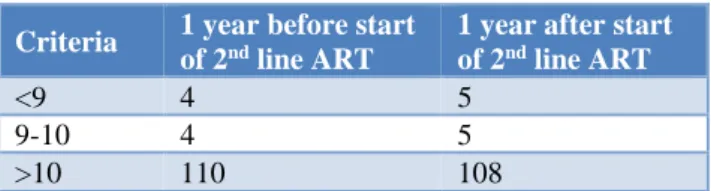
Haemoglobin level of study subject 1 year before and 1 year of after of the start of ART. This study show that no of subject increase in level of <9 4 mg /dl 4to 5, 9 mg/dl to 10 mg/dl is 4to 5 and but more than 10 mg/dl is decrease 110 to 108.
Mean value of HB one year before 10.85 and SD is 1.31 Mean value of HB one year after 10, 5 and SD is 1.31
Table 1: Tabular representation of haemoglobin level.
Criteria 1 year before start of 2nd line ART
1 year after start of 2nd line ART
<9 4 5
9-10 4 5
>10 110 108
Table 2: Tabular representation of bilirubin level.
Criteria 1 year before start of 2nd line ART
1 year after start of 2nd line ART
<1 113 105
>1 5 13
Serum bilirubin level in study subject one year before and one year after start of ART2 our study show less than 1 serum bilirubin the study subject decrease from 113 to 105 but serum bilirubin more than 1 increase in study subject that 5 to13.
Serum Bilirubin one year before 0.69 and SD 0.49 Serum Bilirubin one year after 0.95 and SD 1.13
Table 3: Tabular representation of SGPT/SGOT level.
Criteria 1 year before start of 2nd line ART
1 year after start of 2nd line ART
<40 96 86 40-100 22 32
>100 0 0
SGPT level in study subject one year before and one year after of start of second line ART .Our study show that SGPT is level in our study less than 40 the subject
decrease from 96 to 86 but in 40 to 100 subject is increase from 22 to 32.
Mean Value of SGOT One year before 36.30 and SD 22.15
Mean Value of SGPT One year after 35.13 and SD 17.80
Mean Value of SGOT One Year after 40.61 And SD 21.36
Mean value of SGPT One year after37.31 and SD15.03
Table 4: Tabular representation of serum creatin in level.
Criteria 1 year before start of 2nd line ART
1 year after start of 2nd line ART
<1 86 84
1-1.5 26 24
>1.5 6 10
Serum creatnine level of study subject 1 year before and 1 year after of start of second line ART. Our study show that serum creatinine level less than 1 subject is decrease 86 to 84 ,1 to 1.5 subject is decrease 26 to24, and more than 1.5 decrease 6 to 10.
Mean value of one year before of serum creatinin1.80 andSD11.34
Mean value of one year after of serum creatinin.088 and SD 0.38.
Table 5: Tabular representation of regime of treatment of ART 1.
Treatment regimen No. of patients %age
TLE 90 76%
ZLN 28 23%
In this study there is ART1 regime is taking as TLE and ZLN in which 765 is taking TLE and ZLN regime is taking 23%.
Table 6: Tabular representation of regime of second line ART in study subjects.
Regimens No. of subjects %age
TLATV/R 35 63%
ZLATV/R 74 30%
TLLP/R 5 4%
ZLLP/R 4 3%
are given treatment of 3%. More number of patients are then Tlatv/R.
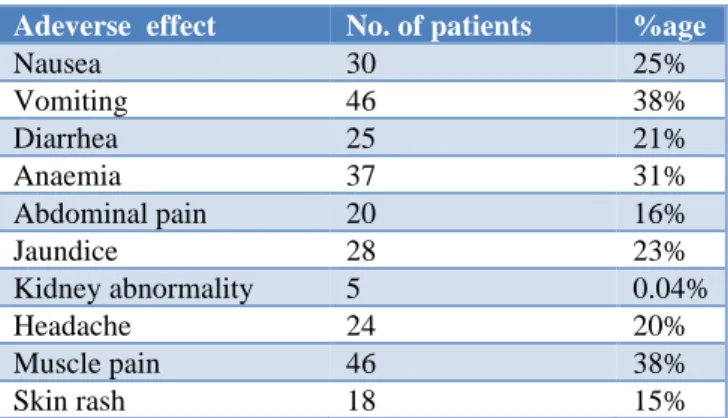
Table 7: Tabular representation of adverse effect of ART 2 regimen.
Adeverse effect No. of patients %age
Nausea 30 25%
Vomiting 46 38%
Diarrhea 25 21%
Anaemia 37 31%
Abdominal pain 20 16%
Jaundice 28 23%
Kidney abnormality 5 0.04%
Headache 24 20%
Muscle pain 46 38%
Skin rash 18 15%
This study show that subject of ART2 have adverse effect is about Nausea 25%, Vomiting 38%, Diarrhea 21%, Aneamia 31%, Abdominal pain 16%, Jaundice 23%,Kidney abnormality.04%,Headach 20%,Muscle pain 38% and Skin rash15%.
This study was conducted in ART plus center KPS PG Institute of Medicine (GSVM medical college Kanpur) tertiary care teaching hospital. (GSVM Medical College Kanpur). In this study total number of subjects was taken 118. All 118 subject went Laboratory investigation. Hemoglobin was taken before one year before and after one year of the study. Hemoglobin in subject become less than 9 increases and 9-10 mg subjects increase and more than 10 subject decreased (Table 1). Bilirubin level one year before and after one year taken there was subject Bilirubin level more than 1 was increase and less than 1 thre subject decrease (Table 2). This study also take serum SGOT and SGPT one year before and one year after the subject having more than 40 less than 100 increase from 22 to 32 and value less than 40 decrease from96 to 86 (Table 3). Creatinine level was also taken one year before and 1 year after there was Creatinin level more than 1.5 was increase and less than 1 the subject decrease. (Table 4)
In this study subject that was considered as treatment failure of ART1, ART1 was taken as TLE regimen90 subject and ZLN 28 subject (Table 5). Subject was taken antiretroviral drug Regimen as Tlatv/R-Tenofovir + Lamivudine + Atazanavir + Retonavir 63%, Zlatv/R- Zaduvudine + Lamivudine + Atazanavir + Ritonavir, 30%, Tllp/R-Tenofovir + Lamivudine + Lopinovir + Ritonavir 04%, Zllp/R- Zaduvudine + Lamivudine + Lopinavir + Retonavir 3% (Table 6). This study was taken as adverse effect in all study subject 118 and there was nausea is 25%, vomiting 38%, diarrhea 21%,,anemia 31%, abdominal pain 16%, jaundice 23%, kidney abnormality 0.04%, headache 20%, muscle pain 38% and skin rashes 15% present (Table 7).
DISCUSSION
This study also show that there was increase in no from 4 to 5 in subject of less than 9 haemoglobin and in the group of 9 to 10 level haemoglobin of subjects no increase from 4 to 5 but more than 10 subject decrease from 110 to 108 patient. It means subject of anaemia increase after start of second line ART. This shows second line ART have the adverse effect of anaemia and this should be monitored after start of second line ART. This mostly in regime of zaduvudine containing drugs. Chauhan NS, et al.1This study considering 2983 subjects
and taken TLE and ZLN regime and at the result threre are zaduvudine containing regime have anemia. In this study the Anaemia cases increase as the regime of Zaduvudine containing regime in almost in proportional.
In this study show that there are no of adverse effect such as Anaemia, Nausea, Vometing Lipodistrophy, Hyperglycemia, Lithargy Headach, Jaudice, skin rashes and Kidney injury. Karnani RK, et al.2 This study
considering total 463 patients in which about 282 patient were taking zaduvudine containe regime and 181 patient were taking tenofovir containg regime In this study commonest adverse effect are nausea /vomiting headache and skin rashes, lipodistrophy. This study show that there was increase in SGPT/SGOT in the subject group in more than group of 40 to 100, it increase from 22 to 32 in study subject and also serum bilirubin is also increase from 5 to 13 in study subject. It is suggestive of that patient treated by second line ART have liver toxicity so liver function test should be monitored every monthly interval. Chandwani A, et al. Lopinavir /Ritonavir 3 in the treatment of HIV 1 infection ; A review - This study show that patient taking the lopinavir /ritonavir regime having increase liver injury and nausea vomiting and diarrhoea patient taking ART and also hepatitis they show more chance of hepatitis and liver injury. Vaghani SV, et al.4 This study was taken 143 HIV positive patient
and tyhe regime ziduvudine containing regime and stavudine containing regime. The result is having adverse effect of rashes abnormal liver function test and anemia This study also show abnormal liver test and anaemia and skin rash with lipodistrophy. Pinda JA et al,5 This study
considering about 189 HIV infected patient in which 175 co infected with HCV HBV All were receiving Atazanavir /ritonavir containg regime. In result there was having elevation of transeminase and total bilirubin. In our study ther is elation in transeminase and serum bilirubin level in roportion of atazanavir /ritonavir taking regime.
Palacios R et al.6 studied that lopinavir/ritonavir can
transeminase and bilirubin level but that is of grade 1 and grade 2.
Wikman P, et al.7 This study considered about 271 HIV
infected patients and treated with HAART. Study show that tenofovir containing regime have increase in creatinine and decrease GFR. This is study also show that there was increase in serum creatinine level more than in the range of > 1.5mg /dl and no of subjects increase from 6 to 10; this shows that second line ART have the adverse effect on kidney injury and in also proportional of atazanavir/ritonavir taking regime but it is grade 1 and grade 2. Patel D, el al.8
Overall outcome of A total of 83 ADRs were observed in 69 (55%) patients, the most common being dyslipidemia (57) followed by ane. This study considered Out of 126 patients, 82 received regimen V [zidovudine (ZDV) + lamivudine (3TC) + tenofovir (TDF) + boosted lopinavir (LPV/r)] and 44 received regimen Va [3TC + TDF + LPV/r. This study also cosidered 118 subject and taking ziduvudine and tenofovir containing regime with lopinavir /ritonavir and atanzanavor /ritonovir containing regime this study also show some adverse effect as lipodistrophy, anemia, liver injury and kidney injury. In this study there was 35 subjects is taking Tenofovir + Lamivudine + Lopinavir /Retinovir regime, 74 subjects is taking Zaduvudine + Lamivudine + Atanzanovir /Retinovir regime, 5 subjects was taking Tenofovir + Lamivudine + Atanzanavir/Retinovir and 4 subjects was takin Zyduvudine + Lamivudine + Lopinavir /Ritonavir regime.
Introduction is from National guideline on second –line and alternative first line ART for adult and adolescent may 2013 NACO Depatment of AIDS control National AIDS control organisation ministry of health and family welfare Government of India.1,5,7,8 In this there is
discription of all regime and some adverse effect of ART medications. Introduction is from Antiretroviral therapy Guidline for HIV – Infected adult and adolescents May 2013 NACO Depatment of AIDS control NATIONAL AIDS control organisation ministry of health and family welfare Government of India.2,5,7 The all regime and and
some adverse effect of ART.
Introduction is from Davidson principles and practice of medicine 22nd ed.This discrinbe the strain of HIV and it
prevelence in some part of world.2-4
Introduction is from Harrison S. Principle of internal medicine 19th ed.1,4 In this thre is discription of first
finding of HIV infected patient.
CONCLUSION
SGPT /SGOT increase in treatment of second line ART treatment so it should be monitored every monthly interval. Serum Creatinin level was also increase in this
study so serum creatinin level should be monitored every monthly interval during treatment of second line of ART.
Haemoglobin level was decrease in our study group in previously anemic subject so it should monitor monthly interval during treatment of second line ART. There is nausea, vomiting, diarrhea, headach abdominal pain lipodistrophy and skin Rashes is also found. But there is some have grade 2 and some grade 3 adverse effect.
There is some drug have reconstitution syndrome and other subsequent drugs reaction so it should be differentiated very clearly abd then treatment accordingly. Grade 1 and 2can be treated with-out drug discontuoation. And opd basis but grade 3 and grade 4 can be treated in hospital base medication.
Funding: No funding sources Conflict of interest: None declared
Ethical approval: The study was approved by the Institutional Ethics Committee
REFERENCES
1. Chauhan NS, Shah SP, Desai MK, Shah A. A safety analysis of different drugs regimens in immunodeficiency virus-positive patient. 201839(2):84-90.
2. Karnani RK, Manoz SK, Kamdar S. A comparison of adverse drugs events profile of two ART regimens consisting Zadivudine. Plus, La ivudine verses Stavudine plus Lamuvudine in comparison with Nevirapine in adult HIV /AIDS patients in atertiary care hospital. 2015; 2(3):120.
3. Chandwani A, Shuter J. Lopinavir/Ritonavir in the treatment of HIV-3 infection. a review; Therapeutics and clinical risk management. 2008 4(5);1023-33.
4. Vaghani SV, Gagiya AK, Shukla DK, Patel VP. Adeverse effect of antiretroviral treatments atertiary care hospital in India, a prospective observational study. Int J Res Med Sci. 2013;1:101-3.
5. Pindari JA, Santos J, Kader AA, Palacios R, Camacho RA, Kisano F. Liver toxicity of antiretroviral combinations including Atanzanavir/ritonavir in patients coinfected with HIV and Hepatitis Virus J.A. Antimicrob Chemother. 2008;61(4):925-32.
6. Palacios R, Vergara S, Rivero A, Aguilar I, Macías J, Camacho A. Low incidence of severe liver events in HIV patients with and without hepatitis C or B coinfection receiving lopinavir/ritonavir. HIV clinical trials. 2006 Dec 1;7(6):319-23.
8. Patel D, Desai M, Shah AN, Dikshit RK. Early outcome of second line antiretroviral therapy in treatment-experienced human immunodeficiency virus positive patients. Perspect Clin Resea. 2013 Oct;4(4):215.