On Integrating Conversations into Web Services Composition
Zakaria Maamar
Zayed University, Dubai, U.A.E [email protected] Soraya Kouadri Mostéfaoui
Oxford Brookes University, Oxford, UK E-mail: [email protected]
Keywords:Web service, conversation, composition, context.
Received:November 28, 2004
We present an approach for integrating conversations into the process of composing Web services. A Web service is an accessible application that other applications and humans can discover and trigger to satisfy various needs such as weather forecasts. While much of the work on Web services to date has focussed on low-level standards, it is becoming urgent to allow Web services engage in conversations, make decisions, and adjust their behavior according to the context of the situations in which they participate.
Povzetek: Predstavljena je integracija koverzacije v spletne storitve.
1 Introduction
In this paper, we highlight the role ofconversationsin the field ofWeb services and assess the value-added of inte-grating conversations into the composition of Web services. Composition primarily addresses the situation of a user’s request that cannot be satisfied by any available Web ser-vice, whereas acomposite serviceobtained by combining available component services (i.e., Web services or com-posite services) might be used [3]. While much of the work on Web services to date has focussed on low-level stan-dards for publishing, discovering, and triggering Web ser-vices [2], the use of conversations promotes Web serser-vices to a higher level by giving them the opportunity to act as ac-tive components. A conversation is a consistent exchange of messages between participants who are involved in joint operations and thus have common interests.
In order to engage in conversations, Web services (also called services in the rest of the paper) have to be lever-aged from passive components, which only respond to trig-gers, to active components, which make decisions and ad-just their behavior according to the contextin which they evolve. Context is the information that characterizes the interactions between humans, applications, and the sur-rounding environment [4]. Huhns backs the importance of leveraging Web services by using software agent architec-tures [9]. Indeed Web services, unlike software agents, are not designed to use and reconcile ontologies. Moreover, software agents are inherently communicative, whereas Web services are passive until invoked.
While some authors agree on the importance of leverag-ing Web services to the level of active components, others have already identified some similarities between Web ser-vices and software agents [6]. Serser-vices (i) advertise their
capabilities after specification using for example WSDL, (ii) search for other services using for example UDDI, and (iii) invoke services without prior notice using for exam-ple SOAP. This kind of behavior bears many likenesses to software agents. For instance, a service accepts re-quests (sense) and returns responses (action) [6]. In ad-dition, once a service is invoked, it performs tasks with or without further inputs (autonomy). However, it is the au-thors’ belief that the aforementioned behavior of a service is mainly hard-coded and consequently, limits the service in its action selection. Enhancing Web services with con-versation capabilities will first, enable an emergent behav-ior during composition and second, permit to services to be more flexible in managing the situations in which they participate.
2 Conversations and Web services
Several authors note that current standards of Web services are used in systems featured by simple interactions [1, 7]. Simple because the interactions adopt a request-response
pattern(e.g., announce/confirm). However there are
multi-ple situations that need more than two turns of interaction (e.g., propose/counter-propose/accept⊕reject⊕ counter-propose/...). The participants in these situations have to engage in conversations before they reach an agreement. Another initiative in the field of Web services is the Web Services Conversation Language (WSCL). This language describes the structure of documents that a Web service ex-pects receiving and producing, as well as the order in which the exchange of documents is expected to take place. While conversations in [1] occur between end-users and providers of Web services, and WSCL focusses on specifying the op-erations that Web services support, our focus is on the con-versations happening among Web services. These services might originate from different sources and have to engage in conversations in order to agree on what to exchange, how to exchange, when to exchange, and what to expect from an exchange during composition.
2.1
Composition stages
To assess the benefits of conversations to Web ser-vices composition, we decompose the composition into three stages: pre-composition, composition, and post-composition. In the following, only the pre-composition stage is discussed. Because similar services exist on the In-ternet, it is important to search for and identify the services that satisfy specific user-defined selection criteria (e.g., ex-ecution cost, reliability, availability [14]). Conversations in the pre-composition stage concern the following aspects:
1. Identification aspect: use search mechanisms (e.g., UDDI registries) to identify Web services. We assume that Web services are already specified and advertised.
2. Invitation aspect: invite Web services to participate in a composition. An invitation is either accepted or refused. The rationale of inviting services instead of directly triggering them is given in [12]. In addition, conversations occurring during service invitation are described towards the end of this paper.
3. Compatibility aspect: check if the Web services can exchange meaningful information because of data het-erogeneity issues that may raise. Details on the semantic compatibility of Web services are found in [13].
2.2
Conversation’s components
Pre-composition, composition, and post-composition stages are each concerned with some of the conversational aspects that take place during Web services composition.
Because of the variety of these aspects, we decided on (i) associating each aspect with aconversation sessionand (ii) implementing a session with acourse of conversational actions.
To handle the multiple conversation sessions, we use
Conversation Schemas(CSs) as a technique for describing
these sessions and their respective course of conversational actions. We define a conversation schema as a specification of the exchange of messages that is expected to happen be-tween participants. This exchange depends on several fac-tors including application domain, active context, and cur-rent chronology. For example, a conversation schema de-scribes both the side-effects of a conversation that is misun-derstood and the corrective actions that permit fixing these side-effects.
First of all, the initiator of a conversation downloads a conversation schema from the library of conversation schemas (Fig. 2) according to the following elements: cur-rent composition stage, progress in this stage with regard to the current aspect, and intention behind establishing the conversation. These elements are needed since conversa-tions are context sensitive [5, 15]. Next, the initiator in-stantiates the conversation object (i.e., gives a value) and checks the activation condition before it transfers a mes-sage to a receiver. Upon reception of the conversation ob-ject that the message conveys, the receiver takes one of the following actions:
1. Accepts the conversation object without any change and starts acting based on the conversation object’s content.
2. Changes the conversation object and submits the mod-ified conversation object to the initiator for either fur-ther change, approval, or rejection.
3. Rejects the conversation object and either submits a new conversation object to the initiator or ignores the initiator (this one has a time-out constraint).
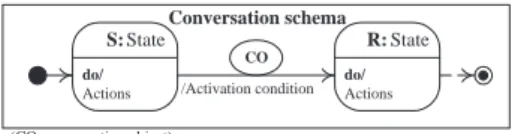
mapping of the concepts of a conversation schema onto the concepts of a state chart.
– Name of states is labelled withS/R(sender/receiver).
– Name of transitions is labelled with activation condi-tion and conversacondi-tion object.
– Actions of states implement the information that con-versation objects convey.
– A complete state chart illustrates the conversation schema of a conversation session.
Conversation schema S: State
do/
Actions
(CO: conversation object)
CO
/Activation condition
R: State
do/
Actions
Figure 1: Conversation schema as a state chart
3 Context-aware conversations for
Web services composition
To assess the way a composition of Web services pro-gresses so relevant conversation sessions are entered and relevant conversation schemas are downloaded from the li-brary of conversation schemas (Fig. 2), the use of aware-ness mechanisms is required. These mechanisms ensure that the status of each Web service is known and instanta-neously reflected in a structure, which we denote byW -context (-context of Web service). using the information thatW-context caters, it is possible to know if a Web ser-vice is part of a composition, under execution, or invited to participate in a composition.
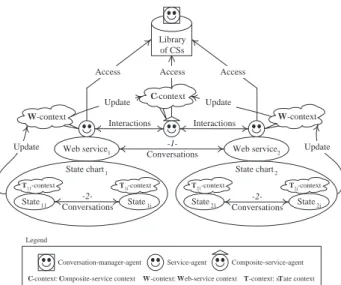
In one of our previous works [12], we strengthened the advantages of the combination (software agent, Web ser-vice, context). For example, agents track Web services in order to update their respectiveW-contexts. The tracking is about the composition in which a service takes part, the current state that the service takes in the composition, and the type of conversations that the service has initiated dur-ing the composition. Fig. 2 presents the context-aware con-versation approach for Web services composition that we developed. The features of this approach are below.
1. Three types of software agents are set: conversation-manager-agent, composite-agent, and service-agent.
A conversation-manager-agent runs on top of the li-brary of conversation schemas. It updates the lili-brary if a new specification of a conversation schema is de-veloped (e.g, by a designer). Plus, the conversation-manager-agent responds to the requests of down-loading conversation schemas that composite-service-agents and service-composite-service-agents submit.
A composite-service-agent triggers and monitors the deployment of the specification of a composite service (to keep Fig. 2 clear, the specification store is not rep-resented1). This monitoring is reflected in a context,
which we refer to asC-context (context ofC omposite-service). In addition, the composite-service-agent in-teracts with service-agents when it comes to inviting services for composition or informing services of the changes in the specification of the composite services. A service-agent is responsible for getting a Web ser-vice ready for composition, monitoring its execution through its state chart, and updating itsW-context.
2. Besides the state charts of the conversation schemas (Fig. 1), additional state charts are as-sociated with Web services (Fig. 2). The states that a Web service takes are immediately reflected in its
W-context. Interesting to note that the transitions in the state charts of services arecontext-based and
conversation-oriented (Fig. 2-2). However, these
conversations are less complex than the conversations that involve Web services (Fig. 2-1). Therefore, each state of a Web service is associated with aT-context (context of Web-service sTate).
3. A library of conversation schemas that stores the spec-ifications of conversation schemas (Fig. 1). The li-brary is a resource from which composite-service-agents and service-composite-service-agents download conversation schemas after interactions with the conversation-manager-agent.
In Fig. 2, the conversations occur in two separate loca-tions. In the first location, the conversations concern the component Web services that participate in a composite service (Fig. 2-1). These conversations are specified us-ing the conversation schemas of Fig. 1. In the second lo-cation, the conversations concern the states of the Web ser-vices (Fig. 2-2). It should be noted that the state chart of a conversation schema supports the interactions between the state charts of services. The distinction between states of services and states of conversations gives a much better flexibility in managing the aspects that each type of state chart is concerned with. State charts of services focus on the changes that apply to services such as availability, com-mitment, and execution, whereas state charts of conversa-tions focus on the changes that apply to conversaconversa-tions such as formulation, reception, and response.
Because of both types of state (those associated with ser-vices and those associated with conversations), we annotate each conversation state with a context, which we refer to as
S-context (context of conversationState). The rationale of
S-contexts of the states of conversations is similar to the rationale ofT-contexts of the states of services. Moreover,
Web service 1
-1-Conversations
State chart 1 State chart 2
Web service 2
W-context Library
of CSs
Update
Interactions Interactions
Access Access
C-context
Update Update
Access
State 11 State 1i
-2-Conversations State 21 State 2j
-2-Conversations W-context
T
11-context T1i-context T21-context T2j-context
Update
Conversation-manager-agent Service-agent Composite-service-agent
C-context: Composite-service context W-context: Web-service context T-context: sTate context
Legend
Figure 2: Context-aware conversation approach for Web services composition
to track the progress of a conversation a context, which we denote byV-context (context of a conVersation), is used. This is similar to theW-context of a Web service.
4 Development example of a
conversation schema
We decomposed the composition of Web services into three stages: pre-composition, composition, and post-composition. Each stage consists of different aspects, which characterize the conversations that occur. In this sec-tion, we illustrate how a conversation schema is developed. This development consists of devising two state charts, one for the conversations and one for the services that partici-pate in these conversations. Before we explain the devel-opment process, the following comments are made on both types of state charts:
– State labels are annotated with S/R (sender/receiver). If there is no annotation, the state identifies the com-munication network.
– Transitions implement the links between states. Two types of transition exist. The transitions that connect states of the same chart are represented with regular lines. The transitions that connect states of separate charts are represented with dashed lines.
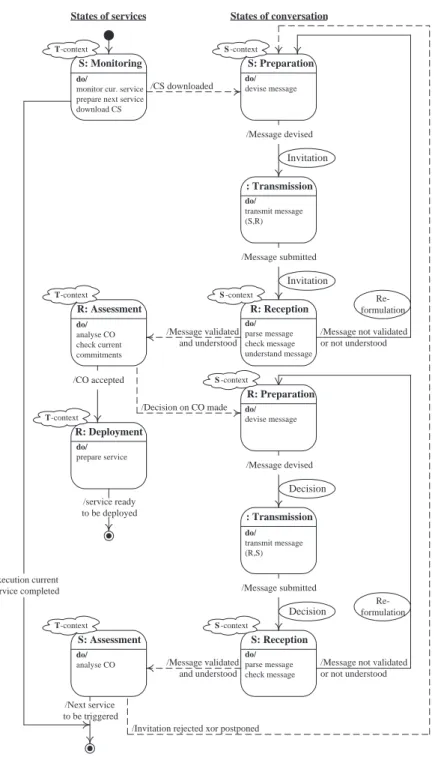
To keep the paper self-contained, only the conversation schema featuring the invitation aspect is illustrated (Fig. 3). While a composite service monitors the component Web services that are currently under execution, the composite service submits an invitation to the next component Web service to join the composition.
States of services. There are four states, which are seen
from two perspectives.
– Sender perspective: two states are associated with the sender service namely monitoring and assessment. Here, the sender corresponds to the composite service. One of the actions in the monitoring state consists of downloading the conversation schema for Web ser-vices invitation. We recall that this schema is stored in the library of conversation schemas (Fig. 2).
– Receiver perspective: two states are associated with the receiver service namely assessment and deploy-ment. Here, the receiver corresponds to the next com-ponent Web service. One of the actions in the assess-ment state consists of checking the current commit-ments that the Web service has towards other compos-ite services. Based on these commitments, the com-ponent service either accepts or rejects the invitation to participate in a composite service.
States of conversations. There are six states, which are
seen from three perspectives. Ellipses glued to transitions correspond to conversation objects.
– Sender perspective: two states are associated with the sender service namely preparation and reception.
– Receiver perspective: two states are associated with the receiver service namely preparation and reception.
– Network perspective: two states are associated with the communication network namely transmission from the sender to the receiver, and transmission from the receiver to the sender.
5 Implementation
As a first step of validating the proposed approach of Fig. 2, we have developed aconversation and Web services
Invitation
/CS downloaded
S: Preparation
do/ devise message
S: Monitoring
do/
monitor cur. service prepare next service download CS
/Message not validated or not understood
Re-formulation
States of conversation States of services
: Transmission
do/ transmit message (S,R)
Invitation
R: Reception
do/ parse message check message understand message /Message validated
and understood
R: Assessment
do/ analyse CO check current commitments
/Message validated and understood
/Invitation rejected xor postponed /Decision on CO made
/Message not validated or not understood
Re-formulation
R: Preparation
do/ devise message
Decision
Decision
S: Reception
do/ parse message check message /Message devised
/Message submitted
/CO accepted
R: Deployment
do/ prepare service
/service ready to be deployed
/Message devised
: Transmission
do/ transmit message (R,S)
/Message submitted
S: Assessment
do/ analyse CO
/Next service to be triggered
T-context
T-context
T-context
T-context
S -context
S -context
S -context
S -context
/Execution current service completed
Figure 4: Graphical editor for conversation schemas and service chart diagrams
Edition version 92. The prototype integrates a set of tools,
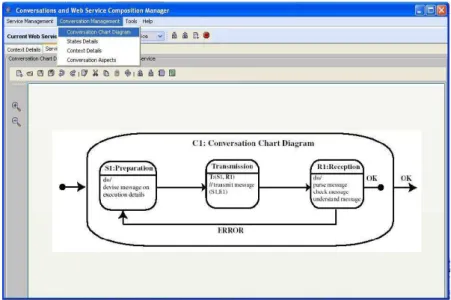
which allow for instance Web services’ providers and users to create, compose, and execute services based on the dif-ferent contexts. WSDL is used for Web services specifi-cation, and UDDI is used for Web services announcement and discovery. Details of contexts and conversation ses-sions are structured as XML files. A dedicated XML editor was developed in order to create, validate, test, and mon-itor the different XML files. The validation of these files is based on two XML schemas (conversations.xsd and con-text.xds). In addition, the conversation manager offers an editor for describing the state charts of conversation ses-sions and composite services (Fig. 4). The graphical edi-tor provides means for directly manipulating conversations and service chart diagrams, states, and transitions (add, re-move, modify, etc.) graphically using drag and drop oper-ations.
6 Conclusion
In this paper, we overviewed our approach for compos-ing Web services uscompos-ing software agents, conversations, and context. Several types of conversation schemas are dis-cussed such as those for inviting Web services to partici-pate in composition. Conversation schemas have been as-sociated with software agents and contextual information. Because needs and interests of users always change, it is important to ensure that the composition of Web services efficiently handles these changes. What is needed is to al-low Web services to decide whether to join a composition, what states to take with regard to the outcomes of conver-sations, and what actions to perform within these states.
2http://www.borland.com/jbuilder/enterprise/index.html.
References
[1] L. Ardissono, A. Goy, and G. Petrone. Enabling Conversations with Web Services. In Proceed-ings of the Second International Joint Conference on Autonomous Agents & Multi-Agent Systems
(AA-MAS’2003), Melbourne, Australia, 2003.
[2] B. Benatallah, Q. Z. Sheng, and M. Dumas. The Self-Serv Environment for Web Self-Services Composition.
IEEE Internet Computing, 7(1), January-February
2003.
[3] D. Berardi, D. Calvanese, G. De Giacomo, M. Lenz-erini, and M. Mecella. A Foundational Vision for e-Services. In Proceedings of The Workshop on Web Services, e-Business, and the Semantic Web (WES’2003) held in conjunction with The 15th Conference On Advanced Information Systems
En-gineering (CAiSE’2003), Klagenfurt/Velden, Austria,
2003.
[4] P. Brézillon. Focusing on Context in Human-Centered Computing. IEEE Intelligent Systems, 18(3), May/June 2003.
[5] T. Bultan, X. Fu, R. Hull, and J. Su. Conversation Specification: A New Approach to Design and Anal-ysis of E-Service Composition. In Proceedings of The Twelfth International World Wide Web
Confer-ence (WWW’2003), Budapest, Hungary, 2003.
[6] B. Burg. Agents in the World of Active Web Services.
In Proceedings of Second Kyoto Meeting on Digital
Cities, Kyoto, Japan, 2001.
Report FLA-NARTM02-08, Fujitsu Laboratories of America, Inc., Sunnyvale CA, USA, 2002.
[8] D. Harel and A. Naamad. The STATEMATE Seman-tics of Statecharts. ACM Transactions on Software
Engineering and Methodology, 5(4), October 1996.
[9] M. Huhns. Agents as Web Services. IEEE Internet
Computing, 6(4), July-August 2002.
[10] F. Lin and D. H. Norrie. Schema-based Conver-sation Modeling for Agent-oriented Manufacturing Systems. Computers in Industry, 46(3), October 2001.
[11] Z. Maamar, B. Benatallah, and W. Mansoor. Ser-vice Chart Diagrams - Description & Application. In
Proceedings of The Twelfth International World Wide
Web Conference (WWW’2003), Budapest, Hungary,
2003.
[12] Z. Maamar, S. Kouadri Mostéfaoui, and H. Yahyaoui. A Web Services Composition Approach based on Software Agents and Context. InProceedings of The 19th Annual ACM Symposium on Applied
Comput-ing (SAC’2004), Nicosia, Cyprus, 2004.
[13] B. Medjahed, A. Bouguettaya, and A. Elmagarmid. Composing Web Services on the Semantic Web. The VLDB Journal, Special Issue on the Semantic Web,
Springer Verlag, 12(4), 2003.
[14] D. A. Menascé. QoS Issues in Web Ser-vices. IEEE Internet Computing, 6(6), Novem-ber/December 2002.
[15] J. P. Morgenthal. Web Service Conversations.