SPECIAL ISSUE IV (2016), Page 343 - 352
A THEORETICAL OVERVIEW OF ROAD HUMP EFFECTS ON TRAFFIC SPEED IN RESIDENTIAL ENVIRONMENTS
Khairun Sarah Radhiah Bachok1, Abdul Azeez Kadar Hamsa2, Mohd Zin
Mohamed3 & Mansor Ibrahim4
1,2,3,4
Kulliyyah of Architecture & Environmental Design
INTERNATIONAL ISLAMIC UNIVERSITY MALAYSIA
Abstract
This paper is part of an ongoing study to analyse the effectiveness of road humps as a traffic calming measure in improving the residential living environment. A review was conducted on various literatures concerning the effects of road humps on vehicle speeds, particularly in residential areas. The major findings from the literatures are that the
vehicles’ operating speeds are affected by the hump design and spacing in between
humps. An incorrect hump profile will also potentially result in passenger discomfort and vehicle damage. Public perceptions also agreed that road humps are effective in reducing
vehicle speeds. More studies should link field study results with residents’ perceptions
particularly in Malaysia, while considering the effect of road geometrics and other devices possibly impacting vehicle speeds along selected roads. Further research also needs to be done to test the effectiveness of current schemes in Malaysian residential areas, as many are on an ad-hoc basis.
Keyword: Road humps, Traffic calming, Traffic speed, Living environment, Malaysia
INTRODUCTION
Khairun Sarah Radhiah Bachok, Abdul Azeez Kadar Hamsa, Mohd Zin Mohamed & Mansor Ibrahim A Theoretical Overview of Road Hump Effects on Traffic Speed in Residential Environments
(24.1 km/h), 37% at 30 mph (48 km/h) and increases to 83% at 44 mph (70.8 km/h) (Limpert, 1994 as cited by Abdul Manan and Hoong, 2009).
As one of the traffic calming measures, road humps have helped to significantly reduce the speed of the moving vehicles especially along residential roads. Due to its largely positive impact in its ability to considerably reduce vehicle speed, its importance has been growing over the years in improving the living environment of the residential areas. However, a prevailing issue in Malaysia is that the Malaysian Traffic Calming Guidelines has not been adhered to in the installation of various existing traffic calming schemes in Malaysian residential areas. This may lead to various issues such as a lack of standardization in dimensions, unsuitable locations, user confusion due to improper construction and no effect on driver behaviour (Abdul Manan and Hoong, 2009). As part of an ongoing research to analyse the effects of road humps in improving the living environment, the objective of this study was to understand the prevailing theories concerning the effects of road humps on traffic speed and also identify the research gaps for the ongoing research to improve upon.
METHODOLOGY
Being a literature review, the method employed is a desk study identifying the relevant literature and any research gaps that the ongoing research can improve upon. The hump design and spacing were selected as the variables explaining the road hump effects on traffic speed. This is due to Parkhill et al. (2009) and Sundo and Diaz (2011) concluding that the hump spacing is a good variable to explain the maximum speed selection of drivers, thus affecting the effectiveness of a road hump in controlling vehicle speeds. Parkhill et al. (2009) and Antic et al. (2013) also listed the hump profile as another factor affecting the effectiveness of a road hump, with the explanation that an incorrect hump profile would potentially cause passenger discomfort and reduce the effectiveness of a hump in encouraging drivers to slow down. In addition, Daniel (2012) proved that hump width was also a factor by finding that the device operating speed is also affected by hump width to road width ratios. Thus the criteria for selecting the case studies were that they were based on road hump design and spacing, and that the speeds were found to be reduced within the 35km/h limit. The reason for the criteria is that 35km/h is the general speed limit along a traffic-calmed residential road in Malaysian urban areas (Abdul Manan and Hoong, 2009).
TRAFFIC CALMING IN MALAYSIA
Traffic calming was classified by the Malaysian Highway Planning Unit (HPU) into two categories, which are as below (Abdul Manan and Hoong, 2009):
1) Vertical Measures: Influences drivers’ speed through vertical deflections of vehicles passing over the device.
2) Horizontal Measures: Influences drivers’ speed through lateral deflections of vehicles navigating the device.
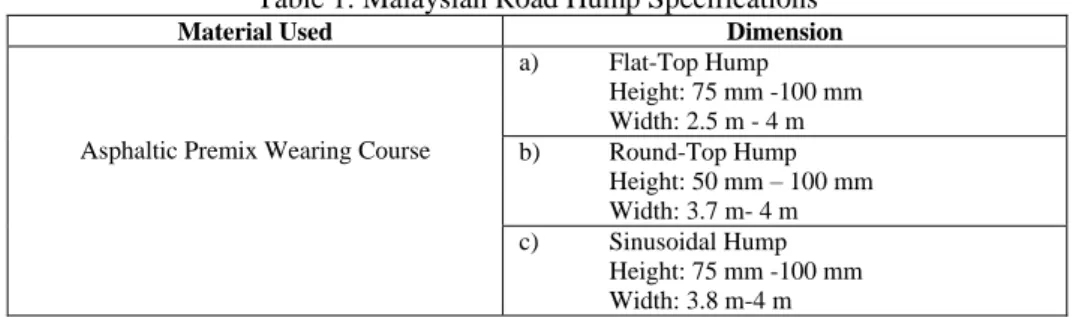
is focused on speed humps, as the speed hump is the most commonly found vertical measure in Malaysian residential areas. The Malaysian road hump design specifications, as derived from Malaysian Ministry of Road Works (2012) are as per Table 1 below.
Table 1: Malaysian Road Hump Specifications
Material Used Dimension
Asphaltic Premix Wearing Course
a) Flat-Top Hump Height: 75 mm -100 mm Width: 2.5 m - 4 m b) Round-Top Hump
Height: 50 mm – 100 mm Width: 3.7 m- 4 m c) Sinusoidal Hump
Height: 75 mm -100 mm Width: 3.8 m-4 m
CONDITIONS WARRANTING INSTALLATIONS OF ROAD HUMPS The Malaysian Ministry of Road Works (2012) defined road humps as a raised area of a pavement, which Berthod (2011) stated causes discomfort due to the vertical displacement created when a vehicle is navigated over the raised area. This influences the drivers to reduce the speed. Hump profiles can be circular, parabolic, sinusoidal or flat-topped (Abdul Manan and Hoong, 2009). The difference between road hump and road
bump is in the length and slope; a hump’s slope is more gradual while its length is greater
than the wheelbase of a vehicle (Berthod, 2011).
According to the Malaysian Ministry of Road Works (2012), the conditions that warrant the installation of road humps are as below:
1) Vehicle Speed: Between 30km/h to 60km/h
2) Road Hierarchy: District Road, Residential Road, Access Road, Rural Road 3) Road Geometry: 2-way and 2-lane roads with no kerbs.
Nevertheless, there are also conditions for which the installation of road humps would be generally deemed unsuitable. The Malaysian Ministry of Road Works (2012) further explained that the conditions that are deemed unsuitable for speed hump installation are as follows:
1) Water retentive locations
2) Main routes for emergency vehicles 3) Locations at road corners, and 4) Federal and State Roads.
Other studies also noted that it is generally unsuitable to install road humps along bus routes, as humps may cause discomfort to the passengers and delay in the travel times
(O’ Flaherty, 1997; Parkhill et al., 2009), though this is not mentioned by the Malaysian
Khairun Sarah Radhiah Bachok, Abdul Azeez Kadar Hamsa, Mohd Zin Mohamed & Mansor Ibrahim A Theoretical Overview of Road Hump Effects on Traffic Speed in Residential Environments
EFFECTS OF ROAD HUMP ON TRAFFIC SPEEDS
Various studies on the effects of road humps have concluded that the road hump is an effective measure in significantly reducing the 85th percentile of vehicle speeds, with speed reductions ranging from 10 to 16 km/h (Appleyard, 1981; Ewing, 1999; Sundo and Diaz, 2011; Huang and Cynecki, 2001; Antic et al., 2013). As stated in the methodology, the review is focused on the effects of road hump design and spacing on reducing the vehicle speeds. The general perception of residents on the effect of road humps is also briefly discussed, in order to further gauge the effectiveness of road humps in a residential area.
Related Literature on Effects of Road Hump Design
The importance of the hump design in controlling traffic speed was mentioned by Sundo and Diaz (2011) and Antic et al. (2013), who indicated that with an increase in the hump
profile’s height or severity, the post-entry speeds and speed in between a series of bumps will decrease.
Antic et al. (2013) evaluated the effectiveness of humps 30 mm, 50 mm and 70 mm height in inverse proportion to the traffic volumes along 3 selected roads, and noted that the speeds reduced with an increase in height. Given that this study made use of humps with similar depths, this means that the slope changes with an increase in height and is thus capable of affecting vehicle speeds. Another notable point made was that despite the significant speed reduction for a hump height of 30 mm, the speeds recorded would result in an 80% fatality rate in case of a vehicle-pedestrian collision. Hence this is fairly consistent with general literatures that recommend heights of 50-100 mm (Layfield and Webster, 1998; Bjarnason, 2004; Malaysian Ministry of Road Works, 2012).
In addition, the study by Yaacob and Hamsa (2013) noted that the speed variations were larger in a hump of 60 mm height as compared to another hump of 80 mm height. The gentler slope of the 60 mm hump resulted in more vehicles exceeding the speed limit 30 m before and after the road hump.
Zainuddin et al. (2014) also found that the hump height was positively correlated with the speed reduction between two measured points, and was also a statistically significant predictor in comparison to hump length and width. This study also developed a regression model to calculate the 85th percentile speed reduction between two selected points, in which the hump height and length at each point were used as predictors. The predictors can also be rearranged to identify the suitable hump height and length to use in order to achieve the desired speed reduction.
to avoid the humps as much as possible. This was one of the negative comments given by respondents in a survey conducted by Cottrell et al. (2006).
On the other hand, the study conducted by Sundo and Diaz (2011) failed to successfully prove the relationship between the hump profile and the driver selection of entry speeds. Thus they stated that the hump height/length ratio was not a good
explanatory variable in assessing a driver’s speed selection, as there was a wide variation
of entry speeds observed. Their conclusion was that driver behaviour is also an important
predictor in explaining the speed selection, concurring with Mao and Koorey’s (2010)
statement that the driving style is a factor to be considered if changes are to be made in the surrounding environment.
Related Literature on Effects of Road Hump Spacing
In addition to road hump design, the spacing in between road humps also plays a factor in influencing vehicle speeds. Hugh Woo et al. (2010) found that tandem speed humps resulted in significant speed reductions of 1.7 – 2.17 km/h as compared to single humps, in a study that compared the effectiveness of single and tandem speed humps in reducing vehicle speeds along a traffic-calmed road. This concurs with Parkhill et al. (2009) stated
that a vehicle’s operating speed is also influenced by the spacing of road humps in a particular hump scheme.
The study by Sundo and Diaz (2011), which used the direct-timing procedure to measure vehicle speeds in between two selected humps, found that hump spacing was a good predictor in explaining the maximum speed selection. They also explained that if the spacing between 2 humps were divided into four quarters, the middle 2 quarters or
midway between the humps would be designated as the ‘Danger Zone’ with vehicles
reaching peak speeds.
In addition, Yaacob and Hamsa’s (2013) study in Taman Setapak, Kuala Lumpur found that with a spacing of 70 m, the 85th percentile speeds recorded 30 m before and after the second hump were 31.88 km/h and 33.20 km/h respectively, thus suggesting that shorter hump spacing would be more suitable to maintain the 35 km/h speed limit in a Malaysian residential area. However it should be noted that the study was not actively studying the effect of road hump spacing; instead it focused on the individual effect of each hump.
A study conducted by Mao and Koorey (2010) also found that 2 out of the 7 case studies with vertical measures resulted in higher vehicle speeds after installation. A possible explanation given was that the spacing was too far apart, thus allowing drivers to reach maximum speed in between the devices. However this is not always the case. A Federal Highway Administration (1994) study was conducted on two traffic-calmed sections of roads with similar geometric standards, the difference being the traffic volume and road hump spacing. The reduction in the 85th percentile speeds were 21 km/h for Section 1 with 182 m hump spacing and VPD of 655, and 16 km/h for Section 2 with 176 m hump spacing and VPD of 472. It can be seen that even with a closer distance in humps, Section 2 had a lesser effect on vehicle speeds; therefore it may be concluded that the
lower traffic volume had also affected the drivers’ choice of speed in navigating through
Khairun Sarah Radhiah Bachok, Abdul Azeez Kadar Hamsa, Mohd Zin Mohamed & Mansor Ibrahim A Theoretical Overview of Road Hump Effects on Traffic Speed in Residential Environments
Public Perception on Effectiveness of Road Hump
Based on the available literature, the public perception on road humps have generally been positive in regards to speed reductions. A study by Kayode (2015) made use of questionnaires targeting a sample of 150 drivers from commercial, private, company and government sectors. The study focused on the perception regarding road bumps; however it found that speed reductions were deemed to be significantly affected by bump type, height, width and spacing. This is concurrent with the literature discussed above on the effects of hump dimension and spacing.
In their study, Cottrell et al. (2006) found that a common positive comment given by the respondents was that the humps reduced traffic speed and volume. This concurred with Du et al. (2001), which studied the perceptions of the residents and travelling public
who regularly used the roads and found that both groups agreed on the humps’
effectiveness in reducing vehicle speeds. Smith et al. (2002) also reported that after installing temporary road humps, residents agreed that the humps reduced vehicle speeds up to 50 percent. On the other hand, Cottrell et al. (2006) and Du et al. (2001) noted that
respondents also complained about drivers speeding aggressively to ‘fly’ over the humps
or driving along the edge of the humps in order to avoid driving over the humps. However this is indicative of variations in driver behavior when navigating over a road hump, and not necessarily an issue regarding the hump design or spacing. Other complaints by the respondents were mostly on the increase in traffic noise levels near the humps (Du et al., 2001; Smith et al., 2002; Cottrell et al., 2006), due to abrupt changes in vehicle speed due to vehicle decelerations and accelerations. Thus it can be generalized that the road hump is effective in addressing the concerns on increased vehicle speeds in residential areas.
Research Gaps from Previous Literature
The previous researches discussed on the effects of road hump profile and spacing was mostly limited to field tests and simulation studies. More studies should discuss field results together with general public understanding and perceptions on traffic calming, particularly in Malaysia. This is important given the inconsistencies in road hump installations throughout Malaysian urban residential areas, which may cause variations in driver behaviour and thus impact their speed selections. Variations in public opinion regarding hump effectiveness may also occur according to the device characteristics.
In addition, the research conducted by Yaacob and Hamsa (2013) and Zainuddin et al. (2014) did not actively take into account the effect of other road humps or traffic
calming devices in the same scheme as those studied, while Sundo and Diaz’s (2011)
study did not take the effects of the road geometry into consideration.
In regards to the public perceptions briefly discussed above, a limitation of Cottrell
et al.’s (2006) study was that the origins of all returned questionnaires were not recorded.
Thus it was not possible to analyse the responses according to the neighbourhood or hump characteristics.
DISCUSSION
visual impression that the road was not intended for high-speed or cut-through traffic. Ibrahim et al. (2003) also identified a linear relationship between average vehicle speed and distance from the hump with an R-squared value of 0.91, indicating that a road hump is significant in reducing the speed of vehicles.
The reviewed literatures have sufficiently proven that the road hump profile and spacing are good predictors in determining the effect of a road hump on the reduction of vehicle speeds. As a result, both predictors can be used in further studies in analysing the effectiveness of road humps.
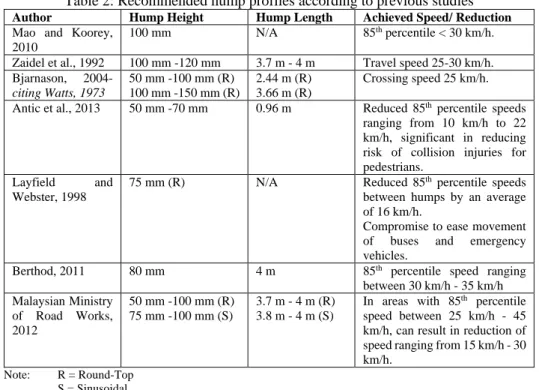
The standard speed limit along a residential road in Malaysia with road hump installation is 35 km/h, which drops to 30 km/h near a school. According to Table 2 below, the reviewed literature recommend hump heights of 50 mm -100 mm and lengths of approximately 3 m - 4 m to achieve vehicle speeds within the 35 km/h speed limit in Malaysian urban residential area.
Table 2: Recommended hump profiles according to previous studies
Author Hump Height Hump Length Achieved Speed/ Reduction
Mao and Koorey, 2010
100 mm N/A 85th
percentile < 30 km/h.
Zaidel et al., 1992 100 mm -120 mm 3.7 m - 4 m Travel speed 25-30 km/h. Bjarnason, 2004-
citing Watts, 1973
50 mm -100 mm (R) 100 mm -150 mm (R)
2.44 m (R) 3.66 m (R)
Crossing speed 25 km/h.
Antic et al., 2013 50 mm -70 mm 0.96 m Reduced 85th percentile speeds
ranging from 10 km/h to 22 km/h, significant in reducing risk of collision injuries for pedestrians.
Layfield and Webster, 1998
75 mm (R) N/A Reduced 85th percentile speeds
between humps by an average of 16 km/h.
Compromise to ease movement of buses and emergency vehicles.
Berthod, 2011 80 mm 4 m 85th percentile speed ranging
between 30 km/h - 35 km/h Malaysian Ministry
of Road Works, 2012
50 mm -100 mm (R) 75 mm -100 mm (S)
3.7 m - 4 m (R) 3.8 m - 4 m (S)
In areas with 85th percentile
speed between 25 km/h - 45 km/h, can result in reduction of speed ranging from 15 km/h - 30 km/h.
Note: R = Round-Top S = Sinusoidal
Khairun Sarah Radhiah Bachok, Abdul Azeez Kadar Hamsa, Mohd Zin Mohamed & Mansor Ibrahim A Theoretical Overview of Road Hump Effects on Traffic Speed in Residential Environments
transverse road markings or transverse rumble strips can be used to warn drivers of an upcoming hazard and help to reduce speed of the vehicles.
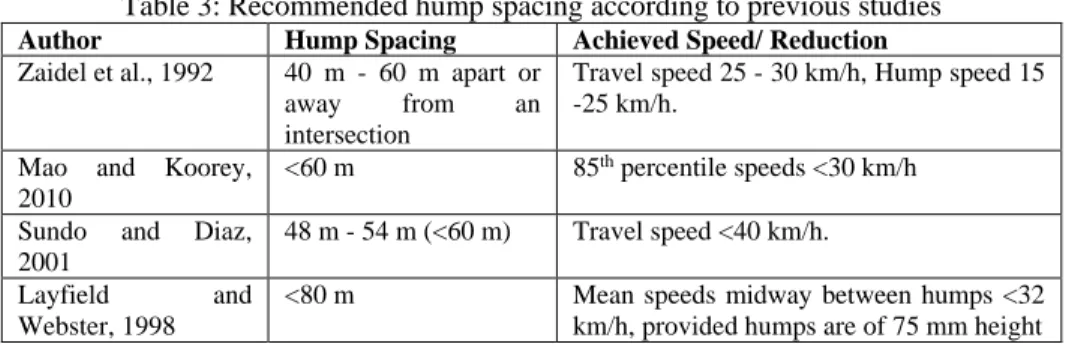
Table 3: Recommended hump spacing according to previous studies
Author Hump Spacing Achieved Speed/ Reduction
Zaidel et al., 1992 40 m - 60 m apart or
away from an
intersection
Travel speed 25 - 30 km/h, Hump speed 15 -25 km/h.
Mao and Koorey, 2010
<60 m 85th percentile speeds <30 km/h
Sundo and Diaz, 2001
48 m - 54 m (<60 m) Travel speed <40 km/h.
Layfield and
Webster, 1998
<80 m Mean speeds midway between humps <32 km/h, provided humps are of 75 mm height
It is also interesting that as explained by Lee et al. (2013), the effectiveness of an
existing device installation can also be assessed by using Roess et al.’s (2004) equation.
The equation compares the existing spacing with the value derived for S. In the case that the existing spacing is less than S, it could be assumed that the performance of a road hump would be affected to an extent by any subsequent devices in the traffic calming scheme. Roess et al. (2004) also stated that the equation can be used to determine the minimum distance after passing a traffic calming device. This equation is based on the
road’s speed limit and minimum driving speed, as below (equation 1).
𝐕𝟐−𝐕𝐨𝟐
𝟐𝐚 = 𝐒 (1) where,
V : speed limits,
V0 : minimum driving speed,
a : acceleration rate (passenger car acceleration rate is 2.286 m/s2), and
S : the resulting minimum spacing between the devices.
However, there is a lack of standardization in the construction of road humps throughout Malaysian urban residential areas (Abdul Manan and Hoong, 2009). Given the importance of the hump profile and spacing in reducing vehicle speeds, the lack of standardization may reduce the effectiveness of road humps as a traffic calming device and cause discomfort to passengers. Thus further studies should be conducted on the effects of existing road hump profiles and spacing to determine their effectiveness in reducing vehicle speeds and improving the liveability of residential areas.
residential area, in order to further understand the driver behaviour in their speed selections.
CONCLUSION
The literature review presented in this paper discussed the effectiveness of road humps in reducing the speeds of vehicles along selected roads, particularly in terms of road hump profiles, hump spacing and public perceptions. From the review, it is indisputable that road hump profiles and spacing are important factors to assess road humps along a residential road. However, there are also different factors that may affect the effectiveness of the road hump schemes, such as the daily traffic volume and driver behaviour. The gaps identified from the previous studies are the considerations of road geometry and the effect of other road humps along the selected roads, as well as the analysis of questionnaires according to the neighbourhood and hump characteristics. As the road hump installations in Malaysia have been largely on an ad-hoc basis with no reference to the official guidelines, the analysis of public perceptions according to existing characteristics would be important in Malaysia. Given that the residential living environment is of importance, it would be very significant to understand the residents’ perceptions on how the road hump has impacted their environment. Thus any further research conducted in Malaysia should consider public perceptions as an important parameter in determining the effectiveness of road humps, and discuss the perceptions together with the obtained field results based on the existing hump profiles and spacing.
ACKNOWLEDGMENT
The authors would like to express their gratitude and appreciation to Ministry of Science, Technology and Innovation (MOSTI) for providing the research grant under E-Science fund for this project (project number: 06-01-08-SF0201).
REFERENCES
Abdul Manan, M.M., Hoong, A.,P., W., (2009). Development and Evaluation of a Traffic Calming Scheme in the Vicinity of Schools in Malaysia: A survey in the Klang Valley. Kajang: MIROS.
Antic, B., Pesic, D., Vujanic, M., Lipovac, K. (2013). The influence of speed bumps heights to the decrease of the vehicle speed- Belgrade Experience. Safety Science. 57: 303-313.
Appleyard, D. (1981). Livable Streets. California: University of California Press.
Berthod, C. (2011). Traffic calming: Speed humps and speed cushions. Paper presented at the 2011 Annual Conference of the Transportation Association of Canada, Edmonton, Alberta. Bjarnason, S. (2004). Round Top and Flat Top Humps: The Influence of Design on the Effects.
Lund Institute of Technology: Sweden.
Cottrell, W.D., Kim, N., Martin, P.T., Perrin Jr, H.J. (2006). Effectiveness of traffic management in Salt Lake City, Utah. Journal of Safety Research, 37: 27-41.
Daniel, B.D. (2012). The influence of width of road humps on operating speed. Paper presented at the Talent Management Symposium 2012, Australia.
Dinh, D.D., Kubota, H. (2013). Profile-speed data-based models to estimate operating speeds for urban residential streets within a 30 km/h speed limit. IATSS Research. 36: 115-122. Du, J., Ivan, J., Garder, P., Aultman-Hall, L. (2003). Public perceptions of traffic-calming device
Khairun Sarah Radhiah Bachok, Abdul Azeez Kadar Hamsa, Mohd Zin Mohamed & Mansor Ibrahim A Theoretical Overview of Road Hump Effects on Traffic Speed in Residential Environments
Ewing, R. (1999). Impacts of traffic calming. TRB Circular E-C019: Urban Street Symposium, I-1/1-14.
Federal Highway Administration. (1994). Traffic calming, auto-restricted zones and other traffic management techniques- Their effects on bicycling and pedestrians (Case study no. 19 publication no. FHWA-PD-93-028). Washington, D.C.: Federal Highway Administration. Huang, H.F., Cynecki, M.J. (2001). Effects of traffic calming measures on pedestrian and motorist
behavior. Transportation Research Record, 1705: 26-31.
Hugh Woo, T., Shih-Ming Ho, Chi-Yuan Lee. (2010). Comparison of single and tandem speed humps in speed reduction. Journal of Society for Transportation and Traffic Studies, 1 (3): 46-53.
Islam, M.T., El-Basyouny, K., Ibrahim, S.E. (2014). The impact of lowered residential speed limits on vehicle speed behaviour. Safety Science, 62: 483-494.
Kadar Hamsa, A.A. (2009). Causes, trends and implications of motorization in Malaysia. Proceedings of the Eastern Asia Society for Transportation Studies, Vol. 7.
Kayode, A.A. (2015). Effectiveness of road bumps in relation to speed reduction among vehicle drivers Ilorin Metropolis. Scholarly Journal of Scientific Research and Essay, 4 (4): 61-65. Layfield, R., Webster, D. (1998). Urban traffic-calming measures: Design, effectiveness, public attitudes and environmental issues (PA 3365/98). Paper presented at the European Transport Conference, United Kingdom.
Lee, G., Joo, S., Oh, C., Choi, K. (2013). An evaluation framework for traffic calming measures in residential areas. Transportation Research Part D, 25: 68-76.
Litman, T. (1999). Traffic calming benefits, costs and equity impacts. Canada: Victoria Transport Policy Institute.
Malaysian Ministry of Road Works. (2012). Kaedah memperlahankan halaju kenderaan: Bonggol jalan. Paper presented at the Seminar Fasiliti Keselamatan Jalan, Kuala Lumpur.
Mao, J., Koorey, G. (2010). Investigating and modelling the effects of traffic calming devices. IPENZ Transportation Group Conference 2010, 1-14.
Martens, M., Comte, S., Kaptein, N. (1997). The effects of road design on speed behaviour: A literature review. Finland: VTT.
O’Flaherty, C.A. (1997). Physical methods of traffic control. In O’ Flaherty, C.A. (Ed.), Transport Planning and Traffic Engineering. New Jersey: Pearson Education Inc.
Parkhill, M., Sooklall, R., Bahar, G. (2009). Updated Guidelines for the Design and Application of Speed Humps. Paper presented at the CITE 2007 Conference, Toronto, Ontario, Canada. Rahman, F., Takemoto A., Sakamoto, K., Kubota, H. (2005). Comparative study of design and
planning process of traffic calming devices. Proceedings of the Eastern Asia Society for Transportation Studies. 5, 1322 – 1336.
Roess, R.P., Prassas, E.S., McShane, W.R. (2004). Traffic Engineering (3rd ed.) New Jersey,
Pearson Education Inc.
Smith, D.J., Knapp, K., Hallmark, S. (2002). Speed impacts of temporary speed humps in small Iowa cities. Ames: Centre for Transportation Research and Education, Iowa State University.
Sundo, B.M., Diaz, C.E.D. (2011). Effect of hump spacing on speed selection of isolated vehicles: The case of exclusive villages in Metro Manila. Proceedings of the Eastern Asia Society for Transportation Studies, 3 (2), 409-423.
Yaacob, N, A., Hamsa, A.A.K. (2013). The effect of road hump in reducing speed of motorcars in a residential area in Kuala Lumpur. Journal of Design and Built Environment, 13, 1-13. Zaidel, D., Hakkert, A.S., Pistiner, A.H. (1992). The use of road humps for moderating speeds on
urban streets. Accident Analysis and Prevention, 24 (1), 45-56.