ON THE SIMSON–WALLACE THEOREM PAVEL PECH1, EMIL SK ˇR´IˇSOVSK ´Y2
Abstract. The paper deals with the well-known Simson–Wallace theorem and its Gergonne’s generalization. In this article we proceed with the general-ization of the Simson–Wallace theorem a bit further. We inspect the validity of previous theorems when affine transformation is applied. This leads to de-riving a few interesting insights. Throughout the paper we used both synthetic and analytical methods.
Volume 21, (2013), No. 1, 59–66.
1. Introduction
This section serves as an introduction into the topic of the Simson–Wallace theorem. If the reader already possesses the knowledge of this topic, he might skip it to the next section.
The Simson–Wallace theorem describes an interesting property regarding the points on a circumcircle of a triangle [4], [5].
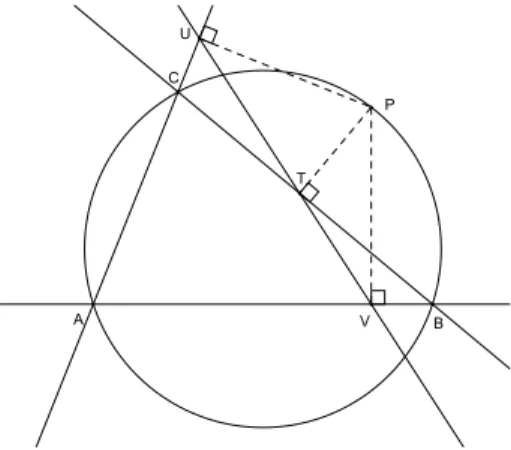
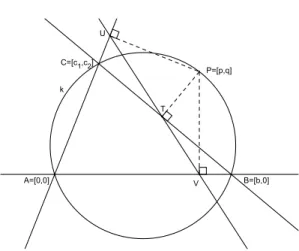
Theorem 1.1 (Simson–Wallace). Let ABC be a triangle and P a point in a plane. The feet of perpendicular lines onto the sides of the triangle are collinear iff P lies on the circumcircle of ABC,Fig.1.
Figure 1. Simson–Wallace theorem — pointsT, U, V are collinear The Simson–Wallace theorem has several generalizations. J. D. Gergonne general-ized the Simson–Wallace theorem as follows:
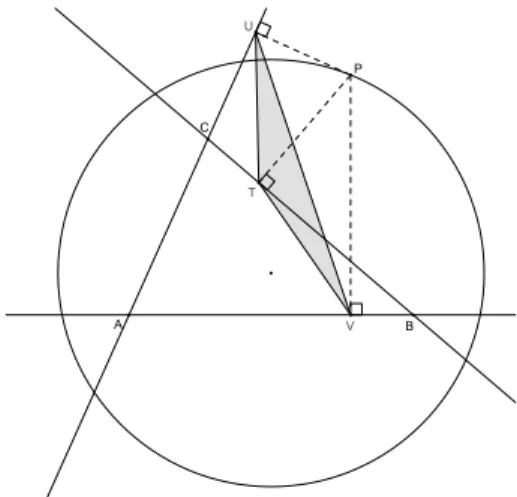
Theorem 1.2 (Gergonne). Let ABC be a triangle and P a point in a plane. The feet of perpendicular lines onto the sides of the triangle form a triangle with
Key words and phrases. Simson–Wallace theorem, loci of points, nine-point circle.
a constant area iffP lies on the circle which is concentric with the circumcircle of ABC, Fig. 2.
Figure 2. Gergonne’s generalization — triangleT U V has a con-stant area
Gergonne’s generalization formulates the necessary and sufficient condition for the pedal triangle ofP with respect to4ABCto have a constant area. If the pedal triangle degenerates into the line, we get the Simson–Wallace theorem.
In this article we proceed with the generalization of the Simson–Wallace the-orem a bit further and we inspect the validity of previous thethe-orems when affine transformation is applied. This leads to deriving a few interesting insights.
2. Affine generalization of the Simson–Wallace theorem First we recall several important properties of affine transformations in a plane which will be used:
Lemma 2.1. Affine transformation preserves collinearity, i.e., image of a line in affine transformationA is also a line or a point, or: if three points are collinear, then their images are collinear as well.
We may generalize the Simson–Wallace theorem with respect to this lemma in this way:
Theorem 2.2. Let ABC be a triangle and P a point in a plane. The images of the feet of the perpendicular lines in an affine transformation Aare collinear iffP lies on the circumcircle of ABC.
Let us leave Theorem 2.2 for a moment and show its consequences later. Another important property of an affine transformation is as follows:
Lemma 2.3. LetAbe an affine transformation. If oriented areas of two triangles in a coordinate systemOxyare in the ratioS1:S2=kthen the ratio of the oriented areas of the images of these triangles is preserved.
In a special case, if these two oriented areas are equal, then the oriented areas of their images are equal as well.
Applying this lemma, we are even able to generalize the Gergonne’s theorem in a similar way:
Theorem 2.4. Let ABC be a triangle andP a point on a circle concentric with the circumcircle of a triangle ABC. Let T U V be a pedal triangle of the point P. Then the area of the triangleT0U0V0, whose vertices are images of pedals in affine transformationA, is for all points on the circle constant.
This theorem is clearly a generalization of the previous Theorem 2.2. Substituting
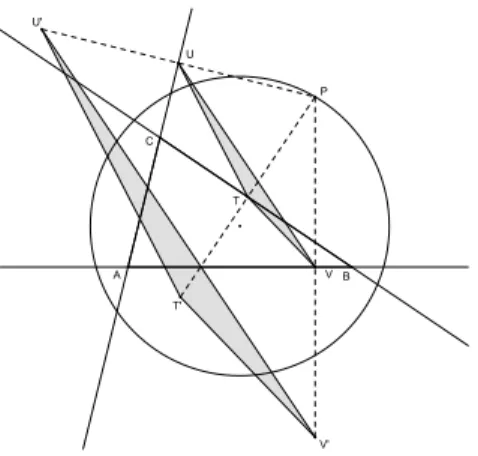
Figure 3. Affine generalization of the theorem of Gergonne – reflection affine transformation in the Theorem 2.4 gradually by its specific examples, we show a geometrical application and obtain:
Consequence 1. We assume the affine transformation to be a homothety with center inP and a scale ratio ofκ= 2. As we easily see, this case is identical with the reflection of this point with respect to the sides of a triangleABC,Fig. 3. Thus the pointsT0, U0, V0 are images ofP in this reflection. For the area of the so
formed triangleT0U0V0 we getS0 = 4S.
As special case we assume the case mentioned in the Theorem 2.2, when these
three points are collinear. We obtain:
Theorem 2.5. Let ABC be a triangle and P a point in a plane. If P lies on its circumcircle, then its images in the reflection with respect to the sides of the triangle ABC are collinear being on the lines0 which is parallel to the Simson line
s, Fig. 4.
Let us explore the properties of the lines0.When we choose an arbitrary position
ofPon the circumcircle of the triangleABC, then we see that the line always passes
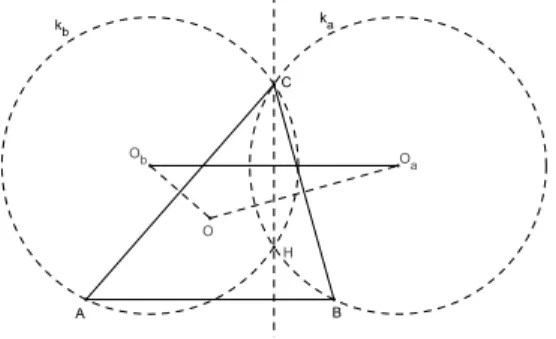
Figure 5. Circleska andkb pass through the orthocenterH
through the orthocenter of the triangle. We state a theorem:
Theorem 2.6. Let ABC be a triangle and P a point in a plane. If P lies on its circumcirle, then its images in reflection with respect the sides of the triangleABC and the orthocenter of the triangle are collinear, Fig. 4.
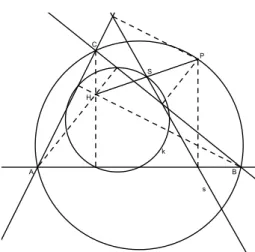
Proof. We will give a synthetic proof of the theorem. First we show that three circles ka, kb and kc which are symmetric with the circumcircle k of a triangle
ABC pass through the orthocenterH ofABC, Fig. 5.
LetO be the circumcenter ofABC, H the intersection of the circleska andkb and
letOa, Ob be centers ofka, kb.As Oa and Ob are symmetric withO with respect
to the sidesBC andACthenOaOb kABand|OaOb|=|AB|.It implies that CH
must be the perpendicular bisector of the segmentOaOb.ThusCH ⊥AB.
Now we will prove, that points H, U0 and T0 are collinear, Fig. 6, from which
our statement follows. We show that the angles between linesCH, HT0 andCH,
HU0 are the same. If we denote ∠CHT0=²then by the inscribed angle theorem
∠CSaT0= 2².Similarly,∠CHU0= 1/2∠CSbU0=²as|CU0|=|CT0|.The theorem
is proved. ¤
Consequence 2. A second interesting consequence goes by when we choose affine transformation in the Theorem 2.4 to be a transformation composed of a rotation and a homothety. Rotating T, U, V around P about the angle θ and mapping in a homothety centered in P with a coefficientk= 1
cosθ, we obtain pointsT0, U0, V0
lying on the sides of a triangle and the angleαbetween the linesT0P, U0P, V0P
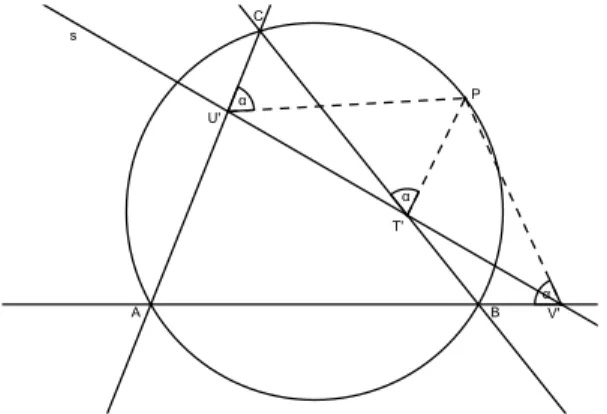
and the sides of a triangleABC is constant. Then the next theorem holds: Theorem 2.7. Given a triangle ABC, a pointP, an oriented angleα,α ∈(0, π)
and points T0, U0 and V0 on the sides BC, AC and AB of the triangle ABC re-spectively. IfP lies on the circumcircle ofABC and∠(T0P, BC) =∠(U0P, AC) =
∠(V0P, AC) =α, then the pointsT0, U0 andV0 are collinear, Fig. 7.
Figure 7. Affine generalization – arbitrary angle
Similarly, assuming P to lie on a circle concentric with the circumcircle of a triangle ABC then the oriented area of a triangle T0U0V0 is constant for all the
points of this circle.1
3. Nine point circle
At this point we remark that not only the lines0which is parallel to the Simson
lines,but even the original Simson line is related to the orthocenter of the triangle. To explore it, we introduce a coordinate system and use analytical method.
Adopt a rectangular coordinate system, whereA= [0,0], B= [b,0], C= [c1, c2]
andP = [p, q],Fig. 8. To the feetT, U, V of perpendiculars fromP to the sides of
1For the area of the so formed triangle it might be easily proven thatS0= 1 sin2αS.
Figure 8. Introduction of a coordinate system
ABC we assign the coordinatesT = [t1, t2], U = [u1, u2] and V = [v1, v2].
We see thatv1=pandv2= 0.Further we easily find that: u1= c1(pc1+qc2) c2 1+c22 , u2= c2(pc1+qc2) c2 1+c22 , and t1=p(c1−b) 2+bc2 2+qc2(c1−b) (c1−b)2+c22 , t2=pc2(c1−b) +qc 2 2−bc2(c1−b) (c1−b)2+c22 , where for the pointP = [p, q]
(3.1) c2p2+c2q2−bc2p+bc1q−qc21−qc22= 0
holds.
It is obvious that (3.1) is the equation of the circumcirclek ofABC.We will also need the equation of the Simson lineswhich is as follows
(3.2) x(pc1+qc2) +y(pc2−qc1)−p(pc1+qc2) = 0,
where variablesp, q obey (3.1).
Finally for the coordinates of the orthocenterH we getH =hc1,c1(bc−2c1)
i
. Now assuming the midpointSof a segmentHPwith endpoints in the orthocenter H and in a point P on the circumcircle of ABC, Fig. 9, with coordinates S =
h p+c1 2 , qc2+c1(b−c1) 2c2 i
, we see that it satisfies the equation (3.2) of the Simson line, thus it lies on it.2 Really, if we set in the coordinates of the pointS into (3.2), we
get
c1(c2p2+c2q2−bc2p+bc1q−qc21−qc22),
which equals, with respect to (3.1), zero.
Simultaneously, eliminating the parameterspandq from the coordinates of the
2This might also be proven as follows: image of a lines0 in a homothety centered at P and
with a coefficientκ= 0.5 is the original Simson line. The midpointS, which is the image of the orthocenterV, thus lies on the Simson line.
Figure 9. The intersection S of the Simson line sand the nine-point circlekbisects the segmentP H
point S and substituting it into the condition that P lies on the circumcircle of ABC,we obtain the equation of the locus of these midpoints
2c2x2−2c2c1x+ 2c2y2−c1yb+c12y−c2xb+c2c1b−c22y= 0.
(3.3)
We see that this equation describes a circle. Altering this equation, a center-radius form of the circle might be obtained
µ x−2c1+b 4 ¶2 + µ y−4c2 2+bc 1−c12 c2 ¶2 = ¡ c12+c22 ¢ ³ (c1−b)2+c22 ´ 16c22 . (3.4)
Let us focus on, in what relation is this circle (3.4) with the original triangleABC. Substituting into its equation, we see that several distinguished points lie on the circle — e.g. feet of altitudes or midpoints of sides satisfy the equation (3.4). Thus this equation describes the nine-point circle which is often called the Feuerbach circle, [1], [5]. This midpointS lies not only on the Simson line, but also on the Feuerbach circle, Fig. 9.
If we become aware of the full extent of the previous statement, we can define, apart from the usual definition, the nine-point circle as follows:
Theorem 3.1. The nine-point circle is a locus of midpoints of segments connecting the orthocenter with the points on a circumcircle of the triangle.
Remark 3.2. We can see, that the Theorem 2.6 is a special case of the less known Hagge theorem. K. Hagge discovered in 1907 a construction of a circle always passing through the orthocenter of a given triangle [3].
Theorem 3.3(Hagge). Let ABCbe a triangle andP a point in a plane different from the vertices of the triangle ABC. Let us denote by K the intersection of the line AP with the circumcircle k and next denote its image in the reflection with respect to the line BC as K0. Similarly we obtain points L0 and M0. Then the orthocenterH lies on a circle passing through the points K0, L0 andM0, Fig. 10.
Figure 10. Hagge theorem
If we assume in this theorem that the pointP lies on the circumcircle ofABC, then its respective Hagge circle degenerates into a parallel line to the Simson line ofP (infinite radius circle). Further, ifPis the orthocenterH itself, then the circle degenerates into a point (zero-radius circle). Consequently, this theorem might be considered in the certain sense as a generalization of the Simson–Wallace theorem.
4. Conclusion
A few properties of the well known Simson–Wallace theorem were discussed. The novelty of the paper consists in the description of these properties by an affine transformation. Moreover analytical approach enables to define the nine-point circle of a triangle in the less known way by the midpoints of segments connecting an arbitrary point of the circumcircle and the orthocenter of the triangle.
References
[1] Baker, H.F.: An introduction to plane geometry: with many examples. Cambridge University Press, Cambridge, 1943.
[2] Budinsk´y, B.: Analytick´a a diferenci´aln´ı geometrie. SNTL, Praha, 1983.
[3] Bradley, J.Ch., Smith, C.G.: On a Construction of Hagge. Forum Geometricorum, 7 (2007), 231–247. [online]: http://forumgeom.fau.edu/FG2007volume7/FG200730index.html [4] Coxeter, H.S.M.: Introduction to geometry. John Wiley and Sons, New York, 1989. [5] Coxeter, H.S.M., Greitzer, S.L.: Geometry revisited (New Mathematical Library). The
Math-ematical Association of America, Washington, 1967.
[6] Pech, P.: Klasick´e vs. poˇc´ıtaˇcov´e metody pˇri ˇreˇsen´ı ´uloh v geometrii. Jihoˇcesk´a univerzita, ˇ
Cesk´e Budˇejovice, 2005.
[7] Rektorys, K. et al.: Pˇrehled uˇzit´e matematiky. SNTL, Praha, 1988.
[8] ˇSvrˇcek, J.: Vybran´e kapitoly z geometrie troj´uheln´ıka. Karolinum, Praha, 2004.
1Faculty of Education, University of South Bohemia,2Gymnasium ˇCesk´a, ˇC. Budˇejovice