YOUNG LATINO CHILDREN AT RISK FOR PSYCHOPATHOLOGY: EFFECTS OF MATERNAL DEPRESSIVE SYMPTOMS ON CHILD BEHAVIOR
Maria I. Martinez
A dissertation submitted to the faculty of the University of North Carolina at Chapel Hill in partial fulfillment of the requirements for the degree of Doctor of Philosophy in the
Department of Psychology (Clinical Psychology)
Chapel Hill 2014
Approved by: Eric Youngstrom Linda Beeber
Roger Mills-Koonce Betsy Bledsoe Deborah Jones
ABSTRACT
Maria I. Martinez: Young Latino Children at Risk for Psychopathology: Effects of Maternal Depressive Symptoms on Child Behavior
(Under the direction of Eric A. Youngstrom)
Children of recently immigrated Latina mothers are at increased risk for adverse outcomes associated with elevated maternal depressive symptoms due to contextual factors related to immigration and ethnic minority status. Few studies have examined the
ACKNOWLEDGEMENTS
This research was made possible by the NIMH research supplement grant 3R34MH08 6553-02S1 and the grants 5R34MH08 6553, The “WINGS” Depressive
TABLE OF CONTENTS
LIST OF TABLES……….……v
LIST OF FIGURES……….vii
LIST OF ABBREVIATIONS………...……….viii
CHAPTER 1: DEPRESSION AND CHILD OUTCOMES………..1
Introduction……….………...1
Contextual Factors Increase Risk for Adverse Outcomes………...3
A Focus on Early Childhood………...5
Long-term and Moderating Effects of Depression………..6
Limitations of Prior Research………..8
Goals of the Present Study…….………..9
CHAPTER 2: METHODS…..…….………10
Participants………12
Measures………12
Demographic Information……...………..…….………13
Language Proficiency……...……….14
Depression………..………14
Child Outcome………..……….15
Data Analytic Approach………13
CHAPTER 3: RESULTS……….16
Missing Data and Multiple Imputation………..17
Sensitivity Analysis…….……….….……..………..………18
Testing Maternal Depression as a Predictor and a Moderator of Child Behaviors…………...………..………17
Strength and Direction of Relationships………….……..……….19
Hierarchical Models of Child Behavior Outcomes……..…….………….20
Maternal Depression as a Moderator..……….………..23
CHAPTER 4: DISCUSSION…...………19
Conclusions….………...31
TABLES………...33
FIGURES……….42
APPENDIX A: Federal Poverty Guidelines for Study Enrollment Years.………...43
APPENDIX B: Center for Epidemiological Study (CES-D)……….………..…………44
APPENDIX C: Child Behavior Checklist (CBCL) Aggressive Behavior Subscale (Ages 1-5)………..…..………...45
APPENDIX D: Infant Toddler SocialEmotional Assessment – Revised (ITSEA-R)...46
APPENDIX E: The Short Acculturation Scale for Hispanics (SASH)………47
LIST OF TABLES
Table 1. Sample Demographic Characteristics………....……….…...……..33 Table 2. Correlations and Descriptive Statistics of Study Variables….………...…….34 Table 3. Correlations and Descriptive Statistics of Sample Participant
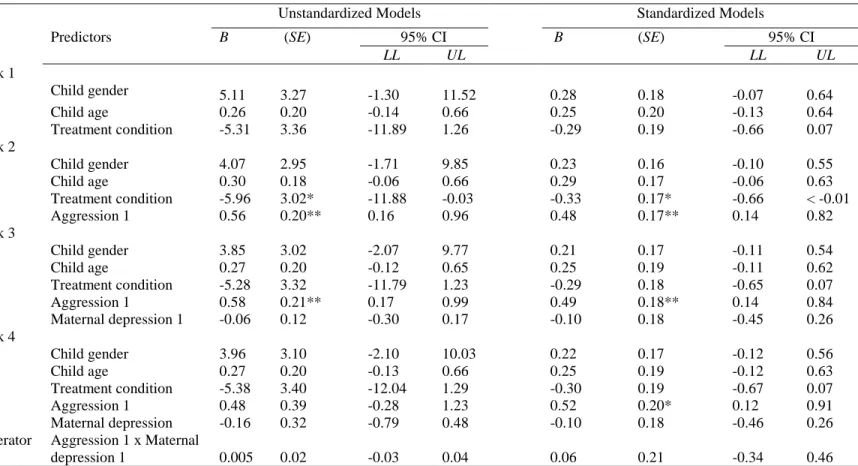
and Study Variables From Pooled Values Based on 500 Imputations………...…………...35 Table 4.Hierarchical Linear Models Predicting Child Aggression at
Follow-up Assessment………..………….……36 Table 5. Hierarchical Linear Models Predicting Child Compliance at
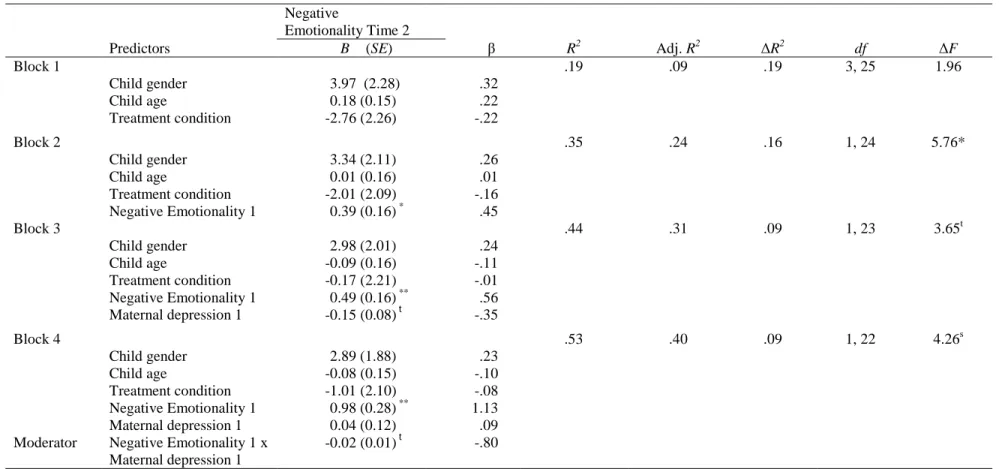
Follow-up Assessment……….…………..………37 Table 6. Hierarchical Linear Models Predicting Child Negative Emotionality
at Follow-up Assessment……….………...……….…………38 Table 7. Hierarchical Linear Models Predicting Child Aggression at Follow-up
Assessment (Pooled Values from Imputed Dataset)..………...…...…………....…..39 Table 8. Hierarchical Linear Models Predicting Child Compliance at Follow-up
Assessment (Pooled Values from Imputed Dataset)……….…..……….…..…40 Table 9. Hierarchical Linear Models Predicting Child Negative Emotionality
LIST OF FIGURES
Figure 1. Interaction Effect of Maternal Depression on Child
LIST OF ABBREVIATIONS
CBCL Child Behavior Checklist
CES-D Center for Epidemiological Studies Depression Scale EHS Early Head Start
IPT Interpersonal Therapy
ITSEA-R Infant and Toddler Social Emotional Assessment – Revised LEP Limited English Proficiency
LEPLI Limited English proficiency and low-income background
LI Low-income
MCAR Missing Completely At Random TAU Treatment As Usual
Time 1 Baseline Assessment (Time 1)
CHAPTER 1: DEPRESSION AND CHILD OUTCOMES
Introduction
Depression is the second leading cause of disability for women of childbearing age (Mental Health: New Understanding, New Hope, 2001). For the purpose of this study, depression, depressive
symptoms, and maternal depression will refer to depressive symptomatology. Recently immigrated Latina mothers with limited English proficiency (LEP) are at increased risk of experiencing
depression, in comparison to other women, due to contextual factors associated with immigration and ethnic minority status (e.g., loss of social ties, increased isolation, lower socio-economic status, poverty, barriers in access to adequate care, etc.; Dennis, Parke, Coltrane, Blacher & Borthwick-Duffy, 2003; Flores & Vega, 1998; Perreira et al., 2009). Compared to their peers, children whose mothers experience symptoms of depression are at greater risk for psychopathology at an early age and the majority will develop a psychiatric disorder by adulthood (Ammerman, Putnam, Bosse, Teeters & Van Ginkel, 2010; Beardslee, Versage, & Gladstone, 1998; Costello, Compton, Keeler & Angold, 2003; Cox, Puckering, Pound & Mills, 1987; Cummings & Davies, 1994; Goodman et al., 2010; Luoma et al., 2001; Weissman et al., 1987; Weissman, Warner, Wickramarante, Moreau & Olfson, 1997). Although the association between maternal depressive symptoms and adverse child outcomes (e.g., behavior problems) is established in the general population (Gelfand & Teti, 1990; Goodman et al., 2011), little is known about this relationship among recently immigrated Latino families with limited English proficiency and low-income backgrounds who reside in the U.S., henceforth referred to as LEPLI.
immigrated LEPLI Latina mothers may have a greater risk for adverse outcomes compared to their peers. Despite a heightened risk for poor outcomes, prior research involving LEPLI Latino families is limited. Because the Latino child population is expected to continue growing to 80.3 million in 2030 and more than a third of children in the U.S. are anticipated to be of Latino descent by 2050
(“America’s children: Key national indicators of well-being”, 2013), it is timely to investigate how maternal depression affects recently immigrated LEPLI Latino families residing in the U.S. It is especially important to improve researchers’ understanding of how maternal depressive symptoms among recently immigrated LEPLI Latina mothers are associated with and influence early child behaviors. When guided by a theoretical model (e.g., Goodman & Gotlib’s [1999] integrative
developmentally sensitive model), this research has the potential to improve theory, research design, and policy as well practice recommendations for children at-risk for adverse outcomes associated with maternal depression (Goodman et al., 2011).
Goodman and Gotlib’s model (1999) provides a developmentally sensitive framework from which to examine the influence of maternal depressive symptoms on child behaviors. From a
developmental perspective, depressive symptoms affect mother-child interactions and reduce optimal parenting, which in turn leads to greater vulnerability for child psychopathology (Goodman & Gotlib, 1999; Weinberg & Tronick, 1998). For example, depression in caregivers can lead to increased irritability, withdrawal, or both, which can result in harsh, disengaged, or inconsistent parenting (Dawson et al., 2003; Goodman, 2007; Gross, Shaw, Burwell & Nagin, 2009; NICHD-ECCRN, 1999a, 1999b). This may lead to stressful dyadic interactions between a mother and child and can start to shape mother and child behaviors, mood, and affect at an early age (Field, 2010; Radke-Yarrow, 1993). According to this model, severity of maternal depression is a risk factor that
are also posited as to moderate the relationship between maternal depression and child outcomes. Thus, child age, child gender, and child temperament or baseline behavior, as well as severity of maternal depression can influence the relationship between maternal symptoms of depression and child behaviors. Dyads experiencing marked stress due to contextual factors associated with poverty and ethnic minority status may be especially vulnerable to risk for development of psychopathology in the presence of maternal symptoms of depression (Beeber et al., 2010; Lovejoy, Graczyk, O’Hare & Neuman, 2010).
Contextual Factors Increase Risk for Adverse Outcomes
Although mothers of young children who are economically disadvantaged are nearly two times more likely (29% versus 17%) to develop symptoms of depression than their counterparts (Ertel, et al., 2011; Kaplan, Roberts, Camacho, & Coyne, 1987; Mora et al., 2009; Pearlin & Johnson, 1977), they are less likely to receive adequate mental health care (Delgado, 2006; Ertel, et al., 2011; Miranda, Nakamura, & Bernal, 2003) and are underrepresented in empirical research studies (Levy & O'Hara, 2010). When ethnic minority status and limited language proficiency compound economic disadvantage, prevalence rates of depression can increase to more than four-fold compared to other women (Alderete, Vega, Kolody, & Aguilar-Gaxiola, 2000; Beeber, 2010; Finch, Kolody, & Vega, 2000; Riolo, Nguyen, Greden, & King, 2005; Wang, Wu, Anderson, & Florence, 2011).
mothers and their young children at high-risk for emotional difficulties and depression (Galea et al., 2007; Gladstone & Beardslee, 2009; Kiernan & Huerta, 2008; Najman et al., 2010; Wang, et al., 2011). Factors associated with low socio-economic status (e.g., single marital status, current unemployment, lower education level and poverty) are also associated with both developing
significant symptoms of depression shortly after childbirth and developing chronic depression (Wang et al., 2011).
Because demographic and contextual factors increase risk for maternal depression among LEPLI Latinas, it is likely that these factors may also increase the risk for adverse child outcomes. It is unclear whether maternal depression is associated with increased risk for adverse child behaviors, above and beyond high-risk demographic and contextual factors (such as in the case of children of Latina women with limited English proficiency from low socio-economic backgrounds residing in the U.S.). Research finds that ethnic minority status is associated with greater children’s internalizing, externalizing, and negative affect/behavior problems in relationship to maternal depression, but it is unknown whether these relationships generalize to specific cultural subgroups such as recently immigrated Latino families (Goodman et al., 2011). Moreover, socio-economic disadvantage appears to be associated with a greater magnitude of child behavior problems in the presence of maternal depression (Goodman et al., 2011), however most studies have not accounted for ethnicity as well as contextual factors in their analyses. Ethnic minority status is associated with socio-economic status; thus, prior research is often confounded by these factors due to overrepresentation of minorities from low socio-economic status. Overall, additional research is needed that controls for demographic and contextual factors.
depression and child outcomes in Latino families. Only one study on this topic specifically focused on Latinos (Dennis et al., 2003). Dennis and colleagues (2003) found maternal depression mediated the relationship between economic pressure and internalizing behaviors, but not externalizing behaviors in a small community sample of Latinas with school aged children. This suggests that maternal depression may be more influential than demographic factors such as economic
disadvantage in the development of child psychopathology. Also, maternal depression may account for a significant amount of variance in models predicting internalizing behavior problems (e.g., negative emotionality) among Latino children from economically disadvantaged households. No studies to date have examined in a LEPLI Latino sample whether maternal depression moderates the relationship among child behavior problems over time.
Maternal Depression and Adverse Child Outcomes
Children are at high risk for psychopathology if their mothers experience symptoms of depression (Ammerman et al., 2010; Costello, Compton, Keeler, & Angold, 2003; Goodman et al., 2010; Weinberg & Tronick, 1998). For example, young children (i.e., infants and toddlers) with depressed mothers display more insecure attachment to their mothers, developmental delays,
difficulty acquiring adaptive self-regulation strategies, and behavior problems compared to children with a non-depressed mother (Cicchetti, Rogosch & Toth, 1998; Cox et al., 1987; Cummings & Davies, 1994; Goodman & Gotlib, 1999; Weinberg & Tronick, 1998). Severity of maternal depression is positively associated with greater risk for internalizing, externalizing and aggression problems in childhood as well as adolescence (Campbell et al., 2009; Cents et al., 2014).
meta-analytic review of maternal depression and child psychopathology (Goodman et al., 2011), found a population effect size estimate r = .23 (weighted mean correlation) for the relationship between maternal depression and internalizing problems. For the relationship between maternal depression and externalizing behaviors the population effect size estimate was also small in magnitude r = .21. When low-income samples (e.g., poverty ratio < 2.0) were examined the population effect size increased in magnitude to r = .26. Population effect size estimates (for the relationship between maternal depression and internalizing or externalizing problems) were not available for the early childhood years because the majority of research to date on these behavioral problems has focused on school aged and adolescent samples. Based on these results, the anticipated effect size estimate for the association between maternal depression and child behavior problems among Latino children may be small or medium in magnitude (upwards of r = .21 and certainly higher than r = .26 might be plausible). Interestingly, child compliance behaviors, separate from externalizing behaviors, have not been examined in previous studies focused on maternal depression and child outcomes.
A Focus on Early Childhood
(Lovejoy et al., 2000); however, for young children, the relationship between maternal symptoms of depression and child psychopathology is not yet well understood – especially when considering socio-economic and ethnic minority status. Studies that have examined the longitudinal trajectory of maternal depression and early child behavior in the general population find that maternal depression is associated with increased risk for internalizing and externalizing behaviors (Campbell, 2007; Cents et al., 2013; Ghodsian, Zajicek & Wolkind, 1984). In early childhood maternal depression also appears to be associated with child aggression (Malik et al., 2007).
Depressive symptomatology is thought to cause more parenting impairment when children are infants and toddlers (Essex et al., 2001; Goodman et al., 2010), due to a child’s decreased autonomy and increased reliance on caretakers, resulting in adverse child outcomes. In fact, earlier child age at time of exposure to maternal depressive symptoms is associated with more
negative/hostile parenting and worse child outcomes (Goodman, et al., 2010; Lovejoy, et al., 2000). Prospective studies that assess maternal depression during infancy and later examine the association of maternal depression with child behaviors in preschool find that earlier child age at time of
exposure to maternal depression is associated with higher risk for internalizing as well as comorbid internalizing and externalizing behaviors as reported by teachers (Essex et al., 2001).
Long-term and Moderating Effects of Depression
Maternal depression is also associated with children’s poor long-term mental health outcomes (Downey & Coyne, 1990; Goodman et al., 2011; Luoma et al., 2010) and is linked with increased psychopathology in adulthood (Beardslee et al., 1998). Thus, the effects of maternal depression during early childhood can have long-term consequences. Evidence in support of this is the finding that the majority of children with a depressed mother will develop an Axis I disorder in adulthood (Beardslee et al., 1998; Murray et al., 2011). Furthermore, chronic exposure to even mild symptoms of maternal depression or brief exposure to severe maternal depression is associated with increased risk for adolescent psychopathology (Hammen, 1991; Hammen, 1999; Hammen & Brennan, 2003; Nelson, Hammen, Brennan, & Ullman, 2003) and impact child behaviors (NICHD, 1999). The
majority of research in the literature focuses on retrospective and concurrent data. Additional research prospectively assessing symptoms of depression and child outcomes are needed.
Even when depressive symptoms remit they may continue to be associated with poor child outcomes because inter-episode symptoms of depression are common and depression is usually recurrent (Cassano & Fava, 2000). It is thought that even mild symptoms of depression can affect parenting thus affecting child outcomes. For example, even mildly symptomatic mothers experience more challenges parenting and parent less optimally than mothers without any symptoms of
depression (Ammerman, et al., 2010; Goodman, 2007; Goodman, et al., 2010; Pelaez, Field, Pickens, & Hart, 2008). Mothers with no history of depressive symptoms are rated higher on maternal
sensitivity than mothers with a single brief history of symptoms, who are rated higher than mothers with chronic elevated symptoms (NICHD-ECCRN, 1999b). Therefore, this suggests that severity of depression may influence the relationship between child behaviors over time.
depression were experienced early and remained in remission (Campbell et al., 2009). It appears that severity of maternal depression and remission of symptoms is associated with changes in child psychopathology (Garber, Ciesla, McCauley, Diamond & Schloredt, 2011; Gunlicks & Weissman, 2008). Parenting and child behaviors, which were measured differently in the aforementioned studies, may differ in their vulnerability to the influences of maternal depression. The impact of remission of symptoms may depend on contextual factors, child age, or severity of symptoms associated with a particular population subgroup. Thus, even mild symptoms of depression appear to be associated with child outcomes, but our understanding of when and for whom is limited. Furthermore, the influence of maternal depression on child behaviors may depend on factors such as the severity of maternal depression and the age of the child.
Limitations of Prior Research
Prior research is limited by a dearth in the literature examining the relationship between maternal depression and early child (ages one to three) behavioral outcomes among LEPLI Latino families. This makes it difficult to determine whether previous research on maternal depression and child outcomes may generalize to recently immigrated Latino families with limited English
proficiency and low-income backgrounds (LEPLI). Prior studies often confounded or failed to
relatively little research has examined moderators influencing the course of child outcomes in the presence of maternal symptoms of depression.
Addressing these limitations in the literature will improve researchers’ understanding of the relationship of maternal depression and child outcomes for at-risk LEPLI Latino families. This research can lead to identifying potential early signs of risk for psychopathology and early developmental pathways that may lead to adverse outcomes, thereby informing intervention.
Addressing these limitations in prior research has the potential to improve decision-making in respect to the delivery of limited intervention resources (Goodman et al., 2011; National Research Council & Institute of Medicine, 2009).
Goals of the Present Study
The current study measured depressive symptomatology and child behavior to examine their relationship among a community sample of recently immigrated Latina mothers of young children (one to three years of age) with limited English proficiency and low-income (LEPLI) backgrounds. Analyses of longitudinal data further explored the relationship between depression and child
behaviors in order to examine how depression contributes to children’s risk for psychopathology. The present study focused on developing a better understanding of predictors of child behaviors
(specifically, child aggression, compliance, and negative emotionality) measured prospectively and longitudinally as well as examining a moderating role of maternal depression severity.
The study focused on three hypotheses. First, child behavior would be associated with
maternal depression severity. More specifically, child negative emotionality and aggression would be positively associated with maternal depression severity whereas child compliance would be
CHAPTER 2: METHODS
Participants
Analyses were performed on a subset of data gathered from a larger study testing the efficacy of Interpersonal Psychotherapy (IPT) delivered in-home to Latina mothers with depressive symptoms who had a child enrolled in Early Head Start, a federal enrichment program for low-income infants and toddlers (see Beeber et al., 2010). Participants were recruited from three of North Carolina’s Early Head Start (EHS) Programs. Enrollment requirements for mothers included: Latino ethnicity, at least 15 years of age, a biological child between 6 weeks and 3 years of age enrolled in Early Head Start, limited English proficiency confirmed by a brief screener, and a positive screen for depressive symptoms. Participants who scored below 16 (Radloff, 1977, 2010) on the Center for Epidemiologic Studies Depression scale (CESD-D) at initial screening were considered ineligible. Exclusion criteria were: English proficiency, inability to provide written consent, refusal in randomization to treatment condition, pregnancy, and/or active mental health treatment for symptoms of depression or anxiety.
A total of 47 participants met eligibility criteria for inclusion in the current study (e.g.,
SD = $589), reflecting wages below the poverty guidelines for the vast majority of participants. Over
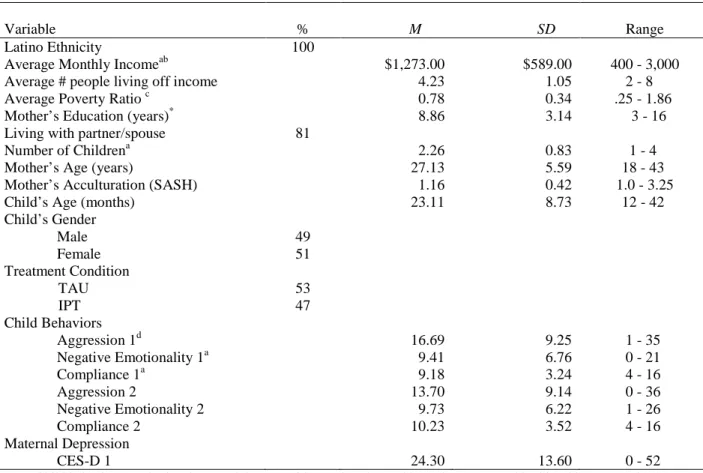
80% of study participants’ yearly income fell below the federal poverty guidelines, a commonly used metric to determine eligibility for federal programs; see Appendix A. This was reflected with an average Poverty Ratio under 1 (M = 0.78, SD = 0.34) that accounts for household size. All mothers in this study endorsed Latino ethnic backgrounds and limited English proficiency. The sample reported recent immigration to the U.S. (M = 5.3 years, SD = 5.9). All participants endorsed Spanish as their primary language. The average age of children involved in the study was 23 months (M = 23.1, SD = 8.7); see Table 1.
All participants were contacted after referral from Early Head Start staff members who were trained to obtain written informed consent and conduct preliminary screening with all Latina mothers with limited English proficiency who were interested in participating in the study. Participants were contacted in Spanish and all materials were provided in Spanish. Those who agreed to participate were scheduled for an in-home visit to obtain a second written informed consent and collect study data. Due to the low literacy level of some study participants, data collectors read consent materials, questions, and response options out loud to participants, who were provided with a small notebook with a visual cue containing a response set that corresponded to each instrument. Participants could point to their answer choice or verbally respond. Interviews ranged from 30 minutes to one hour depending on the wave of data collection. Participants were compensated $10 for each study visit and received small gifts and cards (e.g., framed photos and holiday cards).
Measures
Demographic Information
Language Proficiency
The Short Acculturation Scale for Hispanics (SASH) (Marin, Sabogal, Marin, Otero-Sabogal, & Perez-Stable, 1987) is a 10-item questionnaire that assesses acculturation along a bidirectional continuum. The four language items of the SASH were used to determine limited English language proficiency (Jackson, 2006), a commonly used proxy for acculturation. Average 4-item SASH scores can range from 1-5, with low scores reflecting limited English language proficiency. On average, participants who entered the study reported limited English skills and obtained a total score of 1 (M = 1.2, SD = 0.5), which indicates that most participants had limited English language proficiency. Internal consistency of the 4-item SASH in this sample was excellent (Cronbach’s alpha = .98). Depression
Kolody, Aguilar-Gaxiola & Catalano, 1986). In the current sample reliability was also good, if not excellent (Cronbach’s alpha = .94).
Child Outcome
Infant Toddler Social Emotional Assessment - Revised (ITSEA-R; Carter & Briggs-Gowan, 2000). The ITSEA-R contains 194 items administered to parents via a parent-report questionnaire. It is designed to identify children one to three years of age with potential social-emotional and
behavioral problems or delays (Briggs-Gowan, Carter, Skuban & Horowitz, 2001). Questions ask parents to rate each statement on a 3-point scale (e.g., my child gets angry or pouts, 0=not true or rarely, 1=somewhat true or sometimes, and 2=very true or often). The items create three problem domains, one maladaptive scale, and seven competence scales, with raw scores converted to T scores. Two competence scales (Compliance and Negative Emotionality) were administered as part of the present study. The Compliance Scale measures attending to and following through with parents’ instructions and the Negative Emotionality Scale, measures negative expressed emotions.
Psychometric properties for both the English and Spanish versions of the ITSEA-R are acceptable (Briggs-Gowan & Carter, 1998). Specifically, test-retest reliability for the ITSEA-R ranges from good to excellent, .82-.90 (Carter & Briggs-Gowan, 2001) with Cronbach’s alpha ranging from .71-.86 (Briggs-Gowan & Carter, 1998). Internal consistency in the present sample was similar
(Compliance alpha = .73, Negative Emotionality alpha = .92). Intraclass Correlation Coefficients (ICC) between pairs of parents is upwards of .51-.77 for specific subscales and upwards of .72 for scales. Concurrent validity is high with commonly used instruments including the CBCL (showing correlations upwards of .57 on similar scales).
item Aggressive Behavior subscale from the 2000 version at each wave of data collection.
Psychometric properties for both the English and Spanish versions are good: eight day test–retest reliability .87 for the Externalizing scale and .90 for the Internalizing scale with a Cronbach coefficient alpha of >.89 and equivalence across race/ethnicity, income level, and language (Achenbach & Rescorla, 2000; Gross et al., 2006; Rishel, Greeno, Marcus, Shear, & Anderson, 2005). Internal consistency on the Aggression Behavior subscale was excellent in the current sample (Cronbach’s alpha = .99).
Data Analytic Approach
Data were analyzed using Statistical Package for the Social Sciences (SPSS) version 22.0 or later and SAS 9.0. Analyses included descriptive statistics, zero-order correlations, and regression analyses testing the hypotheses proposed in this study. Correlations and hierarchical multiple linear regression examined the relationships between maternal depression and child behavior outcomes after controlling for child age, child gender, and treatment condition. Hierarchical linear multiple
regression was used to test the incremental value of adding maternal depression, as well as to test for moderation, in models with predictors selected apriori based on theory. Three child behaviors were included in the analyses: aggression, compliance, and negative emotionality, measured at baseline assessment and at follow-up assessment, conducted six months later. Child behaviors (e.g.,
CHAPTER 3: RESULTS
Preliminary Analyses
Preliminary analyses included evaluation of distribution, central tendency, and variability of data (e.g., frequency counts for categorical variables, mean and standard deviation for continuous variables). Screening also checked for missing data, potential outliers, and determined if statistical assumptions--e.g., normality, linearity, homoscedasticity, and multicollinearity--underlying the planned analyses were met prior to conducting data analyses (Tabachnick & Fidell, 2007). Scatterplots illustrated linear relationships between the dependent and independent variables as expected. In addition to scatterplots, quantitative analyses (e.g., standardized residuals, studentized residual, Mahalanobis’ distance, and Cook’s distance) were used to identify potential outliers. A sensitivity analysis was performed. After 3 potential outliers using Cook’s distance were removed from the data set, hypotheses were reanalyzed. No change in direction or significance of results was found even after removing potential outliers. Dependent variables were then examined (e.g., analysis of variance) to test for differences due to demographic factors and treatment condition. There were no significant differences in child outcomes based on demographic variables. Further, child outcomes did not significantly differ between participants randomized to active treatment versus control (treatment as usual) conditions.
Missing Data and Multiple Imputation
2). A total of 10.6% of potential values were missing from all variables included in study analyses. Attrition was determined to be “missing at random” (Schafer & Graham, 2002) based on Little’s Missing Completely At Random (MCAR) test (Little, 1988). Due to missing data and a small sample size, data were imputed for independent variables involved in models predicting child behavior (aggression, compliance, and negative emotionality) at follow-up assessment (Wayman, 2003). Imputation models included: child age, child gender, treatment condition, maternal depression, child behavior (aggression, compliance, or negative emotionality) at baseline assessment and follow-up assessment, maternal depression, and the interaction of child behavior and maternal depression predicting child behavior at follow-up. The dependent variables in the three separate models (aggression at time 2, compliance at time 2, and negative emotionality at time 2) were included as predictors in imputation. Preliminary analyses testing 5 and 500 imputations demonstrated similar results, but pooled values from 500 imputations were more consistent. Thus, five hundred
imputations were used to increase stability of results due to the small sample size. Descriptive statistics, zero-order correlations, and regression results were presented prior to multiple imputation as well as with pooled values from imputations.
Sensitivity Analysis
A sensitivity power analysis using G*Power 3.1 (Faul, Erdfelder, Buchner & Lang, 2009) examined the critical effect size for which study analyses were sufficiently sensitive (Faul, Erdfelder, Lang & Buchner, 2007). Sensitivity analyses indicated 80% power to detect a medium effect size (ρ
Testing Maternal Depression as a Predictor and a Moderator of Child Behaviors
Strength and Direction of Relationships
In order to examine the relationship between child behaviors and maternal depression,
bivariate Pearson correlations were calculated for continuous variables and point-biserial correlations were calculated for relationships involving at least one dichotomous variable; see Table 2.
Relationships between variables did not change in strength or direction after multiple imputation; see Table 3. Baseline assessment of child behavior constructs (aggression, compliance, negative
emotionality) and maternal depression severity were examined in relationship to demographic variables including: child age, child gender, and treatment condition. Aggression, compliance, and negative emotionality were associated with each other as expected (e.g., child aggression was
negatively associated with child compliance). No unexpected relationships statistically different from zero were found. Child age was associated with negative emotionality at initial assessment, r (47) = .31, p < .05, but not at follow-up assessment. Child gender, child age, and treatment condition were not significantly associated with child behavior (aggression, compliance, or negative emotionality) at follow-up. There was a trend, using an alpha level of .05, at baseline assessment for boys to be more likely to be associated with noncompliant behavior than girls, r (47) = -.30, p < .10, but this trend was no longer present at follow-up assessment.
Child Aggression. One hypothesis was that aggression would positively correlate with
Child Compliance. It was hypothesized that compliance would be negatively associated with
maternal depression severity at baseline. Scatterplots and regression analyses showed a very small, negative correlation between compliance and maternal depression, r (47) = -.08, n.s. Therefore, results provided limited support for the hypothesis that maternal depression severity increases would be associated with decreases in children’s compliance behaviors; see Table 2.
Child Negative Emotionality. Another hypothesis was that negative emotionality would be
positively associated with maternal depression severity at baseline. Scatterplots and regression analyses showed a small, positive linear relationship between negative emotionality and maternal depression, r (47) = .19, n.s. As maternal depression severity increased, children’s behavioral problems also increased; see Table 2.
Hierarchical Models of Child Behavior Outcomes
was entered in block 2, followed by depression severity in block 3. The interaction effect of maternal depression and child behavior (depression as a moderator) formed the fourth block.
Predicting Child Aggression. Child gender, age, and treatment condition, entered in the first
block predicting child aggression at follow-up assessment [F (3, 14) = 2.93, p = n.s., R2 = .39, see Table 4. Baseline aggressive behavior entered in the second block, with the combined predictors accounted for a shrinkage-adjusted 56% of the variance [F (4, 13) = 6.48, p < .005, R2 = .66, R2∆ = .28, p < .01]. The third block included maternal depression severity at baseline assessment [F (5, 12) = 5.68, p < .01, R2 = .70, R2∆ = .04, n.s.] accounting for 58% of the total variance. That is, 4% of the variance in aggression, above and beyond that explained by child age, gender, and baseline
compliance score, was attributed to maternal depression severity. When the interaction of maternal depression and child aggression at initial assessment (maternal depression as a moderator) was added in the fourth block, the increment in variance explained [F (6, 11) = 4.57, p = .01, R2 = .71, R2∆ = .01, n.s.] accounted for 1% of the unique variance in aggression or 56% of the total variance (adjusted R2). Results were consistent with those obtained following multiple imputation. Maternal depression severity explained a small amount of unique variance in aggression at follow-up. Moreover, the interaction of maternal depression severity and child aggression at baseline assessment did not appear to explain a significant amount of unique variance in aggression at follow-up.
Predicting Child Compliance. Child gender, age, and treatment condition were entered in the
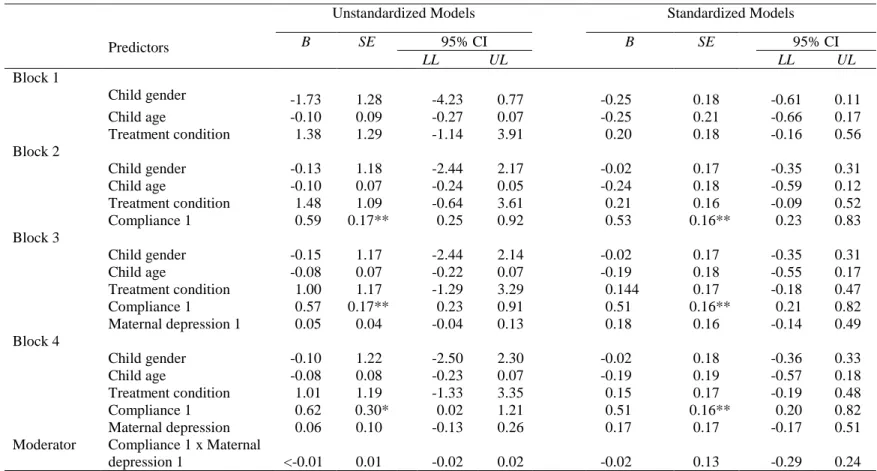
total variance in compliance. That is, 2% of the variance in compliance, above and beyond that explained by child age, gender, and baseline compliance score, was attributed to maternal depression severity. The fourth block added the interaction of maternal depression and compliance at initial assessment [F (6, 22) = 2.98, p < .05, R2 = .46, R2∆ < .01, n.s.] accounting for less than 1% of the unique variance; this final model accounted for roughly 30% of the total shrink-adjusted variance in compliance. Results following imputation were consistent with findings prior to multiple imputation that indicate maternal depression explained a small amount of unique variance in compliance at follow-up. Furthermore, the interaction of maternal depression severity and compliance at baseline assessment did not explain a significant amount of unique variance in compliance at follow-up.
Predicting Child Negative Emotionality. Child gender, child age, and treatment condition,
follow-up (model in block 3) and the interaction of maternal depression severity and negative emotionality at baseline assessment explained a significant amount of variance in negative
emotionality (model in block 4). Imputations showed increasing stability of statistically significant improvements in total variance explained with models 3 and 4; upwards of 9% of the unique variance was explained by maternal depression (model 3) and upwards of 8% of the unique variance was explained by the interaction term in model 4.
Maternal Depression as a Moderator
Building on the previous series of analyses, multiple regression examined if maternal depression interacted with child behavior (at baseline) to predict child behavior at follow-up
assessment. In other words, the next set of analyses tested whether maternal depression moderated the relationship between child behavior at baseline and follow-up assessment. Three constructs
representing child behavior were examined: aggression, compliance, and negative emotionality. The proposed two-way interaction of child outcome at baseline assessment x depression severity entered the regression after controlling for demographic variables and independent variables involved in the interaction (child outcome at baseline and maternal depression at baseline). Simple slopes post hoc probing explicated statistically significant interactions to determine how depression severity interacted to predict child outcomes.
Child Aggression. Building on previous analyses, maternal depression was hypothesized to
moderate the relationship between child aggression at baseline and follow-up assessment. Although the overall model predicting child aggression at follow-up was supported, F (6, 17) = 4.56, p = .01, there was insufficient evidence to support an interaction between maternal depression and child aggression (B = .01, n.s.). This was consistent with models using imputed data as well (B = .01, n.s.).
Maternal depression did not appear to moderate the relationship between child compliance behavior at baseline and follow-up assessment in this study (B < .01, n.s.). Data from imputed models also supported these findings (B = -.02, n.s.).
Child Negative Emotionality. It was hypothesized that maternal depression would moderate
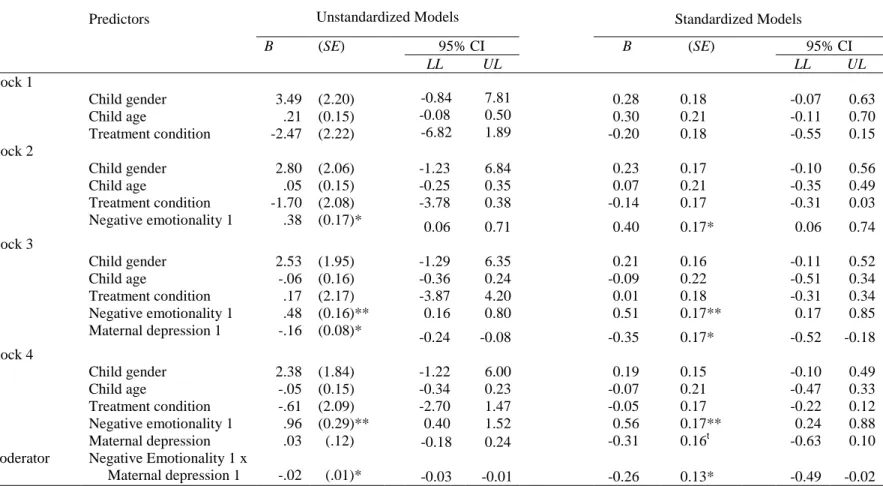
the relationship between negative emotionality at baseline assessment and follow-up assessment. The interaction of baseline child negative emotionality and maternal depression showed evidence of moderation, (B= -.02, p = .051) prior to multiple imputation and (B= -.02, p < .05) with multiple imputation. Pooled coefficient results found maternal depression moderates the relationship between negative emotionality at baseline and follow-up assessment; see Table 9.
CHAPTER 4: DISCUSSION
This study examined relationships between maternal depression and child behavior among a sample of Latinas with limited English proficiency and low-income backgrounds (LEPLI) with a child enrolled in Early Head Start. Maternal depression was tested as both a predictor and moderator of longitudinal parent-reported child behaviors. Mothers completed baseline assessment of maternal depressive symptoms, measured using the CES-D, and child behaviors (aggression, compliance, negative emotionality) measured using the CBCL and ITSEA-R. Data collectors completed assessments in Spanish, mother’s native and dominant language, in families’ homes, including a follow-up assessment 6 months later. Results provided support for associations between maternal depression and child behavior measured concurrently. Maternal baseline depression severity significantly improved hierarchical models predicting child negative emotionality six months later, but less support was demonstrated for models predicting child aggression or child compliance. Further, maternal baseline depression moderated the relationship between negative emotionality at initial and follow-up assessments.
First, it was hypothesized that child negative emotionality and aggression would be positively associated with concurrent maternal depression severity, whereas compliance would be negatively associated with maternal depression. The direction of correlations were consistent with hypotheses and the strength of these relationships were similar to that previously found in the general population of predominantly school-aged samples. Effect sizes were similar in magnitude and in clinical
externalizing and aggression behaviors demonstrate a positive relationship with maternal depression in school-aged samples (Goodman et al., 2011). Furthermore, associations between child behaviors at the same time point and across time points were highly correlated, as expected.
Next, baseline maternal depression was hypothesized to significantly improve models predicting child behavior (aggression, compliance, and negative emotionality) at 6-month follow-up assessment. After controlling for child gender, child age, treatment condition, and child aggression at baseline assessment, adding maternal depression minimally improved hierarchical regression models predicting child aggression at follow-up or compliance at follow-up. Furthermore, adding the
interaction of maternal depression and baseline child behavior provided limited improvements in hierarchical regression models predicting child aggression or compliance. Sensitivity analyses suggest limited support of models predicting child aggression may be due to low power to detect the effect size observed in the sample. With a larger sample size it is plausible that adding maternal depression severity to models predicting child aggression and child compliance may account for a meaningful increment in variance explained, as hypothesized. In contrast, depression severity
explained a significant amount of variance in hierarchical regression models predicting child negative emotionality at follow-up, controlling for child age, child gender, treatment condition, and negative emotionality at baseline. Moreover, adding the interaction between maternal depression and baseline negative emotionality to hierarchical regression models also explained a meaningful amount of variance. Notably, the current study differed from the many longitudinal studies because follow-up assessment occurred six months after baseline assessment compared to years later. A stronger
depression and child behaviors (e.g., negative emotionality) is forming. This association may be a precursor to emotional and behavioral problems, such as affect dysregulation difficulties or internalizing problems, suggesting a potential opportunity for early intervention.
Third, it was hypothesized that maternal depression would moderate the relationship between child behavior at baseline and follow-up assessment after controlling for potentially confounding factors. The proposed two-way interaction demonstrated a moderating effect on child negative emotionality, but less so on aggression or compliance behaviors in this sample. Sensitivity analyses indicate suggest however that additional testing with a larger sample size is needed in order to conclude that maternal depression does not appear to moderate the relationship between child behavior at baseline and follow-up assessment. Depression interacted with child negative emotionality such that the positive relationship was strongest for children whose mother’s
experienced below average symptoms of depression followed by average symptoms. The positive relationship was no longer statistically significantly different from zero for children whose mother experienced above average symptoms of depression. Thus, problematic child behaviors persisted six months after initial assessment among dyads with mothers experiencing mild and average symptoms of depression. Therefore, even mild symptoms of depression may have an adverse effect on child behavior (Campbell et al., 2009; Hammen & Brennan, 2003; Nelson et al, 2003; NICHD Early Child Care Research Network, 1999). Hammen (1991) similarly found a positive relationship between mild maternal depression and adverse child behaviors. Although it is not well understood why mild
interactions. Increased negative behaviors may be a signal of distress associated with these changes and inconsistency. Second, mild symptoms of depression are less likely to be recognized by others and less likely to initiate outsiders and other support caregivers to intervene. Thus, potential supports and buffers may not emerge in less severe cases of depression, resulting in increased child behavior problems. Third, it is possible that those with mild symptoms experienced a recent onset of symptoms and this initial period may be accompanied by a marked exacerbation in negative child behavior as a child attempts to adjust to changes in parent-child interactions. Finally, it plausible that the present sample which included many participants with mild and moderate symptoms (CESD < 30) did not have as many participants in the more severe range of depression compared to previous studies limiting the range and observed relationship between depression and child behaviors. Additional research is needed to determine whether these possibilities may explain the relationship between mild maternal depressive symptoms and child behaviors.
The finding that even mild mood symptoms can affect child behavior is consistent with research showing impaired parenting in the presence of low levels of depressive symptoms (Hammen, 1991; NICHD-ECCRN, 1999b). Moreover, in the mood disorder literature significant impairment is observed among individuals with subsyndromal or mild levels of depressive symptoms (Judd et al., 2005). Mild mood symptoms are likely to continue to occur in between depressive
episodes and are likely to affect parenting as well as child outcomes. Exposure to maternal depression for a period of time as short as 6 months is associated with problematic child outcomes (Hammen et al., 2003), as was found in the present study examining behaviors in early childhood. This is
mother will develop psychopathology and early intervention and remission is associated with improved parenting and child outcomes (Campbell et al., 2009; Garber et al., 2011; Gunlicks et al., 2013), the current findings argue for the importance of early intervention for families at-risk for maternal depression (Weissman & Jensen, 2002). The impact of transient and mild symptoms of maternal depression on toddlers and pre-school children is significant and this period may be timely for intervention before more adverse outcomes develop.
Limitations to the current study include a small sample size that decreased statistical power and the ability to fully represent a diverse, heterogeneous population. Despite the small sample size and limited power, analyses were largely supportive of the proposed hypotheses. Observed effect sizes were consistent in magnitude and clinical significance with effect sizes previously published in the general population. Moreover, a priori hypotheses based on an integrative developmental theory of how maternal depression influences child outcomes was used to build hierarchical regression models (Gotlib & Goodman, 1999; Cicchetti, 1998). Another strength of this study is the longitudinal design, which provides a stronger basis for inferences about temporal and possibly causal
general parent-report provides invaluable and accurate assessment information. Due to the fact that additional research including Latino LEPLI communities is needed, this study addresses an important gap in the literature. It also demonstrates that conducting research in this at-risk and underserved population is feasible. Given the rapid growth of the Latino population, it is crucial to address the dearth of research for Latino youth at-risk for behavior problems and negative outcomes. In order to develop effective culturally congruent and evidence-based models of child psychopathology and interventions, research is needed with LEPLI Latino communities. Few studies have examined moderators of the relationship between mother and child psychopathology (Suveg, Shaffer, Morelen & Thomassin, 2011). A significant contribution is the finding, consistent with previous studies (e.g., Hammen, 1991), that mild symptoms of maternal depression in early childhood matters, and mild depression’s affects on child behavior can be measured.
well as child outcomes can help refine models of transmission of developmental psychopathology as well as identify potential targets for therapy.
Future studies should also compare the relationship between early child behaviors and maternal depression by gender. It will be valuable to examine gender differences in early child behavior and explore potential early developmental pathways leading to healthy outcomes as well as psychopathology. Because Latina girls experience alarmingly high rates of suicide attempts,
compared to their peers (Eaton et al, 2012), it is especially important to develop a better understanding of factors associated with risk for psychopathology. Comparing the relationship between maternal depression and negative emotionality by gender among young Latino children will contribute to a better understanding of factors influencing risk for psychopathology. It is possible that negative emotionality may be involved in an early developmental pathway leading to increased risk for suicide attempts among Latina girls. Knowledge related to gender differences in early child behaviors will contribute towards models explaining mechanisms influencing risk for
psychopathology. Furthermore, analyses with a larger, more diverse sample of Latino families can help identify potential buffers and risk factors associated with maternal depression and risk for psychopathology. It will be a valuable contribution to examine risk factors for psychopathology associated with 1st, 2nd and 3rd immigrant generation Latinos. This may lead to a better understanding of the “immigration paradox” which appears to be associated with age and may protect or predispose at-risk youth to adverse outcomes.
Conclusions
TABLE 1: Sample demographic characteristics (N = 47)
Variable % M SD Range
Latino Ethnicity 100
Average Monthly Incomeab $1,273.00 $589.00 400 - 3,000
Average # people living off income 4.23 1.05 2 - 8
Average Poverty Ratio c 0.78 0.34 .25 - 1.86
Mother’s Education (years)* 8.86 3.14 3 - 16
Living with partner/spouse 81
Number of Childrena 2.26 0.83 1 - 4
Mother’s Age (years) 27.13 5.59 18 - 43
Mother’s Acculturation (SASH) 1.16 0.42 1.0 - 3.25
Child’s Age (months) 23.11 8.73 12 - 42
Child’s Gender
Male 49
Female 51
Treatment Condition
TAU 53
IPT 47
Child Behaviors
Aggression 1d 16.69 9.25 1 - 35
Negative Emotionality 1a 9.41 6.76 0 - 21
Compliance 1a 9.18 3.24 4 - 16
Aggression 2 13.70 9.14 0 - 36
Negative Emotionality 2 9.73 6.22 1 - 26
Compliance 2 10.23 3.52 4 - 16
Maternal Depression
CES-D 1 24.30 13.60 0 - 52
Note. Child behavior sample size decreased due to attrition at time 2 (n = 30). Values presented in this table are actual data values prior to multiple imputation. Mother’s Acculturation was measured with the Short Acculturation Scale for Hispanics (SASH); TAU= Treatment as Usual; IPT = Interpersonal Therapy; 1 = Baseline Assessment/Time 1; 2 = Follow-up Assessment/Time 2; CES-D = Center for Epidemiologic Studies Depression Scale.
a
Data missing for fewer than 4 participants therefore (n ≥ 44); b Average Monthly Income (n = 35) some participants declined to answer this question or answered “I don’t know”; cAverage Poverty Ratio (n = 35) calculations were based on Monthly Total Household Income and Poverty Guidelines (weighted average for household size); d Aggression 1 (n = 32), data was missing for several participants at time 1.
TABLE 2: Correlations and descriptive statistics of sample participant and study variables (N ≤ 47)
1 2 3 4 5 6 7 8 9 10 11 12 13 14 15
1. Child’s Age 1
2. Child’s Gender .14 1
3. Mother’s Age .01 -.04 1
4. Mother’s Education .07 <.01 .26 1
5. Partnered Status .18 .04 -.20 -.12 1
6. Monthly Income .09 -.05 .46** .41* .13 1
7. Aggression 1 .06 .14 .19 .22 .10 .45* 1
8. Compliance 1 .04 -.30 -.28 -.16 .01 -.10 -.63** 1
9. Negative Emotionality 1 .31* .13 .16 .14 .09 .27 .87** -.47** 1
10. Aggression 2 .17 .25 -.16 .18 -.03 .19 .54* -.34 .38* 1
11. Compliance 2 -.20 -.25 -.14 -.32 -.08 -.13 -.56* -.59** -.29 -.58** 1
12. Negative Emotionality 2 .25 .29 -.02 .30 -.01 .41 .54* -.40* .51** .87** -.58** 1
13. CES-D 1 -.09 -.03 .01 -.09 .02 .01 .27 -.08 .19 -.19 .30 -.28 1
14. Treatment Condition -.04 -.07 .09 -.05 .02 .26 -.01 -.05 -.10 -.20 .16 -.15 .11 1
15. Acculturation (SASH) -.23 .03 -.04 .25 -.27 -.15 -.03 -.06 -.15 -.01 -.13 -.11 <.01 -.19 1
Note. 1= Baseline Assessment/Time 1; 2 = Follow-up Assessment/Time 2; CES-D = Center for Epidemiologic Studies Depression Scale, ratings of maternal depression; SASH = The Short Acculturation Scale for Hispanics. Child Behaviors include: aggression, compliance, and negative emotionality
a
Sample size for some variables is less than 47 due to missing data and attrition, see table 1. t
TABLE 3: Correlations and descriptive statistics of sample participant and study variables from pooled values (N = 47) based on 500 imputations
Mean (SD) 1 2 3 4 5 6 7 8 9 10 11 12 13 14 15
1. Child’s Age 23.11 (8.74) 1
2. Child’s Gender .14 1
3. Mother’s Age 27.13 (5.60) .01 -.04 1
4. Mother’s Education 8.86 (3.14) .07 <-.01 .26 1
5. Partnered Status .18 .04 -.20 -.12 1
6. Monthly Income 1272 (588.60) .09 -.05 .46** .41* .13 1
7. Aggression 1 16.70 (9.25) .06 .12 .14 .20 .07 .36* 1
8. Compliance 1 9.18 (3.24) .07 -.29* -.26 -.15 -.01 -.11 -.51** 1
9. Negative Emotionality 1 9.41 (6.76) .29 .13 .16 .14 .08 .27 .73** -.46** 1
10. Aggression 2 13.70 (9.14) .17 .25 -.16 .18 -.03 .19 .43* -.33 .38* 1
11. Compliance 2 10.23 (3.52) -.20 -.25 -.14 -.32 -.08 -.13 -.47 .57** -.28* -.58** 1
12. Negative Emotionality 2 9.73 (6.22) .25 .29 -.02 .30 -.01 .41 .49** -.39* .51** .87** -.58** 1
13. CES-D 1 24.30 (13.60) -.09 -.03 .01 -.09 .02 .01 .20 -.09 .19 -.19 .30 -.28 1
14. Treatment Condition -.04 -.07 .09 -.05 .02 .26 -.03 -.03 -.09 -.20 .16 -.15 .11 1
15. Acculturation (SASH) 1.16 (.42) -.23 .03 -.04 .25 -.27 -.15 <-.01 -.06 -.15 -.01 -.13 -.11 <.01 -.19 1
Note. 1= Baseline Assessment/Time 1; 2 = Follow-up Assessment/Time 2; CES-D = Center for Epidemiologic Studies Depression Scale; SASH = The Short Acculturation Scale for Hispanics. Values based on pooled values following multiple imputation (N = 30 for aggression 2, compliance 2, and negative emotionality 2).
t
TABLE 4: Hierarchical linear models predicting child aggression at follow-up assessment
Aggression Time 2
Predictors B (S.E.) β R2 Adj. R2 ∆R2 df ∆F
Block 1 .39 .25 .39 3, 14 2.93t
Child gender Child age Treatment condition 11.13 (5.04)* 0.08 (0.30) -13.24 (4.84)* .54 .06 -.66
Block 2 .66 .56 .28 1, 13 10.78**
Child gender 8.98 (3.92)* .44
Child age 0.15 (0.23) .11
Treatment condition -13.53 (3.72)** -.67
Aggression 1 0.59 (.18)** .54
Block 3 .70 .58 .04 1, 12 1.58
Child gender 8.95 (3.84)* .43
Child age 0.04 (0.24) .03
Treatment condition -12.13 (3.80)** -.60
Aggression 1 0.63 (0.18)** .57
Maternal depression 1 -0.16 (.13) -.22
Block 4 .71 .56 .01 1, 11 .40
Child gender 9.30 (3.97) .45
Child age .05 (.25) .04
Treatment condition -12.33 (3.92) -.61
Aggression 1 .45 (.33) .41
Moderator
Maternal depression 1 Aggression 1 x Maternal depression 1
-.33 (.30) .01 (.02)
-.46 .32
Note. Block 1 in hierarchical regression models included demographic covariates. Block 2 added aggressive child behavior at time 1. Block 3 added maternal depression severity at time 1. Block 4 added the interaction of aggression x maternal depression (a test for moderation). 1= Baseline Assessment/Time 1; Aggression Time 2 = Follow-up Assessment. t
TABLE 5: Hierarchical linear models predicting child compliance at follow-up assessment
Compliance Time 2
Predictors B (SE) β R2 Adj. R2 ∆R2 df ∆F
Block 1 .16 .06 .16 3, 25 1.55
Child gender Child age Treatment condition -2.08 (1.31) -0.08 (0.09) 1.59 (1.30) -.29 -.16 .23
Block 2 .42 .32 .26 1, 24 10.94**
Child gender -0.41 (1.22) -.06
Child age -0.08 (0.07) -.17
Treatment condition 1.63 (1.10) .23
Compliance 1 0.58 (0.17)** .57
Block 3 .46 .32 .02 1, 23 .98
Child gender -0.39 (1.22) -.06
Child age -0.06 (0.08) -.13
Treatment condition 1.17 (1.19) .17
Compliance 1 .56 (0.17)** .55
Maternal depression 1 .04 (0.04) .17
Block 4 .46 .29 <.01 1, 22 .01
Child gender -.37 (1.28) -.05
Child age -.06 (0.08) -.14
Treatment condition 1.17 (1.22) .17
Compliance 1 .59 (0.31) t .58
Moderator
Maternal depression 1 Compliance 1 x Maternal depression 1
.05 (0.10) <-.01 (0.01)
.21 -.05
Note. Block 1 in hierarchical regression models included demographic covariates. Block 2 added compliance child behavior at time 1. Block 3 added maternal depression severity at time 1. Block 4 added the interaction of compliance x maternal depression (a test for moderation). 1= Baseline Assessment/Time 1; Compliance 2 = Compliance at Follow-up Assessment.In block 4 the coefficient value for Compliance 1 is marginally significant, p = .07, using a p value of .05..
t
TABLE 6: Hierarchical linear models predicting child negative emotionality at follow-up assessment
Negative
Emotionality Time 2
Predictors B (SE) β R2 Adj. R2 ∆R2 df ∆F
Block 1 .19 .09 .19 3, 25 1.96
Child gender Child age
Treatment condition
3.97 (2.28) 0.18 (0.15) -2.76 (2.26)
.32 .22 -.22
Block 2 .35 .24 .16 1, 24 5.76*
Child gender 3.34 (2.11) .26
Child age 0.01 (0.16) .01
Treatment condition -2.01 (2.09) -.16
Negative Emotionality 1 0.39 (0.16) * .45
Block 3 .44 .31 .09 1, 23 3.65t
Child gender 2.98 (2.01) .24
Child age -0.09 (0.16) -.11
Treatment condition -0.17 (2.21) -.01
Negative Emotionality 1 0.49 (0.16) ** .56
Maternal depression 1 -0.15 (0.08)t -.35
Block 4 .53 .40 .09 1, 22 4.26s
Child gender 2.89 (1.88) .23
Child age -0.08 (0.15) -.10
Treatment condition -1.01 (2.10) -.08
Negative Emotionality 1 0.98 (0.28) ** 1.13
Moderator
Maternal depression 1 Negative Emotionality 1 x Maternal depression 1
0.04 (0.12) -0.02 (0.01)t
.09 -.80
Note. Block 1 in hierarchical regression models included demographic covariates. Block 2 added negative emotionality child behavior at time 1. Block 3 added maternal depression severity at time 1. Block 4 added the interaction of negative emotionality x maternal depression (a test for moderation). 1= Baseline Assessment/Time 1; Negative Emotionality Time 2 = Negative Emotionality at Follow-up Assessment.In block 3 the coefficient value for negative emotionality 1 is marginally significant, p = .06, using a p value of .05.In block 4 the coefficient value for Negative Emotionality 1 is marginally significant, p = .051, using a p value of .05.
t
TABLE 7: Hierarchical linear models predicting child aggression at follow-up assessment (pooled values from imputed dataset)
Unstandardized Models Standardized Models
Predictors B (SE) 95% CI B (SE) 95% CI
LL UL LL UL
Block 1
Child gender 5.11 3.27 -1.30 11.52 0.28 0.18 -0.07 0.64
Child age 0.26 0.20 -0.14 0.66 0.25 0.20 -0.13 0.64
Treatment condition -5.31 3.36 -11.89 1.26 -0.29 0.19 -0.66 0.07
Block 2
Child gender 4.07 2.95 -1.71 9.85 0.23 0.16 -0.10 0.55
Child age 0.30 0.18 -0.06 0.66 0.29 0.17 -0.06 0.63
Treatment condition -5.96 3.02* -11.88 -0.03 -0.33 0.17* -0.66 < -0.01
Aggression 1 0.56 0.20** 0.16 0.96 0.48 0.17** 0.14 0.82
Block 3
Child gender 3.85 3.02 -2.07 9.77 0.21 0.17 -0.11 0.54
Child age 0.27 0.20 -0.12 0.65 0.25 0.19 -0.11 0.62
Treatment condition -5.28 3.32 -11.79 1.23 -0.29 0.18 -0.65 0.07
Aggression 1 0.58 0.21** 0.17 0.99 0.49 0.18** 0.14 0.84
Maternal depression 1 -0.06 0.12 -0.30 0.17 -0.10 0.18 -0.45 0.26
Block 4
Child gender 3.96 3.10 -2.10 10.03 0.22 0.17 -0.12 0.56
Child age 0.27 0.20 -0.13 0.66 0.25 0.19 -0.12 0.63
Treatment condition -5.38 3.40 -12.04 1.29 -0.30 0.19 -0.67 0.07
Aggression 1 0.48 0.39 -0.28 1.23 0.52 0.20* 0.12 0.91
Maternal depression -0.16 0.32 -0.79 0.48 -0.10 0.18 -0.46 0.26
Moderator Aggression 1 x Maternal
depression 1 0.005 0.02 -0.03 0.04 0.06 0.21 -0.34 0.46
Note. CI = Confidence Interval; LL = lower limit, UL = upper limit; 1= Baseline Assessment/Time 1; Block 1 included demographic covariates. Block 2 added aggression child behavior at time 1. Block 3 added maternal depression severity at time 1. Block 4 added the interaction of aggression x maternal depression (a test for moderation).
t
TABLE 8: Hierarchical linear models predicting child compliance at follow-up assessment (pooled values from imputed dataset)
Predictors
Unstandardized Models Standardized Models
B SE 95% CI B SE 95% CI
LL UL LL UL
Block 1
Child gender -1.73 1.28 -4.23 0.77 -0.25 0.18 -0.61 0.11
Child age -0.10 0.09 -0.27 0.07 -0.25 0.21 -0.66 0.17
Treatment condition 1.38 1.29 -1.14 3.91 0.20 0.18 -0.16 0.56
Block 2
Child gender -0.13 1.18 -2.44 2.17 -0.02 0.17 -0.35 0.31
Child age -0.10 0.07 -0.24 0.05 -0.24 0.18 -0.59 0.12
Treatment condition 1.48 1.09 -0.64 3.61 0.21 0.16 -0.09 0.52
Compliance 1 0.59 0.17** 0.25 0.92 0.53 0.16** 0.23 0.83
Block 3
Child gender -0.15 1.17 -2.44 2.14 -0.02 0.17 -0.35 0.31
Child age -0.08 0.07 -0.22 0.07 -0.19 0.18 -0.55 0.17
Treatment condition 1.00 1.17 -1.29 3.29 0.144 0.17 -0.18 0.47
Compliance 1 0.57 0.17** 0.23 0.91 0.51 0.16** 0.21 0.82
Maternal depression 1 0.05 0.04 -0.04 0.13 0.18 0.16 -0.14 0.49
Block 4
Child gender -0.10 1.22 -2.50 2.30 -0.02 0.18 -0.36 0.33
Child age -0.08 0.08 -0.23 0.07 -0.19 0.19 -0.57 0.18
Treatment condition 1.01 1.19 -1.33 3.35 0.15 0.17 -0.19 0.48
Compliance 1 0.62 0.30* 0.02 1.21 0.51 0.16** 0.20 0.82
Maternal depression 0.06 0.10 -0.13 0.26 0.17 0.17 -0.17 0.51
Moderator Compliance 1 x Maternal
depression 1 <-0.01 0.01 -0.02 0.02 -0.02 0.13 -0.29 0.24
Note. CI = Confidence Interval; LL = lower limit, UL = upper limit; 1= Baseline Assessment/Time 1; Block 1 included demographic covariates. Block 2 added compliance child behavior at time 1. Block 3 added maternal depression severity at time 1. Block 4 added the interaction of compliance x maternal depression (a test for moderation).
t
TABLE 9: Hierarchical linear models predicting child negative emotionality at follow-up assessment (pooled values from imputed dataset)
Predictors Unstandardized Models Standardized Models
B (SE) 95% CI B (SE) 95% CI
LL UL LL UL
Block 1 Child gender Child age Treatment condition 3.49 .21 -2.47 (2.20) (0.15) (2.22) -0.84 -0.08 -6.82 7.81 0.50 1.89
0.28 0.18 -0.07 0.63
0.30 0.21 -0.11 0.70
-0.20 0.18 -0.55 0.15
Block 2
Child gender 2.80 (2.06) -1.23 6.84 0.23 0.17 -0.10 0.56
Child age .05 (0.15) -0.25 0.35 0.07 0.21 -0.35 0.49
Treatment condition -1.70 (2.08) -3.78 0.38 -0.14 0.17 -0.31 0.03
Negative emotionality 1 .38 (0.17)* 0.06 0.71 0.40 0.17* 0.06 0.74
Block 3
Child gender 2.53 (1.95) -1.29 6.35 0.21 0.16 -0.11 0.52
Child age -.06 (0.16) -0.36 0.24 -0.09 0.22 -0.51 0.34
Treatment condition .17 (2.17) -3.87 4.20 0.01 0.18 -0.31 0.34
Negative emotionality 1 .48 (0.16)** 0.16 0.80 0.51 0.17** 0.17 0.85
Maternal depression 1 -.16 (0.08)* -0.24 -0.08 -0.35 0.17* -0.52 -0.18
Block 4
Child gender 2.38 (1.84) -1.22 6.00 0.19 0.15 -0.10 0.49
Child age -.05 (0.15) -0.34 0.23 -0.07 0.21 -0.47 0.33
Treatment condition -.61 (2.09) -2.70 1.47 -0.05 0.17 -0.22 0.12
Negative emotionality 1 .96 (0.29)** 0.40 1.52 0.56 0.17** 0.24 0.88
Moderator
Maternal depression Negative Emotionality 1 x
Maternal depression 1
.03 -.02 (.12) (.01)* -0.18 -0.03 0.24 -0.01
-0.31 0.16t -0.63 0.10
-0.26 0.13* -0.49 -0.02
Note. CI = Confidence Interval; LL = lower limit, UL = upper limit; 1= Baseline Assessment/Time 1; Block 1 included demographic covariates. Block 2 added negative emotionality child behavior at time 1. Block 3 added maternal depression severity at time 1. Block 4 added the interaction of negative emotionality x maternal depression (a test for moderation).
t
FIGURE 1: Interaction effect of maternal depression on child negative emotionality over time
Child Negative Emotionality Time 1 Ch
ild Ne ga tiv e E m oti on ali ty Ti m e
2 High Dep.Average Dep.
Low Dep.
20
10
0
The relationship between child negative emotionality at baseline and follow-up assessment depends on the severity of maternal depression, even after
controlling for child age, child gender, and treatment group. Negative emotionality at Time 1 by Negative Emotionality at Time 2 depicting slopes for high,
average, and low maternal depression in the present sample.
APPENDIX A: Federal Poverty Guidelines for Study Enrollment Years
Federal Poverty Guidelines published by Federal Register in respective year.
Size of Family Unit Enrollment Year
2003 2004 2005 2006
1 8,980 9,310 9,570 9,800
2 12,120 12,490 12,830 13,200
3 15,260 15,670 16,090 16,600
4 18,400 18,850 19,350 20,000
5 21,540 22,030 22,610 23,400
6 24,680 25,210 25,870 26,800
7 27,820 28,390 21,130 30,200
8 30,960 31,570 32,390 33,600