Advance Access publication 2017 June 26
Two white dwarfs in ultrashort binaries with detached, eclipsing, likely
sub-stellar companions detected by
K2
S. G. Parsons,
1‹J. J. Hermes,
2†
T. R. Marsh,
3B. T. G¨ansicke,
3P.-E. Tremblay,
3S. P. Littlefair,
1D. I. Sahman,
1R. P. Ashley,
3M. Green,
3S. Rattanasoon,
1,4V. S. Dhillon,
1,5M. R. Burleigh,
6S. L. Casewell,
6D. A. H. Buckley,
7I. P. Braker,
6P. Irawati,
4E. Dennihy,
2P. Rodr´ıguez-Gil,
5,8D. E. Winget,
9,10K. I. Winget,
9,10Keaton J. Bell
9,10and Mukremin Kilic
111Department of Physics and Astronomy, University of Sheffield, Sheffield S3 7RH, UK
2Department of Physics and Astronomy, University of North Carolina, Chapel Hill, NC 27599-3255, USA 3Department of Physics, University of Warwick, Coventry CV4 7AL, UK
4National Astronomical Research Institute of Thailand, 191 Siriphanich Bldg., Huay Kaew Road, Chiang Mai 50200, Thailand 5Instituto de Astrof´ısica de Canarias, V´ıa Lactea s/n, La Laguna, E-38205 Tenerife, Spain
6Department of Physics and Astronomy, University of Leicester, Leicester LE1 7RH, UK 7South African Astronomical Observatory, PO Box 9, Observatory 7935, Cape Town, South Africa 8Departamento de Astrof´ısica, Universidad de La Laguna, E-38206 La Laguna, Tenerife, Spain 9Department of Astronomy, University of Texas at Austin, Austin, TX 78712, USA
10McDonald Observatory, Fort Davis, TX 79734, USA
11Homer L. Dodge Department of Physics and Astronomy, University of Oklahoma, Norman, OK 73019, USA
Accepted 2017 June 22. Received 2017 June 16; in original form 2017 April 28
A B S T R A C T
Using data from the extendedKeplermission in K2 Campaign 10, we identify two eclips-ing binaries containeclips-ing white dwarfs with cool companions that have extremely short or-bital periods of only 71.2 min (SDSS J1205−0242, a.k.a. EPIC 201283111) and 72.5 min (SDSS J1231+0041, a.k.a. EPIC 248368963). Despite their short periods, both systems are detached with small, low-mass companions, in one case a brown dwarf and in the other case either a brown dwarf or a low-mass star. We present follow-up photometry and spectroscopy of both binaries, as well as phase-resolved spectroscopy of the brighter system, and use these data to place preliminary estimates on the physical and binary parameters. SDSS J1205−0242 is composed of a 0.39 ± 0.02 M helium-core white dwarf that is totally eclipsed by a 0.049±0.006 M(51±6MJ) brown-dwarf companion, while SDSS J1231+0041 is
com-posed of a 0.56±0.07 Mwhite dwarf that is partially eclipsed by a companion of mass
0.095 M. In the case of SDSS J1205−0242, we look at the combined constraints from common-envelope evolution and brown-dwarf models; the system is compatible with similar constraints from other post-common-envelope binaries, given the current parameter uncertain-ties, but has potential for future refinement.
Key words: binaries: eclipsing – brown dwarfs – stars: fundamental parameters – stars: low-mass – white dwarfs.
1 I N T R O D U C T I O N
Roughly 75 per cent of main-sequence binaries are born wide enough that they evolve essentially as single stars (Willems & Kolb2004). However, for the remaining 25 per cent, the expansion of the more massive star at the end of its main-sequence lifetime
E-mail:[email protected] †Hubble Fellow.
causes the two stars to interact, often initiating a common-envelope event. The frictional forces experienced by the stars during the common-envelope phase result in a dramatic reduction in the sep-aration of the two stars, down to as low as a few solar radii. An-gular momentum loss via magnetic braking and gravitational radi-ation drives the resulting post-common-envelope binary (PCEB) to shorter periods, eventually creating a cataclysmic variable system.
Large-scale surveys have led to an explosion in the num-ber of known PCEBs (Silvestri et al. 2006; Rebassa-Mansergas et al.2010,2016), with more than 100 systems having measured
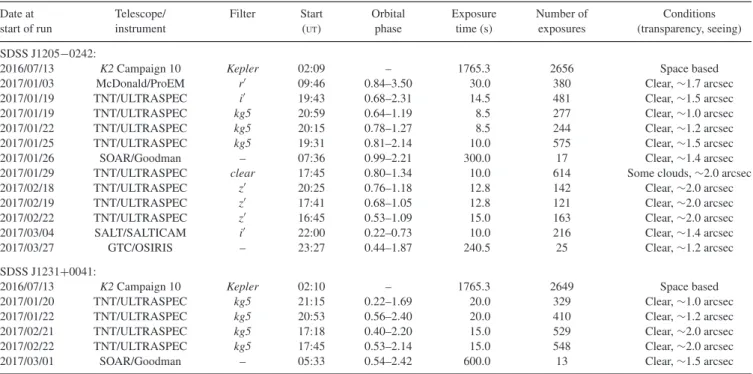
Table 1. Journal of observations. The eclipse of the white dwarf occurs at Phases 1, 2, etc.
Date at Telescope/ Filter Start Orbital Exposure Number of Conditions
start of run instrument (UT) phase time (s) exposures (transparency, seeing)
SDSS J1205−0242:
2016/07/13 K2Campaign 10 Kepler 02:09 – 1765.3 2656 Space based
2017/01/03 McDonald/ProEM r 09:46 0.84–3.50 30.0 380 Clear,∼1.7 arcsec
2017/01/19 TNT/ULTRASPEC i 19:43 0.68–2.31 14.5 481 Clear,∼1.5 arcsec
2017/01/19 TNT/ULTRASPEC kg5 20:59 0.64–1.19 8.5 277 Clear,∼1.0 arcsec
2017/01/22 TNT/ULTRASPEC kg5 20:15 0.78–1.27 8.5 244 Clear,∼1.2 arcsec
2017/01/25 TNT/ULTRASPEC kg5 19:31 0.81–2.14 10.0 575 Clear,∼1.5 arcsec
2017/01/26 SOAR/Goodman – 07:36 0.99–2.21 300.0 17 Clear,∼1.4 arcsec
2017/01/29 TNT/ULTRASPEC clear 17:45 0.80–1.34 10.0 614 Some clouds,∼2.0 arcsec
2017/02/18 TNT/ULTRASPEC z 20:25 0.76–1.18 12.8 142 Clear,∼2.0 arcsec
2017/02/19 TNT/ULTRASPEC z 17:41 0.68–1.05 12.8 121 Clear,∼2.0 arcsec
2017/02/22 TNT/ULTRASPEC z 16:45 0.53–1.09 15.0 163 Clear,∼2.0 arcsec
2017/03/04 SALT/SALTICAM i 22:00 0.22–0.73 10.0 216 Clear,∼1.4 arcsec
2017/03/27 GTC/OSIRIS – 23:27 0.44–1.87 240.5 25 Clear,∼1.2 arcsec
SDSS J1231+0041:
2016/07/13 K2Campaign 10 Kepler 02:10 – 1765.3 2649 Space based
2017/01/20 TNT/ULTRASPEC kg5 21:15 0.22–1.69 20.0 329 Clear,∼1.0 arcsec
2017/01/22 TNT/ULTRASPEC kg5 20:53 0.56–2.40 20.0 410 Clear,∼1.2 arcsec
2017/02/21 TNT/ULTRASPEC kg5 17:18 0.40–2.20 15.0 529 Clear,∼2.0 arcsec
2017/02/22 TNT/ULTRASPEC kg5 17:45 0.53–2.14 15.0 548 Clear,∼2.0 arcsec
2017/03/01 SOAR/Goodman – 05:33 0.54–2.42 600.0 13 Clear,∼1.5 arcsec
periods (e.g. Nebot G´omez-Mor´an et al.2011; Parsons et al.2015). The vast majority of these systems have M-dwarf companions, with the spectral-type distribution of the secondaries peaking near M3– M4, in good agreement with the peak in the initial mass func-tion of single stars (Chabrier2003). Just six PCEBs are known to be composed of white dwarfs with brown-dwarf companions (Dobbie et al.2005; Burleigh et al.2006; Casewell et al.2012; Steele et al.2013; Littlefair et al.2014; Farihi, Parsons & G¨ansicke2017). PCEBs with brown-dwarf companions are difficult to identify from optical data alone. However, infrared surveys have demon-strated that these systems are intrinsically rare, with only 0.4– 2 per cent of white dwarfs having a sub-stellar companion (Farihi, Becklin & Zuckerman2005; Debes et al.2011; Girven et al.2011; Steele et al.2011), including both wide binaries that never inter-acted (e.g. Becklin & Zuckerman1988; Steele et al.2009; Luhman, Burgasser & Bochanski2011) and PCEBs. The small number of white dwarfs with brown-dwarf companions reflects the rarity of sub-stellar objects both in the field (Kirkpatrick et al.2012) and in binaries (Grether & Lineweaver2006).
The short orbital periods of PCEBs provide for many deeply eclipsing binaries, which offer a unique opportunity to directly probe the structures of both components by allowing for model-independent, high-precision mass and radius measurements (e.g. Parsons et al.2012b). This is especially useful for uncommon ob-jects. For example, there are very few known eclipsing binaries composed of at least one brown dwarf.
There is only one double-lined, eclipsing brown-dwarf binary known to date, 2MASS J05352184−0546085 (Stassun, Mathieu & Valenti2006), although another has tentatively been identified (David et al.2016). Both of these systems are young (<10 Myr), however, which will affect their radii, as brown dwarfs contract throughout their lifetime. The remainder of brown dwarfs with di-rect measurements of their radii are in systems where they are highly irradiated. For example, Kelt-1b is a 27MJbrown dwarf in a 29-h orbit around an F star (Siverd et al.2012); it is known to be highly inflated, at the 10σlevel compared to models. However, Wasp-30b
(Anderson et al.2011) is a 61MJbrown dwarf orbiting an F8 star every 4.16 d and has a radius that agrees with model predictions. SDSS J141126.20+200911.1, the only known brown dwarf to be eclipsing in a detached PCEB, also has a radius that is consistent with model predictions (Littlefair et al.2014).
There is thus considerable value in finding more eclipsing PCEBs containing a brown dwarf. As part of a search for transits and vari-ability in white dwarfs observed duringK2Campaign 10, we have discovered two new eclipsing PCEBs composed of a white dwarf and a likely brown-dwarf companion. K2 (Howell et al. 2014) is an extension of the Kepler planet-hunting mission (Borucki et al. 2010), in which a number of fields along the ecliptic are continuously observed with high photometric precision over a pe-riod of approximately 75 d; hence, it is ideal for detecting eclipsing PCEBs. We report here follow-up photometry and spectroscopy for these two new eclipsing systems, and furthermore detail and constrain their binary and stellar parameters.
2 O B S E RVAT I O N S A N D T H E I R R E D U C T I O N
A full journal of observations is given in Table1.
2.1 Target selection
We have proposed multiple Guest Observer programmes to search for transits and variability from hundreds of known and candi-date white dwarfs in every campaign of theK2mission. As part of an analysis of targets observed with long-cadence (29.4-min) exposures duringK2Campaign 10, we flagged two spectroscop-ically confirmed white dwarfs with high-amplitude, short-period variability. The first, SDSS J120515.80−024222.6 (a.k.a. EPIC 201283111,1hereafter SDSS J1205−0242), showed variability near
71.2 min, very near the Nyquist frequency of our data set. The other, SDSS J123127.14+004132.9 (a.k.a. EPIC 248368963,2henceforth SDSS J1231+0041), showed variability at a similarly short period of 72.5 min.
2.2 K2photometry
We examined preliminary extractions of our known and candidate white dwarfs using light curves produced by theKeplerGuest Ob-server (GO) office (Van Cleve et al.2016), available through the Bar-bara A. Mikulski Archive for Space Telescopes (MAST). The Ke-plerbandpass covers roughly 4000–9000 Å. EachK2long-cadence observation represents a co-add of 270×6.02 s exposures.
We improved our extraction of SDSS J1205−0242 (Kp = 18.8 mag) by downloading the processed target pixel file from MAST and using thePYKEsoftware tools (Still & Barclay2012). Using a large (17-pixel) fixed aperture, we extracted the light curve, fitted out a quadratic function to 3-d windows and corrected forK2
motion artefacts using theKEPSFFsoftware package (Vanderburg & Johnson2014). Subsequently, we clipped by hand any highly dis-crepant points. All data obtained inK2Campaign 10 suffer from a large gap caused by the failure of a CCD module on board the spacecraft roughly 7 d into the campaign, which powered off the photometer for roughly 14 d. Still, our final 69.12-d light curve of SDSS J1205−0242 has 2656 points and a duty cycle exceeding 78 per cent.
For SDSS J1231+0041 (Kp=20.0 mag), we saw little improve-ment with our custom PYKEextraction, and used the light curve produced by the GO office for our final data set, which was ex-tracted with a 2-pixel aperture. After clipping, the final 69.12-d light curve of SDSS J1231+0041 has 2644 points.
2.3 McDonald+ProEM photometry
We obtained the first follow-up data of SDSS J1205−0242 on 2017 January 3 using the ProEM frame-transfer camera mounted at the Cassegrain focus of the 2.1-m Otto Struve telescope at the McDon-ald Observatory in West Texas. The data were collected through anr filter. We performed differential, circular aperture photome-try by extracting the target and a nearby comparison star using the IRAFtaskCCD_HSP(Kanaan, Kepler & Winget2002), and applied a barycentric correction using theWQEDsoftware package (Thompson & Mullally2013).
2.4 TNT+ULTRASPEC photometry
We observed both our targets with the high-speed frame-transfer EMCCD camera ULTRASPEC (Dhillon et al.2014) mounted on the 2.4-m Thai National Telescope (TNT) on Doi Inthanon, Thai-land, in 2017 January and February. Our observations were made using the i-band filter, a broadu+g+r filter known askg5(as described in Dhillon et al.2014, see also the appendix of Hardy et al.2017), as well as thez-band and ‘clear’ (fused silica) filters. Exposure times were adjusted depending upon the conditions. The dead time between each exposure is 15 ms. All of these data were reduced using the ULTRACAM pipeline software. The source flux was determined with aperture photometry using a variable aperture scaled according to the full width at half-maximum. Variations in
2Targeted by the programme led by PI Kilic (GO10006).
observing conditions were accounted for by determining the flux relative to a comparison star in the field of view.
2.5 SOAR+Goodman spectroscopy
To better constrain the atmospheric parameters of the primary white dwarfs in both systems, we obtained low-resolution spectra of the upper Balmer series using the high-throughput Goodman spectro-graph (Clemens, Crain & Anderson 2004) on the 4.1-m SOAR telescope at Cerro Pach´on in Chile. We used a 930 line mm−1 grat-ing, and our setup covers roughly 3600–5200 Å at a resolution of roughly 4 Å, set by the seeing.
Using a 1.69-arcsec slit, we obtained 18×300 s exposures of SDSS J1205−0242 on 2017 January 26. The data were optimally extracted (Marsh1989) using thePAMELApackage withinSTARLINK and flux calibrated using the standard Feige 67. The final summed spectrum has a signal-to-noise ratio (S/N) of 65 per resolution el-ement in the continuum around 4600 Å. We obtained 13×600 s exposures of SDSS J1231+0041 on 2017 March 1 using a 3.0-arcsec slit. The optimally extracted spectra were flux calibrated against LTT 2415 and have a summed S/N of 24 per resolution element around 4600 Å. SOAR spectroscopy of both targets was obtained at minimal airmass.
2.6 SALT+SALTICAM photometry
We obtained time-series photometry of SDSS J1205−0242 us-ing the high-speed camera SALTICAM (O’Donoghue et al.2006) mounted on the 10-m Southern African Large Telescope (SALT) on 2017 March 4. We used SALTICAM in the frame-transfer mode, whereby the moving mask occults half the CCD (the storage ar-ray), and we took 10-s exposures with 4×4 binning, yielding a plate scale of 0.56 arcsec pixel−1. All SALTICAM observations had essentially zero deadtime (<6 ms) between frames.
2.7 GTC+OSIRIS spectroscopy
We observed SDSS J1205−0242 with the Optical System for Imaging and low-Intermediate-Resolution Integrated Spectroscopy (OSIRIS) on the 10.4-m Gran Telescopio Canarias (GTC) on La Palma. We used the R2500R grism with a 0.6- arcsec slit cen-tred on the Hα line, giving a resolution ofR 2500. We used exposure times of 240 s and recorded a total of 25 spectra of SDSS J1205−0242, as well as one spectrum of the spectropho-tometric standard star Hiltner 600.
The data were optimally extracted using PAMELA. An arc spec-trum was used to wavelength calibrate the data. In total, 34 lines (mostly neon) were fitted with a sixth-order polynomial giving an rms of 0.01 Å. We then applied additional pixel shifts to each expo-sure (0.3 pixels maximum) based on the positions of three skylines (6300, 6863 and 7276 Å) to correct for instrument flexure. Finally, the instrumental response was removed using the spectrum of the standard star.
3 A 7 1 . 2 - M I N B I N A RY: S D S S J 1 2 0 5−0 2 4 2
Figure 1. The averaged spectrum of SDSS J1205−0242 (left-hand panel) and SDSS J1231+0041 (right-hand panel) obtained with the Goodman spec-trograph on the 4.1-m SOAR telescope. Our best fits to the Balmer lines (shown in red) yield updated atmospheric parameters for the primary white dwarfs in each system.
for a white dwarf, implying a binary origin (Marsh, Dhillon & Duck1995; Rebassa-Mansergas et al.2011).
To confirm if this white dwarf genuinely has a low mass, we analysed our follow-up, higher S/N spectrum from SOAR using the fitting procedures and pure-hydrogen, one-dimensional model atmospheres for white dwarfs described in Tremblay, Bergeron & Gianninas (2011). The fit to our SOAR spectrum is consistent with the SDSS fit, giving a temperature ofTeff=23680±430 K and surface gravity of logg = 7.374 ± 0.057, implying a mass of 0.39±0.02 Mand cooling age of 50 Myr calculated using the helium-core white-dwarf models of Panei et al. (2007). The Balmer lines and best fit to SDSS J1205−0242 are shown in the left-hand panel of Fig.1.
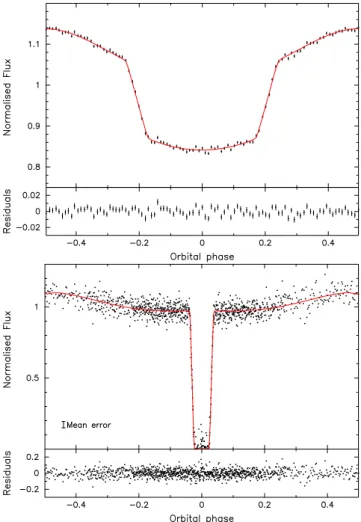
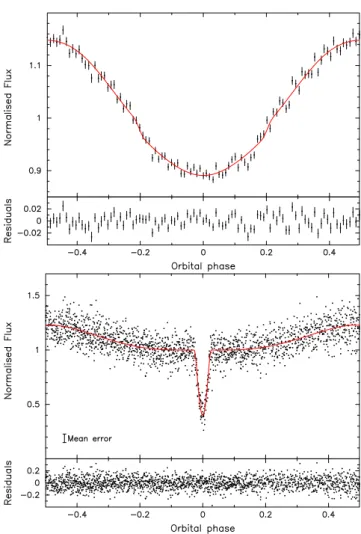
TheK2light curve (Fig.2) shows strong variations on a period of 0.049 465 39(9) d (71.2 min). TheK2data were obtained in long-cadence mode (29.4-min exposures), so any sharp features in the light curve are significantly smeared out. Nevertheless, a clear reflection effect is seen, along with steep eclipse features, implying that the system is likely to be fully eclipsing.
We display in the bottom panel of Fig.2our high-speed, follow-up ULTRASPEC light curve of SDSS J1205−0242, which shows a deep eclipse of the white dwarf, lasting just 5 min from the first to fourth contact points. The reflection effect is also evident out of eclipse. We recorded a total of seven eclipses, although due to the low S/N of the threez-band eclipses we excluded these from our ephemeris calculations. The four remaining eclipse times are listed in Table2. We fitted each of these eclipses with a code specifically designed for binaries containing at least one white dwarf (Copperwheat et al.2010) in order to determine the mid-eclipse times. From these we determined the ephemeris for the system to be
MJD(BTDB)=57768.039311(3)+0.049465250(6)E, (1)
whereEis the orbital phase, withE=0 corresponding to the centre of the white dwarf eclipse.
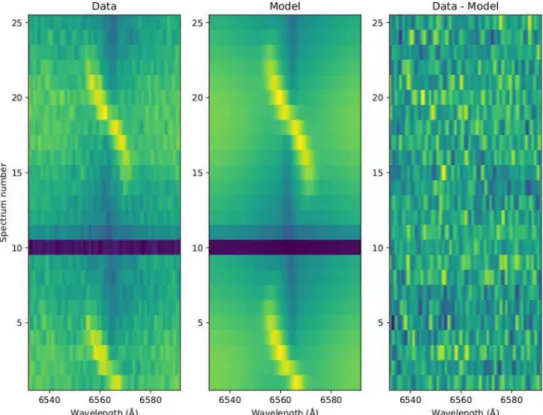
To further improve the physical constraints of each component of the binary, we obtained GTC+OSIRIS time-series spectroscopy of the Hαline (left-hand panel of Fig.3). The spectroscopy shows both a clear absorption component from the white dwarf and an emission component moving in antiphase that is strongest around Phase 0.5
Figure 2. Top panel: phase-folded, binned K2 light curve of SDSS J1205−0242. It is strongly smeared, since each long-cadence ex-posure lasts 29.4 min of the 71.2-min orbit. Still, a sinusoidal variation and eclipse stand out. Bottom panel: phase-folded, ULTRASPECkg5light curve of SDSS J1205−0242 with higher time sampling. The deep eclipse of the white dwarf is clear, as is the out-of-eclipse reflection effect. There is no detection of the companion during the eclipse. Overplotted in red is the best-fitting model light curve (phase smearing is accounted for in theK2 plot at the top).
Table 2. Mid-eclipse times.
Cycle MJD(BTDB) Source
SDSS J1205−0242:
−3061 57616.626169(18) K2Campaign 10
−234 57756.4644612(78) McDonaldrband
97 57772.837463(30) ULTRASPECiband
118 57773.8762091(87) ULTRASPECkg5band
158 57775.8548125(63) ULTRASPECkg5band
218 57778.8227308(78) ULTRASPECkg5band
301 57782.9283510(78) ULTRASPEC clear
SDSS J1231+0041:
−2575 57616.774090(86) K2Campaign 10
546 57773.928207(40) ULTRASPECkg5band
585 57775.892041(30) ULTRASPECkg5band
1178 57805.751893(35) ULTRASPECkg5band
Figure 3. Trailed spectra of the Hαline of SDSS J1205−0242 with time running upwards. The left-hand panel shows our GTC/OSIRIS data (the eclipse of the white dwarf occurs during spectrum 10). The centre panel shows our best-fitting model to the line, including both the absorption from the white dwarf and the emission from its companion. The right-hand panel shows the residuals of the fit.
and disappears near the eclipse, the classic signature of irradiation-induced emission lines from the inner face of the companion to the white dwarf.
We fitted the Hα line with the following components: (1) a second-order polynomial representing the continuum of the white dwarf, which is scaled according to the light-curve model during phases affected by the eclipse; (2) a first-order polynomial repre-senting the irradiation, and its level modulated as (1− cosφ)/2, whereφis the orbital phase; (3) three Gaussian absorption com-ponents for the white dwarf that change position according to γ1+K1sin (2πφ); and (4) two Gaussian emission components from the companion star, with strengths modulated in the same way as the irradiation component and that change position according to γ2+Kemsin (2πφ). We also take into account the smearing of the lines caused by the finite exposure times, and the best model was found using the Levenburg–Marquardt minimization method.
Our best-fitting model is shown in the centre panel of Fig.3, with the residuals of the fit plotted in the right-hand panel. Our best-fitting parameters wereγ1=38.5±3.5 km s−1,K1=48.3±5.1 km s−1, γ2 = 31.9 ± 2.6 km s−1and Kem = 345.0 ± 4.4 km s−1. The offset between the radial-velocity amplitudes of the two stars γ1− γ2= 6.6±4.3 km s−1is effectively the gravitational red-shift of the white dwarf. For a 0.39- Mwhite dwarf, the expected gravitational redshift is 11.2 km s−1(Panei et al.2007). Correcting this value for the redshift of the companion star, the difference in transverse Doppler shifts, and the potential at the companion owing to the white dwarf reduces this to 10.0 km s−1, within 1σ of the measured value. This provides an external consistency check on the spectroscopically determined mass.
The implied mass ratio of the binary is q = M2/M1 =
K1/Kem=0.14. Assuming a white-dwarf mass of 0.39 Mgives a companion mass of 0.055 M or 57MJ. However, since this
emission line originates only from the heated hemisphere of the companion,Kemdoes not represent its true centre-of-mass velocity, but rather a lower limit onK2, the true radial velocity semi-amplitude of the companion. Therefore, 0.055 Mrepresents an upper limit on the mass of the companion; the companion in SDSS J1205−0242 is therefore definitely sub-stellar.
The radial velocity amplitude of the companion’s centre of mass,
K2, is related toKemvia the formula
K2= Kem
1−f(1+q)R2
a
, (2)
whereR2/ais the radius of the brown dwarf scaled by the orbital separation (a) andfis a constant between 0 and 1, which depends upon the location of the centre of light (Parsons et al.2012a). We assume a value off=0.5, which roughly corresponds to optically thick emission from the inner hemisphere, which is what has been found for Hαemission in similar systems (Parsons et al.2012b). This can be combined with the light-curve fit to determine a more accurate value ofK2.
Figure 4. SALTICAMi-band light curve of the transit of the white dwarf in front of the heated face of the brown dwarf (i.e. the secondary eclipse). Also shown are models with inclinations of 90◦(blue), 87◦(red) and 85◦ (green). Inclinations lower than 87◦predict a secondary eclipse that is too shallow.
logg=7.5 white dwarf (Gianninas et al.2013) in thekg5filter.3 The limb-darkening parameters of the brown dwarf have a negli-gible impact on the eclipse profile and so were fixed at the linear value for a 2400 K logg=5.0 star in the SDSSrband (Claret, Hauschildt & Witte2012). The brown-dwarf temperature was also fixed at 2400 K; again this makes no difference to the eclipse fit, since it is undetected during totality. We then varied the inclination from 90◦to 84◦in steps of 1◦and allowed the scaled radii,R1/a
andR2/a, to vary. At each inclination, we then used the value of
R2/ato computeK2via equation (2) and combined this withK1and the inclination to determine the two masses, as well asaand hence the two radii.
In addition to the eclipse of the white dwarf, we also detect the transit of the white dwarf across the irradiated face of the brown dwarf, as shown in Fig.4. The depth of this feature is strongly dependent upon the ratio of the radii and can be combined with the primary eclipse to place stringent constraints upon the inclination (e.g. Parsons et al.2010,2012a). In this case, the 90◦model had aχ2 of 369 (fitting 217 points). Models with inclinations lower than 87◦ hadχ2values higher than 434 (χ2/d.o.f. >2), since they predict eclipses that are too shallow. Additionally, the shape of the brown dwarf is more distorted in the lower inclination models (since it is closer to Roche lobe filling), leading to much poorer fits (e.g. the 85◦model in Fig.4). Therefore, our secondary eclipse data place a lower limit of 87◦on the inclination.
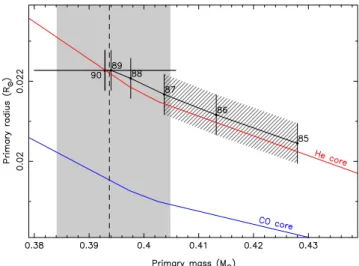
Our final constraints on the stellar parameters are shown in Figs5
and6for the white dwarf and brown dwarf, respectively, and are listed in full in Table3. We found that the minimum inclination of the system is 85◦; below this the radius of the brown dwarf needs to be so large to fit the eclipse width that it fills its Roche lobe. This places a hard upper limit on the mass of the white dwarf of 0.43 M. Our results from the secondary eclipse (i>87◦) further constrain this upper limit to 0.40 M. The uncertainty on theK1measurement dominates the error on the brown dwarf’s mass, leading to a mass range of 0.049±0.06 M(51±6MJ).
3Limb-darkening parameters in thekg5 filter kindly provided by Alex Gianninas.
Figure 5. Constraints on the mass and radius of the white dwarf in SDSS J1205−0242 based on our radial velocity and eclipse fitting. The black line shows how the mass and radius vary as a function of inclination. The red line shows the theoretical mass–radius relationship for a 24 000 K helium-core white dwarf with a canonically thick surface hydrogen layer (Panei et al.2007). The blue line shows the same theoretical mass–radius relationship but for a carbon–oxygen core white dwarf (Fontaine, Brassard & Bergeron2001), also with a canonically thick surface hydrogen layer. The vertical dashed line marks the white dwarf mass as determined from the Balmer-line fits to our SOAR spectrum, with the shaded area showing the 1σ uncertainties on this fit. The hatched region shows the inclinations excluded by the secondary eclipse data. The uncertainty on the white dwarf’s mass from the radial velocity data is shown on the 90◦model.
Table 3. Stellar and binary parameters for the two systems presented in this paper. WD refers to the white dwarf.
Parameter SDSS J1205−0242 SDSS J1231+0041 Orbital period (d) 0.049 465 250(6) 0.050 353 796(23)
Orbital separation (R) 0.42–0.45 –
Orbital inclination (◦) 87–90 –
WD mass (M) 0.39±0.02 0.56±0.07
WD radius (R) 0.0217–0.0223 –
WDTeff(K) 23680±430 37210±1140
WD logg 7.37±0.05 7.77±0.14
WD cooling age (Myr) 50 5
Secondary mass (M) 0.049±0.006 0.095 Secondary radius (R) 0.081–0.087 0.12
Apparent magnitude (g) 18.5 20.1
Distance (pc) 720±40 1500±200
Fig.5shows that the measured radius of the white dwarf is fully consistent with theoretical predictions for helium-core white dwarfs (red line) by Panei et al. (2007) at an inclination of 90◦and is slightly oversized at lower inclinations, although this is still well within the uncertainties. The radii predicted by the carbon–oxygen core models (blue line) of Fontaine et al. (2001) are significantly smaller com-pared to our measurements. Both models have canonically thick hydrogen-layer masses, and we conclude that SDSS J1205−0242 has a helium core. At the highest inclinations, the fit is also consis-tent with the white-dwarf parameters found from the SOAR spec-troscopy, implying that the true inclination is somewhere close to 90◦. Fig.6shows that the brown dwarf’s (volume-averaged) radius is consistent with theoretical predictions if it is older than 2.5 Gyr (>3.5 Gyr for the 90◦solution). We did not detect the brown dwarf in ourz-band light curves, placing an upper limit on its spectral type of L0, consistent with its classification as a brown dwarf.
We estimate the distance to the white dwarf by fitting the SDSS photometry with the Panei et al. (2007) models. We sam-ple the posterior probability distributions for the parameter set
{logg,Teff, E(g − i),d} using a Markov chain Monte Carlo (MCMC) analysis. Posteriors on{logg,Teff}come from the SOAR spectral fits, whilst the posterior on E(g−i) is uniform between 0 and the maximum extinction along the line of sight. To minimize the effects of contamination by the irradiated companion, we only fit theugrphotometry and find a distance of 720±40 pc. Fitting the fullugrizdata set does not change the distance significantly. By combining this distance with an estimate of the proper motion based upon SDSS and PanSTARRS (Tian et al.2017) and adopting γ2 as an estimate of the radial velocity of the system, we can calculate its Galactic space velocity, relative to the local standard of rest, asUVW =(36, −19, 35)± (7, 6, 4) km s−1. We adopt the convention that the sign ofUis positive towards the Galactic anticentre. Following Bensby, Feltzing & Oey (2014), we find that SDSS J1205−0242 is 10 times more likely to belong to the thin disc than the thick disc, and 50 000 times more likely to belong to the thin disc than the halo, justifying the adoption of solar metallicity models for the brown dwarf.
4 A 7 2 . 5 - M I N B I N A RY: S D S S J 1 2 3 1+0 0 4 1
The second of our two systems, SDSS J1231+0041, is a faint (g = 20.1) white dwarf identified from a serendipitous SDSS spectrum. Spectroscopic fits by Rebassa-Mansergas et al. (2016) to the SDSS spectrum found the white dwarf to be a Teff= 38740±2680 K, logg=7.07±0.41 white dwarf; their solution
Figure 7. Top panel: phase-folded, binned K2 light curve of SDSS J1231+0041. As with SDSS J1205−0242, the data are smeared since each long-cadence exposure comprises more than 40 per cent of the 72.5-min orbital period. Still, it shows a strong reflection effect, as well as slight evidence for an eclipse. Bottom panel: phase-folded, ULTRASPECkg5light curve of SDSS J1231+0041 with higher time sampling. The partial eclipse of the white dwarf is clear, as is the out-of-eclipse reflection effect. A model light curve is overplotted in red (and smeared in the top panel to match the K2exposures).
suggested a possible photometric excess at longer wavelengths, sufficient for them to classify it as a possible white dwarf plus main-sequence star system.
We have fitted our higher S/N SOAR spectrum to better con-strain the white dwarf atmospheric parameters, as we did for SDSS J1205−0242. Our updated SOAR fits find that the primary white dwarf hasTeff=37210±1140 K, logg=7.77±0.15, which yields a white-dwarf mass of 0.56±0.07 Musing the models of Fontaine et al. (2001). The SOAR spectrum and best fit are shown in the right-hand panel of Fig.1. Following the same method as for SDSS J1205−0242, we estimate a distance of 1500±200 pc by fitting the carbon–oxygen-core white-dwarf models of Fontaine et al. (2001) to the SDSSugrphotometry.
Figure 8. Theoretical mass–radius relationships (solid lines) for solar metallicity brown dwarfs and low-mass stars (Baraffe et al.2003) with ages of 0.5 (black), 1 (red), 5 (green) and 10 Gyr (blue). The grey dashed lines show the possible loci of Roche-lobe-filling companions to a white dwarf of massMWD=0.56 Mfor fixed orbital period (in steps of 5 min). The figure shows that the most dense brown dwarfs are those with masses∼0.065 M that could still fit within their Roche lobes at periods as short as 45 min, provided they are old enough. It also shows that, to fit within its Roche lobe at a period of 72.5 min (indicated by the solid grey line), the companion to the white dwarf in SDSS J1231+0041 must have a mass of less than 0.095 M.
the white dwarf (i.e. reflection effect). The period could also be double this value, with the variations then caused by the Roche-distorted companion presenting different surface areas throughout the orbit (i.e. ellipsoidal modulation). The long exposure times of theK2data relative to the variability make it difficult to distinguish between these two possibilities. There is also marginal evidence for an eclipse in the form of a steeper curve just before and after the minimum.
Our ground-based follow-up high-speed photometry (Fig. 7) shows that the true binary period is 72.5 min, and establishes that the system is eclipsing, albeit only partially (we do not detect any secondary eclipse). In total, we covered four eclipses of the white dwarf (see Table2). From these, we determined the ephemeris for the system to be
MJD(BTDB)=57746.435076(24)+0.050353796(23)E. (3)
Since SDSS J1231+0041 is only partially eclipsing, determining accurate parameters from the light curve is complicated due to the extra level of degeneracy. However, with such a short orbital period we can place an upper limit on the mass of the companion to the white dwarf, based on the fact that it does not fill its Roche lobe. In Fig.8, we show several mass–radius relationships for low-mass stars and brown dwarfs of different ages and solar metallicity. Also shown are lines of constant density at different orbital periods, which effectively show the Roche-lobe radius at different orbital periods. It is interesting to note how the radii of these low-mass objects are strongly related to their ages, to the extent that some binary configurations could be possible only with older brown dwarfs. For example, any detached system with a period50 min must be older than∼5 Gyr and must have a mass0.07 M. With a period of 72.5 min, we can only say that SDSS J1231+0041 must be older than∼1 Gyr, since at this period most of the models converge. We can also place an upper limit on the mass of the companion to the white dwarf of∼0.095 M; anything more massive than this would
fill its Roche lobe. Therefore, it is quite likely that the companion in SDSS J1231+0041 is a brown dwarf, although radial-velocity data are required to confirm this.
Such a low-mass companion is completely outshone by the white dwarf at visible wavelengths, but Rebassa-Mansergas et al. (2016) suggested a possible photometric excess at red optical wavelengths. We have phased the SDSS photometry to the ephemeris established here and found it was all taken within 5 min of orbital phase 0.25. The apparent photometric red excess is therefore likely the result of irradiation, since the heated face of the companion has a much lower temperature but larger area than the white dwarf.
Our final parameters for both systems are listed in Table3.
5 D I S C U S S I O N
The white dwarfs in both the systems presented in this paper are the remnants of giant stars that were once much larger than their cur-rent orbits. This implies significant orbital shrinkage and points to-wards their emergence from common envelopes that formed around both components of the binaries when mass transfer from the giant stars to their low-mass companions took place (Paczynski1976). Common-envelope evolution is one of the most poorly under-stood and yet significant phases of close binary evolution (Ivanova et al.2013), and well-constrained examples of its effects are worth examination for the constraints they may raise.
In this case, SDSS J1205−0242 offers the most interesting test, first, because it is better constrained and, secondly, because it con-tains a moderately low-mass, helium-core white dwarf. The helium white dwarf in SDSS J1205−0242 is a remnant of the first ascent red giant branch (RGB). As Nelemans et al. (2000) pointed out, the close relation between the core mass and radius of RGB stars (Refsdal & Weigert 1970) can allow tight constraints to be de-rived on the prior evolution of binary stars containing helium white dwarfs. The radius of an RGB star rises rapidly with the helium-core mass (approximately∝M4
c, Iben & Tutukov1985); thus, helium white dwarfs of low mass that have emerged from common en-velopes are of particular interest since they come from relatively small, tightly bound RGB stars. They can therefore lead to the most stringent constraints upon the efficiency with which the envelope is ejected. We express the effect of the common envelope upon the orbital separation,a, through the relation
α
GM1fM2 2af −
GM1iM2 2ai
= GM1i(M1i−M1f)
λR1i , (4)
which equates a fraction of the orbital energy change on the left-hand side with the binding energy of the RGB’s envelope on the right-hand side (Webbink1984; Dewi & Tauris 2000). Here the subscripts ‘i’ and ‘f’ refer to the initial and final values of the respective parameters when they differ. The parametersα andλ encapsulate the efficiency with which orbital energy is used to eject the envelope and the internal structure of the envelope, respectively. There are alternative formulations for the binding energy of the envelope (Iben & Livio1993). We claim no advantage for our choice other than its popularity, which eases comparison with other studies; we refer the reader to Ivanova et al. (2013) and Zorotovic et al. (2010) for further discussions of such variations and their effect on the outcome of the common-envelope phase. Like Zorotovic et al. (2010), we condense what we can deduce from the system into a single constraint upon the combination parameter,αλ.
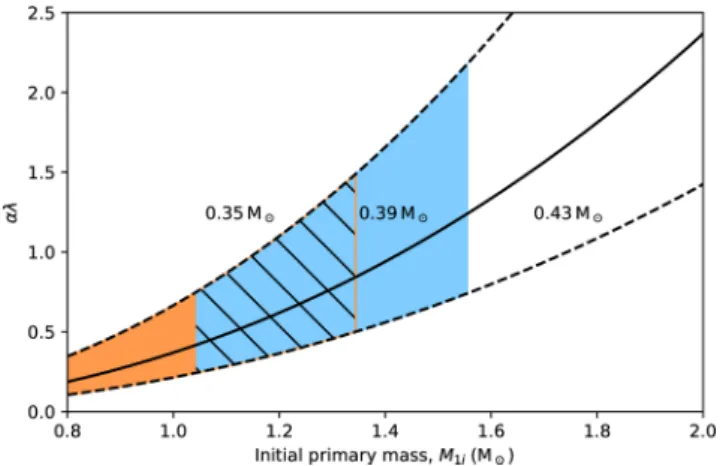
Figure 9. The value of the combined common-envelope/RGB structure parameterαλ(Dewi & Tauris2000) required to match the parameters of SDSS J1205−0242. The curved lines were calculated for three values of white dwarf mass, the value of 0.39 Mfrom spectroscopy and 2σ either side of it and setM2=0.049 M. The shaded regions show the ranges of progenitor mass consistent with the age of the brown dwarf for the models of Baraffe et al. (2015) (upper right-hand side, shaded blue) and Saumon & Marley (2008) (lower left-hand side, shaded orange), allowing for the white dwarf’s cooling age of 50 Myr (Panei et al.2007) and using the formula for the time taken to reach the base of the RGB from Hurley et al. (2000). Solar metallicity has been assumed (Section 3).
increases, both terms in the numerator of the right-hand side of equation (4) increase with little change in the denominator. On the left-hand side, however, there is relatively little change with the progenitor mass, as it is the first term in the brackets that dominates, sinceai af. The result is that the value ofαλrequired to produce SDSS J1205−0242 increases rapidly with the progenitor mass,M1i. These constraints are encapsulated in Fig.9, which is based on the formulae presented by Hurley, Pols & Tout (2000) and Eggleton (1983) in order to calculateR1iandaifor a given choice of progenitor mass.
Ranges of progenitor mass consistent with the age of the brown dwarf for two sets of models (Saumon & Marley 2008; Baraffe et al.2015) are highlighted in Fig.9. The range ofαλruns from 0.1 to 2.2, consistent with many of the systems studied in a sim-ilar manner by Zorotovic et al. (2010). If brown dwarf models can be improved, there is potential for sharper constraints upon the common-envelope parameters, and, given the easily detectable secondary eclipse in SDSS J1205−0242 (Fig.4), there are good prospects for tightening the parameter constraints significantly be-yond those shown in Fig.9. There are caveats, however: first are the significant existing uncertainties of cloud physics, molecular opac-ity and convection in brown dwarf models (Saumon & Marley2008; Baraffe et al.2015), and second, it is possible that the unusual en-vironment of rapid rotation and irradiation could affect the brown dwarf’s size, although the 50 Myr since the common envelope is a blink of an eye compared to the brown dwarf’s Kelvin–Helmholtz time-scale. Resolving such uncertainties is a motivation for finding more examples of such systems.
The usual aim of studies such as this is to constrain the common-envelope efficiency parameterα, but as we have seen, it is the com-binationαλthat is directly constrained. Unfortunately, the struc-ture parameterλ, often taken to be 0.5 (de Kool1990), is almost as ill-defined asα, as it is not known to what extent the internal (thermal) energy of the envelope needs to be taken into account when calculating it (Han, Podsiadlowski & Eggleton1995; Dewi & Tauris 2000; Camacho et al.2014); a contribution from internal
energy can increaseλ significantly. The relatively tightly bound RGB star in this instance should make this uncertainty relatively small compared to later stages of stellar evolution, and once the parameters of the binary are firmed up, it will be worth inves-tigating stellar models to define the range ofλ for this specific instance. In any event, it is clear that SDSS J1205−0242 and simi-lar white-dwarf/brown-dwarf systems have significant potential for both common-envelope evolution and brown-dwarf physics.
Prior to the formation of the common envelope, the binary would have had an orbital period in the range 60–200 d, placing it within or close to the ‘brown dwarf desert’, where few brown dwarf com-panions to solar-type stars are seen (Marcy & Butler2000; Ma & Ge2014). It would be interesting to ascertain whether or not the numbers of white dwarf/brown dwarf PCEBs are consistent with the rarity of their progenitors in radial-velocity surveys.
These systems will transfer mass in the near future (∼300 Myr for SDSS J1205−0242), and presumably appear as cataclysmic variable stars. Their existence in this form, however, may be brief, if recent suggestions of the destabilizing effects of novae on cat-aclysmic variables containing low-mass white dwarfs are correct (Nelemans et al.2016; Schreiber, Zorotovic & Wijnen2016). They may then soon merge to become single white dwarfs, and, in the case of SDSS J1205−0242, a single white dwarf of low mass (Zorotovic & Schreiber2017), a number of which are known (Marsh et al.1995; Brown et al.2011). Their emergence from the common-envelope phase so close to Roche-lobe filling also suggests that had the companions been even less massive, these systems might not have survived the common envelope at all but simply have merged. This exact scenario has been suggested as another way to form single low-mass white dwarfs (Nelemans & Tauris1998).
6 C O N C L U S I O N S
Using long-cadence photometry from theKeplerspace telescope, we have discovered two new ultrashort, detached eclipsing binaries composed of white dwarfs plus cool companions. The binaries have such short orbital periods – 71.2 min and 72.5 min – that the com-panions are likely substellar on the basis of their periods alone, in order that they do not fill their respective Roche lobes.
Follow-up photometry and spectroscopy significantly constrain both systems. SDSS J1205−0242 contains a hot (Teff=23680± 430 K), low-mass (0.39± 0.02 M) white dwarf with a radius consistent with a helium-core white dwarf (0.0217–0.0223 R). It is totally eclipsed every 71.2 min by a 45–57MJbrown-dwarf com-panion that has a radius consistent with an age greater than 2.5 Gyr (0.081–0.087 R). Detection of secondary eclipses constrains the orbital inclination to>87◦.
SDSS J1231+0041 contains a hot (Teff=37210±1140 K), 0.56±0.07 Mwhite dwarf that is partially eclipsed every 72.5 min by a companion of less than 0.095 M, also likely to be a brown dwarf. Details of all physical constraints to both systems are listed in Table3.
Both systems were discovered as part of a search for transits and variability among white dwarfs inK2Campaign 10; we expect to find more similar short-period eclipsing binaries asK2continues surveying new fields along the ecliptic. The results here also help build expectations for the next space-based photometric mission,
TESS(Ricker et al.2014), which can be used to target many bright white dwarfs all-sky at 2-min cadence.
AC K N OW L E D G E M E N T S
SGP acknowledges the support of the Leverhulme Trust. The re-search leading to these results has received funding from the Euro-pean Research Council under the EuroEuro-pean Union’s Seventh Frame-work Programme (FP/2007-2013)/ERC Grant Agreement numbers 340040 (HiPERCAM) and 320964 (WDTracer), as well as the European Union’s Horizon 2020 Research and Innovation Pro-gramme/ERC Grant Agreement number 677706 (WD3D). ULTRA-CAM, and TRM, VSD and SPL are supported by the Science and Technology Facilities Council (STFC) under grants ST/L000733 and ST/M001350. DAHB is supported by the National Research Foundation of South Africa. Support for this work was provided by NASA through Hubble Fellowship grant #HST-HF2-51357.001-A, by NASA K2 Cycle 4 Grant NNX17AE92G, as well as NSF grants AST-1413001 and AST-1312983. This work has made use of data obtained at the Thai National Observatory on Doi Inthanon, op-erated by NARIT; the Southern Astrophysical Research (SOAR) telescope, which is a joint project of the Minist´erio da Ciˆencia, Tecnologia, e Inovac¸˜ao da Rep´ublica Federativa do Brasil, the U.S. National Optical Astronomy Observatory, the University of North Carolina at Chapel Hill and the Michigan State University; and the McDonald Observatory of the University of Texas at Austin; as well as the SALT, through DDT programme 2016-2-DDT-006, where the assistance of Marissa Kotze is acknowledged. Data for this paper have been obtained under the International Time Programme of the CCI (International Scientific Committee of the Observatorios de Canarias of the IAC) with the GTC operated on the island of La Palma in the Observatorio del Teide/Roque de los Muchachos.
Facilities: K2, Otto Struve (ProEM), TNT (ULTRASPEC), SOAR (Goodman), SALT (SALTICAM), GTC (OSIRIS)
R E F E R E N C E S
Anderson D. R. et al., 2011, ApJ, 726, L19
Baraffe I., Chabrier G., Barman T. S., Allard F., Hauschildt P. H., 2003, A&A, 402, 701
Baraffe I., Homeier D., Allard F., Chabrier G., 2015, A&A, 577, A42 Becklin E. E., Zuckerman B., 1988, Nature, 336, 656
Bensby T., Feltzing S., Oey M. S., 2014, A&A, 562, A71 Borucki W. J. et al., 2010, Science, 327, 977
Brown J. M., Kilic M., Brown W. R., Kenyon S. J., 2011, ApJ, 730, 67 Burleigh M. R., Hogan E., Dobbie P. D., Napiwotzki R., Maxted P. F. L.,
2006, MNRAS, 373, L55
Camacho J., Torres S., Garc´ıa-Berro E., Zorotovic M., Schreiber M. R., Rebassa-Mansergas A., Nebot G´omez-Mor´an A., G¨ansicke B. T., 2014, A&A, 566, A86
Casewell S. L. et al., 2012, ApJ, 759, L34 Chabrier G., 2003, PASP, 115, 763
Claret A., Hauschildt P. H., Witte S., 2012, A&A, 546, A14
Clemens J. C., Crain J. A., Anderson R., 2004, in Moorwood A. F. M., Iye M., eds, Proc. SPIE Conf. Ser. Vol. 5492, Ground-Based Instrumentation for Astronomy. SPIE, Bellingham, p. 331
Copperwheat C. M., Marsh T. R., Dhillon V. S., Littlefair S. P., Hickman R., G¨ansicke B. T., Southworth J., 2010, MNRAS, 402, 1824
David T. J., Hillenbrand L. A., Cody A. M., Carpenter J. M., Howard A. W., 2016, ApJ, 816, 21
de Kool M., 1990, ApJ, 358, 189
Debes J. H., Hoard D. W., Wachter S., Leisawitz D. T., Cohen M., 2011, ApJS, 197, 38
Dewi J. D. M., Tauris T. M., 2000, A&A, 360, 1043 Dhillon V. S. et al., 2014, MNRAS, 444, 4009
Dobbie P. D., Burleigh M. R., Levan A. J., Barstow M. A., Napiwotzki R., Holberg J. B., Hubeny I., Howell S. B., 2005, MNRAS, 357, 1049 Eggleton P. P., 1983, ApJ, 268, 368
Eisenstein D. J. et al., 2006, ApJS, 167, 40
Farihi J., Becklin E. E., Zuckerman B., 2005, ApJS, 161, 394 Farihi J., Parsons S. G., G¨ansicke B. T., 2017, Nat. Astron., 1, 0032 Fontaine G., Brassard P., Bergeron P., 2001, PASP, 113, 409
Gianninas A., Strickland B. D., Kilic M., Bergeron P., 2013, ApJ, 766, 3 Girven J., G¨ansicke B. T., Steeghs D., Koester D., 2011, MNRAS, 417,
1210
Grether D., Lineweaver C. H., 2006, ApJ, 640, 1051
Han Z., Podsiadlowski P., Eggleton P. P., 1995, MNRAS, 272, 800 Hardy L. K. et al., 2017, MNRAS, 465, 4968
Howell S. B. et al., 2014, PASP, 126, 398
Hurley J. R., Pols O. R., Tout C. A., 2000, MNRAS, 315, 543 Iben Jr I., Livio M., 1993, PASP, 105, 1373
Iben Jr I., Tutukov A. V., 1985, ApJS, 58, 661 Ivanova N. et al., 2013, A&AR, 21, 59
Kanaan A., Kepler S. O., Winget D. E., 2002, A&A, 389, 896 Kirkpatrick J. D. et al., 2012, ApJ, 753, 156
Kleinman S. J. et al., 2013, ApJS, 204, 5 Littlefair S. P. et al., 2014, MNRAS, 445, 2106
Luhman K. L., Burgasser A. J., Bochanski J. J., 2011, ApJ, 730, L9 Ma B., Ge J., 2014, MNRAS, 439, 2781
Marcy G. W., Butler R. P., 2000, PASP, 112, 137 Marsh T. R., 1989, PASP, 101, 1032
Marsh T. R., Dhillon V. S., Duck S. R., 1995, MNRAS, 275, 828 Nebot G´omez-Mor´an A. et al., 2011, A&A, 536, A43
Nelemans G., Tauris T. M., 1998, A&A, 335, L85
Nelemans G., Verbunt F., Yungelson L. R., Portegies Zwart S. F., 2000, A&A, 360, 1011
Nelemans G., Siess L., Repetto S., Toonen S., Phinney E. S., 2016, ApJ, 817, 69
O’Donoghue D. et al., 2006, MNRAS, 372, 151
Paczynski B., 1976, in Eggleton P., Mitton S., Whelan J., eds, 1976, Proc. IAU Symp. 73, Structure and Evolution of Close Binary Systems. Kluwer, Dordrecht, p. 75
Panei J. A., Althaus L. G., Chen X., Han Z., 2007, MNRAS, 382, 779 Parsons S. G., Marsh T. R., Copperwheat C. M., Dhillon V. S., Littlefair
S. P., G¨ansicke B. T., Hickman R., 2010, MNRAS, 402, 2591 Parsons S. G. et al., 2012a, MNRAS, 419, 304
Parsons S. G. et al., 2012b, MNRAS, 420, 3281 Parsons S. G. et al., 2015, MNRAS, 449, 2194
Rebassa-Mansergas A., G¨ansicke B. T., Schreiber M. R., Koester D., Rodr´ıguez-Gil P., 2010, MNRAS, 402, 620
Rebassa-Mansergas A., Nebot G´omez-Mor´an A., Schreiber M. R., Girven J., G¨ansicke B. T., 2011, MNRAS, 413, 1121
Rebassa-Mansergas A., Ren J. J., Parsons S. G., G¨ansicke B. T., Schreiber M. R., Garc´ıa-Berro E., Liu X.-W., Koester D., 2016, MNRAS, 458, 3808
Refsdal S., Weigert A., 1970, A&A, 6, 426 Ricker G. R. et al., 2014, Proc. SPIE, 9143, 914320 Saumon D., Marley M. S., 2008, ApJ, 689, 1327
Schreiber M. R., Zorotovic M., Wijnen T. P. G., 2016, MNRAS, 455, L16 Silvestri N. M. et al., 2006, AJ, 131, 1674
Siverd R. J. et al., 2012, ApJ, 761, 123
Stassun K. G., Mathieu R. D., Valenti J. A., 2006, Nature, 440, 311 Steele P. R., Burleigh M. R., Farihi J., G¨ansicke B. T., Jameson R. F., Dobbie
P. D., Barstow M. A., 2009, A&A, 500, 1207
Steele P. R. et al., 2013, MNRAS, 429, 3492
Still M., Barclay T., 2012, PyKE: Reduction and Analysis of Kepler Simple Aperture Photometry Data, Astrophysics Source Code Library, record ascl:1208.004
Thompson S., Mullally F., 2013, Wqed: Lightcurve Analysis Suite, Astro-physics Source Code Library, record ascl:1304.004
Tian H.-J. et al., 2017, preprint (arXiv:1703.06278)
Tremblay P.-E., Bergeron P., Gianninas A., 2011, ApJ, 730, 128 Van Cleve J. E. et al., 2016, PASP, 128, 075002
Vanderburg A., Johnson J. A., 2014, PASP, 126, 948 Webbink R. F., 1984, ApJ, 277, 355
Willems B., Kolb U., 2004, A&A, 419, 1057
Zorotovic M., Schreiber M. R., 2017, MNRAS, 466, L63
Zorotovic M., Schreiber M. R., G¨ansicke B. T., Nebot G´omez-Mor´an A., 2010, A&A, 520, A86