REBELS, RESOURCES AND REPRESSION
Chelsea Leigh Estancona
A thesis submitted to the faculty of the University of North Carolina at Chapel Hill in partial fulfillment of the requirements for the degree of Master of Arts in the Department of Political Science, Concentration International Relations.
Chapel Hill 2015
© 2015
ABSTRACT
CHELSEA LEIGH ESTANCONA: Rebels, Resources and Repression (Under the direction of Navin Bapat.)
TABLE OF CONTENTS
LIST OF FIGURES . . . v
Introduction . . . 1
Theory and Hypotheses . . . 2
Explanation and Setup of the Game . . . 7
Solution and Comparative Statics . . . 12
Case Study: Peru and Sendero Luminoso . . . 17
Implications and Future Direction . . . 19
APPENDIX . . . 22
LIST OF FIGURES
Figure
1 3 Player Sequential Game . . . 7
2 Cheap Public Goods . . . 14
3 Highly Profitable State Resources . . . 15
4 Less Profitable State Resources . . . 15
5 Costly Public Goods, Highly Profitable State Resources . . . 16
Introduction
The presence of natural resources is correlated with civil war onset, increased conflict duration, and high levels of conflict severity (Lujala 2010). Despite these observations, scholars have been unable to identify a causal relationship between natural resources and civil war processes. Particularly, we are unaware ofhowrebels’ access to resources changes their conflict behavior. I suggest that previous work fails to consider the civilians necessary for maintaining or maximizing a group’s natural resource endowments. Specifically, I con-sider the importance of mobile, non-landowners engaged in the production of the primary commodities that supplement either rebel or state income.
I argue that rebels compel or encourage action from the non-combatants connected to the production of certain resources, and that the character and economic decisions of these individuals will affect the survival, territorial growth and capacity of the armed group. I also argue that, under certain circumstances, the state will attempt to dissuade civilian laborers from supporting rebels by preemptively employing indiscriminate violence. The state is particularly concerned about situations where the value of a labor-driven resource is high or increasing, leading to rapid growth in rebels’ funding and military capacity. However, engaging in indiscriminate violence is at minimum inefficient, and at most can negatively impact the state in the future of the conflict. My primary research question, then, iswhen does the state perceive that rebels will benefit substantially enough from obtaining access
to labor-based resources to merit the risk of using indiscriminate violence?
incomplete information solution of the game, and present comparative statics for how cer-tain variables affect the overall outcome as well as hypotheses for empirically testing these implications. The fifth section outlines the brief, illustrative case of the Peruvian state and Sendero Luminoso, and the sixth concludes.
Theory and Hypotheses
My argument builds on substantial literature about the role of natural resources in in-trastate conflict, but applies a highly disaggregated level of analysis and reintroduces the state’s decision calculus over contested natural resources. Initial scholarship on resources in conflict used state-level measures of oil endowments to examine if states with natural resources experience more conflict, (Collier and Hoeffler 2004; Fearon 2005; Fearon and Laitin 2003; Douma 2001; Berdal and Malone 2000) finding that, indeed, resource rich states tend to be more conflict prone. These authors propose two explanations - either resource endowments occur in weak states that are less able to contain rebellion, or the prospect of financial gain sufficiently offsets the costs of fighting for rebels. Neither ar-gument is fully explored, and at the state level, the presence of natural resources would appear to have the same effect in either circumstance. Scholars then began to disaggregate the different types of resources accessible to non-state actors to better understand whether resource type matters for conflict duration and severity (Ross 2004; Lujala 2009, 2010). Through case studies, Ross (2004) presents the idea that rebel groups are forward thinking and able to tailor their strategies according to resource type. Lujala predominantly finds correlation between types of resources and conflict duration, which reinforces the idea that resource type matters for rebel-state dynamics. These papers hypothesize that accessibility to different resource types influences a rebel group’s ability to profit from them, thus pro-longing their capacity to engage in conflict, but do not present a theory of how rebels are able to gain and maintain control of certain resources.
con-ditions of intrastate war economies (Arnson and Zartman 2005). The implication of these diverse arguments is that rebels’ funding choices are based not only on resource type, but also on the external actors that influence their level of access to such resources. Beardsley and McQuinn (2009) most closely address this topic by proposing a helpful framework for understanding how a group’s aims and access to efficient financial returns affect its rela-tionship with supporters. They do not, however, consider how the state similarly affects rebel choices, or how the state interacts with non-combatants in relation to the conflict. In summary, scholars have identified that resources affect rebels’ cost-benefit analysis of de-ciding to participate in conflict, that different types of resources are correlated with differing levels of severity and lengths of conflict duration, and that rebels are forward-thinking and strategic about their resource endowments. Despite the focus on rebel groups in the recent literature, it is also necessary to consider how rebel groups’ actions affect the state’s gains or losses of income from these primary commodities.
My theory contributes to existing research first by examining the competition for natural resources at the highly local, disaggregated level. I apply existing bargaining models of conflict to rebel/state competition over civilian economic support, thus also introducing an important third player. Pinpointing the importance of the individuals necessary to produce key natural resources allows for the consideration of two different bargaining processes: between the rebels and the civilians with whom they seek to cooperate, and between the state and the non-combatants they govern. I offer an explanation of rebel group and state strategy at the municipal level based on rebel access to labor-intensive natural resources, in particular those that allow rebels to seize additional territory by maintaining functional ownership of land.
laborers of include but are not limited to drug crop growers, farmers of legal agricultural commodities, or gemstone miners. Such civilians are primarily interested in the return on their investment and maintaining a form of ‘job security’, regardless of their support for the rebels’ political or ideological goals. In order to increase their financial supply and terri-torial holdings, rebels must sufficiently appease or intimidate these civilians into shifting their loyalty1 away from the state.
Rebels aim to establish and maintain this funding relationship at the lowest possible cost, using any surplus for attacks against the state. This process of allocating resources to civilians resembles Acemoglu and Robinson’s (2001) formal explanation of how au-thoritarian state leaders maintain support over time. The authors’ theory is about political transitions and redistribution of goods at the state level, but the concept of redistribution as a commitment to future action can be transformed into a general theory of how finan-cial resources are an investment in future loyalty. Empirically, the rebels are most likely applying a mix of ‘carrots and sticks’ to induce laborers to participate in production. For the first steps of this paper, I simplify the rebel ‘offer’ to civilians as a positive induce-ment (explained in detail in the next section). Examining rebels use of ‘carrots’ rather than sticks follows Wood’s (2014) argument that reliance on civilian support minimizes an insurgency’s use of indiscriminate victimization. This decision also reflects the idea that participation in illicit economies with rebel protection may, in fact, be more profitable to civilians than legal, state-sanctioned economic activity. The value of maintaining loyalty to the state versus engaging with rebel forces differs in distinct districts or municipalities. In particular, a rebel ‘offer’ of future economic gain is profitable in areas where the state is unable or unwilling to provide public goods to maintain civilian loyalty.
The state, meanwhile, can observe the presence of natural resources and the level of local rebel attacks, but not the negotiations between rebels and civilians as rebels seek to move into a specific area. Group access to civilian support affords substantial increases in capital and military power, and when a state anticipates this increase, it will seek to
prevent rebels from expanding their territorial and economic holdings. As Powell (2006) explains, preemptive war occurs when actors anticipate a change in the balance of power that makes them unable to commit to maintaining peace in the future. Thus, states can be expected to take strong measures, even if costly, to prevent civilians from investing in rebel groups as a guard against increasing levels of rebel attacks through the course of a conflict. States that seek to preempt or prevent a rebel/civilian relationship from forming in a given municipality are guarding not only against rebel gains but also their own losses, as rebel access to a resource inherently implies a state’s loss of the same territory and commodity endowments.
It is worth noting that resources such as oil or gas deposits are unlikely to attract civilian participation and thus preemptive state violence against civilians, as initial investment in the necessary technology and skills usually requires significant and stable capital and ownership of land. Thus, these industries are often tied to state support early on, and are unlikely to be swayed in favor of the rebels, as their value for the status quo and stability is high. For other, labor-intensive resources, early and decisive state action should be especially evident when expected returns for the rebels are very high. This follows Carter’s (2010) argument that key territorial gains are endogenous to the balance of military capabilities and, thus, the onset of interstate conflict. In particular, control of natural resources with sharply increasing prices would allow the rebels to rapidly alter the balance of power as their amount of capital grows exponentially. This may be particularly important for illicit crop production, where the state cannot easily anticipate rapid fluctuations in price, and also will lose taxable income as legal crops are replaced by illegal ones. The state, meanwhile, will particularly want to maintain control of legal commodities that are increasing in value. Thus, in the model, one parameter of interest reflects how expected changes in resource values (those that rebels can access vs. those that states can access) affect rebel probability of victory and the state’s willingness to continue local investment to civilians to maintain access to resource taxation or extortion.
2007; Ritter 2014). Although this paper focuses on resources in civil war, my theory also forwards our knowledge of what drives repression or civilian victimization in conflict more broadly. The role of repression in the context of an ongoing conflict is particularly under-investigated. Most extant research focuses on the circumstances under which we observe civilian victimization from either conflict actor and stresses the relationship between capac-ity and civilian victimization, but does not fully address how targeting civilians then affects group or state capabilities. In particular, an investigation of how resource-based economies and the profits states are able to gain from a certain region have not yet influenced studies of local-level indiscriminate violence. Fielding and Shortland (2012), for example, use the Pe-ruvian civil war to highlight that civilian victimization is reciprocal and suggest that either side terrorizes civilians in an effort to coerce action, but do not make claims about the type of action or the effects of gaining civilian ‘support.’ Wood distinguishes between situations of positive feedback and negative feedback in discussing reciprocal civilian victimization. He finds that weak insurgent groups rely on civilian targeting rather than provision of secu-rity or services to compel action and are even more likely to do so following state repression, but that stronger groups attempt to distinguish themselves from a repressive state by pro-viding ‘carrots’ when possible. Wood (2014) then also points to the importance of resource endowments by suggesting that the source of financial support influences levels of insur-gent violence against civilians, but does not connect this finding to state response or overall insurgent success.
to the state or the leadership of a state’s future. It follows, then, that states would respond to opportunities for rebel groups to increase their capacity to threaten the state with violent, indiscriminate action against the broad group of actors that might allow the group to do so. This also reflects the idea that developing lucrative local economic opportunities or contin-uing to provide public goods (carrots rather than sticks) is both time consuming and costly, and states will likely seek quicker and cheaper methods to compel civilian activity (Field-ing and Shortland 2012). Particularly for locales without lucrative primary commodities to offset the costs of maintaining civilian loyalty through public goods, the state will be more likely to choose violent or repressive tactics. The interplay between public goods provision and the value of natural resources for the state and rebels is highlighted in the next section, where I introduce the formal model.
Explanation and Setup of the Game
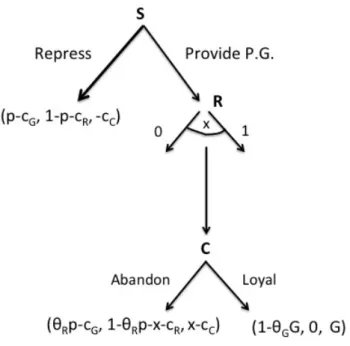
To better understand the interaction between the government and the civilians in par-ticular, I evaluate the rebels’ and state’s beliefs about how rebels gaining certain resource endowments can be exploited in the future through a game theoretic model included in Figure 1. The state (S) moves first to capture that their decision to repress or to continue providing public goods and support to civilians is made without full knowledge of the pos-sible deal that the rebels and local non-combatants make, whether or not this negotiation is successful. The state, then, chooses between strategies of immediate indiscriminate vio-lence and continuing to provide public goods to certain districts or municipalities [Repress, Provide P.G]. In the future, expanding the government’s decision to a ‘range’ of an offer similar to the rebels’, which would allow the civilians to maximize their options between the repressive/rewarding offers from either actor, would be beneficial. For the purposes of this paper, I assess only the choice between two strategies.
Thus, when engaging in indiscriminate violence at the beginning of this game, the gov-ernment is gambling that the risk of civilian backfire, which may decrease their popular perception and overall probability of victory, will be minimal enough to compensate for the risk of waiting to observe a rebel/civilian deal. If the government chooses not to act, the state is risking that rebels and civilians may establish a profitable relationship resulting in a significant increase in rebel capability and probability of besting the state. However, given that the establishment of this relationship is probabilistic, when the perceived risk of increased rebel capacity is low, the state may choose to avoid the consequences of in-discriminate violence by waiting to observe the rebel-civilian negotiations. Particularly in very local-level conflict scenarios where rebels and civilians are difficult to distinguish, this approach may be best for the state.
resource endowments are not high enough to compensate for this investment. In situations where there are few other ways for civilians to support themselves economically, however, indiscriminate violence is more likely to backfire, with the possibility of pushing economic supporters into active fighting support for the rebels should rebel groups move into the area(Wright 2015). In situations where there is a thriving legal economy and extensive state infrastructure, the rebels are unlikely to be able to extend a high enough offer to encourage deviation from the status quo, which also affects the state’s belief about the probability of this deal occurring.
For the state, the decision to repress is partially based on the anticipated value of rebel gainsθR, or how much the economic benefit of winning over civilians changes the rebels’
probability of winning. This parameter θR is bounded between 0 and 1 (θR ∈ [0,1]) and
captures the idea that more valuable resources require less investment relative to their ul-timate value (thus, more desirable resources θR take on values closer to 0).2 This value
θR represents gains from both legal and illegal resources by the rebel group by engaging
civilian labor. On the right hand side of the final node, where civilians maintain loyalty to the government, the government investment in resources made is θG, where θG ∈ [0,1],
and reflectsonlyresources that the government can legally tax, sell, or trade. Thus, in the Colombian example, θR includes the possible value of coca cultivation in a particular
de-partment as well as legal agricultural products, while θG might encompass only coffee or
palm oil production. The state also suffers costscG(cG ∈[0,1]) from fighting the rebels, as
fighting is necessarily costly (Powell 2006).
Uncertainty about whether or not the civilians will shift their loyalty is the primary factor in assessing the state’s initial decision of whether or not to engage in indiscriminate violence as well as the rebel’s offer level. This belief is based on the costs civilians incur by partnering with rebels. The rebels and state share the same belief c0c about whether or not the civilians will accept the costs associated with the rebels’ offer. For the state, if this beliefc0cis sufficiently high, the state will take the risk of incurring these costs to avoid a
change in rebel capacity that significantly increases the group’s chances for military victory. The beliefsc0ccan be thought of as the probability that an agreement between civilians and rebels is made based on levels ofcr,G, andθR. These beliefs are uniformly distributed over
the interval[0,1]. Thus, the state’s expected utility from indiscriminate violence isp−cG.
The state’s utility from foregoing indiscriminate violence and continuing to provide public goods isθRp−cGwhen the civilians accept, and1−θGGwhen they do not.
If widespread indiscriminate violence does not occur,3 The encroaching rebel group decides on a level of an ‘offer’ to extend to the civilians. This offer can be seen as a com-plete alteration of the status quo, in which rebels propose becoming dominant authority in the area, essentially replacing the state’s provision of public goods and economic opportu-nities with their own. Rebels, like the state, have the same level of uncertainty about the costscccivilians incur by transferring their loyalty to the rebel group. Thus, they make an
optimal offer based on their beliefs about these costs c0c, which is derived in the appendix and described in greater detail in the next section.
This offer can be considered an opening of negotiations rather than a sunk cost. As such, the rebels only lose the offerx, and thus must follow through on their commitment to control the municipality, protect the civilians, and provide economic incentives, when the civilians agree to cooperate. Thus, x is a positive offer of cooperation, bounded between 0 and 1 (x∈ [0,1]) with 0 allowing the rebels to make no offer if they perceive this relationship to be too costly to maintain or to only minimally increase their probability of victory against the state. In the case where the rebels make no offer or the civilians perceive cooperation with the rebels to be too costly, the rebel payoff is 0, reflecting that they are unable to make any economic or territorial gains.
Again, for the rebels, a crucial consideration when extending this offer is how the in-creasing value of the resource in question or the capture of associated territory would allow for expanded group capacity. In the model, the termθRrepresents this perceived future
efit, as it increases the rebels’ probability1−pof winning the conflict, following Powell and Carter (2006; 2010).4 As above, lower values ofθR, are more beneficial to the rebels.
When rebels expect a particularly profitable civilian relationship they are more likely to incur a high level of costs (x) to ensure that civilians accept their offer. The rebels, like the state, suffer costs from fightingcR that are included in their payoff for continuing to fight
with civilian assistance. Because this is a highly local story of rebel movement and civilian response, these costs are incurred only when rebels establish a local presence. Thus, the rebels payoff when civilians accept their offer is1−θRp−x−cR, and the rebels’ utility
when civilians reject their offer is simply 0.
Following the rebel offer, these civilians make a choice of whether to begin cooperating with rebels in economic production of a primary commodity or to reject the rebels’ attempt to attract civilian support. As mentioned above, I assume that civilians (C) are motivated only by economic gain – formally, that they agree to work with rebels when the benefits of the rebels offer x outweigh the benefit of public goods G provided by the state. As discussed in the previous section, different types of civilians will have varying evaluations of the costs of giving up legal or regulated economic participation, and thus differing levels ofcC. Civilians with few existing local economic opportunities and a lower level of public
goods provision such as missing infrastructure and poor governmental services are likely to be more perceptive to working for the rebel group. Civilians in municipalities or districts with high levels of state participation or investment would require a much more lucrative ‘deal’ to forfeit their current economic activity and relationship with the state. As such, the civilians’ payoff when they shift their loyalty to the rebels (A for abandon) isx−cc, and
the payoff when they maintain loyalty to the state (L for loyal) is simply G, the value of public goods provided.
4For simplicity’s sake, I assume thatθ
Solution and Comparative Statics
I solve this game using the Perfect Bayesian Equilibrium solution concept based on the rebel and state’s beliefs aboutcc∗, the costs civilians face in engaging with the rebel group
and abandoning their loyalty to the state.5 I assume that neither the state nor the rebels have complete information about the costs shareholders may incur. Thus, the rebels will make an optimal offer based on their beliefs about these costs when it is profitable for their long-term probability of victory, and the state will similarly choose to use indiscriminate violence based on their perception of how likely this offer is to be accepted.
The local labor force (civilians) will find it profitable to cooperate with rebels when the rebel offerxof economic gain and replacement of state authority and governance exceeds their existing value from state provision of public goods G, or when x > G+cc. The
rebels, then, offer the optimal level x, based on the probability of correctly assessing the shareholders’ costsccand reaching a deal. When making decisions about the level of their
offer, the rebels takeθR, or the value of the available resource, into account as rebels are
unwilling to offer an x greater than 1− θRp − cR. Thus, for higher levels of θR, the
rebels can afford lower values ofxand still turn a profit. The state, finally, will engage in indiscriminate violence based also on their beliefscc∗about the probability that the rebels
have proposed this optimal and acceptable value ofx. Their decision is based on weighing the utility of immediate repression, which sacrifices some economic efficiency, and the expected utility of allowing rebels and civilians to negotiate over an offer. The state will continue to provide public goods rather than engaging in indiscriminate repression at the start of the game, whenc∗c > c0c, and will choose indiscriminate violence otherwise (when c∗c < c0c).
When including all of the relevant parameters, the state chooses to continue providing public goods (plays strategy Provide P.G in the first decision node) when:
1−p−θGG+cG 1−θRp−θGG+cG
> 1
2(1−cr−G−pθR)
And state chooses indiscriminate violence (plays strategy Repress) when:
1−p−θGG+cG 1−θRp−θGG+cG
< 1
2(1−cr−G−pθR)
Comparative Statics
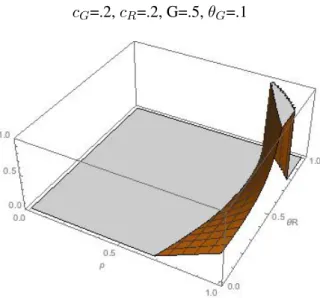
Given the complexity of the above inequalities, I have included plots to show how changes in public goodsG and the value of resources for the rebels and the state θR and
θGaffect when indiscriminate repression occurs. Figures 2 through 6 illustrate when
indis-criminate violence occurs across a range of values for the state’s probability of victorypand the value of the resource rebels may accessθR. I investigated the instances of indiscriminate
violence with three different values of public goods- 0.1, 0.5 and 0.8. Lower values ofG are less costly for the state, but also indicate that civilians may be more willing to strike a deal with rebels as they would have little loyalty to the state. Particularly whenθR is low,
rebels are more likely to offer a high levelxto lock in future economic gains. For each of these levels ofG, I also show differing values ofθG- 0.1, 0.5 and 0.8 again, to show how
the state’s behavior changes based on the overall value of the natural resources that they can access within the area in question. An overall implication from these graphs is that stronger states (higher levels of p) are more willing to engage in indiscriminate violence, but that the range of states willing to do so marginally increases as the expected profits from rebel investment increase or the costs of state investment increase (asθRdecreases orθG andG
increase).
In Figure 2, the value of public goods G are low at 0.1. This means that the state is incurring few costs by providing such goods, but also that civilians gain very little from the state’s involvement. I include only the plot ofθG = 0.5here, as there was very little
change over differing values of the resource θG. This means that states are only slightly
more willing to choose indiscriminate violence in situations where they are unable to truly profit from local natural resource production. For each value of θG, the state is willing to
use indiscriminate violence when rebel gains are anticipated to be high (θRis low), meaning
goods provision. Thus, when a low level of public goods is provided, the state becomes concerned that rebels will reach a ‘deal’ with civilians whenθR is high and the rebels are
particularly anxious to establish this economic relationship.
Figures 3 and 4 show the state’s propensity to use indiscriminate violence when the
Fig. 2:Cheap Public Goods
cG=.2,cR=.2, G=.1,θG=.5
value (and therefore cost to the state) of public goods is in the middle of the range at 0.5. In this case, states are prone to repress when the value ofθR is low, indicating substantial
gains for the rebels from accessing legal or illegal commodities In fact, whenθGis
partic-ularly low at 0.1, as in Figure 3, repression almost never occurs as the state does not want to lose their most efficient access to these lucrative resources. As the value ofθGincreases,
indicating that the state’s return from natural resources is decreasing, the state increasingly chooses indiscriminate violence. Because the state’s return from natural resources is low here, when there is a risk of rebels making significant gains from local primary commodities θR, the state is often willing to forgo their access to local labor by engaging in preemptive
repression. In Figure 4, states choose to repress for all but the highest values ofθR, in which
rebels are unlikely to establish a relationship with civilians.
Fig. 3:Highly Profitable State Resources
cG=.2,cR=.2, G=.5,θG=.1
Fig. 4:Less Profitable State Resources
cG=.2,cR=.2, G=.5,θG=.8
rebels are unlikely to benefit significantly from the resource in question, as in 6. This is be-cause if public goods provision is expensiveandthe state’s income from certain resources is low, the state finds it cheaper to simply repress and mitigate the risk of guerilla-style war seen when rebels and civilians join forces. However, because public goods provision and thus civilian gains are already high, states are more confident in their ability to maintain civilian loyalty. Thus, when the state’s value of a natural resource is high as in 5, repression never occurs. In this case, the state would rather not risk a decrease in taxable or seizable economic production resulting from repression.
be-cause at a certain level, the rebels will make no offer to the civilians. In situations where θR > 1−cRp+G, the rebels recognize that civilians will not accept a shift to rebel control of
the territory and economic endeavors within a profitable range ofx. In this situation, the state is aware that the rebels cannot will make no offer, and thus will never choose repres-sion. The final figure (6) illustrates the state’s cost-benefit analysis of provision of public goods vs. the ‘cheaper’ but riskier option of using indiscriminate violence, showing that when rebels are likely to make gains with civilians in a certain area and the state’s value for the area is low, repression occurs.
Fig. 5:Costly Public Goods, Highly Profitable State Resources
cG=.2,cR=.2, G=.8,θG=.1
Fig. 6:Costly Public Goods, Less Profitable State Resources
cG=.2,cR=.2, G=.8,θG=.8
un-derstanding when we can expect to observe indiscriminate violence at the municipal level. States should be making a cost-benefit analysis of their anticipated gains from a natural resource (θG) and are more likely to choose indiscriminate violence when these returns are
low, indicating that this municipality or area does not hold high value for the state. Simi-larly, when public goods provision is costly (Gis high), the state’s action is dependent upon the expectation of whether or not civilians will accept rebel offers of cooperation. These expectations are partially based on the rebels’ anticipated profits from the local resources, as captured inθR. In short, a lowθR, highθG, and middle to high costs of public goods G
all increase the probability of engaging indiscriminate violence. Based on the implications of the formal model, I formulate two empirically observable hypotheses about when we should see indiscriminate violence. They are as follows:
H1:States are more likely to employ indiscriminate violence against civilians in regions or
locales where profits from resources are lower than the costs of providing public goods.
H2: States are more likely to employ indiscriminate violence against civilians when the
price of natural resources present in areas of rebel activity are rapidly increasing.
Case Study: Peru and Sendero Luminoso
Additional municipal or township-level data collection is necessary, but scholars such as Koc-Menard (2007; 2006) and Galdo (2013) suggest that there were important regional differences as Sendero grew and spread its influence in the 1980s. Kay (1999) discusses how Sendero began in areas with high levels of economic deprivation and very little state presence. As they spread into the Huallaga valley, where the coca industry was already part of the local economy, the rebel group gradually established a relationship with civilians by “protecting coca growers from the state authorities, forcing traffickers to pay a higher price than farmers could negotiate themselves, and establishing a social order” (103). Thus, in its initial movement away from the poorest parts of Ayacucho and the surrounding areas, Sendero moved forward by extending an offer of governance and economic growth to peas-ants (de Wit and Gianotten 1994; Berg 1994). The rebels experienced initial success as these farmers - given the lack of other economic opportunities, security and public goods provided by the state - largely acquiesced to governance by the group.
From roughly 1980 to 1982, Sendero made minimal progress in rural areas by winning over peasant constituencies. As they began to move closer to urban areas, and in particular as they established a stronger foothold in drug-producing areas, the Peruvian state sought to respond to the encroaching threat. As Galdo (2013) states, “the initial response from the government was tardy and ineffective...Instead of using strategic force, along with rapid economic assistance, to bolster local economic conditions in the initially affected areas, police and military forces were accused of using indiscriminate violence against civilians” (793). Military abuses of peasants were widespread during this time, but scholars note regional differences in the levels of indiscriminate violence. For example, Koc-Menard suggests that in certain areas of the Upper Huallaga valley and Ayacucho, where coca pro-duction and trade was established, the state generally employed ‘brutal practices’ in areas on the fringe of Sendero Luminoso’s strongholds in an attempt to deter peasants from en-gaging with or supporting rebel forces (Koc-Menard 2007). However, in Puno, where there was a higher level of legal, taxable agricultural production coupled with previous economic reforms, the Peruvian military engaged in fewer acts of indiscriminate violence.
territory and make minor economic inroads in the early years and in highly remote areas. In these cases, the Peruvian state allowed the rebel groups to make an ‘offer’ of governance to civilians, which they accepted. As the group moved into areas that either allowed them access to a more lucrative illicit economy (as in Upper Huallaga) or encroached upon the state’s taxable economic resources, the Peruvian state often took the gamble of employ-ing indiscriminate violence rather than waitemploy-ing to see if a deal was struck. In the case of areas like Puno, where the state had already established a positive relationship with peas-ants and was engaged in the local economy and governance, the rebels were able to make few advances towards the peasant population. Overall, as Sendero Luminoso’s ‘success’ in gaining territory increased, the emergency zones or EMZs declared by the government increased on the edge of Sendero’s activity, and these zones were often areas that witnessed high levels of indiscriminate violence (Berg 1994).
Implications and Future Direction
The formal model and comparative statics in section 4 indicate that states weigh the costs of continuing public goods and the anticipated value of local resources when consid-ering whether to use indiscriminate violence from the outset to prevent rebels from gaining an economic foothold. When deciding where to cultivate relationships with non-combatants needed to produce primary commodities, rebels similarly consider these civilians’ costs of abandoning the state and shifting their loyalty to the rebels, thus losing access to public goods. The first implication of the formal model is that indiscriminate repression occurs when the state’s income from local extraction does not compensate for the cost of public goods, which we would expect to see in resource-poor areas. Secondly, when rebels may be able to achieve high-levels of economic gain from striking a bargain with civilians, the state will use indiscriminate violence unless their local profits are such that they cannot risk a reduction in production due to the inefficiency produced by choosing repression. The implications of this model are considered with a case study from Peru, in which highly local variation in the state’s use of indiscriminate violence can be seen as a consequence of the different natural resource endowments in areas of possible rebel activity.
APPENDIX
Incomplete Information Solution
The civilians accept the rebel offer when: x−cc ≥G,
x≥G+cc
cc ≤x−G
wherex∈[0,1]
andcc ∈[0,1]
andG∈[0,1]
The rebels will offer the optimal level x, based on the probability of correctly assessing the shareholders’ costsccand reaching a deal. The rebels’ expected utility, then, is:
(x−G)(1−θRp−x−cR) + (1−x+G)(0)
whereθR ∈[0,1]
p ∈[0,1]
cR ∈[0,1]
Taking the derivative of this expression with respect to x yields:
1−cR+G−2x−pθR
This means that the rebels will make the following offer:
x= 1
2(1−cr+G−pθR)
The rebel and state beliefs about shareholder costsc0care thus:
1
2(1−cr+G−pθR)−G
c0c = 1
2(1−cr−G−pθR)
The government, then, will engage in indiscriminate violence based also on their beliefsc0c about the probability that the rebels have proposed this optimal and acceptable value of x. When these beliefs are higher than the critical probabilityc∗cat which the state is indifferent between indiscriminate violence and continuing to provide public goods, the state will use indiscriminate violence. The government chooses to use indiscriminate violence when:
c∗c(θRp−cG) + (1−c∗c)(1−θGG)≥p−cG
whereθG ∈[0,1]
The critical probabilityc∗c at which the state is indifferent between risking the use of using indiscriminate violence and waiting to observe a rebel/civilian interaction is, then:
c∗c = 1−p−θGG+cG 1−θRp−θGG+cG
The state chooses to provide public goods (Plays strategy Provide P.G.) whenc∗c > c0c
1−p−θGG+cG 1−θRp−θGG+cG
> 1
2(1−cr−G−pθR)
Thus, the state chooses indiscriminate violence (plays strategy Repress) when c∗c < c0c, or:
1−p−θGG+cG 1−θRp−θGG+cG
< 1
2(1−cr−G−pθR)
Complete Information Solution
The shareholders will accept if:
x−cc> G
x > G+cc
Rebels propose x when:
1−θRp−cR−x−>0
x <1−θRp−cR
Looking at the civilians’ costscc, this happens when:
G+cc < x <1−θRp−cR
G+cc<1−θRp−cR
cc<1−θRp−cR−G
And rebels make no offer if
cc >1−θRp−cR−G
The government then chooses to use indiscriminate violence when: p−cG> θRp−cG
So, the government uses indiscriminate violence and the game ends (Outcome 1) when: x > G+cc
cc <1−θRp−cR−G 1> θR
And the status quo continues with no shift in civilian loyalty or government indiscriminate violence (Outcome 3) when:
x < G+cc
REFERENCES
Acemoglu, D. and J. Robinson. 2001. “A Theory of Political Transitions.” The American Economic Review91(4):938–963.
Arnson, C. and W. Zartman, eds. 2005. Rethinking the Economics of War: The Intersection of Need, Creed and Greed. Johns Hopkins University Press.
Beardsley, K. and B.‘ McQuinn. 2009. “Rebel Groups as Predatory Organizations: The Political Effects of the 2004 Tsunami in Indonesia and Sri Lanka.”Journal of Conflict Resolution53(4):624–645.
Berdal, M. and D. Malone, eds. 2000. Greed and Grievance: Economic Agendas in Civil War. Lynne Rienner.
Berg, R. 1994. Shining Path of Peru. 2 ed. St. Martin’s Press chapter 4.
Carter, D. 2010. “The Strategy of Territorial Conflict.”American Journal of Political Sci-ence54(4):969–987.
Collier, P. and A. Hoeffler. 2004. “Greed and Grievance in Civil War.”Oxford Economic Papers56(4):563–595.
Davenport, C. 2007. “State Repression and Political Order.” Annual Review of Political Science10:1–23.
de Wit, T. and V. Gianotten. 1994. Shining Path of Peru. 2 ed. St. Martin’s Press chapter 3.
Douma, P.S. 2001. Political Economy of Internal Conflict: A Review of Contemporary Trends and Issues. Netherlands Institute of International Relations (Clingendael).
Earl, J. 2011. “Political Repression: Iron Fists, Velvet Gloves, and Diffuse Control.”Annual Review of Sociology37:261–84.
Fearon, J.D. 2005. “Primary Commodity Exports and Civil War.”Journal of Conflict Res-olution49(4):483–507.
Fielding, D. and A. Shortland. 2012. “The Dynamics of Terror During the Peruvian Civil War.”Journal of Peace Research49(6):847–862.
Fjelde, H. and D. Nilsson. 2012. “Rebels against Rebels: Explaining Violence between Rebel Groups.”Journal of Conflict Resolution56(4):604–628.
Galdo, J. 2013. “The Long-Run Labor-Market Consequences of Civil War: Evidence from the Shining Path in Peru.”Economic Development and Cultural Change61(4):789–823.
Kay, B. 1999. “Violent Opportunities: The Rise and Fall of ”King Coca” and Shining Path.”
Journal of Interamerican Studies and World Affairs41(3):97.
Koc-Menard, S. 2006. “Switching from Indiscriminate to Selective Violence: The Case of the Peruvian Military (1980-1995).”Civil Wars8(3):332–354.
Koc-Menard, S. 2007. “Fragmented Sovereignty: Why Sendero Luminoso Consolidated in Some Regions of Peru but Not in Others.”Studies in Conflict and Terrorism30:173–206.
Lujala, P. 2009. “Deadly conflict over natural resources: gems, petroleum, drugs and the severity of armed civil conflict.”Journal of Conflict Resolution53(1):50–71.
Lujala, P. 2010. “The spoils of nature: Armed civil conflict and rebel access to natural resources.”Journal of Peace Research47(15):15–28.
Myres, G. 2012. “Investing in the Market of Violence: Toward a Micro-Theory of Terrorist Financing.”Studies in Conflict and Terrorism35(10):693–711.
Powell, R. 2006. “War as a Commitment Problem.”International Organization60(1).
Ritter, E. 2014. “Policy Disputes, Political Survival, and the Onset and Severity of State Repression.”Journal of Conflict Resolution58(1):143–168.
Ross, M. 2004. “How do Natural Resources Influence Civil War? Evidence from Thirteen Cases.”International Organization58(1):35–67.
Wood, R. 2014. “Opportunities to kill or incentives for restraint? Rebel capabilities, the origins of support, and civilian victimization in civil war.” Conflict Management and Peace Science31(5):461–480.