Assessing Treatment Fidelity: Lessons Learned from a Multi-Site National Study
Eva Gabrielle Mamak
A dissertation submitted to the faculty of the University of North Carolina at Chapel Hill in partial fulfillment of the requirements for the degree of Doctor of Philosophy in the
School of Education (School Psychology)
Chapel Hill 2007
© 2007
ABSTRACT Eva Gabrielle Mamak
Assessing Treatment Fidelity: Lessons Learned from a Multi-Site National Study (Under the Direction of Barbara H. Wasik, Ph.D.)
Research in the field of early intervention indicates that providing educational services early in a child’s life can produce meaningful changes in outcomes for children. The Partners for Literacy curriculum was provided through the Classroom Literacy Interventions and Outcomes study of the federal Even Start program. The Partners for Literacy curriculum was implemented for two years, and implementation was measured over four time points during this study. The purpose of this dissertation was to determine which factors related to positive implementation of this curriculum and to examine changes in curriculum implementation over time. Results of this study indicated that none of the seven measured factors was significant in predicting a model of curriculum implementation in the first year of the study. However, in the second year, a model including the number of teacher feedback forms that were returned was successful in classifying over 80% of classrooms through logistic regression as high implementation or moderate/low implementation, -2 Log Likelihood = 47.143, χ2 (2) – 24.250, p < .001. Results of repeated measures analysis through a SAS proc mixed procedure also
not mediate this effect. Time was the only significant indicator in this model, t (176) =
ACKNOWLEDGEMENTS
This dissertation could never have been completed without the help and support of many people. I gratefully acknowledge my committee members, Dr. Donna Bryant, Dr. Henry Frierson, Dr. Samuel Song, and Dr. Joseph Sparling, who not only guided me through the dissertation process, but who contributed to my graduate experience in meaningful ways. Their expertise in different areas helped my dissertation become well rounded and comprehensive. I would like to thank Dr. Simeonsson for helping to ensure that my dissertation could be completed in a timely manner, and for his help in editing final drafts of this manuscript. I want to thank Dr. Barbara Wasik, my advisor, for all of her expertise, guidance, and support throughout graduate school and my dissertation. I tremendously appreciate the time and effort she has shared with me in guiding me through this dissertation, and all aspects of graduate school.
I would also like to thank the program consultants, Beth Jones, Terry Grimes, Terry McCandies, Gail DelGreco, and Sally Edwards for their commitment to training teachers and directors and consistently working to collect valid and meaningful data. I am grateful for the efforts of Jeff Lyons, our project coordinator, and the rest of the graduate assistants for the Partners for Literacy project, for their efforts to clean and track down meaningful, reliable, and complete data. I would like to thank the teachers,
TABLE OF CONTENTS
Chapter Page
I. INTRODUCTION ...1
A. Why Study Treatment Fidelity?...3
B. Barriers and Facilitators to Treatment Fidelity...7
C. Models of Treatment Implementation ...9
D. Implementation in Early Intervention Research ...15
1. Abecedarian Project ...16
2. Project CARE...18
3. High/Scope Perry Preschool Program ...20
4. Infant Health and Development Program ...20
5. Early Head Start...26
E. Family Literacy...29
F. Classroom Literacy Interventions and Outcomes Study...34
G. Partners for Literacy ...36
H. Purpose...44
J. Hypotheses...45
II. METHOD ...47
A. Participants...47
B. Instruments...49
C. Procedure ...54
III. RESULTS ...58
IV. DISCUSSION ...62
V. TABLES ...80
VI. FIGURES...93
VI. APPENDIX A: TEACHER FEEDBACK FORM AND MANUAL...97
VII. APPENDIX B: DIRECTOR/MENTOR-TEACHER FEEDBACK FORM AND MANUAL ...103
VIII. APPENDIX C: PROGRAM CONSULTANT CODING SYSTEM – RATINGS OF SITE IMPLEMENTATION AND CLASSROOM QUALITY ...109
LIST OF TABLES
Table 1 Role of Staff...80
Table 2 Ethnic and Gender Distribution of Staff ...81
Table 3 Descriptive Data – Implementation Factors ...82
Table 4 Descriptive Data – Categorical Implementation Factors ...83
Table 5 Descriptive Data – Site Ratings ...84
Table 6 Bivariate Correlations – Year 1 ...85
Table 7 Bivariate Correlations – Year 2 ...87
Table 8 Logistic Regression – Year 1...89
Table 9 Logistic Regression – Year 2...90
Table 10 Mean Initial Ratings of Attrition Group and Non-Attrition Group ...91
LIST OF FIGURES
Figure 1 Research Design for the Classroom Literacy Interventions and
Outcomes Study ...94
CHAPTER 1 INTRODUCTION
Early childhood intervention is based on the assumption that providing meaningful educational experiences early in life can produce significant positive academic and social outcomes for young children. Using a variety of measures, research has shown that specific intervention procedures have been able to achieve positive and significant child outcomes using a variety of measures. We know considerably less, however, about treatment fidelity or the procedures and processes of interventions and how these contribute to the success or failure of interventions.
Treatment procedures are those variables introduced to bring about outcome changes. When outcomes are not significant, the treatment is typically assumed to have been ineffective. Yet, without information on whether the treatment was actually
implemented and to what degree, we can’t say with certainty that a specific treatment was not effective. Furthermore, when a treatment is effective in bringing about significant outcomes, we don’t know which factors contributed to this change, nor do we know what intensity of the treatment was associated with different outcome levels.
in delivering the intervention in a uniform way. Increased attention to treatment implementation, especially in regards to multi-site studies, has resulted in compelling questions about whether a specific intervention has been implemented as planned.
Many early childhood classroom interventions can be divided into several components in order to obtain a more detailed analysis of the intervention procedures. These components include the intervention or curriculum materials used in teaching (such as books or learning activities), specific teaching techniques to be used in the classroom (such as scaffolding children’s learning), professional development (including the participation of staff in workshops and ongoing consultation) and assessment and monitoring of the intervention. Studies examining the effectiveness of a curriculum need to address all these components to gain an understanding of treatment fidelity.
The goal of the current study is to examine treatment fidelity in large scale intervention by using data from the implementation of the Partners for Literacy
intervention. The Partners for Literacy Curriculum is an early childhood and parenting curriculum with numerous components, including a multi-component early childhood curriculum, parenting education, and methods for integrating early childhood education and parenting education. Common strategies and materials are used across program components. In a recent, multi-site experimental study using the Partners for Literacy Curriculum, the developers collected extensive treatment fidelity data to draw
implementation, and describe the levels of treatment fidelity achieved over the first two years of the intervention research.
Why Study Treatment Fidelity?
In general, program implementation is generally defined as the extent to which an intervention is actually carried out (Paulson, Post, Herinckx, & Risser, 2002; Lichstein, Riedel, & Grieve, 1994). Treatment fidelity refers to the extent to which a treatment is executed as intended. While similar, treatment fidelity and implementation are distinct concepts. Treatment implementation generally includes the process by which an
intervention is carried out, while fidelity is primarily focused on the degree to which the intervention was carried out, with less focus on process. Moncher and Prinz (1991) were the first to formally define treatment fidelity as “confirmation that the manipulation of the independent variable occurred as planned” (p. 247). This definition underscores the necessity of treatment fidelity to confirm internal validity. Treatment fidelity specifies the extent to which internal validity is achieved within a study, that is, the extent to which we can be certain that the results of an experiment can be attributed to the manipulation of the independent variable, rather than to another confounding variable.
the use of the treatment or intervention under study, and the extent to which interventionists are prepared to implement the treatment (Santacroce et al., 2004). Santacroce and colleagues noted that the assumption that interventions have been delivered in a consistent manner is imperative to conclude that findings are valid, yet determining adherence to the intervention protocol and competence in delivering interventions is not the standard in research. For example, Gresham and colleagues (2000) reviewed intervention articles in several journals, and found that only 49% described integrity, and only 18.5% measured treatment integrity.
Further justification for the necessity of treatment fidelity data is its importance in the inference of external validity. Moncher and Prinz (1991) noted that the
“…verification of fidelity is necessary to ensure that fair, powerful, and valid comparisons of replicable treatments can be made” (p. 247), and that the results of a study can be generalized to suitable populations. Without knowing the extent to which a treatment was carried out with one population, it would be difficult to determine the extent to which that treatment might be extended or generalized to other populations.
explained best through differences in delivery of the intervention. A further independent benefit to the study of treatment fidelity is the potential to improve statistical power. Statistical power is improved through an increase in treatment effect size and reduction in the number of subjects required to find effects, thereby decreasing the costs and
improving efficacy of intervention research programs which choose to maximize treatment fidelity (Bellg et al., 2004).
Treatment fidelity research is helpful in that it can be used for process evaluation, the ongoing evaluation of a treatment that contributes to its development over time. By monitoring the fidelity of a treatment while it is ongoing, program developers can track progress in delivering the treatment, and provide feedback to implementers. Monitoring treatment delivery, and the extent to which the treatment is delivered as intended, can serve to minimize treatment drift over time (Paulson et al., 2002). However, fidelity is rarely measured over a series of time points, as would be required to determine treatment fidelity across the implementation period.
examined to determine the minimum level of the treatment that might be beneficial, as well as the determination of the optimal level of implementation, and to verify that all parts of a treatment are necessary in order to achieve positive outcomes.
When reviewing literature regarding the effectiveness of particular interventions, information on what distinguishes the intervention group from the control group, in real and practical terms, contributes to accurate interpretation of outcomes. As Peterson and McConnell (1993) point out, regardless of the potential impact of an intervention, an intervention that is not used is not effective. A recent emphasis on evidence based
practices within the field of education has led to the identification of a variety of practices that are supported by research. However, there is little guidance in professional
development literature regarding how these practices might be implemented in the classroom once they are identified (Winton, 2006). The increased focus on evidence-based practice has led to a focus on treatment implementation within professional development literature. For example, assessing teacher fidelity to the curricula is now recognized as an essential variable in drawing conclusions on the effectiveness of a curriculum. As Goss, Noltemeyer and Devore (2007) note, “if the way in which an intervention is implemented is not monitored or its components defined, it is difficult to build an inventory of evidence-based interventions that can be shared and replicated” (p. 35).
Given the importance of studying fidelity to understanding treatment effects, one would expect this type of research to be common in a variety of fields of study.
Moncher & Prinz, 1991; Waltz, Addis, Koerner, & Jacobson, 1993) and mental health prevention (Dane & Schneider, 1998; Domitrovich & Greenberg, 2000; Nelson, Amio, Prilleltensky, & Nickels, 2000; Zins et al., 2000). Generally, treatment fidelity studies in medicine, psychotherapy, and mental health prevention fall into two broad categories. One category addresses barriers and facilitators to treatment implementation, sometimes measuring the relative impact of these factors on outcomes. This category of studies generally addresses single site interventions (e.g., Meyer, Nicholson, Danish, Fries, & Polk, 2000; Noell et al., 2005; Waltz et al., 1993; Domitrovich & Greenberg, 2000). A second category of interest includes studies that propose a model of treatment
implementation and report whether components of that model are used, sometimes using case studies (e.g., Kitson, Harvey & McCormack, 1998). Both categories will be
examined in further depth.
Barriers and Facilitators to Treatment Fidelity
Many studies attempt to measure some absolute level of fidelity to treatment, or some proportion of participants who implemented a given program (i.e., Meyer, Nicholson, Danish, Fries, & Polk, 2000; Noell et al., 2005; Waltz et al., 1993;
Domitrovich & Greenberg, 2000). This goal is achieved through a variety of techniques, including the use of fidelity scales and observation of interventionists. One area of study has been the examination of factors that promote treatment fidelity and the barriers that prevent an intervention from being used effectively in practice. These studies have largely been conducted in order to promote stronger fidelity to treatment which can lead to more effective intervention. In their study of the use of respite care in rural
barriers to implementation after they found low fidelity to treatment for this type of service. Findings from this study were used by program developers who modified the intervention before its wide-spread delivery, resulting in an overall perceived
improvement in the program by recipients.
Studies that relate to barriers and facilitators to treatment fidelity are also found in educational research. Orrill and Anthony (2003) examined the barriers to treatment fidelity found in classrooms attempting to use the standards set forth by the National Council of Teachers of Mathematics. Their study was conducted through qualitative survey and participant observation. This study found that implementation was challenged due to prior beliefs about teaching and learning and lack of teacher commitment to the new program. Teachers had to find a new way to assess learning and knowledge and had to find new strategies to manage behavior in a group format for work. A lack of
Hutinger and Johanson (2000) also conducted a study of implementation in a program in early childhood special education. The intervention included training and staff development for teachers and other staff in the field of technology. Findings from this study showed that teachers tended to adopt new practices in their classroom when there was a well-trained, on-site team to assist with technology. As well, teachers were more likely to adopt these new practices after they observed positive outcomes for children involved with the intervention, and when they had the opportunity to observe other teachers successfully using the intended practices. One factor that enhanced treatment fidelity was a flexible program, and a good fit between the program and the goals and culture of the school in which it was used. As well, teacher acceptance was important in maintaining implementation of the intervention. Finally, a recommendation from this study is that interventions might be most successfully implemented if they are initially carried out on a small scale, with only those teachers who agree to participate in the program, and expand the program after it has been more widely observed by other teachers (Hutinger & Johanson, 2000).
In summary, the examination of barriers and facilitators to treatment fidelity provide a context in which programs can be modified, as a type of process evaluation, in order to maximize the likelihood of participation in the actual intervention, as well as identifying ways to support treatment fidelity in practice.
Models of Treatment Implementation
determine what identified factors in an implementation model are commonly used, and what factors are overlooked. One study that used this methodology was Moncher and Prinz’s study (1991) of treatment fidelity in psychological intervention research. This study intended to evaluate outcome studies from 1980-1988 to determine researcher attention to the issue of implementation. In their review of 359 research articles,
Moncher and Prinz reviewed articles for (1) the presence of training for interventionists, (2) procedures used to promote fidelity, (3) assessment of the aspects of treatment which were verified, (4) what methods were used in assessing fidelity, and (5) whether
assessment of fidelity was included in the interpretation of results. The authors found that, in general, significant increases occurred over time in the proportion of studies that examined implementation and the proportion that used supervision to promote
implementation, but that the majority of studies still tended to ignore these issues. Overall, only one of every eight studies combined the use of treatment manuals, supervision of treatment practices, and assessment of adherence to protocol in their studies (Moncher & Prinz, 1991).
Another study of this type by Witt and Elliott (1985) included a conceptual model for understanding and evaluating the likelihood of implementation. This theoretical model included four elements of the intervention that the authors believed would relate to the likelihood that the intervention would be carried out as anticipated, thereby achieving desired outcomes. These elements included intervention acceptability, use, integrity, and effectiveness. These elements were described as sequential, such that an intervention
intervention will be considered acceptable will increase if an interventionist actually uses the intervention.
However, all these elements are also dependent on external factors, including the rationale used to describe the treatment, as well as the theoretical orientation used in describing it (Witt & Elliott, 1985). Lichstein and colleagues (1994) included the same four elements in their model of implementation, but added two facets, treatment receipt and treatment enactment, to their model. Treatment receipt is ensuring that treatment has been received, which includes data that confirms that the participant understands and demonstrates knowledge of treatment skills, and demonstrates the ability to use treatment skills in any setting. Treatment enactment is defined as the assessment and confirmation that the participant applies the skills learned in the intervention to their daily life. Witt and Elliott’s (1985) model involves determining the intervention acceptability, use, integrity, receipt, enactment, and effectiveness, all reciprocally involved with one another. One advantage of this model is the comprehensiveness with which it considers the outcomes of treatment; however, it fails to describe specific methodology necessary to measure the multiple domains of the model, and what types of measurement might be desirable in order to assess each aspect of the model.
inactive “ingredients” of the intervention. This model includes identifying the common and unique elements of the intervention being studied. One must specify the conditions under which the intervention should be administered, and assess whether the treatment was adequately delivered to all participants. These objectives may be achieved through four requirements, which include: (1) specification of treatment in a manual, (2) training interventionists in the uniform delivery of the treatment and supervision to ensure
uniform training occurs, (3) monitoring treatment delivery, and (4) including intervention fidelity as an independent variable in outcome analysis (Carroll et al., 2000).
The creation of a manual allows for explication and standardization of the intervention’s elements, including the theory, goals and strategies used in the
intervention. It provides an objective means for the comparison of interventions and replication of the study, and allows for competent transfer of the intervention from research to practice. Manuals also help minimize variability in outcomes for an intervention that might result from implementation effects (Santacroce et al., 2004). Training and supervision of interventionists is an important component of this model, as it allows the opportunity for program developers to mold, refine, and expand the skills of interventionists. Monitoring the implementation of interventions tends to be expensive and time consuming; however, it is essential in the final component of the technology model of implementation – relating implementation to intervention outcomes.
Findings from the study by Carroll and her colleagues (2000) found that therapists tended to over-report their own level of adherence relative to that reported by
intervention might be best accomplished through the use of independent observations conducted by raters who are educated in the elements of the intervention. Self-ratings of implementation of a therapeutic protocol have not demonstrated adequate reliability; however, self-rating is often used successfully as a tool in training and supervision (Santacroce et al., 2004). The focus of the study by Carroll and her colleagues (2000) was the development of a specific observation rating system for a variety of
psychotherapy studies, with a goal of assessing therapist implementation of a protocol and the frequency of this behavior, as well as the quality of therapy provided.
In a multi-site treatment fidelity workgroup, as a part of the National Institutes of Health Behavior Change Consortium, many of the strategies mentioned above were combined into a set of “best practices” in the field of treatment fidelity research (Bellg et al., 2004). One of the practices involved ensuring that the treatment dose is the same within conditions. In the field of educational interventions, this treatment dose might include similar numbers of contacts with sites or participants, equal durations of treatment for all conditions of the study and equal informational content in each intervention tested. These contacts should be monitored by independent observers occasionally, and feedback should be provided based on these observations. This group also recommends that interventionists must plan for implementation setbacks, which they specify might include procedures such as training spare intervention providers and
of the same trainers to conduct training, the measurement of skill acquisition, and planned procedures to prevent intervention drift over time. Recommended procedures during standardized training include the use of standardized training materials, role-playing, the observation of intervention procedures, and evaluation of implementation of a protocol within the training itself. Finally, training materials to ensure practice with materials and similar delivery of training across sessions is useful (Bellg et al., 2004).
The study of implementation practices has developed considerably over the past 30 years, beginning in the late 1970s with little mention of the idea of implementation, to definition and examination of implementation in the early 1990s, and, more recently, recommendation of best practices. Over this course of implementation research, there has been little investigation into patterns of change in implementation.
(2004) is that research studies should determine the active component of an intervention, and adapt it closely to the theoretically relevant construct that was used in the
development of that component. The measures that researchers use to assess fidelity to treatment should also be closely tuned to that active component of an intervention. In this view of fidelity, measurement and study of fidelity to treatment is still important, but individual adaptation of the treatment is more acceptable, and fidelity can be defined in more broad, goal-oriented terms.
Implementation in Early Intervention Research
Despite the developing literature on implementation that is found in the fields of medicine, prevention and psychotherapy, not as much published research occurs in the fields of education or early intervention. The focus of this dissertation is to examine the implementation of the Partners for Literacy curriculum, developed for and used in the national experimental study of the Even Start program. Currently, there is limited research addressing implementation of early childhood curriculums, and there is little information regarding factors that might be related to implementation.
NICHD Early Child Care Research Network, 2006; Halpern, 2001; Layzer, & St.Pierre, 1997), it is still unclear to what extent early intervention programs were implemented as planned and through what processes or mechanisms positive change was achieved. Abecedarian Project
One study of the effects of intensive early intervention is the Carolina Abecedarian Project. This experimental study involved random assignment of 111 children in two phases who were screened to be at-risk for school failure through a combination of demographic factors (Campbell & Ramey, 1994). The two phases of this set of studies included an intensive preschool intervention or control group assignment, as well as the random assignment of half of each of these groups to a school-age intervention program or control group assignment. The preschool intervention group received high-quality, intensive preschool care for 5 years, using a curriculum aimed at enhancing cognition, language, social development, and perceptual-motor skills (the LearningGames Curriculum). The follow up data collected on children 4-7 years after intervention suggested that preschool intervention produced positive changes in intellectual
development and academic achievement (Campbell & Ramey, 1994). In the Campbell and Ramey study (1994), few indicators for participation or program integrity were explicitly reviewed. In this single-site study conducted in close proximity to where the researchers based their work, adherence to intervention protocol was monitored by the curriculum developers. However, data regarding child participation in the program is largely absent from publications on this study.
curriculum activity as observed by independent raters, and the latency and duration of this activity. In this study, implementation was defined as the completion of a task; the term implementation did not include the actual frequency of use of these activities over a day in the classroom. Parkinson (1975) did, however, investigate early enrollment in the study, defined as the time of enrollment in the intervention, finding it to be positively related to performance on the Mental Development Index of the Bayley Scales of Infant Development. Attendance was also included in models of motor and cognitive
performance, and a positive correlation was found for the relationship between attendance and success with motor items, and between age of enrollment and success with motor items. Attendance for children included in this study ranged from 104 to 222 days in one year, with a mean of 180.6 days of attendance. The amount of treatment received, measured as enrollment age and days of attendance per year, was positively related to cognitive outcomes. However, data were not included in later studies related to the Abecedarian project.
A follow-up study suggested that cognitive effects as well as positive effects on reading and math achievement were maintained into adulthood, but that both the
(Campbell et al., 2001). This follow up study included little data concerning program participation, implementation, or treatment integrity.
A cost-benefit analysis of the Abecedarian Project suggested that there were additional, indirect effects of the program. Masse and Barnett’s (1994) study of the benefits of this program included a lower rate of smoking for those young adults assigned to the experimental group, which could be an indirect effect of cognitive and achievement gains. Additionally, mothers of children in the experimental group tended to have
higher-paying jobs and attain a higher level of education when their children were 5 years of age than mothers of children in the control group. Masse and Barnett’s study (1994) also found that children in the experimental group tended to make use of the Aid to Families with Dependent children less often than children assigned to the control group. In summary, positive effects on cognition, reading, and mathematics, as well as a variety of indirect effects, were longitudinal outcomes of the Abecedarian Project, and these changes were maintained through adulthood. Additional support for the validity of these findings would be possible if intervention fidelity data and participation data were included in outcome analysis.
Project CARE
Project CARE also examined the impact of early intervention on income, low-literacy families in a randomized, experimental study. This study expanded the
three groups (Wasik, Ramey, Bryant, & Sparling, 1990). Like the Abecedarian Project, the main curriculum used in the child development center was the LearningGames curriculum. The family education component was delivered through home visits and monthly parent meetings, using a supportive approach to family education, thorough modeling and information, as well as the implementation of a program to help parents learn problem solving and coping skills. Findings from this study indicated that the group of participants in the educational day-care plus family education condition of the study showed a significantly higher IQ score at 12, 18, and 24 months of age, but the family education component of the study alone did not produce similar changes. As well, family education did not appear to change the home environment or parent or child behaviors, as measured by the HOME inventory and parent interview (Wasik et al., 1990).
A study which included data from 161 African-American children, using the data from both the Abecedarian Project as well as Project CARE, also looked at predictors in the cognitive changes found in these two studies. This analysis found that children in the early childhood education groups of the interventions were rated as more task oriented in infancy, with higher IQ scores at 10 measurement points between 12 and 90 months of age (Burchinal, Campbell, Bryant, Wasik, & Ramey, 1997). In addition, children with higher IQ scores tended to show greater gains in IQ over time. Maternal marriage status and education were both significant predictors of child IQ scores. The score on a
findings on child outcomes from Project CARE, there was no reported data on participation by families or factors that might influence the amount of treatment that families received, as well as the degree to which the intervention was delivered as intended by curriculum developers.
High/Scope Perry Preschool Program
The High/Scope Perry Preschool Program is another study supporting the effects of high quality, intensive early childhood education on children born to families with low socio-economic status. Schweinhart (2003) reviewed the study in a cost-benefit analysis of the program. The Perry Preschool Program included 123 participants who were exclusively African-American and low-income. This program provided for the intensive preschool education of those children assigned to an experimental group, which included two years of instruction at 3 and 4 years of age as well as lengthy home visits from the child’s preschool teacher. Similar to the data gained in the Abecedarian project, attrition for this sample was extremely low, at 5% (Schweinhart, 2003) and longitudinal follow-up suggested positive outcomes in educational performance and economic benefits as well as a high return on taxpayer investment. Of interest, an additional outcome was the prevention of crime after participation in the experimental group. However, as noted in the Abecedarian project and in Project CARE, little data on child and parent attendance or participation are available, and the degree to which the curriculum was implemented as intended. Documentation of participation, adherence to intervention or curriculum
protocol, and interventionist implementation of the programs would increase the external validity of all three of these early intervention studies.
One study of early intervention which included research concerning implementation as well as rates of participation is the Infant Health and Development Program (IHDP, Ramey et al., 1992). This program was focused on improving the cognitive, health and behavioral outcomes of 377 low birth weight infants at eight sites, through a three year intervention. IHDP included home visits, parent support groups, a center-based early childhood program, and pediatric follow-up (Ramey et al., 1992). Participation in the intervention group of the program was positively related to IQ scores and fewer behavior problems. Positive gains in math, receptive language, and risk behaviors were
maintained through 18 years of age (McCormick et al., 2006). Ramey et al. (1992) describe a “Family Participation Index” that was calculated for use in data analyses. The Family Participation Index combines the number of home visits, attendance at parent support group meetings, and days of child attendance at the center based program into a single participation score, which related positively to child IQ scores at age 3. This relationship was found to be significant even after controlling for a variety of demographic variables. As well, participation data was similar at all eight sites, indicating consistent family involvement with the intervention.
category were positive slightly more often than they were negative. The parental
response to the program was a factor mentioned generally in a positive context, including comments regarding a parent’s opinion of the curriculum and parental involvement. The child as an individual was often mentioned as a positive factor influencing participation. This category included the comments about child achievement and progress, as well as child enjoyment of home visits. Management of home visits was initially often listed as a negative factor, though comments shifted in a positive direction later in the study.
Comments in this category included scheduling problems and communication between the parent and home visitor. One of the categories of comments most often found to be positive was the management of the child development center, including parent
communication with the center and attendance at the center. Comments about parent-child relationships were positive about three-quarters of the time, including comments about the parent’s desire for a good life for the child. Comments about the family living situation were most often negative, while comments about other family member’s influence on participation were about half positive and half negative.
Overall, a regression of initial status (control versus intervention group), participation in the program, and curriculum variables accounted for about 49% of variance in child outcomes. Total negative implementation factors added about 1% to this model, while adding total positive implementation factors into this model did not add significantly to explanation of variance (Sparling & Lewis, 1993). Thus, some factors influencing program implementation were examined in IHDP, with significant influences on participation including factors unique to the parent and child, the parent-child
Consideration of the negative factors influencing implementation added significantly to a regression model. Measurement of the ‘dosage’ of intervention provided to families was accomplished through the use of a Family Participation Index, which was significantly related to child outcome.
Sparling and Lewis (1991) also studied the relationship between one measure of implementation and child cognitive outcome in IHDP. The Early Partners curriculum was designated as the first part of the intervention, delivered by a home visitor in the first months after the child left the hospital. Early Partners was aimed at supporting parent-child interactions in the areas of reading cues from the baby, understanding sleep/wake states, calming the child, awareness of levels of stimulation, interaction and
communication with the baby, knowledge of muscle tone and eye-hand coordination, and developing independent handling and manipulation. The second part of the intervention, the Partners for Learning Curriculum, was delivered by a home visitor as well as in a child development center, from 12 to 36 months of age. The activities in this curriculum involved game-like learning, using two week cycles for each game. The curriculum also included a component to develop adult skills in supporting the child’s learning, which were hierarchical in nature and progressively more complex. In order to measure
implementation of this complex intervention, four variables were considered: the number of activities introduced in the child development center, the number of activities
accounted for a large proportion of the variability in 36 month-old Stanford-Binet IQ scores (39%), the number of activity episodes per day at the child development center accounted for an additional 2% of the variance, and the activities per home visit accounted for an additional 6% of variance, both significant at the p = 0.01 level.
Liaw, Meisels and Brooks-Gunn (1995) built on Sparling and Lewis’ work (1991) by considering the data on implementation in an alternative fashion. These authors used three different variables to measure implementation and relate it to cognitive (36 month-old scores on the Stanford-Binet IQ test) outcomes. These variables were exposure (the number of contacts in the home and at the child development center), rate (the number of activities presented per visit, or per child development center day), and active experience (a combination of the parent’s interest in the activities in the home, as well as the child’s mastery of intervention tasks taught at the center). Thus, the study by Liaw, Meisels and Brooks Gunn (1995) added to the Sparling and Lewis (1991) study by including three measures of the degree to which participants actually experienced the intervention, and their participation in the intervention – a concept that is rarely considered in
which the child was exposed to the curriculum. Thus, the degree to which parents and children actively participated in the curriculum added significantly to a model accounting for variability in IQ scores. In both the Liaw and colleages (1995) study and the study by Sparling and Lewis (1991), implementation was considered in its relation to child
outcomes, revealing specific intervention variables were significantly related to the degree to which children benefited from this intervention.
The IHDP research study contained many of the aspects that the Technology Model for intervention (Carroll et al., 2000) specifies in the documentation of treatment fidelity. First, a manual specifying treatment was included as a key component in this multi-site study. The manual was used as a part of training, which was uniform across all
interventionists and aimed at training interventionists to deliver the program in a uniform fashion at all sites (Ramey et al., 1992). Supervision of interventionists was completed by program developers and was aimed at ongoing training and feedback (McCormick, 2006). Monitoring of treatment delivery was achieved through several means (B. H. Wasik, personal communication, April 2, 2006). Five senior staff conducted site visits two to three times per year to monitor implementation and provide constructive feedback to all staff based on observations of classrooms, home visits, and staff meetings.
Implementation data from sites was reported weekly for early childhood classrooms and after each home visit. This implementation data was monitored weekly by IHDP
implementation. IHDP included the components of treatment fidelity as outlined in the Technology model, including the use of a treatment manual, uniform training of
interventionists and supervision of training, monitoring of treatment delivery, and including implementation in outcome analyses.
Early Head Start
The Early Head Start program has also investigated aspects of treatment fidelity in early childhood intervention. The Early Head Start program is focused on the provision of individualized child development, parent education, and family services using a plan of care and referral to community services. The purpose of the National Early Head Start Research and Evaluation project is to assess the quality of child care services provided through this program and measure implementation for the research sites included in the project. Paulsell, Kisker, Love, and Raikes (2002) examined implementation processes in the program over a four year span of program funding. They examined
implementation through the development of detailed rating scales and a process to rate the implementation of programs; ratings were carried out by trained members of the national evaluation site visit team. Additional data were collected through staff, parent, and community interviews, case file review, staff surveys, and observations of home visits and center-based intervention. Implementation was measured on a five point scale for all components, from minimal implementation (rating of 1) to enhanced
implementation (rating of 5).
with incomplete implementation included an early leadership change at the program, high rates of staff turnover, difficulty responding to feedback from Head Start Bureau
monitors, and difficulties with community partnerships (Paulsell et al., 2002). These data led to strategies that were effective in improving implementation ratings for
programs included changing curricula and assessment tools for children to increase focus on child development, creating child care centers, efforts to increase the quality of
existing child care centers, creation of systems to track services, the formation and strengthening of partnerships with community agencies, creating new staff positions, and improving staff training and education (Paulsell et al., 2002).
methods for assessing implementation of programs, with some seen as positive in promoting advancement of the programs themselves.
Love and colleagues (2005), in a more recent consideration of implementation and its relation to outcomes in the Early Head Start program, found a relationship between site implementation of the program and child cognitive and language outcomes. This study examined interview, standardized assessment, and observational data on 3001 families randomly assigned to participation in the Early Head Start program. Love and colleagues (2005) found that, overall, Early Head Start produced positive outcomes on children’s cognitive and language development, as well as decreases in aggressive behavior and increases in sustained attention. They separated programs into three sets – programs that implemented Early Head Start at a high level soon after receiving funding, programs that implemented the program at a high level later, and programs that did not implement the intervention at a high level throughout the course of the study. All three groups showed positive outcomes in the areas listed above, but programs that
implemented the program at a high level, either early or late in the study, produced greater improvements in child outcomes than did programs that did not implement the program at a high level. The results of this study provide further evidence that the Early Head Start program, when implemented in accordance with federal guidelines, is
responsible for positive impacts on child outcomes.
Resource Center (1999). This report provides step-by-step assistance in starting an Early Head Start program, including how to set up the program itself, and monitoring strategies for evaluation and improvement. Interventionists do not receive uniform training under this program, but do have access to a uniform set of materials that are easy to access on web pages. Supervision of interventionists is generally carried out locally, usually by interventionists themselves, which is inconsistent with the objectives of the Technology Model, calling for supervision of interventionists by independent observers (Carroll et al., 2000). However, monitoring of treatment delivery is thorough and carried out
objectively through the MAP system (Dickstein et al., 2002). Implementation has been incorporated into studies of outcomes over time, through the Manualized Assessment of Progress system and the study by Love and colleagues (2005). The study by Dickstein and colleagues (2002) considered progress towards individualized goals, as assessed in the MAP system, as positive outcomes of the Early Head Start program. Thus, many aspects of the Technology Model of treatment fidelity are present within the Early Head Start program.
Family Literacy
The federal Even Start Family Literacy Program began in 1989 as a federally-funded intergenerational literacy program. The “Even Start program has three related goals: to help parents improve their literacy or basic educational skills; to help parents become full partners in educating their children; and to assist children in reaching their full potential as learners” (St.Pierre et al., 2000, p. 11). To participate in Even Start, parents must be eligible for adult basic education, with low levels of education and/or low levels of English proficiency. Families must be low-income and must have a child between the ages of birth and 8 years. Several components are required of any Even Start program, which may be provided through federal funds or through collaborating agencies and external funding. These include an Early Childhood Education component, an Adult Education component, a Parenting Education component, and time for Interactive
Literacy Activities. Several evaluations of the Even Start program have been conducted in order to determine the status of programs that receive Even Start funding and to generate recommendations for improving outcomes of children who participate in these programs (St.Pierre, Swartz, Murray, and Deck, 1996; Tao, Gamse, & Tarr, 1998; St.Pierre et al., 2003; Ricciuti et al., 2004).
Start program. Of those studies that chose to address implementation, 62% reported participation information, which was often defined as the average number of months that families participated in local Even Start programs, using self report as the measurement approach. In summary, findings from this review of federal Even Start programs indicated that programs often used evaluation as a forum for advocacy, but that
evaluations often lacked conclusions supported by data and there was little information about program implementation in evaluations. Despite positive outcomes that were reported in many evaluations, there is little data to support conclusions that these
outcomes were the result of local Even Start program efforts, as little data was collected to measure positive outcomes, and programs did not compare child outcomes with a suitable control group. The report also indicated that there was little information about the quality of implementation in Even Start programs.
Three national evaluations of the Even Start program have been conducted since the program was established. The evaluation by St.Pierre and colleagues (1996) found several barriers to implementation of the Even Start program. These barriers included difficulties with participant recruitment, poor participant retention, poor attendance, low motivation of families, problems of communication and coordination with cooperating agencies, lack of transport for participants, unexpectedly severe social services needs, a lack of quality child care, financial problems, staffing problems, and problems with facilities and space. It also found that while Even Start programs were funded for 4 years at a time, few families participated for more than two years in the program.
education, and early childhood education than other low-income parents who did not enroll in the Even Start program. Significant variability was found among projects in all facets of Even Start, including planning and implementation, the characteristics of families served, the amount and duration of program participation, and the outcomes for participating children and adults. In general, cognitive outcomes for children were initially positive, though gains tended to diminish once children were enrolled in school.
The Third National Even Start Evaluation (St.Pierre et al., 2003) collected
evaluation of the even start program, participation rates in Even Start were low, while about one-third of families in the control group again participated in other types of early childhood education (Ricciuti et al., 2004).
The findings from the third evaluation and follow-up to this evaluation were important in describing the state of the Even Start program at that time, and to highlight areas for potential improvement. One area for improvement noted in both these studies was a lack of language acquisition and reasoning instructional content in classrooms, as well as concern with the quality of classroom instructional practices (St.Pierre et al., 2003). As well, in the third evaluation and follow up study, no significant child literacy outcomes were found when compared with the control group. This disappointing finding could be due to a lack of distinctiveness between the experimental and control groups, in terms of the early childhood education services received, given that one-third of control group members participated in other early childhood education programs. Areas for improvement as found in the third National Even Start study and follow-up were
considered when further evaluation of the Even Start program began in 2003, through the Classroom Literacy Outcomes and Interventions study (CLIO).
Classroom Literacy Interventions and Outcomes Study (CLIO)
The Classroom Literacy Interventions and Outcomes (CLIO) study is a research study commissioned by the United States Department of Education to compare the current state of the Even Start program with two experimental sets of curricula for early childhood education and parenting education. This study is being carried out by Westat. Criteria for selection of experimental curricula in this study included evidence of
by Even Start, a focus on early literacy, the development of integrated parenting programs, and cost. Thus, both interventions had a previous, positive research basis before selection for this study (Westat & Abt Associates, 2004).
Both sets of curricula were designed to be tested in the early childhood classroom and in the parenting component, or in the early childhood classroom alone. The CLIO study also contains a control group of sites that received neither curriculum for the duration of the study. Thus, there are five groups of sites participating in the study: two groups of sites where the early childhood curriculum from each program is being implemented, two groups of sites where the early childhood curriculum as well as the parenting education curriculum are implemented, and one control group (see Figure 1). The original recruitment goal was for each group to include 30 sites, for a total of 150 sites participating in the CLIO study.
One curriculum chosen for use in the CLIO study was developed at the University of North Carolina’s (UNC) Frank Porter Graham Child Development Institute (FPG). This program, titled “Partners for Literacy,” (PfL) builds on three earlier studies: the Abecedarian project, Project CARE, and IHDP, as well as a descriptive study of family literacy programs (Wasik, Herrmann, Dobbins, & Roberts, 2000; Harbin, Herrmann, Wasik, Dobbins, & Lam, 2004). The other curriculum, from the CIRCLE group at the University of Texas – Houston Health Sciences Center, includes the “Let’s Begin with the Letter People” early childhood curriculum and “Play and Learn Strategies” for parenting education. Both these projects had a year to complete extended curriculum development and pilot testing, during which Westat collected baseline data at all
or control condition, and trainings were conducted for all intervention programs at three different locations across the country. Implementation of the curricula began in the fall of 2004, and continued through the spring of 2006. A second set of trainings were conducted in the summer of 2005 for all participating staff (Westat & Abt Associates, 2004).
The sites participating in the CLIO study were recruited based on several inclusion criteria. First, the chosen Even Start sites had to include a minimum of 5 three- and four-year-old children in one classroom, or 8 of the same aged children in two classrooms at the site. Sites were required to provide at least 12 hours of center-based early childhood instruction per week, and serve a majority of families that spoke English or Spanish. Finally, sites had to be willing to participate in the study and be willing to be assigned to one of the five intervention conditions (Westat & Abt Associates, 2004). Based on the above recruitment criteria, 120 sites agreed to participate. Sites come from 33 states, in every region of the United States (Westat & Abt Associates, 2004).
Partners for Literacy
Partners for Literacy is one of the two experimental curricula chosen for evaluation in the CLIO study. This curriculum, designed by Barbara H. Wasik and Joseph Sparling, is based on the idea that children learn best through intensive, individualized instruction, especially instruction that is presented in a fun, game-like format. Several strategies are included as part of the Partners for Literacy curriculum. These include:
- The 3N strategy,
- Interactive Book Reading, and
In addition, several curriculum materials were included in the Partners for Literacy curriculum. These include:
- LiteracyGames,
- LearningGames,
- Manuals for the use of Interactive Book Reading, LiteracyGames, Enriched Caregiving, Problem Solving, Little Conversation Books, and Literacy Rich Classrooms
- Little Conversation Books, and
- Curriculum embedded assessment, through the Record of Mastery and Interactive Book Reading checklist.
The above curriculum strategies and curriculum materials will be described in further depth.
strategy builds on a child’s knowledge and skills through individualized, high intensity direct instruction.
Interactive book reading is a set of strategies aimed at engaging the child in reading activities, providing context for reading and building on emergent literacy skills in the preschool classroom. Interactive Book Reading includes the 3S strategy, Expanded Book Reading and the use of Wh Questions (Wasik & Sparling, 2005). Interactive Book Reading is intended to be used with all books within the classroom, including those provided by the Partners for Literacy Project. Teachers were instructed to use Interactive Book Reading strategies with children in groups of one to two children, at least once per day.
The 3S strategy, part of the interactive book reading strategies, uses individualized, intensive instruction in reading to help build on emergent literacy skills. In this strategy, the caregiver begins by using “see”, where the caregiver points to elements in the book and encourages the child to direct their attention to a part of the book. Next, the
caregiver asks the child to “show” them something, such as pointing to a part of a picture. The third part of this strategy is “say”, where the caregiver encourages the child to give a verbal response to some prompt (Wasik & Sparling, 2005). The three steps in this process are recursive much like those in the 3N strategy. The caregiver might start off using the “see” part of the strategy, and might move to “show” soon thereafter. The caregiver can move from level to level depending on the child’s skill level. The caregiver can use this strategy to individualize the difficulty of the activity to the child’s skill level.
Why are used to ask questions about the book in a variety of levels of difficulty. For example, the “who” and “where” questions tend to be easiest, while the “when” and “what” tend to be slightly more difficult. “Why” tends to be the most difficult type of question, building on inference (Wasik & Sparling, 2005). Wh Questions are used during book reading to promote verbal interaction between the caregiver and child.
Expanded Book Reading refers to a set of activities that expand the reading
experience beyond just reading the words written on the page of a book. Expanded Book Reading includes the use of activities to connect the child with the book in a meaningful and interactive way. Introduction refers to the teacher describing the book before it is read, including a discussion of concepts of print. Prediction involves discussing what might happen in the story with the child before it is read. Identification involves a child making personal connections with the story. Retelling asks the child to describe the beginning, middle, and end of the story after it is read. Discussion involves talking about the story after it has been read. The expanded book reading strategies, Wh Questions, and 3S strategies are all components of interactive book reading strategies, a major set of curriculum strategies in the Partners for Literacy curriculum.
The final Partners for Literacy strategy is Problem Solving. Problem solving refers to a set of steps designed to help teachers, children, and parents work methodically through a problem. For parents and teachers, these steps include identifying the problem, identifying the goal, generating solutions, evaluating consequences of solutions, deciding on a solution, executing the solution, and evaluating the solution. These steps are
simplified for children’s use in the classroom.
Teachers were asked to make their classrooms “literacy rich.” They received training during week-long summer workshops and were provided with materials to facilitate improvement in literacy content. A checklist was completed with program consultants to ensure that components of a literacy rich classroom were included in the classroom. Many of the materials required for this component were provided by the Partners for Literacy project. These materials include classroom labels for centers and materials found in the classroom, labeled in English and Spanish, alphabet letters, and posters of the main strategies for the PfL curriculum. Additionally, teachers received a large number of “conversation stands,” transparent plastic frames in which teachers were asked to place pictures and items to encourage conversation, for placement on tables in the learning centers and on tables used for meals and snacks. Creation of a writing center, including a variety of materials available for use in emergent writing activities, was included as part of the literacy rich classroom in the second year of the intervention.
Another curriculum material is the set of Little Conversation Books. Little
The final set of curriculum materials are assessment materials, including the record of mastery, interactive book reading checklist, and feedback forms. In order to fully implement the Partners for Literacy Curriculum, teachers were instructed to complete the Record of Mastery for each child in the intervention, which measured child progress in the LiteracyGames. To ensure daily interactive book reading, teachers were instructed to complete a checklist for interactive book reading. As well, teachers were asked to complete a Teacher Feedback Form for each classroom, every two to four weeks. The director at the site, or the teacher’s supervisor or mentor, was asked to complete a
Director/Mentor - Teacher Feedback Form for each teacher and teacher’s aide within the classroom, every two weeks.
The Partners for Literacy curriculum was supported through intensive training, on-site consultation, and staff support in North Carolina. The project personnel included the principal investigator, Barbara Wasik, co-principal investigator, Joe Sparling, project coordinator, project assistant, five program consultants, and four graduate assistants, as well as numerous contract and FPG Institute staff. The focus of the work of the program consultants was site support and training. Program consultants provided on-site training to all sites, visiting each participating site two to three times per year for observation, intensive training, and support in the implementation of the Partners for Literacy curriculum as described above.
The Technology Model of Implementation, as noted earlier, requires four elements of implementation: (1) the specification of treatment in a manual, (2) training of
uniform training occurs, (3) monitoring of treatment delivery, and (4) inclusion of
intervention fidelity as an independent variable in outcome analysis (Carroll et al., 2000). The Partners for Literacy curriculum in the CLIO study includes all of the above requirements. The Partners for Literacy curriculum includes an extensive set of manuals that outline specific elements of the intervention (Wasik & Sparling, 2005). Training of interventionists took place at seven large-scale trainings over a period of two years using the same procedures for all interventionists. Though the program developers trained the interventionists during workshops, ongoing monitoring was provided by both program consultants and project directors. Monitoring of treatment fidelity also took place through teacher and director completion of Feedback Forms, and Program Consultant ratings of classroom implementation. Ratings of intervention fidelity will be used by Westat as an independent variable in outcome analysis. Thus, procedures in the Partners for Literacy study fit well with requirements for implementation as outlined in the Technology Model (Carroll et al., 2000).
consultant site visits, (3) collection of implementation documentation from sites, and (4) observations by Partners for Literacy staff.
Purpose
The purpose of this study was to investigate the factors that contribute to program implementation for the Partners for Literacy Curriculum. Several factors were
specifically addressed. The first factors, teacher and director attendance at training, are defined as the number of week-long training sessions that a teacher or director attended over the two year intervention. The next factor, the number of on-site consultations, is defined as the number of times the teacher was visited by a program consultant during the two year intervention. Teacher and director compliance with record keeping is the next set of factors, defined as the number of feedback forms that the director and teacher returned over the two year period. Teacher turnover, another implementation factor, is defined as changes in the lead teacher employed in the classroom over a two year period. The number of children, the final implementation factor, is defined as the number of children enrolled in the CLIO study at the beginning of each intervention year. Implementation ratings were made by program consultants, addressing the quality of Partners for Literacy Curriculum implementation independent of overall classroom quality, which was outlined through meetings with all Partners for Literacy staff.
This investigation focused on the early childhood education component of the intervention. In addition to examining the factors that predict implementation, this study examined changes in implementation over time for a new curriculum in the early
The main foci of this dissertation were (a) to determine the factors that predict quality program implementation in a Partners for Literacy early childhood education classroom and (b) to examine how implementation ratings changed over time in Partners for Literacy early childhood education classrooms. First, correlations among program implementation factors were analyzed.
Purpose:
To examine the correlations among the factors used to define program implementation. Hypotheses
It was hypothesized that:
i. Teacher attendance at training would be positively correlated with teacher compliance with record keeping.
ii. Teacher attendance at training would be negatively correlated with teacher turnover.
iii. Director attendance at training would be positively correlated with director participation in record keeping.
iv. Teacher participation in record-keeping would be negatively correlated with teacher turnover.
Next, seven program implementation factors were analyzed for their ability to predict program implementation ratings at the end of two years.
Purpose:
To examine how well seven program implementation factors predicted the fidelity of program implementation in the Partners for Literacy Curriculum measured at the end of two years.
It was hypothesized that teacher and director attendance at large-group trainings would be positively correlated with ratings of program implementation conducted by intensively trained program consultants. The number of site visits was hypothesized to relate positively to program implementation ratings. It was hypothesized that teacher and director participation in record keeping would be positively associated with ratings of program implementation. It was hypothesized that the number of children enrolled per classroom would not relate significantly to the degree to which a curriculum is
implemented.
To build on the first research question and hypotheses, it was expected that teacher and director attendance at workshop trainings, the number of on-site training sessions, and participation in record keeping on the part of the teacher and director would be the factors which best predicted ratings of program implementation in a classroom. Finally, the patterns of change of implementation ratings was examined.
Purpose:
To examine how ratings of implementation quality changed over a period of two years in classrooms using the Partners for Literacy Curriculum.
Hypothesis:
It was expected that implementation would occur slowly, that by the mid-year point of the first year of implementation, only about 30 percent of sites would have
CHAPTER 2 METHOD Participants
This study has two groups of participants, the Partners for Literacy program consultants and the program staff at the study sites throughout the country. Consultants provided data regarding ratings of implementation, while site staff involved in
implementation provided data regarding other aspects of program implementation. Program Consultants: The five program consultants were full time staff who
provided summer training and ongoing program consultation for all program sites. Each consultant was assigned 8 to 10 of the program sites to provide onsite consultation three times per year. All consultants were female, varying in age from 29 to 55 at the time of data collection. One consultant held a bachelor’s degree, three held master’s degrees, and one held a Ph.D. Four of the five program consultants had teaching experience ranging from 2 to 20 years. Four consultants were Caucasian and one was African-American. All were native English speakers, and one also spoke Spanish.
Site Staff: Participants were staff at intervention sites recruited for the Classroom
Sites were located in 23 states, in all regions of the United States (see figure 2). The number of sites participating in the study varied from initial random assignment to June, 2006. Of the 47 sites originally assigned to the PfL condition of the study, two sites withdrew prior to the initial training, and are not included in analyses for this study as no data were collected. One site had no 3 or 4 year old children enrolled during either of the years of this study, no data were collected from the site and they were not included in data analysis for this study. Two additional sites withdrew in year two. Data from these sites was collected in year one of the project, but not in year two. Three sites lost funding in the second year of the study, so their data are available for the first year but not the second. Data for year one from these five sites are included in this study. Finally, one site was recruited by Westat during late spring of 2005 and began implementing the Partners for Literacy curriculum in September, 2005, as a replacement for one program that had lost funding. Data from this site will not be included in analyses because their training and participation varied significantly from the 44 sites trained and participating in year one.
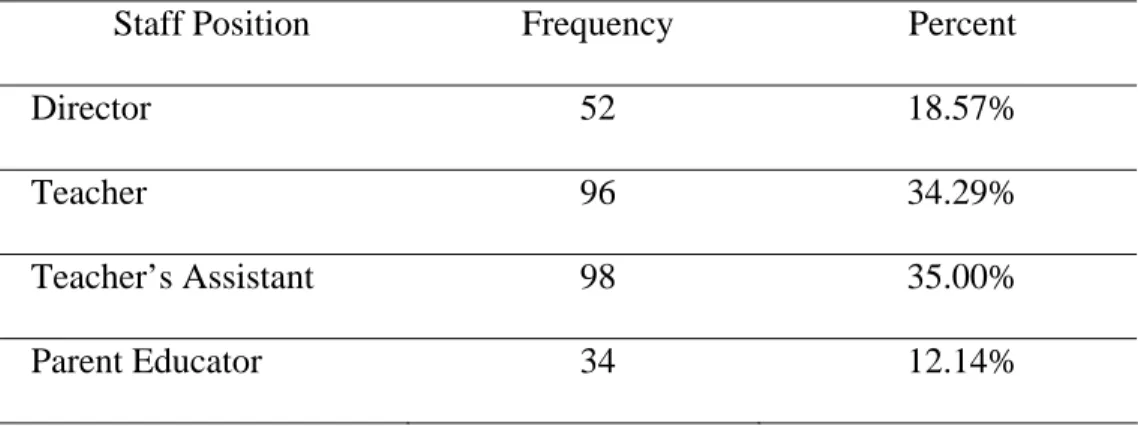
There were a total of 277 staff involved in data collection in this analysis. Of these staff, 52 were the director or lead teacher at their site, 96 were Early Childhood Education teachers, and 98 were Teacher Assistants or Teacher Aides. Thirty-four Parent Educators also participated in this intervention but are not included in this study. Staff at the sites varied considerably in education level, age, gender, ethnicity, and languages spoken. See Tables 1-2 for data on race/ethnicity and gender distribution for the