ORIGINAL ARTICLE
Convergent patterns in the evolution of mealybug
symbioses involving different intrabacterial
symbionts
Gitta Szabó
1, Frederik Schulz
1,4, Elena R Toenshoff
1,5, Jean-Marie Volland
2,
Omri M Finkel
3,6, Shimshon Belkin
3and Matthias Horn
11Division of Microbial Ecology, Department of Microbiology and Ecosystem Science, University of Vienna,
Vienna, Austria;2Department of Limnology and Bio-Oceanography, University of Vienna, Vienna, Austria and3Department of Plant and Environmental Sciences, The Alexander Silberman Institute of Life Sciences, Hebrew University of Jerusalem, Jerusalem, Israel
Mealybugs (Insecta: Hemiptera: Pseudococcidae) maintain obligatory relationships with bacterial symbionts, which provide essential nutrients to their insect hosts. Most pseudococcinae mealybugs harbor a unique symbiosis setup with enlarged betaproteobacterial symbionts (‘Candidatus Tremblaya princeps’), which themselves contain gammaproteobacterial symbionts. Here we
investigated the symbiosis of the manna mealybug, Trabutina mannipara, using a metagenomic
approach. Phylogenetic analyses revealed that the intrabacterial symbiont ofT. mannipararepresents
a novel lineage within the Gammaproteobacteria, for which we propose the tentative name
‘CandidatusTrabutinella endobia’. Combining our results with previous data available for the nested symbiosis of the citrus mealybugPlanococcus citri, we show that synthesis of essential amino acids and vitamins and translation-related functions partition between the symbiotic partners in a highly similar manner in the two systems, despite the distinct evolutionary origin of the intrabacterial symbionts. Bacterial genes found in both mealybug genomes and complementing missing functions in both symbioses were likely integrated in ancestral mealybugs before T. mannipara and P. citri diversified. The high level of correspondence between the two mealybug systems and their highly intertwined metabolic pathways are unprecedented. Our work contributes to a better understanding of the only known intracellular symbiosis between two bacteria and suggests that the evolution of this unique symbiosis included the replacement of intrabacterial symbionts in ancestral mealybugs. The ISME Journal(2017)11,715–726; doi:10.1038/ismej.2016.148; published online 16 December 2016
Introduction
Mealybugs (Insecta: Hemiptera: Pseudococcidae) are phloem sap-feeding insects, which harbor a unique intrabacterial symbiotic system within their bacter-iome, a large specialized organ in the abdomen. Bacteriocytes of most pseudococcinae mealybugs (Hardy et al., 2008) contain betaproteobacterial symbionts, which themselves host gammaproteobac-terial symbionts within their cytoplasm (von Dohlen et al., 2001). Similar to other plant sap-feeding
insects (Baumann, 2005; Moran et al., 2008), these bacterial symbionts provide essential amino acids (and vitamins) scarce in the phloem diet of the mealybugs (McCutcheon and von Dohlen, 2011). The monophyletic betaproteobacterial lineage, named Tremblaya, and the insect hosts show congruent phylogenies, indicating a single infection followed by long-term co-speciation in ancestral mealybugs (Fukatsu and Nikoh, 2000; Thao et al., 2002; Baumann and Baumann, 2005; Downie and Gullan, 2005; Gruwellet al., 2010). However,Tremblayawas likely infected by different enterobacterial precur-sors in different mealybug lineages, as suggested by phylogenetic analyses of the 16S and 23S ribosomal RNA genes of these secondary symbionts (Fukatsu and Nikoh, 2000; Thaoet al., 2002). Thus the unique nested symbiosis of mealybugs, also referred to as‘a bug in a bug in a bug’, likely emerged multiple times during evolution (Thaoet al., 2002).
To date, genome sequences of the symbiont pair of the citrus mealybug Planococcus citri (‘Candidatus Tremblaya princeps’ and ‘Candidatus Moranella Correspondence: G Szabó or M Horn, Division of Microbial
Ecology, Department of Microbiology and Ecosystem Science, University of Vienna, Althanstrasse 14, Vienna 1090, Austria. E-mail: [email protected] or [email protected] 4Current address: US Department of Energy (DOE) Joint Genome Institute, Walnut Creek, CA, USA.
5Current address: Zoological Institute, Department of Environ-mental Sciences, University of Basel, Basel, Switzerland. 6Current address: Department of Biology, University of North Carolina, Chapel Hill, NC, USA.
endobia’) (McCutcheon and von Dohlen, 2011; López-Madrigal et al., 2013) and the sole symbiont of the mealybug Phenacoccus avenae (‘Ca. T. phenacola’) that does not contain an intrabacterial symbiont have been determined (Husnik et al., 2013). These revealed an extreme reduction of Tremblayagenomes making them one of the smallest known (Moran and Bennett, 2014). More than one-fifth of the 139 kb chromosome of‘Ca.T. phenacola’ in P. citri is devoted to essential amino-acid biosynthesis, which is the central role of the symbiosis. However, Tremblaya in P. citri has lost several genes even in functions key for the main-tenance of the symbiosis (such as genes involved in translation and essential amino-acid synthesis), and its genome is still in the process of reduction. Its intrabacterial partner, Moranella is metabolically more versatile and can complement some of these missing functions, but operation of the symbiosis requires a substantial supply of metabolites and gene products from the mealybug host (McCutcheon and von Dohlen, 2011; Husnik et al., 2013; López-Madrigalet al., 2013).
Recent studies demonstrated a heterogeneous nature of contribution of the insect hosts in main-taining the symbiosis in aphids, psyllids and mealy-bugs, which is mediated by eukaryotic genes as well as genes of bacterial origin encoded in the insect genomes (Nikoh et al., 2010; Hansen and Moran, 2011; Husniket al., 2013; Sloan et al., 2014). It was suggested that bacterial genes were acquired by P. citri through ancient horizontal gene transfer events from a surprisingly diverse set of putative facultative bacterial symbionts. Genes of bacterial origin encoded in the mealybug genome seem to be overexpressed in the bacteriome and can bypass key reactions, for instance, in essential amino-acid and vitamin synthesis (Husnik et al., 2013). Thus the P. citri symbiosis requires a complex interplay between the insect host and its two bacterial symbionts, which also involves gene products of horizontally acquired bacterial genes encoded in the mealybug genome (McCutcheon and von Dohlen, 2011; Husnik et al., 2013).
Here we investigated the symbiosis of the manna mealybug Trabutina mannipara (Ben-Dov, 1988), inhabiting the leaves and branches of the salt-secreting desert tree tamarisk (Tamarix nilotica; Waisel, 1961; Qvit-Raz et al., 2008; Finkel et al., 2011). Tremblaya cells in T. mannipara harbor an apparently novel gammaproteobacterial symbiont. Using a metagenomic approach to investigate the T. mannipara system and comparing our data with those available for P. citri, we asked whether the nested bacterial symbioses involving different intra-bacterial symbionts in the two mealybug species display convergent patterns of evolution. Our results demonstrate that metabolic functions are partitioned in a highly complex yet surprisingly similar manner between the three symbiotic partners despite the polyphyletic origin of the intrabacterial symbionts in
the two consortia. Moreover, bacterial genes involved in essential amino-acid and vitamin pro-duction are present in both mealybug genomes and were likely laterally acquired before T. mannipara andP. citri diversified.
Materials and methods
Sample collection and microscopy
Egg sacs of the mealybug T. mannipara were collected from tamarisk (T. nilotica; Waisel, 1961; Qvit-Razet al., 2008; Finkelet al., 2011) in the Dead Sea area in Israel (31.271980°N, 35.215690°E). Mealybugs were transferred to Vienna while still attached to the tamarisk branches at ambient temperature. Egg sacs were stored at −80 °C for genomic DNA isolation.
We used fluorescence in situ hybridization, including an oligonucleotide probe specific for the 16S rRNA of the gammaproteobacterial symbiont of T. manniapara (Trabutinella-300: 5′-CAGTGTGGC TGTTTATCC-3′). Details on the fluorescence in situ hybridization procedure are given in Supplementary Information together with the light and transmission electron microscopic methods used for the visualiza-tion of the symbionts on semithin and ultrathin sections of the mealybug bacteriome, respectively.
Genome sequencing and assembly
Insects were dissected in 96% ethanol. Ventral sides of the mealybugs were opened and bacteriomes— usually showing up instantly as large and compact organs—were isolated by using fine forceps. Bacter-iomes of 15–20 individuals were collected by pipetting, pooled, washed twice and homogenized in 1 × TE using a plastic pestle prior to DNA isolation. High molecular weight DNA was extracted by a CTAB-based isolation method (Zhou et al., 1996) using 1.5 v/v% polyvinylpyrrolidone in the extraction buffer.
with 1216-fold coverage. The genome of the outer symbiontTremblayais currently represented by four contigs with an average 592-fold coverage. Further bacterial contigs were not detected with reasonable coverage. Excluding those sequences that could be mapped back on the genomes of the bacterial symbionts, we generated a draft genome of T. mannipara with a coverage of ~ 11-fold. Only contigs 41000 bp were used for further analysis. Genome sequences have been submitted to the European Nucleotide Archive and are available under the accession numbers LT594522, FLRF01000001– FLRF01000004 and FKYK01000001–FKYK01037035.
Annotation, functional and comparative analysis of the symbiont genomes
The putative origin of replication was set with GenSkew (http://genskew.csb.univie.ac.at/). Synteny and rearrangements between genomes were visua-lized by Mauve (Darlinget al., 2010).
We used an in-house pipeline, called ConsPred (Weinmaieret al., unpublished; available at https:// sourceforge.net/p/conspred/) for gene prediction and annotation. Detailed description of the annotation method is available in the Supplementary Infor-mation. Genome annotations were manually curated using the UniPro UGENE tool (Okonechnikovet al., 2012). In order to identify potential pseudogenes, intergenic regions and hypothetical proteins were submitted to blastx searches against the non-redundant protein database (nr) of the National Center for Biotechnology Information and the Uni-Prot Swiss-Uni-Prot databases. Uni-Protein domains were predicted according to the Conserved Domain Database (Marchler-Bauer et al., 2011) of National Center for Biotechnology Information. Pseudogenes were identified as remnants of genes, which are truncated or interrupted by internal stop codons and/or frameshifts showing high confidence (e-valueo1e-3) blast hits to proteins with defined functions. Regions with premature stop codons were identified as pseudogenes if their length wereo80% of the length of the reference sequences. Pseudogene coordinates were set according to the best blast hit against the Uniprot Swiss-Prot database.
Mobile genetic elements were checked by ISfinder (Siguier et al., 2006). Metabolic pathways were manually inspected using the Pathway Tools soft-ware (Karpet al., 2010) and the Ecocyc, Biocyc and Metacyc resources (Caspi et al., 2010). Clusters of orthologous groups shared by the relevant geno-mes or unique to the symbionts were identified by OrthoMCL using an 1e-5 e-value threshold (Liet al., 2003).
Phylogenetic placement of the symbionts
The relationship of the intrabacterial symbiont of T. mannipara with other symbionts of mealybugs was inferred by 16S rRNA-based phylogenetic
analysis. A Bayesian tree was calculated with MrBayes v3.2.6 (Ronquist et al., 2012), using the GTR+I+G model with 4gamma categories. Two runs each with four chains were performed. The propor-tion of invariable sites and the gamma shape parameter were estimated from the data. Chains were stopped when convergence diagnostics fell o0.03; 50% majority consensus trees were generated with a relative burn-in of 25%. Tree calculations were performed on the CIPRES Science Gateway v.3.3. web interface (Milleret al., 2010).
A phylogenomic approach was also employed to characterize the relationship of the gammaproteo-bacterial symbiont of T. mannipara to other insect symbionts and free-living bacteria within the Enter-obacteriaceae. For this, single copy marker genes were selected and aligned to the gammaproteobac-terial reference data set integrated in Phyla-AMPHORA (Wang and Wu, 2013). Poorly aligned positions were excluded by Gblocks 0.91b (Castresana, 2000) using the default settings apart from the followings: minimum length of a block: 5, allowed gap positions: with half. A Bayesian phylo-genetic tree was reconstructed from the concatenated alignment of 34 ribosomal proteins. We employed the CAT+GTR models (Lartillot and Philippe, 2004) as implemented in PhyloBayes MPI v1.6j (Lartillot et al., 2009, 2013) together with the Dayhoff 6 amino-acid recoding scheme, as suggested for phylogenetic reconstruction of symbiont lineages by Husníket al. (2011). Two chains were run until all discrepancies between the chains fell o0.1 and effective sample sizes were o100. The first 20% of the trees were discarded prior to generation of a majority consensus tree.
Phylogenetic trees were visualized with FigTree v1.4.1 (http://tree.bio.ed.ac.uk/software/figtree/) and iTOL (Letunic and Bork, 2011).
Identification of contribution of the insect host to selected bacterial pathways
We investigated the role of the insect host in the T. manniparasymbiosis based on previous results by Husnik et al. (2013) on the symbiosis of the mealy-bug P. citri. Protein/DNA sequences already avail-able for eukaryotic genes as well as genes of bacterial origin in theP. citrigenome were used as queries in tblastn/blastn searches against the draft genome of T. mannipara, respectively. Genomic regions corre-sponding to the subject sequences of the best significant blast hits (e-valueX1e-3) were extracted together with their flanking regions and were submitted for a blastx search against nr. Top hits (up to 100) were collected for each query and were used for phylogenetic analysis. Individual protein alignments were generated by the MAFFT L-INS-i algorithm (Katoh and Standley, 2013). Ambiguous positions were filtered with Gblocks as described above. Bayesian trees were generated in MrBayes v3.2.6 (Ronquistet al., 2012) as described for the 16S
rRNA-based analysis above, except that we applied the WAG+I+G model with 4gamma categories.
Results and Discussion
T. mannipara contains a novel intrabacterial symbiont The 16S rRNA of the betaproteobacterial symbiont of T. mannipara was most similar (97%) to ‘Ca. T. phenacola’ strains in other mealybugs, and its affiliation with the Tremblaya lineage was highly supported in the 16S rRNA-based phylogenetic analysis (data not shown). In contrast to the mono-phyletic origin of the primary symbionts of mealy-bugs, previous phylogenetic analyses of 16S and 23S rRNA genes suggested a polyphyletic origin of their secondary symbionts among the Enterobacteriaceae (Fukatsu and Nikoh, 2000; Thao et al., 2002). Consistent with this, our 16S rRNA-based analysis (Supplementary Figure S1) placed the inner sym-biont of T. mannipara in a well-supported cluster with those of other mealybugs (Melanococcus albiz-ziae,Australicoccus grevilleae,Amonostherium lich-tensioides and Antonina pretiosa) from the tribe Trabutinini (Hardyet al., 2008) with which it shared 90.3–92.1% sequence similarity. This group clus-tered with other insect symbionts and the inner symbionts of other Trabutinini mealybugs ( Paracoc-cus nothofagicola and Cyphonococcus alpinus) (Thaoet al., 2002), although the exact relationships among these clades remain unresolved. Moranella endobia, the intrabacterial symbiont of P. citri, formed a relatively closely related yet distinct cluster together with the secondary symbiont of Planococ-cus fiPlanococ-cus, in agreement with previous reports (Thao et al., 2002). Given its low degree of sequence similarity to known gammaproteobacterial species, the intrabacterial symbiont of T. mannipara repre-sents a novel lineage within the Enterobacteriaceae. We thus propose to tentatively classify these symbionts as ‘Candidatus Trabutinella endobia’ (according to Murray and Stackebrandt, 1995);
‘Trabutinella’ alluding to the mealybug host, T. mannipara; ‘endo-bia’ (‘inside-living’) referring to the intrabacterial lifestyle of this bacterium).
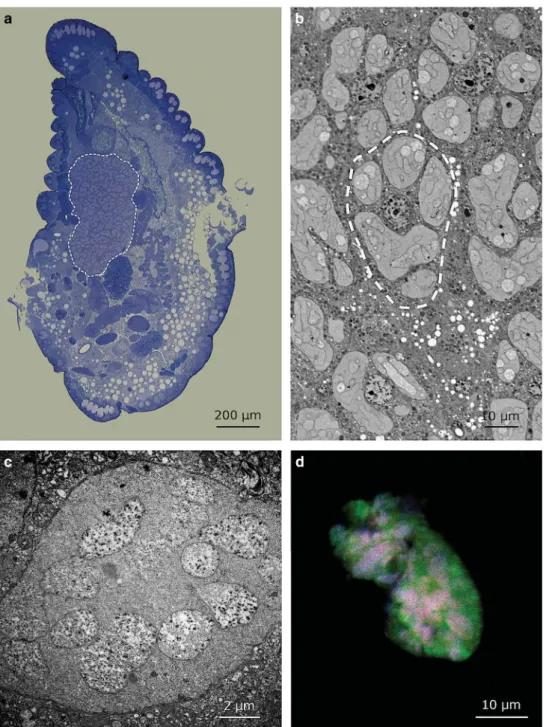
Fluorescence in situ hybridization using 16S rRNA-targeted-specific probes demonstrated that Trabutinella is present within the cells of Trem-blaya, which in turn are located in the bacteriocytes of T. mannipara (Figure 1d). Light and electron microscopic observations on sections of T. manni-para bacteriomes showed that the intrabacterial Trabutinella are polymorphic and have a size of
2–7μm in diameter (Figures 1a–c). Large (10–20μm
in diameter) cells of the outer bacterial symbiont Tremblayacontain up to 20Trabutinellacells within their cytoplasm.
The genomes of bacterial symbionts are often characterized by skewed nucleotide composition and rapid sequence evolution, which hampers phylogenetic analysis and may result in grouping
of unrelated taxa. Thus, in order to get further support for the relationship of Trabutinella and Moranellato other insect symbionts and free-living bacteria, we employed multilocus sequence data and advanced phylogenetic methods to overcome these biases, as suggested earlier (Husník et al., 2011). Phylogenetic analysis of a concatenated set of 34 ribosomal proteins (Figure 2, Supplementary Figure S2) showed that, although Trabutinella fell within the same monophyletic group as Moranella, they did not appear as sister taxa. This is consistent with our 16S rRNA-based analysis and confirms that the intrabacterial symbiosis in T. mannipara is a result of an infection of the Tremblaya cells independent from the one in P. citri. Trabutinella and Moranella were interleaved in a large group containing other facultative and obligate insect symbionts, such as Sodalis species, described as closest relative of Moranella (McCutcheon and von Dohlen, 2011), Baumannia in sharpshooters (Wu et al., 2006), Wigglesworthia in tsetse flies (Akmanet al., 2002) and Blochmanniain carpenter ants (Gilet al., 2003; Degnan et al., 2005; Williams and Wernegreen, 2010). Although a common origin of this diverse set of symbionts is still debated, this group is consistent with one of the major symbiont lineages among the Enterobacteriaceae, which could be distinguished in recent comprehensive phyloge-nomic analyses (Husníket al., 2011; Manzano-Marín et al., 2015). Taken together, our data showed that phylogenetically different bacterial symbionts have independently infectedTremblayaduring the evolu-tion ofT. manniparaandP. citri.
A highly conserved Tremblaya genome and loss of functions in the intrabacterial symbiont from T. mannipara
Five genes (leuB, leuC, leuD, iscS and fdx (puta-tive 2Fe-2S ferredoxin)) were present in the genome of Tremblaya from P. citri but were missing from the genome of the outer symbiont of T. mannipara. Among these, the leucine syn-thesis gene (leu) and the cysteine desulfurase
gene (iscS) were pseudogenized and thus were likely recently inactivated in Tremblaya from T. mannipara. This is further supported by the observation that a functional homolog for each of these genes was found in the Trabutinella genome.
Figure 1 (a) Light microscopic micrograph at low magnification of a longitudinal section of the mealybugT. mannipara. The bacteriome (outlined in white) occupies a considerable part of the insect abdomen. (b) Light microscopic micrograph at higher magnification of the bacteriome. One of the bacteriocytes is outlined in white. The bacteriocytes present central nuclei with large nucleoli, indicating high cellular activity. Individual bacteriocytes contain up to seven enlarged bacterial symbionts (Tremblaya) in highly amorphous shapes, which themselves harbor several polymorphic bacteria (Trabutinella). (c) Transmission electron microscopic observation of a single host bacterium (Tremblaya) containing several bacteria (Trabutinella) within its cytoplasm. (d) Localization of ‘Candidatus Trabutinella endobia’ within ‘Ca. T. phenacola’ cells as seen with fluorescence in situ hybridization. A general bacterial probe (in green), a gammaproteobacterial probe (in red) and aTrabutinella-specific probe (in blue) were used; cells ofTrabutinellaappear white–purple,
Tremblayagreen.
The genome of the intrabacterial symbiont Tra-butinella showed only minimal synteny with that of Moranella from P. citri, which is consis-tent with the distinct evolutionary origin of these symbionts. Remarkably though, the Trabutinella genome was substantially more reduced hav-ing a size of 298 471 bp compared with the 538 294 bp genome of Moranella (McCutcheon and von Dohlen, 2011). The chromosome of Trabutinella had a G+C content of 32.6%: encoded for 237 proteins, one rRNA operon, and 41 tRNA genes. This means a 440% reduction in the number of protein-coding genes compared with Moranella. Moreover, the Trabutinella gen-ome is likely still in the process of reduction as indicated by the presence of 27 pseudo-genes (a feature typically not seen in tiny genomes of obligate symbionts) (Moran and Bennett, 2014).
Similarly to other obligate insect symbionts with small genomes (Moranet al., 2008; McCutcheon and Moran, 2012), most of the Trabutinella genome is devoted to replication, transcription, translation and to its symbiotic role, which—based on pathway reconstructions—is the complementation of Trem-blaya with respect to essential amino-acid synthesis and vitamin provision of the insect host. In compar-ison toMoranella,450% decrease in the percentage of genes involved in the central metabolism, coen-zyme and lipid production, inorganic ion metabolism, transport mechanisms in general, cell envelope synthesis and cell division was observed (Supple-mentary Figure S3). For instance, whileMoranellais still capable of glycolysis and can convert pyruvate to acetate and build up its own NAD+ pool (López-Madrigal et al., 2013), Trabutinella lacks all these capabilities except for the last two glycolytic enzymes (eno, pykF). Unlike Moranella, Trabutinella has lost Figure 2 Phylobayes cladogram showing the affiliation of‘CandidatusTrabutinella endobia’, intrabacterial symbiont of the mealybug
T. mannipara, among Enterobacteriaceae. Insect symbiont lineages are colored in green. The complete phylogenetic tree with the original branch lengths is given in Supplementary Material (Supplementary Figure S2). The analysis is based on a concatenated set of 34 ribosomal proteins. Posterior probabilities are indicated on the internal nodes. Asterisks stand for posterior probabilities equal to 1. Nodes with a support of⩽0.5 are collapsed.
the genes for the SUF machinery of the [Fe-S] cluster biosynthesis (only sufA is present). However, [Fe-S] clusters might be still synthetized by the combined action of both symbionts, with the help of the products of iscS (encoded in Trabutinella), iscUand erpA (in Tremblaya) (Vinella et al., 2009). Moreover, Trabutinella has apparently also lost its transporters and maintained only a putative mechan-osensitive ion channel. This type of transporter, generally involved in the osmotic stress response, was also identified inMoranellaamong others. It has been proposed that mechanosensitive ion channels might facilitate the release of metabolites, perhaps even small proteins from Moranella, as skewed metabolic activity of the inner and outer symbionts might result in osmotic stress for the inner sym-biont (López-Madrigal et al., 2013; López-Madrigal et al., 2013).
Surprisingly, Trabutinella does not encode a single known gene responsible for generation of the cell envelope, while Moranella still harbors most of the genes required for fatty acid and lipolysaccharide synthesis, some genes for peptido-glycan synthesis and two rod shape-determining proteins (McCutcheon and von Dohlen, 2011; López-Madrigal et al., 2013). As Tremblaya does not possess any of these functions either, synthesis of the cell envelopes of both bacterial symbionts likely fully relies on metabolites derived from the insect host in theT. manniparasystem. A similar situation was described in mealybugs containing solely Tremblaya in psyllids, in whiteflies and in most members of the Auchenorrhyncha (Nakabachiet al., 2006; McCutcheon and Moran, 2010; Husniket al., 2013; Jianget al., 2013). However, how the process of insect host-mediated cell envelope synthesis is accomplished remains yet to be determined.
In accordance with the absence of cell wall synthesis genes,Trabutinellacells were polymorphic and appea-red often in highly amorphous shapes (Figure 1). On the contrary, the cells of Moranella are typically rod shaped (von Dohlen et al., 2001), although appar-ently degenerative forms were also observed in mealybugs closely related to P. citri (Koga et al., 2013). It has been proposed that P. citri might complement missing functions in the peptidoglycan synthesis and degradation in Moranella owing to products of nine genes of bacterial origin present in the insect genome (Husnik et al., 2013). Differential expression of those genes might serve to regulate the integrity ofMoranellacells and thereby the accessibility ofMoranellaproducts for the other symbiosis partners. In the absence of genes for peptidoglycan synthesis in both the bacterial symbionts and the T. mannipara draft genome, such a control mechanism seems unlikely to be at work in theT. manniparasymbiosis.
Bacterial genes in theT. mannipara genome
Out of the 22 genes of bacterial origin previously identified in the genome of the mealybug P. citri
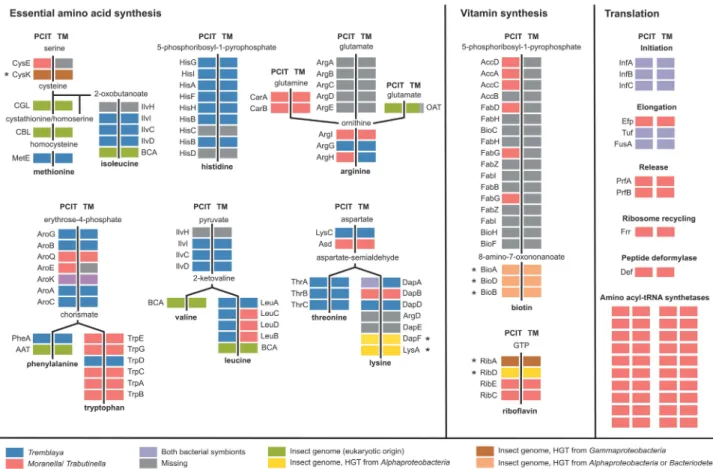
(Husniket al., 2013), a set of nine genes was found in the draft genome of T. mannipara. Eight genes showed high similarity (486% on the protein level) to their respective counterpart inP. citri, suggesting that their function is conserved and that they might be active inT. mannipara, as well. These genes are involved in essential amino-acid (cysK, dapF,lysA), biotin (bioA, bioB, bioD) and riboflavin (ribA,ribD) production (Figure 3). Function, putative origin and distribution of individual genes among the symbiosis partners in theT. manniparaversusP. citriconsortia are shown in Figure 3 (genes of bacterial origin encoded in the insect genomes are highlighted by asterisks).
One gene, tms1 (tryptophan 2-monooxygenase oxidoreductase), shared only moderate similarity (amino-acid sequence identity = 42.6%, similarity = 60.4%) with its equivalent inP. citri, and its FAD-binding domain seemed to be disrupted. This gene was found in two copies in theP. citrigenome, while only one was identified inT. mannipara. According to Husnik et al. (2013), tms1 was slightly over-expressed in the bacteriome. Its product is known to function in the bacterial synthesis of the phytohor-mone auxin, which is considered an important virulence factor in several plant-associated bacteria (Vallset al., 2006; Chenet al., 2007). The role oftms1 in mealybug symbioses remains unclear; however, the lower copy number and the disrupted functional domain found inT. manniparasuggest that this gene rather represents a non-functional relic of an ancient horizontal gene transfer event.
In addition, a ddlB (D-alanine-D-alanine ligase) pseudogene was found in theT. manniparagenome, which suggests that this bacterial gene has recently lost its function in this mealybug species. TheddlB pseudogene in T. mannipara contains frameshift mutations and internal stop codons, whileddlBwas intact and highly active in the bacteriome ofP. citri (Husnik et al., 2013). Degeneration of this gene, which is generally involved in peptidoglycan synth-esis, is consistent with the absence of other genes accountable for bacterial cell envelope synthesis in theT. manniparaconsortium.
Interestingly, all of the laterally acquired genes present inT. manniparaandP. citriand investigated here appeared as sister taxa in phylogenetic trees (Supplementary Figure S4). This indicates that they share a common origin and were present in ancestral mealybugs beforeP. citriandT. mannipara diversi-fied. In accordance with previous findings (Husnik et al., 2013), our analyses suggested known sym-bionts of insects as potential donors, including Alphaproteobacteria (lysA from Ehrlichia, dapF from Rickettsia,ribD fromWolbachia) and Gamma-proteobacteria(cysKfromSodalis,ribAfrom Arseno-phonus). The affiliation of bioABDinT. mannipara could not be clearly determined, as they grouped both with Cardinium and members of the Rick-ettsiales (similarly to P. citri). Tms1 was putatively acquired from Pseudomanas, Burkholderia or
Ralstonia species, microbes typically not found as symbionts of insects but encompassing auxin-producing plant-associated bacteria (Valls et al., 2006; Chen et al., 2007; Compant et al., 2008). Horizontal gene transfer from plant-associated bac-teria to insects has recently also been proposed for the silkworm Bombyx mori(Liet al., 2011).
High degree of convergence betweenT. mannipara and P. citri symbioses
Symbiotic partners of theT. mannipara andP. citri systems partition the synthesis of essential amino acids in a highly similar manner (Figure 3). Although the majority of genes responsible for essential amino-acid synthesis are encoded in the Tremblaya genomes, only histidine might be produced by the outer symbionts alone in both consortia. The bacterial partners together can produce tryptophan and threonine, while synthesis of other essential amino acids likely requires additional gene products from the mealybug hosts.
In detail, although the majority of genes for histidine synthesis are present in all Trem-blaya strains, the pathway is still incomplete in both symbiotic systems. Notably, Tremblaya of T. mannipara lacks exactly the same
histidine-synthetizing genes as Tremblaya of P. citri and Tremblaya phenacolainP. avenae. Our observations thus further support that this pathway is indeed active but functions by a yet unknown mechanism in mealybug symbioses (Husniket al., 2013).
The production of methionine, isoleucine, pheny-lalanine, arginine, valine and leucine likely requires products of eukaryotic genes (cystathionine beta (CBL)/cystathionine gamma (CGL), AAT, OAT, BCA), which were found in the T. mannipara genome, similarly toP. citri. These genes have also been identified in other insects, such as aphids (Hansen and Moran, 2011) and psyllids (Sloanet al., 2014), where they are typically overexpressed in the bacteriome compared with the rest of the insect body.
The synthesis of lysine and methionine seems to involve genes of bacterial origin present in both mealybug genomes (cysK,dapF,lysA). Similar to the synthesis of histidine, production of lysine is incomplete in both mealybug symbioses and might operate by a yet undetermined manner. The respec-tive genes are also missing in members of Auchenor-rhyncha (dapE) (McCutcheon and Moran, 2010) and in psyllids (argD) (Sloanet al., 2014), while the rest Figure 3 Convergent evolution of symbiotic roles in essential amino-acid synthesis, vitamin production and translation inT. mannipara
(TM) andP. citri(PCIT). Colored boxes show the distribution of individual genes among the three symbiotic partners in theT. mannipara
andP. citriconsortia. Data forP. citriwere taken from Husniket al.(2013). Asterisks highlight genes of bacterial origin encoded in the
T. manniparaandP. citriinsect genomes. These genes were likely obtained by horizontal gene transfer during ancient associations of mealybugs with bacterial symbionts affiliated with theAlpharoteobacteria,GammaproteobacteriaorBacteriodetes.
of the lysine synthesis pathway is encoded in the SulciaandCarsonellasymbionts, respectively.
It is striking that, in most of the essential amino-acid production pathways, exactly the same steps are carried out by the inner or the outer symbiont inT. mannipara and P. citri, despite the independent origin of the intrabacterial symbionts. For instance, intermediate genes in the chorismate synthesis are encoded in the inner symbionts, while the rest is present in Tremblaya in both systems (Figure 3). Moreover, the same genes are present exclusively in the inner symbiont in case of the synthesis of threonine and lysine. Altogether we found only five differences between the biosynthesis pathways for essential amino acids in the two consortia. (1)AroEin the chorismate (phenylalanine and tryptophan) synth-esis is missing in theT. manniparasystem, while it is present inP. citri. Lack of the shikimate dehydrogen-ase AroE despite the presence of all other genes in the chorismate synthesis has also been reported for psyllids, suggesting an alternate route which can bypass this gap in the pathway (Sloanet al., 2014). (2) The final enzyme of the arginine synthesis (argH) is encoded inMoranellain theP. citriconsortium while it was identified inTremblaya of T. mannipara. (3) Unlike inP. citri, dapA in the lysine synthesis does not exist in both symbionts but is only present in TremblayainT. mannipara. This is consistent with an increased reduction of functional redundancy in long-term symbioses. (4)Trabutinellacarries out three steps of leucine synthesis (leuCDB), which are encoded by the Tremblaya genome in P. citri; and (5) cysE in the cysteine (and methionine) synthesis seems to be missing from both symbionts of T. mannipara, while it was found in Moranella in P. citri. As the bacterial cysteine synthase CysK encoded in the T. mannipara genome seems to be intact, it might contribute to the metabolism of cysteine if the necessary precursors were present. Sequences similar to CGL and CBL lyases were also found in the draft genome of T. mannipara, similar to P. citri, aphids and psyllids (Hansen and Moran, 2011; Husniket al., 2013; Sloanet al., 2014). Thus cysteine might also be produced by the CGL activity from exogenous cystathionine, if that was available. Cystathionine, rather than cysteine might also be the substrate of the synthesis of methionine, as demonstrated by enzy-matic assays for pea aphids (Russell et al., 2013). In this scenario, CBL activity of the host converts cystathionine into homocysteine, which can be converted to methionine by the homocysteine trans-methylase MetE encoded inTremblayain case of both mealybugs. (Note that the insect host might also contribute to the production of methionine by the activity of a homocysteine S-methyltransferase, which was found in the genome of bothP. citri(Husniket al., 2013) and T. mannipara.). In addition, CGL might also have a role in the synthesis of isoleucine using homoserine, an alternative of cystathionine for 2-oxobutanoate production (Husnik et al., 2013; Russellet al., 2013).
In addition to essential amino acids, the cofactor riboflavin can also be produced in both mealybug symbiotic associations (Figure 3). Its synthesis is apparently performed in a similar manner in both consortia as it involves gene products from the gammaproteobacterial symbionts (ribEC) as well as insect host genes of bacterial origin (ribAD). The synthesis of biotin is carried out throughMoranella and horizontally transferred genes in the P. citri genome, although several steps are missing from that pathway. Interestingly, symbionts of T. mannipara do not encode any of the genes involved in this pathway, although remnants offabGZIare present as pseudogenes in the Trabutinella genome. Only the last three steps of the pathway might be carried out by bacterial genes encoded in the T. mannipara genome (bioADB), which could be used to build up biotin from 8-amino-7-oxononanoate, if that sub-strate would be available. This pathway is thus further reduced in the T. mannipara consortium compared withP. citri.
Similar toP. citri, the intrabacterial symbiont took over most of the translation-related functions in T. mannipara, including the ribosome-recycling factor, the peptide deformylase, the two release factors and all amino acyl tRNA synthetases. Only the three translation initiation factors (IF1–IF3) and two elongation factors (EF-Tu, EF-G) have been retained inTremblayaas well as the inner symbiont inT. mannipara, exactly similar toP. citri(Figure 3). As translation-related genes were present in the genome ofT. phenacola, which does not contain an intrabacterial symbiont, loss of these essential genes inTremblayaof bothT. manniparaandP. citriwas likely facilitated by the acquisition of the inner symbionts (McCutcheon and von Dohlen, 2011; Husnik et al., 2013). However, our data imply that genes required for the initiation and elongation phase of translation are not subject of further reduction but instead are maintained in Tremblaya to perhaps provide some sort of independent control over protein production between the two symbionts.
Conclusions
In most plant sap-feeding insects, usually one of the bacterial symbionts is responsible for complete or nearly complete synthesis of individual metabolites. The high degree of metabolic complementarity, that is, the step by step division of labor between the nested symbionts in mealybugs is unusual, and is likely the consequence of their intimate intrabacter-ial association (McCutcheon and von Dohlen, 2011). Gradual degradation of the inner symbionts and release of their metabolites might facilitate the exchange of metabolites between the symbionts, thus allowing for a more complex partition of individual pathways between the partners in this association (McCutcheon and von Dohlen, 2011; Husnik et al., 2013; Koga et al., 2013). The highly
congruent patterns of gene loss and metabolic complementarity observed in theT. manniparaand P. citri symbioses show that partition of the path-ways is apparently not random as certain steps are carried out by the same symbiont in the two systems
—despite the different evolutionary origin of the intrabacterial symbiont. A similar, yet far less complex situation has been observed among mem-bers of Auchenorrhyncha, whereSulcia synthesizes eight or seven essential amino acids while the remaining two or three are produced by different co-symbionts in different lineages, for instance. by Baumannia in sharpshooters, Hodgkinia in cicadas and Zinderia in spittlebugs (McCutcheon and Moran, 2010; Bennett and Moran, 2013).
A conceivable scenario explaining the observed similarities between the P. citri and T. mannipara symbioses would be that theTremblayaancestor was already infected by an (intra-)bacterial symbiont in ancestral mealybugs beforeP. citriandT. mannipara diverged. This ancient association would have facilitated reduction of the Tremblaya genome and has shaped its gene repertoire. We favor this scenario over alternative scenarios such as ancient co-obligatory or facultative associations of Tremblaya with another bacteriocyte-associated symbiont because of the high level of congruence between the loss of genes in different Tremblaya strains at intermediate steps of essential amino-acid synthesis pathways (such as in the synthesis of chorismate, lysine and threonine). These suggest that the pri-mordial bacterial symbiont likely had an obligatory status and was already located within the cytoplasm of Tremblaya (facilitating exchange of metabolites and gene products) in the progenitor of the two mealybug species. The inner symbiont might have been subsequently replaced in the ancestor of P. citri and/or T. mannipara, with the new symbiont taking over the functions required by Tremblayaand at the same time allowing for loss of further genes from the Tremblaya genome, which would account for the observed differences between the two systems.
In summary, the identification of novel bacterial symbionts of Tremblayain the mealybugT. manni-para and the genomic analysis of this consortium demonstrated an unexpected high degree of con-vergent evolution in these unique symbioses, in which—despite of the different evolutionary origin of one of the partners—both bacterial symbionts and the insect host act in concert in a highly complex manner. We also show that further reduction of essential functions in the already extremely deterio-ratedTremblayagenome is possible.
Note
A paper by Husnik and McCutcheon (Husnik and
McCutcheon, 2016) that appeared during the revision/ proof stage of this article demonstrated that symbiont replacement also occurred in other mealybug lineages.
Conflict of Interest
The authors declare no conflict of interest.
Acknowledgements
We thank Yair Ben-Dov for his help in identifying the sampling site and timing for collecting the mealybugs and Filip Husník for his guidance in the isolation of the bacteriomes. This study was funded by the Austrian Science Fund (FWF) project P22533-B17. Work in the Belkin laboratory (OMF and SB) was supported by United
States–Israel Binational Science Foundation grant
2010262.
References
Akman L, Yamashita A, Watanabe H, Oshima K, Shiba T,
Hattori M et al. (2002). Genome sequence of the
endocellular obligate symbiont of tsetse flies
Wiggle-sworthia glossinidia.Nat Genet32: 402–407.
Bankevich A, Nurk S, Antipov D, Gurevich AA, Dvorkin M,
Kulikov AS et al. (2012). SPAdes: a new genome
assembly algorithm and its applications to single-cell
sequencing.J Comput Biol19: 455–477.
Baumann L, Baumann P. (2005). Cospeciation between the primary endosymbionts of mealybugs and their hosts.
Curr Microbiol50: 84–87.
Baumann P. (2005). Biology bacteriocyte-associated
endo-symbionts of plant sap-sucking insects. Annu Rev
Microbiol59: 155–189.
Ben-Dov Y. (1988). Manna scale, Trabutina mannipara
(Hemprich & Ehrenberg) (Homoptera: Coccoidea:
Pseudococcidae).Syst Entomol13: 387–392.
Bennett GM, Moran NA. (2013). Small, smaller, smallest: The origins and evolution of ancient dual symbioses in a
phloem-feeding insect.Genome Biol Evol5: 1675–1688.
Caspi R, Altman T, Dale JM, Dreher K, Fulcher CA, Gilham F
et al. (2010). The MetaCyc database of metabolic pathways and enzymes and the BioCyc collection of
pathway/genome databases. Nucleic Acids Res 38:
D473–D479.
Castresana J. (2000). Selection of conserved blocks from multiple alignments for their use in phylogenetic
analysis.Mol Biol Evol17: 540–552.
Chen Z, Agnew JL, Cohen JD, He P, Shan L, Sheen Jet al.
(2007).Pseudomonas syringaetype III effector AvrRpt2
alters Arabidopsis thaliana auxin physiology. Proc
Natl Acad Sci104: 20131–20136.
Compant S, Nowak J, Coenye T, Clément C, Ait Barka E.
(2008). Diversity and occurrence ofBurkholderiaspp.
in the natural environment. FEMS Microbiol Rev 32:
607–626.
Darling AE, Mau B, Perna NT. (2010). ProgressiveMauve: multiple genome alignment with gene gain, loss and
rearrangement.PLoS One5: e11147.
Degnan PH, Lazarus AB, Wernegreen JJ. (2005). Genome
sequence of Blochmannia pennsylvanicus indicates
parallel evolutionary trends among bacterial
mutual-ists of insects.Genome Res15: 1023–1033.
Downie DA, Gullan PJ. (2005). Phylogenetic congruence of
mealybugs and their primary endosymbionts. J Evol
Biol18: 315–324.
Finkel OM, Burch AY, Lindow SE, Post AF, Belkin S. (2011). Geographical location determines the popula-tion structure in phyllosphere microbial communities of a salt-excreting desert tree.Appl Environ Microbiol
77: 7647–7655.
Fukatsu T, Nikoh N. (2000). Endosymbiotic microbiota of
the bamboo pseudococcid Antonina crawii (Insecta,
Homoptera).Appl Environ Microbiol66: 643–650.
Gil R, Silva FJ, Zientz E, Delmotte F, González-Candelas F,
Latorre A et al. (2003). The genome sequence of
Blochmannia floridanus: comparative analysis of
reduced genomes.Proc Natl Acad Sci100: 9388–9393.
Gruwell ME, Hardy NB, Gullan PJ, Dittmar K. (2010). Evolutionary relationships among primary endosym-bionts of the mealybug subfamily Phenacoccinae
(Hemiptera: Coccoidea: Pseudococcidae). Appl
Environ Microbiol76: 7521–7525.
Hansen AK, Moran NA. (2011). Aphid genome expression reveals host–symbiont cooperation in the production
of amino acids.Proc Natl Acad Sci108: 2849–2854.
Hardy NB, Gullan PJ, Hodgson CJ. (2008). A subfamily-level classification of mealybugs (Hemiptera:
Pseudo-coccidae) based on integrated molecular and
morphological data.Syst Entomol33: 51–71.
Husnik F, Nikoh N, Koga R, Ross L, Duncan RP, Fujie Met
al. (2013). Horizontal gene transfer from diverse
bacteria to an insect genome enables a tripartite nested
mealybug symbiosis.Cell153: 1567–1578.
Husnik F, McCutcheon JP. (2016). Repeated replacement of an intrabacterial symbiont in the tripartite nested
mealybug symbiosis. Proc Natl Acad Sci USA 113:
E5416–E5424.
Husník F, Chrudimský T, Hypša V. (2011). Multiple origins
of endosymbiosis within the Enterobacteriaceae (γ
-Proteobacteria): convergence of complex phylogenetic
approaches.BMC Biol9: 87.
Jiang Z-F, Xia F, Johnson KW, Brown CD, Bartom E, Tuteja JHet al.(2013). Comparison of the genome sequences of‘CandidatusPortiera aleyrodidarum’primary
endo-symbionts of the whitefly Bemisia tabaci B and Q
biotypes.Appl Environ Microbiol79: 1757–1759.
Karp PD, Paley SM, Krummenacker M, Latendresse M,
Dale JM, Lee TJ et al. (2010). Pathway Tools version
13.0: integrated software for pathway/genome infor-matics and systems biology.Brief Bioinform11: 40–79.
Katoh K, Standley DM. (2013). MAFFT multiple sequence alignment software version 7: improvements in
perfor-mance and usability.Mol Biol Evol30: 772–780.
Koga R, Nikoh N, Matsuura Y, Meng X-Y, Fukatsu T. (2013). Mealybugs with distinct endosymbiotic
sys-tems living on the same host plant. FEMS Microbiol
Ecol83: 93–100.
Lartillot N, Lepage T, Blanquart S. (2009). PhyloBayes 3: a Bayesian software package for phylogenetic
recon-struction and molecular dating. Bioinformatics 25:
2286–2288.
Lartillot N, Philippe H. (2004). A Bayesian mixture model for across-site heterogeneities in the amino-acid
repla-cement process.Mol Biol Evol21: 1095–1109.
Lartillot N, Rodrigue N, Stubbs D, Richer J. (2013). PhyloBayes MPI: phylogenetic reconstruction with infinite mixtures of profiles in a parallel environment.
Syst Biol62: 611–615.
Letunic I, Bork P. (2011). Interactive Tree Of Life v2: online
annotation and display of phylogenetic trees
made easy.Nucleic Acids Res, W475–W478.
Li H, Durbin R. (2009). Fast and accurate short read
alignment with Burrows-Wheeler transform.
Bioinfor-matics25: 1754–1760.
Li L, Stoeckert CJ, Roos DS. (2003). OrthoMCL: identifica-tion of ortholog groups for eukaryotic genomes.
Genome Res13: 2178–2189.
Li Z-W, Shen Y-H, Xiang Z-H, Zhang Z. (2011). Pathogen-origin horizontally transferred genes contribute to
the evolution of Lepidopteran insects.BMC Evol Biol
11: 356.
López-Madrigal S, Balmand S, Latorre A, Heddi A, Moya
A, Gil R. (2013). How does Tremblaya princeps get
essential proteins from its nested partner Moranella
endobiain the mealybugPlanoccocus citri?.PLoS One
8: e77307.
López-Madrigal S, Latorre A, Porcar M, Moya A, Gil R. (2013). Mealybugs nested endosymbiosis: going into the‘matryoshka’system inPlanococcus citriin depth.
BMC Microbiol13: 74.
Manzano-Marín A, Oceguera-Figueroa A, Latorre A, Jiménez-García LF, Moya A. (2015). Solving a bloody mess: B-vitamin independent metabolic convergence among gammaproteobacterial obligate endosymbionts
from blood-feeding arthropods and the leech
Haemen-teria officinalis.Genome Biol Evol7: 2871–2884. Marchler-Bauer A, Lu S, Anderson JB, Chitsaz F,
Derby-shire MK, DeWeese-Scott C et al. (2011). CDD: a
Conserved Domain Database for the functional
annota-tion of proteins.Nucleic Acids Res39: D225–D229.
McCutcheon JP, Moran NA. (2010). Functional conver-gence in reduced genomes of bacterial symbionts
spanning 200 My of evolution. Genome Biol Evol 2:
708–718.
McCutcheon JP, Moran NA. (2012). Extreme genome
reduction in symbiotic bacteria. Nat Rev Microbiol
10: 13–26.
McCutcheon JP, von Dohlen CD. (2011). An interdepen-dent metabolic patchwork in the nested symbiosis of
mealybugs.Curr Biol21: 1366–1372.
Miller MA, Pfeiffer W, Schwartz T. (2010), Creating the CIPRES Science Gateway for inference of large phylo-genetic trees http://www.phylo.org/ accessed 9 April 2016).
Moran NA, Bennett GM. (2014). The tiniest tiny genomes.
Annu Rev Microbiol68: 195–215.
Moran NA, McCutcheon JP, Nakabachi A. (2008). Geno-mics and evolution of heritable bacterial symbionts.
Annu Rev Genet42: 165–190.
Murray RGE, Stackebrandt E. (1995). Taxonomic note:
implementation of the provisional status Candidatus
for incompletely described procaryotes. Int J Syst
Bacteriol45: 186–187.
Nakabachi A, Yamashita A, Toh H, Ishikawa H,
Dunbar HE, Moran NAet al.(2006). The 160-kilobase
genome of the bacterial endosymbiont Carsonella.
Science314: 267.
Nikoh N, McCutcheon JP, Kudo T, Miyagishima S, Moran NA, Nakabachi A. (2010). Bacterial genes in the aphid genome: absence of functional gene transfer from
Buchnerato its host.PLoS Genet6: e1000827. Okonechnikov K, Golosova O, Fursov M. (2012). Unipro
UGENE: a unified bioinformatics toolkit.
Bioinfor-matics28: 1166–1167.
Qvit-Raz N, Jurkevitch E, Belkin S. (2008). Drop-size soda lakes: transient microbial habitats on a salt-secreting
desert tree.Genetics178: 1615–1622.
Ronquist F, Teslenko M, Mark P, van der, Ayres DL, Darling A, Höhna Set al.(2012). MrBayes 3.2: efficient Bayesian phylogenetic inference and model choice
across a large model space.Syst Biol61: 539–542.
Russell CW, Bouvaine S, Newell PD, Douglas AE. (2013). Shared metabolic pathways in a coevolved insect-bacterial symbiosis.Appl Environ Microbiol79: 6117– 6123.
Schmieder R, Edwards R. (2011). Quality control and
preprocessing of metagenomic datasets.Bioinformatics
27: 863–864.
Siguier P, Perochon J, Lestrade L, Mahillon J, Chandler M. (2006). ISfinder: the reference centre for bacterial
insertion sequences.Nucleic Acids Res34: D32–D36.
Sloan DB, Nakabachi A, Richards S, Qu J, Murali SC, Gibbs RAet al.(2014). Parallel histories of horizontal gene transfer facilitated extreme reduction of
endo-symbiont genomes in sap-feeding insects. Mol Biol
Evol31: 857–871.
Thao ML, Gullan PJ, Baumann P. (2002). Secondary
(γ-Proteobacteria) endosymbionts infect the primary
(β-Proteobacteria) endosymbionts of mealybugs
multi-ple times and coevolve with their hosts.Appl Environ
Microbiol68: 3190–3197.
Valls M, Genin S, Boucher C. (2006). Integrated regulation of the type III secretion system and other virulence
determinants inRalstonia solanacearum.PLoS Pathog
2: e82.
Vinella D, Brochier-Armanet C, Loiseau L, Talla E, Barras
F. (2009). Iron-sulfur (Fe/S) protein biogenesis:
phylogenomic and genetic studies of A-type carriers.
PLOS Genet5: e1000497.
von Dohlen CD, Kohler S, Alsop ST, McManus WR. (2001).
Mealybug β-proteobacterial endosymbionts contain γ
-proteobacterial symbionts.Nature412: 433–436.
Waisel Y. (1961). Ecological studies onTamarix aphylla.
(L.) Karst.Plant Soil13: 356–364.
Wang Z, Wu M. (2013). A phylum-level bacterial
phylogenetic marker database. Mol Biol Evol 30:
1258–1262.
Williams LE, Wernegreen JJ. (2010). Unprecedented loss of ammonia assimilation capability in a urease-encoding
bacterial mutualist.BMC Genomics11: 687.
Wu D, Daugherty SC, Van Aken SE, Pai GH, Watkins KL,
Khouri Het al.(2006). Metabolic complementarity and
genomics of the dual bacterial symbiosis of sharp-shooters.PLoS Biol4: e188.
Zhou J, Bruns MA, Tiedje JM. (1996). DNA recovery from
soils of diverse composition.Appl Environ Microbiol
62: 316–322.
This work is licensed under a Creative
Commons
Attribution-NonCommercial-ShareAlike 4.0 International License. The images or other third party material in this article are included in the article’s Creative Commons license, unless indicated otherwise in the credit line; if the material is not included under the Creative Commons license, users will need to obtain permission from the license holder to reproduce the material. To view a copy of this license, visit http://creativecommons.org/ licenses/by-nc-sa/4.0/