WHAT SHOULD I DO NOW?
IMPACT ON SELF-EFFICACY OF SEEING CONFLICTING MEDICAL INFORMATION ONLINE
Laura H. Marshall
A thesis submitted to the faculty of the University of North Carolina at Chapel Hill in partial fulfillment of the requirements for the degree of Master of Arts in the School of Journalism (Interdisciplinary Health Communication curriculum).
Chapel Hill 2013
Approved by:
Maria Leonora Comello Brian Southwell
ABSTRACT LAURA H. MARSHALL:
What Should I Do Now?
Impact on Self-Efficacy of Seeing Conflicting Medical Information Online Under the direction of Brian Southwell, M.A., Ph.D.
Increasing numbers of contradictory reports fill online media with conflicting advice or recommendations for health information-seekers. Recent examples include the
Acknowledgements
Table of Contents
List of Tables ... vi
List of Figures ... vii
Chapter One: Introduction and Background ... 1
Chapter Two: Literature Review ... 5
Chapter Three: Research Questions ... 18
Chapter Four: Methods ... 19
Chapter Five: Results ... 25
Research Question 1: Results ... 26
Research Question 2: Results ... 27
Research Question 3: Results ... 27
Chapter Six: Discussion ... 29
Appendix 1: Survey: Self-Efficacy and Conflicting Medical Messages in Social Media ... 37
Appendix 2: Graphics Used in Survey Groups ... 44
LIST OF TABLES
Table 1 Tukey Post-Hoc Mean Self-Efficacy ... 33
Table 2 Mean Self-Efficacy Scores by Group ... 34
Table 3 Mean Self-Efficacy by Conflict ... 34
Table 4 Mean Self-Efficacy by Harm Messages ... 34
Table 5 Gender as a moderator of harm impact ... 35
Table 6 Mean Intention Post-Exposure Sliding Scale ... 36
LIST OF FIGURES
Chapter One: Introduction and Background
The purpose of this thesis is to attempt to measure emotional responses to and the
impact on participants’ self-efficacy of contradictory online media reports about medical
research into cancer prevention. This is an important and little-studied field currently despite
the dramatic recent increases in availability of detailed medical information to lay readers
and the very public debates within the medical community about the usefulness of screening
tests and some treatments for serious illnesses and diseases such as cancer. A concept that is
generally well understood by academic and clinical researchers—i.e., that no single study is
authoritative on a given subject, and that the validity of study results varies according to a
given study’s methodology, structure, and breadth—is not necessarily as clear to the average
person who reads about or follows medical news and other information on mainstream
websites or via social media.
Considering that 80% of internet users look for health information while online, and
that “66% of internet users look online for information about a specific disease or medical
problem (perennially in the top spot) and 56% of internet users look online for information
about a certain medical treatment or procedure” (Fox, 2011), and that there are more than
14,400 medical journals listed in the National Institutes of Health’s List of Serials Indexed
for Online Users (LSIOU), the odds are great that Internet health information-seekers will find conflicting or contradictory information when they seek answers about their own health
provider-patient communication, Timimi (2012) described the rapid increase in availability of
research publications to a broad audience as “striking and profound.”
…our medical information has become more broadly and transparently available, leveling the patient-provider playing field as data increasingly moves to an open access model. Moreover, early access is no longer weighted towards healthcare providers, as late-breaking clinical trials are now often highlighted in publicly available press releases before they appear in peer-reviewed journals… (p. 2)
This thesis surveys health information-seekers to examine how brief, conflicting pieces of
medical information shared via social media such as Facebook and Twitter affect perceptions of
self-efficacy. Social media are increasingly important sources of information for adult health
information-seekers, as documented by the Pew Internet and American Life Project (Fox, 2011),
which found that one in four internet users living with high blood pressure, diabetes, heart
conditions, lung conditions, cancer, or some other chronic ailment says they have gone online to
find others with similar health concerns.
Of those who use social network sites (62% of adult internet users, or 46% of all adults): 23% of social network site users, or 11% of adults, have followed their friends’ personal health experiences or updates on the site. 17% of social network site users, or 8% of adults, have used social networking sites to remember or memorialize other people who suffered from a certain health condition. 15% of social network site users, or 7% of adults, have gotten any health information on the sites. (Fox, 2011, p. 2)
The time to study this subject is upon us because the number of news reports of medical
research and treatment recommendations is growing daily, and the availability of those reports
and the sources of the information contained within them are increasing with the growth in
availability to the average household of broadband access and concurrent use of the Internet.
Before online access became ubiquitous, an average consumer was far less likely to be
confronted with the incomprehensible volume of reports of medical research that are available
searchable in PubMed, the online database of the National Institutes of Medicine.
It’s unlikely the numbers of published reports—or consumers going online to find
them—will decrease from this point. At the same time, the generational shift that has changed
the demographic profile of the United States population means a greater percentage of people are
of an age that makes them more likely to have medical issues and, therefore, more likely to seek
or be receptive to medical information. According to U.S. Census data, more than a quarter of
the American population was aged 45 to 64 in 2010, an increase of 31.5% from the previous
census in 2000 (Howden & Meyer, 2011). As the proportion of older Americans grew, the
segment of the population aged 25 to 44 decreased by 3.4%. With those changes has also come
considerable shrinking of the digital divide between younger and older users of technology; a
study of online information-seekers performed by the Pew Internet and American Life Project
found that 89% of Americans aged 30 to 49, and 77% of those between 50 and 64, use the
Internet. “Health seekers are proportionally more middle-aged than very young or old, with the
highest proportions of usage showing up in those between the ages of 30 and 64” (Pew Research
Center, 2000).
Focusing on cancer screening and prevention as a topic that generates complicated and
conflicting news reports—reports that may influence the behavior of readers and viewers—is
supported by literature already prevalent in the medical research and health communication
communities. Both groups have been examining the issue in recent years, looking into the
impact of news reports on cancer prevention behavior, as in the 2010 publication of Niederdeppe,
Fowler, Goldstein, and Pribble, “Does Local Television News Coverage Cultivate Fatalistic
Beliefs About Cancer Prevention?” The authors cite statistics indicating prevailing attitudes
“Nearly half of U.S. adults agree that ‘It seems like almost everything causes cancer’
(pessimism), more than a quarter agree that ‘There’s not much people can do to lower their
chances of getting cancer’ (helplessness), and almost three in four agree that ‘There are so many
recommendations about preventing cancer, it’s hard to know which ones to follow’” (p. 230).
Chapter Two: Literature Review
The literature reviewed here explores the environments in which consumers search for
and absorb information online about health issues, and evaluates the mental and emotional
consequences that occur in lay readers who encounter contradictory information on health issues
that pertain to their own perceptions of risk of a given disease. This issue has become
particularly salient recently as the medical community has disagreed very publicly about the
value of screening tests for cancer, particularly mammography for breast cancer and the PSA test
for prostate cancer (Mazor et al., 2011). As of this writing, the American College of
Obstetricians and Gynecologists (ACOG), the National Cancer Institute (NCI) and the U.S.
Preventive Services Task Force (USPSTF) differ in their recommendations for mammography
screening, from recommending annual exams for all women over 40 (ACOG) to recommending
screenings every two years for women aged 50 to 74 (USPSTF). As well, the USPSTF’s
statement on breast cancer screening (U.S. Preventive Services Task Force, 2009) includes
reference to the potential harms of mammography screening, including this statement:
Harms of screening include psychological harms, additional medical visits, imaging, and biopsies in women without cancer, inconvenience due to false-positive screening results, harms of unnecessary treatment, and radiation exposure.
In the past few years conflicting medical and epidemiological research reports have been
widely publicized that support or refute long-held assumptions about cancer screening: that
prostate-community has debated the value of disseminating conflicting information to an audience that
may not be able to sort the truth for itself, with organizations such as ACOG changing its
mammography recommendations to expand the age groups covered even as other cancer
specialists believe health care consumers should decide for themselves which screening choices
to make.
At a joint hearing of the Senate Subcommittee on Public Health and the Committee on Appropriations, Fran Visco, president of the National Breast Cancer Coalition, called for a more open acknowledgment of the flaws of mammography. “Our goal should not be to provide a clear, simple message,” Visco said. “Our goal should be, ‘let’s find the truth about what will save women’s lives, and let’s get that information and those interventions to women.’ A clear, simple message, while comforting, is not necessarily correct.”
(Arnold, 2002)
Communication scholars have conducted studies of the effect of media reports of
changing cancer screening recommendations on the volume of online searching for information
about the disease. Weeks, Friedenberg, Southwell and Slater (2012) found that such news stories
do drive consumers to search engines such as Google in increased numbers, but that
“information seeking online does not equate with obtaining quality information or making good
personal decisions based on the information obtained” (p. 164). Seeking information, even
finding it, does not necessarily lead to better decision-making, and “mammography information
from unreliable sources (which often looks credible) may help tip the decisional balance, and
lead to a decision either not to act or not to act out of indecision” (Weeks et al., 2012, p. 164).
Some scholars have studied how perceptions of cancer risk have changed in recent years
(Han, Moser & Klein, 2007, and Haas et al. 2006), but few have looked specifically at the
immediate emotional and mental responses generated by seeing conflicting news reports of
medical research on a certain disease or treatment. As Nagler and Hornik state in their 2012
of information about the impact of such messages, and go on to state that “Decision theory and,
more specifically, the concept of ‘ambiguity’ as described by Ellsberg (1961) provides a
foundation for the link between contradictory information exposure and confusion” (Nagler and
Hornik, 2012, p. 58).
In 2011, Mankoff and colleagues published one of the few recent studies to directly
examine the issue of the mental and emotional impact on patients of encountering conflicting
online health information about a specific long-term illness. They found that Lyme disease
patients who discovered conflicting viewpoints within the medical community became frustrated
and disenchanted with the prevailing medical recommendations for treatment, and that
frustration “…drove participants away” (p. 8) from the accepted medical model of the disease
and its treatment recommendations. “From our interviews, it became evident that our participants
had encountered conflicting accounts of the disease online, particularly two prevailing
explanatory models of Lyme disease. … this contradiction has led to disagreements about the
diagnosis, treatment, and progression of prolonged Lyme symptoms” (Mankoff et al., 2011, p.
592).
Self-efficacy, sensemaking, and ambiguity aversion. Key concepts in the relevant literature pertinent to this project include self-efficacy as described by Bandura (1977);
sensemaking as described by Dervin (1998, 2001, 2012) and Duffy (1995, Sensemaking in
Classroom Conversations); and ambiguity aversion as theorized by Fox and Tversky in 1995 and
elaborated upon by Han in 2006 and 2009. These three concepts—self-efficacy, sense-making,
and ambiguity aversion—are important because they have to do with the processes health
information seekers go through in confronting conflicting information and determining what to
decisions about health behavior.
Self-efficacy has to do with whether one believes he or she is capable of modifying or
initiating a behavior to accomplish a certain outcome. According to Bandura (1977),
“expectations of personal efficacy determine whether coping behavior will be initiated, how
much effort will be expended, and how long it will be sustained in the face of obstacles and
aversive experience” (p. 191). This thesis postulates that contradictory information constitutes an
obstacle and contributes to aversive experiences when one seeks information online about
preventing illness or disease or simply maintaining good health.
Sense-making is what we try to do with information otherwise beyond our ken, described
by Brenda Dervin (1998) as an approach that “has from its inception conceptualized knowledge
and information as a verb.” Dervin postulates that “knowledge is the sense made at a particular
point in time-space by someone.” The concept includes the consumer of information in the very
making of knowledge, rather than imagining information as an external, unchanging entity
perceived the same way by every user of that information.
Ambiguity aversion, an idea that began taking shape in the 1920’s, relates to the human
mind’s desire to resolve situations rather than tolerate conflict. It has been applied to models of
risk-taking behavior and organizational change, and recently to coping behaviors of health
information seekers.
Self-Efficacy.
Self-efficacy, as defined by Albert Bandura in 1977, is “…the conviction that one can
successfully execute the behavior required to produce the [desired] outcomes.” Bandura’s work
differentiated self-efficacy from outcome expectations to show that having knowledge of the
motivate individuals to attempt behavior change. According to Bandura, “…individuals can
believe that a particular course of action will produce certain outcomes, but if they entertain
serious doubts about whether they can perform the necessary activities such information does not
influence their behavior.”
Bandura’s concept of self-efficacy is a key tenet of his Social Cognitive Theory (SCT),
which is used to explain how behavior change could be influenced by experiences of mastery
and perceptions of social norms and likely outcomes. The concept is key to health behavior
change campaigns. Bandura proposed the idea that how a given person feels about their ability
to effect change in their own behaviors directly influences whether they will attempt that
behavior change; that the perceived outcome expectancies they may have are not primary
influences over whether the change will be attempted but are dependent upon the person’s belief
that they are capable of making the necessary change. The factors of efficacy beliefs that affect a
person’s behavior include the level, strength, and generality of those beliefs, and outcomes are
affected by the physical, social, and self-evaluative expectancies of the individual.
Bandura also said, “If people lack awareness of how their lifestyle habits affect their
health, they have little reason to put themselves through the misery of changing the bad habits
they enjoy” (Bandura, 1998). This idea relates well to the topic of sense-making, in that it
references the importance of awareness and understanding of health messages a person
encounters and perceives as relevant to their own situation.
Sense-Making.
Dervin’s concept of sense-making as a process of bridging gaps in knowledge posits the
idea that information is less a static, objectively describable entity—a set of hard, cold facts—
conceives it, is dependent on the information consumer’s own creation of knowledge via their
ideas and cognitions, their experiential “filters,” and their emotional and mental framing of found
information based upon personal time-space moments and situations. Dervin compares the idea
of sense-making to the long-established “rigidity” of conceiving of knowledge as an immutable
thing separate and distinct from the human beings who utilize it (Dervin, 1998).
Once upon a time, in the western tradition at least, it was thought that information/ knowledge could describe and fix reality and that transferring that valuable resource into the minds of participating humans would enable them to act effectively in their work and life environments. (Dervin, 1998, p. 37)
Dervin’s concept of gap-bridging sees the information user as being in constant motion,
and likely to repeat previously successful methods of bridging information gaps using “thoughts
and answers and practices from the past” (Reinhard and Dervin, 2012, p.32). In other words,
when confronted with a gap in knowledge, or information that does not immediately make sense,
a person is likely to rely on previous sense-making practice to bridge the gap and proceed to their
desired outcome.
Ambiguity Aversion.
Ambiguity aversion, the third key concept in this review, can be traced to experiments in
the 1920’s (Knight, 1921) and to work by Ellsberg in 1961 in which people were asked to
gamble on the percentages of a given color of balls in an urn. Fox and Tversky (1995) wrote of
Ellsberg’s work that “…people's willingness to act in the presence of uncertainty depends not
only on the perceived probability of the event in question, but also on its vagueness or ambiguity”
(p. 586). When Han, Moser and Klein applied the concept of ambiguity aversion to cancer
prevention recommendations in 2006, they found that “…perceived ambiguity about cancer
prevention recommendations may have broad and important effects on other health cognitions”
around various cancer prevention and screening procedures, including whether tests for
prostate-specific antigen (PSA) are truly helpful in preventing prostate cancer and how effective
mammograms are in preventing breast cancer in women. They found a positive relationship
between perceived ambiguity about cancer prevention and both worry about cancer and the
perceived risk of contracting the disease; in other words, the more confused a person was about
how to prevent one of the cancers studied by the authors, the higher their level of worry about
the disease and the higher their perception that they were at risk of it. Han, Moser and Klein
(2006, 2007) posited the potential for increased levels of pessimism, resignation and helplessness
in people presented with conflicting information on cancer prevention, despite the medical
community’s likely belief in an ethical duty to promote informed decision-making and
thoroughly inform and educate the public.
In The Paradox of Choice, Schwartz (2005) cites studies indicating that too many
choices—too much information to sort and understand—can effectively stultify a person’s ability
to make a decision. Faced with conflicting information and asked to choose which treatment
they would prefer, cancer patients frequently defer the decision to their physicians: “When it
comes to medical treatment, patients see choice as both a blessing and a burden.” As Schwartz
points out, “knowing what we want means, in essence, being able to anticipate how one choice
or another will make us feel, and that is no simple task.” For the average health information
consumer, the task is perhaps more daunting than the consumer shopping choices Schwartz
writes about, because how we will feel in health care situations also has to do with the more
serious consequences of morbidity and mortality. When the choices or information contradict
each other, and the question we are trying to answer is complex, that inability to decide may
screening test or take a specific treatment when even medical professionals—far more informed
on these issues than I—can not agree about the value of the test or treatment, even whether it
might in fact do me harm?
Mainstream consumer media recognize the quandary posed by overabundance of choice
when a decision becomes imperative. Writing for a Canadian fashion magazine, author Michele
Sponagle mentions Schwartz and interviews a psychotherapist for another point of view.
If we're stymied by shopping decisions, it's no wonder we have a difficult time making tougher ones surrounding issues like relationships, careers, family, finances or health. Indecision is not a good place to be, according to psychotherapist Andrea J. Moses with Toronto Psychotherapy. ‘You feel bad and you beat yourself up mentally. You get into a cycle where you feel weaker and weaker. You end up trusting yourself less and your self-confidence suffers.’ (Sponagle, 2010)
Online information-seeking; online news sources and social media. The importance of examining online health information-seeking behavior in evaluating whether contradictory
information has a negative impact on information seekers is evident in much recent literature
examining where health consumers go to find information about a given disease or procedure.
Pew’s Internet and American Life Project points out that 4 in 5 Americans use the Internet and
many use multiple devices to access online information. “Currently, 88% of American adults
have a cell phone, 57% have a laptop, 19% own an e-book reader, and 19% have a tablet
computer; about six in ten adults (63%) go online wirelessly with one of those devices” (Zickuhr
& Smith, 2012).
Pew researchers have also found that 80 percent of internet users seek health information
online, and most are looking for information about a specific disease or procedure. A recent
report by the Pew Internet and American Life Project on social media and health
information-seeking and –sharing highlights the need many health care consumers feel to reach out to peers
health is being driven forward by two forces: 1) the availability of social tools and 2) the
motivation, especially among people living with chronic conditions, to connect with each other”
(Fox, 2011, p.3). What that information tells us is that non-experts who seek information about
health and medicine are likely to do it away from a medical professional’s office, either at home,
in a library, or in a non-medical environment where the information they find and consume is not
interpreted or explained for them by professionals who can then help them apply that information
to their own situations and lives in a relevant or meaningful way.
Scholars in the fields of medicine, psychology and media studies point out in the
literature on decision-making and the impact of conflicting news media coverage of medical
issues that (1) news stories about medical or health sciences research can and do have an impact
on the behavior of patients or potential patients (Haas et al., 2007); (2) the complexities of
research results are often communicated poorly in media reports of such research (Han, 2006,
2009), and (3) when advice presented to potential patients contradicts itself, decision-making on
the part of health information seekers is affected in such a way as to stymie their efforts to
improve their own health outcomes (Sillence, Briggs, Fishwick & Harris, 2004; Passalacqua et
al., 2004; Mankoff, Kuksenok, Rode, Kiesler & Waldman, 2012).
Haas and colleagues (2007) looked at associations between newspaper coverage of new
medical evidence (specifically in regard to the Women’s Health Initiative studies of menopausal
hormone therapy, or HT, and its newly-discovered risks in 2002) and changes in medication use.
The authors found that women who lived in areas with “more newspaper coverage about the
harmful effects of HT had greater declines in HT use” (p. 72) They also found, however, that a
single reading of such an article did not have a great impact on behavior change; it took
medications’ efficacy and a subsequent change in behavior.
Haas and colleagues (2006) also found that the character and focus of news articles about
the hormone studies changed when the new results were published. In particular, they wrote that
one-third of articles published after the results of the WHI study did not include “a specific
qualitative or quantitative assessment of risks of HT” (p. 308) despite an increase in the
presentation of such tools during the month of the publication of the study (Haas, Canales,
Ballard-Barbash, Geller, Miglioretti, Buist et al., 2006). While their focus was not primarily the
impact on audiences of such coverage frames, the authors did write, “A small survey of women
from North Carolina found that every woman reported having heard of the EPT-WHI study, and
half reported that it had affected their use of HT” (p. 308).
Online trade publications and weblogs are aware of the viral nature much health news
exhibits when it is shared via social media. In a blog that follows digital media and its impact on
healthcare practices, one author wrote of shared research news: “where I see these things come
up first is on Twitter where there’s an echo chamber effect of people sharing the same story back
and forth and with hashtags that make it simple to follow along” (Evans, 2011).
Communicating uncertainty. Several authors discussed the difficulty of
communicating uncertainty about the benefits of a given health treatment or behavior. Paul Han,
of the National Cancer Institute, has written extensively on ambiguity aversion and medical
decision-making. Han wrote of the complexity of communication of uncertainty and the
underlying factors that affect how individuals perceive personal levels of risk when cancer risk
ranges were described. Personality characteristics and other factors were found to influence how
recipients of mixed messages accepted them. Han found that “ambiguous health information
from targeted efforts to improve their capacity to understand and cope with such information”
(Han et al., 2009, p. 567).
A German theologian, Breitsameter, wrote in 2010 about the ideal of informed medical
decision-making as an “illusion” saying that “…it is often difficult for patients to deal with
uncertainty and often that is the reason why they succumb to an illusion of certainty” (p.349).
Mazor and colleagues found that messages about prevention of and screening for cancer were
frequently misunderstood by viewers and readers of news media.
…spoken messages about cancer prevention and screening are frequently misunderstood. Comprehension of key concepts was found to be highly variable. While some participants expressed a clear understanding of the ‘gist’ of the messages presented in the video clips used here, a number of significant ‘verbatim’-level misunderstandings were noted. (Mazor, Calvi, Cowan, Costanza, Han, Greene et al., 2010, p. 139)
Mazor’s study also found that misunderstanding of risks communicated in news reports
“…could have other negative effects, including diminishing people’s sense of well being, and
promoting feelings of helplessness” (p. 139).
Effects of media reporting on decision-making. A study in Italy (Passalacqua et al., 2004), focused on how news reports of a controversial cancer treatment that was later debunked
affected the perception of cancer patients that they could trust research results or understand
media coverage of health research. The survey queried patients at oncology centers before and
after carefully conducted clinical trials debunked an alternative method of treating cancer known
as the “Di Bella Therapy,” or DBT. DBT mixed existing prescription medicines with vitamins,
melatonin and other drugs and carried a per-patient cost of as much as 5,000 U.S. dollars per
month. Passalacqua’s surveys showed “the enormous influence of the media on patient feelings”
(p. 1078) and found “serious inadequacies in physician-patient relationships” (p. 1078) that
inferences represent misunderstandings, they are ethically problematic and could have other
negative effects, including diminishing people’s sense of well being, and promoting feelings of
helplessness” (p. 139). Mazor and colleagues looked at how well people understood cancer
screening and prevention messages in video clips in an effort to evaluate comprehension of
spoken information pertaining to disease risk and avoidance.
Confusion engenders avoidance. Focusing particularly on cancer risk communication, Han (2006) wrote that ambiguity aversion (AA) can be associated with certain demographic
characteristics, but that the profiles he came up with sometimes defied straightforward linear
progression. In one study, he found that “AA was associated with non-White race, lower
education, and lower income. Ambiguity aversion … also was associated with older age,
although a more complex curvilinear relationship was evident, with the youngest respondents
also demonstrating greater AA” (Han, Reeve, Moser & Klein, 2009, p. 566).
What Han and colleagues found with cancer patients confronted with conflicting
information about the effectiveness and importance of screening was that ambiguity could, itself,
increase patients’ perceptions of their own health risks—whether or not there was a factual basis
for them to have that greater fear. Feeling unable to understand conflicting information, patients
would default to imagining themselves to be at greater risk of disease. Ambiguity thus had “a
strong negative relationship with perceived cancer preventability, consistent with ‘ambiguity
aversion’—a pessimistic bias in the interpretation of ambiguity. Cancer worry moderated this
relationship; ambiguity aversion increased with higher levels of worry” (Han et. al., 2006, p. 51).
Einhorn and Hogarth (1986) looked more generally at ambiguity and its impact on
decision-making in non-medical situations, including purchases of insurance and warranties.
situation from a familiar vantage point, their “anchor,” in order to lower stress levels and
understand their own risks or “weight” the probability of an unfavorable outcome. “The basic
idea underlying the ambiguity model is that people use an anchoring-and-adjustment strategy in
which an initial probability is used as the anchor (or starting point) and adjustments are made for
ambiguity. The anchor probability can come from a variety of sources; it may be a probability
that is salient in memory, the best guess of experts, or a probability that is otherwise available”
(Einhorn & Hogarth 1986). The problem for non-clinicians seeing or reading journalistic
interpretations of medical texts may be that those “anchors” do not exist, or that the reports they
read challenge the solidity of the anchor and create perceptions of risk and uncertainty not based
Chapter Three: Research Questions
RQ1: What is the effect of exposure to conflicting messages about cancer screening information
on an individual’s self-efficacy regarding the ability to take positive action to manage health?
RQ2: What is the effect of exposure to messages that include the possibility of harm caused by
cancer screening on an individual’s self-efficacy regarding intention to take positive action to
manage health?
RQ3: Does the effect of exposure to messages that conflict or indicate potential harm depend
Chapter Four: Methods
This study was a between-groups experiment with random assignment to one of four
conditions, those conditions being:
1. Exposure to social media messages with conflicting recommendations about use of
the cancer screening tests mammography (for female subjects) or
prostate-specific antigen (PSA) for male subjects that include both a supporting
message and another containing the element of harm. This is the
“conflict:harm” study group.
2. Exposure to two sets of non-conflicting social media messages supporting the use the
cancer screening tests listed in item #1. This group is called “no conflict” in
the study results.
3. Exposure to social media messages with conflicting recommendations about use of
the cancer screening tests listed in item #1 without inclusion of the element of
harm, showing a combination of messages that support current screening tests
with messages that claim the tests are ineffective. This group is called
“conflict:no harm” in the study.
4. Exposure to social media messages with conflicting recommendations about use of
the cancer screening methods mammography and PSA testing that include a
neutral message and another containing the element of harm. This group is
Study Design. A Qualtrics survey was used to query participants about their sources of
health information and their use of the Internet and online social media. Two questions asked
about information sources for answers to personal health questions, two questions queried
participants about their general computer and Internet use, and five questions asked respondents
whether and how often they had used the Internet and social media to find any information,
including information about their own or someone else’s health. Because a cancer diagnosis can
be emotionally traumatic, and the author preferred not to risk additional emotional trauma by
exposing cancer patients to potentially disturbing images and information about the disease,
survey respondents were queried about any previous diagnosis of cancer and those responding
positively were thanked for their participation and “skipped” to the end of the survey rather than
potentially being exposed to questions that might depict harm from cancer screening tests
Participants. After answering the preliminary and screening questions, a total of 200
participants, 112 men and 88 women aged 31 and older, were queried before and after their
exposure to very brief reports of health information as might be shared via Facebook posts or
140-character Twitter “tweets.” (Appendix 2.) Participant age groups were defined as Under 20,
21 to 30 years old, 31 to 45 years old, 46 to 60 years old, and 61 and over. In initial screening
questions, participants who answered “younger than 20” or “21 to 30” were excluded from
analysis. The target audience was intended to include the demographic age range most likely to
have awareness of and potential concern about cancer risks, i.e. middle-aged adults, defined as
the group between 30 and 60 years old. This age range is also the group most likely to seek
health information online, as reported by the Pew Internet and American Life Project in 2000
(Fox, 2011).
measuring perceived response efficacy from the Risk Behavior Diagnosis (RBD) scale
developed by Witte, Cameron, McKeon & Berkowitz in 1996. The items from the Witte
inventory included in the survey used for this study were:
1. “I am able to take appropriate measures to prevent this kind of cancer.”
2. “Preventing the kind of cancer mentioned in these posts is easy to do.”
3. “It’s easy to take the right steps to prevent the cancer mentioned in these posts.”
4. “Screening tests like these work to prevent cancer.”
A composite variable was created by taking the means of the four items from Witte’s
RBD inventory. Each of the inventory items used a 1 to 5 scale intended to measure self-reported
decrease or increase in feelings of efficacy post-exposure. Participants chose potential answers
for each item from a low of 1, meaning “I feel a lot less than before” to a high of 5, or “I feel a
lot more than before.” Cronbach’s Alpha for the scale measured .883, indicating a high level of
reliability of the items.
The RBD inventory was theoretically guided by the Extended Parallel Process Model or
EPPM (Witte, 1992), which posits that particular health behaviors, mediated by perceptions of
susceptibility and severity as well as efficacy, ensue from fear appeals in health campaigns.
“When health risk messages backfire, it is usually because these messages have induced the
emotional fear control process instead of the cognitive danger control process” (Witte et al., 1996,
p. 321). Two constructs of the EPPM relevant to this thesis are that people with high
self-efficacy are more likely to engage in “danger control” behaviors, taking measures to lower their
perceived susceptibility to a threat, and that those with lowered self-efficacy engage in “fear
control” by denying the threat or otherwise engaging in behaviors that mitigate their perceptions
Three additional items were created for this survey to attempt measurement of intention
to take action to prevent cancer following randomized exposure to the social media couplets.
Two items used a three-point scale to measure intent, where feeling “not at all” clear about
appropriate measures or ability to take such measures equaled 1 and “very” clear and able
measured 3. The items asked: “How did the information you saw in the Facebook and Twitter
posts make you feel about your ability to prevent this specific kind of cancer?” Respondents
were asked to rank how they felt on a 1 to 3 scale both “Clear about what I need to do,” and
“Able to take measures to prevent cancer.” Cronbach’s Alpha for these measures equaled .924.
The third item used a sliding scale of 1 to 9 in response to the question, “After seeing these posts,
do you feel that you will be able to prevent the specific cancer mentioned?”
Survey respondents were solicited via numerous social media and networking sites,
including Facebook, Twitter, LinkedIn and sites focused on specific content or topics (two social
networking sites for woodworkers were included to ensure an adequate representation of male
respondents) as well as email invitations via personal contacts and listservs and snowball
sampling (sharing the survey’s URL with friends and acquaintances) by those who chose to
respond. An additional 100 participants were recruited via Qualtrics.
Participants were asked about their use of Internet resources to gather information about
health issues. Individual survey items also queried each respondent as to their perceived risk of
cancer and concern about health risks in general. Participants were grouped by gender so as to
target women with questions about breast cancer screening and risk factors, and men with
questions relating to prostate cancer screening and risk factors.
256 participants completed the first twelve questions in the survey, intended to measure
inquiring specifically about the two most frequently used sites, Facebook and Twitter.
Participants were also given the option to name other social media sites they use. Two items also
measured recall of and emotional responses to encounters with contradictory health information
items users had previously seen online.
Stimuli. 200 subjects who responded that they had not had a cancer diagnosis moved
through the randomization process, which first divided study subjects by gender and then
randomized participants into one of four groups shown four similar social media posts. (See
page 19 of this document.) Each group saw two mocked-up examples of Facebook “shares” and
Twitter “tweets.” The shares and tweets used icons created for this study that appeared to
represent medical information sources, including clip art of either a caduceus or a stethoscope,
with “Medical Research News” and “JAME” the fabricated information sources for each item.
Respondents were randomized into groups that saw two “shares” and two “tweets,” with each
couplet (one share plus one tweet) containing similar information. 49 study participants in the
control group saw couplets that agreed about the positive value of either mammograms (for
female respondents) or prostate-specific antigen (PSA) tests (for male respondents) to lower the
risk of late-stage cancer; the other groups saw couplets that disagreed. One study variable
measured by these disagreements was that of perception of severity, as the items included or
excluded the element of potential harm. The other variable was the key construct of the
hypothesis informing this study; whether contradictory information then decreased a
participant’s perception of self-efficacy as to preventing the specific cancer referenced in the
survey items.
Of the experimental couplets, one group of 49 participants saw images contrasting a news
effectiveness of the test but no harm. 52 study participants saw content that showed a direct
conflict, showing first that the specific cancer screening test could help prevent late-stage cancer
and then that it could do harm. The final group of 50 survey respondents saw content that
contrasted a couplet indicating effectiveness of the test with another couplet showing evidence of
lack of effectiveness. (Examples of the graphics are in the survey questionnaire included in the
Appendix.)
Measures. The independent variables in this experiment are exposure to health
information via brief social media posts and the severity of conflict of those messages; the
dependent variable is the viewer’s perceived self-efficacy in respect to ability to manage one’s
health in light of the information presented. Moderating factors include the gender of the viewer;
the topic and its relevance to the viewer; and the introduction of the possibility of harm caused
by making a “wrong” decision. The control group saw stories that agreed in supporting the
effectiveness of the cancer screening tests that are the focus of the content shared in the
mocked-up social media posts (e.g. mammography and prostate-specific antigen or PSA testing).
Chapter Five: Results
A total of 200 participants, 112 men and 88 women aged 31 and older, responded to the
survey’s inventory on self-efficacy. 45 percent of the respondents were aged 46 to 60; 36
percent were 31 to 45 years old; 19 percent over 61. (Fig. 1.) The research hypothesis that
self-efficacy (SE) would be affected by seeing conflicting information about the benefits or hazards
of a specific health behavior in online social media sources such as Facebook and Twitter seems
to be supported by the data analyzed in this study. A one-way between-groups analysis of
variance was conducted to explore the impact of contradictory messages about cancer screening
tests on feelings of self-efficacy regarding ability to prevent the cancer mentioned in each
example seen by participants, using Witte’s inventory items. There was a statistically significant
difference at the p < .05 level in Witte scores for the four groups: F (3, 196) = 7.02, p = .0005.
To follow up on the significant F test, we examined contrasts between all pairs of groups to see
where significant differences existed. Tukey post-hoc comparisons found significant differences
between the “no conflict” group and the “conflict: no harm” group, between the “no conflict”
group and the “conflict:no positive” group, and between the “conflict:harm” group and the “no
Group mean self-efficacy mean intention*
1. conflict/harm 3.0 c 5.0
2. no conflict 3.4 a,b,c 4.1
3. conflict/no harm 3.0 a 3.9
4. conflict/no positive 2.7 b 4.4
any positive 3.1 4.5
any negative 2.9 4.0
conflict 2.9 4.1
no conflict 3.4 5.0
a = statistically significant difference between groups 2 and 3 of p <.05; b = statistically significant difference between groups 2 and 4 of p <.05; c = statistically significant difference between groups 1 and 2 of p <.05 * = intention measure used sliding scale of 1 to 9, with one indicating least intention and 9 most.
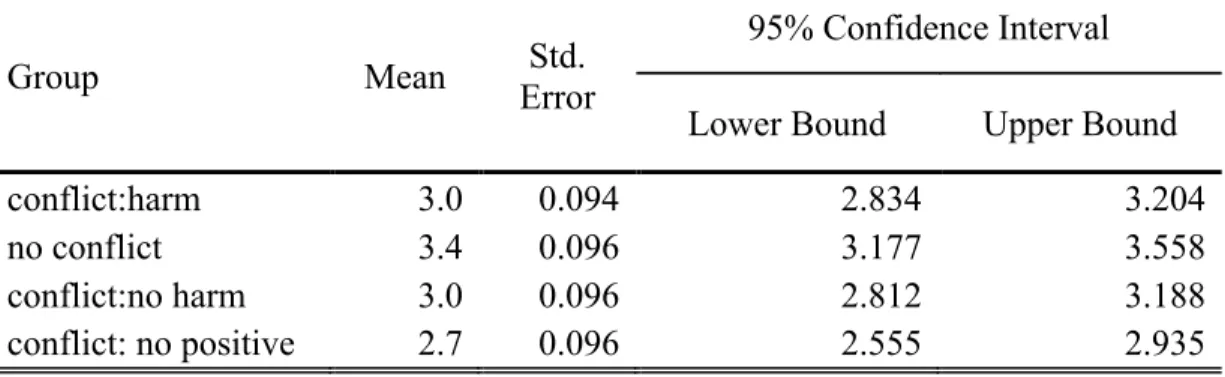
Mean self-efficacy post-exposure among participants who saw couplets indicating
support for and effectiveness of the screening tests—the “no conflict” control group—measured
3.367 on a Likert-like measure where 1 indicates lowest feeling of self-efficacy and 5 equals
highest levels. The group exposed to a direct conflict that also included the variable of potential
harm showed a mean SE level of 3.019. The group that saw conflict with no harm self-reported
an SE level mean of 3.000. The group most affected by exposure to conflict was the group that
saw no positive support for the tests coupled with the potential for harm, the “conflict:no positive”
group, reported an SE level mean of 2.745. (Table 2.)
Research Question 1: Results
In answer to the research question “What is the effect of exposure to conflicting messages
about cancer screening information on an individual’s (a) self-efficacy and (b) intention to take
positive action to manage health?” the data gathered for this study appear to show a correlation
to conflicting or non-conflicting messages, a statistically significant difference appeared: F (1,
198) = 15.70, p = .0005. Exposure to conflicting messages resulted in lower feelings of
self-efficacy (M = 2.92 SD = 7.37) compared to self-self-efficacy after exposure to messages that do not
conflict (M= 3.37 SD= 4.62) concerning the effectiveness of cancer screening tests in
preventing late-stage cancer has a negative impact on individual feelings of self-efficacy
regarding the ability to prevent such cancers. (Table 3.)
Research Question 2: Results
In answer to the question: “What is the effect of exposure to messages that include the
possibility of harm caused by cancer screening on an individual’s (a) self-efficacy and (b)
intention to take positive action to manage health?” Messages containing information that
indicated the potential for harm from the specific cancer screening tests named in this study
appear to decrease individual self-efficacy. The data show that harm clearly affected perceptions
of self-efficacy, with a statistically significant difference at the p < .5 level in Witte scores
between the two groups: F (1, 198) = 9.142, p = .003. In other words, respondents who saw any
message including the potential for harm from the screening tests—whether coupled with a
directly conflicting message showing support for and effectiveness of the tests, or coupled with a
neutral message claiming only that the tests were ineffective—felt the greatest loss of
self-efficacy. (Table 4.)
Research Question 3: Results
thus topic, i.e. breast or prostate cancer, according to the respondent’s gender) appeared to have
little to no impact on self-efficacy. In the control group, which saw images that agreed upon
support for the safety and effectiveness of screening tests in preventing late-stage cancer (the “no
conflict” group), there was virtually no difference between female and male respondents in
impact upon self-efficacy. Slight differences were seen between genders in the groups shown
conflicting messages, particularly the groups shown images that included the variable of harm
(the “conflict:harm” and “conflict:no positive” groups). (Table 5.) The differences were most
noticeable (but not statistically significant) in the group that saw no messages supporting use of
the screening tests—group four, “conflict:no positive,” which saw couplets indicating only that
mammography or PSA tests could cause harm or, at best, be ineffective. (Figure 2.)
Intention post-exposure was measured on a sliding scale of 1 to 9, where 1 indicated least
positive about cancer prevention and 9 indicated most positive. Means here echoed the results
from the Witte inventory items, with the group exposed to the “no conflict” couplets, group 2,
showing the highest measure of intention (mean = 5.03) and group 4, exposed to the couplet that
included the harm variable with no positive message, “conflict:no positive,” showing the lowest
score on intention to take measure to prevent cancer (mean 3.86). (Table 6.)
Similar results were found for intention when subjects were asked whether they felt “able
to take measures to prevent cancer” after seeing the couplets. Cronbach’s Alpha for this scale
Chapter Six: Discussion
The purpose of this study was to examine the potential association between viewing brief
social media reports of conflicting cancer screening recommendations and decreased feelings of
self-efficacy. Little research into this specific topic has been performed in the years since social
media outlets such as Facebook and Twitter have become widely used—Facebook has 1.06
billion monthly users (Tam, 2013) and Twitter claims “over 200 million active users” (Wickre,
2013) even as earlier studies have illustrated the impact of media reporting of medical issues on
readers’ and viewers’ perceptions of risk and self-efficacy in preventing disease.
As hypothesized, significant association was found between exposure to conflicting
social media reports on the effectiveness of widely-used cancer screening tests and individual
perceptions of self-efficacy in preventing the cancer such tests detect in early stages of the
disease. Adding the variable of harm to the experimental groups into which participants were
randomized also showed a positive association between conflict and decreased self-efficacy; in
other words, when a respondent saw any conflict between messages their self-efficacy decreased,
and if the conflicting messages included reports of harm potentially done by such tests an
individual participant’s feelings of being capable of preventing the cancers such tests screen for
were decreased further. The variable of harm was included in this research because some
screening and prevention guidelines disseminated by credible sources such as the U.S.
Gender, and thus related type of cancer (breast vs. prostate), did not appear to affect
decreases in self-efficacy or response to conflict; among the 200 respondents who were
randomized into four different groups that saw conflict or no conflict in social media reports
about cancer screening tests, women and men responded similarly by reporting increased
self-efficacy in the control group and decreased self-self-efficacy in the groups that saw conflicting
reports. The variable of harm showed a similar impact on both genders.
While no measures were used to specifically address the impact of this experiment on
participants’ sensemaking processes or increase in ambiguity aversion, as referenced in the
literature review chapter here, the implied impact on overall self-efficacy is that sense-making
and ambiguity aversion contribute to one’s perceptions of competency to act. Future research
into this topic could use specific inventory items to evaluate how individual sense-making is
employed when a person is confronted with conflicting information and how ambiguity aversion
factors into both sense-making and self-efficacy. The concepts spring from different theories
used in different fields of communication, but their principles interrelate.
Limitations of this type of study include the shortcomings associated with all
self-reported data, such as social desirability bias and exaggeration or hesitation in stating responses.
The inventory used to measure impact on self-efficacy could be improved visually to make its
individual items clearer and to make certain their individual specifics are easier to comprehend.
It would also be useful in future studies to provide a base measurement of self-efficacy and
perception of susceptibility/severity specifically regarding these cancer screening tests, prior to
exposure to the independent variable. As Nagler and Hornik (2012) point out in their attempt to
measure exposure to contradictory media messages about health information, “contradictory
information from health media exposure and attention measures.”
Disease differences versus gender
There is also the issue of testing messages about different cancers on different audiences.
Mammography and PSA testing were chosen for this study because of the very public debate
about the usefulness or risk of those tests in the past decade, but the responses by gender are
likely affected by different personal and psychological factors, since a woman’s response to her
own risk of breast cancer may be affected by different personal sense-making than a man’s
response to his own risk of prostate cancer. The impact of the diseases is different, both
psychologically and physically. Future research could focus on a non-gender-specific cancer
such as melanoma or lung cancer.
This field of study would also benefit from more qualitative methods, including personal
interviews and focus group research. Because of the inherent nature of an online study, there is
no opportunity to observe non-verbal responses to the stimuli such as facial expressions and
body movements that might indicate mood or emotional response, and no opportunity to ask
follow-up questions that might shed greater light on a short answer.
Future research into this topic could benefit from inclusion of live hyperlinks in shared
social media posts, to measure whether and how often a user of online sites where very brief
messages are shared might seek more detailed information rather than draw conclusions based on
140-character “tweets” or Facebook “shares” that typically show one or two sentences and a
single graphic.
This issue is important because of the ever-increasing number of reports of medical
research available to lay audiences and because, increasingly, those who seek and consume such
long-form print reports in newspapers or magazines. The increasing availability of such inlong-formation
in forums such as Facebook and Twitter—as well as less-well-known social media sites
including Reddit, Tumblr, and Pinterest and sites focusing on specific audiences by interest—
makes the likelihood greater that information-seekers will encounter multiple media reports on
the topics they research, and that those reports will disagree or directly conflict. Without the
depth of understanding of research types or credibility a more expert reader would have, the
average health information seeker will likely encounter information that presents a complex and
often confusing picture.
This author is deeply concerned that the intersection of two phenomena may affect health
information consumers in exactly the opposite way its creators intend. Those who publish and
promote medical research are often motivated by a very real desire to help—researchers
investigate health issues and spearhead clinical trials because they truly desire to create a better
world, at least in the realm of healthier, happier citizens of that world; those who disseminate the
information—journalists, public relations practitioners, medical journals—believe in a rational
audience, and that more information will better enable people to decide how to attain that
healthier, happier state. In fact, as the literature suggests and this study begins to confirm, more
information about health may have the opposite effect, especially when the central message of
Figure 1 Age Grouping of Participants
Table 1 Tukey Post-Hoc Mean Self-Efficacy
Tukey Post-Hoc Comparisons, all groups, composite measure of four Witte inventory items
Mean Difference (I-J) Std. Error Sig.
95% Confidence Interval Lower Bound Upper Bound
1 2 -.35 .135 .052 -.70 .00
3 .02 .134 .999 -.33 .37
4 .27 .135 .180 -.08 .62
2 1 .35 .135 .052 .00 .70
3 .37* .136 .038 .01 .72
4 .62* .137 .000 .27 .98
3 1 -.02 .134 .999 -.37 .33
2 -.37* .136 .038 -.72 -.01
4 .26 .136 .244 -.10 .61
4 1 -.27 .135 .180 -.62 .08
2 -.62* .137 .000 -.98 -.27
Table 2 Mean Self-Efficacy Scores by Group
Mean Effect on Self-Efficacy using composite value for all Witte inventory items
Group Mean Error Std.
95% Confidence Interval Lower Bound Upper Bound
conflict:harm 3.0 0.094 2.834 3.204
no conflict 3.4 0.096 3.177 3.558
conflict:no harm 3.0 0.096 2.812 3.188
conflict: no positive 2.7 0.096 2.555 2.935
Table 3 Mean Self-Efficacy by Conflict
Mean Self-Efficacy Score by Exposure to Conflicting Messages
Mean
Std.
Error N
95% Confidence Interval Lower
Bound
Upper Bound
conflict 2.9 0.055 151 2.815 3.033
no conflict 3.4 0.097 49 3.176 3.559
Table 4 Mean Self-Efficacy by Harm Messages
Mean Self-Efficacy Score by Exposure to Harm Messages
Mean
Std.
Error N
95% Confidence Interval Lower
Bound
Upper Bound
harm 2.882 .070 101 2.745 3.020
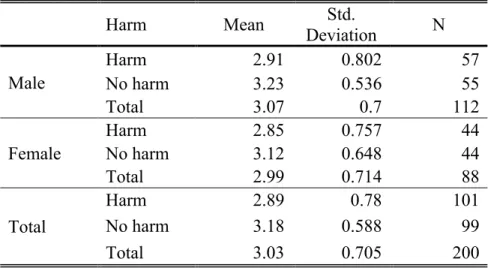
Table 5 Gender as a moderator of harm impact
Mean Self-Efficacy Score by Gender and Exposure to Harm
Harm Mean Std.
Deviation N Male
Harm 2.91 0.802 57
No harm 3.23 0.536 55
Total 3.07 0.7 112
Female
Harm 2.85 0.757 44
No harm 3.12 0.648 44
Total 2.99 0.714 88
Total
Harm 2.89 0.78 101
No harm 3.18 0.588 99
Total 3.03 0.705 200
Figure 2 Gender and Impact on Self-Efficacy
.00 .50 1.00 1.50 2.00 2.50 3.00 3.50 4.00
Male Female Male Female Male Female Male Female
Postive/Negative Positive/Positive Positive/Neutral Negative/Neutral
Table 6 Mean Intention Post-Exposure Sliding Scale
Mean Intention Score Post-Exposure
After seeing these posts, do you feel that you will be able to prevent the specific cancer mentioned?
N Mean Std.
Deviation
Std. Error
95% Confidence Interval for Mean
Minimum Maximum
Lower Bound
Upper Bound
1 41 4.10 2.478 .387 3.32 4.88 1 8
2 39 5.03 2.529 .405 4.21 5.85 1 9
3 41 4.44 2.712 .423 3.58 5.29 1 9
4 42 3.86 2.637 .407 3.04 4.68 1 9
Total 163 4.34 2.604 .204 3.94 4.75 1 9
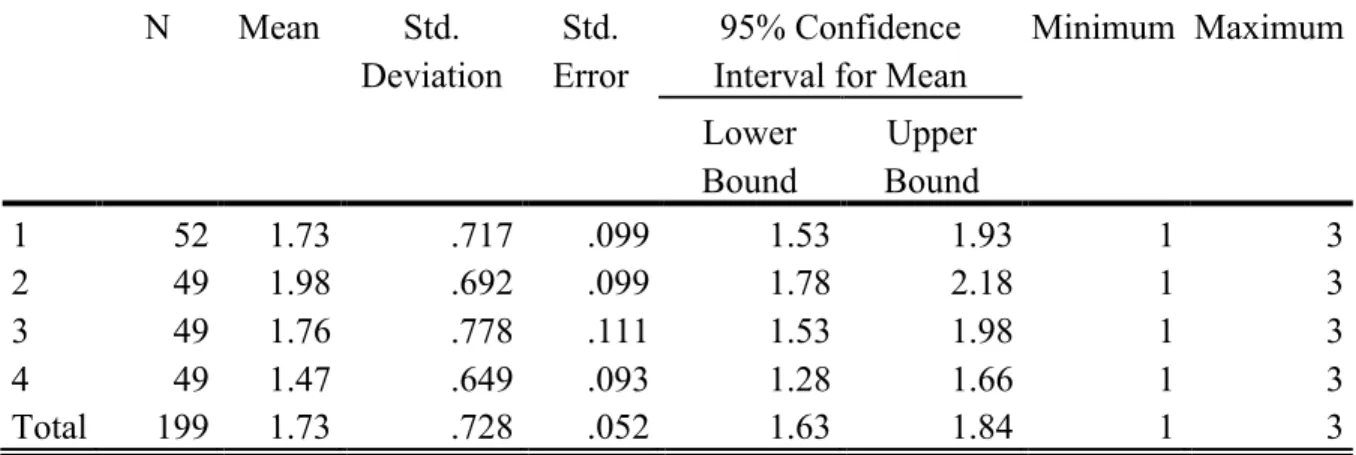
Table 7 Mean Intention Post-Exposure 1 to 3 Scale
Mean Intention Score Post-Exposure, Measure 2
How did the information you saw in the Facebook and Twitter posts make you feel about your ability to take measures to prevent cancer?
N Mean Std.
Deviation
Std. Error
95% Confidence Interval for Mean
Minimum Maximum
Lower Bound
Upper Bound
1 52 1.73 .717 .099 1.53 1.93 1 3
2 49 1.98 .692 .099 1.78 2.18 1 3
3 49 1.76 .778 .111 1.53 1.98 1 3
4 49 1.47 .649 .093 1.28 1.66 1 3
Appendix 1: Survey: Self-Efficacy and Conflicting Medical Messages in Social Media
Consent to Participate in a Research Study
Title of Study: Self-Efficacy and Conflicting Medical Messages in Social Media IRB Study #: 118119
Principal Investigator: Laura H. Marshall ([email protected]) Faculty Advisor: Brian Southwell ([email protected])
What are some general things you should know about research studies? You are being asked to take part in a research study. To join the study is voluntary. You may refuse to join, or you may withdraw your consent to be in the study, for any reason, without penalty. Details about this study are discussed below. It is important that you understand this information so that you can make an informed choice about being in this research study.
What is the purpose of this study? The purpose of this research study is to collect data about how people respond to messages about cancer prevention.
How many people will take part in this study? If you decide to be in this study, you will be one of approximately 80 people in this research study.
What will happen if you take part in the study? Your part in this study will last
approximately 15 minutes. During this study, you will be shown images of medical news items shared via social media, asked to look at them closely, and complete an online
questionnaire. The questionnaire will ask you to describe your reactions to the social media posts you see.
What are the possible benefits from being in this study? Your participation in this research is intended to benefit society by gaining new knowledge. There is no direct benefit from participating in this study.
What are the possible risks or discomforts involved from being in this study? You may see information about cancer prevention that evokes emotions related to your perceived risk of cancer.
How will your privacy be protected? All of the data you provide will be stored anonymously. This means that there will be no way for anybody to ever link your data or the results of the study to your identity.
What if you want to stop before your part in the study is complete? You can withdraw from this study at any time, without penalty and skip any question for any reason. The
What if you have questions about this study? You have the right to ask, and have answered, any questions you may have about this research. Contact the principal investigator listed above with any questions, complaints, or concerns you may have.
What if you have questions about your rights as a research participant? All research on human volunteers is reviewed by a committee that works to protect your rights and welfare. If you have questions or concerns, or if you would like to obtain information or offer input, please contact the Institutional Review Board at 919-966-3113 or by email to
[email protected]. I consent (1)
I do not consent (2)
If I do not consent Is Selected, Then Skip To End of Survey
How do you get information when you want to learn about a health-related issue? (check all that apply.)
online, using a search engine like Google or Bing (1) from friends or family members (2)
from my doctor (3) from newspapers (4)
from radio or TV newscasts (5) Other (6) ____________________ does not apply to me (7)
Which sources do you trust most for information about your health? (check all that apply.) online news outlets (1)
friends and family members (2) my doctor (3)
newspaper stories (4)
radio or television news stories (5) Other (6) ____________________
Do you have regular access to an electronic device (smartphone, tablet, laptop, desktop computer) connected to the Internet?
Yes (1) No (2)
If yes, how often do you use a device to go online? Never (1)
Less than Once a Month (2) Once a Month (3)
2-3 Times a Month (4) Once a Week (5) 2-3 Times a Week (6) Daily (7)
If Never Is Selected, Then Skip To End of Survey
Do you use a social media networking site, like Facebook or Twitter, when online? (Check all that apply.)
Yes, Facebook. (1) Yes, Twitter. (2)
Yes, other. (3) ____________________ No. (4)
Have you ever looked for health information online? Yes (1)
No (2)
If No Is Selected, Then Skip To Have you ever been diagnosed with can...
When you search for health information, are you looking for (click all that apply)... Information about my own health (1)
Information for a family member (2) Information for a friend (3)
General information (4)
Other (5) ____________________
When you search for health information, have you ever found reports that appear to
contradict each other? In other words, one piece of information says something is good for you and the other says the same thing is bad for you?
Yes (1) No (2)
If you answered "yes" to the previous question, when was the last time this happened to you? Choose one answer that reflects the most recent time you saw that conflicting health information.
in the past week (1) in the past month (2) in the past year (3)
How did it make you feel when you found conflicting advice from different sources of information?
Have you ever been diagnosed with cancer? Yes (1)
No (2)
If Yes Is Selected, Then Skip To End of Survey
Do you believe you are at increased risk of cancer compared to the average person? Yes (1)
No (2)
Do you have other concerns about your health or future risk of illness? Yes, I worry about... (1) ____________________
No (2)
What is your age? Under 20 (1) 21 - 30 (2) 31 - 45 (3) 46 - 60 (4) 61 + (5)
If 21 -‐ 30 Is Selected, Then Skip To End of Survey
Please tell us your gender. This is important because the following questions relate specifically to health risks determined by biological gender. Should you choose not to answer, you will be taken to the end of the survey.
Male (1) Female (2)
Choose not to answer (3)
[See Appendix 2 for Graphics used by Experimental Group]
To what degree did the information in these posts make you feel... Feel a lot less
than I did before (1)
Feel a little less (2)
No change (3)
Feel a little more than I did before
(4)
Feel a lot more (5)
I am able to take
appropriate measures to prevent this kind of cancer.
Preventing the kind of cancer mentioned in these posts is easy to do.
It's easy to take the right steps to prevent the cancer
mentioned in the posts.
Screening tests like these work to prevent cancer.
How did the information you saw in the Facebook and Twitter posts make you feel about your ability to prevent this specific kind of cancer?
Not at all (1) Somewhat (2) Very (3) Clear about what I need
to do (1)
Able to take measures
to prevent cancer (2)
After seeing these posts, do you feel that you will be able to prevent the specific cancer mentioned? (9 = very positive, 1 = not at all positive)
1 (1) 2 (2) 3 (3) 4 (4) 5 (5) 6 (6) 7 (7) 8 (8) 9 (9)
Do you feel the information you saw in these posts was trustworthy? Yes (1)
No (2)
What level of education have you completed? High school (1)