Treatment initiation among persons
diagnosed with drug resistant tuberculosis in
Johannesburg, South Africa
Denise Evans1*, Kathryn Schnippel1,2,3, Caroline Govathson1, Tembeka Sineke1, Andrew Black4, Lawrence Long1, Rebecca Berhanu5, Sydney Rosen1,6
1 Health Economics and Epidemiology Research Office, Department of Internal Medicine, School of Clinical
Medicine, Faculty of Health Sciences, University of the Witwatersrand, Johannesburg, South Africa, 2 Right to Care, Johannesburg, South Africa, 3 Clinical HIV Research Unit, Department of Internal Medicine, School of Clinical Medicine, Faculty of Health Sciences, University of the Witwatersrand, Johannesburg, South Africa, 4 Wits Reproductive Health and HIV Institute, Department of Internal Medicine, School of Clinical Medicine, Faculty of Health Sciences, University of the Witwatersrand, Johannesburg, South Africa,
5 Division of Infectious Diseases, University of North Carolina, Chapel Hill, NC, United States of America, 6 Department of Global Health, Boston University School of Public Health, Boston, MA, United States of
America
Abstract
Background
In South Africa, roughly half of the drug-resistant TB cases diagnosed are reported to have been started on treatment. We determined the proportion of persons diagnosed with rifampi-cin resistant (RR-) TB who initiated treatment in Johannesburg after the introduction of decentralized RR-TB care in 2011.
Methods
We retrospectively matched adult patients diagnosed with laboratory-confirmed RR-TB in Johannesburg from 07/2011-06/2012 with records of patients initiating RR-TB treatment at one of the city’s four public sector treatment sites (one centralized, three decentralized). Patients were followed from date of diagnosis until the earliest of RR-TB treatment initiation, death, or 6 months’ follow-up. We report diagnostic methods and outcomes, proportions ini-tiating treatment, and median time from diagnosis to treatment initiation.
Results
594 patients were enrolled (median age 34 (IQR 29–42), 287 (48.3%) female). Diagnosis was by GenoType MTBDRplus (Hain-Life-Science) line probe assay (LPA) (281, 47.3%), Xpert MTB/RIF (Cepheid) (258, 43.4%), or phenotypic drug susceptibility testing (DST) (30, 5.1%) with 25 (4.2%) missing a diagnosis method. 320 patients (53.8%) had multi-drug resistant TB, 158 (26.6%) rifampicin resistant TB by Xpert MTB/RIF, 102 (17.2%) rifampicin mono-resistance, and 14 (2.4%) extensively drug-resistant TB. 256/594 (43.0%) patients initiated treatment, representing 70.7% of those who were referred for treatment (362/594). 338/594 patients (57.0%) did not initiate treatment, including 104 (17.5%) who died before a1111111111 a1111111111 a1111111111 a1111111111 a1111111111 OPEN ACCESS
Citation: Evans D, Schnippel K, Govathson C,
Sineke T, Black A, Long L, et al. (2017) Treatment initiation among persons diagnosed with drug resistant tuberculosis in Johannesburg, South Africa. PLoS ONE 12(7): e0181238.https://doi.org/ 10.1371/journal.pone.0181238
Editor: Pere-Joan Cardona, Fundacio´ Institut
d’Investigacio´ en Ciències de la Salut Germans Trias i Pujol, Universitat Autònoma de Barcelona, SPAIN
Received: June 27, 2016 Accepted: June 28, 2017 Published: July 26, 2017
Copyright:©2017 Evans et al. This is an open access article distributed under the terms of the
Creative Commons Attribution License, which permits unrestricted use, distribution, and reproduction in any medium, provided the original author and source are credited.
Data Availability Statement: The data are owned
treatment was started. The median time from sputum collection to treatment initiation was 33 days (IQR 12–52).
Conclusion
Despite decentralized RR-TB treatment, fewer than half the patients diagnosed in Johan-nesburg initiated appropriate treatment. Offering treatment at decentralized sites alone is not sufficient; improvements in linking patients diagnosed with RR-TB to effective treatment is essential.
Introduction
In 2015, a global total of 132 120 cases of multi-drug resistant tuberculosis (MDR-TB) and rifampicin resistant TB (RR-TB) were notified to the World Health Organization (WHO). This represented 23% of the estimated 580 000 cases of MDR/RR-TB cases worldwide demon-strating a major diagnostic gap [1].
South Africa, with less than 1% of the world’s population, accounted for 15% of the notified cases of MDR/RR-TB globally, with 19 613 cases of laboratory confirmed MDR/RR-TB cases in 2015 [1]. Although the proportion of eligible patients who initiated MDR-TB treatment in South Africa increased from 41% in 2013 to 64% in 2015, a major diagnosis-to-treatment gap remains [1,2]. Despite this increase, the proportion initiating MDR-TB treatment in South Africa is below the global figure of 90% [3]. There is no possibility of achieving the Global Plan to End TB by 2020 if a third of patients diagnosed with MDR/RR-TB never start treatment [1]. Prior to 2011, all patients with RR-TB in South Africa (a category that includes rifampicin resistant TB with unknown additional drug resistance, MDR-TB, and extensively drug resis-tant TB (XDR) TB were treated at specialized, inpatient facilities for the duration of the inten-sive phase of drug resistant (DR-) TB treatment, typically six months [4]. Studies reported that time from sputum collection to inpatient admission ranged from 10–16 weeks, and up to 40% of MDR-TB patients died within 30 days of sputum collection in certain provinces [5–7]. In 2011, South Africa improved its ability to test for DR-TB by introducing Xpert MTB/RIF (Cepheid), a molecular test capable of identifying both TB and rifampicin resistance in under two hours [8,9]. At the same time, in order to increase treatment capacity, minimize treatment delays, and improve outcomes, the South African National TB program announced a frame-work for “decentralized and deinstitutionalized management” of MDR-TB, authorizing outpa-tient initiation of DR-TB treatment [10]. This policy allows paoutpa-tients to start treatment at sites closer to their homes and remain resident at home for the duration of treatment, rather than being isolated at one of the country’s few specialized, provincial-level inpatient TB hospitals. Following implementation of the new policy, the number of sites initiating DR-TB treatment quadrupled nationally, with at least one treatment site in each district [11].
To help inform further improvements in DR-TB programs and guidelines, we evaluated the extent to which better diagnosis with Xpert MTB/RIF and decentralized service delivery has improved DR-TB treatment initiation in South Africa. We conducted a retrospective medical register review to match patients diagnosed with laboratory-confirmed RR-TB, as reported to the City of Johannesburg in Gauteng Province, to DR-TB treatment initiation records at the city’s four public sector treatment sites during the study period. We report diagnostic methods and outcomes, proportions initiating treatment, and median time from diagnosis to treatment initiation.
from the Health Economics and Epidemiology Research Office [email protected] additional information regarding data access.
Funding: DE, TS, CG, RB, SR and LL are supported
through the South Africa Mission of the US Agency for International Development (USAID) under the terms of cooperative agreement 674-A-12-00029 to the Health Economics and Epidemiology Research Office. KS and RB were supported by a cooperative agreement from the USAID to Right to Care 674-A-12-00020. AB was supported by USAID cooperative agreement number 674-12-00002 to Wits Reproductive Health and HIV Research Institute. This study was made possible by the generous support of the American people through USAID. The contents of the article are the responsibility of the authors and do not necessarily reflect the views of USAID or the Unites States Government. The funders had no role in the study design, collection, analysis and interpretation of the data, in manuscript preparation or the decision to publish.
Competing interests: The authors have declared
Methods
Setting, sites, and population
We conducted a retrospective medical register review of adult (18 years) patients with
labo-ratory-confirmed RR-TB between July 2011 and June 2012 in the City of Johannesburg (COJ), the largest metropolitan area in the country. By June/July 2012 the National Health Laboratory Service Laboratory (NHLS) had performed 54,232 Xpert MTB/RIF tests in Gauteng Province [12]. Of these MTB was detected in 12.6% (n = 6,857) and 6.67% of these were resistant to rifampicin (n = 457). Based on the NHLS data the City of Johannesburg, which has an esti-mated overall HIV prevalence of 11.1%, reported 42,924 Xpert MTB/RIF tests between July 2011 and June 2012 [13].
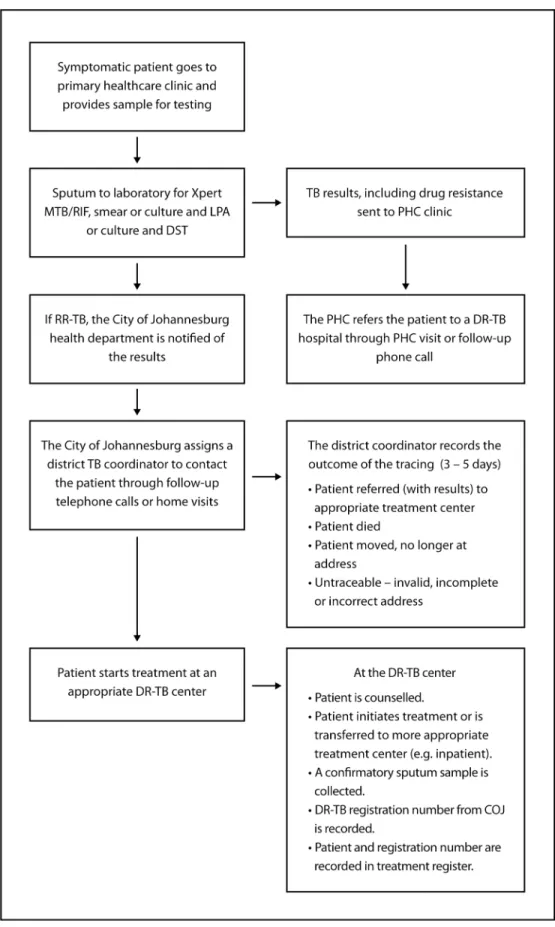
As illustrated inFig 1, symptomatic patients presenting at one of the city’s primary
health-care clinics provide 1–2 sputum samples, which are sent to the NHLS for the diagnosis of TB and rifampicin resistance or multi-drug resistance (rifampicin and isoniazid resistance). The NHLS sends all RR-TB results back to the diagnosing clinic and to the COJ TB coordinator, where the results are recorded and a DR-TB case registration number is assigned. The COJ assigns each patient to a district TB coordinator who contacts and refers the patient to appro-priate care and reports the outcome of the tracing to the COJ within 3–5 days. At the diagnos-ing clinic, a nurse records the results in the TB suspect register and refers the patient to an appropriate DR-TB treatment center. Once the patient arrives at the DR-TB treatment center, the patient is initiated onto DR-TB treatment and the DR-TB treatment center records the patient information and DR-TB case registration number (obtained from COJ). Alternatively, the DR-TB treatment center may decide to transfer the patient to a more appropriate facility (e.g. if the first DR-TB treatment center is an outpatient clinic and the patient should be admit-ted as an inpatient). The COJ maintains an electronic register of diagnosed patients and also has paper records of tracing activities.
During the study period, DR-TB patients within COJ could be referred to one inpatient treatment center or one of three outpatient treatment centers. Sizwe Tropical Disease Hospital (STDH), the inpatient treatment center, serves as a referral center for all DR-TB in Gauteng Province, where Johannesburg is located [14]. Prior to decentralization in 2011, all MDR-TB and XDR-TB patients in the province were treated at STDH; currently all XDR-TB patients are still treated there. Between January 2007 and December 2010 a total of 2005 MDR-TB pa-tients were admitted to STDH [14]. Records for papa-tients initiated onto treatment for MDR-TB and XDR-TB at STDH are entered directly into the national electronic DR-TB register, which is called EDRweb.
In 2011, three outpatient clinics, at Charlotte Maxeke Johannesburg Academic Hospital (CMJAH), Helen Joseph Hospital (HJH), and South Rand Hospital (SRH), were authorized to initiate and treat DR-TB on an outpatient basis. Eligibility criteria for outpatient initiation of DR-TB treatment were established by the National Department of Health and take into account transmission risk (smear negative or extra-pulmonary TB), clinical condition (e.g.
body mass index>18.5 kg/m2), social support, and stable accommodation [10]. Patients are
also treated at the outpatient facility if there are no beds available at STDH or if the patient refuses to be admitted for inpatient care. All three facilities maintain on-site electronic clinical patient DR-TB registers.
Fig 1. Schematic of the procedures and structures established within district health system for the follow-up of all patients diagnosed with RR-TB.
Diagnostic algorithms
Xpert MTB/RIF was implemented as the first-line diagnostic test for tuberculosis in South Africa during the study period. Prior to 2011, the TB diagnostic algorithm relied on smear mi-croscopy for cases of suspected tuberculosis. Line probe assay (LPA; GenoType MTBDRplus Hain-Life-Science) with culture and phenotypic DST were only done in cases of suspected drug-resistance such as contact of person with known DR-TB; relapse and treatment failure [15]. With implementation of Xpert MTB/RIF universal DST for rifampicin became the stan-dard of care. Xpert MTB/RIF roll-out by the National Health Laboratory Services (NHLS) in the City of Johannesburg began in August 2011 with full utilization by January 2012 [12]. Cer-tain sites had earlier access to Xpert MTB/RIF prior to implementation by the NHLS through validation research studies.
Outcomes, data, and data analysis
The primary outcome of the study was the proportion of patients who initiated DR-TB treat-ment at one of the city’s four treattreat-ment sites within six months of sputum collection. To de-termine who initiated DR-TB treatment we matched eligible patients in the COJ register to electronic registers at the sites. Study staff worked with facilities and the COJ to verify and cor-rect patient information (e.g. to corcor-rectly record DR-TB registration numbers in facility regis-ters and query specific cases where diagnosis date or treatment initiation date preceded the sputum collection date). For patients in the COJ register who could not be matched to the elec-tronic registers by DR-TB case registration number or where the registration number was missing, probabilistic matching using first name, surname, date of birth, and sex was used to match individuals. For patients who still could not be matched, we then matched on (i) first three initials of name and surname, date of birth and sex, (ii) first three initials of name and surname, year of birth and sex, and (iii) a four-character code created using a phonetic algo-rithm (Soundex) to account for minor differences in spelling (e.g. ‘Ngcobo’ vs ‘Ngobo’). Matched pairs were manually checked and verified by two independent evaluators. DR-TB treatment initiation date was obtained from the electronic registers at the sites for patients who could be matched.
The outcomes of COJ tracing for all patients diagnosed with RR-TB were obtained from the COJ register and were defined as died, moved or transferred out of the city, lost (untraceable), or successfully traced and referred.
Variables including first name, surname, date of birth, sex, tracing outcome, treatment ini-tiation date, and address were obtained from the COJ electronic register. In addition, variables collected for each patient such as disease classification, diagnosis method and diagnosis date (obtained from NHLS), smear microscopy result, and site of disease were also obtained from the registers. We further classified RR-TB with unknown or pending sensitivities to other drugs according to the diagnosis method used: Xpert MTB/RIF, LPA or phenotypic DST. In addition, we used the address the patient recorded in the COJ electronic register to calculate the distance from the diagnosing/referring clinic to the patient’s residence and, for those initi-ating treatment, from the patient’s residence to the DR-TB treatment center using Google Maps and SAS version 9.3. We further divided distance from the patient’s residence to diag-nosing/referring clinic into quintiles. The first and second quintile were groups and labeled
“near” (<11.2 km), the third labelled intermediate (11.2–54.3 km) and the third to fifth
quin-tile were grouped and labelled far (54.3 km) [16–18].
primary outcome. We used competing risk regression method from Fine and Gray to fit a proportional subdistribution hazard model [19,20]. Death was considered a competing risk, which arises when the event of interest (initiation of DR-TB treatment) can be impeded by a prior event of a different type (e.g. death). Patient time accrued from the date of diagnosis until the earliest of DR-TB treatment initiation, death, lost/transferred out of the city/moved, or 6 months’ follow-up after diagnosis. In instances where the transfer out date was missing, the date of last contact with the patient, as recorded by the TB district coordinator, was used as the outcome date. Subdistribution hazard ratios (sHR) with 95% confidence intervals (CI) are presented. Categorized age, sex, disease classification and diagnosis method were included in
the adjusted model along with othera prioriidentified characteristics.
To identify predictors of all-cause mortality, we used Cox proportional hazard regression to estimate a hazard ratio (HR) and corresponding 95% confidence interval (CI). Patient time accrued from the date of diagnosis until the earliest of all-cause mortality, lost (untraceable), transferred out of the city/moved, or 6 months’ follow-up after diagnosis. Crude and adjusted hazard ratios (HR) with 95% confidence intervals (CI) are presented.
We also compared median time from sputum collection to treatment initiation by disease classification, site of treatment initiation (decentralized-outpatient vs centralized-inpatient) and diagnosis method using the student t test for parametric or Kruskal-Wallis for non-parametric data. We also tested the association between treatment site and initiating treatment within five days of diagnosis using log-binomial regression with crude risk ratios and 95% con-fidence intervals. All analyses were carried out using SAS version 9.3 (SAS Institute, Cary, North Carolina, USA).
This study was approved by the Human Research Ethics Committee (Medical) of the Uni-versity of the Witwatersrand (Wits HREC M130601). Participants did not provide written or verbal consent to participate in the study as all data analyzed were collected as part of routine diagnosis and treatment.
Results
We enrolled 594 patients in the study. As described inTable 1, they had a median (IQR) age of
34 (29–42) years, and 48.3% were female. Most were diagnosed by LPA (281, 47.3%) or Xpert MTB/RIF (258, 43.4%), with a few by phenotypic DST (30, 5.1%) or by unknown (missing) diagnostic method (25, 4.2%). 320 patients (53.8%) had MDR-TB, 158 (26.6%) had rifampicin resistant TB by Xpert MTB/RIF with no additional drug susceptibility results available, 102 (17.2%) had rifampicin mono-resistance, and 14 (2.4%) had XDR TB.
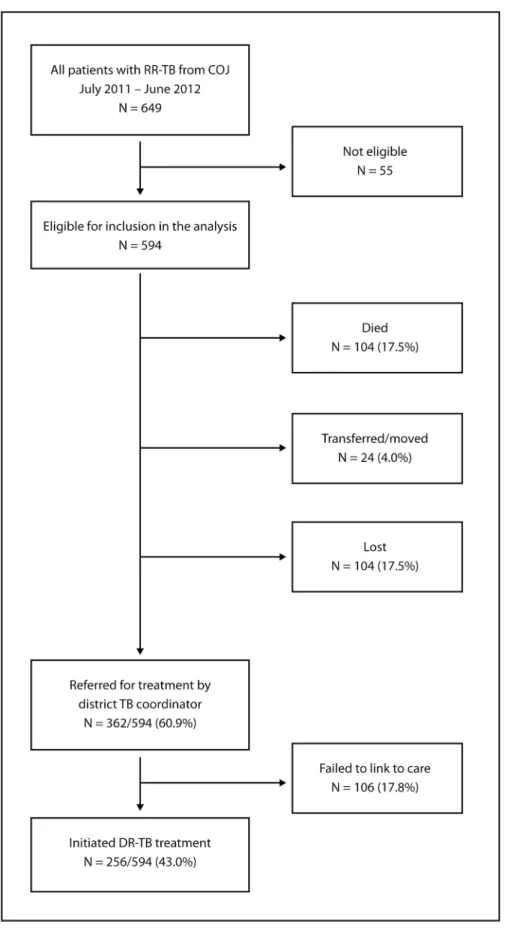
Only 43% (256/594) of the patients diagnosed with DR-TB in COJ initiated treatment at one of the four treatment sites within six months of diagnosis. Of the 594 laboratory confirmed cases reported to the COJ, 60.9% (362/594) were successfully traced and referred for treatment; the 256 who actually started treatment represent 70.7% of these (Fig 2). Among the 338 patients (57.0%) who did not initiate treatment, 104 died before treatment was started, 24 transferred out or moved out of the province and 104 could not be traced (lost). Of the 362 patients who were successfully traced and referred, 106 failed to link to care after referral. According to the COJ tracing outcome, median time from sputum collection to death was 19 days (IQR 10–30) and from sputum collection to other reported outcome (lost/untraceable or transferred out of the city/moved) was 14 days (IQR 8–34).
Among those who did start treatment, 34.4% (88/256) initiated treatment at the central-ized-inpatient DR-TB treatment center, and 65.6% (168/256) initiated at one of the three decentralized-outpatient sites. Demographic and clinical characteristics of those who initiated
For the sample as a whole, the median time from sputum collection to diagnosis was 26 days (IQR 7–36) and from sputum collection to treatment initiation 33 days (IQR 12–52; n = 256). Time from sputum collection to treatment initiation varied by type of treatment center: 42 days (IQR 29–55) and 22 days (9–50) for inpatient (n = 88) and outpatient sites (n = 168), respectively (p = 0.03). This interval also varied by diagnostic method for diagnosis of rifampicin resistance (e.g. Xpert MTB/RIF vs LPA and phenotypic DST): 17 days (9–47), 38 days (23–54), and 81 days (49–115) for Xpert MTB/RIF (n = 107), LPA (n = 129), and
pheno-typic DST (n = 8), respectively (p = 0.002).Table 3summarizes median time from sputum
col-lection to treatment initiation, by treatment site and diagnostic method.
Only ten percent (25/256) of patients diagnosed with RR-TB initiated treatment within five days, which is the national target [21]. Those starting treatment at the inpatient facility were more likely to initiate after five days (RR 1.15 95% CI 1.08–1.23). More patients at the outpa-tient facilities started treatment within five days than at the inpaoutpa-tient facility (1% [1/88] vs 14% [24/168]), though the proportion achieving this target, 14%, was very low even at the decen-tralized facilities.
Table 1. Demographic and clinical characteristics of patients who had a diagnosis of laboratory-confirmed RR-TB reported to the COJ for tracing between July 2011 and June 2012 (n = 594).
Characteristic Description N = 594
Gender Male n,% 307 (51.7%)
Female 287 (48.3%)
Age, years Median, IQR 34 (29–42)
<30 n, % 162 (27.3%)
30–45 308 (51.9%)
45–60 105 (17.7%)
60 19 (3.2%)
Disease classification RR-TB by Xpert^ n, % 158 (26.6%)
RR-TB (mono and poly)^^ 102 (17.2%)
MDR-TB 320 (53.8%)
XDR TB 14 (2.4%)
Diagnosis method Xpert MTB/RIF n, % 258 (43.4%)
GenoType MTBDRplus line probe assay 281 (47.3%)
Phenotypic drug susceptibility testing 30 (5.1%)
Unknown 25 (4.2%)
AFB smear microscopy status Positive n, % 144 (24.2%)
Negative 78 (13.1%)
Unknown 372 (62.7%)
Site of disease Pulmonary n, % 581 (97.8%)
Extra-pulmonary 13 (2.2%)
Treatment site Helen Joseph Hospital (outpatient) n, % 70/256 (27.3%)
Charlotte Maxeke Hospital (outpatient) 61/256 (23.8%)
South Rand Hospital (outpatient) 37/256 (14.5%)
Sizwe Tropical Disease Hospital (inpatient) 88/256 (34.4%)
Location of residence Distance from diagnosing/referral facility to residence, km (n = 402; 67.7%) Median, IQR 13 (11.2–54.3) Distance from DR-TB treatment facility to residence, km (n = 249; 97.3%) Median, IQR 11.2 (7.7–23.0)
RR-TB rifampicin resistant tuberculosis; MDR-TB multi-drug resistant TB; XDR TB extensively drug resistant TB; km kilometer; AFB acid fast bacilli; IQR inter-quartile range
^RR-TB diagnosed by Xpert with unknown or pending sensitivities to other drugs
^^mono- or poly-resistant is resistance to rifampicin alone or rifampicin plus another first-line drug (other than isoniazid), confirmed by LPA or DST.
Fig 2. Schematic showing the proportion of those diagnosed with RR-TB in the COJ who were successfully traced and referred and who initiated treatment along with other tracing outcomes including death, moved or transferred out of the city and untraceable.
Factors predicting treatment initiation and mortality
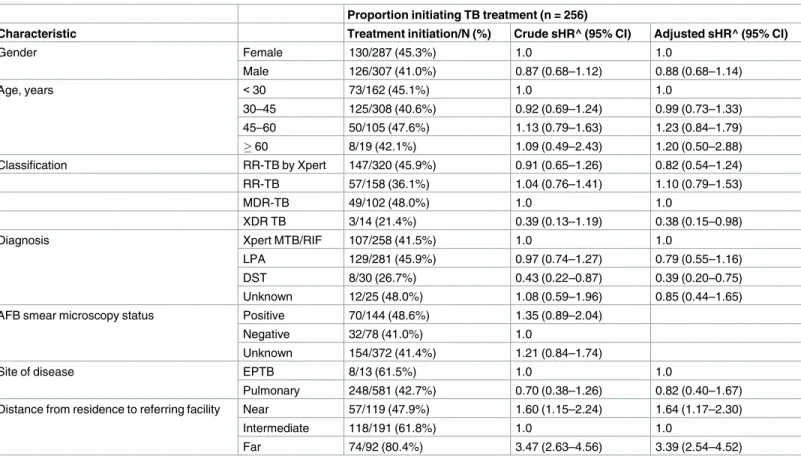
We demonstrate that compared to those diagnosed by Xpert MTB/RIF, patients diagnosed by phenotypic DST were less likely to initiate treatment (sHR 0.39 95% CI 0.20–0.75). Patients diagnosed with XDR-TB were also less likely to link to care (sHR 0.38 95% CI 0.15–0.98). Dis-tance from residence to referring facility was a significant predictor of treatment initiation (Table 4).
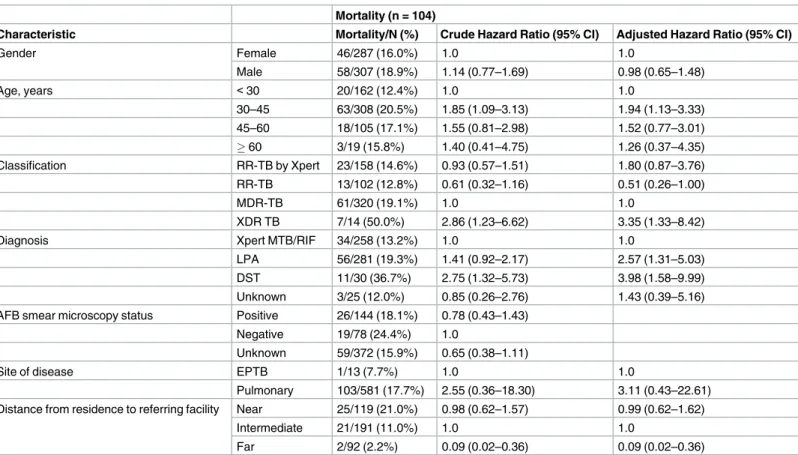
Time to treatment initiation varied by diagnostic method, and this then may explain some of the differences observed in mortality before treatment initiation. Those diagnosed by LPA (HR 2.57 95% CI 1.31–5.03) and phenotypic DST (HR 3.98 95% CI 1.58–9.99) were more likely to die before treatment initiation, compared to those diagnosed by Xpert MTB/RIF. Patients classified as having XDR TB (HR 3.35 95% CI 1.33–8.42) were more likely to die before treatment initiation compared to those with MDR-TB. Conversely, those classified as
Table 2. Comparison of case characteristics between those initiated treatment at outpatient and inpatient sites (n = 256).
Characteristic Description Outpatient sites
(n = 168)
Inpatient site (n = 88)
P value
Sex Female n,% 89 (53.0%) 41 (46.6%) 0.332
Age, years Median,
IQR
34 (29–42) 35 (29–44) 0.773
<30 n, % 49 (29.2%) 24 (27.3%)
30–45 83 (49.4%) 42 (47.7%)
45–60 30 (17.8%) 20 (22.7%)
60 6 (3.6%) 2 (2.3%)
Classification RR-TB by Xpert n, % 56 (33.3%) 1 (1.1%) <0.005
RR-TB 49 (29.2%)
-MDR-TB 63 (37.5%) 84 (95.5%)
XDR TB - 3 (3.4%)
Diagnosis Xpert MTB/RIF n, % 81 (48.2%) 26 (29.6%) 0.022
MTBDRplus LPA 75 (44.6%) 54 (61.4%)
DST 6 (3.6%) 2 (2.3%)
Unknown 6 (3.6%) 6 (6.8%)
AFB smear microscopy status
Negative n, % 24 (14.3%) 8 (9.1%) 0.155
Positive 40 (23.8%) 30 (34.1%)
Unknown 104 (61.9%) 50 (56.8%)
Site of disease Pulmonary n, % 165 (98.2%) 83 (94.3%) 0.089
Extra-pulmonary 3 (1.8%) 5 (5.7%)
Diagnosed at Clinic/CHC n,% 113 (67.3%) 38 (43.2%) 0.099
Hospital 55 (32.7%) 50 (56.8%)
HIV status Positive n,% 149 (88.7%) Not available Not
Negative/Unknown 19 (11.3%) applicable
Location of residence Distance from diagnosing/referral facility to residence, km
Median, IQR
12.0 (11.2–54.5) (n = 161)
54.2 (11.3–69.5) (n = 88)
0.726
Distance from DR-TB treatment facility to residence, km
Median, IQR
13.0 (7.8–29.0) (n = 162)
11.1 (7.6–12.0) (n = 87)
0.091
Diagnosis site Proportion diagnosed and treated at the same site
n, % 43 (25.6%) 0 (0%) Not
applicable
RR-TB rifampicin resistant tuberculosis; MDR-TB multi-drug resistant TB; XDR TB extensively drug resistant TB; AFB acid fast bacilli; LPA line probe assay; phenotypic DST drug susceptibility testing; HIV human immunodeficiency virus; km kilometer; CHC community health centers IQR inter-quartile range
having rifampicin mono-resistance were less likely to die before treatment initiation (HR 0.51 95% CI 0.26–1.00). Interestingly, patients who lived near to (sHR 1.64 95% CI 1.17–2.30) and those who lived far (sHR 3.39 95% CI 2.54–4.52) from the diagnosing/referring facility were more likely to initiate treatment. Those who lived greater distances from the diagnosing/refer-ring facility were also less likely to die before treatment initiation (far vs intermediate HR 0.09 95% CI 0.02–0.36) (Table 5).
Discussion
In this study, fewer than half (43.0%) the patients diagnosed with DR-TB in the City of Johan-nesburg in 2011–2012 initiated appropriate treatment within six months of diagnosis despite the quadrupling of facilities offering DR-TB treatment under the new decentralization frame-work–from one inpatient facility to one inpatient plus three outpatient facilities. The propor-tion of patients who initiated treatment within six months (43.0%) is similar to napropor-tional estimates reported for South Africa in the 2013 WHO Global TB report (6 494 cases started on MDR-TB treatment/15 419 cases of laboratory confirmed MDR-TB for 2012; 42%) [22]. Pre-treatment loss to follow-up among drug sensitive patients in Africa ranges from 6 to 38%, and is similar among patients with drug resistant TB [23–26]. We showed high pre-treatment loss of 17.8% and many patients (17.5%) died before DR-TB treatment could be initiated. Only 3 out of 5 patients diagnosed with DR-TB (60.9%) could be traced and referred for treatment. Although decentralization and the implementation of Xpert MTB/RIF for the diagnosis of TB and rifampicin resistance has resulted in a significant reduction in time to treatment initiation as reported in previous studies [26], these programmatic changes did not solve the problem of loss of patients between diagnosis and treatment initiation seen in our cohort. This initial loss from care has contributed to lack of improvement in treatment outcomes [27]. This is an area where additional health system strengthening is required.
For the study period, we report a median time to treatment initiation of 33 days, which is consistent with what has been reported elsewhere in the country following implementation of decentralized treatment. Results from Khayelitsha, Cape Town report that the introduction of
Table 3. Median time from sputum collection to treatment initiation, by treatment site and diagnostic method and proportion initiating treatment by treatment site (n = 256).
All Xpert MTB/RIF GenoType MTBDRplus line probe assay
Phenotypic drug susceptibility testing
P value
Median time from sputum collection to treatment initiation
DR-TB treatment site
All (n = 256) 17 (9–47) 38 (23–54) 81 (49–115) 0.002
Outpatient (n = 168) 13 (9–28) 41 (6–62) 75 (28–133) 0.01
Inpatient (n = 88) 49 (33–64) 37 (29–46) 89 (81–97) 0.04
AFB smear microscopy status
Positive (n = 70) 15 (1–42) 32 (7–42) 81 (75–107) 0.003
Negative (n = 32) 54 (45–62) 97 (28–133) 0.316
Proportion initiating DR-TB treatment by DR-TB treatment site
Outpatient N = 107 N = 129 N = 8
Helen Joseph Hospital (outpatient) 18 (16.8%) 46 (35.7%) 4 (50.0%) Charlotte Maxeke Hospital
(outpatient)
35 (32.7%) 21 (16.3%) 1 (12.5%)
South Rand Hospital (outpatient) 28 (26.2%) 8 (6.2%) 1 (12.5%)
Inpatient
Sizwe Tropical Disease Hospital 26 (24.3%) 54 (41.9%) 2 (25.0%)
LPA during 2007–2008 was associated with a decrease in time to treatment initiation from 76 to 50 days. Decentralization during 2008–2011 saw a further reduction to 28 days (IQR 16–40) [26]. Our results show that time to treatment initiation varied by diagnostic method and whether the patient was smear positive or negative, and the reason for the test. Time from sputum collection to diagnosis differed by diagnostic method, which in turn delayed reporting, referral, and treat-ment initiation. Xpert MTB/RIF was impletreat-mented as the first-line diagnostic test for tuberculosis in South Africa during the study period, as such some patients some patients in the early study period would have been diagnosed under the culture and LPA diagnostic algorithm. Time to treatment initiation has improved significantly following implementation of Xpert MTB/RIF in South Africa, from a median delay of 28–62 days [26,28] with the use of Genotype MTBDRplus line probe assay, to 8–10 days since implementation of Xpert MTB/RIF [26,29].
Negative sputum smears are also correlated with delays for TB treatment in those diagnosed by LPA [30,31] because LPAs are generally performed on culture, rather than directly on speci-men, in smear negative cases, resulting in significant delays in therapy (24 days vs 62 days) [32]. In addition to the diagnostic method used, the burden of TB in the setting may also con-tribute to delays in initiation. High numbers of RR-TB positive cases may result in delays in home visits or reporting of laboratory results, which can result in delayed or inappropriate
Table 4. Subdistribution hazard regression to identify predictors treatment initiating among patients diagnosed with RR-TB in the COJ between July 2011 and June 2012.
Proportion initiating TB treatment (n = 256)
Characteristic Treatment initiation/N (%) Crude sHR^ (95% CI) Adjusted sHR^ (95% CI)
Gender Female 130/287 (45.3%) 1.0 1.0
Male 126/307 (41.0%) 0.87 (0.68–1.12) 0.88 (0.68–1.14)
Age, years <30 73/162 (45.1%) 1.0 1.0
30–45 125/308 (40.6%) 0.92 (0.69–1.24) 0.99 (0.73–1.33) 45–60 50/105 (47.6%) 1.13 (0.79–1.63) 1.23 (0.84–1.79)
60 8/19 (42.1%) 1.09 (0.49–2.43) 1.20 (0.50–2.88)
Classification RR-TB by Xpert 147/320 (45.9%) 0.91 (0.65–1.26) 0.82 (0.54–1.24)
RR-TB 57/158 (36.1%) 1.04 (0.76–1.41) 1.10 (0.79–1.53)
MDR-TB 49/102 (48.0%) 1.0 1.0
XDR TB 3/14 (21.4%) 0.39 (0.13–1.19) 0.38 (0.15–0.98)
Diagnosis Xpert MTB/RIF 107/258 (41.5%) 1.0 1.0
LPA 129/281 (45.9%) 0.97 (0.74–1.27) 0.79 (0.55–1.16)
DST 8/30 (26.7%) 0.43 (0.22–0.87) 0.39 (0.20–0.75)
Unknown 12/25 (48.0%) 1.08 (0.59–1.96) 0.85 (0.44–1.65) AFB smear microscopy status Positive 70/144 (48.6%) 1.35 (0.89–2.04)
Negative 32/78 (41.0%) 1.0
Unknown 154/372 (41.4%) 1.21 (0.84–1.74)
Site of disease EPTB 8/13 (61.5%) 1.0 1.0
Pulmonary 248/581 (42.7%) 0.70 (0.38–1.26) 0.82 (0.40–1.67) Distance from residence to referring facility Near 57/119 (47.9%) 1.60 (1.15–2.24) 1.64 (1.17–2.30)
Intermediate 118/191 (61.8%) 1.0 1.0
Far 74/92 (80.4%) 3.47 (2.63–4.56) 3.39 (2.54–4.52)
sHR subdistribution hazard ratio
^sHR from competing risk regression accounting for death. CI confidence interval; EPTB extra-pulmonary TB; AFB acid fast bacilli; RR-TB rifampicin resistant TB; MDR-TB multi-drug resistant TB; XDR extensively drug resistant TB; LPA line probe assay; phenotypic DST drug susceptibility testing; Reference = HR 1.00
treatment and missed opportunities to prevent transmission. In our setting, Xpert MTB/RIF has been used as the initial diagnostic test since late 2011 for TB. Smear and culture are or-dered if Xpert MTB/RIF negative and the patient is still symptomatic for TB. LPA is done on smear positive sputa or on MTB+ culture isolates whereas if smear negative, a culture is grown and then LPA is done on the culture, which in turn delays reporting, referral, and treatment initiation. Our study coincides with the rollout of Xpert MTB/RIF with laboratories in high burden sub-districts receiving Xpert MTB/RIF machines first. Xpert MTB/RIF implementa-tion was accompanied by considerable operaimplementa-tional and logistical challenges [9], and as a result not all sites had access to Xpert MTB/RIF during the early part of the study. Full, nation-wide, capacitation was reached in September 2013, however in the City of Johannesburg full capacity was reached in early 2012 [15].
In our study, patients diagnosed by LPA and phenotypic DST were more likely to die before treatment initiation. The median time from sputum collection to treatment initiation for patients diagnosed by these methods—38 days and 81 days for LPA and phenotypic DST, respectively, compared to just 17 days for diagnosis by Xpert—may in itself place patients at risk: in a 2010 study from KwaZulu Natal, South Africa, 40% of MDR-TB and 51% of XDR TB patients died within 30 days of sputum collection [7]. A recent study demonstrated the impact of reducing time to MDR-TB treatment initiation on treatment outcomes. The study showed that time to MDR-TB treatment initiation was lower in the group diagnosed using the LPA-based algorithm compared to those diagnosed with the culture-LPA-based algorithm (50 and 66
Table 5. Unadjusted and adjusted predictors of mortality among patients diagnosed with RR-TB in the COJ between July 2011 and June 2012.
Mortality (n = 104)
Characteristic Mortality/N (%) Crude Hazard Ratio (95% CI) Adjusted Hazard Ratio (95% CI)
Gender Female 46/287 (16.0%) 1.0 1.0
Male 58/307 (18.9%) 1.14 (0.77–1.69) 0.98 (0.65–1.48)
Age, years <30 20/162 (12.4%) 1.0 1.0
30–45 63/308 (20.5%) 1.85 (1.09–3.13) 1.94 (1.13–3.33) 45–60 18/105 (17.1%) 1.55 (0.81–2.98) 1.52 (0.77–3.01)
60 3/19 (15.8%) 1.40 (0.41–4.75) 1.26 (0.37–4.35)
Classification RR-TB by Xpert 23/158 (14.6%) 0.93 (0.57–1.51) 1.80 (0.87–3.76) RR-TB 13/102 (12.8%) 0.61 (0.32–1.16) 0.51 (0.26–1.00)
MDR-TB 61/320 (19.1%) 1.0 1.0
XDR TB 7/14 (50.0%) 2.86 (1.23–6.62) 3.35 (1.33–8.42)
Diagnosis Xpert MTB/RIF 34/258 (13.2%) 1.0 1.0
LPA 56/281 (19.3%) 1.41 (0.92–2.17) 2.57 (1.31–5.03) DST 11/30 (36.7%) 2.75 (1.32–5.73) 3.98 (1.58–9.99) Unknown 3/25 (12.0%) 0.85 (0.26–2.76) 1.43 (0.39–5.16) AFB smear microscopy status Positive 26/144 (18.1%) 0.78 (0.43–1.43)
Negative 19/78 (24.4%) 1.0
Unknown 59/372 (15.9%) 0.65 (0.38–1.11)
Site of disease EPTB 1/13 (7.7%) 1.0 1.0
Pulmonary 103/581 (17.7%) 2.55 (0.36–18.30) 3.11 (0.43–22.61) Distance from residence to referring facility Near 25/119 (21.0%) 0.98 (0.62–1.57) 0.99 (0.62–1.62)
Intermediate 21/191 (11.0%) 1.0 1.0
Far 2/92 (2.2%) 0.09 (0.02–0.36) 0.09 (0.02–0.36)
CI confidence interval; EPTB extra-pulmonary TB; AFB acid fast bacilli; RR-TB rifampicin resistant TB; MDR-TB multi-drug resistant TB; XDR extensively drug resistant TB; LPA line probe assay; phenotypic DST drug susceptibility testing; Reference = HR 1.00
days) which resulted in better treatment outcomes, both in terms of treatment success (65.2% vs 44.8%) and mortality (7.6% vs 15.9%) [32]. Prior to implementation of Xpert MTB/RIF as the first line diagnostic test, phenotypic DST and LPA were done on patients suspected of having DR-TB due to prior treatment failure, default, or contact with a person with known DR-TB [14]. As a result the groups of patients diagnosed in the previous algorithm may reflect a sicker population of patients with longer standing undiagnosed/untreated tuberculosis at higher risk of early mortality. As a result the group diagnosed by Xpert MTB/RIF may not be equivalent than those diagnosed by LPA.
We found that patients who lived near (<11.2 km) to the diagnosing/referring facility were
more likely to initiate treatment compared to those at a middle or intermediate distance. This was supported by the finding that patients who lived in the same COJ region as the diagnos-ing/referring facility (RR 1.24 95% CI 0.92–1.67) or the same region as one of the treatment facilities (RR 1.47 95% CI 1.14–1.90) were more likely to initiate treatment. Contradictory to
other reports, we also found that patients who lived far (54.3 km) from the
diagnosing/refer-ring facility were more likely to initiate treatment. Therefore, according to distance from diag-nosing/referring facility, we found the highest rates of initiation among two groups, those who live very close and those who live very far, with less initiation for those at a middle distance from the diagnosing/referring facility (e.g. not close to work or home). There are a number of possible factors that may help explain why patients who live very far from the diagnosing/ referring facility are more likely to initiate treatment. There could be a component of selection bias as those patients located far from the urban center who manage to seek out care and get diagnosed with DR-TB may reflect a sub-set of patients more likely to engage in care. Also, patients who are still well enough to work may be using the facility closest to their employ-ment, as facilities are only open during working hours, rather than near their residential address (which is typically located outside of the cities and places of work). Another contribut-ing factor may be the use of public transportation (e.g. patients may choose to travel to a more distant clinic as it requires less taxi switches, cost and time). Some other patient related factors that may contribute to delaying treatment include first consulting with a traditional healer, financial constraints, stigmatization and misperceptions about TB causes and symptoms [30, 33–36]. Type of health care provider (e.g. initial visit to a specialized TB facility) may be an important factor for patients seeking care [37,38]. Provider factors such as infrastructure of health services, diagnostic facilities, availability of trained staff, quality of services and effective supervision may persuade patients to travel long distances to access and utilize healthcare ser-vices [39] Further exploration of this unexpected finding is required. The current study was retrospective and was not designed to explore the patients’ health seeking behaviour.
Results should be considered in light of the study limitations. First, as this was a retrospec-tive medical register review there were some variables, such as HIV status, travel time or travel cost and previous history of TB, which could not be included in the analysis. Moreover, al-though death dates were available for most of those who died (93%), dates of other outcomes (e.g. moved or transferred) were reported for only a third of those concerned (34%), requiring us to use the date of last contact with patient as recorded by the district coordinator as a proxy date. Since death is ascertained from family reports and passive tracing by the district TB coor-dinator, it is possible that some of those lost (n = 104) may have died, resulting in an underesti-mation of mortality prior to treatment initiation. Although disease classification was recorded from the COJ register, there may have been some misclassification due to inadequate second-line resistance testing, and as such, several people classified as RR-TB may be MDR-TB or (pre) XDR TB. Though we attempted to verify the diagnostic test and data, using the COJ reg-ister and NHLS laboratory reports, diagnosis method and the date of diagnosis may have been incorrect in some instances. For example, if the initial diagnostic test (e.g. Xpert MTB/RIF) was missing we used LPA and the date of the LPA as the diagnostic test.
Second, since the starting point of the study was the COJ register (NHLS sends all RR-TB results back to the diagnosing clinic and to the COJ TB coordinator who records the result and assigns a TB case registration number) we could not ascertain if all laboratory diagnosed RR-TB cases were registered in the COJ register and therefore included in the study. Albeit minimal, this may have led to an underestimation of the number of cases of laboratory con-firmed RR-TB, in the COJ, for the study period. In addition, we relied on the COJ register for linkage outcomes and dates of linkage outcomes for SDTH patients in the cohort and did not access the DR-TB register or EDRweb for this treatment site. Finally, although we attempted to match eligible patients using the DR-TB case registration number, in some cases this was missing in the electronic registers at the site, leading us to underestimate the proportion of patients who initiated treatment. Although we used various combinations of patient first name, surname, date of birth and gender to match patients in the COJ register to electronic registers at the sites, we cannot be certain that no patients were missed.
Conclusion
Despite these limitations, our data indicate very high rates of failure to initiate appropriate RR-TB treatment for patients diagnosed with drug-resistant TB in the City of Johannesburg. Though it is surely a step in the right direction, offering treatment at decentralized sites alone is not sufficient; improvements in linking patients diagnosed with RR-TB to effective treat-ment remains a high priority.
Acknowledgments
The authors wish to thank the staff at all facilities, in particular the City of Johannesburg for supporting data collection and verification. The authors would like to thank and extend their sincere gratitude to Alice Kono, Busi Sithole, Portia Baloyi, Xolani Maseko, Antonia Barnard and Edwin Madibogo for all their help with data collection and verification.
Author Contributions
Conceptualization: Kathryn Schnippel, Andrew Black, Rebecca Berhanu, Sydney Rosen.
Data curation: Denise Evans, Caroline Govathson, Tembeka Sineke, Rebecca Berhanu.
Funding acquisition: Lawrence Long, Sydney Rosen.
Investigation: Denise Evans, Kathryn Schnippel, Caroline Govathson, Tembeka Sineke,
Andrew Black, Rebecca Berhanu.
Methodology: Kathryn Schnippel, Andrew Black, Rebecca Berhanu.
Project administration: Denise Evans, Lawrence Long, Rebecca Berhanu, Sydney Rosen.
Resources: Lawrence Long, Sydney Rosen.
Software: Denise Evans, Caroline Govathson, Tembeka Sineke, Andrew Black, Rebecca
Berhanu.
Supervision: Kathryn Schnippel, Lawrence Long, Rebecca Berhanu, Sydney Rosen.
Validation: Kathryn Schnippel, Andrew Black, Lawrence Long, Rebecca Berhanu, Sydney
Rosen.
Visualization: Kathryn Schnippel, Andrew Black, Lawrence Long, Rebecca Berhanu, Sydney
Rosen.
Writing – original draft: Denise Evans.
Writing – review & editing: Kathryn Schnippel, Andrew Black, Lawrence Long, Rebecca
Ber-hanu, Sydney Rosen.
References
1. World Health Organization (WHO). Global Tuberculosis Report. Geneva: World Health Organization; 2016. Available fromhttp://www.who.int/tb/publications/global_report/en/. Accessed December 2016
2. World Health Organization (WHO). Global Tuberculosis Report. Geneva: World Health Organization; 2014. Available fromhttp://reliefweb.int/report/world/global-tuberculosis-report-2014. Accessed December 2016.
3. World Health Organization (WHO). Global Tuberculosis Report. Geneva: World Health Organization; 2015. Available fromhttp://www.who.int/tb/publications/global_report/gtbr2015_executive_summary. pdf. Accessed December 2016.
4. World Health Organization (WHO). Guidelines for programmatic management of drug-resistant tuber-culosis, Geneva: World Health Organization; 2011. Available fromhttp://apps.who.int/iris/bitstream/ 10665/44597/1/9789241501583_eng.pdfAccessed online 13 June 2016.
5. Cox H, Dickson-Hall, Ndjeka N, Grant A, Van’t Hoog A, Stevens W, et al. The drug-resistant TB treat-ment gap and treattreat-ment initiation delays in South Africa: impact of Xpert impletreat-mentation. OA: 390–05. 46th Union World Conference on Lung Health, Cape Town, 2015
6. Schnippel K, Rosen S, Shearer K, Martinson N, Long L, Sanne I, et al. Costs of inpatient treatment for multi-drug-resistant tuberculosis in South Africa. Trop Med Int Health. 2013; 18(1):109–16.https://doi. org/10.1111/tmi.12018PMID:23170876
7. Gandhi NR, Shah NS, Andrews JR, Vella V, Moll AP, Scott M, et al. HIV coinfection in multidrug- and extensively drug-resistant tuberculosis results in high early mortality. Am J Respir Crit Care Med. 2010; 181(1):80–6.https://doi.org/10.1164/rccm.200907-0989OCPMID:19833824
8. TB Diagnostics Market Analysis Consortium. Market assessment of tuberculosis diagnostics in South Africa, 2012–2013. Int J Tuberc Lung Dis. 2015; 19(2):216–22.https://doi.org/10.5588/ijtld.14.0565
PMID:25574922
9. Ardizzoni E, Fajardo E, Saranchuk P, Casenghi M, Page A, Varaine F, et al. Implementing the Xpert® MTB/RIF Diagnostic Test for Tuberculosis and Rifampicin Resistance: Outcomes and Lessons Learned in 18 Countries. PLoS One. 2015; 10(12):e0144656.https://doi.org/10.1371/journal.pone.0144656
PMID:26670929
11. Bosworth B. South Africa Battles Drug-Resistant TB. Inter Press Service. 2014. Available onlinehttp:// www.ipsnews.net/2014/03/south-africa-battles-drug-resistant-tb/Accessed 29 November 2016.
12. NHLS Gene Xpert National Priority Programme implementation progress reports.http://www.nhls.ac. za/?page=genexpert_implementation_progress_reports&id=75
13. Shisana O, Rehle T, Simbayi LC, Zuma K, Jooste S, Zungu N, et al. South African National HIV Preva-lence, Incidence and Behaviour Survey, 2012. Cape Town, HSRC Press. Available onlinehttp://www. hsrc.ac.za/uploads/pageContent/4565/SABSSM%20IV%20LEO%20final.pdf. Accessed December 2016.
14. Umanah TA, Ncayiyana JR, Nyasulu PS. Predictors of cure among HIV co-infected multidrug-resistant TB patients at Sizwe Tropical Disease Hospital Johannesburg, South Africa. Trans R Soc Trop Med Hyg. 2015; 109(5):340–8.https://doi.org/10.1093/trstmh/trv025PMID:25787727
15. National Department of Health. National Tuberculosis Management Guidelines. 2009. Available from
http://familymedicine.ukzn.ac.za/Libraries/Guidelines_Protocols/TB_Guidelines_2009.sflb.ashx. Accessed December 2016.
16. Målqvist M, Sohel N, Do TT, Eriksson L and Persson L. Distance decay in delivery care utilisation asso-ciated with neonatal mortality. A case referent study in northern Vietnam. BMC Public Health. 2010; 10:762https://doi.org/10.1186/1471-2458-10-762PMID:21144058
17. Ng E, Wilkins R, Perras A. How far is it to the nearest hospital? Calculating distances using the Statistics Canada Postal Code Conversion File. Health Rep. 1993; 5(2):179–88. PMID:8292757
18. Kadobera D, Sartorius B, Masanja H, Mathew A, Waiswa P. The effect of distance to formal health facil-ity on childhood mortalfacil-ity in rural Tanzania, 2005–2007. Glob Health Action. 2012; 5:1–9.https://doi. org/10.3402/gha.v5i0.19099PMID:23151364
19. Fine JP and Gray RJ. A Proportional Hazards Model for the Subdistribution of a Competing Risk. Jour-nal of the American Statistical Association. 1999; 94: 496–509.
20. Heinze G. SAS macro PSHREG. Available from http://cemsiis.meduniwien.ac.at/en/kb/science-research/software/statistical-software/pshreg/Accessed December 2016.
21. National Department of Health. National TB Management Guidelines 2014. Available online.http:// www.hst.org.za/sites/default/files/NTCP_Adult_TB-Guidelines-27.5.2014.pdf. Accessed December 2016.
22. World Health Organization (WHO). Global Tuberculosis Report. Geneva: World Health Organization; 2013. Available fromhttp://apps.who.int/iris/bitstream/10665/91355/1/9789241564656_eng.pdf
Accessed 20 April 2017.
23. Mwansa-Kambafwile J, Maitshotlo B, Black A. Microbiologically confirmed tuberculosis: Factors associ-ated with pre-treatment loss to follow-up, and time to treatment initiation. PLOS One. 2017; 12(1): e0168659.https://doi.org/10.1371/journal.pone.0168659PMID:28068347
24. MacPherson P, Houben R MGJ, Glynn JR, Corbett EL, Kranzer K. Pre-treatment loss to follow-up in tuberculosis patients in low- and lower-middle-income countries and high-burden countries: a system-atic review and meta-analysis. Bulletin of the World Health Organization. 2014; 92: 126–138.https:// doi.org/10.2471/BLT.13.124800PMID:24623906
25. Cox H, Dickson-Hall L, Ndjeka N, Van’t Hoog A, Grant A, Cobelens F, et al. Delays and loss to follow-up before treatment of drug-resistant tuberculosis following implementation of Xpert MTB/RIF in South Africa: A retrospective cohort study. PLoS Med. 2017; 14(2): e1002238.https://doi.org/10.1371/ journal.pmed.1002238PMID:28222095
26. Cox HS, Daniels JF, Muller O, Nicol MP, Cox V, van Cutsem G, et al. Impact of Decentralized Care and the Xpert MTB/RIF Test on Rifampicin-Resistant Tuberculosis Treatment Initiation in Khayelitsha, South Africa. Open Forum Infect Dis. 2015; 2(1): ofv014.https://doi.org/10.1093/ofid/ofv014PMID:
26034764
27. Harris RC, Grandjean L, Martin LJ, Miller AJ, Nkang JE, Allen V, et al. The effect of early versus late treatment initiation after diagnosis on the outcomes of patients treated for multidrug-resistant tuberculo-sis: a systematic review. BMC Infect Dis. 2016; 16(1):193.
28. Jacobson KR, Theron D, Kendall EA, Franke MF, Barnard M, van Helden PD, et al. Implementation of GenoType MTBDRplus reduces time to multidrug-resistant tuberculosis therapy initiation in South Africa. Clin Infect Dis. 2012; 56: 1–16.https://doi.org/10.1093/cid/cis920PMID:23090928
29. Berhanu R, Schnippel K, Mohr E, Hirasen H, Evans D, Rosen S, et al. Early outcomes of decentralized care for rifampicin-resistant tuberculosis in Johannesburg, South Africa: an observational cohort study. Plos One 2016; 11(11): e0164974.https://doi.org/10.1371/journal.pone.0164974PMID:27812140 30. Cai J, Wang X, Ma A, Wang Q, Han X, Li Y. Factors associated with patient and provider delays for
31. Lin CY, Lin WR, Chen TC, Lu PL, Huang PM, Tsai ZR, et al. Why is in-hospital diagnosis of pulmonary tuberculosis delayed in southern Taiwan? J Formos Med Assoc. 2010; 109(4):269–77.https://doi.org/ 10.1016/S0929-6646(10)60052-6PMID:20434036
32. Eliseev P, Balantcev G, Nikishova E, Gaida A, Bogdanova E, Enarson D, et al. The Impact of a Line Probe Assay Based Diagnostic Algorithm on Time to Treatment Initiation and Treatment Outcomes for Multidrug Resistant TB Patients in Arkhangelsk Region, Russia. PLoS One. 2016; 11(4):e0152761.
https://doi.org/10.1371/journal.pone.0152761PMID:27055269
33. Sullivan BJ, Esmaili BE, Cunningham CK. Barriers to initiating tuberculosis treatment in sub-Saharan Africa: a systematic review focused on children and youth. Glob Health Action. 2017; 10(1):1290317.
https://doi.org/10.1080/16549716.2017.1290317PMID:28598771
34. Cremers AL, Janssen S, Huson MA, Bikene G, Be´lard S, Gerrets RP, Grobusch MP. Perceptions, health care seeking behaviour and implementation of a tuberculosis control programme in Lambare´ne´, Gabon. Public Health Action. 2013; 3(4):328–32.https://doi.org/10.5588/pha.13.0038PMID:
26393056
35. Finnie RK, Mabunda T, Khoza LB, van den Borne B, Selwyn B, Mullen PD. Pilot study to develop a rapid assessment of tuberculosis care-seeking and adherence practices in rural Limpopo Province, South Africa. Int Q Community Health Educ. 2010–2011; 31(1):3–19.https://doi.org/10.2190/IQ.31.1.b
PMID:21576064
36. Tadesse. Stigma against Tuberculosis Patients in Addis Ababa, Ethiopia. PLoS One. 2016; 11(4): e0152900.https://doi.org/10.1371/journal.pone.0152900PMID:27054714
37. Aye´ R, Wyss K, Abdualimova H, and Saidaliev S. Patient’s site of first access to health system influ-ences length of delay for tuberculosis treatment in Tajikistan. BMC Health Serv Res. 2010; 10: 10.
https://doi.org/10.1186/1472-6963-10-10PMID:20064224
38. Chen C, Chiang C, Pan S, Wang J and Lin H. Health system delay among patients with tuberculosis in Taiwan: 2003–2010. BMC Infect Dis. 2015; 15: 491https://doi.org/10.1186/s12879-015-1228-xPMID:
26527404
39. Barker RD, Nthangeni ME, Millard FJ. Is the distance a patient lives from hospital a risk factor for death from tuberculosis in rural South Africa? Int J Tuberc Lung Dis. 2002; 6(2): 98–103. PMID:11931423 40. Voss De Lima Y, Evans D, Page-Shipp L, Barnard A, Sanne I, Menezes C, et al. Linkage to Care and